Tag Archives: racism

Light Skin Warfare, Dark Skin Denial

Colorism has been a pervasive force in Black communities for centuries, originating during slavery when European colonizers assigned value and privilege based on proximity to whiteness. Lighter-skinned enslaved people often received marginally better treatment, from less grueling labor to domestic positions, creating a hierarchy that placed darker-skinned individuals at the bottom. This historical legacy of “light skin preference” seeded deep psychological wounds, shaping self-perception and community dynamics for generations. The battle over skin tone, often internalized, has been aptly described as “light skin warfare,” where lighter skin is idolized, and darker skin is undervalued or denied.

The psychological consequences of this internalized hierarchy are profound. Dark-skinned individuals often experience lower self-esteem, social marginalization, and even economic disadvantage due to preferential treatment of lighter skin. Research in sociology and psychology underscores that colorism affects educational opportunities, workplace advancement, and social mobility. Dark-skinned children frequently internalize negative messages about their worth, perpetuating cycles of self-doubt and identity suppression.

Media representation amplifies these disparities. Historically, films, television, and advertisements have disproportionately cast lighter-skinned Black actors and models in prominent roles while relegating darker-skinned individuals to stereotypical or subservient characters. This visual reinforcement of light skin as ideal perpetuates what sociologists call “cultural hegemony,” conditioning societies to equate beauty, intelligence, and value with proximity to whiteness.

The Bible addresses the consequences of favoring outward appearance over spiritual truth. 1 Samuel 16:7 (KJV) reminds, “The Lord seeth not as man seeth; for man looketh on the outward appearance, but the Lord looketh on the heart.” This scripture underscores the spiritual principle that intrinsic worth and character surpass superficial traits such as skin tone. Yet, when communities internalize light skin as superior, they violate this divine precept, creating divisions that echo generational trauma.

Light skin warfare also manifests socially in interpersonal relationships. In dating, marriage, and social networks, preference for lighter skin often guides choices, sometimes subconsciously. Darker-skinned individuals are frequently denied opportunities for love, acceptance, or recognition. The resulting emotional toll contributes to mental health disparities within Black communities, fostering resentment, envy, and self-alienation.

Historically, the transatlantic slave trade reinforced these divisions. European colonizers’ policies exploited mixed-race offspring to weaken solidarity among enslaved Africans, creating internal conflicts along color lines. Plantation owners often positioned lighter-skinned individuals in supervisory roles over darker-skinned laborers, embedding a hierarchy that normalized self-denial for darker-skinned people and unearned privilege for lighter-skinned peers.

Colorism has persisted in modern times through the beauty and cosmetic industry, which frequently promotes skin-lightening products targeted at darker-skinned populations. This commercial exploitation reinforces the notion that lighter skin equates to social advantage, perpetuating cycles of shame, self-rejection, and assimilationist ideals. This form of cultural warfare damages self-love and spiritual identity, undermining biblical principles of dignity and divine creation.

Culturally, music, film, and social media perpetuate light skin worship. Popular music lyrics often celebrate fair skin while vilifying dark skin, and social media filters and editing apps enable the erasure of natural melanin-rich features. Dark-skinned individuals are compelled to modify or deny their authentic appearance to gain societal approval. This denial is a subtle yet potent form of oppression, internalizing the colonizer’s value system.

Dark-skinned resistance has always existed, however. From early Black literature and arts to contemporary movements celebrating dark-skinned beauty, activists, writers, and cultural icons have championed self-love, authenticity, and pride. Figures like Lupita Nyong’o, Cicely Tyson, and Rashida Strober have publicly confronted colorism, reframing dark skin as powerful, beautiful, and divinely designed. Their advocacy embodies the principle that recognition of God’s creation supersedes societal bias.

The biblical perspective further affirms this truth. Genesis 1:27 (KJV) teaches, “So God created man in his own image, in the image of God created he him; male and female created he them.” Skin tone, therefore, is an aspect of divine artistry, not a measure of value. To deny dark skin is to reject God’s intentional design, a spiritual error as much as a social one.

Education is critical in dismantling light skin warfare. Teaching children and adults about the historical roots of colorism, alongside biblical affirmations of intrinsic worth, can interrupt cycles of preference and self-denial. Social programs, mentorship, and media representation that celebrate dark-skinned excellence help cultivate pride and resilience.

Psychologically, affirmations of dark-skinned beauty counteract internalized oppression. Counseling and therapy that address colorism equip individuals to reject societal biases, embrace their natural complexion, and cultivate healthy self-esteem. Encouraging self-love and spiritual grounding strengthens identity in ways that appearance-based validation cannot.

Economically, colorism can influence opportunities in careers, promotions, and social capital. Research shows that darker-skinned professionals face wage disparities and are underrepresented in leadership roles. This modern extension of historical privilege requires conscious institutional reform, alongside individual empowerment.

Communities must actively recognize and challenge light skin preference. Family dynamics often perpetuate subtle biases, from complimenting lighter-skinned children more frequently to encouraging them to pursue higher social status. Awareness and intentional action can prevent perpetuation of self-denial among darker-skinned youth.

Social media campaigns and contemporary art have become powerful tools for challenging light skin warfare. Viral movements celebrating melanin-rich beauty and historical awareness of colorism empower younger generations to reject internalized bias, fostering collective healing and pride.

Religious institutions can play a role by teaching scripture-based affirmations of worth. Churches and faith-based organizations emphasizing that God values the heart above outward appearance help counter societal norms that glorify light skin. Preaching against colorism aligns with spiritual principles of equality and justice.

Mentorship from dark-skinned leaders, entertainers, and entrepreneurs reinforces positive identity. When children and young adults see dark-skinned individuals achieving excellence, it disrupts stereotypes and encourages self-belief. Representation matters not only in media but in everyday life.

Self-expression through fashion, hair, and culture also combats denial. Celebrating natural hairstyles, traditional dress, and melanin-positive imagery strengthens cultural pride and challenges imposed beauty hierarchies. These visual affirmations serve as both rebellion and healing.

Finally, light skin warfare is a battle not just of aesthetics but of the soul. To overcome it, communities must embrace God’s vision of equality and honor the divine in every shade. When dark skin is denied, the spirit is diminished. When it is celebrated, identity, pride, and faith are strengthened. Colorism is not inevitable; with education, representation, and biblical grounding, Black communities can dismantle internalized hierarchies and honor the full spectrum of God’s creation.

References

  • The Holy Bible, King James Version (KJV) – 1 Samuel 16:7; Genesis 1:27
  • Hunter, M. (2016). Race, Gender, and the Politics of Skin Tone. Routledge.
  • Hall, R. E., & Carter, R. T. (2006). Skin Color, Psychological Functioning, and Black Identity. Journal of Black Psychology, 32(3), 319–346.
  • Strober, R. (2020). Colorism: The Psychological and Social Effects. Essence Magazine.
  • Russell-Cole, K., Wilson, M., & Hall, R. E. (2013). The Color Complex: The Politics of Skin Color in a New Millennium. Anchor Books.

Dilemma: Spiritually Shell-Shocked.

Spiritual Prisoners of War.

Photo by Nicola Barts on Pexels.com

In the landscape of American history, the Black experience remains a story marked by both divine endurance and deep trauma. The spiritual and psychological wounds inflicted by systemic racism, economic disenfranchisement, police brutality, and the remnants of Jim Crow laws have created generations that are spiritually shell-shocked—alive yet aching, breathing yet broken. The dilemma lies in navigating faith amid oppression, maintaining hope in a society designed to erode it, and remembering God’s promises when the world appears to forget justice.

From slavery to segregation, the Black soul has endured centuries of assault. The spiritual shell-shock of oppression echoes through time, a collective PTSD that manifests in our communities, churches, and identities. Just as soldiers return from war carrying invisible wounds, so too do descendants of the enslaved carry inherited pain. The difference is that this war was not fought overseas—it was fought on American soil, in cotton fields, courtrooms, and city streets.

Systemic racism operates not merely as prejudice, but as a structured power that undermines entire communities. It infiltrates schools, healthcare, housing, and employment, creating barriers that cripple progress. This machinery of inequity causes spiritual fatigue—a despair that whispers, “You are less than.” Yet Scripture declares otherwise: “I will praise thee; for I am fearfully and wonderfully made” (Psalm 139:14, KJV). This biblical truth must combat societal lies.

The economics of racial inequality further deepen the wound. The wealth gap between Black and white families is not accidental but a continuation of the theft of labor, land, and opportunity. During Reconstruction, promises like “forty acres and a mule” dissolved into betrayal, leaving many freedmen impoverished and powerless. The spiritual result was disillusionment—a people free in name but bound by poverty.

This cycle of economic despair is a modern plantation, disguised as urban poverty and wage disparity. Financial oppression strips dignity and fosters hopelessness. Yet the Bible reminds us that “The borrower is servant to the lender” (Proverbs 22:7, KJV). The struggle for economic liberation, therefore, is not only political but deeply spiritual—a fight for self-determination and divine restoration.

Police brutality represents the contemporary form of public terror once embodied by lynching. The televised deaths of unarmed Black men and women mirror the postcards of hangings sent during Jim Crow. The uniform replaced the hood, but the system remains. When another Black life is unjustly taken, the community collectively grieves—not just the person, but the persistence of evil.

This trauma accumulates. Every hashtag and protest becomes another reminder of a system that sees our skin as a weapon. For many, faith becomes both refuge and rebellion. It is the cry of Psalm 13:1—“How long wilt thou forget me, O Lord? forever? how long wilt thou hide thy face from me?” This ancient lament still echoes in our streets.

Jim Crow’s ghost still walks among us, haunting courtrooms, schools, and neighborhoods. Though its laws were repealed, its logic endures—in redlining, mass incarceration, and inequitable education. The spiritual dilemma emerges when those once oppressed by the whip now face oppression by the pen and policy.

Violence—both physical and structural—has long been a tool of control. From slave patrols to modern policing, from bombed Black churches to mass shootings, violence serves as a reminder that progress is fragile. This constant threat instills a collective fear, a hypervigilance that mirrors soldiers in combat. Spiritually, it breeds exhaustion and distrust, even toward divine promises.

The community’s resilience, however, is nothing short of miraculous. The same Bible that slaveholders misused to justify bondage became the source of liberation for the enslaved. The Exodus story, with Moses leading the Israelites from Egypt, became the heartbeat of the Black spiritual imagination. “Let my people go” (Exodus 5:1, KJV) was not only a biblical command but a declaration of human dignity.

Churches became sanctuaries for both the soul and the movement. Spiritual shell-shock was met with sacred song, protest, and prayer. The Negro spirituals—“Go Down, Moses,” “Swing Low, Sweet Chariot”—carried coded messages of freedom and theological hope. These songs were both therapy and theology, merging lament with resistance.

Yet in today’s world, the faith of our ancestors collides with a modern crisis of belief. Many young Black men and women question God’s justice in the face of persistent inequality. The dilemma deepens: How does one trust a God who allows suffering? But Scripture reminds us that “The sufferings of this present time are not worthy to be compared with the glory which shall be revealed in us” (Romans 8:18, KJV).

This verse reframes pain as purpose. What we endure is not meaningless, but molding. Oppression has refined our faith, producing resilience that outlasts empires. Every attempt to destroy us has revealed God’s sustaining hand. The survival of Black faith is a miracle greater than any political reform.

Education, too, has been weaponized and redeemed. During segregation, Black excellence flourished in spite of systemic neglect. Teachers and parents instilled divine worth in children the world rejected. Today, the erosion of that moral foundation contributes to spiritual shell-shock. The mind cannot heal if it is constantly fed inferiority.

Media and pop culture compound this by distorting Black identity. The glorification of violence, hypersexuality, and materialism numbs spiritual awareness. It’s a different kind of warfare—psychological colonization. Romans 12:2 urges, “Be not conformed to this world: but be ye transformed by the renewing of your mind.” This transformation is critical for our collective healing.

The Black home once stood as a fortress of love and resilience. However, systemic pressures—from mass incarceration to economic hardship—have fractured family structures. Absentee fathers, struggling mothers, and disillusioned youth form the triad of generational pain. This fragmentation contributes to our spiritual disorientation.

Healing, therefore, must be both individual and communal. It begins with acknowledgment—confessing that we are wounded yet worthy, broken yet beloved. Psalm 34:18 assures us, “The Lord is nigh unto them that are of a broken heart; and saveth such as be of a contrite spirit.”

True liberation requires spiritual reawakening. Policy changes may improve conditions, but only divine renewal can restore identity. When people recognize that their worth is not defined by systems but by God, they reclaim the power once stripped away.

The dilemma of being spiritually shell-shocked also exposes the hypocrisy of America’s Christian conscience. The same nation that quotes Scripture to justify its actions often ignores the Bible’s call for justice: “Learn to do well; seek judgment, relieve the oppressed, judge the fatherless, plead for the widow” (Isaiah 1:17, KJV).

Economic justice is a biblical command, not a political suggestion. The prophets denounced exploitation and greed. Amos cried, “Let judgment run down as waters, and righteousness as a mighty stream” (Amos 5:24, KJV). Martin Luther King Jr. echoed this cry, linking faith with civil rights, spirituality with social action.

Racial reconciliation cannot occur without repentance. America must confront its original sins of slavery and genocide with humility, not denial. Forgiveness without truth is false peace. Healing requires both justice and grace, both accountability and compassion.

Mental health, often stigmatized in the Black community, is another battlefield. The trauma of racism manifests as depression, anxiety, and despair. Churches must evolve into spaces of both prayer and therapy, merging spiritual and psychological care. For faith without healing is fragile.

As generational trauma lingers, hope becomes revolutionary. The very act of believing in God’s goodness amid injustice defies despair. Hebrews 11:1 declares, “Now faith is the substance of things hoped for, the evidence of things not seen.” Black faith, in this sense, is radical—it believes when the world gives no reason to.

The modern civil rights struggle continues through education, protest, and policy, but it must also continue through prayer. Spiritual warfare demands spiritual weapons: truth, righteousness, and perseverance. Ephesians 6:12 reminds us that “we wrestle not against flesh and blood, but against principalities, against powers, against the rulers of the darkness of this world.”

To be spiritually shell-shocked is not to be defeated—it is to be aware of the cost of survival. It is the weariness of a people who have prayed, marched, and bled for centuries, yet still believe. That belief is the bridge between trauma and triumph.

Every generation must decide whether to remain wounded or to walk toward wholeness. Healing demands confrontation—with history, with injustice, and with ourselves. But as 2 Chronicles 7:14 promises, “If my people, which are called by my name, shall humble themselves, and pray… then will I hear from heaven, and will forgive their sin, and will heal their land.”

The Healing of the Shell: Faith After the Fire

After centuries of endurance, the Black spirit stands at a crossroads—scarred but not destroyed, wounded but still whispering songs of survival. “We are troubled on every side, yet not distressed; we are perplexed, but not in despair” (2 Corinthians 4:8, KJV). These words encapsulate the paradox of our condition: to have walked through fire and yet to still reach toward heaven. Healing the spiritual shell-shock of oppression requires not only remembrance of the pain but the reclaiming of divine purpose that outlasts it.

The shell, once a defense mechanism, is also a symbol of transformation. It represents the hardened exterior formed by centuries of struggle, the thick skin we developed to survive injustice. Yet true healing calls for the courage to shed that shell—to allow vulnerability, forgiveness, and faith to reemerge. For too long, survival has been mistaken for healing. Now, the time has come for restoration.

The first step toward healing is truth. Healing cannot occur where denial persists. The nation must confront its sins, and individuals must acknowledge their pain. As Christ said, “Ye shall know the truth, and the truth shall make you free” (John 8:32, KJV). The truth liberates both the oppressed and the oppressor, for only through confession can grace begin its work.

Healing also requires remembrance without reliving. To remember is to honor our ancestors who carried crosses not of their choosing. To relive, however, is to remain bound by yesterday’s trauma. Faith becomes the bridge between memory and freedom. It transforms lament into legacy.

Forgiveness remains one of the hardest lessons. How can a people forgive centuries of cruelty? The answer is not found in excusing evil but in freeing the heart from its grip. Christ’s command to forgive seventy times seven (Matthew 18:22, KJV) was not meant to minimize injustice, but to preserve the soul from bitterness. To forgive is to reclaim control over one’s spirit.

Economic and psychological restoration must accompany spiritual healing. Poverty is not only material but mental—a conditioned belief in lack. The renewed Black mind must recognize that abundance begins in purpose, not possessions. Deuteronomy 8:18 reminds us, “But thou shalt remember the Lord thy God: for it is he that giveth thee power to get wealth.” True wealth is wisdom, faith, and community.

Education becomes both the sword and the salve. Where ignorance once enslaved, knowledge now emancipates. Every degree earned, every book read, every child taught is an act of spiritual warfare. Hosea 4:6 warns, “My people are destroyed for lack of knowledge.” Education is not merely academic—it is divine awakening.

The Black Church, though wounded, remains a pillar of healing. It must evolve beyond emotional worship to holistic restoration—addressing mental health, family stability, and financial literacy alongside prayer. A healed church produces healed people, and healed people transform nations.

Prayer, too, takes on new meaning after the fire. No longer the desperate cry of the oppressed, it becomes the steady declaration of the redeemed. Prayer changes posture—it lifts bowed heads and strengthens weary hearts. Philippians 4:6–7 teaches, “Be careful for nothing; but in every thing by prayer and supplication with thanksgiving let your requests be made known unto God.” Gratitude after grief is evidence of divine maturity.

Generational trauma must meet generational transformation. The pain inherited from slavery, segregation, and systemic racism must end where revelation begins. When we teach our children who they are—royalty, not remnants—we disrupt the cycle. Psalm 127:3 reminds us, “Lo, children are an heritage of the Lord.” Healing, therefore, is not just for us, but for those who come after.

Black love is also a revolutionary form of healing. To love oneself in a world that taught you to hate your reflection is an act of holy defiance. To love one another, beyond pain and prejudice, restores the image of God in humanity. 1 John 4:7 declares, “Beloved, let us love one another: for love is of God.” Love becomes our new language of deliverance.

Art, music, and storytelling continue to serve as instruments of spiritual recovery. Every poem, painting, and melody created from the ashes of struggle is testimony that beauty still lives in us. The creative spirit is sacred—it mirrors the Creator’s power to bring light out of darkness.

Faith must also be paired with works. James 2:17 reminds us, “Faith, if it hath not works, is dead.” The healing of our communities requires action—voting, mentoring, organizing, and building. Spirituality must step out of the sanctuary and into the streets. Healing is faith in motion.

Black women, as the backbone of resilience, deserve rest as part of healing. Too long have they carried the dual burdens of race and gender, faith and fatigue. Their healing is essential for the restoration of families and nations. Proverbs 31 describes a virtuous woman, but she must also be valued beyond her labor—honored for her soul.

Black men, too, must rediscover their divine identity beyond trauma. They are not statistics or stereotypes, but kings in covenant with God. The healing of their minds and spirits restores balance to homes and communities. Psalm 82:6 declares, “Ye are gods; and all of you are children of the most High.” The rediscovery of this truth breaks the curse of inferiority.

Community healing requires unity. Division—by class, colorism, or creed—only prolongs our pain. Christ’s prayer in John 17:21 was for oneness: “That they all may be one; as thou, Father, art in me, and I in thee.” Healing begins when we see each other not as rivals, but as reflections.

Healing after the fire also means redefining justice. Justice is not revenge but restoration—repairing what was broken and returning what was stolen. The call for reparations is not greed but biblical righteousness. Exodus 22:1 shows that restitution follows wrongdoing. A healed people must also be a just people.

Our relationship with God deepens through suffering. Pain teaches empathy, dependence, and humility. The scars of our history become testimonies of grace. As Joseph told his brothers, “Ye thought evil against me; but God meant it unto good” (Genesis 50:20, KJV). Our collective suffering has birthed divine wisdom.

Faith after the fire demands hope beyond sight. Hebrews 10:23 declares, “Let us hold fast the profession of our faith without wavering; (for he is faithful that promised).” The promise is not that the fire will not come, but that it will refine, not consume.

Healing also requires joy. After centuries of lament, we must learn to laugh again, to celebrate victories both great and small. Psalm 30:5 promises, “Weeping may endure for a night, but joy cometh in the morning.” That morning has not yet fully come, but dawn is near.

Cultural healing emerges when we reclaim the narratives once stolen from us. The story of the African diaspora is not solely one of suffering, but of strength, innovation, and divine purpose. We are not victims of history—we are vessels of prophecy.

The healing journey is incomplete without gratitude. Gratitude acknowledges that despite everything—chains, whips, and systemic cruelty—we are still here. Gratitude is a weapon of faith. It transforms trauma into triumph, sorrow into song.

In the ashes of oppression, new seeds of purpose take root. Out of the pain of racism grows the fruit of resilience; out of exile comes excellence. The fire was never meant to destroy us—it was meant to purify us for destiny.

Each generation must decide whether to inherit pain or pursue peace. Healing is a choice, one made daily in the face of adversity. Joshua 24:15 declares, “Choose you this day whom ye will serve.” To choose healing is to choose God’s will over generational wounds.

Ultimately, the healing of the shell represents resurrection. The same God who raised Christ from the dead can revive a people once buried under oppression. Romans 8:11 promises, “He that raised up Christ from the dead shall also quicken your mortal bodies by his Spirit.” Our spirits, too, are being quickened.

The fire has passed. The smoke still lingers, but so does the song. We rise not as victims, but as visionaries. Our shells may be cracked, but light now shines through them. The healing has begun—not just for a people, but for the soul of a nation.

And when the world asks how we survived, our answer will be simple: because grace never left us. “But they that wait upon the Lord shall renew their strength; they shall mount up with wings as eagles” (Isaiah 40:31, KJV). The spiritually shell-shocked have become spiritually restored—healed after the fire, whole by faith.

That healing is the hope of the spiritually shell-shocked. Despite every injustice, we endure. Despite every wound, we rise. The dilemma of our suffering becomes the testimony of our faith: that though the world may bruise the body, it cannot break the spirit.


References

  • The Holy Bible, King James Version (KJV).
  • Alexander, M. (2010). The New Jim Crow: Mass Incarceration in the Age of Colorblindness. The New Press.
  • Du Bois, W. E. B. (1903). The Souls of Black Folk. A. C. McClurg & Co.
  • Cone, J. H. (1970). A Black Theology of Liberation. Orbis Books.
  • King Jr., M. L. (1963). Letter from Birmingham Jail.
  • Wilkerson, I. (2020). Caste: The Origins of Our Discontents. Random House.
  • West, C. (1993). Race Matters. Beacon Press.
  • Thurman, H. (1949). Jesus and the Disinherited. Abingdon Press.

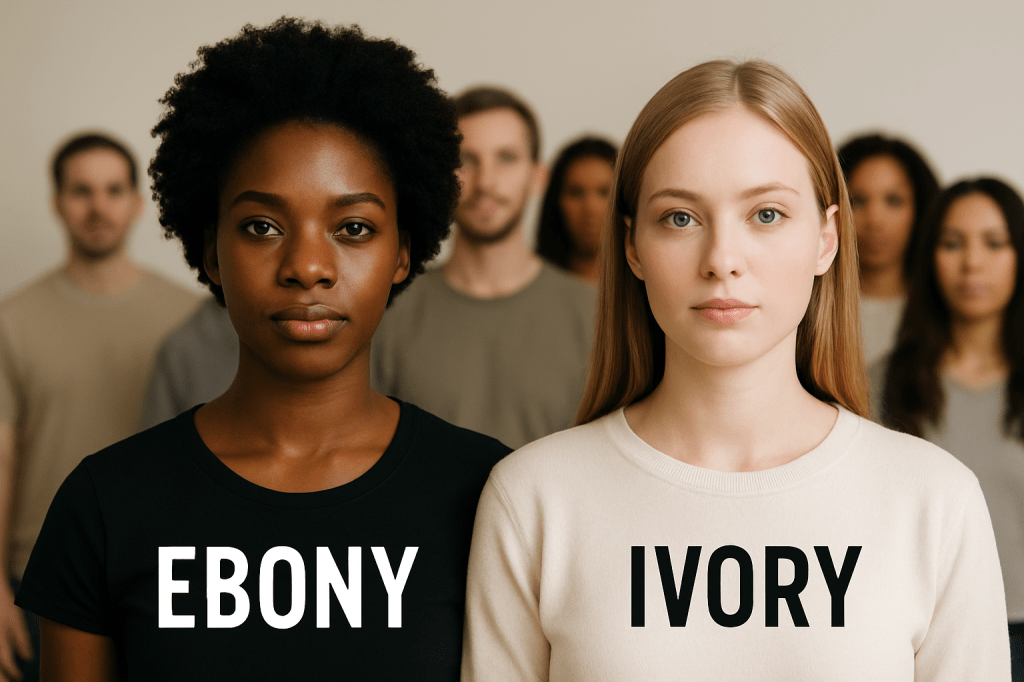
Ebony and Ivory: Two Shades, One Standard of Beauty.

From the dawn of civilization, beauty has been both a mirror and a weapon—reflecting ideals shaped by power and privilege, and wielded to define worth within social hierarchies. Within the globalized gaze of modernity, the politics of skin color continue to influence how femininity and desirability are perceived, especially among women of African descent. The notion of “Ebony and Ivory” evokes more than just color; it symbolizes the ongoing dialogue between light and dark, between acceptance and exclusion, and between the internalized and externalized standards of beauty that shape identity (hooks, 1992).

The idea of “two shades, one standard” captures the paradox of colorism: the simultaneous elevation and devaluation of Blackness within the same racial group. While “ivory” tones have historically been exalted as closer to Western ideals, “ebony” skin has often been marginalized, caricatured, or fetishized. Both ends of the spectrum, however, are measured against the same Eurocentric barometer that privileges whiteness as the ultimate aesthetic reference (Hunter, 2005).

This phenomenon, deeply rooted in colonialism, reveals how beauty became a tool of control. During the transatlantic slave trade, lighter-skinned enslaved individuals were often granted domestic positions and social proximity to white power structures, breeding intra-racial hierarchies that persist today. These legacies still echo in media representation, where lighter skin is frequently coded as “refined,” while darker tones are portrayed as “exotic” or “primitive” (Craig, 2006).

For many women of color, navigating these coded perceptions can be exhausting. The “brown girl dilemma” emerges when one feels too dark to be celebrated and too light to be considered authentically Black. This liminal existence is both a burden and a revelation—proof that beauty, as defined by Western constructs, remains an unattainable illusion that fractures rather than unites.

Beauty standards, much like colonial borders, were imposed rather than chosen. From the powdered faces of the Victorian era to the filtered glow of Instagram, the valuation of lightness has remained a constant aesthetic undercurrent. Yet, even within African and Afro-diasporic communities, this colonial inheritance continues to dictate preferences in partners, media icons, and even professional opportunities (Glenn, 2008).

In popular culture, colorism is often masked by phrases like “preference” or “type.” However, these preferences are rarely organic—they are sociologically constructed through centuries of imagery that equate lightness with purity and success, and darkness with defiance and struggle. The entertainment industry’s casting choices often reinforce these biases, rewarding lighter skin with visibility while relegating darker complexions to supporting or stereotypical roles (Russell, Wilson, & Hall, 2013).

This bias extends beyond film and television. In the global beauty market, skin-lightening creams generate billions annually, a grim testament to the internalization of Eurocentric ideals (Glenn, 2008). The psychological effects of such products are profound, suggesting that beauty is not only skin-deep but soul-deep, affecting one’s perception of self-worth and belonging.

For Black women, beauty is an act of survival. To adorn oneself becomes an assertion of existence in a world that often demands invisibility. From the regal hairstyles of precolonial Africa to the natural hair movement, Black women have continuously redefined and reclaimed their beauty on their own terms (Byrd & Tharps, 2014).

Yet, this reclamation is not without struggle. Within the Black community itself, hierarchies persist. The glorification of lighter women as more “marriageable” or “acceptable” continues to fracture solidarity. It is an unspoken inheritance of slavery’s psychological residue, perpetuated by both men and women who unconsciously valorize proximity to whiteness.

The darker-skinned woman often bears the weight of invisibility and hypervisibility simultaneously—ignored in spaces of admiration, yet scrutinized as the embodiment of resistance or rebellion. This double-bind mirrors W.E.B. Du Bois’ concept of “double consciousness,” wherein one is forced to see oneself through the lens of a world that refuses full recognition (Du Bois, 1903).

Light-skinned women, conversely, navigate their own complexities. While society may privilege them aesthetically, they are often accused of benefiting from colorism or being “not Black enough.” Thus, both ebony and ivory tones bear distinct forms of cultural alienation, tied together by an oppressive standard neither created (Monk, 2014).

In this context, beauty becomes not celebration but negotiation. Every compliment, every criticism, every casting call, and every social media post reinforces the invisible hierarchy of shade. The struggle is not between dark and light, but against the system that pits them against each other.

Media representation plays a critical role in dismantling or reinforcing these divides. When dark-skinned actresses like Lupita Nyong’o or Viola Davis are celebrated, it signals progress—but also exposes how rare such representation remains. Likewise, the inclusion of mixed-race models in campaigns may appear inclusive, yet often centers features still aligned with Eurocentric beauty (Tate, 2009).

To heal from this color divide, we must first acknowledge that beauty is not a monolith. It is plural, diverse, and spiritually rooted. In the biblical sense, humanity was created “in the image of God” (Genesis 1:27, KJV), meaning all shades reflect divine artistry. The rejection of any hue is, therefore, a rejection of the Creator’s design.

Moreover, Proverbs 31:30 reminds us that “favor is deceitful, and beauty is vain: but a woman that feareth the Lord, she shall be praised.” This verse redirects the gaze from the external to the eternal, urging women to seek validation not from comparison but from divine purpose.

Ebony and ivory are not opposites but complements, each contributing to the symphony of creation. Just as piano keys of contrasting colors produce harmony, so too can diverse complexions coexist in mutual admiration and respect. The beauty of one does not diminish the beauty of the other; together, they reveal the fullness of God’s palette.

True beauty transcends complexion—it emanates from character, compassion, and conviction. In a world obsessed with appearances, spiritual and cultural consciousness must redefine the standard. Beauty should not divide but dignify, not exclude but exalt.

To love one’s shade is to reclaim agency over identity. When Black women, in all their hues, embrace their reflection without apology, they dismantle centuries of aesthetic oppression. “Ebony and Ivory” then becomes more than a contrast—it becomes a covenant of self-acceptance and collective healing.

As we move forward, let beauty be measured not by shade but by soul. For when light and dark come together, they create balance, harmony, and wholeness—the true reflection of divine beauty.


References

Byrd, A. D., & Tharps, L. L. (2014). Hair Story: Untangling the Roots of Black Hair in America. St. Martin’s Press.
Craig, M. L. (2006). Race, beauty, and the tangled knot of a guilty pleasure. Feminist Theory, 7(2), 159–177.
Du Bois, W. E. B. (1903). The Souls of Black Folk. Chicago: A.C. McClurg.
Glenn, E. N. (2008). Yearning for lightness: Transnational circuits in the marketing and consumption of skin lighteners. Gender & Society, 22(3), 281–302.
hooks, b. (1992). Black Looks: Race and Representation. South End Press.
Hunter, M. L. (2005). Race, gender, and the politics of skin tone. Routledge.
Monk, E. P. (2014). Skin tone stratification among Black Americans, 2001–2003. Social Psychology Quarterly, 77(4), 360–379.
Russell, K., Wilson, M., & Hall, R. (2013). The Color Complex (Revised): The Politics of Skin Color Among African Americans. Anchor.
Tate, S. A. (2009). Black Beauty: Aesthetics, Stylization, Politics. Ashgate Publishing.
The Holy Bible, King James Version (KJV). (1611).

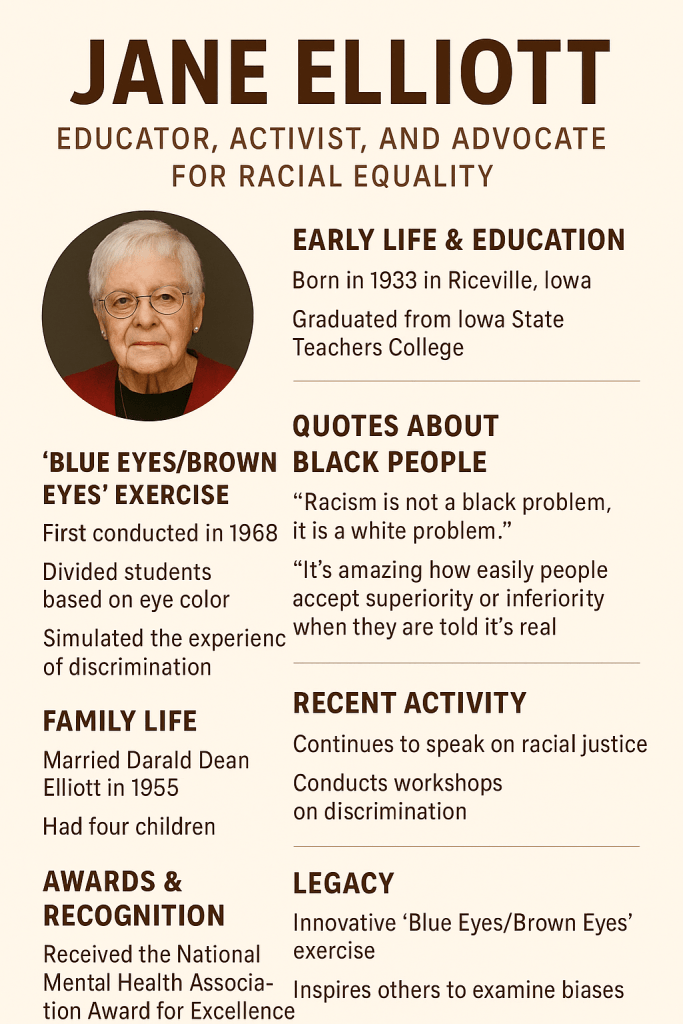
Jane Elliott: Educator, Activist, and Advocate for Racial Equality.

Elliott has spoken candidly about race and prejudice, emphasizing the importance of awareness and accountability. Two notable quotes include:

We don’t know anything about racism. We’ve never experienced it. If words can make a difference in your life for seven minutes, how would it affect you if you heard this every day of your life?”
— Jane Elliott BrainyQuote

“Racism is a learned affliction, and anything that is learned can be unlearned.”
— Jane Elliott A-Z Quotes

Jane Elliott is a prominent American educator and anti-racism activist, renowned for her innovative approach to teaching about prejudice and discrimination. Her most notable contribution is the “Blue Eyes/Brown Eyes” exercise, which she first conducted with her third-grade class in 1968, the day after the assassination of Dr. Martin Luther King Jr. This exercise aimed to simulate the experience of discrimination by dividing students based on eye color and assigning them arbitrary privileges and disadvantages accordingly. The profound impact of this exercise has led to its widespread adoption in various educational and corporate settings.


Early Life and Education

Born Jane Jennison on November 30, 1933, in Riceville, Iowa, she was the fourth of several children in her family. After graduating from high school in 1952, Elliott attended the Iowa State Teachers College (now the University of Northern Iowa), where she obtained an emergency elementary teaching certificate in five quarters. In 1953, she began teaching in a one-room school in Randall, Iowa, marking the start of her long career in education.


The “Blue Eyes/Brown Eyes” Exercise

In 1968, following Dr. King’s assassination, Elliott sought to teach her all-white, small-town students about the realities of discrimination. She divided the class into two groups based on eye color, assigning privileges to one group and disadvantages to the other. The exercise demonstrated how quickly individuals could internalize superiority or inferiority based on arbitrary characteristics, providing a powerful lesson on the mechanisms of prejudice. The exercise was documented in the 1970 film The Eye of the Storm and revisited in the 1985 PBS special A Class Divided.


Transition to Full-Time Activism

The success and impact of the “Blue Eyes/Brown Eyes” exercise led Elliott to leave her teaching position and pursue a career as a full-time speaker and educator on issues of race and discrimination. She has since conducted the exercise and lectured on its effects worldwide, including with college students, as seen in the 2001 documentary The Angry Eye.


Family Life

Elliott married Darald Dean Elliott in 1955. Together, they had four children. Darald Dean Elliott passed away in 2013. Elliott’s family life has been marked by her commitment to social justice and her role as a mother and educator.


Awards and Recognition

Throughout her career, Elliott has received numerous accolades for her work in education and anti-racism activism. She was honored with the National Mental Health Association Award for Excellence in Education. Her innovative approach to teaching about discrimination has been recognized globally, and she continues to be a sought-after speaker and trainer.


Advocacy for Racial Equality

Elliott’s work extends beyond the classroom. She has been an outspoken advocate for racial equality, challenging individuals and institutions to confront and address systemic racism. Her advocacy includes speaking engagements, workshops, and media appearances aimed at raising awareness and promoting change.


Public Speaking and Workshops

As a public speaker, Elliott has addressed a wide range of audiences, including educators, students, corporate leaders, and community groups. Her workshops often involve participatory exercises designed to help individuals experience and reflect on the impact of discrimination. These sessions are intended to foster empathy and inspire action toward greater inclusivity and equity.


Media Appearances

Elliott’s work has been featured in various media outlets, including documentaries, interviews, and news programs. Her appearances have helped to bring the conversation about race and discrimination into the public eye, reaching audiences beyond those who attend her workshops and lectures.


Philosophy on Race and Discrimination

Elliott’s philosophy centers on the idea that racism is a learned behavior that can be unlearned through education and awareness. She emphasizes the importance of confronting uncomfortable truths and encourages individuals to take responsibility for their actions and beliefs.


Critiques and Controversies

While Elliott’s methods have been widely praised, they have also faced criticism. Some argue that the “Blue Eyes/Brown Eyes” exercise can be emotionally distressing for participants. Elliott acknowledges these concerns but maintains that the discomfort experienced is necessary for individuals to understand the pain caused by discrimination.


Legacy and Impact

Elliott’s legacy is evident in the continued use of her “Blue Eyes/Brown Eyes” exercise in educational settings around the world. Her work has inspired countless individuals to examine their own biases and take action against racism. She remains a prominent figure in the fight for racial equality. In recent years, Elliott has continued her advocacy through speaking engagements and workshops. She remains active in promoting racial justice and educating others about the realities of discrimination. Reflecting on her career, Elliott expresses a deep commitment to her mission of combating racism. She views her work as a lifelong endeavor and remains dedicated to making a difference in the lives of others.


Conclusion

Jane Elliott’s contributions to the field of anti-racism education have had a lasting impact. Through her innovative exercises, public speaking, and unwavering commitment to social justice, she has challenged individuals and institutions to confront and address racism. Her work continues to inspire and educate, fostering a more inclusive and equitable society.


References

“Jane Elliott.” Wikipedia, https://en.wikipedia.org/wiki/Jane_Elliott

“The Eye of the Storm.” Wikipedia, https://en.wikipedia.org/wiki/The_Eye_of_the_Storm_(1970_film)

“A Class Divided.” Wikipedia, https://en.wikipedia.org/wiki/A_Class_Divided

“Jane Elliott.” IMDb, https://www.imdb.com/name/nm0254486/bio/

“From racism to one race: the Jane Elliott story.” Orato World Media, https://orato.world/2021/07/12/from-racism-to-one-race-the-jane-elliott-story/

“Jane Elliott’s Message To Black Women.” YouTube, https://www.youtube.com/watch?v=pAoLU9btfKU

Psychological and Emotional Depths of Racism, Colorism, and Lookism.

Photo by Ali Drabo on Pexels.com

Racism, colorism, and lookism represent a triad of psychological violence that shapes human experience, distorting both identity and emotional well-being. These constructs intertwine to create hierarchies of worth rooted in superficial attributes—skin color, facial symmetry, and physical appearance—while leaving lasting scars on the psyche of those marginalized by them. Their effects extend far beyond social exclusion; they penetrate the self-concept, dismantling the foundations of self-esteem and belonging.

Racism is not merely an external act of discrimination—it is an internalized poison that teaches individuals to view themselves through the eyes of their oppressors. When a person of African descent absorbs racist messages about inferiority or hyper-visibility, a split occurs between their authentic self and their socially imposed identity. This psychological rupture, described by W.E.B. Du Bois (1903) as “double consciousness,” forces Black individuals to exist between two conflicting perceptions: who they truly are and how they are seen.

Colorism deepens this fracture by introducing an internal hierarchy within racial groups, privileging lighter skin as more beautiful, intelligent, or desirable. Rooted in colonial history, colorism functions as an inherited trauma that reinforces Eurocentric standards of worth. Studies have shown that darker-skinned individuals face harsher judgments in employment, education, and romantic desirability (Hunter, 2007). This creates an invisible caste system within the same racial identity, perpetuating cycles of low self-esteem and division.

The emotional consequences of colorism are profound, particularly for women. Dark-skinned women are often depicted as less feminine or less worthy of love, a stereotype perpetuated by media and societal norms. The absence of representation or the presence of negative portrayals leads to what psychologists term “internalized colorism”—a form of self-loathing or constant comparison to lighter peers. This condition manifests in depression, anxiety, and body dysmorphia, echoing generations of colonial degradation.

Men, too, are not immune to this system of valuation. In a world where light skin and European features are exalted, darker-skinned men are frequently stereotyped as aggressive or undesirable unless they attain wealth or fame. This conditional acceptance feeds into what scholars call “compensatory masculinity,” where self-worth becomes tied to external achievements rather than intrinsic identity (Majors & Billson, 1992). The psychological toll is heavy, fostering performance-based validation instead of authentic self-acceptance.

Lookism—the discrimination based on physical appearance—intersects with both racism and colorism, reinforcing social hierarchies of attractiveness that favor Eurocentric beauty ideals. The psychological effects of lookism can be as damaging as racial prejudice, leading to social anxiety, isolation, and chronic insecurity. Individuals who deviate from mainstream beauty standards often develop what psychologists refer to as “appearance-based self-worth,” where self-esteem fluctuates based on perceived attractiveness.

Racism, colorism, and lookism collectively weaponize the human gaze. The eyes of others become a source of judgment and trauma, transforming the act of being seen into an emotional burden. Frantz Fanon (1952) described this phenomenon in Black Skin, White Masks, recounting how the colonial gaze reduces the Black body to an object of otherness. Such dehumanization fractures the self, replacing the joy of identity with the anxiety of perception.

The family, often a place of refuge, can also become the site where these hierarchies are reinforced. Generations of internalized color preference lead parents to praise lighter children or to discourage darker-skinned ones from embracing their natural features. This subtle form of intra-racial discrimination plants seeds of insecurity early in life. Over time, these messages crystallize into adult self-doubt and relational struggles, perpetuating a cycle of self-denial.

In the context of love and relationships, colorism and lookism operate as silent dictators of desirability. Studies show that both men and women subconsciously associate lighter skin and Eurocentric features with higher social status and compatibility (Maddox & Gray, 2002). For darker individuals, this creates a psychological dilemma—wanting to be loved authentically yet fearing rejection for something immutable.

The emotional depth of these issues cannot be understood without addressing media influence. Hollywood, fashion, and advertising have historically upheld narrow definitions of beauty, centering whiteness as the ideal. Even when diversity is celebrated, it is often curated within acceptable limits—favoring lighter tones, looser curls, and symmetrical features. This reinforces the narrative that true beauty requires proximity to whiteness.

Social media, though often praised for democratizing visibility, has amplified lookism. Platforms that reward filtered perfection encourage constant comparison and digital self-surveillance. The curated self replaces the authentic self, and validation becomes addictive. For Black and brown users, the algorithm often mirrors historical biases—prioritizing lighter-skinned influencers or Eurocentric aesthetics.

Psychologically, this environment breeds what some researchers term “mirror trauma”—a form of emotional distress that arises from seeing distorted versions of oneself reflected in culture and technology. The self becomes fragmented between the reality of one’s body and the idealized digital fantasy that gains approval. Over time, this can lead to emotional numbness, perfectionism, and identity confusion.

The intersection of racism, colorism, and lookism also shapes social mobility. Those who visually conform to beauty norms often experience what sociologists call “aesthetic privilege.” This unearned advantage affects job opportunities, income levels, and even criminal sentencing outcomes. Studies reveal that lighter-skinned Black individuals are more likely to receive lenient treatment in the justice system (Viglione, 2018). Beauty thus becomes currency—a silent economy of worth rooted in colonial logic.

In educational settings, these biases shape teacher expectations and peer interactions. Research indicates that darker-skinned students are disciplined more harshly and perceived as less capable, even when their performance matches that of their lighter peers. These early experiences internalize inferiority, breeding self-doubt and academic disengagement (Hannon et al., 2013).

From a psychological standpoint, the internalization of beauty hierarchies functions as a form of self-surveillance—a mental colonization where individuals police their own features. This creates what bell hooks (1992) described as “aesthetic trauma,” where Black individuals struggle to see themselves as beautiful outside of white validation. Healing from this requires unlearning centuries of visual propaganda.

Spiritually, the damage runs deeper still. Many who grow up under the shadow of colorism question their divine worth. They subconsciously associate lighter skin with purity or godliness, reflecting how colonial religion once depicted holiness through whiteness. Reclaiming one’s spiritual identity, therefore, becomes an act of resistance—seeing oneself as made in the image of the Creator, not the colonizer.

Healing from these intertwined oppressions requires collective re-education. Communities must confront how they perpetuate colorist and lookist narratives through jokes, preferences, or casting choices. Recognizing these patterns allows for intentional change, transforming inherited bias into self-awareness.

Therapeutically, interventions must address both the individual and societal dimensions of appearance-based trauma. Cognitive-behavioral therapy can help reframe distorted beliefs about worth, while cultural therapy reconnects individuals to ancestral pride and historical truth. For many, embracing natural hair, melanin, or cultural fashion becomes a symbolic act of psychological liberation.

Emotionally, the journey toward self-acceptance involves mourning—grieving the years lost to self-hate, rejection, or invisibility. This grief process allows for rebirth, where identity is no longer contingent upon comparison but rooted in divine and cultural truth.

Art, literature, and music serve as tools of resistance. From Nina Simone’s defiant “To Be Young, Gifted and Black” to contemporary movements like #MelaninMagic, creative expression reclaims narrative control. These acts remind the world—and the self—that beauty is not a European export but a human inheritance.

The emotional healing of colorism and lookism requires a mirror reimagined—not one that distorts but one that reflects truth. Each shade, each feature, carries ancestral memory and divine intention. When individuals learn to see themselves as sacred art, the gaze of oppression loses power.

Ultimately, the psychological liberation from racism, colorism, and lookism is both personal and collective. It demands that we dismantle the systems that define beauty as hierarchy and worth as appearance. True freedom begins not when others affirm us, but when we affirm ourselves beyond their gaze.

References

Du Bois, W. E. B. (1903). The souls of Black folk. Chicago: A.C. McClurg.

Fanon, F. (1952). Black skin, white masks. Grove Press.

Hannon, L., Defina, R., & Bruch, S. (2013). The relationship between skin tone and school suspension for African Americans. Race and Social Problems, 5(4), 281–295.

hooks, b. (1992). Black looks: Race and representation. South End Press.

Hunter, M. (2007). The persistent problem of colorism: Skin tone, status, and inequality. Sociology Compass, 1(1), 237–254.

Majors, R., & Billson, J. M. (1992). Cool pose: The dilemmas of Black manhood in America. Lexington Books.

Maddox, K. B., & Gray, S. A. (2002). Cognitive representations of Black Americans: Reexploring the role of skin tone. Personality and Social Psychology Bulletin, 28(2), 250–259.

Viglione, J. (2018). The impact of skin tone on the criminal justice process. Race and Justice, 8(2), 175–200.

Dilemma: Hate Crimes

A Scholarly Examination of Systemic Violence and Racial Terror

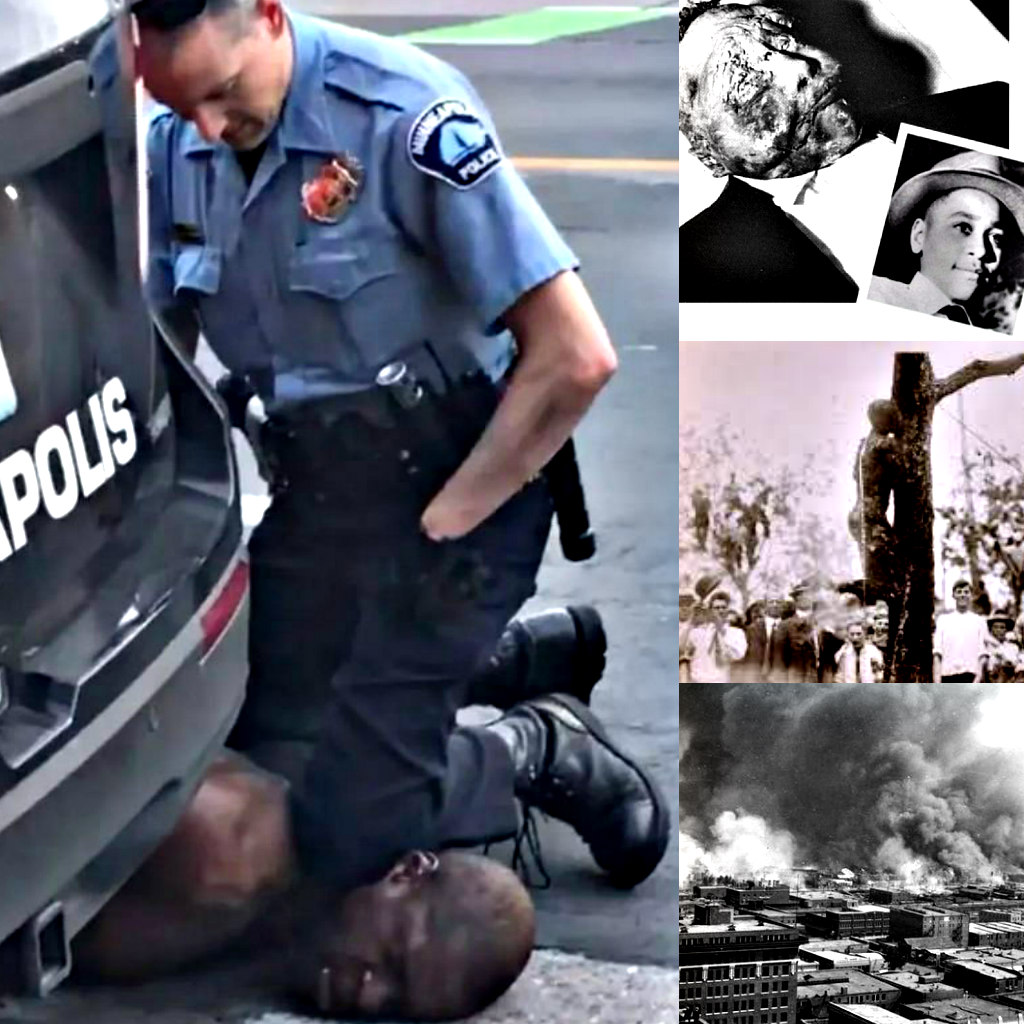
These photographs are the property of their respective owners. No copyright infringement intended.

The history of Black people in America is tragically punctuated by acts of racial terror, lynching, and systemic injustice. Hate crimes against African Americans have not only taken individual lives but also reinforced centuries of inequality and fear. This essay highlights ten of the most significant hate crimes in American history, revealing a consistent pattern of racialized violence that continues to reverberate in the present day.

The lynching of Emmett Till in 1955 stands as one of the most notorious hate crimes in U.S. history. At only fourteen years old, Till was brutally murdered in Mississippi for allegedly whistling at a white woman. His mutilated body, displayed publicly by his mother, Mamie Till-Mobley, exposed the horror of racial hatred to the world. The acquittal of his murderers by an all-white jury demonstrated the deep complicity of the justice system in racial violence (Whitfield, 1988).

The 1921 Tulsa Race Massacre remains one of the most devastating racial attacks on Black prosperity. White mobs destroyed the prosperous Greenwood District, known as “Black Wall Street,” killing an estimated 300 people and displacing thousands. The massacre wiped out decades of economic progress and reinforced the racial hierarchy that dominated early 20th-century America (Ellsworth, 1992).

Another brutal episode occurred during the Rosewood Massacre of 1923 in Florida, where a false accusation against a Black man led to the burning of an entire Black town. Dozens were killed, and survivors fled into swamps to escape white mobs. The incident was later recognized by the state of Florida, which awarded reparations to survivors decades later (D’Orso, 1996).

The Birmingham Church Bombing of 1963, which killed four young girls—Addie Mae Collins, Denise McNair, Carole Robertson, and Cynthia Wesley—shocked the conscience of the nation. The bombing, carried out by Ku Klux Klan members, occurred during the height of the civil rights movement and symbolized white resistance to desegregation and Black empowerment (McWhorter, 2001).

The murder of Medgar Evers in 1963, a civil rights leader and NAACP field secretary in Mississippi, represented another targeted act of racial terrorism. Evers was assassinated in his driveway for his efforts to secure voting rights and challenge segregation. His death galvanized the civil rights movement and intensified national awareness of southern racism (Marable, 1984).

The lynching of Jesse Washington in 1916 in Waco, Texas, was one of the most barbaric acts of mob violence ever recorded. A crowd of thousands gathered to watch as Washington was tortured and burned alive. The atrocity highlighted the normalization of public lynching as entertainment and a tool of white supremacy (Dray, 2002).

The Central Park Five case (1989) exposed how systemic racism can manifest within the criminal justice system without physical lynching. Five Black and Latino teenagers were wrongfully convicted of raping a white woman in Central Park. Media bias, coerced confessions, and racial profiling led to years of imprisonment before their exoneration. The case illustrated how racial fear could replace evidence in shaping narratives (Burns, 2011).

The Charleston Church Massacre in 2015 further proved that racial hatred still thrives in modern America. Dylann Roof entered the historic Emanuel AME Church and murdered nine Black worshipers during Bible study. This act of terror targeted a sacred space and echoed the domestic terrorism once carried out by the Ku Klux Klan (Thompson, 2016).

The murder of James Byrd Jr. in 1998 in Jasper, Texas, was a gruesome reminder that lynching never truly ended. Byrd was chained to the back of a truck and dragged for miles by three white supremacists. His death prompted national outrage and led to the 2009 Matthew Shepard and James Byrd Jr. Hate Crimes Prevention Act, expanding federal hate crime laws (Coleman, 2010).

The killing of George Floyd in 2020 reignited the global fight against racial injustice. Floyd’s death, captured on video as a white police officer knelt on his neck for over nine minutes, symbolized centuries of institutionalized violence against Black bodies. His dying words, “I can’t breathe,” became a rallying cry for the Black Lives Matter movement, leading to one of the largest civil rights protests in modern history (Clayton, 2020).

Each of these incidents illustrates how racism in America transcends time, geography, and form—manifesting in lynchings, massacres, police brutality, and judicial bias. The persistence of hate crimes underscores that racial violence is not an aberration but a fundamental feature of the American racial order.

Historically, these acts were often justified or ignored by law enforcement and political institutions, revealing systemic complicity. The failure to hold perpetrators accountable reinforced cycles of violence and mistrust within the Black community (Alexander, 2010).

Modern hate crimes, including the murders of Trayvon Martin, Ahmaud Arbery, and Breonna Taylor, continue this legacy. Each incident reflects a continuum of racialized fear and control rooted in America’s original sin—slavery and white supremacy (Taylor, 2016).

Sociologists argue that hate crimes against Black Americans are not merely individual acts but collective expressions of dominance intended to maintain racial hierarchy (Feagin, 2013). The violence communicates that Black progress and autonomy are met with punishment.

Media framing has often contributed to victim-blaming and the criminalization of Black identity. From Emmett Till to George Floyd, victims are frequently portrayed as threatening or non-compliant, a tactic that subtly absolves perpetrators (Entman & Rojecki, 2000).

Education about these events remains essential for dismantling ignorance and denial. Erasing or minimizing racial atrocities fosters a dangerous cultural amnesia that perpetuates prejudice (Loewen, 1995).

The psychological impact on Black Americans—manifested in generational trauma, mistrust of institutions, and internalized fear—continues to affect community health and cohesion (Comas-Díaz et al., 2019).

Despite this painful history, Black resilience endures. The collective response to racial violence has birthed justice movements, from civil rights to Black Lives Matter, reaffirming the enduring spirit of a people determined to live free and equal.

Ultimately, these ten hate crimes are not isolated tragedies but interconnected chapters in the story of America’s racial conscience. Understanding them demands not only remembrance but transformation—a collective moral reckoning that ensures such hatred never again defines the nation’s soul.


References

Alexander, M. (2010). The New Jim Crow: Mass Incarceration in the Age of Colorblindness. New Press.
Burns, S. (2011). The Central Park Five: The Untold Story Behind One of New York City’s Most Infamous Crimes. Knopf.
Clayton, J. (2020). George Floyd and the Rebirth of the Movement for Black Lives. Journal of Race and Social Justice, 5(2), 45–58.
Coleman, W. (2010). Hate Crimes in America: James Byrd Jr. and Beyond. Oxford University Press.
Comas-Díaz, L., Hall, G. N., & Neville, H. A. (2019). Racial trauma: Theory, research, and healing. American Psychologist, 74(1), 1–12.
D’Orso, M. (1996). Like Judgment Day: The Ruin and Redemption of a Town Called Rosewood. Perennial.
Dray, P. (2002). At the Hands of Persons Unknown: The Lynching of Black America. Random House.
Ellsworth, S. (1992). Death in a Promised Land: The Tulsa Race Riot of 1921. LSU Press.
Entman, R. M., & Rojecki, A. (2000). The Black Image in the White Mind: Media and Race in America. University of Chicago Press.
Feagin, J. R. (2013). Racist America: Roots, Current Realities, and Future Reparations. Routledge.
Loewen, J. W. (1995). Lies My Teacher Told Me: Everything Your American History Textbook Got Wrong. New Press.
Marable, M. (1984). Race, Reform, and Rebellion: The Second Reconstruction in Black America. University Press of Mississippi.
McWhorter, D. (2001). Carry Me Home: Birmingham, Alabama, the Climactic Battle of the Civil Rights Revolution. Simon & Schuster.
Taylor, K.-Y. (2016). From #BlackLivesMatter to Black Liberation. Haymarket Books.
Thompson, E. (2016). Charleston shooting: White supremacy, religion, and the politics of forgiveness. Journal of American Culture, 39(4), 385–392.
Whitfield, S. J. (1988). A Death in the Delta: The Story of Emmett Till. Johns Hopkins University Press.

ChatGPT can make mistakes. Check important info.

The Male Files: Black Men of the Past, History, and Values.

The legacy of Black men throughout history is a chronicle of courage, intellect, and moral strength. Too often, mainstream narratives reduce their contributions to fragments—overlooking the deep values that guided their endurance and brilliance. From the kingdoms of Africa to the modern struggles of identity in America, the Black man has been a central figure in the construction of civilization and the preservation of humanity’s conscience. His story is not just one of survival but of purpose, rooted in ancestral wisdom and spiritual discipline.

The image of the Black man before colonialism was one of leadership and sacred duty. In empires such as Mali, Songhai, and Kemet (Egypt), men were not only warriors and rulers but also philosophers, astronomers, and spiritual guides. Their sense of manhood was inseparable from service to community and reverence for the divine. Mansa Musa of Mali, for instance, exemplified how wealth and faith could coexist under moral responsibility, making him one of history’s most revered kings (Gomez, 1998).

Colonialism, however, disrupted this equilibrium. European imperialists imposed false hierarchies that redefined the African man as primitive, stripping him of dignity and rewriting his identity through the lens of conquest. The transatlantic slave trade transformed men once viewed as protectors and visionaries into property. Yet, even in bondage, the enslaved man retained an inner compass of values—courage, faith, and brotherhood—that sustained his humanity against systematic dehumanization (Franklin & Moss, 2000).

Black men of the antebellum era carried an unspoken theology of resistance. Their faith was both shield and sword, as seen in the spirituals sung under the stars and the coded messages of liberation woven into song. The story of men like Denmark Vesey and Nat Turner reflects the moral paradox of faith and rebellion—where violence was not a lust for power but a cry for freedom born from divine conviction (Aptheker, 1943).

With emancipation came new challenges. The Reconstruction period presented opportunities for leadership and literacy, yet the rise of Jim Crow laws swiftly sought to crush these gains. Black men responded not by despair but by constructing values-based institutions—churches, schools, and fraternal orders—that instilled discipline and dignity. Leaders like Booker T. Washington and W. E. B. Du Bois embodied contrasting yet complementary visions of manhood: one rooted in practical labor and self-reliance, the other in intellectual excellence and cultural pride (Harlan, 1983).

Throughout the 20th century, the Black man became both the conscience and catalyst of social change. The Civil Rights era revealed men whose moral fortitude transcended fear. Martin Luther King Jr. wielded nonviolence as a weapon of divine justice, while Malcolm X called for self-defense and cultural awakening. Despite their differences, both shared the same masculine integrity—the conviction that manhood is not about dominance but discipline, not ego but service (Marable, 2011).

The strength of these men was not limited to their activism; it extended to their private lives as fathers, mentors, and builders. The Black father figure, though often attacked by policy and stereotype, has remained a vital symbol of stability and love. The presence of a guiding father or mentor—whether biological or spiritual—represents a foundational value in the Black male experience: accountability through legacy.

Black artistry has also served as a mirror of male evolution. Jazz, blues, and hip-hop became outlets for emotional expression in a world that often silenced the Black man’s voice. From Louis Armstrong’s trumpet to Kendrick Lamar’s lyrical introspection, these men have embodied vulnerability as strength, challenging toxic models of masculinity. Their art carries ethical messages of perseverance, faith, and cultural self-knowledge (Dyson, 2001).

The value system of the Black man has always been rooted in communal consciousness. In African and diasporic traditions, the concept of “Ubuntu”—I am because we are—captures the essence of his worldview. Manhood is measured not by isolation but by contribution. Even in the face of racism, this communal ethos has survived, inspiring social movements and mentorship programs that uphold integrity, responsibility, and respect as cornerstones of Black male identity.

In academia and philosophy, the Black man has reclaimed intellectual space once denied to him. Thinkers like Cornel West and Molefi Kete Asante have redefined masculinity through Afrocentric and moral frameworks, asserting that to be a man is to be morally awake. This intellectual tradition resists Western individualism by grounding value in collective elevation rather than competition (Asante, 2007).

Spiritually, the Black man’s faith remains one of his most defining values. The pulpit has long been his platform of leadership, where preachers like Richard Allen and T. D. Jakes have spoken truth to power. Even outside the church, his spiritual strength manifests in prayer, meditation, and ancestral reverence. The KJV Bible’s portrayal of righteous men—David, Joseph, Moses—resonates deeply within his cultural narrative, reinforcing the belief that godly character is the highest expression of manhood (Proverbs 20:7, KJV).

The challenges of modernity have not erased these values but tested them. Systemic racism, mass incarceration, and economic disenfranchisement continue to threaten the moral fabric of Black manhood. Yet, new generations of men are reclaiming purpose through mentorship, entrepreneurship, and fatherhood. The rebirth of the “modern griot”—the storyteller who teaches through wisdom—is proof that the value of knowledge endures.

Masculine values within the Black community emphasize balance—strength tempered with humility, courage coupled with compassion. The ideal man is both protector and nurturer, reflecting divine duality. His power is not to control but to sustain, his authority not to dominate but to serve. This ethical framework echoes the ancient African principle of Ma’at, representing truth, justice, and harmony (Karenga, 2004).

In examining historical figures like Frederick Douglass, we see a prototype of moral masculinity—an intellect sharpened by suffering, a leader shaped by conviction. His life embodies a recurring theme: that the Black man’s greatness lies not in what he possesses, but in what he perseveres through. The same can be said for countless unnamed men who labored, prayed, and built legacies under the weight of oppression.

Values such as loyalty, integrity, and faith are not abstract ideals for the Black man—they are survival mechanisms. To navigate a world that questions his humanity, he must cultivate inner peace and moral consistency. In every era, from slavery to the digital age, these values have anchored him, ensuring that his reflection in history’s mirror is not defined by pain alone, but by principle.

The psychological and emotional wellness of the Black man has become a vital modern conversation. Healing from generational trauma requires returning to ancestral values—brotherhood, spiritual grounding, and emotional intelligence. These are not signs of weakness but pathways to restoration. As Proverbs 27:17 teaches, “Iron sharpeneth iron; so a man sharpeneth the countenance of his friend.” Brotherhood remains a sacred practice of renewal.

Education has always been both shield and sword for the Black man. The pursuit of knowledge represents not assimilation but liberation—a means to reclaim narrative and redefine identity. The value of education, both formal and spiritual, transforms oppression into opportunity and silence into strategy.

As history continues to unfold, the story of Black men remains unfinished but unbroken. From ancient kings to modern visionaries, they are the living embodiment of endurance shaped by ethics. The “Male Files” of history reveal not just a pattern of survival, but a symphony of values—faith, resilience, honor, and love—that continue to define their collective soul.

In the mirror of time, the Black man sees more than scars—he sees structure. His reflection is not one of victimhood but vision, not despair but determination. The values that were carried his ancestors now sustain his sons. The beauty of his story is not only in his strength, but in the moral code that gives that strength purpose.


References

Aptheker, H. (1943). American Negro slave revolts. Columbia University Press.
Asante, M. K. (2007). Afrocentricity: The theory of social change. African American Images.
Dyson, M. E. (2001). Holler if you hear me: Searching for Tupac Shakur. Basic Civitas Books.
Franklin, J. H., & Moss, A. A. (2000). From slavery to freedom: A history of African Americans. McGraw-Hill.
Gomez, M. A. (1998). Exchanging our country marks: The transformation of African identities in the colonial and antebellum South. University of North Carolina Press.
Harlan, L. R. (1983). Booker T. Washington: The wizard of Tuskegee, 1901–1915. Oxford University Press.
Karenga, M. (2004). Maat, the moral ideal in ancient Egypt: A study in classical African ethics. Routledge.
Marable, M. (2011). Malcolm X: A life of reinvention. Viking.
The Holy Bible, King James Version. (1611/2017). King James Bible Online. https://www.kingjamesbibleonline.org/

Racial Caste Systems: The Architecture of Hierarchy and Human Division.

Throughout history, societies have constructed hierarchies that determine human worth, access, and opportunity. A racial caste system is one of the most enduring forms of social stratification—an arrangement where race determines an individual’s status, mobility, and humanity within a society. Rooted in power, these systems are not merely social constructs but political technologies designed to preserve dominance and justify inequality (Feagin, 2013).

In the United States, the racial caste system originated with the transatlantic slave trade. Africans were systematically dehumanized, defined legally as property, and positioned at the bottom of the social order. This structure created a rigid racial hierarchy that survived emancipation and evolved through segregation, mass incarceration, and economic disparity (Alexander, 2010).

The American racial caste system was not accidental but deliberate. It was engineered through laws such as the Virginia Slave Codes of 1705 and later solidified through Jim Crow legislation. These legal instruments established whiteness as a form of property and superiority, ensuring that freedom and rights were racially distributed (Harris, 1993).

Caste systems rely on ideology to sustain themselves. In America, white supremacy functioned as the central narrative that rationalized subjugation. Pseudoscientific racism, biblical distortions, and economic exploitation merged to construct a worldview that depicted Africans and their descendants as inferior, thus justifying their oppression (Fields & Fields, 2012).

Globally, racial caste systems have appeared in various forms. The Indian caste system, though based on purity and birth rather than race, parallels the racial hierarchy of the West in its systemic exclusion of the Dalits (“untouchables”). Similarly, the apartheid regime in South Africa created a codified racial order that privileged whites and oppressed Africans through political and economic control (Fredrickson, 1981).

In Latin America, colonial powers instituted the casta system, which ranked individuals by racial mixture—from pure-blooded Spaniards at the top to Indigenous and African peoples at the bottom. This system demonstrates how racial stratification was a global phenomenon rooted in European imperialism (Martínez, 2008).

The concept of a racial caste system in modern America was revived in contemporary discourse by Michelle Alexander’s The New Jim Crow (2010). She argues that mass incarceration functions as a new racial caste, disenfranchising Black men through criminalization, restricted employment, and civic exclusion. Though slavery and segregation are abolished, their logic persists in the criminal justice system.

Caste systems persist because they evolve with society. When one form of racial control becomes untenable, it is replaced by another—slavery gave way to segregation, segregation to redlining, and redlining to mass incarceration. Each transformation preserves hierarchy while maintaining the illusion of progress (Wilkerson, 2020).

Sociologists describe racial caste systems as “closed systems,” where mobility is nearly impossible. The barriers are both structural and psychological, reinforced by stereotypes, institutional bias, and intergenerational trauma. These systems teach both the oppressed and the privileged their “place” within the social order (Omi & Winant, 2014).

The psychological impact of racial caste systems cannot be overstated. Black and brown individuals internalize inferiority through constant exposure to racism, while dominant groups internalize superiority as cultural normalcy. This dual conditioning ensures the persistence of inequality even without overt enforcement (Fanon, 1952).

Education plays a central role in reinforcing or dismantling caste systems. Historically, Black Americans were denied literacy and access to higher education to prevent empowerment. Even today, educational inequity, biased testing, and underfunded schools perpetuate the old caste boundaries in subtler forms (Ladson-Billings, 2006).

Economics also undergirds the racial caste hierarchy. Wealth accumulation among white Americans is directly tied to centuries of land theft, free Black labor, and discriminatory housing policies. Economic inequality thus becomes a material expression of the racial caste system, sustaining privilege through capital inheritance (Rothstein, 2017).

Religion has been used both to justify and to resist racial caste systems. Slaveholders once cited scripture to defend bondage, while liberation theologians and civil rights leaders later used the same texts to challenge oppression. Theological interpretations have therefore mirrored the moral tensions within society’s caste structures (Cone, 1975).

Media representation contributes to the perpetuation of caste by shaping public perception. Stereotypical portrayals of Black criminality, Asian servitude, or Latino illegality reinforce cultural hierarchies that align with economic and political control (hooks, 1992). These narratives normalize subordination and invisibility for marginalized groups.

The persistence of racial caste systems in democratic societies exposes a contradiction between declared ideals and lived realities. Nations that claim liberty and equality often maintain invisible systems of exclusion, allowing structural racism to flourish under the guise of meritocracy and neutrality (Bonilla-Silva, 2014).

Breaking racial caste systems requires more than moral outrage—it demands institutional transformation. Policies addressing education, housing, healthcare, and criminal justice must confront the racialized roots of inequality, not merely its symptoms (Kendi, 2019).

Social movements have historically played a critical role in challenging caste structures. From abolitionists to civil rights activists and the modern Black Lives Matter movement, collective resistance has been the most effective counterforce to entrenched hierarchy. These struggles reveal that caste is maintained by compliance but undone by courage (Taylor, 2016).

Globally, the persistence of racial hierarchy shows that caste is not uniquely American. From Australia’s treatment of Aboriginal peoples to Europe’s anti-immigrant rhetoric, the global order still privileges whiteness as the dominant standard of humanity and civilization (Painter, 2010).

The modern concept of race was not a natural or scientific discovery—it was a social and political invention that emerged primarily during the Age of Exploration (15th–18th centuries). Its purpose was to justify European colonization, slavery, and the exploitation of non-European peoples.

Origins in Pseudo-Science and Colonialism

1. Early European Encounters (15th–16th centuries)
Before the transatlantic slave trade, people were classified mainly by nationality, religion, or social status—not by skin color. However, when European explorers like the Portuguese and Spanish began to explore Africa, Asia, and the Americas, they encountered physical and cultural differences they sought to explain and control.

2. Justifying Enslavement and Colonial Rule
As the Atlantic slave trade grew, European powers needed a moral and theological rationale to enslave millions of Africans and seize Indigenous lands. They began to argue that nonwhite peoples were “inferior” or “subhuman.” This was a man-made ideology, not a scientific fact.

3. The Role of Enlightenment Thinkers (17th–18th centuries)
Ironically, during the so-called “Age of Reason,” European philosophers and scientists began categorizing humans by skin color and appearance, using false “scientific” reasoning.

  • Carl Linnaeus (1735), a Swedish naturalist, classified humans into subspecies based on continent and color (e.g., Homo europaeus albus for Europeans and Homo afer niger for Africans).
  • Johann Friedrich Blumenbach (1779) introduced five racial categories (Caucasian, Mongolian, Ethiopian, American, and Malay). His use of “Caucasian” helped cement whiteness as the ideal standard of beauty and intelligence.
  • Georges-Louis Leclerc de Buffon and others claimed environmental factors shaped human differences, but their theories were later distorted into racial hierarchies.

4. Race as a Tool of Power
By the 18th and 19th centuries, race became embedded in law, science, and religion. European colonizers institutionalized racial differences through:

  • Slave codes in the Americas
  • Jim Crow laws in the United States
  • Casta systems in Latin America
  • Apartheid in South Africa

These systems legally and socially defined who was considered “white” or “nonwhite,” determining access to education, property, and freedom.

5. The Myth of Scientific Racism (19th century)
So-called scientists like Samuel Morton (craniometry) and Josiah Nott claimed that skull size and brain shape determined intelligence. Their findings, later proven false, were used to argue for white superiority. These theories justified slavery and segregation by presenting racism as “scientific truth.”

6. The Shift in the 20th Century
After World War II and the Holocaust, when racial ideologies led to genocide, anthropologists like Franz Boas and Ashley Montagu dismantled the biological concept of race. They proved that genetic differences among humans are too small to justify racial divisions—humans share over 99.9% of the same DNA.

7. Modern Understanding
Today, race is understood as a social construct, not a biological reality. It has real consequences—shaping identity, privilege, and oppression—but it is rooted in historical systems of control.

The concept of race was created by European thinkers and colonial powers between the 15th and 18th centuries as a tool to legitimize inequality, slavery, and empire. Over time, it evolved into a global system of social hierarchy, deeply influencing how societies perceive and treat one another.


Ultimately, the racial caste system is an architecture of power—designed, maintained, and justified through centuries of policy, ideology, and violence. To dismantle it requires not only equity in law but equality in humanity. The reconstruction of society demands recognition that no human being should be bound by the color of their skin, the shape of their face, or the history of their birth. The future of justice depends on the collective dismantling of the myths that sustain racial caste systems. When truth replaces denial and love replaces hierarchy, humanity will finally step beyond the shadow of its own divisions. Until then, the work of liberation remains unfinished, and the echoes of caste still whisper through the walls of every institution built upon its foundation.


References

Alexander, M. (2010). The new Jim Crow: Mass incarceration in the age of colorblindness. The New Press.
Bonilla-Silva, E. (2014). Racism without racists: Color-blind racism and the persistence of racial inequality in America. Rowman & Littlefield.
Cone, J. H. (1975). God of the oppressed. Orbis Books.
Fanon, F. (1952). Black skin, white masks. Grove Press.
Feagin, J. R. (2013). Systemic racism: A theory of oppression. Routledge.
Fields, K. E., & Fields, B. J. (2012). Racecraft: The soul of inequality in American life. Verso.
Fredrickson, G. M. (1981). White supremacy: A comparative study in American and South African history. Oxford University Press.
Harris, C. I. (1993). Whiteness as property. Harvard Law Review, 106(8), 1707–1791.
hooks, b. (1992). Black looks: Race and representation. South End Press.
Kendi, I. X. (2019). How to be an antiracist. One World.
Ladson-Billings, G. (2006). From the achievement gap to the education debt. Educational Researcher, 35(7), 3–12.
Martínez, M. E. (2008). Genealogical fictions: Limpieza de sangre, religion, and gender in colonial Mexico. Stanford University Press.
Omi, M., & Winant, H. (2014). Racial formation in the United States. Routledge.
Painter, N. I. (2010). The history of white people. W. W. Norton.
Rothstein, R. (2017). The color of law: A forgotten history of how our government segregated America. Liveright Publishing.
Taylor, K.-Y. (2016). From #BlackLivesMatter to Black liberation. Haymarket Books.
Wilkerson, I. (2020). Caste: The origins of our discontents. Random House.Fredrickson, G. M. (2002). Racism: A Short History. Princeton University Press.

Smedley, A., & Smedley, B. D. (2005). Race as biology is fiction, racism as a social problem is real. American Psychologist, 60(1), 16–26.

Gould, S. J. (1981). The Mismeasure of Man. W. W. Norton.

Fields, B. J., & Fields, K. (2012). Racecraft: The Soul of Inequality in American Life. Verso.

Painter, N. I. (2010). The History of White People. W. W. Norton.

Boas, F. (1940). Race, Language, and Culture. University of Chicago Press.

Types of Racism

Racism is not a singular phenomenon but a complex system of beliefs, policies, and practices that establish and maintain racial hierarchies. It operates on individual, institutional, and structural levels, shaping everything from identity formation to social mobility. Understanding the types of racism is critical for dismantling the deeply embedded inequities that continue to define societies around the world (Bonilla-Silva, 2014).

Individual racism occurs when a person’s beliefs, attitudes, or actions consciously or unconsciously perpetuate racial prejudice or discrimination. It is expressed through personal bias, stereotyping, and direct acts of hostility toward people of another race. Though often the most visible form of racism, it is only one layer of a much larger system (Tatum, 2017).

Interpersonal racism happens in day-to-day interactions, often disguised as microaggressions. These subtle acts—such as questioning a person’s intelligence or making assumptions about their background—communicate inferiority and reinforce racial hierarchies. The cumulative impact of such encounters can result in significant psychological harm (Sue et al., 2007).

Internalized racism occurs when individuals from marginalized racial groups adopt the negative beliefs or stereotypes perpetuated by dominant groups. This internal oppression manifests through self-doubt, assimilation, and the devaluation of one’s cultural heritage. It often results from centuries of colonization, media misrepresentation, and social exclusion (Pyke, 2010).

Institutional racism refers to policies and practices embedded within organizations—such as schools, corporations, or law enforcement—that produce unequal outcomes along racial lines. Even when not explicitly racist, these structures perpetuate disparities in employment, housing, education, and criminal justice (Carmichael & Hamilton, 1967).

Structural racism extends beyond individual institutions and reflects the historical accumulation of inequality across systems. It is the totality of social, economic, and political mechanisms that normalize racial disadvantage and privilege. Structural racism is both pervasive and self-reinforcing, making it one of the most difficult forms to dismantle (Gee & Ford, 2011).

Systemic racism operates as a comprehensive framework that upholds racial inequality in virtually every sphere of life. It is the “normalization and legitimization” of various dynamics—historical, cultural, and institutional—that routinely advantage white people while disadvantaging people of color (Feagin, 2013).

Cultural racism manifests through the promotion of one group’s norms, values, and aesthetics as the universal standard. This form of racism is deeply embedded in media, beauty ideals, education, and religion. It often leads to the marginalization of cultural expressions that do not align with dominant ideals (hooks, 1992).

Colorism—a byproduct of cultural and systemic racism—favors lighter skin tones over darker ones, even within the same racial group. This phenomenon originates from colonial hierarchies that equated proximity to whiteness with superiority and privilege. Colorism affects access to opportunities, social status, and self-worth (Hunter, 2007).

Environmental racism refers to the disproportionate exposure of marginalized racial communities to environmental hazards. Examples include toxic waste sites, polluted neighborhoods, and limited access to clean water and green spaces. This form of racism connects race directly to public health outcomes (Bullard, 2000).

Economic racism operates through inequitable labor systems, wage disparities, and barriers to financial mobility. The racial wealth gap in the United States, for instance, is not accidental but the result of centuries of discriminatory practices—from slavery and sharecropping to redlining and employment discrimination (Oliver & Shapiro, 2019).

Educational racism is evident in underfunded schools, biased curricula, and tracking systems that disadvantage students of color. These inequities reinforce generational poverty and limit access to higher education, perpetuating systemic disparities (Ladson-Billings, 2006).

Political racism manifests when laws, policies, or voting systems suppress the political power of racial minorities. Gerrymandering, voter ID laws, and disenfranchisement are tools historically used to limit Black and brown representation in governance (Anderson, 2016).

Medical racism exposes racial disparities in health care access, treatment, and outcomes. From the exploitation of enslaved Black bodies in early medical research to the ongoing neglect of pain reports by Black patients, racism remains a critical determinant of health inequality (Washington, 2006).

Linguistic racism operates through language hierarchies that stigmatize certain dialects or accents as “less educated” or “unprofessional.” This form of bias privileges white, Western speech norms and penalizes linguistic diversity within communities of color (Flores & Rosa, 2015).

Religious racism merges ethnocentrism with theological bias, often using religion to justify racial domination. Historically, Christianity was weaponized to validate slavery and colonization, presenting whiteness as divine and Blackness as cursed (Cone, 1969). The aftershocks of this manipulation still influence racialized theology today.

Spatial racism refers to the deliberate segregation of communities through housing policies and urban planning. Practices like redlining, restrictive covenants, and gentrification maintain racial boundaries, limiting access to resources and generational wealth (Rothstein, 2017).

Media racism perpetuates stereotypes that frame people of color as dangerous, inferior, or hypersexualized. Such portrayals shape public perception, influence policy, and justify violence. The absence of nuanced representation contributes to cultural erasure (Entman & Rojecki, 2001).

Colorblind racism is a contemporary form that denies the existence of racial inequality by asserting that race “no longer matters.” This ideology ignores systemic inequities and discourages meaningful discussions about race, ultimately maintaining the status quo (Bonilla-Silva, 2014).

Ultimately, racism manifests in diverse but interconnected ways—individual prejudice feeding institutional policy, cultural bias informing structural design. These interlocking forms ensure that racial inequality is both normalized and invisible to those who benefit from it. Understanding the many faces of racism is not an intellectual exercise but a moral imperative toward dismantling its hold on humanity.


References (APA 7th Edition)

Anderson, C. (2016). White rage: The unspoken truth of our racial divide. Bloomsbury.

Bonilla-Silva, E. (2014). Racism without racists: Color-blind racism and the persistence of racial inequality in America. Rowman & Littlefield.

Bullard, R. D. (2000). Dumping in Dixie: Race, class, and environmental quality. Westview Press.

Carmichael, S., & Hamilton, C. V. (1967). Black power: The politics of liberation. Vintage Books.

Cone, J. H. (1969). Black theology and Black power. Seabury Press.

Entman, R. M., & Rojecki, A. (2001). The Black image in the White mind: Media and race in America. University of Chicago Press.

Feagin, J. R. (2013). Systemic racism: A theory of oppression. Routledge.

Flores, N., & Rosa, J. (2015). Undoing appropriateness: Raciolinguistic ideologies and language diversity in education. Harvard Educational Review, 85(2), 149–171.

Gee, G. C., & Ford, C. L. (2011). Structural racism and health inequities. Du Bois Review, 8(1), 115–132.

hooks, b. (1992). Black looks: Race and representation. South End Press.

Hunter, M. (2007). The persistent problem of colorism: Skin tone, status, and inequality. Sociology Compass, 1(1), 237–254.

Ladson-Billings, G. (2006). From the achievement gap to the education debt. Educational Researcher, 35(7), 3–12.

Oliver, M. L., & Shapiro, T. M. (2019). Black wealth/White wealth: A new perspective on racial inequality. Routledge.

Pyke, K. D. (2010). What is internalized racial oppression and why don’t we study it? Sociological Perspectives, 53(4), 551–572.

Rothstein, R. (2017). The color of law: A forgotten history of how our government segregated America. Liveright Publishing.

Sue, D. W., Capodilupo, C. M., & Holder, A. M. B. (2007). Racial microaggressions in everyday life. American Psychologist, 62(4), 271–286.

Tatum, B. D. (2017). Why are all the Black kids sitting together in the cafeteria? Basic Books.

Washington, H. A. (2006). Medical apartheid: The dark history of medical experimentation on Black Americans from colonial times to the present. Doubleday.

ChatGPT can make mistakes. Check important info.

Pagan Holiday Series: The Celebration of Columbus Day – Unmasking the Truth Behind a Controversial Holiday

Columbus Day, celebrated on the second Monday in October in the United States, has long been promoted as a day to honor Christopher Columbus, the Italian explorer credited with “discovering” the Americas in 1492. Yet, beneath this national holiday lies a dark and painful legacy of colonization, genocide, and enslavement. To understand why many now question or reject the celebration of Columbus Day, we must revisit history through the eyes of the oppressed — the Indigenous peoples of the Americas and the enslaved Africans who suffered under European conquest.

Christopher Columbus, born in Genoa around 1451, was an ambitious navigator who sought a western sea route to Asia. Backed by Spain’s monarchs, Ferdinand and Isabella, his 1492 voyage was not a mission of peace or discovery, but one driven by greed, power, and imperial expansion. When Columbus landed in the Caribbean, he mistakenly believed he had reached the East Indies. He called the native people “Indians,” beginning a legacy of misnaming and misunderstanding that persists to this day.

Columbus’s arrival marked the beginning of a brutal system of colonization. The Taíno and Arawak peoples of Hispaniola (modern-day Haiti and the Dominican Republic) were among the first to encounter the Europeans. What followed was devastation. Columbus enslaved the Indigenous people, forced them to mine gold, and imposed cruel punishments on those who resisted. His regime was marked by torture, mutilation, and mass murder, documented even by his contemporaries (Zinn, 1980).

Within a few short decades, the Indigenous population of the Caribbean had been nearly wiped out through violence, disease, and forced labor. Columbus’s legacy was not one of discovery, but of destruction. His expeditions paved the way for centuries of European exploitation across the Americas, leading to the transatlantic slave trade that forcibly brought millions of Africans to the New World. Thus, both Native Americans and Africans suffered under systems of oppression rooted in Columbus’s so-called “discovery.”

Despite this horrific history, Columbus was later glorified as a national hero. The idea of celebrating him gained traction in the late 19th century, particularly among Italian-Americans who viewed him as a symbol of ethnic pride in a time of widespread discrimination. In 1937, President Franklin D. Roosevelt, under pressure from the Knights of Columbus (a Catholic fraternal organization), made Columbus Day a federal holiday. The decision was political, not moral — meant to unite Catholics and immigrants under a banner of patriotism.

However, this government-sanctioned glorification of Columbus ignored the historical atrocities committed under his rule. The myth of Columbus as a brave explorer who brought “civilization” to the New World perpetuated Eurocentric narratives that erased Indigenous voices and justified colonial domination. This narrative served to validate white supremacy, expansionism, and the exploitation of both land and people.

For African Americans, Columbus Day represents a celebration of the very system that enslaved and dehumanized their ancestors. The same European expansion that began with Columbus led directly to the transatlantic slave trade, the Middle Passage, and centuries of racial oppression. In this light, celebrating Columbus Day is akin to celebrating the foundations of systemic racism.

For Native Americans, the day symbolizes genocide and cultural annihilation. Entire civilizations were decimated as European powers claimed their lands, destroyed their spiritual systems, and imposed foreign rule. The diseases brought by European settlers wiped out millions, and survivors were forced into reservations centuries later. Columbus became the emblem of Indigenous suffering — not freedom or progress.

The modern push to replace Columbus Day with Indigenous Peoples’ Day represents a moral reckoning with this painful history. Indigenous activists, scholars, and allies have fought tirelessly to reclaim the narrative, emphasizing survival, resilience, and the truth about colonization. Cities and states across the U.S., including California, Minnesota, and New Mexico, have officially recognized Indigenous Peoples’ Day in place of Columbus Day.

The shift toward Indigenous Peoples’ Day reflects a growing awareness of historical injustice and a rejection of whitewashed history. It honors the first inhabitants of the Americas and acknowledges their enduring contributions to humanity, spirituality, and ecological wisdom. It also calls for repentance and reconciliation for the centuries of violence inflicted by European colonization.

Columbus’s voyages cannot be separated from their consequences — the destruction of Indigenous cultures, the theft of land, and the enslavement of Africans. His story symbolizes the birth of a global system of exploitation that shaped modern capitalism and racial hierarchies. Celebrating him, therefore, is not a tribute to exploration but a denial of historical truth.

Many historians now argue that Columbus should be remembered, not revered. His actions and their aftermath belong in the history books as a warning against the dangers of greed and ethnocentrism, not as a model of heroism. The celebration of Columbus Day perpetuates myths that distort the origins of the Americas and obscure the suffering of millions.

For Black people, the connection to Columbus’s legacy is direct and devastating. The European conquest he initiated laid the groundwork for the dehumanization of Africans, justified through false notions of racial superiority. It began a cycle of exploitation that continues to manifest in systemic inequalities today.

True historical education must include both the achievements and atrocities of the past. To celebrate Columbus without acknowledging the cost of his conquests is to dishonor those who perished because of them. It is to endorse the continued erasure of Black and Indigenous histories in favor of colonial pride.

The time has come for America to replace glorification with truth-telling. Recognizing Indigenous Peoples’ Day is not about erasing history — it is about correcting it. It is about lifting up the stories of those who were silenced and acknowledging that the “discovery” of America came at a horrific human price.

Ultimately, the celebration of Columbus Day reflects who society chooses to honor. Will we continue to idolize an oppressor, or will we honor the resilience of those who survived his legacy? The answer to that question defines not only our understanding of history but our commitment to justice and truth.


References (APA Style):
Zinn, H. (1980). A People’s History of the United States. Harper & Row.
Loewen, J. W. (1995). Lies My Teacher Told Me: Everything Your American History Textbook Got Wrong. The New Press.
Dunbar-Ortiz, R. (2014). An Indigenous Peoples’ History of the United States. Beacon Press.
Sale, K. (1990). The Conquest of Paradise: Christopher Columbus and the Columbian Legacy. Alfred A. Knopf.
Churchill, W. (1997). A Little Matter of Genocide: Holocaust and Denial in the Americas, 1492 to the Present. City Lights.