Category Archives: the brown boy dilemma

From Boys to Builders: The Responsibility of Manhood. #thebrownboydilemma

Photo by Ron Lach on Pexels.com

Manhood is more than a biological milestone; it is a journey of responsibility, character, and purposeful action. Transitioning from boyhood to manhood requires cultivating moral integrity, emotional intelligence, and the ability to contribute positively to family, community, and society. The measure of a man lies not in privilege or strength, but in accountability and leadership.

Historically, societies have defined manhood through rites of passage, labor, and civic contribution. In many African cultures, coming-of-age ceremonies marked the shift from boyhood to manhood, emphasizing courage, wisdom, and communal responsibility (Imam, 2015). These traditions underscored that manhood entails service and stewardship.

Faith plays a critical role in shaping responsible manhood. Biblical teachings encourage men to exemplify virtues such as integrity, diligence, and protection of the vulnerable. Proverbs 20:7 asserts, “The just man walketh in his integrity: his children are blessed after him” (KJV). Spiritual grounding equips men to make decisions rooted in principle rather than impulse.

Education and knowledge are foundational to manhood. A responsible man seeks to cultivate wisdom and skill, not only for personal advancement but for the betterment of his community. Learning equips men to lead effectively, mentor youth, and participate in society with discernment.

Emotional maturity is a cornerstone of responsibility. Boys often navigate socialization that discourages vulnerability, yet a man must develop the capacity for empathy, reflection, and self-regulation. Emotional intelligence enables men to manage relationships, resolve conflict, and provide guidance within families and communities.

Economic responsibility is an integral aspect of manhood. Men are often expected to provide for themselves and their dependents, building financial stability and intergenerational wealth. Responsible stewardship of resources demonstrates reliability and ensures that one’s household and community are supported (Graves, 2013).

Mentorship and legacy building are key duties of a man. By teaching younger generations, men transfer wisdom, skills, and ethical frameworks. Mentorship is not merely advice-giving; it involves modeling accountability, perseverance, and principled action, shaping future leaders.

Community engagement reflects a man’s broader responsibility. Acts of service, civic involvement, and advocacy demonstrate that manhood is relational and societal, not merely individual. Men who contribute to the welfare of their communities embody leadership through action rather than authority alone.

Resilience in adversity distinguishes boys from men. Life presents inevitable trials, and a responsible man responds with courage, integrity, and problem-solving. Facing challenges rather than avoiding them cultivates strength of character and earns respect across social and familial spheres.

Spiritual and moral leadership within the family is another crucial responsibility. Fathers and elder men guide children and young adults through modeling, instruction, and protection. The stability of families often reflects the integrity and commitment of male leaders.

Cultural narratives and media representations influence perceptions of manhood. Responsible manhood challenges stereotypes of aggression, irresponsibility, and dominance, offering alternative models based on character, ethical leadership, and service. Representation of positive masculinity reshapes expectations for boys growing into men.

Accountability and self-discipline are defining markers of maturity. A man must take ownership of actions, accept consequences, and strive to align behavior with ethical and spiritual principles. These traits foster trust, respect, and social cohesion, distinguishing boys from men.

Health and well-being are also responsibilities of manhood. Physical, mental, and emotional health enable men to fulfill familial and societal roles effectively. Neglect of well-being undermines capacity to lead, mentor, and contribute meaningfully.

Spiritual resilience supports ethical decision-making. Men grounded in faith or moral principle are better equipped to resist societal pressures that encourage dishonesty, exploitation, or neglect of duty. Integrity becomes both armor and compass in navigating the complexities of adulthood.

In conclusion, the journey from boyhood to manhood is defined by responsibility, accountability, and service. Men who embrace their roles as builders of families, communities, and legacies demonstrate that true masculinity is rooted in principle, character, and purposeful action. The transformation from boy to builder requires dedication, resilience, and unwavering commitment to ethical and spiritual growth.


References

Graves, J. (2013). Black men in America: Health, family, and social policy. Routledge.

Hunter, M. (2005). Race, gender, and the development of African American masculinity. In M. Hunter & J. Davis (Eds.), African American family life: Ecological and cultural diversity (pp. 45–62). Sage Publications.

Imam, A. (2015). African rites of passage: Cultural significance and social impact. African Studies Review, 58(2), 89–107. https://doi.org/10.1017/asr.2015.21

Proverbs 20:7 (King James Bible). (n.d.). King James Bible Online. https://www.kingjamesbibleonline.org

Connell, R. W. (2005). Masculinities (2nd ed.). University of California Press.

Zimbardo, P. G., & Coulombe, N. D. (2015). Man interrupted: Why young men are struggling and what we can do about it. Conari Press.

From Chains to Challenges: The Black Journey from Slavery to Modern Struggle.

The story of Black people in the Americas is a long arc of suffering, survival, and strength. Slavery was one of the most devastating atrocities in human history, yet it became the soil out of which resilience, culture, and faith blossomed. To understand where we stand today, we must revisit the beginning—how slavery started, how it ended, and what challenges remain in the present day. This narrative is not merely about the past; it is about the enduring struggle for freedom, dignity, and equality.

Black History Timeline: From Slavery to Modern Struggle

  • 1619 – First enslaved Africans arrive in Virginia, marking the beginning of chattel slavery in the English colonies.
  • 1863 – President Abraham Lincoln issues the Emancipation Proclamation, declaring enslaved people in Confederate states free.
  • 1865 – The 13th Amendment is ratified, officially abolishing slavery in the United States.
  • 1868 – The 14th Amendment grants citizenship and equal protection under the law to formerly enslaved people.
  • 1870 – The 15th Amendment grants Black men the right to vote.
  • 1896Plessy v. Ferguson Supreme Court decision establishes “separate but equal,” legalizing racial segregation.
  • 1954Brown v. Board of Education Supreme Court decision declares school segregation unconstitutional.
  • 1964 – The Civil Rights Act is passed, outlawing discrimination based on race, color, religion, sex, or national origin.
  • 1965 – The Voting Rights Act is signed into law, protecting Black Americans’ right to vote.
  • 2008 – Barack Obama is elected the first Black President of the United States.
  • 2013 – The Black Lives Matter movement is founded in response to police violence and systemic racism.
  • 2020 – Global protests erupt after the murder of George Floyd, sparking renewed calls for racial justice worldwide.

The transatlantic slave trade began in the 15th century when European powers discovered the economic potential of African labor for their colonies in the Americas. Enslaved Africans were kidnapped, sold, and shipped under brutal conditions across the Atlantic in what became known as the Middle Passage. Millions perished along the way, their bodies thrown overboard. Those who survived were forced into chattel slavery, treated as property with no rights, and subjected to physical abuse, family separation, and cultural erasure (Smallwood, 2007).

Slavery in the United States was particularly harsh because it was racialized and hereditary. The legal system ensured that children born to enslaved mothers were automatically slaves, cementing generational bondage (Baptist, 2014). Plantations thrived on cotton, sugar, and tobacco, and the wealth of the American South—and much of the North—depended on unpaid African labor. This institution became so entrenched that it divided the nation politically, socially, and economically.

Resistance was always present. Enslaved people rebelled in overt and covert ways, from uprisings like Nat Turner’s rebellion to everyday acts of defiance such as breaking tools, escaping via the Underground Railroad, or maintaining African traditions in music and religion. These acts of resistance preserved Black humanity and spirit even in the face of dehumanization (Berlin, 2003).

The formal end of slavery in the United States came with the Civil War (1861–1865). President Abraham Lincoln’s Emancipation Proclamation in 1863 declared freedom for enslaved people in Confederate states, though true liberation came only with the Union victory and the ratification of the 13th Amendment in 1865. Yet freedom was only partial—many enslavers resisted, and newly freed people faced systemic violence and oppression (Foner, 2014).

Reconstruction (1865–1877) was a critical but short-lived moment of hope. Freedmen’s schools were established, Black men gained the right to vote, and several Black politicians were elected to office. However, white supremacist backlash soon reversed these gains through Black Codes, sharecropping systems, and domestic terrorism by groups such as the Ku Klux Klan. Reconstruction’s collapse ushered in the era of Jim Crow segregation (Litwack, 1998).

Jim Crow laws legally enforced racial segregation, keeping Black Americans in a second-class status for nearly a century. Public spaces, schools, and neighborhoods were divided, with Black people denied equal access to education, housing, and voting rights. Lynchings became a tool of terror, and entire communities were burned to the ground, as in Tulsa’s 1921 massacre (Gates, 2019). Despite this, Black Americans built their own thriving institutions, from HBCUs to churches that became pillars of community life.

The Civil Rights Movement of the 1950s and 1960s was a turning point. Leaders like Martin Luther King Jr., Rosa Parks, and Malcolm X challenged racial injustice through marches, boycotts, and powerful speeches. Landmark victories included the Brown v. Board of Education decision (1954), the Civil Rights Act (1964), and the Voting Rights Act (1965). These legal changes dismantled de jure segregation, though de facto inequalities persisted (Branch, 1988).

Key Figures Who Made a Difference

  • Abraham Lincoln – Issued the Emancipation Proclamation and pushed for the 13th Amendment to abolish slavery.
  • Frederick Douglass – Escaped slave, abolitionist, writer, and orator who advocated for freedom and equality.
  • Harriet Tubman – Led hundreds to freedom through the Underground Railroad, symbolizing courage and liberation.
  • Sojourner Truth – Abolitionist and women’s rights advocate, known for her “Ain’t I a Woman?” speech.
  • W.E.B. Du Bois – Scholar and co-founder of the NAACP, championed civil rights and Pan-African unity.
  • Marcus Garvey – Advocated Black pride, economic independence, and Pan-Africanism.
  • Martin Luther King Jr. – Leader of the Civil Rights Movement, preached nonviolent resistance and racial equality.
  • Malcolm X – Spokesman for Black empowerment and self-defense, encouraged pride in African heritage.
  • Rosa Parks – Sparked the Montgomery Bus Boycott by refusing to give up her seat, inspiring nationwide action.
  • Thurgood Marshall – First Black Supreme Court Justice, fought segregation through legal challenges.
  • Ida B. Wells – Journalist and anti-lynching crusader, raised awareness of racial terror.
  • Barack Obama – First Black President of the United States, symbolizing progress and representation.

After the Civil Rights era, there were significant advances: greater representation in politics, the election of mayors, governors, and, eventually, President Barack Obama. Economic opportunities slowly expanded, but wealth disparities, mass incarceration, and systemic racism remained. The War on Drugs disproportionately targeted Black communities, leading to generations of Black men being imprisoned and families being destabilized (Alexander, 2010).

In today’s world, slavery no longer wears chains but manifests economically and psychologically. Financial bondage can be seen in predatory lending, wage disparities, and a lack of generational wealth. Black households, on average, hold a fraction of the wealth of white households due to historical exclusion from homeownership programs like the GI Bill and redlining practices (Oliver & Shapiro, 2006).

One of the clearest examples of modern-day economic slavery is student debt. Black students are more likely to take on loans for college and graduate with higher debt burdens than their white counterparts, limiting their ability to buy homes, invest, and build wealth (Scott-Clayton & Li, 2016). Education, once seen as a tool of liberation, can trap graduates in decades of repayment, mirroring the cycle of sharecropping debt from the Reconstruction era.

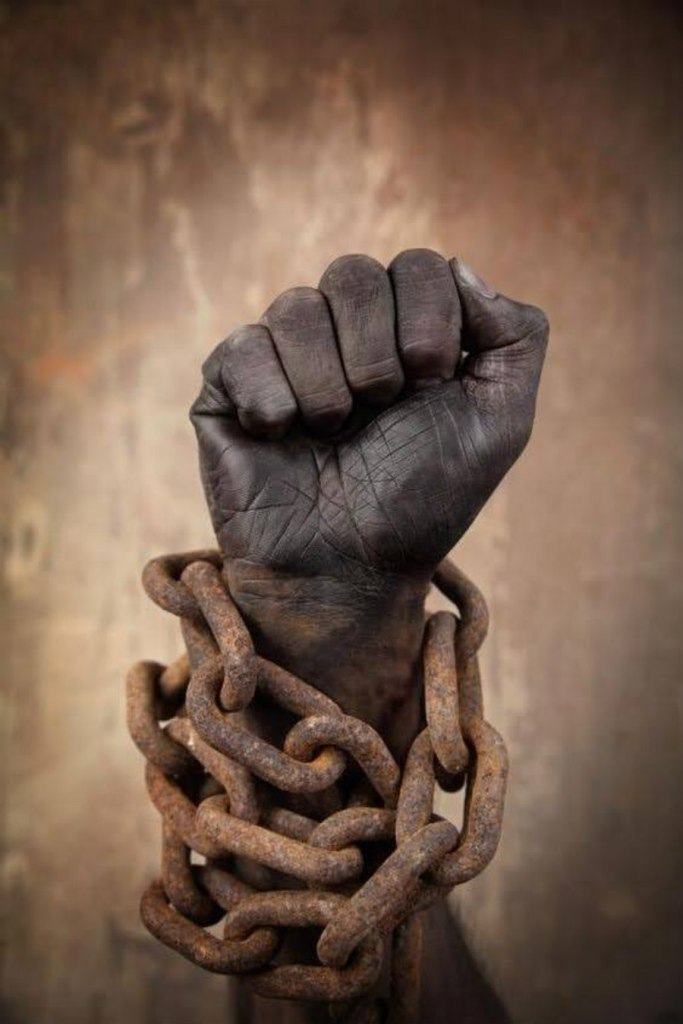
Prison labor is another form of present-day slavery. The 13th Amendment abolished slavery “except as punishment for crime,” allowing prisons to exploit incarcerated individuals for little to no pay. Many major corporations profit from prison labor, making mass incarceration an economic engine that disproportionately affects Black men (Davis, 2003). This system echoes the convict leasing programs of the late 19th century, where newly freed Black men were arrested for minor infractions and leased out to plantations and factories.

Corporate exploitation also plays a role in the new slavery. Many Black communities are targeted by payday lenders, fast-food chains, and predatory retailers who profit from economic desperation. Food deserts—neighborhoods with little access to fresh produce—force residents to rely on unhealthy options, contributing to poor health outcomes and reinforcing a cycle of dependency (Walker et al., 2010).

Employment discrimination continues to be a barrier. Studies have shown that resumes with “Black-sounding” names receive fewer callbacks than those with “white-sounding” names despite identical qualifications (Bertrand & Mullainathan, 2004). This systemic bias reinforces cycles of poverty and limits access to economic mobility.

Education remains a battleground. Predominantly Black schools often receive less funding, leading to fewer resources, overcrowded classrooms, and lower graduation rates. Yet, despite these challenges, Black students continue to excel, breaking barriers in academia, science, and entrepreneurship (Ladson-Billings, 2006).

Cultural slavery persists in the form of media stereotypes that shape perceptions of Black identity. From harmful tropes of the “thug” or “angry Black woman” to colorism within the Black community, these narratives influence hiring decisions, policing, and self-esteem. Representation in media, however, is slowly shifting, with more nuanced and empowering portrayals emerging.

Financial literacy has become a tool of modern liberation. Black entrepreneurs, activists, and educators are teaching about credit, investments, and ownership. Movements like #BuyBlack encourage the circulation of dollars within Black communities to build sustainable economic power (Anderson, 2017).

Social justice movements have reignited the fight against systemic oppression. These movements use technology and social media to expose police brutality, advocate for criminal justice reform, and mobilize global solidarity. The digital age has given new tools to an old struggle for freedom.

Spiritually, many in the Black community turn to faith as a source of endurance. Churches remain hubs for organizing, political activism, and community care. The Black church has historically been a place where the enslaved could sing freedom songs, where civil rights leaders could strategize, and where today’s generation continues to find hope.

Globally, the African diaspora faces similar challenges. In places like Brazil, the Caribbean, and the UK, Afro-descendant communities grapple with racial inequality, police violence, and underrepresentation. The struggle for Black liberation is international, linking us to a global human rights movement.

Despite the challenges, the Black journey is marked by incredible achievements in arts, science, sports, politics, and beyond. The cultural contributions of African Americans—from jazz to hip-hop, from literature to fashion—have transformed the world and redefined what it means to be resilient.

Today, being “enslaved” can also mean mental enslavement: internalized racism, self-hate, and the pursuit of material validation rather than true freedom. Breaking free requires education, healing, and a reorientation toward self-love and community empowerment.

This journey is not only about survival but about thriving. The legacy of slavery can be transformed into a legacy of greatness when knowledge, faith, and economic empowerment are combined. The fight is not over, but the foundation has been laid by those who came before us.


References
Alexander, M. (2010). The new Jim Crow: Mass incarceration in the age of colorblindness. The New Press.
Anderson, C. (2017). PowerNomics: The national plan to empower Black America. PowerNomics Corporation of America.
Baptist, E. (2014). The half has never been told: Slavery and the making of American capitalism. Basic Books.
Berlin, I. (2003). Generations of captivity: A history of African-American slaves. Harvard University Press.
Bertrand, M., & Mullainathan, S. (2004). Are Emily and Greg more employable than Lakisha and Jamal? American Economic Review, 94(4), 991–1013.
Branch, T. (1988). Parting the waters: America in the King years 1954-63. Simon & Schuster.
Davis, A. (2003). Are prisons obsolete? Seven Stories Press.
Foner, E. (2014). Reconstruction: America’s unfinished revolution, 1863-1877. Harper Perennial.
Gates, H. L. (2019). Stony the road: Reconstruction, white supremacy, and the rise of Jim Crow. Penguin Press.
Ladson-Billings, G. (2006). From the achievement gap to the education debt: Understanding achievement in U.S. schools. Educational Researcher, 35(7), 3–12.
Litwack, L. F. (1998). Trouble in mind: Black southerners in the age of Jim Crow. Vintage.
Oliver, M. L., & Shapiro, T. M. (2006). Black wealth/white wealth: A new perspective on racial inequality. Routledge.
Scott-Clayton, J., & Li, J. (2016). Black-white disparity in student loan debt more than triples after graduation. Brookings Institution.
Smallwood, S. (2007). Saltwater slavery: A middle passage from Africa to American diaspora. Harvard University Press.
Walker, R. E., Keane, C. R., & Burke, J. G. (2010). Disparities and access to healthy food in the United States: A review of food deserts literature. Health & Place, 16(5), 876–884.


The Kingdoms of This World

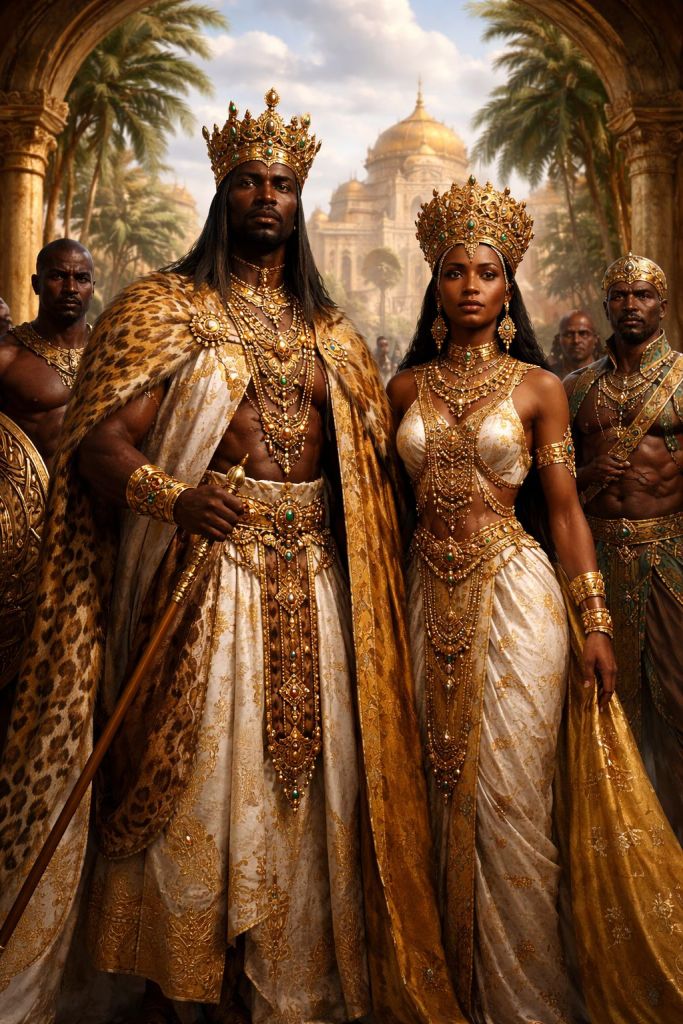
The phrase “the kingdoms of this world” evokes both a theological and historical imagination, referring not only to political empires but to systems of power, culture, and identity that shape human civilization. In biblical literature, kingdoms are not merely geographic territories; they are moral, spiritual, and ideological orders that reflect humanity’s relationship to God, authority, and justice. Within this framework, Black kingdoms—both biblical and African—occupy a significant but often marginalized place in world history and sacred narrative.

The Bible presents Africa and African-descended peoples as foundational to early civilization. From the genealogies in Genesis to the empires that shaped the ancient Near East, Black kingdoms appear repeatedly as centers of power, wisdom, and divine interaction. Yet Eurocentric interpretations have historically minimized or obscured these realities, reframing biblical history through a Western racial lens.

One of the earliest Black kingdoms mentioned in the Bible is Cush, identified with Nubia and ancient Sudan. In Genesis 10, Cush is named as the son of Ham and the father of Nimrod, described as the first mighty ruler on earth. Cush is associated with military strength, wealth, and early state formation, positioning Africa at the very origin of post-Flood civilization.

Ethiopia, often synonymous with Cush in biblical texts, appears frequently in the Old Testament as a respected and powerful nation. Psalm 68:31 famously declares, “Ethiopia shall soon stretch out her hands unto God,” symbolizing divine recognition and spiritual significance. Ethiopia was not portrayed as peripheral but as a kingdom with diplomatic relations, armies, and religious authority.

Another major Black biblical kingdom is Egypt, arguably the most influential ancient civilization in human history. Egypt dominates the biblical narrative from Genesis through Exodus, serving as both refuge and oppressor. Abraham sojourned in Egypt, Joseph ruled in Egypt, and Moses was educated in the royal court of Egypt. Egypt is depicted as technologically advanced, philosophically complex, and politically dominant.

The Exodus story itself situates Egypt as the archetype of imperial power. Pharaoh represents not merely a political ruler but a symbolic embodiment of worldly authority opposing divine liberation. Yet Egypt’s greatness is never denied; it is portrayed as the supreme empire of its time, ruling through knowledge, architecture, engineering, and spiritual institutions.

Another significant biblical kingdom is Sheba, commonly associated with regions of Ethiopia, Yemen, and the Horn of Africa. The Queen of Sheba’s visit to King Solomon demonstrates Africa’s role as a source of wealth, wisdom, and international diplomacy. She is described as arriving with gold, spices, and intellectual curiosity, challenging and affirming Solomon’s wisdom.

Sheba’s appearance disrupts Western assumptions about ancient power. The Queen is not subordinate but sovereign, not exotic but intellectual, not marginal but central to the global political network of the ancient world. Her kingdom represents Africa as an epistemic authority, a producer of knowledge and culture.

Libya, known in biblical texts as Put, is another African kingdom involved in ancient warfare and alliances. Put appears in the prophetic books as a military power aligned with Egypt, indicating Africa’s geopolitical influence in the ancient Mediterranean world. These kingdoms were not isolated but deeply integrated into global history.

Beyond the Bible, African history reveals vast civilizations that rivaled and surpassed European empires in wealth, organization, and intellectual development. One of the most famous is the Mali Empire, which flourished in West Africa between the 13th and 16th centuries. Mali controlled trans-Saharan trade routes and became one of the richest empires in human history.

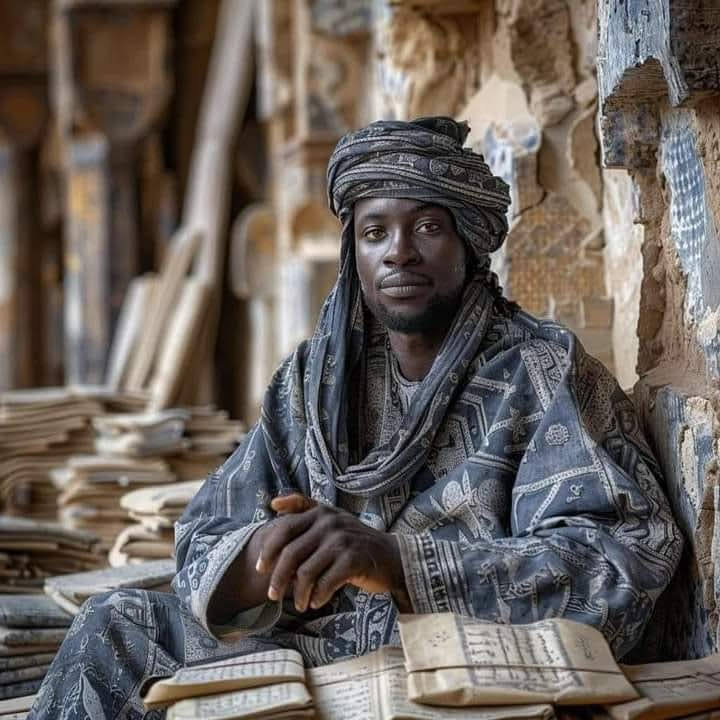
Mansa Musa, the most renowned ruler of Mali, is widely considered the wealthiest individual who ever lived. His pilgrimage to Mecca in 1324 reshaped global economies, distributing so much gold that it caused inflation across North Africa and the Middle East. Mali was not only wealthy but intellectually dominant, with universities in Timbuktu that rivaled medieval European institutions.

The Mali Empire also functioned as a center of Islamic scholarship, law, astronomy, and medicine. Libraries housed thousands of manuscripts, and scholars from across the Islamic world traveled to study there. This directly contradicts colonial narratives that portray Africa as intellectually barren before European contact.

Another major African kingdom was Great Zimbabwe, which flourished between the 11th and 15th centuries in Southern Africa. Its massive stone architecture, complex urban planning, and extensive trade networks demonstrate advanced engineering and political organization. European colonizers initially refused to believe Africans built it, attributing it falsely to Phoenicians or Arabs.

Great Zimbabwe controlled trade routes linking Africa to China, Persia, and India, exporting gold, ivory, and copper. Its very existence undermines the myth that Africa lacked civilization, revealing instead a long tradition of architectural mastery and global economic participation.

These African kingdoms parallel biblical themes of rise and fall. Like Egypt, Cush, and Sheba, Mali and Zimbabwe illustrate how kingdoms operate within divine cycles of power, wealth, justice, and decline. Scripture repeatedly teaches that no empire is permanent and that human authority is ultimately limited.

In the New Testament, Jesus declares, “My kingdom is not of this world,” distinguishing divine sovereignty from worldly empires. Yet Revelation speaks of “the kingdoms of this world” becoming the kingdoms of God, implying that all political systems are subject to spiritual judgment and transformation.

This theological framework invites a reinterpretation of Black history. Black kingdoms were not accidents of geography but expressions of divine order within human civilization. Their suppression through slavery and colonialism represents not natural decline but violent interruption of historical trajectories.

Colonialism functioned as a global reconfiguration of kingdoms, replacing African and Indigenous sovereignty with European imperial systems. These new “kingdoms of this world” restructured knowledge, race, labor, and power, redefining humanity itself through hierarchies of domination.

The erasure of Black kingdoms from mainstream history is therefore epistemological, not accidental. It reflects what scholars call “colonial knowledge production,” where history is written to legitimize conquest. Reclaiming Black kingdoms becomes an act of intellectual and spiritual restoration.

The Bible itself offers a counter-narrative. It consistently situates Africa within sacred history, not as an afterthought but as a foundational space of civilization, prophecy, and divine interaction. Black kingdoms are not footnotes; they are pillars.

Ultimately, “the kingdoms of this world” reveal that power is cyclical, meaning is political, and history is contested. Black kingdoms—biblical and African—demonstrate that Africa has always been central to global civilization, not marginal to it.

To study these kingdoms is not merely to recover lost history but to challenge the philosophical foundations of modernity itself. Black kingdoms remind the world that civilization did not begin in Europe, and that the future of humanity cannot be understood without Africa at its center.


References

Bible. (2011). King James Version. Hendrickson Publishers.

Diop, C. A. (1974). The African origin of civilization: Myth or reality. Lawrence Hill Books.

Fanon, F. (1967). Black skin, white masks. Grove Press.

Gordon, L. R. (2008). An introduction to Africana philosophy. Cambridge University Press.

Ki-Zerbo, J. (1997). General history of Africa, Vol. I: Methodology and African prehistory. UNESCO.

Levtzion, N., & Hopkins, J. F. P. (2000). Corpus of early Arabic sources for West African history. Markus Wiener.

Mudimbe, V. Y. (1988). The invention of Africa: Gnosis, philosophy, and the order of knowledge. Indiana University Press.

Shillington, K. (2018). History of Africa (4th ed.). Palgrave Macmillan.

Toby Green, T. (2019). A fistful of shells: West Africa from the rise of the slave trade to the age of revolution. University of Chicago Press.

Wynter, S. (2003). Unsettling the coloniality of being/power/truth/freedom. The New Centennial Review, 3(3), 257–337.

History in Black: The Slave Trade

The history of the transatlantic slave trade is one of the most defining and devastating chapters in Black history, shaping the modern world through violence, exploitation, and racial hierarchy. It represents not merely a period of forced labor, but the systematic dehumanization of African peoples and the construction of a global economy built on Black suffering. Slavery was not accidental or natural; it was a deliberate system engineered for profit, power, and domination.

The slave trade began in the late 15th century with European expansion into Africa and the Americas. Portuguese and Spanish traders were among the first to establish routes, followed by the British, French, Dutch, and later Americans. Africa became a central source of labor for European colonies in the so-called “New World,” especially in plantations producing sugar, cotton, tobacco, and coffee.

The primary reason behind the slave trade was economic. European empires needed a massive labor force to exploit land stolen from Indigenous peoples. Africans were targeted because they were already skilled agricultural workers, could survive tropical climates, and were geographically accessible through coastal trading ports. Race was later used to morally justify what was, at its core, an economic crime.

African people were captured through warfare, raids, kidnappings, and betrayal by local intermediaries pressured or coerced into participating. Millions were marched to coastal forts, imprisoned in dungeons, and branded as property. Families were torn apart permanently, with no regard for kinship, language, or humanity.

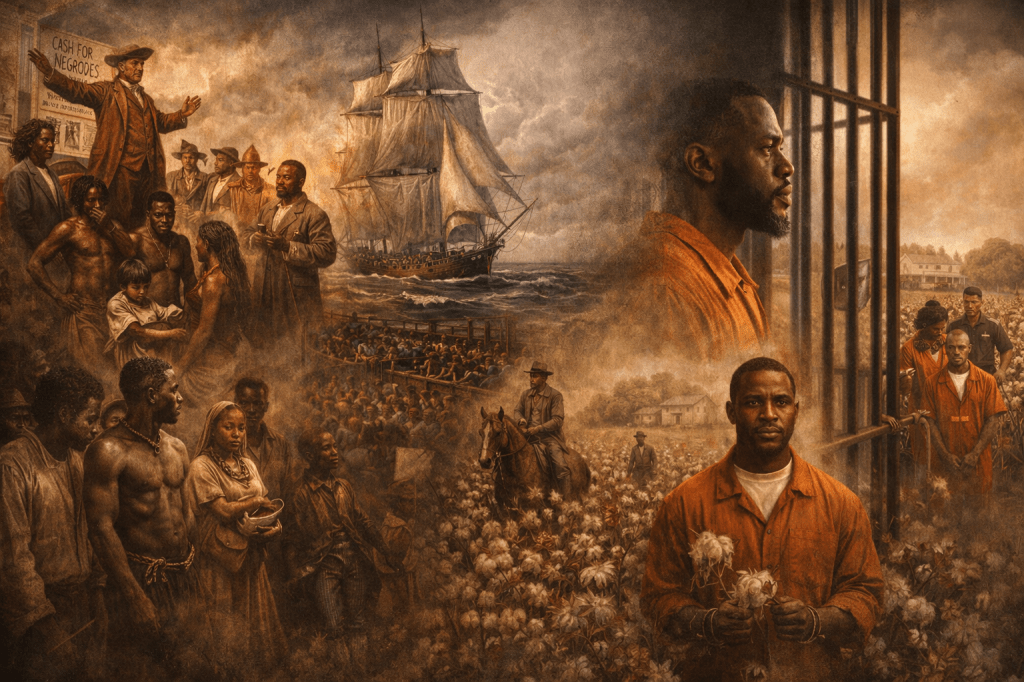
The Middle Passage was one of the most horrific experiences in human history. Enslaved Africans were packed into ships like cargo, chained, starved, raped, beaten, and thrown overboard. Many died from disease, suicide, or suffocation before ever reaching land. Those who survived arrived psychologically traumatized and physically broken.

Upon arrival in the Americas, Black people were sold at auction and legally reduced to chattel. They were stripped of names, cultures, religions, and identities. Enslaved Africans were treated not as human beings, but as livestock—bred, whipped, mutilated, and worked to death.

Slavery was enforced through extreme violence. Enslaved people were beaten, lynched, raped, and tortured for disobedience. Laws known as slave codes made it illegal for Black people to read, write, gather, or defend themselves. Resistance was punished with death.

Yet, despite unimaginable brutality, enslaved Africans resisted constantly. They escaped, revolted, preserved culture, practiced spiritual traditions, and passed down ancestral knowledge. Revolts such as the Haitian Revolution proved that enslaved people never accepted their condition as legitimate.

In the United States, slavery became the foundation of the national economy. Cotton was king, and enslaved labor made America one of the richest nations on earth. Banks, insurance companies, universities, and governments were directly funded by slave profits.

The Civil War (1861–1865) led to the formal abolition of slavery in the U.S. through the 13th Amendment. However, freedom was largely symbolic. Formerly enslaved people were released into poverty with no land, no resources, and no protection.

Immediately after slavery, Black Americans faced Black Codes, sharecropping, and convict leasing—systems that recreated slavery under new names. Prisons replaced plantations. Chain gangs replaced whips. Black labor remained controlled.

The Jim Crow era legalized racial segregation and terror. Lynchings, racial pogroms, and voter suppression were used to maintain white supremacy. Black people were excluded from housing, education, healthcare, and political power.

The Civil Rights Movement of the 1950s and 60s challenged legal segregation. Figures like Martin Luther King Jr., Malcolm X, and Fannie Lou Hamer fought for basic human rights. Laws changed, but systems did not.

Mass incarceration emerged as the new form of social control. The “War on Drugs” targeted Black communities, filling prisons with nonviolent offenders. Black men became statistically more likely to be incarcerated than to attend college.

Police violence replaced slave patrols. The same logic of control persisted: Black bodies were still viewed as dangerous, disposable, and criminal. Surveillance, brutality, and profiling became modern tools of oppression.

Economic inequality remains rooted in slavery. The racial wealth gap, housing discrimination, school segregation, and healthcare disparities all trace back to stolen labor and denied opportunity.

Globally, the legacy of slavery continues through neocolonialism, resource extraction, and economic dependency across Africa and the Caribbean. Western wealth still rests on historical exploitation.

Culturally, Black identity has been shaped by trauma and resilience. Music, religion, language, and art emerged as tools of survival. Black culture became both a source of global influence and commodification.

Psychologically, slavery created intergenerational trauma. Internalized racism, colorism, and identity fragmentation are modern expressions of historical violence. The mind became another site of colonization.

Legally, slavery was never repaired. There were no reparations, no land restitution, no national healing process. Former enslavers were compensated—former slaves were not.

From slavery to Jim Crow, from segregation to mass incarceration, the system changed in form but not in function. Black people remain disproportionately policed, imprisoned, impoverished, and surveilled.

History in Black reveals a painful truth: slavery did not end—it evolved. The chains became invisible, the plantations became prisons, and the auction blocks became algorithms. What changed were the laws. What did not change was the structure of power.


References

Alexander, M. (2012). The New Jim Crow: Mass incarceration in the age of colorblindness. The New Press.

Baptist, E. E. (2014). The half has never been told: Slavery and the making of American capitalism. Basic Books.

Berlin, I. (2003). Generations of captivity: A history of African-American slaves. Harvard University Press.

Du Bois, W. E. B. (1935). Black reconstruction in America. Free Press.

Equiano, O. (1789). The interesting narrative of the life of Olaudah Equiano. Author.

Equal Justice Initiative. (2017). Lynching in America: Confronting the legacy of racial terror. https://eji.org

Gates, H. L. (2014). The African Americans: Many rivers to cross. PBS.

Hochschild, A. (1998). King Leopold’s ghost. Houghton Mifflin.

Kendi, I. X. (2016). Stamped from the beginning: The definitive history of racist ideas in America. Nation Books.

UNESCO. (2010). The transatlantic slave trade database. https://www.slavevoyages.org

U.S. National Archives. (n.d.). 13th Amendment to the U.S. Constitution. https://www.archives.gov

Washington Post. (2020). Fatal Force: Police shootings database. https://www.washingtonpost.com/graphics/investigations/police-shootings-database/

Williams, E. (1944). Capitalism and slavery. University of North Carolina Press.

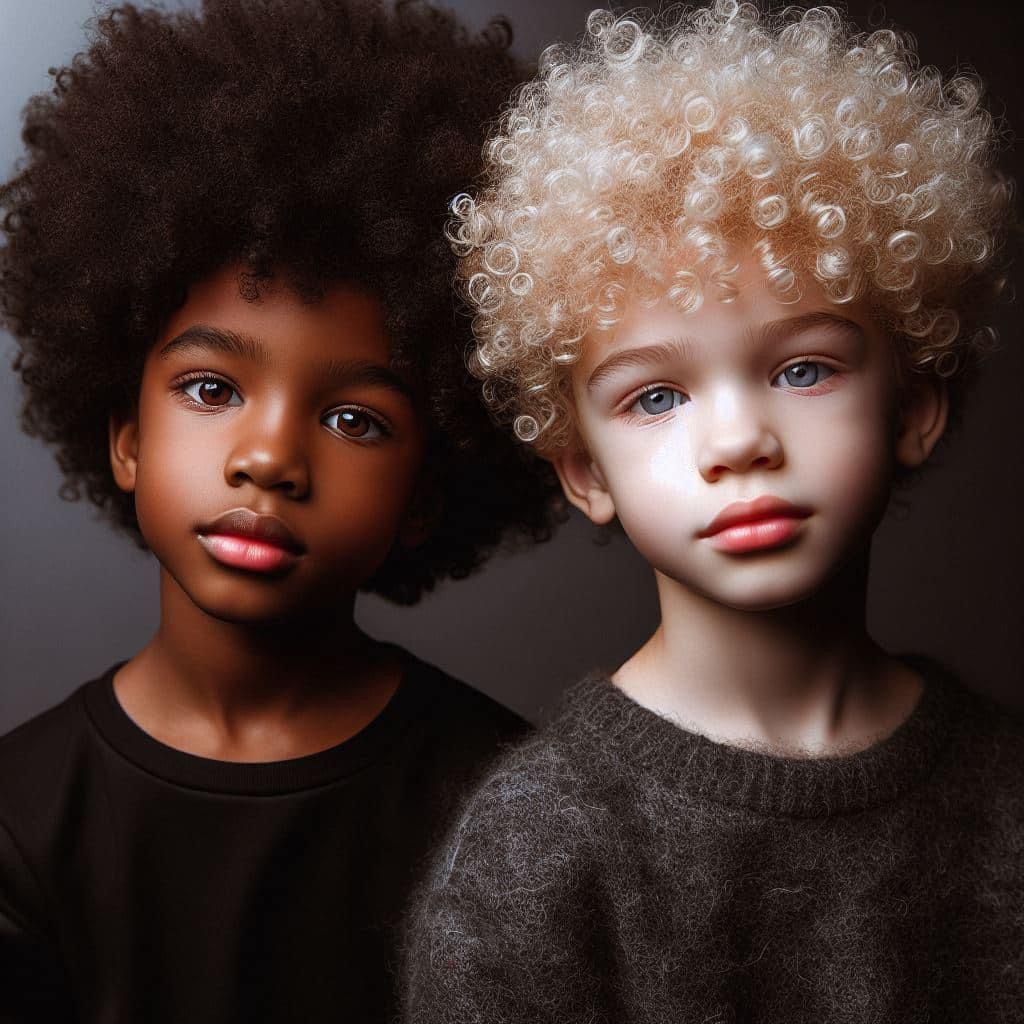
The Brown Boy Dilemma: Colorism

This photograph is the property of its respective owner. No copyright infringement intended.

Colorism—the prejudice or discrimination against individuals with darker skin tones, often within the same racial group—has long been recognized as a pervasive issue affecting Black communities. While much attention has been given to the experiences of Black women, it’s crucial to examine how colorism impacts Black men, whether differently or similarly, and to understand the nuances of this phenomenon.

Understanding Colorism and Its Origins

Colorism is rooted in historical and societal structures that have privileged lighter skin tones, often associating them with beauty, intelligence, and higher social status. This bias has been perpetuated through various means, including media representation, employment opportunities, and social interactions. The Guardian

The Impact of Colorism on Black Men

Black men, like their female counterparts, experience colorism, though the manifestations and societal perceptions may differ. Studies have shown that darker-skinned Black men often face challenges in areas such as employment and social acceptance. ScholarWorks

Media Representation and Stereotyping

In media portrayals, Black men with darker skin tones are frequently depicted in roles that emphasize aggression or criminality, reinforcing negative stereotypes. Conversely, lighter-skinned Black men may be portrayed in more favorable or diverse roles, contributing to a skewed representation that favors lighter skin tones. Verywell Mind

Colorism in Dating and Relationships

Within the dating scene, preferences often lean towards lighter-skinned individuals, a bias that extends to Black men. This preference can lead to feelings of inadequacy or rejection among darker-skinned Black men, affecting their self-esteem and social interactions. Frontiers

Internalized Colorism Among Black Men

Some Black men may internalize colorist attitudes, leading to a preference for lighter-skinned partners or associates. This internalization can perpetuate the cycle of colorism within the community, as individuals may unconsciously uphold and propagate these biases. Medium

Colorism in Professional Environments

In professional settings, lighter-skinned Black men may experience advantages in hiring and promotions due to perceived proximity to Eurocentric beauty standards. Darker-skinned Black men, on the other hand, may face biases that hinder their career advancement, despite equal qualifications. Verywell Mind

The Role of Family and Community

Family and community dynamics can either challenge or reinforce colorism. In some cases, darker-skinned Black men may receive support and affirmation from their families, helping to counteract societal biases. In other instances, families may unknowingly perpetuate colorist attitudes, influencing the individual’s self-perception. The Guardian

Intersectionality and the Experience of Colorism

The experience of colorism among Black men is also shaped by other intersecting factors such as socioeconomic status, education, and geographic location. These intersections can amplify or mitigate the effects of colorism, leading to diverse experiences within the community. Verywell Mind

Addressing Colorism: Steps Toward Equity

Combatting colorism requires a multifaceted approach, including education, media reform, and community engagement. Initiatives aimed at promoting diversity and inclusion can help challenge colorist norms and create a more equitable society for all Black individuals. The Guardian

Conclusion

Colorism affects Black men in complex and multifaceted ways, often intersecting with other forms of discrimination and bias. While the experiences may differ from those of Black women, the underlying issue remains the same: a societal preference for lighter skin tones that marginalizes those with darker complexions. Addressing colorism requires collective effort and a commitment to dismantling the structures that perpetuate these biases.

References:

The Phenomenal Black Woman

The Black woman stands as one of the most powerful and resilient figures in modern society—an embodiment of endurance, brilliance, and sacred strength. Her story is not merely one of survival, but of transformation: turning adversity into innovation, pain into purpose, and marginalization into leadership. Across history and into the present, the Black woman continues to rise as a cultural architect, economic force, spiritual anchor, and intellectual pioneer.

Statistically and socially, Black women are among the most educated demographic groups in the United States. They consistently enroll in and complete higher education at rates surpassing many of their counterparts, often while balancing work, family, and community responsibilities. This pursuit of education is not simply for individual advancement but reflects a collective ethos—education as liberation, as legacy, as resistance against systems that once forbade their literacy.

Beyond education, Black women are also the most entrepreneurial group in America. They are starting businesses at unprecedented rates, creating brands, services, and institutions that respond directly to the needs of their communities. From beauty and wellness to finance, tech, education, and real estate, Black women are building economic ecosystems that circulate wealth and opportunity where it was historically denied.

This entrepreneurial spirit is deeply rooted in historical memory. Enslaved Black women were traders, healers, midwives, and market women long before modern capitalism recognized them as business owners. In the face of legal exclusion from wealth-building systems, they created informal economies, mutual aid societies, and cooperative networks that sustained entire communities through segregation and poverty.

The strength of the Black woman is not performative—it is structural. She is often the backbone of the family, holding emotional, financial, and spiritual labor simultaneously. She raises children, supports elders, nurtures partners, and still finds space to cultivate her own dreams. Her strength is not the absence of vulnerability, but the discipline of carrying love even while burdened.

Black women have long served as cultural carriers. Through language, food, music, fashion, and spirituality, they preserve ancestral knowledge and translate it into modern expression. From gospel hymns to hip-hop aesthetics, from soul food to wellness rituals, Black women shape culture while rarely being credited as its original architects.

Spiritually, the Black woman has been a priestess of survival. Whether through church leadership, ancestral traditions, or personal faith practices, she has held communities together through prayer, prophecy, and healing. She is often the intercessor—the one who believes when others lose faith, the one who remembers God when the world forgets her humanity.

Psychologically, Black women navigate a unique intersection of racial and gendered stress, yet they exhibit extraordinary emotional intelligence and adaptability. They master the art of code-switching, resilience, and strategic silence, often carrying invisible labor in professional and social spaces that demand excellence without offering protection.

Intellectually, Black women have been architects of major political, social, and academic movements. From abolition and civil rights to feminism, education reform, and digital activism, Black women have consistently led revolutions that they were later written out of. Their intellectual labor has reshaped law, sociology, literature, theology, and psychology.

The Black woman’s body itself has been a site of political struggle and cultural projection. Historically exoticized, commodified, hypersexualized, and criticized, her body has also been reclaimed as a symbol of beauty, fertility, creativity, and divine design. Today, Black women redefine beauty standards, celebrating melanin, natural hair, full features, and diverse body types as sacred rather than marginal.

In motherhood, Black women often mother not only their own children but entire communities. They become teachers, counselors, protectors, and advocates. Even in systems that criminalize their sons and overlook their daughters, Black women remain the primary architects of emotional and moral development.

In love and relationships, Black women are frequently expected to be endlessly loyal, patient, and forgiving, even when reciprocity is absent. Yet they continue to choose love, family, and connection, often while healing generational wounds of abandonment, instability, and emotional labor imbalance.

Economically, Black women stretch limited resources into abundance. They are financial strategists by necessity—managing households, building credit, launching side businesses, and creating generational pathways where none previously existed. They practice wealth-building not as luxury, but as survival and stewardship.

Politically, Black women are the most reliable voting bloc and one of the most influential forces in democratic movements. They organize, mobilize, educate, and protect civil rights, often without institutional power or public recognition. When social justice shifts, it is usually because Black women moved first.

Culturally, Black women shape global aesthetics. From hairstyles and slang to fashion, dance, and social media trends, Black women generate cultural capital that fuels entire industries. Yet their influence is frequently extracted, rebranded, and monetized without fair compensation or acknowledgment.

Emotionally, the Black woman is a healer. She holds space for grief, trauma, and transformation—not only her own, but others’. She listens, nurtures, advises, and absorbs emotional pain while rarely being given the same care in return.

Historically, the Black woman has been both invisible and indispensable. She built America’s domestic, agricultural, and caregiving infrastructure while being excluded from its rewards. Yet she continues to rise, not waiting for permission to thrive.

The modern Black woman is redefining femininity itself. She is soft and strong, spiritual and strategic, nurturing and ambitious. She refuses false binaries between vulnerability and power, choosing instead to embody both with grace.

An ode to the Black woman is an ode to life itself. She is the womb of culture, the memory of nations, the architect of futures not yet seen. Her existence is not an accident of history—it is a divine intervention in a world that tried to erase her.

The phenomenal Black woman is not exceptional because she overcame suffering—she is exceptional because she transformed suffering into legacy. She is the most educated, the most entrepreneurial, the most spiritually resilient, and one of the most culturally influential forces on earth. She is not just surviving history—she is writing it.

References

American Association of University Women. (2023). Fast facts: Women of color in higher education. https://www.aauw.org/resources/article/fast-facts-woc-higher-ed/

Anderson, M., & Perrin, A. (2018). Black women and technology adoption. Pew Research Center. https://www.pewresearch.org/internet/2018/01/25/blacks-and-technology-adoption/

Collins, P. H. (2000). Black feminist thought: Knowledge, consciousness, and the politics of empowerment (2nd ed.). Routledge.

Crenshaw, K. (1991). Mapping the margins: Intersectionality, identity politics, and violence against women of color. Stanford Law Review, 43(6), 1241–1299. https://doi.org/10.2307/1229039

Federal Reserve Bank of Kansas City. (2021). The state of women-owned businesses. https://www.kansascityfed.org/research/economic-review/women-owned-businesses/

Georgetown University Center on Education and the Workforce. (2020). A profile of Black women in the labor market. https://cew.georgetown.edu/cew-reports/black-women/

Giddings, P. (1984). When and where I enter: The impact of Black women on race and sex in America. HarperCollins.

McKinsey & Company. (2022). Black women are ambitious. But they’re held back at work. https://www.mckinsey.com/featured-insights/diversity-and-inclusion/black-women-are-ambitious-but-theyre-held-back-at-work

National Women’s Business Council. (2023). Black women entrepreneurs: Driving innovation and economic growth. https://nwbc.gov/

Pew Research Center. (2021). Black Americans are more likely than others to say family is central to their identity. https://www.pewresearch.org/social-trends/2021/03/25/

Smith, J. A., & Patton, L. D. (2016). Postracial rhetoric and the Black female student. Journal of College Student Development, 57(6), 645–661. https://doi.org/10.1353/csd.2016.0064

U.S. Census Bureau. (2022). Women-owned businesses by race and ethnicity. https://www.census.gov/programs-surveys/sbo.html

U.S. Department of Labor. (2023). Women in the labor force: A databook. https://www.dol.gov/agencies/wb/data

Walker, A. (1983). In search of our mothers’ gardens: Womanist prose. Harcourt Brace Jovanovich.

World Economic Forum. (2020). The power of Black women in the U.S. economy. https://www.weforum.org/reports/

The Phenomenal Black Man

The Black man stands as one of the most complex and misunderstood figures in modern society—shaped by historical trauma, systemic barriers, and cultural misrepresentation, yet continually producing excellence, innovation, and leadership. His story is not one of deficiency, as dominant narratives often suggest, but of resilience: surviving institutions that were never designed for his success while still cultivating identity, dignity, and generational hope.

Historically, Black men were foundational to the construction of the modern world. From forced labor during enslavement to skilled craftsmanship, engineering, agriculture, and military service, Black men have contributed materially to global economies while being excluded from the political and financial rewards of their labor. This historical displacement from power did not erase their leadership capacity—it delayed its recognition.

In education, Black men face some of the most significant structural barriers of any demographic group, including school discipline disparities, underfunded institutions, and racialized tracking systems. Yet despite these obstacles, Black men continue to excel in higher education, producing scholars, scientists, theologians, engineers, physicians, and legal minds who challenge the myth of intellectual inferiority.

The intellectual legacy of Black men includes some of the most influential thinkers of modern history. Figures such as W.E.B. Du Bois, James Baldwin, Martin Luther King Jr., Malcolm X, Frantz Fanon, and Carter G. Woodson reshaped sociology, political theory, psychology, theology, and cultural studies. Their work remains foundational to understanding race, power, identity, and human liberation.

Economically, Black men are increasingly asserting entrepreneurial agency. From tech startups and financial services to fashion, real estate, sports management, and media production, Black men are building independent economic infrastructures. Entrepreneurship has become both a form of resistance to labor market discrimination and a strategy for generational wealth creation.

The Black man is also a cultural architect. Music, fashion, language, and global aesthetics have been profoundly shaped by Black male creativity—from jazz and blues to hip-hop, from streetwear to luxury fashion, from spoken word to film and digital media. Black men continuously produce cultural capital that fuels global industries.

Spiritually, the Black man has served as a prophet, preacher, teacher, and revolutionary theologian. The Black church, Islamic movements, and Afrocentric spiritual systems have provided Black men with frameworks for moral leadership, communal healing, and resistance to psychological colonization. Faith has often been a survival technology in a hostile world.

Psychologically, Black men navigate a unique terrain of racialized masculinity. They are frequently socialized to suppress vulnerability, emotional expression, and mental health needs in order to survive in environments that criminalize their bodies and silence their pain. Yet Black men are increasingly reclaiming emotional literacy, therapy, and self-awareness as tools of empowerment.

In family life, the narrative of the “absent Black father” has been one of the most damaging cultural myths. Research consistently shows that Black fathers are among the most involved fathers across racial groups when structural barriers such as incarceration and economic exclusion are accounted for. Black men actively participate in caregiving, emotional bonding, and moral instruction.

The Black man’s body has historically been framed as a site of fear and criminality. From slavery patrols to modern policing, Black male bodies have been surveilled, punished, and politicized. Yet the Black man continues to reclaim his body as sacred—through health, fitness, discipline, self-care, and spiritual grounding.

Politically, Black men have been central to liberation movements worldwide. From abolition and anti-colonial struggles to civil rights and Pan-Africanism, Black men have organized, theorized, and mobilized resistance against racial oppression. Their political consciousness has shaped democratic ideals globally.

The Black man’s relationship to labor has been one of both exploitation and mastery. Despite being overrepresented in physically demanding and dangerous occupations, Black men have also excelled in professional, technical, and intellectual fields, redefining what Black masculinity looks like beyond brute survival.

In relationships and intimacy, Black men are often burdened by stereotypes of emotional detachment, hypersexuality, or instability. Yet many Black men actively seek emotional depth, spiritual connection, and partnership grounded in respect and mutual growth. They are redefining masculinity beyond dominance toward responsibility and presence.

Culturally, Black men serve as intergenerational bridges. They carry ancestral memory, oral history, and survival strategies passed down through fathers, grandfathers, and community elders. Their identity is not isolated—it is collective, historical, and deeply rooted in lineage.

The modern Black man is increasingly invested in self-development. He studies financial literacy, mental health, spirituality, fitness, and purpose. He reads, builds, mentors, and heals. This shift represents a quiet revolution in Black male consciousness.

The Black man is also a mentor and protector. Whether through coaching, teaching, community organizing, or informal leadership, Black men invest in the next generation, offering guidance in environments where institutional support is often absent.

Despite structural violence, Black men continue to love—deeply, creatively, and spiritually. They love their families, their communities, their cultures, and their futures. Love becomes an act of resistance in a world that expects their emotional absence.

The phenomenal Black man is not defined by pathology but by possibility. He is a survivor of historical trauma and a carrier of ancestral wisdom. He is a thinker, a builder, a father, a lover, a leader, and a visionary.

An ode to the Black man is an ode to perseverance. He exists in the tension between vulnerability and strength, memory and future, pain and purpose. His presence is not accidental—it is historical, spiritual, and revolutionary.

The phenomenal Black man is not waiting to be redeemed by society—he is redeeming himself through consciousness, discipline, faith, and collective responsibility. He is not a problem to be solved, but a force to be understood, honored, and supported.


References

American Psychological Association. (2018). Boys and men of color: Implications for academic success. https://www.apa.org/monitor/2018/07/boys-men-color

Anderson, E. (1999). Code of the street: Decency, violence, and the moral life of the inner city. W. W. Norton.

Bonilla-Silva, E. (2014). Racism without racists: Color-blind racism and the persistence of racial inequality in America (4th ed.). Rowman & Littlefield.

Du Bois, W. E. B. (1903). The souls of Black folk. A.C. McClurg & Co.

Edin, K., Tach, L., & Mincy, R. (2009). Claiming fatherhood: Race and the dynamics of paternal involvement. The ANNALS of the American Academy of Political and Social Science, 621(1), 149–177. https://doi.org/10.1177/0002716208325548

Fanon, F. (1952). Black skin, white masks. Grove Press.

Harper, S. R. (2012). Black male student success in higher education. ASHE Higher Education Report, 38(3), 1–140. https://doi.org/10.1002/aehe.20002

National Center for Education Statistics. (2022). Status and trends in the education of racial and ethnic groups. https://nces.ed.gov/

Pew Research Center. (2018). Black fathers more involved than other dads. https://www.pewresearch.org/social-trends/2018/06/14/fathers-day-2018/

U.S. Department of Justice. (2021). Contacts between police and the public. https://bjs.ojp.gov/

U.S. Small Business Administration. (2023). Black-owned business statistics. https://www.sba.gov/

Woodson, C. G. (1933). The mis-education of the Negro. Associated Publishers.

World Economic Forum. (2020). The future of jobs report. https://www.weforum.org/reports/

Pretty Privilege Series: The Shade Hierarchy — Breaking Free from the Color Caste System.

Photo by King Cyril Kalu on Pexels.com

Colorism, often described as prejudice or discrimination based on skin tone, creates a hierarchy within the Black community that values lighter skin over darker shades. This “shade hierarchy” functions like an internal caste system, influencing beauty standards, social acceptance, and economic opportunities (Hunter, 2007).

The origins of this hierarchy are deeply entwined with colonialism and slavery. European colonizers created a system where proximity to whiteness equaled privilege. Lighter-skinned enslaved Africans were often assigned domestic work and given preferential treatment, while darker-skinned individuals labored in the fields, cementing a perception that lighter skin was inherently superior (Williams, 1987).

Media and pop culture perpetuated these notions over centuries. Hollywood films frequently cast light-skinned Black women in romantic or leading roles while relegating darker-skinned women to subservient, villainous, or hypersexualized stereotypes. This not only shaped public perception but also influenced self-image among Black women (Bogle, 2016).

The psychological impact of the shade hierarchy is profound. Dark-skinned individuals often experience lower self-esteem, body image dissatisfaction, and internalized racism. Being told, explicitly or implicitly, that one’s skin is “too dark” to be desirable produces lasting trauma (Hill, 2002).

Dating preferences also reveal the pervasiveness of this hierarchy. Studies show that lighter-skinned Black women are often perceived as more attractive and desirable for relationships, while darker-skinned women are marginalized in the dating market (Wilder, 2010). Men’s internalization of colorist standards reinforces systemic bias.

Colorism extends into education and professional opportunities. Research demonstrates that darker-skinned Black men and women earn less than lighter-skinned peers, even when controlling for education and experience. This colorism wage gap mirrors the historical privileging of lighter skin (Goldsmith, Hamilton, & Darity, 2006).

Schools are microcosms where colorism manifests early. Dark-skinned children are often subject to teasing, social exclusion, or disproportionate disciplinary actions. This reinforces societal hierarchies and internalized biases before adulthood (Monk, 2014).

Family and community can either reinforce or challenge the shade hierarchy. Favoring lighter-skinned relatives in compliments, marriage prospects, or inheritance decisions perpetuates the caste system. Conversely, affirming all shades equally fosters resilience and pride in melanin-rich identities (Russell, Wilson, & Hall, 2013).

Language plays a crucial role in perpetuating colorism. Terms like “redbone,” “high yellow,” and backhanded compliments such as “pretty for a dark-skinned girl” normalize hierarchy and shape self-perception. Challenging and changing this language is essential for liberation (Charles, 2003).

Social media has emerged as both a challenge and a solution. While platforms sometimes reinforce colorism through algorithmic biases and influencer culture, they also provide spaces for celebrating dark-skinned beauty, such as #MelaninPoppin and #DarkSkinIsBeautiful campaigns. These initiatives help counter harmful narratives and create visible representation.

Religious and spiritual frameworks can aid in dismantling the shade hierarchy. Scriptures such as Song of Solomon 1:5 — “I am black, but comely” — affirm that melanin is not a flaw but a feature worthy of pride. Church communities can preach against favoritism and celebrate beauty in all skin tones (James 2:1-4).

Media literacy is another tool. Teaching children and adults to critically assess representations in television, film, and advertising reduces the internalization of harmful beauty norms. Awareness of how light-skinned individuals are often elevated helps viewers resist accepting a biased standard unconsciously.

Empowerment programs targeting youth can directly counter colorism. Workshops that teach self-esteem, beauty appreciation, and historical knowledge about African ancestry encourage young people to embrace their skin tone with pride (Hall, 1992).

Feminist scholars emphasize that dismantling the shade hierarchy is not just about aesthetics; it is about power. Colorism intersects with sexism and racism, creating compounded oppression for dark-skinned women. Addressing these structural inequalities is critical for holistic liberation (Hunter, 2007).

Representation in professional and artistic spaces also matters. Featuring dark-skinned Black men and women in leadership roles, creative industries, and political office challenges societal hierarchies and normalizes their presence in positions of influence.

Black men’s participation is key in dismantling the hierarchy. By affirming dark-skinned women as desirable partners, celebrating them publicly, and rejecting societal pressure to prefer lighter skin, men can help erode internalized colorist standards in the community (Harris, 2015).

Economic interventions are also necessary. Organizations should prioritize diversity in hiring and promotion, ensuring that darker-skinned candidates are not overlooked due to unconscious bias. Equitable opportunities disrupt the cycle of privilege attached to lighter skin.

Education and mentorship programs should include historical context about colorism and practical strategies for resistance. Teaching children about African history, melanin-rich heroes, and cultural pride counteracts centuries of negative messaging about dark skin (Smedley, 1999).

Personal reflection and therapy can help individuals confront internalized colorism. Journaling, counseling, and group discussions offer spaces to unlearn harmful messages and rebuild self-worth, allowing people to embrace their natural complexion fully.

Breaking free from the color caste system requires sustained effort across generations. By challenging social norms, affirming diverse beauty, and creating supportive spaces, the Black community can replace hierarchical thinking with pride, dignity, and unity.


References

  • Bogle, D. (2016). Toms, Coons, Mulattoes, Mammies, and Bucks: An Interpretive History of Blacks in American Films. Bloomsbury.
  • Charles, C. (2003). Skin Bleaching, Self-Hate, and Black Identity in Jamaica. Journal of Black Studies, 33(6), 711–728.
  • Goldsmith, A., Hamilton, D., & Darity, W. (2006). Shades of Discrimination: Skin Tone and Wages. American Economic Review, 96(2), 242–245.
  • Hall, R. E. (1992). Bias Among African Americans Regarding Skin Color: Implications for Social Work Practice. Research on Social Work Practice, 2(4), 479–486.
  • Harris, A. (2015). The Influence of Fathers on the Self-Esteem of African American Daughters. Journal of Black Psychology, 41(3), 257–276.
  • Hunter, M. (2007). The Persistent Problem of Colorism: Skin Tone, Status, and Inequality. Sociology Compass, 1(1), 237–254.
  • Monk, E. P. (2014). Skin Tone Stratification among Black Americans, 2001–2003. Social Forces, 92(4), 1313–1337.
  • Russell, K., Wilson, M., & Hall, R. (2013). The Color Complex: The Politics of Skin Color Among African Americans. Anchor Books.
  • Smedley, A. (1999). Race in North America: Origin and Evolution of a Worldview. Westview Press.
  • Williams, E. (1987). Capitalism and Slavery. UNC Press.
  • Wilder, J. (2010). Revisiting “Color Names and Color Notions”: A Contemporary Examination of the Language and Attitudes of Skin Color among Young Black Women. Journal of Black Studies, 41(1), 184–206.

The Male Files: The Truth About Men — No Filter.

Photo by Ali Drabo on Pexels.com

The truth about men is not always easy to say, but it is necessary. Men are often painted in extremes—either as stoic protectors who never feel or as reckless pursuers of sex and power. But in reality, men live in a space where strength collides with vulnerability, and where desires often wrestle against fears. No filter means speaking plainly about what men deal with, even if it’s uncomfortable.

Sex is one of the biggest areas where men are misunderstood. For many, sex is not just about physical pleasure—it is deeply tied to identity, validation, and self-worth. Men often measure their value by their ability to attract women, perform sexually, and maintain dominance. This pressure distorts healthy intimacy into performance, creating cycles of insecurity when men fall short.

At the root of this is fear. Many men fear rejection more than they fear failure. Rejection strikes at a man’s sense of masculinity, raising questions about whether he is desirable or enough. Psychology explains this through self-determination theory: humans crave competence, relatedness, and autonomy (Ryan & Deci, 2000). When men feel rejected, competence and relatedness are shattered, leaving insecurity behind.

Men also fear vulnerability. Society trains boys to suppress emotions, equating tears with weakness. As Proverbs 29:25 (KJV) warns, “The fear of man bringeth a snare.” This cultural snare traps men in silence, unable to express pain. In relationships, this silence becomes misinterpreted as indifference, when in reality it is fear of exposure.

Insecurity about provision is another deep truth. Many men are raised to believe their worth rests in financial success. If they cannot provide, they often feel emasculated. Studies show that unemployment or underemployment strongly correlates with depression in men, not just because of economic loss but because of an identity crisis (Wilkinson, 2001).

Sexual performance anxiety also weighs heavily. Men fear being inadequate in bed, as performance has been culturally tied to masculinity. Failure in this area can cause shame, silence, and avoidance. This creates a paradox: men crave sexual intimacy but fear it because it risks exposing their insecurities.

Pornography intensifies these struggles. Men are conditioned to view sex as conquest, comparing themselves to exaggerated performances on screen. This distorts expectations, leaving many dissatisfied with reality and unprepared for real intimacy. Proverbs 6:25 (KJV) warns against lustful illusions: “Lust not after her beauty in thine heart; neither let her take thee with her eyelids.”

Commitment is another area clouded by fear. Many men desire stability but fear losing freedom. This creates tension between wanting a lifelong partner and clinging to independence. Psychology calls this avoidant attachment, where closeness feels threatening because it means potential loss (Mikulincer & Shaver, 2007).

For others, commitment is frightening because it exposes the possibility of failure. Divorce, heartbreak, and betrayal leave scars, teaching men that intimacy is dangerous. Instead of healing, many retreat into casual sex or emotional withdrawal. It feels safer, but it leaves them lonely.

Trust is a battlefield for men. Some carry deep wounds from betrayal—whether from mothers, past lovers, or absent fathers. These betrayals create a reluctance to fully invest in women, out of fear of being hurt again. As a result, many men love halfway, holding back pieces of themselves.

Ego is another powerful force. Men often protect their egos with silence, pride, or anger. To admit fear feels like weakness, so many hide behind bravado. But as the Bible reminds us in 2 Corinthians 12:9 (KJV), “My strength is made perfect in weakness.” True strength for men lies not in hiding fears but in owning them.

Friendship is another misunderstood need. Men crave brotherhood, but modern masculinity often isolates them. Without trusted male friends, they place all emotional needs on women, which strains relationships. Research confirms that men with strong male friendships experience greater mental health and marital satisfaction (Mahalik et al., 2003).

Fatherhood also reveals deep insecurities. Many men wrestle with the fear of becoming the same fathers who wounded them—or of failing their children altogether. This fear pushes some into abandonment, while others overcompensate through over-discipline. The balance is difficult, especially when men themselves were never nurtured.

Spiritually, men wrestle with temptation. The struggle against lust, pride, and greed is ongoing. Paul describes this inner battle in Romans 7:19 (KJV): “For the good that I would I do not: but the evil which I would not, that I do.” Men know right from wrong but often find themselves doing the very things they despise.

Communication is another truth. Men are often labeled as emotionally unavailable, but many simply lack the vocabulary for vulnerability. They were never taught to name feelings beyond anger, so frustration becomes the default. This miscommunication fuels conflict in relationships, leaving women feeling unloved while men feel misunderstood.

Financial insecurity intersects with relational fear. Men fear being loved only for what they provide. This suspicion creates defensiveness, leading them to test women’s loyalty. Unfortunately, this defensive posture can drive away genuine partners, reinforcing their fears.

Another truth is men’s longing for respect. Ephesians 5:33 (KJV) highlights this dynamic: “Let the wife see that she reverence her husband.” Men crave respect as deeply as women crave love. When men feel disrespected, they withdraw, often silently, creating distance in relationships.

Men also struggle with aging. Gray hair, slowing bodies, and decreased strength remind men of mortality. Fear of losing virility leads some to chase younger women or cling to shallow displays of masculinity. Others grow resentful, fearing they are no longer attractive or useful.

Another hidden truth is men’s battle with mental health. Depression in men often manifests as anger, workaholism, or substance abuse. Yet men are less likely to seek help, fearing stigma. This silent suffering devastates relationships, as unaddressed pain spills over into destructive behavior.

Yet, despite these fears and insecurities, men deeply desire love. They may not always show it in words, but most crave companionship, partnership, and legacy. This truth cuts through the myths: men want intimacy, not just sex, but fear often distorts how they pursue it.

The key to healing lies in honesty. Men must learn to admit their weaknesses without shame. Vulnerability opens the door to authentic connection. When men speak plainly about their struggles, they discover they are not alone.

Women, too, play a role in this process. Patience, respect, and encouragement help men lower their defenses. But men must also take responsibility—learning to communicate, seeking therapy when needed, and grounding their worth not in sex or money but in God’s design.

Spiritually, men find strength when they root their identity in Christ. 1 Corinthians 16:13 (KJV) says, “Watch ye, stand fast in the faith, quit you like men, be strong.” This strength is not bravado but courage rooted in faith. True manhood is not about hiding fear but walking through it with integrity.

The truth about men, no filter, is that they are human. They fear, they fail, they hurt, and they love. Behind the masks of pride and performance lies a deep longing to be seen, respected, and loved for who they are. The more men embrace this truth, the more honest and whole their relationships become.


References

  • Mahalik, J. R., Burns, S. M., & Syzdek, M. (2003). Masculinity and perceived normative health behaviors as predictors of men’s health behaviors. Social Science & Medicine, 57(8), 1559–1569.
  • Mikulincer, M., & Shaver, P. R. (2007). Attachment in adulthood: Structure, dynamics, and change. Guilford Press.
  • Ryan, R. M., & Deci, E. L. (2000). Self-determination theory and the facilitation of intrinsic motivation, social development, and well-being. American Psychologist, 55(1), 68–78.
  • Wilkinson, R. (2001). Unemployment and health: A review. Public Health, 115(3), 153–160.
  • The Holy Bible, King James Version.

The Male Files: Looks vs. Personality — The Battle Between Flesh and Spirit.

In the modern world, men are often accused of being shallow, drawn first and foremost to physical appearance rather than personality. While this stereotype carries truth, the reasons behind it run deeper than vanity. Men are visually wired. From a biological standpoint, the male brain responds quickly to physical stimuli; it is a built-in survival mechanism designed for attraction, reproduction, and the continuation of the species. Yet, the spiritual man operates under a higher calling. The tension between what men see and what they value defines much of the internal conflict in today’s dating culture.

Society tells men that beauty equals worth. From music videos to advertisements, the female form has been commodified and marketed as the ultimate prize. A man’s status is often measured by the attractiveness of the woman he can “get.” This cultural conditioning fuels ego rather than intimacy. Many men pursue beauty not because they love it, but because they crave validation. It becomes a trophy to cover insecurity, not a reflection of true connection.

Biblically, however, man was created to discern beyond the surface. Proverbs 31:30 (KJV) reminds us, “Favour is deceitful, and beauty is vain: but a woman that feareth the Lord, she shall be praised.” Godly men are called to see character, not just curves. True beauty, in the eyes of a godly man, is rooted in virtue, kindness, and spiritual alignment—not in Instagram filters or waist-to-hip ratios.

Worldly men, on the other hand, often chase the image of perfection without understanding its emptiness. The “perfect 10” they desire is rarely about companionship—it’s about conquest. The lust of the flesh blinds the spirit, and in trying to fulfill a fantasy, many men lose their purpose. First John 2:16 (KJV) warns, “For all that is in the world, the lust of the flesh, and the lust of the eyes, and the pride of life, is not of the Father.” The worldly man is driven by impulse; the godly man is led by vision.

Interestingly, many men who demand “perfection” from women are themselves far from perfect. They want a fit, flawless partner while neglecting their own health, appearance, and spiritual discipline. This hypocrisy stems from ego insecurity—the desire to possess beauty as a way to elevate one’s own self-esteem. In psychology, this is called compensatory desire—when a person overvalues traits in others to make up for their own perceived inadequacies.

At its root, this obsession is not about women—it’s about male identity. The modern man has been raised in a culture that equates manhood with dominance, sexual access, and external success. When that is stripped away, many men feel powerless. So, they chase beauty to regain control, mistaking admiration for affirmation. But the truth is, external validation can never heal internal wounds.

A godly man, however, views attraction through the lens of purpose. He recognizes that a wife is not a status symbol but a partner in destiny. Genesis 2:18 (KJV) says, “It is not good that the man should be alone; I will make him an help meet for him.” This implies alignment, not aesthetic. God designed women to complement a man’s calling, not to decorate his ego. A woman’s beauty, therefore, should inspire responsibility, not lust.

Men who walk by the flesh often find themselves unsatisfied. No matter how beautiful the woman, the excitement fades if there is no emotional or spiritual connection. Proverbs 27:20 (KJV) declares, “Hell and destruction are never full; so the eyes of man are never satisfied.” This is why even men who “have it all” continue to wander—because their desires are rooted in emptiness, not wholeness.

True masculinity requires discipline. The ability to admire beauty without idolizing it separates a man of faith from a man of flesh. Lust feeds on fantasy; love grows from foundation. A man who cannot govern his eyes will never govern his home. Matthew 6:22 (KJV) says, “The light of the body is the eye.” What a man focuses on determines the direction of his soul.

In truth, many men were never taught what to look for in a wife. They learned from rap videos, social media, and locker room talk instead of from Scripture and wisdom. The world glorifies quantity over quality, teaching men to chase pleasure rather than purpose. But a godly man seeks more. He seeks peace over passion, loyalty over lust, and substance over spectacle.

The “perfect 10” mentality is also a reflection of comparison culture. Men, like women, are influenced by social media’s curated illusions. Scrolling through endless images of beauty creates unrealistic expectations, making average women seem “less than.” Yet these filtered fantasies are not real—they are projections of desire, not demonstrations of character. In chasing illusion, men lose appreciation for authenticity.

From a spiritual perspective, this obsession with physical perfection mirrors idolatry. When a man places more value on appearance than on godly character, he dethrones God as the source of beauty. The Bible teaches that the fear of the Lord is the beginning of wisdom (Proverbs 9:10 KJV). Therefore, discernment—not desire—should guide his heart.

Moreover, the male ego often equates attraction with achievement. To be seen with a beautiful woman boosts a man’s social standing among other men. But such validation is hollow. It creates relationships based on appearance rather than depth. When life’s trials come—and they always do—beauty alone cannot sustain love.

A godly man recognizes that real attraction grows with intimacy, respect, and shared faith. When a woman prays with him, encourages his purpose, and walks in integrity, her beauty multiplies in his eyes. Physical beauty fades, but spiritual beauty endures. First Peter 3:4 (KJV) describes this kind of woman as one with “the ornament of a meek and quiet spirit, which is in the sight of God of great price.”

Worldly men measure worth by what they can see; godly men measure it by what they can build. The worldly man asks, “How does she make me look?” The godly man asks, “How can we glorify God together?” The difference lies in maturity, not masculinity. One pursues pleasure; the other pursues purpose.

When men learn to lead with discernment, they break the cycle of superficial love. They begin to see women not as possessions but as partners. They understand that true attraction begins in the spirit, not the skin. This is the transformation the modern male psyche desperately needs—to evolve from consumerism to covenant.

In the end, the greatest beauty a man can find in a woman is peace. Proverbs 18:22 (KJV) declares, “Whoso findeth a wife findeth a good thing, and obtaineth favour of the Lord.” That “good thing” is not defined by her looks but by her godliness. For beauty catches the eye, but virtue captures the soul.


References

Holy Bible, King James Version. (n.d.). Bible Gateway. https://www.biblegateway.com

Cloud, H., & Townsend, J. (2018). Boundaries in Dating: How Healthy Choices Grow Healthy Relationships. Zondervan.

Eldredge, J. (2001). Wild at Heart: Discovering the Secret of a Man’s Soul. Thomas Nelson.

Lewis, C. S. (1942). The Screwtape Letters. Geoffrey Bles.

Piper, J. (1993). Desiring God: Meditations of a Christian Hedonist. Multnomah Press.