Tag Archives: writing

Diary of a Brown Girl Becoming: Angela’s Story.

Angela grew up in a world that measured beauty with a narrow ruler, one that often excluded the richness of her brown skin. From an early age, she noticed how lighter faces were praised while hers seemed to absorb shadows in spaces that celebrated whiteness. The mirror became both friend and foe, reflecting the contradictions of pride and self-doubt.

Her childhood was filled with stories of her ancestors, tales of resilience whispered between the cracks of slavery and colonization. They were strong, courageous, and unapologetically beautiful in ways society often refused to acknowledge. Angela clung to these narratives, even when the world outside questioned the worth of her hue.

School became a battleground for identity. Angela learned to navigate the subtle hierarchy of complexion and the unspoken preference for European features. Teachers, peers, and media reinforced these ideals. The pain of comparison gnawed at her, but it also planted seeds of resistance.

She remembers the first time someone called her “exotic.” Though meant as a compliment, it made her feel like a specimen rather than a person. She began to dissect her features, questioning which were assets and which were liabilities. Angela started a silent dialogue with herself, seeking the beauty that history seemed intent on denying her.

Television screens and magazine covers rarely reflected faces like hers. She noticed the patterns: brownness was either fetishized, caricatured, or erased altogether. Yet in her family, brown skin was celebrated for its depth, its connection to roots, and its story of survival. These dual narratives shaped Angela’s understanding of the world.

Adolescence brought a heightened awareness of colorism within her community. The unspoken hierarchy of light versus dark created tensions and insecurities among peers. Angela observed how her lighter-skinned friends often received attention and opportunities more easily, while girls with darker skin had to fight harder for recognition.

Despite these challenges, she cultivated a sense of pride. Angela immersed herself in literature, history, and art that celebrated brownness. From Toni Morrison to Zora Neale Hurston, from the Harlem Renaissance to contemporary Black artists, she discovered that her skin tone carried a lineage of creativity, power, and beauty.

Her relationship with hair mirrored her journey with skin. Angela learned to appreciate the versatility of her texture, experimenting with styles that honored her heritage rather than conforming to Eurocentric standards. Every braid, twist, and coil became an assertion of identity, a declaration of belonging to a legacy that endured despite oppression.

She began keeping a diary, writing candidly about her experiences, fears, and triumphs. It became a space to explore the contradictions of desire and self-acceptance. In its pages, Angela could reconcile the tension between wanting to fit in and yearning to stand out authentically.

Love and relationships complicated her understanding of self. Angela noticed how society and culture influenced attraction, favoring lighter complexions and certain features. These patterns were not universal, but they shaped how she viewed herself in the mirror and how others perceived her.

Social media became a double-edged sword. On one hand, it allowed Angela to see faces like hers celebrated globally. On the other, it highlighted the persistent bias toward light skin and European features. She learned to curate her feed, choosing inspiration over comparison, empowerment over envy.

College opened new horizons. Angela met brown girls from diverse backgrounds who embraced their skin with courage. Their shared experiences created bonds rooted in understanding and affirmation. They spoke openly about colorism, representation, and the politics of identity, reinforcing the notion that brownness was a spectrum, each shade deserving celebration.

Professional life brought its own set of challenges. Bias and microaggressions tested Angela’s confidence. At times, her capabilities were underestimated or overlooked because of the color of her skin. Yet she discovered that excellence could be a form of resistance, a way to redefine the narrative about brown girls in historically unwelcoming spaces.

She embraced spirituality as a grounding force. Scripture, meditation, and ancestral wisdom reminded Angela that her worth was not dictated by societal standards but by a divine design. Her skin became a canvas of history, a symbol of endurance and hope that transcended mere appearance.

Travel allowed Angela to witness the global diaspora of brownness. From African cities to Caribbean islands, she saw beauty celebrated in its natural state. These encounters expanded her vision, teaching her that brown skin carries stories of migration, adaptation, and resilience that are both universal and profoundly personal.

Motherhood—real or symbolic in her nurturing of community—taught Angela the importance of modeling self-love. She wanted the next generation of brown girls to see themselves reflected not as anomalies but as embodiments of strength, intelligence, and grace. This responsibility shaped her daily choices and interactions.

Art and creative expression became sanctuaries. Painting, photography, and poetry allowed Angela to externalize her journey, to give form to the invisible struggles of growing up brown in a world obsessed with lighter shades. Each creation was a testament to survival, pride, and the beauty of becoming.

Friendship revealed mirrors of self-acceptance. Surrounding herself with brown girls who celebrated authenticity helped Angela dismantle lingering insecurities. Their laughter, shared stories, and communal validation created a counter-narrative to societal rejection, affirming that beauty and value are inherent, not granted.

As she reflects on this journey, Angela recognizes the power of narrative. Writing her diary has been an act of reclamation—transforming shame into pride, doubt into confidence, and invisibility into presence. Each entry affirms that becoming is not linear but a layered, ongoing process.

Now, as a brown woman fully embracing her skin, features, and heritage, Angela understands that her story is both personal and collective. It is the story of countless girls who came before her and those who will follow. Her skin, her features, her history are not deficits to overcome but treasures to honor.

In becoming, Angela has learned that brownness is not a limitation but a lens—a way to see the world, understand its complexities, and assert a presence that is unapologetic, radiant, and transformative. Her diary will continue as long as there is growth, reflection, and the beauty of embracing the journey.

The Art of the Male Form: Power, Presence, and Perception.

Photo by ROCKETMANN TEAM on Pexels.com

The human male form has long been a subject of fascination in art, science, and culture, reflecting not only physicality but also social hierarchies, cultural ideals, and psychological projections. Across centuries, the representation of the male body has evolved, embodying changing conceptions of masculinity, strength, and beauty. From classical sculptures of Greece and Rome to contemporary photography and film, the male form has been interpreted as a canvas of power and presence.

Historically, the Greek ideal celebrated the male body as a perfect balance of symmetry, proportion, and athleticism. Sculptures such as Polykleitos’ Doryphoros exemplified mathematical precision, with the canon of proportions establishing standards for physical perfection that would influence Western art for millennia. This idealized vision of masculinity combined both aesthetic beauty and moral virtue, suggesting that bodily perfection mirrored inner excellence.

The Renaissance reintroduced classical principles while emphasizing dynamic motion and individual expression. Artists such as Michelangelo in David portrayed not only physical strength but also psychological tension and heroic presence. The male form became an emblem of intellectual and spiritual power, reflecting a holistic understanding of human potential. Renaissance art thus bridged the external and internal, situating the male body as both a physical marvel and a symbolic vessel of identity.

In non-Western contexts, the male form has been depicted through varied cultural lenses. In African art, the male figure often embodies communal roles, leadership, and spiritual vitality rather than purely aesthetic ideals. Carvings, masks, and statues depict muscularity and posture as markers of social and ceremonial significance. Similarly, in East Asian traditions, male figures have symbolized wisdom, martial skill, and filial duty, emphasizing presence over purely sculptural beauty.

Contemporary representations of the male body have expanded to encompass a spectrum of forms, challenging classical notions of beauty and strength. Media, fashion, and advertising frequently spotlight muscular, lean physiques, reinforcing cultural ideals tied to health, athleticism, and desirability. These portrayals, however, often obscure the diversity of natural male forms, creating pressures that intersect with gender norms and body image concerns.

The perception of male strength and virility is deeply intertwined with visual cues. Broad shoulders, defined musculature, and upright posture convey dominance and confidence, signaling both physical capability and social authority. Yet these traits are culturally mediated; in some societies, intellectual presence, sartorial elegance, or artistic skill may supersede raw physicality as markers of masculine power.

Psychologically, the male form operates as a site of projection for both men and women. Men may internalize societal ideals as standards for self-worth, while women may perceive these traits through lenses of attraction, protection, or social status. The interaction of biology, culture, and psychology produces a complex matrix in which physicality, behavior, and charisma intersect.

Artistic depiction often emphasizes narrative alongside form. Paintings, photographs, and sculptures do not merely replicate anatomy but evoke story, emotion, and character. The male form thus becomes a storytelling tool, capable of conveying vulnerability, aggression, heroism, or intimacy depending on context. Such portrayals can redefine social perceptions of masculinity beyond mere physical prowess.

The study of anatomy underpins much of the artistic representation of the male body. Knowledge of skeletal structure, muscle distribution, and movement enables artists to render the body convincingly and expressively. Anatomical studies by Leonardo da Vinci and modern biomechanics research illustrate how understanding physiology enhances both aesthetic and functional interpretation of form.

In cinema and performance, the male body functions as a medium of narrative embodiment. Action films, dance, and theater utilize posture, gesture, and musculature to communicate character, intent, and emotion. Actors’ physical training is integral to credibility, reinforcing cultural associations between physical form and personal agency.

Clothing and adornment further influence perception. Tailored suits, armor, traditional garments, or casual attire interact with the body’s contours to project authority, elegance, or approachability. Fashion, therefore, becomes a form of embodied rhetoric, shaping how presence is interpreted socially and aesthetically.

The intersection of race and the male form reveals additional layers of perception. Societal biases often exaggerate or stereotype certain physiques, influencing both admiration and marginalization. Scholarly research highlights how media representation of Black, Asian, and Indigenous men can reinforce prejudicial narratives while simultaneously offering opportunities for celebration and redefinition of power.

Athleticism, historically celebrated in art and society, continues to reinforce ideals of the male form. Sports icons, Olympians, and bodybuilders exemplify disciplined cultivation of the body, symbolizing perseverance, control, and societal admiration. These figures operate at the nexus of corporeal excellence and symbolic authority.

The sexualization of the male form has also evolved, reflecting shifting cultural mores. Where once nudity implied heroism, divinity, or philosophical ideal, contemporary eroticized representations carry complex implications regarding consent, objectification, and agency. The male body thus navigates multiple discourses simultaneously: aesthetic, athletic, sexual, and symbolic.

Media proliferation intensifies scrutiny of the male form. Social platforms, advertising, and global cinema perpetuate standards of muscularity, height, and symmetry, creating feedback loops that influence self-perception and social judgment. These pressures can foster both aspiration and anxiety, highlighting the psychosocial dimensions of bodily representation.

Philosophically, the male form invites reflection on mortality, temporality, and embodiment. Aging, injury, and transformation challenge ideals of constancy and perfection, offering opportunities for more nuanced understandings of masculinity. Imperfection, once marginalized in classical aesthetics, now contributes to narratives of resilience, authenticity, and wisdom.

Cross-disciplinary studies, incorporating anthropology, psychology, and art history, illuminate the interplay between biology and culture in shaping perceptions of the male form. Evolutionary theory, for example, considers sexual selection, strength signaling, and social hierarchy as factors influencing both appearance and societal valuation. Cultural studies, in turn, examine media representation, ritual, and mythology as determinants of perception.

Digital technology and virtual spaces are redefining the male form in contemporary imagination. CGI, motion capture, and social media avatars allow manipulation of physique, posture, and expression beyond natural limits, raising questions about authenticity, aspiration, and identity. Such developments extend the discourse of perception into immersive and interactive arenas.

Ultimately, the art of the male form transcends mere anatomy. It is a dialogue among power, presence, and perception, reflecting the interdependence of physicality, culture, and cognition. The male body is both observed and experienced, a site of aesthetic contemplation, social negotiation, and personal embodiment.

Contemporary discourse urges inclusivity, diversity, and critical reflection, challenging narrow definitions of strength and beauty. Recognizing variation, vulnerability, and agency broadens appreciation of the male form beyond traditional paradigms. In this light, art, science, and lived experience converge to create a dynamic understanding of masculinity as both human and culturally mediated.

In conclusion, the male form remains a compelling locus of study and representation. Its power lies not solely in muscle or height but in the interplay of physicality, presence, and perception, shaped by history, culture, and psychology. From the classical canon to modern media, the male body continues to articulate ideals, challenge assumptions, and inspire contemplation, affirming its enduring significance in human imagination and social life.

References

Frontiers in Psychology. (2023). Body image dissatisfaction in men: Causes and consequences. https://www.frontiersin.org/journals/psychology/articles/10.3389/fpsyg.2023.1116686/full

Metropolitan Museum of Art. (n.d.). Anatomy in the Renaissance. https://www.metmuseum.org/essays/anatomy-in-the-renaissance

PubMed. (2002). Impact of media images on male body image. https://pubmed.ncbi.nlm.nih.gov/11920996/

Smarthistory. (n.d.). Polykleitos, Doryphoros (Spear Bearer). https://smarthistory.org/polykleitos-doryphoros-spear-bearer/

Smarthistory. (n.d.). Depictions of the human figure and animals in African art. https://smarthistory.org/depictions-of-the-human-figure-and-animals/

Italian Renaissance. (n.d.). Michelangelo’s David: Analysis and history. https://www.italianrenaissance.org/michelangelos-david/

Science Museum, UK. (n.d.). Anatomy, art, and science. https://www.sciencemuseum.org.uk/objects-and-stories/medicine/anatomy-art-and-science

The Boar. (2020, June). Male bodies in film: Representations of masculinity. https://theboar.org/2020/06/male-bodies-film/

Vogue Business. (2021). Sizing is stopping consumers from shopping: Here’s what brands need to know. https://www.voguebusiness.com/story/fashion/sizing-is-stopping-consumers-from-shopping-heres-what-brands-need-to-know

The Times. (n.d.). Unhealthy skinny models: Fashion week report. https://www.thetimes.co.uk/article/vogue-report-unhealthy-skinny-models-fashion-week-jj3qwhf9w

Smithsonian Asian Art Museum. (n.d.). Facing East: Portraits from Asia. https://asia.si.edu/whats-on/exhibitions/facing-east-portraits-from-asia/

Blonde Hair Supremacy: The White Girl’s Colorism.

The concept of “blonde hair supremacy” has long shaped Western ideals of beauty, establishing a hierarchy even within whiteness itself. This ideology, rooted in centuries of Eurocentric preference, privileges women with blonde hair and blue eyes, symbolizing purity, desirability, and social power. Within this system, the image of the fair-haired, light-eyed woman became not just an aesthetic ideal but a cultural and racial marker that influenced fashion, film, and identity formation throughout the twentieth century.

In American culture, the blonde archetype rose to prominence during the 1950s and 1960s, coinciding with Hollywood’s golden age. Actresses like Marilyn Monroe, Grace Kelly, and Farrah Fawcett embodied the so-called “ideal woman”—white, blonde, and radiant. Their image was meticulously marketed through cinema, advertisements, and magazines, reinforcing the notion that lighter features represented not only beauty but also innocence and superiority. This visual monopoly excluded women of darker complexions, hair, and eyes, even among white women themselves.

Model and actress Kim Alexis, for example, became one of the quintessential blonde supermodels of the 1980s, gracing the covers of Vogue, Elle, and Sports Illustrated. Her beauty—defined by her golden hair and blue eyes—epitomized the mainstream aesthetic of the era. Similarly, Christie Brinkley, another icon of the same decade, was marketed as the “All-American Girl.” Her long blonde hair and bright smile symbolized youthful perfection, becoming a marketing standard for brands from CoverGirl to Coca-Cola.

Farrah Fawcett, meanwhile, became a cultural phenomenon in the 1970s with her feathered blonde hair and dazzling smile. Her poster, depicting her in a red swimsuit, sold millions and established her as the ultimate beauty symbol of her time. These women were not merely admired—they were used to define femininity itself. The message was clear: to be beautiful was to be blonde, thin, and white.

Yet even within whiteness, colorism operated as a silent divider. Brunettes, redheads, and women with darker features often faced subtle bias in media representation. While brunettes were sometimes portrayed as “smart” or “serious,” blondes were seen as desirable and approachable—the epitome of male fantasy. This dynamic created an intra-racial hierarchy that mirrored the larger racial colorism imposed on Black and brown women.

Historically, the glorification of blonde hair and blue eyes has roots in European pseudo-scientific racial theories from the 19th and early 20th centuries. Thinkers such as Arthur de Gobineau and Madison Grant associated fair features with racial purity and superiority, concepts later exploited by Nazi propaganda. The “Aryan ideal” became both a political and aesthetic weapon that reinforced systemic racism, influencing beauty standards far beyond Europe.

In American advertising, blonde hair became a shorthand for trustworthiness, innocence, and wealth. During the post–World War II boom, advertisers overwhelmingly selected blonde women to sell everything from soap to cigarettes. A lighter look suggested cleanliness, prosperity, and moral virtue. As a result, darker-haired or ethnically ambiguous women were often sidelined, exoticized, or cast as the “other.”

The media’s fixation on blonde beauty continued well into the 1990s and early 2000s. Models such as Claudia Schiffer and actresses like Cameron Diaz and Gwyneth Paltrow carried forward the tradition. Their success perpetuated a standard that was as much about race and class as it was about hair color. To be blonde was to be marketable—and to conform to the expectations of a predominantly white, Western gaze.

However, this “white girl’s colorism” also exposed the contradictions within white femininity. Women who did not fit the blonde mold—such as Winona Ryder, Anne Hathaway, or Monica Bellucci—were often cast as “edgy” or “mysterious,” relegated to roles that contrasted the wholesome allure of their blonde counterparts. Hollywood systematically used hair color to typecast femininity itself, establishing psychological and social divisions.

The impact of blonde supremacy extends beyond media representation. Sociologists have observed that hair color can influence professional success, dating preferences, and even perceptions of intelligence. Studies have shown that blonde women are often perceived as more youthful and sexually attractive, though not always as competent. This paradoxical stereotype—“the dumb blonde”—reveals how whiteness itself is tiered and manipulated to maintain gender and racial power structures.

The fascination with blonde hair also extends to global markets, where Western beauty ideals continue to shape standards. In Asia, Africa, and Latin America, the demand for blonde wigs, dyes, and blue contact lenses reflects the lingering legacy of colonial aesthetics. The image of blonde beauty remains aspirational, reinforcing the cultural dominance of Eurocentric features worldwide.

In contemporary pop culture, the legacy of the blonde hierarchy persists. From Barbie’s platinum locks to the filtered perfection of social media influencers, blonde beauty continues to dominate algorithms and advertising. Yet, a growing awareness challenges this monopoly. Celebrities like Beyoncé, Rihanna, and Zendaya have redefined what “blonde” can mean—appropriating the symbol and recontextualizing it within Black beauty.

Despite these shifts, the cultural script of blonde supremacy remains powerful. It subtly dictates who gets visibility, validation, and admiration. Even among white women, colorism functions as a social currency—blonde often equating to higher status, desirability, and femininity. The effect is an internalized bias that reinforces patriarchal and racialized beauty structures.

The stories of Kim Alexis, Christie Brinkley, and Farrah Fawcett illustrate how the blonde ideal was constructed and maintained. These women, while undoubtedly talented and charismatic, were elevated because they fit a specific, racially loaded template of beauty. Their images became benchmarks that influenced generations of women, shaping everything from hairstyle trends to cosmetic surgery preferences.

Let’s look at the celebrated physical beauty of today’s leading blonde actresses — Margot Robbie, Scarlett Johansson, Jennifer Lawrence, and Nicole Kidman — through a balanced, cultural and aesthetic lens. Each embodies a different version of the modern “blonde ideal,” reflecting how beauty has evolved beyond uniformity while still carrying echoes of the traditional blonde archetype that has dominated Western media.


Margot Robbie: The Modern Golden Muse

Margot Robbie represents a contemporary evolution of blonde beauty — one that blends classic glamour with natural vitality. Her golden-blonde hair, luminous skin, and symmetrical facial structure recall old Hollywood icons like Grace Kelly and Veronica Lake, yet she possesses a modern confidence that redefines the archetype. Her eyes, a pale blue-green, add to her ethereal quality, creating contrast and depth against her tanned complexion. What distinguishes Robbie’s beauty is its balance of innocence and authority: she can shift seamlessly from the sensuality of The Wolf of Wall Street to the playfulness and empowerment of Barbie. Her facial symmetry, delicate yet strong jawline, and high cheekbones align with many scientific measures of aesthetic appeal, while her demeanor projects a confidence that challenges passive beauty tropes.


Scarlett Johansson: The Classic Bombshell Reimagined

Scarlett Johansson embodies the sensual blonde archetype often associated with the “Hollywood siren.” With her soft golden hair, full lips, and almond-shaped green eyes, Johansson evokes the timeless allure of actresses like Marilyn Monroe — yet with a contemporary twist of mystery and self-awareness. Her beauty is characterized by balance: a heart-shaped face, voluptuous features, and expressive eyes that suggest both vulnerability and strength. Johansson’s blonde persona has often been tied to femininity and desire, but her career choices — from Lost in Translation to Marriage Story — have reframed her image as one of depth and introspection. She symbolizes a shift in how blonde beauty can coexist with complexity, intellect, and emotional power.


Jennifer Lawrence: The Relatable All-American Blonde

Jennifer Lawrence’s beauty embodies warmth and accessibility rather than untouchable perfection. Her sandy-blonde hair and blue-gray eyes, combined with an expressive face and lively personality, make her the archetype of the “girl next door” reimagined for the modern age. Her features are less sculpted and more open, conveying authenticity and natural charm. Lawrence’s beauty resonates because it feels achievable — she represents the kind of blonde aesthetic that bridges glamour with humanity. Even when styled for luxury campaigns or red-carpet appearances, her appeal lies in her spontaneity and unfiltered confidence. In contrast to the icy distance of older blonde ideals, Lawrence projects sincerity, humor, and relatability.


Nicole Kidman: The Regal and Ethereal Blonde

Nicole Kidman’s beauty has long been described as ethereal — a combination of porcelain skin, fine golden-blonde hair, and crystalline blue eyes. Her tall, statuesque frame and delicate bone structure evoke a timeless elegance reminiscent of European aristocracy. Kidman’s features — elongated facial proportions, high cheekbones, and translucent complexion — give her a luminous quality under light, often enhanced by minimalistic styling. Her beauty is less about sensuality and more about refinement; she embodies the dignified, almost otherworldly aspect of blonde femininity. Through decades in film, Kidman’s evolving hairstyles — from soft waves to sleek platinum — have mirrored her artistic transformations, maintaining her as one of Hollywood’s enduring icons of sophistication.


The Symbolism of Their Blonde Beauty

Together, these actresses illustrate how “blonde beauty” has diversified while maintaining its symbolic power in Western culture. Robbie’s sunlit glamour, Johansson’s sensual mystique, Lawrence’s approachable vitality, and Kidman’s aristocratic poise demonstrate four distinct interpretations of the same archetype. Historically, blonde hair represented purity, wealth, and desirability, but today it has become more fluid — capable of expressing rebellion, intellect, or authenticity.


Cultural Reflection

In a world increasingly aware of inclusivity, these women’s images still reflect how society continues to equate lightness with idealized femininity. Each actress, however, redefines the blonde standard by embedding depth, independence, and nuance within it. Robbie uses humor and intelligence to expand the archetype; Johansson infuses sensuality with emotional realism; Lawrence disrupts perfection with honesty; and Kidman merges elegance with resilience.

Their physical beauty — characterized by the interplay of hair color, eye contrast, facial proportion, and aura — continues to influence global beauty trends, but their power lies in their ability to transcend the traditional “white blonde” stereotype. They remind audiences that blonde hair no longer dictates fragility or conformity — it can signify strength, creativity, and individuality.

Meanwhile, women who did not conform to this mold often faced exclusion. Darker-haired white women, particularly those of Southern European, Jewish, or Slavic descent, were historically viewed as less “American” or less pure. The preference for blonde hair thus acted as a proxy for whiteness itself—an aesthetic measure of cultural belonging.

Psychologically, the preference for blonde hair ties into deeper cultural myths of light and darkness, purity and sin. Literature, film, and art have long used light-colored hair as a metaphor for goodness, while darker hair often signified danger or seduction. These tropes conditioned generations to associate moral and aesthetic superiority with fairer features.

As the 21st century progresses, conversations about inclusion have begun to deconstruct these biases. Movements promoting body positivity, natural hair, and diverse beauty have challenged the once-untouchable dominance of blonde imagery. Yet, the persistence of blonde beauty standards in advertising and entertainment suggests that the myth remains deeply embedded in Western consciousness.

“Blonde hair supremacy” is not merely a preference—it is a historical construct shaped by colonialism, capitalism, and patriarchy. It functions as a social code that privileges certain bodies and marginalizes others, even within the white population. Recognizing this dynamic is essential for dismantling the layered hierarchies that underpin colorism in all its forms.

Ultimately, the celebration of beauty in all its shades requires acknowledging how even “innocent” aesthetics carry ideological weight. The blonde ideal has long stood as a symbol of privilege, but awareness and representation are slowly reshaping what beauty means. The conversation around blonde hair supremacy opens a necessary dialogue about whiteness, power, and the evolving face of femininity in modern culture.


References

  • Craig, M. L. (2006). Race, Beauty, and the Politics of Hair. University of Chicago Press.
  • Dyer, R. (1997). White: Essays on Race and Culture. Routledge.
  • Peiss, K. (2011). Hope in a Jar: The Making of America’s Beauty Culture. University of Pennsylvania Press.
  • Wolf, N. (1991). The Beauty Myth: How Images of Beauty Are Used Against Women. HarperCollins.
  • Jeffries, D. J. (2016). “The White Ideal and the Blonde Archetype.” Journal of Cultural Studies, 12(3), 45–61.
  • Sobchack, V. (2004). Carnal Thoughts: Embodiment and Moving Image Culture. University of California Press.
  • Tate, S. (2009). Black Beauty: Aesthetics, Stylization, Politics. Ashgate.
  • Gates, H. L. (2014). Colorism: Skin Tone Stratification in the 21st Century. Harvard University Press.
  • Bordo, S. (2003). Unbearable Weight: Feminism, Western Culture, and the Body. University of California Press.
  • Entwistle, J. (2002). The Fashioned Body: Fashion, Dress and Modern Social Theory. Polity Press.
Cocoa & Crown: The Story of Black Love 👑🤎

Photo by Enock Mensah on Pexels.com

Black love is more than romance—it is revolution. In a world that has systematically tried to dismantle Black families, Black love stands as a testimony of survival and hope. From the plantations where love was forbidden, to the present day where media often distorts images of Black relationships, every Black couple that chooses each other is participating in a radical act of restoration. ✊🏾🤎

Historically, the love between Black men and women has been under attack. Enslavement ripped husbands from wives and sold children away from mothers. Marriage among enslaved Africans was often not legally recognized, leaving couples vulnerable to forced separation (King, 2011). Yet even then, they jumped the broom, exchanged secret vows, and carved out sacred spaces for intimacy despite the chains. This resilience was the earliest chapter of Cocoa & Crown.

After Emancipation, the Black family became a target for Jim Crow laws, systemic poverty, and racial violence. Sociologists note that Black love survived despite mass incarceration, economic deprivation, and social disinvestment (Alexander, 2010). Black couples built churches, schools, and businesses together, proving that their love was both personal and political. 👑🏾

Psychologically, Black love carries intergenerational trauma but also intergenerational strength. Epigenetic research suggests that trauma can leave biological imprints, yet so can resilience (Yehuda et al., 2016). This means Black love is not just about two people—it is about rewriting genetic memory, passing on healing instead of pain.

Gender dynamics complicate this story. Black men have been stereotyped as absentee fathers or hypersexual predators, while Black women have been portrayed as angry, emasculating, or undesirable (Collins, 2000). These harmful narratives create division and distrust, shaping how Black men and women approach love. Cocoa & Crown calls for breaking those stereotypes and rediscovering each other’s humanity.

Spiritually, Black love is a reflection of God’s covenant love. Marriage was designed as a picture of Christ and the Church (Ephesians 5:25–33), meaning that when a Black man loves a Black woman well, it is a sermon to the world about God’s faithfulness. When a Black woman honors and supports her Black man, she reflects the beauty and strength of the Bride of Christ. This is why spiritual warfare often targets Black unions—they carry prophetic power. ✝️🤎

Healing must begin with honest dialogue. Black men must face the wounds they carry from systemic emasculation and the pressures of hypermasculinity. Black women must process the pain of being expected to be “strong” to the point of self-neglect. Together, they must create safe spaces to be vulnerable and rebuild trust. 💬🏾

Forgiveness is a cornerstone of Cocoa & Crown. Many relationships carry scars from betrayal, misunderstanding, and generational baggage. Forgiveness allows couples to move forward rather than remain chained to past hurts (Matthew 18:21–22). Therapy, prayer, and mentorship can all play a role in this healing process.

Economically, Black love thrives when partners support each other’s growth. Couples who build together—saving, investing, and creating generational wealth—turn love into legacy. This is how Cocoa & Crown becomes more than passion; it becomes partnership. 💼👑

Representation matters. Seeing images of Black couples who love each other deeply, publicly, and without apology inspires others to do the same. Television shows like Black Love (OWN) and films like Love Jones and Queen & Slim offer alternative narratives to the toxic stereotypes that flood mainstream media. 🎥🤎

Culturally, Black love is flavored by music, language, and shared struggle. It is the way we dance together at cookouts, the way we grieve together at funerals, the way we pray together during hard times. It is romance rooted in rhythm, tenderness born of trial. 🎶✊🏾

Raising children within Black love is also revolutionary. When sons see their fathers loving their mothers well, they learn what true manhood looks like. When daughters see their mothers respected and cherished, they learn what love they should accept. Strong Black unions become training grounds for future generations of kings and queens. 👑👶🏾

Black love must also transcend competition. Sometimes colonial conditioning pits Black men and women against one another, turning relationships into battlegrounds for power. True love is not about domination but mutual submission (Ephesians 5:21). It is about laying down ego to build something greater than the sum of two individuals.

Ultimately, Cocoa & Crown is a story of restoration. It is a call to honor the beauty, vulnerability, and sacredness of Black love. It is a reminder that despite centuries of attempts to erase it, this love remains. It blooms in protest, prays through pain, and dances in joy. It wears its crown proudly. 👑🤎

The story is still being written. Every time a Black man and woman choose each other, choose forgiveness, choose partnership, they add another chapter. Cocoa & Crown is not just a love story—it is a legacy story. And it is one the world needs to see.


References

  • Alexander, M. (2010). The new Jim Crow: Mass incarceration in the age of colorblindness. The New Press.
  • Collins, P. H. (2000). Black feminist thought: Knowledge, consciousness, and the politics of empowerment. Routledge.
  • King, W. (2011). Stolen childhood: Slave youth in nineteenth-century America. Indiana University Press.
  • Yehuda, R., Daskalakis, N. P., Lehrner, A., et al. (2016). Influences of maternal and paternal PTSD on epigenetic regulation of the glucocorticoid receptor gene in Holocaust survivor offspring. American Journal of Psychiatry, 173(8), 856–864.

The Golden Fleece and Its Connection to Black Skin.

Beneath the sun, our skin ignites,
A molten glow of ancient lights.
From river, sea, or morning ray,
The gold within cannot decay.


Photo by Gifty Dzenyo on Pexels.com

The Golden Fleece, in classical mythology, was a symbol of ultimate power, wealth, and divine favor. While often imagined as a literal object in Greek legend, symbolically, it represents the sacred, coveted essence of life and vitality. In Afrocentric interpretations, the Golden Fleece parallels the natural golden undertones of melanated skin, celebrating the richness, resilience, and uniqueness of Black bodies.

When a Black man or woman emerges from water, sunlight reveals a golden glow, a phenomenon that occurs across the spectrum of dark skin tones. This luminous effect reflects the melanin-rich composition of the skin, which absorbs and diffuses light in ways that give a subtle, warm radiance. The glow has been described as a visual testament to the divine and ancestral heritage carried in every melanated body.

Frances Cress Welsing, in her seminal work The Isis Papers, addresses the psychology of melanated skin, emphasizing how white-dominant societies have historically envied the physical, intellectual, and spiritual capacities associated with Blackness. She posits that melanin is not merely pigment but a symbol of power, and the natural golden glow of the skin is a manifestation of life-force and genetic vitality, evoking both admiration and subconscious fear in societies conditioned to reject Black excellence.

The Golden Fleece, then, becomes a metaphor for the sacred value inherent in Black skin—a treasure of beauty, resilience, and divine design. It is a reminder that melanated bodies are not only aesthetically radiant but spiritually significant, carrying a legacy that cannot be replicated or diminished.

Biblical References (KJV)

  • Exodus 3:21-22. King James Version.
  • Deuteronomy 28:12. King James Version.
  • Psalm 139:14. King James Version.

Secondary Sources

Welsing, F. C. (1991). The Isis Papers: The Keys to the Colors. Third World Press.

Fanon, F. (1967). Black Skin, White Masks. Grove Press.

Grier, W. H., & Cobbs, P. M. (1968). Black Rage. Basic Books.

Harris, S. (2015). The Psychological Effects of Racism on African Americans. American Psychological Association.

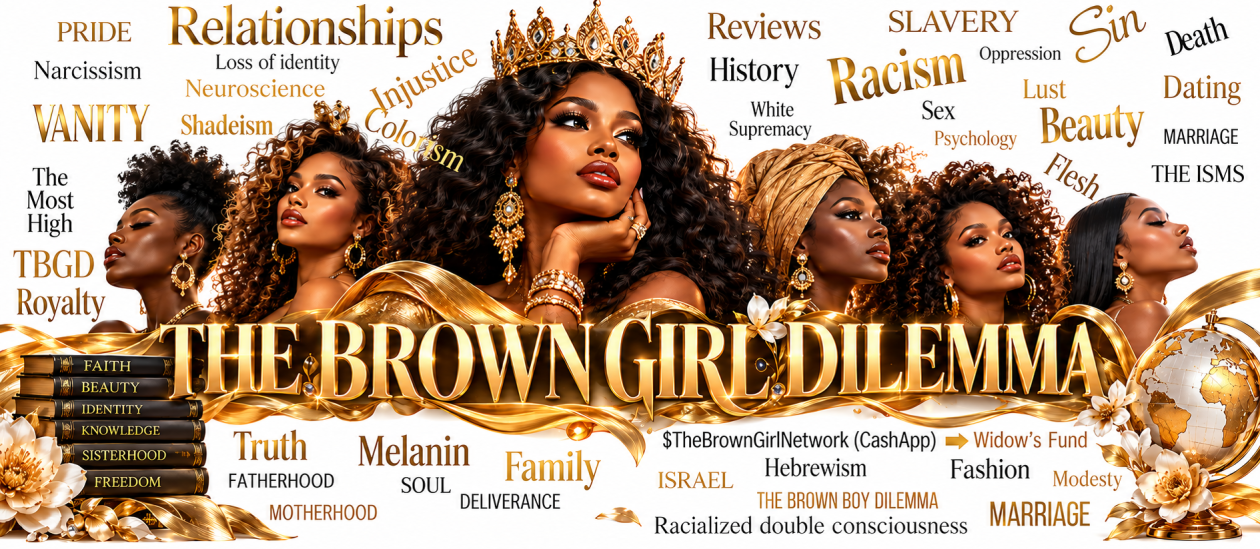
The Burden of Beauty: Brown Skin in a Colorist World. #thebrowngirldilemma

Photo by EZEKIXL AKINNEWU on Pexels.com

Beauty has always been both a blessing and a burden, especially for brown-skinned women navigating societies structured by colorism and white supremacy. The burden of beauty for the brown girl lies not only in external perceptions of her skin but also in the internalized struggles she must confront in affirming her own worth. In a world where lighter skin is often equated with superiority, desirability, and privilege, brown skin becomes a site of both fascination and rejection—desired for its exotic appeal yet devalued in the hierarchy of social status.

Historically, this burden is rooted in colonialism and slavery, where skin tone was weaponized as a measure of proximity to whiteness. Lighter-skinned women were often afforded marginal privileges, while darker-skinned women were relegated to harsher labor and harsher stereotypes (Hunter, 2007). This historical legacy continues in modern media, where Eurocentric beauty standards dominate, casting brown women as either hypersexualized or invisible. Such distortions create psychological weight, forcing many brown women to wrestle with feelings of inadequacy, envy, or invisibility.

Yet, paradoxically, the brown girl’s beauty is undeniable. Her skin is rich in melanin, biologically designed to protect and preserve, defying aging in a way the world calls “Black don’t crack.” Her hair grows in crowns of coiled resilience, testifying to strength and uniqueness. Still, the blessing of this natural beauty becomes a burden when society simultaneously covets and condemns it. For example, fashion and beauty industries often imitate brown features—full lips, curves, tanned skin—while marginalizing the very women who embody them naturally (Tate, 2016).

From a theological perspective, this burden of beauty is not merely social but spiritual. Scripture reminds us that beauty is not defined by outward appearance but by the inward spirit: “Whose adorning let it not be that outward adorning of plaiting the hair, and of wearing of gold… But let it be the hidden man of the heart, in that which is not corruptible, even the ornament of a meek and quiet spirit” (1 Peter 3:3–4, KJV). The brown girl’s true beauty rests not in meeting a colonial standard but in embracing her God-given design. Her worth is eternal, sealed by divine purpose, and not diminished by earthly bias.

Psychologically, carrying this burden often leads to both trauma and transformation. Studies on colorism reveal that women of darker complexions face greater discrimination in employment, relationships, and media representation (Keith & Herring, 1991). Yet, those who reclaim their identities often experience heightened resilience and self-definition. The process of unlearning colorist ideologies is itself an act of resistance—a reprogramming of the mind to embrace authenticity over assimilation.

Culturally, movements such as #MelaninMagic, #BlackGirlMagic, and natural hair revolutions signify collective rejection of imposed beauty hierarchies. They are testimonies that brown girls are no longer passive recipients of definition but active authors of their beauty narrative. Representation of dark-skinned actresses like Viola Davis, Danai Gurira, and Lupita Nyong’o has further chipped away at barriers, providing mirrors for young girls who previously saw none.

The burden of beauty, therefore, becomes an opportunity for liberation. Brown skin is not a curse but a crown; its richness tells the story of survival, endurance, and divine creativity. The true challenge lies not in the brown girl’s skin but in the world’s distorted lens. To confront colorism is to confront an entire system that profits from insecurity. When brown girls embrace their reflection, they transform the burden of beauty into a banner of pride, healing not only themselves but generations to come.

The brown girl dilemma, in this context, is not about being beautiful—it is about surviving the weight of being beautiful in a world that struggles to accept her as she is. Her power rests in remembering that her worth predates colonial hierarchies and transcends human judgment. Her beauty is eternal, rooted in divine creation, and no longer a burden when she learns to see it through God’s eyes.


References

  • Hunter, M. (2007). The Persistent Problem of Colorism: Skin Tone, Status, and Inequality. Sociology Compass, 1(1), 237–254.
  • Keith, V. M., & Herring, C. (1991). Skin tone and stratification in the Black community. American Journal of Sociology, 97(3), 760–778.
  • Tate, S. (2016). Skin Bleaching in Black and Brown Communities: Connected to Colorism and Colonialism. Palgrave Macmillan.
  • The Holy Bible, King James Version.

Black Women and Representation in Literature. #BlackWomenAuthors

Photo by Thought Catalog on Pexels.com

Representation matters. The stories we tell and the voices we amplify shape culture, identity, and self-worth. For centuries, literature often marginalized or misrepresented Black women, reducing them to stereotypes or erasing their experiences entirely. Yet, Black women writers and literary characters have fought to reclaim narrative space, offering authentic portrayals that celebrate resilience, intellect, and cultural identity. Their contributions illuminate the power of literature and the profound importance of representation.

During slavery and the post-emancipation era, Black women were frequently depicted through harmful stereotypes, such as the “mammy,” the “jezebel,” or the “tragic mulatto,” which reinforced social hierarchies and dehumanized Black women. Despite systemic erasure, their stories persisted through oral histories, spirituals, and later written works, preserving cultural memory and lived experience. Early literary trailblazers such as Phillis Wheatley, the first published African American poet, and Harriet E. Wilson, the first African American woman to publish a novel, broke barriers in the 18th and 19th centuries. Their works challenged prevailing racial and gender norms, providing insight into the intellect, faith, and resilience of Black women under oppression.

The Harlem Renaissance further elevated Black women’s voices in literature. Zora Neale Hurston, through works like Their Eyes Were Watching God and Mules and Men, celebrated the journey of self-discovery and the richness of Black Southern culture. Nella Larsen, author of Passing and Quicksand, explored the complexities of racial identity, colorism, and societal expectations. These writers foregrounded Black women’s experiences, challenging the silence and stereotypes imposed by mainstream literature.

Contemporary Black women writers continue this tradition with extraordinary impact. Toni Morrison, through novels like The Bluest Eye, Beloved, and Song of Solomon, explored the legacy of slavery, trauma, and cultural memory, portraying Black womanhood with depth and nuance. Alice Walker, in The Color Purple, celebrates female solidarity, spirituality, and self-realization amidst oppression. Audre Lorde and bell hooks interrogated the intersections of race, gender, and class, with works such as Sister Outsider and Ain’t I a Woman? providing insight into feminism, activism, and liberation.

Authors like Chimamanda Ngozi Adichie, with Purple Hibiscus, Americanah, and Half of a Yellow Sun, explore immigration, identity, and cultural displacement, while Roxane Gay, in Bad Feminist and Hunger, addresses trauma, body image, and social critique. Jesmyn Ward’s Salvage the Bones and Sing, Unburied, Sing depict resilience and family in the American South, and Nikki Giovanni’s poetry emphasizes love, community, and empowerment. Science fiction and Afrofuturism have also been reshaped by Black women writers like Octavia E. Butler (Kindred, Parable of the Sower) and Nnedi Okorafor (Binti, Who Fears Death), who explore race, gender, and identity within imaginative worlds. Claudia Rankine’s Citizen: An American Lyric examines contemporary racism and microaggressions, bridging literature and social consciousness. Misty Copeland, while primarily a ballet trailblazer, also contributes to cultural narratives around representation and excellence in artistic literature.

🌟 Trailblazers in Literature: Black Women Who Shaped the Narrative

Phillis Wheatley (1753–1784) – Poems on Various Subjects, Religious and Moral
Themes: Faith, intellect, early African American identity, resilience.

Harriet E. Wilson (1825–1900) – Our Nig
Themes: Slavery, race, gender, survival in Northern society.

Zora Neale Hurston (1891–1960) – Their Eyes Were Watching God, Mules and Men
Themes: Self-discovery, folklore, Southern Black culture, female empowerment.

Nella Larsen (1891–1964) – Passing, Quicksand
Themes: Racial identity, colorism, gender, societal expectations.

Toni Morrison (1931–2019) – The Bluest Eye, Beloved, Song of Solomon
Themes: Slavery, trauma, Black womanhood, cultural memory.

Alice Walker (b. 1944) – The Color Purple
Themes: Oppression, female solidarity, self-realization, spirituality.

Audre Lorde (1934–1992) – Sister Outsider, Zami: A New Spelling of My Name
Themes: Intersectionality, feminism, sexuality, activism.

bell hooks (1952–2021) – Ain’t I a Woman?, Feminist Theory: From Margin to Center
Themes: Gender, race, love, liberation, cultural critique.

Chimamanda Ngozi Adichie (b. 1977) – Purple Hibiscus, Americanah, Half of a Yellow Sun
Themes: Immigration, identity, feminism, cultural displacement.

Roxane Gay (b. 1974) – Bad Feminist, Hunger
Themes: Body image, trauma, race, feminism, social critique.

Jesmyn Ward (b. 1977) – Salvage the Bones, Sing, Unburied, Sing
Themes: Family, poverty, grief, Southern Black life, resilience.

Nikki Giovanni (b. 1943) – Black Feeling, Black Talk, Black Judgment, Love Poems
Themes: Civil rights, love, community, empowerment.

Octavia E. Butler (1947–2006) – Kindred, Parable of the Sower
Themes: Science fiction, social justice, race, human morality.

Claudia Rankine (b. 1963) – Citizen: An American Lyric
Themes: Racism, microaggressions, identity, social consciousness.

Nnedi Okorafor (b. 1974) – Binti, Who Fears Death
Themes: Afrofuturism, African culture, female empowerment, identity.

Literary representation has profound effects on identity and self-perception. Seeing multidimensional Black women as authors and characters empowers readers to value their intellect, creativity, and beauty. Psychological research demonstrates that positive representation strengthens self-efficacy, reduces internalized bias, and fosters a sense of belonging. Literature also provides a platform for exploring the intersection of faith, resilience, and cultural pride. Biblical principles affirm dignity and divine purpose, as Psalm 139:14 reminds us: “I am fearfully and wonderfully made” (KJV), emphasizing that worth is inherent and divinely assigned rather than dictated by societal bias.

Despite the remarkable achievements of Black women writers, challenges persist. Underrepresentation in mainstream publishing, limited critical recognition, and pressures to conform to marketable stereotypes continue to restrict opportunities. Advocacy for inclusive publishing, mentorship, and the celebration of authentic Black women’s voices remains crucial. Organizations such as the National Black Writers Conference and collectives like We Need Diverse Books provide mentorship, visibility, and resources, fostering a community that values authenticity and excellence.

Black women’s representation in literature is essential for cultural understanding, personal empowerment, and social justice. From Phillis Wheatley to Roxane Gay, Zora Neale Hurston to Chimamanda Ngozi Adichie, Black women writers have resisted erasure, reclaimed narratives, and inspired generations through their artistry and insight. Their stories affirm identity, challenge oppression, and celebrate the intellectual, spiritual, and cultural richness of Black womanhood.


References

  • West, C. (1995). Mammy, Jezebel, Sapphire, and Other Stereotypes: Black Women in Literature. Journal of African American Studies, 1(1), 45–60.
  • Tajfel, H., & Turner, J. C. (1986). The social identity theory of intergroup behavior. In S. Worchel & W. G. Austin (Eds.), Psychology of intergroup relations (pp. 7–24). Nelson-Hall.
  • Morrison, T. (1970). The Bluest Eye. Holt, Rinehart & Winston.
  • Hurston, Z. N. (1937). Their Eyes Were Watching God. J. B. Lippincott.
  • Walker, A. (1982). The Color Purple. Harcourt.
  • Adichie, C. N. (2013). Americanah. Knopf.

Gil Scott-Heron: The Voice of the Revolution that was Televised 🎤

🎤 The Voice of a Generation…..

Gil Scott-Heron was a poet, musician, novelist, and spoken-word prophet whose powerful lyrics and uncompromising critique of systemic racism made him a towering figure in Black consciousness and American protest culture. Best known for his seminal work “The Revolution Will Not Be Televised,” Scott-Heron used jazz, funk, and poetry to expose the hypocrisy of American democracy and ignite a deeper understanding of Black identity, oppression, and resilience.


🪶 Biography: A Revolutionary Mind

Gilbert Scott-Heron was born on April 1, 1949, in Chicago, Illinois, and raised in Jackson, Tennessee and later The Bronx, New York. His mother, Bobbie Scott, was a librarian and opera singer; his father, Gil Heron, was a Jamaican-born professional soccer player and the first Black man to play for Scotland’s Celtic FC. Scott-Heron was intellectually precocious, winning a full scholarship to the elite Fieldston School in New York and later attending Lincoln University—a historically Black university in Pennsylvania—where he began collaborating with future jazz great Brian Jackson.

He later earned his master’s degree in creative writing from Johns Hopkins University, blending literary talent with political activism and music.


📢 “The Revolution Will Not Be Televised” – A Cultural Detonation

First recorded in 1970, “The Revolution Will Not Be Televised” became an anthem for Black power and radical critique. Delivered in a gritty, urgent tone over a sparse conga beat, the piece warned against passive consumption of media, urging Black Americans to reject corporate distractions and confront real-world oppression.

“The revolution will not be brought to you by Xerox…The revolution will not go better with Coke.”

It rejected commercialism and fake liberalism, shaking the Black community out of political slumber. For many, it was a wake-up call to reclaim agency, identity, and justice—decades before terms like “woke” were popularized. It remains a cornerstone of hip-hop, neo-soul, and conscious rap, influencing artists like Public Enemy, Kendrick Lamar, Common, and Kanye West.


💍 Marriage, Family, and Struggles

Scott-Heron was married to Brenda Sykes, an actress, and had several children, including Gia Scott-Heron, a poet. His personal life, however, was often turbulent. He struggled with drug addiction, particularly crack cocaine, which led to multiple arrests and prison stints.

He died on May 27, 2011, in New York City, reportedly from complications related to HIV/AIDS, as well as pneumonia.


🏆 Awards and Recognition

Despite his commercial limitations, Scott-Heron was widely revered:

  • Grammy Lifetime Achievement Award (posthumously, 2012)
  • BET Honors and various tributes by musical peers
  • Inducted into the Rock and Roll Hall of Fame (2021) under the category of Early Influence

Critics often credit him as the “godfather of rap,” though he personally rejected the label, arguing that his work was rooted more in Blues, Jazz, and Soul-inflected poetry than the structure of hip-hop.


📚 Literary Work: The Vulture (1970)

Gil Scott-Heron was also an accomplished novelist. His debut novel The Vulture was a gripping urban murder mystery that explored themes of race, violence, and identity in Harlem. The story follows the murder of a young Black man and the perspectives of four friends as they try to uncover the truth.

Written when he was just 19, the novel was raw, honest, and infused with street dialect, jazz rhythms, and sociopolitical tension. Scott-Heron wrote it because he saw literature as another weapon to confront societal neglect and expose the real conditions of inner-city youth. The novel was praised for giving voice to disenfranchised Black characters in a way few literary works had done before.


🤍 Reception from White America

Scott-Heron’s message was unapologetically pro-Black and critical of systemic whiteness, so mainstream (largely white) America viewed him with caution, if not outright hostility. However, progressive white intellectuals and musicians appreciated his genius. Over time, as social justice became a broader conversation, even mainstream outlets began to recognize his prophetic insight.


🧠 What He Thought and Said

Scott-Heron was not only a performer but also a philosopher of Black struggle. One of his most quoted lines:

“The first revolution is when you change your mind.”
—Gil Scott-Heron, The Mind of Gil Scott-Heron (1978)

He believed liberation began with mental transformation—a message that deeply influenced Black consciousness movements.


🔥 Legacy and Influence

Scott-Heron’s work laid the foundation for conscious hip-hop, Black Lives Matter rhetoric, and modern spoken word. His uncompromising style still echoes through the works of artists like Nas, Mos Def, Erykah Badu, and Common.

Though he passed away in 2011, Gil Scott-Heron’s prophetic voice still resonates in every protest, every poem, and every performance that dares to tell the truth.


📚 References

Dilemma: Misogynoir

The Unique Discrimination Against Black Women

Photo by Bave Pictures on Pexels.com

Misogynoir—a term coined by Moya Bailey (2010)—captures the specific intersection of racism and sexism that Black women face. Unlike generalized sexism or racism, misogynoir uniquely blends both to create social, cultural, and psychological burdens for Black women. It is manifested in harmful stereotypes that distort their humanity and confine them to demeaning roles. The “angry Black woman” trope frames Black women as hostile, aggressive, and perpetually dissatisfied, disregarding the legitimate roots of their frustration in systemic injustice. The hypersexualized “jezebel” stereotype objectifies Black women, reducing them to their bodies and marking them as sexually available. Meanwhile, the “mammy” archetype portrays Black women as self-sacrificing caretakers, expected to prioritize others’ needs at the expense of their own. These stereotypes have persisted from slavery into the present day, shaping workplace dynamics, media representation, and interpersonal relationships (Collins, 2000).

From a psychological standpoint, these stereotypes function as a form of “stereotype threat” (Steele, 1997), in which awareness of negative perceptions can hinder performance, increase stress, and damage self-concept. Black women often navigate “double consciousness” (Du Bois, 1903), a fractured identity where they see themselves through both their own cultural lens and the distorted gaze of a white, patriarchal society. This duality can lead to anxiety, depression, and diminished self-esteem (Watson-Singleton, 2017). Furthermore, the internalization of misogynoir reinforces cycles of silence, guilt, or perfectionism, where Black women feel compelled to “work twice as hard” to prove their worth. Psychology affirms that such sustained exposure to stress produces physical consequences, often termed “weathering” (Geronimus, 1992), leading to earlier onset of health disparities such as hypertension and heart disease.

The King James Bible reminds us that stereotypes and false witness are contrary to God’s commandments. Proverbs 31:10–31 exalts the virtuous woman, describing her as strong, wise, and industrious—not angry, oversexualized, or expendable. God calls women to be valued as His image-bearers (Genesis 1:27), not diminished by human prejudice. Ephesians 4:29 warns, “Let no corrupt communication proceed out of your mouth, but that which is good to the use of edifying.” Thus, speech and actions rooted in misogynoir are not only socially destructive but also spiritually sinful. The Bible underscores that all slander and demeaning words are falsehoods, and in God’s sight, women are honored creations with divine purpose.

Overcoming misogynoir requires both personal and collective strategies. Spiritually, Black women and communities are called to reclaim identity in God’s truth, remembering that liberation begins with obedience to His commandments and the refusal to internalize lies. As Romans 12:2 reminds, “Be not conformed to this world: but be ye transformed by the renewing of your mind.” Healing begins by rejecting false stereotypes and embracing God’s definition of worth. Psychologically, access to therapy, affirming spaces, and intergenerational support networks counter the damage of stereotype threat and provide avenues for resilience. Collective affirmation of beauty, intelligence, and dignity serves as a cultural shield against internalized oppression.

Socially, dismantling misogynoir means challenging media portrayals, workplace discrimination, and community dynamics that recycle harmful tropes. Black men in particular bear responsibility for rejecting narratives that demean Black women, while allies of all backgrounds must amplify voices that resist sexist-racist imagery. Policy reforms addressing wage gaps, healthcare disparities, and violence against Black women also play a crucial role in reducing the systemic roots of misogynoir. Building unity within the Black community, rooted in love and respect, strengthens collective resistance and ensures that oppressive frameworks are not perpetuated internally.

Ultimately, the dilemma of misogynoir is overcome by centering truth—biblical truth that affirms dignity, psychological truth that validates lived experiences, and social truth that reclaims narrative power. As Michelle Obama (2018) once said, “We need to do a better job of putting ourselves higher on our own ‘to-do list.’” Black women must be honored as full, complex beings, not limited by stereotypes. When society begins to see Black women through the lens of God’s truth and not historical lies, healing, restoration, and justice can emerge for future generations.


📚 References

  • Bailey, M. (2010). They aren’t talking about me… Misogynoir in hip-hop culture.
  • Collins, P. H. (2000). Black feminist thought. Routledge.
  • Du Bois, W. E. B. (1903). The Souls of Black Folk.
  • Geronimus, A. T. (1992). The weathering hypothesis. Ethnicity & Disease, 2(3), 207–221.
  • Steele, C. (1997). A threat in the air: How stereotypes shape intellectual identity. American Psychologist, 52(6), 613–629.
  • Watson-Singleton, N. (2017). Strong Black woman schema and mental health. Journal of Black Psychology, 43(8), 771–789.