Tag Archives: the brown girl dilemma

The Journey to God: Spiritual Habits that Transform Your Life.

Developing a deep and meaningful relationship with God requires intentionality, discipline, and spiritual focus. The Christian life is often described as a journey—a process of growth, transformation, and alignment with divine purpose (Philippians 3:12–14, KJV). Spiritual habits, when practiced consistently, form the foundation of this journey, shaping character, strengthening faith, and fostering intimacy with the Lord.

Prayer is one of the most fundamental habits for spiritual transformation. Through prayer, believers communicate with God, express gratitude, seek guidance, and intercede for others (1 Thessalonians 5:16–18). Consistent prayer cultivates dependence on God and trains the heart to align with His will. The practice of private, uninterrupted prayer develops patience, self-discipline, and sensitivity to the Holy Spirit (Matthew 6:6).

Scripture study is another essential habit. The Bible is described as “the sword of the Spirit” and a lamp to guide the believer’s path (Ephesians 6:17; Psalm 119:105). Daily engagement with Scripture allows the mind to be renewed (Romans 12:2), equips believers for spiritual battles, and teaches wisdom, discernment, and godly living. Meditating on God’s Word fosters internal transformation by embedding divine truth in thought patterns and behavior.

Worship and praise—both private and corporate—help believers experience God’s presence and cultivate gratitude. Worship is not limited to music but includes acts of obedience, service, and thanksgiving (Psalm 100:2; Colossians 3:16). Regular praise reorients the heart away from self-reliance and toward recognition of God’s sovereignty. It strengthens faith, increases joy, and fosters a sense of spiritual community.

Fasting and self-discipline play a critical role in focusing the believer’s spiritual energy. Fasting is a biblical practice for humbling oneself, seeking clarity, and deepening reliance on God (Matthew 4:1–2; Isaiah 58:6). By denying the flesh, believers cultivate spiritual sensitivity, patience, and resilience. Self-discipline in other areas, such as controlling speech, thoughts, and desires, reinforces obedience to God and encourages a Christ-centered life (1 Corinthians 9:27).

Service and acts of love are practical habits that transform the believer’s heart while honoring God. Serving others reflects Christ’s love and fulfills the command to love one’s neighbor (Matthew 22:37–39; James 1:27). Regular acts of service cultivate humility, empathy, and a broader perspective that transcends self-interest. Spiritual growth is inseparable from outward expressions of God’s love in action.

Fellowship and accountability with other believers are also crucial. The Bible emphasizes the importance of mutual encouragement and correction in spiritual communities (Hebrews 10:24–25; Proverbs 27:17). Consistent fellowship helps believers stay steadfast, gain wisdom, and receive guidance from mature Christians. Accountability encourages integrity, reduces spiritual drift, and reinforces the application of spiritual habits in daily life.

Finally, gratitude and reflection are habits that nurture a continuous awareness of God’s presence. Reflecting on His faithfulness and recording answered prayers or spiritual lessons can strengthen faith during trials and maintain perspective in success (1 Thessalonians 5:18; Psalm 77:11–12). Gratitude reorients the heart toward God and fosters joy, peace, and contentment.

In essence, the journey to God is not a single event but a lifelong process of intentional spiritual practice. By cultivating prayer, Scripture study, worship, fasting, service, fellowship, and gratitude, believers align their hearts and minds with God’s will. These spiritual habits transform character, deepen intimacy with the Lord, and empower the believer to navigate life’s challenges with wisdom, faith, and perseverance. The Christian journey is a sacred rhythm of learning, growing, and reflecting God’s love in every aspect of life.


References

Alexander, T. D. (2001). 1 & 2 Timothy and Titus: An exegetical and theological exposition of Holy Scripture. B&H Publishing.

Dever, M. (2012). A display of God’s glory: The beauty of living the gospel. Crossway.

Foster, R. (1998). Celebration of discipline: The path to spiritual growth. HarperCollins.

Keller, T. (2012). Every good endeavor: Connecting your work to God’s work. Dutton.

Willard, D. (2002). Renovation of the heart: Putting on the character of Christ. NavPress.

The Holy Bible, King James Version. (1611/2017). Cambridge University Press.

Black Women in Leadership: Navigating Corporate America with Excellence

Black women in leadership occupy a unique position in corporate America, balancing professional responsibilities with societal expectations and systemic challenges. Their presence in executive roles is still disproportionately low, yet their impact is profound, influencing organizational culture, decision-making, and diversity initiatives. Understanding the nuances of effective leadership for Black women requires examining both personal development and structural navigation.

Effective leadership begins with self-awareness. Understanding one’s strengths, weaknesses, and leadership style allows Black women to lead authentically. Emotional intelligence, including the ability to empathize, communicate effectively, and manage interpersonal dynamics, is a cornerstone of effective leadership. Self-aware leaders inspire trust, credibility, and loyalty among colleagues and teams.

Mentorship and sponsorship are critical tools for advancement. Black women leaders benefit from relationships with mentors who provide guidance, feedback, and strategic advice. Sponsorship, in contrast, involves advocates who actively promote career growth and visibility within the organization. Building these networks creates pathways for recognition, promotion, and professional influence.

Strategic vision is another essential component. Leaders must articulate clear goals, communicate expectations, and inspire their teams to execute strategies effectively. Black women leaders who demonstrate clarity of vision often create alignment across departments, foster collaboration, and drive organizational success. This requires both analytical acumen and the ability to translate complex strategies into actionable initiatives.

Resilience is particularly important for Black women navigating corporate environments that may be implicitly or explicitly biased. Developing mental toughness, stress management skills, and adaptive coping strategies allows leaders to persevere despite obstacles. Resilient leaders model composure under pressure and create organizational cultures that value problem-solving and growth mindset approaches.

Communication skills are indispensable. Leaders must be able to present ideas persuasively, negotiate effectively, and manage conflict constructively. Public speaking, active listening, and storytelling are tools that enable Black women leaders to convey their vision, inspire teams, and advocate for themselves and others in executive spaces.

Cultural competence strengthens leadership efficacy. Black women leaders often serve as bridges across diverse teams, translating experiences and perspectives in ways that enhance inclusion. Understanding systemic inequities, microaggressions, and organizational dynamics enables leaders to create environments where diverse employees feel valued and empowered to contribute meaningfully.

Time management and delegation are practical strategies that elevate leadership effectiveness. Leaders who prioritize tasks, delegate responsibilities appropriately, and focus on high-impact activities maximize productivity while preventing burnout. This is especially critical for Black women who may face disproportionate scrutiny and pressure to excel continuously.

Confidence balanced with humility is another hallmark of effective leadership. Black women must advocate for themselves while maintaining openness to feedback and collaboration. Demonstrating confidence encourages respect and authority, while humility ensures approachability and fosters a team-oriented culture.

Decision-making skills are essential. Leaders must analyze complex data, anticipate potential outcomes, and make informed choices. Integrating input from diverse stakeholders while remaining decisive ensures that leadership decisions are strategic, ethical, and aligned with organizational goals.

Professional branding and visibility cannot be overlooked. Black women leaders must actively showcase their accomplishments, engage in professional networks, and maintain a presence in high-profile projects. Visibility not only enhances career advancement but also positions leaders as role models for aspiring professionals.

Continuous learning is vital in dynamic corporate landscapes. Engaging in professional development, leadership programs, and executive education helps Black women stay abreast of industry trends, technological innovations, and best practices. Lifelong learning enhances credibility, adaptability, and overall leadership impact.

Advocacy for equity and inclusion is integral. Black women leaders often champion policies and initiatives that create equitable opportunities for employees across racial, gender, and socioeconomic lines. Their leadership influences organizational culture and sets a precedent for accountability in diversity and inclusion efforts.

Networking beyond the organization amplifies influence. Participation in professional associations, conferences, and thought leadership initiatives creates access to resources, knowledge, and collaborative opportunities. Expanding networks strengthens leadership presence and facilitates the exchange of innovative ideas.

Ultimately, effective leadership for Black women requires a holistic approach: blending personal development, strategic vision, resilience, communication, cultural competence, and advocacy. By leveraging these skills and strategies, Black women can navigate corporate America successfully, break barriers, and leave lasting legacies that inspire future generations.


References

Catalyst. (2020). Women in leadership at S&P 500 companies. https://www.catalyst.org/research/women-in-sp-leadership/

Herring, C., & Henderson, L. (2019). Diversity in organizations: Current perspectives and future directions. Routledge.

Ibarra, H., Carter, N. M., & Silva, C. (2010). Why men still get more promotions than women. Harvard Business Review. https://hbr.org/2010/09/why-men-still-get-more-promotions-than-women

Sandberg, S. (2013). Lean in: Women, work, and the will to lead. Knopf.

Thomas, D. A., & Ely, R. J. (1996). Making differences matter: A new paradigm for managing diversity. Harvard Business Review, 74(5), 79–90.

Dilemma: Blackness

Photo by Wavy_ revolution on Pexels.com

The concept of Blackness embodies both divine purpose and societal marginalization. This paper explores the paradoxical experience of Black people: exalted by God yet diminished by the world. Drawing from Scripture, African historical scholarship, and sociocultural studies, the paper examines how Black identity has been misrepresented, appropriated, and simultaneously celebrated. The discussion addresses historical, psychological, and spiritual dimensions of Blackness, highlighting resilience, chosenness, and divine destiny.


Blackness represents more than a physical characteristic; it is a spiritual, cultural, and historical identity that has shaped civilizations, contributed to global progress, and faced systemic oppression. Historically, African civilizations such as Kemet, Mali, and Ethiopia exemplified innovation, scholarship, and governance, demonstrating Black excellence prior to European colonial interventions (Diop, 1974). Yet, contemporary social structures often fail to acknowledge this legacy, producing tension between inherent value and societal perception. This tension can be conceptualized as the “dilemma of Blackness”: exalted by God, yet diminished by human systems.


Divine Identity and Chosenness

Scripture affirms the divine purpose inherent in Black identity. “Ye are a chosen generation, a royal priesthood” (1 Peter 2:9, KJV). The Bible situates African peoples as integral to God’s plan, as evidenced in references to Cush, Ethiopia, and Egypt (Psalm 68:31, KJV; Acts 8:27, KJV). This divine chosenness establishes a spiritual framework for resilience, dignity, and legacy.


Historical Context of Oppression

Despite divine design, Black people have endured centuries of systemic oppression. Enslavement, colonialism, and institutionalized racism sought to erase cultural memory, distort identity, and suppress potential (Muhammad, 2010; Du Bois, 1903). Enslaved Africans were denied literacy, property, and familial autonomy, yet preserved spiritual practices and communal solidarity, demonstrating both resistance and divine fidelity (Fanon, 1967).


Cultural Appropriation and Misrepresentation

A critical facet of the dilemma is the simultaneous appropriation and marginalization of Black culture. Music, fashion, language, and spirituality have been widely adopted by global societies while the creators remain undervalued (Asante, 1988; hooks, 1995). This contradiction reinforces the paradoxical experience of Black identity: celebrated superficially but denied authentic acknowledgment.


Psychological Dimensions

The internalization of societal bias has produced psychological tension, as theorized by Du Bois (1903) in the concept of double consciousness. Black individuals navigate dual realities: embracing inherent worth while confronting misperceptions and prejudice. Psychological resilience emerges through community, faith, and cultural continuity, facilitating coping mechanisms in the face of persistent marginalization.


The Role of Faith

Faith has historically anchored Black identity. Spirituality and religion provided a lens for understanding suffering and endurance. The enslaved relied on faith-based songs, prayers, and scripture to sustain hope (“Let my people go”, Exodus 5:1, KJV). Contemporary Black communities continue to rely on biblical principles to navigate systemic inequities, affirming God as the ultimate arbiter of worth (Isaiah 54:17, KJV).


Resistance and Resilience

Blackness embodies resilience. Resistance has manifested through education, civil rights activism, entrepreneurship, and cultural preservation (Bell, 1992; Woodson, 1933). This resilience aligns with prophetic scripture: “No weapon that is formed against thee shall prosper” (Isaiah 54:17, KJV). Through trials, Black communities have transformed oppression into cultural, intellectual, and spiritual advancement.


Identity and Modern Society

In contemporary contexts, Black identity is often commodified. Social media, entertainment, and consumer culture showcase Black excellence aesthetically while minimizing structural support or historical context (Karenga, 2002). This commodification reflects a persistent societal discomfort with authentic Black power, echoing historical patterns of marginalization.


The Dilemma of Recognition

The tension between visibility and invisibility characterizes the dilemma. Black contributions are integral to global progress, yet Black people remain underrepresented in leadership, academia, and economic control (Muhammad, 2010; Asante, 1988). Recognition is partial, conditional, and often superficial, reinforcing the ongoing paradox.


The Spiritual Imperative

Spirituality provides a counter-narrative to worldly diminishment. By centering God as the source of identity, Black people navigate societal misunderstanding with divine perspective. “The steps of a good man are ordered by the Lord” (Psalm 37:23, KJV). Blackness is reframed not as a social liability but as a divine blessing and instrument of purpose.


Conclusion

Blackness represents both a historical challenge and a divine calling. The dilemma lies not in identity but in the world’s inability to reconcile with it. Black people embody resilience, creativity, and divinely ordained worth. The reconciliation of societal misperception with spiritual truth is ongoing. As the world struggles to comprehend Black excellence, faith and historical awareness provide the foundation for self-definition, legacy, and empowerment.


References

Asante, M. K. (1988). Afrocentricity: The theory of social change. African American Images.

Bell, D. (1992). Faces at the bottom of the well: The permanence of racism. Basic Books.

Diop, C. A. (1974). The African origin of civilization: Myth or reality. Lawrence Hill Books.

Du Bois, W. E. B. (1903). The souls of Black folk. A. C. McClurg & Co.

Fanon, F. (1967). Black skin, white masks. Grove Press.

hooks, b. (1995). Killing rage: Ending racism. Henry Holt and Co.

Karenga, M. (2002). Introduction to Black studies (3rd ed.). University of Sankore Press.

Muhammad, K. G. (2010). The condemnation of Blackness: Race, crime, and the making of modern urban America. Harvard University Press.

Woodson, C. G. (1933). The mis-education of the Negro. Associated Publishers.

Holy Bible, King James Version (KJV).

Girl Talk Series: Faith, Femininity & Future.

Ladies, first and foremost, remember that your life is in the hands of a loving God. Seek Him first in all things, and pray earnestly for His will to be done in your life. By centering your relationship with Him, you create a foundation that guides your choices, relationships, and personal growth (Matthew 6:33, KJV).

Faith is not just a Sunday ritual; it is a daily practice that informs every decision you make. As women, our spiritual strength sets the tone for our emotional, mental, and social well-being. Engaging with scripture, prayer, and worship equips us to navigate life’s challenges with wisdom and grace (Hebrews 11:1).

Femininity is a divine gift. It is not defined solely by appearance, style, or societal expectations, but by character, poise, and the ability to influence with gentleness and confidence. Proverbs 31:25 reminds us that strength and honor are her clothing, and she rejoices in the days to come. Embracing your femininity means recognizing your inherent worth in God’s eyes.

Understanding your purpose is crucial for shaping your future. Life can present distractions, temptations, and pressure to conform to worldly standards. By remaining anchored in faith, you can discern what aligns with God’s plan versus what is fleeting or superficial (Jeremiah 29:11).

Healthy boundaries are essential in protecting your heart, time, and emotional energy. Setting limits in friendships, romantic relationships, and professional spaces demonstrates self-respect and ensures that your focus remains on growth and godly priorities (Proverbs 4:23).

Education and personal development are acts of stewardship over your God-given talents. Pursue knowledge, skill-building, and experiences that broaden your capacity to serve, lead, and contribute meaningfully to society. Wisdom is more valuable than gold, and a disciplined mind honors God (Proverbs 3:13–14).

Sisterhood is powerful when nurtured with love, encouragement, and accountability. Surround yourself with women who uplift you, challenge you to grow, and inspire you to walk in faith. As iron sharpens iron, supportive relationships strengthen character and purpose (Proverbs 27:17).

Emotional intelligence is a cornerstone of mature femininity. Understanding your feelings, responding thoughtfully, and navigating conflict with grace reflects both wisdom and self-control. Galatians 5:22–23 highlights the fruit of the Spirit, including love, peace, and patience—qualities that sustain healthy interactions.

Self-respect and self-worth begin with recognizing your divine identity. You are fearfully and wonderfully made, created in God’s image (Psalm 139:14). No external validation can replace the confidence that comes from understanding your spiritual value.

Practical wisdom in dating and relationships protects your heart and preserves your future. Seek partners who share your values, respect your boundaries, and pursue godly intimacy. Avoid situations that compromise your integrity or emotional well-being (1 Corinthians 6:18–20).

Financial literacy and independence empower women to steward resources responsibly. Money is a tool to support your goals, generosity, and stability. Proverbs 31:16 describes the virtuous woman as one who considers a field and buys it; wise financial management reflects discernment and preparation.

Health and self-care are spiritual responsibilities as well as physical necessities. Treat your body as a temple of the Holy Spirit, honoring God through nutrition, exercise, and rest (1 Corinthians 6:19–20). Holistic wellness ensures energy, clarity, and longevity for life’s pursuits.

Your voice matters. Express your ideas, dreams, and convictions with confidence and humility. Women who speak with clarity and kindness can influence communities, workplaces, and families, demonstrating the power of godly communication (Proverbs 31:26).

Faith equips you to face trials without despair. Challenges will come, but a prayerful and trusting heart can endure hardship with hope. Romans 12:12 encourages rejoicing in hope, patience in tribulation, and steadfastness in prayer.

Mentorship is invaluable. Seek guidance from older, experienced women of faith, and be willing to mentor younger sisters in turn. This generational exchange strengthens both individual lives and the broader community (Titus 2:3–5).

Creativity and expression honor God when used with intention. Whether through art, music, writing, or entrepreneurship, your talents can inspire others and glorify the Creator. Colossians 3:23 reminds us to work heartily as for the Lord, not men.

Resilience is cultivated through prayer, patience, and perseverance. Life may present setbacks, but steadfast faith and a positive mindset ensure that obstacles become lessons and opportunities (James 1:2–4).

Forgiveness frees the heart. Holding onto bitterness or past hurt limits your potential and blocks God’s plan for your life. Ephesians 4:31–32 calls us to put away anger, bitterness, and malice, and to be kind and forgiving.

Gratitude transforms perspective. Daily recognition of God’s blessings fosters joy, humility, and contentment, shaping a mindset that thrives even in adversity (1 Thessalonians 5:18).

Finally, embrace your future with courage and faith. God’s plans are perfect, and trusting Him allows you to walk confidently into your purpose. Commit your ambitions, relationships, and aspirations to Him, and watch as He orchestrates a life of blessing, influence, and fulfillment (Jeremiah 29:11).

Dilemma: The Pros and Cons of Being Black in Society.

The experience of being Black in modern society is multifaceted, complex, and deeply influenced by historical, social, and systemic factors. While there are many sources of pride, cultural richness, and resilience within Black communities, these are often juxtaposed with enduring structural inequalities, societal prejudices, and personal dilemmas that affect daily life. Understanding this duality requires both historical context and contemporary analysis.

Historically, the Black experience has been marked by the transatlantic slave trade, colonization, and systemic oppression. These historical realities have shaped social structures, economic opportunities, and cultural perceptions in ways that continue to affect Black individuals today. Deuteronomy 28:43-44 (KJV) warns that disobedience leads to subjugation, which resonates metaphorically in discussions of generational oppression and societal marginalization.

One prominent challenge is systemic racism, which manifests in employment, housing, healthcare, and education. Despite decades of civil rights advancements, Black individuals frequently encounter barriers that limit social mobility. Studies show that Black applicants are less likely to be called for job interviews compared to White applicants with identical resumes (Bertrand & Mullainathan, 2004). Such disparities illustrate that merit alone does not eliminate discrimination.

Another societal challenge is criminal justice bias. Black communities are disproportionately targeted by law enforcement, resulting in higher arrest and incarceration rates. According to the NAACP, Black Americans are incarcerated at more than five times the rate of White Americans. This over-policing contributes to cycles of poverty, familial disruption, and community distrust, creating profound social dilemmas for Black families.

Education represents both a challenge and a source of opportunity. Historically underfunded schools in Black neighborhoods often provide fewer resources, which perpetuates educational inequities. Yet, Black students who overcome these obstacles demonstrate remarkable resilience and achievement, often excelling academically and culturally despite systemic disadvantages. Proverbs 22:6 (KJV) emphasizes the importance of early training and guidance, highlighting the potential power of nurturing and support.

Cultural pride and identity are undeniable pros of being Black. From music and art to fashion and language, Black culture has enriched global society. The spread of hip-hop, Afrobeat, and literature by Black authors showcases creativity and influence that transcends racial boundaries. This cultural visibility fosters empowerment and serves as a reminder of a rich ancestral heritage.

Community solidarity is another significant advantage. Black communities often demonstrate strong family bonds, church networks, and mutual support systems. Churches, historically central to Black life, provide spiritual guidance, social activism, and a sense of belonging. Psalm 133:1 (KJV) celebrates unity, which resonates with the communal cohesion often observed in Black societies.

Yet, colorism within the Black community itself presents internal dilemmas. Preference for lighter skin tones often mirrors societal biases inherited from colonialism and slavery. This internalized prejudice can affect self-esteem, social perception, and personal relationships, creating tension within communities that otherwise share cultural pride.

Representation in media is a double-edged sword. While more Black faces appear in entertainment, sports, and politics, the industry often emphasizes stereotypical roles, beauty standards, and tokenism. While visibility can inspire, it can also impose limiting expectations. The struggle for authentic portrayal remains ongoing, reflecting broader societal dilemmas.

Economic disparities remain a persistent challenge. The racial wealth gap shows that Black households typically hold a fraction of the assets of White households. This gap affects homeownership, business investment, and generational wealth accumulation. Proverbs 21:20 (KJV) highlights the wisdom of prudent resource management, a principle made more challenging under systemic economic disadvantage.

Health disparities compound these challenges. Black communities face higher rates of chronic illnesses, limited access to quality healthcare, and environmental health hazards. COVID-19, for example, disproportionately affected Black populations due to preexisting health inequities and socioeconomic vulnerabilities. These disparities illustrate the tangible consequences of systemic neglect.

Despite these challenges, Black excellence is increasingly recognized globally. Figures in politics, science, business, and the arts exemplify achievement that counters negative stereotypes. Celebrating such accomplishments fosters pride, aspiration, and resilience, reinforcing the potential for success even amid adversity.

Spiritual resilience is another advantage. Many Black individuals find strength and guidance through faith. Biblical teachings, such as Isaiah 40:31 (KJV), provide hope and endurance: “They that wait upon the Lord shall renew their strength.” Faith often serves as a stabilizing force amid societal challenges, offering both solace and motivation.

Black identity often fosters creativity, adaptability, and problem-solving skills. Navigating systemic obstacles requires ingenuity and resourcefulness, traits that are highly valuable in both personal and professional contexts. These adaptive skills can empower individuals to excel even in restrictive environments.

Interpersonal relationships are shaped by societal perceptions. While some Black individuals experience bias or exclusion, strong mentorship, networking, and cultural affinity can counteract isolation. These relationships foster opportunity, guidance, and resilience, highlighting the importance of social capital in overcoming systemic barriers.

Experiences of discrimination often instill a heightened awareness of social justice issues. Black individuals frequently become advocates for equity, education, and reform, contributing to broader societal change. This activist orientation demonstrates both the burden and the empowerment that can arise from lived experience.

However, microaggressions—subtle, often unintentional slights—permeate daily life. These can erode mental health, self-esteem, and overall well-being. Black individuals often must navigate these invisible challenges while maintaining composure, a psychological burden that underscores the complexity of societal interaction.

Cultural legacy provides a profound source of pride. Knowledge of African ancestry, historical resilience, and contributions to civilization empowers Black individuals to claim identity and dignity. Works by historians such as Cheikh Anta Diop and Molefi Kete Asante illuminate the rich heritage often overlooked by mainstream narratives.

The intersectionality of identity adds layers to the dilemma. Gender, sexuality, socioeconomic status, and nationality intersect with race to shape individual experiences. Black women, for instance, navigate compounded biases in both racial and gendered contexts, highlighting the multifaceted nature of oppression and resilience.

Finally, being Black in society is both a challenge and an opportunity. While systemic inequities, bias, and historical trauma present undeniable obstacles, the cultural richness, resilience, and global influence of Black communities demonstrate profound strength. Navigating this duality requires awareness, advocacy, and faith.

In conclusion, the dilemma of being Black in society reflects a tension between oppression and empowerment, struggle and resilience, exclusion and recognition. Understanding both the pros and cons encourages empathy, informed action, and a celebration of Black identity while confronting persistent inequities. As Psalm 34:18 (KJV) reminds, “The Lord is nigh unto them that are of a broken heart,” offering hope and justice amid societal challenges.

References

  • Bertrand, M., & Mullainathan, S. (2004). Are Emily and Greg more employable than Lakisha and Jamal? A field experiment on labor market discrimination. American Economic Review, 94(4), 991–1013.
  • NAACP. (2020). Criminal justice fact sheet.
  • Diop, C. A. (1974). The African origin of civilization: Myth or reality. Lawrence Hill & Company.
  • Asante, M. K. (1991). The Afrocentric idea. Temple University Press.
  • Holy Bible, King James Version.

Dilemma: Black Hair Discrimination

The Politics of Policing Black Identity

Angela Davis

“I had been looking at pictures of women who were free, and they were wearing their hair the way it grows out of their heads.”
(Davis, A. Y., Women, Race & Class, 1981)

Chimamanda Ngozi Adichie

“Hair is political. Hair is personal. Hair is identity.”
(Adichie, C. N., Americanah, 2013)

Bell Hooks

“Straightening our hair is one of the many ways we try to erase the reality of our Blackness.”
(Hooks, b., Black Looks: Race and Representation, 1992)

Lupita Nyong’o

“What I learned is that when the world tells you you’re not enough, you don’t have to believe it.”
(Nyong’o, L., Sulwe, 2019)

“Black hair is not a trend, a problem, or a phase—it is a living archive of survival, resistance, and ancestral memory.”

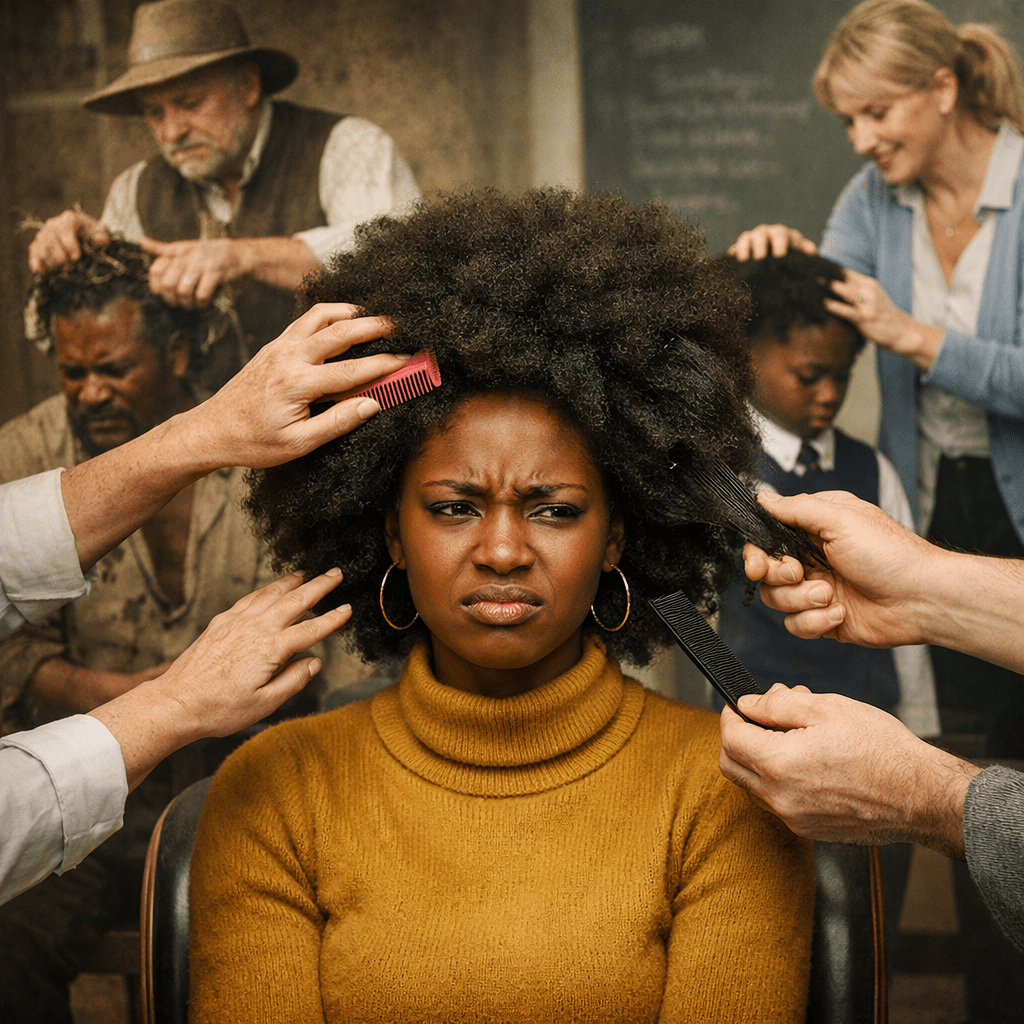
Black hair discrimination remains one of the most visible and normalized forms of racial bias in modern society. From classrooms to corporate offices, Black hair is disproportionately scrutinized, regulated, and punished under the guise of “professionalism,” “neatness,” or “dress code policies.” These standards are not neutral; they are rooted in Eurocentric ideals that define straight, loose, and non-textured hair as the default measure of beauty and respectability. As a result, Black people are often forced to alter their natural hair to gain acceptance, employment, or basic dignity.

In schools, Black children are suspended, sent home, or humiliated for wearing braids, locs, Afros, twists, or even natural curls. These disciplinary practices communicate a dangerous message: that Black identity itself is disruptive and unacceptable. When a child’s natural hair becomes grounds for punishment, the educational system participates in psychological harm that can shape self-esteem and identity formation for life. The classroom becomes not a place of learning, but a site of racial conditioning.

In the workplace, similar patterns persist. Black professionals are routinely told their hair is “unprofessional,” “distracting,” or “unkept,” even when it is clean, styled, and culturally appropriate. This forces many to chemically straighten their hair, wear wigs, or suppress their natural texture in order to be perceived as competent. Such pressures reveal how deeply white norms are embedded in institutional culture, where assimilation is often required for survival.

The hatred toward Black hair did not originate in modern offices or schools—it was cultivated during slavery. Enslaved Africans were stripped of their cultural grooming practices and taught to associate straight hair with proximity to whiteness and social advantage. Field laborers, who often had tightly coiled hair, were deemed inferior, while those with looser textures were privileged within the plantation hierarchy. Hair became a racial marker used to rank human worth.

This legacy did not disappear after emancipation. It evolved into colorism and texture discrimination, where straighter hair is still associated with beauty, intelligence, and professionalism, while kinky or coiled hair is labeled “nappy,” “bad,” or “ugly.” These terms, passed down through generations, reflect internalized racism—a psychological inheritance from white supremacy that continues to shape how Black people see themselves.

One of the most painful aspects of Black hair discrimination is that it is often reinforced within Black families themselves. Many Black parents, conditioned by their own experiences of rejection and survival, teach their children that their natural hair is something to be fixed, relaxed, or hidden. Phrases like “your hair is too nappy” or “you need a perm” are not harmless—they transmit shame and self-rejection at the most formative stages of identity.

This internalization is not accidental; it is a direct result of systemic oppression. When society consistently rewards whiteness and penalizes Blackness, marginalized communities may adopt those standards as coping mechanisms. However, survival strategies should not become permanent ideologies. Black parents must wake up to the reality that teaching children to hate their natural features only perpetuates the same system that devalues them.

White supremacy plays a central role in Black hair discrimination because it establishes whiteness as the universal standard of normality. Under this system, anything outside of European phenotypes is constructed as deviant, exotic, or inferior. Hair texture becomes political, not because Black people made it so, but because racism made Black bodies sites of control.

The concept of “professionalism” itself is racially coded. There is no scientific or moral basis for associating straight hair with competence or intelligence. These associations are cultural myths that developed within colonial and capitalist systems that centered white identity as the model citizen. Black hair challenges these myths simply by existing in its natural state.

Black hair has also been criminalized. From police stops to courtroom bias, Afro-textured hair has been associated with deviance and threat. Studies show that Black people with natural hairstyles are more likely to be perceived as aggressive, untrustworthy, or less intelligent, even when all other factors are controlled. This demonstrates how aesthetic bias becomes a mechanism of social exclusion.

The rise of movements like the Natural Hair Movement and the passing of the CROWN Act represent resistance against these injustices. These efforts aim to legally protect individuals from discrimination based on hair texture and style. However, legal reform alone cannot dismantle deeply ingrained psychological and cultural beliefs. Laws can change policies, but they cannot instantly heal internalized self-hatred.

True liberation requires a cultural shift in how Black beauty is defined and taught. Black hair must be reframed not as a problem to manage, but as a sacred inheritance—genetically rich, biologically diverse, and historically powerful. The same coils once mocked were used to map escape routes during slavery, braid seeds for survival, and encode communal identity.

Education plays a crucial role in this transformation. Schools must incorporate Black history and African aesthetics into curricula, not as side notes, but as central narratives. When children learn that their features have historical meaning and cultural value, they are less likely to internalize racist hierarchies imposed by society.

Media representation is equally important. For decades, Black beauty was only celebrated when it approximated whiteness—light skin, straight hair, narrow features. Today, although representation has expanded, Eurocentric beauty standards still dominate advertising, film, and fashion industries. The normalization of natural Black hair must move beyond trends and become structural.

The policing of Black hair is ultimately about control. It is about who gets to define beauty, respectability, and humanity. When institutions regulate how Black people wear their hair, they are not managing aesthetics—they are managing identity. Hair becomes a battlefield where cultural memory confronts colonial ideology.

Psychologically, hair discrimination contributes to identity fragmentation. Black individuals are often forced to perform different versions of themselves depending on context—natural at home, altered at work, cautious in public. This constant self-monitoring produces emotional fatigue and reinforces the idea that authenticity is unsafe.

Black parents, educators, and leaders have a responsibility to disrupt this cycle. Teaching children that their hair is “good” exactly as it grows is not a trivial affirmation—it is a radical act of resistance. It challenges centuries of propaganda designed to disconnect Black people from their bodies and ancestry.

Healing from hair discrimination requires both structural and spiritual work. Structurally, institutions must dismantle biased policies. Spiritually and psychologically, Black communities must unlearn the lie that proximity to whiteness equals worth. The reclamation of Black hair is inseparable from the reclamation of Black identity.

Black hair is not unprofessional, unclean, or undesirable. It is African. It is genetic. It is historical. It is political because oppression made it so. And until society confronts the racial logic behind its beauty standards, Black hair will continue to be policed—not because it is wrong, but because it refuses to conform to a system built on white supremacy.

Ultimately, the hatred of Black hair reflects a deeper hatred of Black existence. To love Black hair fully is to reject the entire hierarchy that ranks human value by proximity to Europe. In that sense, every Afro worn freely, every loc grown proudly, and every child taught to love their coils is an act of cultural revolution.


References

Banks, I. (2000). Hair matters: Beauty, power, and Black women’s consciousness. New York, NY: New York University Press.

Byrd, A. D., & Tharps, L. L. (2014). Hair story: Untangling the roots of Black hair in America. New York, NY: St. Martin’s Press.

Collins, P. H. (2004). Black sexual politics: African Americans, gender, and the new racism. New York, NY: Routledge.

Crenshaw, K. (1991). Mapping the margins: Intersectionality, identity politics, and violence against women of color. Stanford Law Review, 43(6), 1241–1299.

Johnson, T. R., & Bankhead, T. (2014). Hair it is: Examining the experiences of Black women with natural hair. Open Journal of Social Sciences, 2(1), 86–100.

Rooks, N. (1996). Hair raising: Beauty, culture, and African American women. New Brunswick, NJ: Rutgers University Press.

Rosette, A. S., & Dumas, T. L. (2007). The hair dilemma: Conformity versus authenticity. Journal of Applied Psychology, 92(6), 1601–1616.

Tate, S. A. (2009). Black beauty: Aesthetics, stylization, politics. Farnham, UK: Ashgate.

The CROWN Act. (2019). Creating a Respectful and Open World for Natural Hair. U.S. legislation on hair discrimination.

Black History Month: Trayvon Martin – A Life Stolen, A Nation Awakened.

Trayvon Benjamin Martin was born on February 5, 1995, in Miami, Florida. He was a young African American teenager known by his family and friends as kind-hearted, playful, and full of potential. Trayvon enjoyed sports, especially football and basketball, and aspired to become an aviation mechanic. Like many young Black boys in America, his life reflected both ordinary youthful dreams and the inherited weight of navigating a society shaped by racial stereotypes and systemic inequality.


What Happened to Trayvon Martin

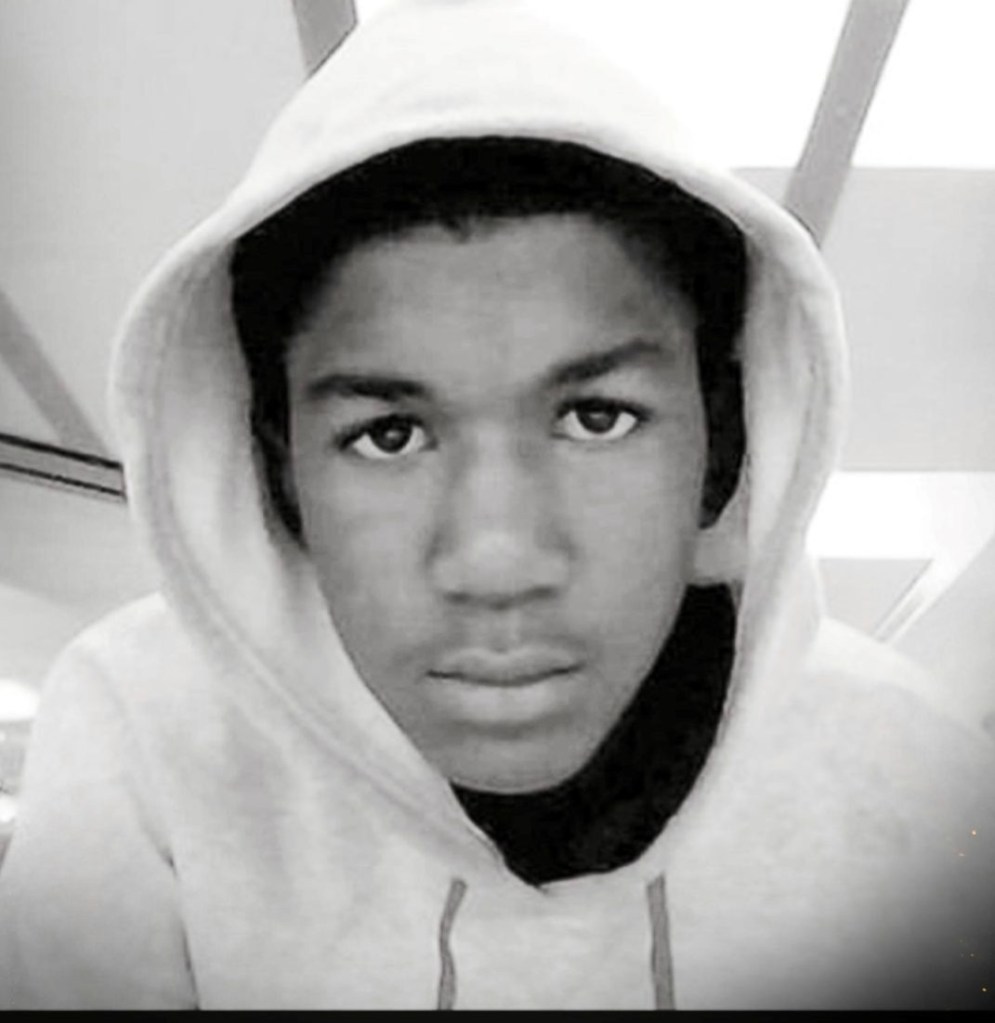
On the evening of February 26, 2012, Trayvon Martin was walking back to his father’s fiancée’s home in Sanford, Florida, after purchasing snacks from a convenience store. He was unarmed, wearing a hoodie, and talking on the phone with a friend. George Zimmerman, a neighborhood watch volunteer, reported Trayvon as “suspicious” to police, followed him despite being advised not to, and ultimately shot and killed him.

Zimmerman claimed self-defense and was later acquitted of all charges in 2013. The verdict sparked national and international outrage, as many saw the case as a reflection of how Black bodies are often criminalized, feared, and devalued within American society.


His Impact on the World

Though his life was tragically cut short at just 17 years old, Trayvon Martin’s death became a historical turning point. His name became a symbol of racial injustice and the dangerous consequences of racial profiling. The case helped ignite the modern civil rights movement known as Black Lives Matter, founded in 2013 by Alicia Garza, Patrisse Cullors, and Opal Tometi in response to Trayvon’s killing and Zimmerman’s acquittal.

Trayvon’s story forced America to confront uncomfortable truths about race, surveillance, fear, and the unequal application of justice. His hoodie became a global symbol of protest, representing how something as simple as clothing could become a perceived threat when worn by a Black male.


He Would Have Been 31 This Year

In 2026, Trayvon Martin would have been 31 years old. He could have been a husband, a father, a professional, or a leader in his community. Instead, his life exists in collective memory as a reminder of stolen futures and unrealized potential. His age now represents not just time passed, but the depth of loss — a life that never had the chance to fully begin.


Racism in America: A Broader Context

Trayvon Martin’s death cannot be understood in isolation. It exists within a long historical continuum of racial violence in America, from slavery and lynching to mass incarceration and police brutality. Sociologists describe this phenomenon as systemic racism — a structure in which laws, institutions, and cultural narratives disproportionately harm Black people.

The fear that led to Trayvon’s death reflects what scholars call implicit racial bias, where Black males are often subconsciously associated with danger, criminality, and threat. These biases influence everything from policing and surveillance to legal outcomes and media portrayals.

Trayvon’s case exposed how even in the absence of a crime, Black existence itself can be treated as suspicious. His death became a mirror held up to American society, forcing the nation to ask: Who is allowed to be innocent? Who is allowed to be safe? And whose life is presumed valuable?


Legacy

Trayvon Martin’s legacy is not defined by his death, but by the global movement that arose because of it. His name is spoken alongside others — Michael Brown, Tamir Rice, Sandra Bland, Breonna Taylor, George Floyd — as part of a growing historical archive of racial injustice.

Yet Trayvon remains unique: he was not arrested, not resisting, not committing a crime. He was simply walking home.

His life and death continue to educate, mobilize, and challenge the world to build a society where Black children can exist without fear, where justice is not selective, and where no family must bury a child for simply being seen as “out of place.”


References

Alexander, M. (2012). The new Jim Crow: Mass incarceration in the age of colorblindness. The New Press.

Bonilla-Silva, E. (2018). Racism without racists: Color-blind racism and the persistence of racial inequality in America (5th ed.). Rowman & Littlefield.

CBS News. (2013). George Zimmerman acquitted in Trayvon Martin case.

Garza, A. (2014). A herstory of the #BlackLivesMatter movement. The Feminist Wire.

Newman, K. S., & Cohen, A. (2014). Race, place, and building a youth movement: The case of Trayvon Martin. American Sociological Review, 79(3), 449–476.

Pew Research Center. (2016). On views of race and inequality, Blacks and Whites are worlds apart.

U.S. Department of Justice. (2013). Investigation of the Sanford Police Department’s handling of the Trayvon Martin shooting.

Girl Talk Series: The Illusion of 50/50 Relationships.

Listen, Ladies: A Man is Called to Provide

Listen, ladies — it is not wrong for a woman to desire a man who provides for her. My late husband always reminded me that provision is a man’s duty and honor, not a burden. When a man loves a woman, he does not see caring for her needs as a chore but as a privilege that reflects his role as leader and protector. The Bible is clear about this responsibility. First Timothy 5:8 warns, “But if any provide not for his own, and especially for those of his own house, he hath denied the faith, and is worse than an infidel.” This is not a light statement — it means that failing to provide for one’s household is a spiritual and moral failure. When a man provides, he demonstrates sacrificial love, mirroring Christ’s care for the church (Ephesians 5:25–28). He creates an environment where a woman feels safe, secure, and valued, allowing her to flourish in her calling. Provision is not just financial — it is emotional, spiritual, and physical care that establishes stability for the entire family. Women should not feel guilty for expecting this. It is not greed; it is alignment with God’s design for marriage. A man’s willingness to provide reveals his maturity, character, and readiness for covenant commitment.

The modern cultural push for “50/50 relationships” promises fairness and equality between partners, yet many women discover that this model can still leave them emotionally, financially, and spiritually depleted. On the surface, splitting bills, chores, and responsibilities seems fair, but when a man avoids leadership and provision, the relationship quickly becomes unbalanced. The woman may end up carrying the weight of both provider and nurturer, which goes against the biblical design for marriage.

God’s Word establishes a clear picture of headship and provision. Ephesians 5:25–28 commands husbands to love their wives “even as Christ also loved the church, and gave himself for it.” Christ did not share the burden of salvation equally with the church—He bore it entirely. Likewise, a husband’s role is one of sacrificial leadership, taking primary responsibility for the welfare of his wife and household. When a man shirks this responsibility, the woman becomes vulnerable to exhaustion and resentment.

The 50/50 model also creates confusion in roles. When financial and emotional labor is divided down the middle, leadership often becomes negotiable, leading to power struggles or passivity. Scripture does not teach mutual passivity but calls men to lead with humility and love. A man who abdicates this role leaves a vacuum that the woman may feel forced to fill, creating a dynamic that undermines trust and respect.

Psychology sheds light on why such arrangements often fail. Research on learned helplessness shows that when one partner refuses to carry their share of responsibility, the other partner may overfunction, doing more and more to keep the relationship afloat. Over time, this can lead to emotional burnout, anxiety, and even depression. The imbalance of power can create a subtle form of exploitation, where one partner benefits at the expense of the other.

Financially, many women have found themselves paying half the bills, contributing to a man’s dreams, and even funding his education—only to have him leave once he is stable. This pattern is so common that it has been discussed in popular media and relationship studies. The emotional toll is devastating because the woman not only loses the relationship but also feels robbed of the investment she made into his life.

One well-known media example is the breakup of singer Mary J. Blige’s marriage to Kendu Isaacs. During the divorce, it became public that Blige had supported Isaacs financially for years, only for him to allegedly misuse funds and engage in infidelity. This public case highlights the painful reality many women face when they invest financially in men who do not share the same loyalty or commitment (Gonzalez, 2017).

Biblically, men are called to be providers. First Timothy 5:8 warns, “But if any provide not for his own, and specially for those of his own house, he hath denied the faith, and is worse than an infidel.” This is a serious charge: a man who refuses to take responsibility for his household is living in disobedience. A 50/50 arrangement may seem modern and progressive, but if it allows a man to neglect his God-given duty, it ultimately harms the spiritual order of the home.

Women can protect themselves from one-sided emotional labor by establishing clear boundaries early in relationships. If a man expects financial partnership, she must ask whether he is also prepared to lead spiritually, emotionally, and sacrificially. Leadership is not domination; it is service. If he only wants to split bills but not bear the weight of provision, he is asking for partnership without accountability.

Self-protection also means paying attention to patterns of behavior. A man who frequently “borrows” money, avoids discussing finances, or becomes defensive when asked about spending habits may be signaling irresponsibility. Proverbs 27:12 says, “A prudent man foreseeth the evil, and hideth himself.” Women must be vigilant and not ignore early warning signs.

Another safeguard is financial independence before marriage. Women should maintain their own savings, credit, and emergency fund until they are in a covenant where mutual provision is clear. This is not distrustful but wise stewardship. If the relationship ends, she will not be left destitute.

From a psychological perspective, women must resist the trap of overfunctioning. Doing more than your fair share may feel noble, but it fosters resentment and reinforces a man’s avoidance of growth. Boundaries are not punishment; they are invitations for the man to step up. If he does not rise to the occasion, that reveals his character.

Spiritually, women must pray for discernment. James 1:5 promises wisdom to those who ask God. Discernment helps a woman recognize whether a man’s intentions are honorable or self-serving. Godly headship is seen in consistent character, not just charm or romantic gestures.

Teaching men biblical manhood is also part of the solution. Men must understand that provision is not optional but part of reflecting Christ’s image. Churches and mentors should call men to accountability, teaching them to view marriage not as a financial arrangement but as a covenant requiring sacrifice.

For women already in 50/50 relationships, communication is key. Honest conversations about expectations, finances, and future plans can bring clarity. If the man is unwilling to discuss or adjust, she must decide whether the relationship is sustainable long-term.

Emotional labor must also be addressed. Many women carry the emotional weight of the relationship—planning dates, managing household tasks, and maintaining communication—while the man coasts. This imbalance can be corrected by delegating responsibilities or refusing to do tasks he is capable of doing.

Ultimately, the illusion of 50/50 relationships is that they are fair. True fairness is not mathematical equality but mutual giving according to each person’s capacity and role. A godly man will give more than 50% because he loves sacrificially. A godly woman will respond with respect and support, creating a dynamic of harmony rather than competition.

Relationships thrive when both partners embrace their biblical roles. The man leads, provides, and protects. The woman nurtures, supports, and helps. When these roles are honored, there is peace. When they are reversed or neglected, there is confusion and pain.

50/50 Relationship vs. Biblical Covenant Relationship

Category50/50 RelationshipBiblical Covenant Relationship (Ephesians 5:25–28)
LeadershipNegotiated or shared — often leaves a power vacuum or power struggle.The man lovingly leads, sacrifices, and takes spiritual responsibility.
ProvisionSplit equally — may leave the woman vulnerable if he withdraws support.The man provides for his household (1 Tim. 5:8) and prioritizes her well-being.
Emotional LaborOften falls disproportionately on the woman (planning, nurturing, problem-solving).Shared — the man takes initiative to care for her emotional needs.
Conflict ResolutionCan become transactional (“I did my half, you do yours”).Built on grace, humility, and sacrificial love, not score-keeping.
Financial SecurityDepends on both parties keeping their share. If one stops, the other is overburdened.The husband bears the main responsibility so the wife feels secure.
Spiritual DirectionUsually absent or inconsistent; spiritual growth is optional.The man leads prayer, worship, and sets a Christ-centered tone for the home.
View of RolesGender roles are blurred or dismissed.Roles are distinct yet complementary — the man leads, the woman supports.
Decision-MakingRequires constant negotiation; can breed resentment.Man leads with humility, consults his wife, and seeks God’s will.
Motivation for GivingConditional — “I will give my half if you give yours.”Unconditional — he loves and gives first, as Christ gave to the church.
Long-Term StabilityCan collapse if one partner stops contributing or loses interest.Endures through trials because it is built on covenant, not contract.

The call to women is not to settle for half-hearted leadership or a man who uses partnership as an excuse to avoid responsibility. Your worth is too great to finance your own exploitation. Trust God to send a man who reflects Christ’s love—a man who gives, leads, and sacrifices.


References

  • Holy Bible, King James Version (KJV).
  • Gonzalez, S. (2017). Mary J. Blige on Divorce: “I’m Gonna Be Just Fine.” Billboard.
  • Beck, J. S. (2021). Cognitive Behavior Therapy: Basics and Beyond. Guilford Press.
  • Cloud, H., & Townsend, J. (2017). Boundaries in Dating. Zondervan.
  • Smith, C. A. (2020). The Psychology of Power Imbalance in Romantic Relationships. Journal of Family Psychology, 34(4), 512–523.

We Are the Story America Cannot Edit

Black history in America has always been more than a chapter—it is the spine of the national narrative. Yet for centuries, this story has been edited, erased, softened, or rewritten to soothe the conscience of a nation deeply shaped by the labor, blood, and brilliance of a people it tried to silence. Still, despite redactions and revisions, the truth endures: we are the story America cannot edit.

This story begins long before ships touched the Atlantic coast. It begins in African kingdoms where art, astronomy, architecture, and theology flourished. The brilliance of the ancestors did not begin in bondage; it began in royalty, innovation, and legacy. No revisionist textbook can erase the origins of a people whose civilizations helped advance global knowledge.

When the Middle Passage shattered families and scattered bodies across the ocean, America inherited a people it tried to dehumanize but could not destroy. The nation wrote laws to silence Black voices, but those voices survived. They survived in spirituals, in whispered prayers, in maroon communities, in the coded footsteps of escape routes carved in the night. The ink of this story was not blacklisted—it was carved in courage.

America tried to enslave people into subservience, but instead they became prophets, builders, warriors, and liberators. Harriet Tubman turned the Underground Railroad into a living testament of freedom. Frederick Douglass transformed literacy into a revolution. Sojourner Truth took the podium and shook the conscience of a country pretending not to hear her. These names refuse erasure.

The Civil War and Reconstruction wrote a brief chapter of possibility—Black senators, congressmen, teachers, and landowners rose swiftly. But America attempted another revision: Jim Crow. Segregation, lynching, and systemic disenfranchisement were designed to rewrite the Black story into one of subjugation. Yet the people refused the edits. Every protest, every church meeting, every organizing circle was a declaration that the pen of oppression could not overrule the pen of destiny.

The Civil Rights Movement authored a new wave of transformation. Martin Luther King Jr.’s dream, Malcolm X’s fire, Rosa Parks’ quiet firmness, and Fannie Lou Hamer’s thunderous truth-telling exposed the nation’s moral contradictions. Their lives demonstrate that Black people did not just endure history—they shaped it. They re-inked the American narrative with justice.

America has long tried to reduce Black identity to struggle, but Black culture refuses to be footnoted. Jazz, gospel, blues, soul, hip-hop, theatre, literature, and film—all are chapters written in brilliance, not brokenness. These art forms do not ask permission; they testify. They preserve memory. They uplift. They correct the historical record by embodying the power and creativity of a people the nation tried to underestimate.

Black resilience has always been inconvenient for America’s preferred storyline. It challenges myths of meritocracy, exposes the violence of past and present systems, and proves that progress was never given—only won. This is why so many attempts have been made to censor, dilute, or distort Black history. Yet truth has a way of resurfacing, even through the cracks of suppression.

The story America cannot edit also includes everyday heroes—grandmothers who kept families together, fathers who worked two and three jobs, children who dared to learn in schools that did not want them, freedom fighters whose names never made headlines, teachers who planted dreams in young minds, and church mothers who prayed communities through storms. These lives are sacred scripture for a people who built resilience into their DNA.

Even today, as political forces attempt to ban books, restrict curriculum, or sanitize the past, the story resists. Black scholars, artists, pastors, activists, and youth are documenting the truth in new ways—through digital archives, spoken word, classrooms, podcasts, and movements for justice. The story is not just preserved; it is expanding.

We are the story America cannot edit because our existence defies the narrative of inferiority that once dominated the national imagination. Every achievement in science, politics, sports, education, business, and ministry disproves the lies that once served as historical “facts.” Black excellence is not an anomaly—it is a continuation of ancestral greatness.

We are the story America cannot edit because the evidence is everywhere. It is in the economic foundation Black labor built. It is in the culture Black creativity shaped. It is in the democracy Black activism strengthened. It is in the global influence Black innovation commands. America has benefitted too deeply from Black genius to pretend it did not exist.

Our story remains uneditable because it is woven into Scripture as well as history. From Cush to Ethiopia, from the Queen of Sheba to the early church, the Bible itself records the presence, power, and purpose of African-descended people. The sacred text affirms what oppression tried to deny: that Blackness has always been part of God’s design and destiny.

We are the story America cannot edit because the truth is living, breathing, and continually unfolding. It shows up in every generation—Black children with brilliance in their eyes, Black elders carrying the wisdom of survivors, Black communities redefining strength, joy, and possibility.

Ultimately, America cannot edit what God Himself has preserved. The story of Black people is marked by divine protection, ancestral strength, and spiritual authority. It is a story of survival, transformation, and triumph. It is a story that exposes injustice but also reveals hope. It is a story bigger than slavery, bigger than segregation, bigger than racism.

We are the story America cannot edit because the truth is too powerful, too resilient, too sacred to be silenced. And as long as we continue to speak it, write it, live it, and teach it—the story will remain unaltered, unstoppable, and unforgettable.

References:
Exodus 1–3 (KJV); Psalm 68:31; Acts 8:27–39; Franklin, J. H. From Slavery to Freedom; Gates, H. L. The African Americans: Many Rivers to Cross; Hannah-Jones, N. The 1619 Project; Litwack, L. Trouble in Mind; Stevenson, B. Just Mercy; Anderson, C. White Rage; Raboteau, A. Slave Religion.

The Brown Standard

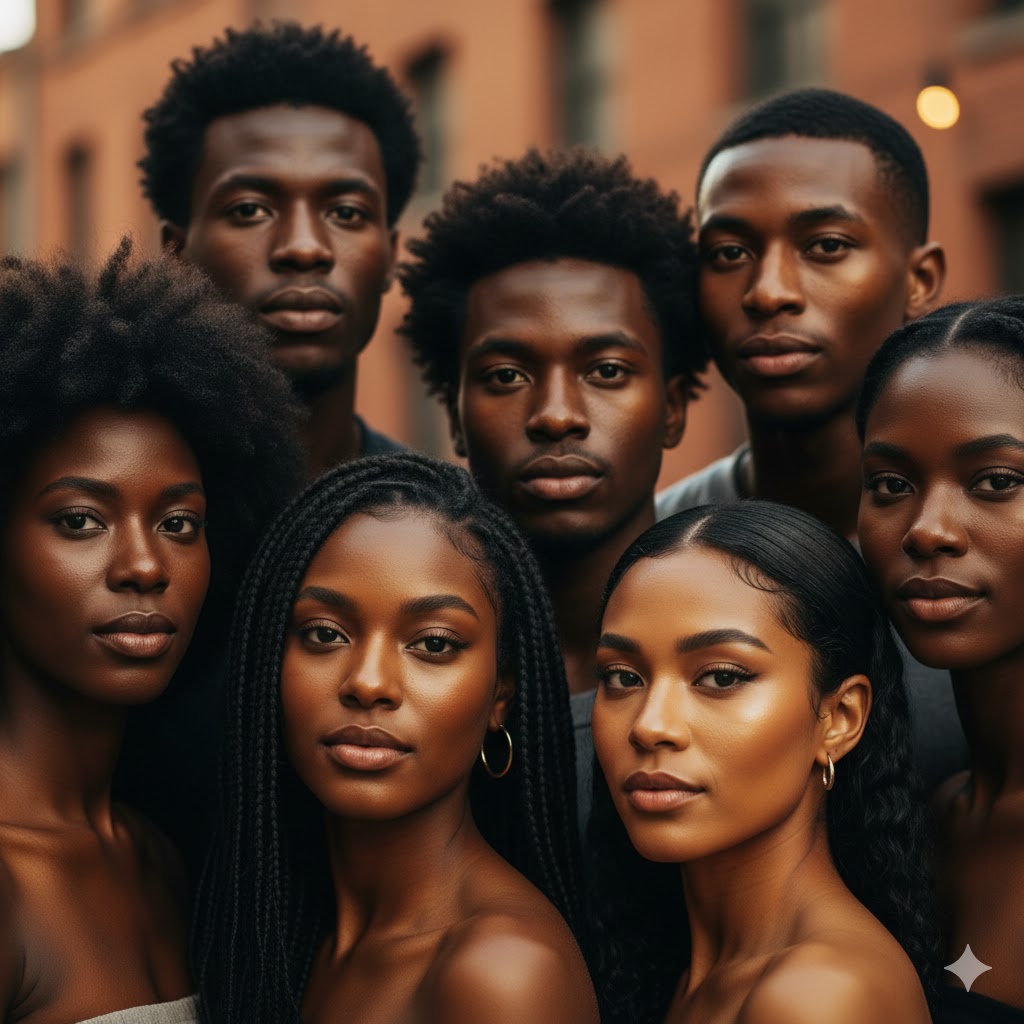
The Brown Standard of beauty is a celebration of melanin-rich aesthetics, cultural heritage, and racial pride. It challenges Eurocentric beauty ideals by centering features historically marginalized yet deeply valued within Black and brown communities. From the warmth of light sun-kissed skin to the richness of deep chocolate tones, from big expressive eyes to small delicate ones, from broad noses to narrow bridges, and from full lips to more subtle contours, the Brown Standard honors the diversity of features shaped by ancestry, environment, and lineage. Hair textures—curly, coily, wooly, and naturally sun-kissed fros—are celebrated as both aesthetic markers and cultural symbols. This standard recognizes beauty not merely as symmetry or proportion but as an embodiment of heritage, identity, and lived experience.

Historically, African civilizations revered features now central to the Brown Standard. Sculptures, carvings, and paintings depict broad noses, full lips, and textured hair as signs of dignity, strength, and nobility. Beauty was intertwined with status, spirituality, and communal values rather than arbitrary or externally imposed standards. As Asante (2003) emphasizes, African societies understood aesthetics as a reflection of balance, harmony, and moral character.

Colorism, however, complicates the Brown Standard. Hunter (2007) observes that lighter skin tones have historically received greater social recognition and privilege, even within communities of color. The Brown Standard emerges as both a reclamation and a counter-narrative: it affirms that beauty exists across the spectrum of melanin-rich skin and that features long devalued by colonial and Eurocentric influence are inherently beautiful.

Socially, the Brown Standard functions as a form of aesthetic capital (Bourdieu, 1986). Individuals embodying these traits often gain visibility, credibility, and social deference within their communities. Big eyes, full lips, and textured hair can signal health, vitality, and cultural alignment. Yet, the standard is not prescriptive; it celebrates diversity and the individuality of melanin-rich features rather than enforcing conformity to a single template.

Psychologically, embracing the Brown Standard enhances self-esteem and cultural pride. Dion, Berscheid, and Walster (1972) demonstrate that perceptions of attractiveness influence assumptions about intelligence, kindness, and capability. In communities honoring the Brown Standard, individuals experience affirmation of their worth, resisting the internalized bias imposed by Eurocentric ideals.

Hair remains one of the most visible markers of the Brown Standard. Natural curls, coils, and fros are celebrated as symbols of authenticity, heritage, and resistance to assimilation. The reclamation of natural hair in recent decades represents both a personal and collective assertion of identity, challenging discriminatory practices in professional, educational, and social contexts (Rhode, 2010).

Facial features such as big eyes and full lips carry expressive power, conveying emotion, vitality, and presence. Broad noses and high cheekbones reflect ancestral lineage and are markers of cultural pride. Each feature contributes to a holistic aesthetic that communicates identity, resilience, and historical continuity.

The Brown Standard also acknowledges the interplay of skin tone and environmental influence. Sun-kissed tones, freckles, and variations in melanin distribution are celebrated as markers of natural beauty rather than flaws. This inclusivity fosters recognition of the wide range of expressions within melanin-rich populations.

Colorism continues to influence access to social and economic opportunities. Hamermesh (2011) notes that lighter-skinned individuals often receive favorable treatment, higher wages, and greater social mobility. The Brown Standard, by affirming the beauty of darker tones, challenges systemic bias and encourages broader societal recognition of diverse aesthetics.

Media representation plays a pivotal role in shaping the Brown Standard. For decades, Eurocentric models dominated television, film, and advertising. However, contemporary Black and brown media increasingly feature melanin-rich beauty in its varied forms, highlighting curly hair, full lips, and diverse skin tones. Representation affirms identity, validates aesthetic preference, and reshapes cultural perceptions.

The spiritual dimension of beauty within the Brown Standard cannot be overlooked. Biblical teachings emphasize that true worth lies in character, integrity, and divine favor rather than external appearance (1 Samuel 16:7). Yet, celebrating the beauty inherent in melanin-rich features aligns with a recognition of God’s creativity and the sacredness of His diverse creation.

Education and cultural discourse are essential to sustaining the Brown Standard. Schools, media, and community institutions can teach the history of Black aesthetics, the social consequences of colorism, and the value of melanin-rich features. Knowledge of ancestral beauty practices reinforces cultural pride and counters internalized bias.

The Brown Standard also intersects with gender. Women, in particular, face societal pressure to conform to Eurocentric ideals, yet embracing features aligned with the Brown Standard fosters empowerment and self-affirmation. Men similarly navigate expectations around masculinity and attractiveness, and recognition of ancestral features enhances confidence and social authority.

Psychologically, the affirmation of the Brown Standard combats feelings of invisibility or inadequacy. When communities celebrate features like sun-kissed fros, curly hair, and full lips, individuals internalize a sense of worth that resists systemic prejudice. This recognition contributes to mental health, social cohesion, and identity formation.

Culturally, the Brown Standard affirms continuity with African and diasporic heritage. Hairstyles, skin tones, and facial features function as living markers of lineage, connecting contemporary individuals to historical identity and ancestral pride. It celebrates the multiplicity of Black and brown beauty without imposing rigid conformity.

Colorism and the fetishization of lighter skin within global contexts reveal the ongoing struggle for equitable recognition. The Brown Standard challenges these hierarchies by emphasizing the legitimacy, attractiveness, and dignity of darker tones. It asserts that all expressions of melanin-rich beauty are valid, desirable, and worthy of visibility.

The Brown Standard also engages with intersectional identity. Skin tone, hair texture, facial features, and body shape intersect with culture, socioeconomic status, and historical context to influence how individuals are perceived. Recognition of this complexity ensures that the Brown Standard honors diversity rather than enforcing a narrow ideal.

Media, fashion, and beauty industries are beginning to reflect the Brown Standard more faithfully. Campaigns featuring a wide spectrum of skin tones, natural hair textures, and facial features expand societal understanding of beauty, affirming that aesthetics rooted in ancestry and melanin are compelling and desirable.

Ultimately, the Brown Standard is not merely a set of physical prerequisites but a holistic framework of cultural pride, identity, and self-affirmation. It celebrates the wide spectrum of melanin-rich skin, curly and wooly hair, big and small eyes, broad and narrow noses, and full or subtle lips. It is a standard grounded in ancestry, history, and lived experience, challenging Eurocentric hierarchies while elevating the dignity and visibility of Black and brown bodies.

In conclusion, the Brown Standard represents the intersection of history, culture, and aesthetics. It affirms the beauty inherent in diversity, the power of melanin-rich features, and the importance of honoring ancestral lineage. By embracing this standard, individuals and communities reclaim identity, resist colorism, and celebrate the unique and radiant expressions of Black and brown beauty.


References

Anderson, T. L., Grunert, C., Katz, A., & Lovascio, S. (2010). Aesthetic capital: A research review on beauty perks and penalties. Sociology Compass, 4(8), 564–575. https://doi.org/10.1111/j.1751-9020.2010.00312.x

Asante, M. K. (2003). The history of Africa: The quest for eternal harmony. Routledge.

Bourdieu, P. (1986). The forms of capital. In J. Richardson (Ed.), Handbook of theory and research for the sociology of education (pp. 241–258). Greenwood Press.

Dion, K., Berscheid, E., & Walster, E. (1972). What is beautiful is good. Journal of Personality and Social Psychology, 24(3), 285–290.

Eagly, A. H., Ashmore, R. D., Makhijani, M. G., & Longo, L. C. (1991). What is beautiful is good, but… A meta-analytic review. Psychological Bulletin, 110(1), 109–128.

Feingold, A. (1992). Good-looking people are not what we think. Psychological Bulletin, 111(2), 304–341.

Hunter, M. (2007). The persistent problem of colorism: Skin tone, status, and inequality. Sociology Compass, 1(1), 237–254. https://doi.org/10.1111/j.1751-9020.2007.00006.x

Langlois, J. H., et al. (2000). Maxims or myths of beauty? Psychological Bulletin, 126(3), 390–423.

Rhode, D. L. (2010). The beauty bias: The injustice of appearance in life and law. Oxford University Press.

Wilson, T. D. (2002). Strangers to ourselves: Discovering the adaptive unconscious. Harvard University Press.

Gafney, W. (2017). Womanist midrash: A reintroduction to the women of the Torah and the Throne. Westminster John Knox Press.