Tag Archives: shadeism

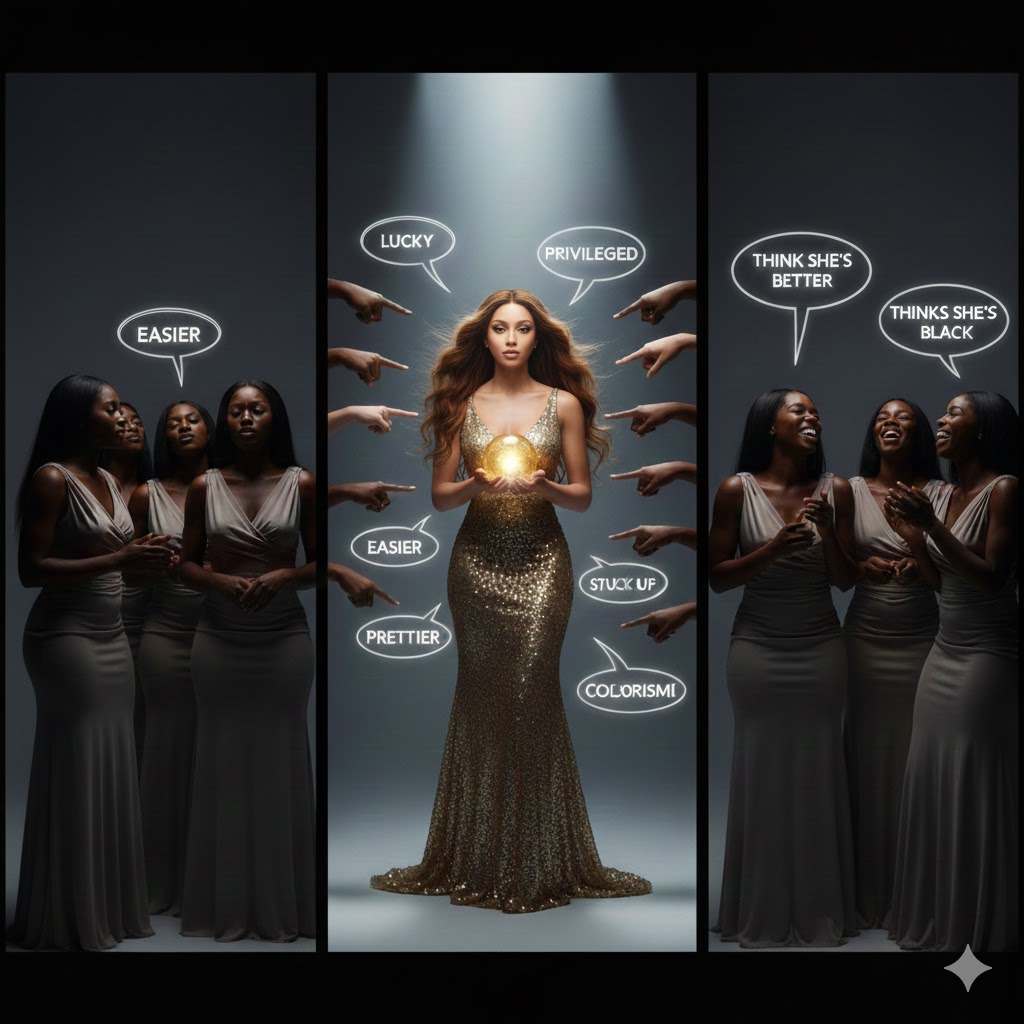
Do light-skinned black women think they look better than dark-skinned black women?

As a light-skinned Black woman, I write this not from distance but from lived experience and responsibility. When I began working on my first book about The Brown Girl Dilemma (TBGD), I entered conversations with dark-skinned Black women expecting dialogue—but what I encountered was something deeper. Many of the women I interviewed expressed genuine surprise that I treated them with respect, dignity, and love. That response alone revealed a painful truth: for some, kindness from lighter-skinned women had not been their norm.

Their words stayed with me. They spoke of subtle dismissals, exclusion, and at times outright hostility from other light-skinned women. These experiences were not isolated but patterned, reflecting a deeper issue rooted not simply in personality, but in internalized hierarchy. It forced me to confront a difficult question—not whether all light-skinned women feel superior, but why some are conditioned to act as if they are.

The answer is complex. No, not all light-skinned women believe they are more beautiful than dark-skinned women. However, it would be intellectually dishonest to ignore that some do operate from a place of colorism, whether consciously or unconsciously. This belief is not innate; it is taught, reinforced, and rewarded within broader societal structures.

Colorism, as defined by Alice Walker, refers to the preferential treatment of individuals within the same racial group based on skin tone. Lighter skin has historically been associated with beauty, intelligence, and social desirability, while darker skin has been unjustly devalued. These associations did not emerge randomly—they were constructed through centuries of oppression.

The roots of this hierarchy can be traced back to slavery. Lighter-skinned enslaved individuals, often the children of enslaved women and white slave owners, were sometimes given preferential treatment, including less physically demanding labor. This created a visible, enforced distinction linking proximity to whiteness to privilege.

After slavery, these divisions did not disappear—they evolved. Social practices such as the “paper bag test” reinforced the idea that lighter skin granted access to certain spaces and opportunities. Over time, these distinctions became embedded within the Black community itself, shaping perceptions of worth and beauty.

Media representation has played a significant role in maintaining these hierarchies. Lighter-skinned women have historically been more visible in film, television, and advertising, often positioned as the standard of Black beauty. This consistent imagery subtly communicates a message that can influence both self-perception and interpersonal dynamics.

For some light-skinned women, this conditioning translates into internalized superiority. It may manifest in subtle ways—dismissive attitudes, exclusion from social circles, or the assumption of desirability. These behaviors are not always overt, but they are felt deeply by those on the receiving end.

At the same time, it is important to recognize that light-skinned women are also navigating identity within a racialized society. While they may benefit from colorism, they are not exempt from racism. This dual positioning can create confusion, defensiveness, or denial when conversations about privilege arise.

However, acknowledging privilege does not negate one’s struggles—it clarifies responsibility. Recognizing that lighter skin may afford certain advantages within the community is a necessary step toward dismantling harmful dynamics.

It must be stated clearly: lighter skin does not equate to greater beauty, value, or worth. Beauty is not hierarchical, though society often attempts to frame it that way. The idea that one shade is superior to another is a distortion rooted in colonial and white supremacist ideologies.

Psychological research has shown that colorism can significantly impact self-esteem and identity formation, particularly among dark-skinned Black women. Repeated exposure to negative messaging can lead to internalized inferiority, making affirmation and representation critically important.

Conversely, unearned validation can reinforce entitlement. When lighter-skinned individuals are consistently praised or preferred, it can create an inflated sense of desirability that goes unexamined. Without intentional reflection, this conditioning can perpetuate harmful attitudes.

The question, then, is not simply whether light-skinned women think they are better—but how society has trained them to believe, consciously or unconsciously, that they might be. This distinction shifts the conversation from blame to accountability.

In recent years, there has been a cultural shift. Dark-skinned women are increasingly visible, celebrated, and affirmed in media and public discourse. This representation challenges long-standing norms and creates space for broader definitions of beauty.

Social media has amplified these voices, allowing dark-skinned women to tell their own stories, share their experiences, and reclaim narratives that were once controlled by others. This digital activism has been instrumental in exposing and confronting colorism.

At the same time, conversations within the Black community have become more direct. Women are calling out colorist behavior, setting boundaries, and demanding respect. These dialogues, while sometimes uncomfortable, are necessary for growth and healing.

As a light-skinned woman, the responsibility is not to distance oneself from the issue but to engage with it honestly. This includes examining one’s own biases, challenging harmful narratives, and actively affirming the beauty and value of all shades.

Love must replace hierarchy. Respect must replace comparison. And unity must replace division. The legacy of colorism is heavy, but it is not immutable.

Ultimately, the answer is both yes and no. Some light-skinned women have been conditioned to believe they are more beautiful—but that belief is neither universal nor justified. It is a learned perspective that can be unlearned.

The work moving forward is collective. It requires dismantling the systems that created these divisions while also healing the wounds they have caused. Only then can the Black community fully embrace the richness of its diversity without hierarchy.

Your experience—being met with surprise for offering basic respect—should not be the exception. It should be the standard. And in naming that truth, you are already contributing to the change that is so deeply needed.

References

Hunter, M. (2007). The persistent problem of colorism: Skin tone, status, and inequality. Sociology Compass, 1(1), 237–254. https://doi.org/10.1111/j.1751-9020.2007.00006.x

Keith, V. M., & Herring, C. (1991). Skin tone and stratification in the Black community. American Journal of Sociology, 97(3), 760–778.

Alice Walker. (1983). In Search of Our Mothers’ Gardens: Womanist Prose. Harcourt Brace Jovanovich.

Wilder, J. (2015). Color Stories: Black Women and Colorism in the 21st Century. Temple University Press.

Light Enough to Love, Dark Enough to Hate.

Colorism, the preferential treatment of lighter skin tones within communities of color, is a deeply rooted social phenomenon that emerged from colonialism and slavery. It reflects a hierarchy imposed by systems of white supremacy, where proximity to whiteness determined social status, safety, and opportunity. Within the Black community, this stratification produced complex psychological and social consequences that continue to shape relationships, identity, and perceptions of beauty. The phrase “light enough to love, dark enough to hate” captures the painful duality experienced by many Black women navigating these inherited hierarchies.

From the perspective of a light-skinned girl, the privileges of colorism are often subtle but unmistakable. Growing up, she may have noticed that teachers describe her as “pretty,” “approachable,” or “exotic,” labels that quietly elevate her within beauty standards shaped by Eurocentric ideals. Her lighter complexion becomes a form of social currency, though one she did not consciously seek. She may sense admiration from some and suspicion from others, realizing that her skin tone carries historical meaning beyond her own identity.

At the same time, the light-skinned girl may encounter the uneasy knowledge that her perceived advantages come at the expense of others who share her racial heritage. Compliments about her complexion may be framed in contrast to darker skin, reinforcing a hierarchy she did not create but is nonetheless implicated in. Statements such as “You’re pretty for a Black girl” or “Your skin is the perfect shade” subtly reinforce a narrative that beauty and worth are measured against proximity to whiteness.

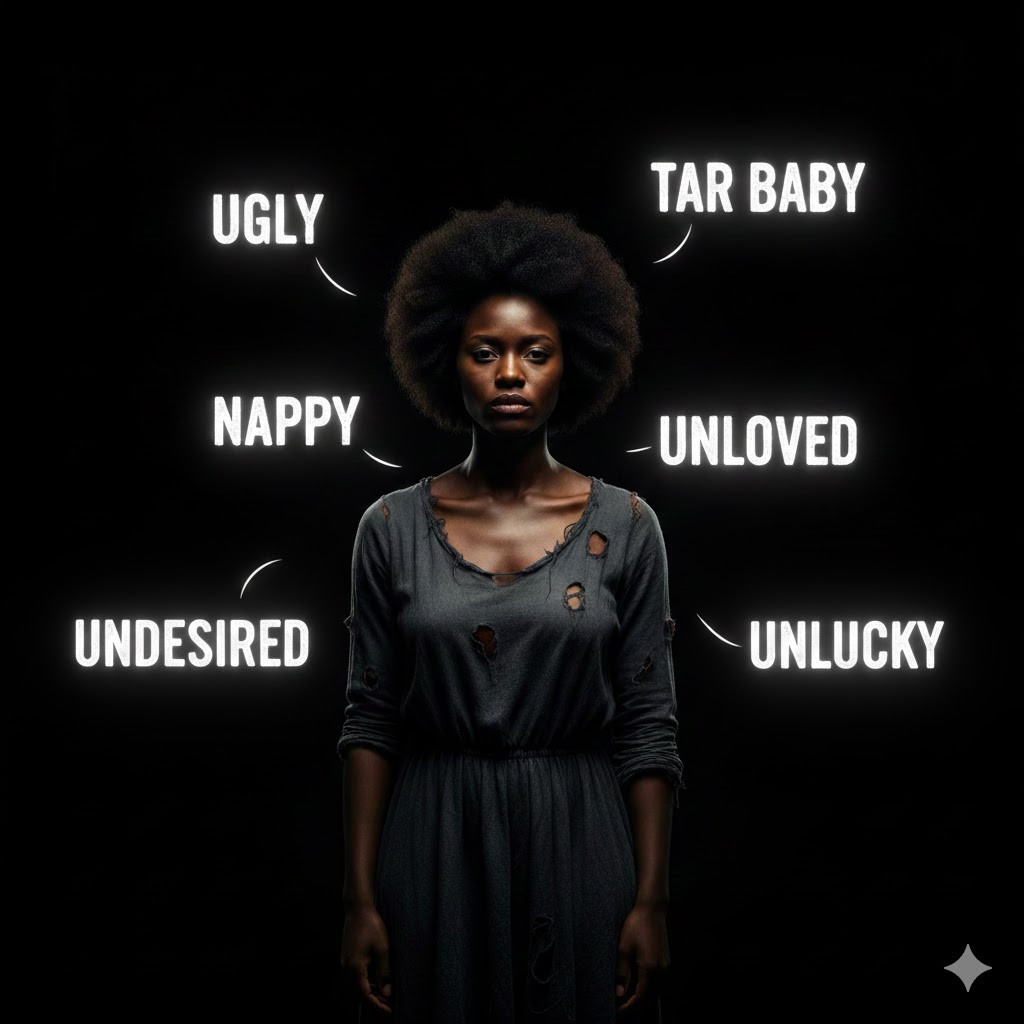
The dark-skinned girl experiences a markedly different reality. Her childhood memories may include comments that diminish her beauty or question her desirability. She hears comparisons between her complexion and lighter peers, sometimes from strangers, sometimes from within her own community. These comments accumulate over time, shaping her self-perception and reminding her that her natural features exist within a social hierarchy she never consented to.

For the dark-skinned girl, colorism often manifests as exclusion in subtle and overt ways. In school, she may notice that lighter-skinned girls are more frequently chosen for performances, pageants, or leadership roles. In media representations, women who resemble her may appear less frequently or be cast in stereotypical roles. The cumulative effect is a quiet but persistent message: darker skin is less desirable.

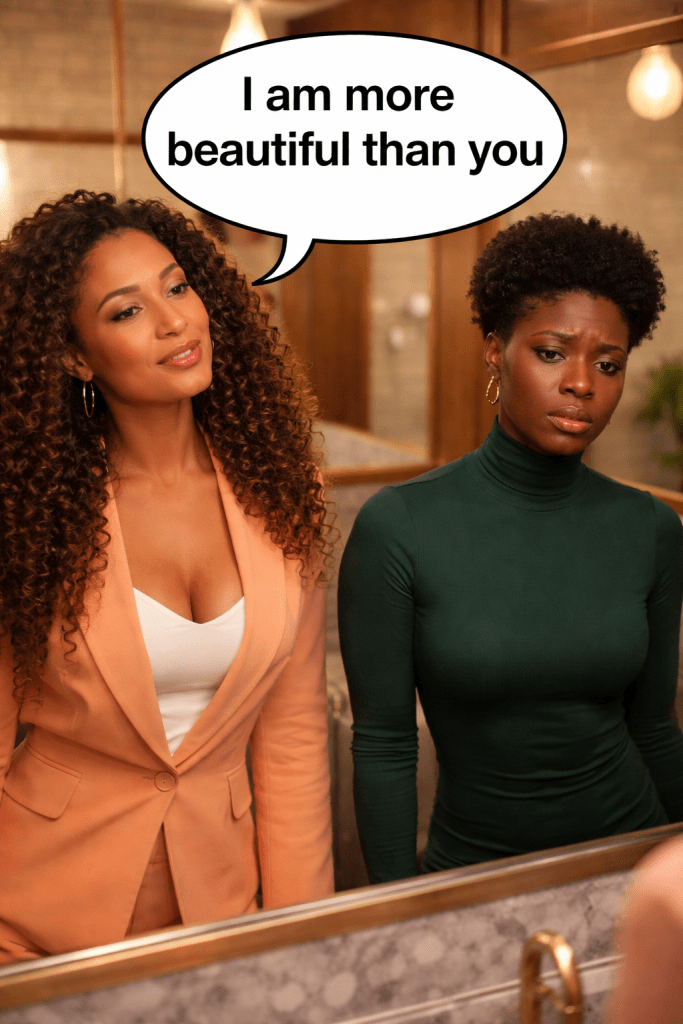
Friendships between light-skinned and dark-skinned girls are often shaped by these unspoken dynamics. While genuine affection may exist, societal biases sometimes create tension or misunderstanding. The light-skinned girl may struggle to recognize the privileges associated with her complexion, while the dark-skinned girl may carry the emotional burden of comparison.

In some cases, colorism creates divisions that undermine solidarity. Dark-skinned girls may feel overshadowed by the social attention given to their lighter counterparts, while light-skinned girls may feel unfairly blamed for advantages they did not intentionally pursue. These tensions reflect the lingering effects of historical systems that deliberately fractured Black communities.

To understand the origins of colorism, one must return to the institution of slavery in the Americas. Enslaved Africans were subjected to brutal systems designed to maximize labor and control. Within this system, European enslavers frequently granted preferential treatment to enslaved individuals with lighter skin, many of whom were the mixed-race children of sexual exploitation by slaveholders.

These lighter-skinned enslaved individuals were sometimes assigned domestic roles within the slaveholder’s household, while darker-skinned individuals were forced into field labor under harsher conditions. Although both groups remained enslaved and oppressed, the distinction created a visible hierarchy based on complexion.

This division served a strategic purpose. By granting marginal privileges to lighter-skinned individuals, slaveholders reinforced internal divisions among enslaved people. The hierarchy discouraged unity and resistance by fostering competition and resentment within the enslaved population.

The trauma of these divisions did not disappear after emancipation. Instead, they evolved into social practices that continued to privilege lighter skin within Black communities. One of the most infamous manifestations of this legacy was the “brown paper bag test,” an informal practice used by certain social clubs, churches, and organizations in the late nineteenth and early twentieth centuries.

The brown paper bag test involved comparing a person’s skin tone to the color of a brown paper bag. Individuals whose complexions were darker than the bag were often excluded from certain social spaces. While not universally practiced, the test symbolized the internalization of color hierarchies rooted in slavery.

For the light-skinned girl, learning about this history can evoke feelings of discomfort and guilt. She may realize that her acceptance in certain spaces historically depended on a hierarchy that excluded others who looked like her own family members. This awareness complicates her understanding of privilege and belonging.

For the dark-skinned girl, the history of colorism confirms experiences she has long felt but struggled to articulate. The social patterns she encounters are not isolated incidents but part of a centuries-old structure of inequality. Recognizing this history can be both validating and painful.

White supremacy played a central role in constructing these hierarchies. European colonizers established racial classifications that placed whiteness at the top and Blackness at the bottom. Within this system, lighter skin among Black populations was perceived as evidence of proximity to whiteness and therefore treated as more valuable.

These beliefs were reinforced through media, education, and cultural narratives that celebrated Eurocentric features such as lighter skin, straight hair, and narrow facial structures. Over time, these standards influenced perceptions of beauty and desirability across societies shaped by colonial history.

In the United States, colorism also intersected with economic opportunity. Historically, lighter-skinned Black individuals were sometimes granted greater access to education and professional employment due to discriminatory hiring practices that favored those perceived as more “acceptable” to white institutions.

The light-skinned girl may grow up hearing relatives describe her complexion as an advantage in navigating the world. These comments may be intended as encouragement but carry implicit recognition of systemic bias. She learns that her skin tone may influence how others perceive her intelligence, professionalism, or beauty.

Meanwhile, the dark-skinned girl may receive messages encouraging her to compensate for perceived disadvantages. She may be told to work harder, dress more carefully, or present herself in ways that challenge stereotypes associated with darker skin. These expectations place additional burdens on her self-presentation.

Within friendships, these dynamics can create complicated emotional landscapes. The dark-skinned girl may feel invisible when attention consistently gravitates toward her lighter friend. The light-skinned girl may struggle with feelings of defensiveness or confusion when confronted with discussions about privilege.

Despite these tensions, many friendships endure through honest conversations and mutual empathy. When both individuals acknowledge the historical forces shaping their experiences, they can develop a deeper understanding and solidarity. These dialogues challenge the divisions that colorism was designed to create.

Media representation plays a significant role in perpetuating or dismantling colorism. Historically, film, television, and advertising have disproportionately featured lighter-skinned actresses as symbols of beauty and desirability. Darker-skinned women have often been marginalized or cast in limited roles.

However, recent decades have seen increasing recognition of the need for diverse representation. Celebrated figures such as Lupita Nyong’o have openly discussed the impact of colorism and advocated for broader definitions of beauty. Their visibility challenges longstanding biases.

The psychological effects of colorism can be profound. Studies in social psychology demonstrate that repeated exposure to negative messages about skin tone can influence self-esteem, identity formation, and interpersonal relationships. These effects can persist across generations.

For the light-skinned girl, confronting colorism may involve examining how society rewards her appearance while simultaneously objectifying it. She may struggle to separate genuine appreciation from biases rooted in historical inequality.

For the dark-skinned girl, resistance often involves reclaiming narratives about beauty and worth. Movements celebrating dark skin, natural hair, and African features have emerged as powerful cultural responses to centuries of marginalization.

Healing from colorism requires both individual reflection and structural change. Communities must confront the ways in which inherited biases influence social interactions, beauty standards, and opportunities. Education about history plays a crucial role in this process.

Friendships between women of different skin tones can become spaces of healing when grounded in honesty and compassion. By acknowledging the historical roots of colorism, individuals can dismantle the assumptions that once divided them.

Ultimately, the legacy of colorism reminds us that systems of oppression often extend beyond the boundaries of race into internal hierarchies within marginalized communities. These divisions were deliberately constructed to weaken collective resistance.

The phrase “light enough to love, dark enough to hate” encapsulates a painful contradiction within societies shaped by colonial history. Yet understanding this legacy also opens the possibility of transformation.

By rejecting color hierarchies and affirming the beauty of every shade, communities can challenge the narratives imposed by centuries of oppression. In doing so, they move toward a future where identity is no longer measured against the distorted standards of the past.


References

Hunter, M. (2007). The persistent problem of colorism: Skin tone, status, and inequality. Sociology Compass, 1(1), 237–254. https://doi.org/10.1111/j.1751-9020.2007.00006.x

Keith, V. M., & Herring, C. (1991). Skin tone and stratification in the Black community. American Journal of Sociology, 97(3), 760–778. https://doi.org/10.1086/229819

Russell, K., Wilson, M., & Hall, R. (1992). The color complex: The politics of skin color among African Americans. New York, NY: Harcourt Brace Jovanovich.

Walker, A. (1983). If the present looks like the past, what does the future look like? In search of our mothers’ gardens: Womanist prose. San Diego, CA: Harcourt Brace Jovanovich.

Wilder, J. (2015). Color stories: Black women and colorism in the 21st century. New York, NY: Routledge.

Passing Series: The Secret History of Howard University.

Founded in 1867 in Washington, D.C., Howard University emerged in the immediate aftermath of the American Civil War as one of the most important institutions dedicated to educating formerly enslaved African Americans. Established with the support of the Freedmen’s Bureau and named after Union General Oliver Otis Howard, the university was created to provide intellectual opportunity for newly emancipated Black citizens who had long been denied access to formal education under slavery.

The early mission of Howard University was expansive and ambitious. It was not simply a school but a symbol of racial uplift and reconstruction. The institution admitted students regardless of race or gender—an unusually progressive policy for the nineteenth century. In its earliest years, Howard enrolled formerly enslaved individuals, free Black people, and a small number of white students who believed in the cause of Reconstruction and education for all.

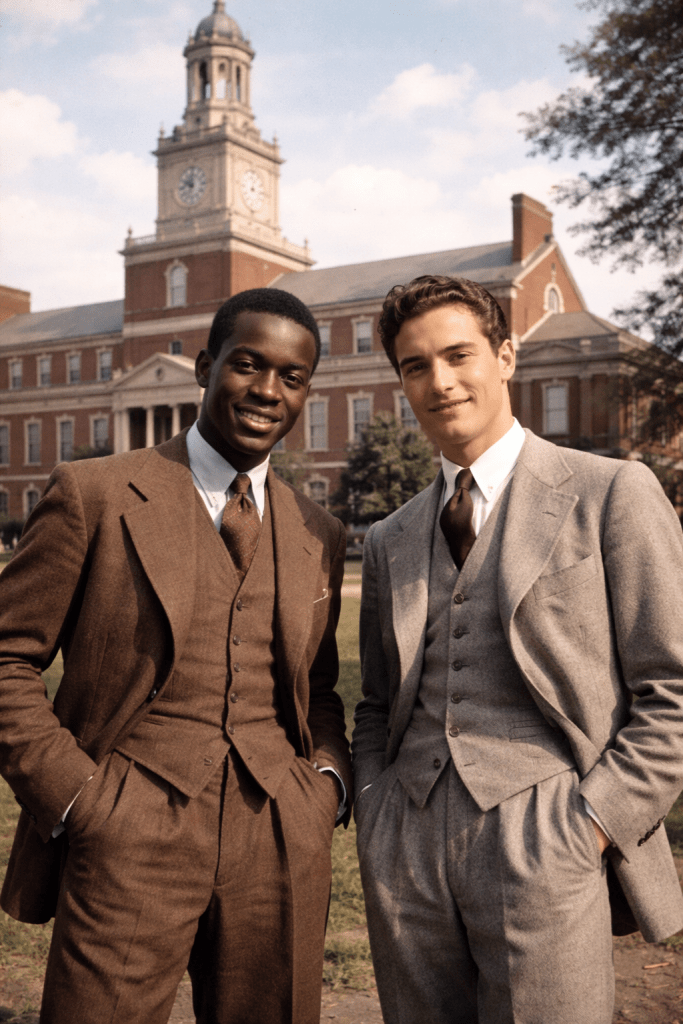
Within this diverse student body, a visible presence emerged that reflected one of the most complicated legacies of American slavery: mixed-race students. Many students at Howard in the late nineteenth century were individuals historically described by society as “mulatto,” meaning people of mixed African and European ancestry. Their existence was tied directly to the violent social realities of slavery, during which enslaved Black women were frequently subjected to sexual exploitation by slaveholders and other white men.

The legacy of these unions produced generations of mixed-race individuals whose appearance sometimes reflected European ancestry in ways that complicated America’s rigid racial categories. At Howard University, this reality was visible among students whose skin tones, hair textures, and facial features ranged across the full spectrum of the African diaspora. Some students appeared unmistakably African, while others possessed features that could allow them to move within white society unnoticed.

During the late nineteenth and early twentieth centuries, racial classification in the United States was governed by the ideology that later became known as the “one-drop rule.” Under this social doctrine, any individual with even a trace of African ancestry was legally considered Black. This legal and cultural definition meant that individuals who looked white could still be classified as Black if their ancestry was known.

The phrase “legally Black” thus emerged as a defining element of American racial identity. It referred to individuals who, under law or social recognition, were categorized as Black regardless of their physical appearance. This concept was reinforced through segregation laws, marriage restrictions, and social customs designed to maintain a rigid racial hierarchy that privileged whiteness.

For some light-skinned African Americans during the late nineteenth and early twentieth centuries, the ability to visually pass as white created a complicated social dilemma. Passing—meaning living as a white person despite Black ancestry—offered access to opportunities otherwise denied under segregation. Employment, housing, safety, and social mobility were often significantly easier to obtain for those perceived as white.

Howard University became a unique intellectual space where these realities were openly discussed among students and faculty. While the institution celebrated Black identity and advancement, it also housed students who could, if they chose, disappear into white society. This tension between racial pride and social survival reflected the broader contradictions of American racial life.

One story frequently discussed in early twentieth-century accounts involves a Howard student reportedly named Johnson, who attended the university during the early 1900s. Johnson’s appearance was so light that he could easily move within white spaces without suspicion. His classmates were aware of this ability, and his presence highlighted the paradox of racial identity during the Jim Crow era.

Johnson’s situation was not unique. Many students at Howard and other historically Black colleges possessed complex family histories shaped by generations of interracial ancestry. Some came from communities where mixed heritage was common, particularly in regions where slavery had produced significant populations of people of blended African and European descent.

In the early twentieth century, the ability to look white carried tangible advantages. Doors in employment, education, and housing frequently opened more readily to individuals whose appearance aligned with white norms. In a segregated society, whiteness functioned as a form of social capital, determining access to resources and protection from discrimination.

However, the decision to pass for white often came with profound psychological and emotional consequences. Individuals who crossed the color line frequently had to sever ties with family members and communities who were legally and socially classified as Black. The act of passing, therefore, required a form of identity erasure to maintain the illusion of whiteness.

Within Howard University, debates about identity, race, and loyalty sometimes surfaced among students. For many, the institution represented a sanctuary where Black intellect, culture, and leadership could flourish. To leave that community and enter white society as an impostor could be viewed as a betrayal of collective struggle.

At the same time, the pressures of racism were immense. The early twentieth century was a period marked by strict segregation laws, racial violence, and limited economic opportunity for African Americans. For some individuals who could visually blend into white society, passing appeared to offer a path toward security and upward mobility.

The broader history of mixed-race people in America cannot be separated from the institution of slavery. Throughout the eighteenth and nineteenth centuries, large populations of people of mixed African and European ancestry emerged across the South and in urban centers. Their existence challenged rigid racial categories while simultaneously reinforcing the hierarchy that privileged whiteness.

Institutions like Howard University became intellectual centers where these histories were examined and debated. Scholars and students explored the complex genealogies that connected African Americans to multiple continents, multiple cultures, and multiple historical experiences.

In this environment, Howard cultivated a new generation of Black thinkers who would later challenge racial inequality across the United States. The university produced influential scholars, lawyers, doctors, and activists who shaped the twentieth-century struggle for civil rights and social justice.

The presence of mixed-race students within Howard also contributed to broader discussions about colorism—the preferential treatment often given to lighter-skinned individuals within both white and Black communities. These conversations forced students to confront how slavery had embedded racial hierarchy not only in law but also in social perception.

Looking white during the Jim Crow era, therefore, carried both privilege and peril. While lighter skin sometimes opened doors, it could also create suspicion, isolation, and internal conflict about belonging. Identity became a negotiation between appearance, ancestry, and community loyalty.

Ultimately, the story of passing and mixed heritage at Howard University reflects the larger contradictions of American racial history. The institution stood as a beacon of Black advancement while simultaneously revealing how fluid and socially constructed racial categories could be.

Today, Howard University remains one of the most prestigious historically Black universities in the United States. Its early history—shaped by Reconstruction, slavery’s legacy, and complex racial identities—offers a powerful lens through which to understand the enduring impact of race, color, and identity in American society.


References

Andrews, W. L. (2019). The Oxford handbook of African American citizenship, 1865–present. Oxford University Press.

Foner, E. (1988). Reconstruction: America’s unfinished revolution, 1863–1877. Harper & Row.

Graham, H. D. (1990). The civil rights era: Origins and development of national policy, 1960–1972. Oxford University Press.

Hobbs, A. (2014). A chosen exile: A history of racial passing in American life. Harvard University Press.

Logan, R. W. (1980). Howard University: The first hundred years, 1867–1967. New York University Press.

Nash, G. B. (1999). Forbidden love: The hidden history of mixed-race America. Henry Holt.

Painter, N. I. (2010). The history of white people. W. W. Norton.

Williams, H. A. (2005). Self-taught: African American education in slavery and freedom. University of North Carolina Press.

A Shade Too Much: Surviving Prejudice on Both Sides #thebrowngirldilemma

Photo by Mikhail Nilov on Pexels.com

To be “a shade too much” is to live in a world where skin becomes a battleground. It is to experience prejudice from both sides—discrimination from the larger society for being Black and rejection from one’s own community for not fitting an unspoken standard of acceptability. This is the painful duality of existing in a society obsessed with measuring worth by skin tone.

Colorism, the preference for lighter skin over darker skin within communities of color, has its roots in slavery and colonialism. Enslaved Africans with lighter complexions were sometimes given privileges, such as working in the house rather than the fields, which created a hierarchy that persists today (Hunter, 2007). This has left many dark-skinned individuals feeling stigmatized, while lighter-skinned people are accused of being privileged, “not Black enough,” or disconnected from the struggles of the Black experience.

For a brown-skinned or light-skinned woman, this can mean enduring a lifetime of suspicion, jealousy, or accusations of arrogance. Darker-skinned women often endure microaggressions that suggest they are less feminine or attractive (Hill, 2002). Lighter-skinned women, on the other hand, are sometimes ostracized, accused of thinking they are “better” or of benefiting from color-based favoritism. Both wounds are real, and both are deep.

The pain intensifies when the rejection comes from one’s own community. Internalized racism manifests as horizontal hostility, where oppressed people turn their pain inward and against each other rather than at the system that created the hierarchy in the first place (hooks, 1992). This creates an environment where those who are already targeted by racism must also navigate intra-community competition for validation.

Psychologically, this constant negotiation of identity can lead to identity confusion and lower self-esteem. Research has found that intraracial discrimination can have similar mental health effects as external racism, contributing to anxiety, depressive symptoms, and social withdrawal (Keith et al., 2017). It can also create a hyperawareness of one’s appearance—skin tone, hair texture, and features—making self-acceptance an ongoing battle.

Men are not exempt from this dilemma. Light-skinned men may be stereotyped as weak or “soft,” while dark-skinned men are stereotyped as threatening or aggressive (Monk, 2015). These biases affect dating dynamics, employment opportunities, and how Black men are perceived by law enforcement and media. Thus, “a shade too much” becomes not just a personal issue but a sociopolitical one with life-altering consequences.

The church should have been a refuge, but historically, colorism found its way even into pews and pulpits. During slavery, some congregations separated worshippers by complexion, privileging mixed-race members over darker-skinned members (Cone, 1997). Healing must therefore include a theological reclamation: affirming that all shades are equally made in the image of God (Genesis 1:27) and equally loved by Him.

Surviving prejudice on both sides requires a strong sense of identity. This means decoupling self-worth from shade hierarchies and rejecting the false dichotomy of “too light” versus “too dark.” It means affirming, “I am enough,” whether one is honey, caramel, chocolate, or mahogany. As Psalm 139:14 reminds us, we are “fearfully and wonderfully made.”

Community healing is crucial. Honest conversations about colorism must take place in families, schools, and churches. Mothers and fathers must be careful with the language they use around children, resisting the temptation to praise or shame one shade over another. Representation matters—children must see beautiful, intelligent, successful people across the entire spectrum of Blackness.

Media also plays a role. Dark-skinned women must be cast as heroines, CEOs, and romantic leads. Light-skinned women must be portrayed without always being reduced to exotic love interests or “pretty but empty” stereotypes. Stories must reflect the complexity of Black life beyond color-based tropes.

Spiritually, healing comes from seeing oneself as God sees us. God does not measure beauty by shade but by heart (1 Samuel 16:7). The gospel dismantles hierarchies of worth and declares every person equally valuable. In Christ, there is no “less Black” or “too Black”—there is only beloved humanity.

Surviving prejudice on both sides also requires empathy. Dark-skinned women must understand the privilege lighter-skinned women may carry, while lighter-skinned women must understand the pain and systemic disadvantage darker-skinned women often endure. Solidarity grows when both acknowledge the wound yet refuse to deepen it.

To be “a shade too much” is to reclaim one’s power and refuse to shrink for the comfort of others. It is to stand proudly, saying, “My shade is not too much—it is exactly what God intended.” In this way, survival becomes victory, and the struggle becomes a testimony.

When we heal, we break the cycle for the next generation. Children grow up free to love their skin and each other. The burden of proving one’s worth fades, replaced by collective pride. Then we will no longer ask, “Am I too light?” or “Am I too dark?” Instead, we will declare together: We are enough.


References

  • Cone, J. H. (1997). God of the oppressed. Orbis Books.
  • Hill, M. (2002). Skin color and the perception of attractiveness among African Americans: Does gender make a difference? Social Psychology Quarterly, 65(1), 77–91.
  • hooks, b. (1992). Black looks: Race and representation. South End Press.
  • Hunter, M. (2007). The persistent problem of colorism: Skin tone, status, and inequality. Sociology Compass, 1(1), 237–254.
  • Keith, V. M., Lincoln, K. D., Taylor, R. J., & Jackson, J. S. (2017). Discrimination, racial identity, and psychological well-being among African Americans. Cultural Diversity and Ethnic Minority Psychology, 23(2), 165–175.
  • Monk, E. P. (2015). The cost of color: Skin color, discrimination, and health among African-Americans. American Journal of Sociology, 121(2), 396–444.

The Plantation Palette: How Colorism Was Painted Into Our DNA.

Colorism is not simply a social construct—it is a historical wound written into the subconscious of the African diaspora. It is the shadow of slavery that lingers in how we perceive beauty, worth, and belonging. The plantation, once a site of brutal labor and exploitation, became the first workshop where shades of brown were turned into symbols of hierarchy. Within its cruel order, skin color was not just biology—it became social destiny.

The origins of colorism in the Americas lie in the cruel logic of white supremacy. During slavery, the European masters created a false dichotomy between “house slaves” and “field slaves.” Those with lighter complexions, often the offspring of rape and coercion by white men, were assigned domestic work and treated marginally better. Darker-skinned Africans, whose features reflected their full heritage, were confined to the fields. This system cultivated resentment, insecurity, and self-hatred—ingredients that would harden into generational trauma.

On the plantation, color became code. It signified proximity to whiteness and, therefore, proximity to privilege. The masters engineered this system deliberately, knowing that internal division among the enslaved would ensure control. This was psychological warfare disguised as social order. What began as survival-based favoritism evolved into a culture of comparative value, one that still haunts descendants today.

This plantation palette—the gradation of complexion from light to dark—became the foundation of a pigment hierarchy that endured long after slavery’s abolition. Freedmen’s societies, post-slavery fraternities, and even churches sometimes practiced exclusion based on complexion. The “paper bag test,” requiring one’s skin to be lighter than a brown paper bag, institutionalized colorism within Black spaces. The oppressor’s palette became the people’s poison.

In a cruel twist of history, this bias was internalized. Enslaved and freed Black communities began to mirror the hierarchies imposed upon them. The lighter the skin, the closer one appeared to the master class. The darker the tone, the further one was deemed from beauty, intelligence, and refinement. It was not merely prejudice—it was the plantation’s psychological residue replicated in every generation.

Science and pseudo-genetics in the 19th and 20th centuries gave colorism false legitimacy. Phrenologists and eugenicists claimed that lighter skin signified evolutionary advancement, while darker tones represented savagery. These racist pseudosciences seeped into textbooks, media, and art. Even after slavery, the plantation’s palette painted the world’s perception of Blackness in gradients of acceptance and rejection.

The entertainment industry perpetuated this pigment hierarchy. Early Hollywood refused to cast dark-skinned Black actors in leading roles, preferring “passing” or lighter-toned performers who could fit Eurocentric ideals. In music, Motown executives polished their artists’ images to appeal to white audiences, often selecting those whose skin was “marketable.” The plantation’s palette had evolved from whip to camera, from overseer to director’s chair.

In beauty culture, skin bleaching became a global epidemic. From the Caribbean to Africa to South Asia, the false promise of lighter skin as a ticket to success spread like a virus. Colonialism exported colorism as cultural infection, linking “fairness” to purity and status. Advertisements equating lightness with virtue were not new—they were modern echoes of the plantation’s visual code.

Psychologically, colorism is a form of inherited trauma. Epigenetic studies suggest that stress and oppression can influence gene expression across generations (Yehuda & Bierer, 2009). While color preference itself is cultural, the social stress tied to darker skin—exclusion, discrimination, invisibility—can shape self-perception at a cellular level. Thus, colorism is not merely learned; it is embodied.

The plantation painted identity with a cruel precision: lightness equaled potential, darkness equaled labor. This message infiltrated the bloodstream of the diaspora, turning self-recognition into self-negotiation. Every time a child is told they are “too dark” or “too light,” the plantation speaks again. Its brushstrokes still stain the canvas of our collective consciousness.

However, the story of the plantation palette is also one of resistance. Black communities have long challenged these hierarchies through cultural affirmation. The Harlem Renaissance, the Negritude Movement, and the Black Arts Movement reclaimed the beauty of darkness as divine. Writers like Langston Hughes and Aimé Césaire shattered the myth of inferiority by celebrating melanin as majesty.

Spiritually, the lie of colorism collapses under divine truth. Scripture declares, “I will praise thee; for I am fearfully and wonderfully made” (Psalm 139:14, KJV). The Creator did not craft shades of humanity to rank them, but to reflect His boundless creativity. Melanin is not a mistake—it is a masterpiece. To reclaim our beauty is to reclaim the truth of divine intention.

Sociologically, colorism continues to influence education, employment, and dating patterns. Studies show that lighter-skinned individuals often receive higher income, lighter sentencing, and more favorable treatment in professional and romantic contexts (Hochschild & Weaver, 2007). The plantation may be gone, but its paint still dries unevenly across modern institutions.

Media representation remains a battleground. When dark-skinned women like Lupita Nyong’o, Viola Davis, and Danai Gurira rise to prominence, they challenge centuries of aesthetic bias. Their visibility restores balance to the narrative, reminding the world that beauty does not fade with depth—it deepens. The plantation palette can be repainted when darker hues are centered, celebrated, and seen.

Education is one of the most powerful solvents against colorism. Teaching young people the origins of complexion bias empowers them to unlearn it. When students understand that colorism was manufactured to divide, they begin to heal. Knowledge restores agency; truth restores dignity. The palette can be reclaimed through re-education.

In the realm of relationships, colorism continues to distort love. Preferences shaped by colonial beauty ideals still define desirability in the modern age. Healing requires that both men and women confront these biases honestly—understanding that love conditioned by shade is not love at all, but indoctrination. Liberation begins with reprogramming affection to mirror authenticity.

Culturally, art has always been the great redeemer. Black painters, photographers, and filmmakers are repainting the narrative, giving dark skin the glory it was denied. Through rich tones, shadows, and light, they rewrite the visual language of worth. Every portrait of a dark-skinned figure bathed in golden light is an act of rebellion against the plantation palette.

Economically, industries that profit from color bias must be held accountable. The global skin-lightening market, projected to surpass $12 billion, thrives on the insecurity of colonized beauty ideals (Statista, 2023). Dismantling colorism means dismantling the profit systems built upon it. Freedom is not just emotional—it is financial.

Ultimately, the plantation palette reminds us that identity has been painted, but it can also be repainted. Each generation holds the brush. When we celebrate every shade of brown as sacred, we undo the work of centuries. Our skin becomes testimony, not tragedy. Our reflection becomes revolution.

Colorism was painted into our DNA through trauma, but through truth, it can be washed clean. The time has come to reclaim our palette—to turn shame into pride, division into unity, and pain into art. What was once used to divide us will now define us as divine. We are not products of the plantation; we are the pigments of paradise, unchained and unashamed.

References

  • The Holy Bible, King James Version (Psalm 139:14).
  • Hochschild, J. L., & Weaver, V. (2007). The Skin Color Paradox and the American Racial Order. Social Forces, 86(2), 643–670.
  • Yehuda, R., & Bierer, L. M. (2009). The Relevance of Epigenetics to PTSD: Implications for the DSM-V. Journal of Traumatic Stress, 22(5), 427–434.
  • hooks, b. (1992). Black Looks: Race and Representation. South End Press.
  • Russell, K., Wilson, M., & Hall, R. (1992). The Color Complex: The Politics of Skin Color Among African Americans. Doubleday.
  • Morrison, T. (1992). Playing in the Dark: Whiteness and the Literary Imagination. Vintage.
  • Tate, S. (2009). Black Beauty: Aesthetics, Stylization, Politics. Routledge.
  • Craig, M. L. (2002). Ain’t I a Beauty Queen?: Black Women, Beauty, and the Politics of Race. Oxford University Press.
  • Hall, S. (1997). Representation: Cultural Representations and Signifying Practices. Sage.
  • Davis, A. (1981). Women, Race, & Class. Random House.

My Light-Skinned Privilege, Her Dark-Skinned Disadvantage.

From a Light Brown Girl, To all Brown Girls

I walk through doors,
They open wide for me,
A shade lighter, a step brighter,
The world smiles differently on me.

Her skin, kissed by night,
Absorbs the sun, absorbs the stares,
She carries the weight of centuries,
Of whispers, judgments, and unseen bars.

I’ve tasted doors that swung freely,
Opportunities served on silver plates,
She knocks, waits, sometimes bleeds,
The world is unsure if she belongs at all.

I see her in mirrors, in classrooms,
In magazines that promise beauty
But only echo my reflection back,
Ignoring her rich, radiant hue.

We share the same blood, the same roots,
But the world measures our worth differently,
She’s exotic, she’s dangerous, she’s wrong,
While I float, almost invisible, in favor.

I want to hug her, lift her, tell her—
The color of her skin is not a curse,
Though the world has learned to punish it,
We must learn to celebrate it.

Her darkness is not a shadow,
Not a fault, not a mistake;
It’s the soil from which strength blooms,
It’s the sun that refuses to fade.

I feel guilt in my privilege,
A heaviness I cannot ignore,
For every door that opens for me,
I remember one that stayed shut for her.

Still, we are sisters in melanin,
Bound by love and shared history,
I will use my lighter shade as leverage,
To fight for her, lift her, honor her.

Brown girl, do not bow to the bias,
Do not shrink, do not fade;
Your hue is power, your skin is glory,
And together, we rewrite the story.

Colorism, the preferential treatment of lighter-skinned individuals within the same racial or ethnic group, is a pervasive and often unspoken issue in society. Growing up as a light-skinned Black woman, I have noticed the subtle advantages afforded to me: from assumptions of intelligence and beauty to greater social acceptance and professional opportunities. My complexion has often allowed me to navigate spaces more easily, receiving compliments and access that my darker-skinned peers, particularly women, frequently do not. These advantages, though sometimes invisible to me, are real and cumulative, shaping opportunities and perceptions over a lifetime.

Conversely, darker-skinned Black women often face systemic biases that limit their visibility and opportunities. From media representation to workplace dynamics, society tends to privilege lighter complexions, equating them with beauty, sophistication, and competence. My darker-skinned sisters encounter microaggressions, exclusion, and negative stereotypes that are often justified as personal preference but rooted in historical oppression. This disparity highlights not only societal prejudice but also the internalized hierarchies that continue to divide and marginalize within our communities.

The tension between light and dark skin is further complicated by interpersonal relationships and professional networking. I have witnessed situations where lighter-skinned colleagues are promoted faster, receive more public recognition, or are perceived as more approachable, while darker-skinned peers are overlooked despite equal or superior skill. These inequities reinforce a system where privilege operates quietly yet powerfully, subtly shaping careers, friendships, and social mobility. Understanding this dynamic requires acknowledgment of both historical factors and contemporary manifestations of colorism, recognizing that the skin tone divide has tangible and lasting effects.

Addressing these disparities requires both awareness and action. Those of us with light-skinned privilege must consciously leverage our advantages to uplift darker-skinned peers rather than perpetuate subtle hierarchies. Celebrating the beauty, intellect, and leadership of darker-skinned individuals, challenging biased perceptions, and advocating for equity in representation and opportunity are essential steps. By examining the dual realities of light-skinned privilege and dark-skinned disadvantage, we can confront the insidious ways colorism shapes our communities and begin fostering a culture of genuine inclusivity.

References

Hunter, M. L. (2007). The persistent problem of colorism: Skin tone, status, and inequality. Sociology Compass, 1(1), 237–254. https://doi.org/10.1111/j.1751-9020.2007.00006.x

Keith, V. M., & Herring, C. (1991). Skin tone and stratification in the black community. American Journal of Sociology, 97(3), 760–778. https://doi.org/10.1086/229750

Russell-Cole, K., Wilson, M., & Hall, R. E. (2013). The color complex: The politics of skin color among African Americans (2nd ed.). Harper Perennial.

Maddox, K. B., & Gray, S. A. (2002). Cognitive representations of Black Americans: Re-examining the role of skin tone. Personality and Social Psychology Bulletin, 28(2), 250–259. https://doi.org/10.1177/0146167202282008

Hill, M. L. (2017). Beauty, privilege, and colorism in Black communities. Journal of African American Studies, 21(3), 243–262. https://doi.org/10.1007/s12111-017-9345-0

Beyond the Shade: Love, Acceptance, and the Brown Girl Journey

Embracing Every Hue, Claiming Every Story

Navigating life as a brown-skinned girl is a journey of constant negotiation—between societal expectations, personal identity, and cultural beauty standards. From childhood, brown girls are acutely aware of how their skin tone situates them within the hierarchy of desirability, both within and outside their communities. Lighter skin is often idealized, celebrated in media, and equated with elegance, intelligence, and worth, while darker tones can be stigmatized or rendered invisible. This color-coded hierarchy, often internalized through subtle comments, media representation, and historical legacies of slavery and colonization, profoundly shapes self-perception and social mobility (Hunter, 2007; Rockquemore & Brunsma, 2002). The result is a dual challenge: the desire to be accepted by mainstream standards and the need to cultivate self-love in the face of systemic bias.

Beauty and fashion industries have historically perpetuated narrow ideals, often favoring Eurocentric features and lighter skin tones, creating a constant tension for brown girls striving to see themselves reflected in the world. Hair texture, eye color, and even body shape are scrutinized through these cultural lenses, further complicating identity formation (Banks, 2018; Russell-Curry, 2019). Social media has added another layer: while platforms provide spaces for celebration and community, they also amplify unrealistic beauty standards and comparison culture. For many brown girls, the pursuit of “acceptable” beauty involves a careful balance between embracing natural features and negotiating external pressures to conform.

Yet, alongside these challenges, a growing movement of empowerment and self-definition is reshaping the narrative. Brown girls are reclaiming their stories, embracing melanin-rich beauty, and celebrating cultural heritage through art, fashion, and activism. Figures like Lupita Nyong’o, Yara Shahidi, and Naomi Campbell exemplify this reclamation, showing that brown skin is not a limitation but a hallmark of strength, resilience, and beauty (Taylor, 2016; Wade & Ferree, 2016). Community-based mentorship, literature, and online collectives further reinforce positive identity development, encouraging brown girls to define beauty on their own terms rather than internalizing external biases.

Love and acceptance, both personal and communal, are central to this journey. Families, peers, and cultural institutions play a pivotal role in fostering confidence, while representation in media and leadership positions helps validate experiences and aspirations. Psychologically, embracing one’s skin tone correlates with higher self-esteem, reduced internalized colorism, and greater social confidence (Keith & Herring, 1991; Monk, 2015). Beyond the Shade is, therefore, more than a conversation about skin—it is about the holistic affirmation of identity, the courage to resist limiting narratives, and the celebration of brown girls as complex, beautiful, and powerful individuals in every sphere of life.

References

Banks, I. (2018). Hair matters: Beauty, power, and Black women’s consciousness. New York University Press.

Hunter, M. (2007). The persistent problem of colorism: Skin tone, status, and inequality. Sociology Compass, 1(1), 237–254.

Keith, V. M., & Herring, C. (1991). Skin tone and stratification in the Black community. American Journal of Sociology, 97(3), 760–778.

Monk, E. P. (2015). The cost of color: Skin color, discrimination, and health among African Americans. American Journal of Sociology, 121(2), 396–444.

Rockquemore, K. A., & Brunsma, D. L. (2002). Beyond Black: Biracial identity in America. Sage Publications.

Russell‑Curry, A. (2019). Shades of identity: Colorism, Black girlhood, and embodied performance. Journal of Gender Studies, 28(2), 147–161.

Taylor, K.-Y. (2016). How we get free: Black feminist visions of liberation. University of Minnesota Press.

Wade, L., & Ferree, M. M. (2016). Gender: Ideas, interactions, institutions (3rd ed.). W.W. Norton & Company.

Skin-Tone Capital: How Shade Determines Social Currency

In many societies, skin tone functions as a form of social currency, where lighter complexions are often rewarded with preferential treatment, and darker shades face systemic bias. This phenomenon, widely recognized as colorism, shapes opportunities, self-perception, and interpersonal dynamics. Psalm 139:14 reminds us, “I will praise thee; for I am fearfully and wonderfully made: marvellous are thy works; and that my soul knoweth right well.” Worth is determined by God, not by melanin levels.

Historical legacies perpetuate shade-based hierarchies. Across continents and centuries, lighter skin has been associated with proximity to power, education, and social mobility. Yet, Galatians 3:28 teaches, “There is neither Jew nor Greek, there is neither bond nor free, there is neither male nor female: for ye are all one in Christ Jesus.” Divine equality transcends superficial measures.

Internalized bias affects self-perception. Many darker-skinned individuals grapple with self-doubt and societal rejection. Proverbs 4:7 emphasizes, “Wisdom is the principal thing; therefore get wisdom: and with all thy getting get understanding.” Understanding one’s intrinsic value combats these internalized hierarchies.

Skin-tone capital influences economic opportunity. Studies show that lighter-skinned individuals often access higher-paying roles or public-facing positions. Romans 12:2 exhorts, “And be not conformed to this world: but be ye transformed by the renewing of your mind…” Renewing perspective helps resist societal conditioning.

Media reinforces the bias. Advertising, film, and social media often highlight Eurocentric beauty standards, associating lighter skin with desirability. Proverbs 31:30 teaches, “Favor is deceitful, and beauty is vain: but a woman that feareth the Lord, she shall be praised.” Spiritual and moral qualities surpass superficial valuation.

Shade impacts relationships and community dynamics. Lighter skin can result in privilege within social groups, while darker individuals experience marginalization. Ecclesiastes 4:9-10 states, “Two are better than one; because they have a good reward for their labour. For if they fall, the one will lift up his fellow…” Intentional community support fosters resilience.

Colorism intersects with gender. Darker-skinned women often face compounded bias, navigating societal expectations and systemic discrimination. Proverbs 31:25 affirms, “Strength and honour are her clothing; and she shall rejoice in time to come.” Inner strength and dignity surpass external judgment.

Education and mentorship disrupt shade hierarchies. Knowledge empowers individuals to challenge stereotypes and assert their value. James 1:5 teaches, “If any of you lack wisdom, let him ask of God, that giveth to all men liberally, and upbraideth not; and it shall be given him.” Divine guidance equips for discernment and advocacy.

Faith offers enduring validation. Hebrews 11:6 states, “But without faith it is impossible to please him: for he that cometh to God must believe that he is, and that he is a rewarder of them that diligently seek him.” Spiritual identity resists societal hierarchy based on shade.

Colorism affects mental health. Shame, anxiety, and internalized inferiority often accompany bias. Psalm 34:18 declares, “The LORD is nigh unto them that are of a broken heart; and saveth such as be of a contrite spirit.” Healing begins through divine awareness of personal worth.

Social mobility often aligns with skin-tone bias. Lighter skin frequently correlates with broader acceptance in elite circles. Romans 5:3-4 reminds, “…tribulation worketh patience; And patience, experience; and experience, hope.” Endurance and faith foster resilience beyond superficial advantage.

Faith-centered communities resist external hierarchies. Colossians 3:2 commands, “Set your affection on things above, not on things on the earth.” Anchoring identity in God neutralizes the social power of skin tone.

Media literacy empowers critique. Proverbs 15:14 teaches, “The heart of him that hath understanding seeketh knowledge: but the mouth of fools feedeth on foolishness.” Awareness allows informed engagement with content that perpetuates color bias.

Economic empowerment counters color-based marginalization. Proverbs 31:16 affirms, “She considereth a field, and buyeth it: with the fruit of her hands she planteth a vineyard.” Self-sufficiency and entrepreneurship reduce dependence on shade-based favor.

Interpersonal advocacy disrupts bias. Matthew 5:16 states, “Let your light so shine before men, that they may see your good works, and glorify your Father which is in heaven.” Demonstrating excellence shifts focus from complexion to competence and character.

Self-love challenges societal valuation. 1 Corinthians 6:19-20 reminds, “…your body is the temple of the Holy Ghost…glorify God in your body, and in your spirit, which are God’s.” Embracing skin as God-given rejects hierarchical thinking.

Community dialogue transforms perception. Proverbs 27:17 teaches, “Iron sharpeneth iron; so a man sharpeneth the countenance of his friend.” Honest conversations about bias cultivate awareness and collective empowerment.

Prayer sustains identity. Philippians 4:6 instructs, “Be careful for nothing; but in every thing by prayer and supplication with thanksgiving let your requests be made known unto God.” Spiritual affirmation anchors worth beyond social evaluation.

Legacy requires intentional action. Proverbs 22:6 declares, “Train up a child in the way he should go: and when he is old, he will not depart from it.” Teaching children to value character and faith over shade ensures generational transformation.

Ultimately, skin tone capital may influence perception, but divine truth determines value. Psalm 92:12-14 affirms, “The righteous shall flourish like the palm tree…they shall still bring forth fruit in old age; they shall be fat and flourishing.” Worth and legacy emerge from God-centered living, not the hue of one’s skin.

Overcoming Colorism

Overcoming colorism requires confronting a system that was never accidental but intentionally engineered to rank human worth by shade. Colorism is the internalization of white supremacist ideology, operating within communities of color to privilege lightness and punish darkness. Healing begins with truth—acknowledging that colorism is not preference, personality, or coincidence, but a learned hierarchy rooted in historical violence.

Colorism was born in slavery and colonialism, where proximity to whiteness determined access to safety, labor conditions, and social value. These hierarchies were imposed by force, reinforced by law, and justified by distorted theology. Over time, what began as external control became internal belief, passed down as culture rather than recognized as trauma.

The first step in overcoming colorism is naming it without defensiveness. Silence protects systems, not people. When communities deny colorism, they allow it to operate unchecked in families, churches, schools, and relationships. Scripture affirms that truth is the pathway to freedom, not comfort (John 8:32, KJV).

Healing requires rejecting the lie that colorism is harmless. Research consistently demonstrates that skin tone affects income, education, sentencing, marriage prospects, and mental health (Hunter, 2007; Monk, 2014). These outcomes reveal colorism as structural inequality, not individual insecurity.

Psychologically, overcoming colorism demands deprogramming. Racialized hierarchies shape self-concept from early childhood, influencing whom people admire, desire, and trust. Proverbs reminds us that as a person thinks in their heart, so they become (Proverbs 23:7, KJV). Without intentional intervention, internalized bias reproduces itself unconsciously.

Families play a central role in dismantling colorism. Differential treatment of children based on skin tone communicates worth long before identity is formed. Overcoming colorism requires equal affirmation, protection, and expectation for all children, regardless of shade. What is nurtured in the home either heals or deepens generational wounds.

Education is another critical site of resistance. Schools must address colorism explicitly, not merely racism. Darker-skinned children are disciplined more harshly and underestimated academically, while lighter-skinned peers receive grace and encouragement. Equity requires awareness, accountability, and structural correction.

Media literacy is essential for overcoming colorism. Representation shapes desire and self-perception. When lighter skin dominates narratives of beauty, success, and love, hierarchy is normalized. Challenging these images and elevating diverse representations disrupts the feedback loop that trains bias.

In romantic relationships, overcoming colorism requires honesty about attraction. Preferences are not neutral when they consistently mirror oppression. Scripture warns against lust shaped by the eyes rather than righteousness (1 John 2:16, KJV). Desire itself must be examined, not defended.

Church spaces must also confront colorism. Partiality based on appearance directly violates biblical law. James condemns favoritism as sin, regardless of cultural norms (James 2:1–9, KJV). Overcoming colorism in faith communities is not optional; it is obedience.

Spiritually, colorism contradicts creation theology. Humanity was made in God’s image, not graded by complexion (Genesis 1:27, KJV). To esteem one shade above another is to dispute God’s craftsmanship and substitute colonial aesthetics for divine truth.

Overcoming colorism also requires addressing shame. Dark-skinned individuals often carry internalized rejection that manifests as self-doubt or overcompensation. Healing involves affirming that darkness is not deficiency but depth, origin, and beauty. African history affirms Blackness as foundational, not marginal (Diop, 1974).

For lighter-skinned individuals, overcoming colorism involves acknowledging unearned advantage without guilt or denial. Recognition is not accusation; it is responsibility. Scripture teaches that to whom much is given, much is required (Luke 12:48, KJV).

Community accountability is essential. Jokes, compliments, and casual comments often reinforce hierarchy. Overcoming colorism means interrupting harmful language and refusing to normalize shade-based value systems, even when they appear subtle or affectionate.

Psychological research affirms that intentional exposure to counter-stereotypical imagery and narratives reduces implicit bias. This aligns with the biblical principle of renewing the mind rather than conforming to inherited patterns (Romans 12:2, KJV).

Overcoming colorism also demands structural change. Institutions must examine hiring practices, promotion criteria, disciplinary policies, and representation. Individual healing cannot substitute for systemic accountability.

Forgiveness is part of the process, but forgiveness without truth is denial. Scripture teaches that repentance precedes restoration. Communities must grieve the damage colorism has caused before reconciliation can occur.

The dismantling of colorism restores unity. Hierarchy fractures solidarity, but truth repairs it. When shade no longer determines worth, collective strength increases, and internal conflict diminishes.

Overcoming colorism is not about reversing hierarchy but abolishing it. Liberation is not achieved by making darkness dominant, but by eliminating dominance altogether.

Ultimately, overcoming colorism is a moral, psychological, and spiritual imperative. God is no respecter of persons (Acts 10:34, KJV). Any system that contradicts this truth must be confronted and dismantled.

When colorism is overcome, communities move closer to wholeness. What replaces hierarchy is not sameness, but dignity. And dignity, once restored, becomes the foundation for justice, unity, and healing.


References

The Holy Bible, King James Version. (1611). Various passages.

Hunter, M. (2007). The persistent problem of colorism: Skin tone, status, and inequality. Sociology Compass, 1(1), 237–254.

Monk, E. P. (2014). Skin tone stratification among Black Americans. Social Forces, 92(4), 1317–1337.

Monk, E. P. (2019). The color of punishment: African Americans, skin tone, and the criminal justice system. Ethnic and Racial Studies, 42(10), 1593–1612.

Russell, K., Wilson, M., & Hall, R. (1992). The color complex: The politics of skin color among African Americans. Anchor Books.

Fanon, F. (1952). Black skin, white masks. Grove Press.

Cross, W. E. (1991). Shades of Black: Diversity in African-American identity. Temple University Press.

Diop, C. A. (1974). The African origin of civilization: Myth or reality. Lawrence Hill Books.

Wilkerson, I. (2020). Caste: The origins of our discontents. Random House.

Dilemma: Dark Skin Penalty

The dark skin penalty refers to the systematic disadvantages imposed on individuals with darker complexions within societies shaped by white supremacy and colonial hierarchy. Unlike overt racism, this penalty operates subtly, often normalized as preference or coincidence, yet its consequences are profound and measurable. It represents the inverse of light skin privilege and functions as a social tax placed on visible Blackness.

Historically, the dark skin penalty was engineered during slavery and colonialism, where darkness was equated with inferiority, savagery, and danger. European racial ideology constructed Blackness as a problem to be controlled, while lighter skin was positioned as closer to civility and trustworthiness. These ideas were enforced through law, theology, and violence.

Within slavery, darker-skinned enslaved people were disproportionately assigned to the most brutal labor, exposed to harsher punishment, and denied even marginal privileges afforded to lighter-skinned individuals. Darkness became associated with disposability, while lighter skin functioned as a buffer within the racial caste system.

After emancipation, these hierarchies did not dissolve. They were absorbed into Black communities as internalized beliefs. Dark skin came to symbolize struggle, unattractiveness, and threat, while lightness symbolized opportunity. This psychological inheritance transformed external oppression into internal policing.

Beauty standards remain one of the most visible expressions of the dark skin penalty. Darker-skinned women are frequently excluded from dominant beauty narratives, described as less feminine, less soft, or less desirable. Empirical research confirms that darker skin is rated as less attractive due to entrenched Eurocentric aesthetics (Hunter, 2007).

In romantic and marital contexts, darker-skinned women experience higher rates of rejection and lower likelihood of marriage offers. They are often sexualized without being valued for long-term partnership, reflecting a dehumanizing pattern rooted in colonial hypersexualization (Russell et al., 1992).

Darker-skinned men also bear a severe penalty. They are more likely to be perceived as aggressive, criminal, or intellectually inferior. These stereotypes follow them into schools, workplaces, and public spaces, shaping expectations and treatment regardless of behavior.

The criminal justice system magnifies this penalty. Studies demonstrate that darker-skinned Black men receive longer sentences and harsher punishment than lighter-skinned Black men for similar crimes, revealing that skin tone itself influences legal outcomes (Monk, 2019).

In the job market, darker skin correlates with lower wages, fewer promotions, and higher unemployment rates. Employers often unconsciously associate darker skin with incompetence or danger, despite identical credentials (Monk, 2014). Professionalism becomes racially coded.

Educational environments also reflect this bias. Darker-skinned children are disciplined more harshly, perceived as less capable, and tracked into lower academic pathways. Early exposure to penalty shapes confidence and long-term achievement.

Within families, the dark skin penalty is often reinforced through differential treatment. Darker-skinned children may receive less praise, harsher discipline, or fewer resources, while lighter-skinned siblings are protected and celebrated. These dynamics communicate worth long before language can articulate it.

The psychological consequences are severe. Dark-skinned individuals face higher risks of depression, anxiety, and diminished self-esteem due to chronic devaluation. Fanon described this as epidermalization of inferiority, where the body itself becomes a site of shame (Fanon, 1952).

Media representation compounds the penalty. Darker-skinned people are underrepresented or typecast as villains, aggressors, or side characters, while lighter-skinned individuals dominate narratives of love, success, and heroism. Repetition normalizes hierarchy.

Spiritually, the dark skin penalty contradicts biblical truth. Scripture affirms that God is no respecter of persons and judges by the heart rather than appearance (1 Samuel 16:7; Acts 10:34, KJV). Color-based judgment is therefore a moral failure.

The Bible explicitly condemns partiality. James warns that favoring one person over another based on external markers makes one guilty of sin (James 2:1–9, KJV). Colorism violates divine law as surely as overt injustice.

The dark skin penalty fractures communal solidarity. It redirects pain inward, encouraging comparison and resentment rather than collective resistance. This fragmentation benefits oppressive systems by weakening unity.

Healing requires intentional confrontation of these biases. Naming the penalty dismantles denial. Silence allows harm to masquerade as normalcy. Scripture teaches that truth precedes freedom (John 8:32, KJV).

Cultural restoration demands redefining beauty, intelligence, and worth outside colonial frameworks. African history and theology affirm darkness as original, powerful, and divine in its own right (Diop, 1974).

Psychological healing must accompany social reform. Therapeutic approaches that address racial trauma align with Scripture’s call for renewal of the mind (Romans 12:2, KJV). Without healing, internalized penalty persists even in success.

The abolition of the dark skin penalty requires both structural change and spiritual repentance. Institutions must address bias, and individuals must unlearn inherited hierarchies. Liberation is incomplete without both.

Ultimately, the dark skin penalty is not a reflection of deficiency but of distortion. It reveals the depth of colonial damage, not the worth of those who bear it. Divine justice demands its dismantling.

Until dark skin is affirmed as fully human, fully beautiful, and fully worthy, inequality will continue to reproduce itself within oppressed communities. God’s standard remains unchanged: all flesh stands equal before Him.


References

The Holy Bible, King James Version. (1611). Various passages.

Russell, K., Wilson, M., & Hall, R. (1992). The color complex: The politics of skin color among African Americans. Anchor Books.

Hunter, M. (2007). “The persistent problem of colorism.” Sociology Compass, 1(1), 237–254.

Monk, E. P. (2014). “Skin tone stratification among Black Americans.” Social Forces, 92(4), 1317–1337.

Monk, E. P. (2019). “The color of punishment.” Ethnic and Racial Studies, 42(10), 1593–1612.

Fanon, F. (1952). Black skin, white masks. Grove Press.

Cross, W. E. (1991). Shades of Black: Diversity in African-American identity. Temple University Press.

Diop, C. A. (1974). The African origin of civilization: Myth or reality. Lawrence Hill Books.

Wilkerson, I. (2020). Caste: The origins of our discontents. Random House.