Category Archives: The Brown Girl Experience

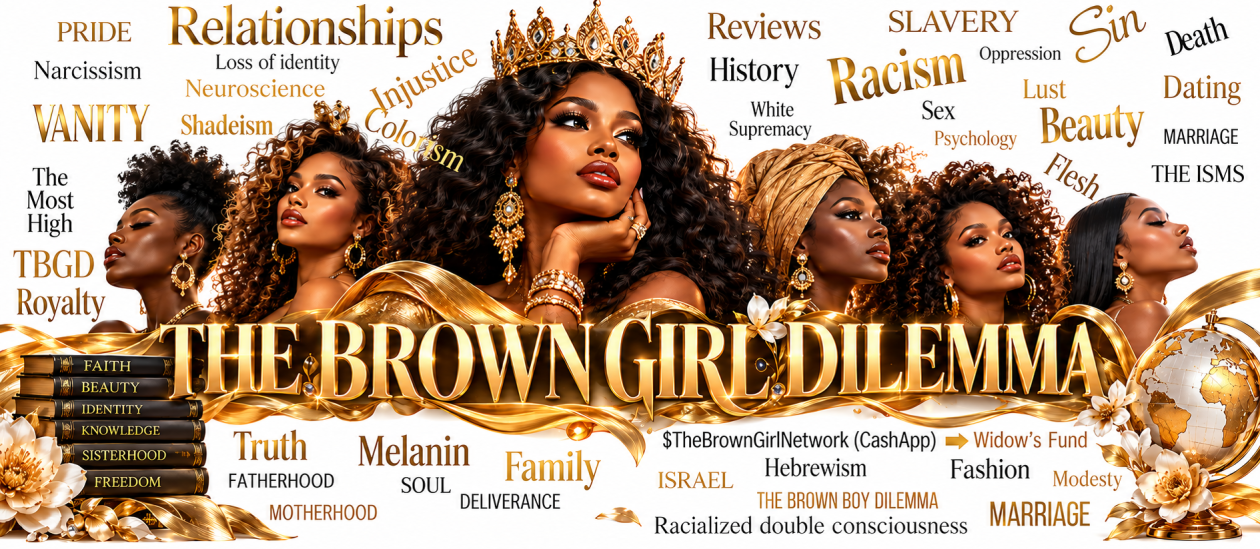
The Brown Girl: A Queen in the Making

The concept of the Brown Girl as a queen in the making recognizes her inherent value, potential, and divinely ordained purpose. She embodies resilience, beauty, and intellect, and her journey is one of self-discovery, empowerment, and spiritual growth. Being a queen is not defined by titles or external validation, but by character, faith, and a commitment to excellence.

A queen in the making understands the importance of her identity. She is rooted in her heritage, culture, and lineage, which provide a foundation for pride and confidence. Knowing her worth allows her to navigate a world that often underestimates her potential. Proverbs 31:25 (KJV) states, “Strength and honour are her clothing; and she shall rejoice in time to come.” Her value is reinforced by wisdom, grace, and self-respect.

Education is a key aspect of her preparation. Intellectual growth equips her to face challenges, pursue her dreams, and lead effectively. Proverbs 4:7 (KJV) teaches, “Wisdom is the principal thing; therefore get wisdom: and with all thy getting get understanding.” A queen in the making recognizes that knowledge is a tool to empower herself and uplift her community.

Spiritual development is central to her journey. A queen seeks to cultivate a relationship with God, grounding her decisions, actions, and ambitions in faith. 1 Peter 3:3-4 (KJV) reminds her, “Whose adorning let it not be that outward adorning… But let it be the hidden man of the heart, in that which is not corruptible, even the ornament of a meek and quiet spirit, which is in the sight of God of great price.” Her inner life forms the crown she will wear.

Self-discipline and self-respect shape her path. A queen in the making avoids behaviors that compromise her integrity or values. She sets boundaries, pursues excellence, and cultivates virtues that reflect her character. 1 Corinthians 9:27 (KJV) instructs, “But I keep under my body, and bring it into subjection: lest that by any means, when I have preached to others, I myself should be a castaway.” Discipline fortifies her strength.

Physical well-being is also part of her preparation. Caring for her body through health, nutrition, and exercise demonstrates stewardship of the life God has given her. 1 Corinthians 6:19-20 (KJV) teaches, “Ye are not your own; for ye are bought with a price: therefore glorify God in your body, and in your spirit, which are God’s.” A queen in the making honors her body as a temple of God.

Emotional intelligence is critical in her development. She learns to manage feelings, communicate effectively, and navigate relationships with empathy and grace. Proverbs 31:26 (KJV) states, “She openeth her mouth with wisdom; and in her tongue is the law of kindness.” Emotional maturity enables her to lead with compassion and integrity.

A queen in the making values community and mentorship. She surrounds herself with wise counsel, peers who uplift her, and mentors who challenge her to grow. Proverbs 27:17 (KJV) teaches, “Iron sharpeneth iron; so a man sharpeneth the countenance of his friend.” Positive influence strengthens her resolve and expands her vision.

Faithful stewardship of her gifts, time, and resources is essential. A queen in the making understands that leadership comes with responsibility. Luke 16:10 (KJV) says, “He that is faithful in that which is least is faithful also in much.” Small acts of diligence prepare her for greater roles of influence and responsibility.

Integrity under pressure distinguishes her path. Challenges and setbacks test her character, yet she remains steadfast, guided by faith and principles. James 1:12 (KJV) reminds, “Blessed is the man that endureth temptation: for when he is tried, he shall receive the crown of life, which the Lord hath promised to them that love him.” Her resilience is a hallmark of queenly character.

The brown girl’s voice is powerful. She expresses her thoughts, shares her vision, and advocates for justice, truth, and positive change. Proverbs 31:8-9 (KJV) advises, “Open thy mouth for the dumb in the cause of all such as are appointed to destruction. Open thy mouth, judge righteously, and plead the cause of the poor and needy.” Her influence shapes her world.

Cultural pride is an inseparable aspect of her majesty. Celebrating her roots, embracing her natural beauty, and honoring her ancestors fortify her identity. Psalm 139:14 (KJV) asserts, “I will praise thee; for I am fearfully and wonderfully made: marvelous are thy works; and that my soul knoweth right well.” She honors God through her authentic self.

A queen in the making cultivates leadership through action. She engages in initiatives, serves her community, and uplifts those around her. Romans 12:8 (KJV) encourages, “Or he that exhorteth, on exhortation: he that giveth, with simplicity; he that ruleth, with diligence; he that sheweth mercy, with cheerfulness.” Leadership is both service and stewardship.

Her journey includes preparation for meaningful relationships. She seeks companionship that aligns with her values, faith, and aspirations. Song of Solomon 2:7 (KJV) emphasizes guarding one’s heart, “I charge you, O daughters of Jerusalem, by the roes, and by the hinds of the field, that ye stir not up, nor awake my love, until he please.” She preserves her heart for God’s timing.

Ultimately, the Brown Girl: Queens in the Making represents a holistic approach to empowerment. Through education, faith, character, and service, she steps into her purpose with grace and authority. Her life becomes a model for other young women, inspiring a legacy of dignity, resilience, and divine alignment.

References

1 Corinthians 6:19-20; 9:27. (KJV). Holy Bible.

1 Peter 3:3-4. (KJV). Holy Bible.

James 1:12. (KJV). Holy Bible.

Luke 16:10. (KJV). Holy Bible.

Proverbs 4:7; 27:17; 31:25-26; 31:30. (KJV). Holy Bible.

Psalm 139:14. (KJV). Holy Bible.

Romans 12:8. (KJV). Holy Bible.

Song of Solomon 2:7. (KJV). Holy Bible.

Girl Talk Series: Am I a Queen or a Plaything?

There is a question every woman should eventually ask herself: How does the man who wants me treat me? Not how does he talk when he wants something from me, not how does he behave when he is lonely, and not how much attention does he give me when he wants sex—but how does he consistently treat me when there is nothing immediate for him to gain? A woman who understands her worth learns to distinguish between being genuinely valued and merely being desired.

Being a queen does not mean demanding perfection from a man or expecting him to finance every aspect of your life. It means understanding that your dignity is not something you negotiate for temporary attention. A woman should not have to surrender her standards, body, peace, convictions, or self-respect to convince a man to stay. If keeping a man requires abandoning yourself, the price is too high.

One of the strongest boundaries a woman can establish is waiting until marriage to have sex. Sex is powerful, intimate, and capable of creating emotional, physical, and spiritual consequences. However, choosing abstinence can provide an opportunity to determine whether a man’s interest extends beyond physical access. A man who genuinely respects a woman’s conviction should be capable of respecting her boundary without manipulation, intimidation, pressure, or resentment.

A woman should pay close attention to what happens when she says no. A man who becomes angry, insulting, threatening, distant, or emotionally manipulative because she will not have sex is revealing something important. Pressure is not passion. Persistence after a clearly communicated boundary is not romance.

And girl, let’s talk about the 50/50 relationship conversation. There is nothing inherently wrong with two adults contributing financially to a household according to their circumstances. Healthy relationships can involve different arrangements depending upon income, children, career choices, debt, health, and personal agreements. But a relationship should never become a mathematical transaction in which both people are constantly calculating who owes whom. Marriage requires partnership, sacrifice, generosity, and responsibility—not merely splitting every receipt down the middle.

In the experiences of many women, the issue is not simply whether a relationship is 50/50; it is what happens when a woman contributes financially, and the man uses the money he saves—or sometimes even shared household resources—to invest in another woman. A woman may work, pay half the bills, contribute to groceries, household expenses, dates, vacations, or other necessities, only to discover that the man is using his remaining income to entertain, pursue, or financially support someone else. In that situation, her frustration is understandable. She may feel that she helped sustain the relationship while he redirected his resources and attention toward another woman.

Some women therefore question whether a strictly 50/50 arrangement actually protects them from being taken for granted. It does not. A woman contributing half does not purchase a man’s loyalty, and a man contributing more does not automatically make him faithful. Money does not purchase fidelity. A man who intends to cheat can cheat whether his woman contributes 50%, 20%, or nothing financially. Likewise, a faithful man does not suddenly become unfaithful because his partner contributes financially. Infidelity is ultimately a matter of character, boundaries, entitlement, opportunity, and choice—not simply who paid the electric bill.

The deeper issue is reciprocity. A woman should not be expected to contribute financially, emotionally, domestically, and sexually while receiving little commitment, protection, consideration, or accountability in return. Likewise, a man should not be expected to carry every financial responsibility simply because he is a man if the couple has mutually agreed upon another arrangement. The healthiest relationship is not necessarily the one where every expense is divided precisely down the middle; it is the one where both people believe the arrangement is fair, mutually agreed upon, sustainable, and consistent with the commitment they have made to each other.

And if a man is using the financial freedom created by his partner’s contributions to pursue another woman, the problem is not that the relationship was 50/50. The problem is that he was using the benefits of one woman’s partnership while violating the trust of that partnership with another woman. That is betrayal, regardless of how the bills were divided.

However, there is a legitimate concern behind some women’s frustration with transactional relationships. If a woman is contributing substantial financial resources while a man simultaneously uses his discretionary income, time, attention, and energy to pursue other women, she may reasonably question whether the relationship is equitable. The problem is not that she contributed money. The problem is that the relationship lacks mutual commitment and accountability.

A woman should therefore stop asking only, “What is he spending on me?” and start asking, “What is he investing in us?” A man can buy flowers, expensive dinners, jewelry, vacations, and designer handbags and still be an unfaithful man. Another man may have limited financial resources but demonstrate extraordinary integrity, responsibility, consistency, and devotion. Money can reveal priorities, but it cannot substitute for character.

So, how do you spot a cheater? You cannot identify infidelity with absolute certainty from a checklist, because people behave differently and some unfaithful people are exceptionally deceptive. Nevertheless, certain patterns deserve attention: excessive secrecy surrounding phones, unexplained changes in routine, inconsistent stories, sudden emotional distance, disappearing for unexplained periods, unusual defensiveness, unexplained expenses, flirtatious relationships that violate agreed boundaries, and a dramatic reduction in transparency.

One of the biggest red flags is inconsistency. His words say one thing while his behavior repeatedly says another. He tells you that you are important, but he constantly disappears. He claims he is committed, but he keeps inappropriate relationships with women he insists are “just friends.” He says he wants a future, but refuses to make concrete plans. A woman should learn to listen to behavior because behavior often communicates what words attempt to conceal.

Another warning sign is a man who needs constant female validation. A man who is perpetually collecting women’s phone numbers, responding to suggestive messages, maintaining dating-app profiles, entertaining flirtation, or needing women to reassure him that he is attractive may have difficulty establishing appropriate boundaries. Confidence does not require an audience of women. A man can know that he is desirable without behaving as though every woman must confirm it.

Now let’s turn to the question every woman wants answered: What does a man do when he really wants you? He makes his intentions increasingly clear. He does not require you to spend months decoding contradictory signals. He communicates. He makes plans. He follows through. He wants to know you beyond your physical appearance. He becomes interested in your mind, values, family, aspirations, faith, fears, and future.

A serious man also creates room for you in his life. That does not mean immediately introducing you to everyone he knows or rushing into marriage. It means that over time, you can see evidence that the relationship has a legitimate place in his life. You are not permanently hidden. You are not exclusively contacted after midnight. You are not his secret. You are not competing against an invisible lineup of women for his attention.

A man who genuinely wants a woman should also be willing to define the relationship. Commitment does not necessarily happen immediately, but perpetual ambiguity is not commitment. If months or years pass and he continues saying, “Let’s just see where this goes,” while expecting girlfriend privileges, emotional support, sexual access, financial assistance, and loyalty, a woman has every right to ask whether she is actually receiving a relationship or merely providing relationship benefits without relationship security.

And here is another important lesson: watch how he treats you when he doesn’t get his way. Anyone can be charming while everything is going according to plan. Character becomes visible during disappointment. Does he communicate respectfully? Does he punish you with silence? Does he insult you? Does he threaten to leave? Does he pressure you sexually? Does he attempt to make you jealous? A man’s reaction to your boundaries can tell you considerably more than his romantic speeches.

A woman should also examine the difference between being pursued and being consumed. Some men pursue women intensely because they want conquest, sex, validation, or the excitement of obtaining someone they consider difficult to get. Once they receive what they wanted, their enthusiasm disappears. Genuine interest, however, is sustained by curiosity, respect, affection, responsibility, and an actual desire to build something.

Girl, do not confuse sexual chemistry with compatibility. You can have incredible chemistry with someone who would make a terrible husband. You can be intensely attracted to a man who lacks emotional maturity, financial responsibility, fidelity, spiritual alignment, or respect for your boundaries. Attraction tells you that you desire someone. It does not tell you whether that person is suitable for your life.

The woman who asks, “Am I a queen or a plaything?” must also examine herself without shame. Are you accepting situations you secretly know are beneath your standards because you fear being alone? Are you allowing a man to repeatedly disappoint you because you are hoping his potential will eventually become reality? Are you giving wife-level loyalty to someone who has never demonstrated husband-level commitment? Sometimes the most difficult conversation is not with the man—it is with ourselves.

Biblically, a woman does not have to become desperate to be chosen. Scripture repeatedly emphasizes wisdom, self-control, discernment, and honorable conduct. Proverbs 31 presents a woman whose value extends far beyond her physical attractiveness, while 1 Corinthians 6:18 teaches believers to flee sexual immorality. Hebrews 13:4 declares marriage honorable and the marriage bed undefiled. Waiting until marriage, therefore, can be understood not merely as a restriction but as a deliberate expression of conviction, discipline, and reverence for intimacy.

Ultimately, being a queen is not about being placed on a pedestal; it is about knowing what you will and will not participate in. You cannot control whether a man cheats. You cannot force a man to marry you. You cannot purchase loyalty with sex, money, beauty, cooking, submission, or sacrifice. What you can control is whether you remain in situations that continually violate your values. The woman who knows her worth does not spend her entire life begging someone else to recognize it.

So, ladies, ask the difficult questions early. Does he respect my boundaries? Is he consistent? Does he have integrity? Does he make his intentions clear? Does he protect the relationship? Does he keep appropriate boundaries with other women? Does he take responsibility? Does he pursue marriage if marriage is what we both desire? Does his private behavior match his public words? A ring is not the only evidence of seriousness—but neither is a man’s sweet talk.

You are not a plaything because a man desires you. You become diminished when you allow someone else’s desire to determine your value. Your body is not a bargaining chip. Your companionship is not a consolation prize. Your femininity is not a commodity. And your love should not be given blindly to someone who has demonstrated that he only wants access without responsibility. Let a man’s character answer the question his mouth may avoid: Does he merely want you, or does he genuinely want to build a life with you?

References

Bible Gateway. (n.d.). The Holy Bible, King James Version. https://www.biblegateway.com/

Foster, E. M. (2000). The gender gap in family spending. Journal of Marriage and Family, 62(2), 505–516.

Fowers, B. J., & Olson, D. H. (1993). ENRICH marital satisfaction scale: A brief research and clinical tool. Journal of Family Psychology, 7(2), 176–185.

Gottman, J. M., & Gottman, J. S. (2015). 10 principles for doing effective couples therapy. W. W. Norton.

Gottman, J. M., & Silver, N. (2015). The seven principles for making marriage work (Rev. ed.). Harmony Books.

Regnerus, M. D. (2017). Cheap sex: The transformation of men, marriage, and monogamy. Oxford University Press.

Stanley, S. M., Rhoades, G. K., & Markman, H. J. (2006). Sliding versus deciding: Inertia and the premarital cohabitation effect. Family Relations, 55(4), 499–509.

Twenge, J. M., Sherman, R. A., & Wells, B. E. (2016). Changes in American adults’ sexual behavior and attitudes, 1972–2012. Archives of Sexual Behavior, 45, 193–208.

Waite, L. J., & Gallagher, M. (2000). The case for marriage: Why married people are happier, healthier, and better off financially. Doubleday.

Pretty Lies We Were Told

Pretty lies are often wrapped in compliments, trends, and cultural norms that sound empowering but quietly mislead women. These lies are not always malicious; many are inherited, repeated, and normalized until they feel like the truth. Yet their impact is profound, shaping how women see themselves, love others, and measure worth.

One of the earliest lies women are told is that beauty equals value. From a young age, girls learn that appearance attracts attention, approval, and opportunity. While beauty can open doors, it was never meant to define identity. When worth is tied to looks, self-esteem becomes fragile and externally controlled.

Another common lie is that attention is the same as love. Many women are taught—directly or indirectly—that being desired means being cherished. In reality, attention can be fleeting, self-serving, or purely physical. Love requires responsibility, consistency, and sacrifice, not just attraction.

Women are also told that being chosen is the ultimate goal. This narrative places romantic selection above personal development, faith, purpose, and peace. It subtly teaches women to shrink standards, silence instincts, and tolerate mistreatment to avoid being alone.

The lie that independence means isolation has misled many. Strength is often portrayed as emotional detachment or self-sufficiency at all costs. True strength, however, allows for interdependence, healthy vulnerability, and discernment without surrendering self-worth.

Another deception suggests that men will change once they feel secure. Women are often encouraged to invest emotionally, sexually, or sacrificially in the hope of potential rather than proof. Change requires personal conviction, not romantic pressure.

The culture also promotes the idea that sexual freedom automatically leads to empowerment. While autonomy matters, detaching intimacy from meaning has often left women emotionally unprotected. Empowerment without wisdom can become another form of exploitation.

Women are frequently told that boundaries push love away. In truth, boundaries reveal intentions. Those who respect limits reveal alignment; those who resist them expose entitlement. Boundaries do not destroy healthy relationships—they protect them.

The lie that marriage is restrictive has discouraged commitment while romanticizing endless options. Research consistently shows that stable marriages often provide emotional security, shared purpose, and long-term well-being when built on mutual respect.

Another subtle lie is that emotional chaos equals passion. Intensity is mistaken for depth, and instability for excitement. Healthy love is often quieter, steadier, and rooted in peace rather than adrenaline.

Women are also taught that forgiveness requires tolerance of repeated harm. Forgiveness is spiritual; endurance of abuse is not. Healing and accountability must coexist for relationships to remain healthy.

The myth of having it all simultaneously has placed impossible pressure on women. Career success, perfect appearance, flawless relationships, and emotional availability are expected without rest or support. This lie produces burnout, not fulfillment.

Comparison is another pretty lie disguised as motivation. Social media amplifies curated images that distort reality. Measuring life against highlights breeds dissatisfaction and erodes gratitude.

Women are often told that their biological clocks define their value. While time matters, panic-driven decisions often lead to regret. Wisdom encourages patience, not fear-based choices.

The belief that love requires suffering has romanticized pain. Struggle may exist in growth, but love itself should not consistently wound. Peace, safety, and respect are not optional luxuries.

Another lie claims that silence keeps the peace. Women are often encouraged to suppress their needs to maintain harmony. Yet unspoken resentment eventually damages the connection more than honest conversation.

Faith is sometimes framed as weakness rather than discernment. Trusting God, waiting, and choosing obedience are portrayed as outdated. Yet faith often provides clarity and protection where impulse fails.

Women are also misled into thinking self-love means self-indulgence. True self-love includes discipline, accountability, and choices that honor long-term well-being, not just immediate comfort.

The lie that healing can happen inside the same environment that caused the harm keeps many stuck. Growth often requires distance, boundaries, and new patterns.

Ultimately, these pretty lies persist because they are profitable—emotionally, socially, and economically. But truth, though less glamorous, leads to freedom.

Unlearning these lies is not about blame; it is about awakening. When women choose truth over illusion, they reclaim clarity, dignity, and peace.

Pretty lies may sparkle, but truth sustains. And women deserve lives built on what lasts, not what merely looks good.


References

Holy Bible, King James Version. (1611/1769).

Gottman, J. M., & Silver, N. (2015). The seven principles for making marriage work. Harmony Books.

Regnerus, M. (2017). Cheap sex: The transformation of men, marriage, and monogamy. Oxford University Press.

Twenge, J. M. (2017). iGen: Why today’s super-connected kids are growing up less rebellious, more tolerant, less happy—and completely unprepared for adulthood. Atria Books.

Fredrickson, B. L., & Roberts, T.-A. (1997). Objectification theory: Toward understanding women’s lived experiences and mental health risks. Psychology of Women Quarterly, 21(2), 173–206.

Wilcox, W. B., & Nock, S. L. (2006). What’s love got to do with it? Equality, equity, commitment and women’s marital quality. Social Forces, 84(3), 1321–1345.

We Are History

“A people without the knowledge of their past history, origin and culture is like a tree without roots.” – Marcus Garvey

🖤 🖤 🖤 🖤 🖤 🖤 🖤 🖤 🖤 🖤

🖤 🖤 🖤 🖤 🖤 🖤 🖤 🖤 🖤 🖤

We are history. Before our names were written into textbooks, before photographs captured our faces, and before monuments were erected in our honor or shame, human beings were already creating the story that would become the history of the world. Every generation inherits the consequences of what previous generations built, destroyed, preserved, resisted, and forgot. History is therefore not merely something behind us; it is a living inheritance carried into the present.

For Black people, the statement “We Are History” carries extraordinary significance. Black history is not a small chapter within American history, nor is it limited to slavery, civil rights, and racial discrimination. Black history encompasses ancient African civilizations, intellectual traditions, kingdoms, migrations, scientific achievements, artistic expression, religious traditions, political movements, family histories, economic contributions, and the countless ordinary lives that collectively shaped civilization.

Africa itself is central to the story of humanity. Archaeological and genetic evidence demonstrates that modern humans originated in Africa and subsequently migrated across the world. This means that African history is not peripheral to human history. It is foundational to the human story. Long before modern racial categories developed, African societies were producing technologies, agricultural systems, political institutions, artistic traditions, architecture, trade networks, and philosophical ideas.

Ancient African civilizations demonstrate the diversity and sophistication of the continent’s past. Egypt and Nubia developed complex political and cultural systems, while civilizations throughout West Africa later established powerful kingdoms and empires. Ghana, Mali, Songhai, Great Zimbabwe, and other societies participated in regional and international commerce. Their histories challenge simplistic narratives that portray Africa as historically passive or disconnected from global civilization.

The history of slavery is one of the most consequential and painful chapters in the history of Black people and the Americas. Millions of Africans were forcibly removed from their homelands through the transatlantic slave trade and transported under brutal conditions to the Americas, where enslaved people were subjected to forced labor, family separation, physical violence, sexual exploitation, and legal systems that denied their fundamental humanity. Yet enslaved Africans were never merely victims of history; they resisted oppression through rebellion, escape, cultural preservation, community building, and countless everyday acts of defiance. Their labor also generated enormous wealth that contributed to the economic development of colonial and later American society. Understanding slavery therefore requires examining both the brutality of the institution and the humanity, resilience, resistance, and cultural creativity of the people who endured it. As historian Ira Berlin demonstrates, enslaved people were active historical agents who continually shaped their own lives and communities despite the constraints imposed upon them (Berlin, 2003).

The transatlantic slave trade profoundly altered the history of Africa, Europe, and the Americas. Millions of Africans were forcibly transported across the Atlantic, separated from families and communities, and subjected to systems of hereditary enslavement. The consequences were enormous, producing demographic, economic, political, cultural, and psychological transformations that continue to influence societies centuries later.

Enslaved Africans nevertheless remained human beings with memories, cultures, languages, beliefs, skills, relationships, and aspirations. Slavery attempted to reduce people to property, but enslaved people continually asserted their humanity. They formed families, preserved cultural practices, created spiritual traditions, resisted oppression, escaped when possible, and fought for freedom. Their resistance is an essential part of Black history.

Black history also belongs to the history of American labor and economic development. Enslaved people cultivated agricultural products, constructed buildings, performed domestic labor, developed skilled trades, and generated enormous wealth for individuals and institutions. After emancipation, Black workers continued contributing to American economic development while frequently confronting discriminatory wages, exclusion from opportunities, segregation, and exploitation.

Emancipation did not immediately create equality. The Reconstruction era represented a remarkable period of Black political participation, institution building, education, and civic engagement, but it was followed by violent resistance and the establishment of systems designed to restrict Black freedom. Jim Crow segregation, disenfranchisement, racial terror, and discriminatory laws shaped the lives of generations.

Yet Black Americans repeatedly created institutions that strengthened their communities. Churches, schools, colleges, newspapers, businesses, fraternal organizations, mutual-aid societies, and civic organizations became essential sources of education, economic development, spiritual life, and political organization. These institutions demonstrated that Black communities were not merely surviving oppression; they were building structures capable of sustaining future generations.

The intellectual history of Black America is equally powerful. Scholars, writers, philosophers, scientists, educators, journalists, and activists challenged prevailing assumptions about race and human ability. Figures such as W. E. B. Du Bois, Anna Julia Cooper, Carter G. Woodson, Zora Neale Hurston, Alain Locke, and countless others expanded American intellectual life through scholarship, literature, education, and cultural criticism.

Black women occupy a particularly important place within this history. Their experiences cannot be reduced to the stories of Black men or white women. Black women navigated racial discrimination, gender inequality, economic exploitation, family responsibilities, political struggles, and cultural expectations while producing extraordinary contributions to education, literature, activism, science, medicine, business, religion, and the arts.

The Civil Rights Movement is one of the most recognized portions of Black history, but even that movement was larger than the names most commonly remembered. Martin Luther King Jr., Rosa Parks, Malcolm X, Ella Baker, Fannie Lou Hamer, Medgar Evers, John Lewis, Diane Nash, Bayard Rustin, and countless local organizers contributed to movements that challenged segregation and racial injustice. History is often remembered through famous individuals, but movements are built by thousands of people whose names may never appear in textbooks.

Black history also includes intellectual and cultural movements that transformed global culture. The Harlem Renaissance demonstrated the extraordinary creative power of Black literature, music, visual art, theater, and intellectual life. Jazz, blues, gospel, rhythm and blues, hip-hop, and numerous other musical traditions developed through Black creativity and became influential throughout the world.

Fashion, beauty, and popular culture are also historical subjects. Black hairstyles, clothing, cosmetics, music, dance, language, and artistic expression have repeatedly influenced mainstream culture. Yet recognition and economic compensation have not always followed cultural influence. Studying this history allows us to understand both Black creativity and the complicated relationship between cultural contribution, commercialization, appropriation, and ownership.

Black history extends far beyond the United States. The African diaspora includes communities throughout the Caribbean, Latin America, Canada, Europe, and other parts of the world. People of African descent have shaped the political, economic, cultural, and intellectual histories of numerous nations. The experiences differ from country to country, but connections can be found through migration, colonialism, slavery, resistance, culture, religion, and shared ancestry.

Genealogy provides another way of understanding history. Every individual represents a chain of generations. Names, photographs, birth records, oral traditions, family stories, genetic ancestry, and geographic migrations can help reconstruct pieces of that chain. For descendants of people whose records were destroyed, altered, or never created, genealogical research can become an especially meaningful process of recovering historical identity.

History also contains painful truths. There are stories of violence, betrayal, exploitation, discrimination, displacement, and loss that cannot simply be erased because they make people uncomfortable. Remembering painful history does not mean remaining trapped in the past. It means understanding how the past shaped the present and recognizing the consequences of decisions made by previous generations.

At the same time, Black history should never be reduced exclusively to suffering. There is beauty in the story: families raising children, communities building churches and schools, entrepreneurs creating businesses, artists producing masterpieces, scientists expanding knowledge, musicians transforming sound, writers creating worlds, and ordinary people finding joy under extraordinary circumstances. Resilience is part of the story, but so are creativity, love, humor, ambition, achievement, and celebration.

“We Are History” therefore means that history is not something that belongs exclusively to famous people. Every family has a history. Every community has a history. Every migration, marriage, struggle, achievement, invention, song, photograph, letter, and memory contributes another piece to the human record. The grandmother who preserved family recipes and the grandfather whose work supported his children are historical figures within their own family narratives.

Ultimately, knowing history is an act of understanding. It teaches us where we came from, what previous generations endured, what they accomplished, what mistakes they made, and what possibilities they created. For Black people, studying history can restore stories that were ignored, distorted, or deliberately excluded. But the purpose of remembering is not simply to celebrate yesterday. We are history because we are the living continuation of those who came before us—and what we do today will become the history that someone else inherits tomorrow.

If this work has informed or inspired you, please consider supporting it so we can continue researching, writing, and sharing these stories.

CashApp: $thebrowngirlnetwork

References

Berlin, I. (2003). Generations of captivity: A history of African-American slaves. Belknap Press of Harvard University Press.

Blassingame, J. W. (1972). The slave community: Plantation life in the antebellum South. Oxford University Press.

Du Bois, W. E. B. (1935). Black reconstruction in America, 1860–1880. Harcourt, Brace and Company.

Gates, H. L., Jr. (2011). Black in Latin America. New York University Press.

Gomez, M. A. (1998). Exchanging our country marks: The transformation of African identities in the colonial and antebellum South. University of North Carolina Press.

Hine, D. C., Hine, W. C., & Harrold, S. (2018). The African American odyssey (7th ed.). Pearson.

Horton, J. O., & Horton, L. E. (Eds.). (2006). Slavery and public history: The tough stuff of American memory. University of North Carolina Press.

Lewis, D. L. (2009). W. E. B. Du Bois: The complete biography. Henry Holt and Company.

Painter, N. I. (2006). Creating Black Americans: African-American history and its meanings, 1619 to the present. Oxford University Press.

Robinson, J. (1989). Black women and the struggle for equality. Cambridge University Press.

Woodson, C. G. (1933). The mis-education of the Negro. Associated Publishers.

Yacovone, D. (2020). Teaching White supremacy: America’s democratic ordeal and the forging of our national identity. Pantheon Books.

Wilkerson, I. (2020). Caste: The origins of our discontents. Random House.
Diary of a Brown Girl Becoming: Tameka’s Story

Tameka was the kind of woman whose light shone quietly—a Sabbath-keeping, God-loving soul who wore her faith like a crown even when her heart felt heavy. Every Friday evening, as the sun set, she lit her candles, prayed her prayers, and welcomed peace into her home. Yet, even in the holiness of rest, she wrestled with a weariness that no Sabbath could wash away—the ache of being unseen.

At nearly 300 pounds, Tameka carried more than just her body; she carried the weight of people’s judgments. Her light skin, once thought to be a shield in a world obsessed with shade, offered no protection from the cruelty of lookism—the silent prejudice that measures worth by waistlines and confidence by clothing size. She had learned that even privilege bends under the pressure of beauty standards.

“Pretty for a big girl” was the compliment she heard most often—words that stung more than they soothed. They reminded her that people saw her as a category, not as a woman. She was both visible and invisible—noticed for her size, ignored for her spirit. And though she smiled through it, inside, she was breaking.

On the Sabbath, she sang praises that reached Heaven, but on the car on other days, her thoughts were less holy. “Lord,” she’d whisper, “am I not enough?” She wanted love—not the kind you beg for, but the kind that chooses you. She dreamed of holding hands with a man who saw her heart before her hips. But love never seemed to linger near her door.

Friends told her to be patient, to focus on herself, to wait on God’s timing. And she tried—she really did. But sometimes, waiting felt like a punishment. She watched thinner women marry, have children, and post smiling pictures online. Their lives looked effortless, while hers felt like endurance.

Still, she never stopped believing. Each Sabbath, she opened her worn Bible and found solace in scriptures like Psalm 34:18: “The Lord is nigh unto them that are of a broken heart; and saveth such as be of a contrite spirit.” It reminded her that God saw what others overlooked—the beauty in her endurance, the strength in her faith, the sacredness of her struggle.

Slowly, she began to understand that her worth was not tied to her weight, her job, or her relationship status. Her body, though judged by others, was still a temple. Her singleness, though lonely at times, was still holy ground. She started walking—small steps at first, not for validation, but for vitality. She began journaling her prayers, affirming herself with the Word.

Over time, Tameka’s reflection began to change—not because her body shrank, but because her spirit expanded. She started to see herself through God’s eyes: chosen, cherished, and complete. The laughter of others no longer defined her; the love of God did.

She began to speak openly about her struggles, testifying that healing begins when we stop hiding. Women who once pitied her began to find strength in her transparency. She reminded them that holiness isn’t measured in dress sizes or marriage certificates, but in the faith that survives mockery and loneliness.

Tameka still has hard days—days when the mirror whispers old lies, when her job feels unfulfilling, when she wishes for companionship. But she no longer lets those feelings dictate her worth. Her joy has roots now, planted deep in grace.

Her story is a mirror for every woman who feels unseen in a world obsessed with appearance. Light-skinned or dark, thin or thick, rich or struggling—God’s love does not discriminate. Tameka’s beauty was never hidden; it was holy. Her body is not a burden but a vessel of testimony, proof that even in the quiet suffering, God is still writing redemption.

The Brown Girl Dilemma: How the World Sees Our Beauty

The Brown Girl Dilemma begins with a deceptively simple question: How is the beauty of the Brown girl seen by the world, and how does she learn to see herself? Brown women and girls exist across continents, cultures, languages, ethnicities, and histories. Their appearances encompass an extraordinary range of skin tones, facial structures, hair textures, body types, and cultural expressions. Yet beauty is never merely biological. It is also interpreted through history, media, culture, economics, geography, and social expectations. The dilemma emerges when a woman must navigate the difference between how the world defines beauty and how she understands her own God-given identity.

Around the world, beauty has never had one universal standard. Anthropological and psychological research demonstrates that people make judgments about attractiveness through a combination of biological, cultural, social, and individual influences (Etcoff, 1999; Little et al., 2011). Features such as facial symmetry, averageness, skin quality, and certain proportions can influence perceptions of attractiveness, but cultural context significantly shapes what societies celebrate. What one society considers exceptionally beautiful may be interpreted differently somewhere else. The Brown girl therefore enters a world in which beauty is simultaneously personal, cultural, and socially constructed.

The global visibility of Brown women has expanded dramatically through cinema, television, fashion, music, sports, social media, and international entertainment. Representation matters because people often recognize possibilities for themselves when they see people who resemble them occupying spaces historically unavailable to them.

Yet visibility alone does not determine how beauty is valued. The Brown girl may discover that being admired in one cultural environment does not necessarily guarantee acceptance in another. Her hair, facial features, accent, body, clothing, or cultural traditions may be celebrated in one place and misunderstood somewhere else. Globalization has created greater exposure to different standards of beauty, but it has also created an enormous marketplace in which women are continually encouraged to modify themselves. Cosmetics, fashion, cosmetic procedures, hair products, fitness industries, and digital filters can transform beauty from an expression of identity into an endless project of self-improvement.

Social media has intensified this phenomenon. Platforms built around photographs and short-form video encourage people to evaluate themselves visually and immediately. Research has associated frequent exposure to idealized appearance-related social media content with body-image concerns and appearance comparison (Fardouly & Vartanian, 2016). The Brown girl may therefore find herself comparing her ordinary face to carefully selected photographs, professional makeup, lighting, filters, editing, and cosmetic enhancement. The problem is not beauty itself; the problem occurs when the pursuit of an artificial image convinces a woman that her natural appearance is perpetually inadequate.

The international beauty industry also demonstrates how cultural ideas travel. A beauty trend that begins in one region can quickly become global through entertainment and social media. Hairstyles, cosmetics, fashion silhouettes, skincare practices, and aesthetic preferences increasingly cross national boundaries. This cultural exchange can be enriching because women gain access to new forms of creativity and self-expression. At the same time, globalization can produce pressure to conform to increasingly narrow visual ideals. The Brown girl must therefore learn to distinguish between appreciating beauty and surrendering her identity to beauty culture.

There is also a spiritual dimension to the question. Scripture does not teach that physical beauty is meaningless, but it refuses to make physical appearance the foundation of human worth. Proverbs 31:30 declares, “Favour is deceitful, and beauty is vain: but a woman that feareth the LORD, she shall be praised” (KJV). First Samuel 16:7 similarly teaches that while human beings look upon outward appearance, “the LORD looketh on the heart.” These passages do not require women to reject beauty. Rather, they establish a hierarchy in which character, wisdom, righteousness, and reverence for God ultimately possess greater value than physical appearance.

The Brown girl must therefore learn to inhabit her beauty rather than constantly audition for the world’s approval. There is nothing wrong with makeup, fashion, jewelry, hairstyling, fitness, skincare, or other forms of adornment when they remain expressions rather than masters. A woman can enjoy becoming glamorous without believing that glamour determines her worth. She can appreciate international beauty standards without becoming enslaved to them. She can admire another woman’s appearance without interpreting that woman’s beauty as evidence that her own is insufficient. Beauty becomes healthier when it is experienced as abundance rather than competition.

Ultimately, the Brown Girl Dilemma is not simply about whether Brown women are considered beautiful. They clearly are. The deeper question is who gets to define what their beauty means. Does the fashion industry decide? Does Hollywood decide? Does social media decide? Does popular culture decide? Does a romantic partner decide? Or does the woman herself, informed by her history, culture, individuality, faith, and understanding of human dignity, participate in defining her own image? The answer matters because a woman who allows everyone else to define her beauty may spend her life pursuing an identity that was never truly hers.

The Brown girl therefore deserves a beauty narrative that is expansive rather than restrictive. She can be elegant, natural, glamorous, athletic, intellectual, traditional, modern, conservative, creative, feminine, ambitious, spiritual, or any combination of these qualities without having to fit a single template. Her beauty exists within a larger human story that includes character, intelligence, creativity, compassion, resilience, and purpose. The world may look at her through many different lenses, but she does not have to borrow every lens through which she is viewed. The Brown Girl Dilemma ultimately asks her to look beyond the world’s mirror and discover the woman standing in front of it.

If this work has informed or inspired you, please consider supporting it so we can continue researching, writing, and sharing these stories.

CashApp: $thebrowngirlnetwork

References

Etcoff, N. (1999). Survival of the prettiest: The science of beauty. Doubleday.

Fardouly, J., & Vartanian, L. R. (2016). Social media and body image concerns: Current research and future directions. Current Opinion in Psychology, 9, 1–5. https://doi.org/10.1016/j.copsyc.2015.09.005

Little, A. C., Jones, B. C., & DeBruine, L. M. (2011). Facial attractiveness: Evolutionary based research. Philosophical Transactions of the Royal Society B: Biological Sciences, 366(1571), 1638–1659. https://doi.org/10.1098/rstb.2010.0404

The Holy Bible, King James Version. (1611/1769). 1 Samuel 16:7; Proverbs 31:30.

Who Deserves the Crown?

Beauty is often presented as though it were an objective truth, a quality that naturally belongs to certain faces and bodies. Yet the history of beauty reveals something far more complicated. The question of who “deserves the crown” is rarely determined by physical appearance alone. Beauty is interpreted through cultural values, historical circumstances, social hierarchies, economics, media institutions, and systems of power. The crown, therefore, is not merely placed upon the head of the most beautiful woman; it is often awarded by those who possess the authority to define beauty in the first place.

For centuries, societies have created standards that distinguish desirable appearances from undesirable ones. Ancient civilizations developed their own ideals concerning proportion, complexion, hair, body shape, youth, and ornamentation. Classical Greek aesthetics emphasized symmetry and proportion, while other cultures developed standards reflecting their own environments and social values. There has never been one universal definition of beauty shared equally across humanity. What is considered beautiful is partly shaped by culture and historical experience.

The modern beauty industry transformed these cultural preferences into commercial institutions. Cosmetics, fashion, advertising, photography, film, television, and eventually social media created enormous markets around the human desire to become more attractive. Beauty ceased to be merely an aesthetic judgment and became an economic system. Naomi Wolf famously argued in The Beauty Myth that modern societies could use beauty standards as a mechanism for disciplining women even as women gained greater social and political freedoms (Wolf, 1991). The crown could therefore become both a prize and a form of social control.

Race profoundly complicates the question of beauty. European colonialism established racial hierarchies that frequently associated European physical characteristics with civilization, refinement, and social superiority. These ideas did not disappear with the formal end of colonial rule. They continued through cultural institutions, advertising, entertainment, education, and social conventions. Consequently, the question “Who is beautiful?” cannot be separated from the historical question of “Whose appearance has been granted authority?”

For Black women, the politics of beauty have been particularly complicated. Features historically associated with African ancestry—dark skin, tightly coiled hair, broad noses, fuller lips, and certain body types—have frequently been stigmatized within societies influenced by Eurocentric standards. At the same time, Black women have continually created their own traditions of beauty, fashion, hair artistry, adornment, and self-definition. The history of Black beauty is therefore not simply a history of exclusion; it is also a history of resistance.

Colorism adds another dimension to this struggle. Within and across racial communities, lighter skin has sometimes been associated with greater beauty, privilege, desirability, or social status. Research on skin-tone bias has documented associations between complexion and social outcomes, including perceptions of attractiveness and social treatment (Hunter, 2005). The result is a troubling hierarchy in which Black women may be judged not simply according to whether they are considered beautiful, but according to where their complexion places them within a racialized beauty spectrum.

Hair provides another example of how beauty standards can become social expectations. Black women’s natural hair has historically been subjected to scrutiny, regulation, and discrimination. Straightened hair has sometimes been interpreted as more professional or socially acceptable than natural Afro-textured hair. The contemporary natural-hair movement has challenged this assumption by asserting that tightly coiled and textured hair does not require transformation to become legitimate. The crown, in this context, becomes symbolic: Who gets to appear as herself without modification?

The entertainment industry has also played a powerful role in determining which women receive widespread recognition for their beauty. Film studios, magazines, advertising agencies, television networks, and fashion institutions historically had disproportionate influence over which faces became internationally recognizable. When particular racial groups were underrepresented, audiences were exposed to a narrower definition of attractiveness. Representation matters because repeated visibility can influence perceptions of what is considered normal, desirable, aspirational, or beautiful.

Yet representation alone does not eliminate hierarchy. A society can increase the visibility of Black women while still rewarding particular forms of Black beauty over others. The preferred Black woman may be lighter-skinned, younger, thinner, more racially ambiguous, closer to Eurocentric facial proportions, or more commercially marketable. This produces an important distinction between representation and liberation. Being permitted into the beauty hierarchy is not necessarily the same as dismantling the hierarchy itself.

Age introduces another contradiction. Women are frequently told that beauty is timeless, yet commercial culture overwhelmingly associates feminine desirability with youth. Older women may become increasingly invisible within advertising, fashion, entertainment, and romantic narratives. Gray hair, wrinkles, changing bodies, and mature facial features are often treated as problems to conceal rather than evidence of a life lived. The older woman therefore confronts a different question: Can she possess the crown without pretending she is still young?

Class also influences beauty. Maintaining the appearance celebrated by contemporary culture can require substantial resources. Professional hairstyling, skincare, cosmetics, dental care, fashionable clothing, cosmetic procedures, fitness programs, photography, and other forms of appearance management can be expensive. Consequently, beauty standards may appear universal while being easier to achieve for people with greater economic resources. The crown can therefore conceal a financial barrier.

Social media has intensified these dynamics. Platforms built around photographs and short-form video have created unprecedented opportunities for ordinary people to participate in beauty culture, but they have also expanded exposure to filters, cosmetic editing, algorithmic recommendations, influencer marketing, and highly curated images. Research has associated social-media exposure and appearance-focused comparison with body-image concerns among some users (Fardouly & Vartanian, 2016). The contemporary beauty contest is no longer confined to a stage; it can occur every time someone opens a phone.

Algorithms introduce an additional complication because they can amplify particular forms of attractiveness. Images that generate engagement may receive greater visibility, while beauty characteristics that do not perform as well commercially can become less visible. This creates the possibility of an automated beauty hierarchy—one in which technological systems appear neutral while reproducing patterns embedded in their training data, user behavior, and commercial incentives. The crown can therefore become increasingly difficult to locate because the judges are no longer visibly sitting at a table.

Beauty pageants themselves illustrate the tension between individual achievement and institutional judgment. A contestant may possess intelligence, charisma, confidence, talent, physical beauty, and community commitment, yet the title still depends on a judging system. The winner does not become objectively more beautiful because a crown is placed on her head. Rather, she becomes the person whom a particular institution selected according to particular criteria at a particular historical moment. The crown establishes recognition, not metaphysical truth.

This distinction matters because declaring someone “the most beautiful woman in the world” sounds definitive even though beauty cannot be measured with the precision of temperature or blood pressure. Researchers can study facial symmetry, averageness, sexual dimorphism, skin quality, and other features associated with attractiveness judgments, but human attraction remains influenced by culture, familiarity, individual preference, context, and social meaning (Rhodes, 2006). Science can investigate patterns in attractiveness; it cannot legitimately appoint one woman as humanity’s objectively most beautiful person.

There is also a psychological cost to constantly ranking women. When women are encouraged to see one another as competitors for a limited supply of beauty, another woman’s attractiveness can become a threat to one’s own perceived worth. This creates a scarcity model of beauty: if she is the most beautiful, perhaps I am less beautiful. If she receives the crown, someone else must remain beneath it. Such thinking transforms beauty from a form of human appreciation into a hierarchy of female value.

The true crown comes from the Most High.

Perhaps the most important question, therefore, is whether anyone deserves the crown at all. Deserving implies that beauty is a competition in which one woman can legitimately outrank billions of others. But human beings possess radically different forms of beauty. One woman may possess extraordinary facial symmetry; another may possess striking eyes; another may have an unforgettable smile; another may become more beautiful with age; another may possess a presence that cannot be captured in a photograph. Beauty is multidimensional, and the attempt to compress it into one winner inevitably leaves something out.

For Black women, rejecting a single crown can be particularly liberating. It means that dark-skinned women do not need to prove that they can compete with lighter-skinned women; women with natural hair do not need to demonstrate that their texture can imitate another standard; older women do not need to defeat younger women; and Black women do not need institutional approval before recognizing their own beauty. The goal is not to replace one hierarchy with another but to question why beauty must function as a hierarchy at all.

This does not mean that preferences cease to exist. Human beings will continue to find particular faces, bodies, styles, and personalities attractive. Individuals are entitled to aesthetic preferences. The problem emerges when personal preference becomes institutionalized as universal truth. When one group’s preferences determine who receives social respect, romantic desirability, employment opportunities, media visibility, or cultural prestige, beauty becomes something more consequential than taste.

Perhaps, then, the crown belongs to no single woman. Or perhaps every woman has a crown that cannot be transferred to another person because beauty is not a finite resource. The woman with dark skin does not become less beautiful because another woman has lighter skin. The older woman does not become invisible because a younger woman is radiant. The woman without expensive clothing does not become less worthy because another woman can afford designer fashion. Beauty does not become smaller when it is shared.

The real crown may therefore belong to the person who refuses to surrender her humanity to the beauty hierarchy. She understands that attractiveness can be celebrated without becoming a measure of worth. She can admire another woman’s beauty without diminishing her own. She can acknowledge cultural standards without allowing them to determine her identity. And she can recognize that the most important question is not “Who is the prettiest race?” but “Who gave anyone the authority to decide?”

Ultimately, the crown is a symbol of power. Whoever controls the definition of beauty can elevate some appearances and marginalize others. That is why the beauty question deserves serious examination rather than superficial celebration. The future of beauty may not require a new winner; it may require a new understanding. Instead of asking which woman deserves to stand above all others, perhaps society should learn to recognize beauty without constructing a throne beneath it.

If this work has informed or inspired you, please consider supporting it so we can continue researching, writing, and sharing these stories.

CashApp: $thebrowngirlnetwork

References

Fardouly, J., & Vartanian, L. R. (2016). Social media and body image concerns: Current research and future directions. Current Opinion in Psychology, 9, 1–5. https://doi.org/10.1016/j.copsyc.2015.09.005

Hunter, M. (2005). Race, gender, and the politics of skin tone. Routledge.

Rhodes, G. (2006). The evolutionary psychology of facial beauty. Annual Review of Psychology, 57, 199–226. https://doi.org/10.1146/annurev.psych.57.102904.190208

Wolf, N. (1991). The beauty myth: How images of beauty are used against women. William Morrow and Company.

Black Girl Problems

Understanding the Challenges, Strength, and Resilience of Black Women

Being a Black woman in America is often a beautiful contradiction. It is carrying centuries of resilience while navigating modern challenges that many people neither see nor fully understand. The phrase “Black Girl Problems” is often spoken jokingly among Black women, but behind the humor are experiences rooted in history, culture, beauty, identity, and survival. These experiences do not define Black women, but they shape many of the realities they encounter throughout their lives.

The phrase “Black girl problems” can mean different things to different people, and not every Black girl or Black woman experiences the same challenges. However, researchers, writers, and Black women themselves have frequently discussed several recurring issues that arise from the intersection of race and gender.

The 10 Most Common “Black Girl Problems

  1. Colorism
    • Being judged differently based on skin tone.
    • Darker-skinned girls may face additional biases regarding beauty, dating, and social acceptance.
  2. Hair Discrimination
    • Pressure to straighten natural hair or conform to Eurocentric beauty standards.
    • Negative stereotypes about Afros, braids, locs, and other natural hairstyles.
  3. Eurocentric Beauty Standards
    • Constant exposure to beauty ideals that often exclude African features, darker skin, and natural hair textures.
  4. Adultification Bias
    • Black girls are sometimes perceived as older, less innocent, or more mature than their peers, which can affect how they are treated in schools and society.
  5. Stereotyping
    • Harmful labels such as the “angry Black woman” stereotype or assumptions about attitude, intelligence, or behavior.
  6. Underrepresentation in Media
    • Limited visibility of Black girls and women, especially dark-skinned women, in leading roles, beauty campaigns, and mainstream media.
  7. Workplace and Educational Bias
    • Facing discrimination, lower expectations, or barriers to advancement despite qualifications and achievements.
  8. Mental Health Stigma
    • Pressure to be strong and resilient at all times, which can discourage seeking help for stress, anxiety, depression, or trauma.
  9. Dating and Relationship Challenges
    • Colorism, beauty standards, and racial stereotypes can influence dating experiences and perceptions of desirability.
  10. The Burden of Representation
    • Feeling pressure to represent an entire race or community rather than being viewed as an individual with unique strengths and experiences.

The Other Side of the Story

While these challenges are often discussed, it is equally important to recognize the strengths that many Black women develop in response to adversity:

  • resilience,
  • creativity,
  • leadership,
  • cultural pride,
  • community building,
  • academic and professional achievement.

Many Black women transform obstacles into sources of empowerment, advocacy, and success. The story of Black womanhood is not only about challenges; it is also about perseverance, beauty, innovation, and strength.

Many Black women learn early that vulnerability is not always welcomed. They are taught to work harder, fight longer, and remain composed under pressure. While these qualities often lead to remarkable achievements, they can also create emotional fatigue and feelings of isolation.

Professional environments can be particularly challenging. Black women frequently find themselves navigating spaces where they are underrepresented. They may feel pressure to outperform expectations while simultaneously managing stereotypes about competence, temperament, and leadership ability.

Despite earning degrees at increasing rates and launching businesses at some of the fastest-growing rates in the country, Black women often continue to encounter barriers to advancement. Nevertheless, they persist with determination, creativity, and entrepreneurial vision.

Social media has become both a blessing and a challenge. On one hand, it has allowed Black women to celebrate natural beauty, share experiences, build brands, and create communities. On the other hand, it has intensified comparisons and exposed many women to criticism, harassment, and unrealistic beauty standards.

The rise of natural hair movements has helped reshape conversations about beauty. More Black women are embracing curls, coils, kinks, and natural textures that previous generations were often encouraged to hide. This movement represents not only aesthetic preference but also cultural affirmation and self-acceptance.

Representation matters because visibility shapes perception. The success of women such as Viola Davis, Naomi Campbell, Halle Berry, and Angela Bassett demonstrates that Black beauty exists in many shades, features, ages, and forms.

Black women have often been trendsetters whose influence extends far beyond their communities. Hairstyles, fashion choices, language, music, and cultural innovations originating among Black women frequently become mainstream trends. Yet recognition and credit have not always followed.

Family and community remain sources of strength. Grandmothers, mothers, aunts, sisters, mentors, and friends often serve as pillars of support. Through storytelling, encouragement, faith, and shared experiences, generations of Black women have passed down wisdom that helps others endure life’s challenges.

Faith has historically played an important role in the lives of many Black women. Churches and spiritual communities have provided emotional support, leadership opportunities, and spaces where Black women could find dignity and purpose even when society denied them both.

At the same time, many Black women are redefining what success looks like. Rather than measuring themselves solely by marriage, motherhood, career status, or appearance, they are increasingly embracing holistic definitions of fulfillment that include peace, health, purpose, and personal freedom.

The beauty of Black women cannot be reduced to physical appearance. It is found in resilience, compassion, intelligence, creativity, and perseverance. It is reflected in women who continue to rise despite obstacles designed to discourage them.

Black girl problems are not merely stories of struggle. They are stories of triumph, identity, self-discovery, and transformation. They reveal the extraordinary ability of Black women to create beauty from adversity and strength from challenge. In every generation, Black women continue to redefine what it means to be beautiful, powerful, and unapologetically themselves.

Community remains one of the greatest sources of strength for many Black women. Churches, social organizations, sisterhood networks, mentorship programs, and family structures have historically provided support systems that foster resilience and empowerment.

Recent cultural movements have encouraged broader appreciation of Black beauty in all its forms. Campaigns promoting natural hair, darker skin tones, diverse body types, and authentic representation have challenged longstanding stereotypes and expanded public understanding of beauty.

The conversation surrounding Black girl problems is ultimately not only about challenges but also about perseverance, creativity, dignity, and triumph. Acknowledging these realities allows society to better understand the experiences of Black women while celebrating their enduring contributions and remarkable strength.

As awareness grows, meaningful progress requires continued efforts toward equity, representation, healthcare access, educational opportunity, and economic justice. By listening to Black women’s voices and experiences, communities can move toward a future characterized by greater understanding, respect, and inclusion for all.

If this work has informed or inspired you, please consider supporting it so we can continue researching, writing, and sharing these stories.

CashApp: $thebrowngirlnetwork

References

Collins, P. H. (2022). Black feminist thought: Knowledge, consciousness, and the politics of empowerment (30th anniversary ed.). Routledge.

Crenshaw, K. (1991). Mapping the margins: Intersectionality, identity politics, and violence against women of color. Stanford Law Review, 43(6), 1241–1299.

Jones, C. P. (2000). Levels of racism: A theoretic framework and a gardener’s tale. American Journal of Public Health, 90(8), 1212–1215.

Lewis, J. A., Mendenhall, R., Harwood, S. A., & Browne Huntt, M. (2016). Coping with gendered racial microaggressions among Black women college students. Journal of African American Studies, 20(1), 51–73.

Monk, E. P. (2015). The cost of color: Skin color, discrimination, and health among African Americans. American Journal of Sociology, 121(2), 396–444.

National Women’s Law Center. (2024). Black women’s economic status in the United States.

Rosette, A. S., Koval, C. Z., Ma, A., & Livingston, R. W. (2016). Race matters for women leaders. Harvard Business Review, 94(4), 1–5.

U.S. Centers for Disease Control and Prevention. (2024). Maternal mortality and pregnancy-related health disparities in the United States.

World Health Organization. (2024). Social determinants of health and health equity.

hooks, b. (2000). Where we stand: Class matters. Routledge.

Hunter, M. (2007). The persistent problem of colorism: Skin tone, status, and inequality. Sociology Compass, 1(1), 237–254.

Jones, T. (2010). Skin deep: Inside the minds and hearts of Black women. Atria Books.

Nyong’o, L. (2014). Speech at the ESSENCE Black Women in Hollywood Awards.

Patton, T. O. (2006). Hey girl, am I more than my hair? African American women and their struggles with beauty, body image, and hair. NWSA Journal, 18(2), 24–51.

Walker, A. (1983). In search of our mothers’ gardens: Womanist prose. Harcourt Brace Jovanovich.

West, C. M. (1995). Mammy, Sapphire, and Jezebel: Historical images of Black women and their implications for psychotherapy. Psychotherapy: Theory, Research, Practice, Training, 32(3), 458–466.

Crenshaw, K. (1989). Demarginalizing the intersection of race and sex. University of Chicago Legal Forum, 1989(1), 139–167.

Epstein, R., Blake, J. J., & González, T. (2017). Girlhood Interrupted: The Erasure of Black Girls’ Childhood. Georgetown Law Center on Poverty and Inequality.

Hunter, M. (2007). The persistent problem of colorism. Sociology Compass, 1(1), 237–254.

Thomas, A. J., Witherspoon, K. M., & Speight, S. L. (2004). Toward the development of the stereotypic roles for Black women scale. Journal of Black Psychology, 30(3), 426–442.

🌱🌹The Garden Within Her🌹🌱

“Before the world ever sees the flower, there is a hidden place where roots grow. In that unseen garden, character is formed, faith is strengthened, and purpose begins to bloom.”

A garden is a beautiful symbol of life, growth, patience, and transformation. Beneath the surface of the soil, roots develop quietly before flowers ever appear. In the same way, the deepest qualities of a woman are often cultivated in places others cannot see. Her wisdom, strength, compassion, faith, and character are not created overnight; they are carefully nurtured through experiences, challenges, relationships, and her walk with God. The garden within her represents the beauty that grows from a heart cultivated with purpose.

Every garden requires care. Without attention, even the most beautiful garden can become neglected. Likewise, a woman’s inner life requires nurturing through prayer, reflection, learning, healing, and personal growth. The world often focuses on outward appearance, but true beauty begins in the unseen places of the heart. Scripture reminds believers that God looks beyond outward appearances and sees the heart (1 Samuel 16:7, KJV).

The garden within her is where her dreams, gifts, and identity take root. A woman who understands her purpose does not merely exist to meet the expectations of others; she seeks to become the person God created her to be. Her life becomes a reflection of the seeds planted within her—seeds of faith, courage, kindness, creativity, and perseverance.

Gardens experience different seasons, and so do people. There are seasons of blooming, where life feels joyful and abundant, and there are seasons of pruning, where growth comes through difficulty and change. A wise woman understands that every season has a purpose. The challenges she faces can strengthen her roots, deepen her compassion, and prepare her for greater responsibilities.

🌱 Roots — her foundation, faith, family, history, and values
🌸 Flowers — her beauty, gifts, creativity, and kindness
🌧️ Rain — the difficult seasons that bring growth
✂️ Pruning — the painful but necessary process of maturity
☀️ Sunlight — God’s guidance, hope, and purpose
🌳 Fruit — the impact she leaves on others and future generations

The process of growth is not always visible. A seed buried beneath the soil may appear forgotten, yet beneath the surface transformation is taking place. Similarly, a woman may experience seasons where her progress seems unnoticed, but God is often working within her during those quiet moments. Growth does not always announce itself; sometimes it happens silently.

The garden within her is also shaped by the experiences she has survived. Many women carry stories of hardship, disappointment, sacrifice, and resilience. These experiences do not diminish their beauty; they often deepen it. Like a flower that grows stronger through changing weather, a woman who overcomes adversity develops a strength that cannot be easily shaken.

For Black women especially, the garden within has often been cultivated through generations of courage and perseverance. Throughout history, Black women have demonstrated remarkable strength while preserving families, communities, cultures, and traditions. Their stories reflect resilience, creativity, and determination. The beauty of their journey is found not only in what they have endured but in what they have created despite those challenges.

A healthy garden requires boundaries. Certain plants cannot flourish when surrounded by harmful conditions, and people also need healthy boundaries to protect their emotional and spiritual well-being. A woman who values herself understands that protecting her peace is not selfishness; it is wisdom. She recognizes that she cannot pour into others if her own spirit is constantly being depleted.

The garden within her is also a place of wisdom. Knowledge, discernment, and understanding grow through experience and learning. A wise woman does not allow emotions alone to guide her decisions. She seeks truth, considers consequences, and understands that her choices influence not only her present but also her future.

Love is one of the flowers that grows in the garden of her heart. However, mature love requires more than emotion. It requires patience, forgiveness, humility, and understanding. A woman who has cultivated inner beauty brings more than attraction into a relationship; she brings character, loyalty, and a willingness to build something meaningful.

The garden within her also reveals her relationship with God. Faith is the foundation that nourishes her spirit through every season. When circumstances change, her roots remain anchored in something greater than herself. Isaiah 58:11 declares that the Lord will guide and satisfy the soul, providing strength and renewal to those who seek Him.

A woman’s garden flourishes when she embraces gratitude. Gratitude allows her to recognize blessings even during difficult seasons. It transforms her perspective and helps her appreciate growth that may have come through unexpected paths. A grateful heart becomes fertile ground for joy and peace.

The beauty of a garden is found in its uniqueness. No two gardens are exactly alike, and no two women share the same journey. Comparison can prevent a person from appreciating the beauty of their own design. A woman who understands her worth does not need to imitate another person’s life; she can celebrate the gifts and purpose God placed within her.

The garden within her also requires wisdom about what she allows into her life. Just as a gardener carefully chooses what to plant, a woman must consider the influences, relationships, and beliefs she permits to shape her heart. The seeds planted today often determine the fruit produced tomorrow.

A woman of character understands that beauty is not something she simply possesses; it is something she cultivates. Kindness, patience, humility, and faithfulness are like flowers that grow through consistent care. The more she nurtures these qualities, the more her life becomes a blessing to those around her.

The biblical examples of women demonstrate the beauty of cultivated character. Ruth displayed loyalty and devotion. Esther demonstrated courage and purpose. Deborah carried wisdom and leadership. Mary showed humility and faith. Their lives remind us that true beauty comes from the combination of character, obedience, and courage.

The garden within her is not perfect, because every garden experiences storms, weeds, and seasons of change. Yet imperfections do not destroy beauty. In many ways, the process of restoration and renewal reveals the gardener’s care. God continues to shape, refine, and strengthen those who seek Him.

A woman who understands the garden within her learns that she is not defined by her past, her struggles, or the opinions of others. She is defined by the growth that continues within her. Every lesson learned, every obstacle overcome, and every act of faith contributes to the beautiful landscape of her life.

The greatest gardens are not admired only because of their appearance but because of what they produce. Likewise, a woman’s greatest impact is not merely how she looks but what her life gives to others. Does she bring encouragement? Does she inspire hope? Does she demonstrate love? Does she leave a legacy of goodness?

Ultimately, the garden within her represents the sacred work of becoming. It is the place where faith grows, wisdom develops, and purpose takes root. A woman who tends to her inner garden becomes a source of beauty, strength, and inspiration. Her life becomes a testimony that the most extraordinary beauty often grows from the deepest roots.

If this work has informed or inspired you, please consider supporting it so we can continue researching, writing, and sharing these stories.

CashApp: $thebrowngirlnetwork

References

Angelou, M. (1978). And Still I Rise. Random House.

Hill Collins, P. (2000). Black Feminist Thought: Knowledge, Consciousness, and the Politics of Empowerment. Routledge.

The Holy Bible, King James Version. (1769/Authorized Version). Cambridge University Press.

hooks, b. (2000). Feminism Is for Everybody: Passionate Politics. South End Press.

Peterson, C., & Seligman, M. E. P. (2004). Character Strengths and Virtues: A Handbook and Classification. Oxford University Press.