Tag Archives: writing

Light Enough to Love, Dark Enough to Hate.

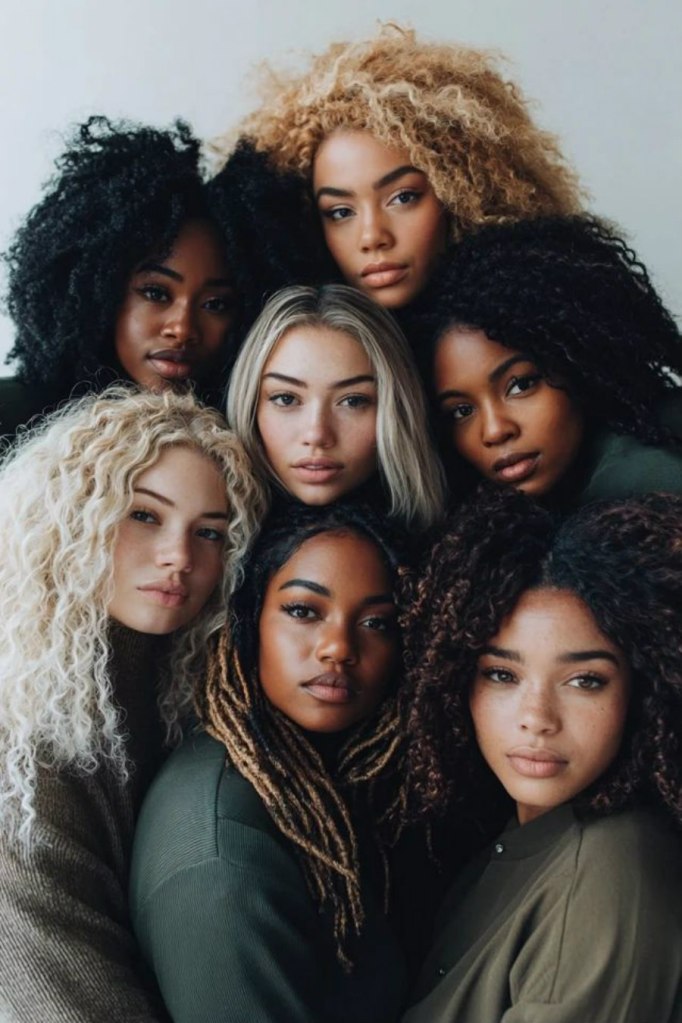
Colorism, the preferential treatment of lighter skin tones within communities of color, is a deeply rooted social phenomenon that emerged from colonialism and slavery. It reflects a hierarchy imposed by systems of white supremacy, where proximity to whiteness determined social status, safety, and opportunity. Within the Black community, this stratification produced complex psychological and social consequences that continue to shape relationships, identity, and perceptions of beauty. The phrase “light enough to love, dark enough to hate” captures the painful duality experienced by many Black women navigating these inherited hierarchies.

From the perspective of a light-skinned girl, the privileges of colorism are often subtle but unmistakable. Growing up, she may have noticed that teachers describe her as “pretty,” “approachable,” or “exotic,” labels that quietly elevate her within beauty standards shaped by Eurocentric ideals. Her lighter complexion becomes a form of social currency, though one she did not consciously seek. She may sense admiration from some and suspicion from others, realizing that her skin tone carries historical meaning beyond her own identity.

At the same time, the light-skinned girl may encounter the uneasy knowledge that her perceived advantages come at the expense of others who share her racial heritage. Compliments about her complexion may be framed in contrast to darker skin, reinforcing a hierarchy she did not create but is nonetheless implicated in. Statements such as “You’re pretty for a Black girl” or “Your skin is the perfect shade” subtly reinforce a narrative that beauty and worth are measured against proximity to whiteness.

The dark-skinned girl experiences a markedly different reality. Her childhood memories may include comments that diminish her beauty or question her desirability. She hears comparisons between her complexion and lighter peers, sometimes from strangers, sometimes from within her own community. These comments accumulate over time, shaping her self-perception and reminding her that her natural features exist within a social hierarchy she never consented to.

For the dark-skinned girl, colorism often manifests as exclusion in subtle and overt ways. In school, she may notice that lighter-skinned girls are more frequently chosen for performances, pageants, or leadership roles. In media representations, women who resemble her may appear less frequently or be cast in stereotypical roles. The cumulative effect is a quiet but persistent message: darker skin is less desirable.

Friendships between light-skinned and dark-skinned girls are often shaped by these unspoken dynamics. While genuine affection may exist, societal biases sometimes create tension or misunderstanding. The light-skinned girl may struggle to recognize the privileges associated with her complexion, while the dark-skinned girl may carry the emotional burden of comparison.

In some cases, colorism creates divisions that undermine solidarity. Dark-skinned girls may feel overshadowed by the social attention given to their lighter counterparts, while light-skinned girls may feel unfairly blamed for advantages they did not intentionally pursue. These tensions reflect the lingering effects of historical systems that deliberately fractured Black communities.

To understand the origins of colorism, one must return to the institution of slavery in the Americas. Enslaved Africans were subjected to brutal systems designed to maximize labor and control. Within this system, European enslavers frequently granted preferential treatment to enslaved individuals with lighter skin, many of whom were the mixed-race children of sexual exploitation by slaveholders.

These lighter-skinned enslaved individuals were sometimes assigned domestic roles within the slaveholder’s household, while darker-skinned individuals were forced into field labor under harsher conditions. Although both groups remained enslaved and oppressed, the distinction created a visible hierarchy based on complexion.

This division served a strategic purpose. By granting marginal privileges to lighter-skinned individuals, slaveholders reinforced internal divisions among enslaved people. The hierarchy discouraged unity and resistance by fostering competition and resentment within the enslaved population.

The trauma of these divisions did not disappear after emancipation. Instead, they evolved into social practices that continued to privilege lighter skin within Black communities. One of the most infamous manifestations of this legacy was the “brown paper bag test,” an informal practice used by certain social clubs, churches, and organizations in the late nineteenth and early twentieth centuries.

The brown paper bag test involved comparing a person’s skin tone to the color of a brown paper bag. Individuals whose complexions were darker than the bag were often excluded from certain social spaces. While not universally practiced, the test symbolized the internalization of color hierarchies rooted in slavery.

For the light-skinned girl, learning about this history can evoke feelings of discomfort and guilt. She may realize that her acceptance in certain spaces historically depended on a hierarchy that excluded others who looked like her own family members. This awareness complicates her understanding of privilege and belonging.

For the dark-skinned girl, the history of colorism confirms experiences she has long felt but struggled to articulate. The social patterns she encounters are not isolated incidents but part of a centuries-old structure of inequality. Recognizing this history can be both validating and painful.

White supremacy played a central role in constructing these hierarchies. European colonizers established racial classifications that placed whiteness at the top and Blackness at the bottom. Within this system, lighter skin among Black populations was perceived as evidence of proximity to whiteness and therefore treated as more valuable.

These beliefs were reinforced through media, education, and cultural narratives that celebrated Eurocentric features such as lighter skin, straight hair, and narrow facial structures. Over time, these standards influenced perceptions of beauty and desirability across societies shaped by colonial history.

In the United States, colorism also intersected with economic opportunity. Historically, lighter-skinned Black individuals were sometimes granted greater access to education and professional employment due to discriminatory hiring practices that favored those perceived as more “acceptable” to white institutions.

The light-skinned girl may grow up hearing relatives describe her complexion as an advantage in navigating the world. These comments may be intended as encouragement but carry implicit recognition of systemic bias. She learns that her skin tone may influence how others perceive her intelligence, professionalism, or beauty.

Meanwhile, the dark-skinned girl may receive messages encouraging her to compensate for perceived disadvantages. She may be told to work harder, dress more carefully, or present herself in ways that challenge stereotypes associated with darker skin. These expectations place additional burdens on her self-presentation.

Within friendships, these dynamics can create complicated emotional landscapes. The dark-skinned girl may feel invisible when attention consistently gravitates toward her lighter friend. The light-skinned girl may struggle with feelings of defensiveness or confusion when confronted with discussions about privilege.

Despite these tensions, many friendships endure through honest conversations and mutual empathy. When both individuals acknowledge the historical forces shaping their experiences, they can develop a deeper understanding and solidarity. These dialogues challenge the divisions that colorism was designed to create.

Media representation plays a significant role in perpetuating or dismantling colorism. Historically, film, television, and advertising have disproportionately featured lighter-skinned actresses as symbols of beauty and desirability. Darker-skinned women have often been marginalized or cast in limited roles.

However, recent decades have seen increasing recognition of the need for diverse representation. Celebrated figures such as Lupita Nyong’o have openly discussed the impact of colorism and advocated for broader definitions of beauty. Their visibility challenges longstanding biases.

The psychological effects of colorism can be profound. Studies in social psychology demonstrate that repeated exposure to negative messages about skin tone can influence self-esteem, identity formation, and interpersonal relationships. These effects can persist across generations.

For the light-skinned girl, confronting colorism may involve examining how society rewards her appearance while simultaneously objectifying it. She may struggle to separate genuine appreciation from biases rooted in historical inequality.

For the dark-skinned girl, resistance often involves reclaiming narratives about beauty and worth. Movements celebrating dark skin, natural hair, and African features have emerged as powerful cultural responses to centuries of marginalization.

Healing from colorism requires both individual reflection and structural change. Communities must confront the ways in which inherited biases influence social interactions, beauty standards, and opportunities. Education about history plays a crucial role in this process.

Friendships between women of different skin tones can become spaces of healing when grounded in honesty and compassion. By acknowledging the historical roots of colorism, individuals can dismantle the assumptions that once divided them.

Ultimately, the legacy of colorism reminds us that systems of oppression often extend beyond the boundaries of race into internal hierarchies within marginalized communities. These divisions were deliberately constructed to weaken collective resistance.

The phrase “light enough to love, dark enough to hate” encapsulates a painful contradiction within societies shaped by colonial history. Yet understanding this legacy also opens the possibility of transformation.

By rejecting color hierarchies and affirming the beauty of every shade, communities can challenge the narratives imposed by centuries of oppression. In doing so, they move toward a future where identity is no longer measured against the distorted standards of the past.


References

Hunter, M. (2007). The persistent problem of colorism: Skin tone, status, and inequality. Sociology Compass, 1(1), 237–254. https://doi.org/10.1111/j.1751-9020.2007.00006.x

Keith, V. M., & Herring, C. (1991). Skin tone and stratification in the Black community. American Journal of Sociology, 97(3), 760–778. https://doi.org/10.1086/229819

Russell, K., Wilson, M., & Hall, R. (1992). The color complex: The politics of skin color among African Americans. New York, NY: Harcourt Brace Jovanovich.

Walker, A. (1983). If the present looks like the past, what does the future look like? In search of our mothers’ gardens: Womanist prose. San Diego, CA: Harcourt Brace Jovanovich.

Wilder, J. (2015). Color stories: Black women and colorism in the 21st century. New York, NY: Routledge.
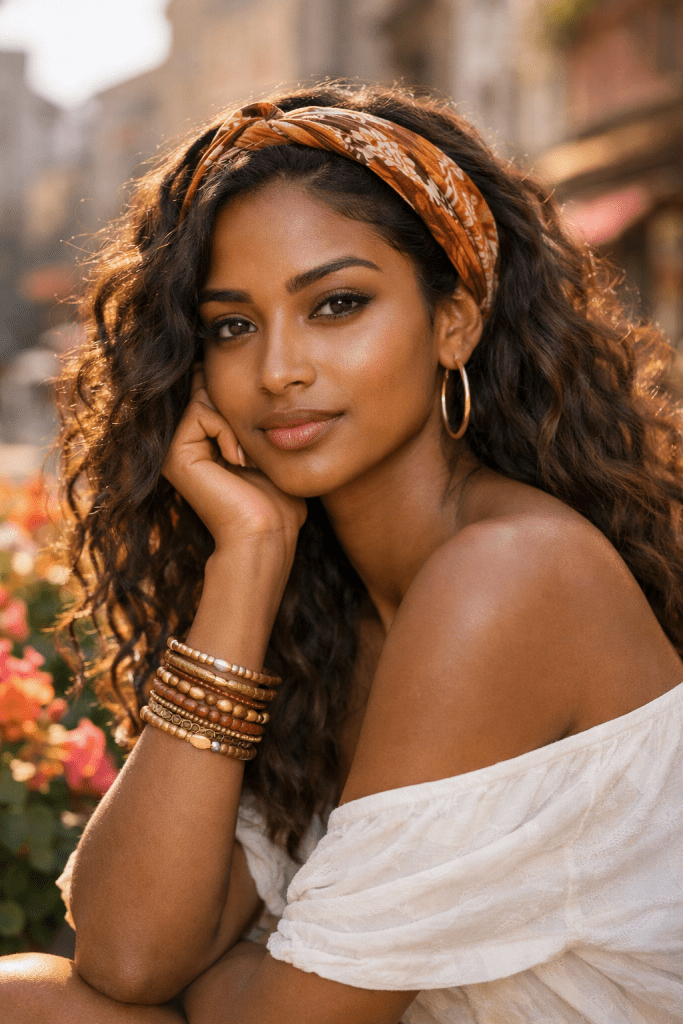

Beyond the Shade: Love, Acceptance, and the Brown Girl Journey

Embracing Every Hue, Claiming Every Story

Navigating life as a brown-skinned girl is a journey of constant negotiation—between societal expectations, personal identity, and cultural beauty standards. From childhood, brown girls are acutely aware of how their skin tone situates them within the hierarchy of desirability, both within and outside their communities. Lighter skin is often idealized, celebrated in media, and equated with elegance, intelligence, and worth, while darker tones can be stigmatized or rendered invisible. This color-coded hierarchy, often internalized through subtle comments, media representation, and historical legacies of slavery and colonization, profoundly shapes self-perception and social mobility (Hunter, 2007; Rockquemore & Brunsma, 2002). The result is a dual challenge: the desire to be accepted by mainstream standards and the need to cultivate self-love in the face of systemic bias.

Beauty and fashion industries have historically perpetuated narrow ideals, often favoring Eurocentric features and lighter skin tones, creating a constant tension for brown girls striving to see themselves reflected in the world. Hair texture, eye color, and even body shape are scrutinized through these cultural lenses, further complicating identity formation (Banks, 2018; Russell-Curry, 2019). Social media has added another layer: while platforms provide spaces for celebration and community, they also amplify unrealistic beauty standards and comparison culture. For many brown girls, the pursuit of “acceptable” beauty involves a careful balance between embracing natural features and negotiating external pressures to conform.

Yet, alongside these challenges, a growing movement of empowerment and self-definition is reshaping the narrative. Brown girls are reclaiming their stories, embracing melanin-rich beauty, and celebrating cultural heritage through art, fashion, and activism. Figures like Lupita Nyong’o, Yara Shahidi, and Naomi Campbell exemplify this reclamation, showing that brown skin is not a limitation but a hallmark of strength, resilience, and beauty (Taylor, 2016; Wade & Ferree, 2016). Community-based mentorship, literature, and online collectives further reinforce positive identity development, encouraging brown girls to define beauty on their own terms rather than internalizing external biases.

Love and acceptance, both personal and communal, are central to this journey. Families, peers, and cultural institutions play a pivotal role in fostering confidence, while representation in media and leadership positions helps validate experiences and aspirations. Psychologically, embracing one’s skin tone correlates with higher self-esteem, reduced internalized colorism, and greater social confidence (Keith & Herring, 1991; Monk, 2015). Beyond the Shade is, therefore, more than a conversation about skin—it is about the holistic affirmation of identity, the courage to resist limiting narratives, and the celebration of brown girls as complex, beautiful, and powerful individuals in every sphere of life.

References

Banks, I. (2018). Hair matters: Beauty, power, and Black women’s consciousness. New York University Press.

Hunter, M. (2007). The persistent problem of colorism: Skin tone, status, and inequality. Sociology Compass, 1(1), 237–254.

Keith, V. M., & Herring, C. (1991). Skin tone and stratification in the Black community. American Journal of Sociology, 97(3), 760–778.

Monk, E. P. (2015). The cost of color: Skin color, discrimination, and health among African Americans. American Journal of Sociology, 121(2), 396–444.

Rockquemore, K. A., & Brunsma, D. L. (2002). Beyond Black: Biracial identity in America. Sage Publications.

Russell‑Curry, A. (2019). Shades of identity: Colorism, Black girlhood, and embodied performance. Journal of Gender Studies, 28(2), 147–161.

Taylor, K.-Y. (2016). How we get free: Black feminist visions of liberation. University of Minnesota Press.

Wade, L., & Ferree, M. M. (2016). Gender: Ideas, interactions, institutions (3rd ed.). W.W. Norton & Company.

Black History: The Soul Train… The hippest trip in America.

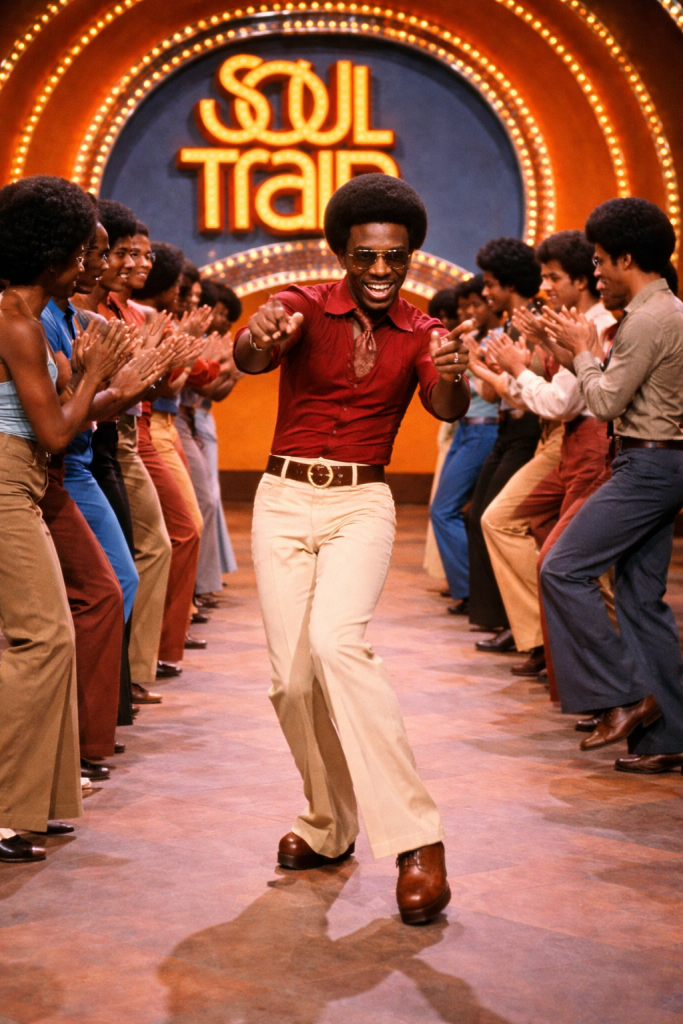
When Soul Train first aired in 1971, it was more than a television program—it was a cultural declaration. Branded “the hippest trip in America,” the show became a weekly sanctuary where Black music, fashion, and joy were broadcast unapologetically into millions of homes. At a time when mainstream television offered limited and often distorted portrayals of African Americans, Soul Train centered Black artistry with elegance, style, and pride.

The visionary behind the show was Don Cornelius, a former Chicago police officer and radio DJ whose deep baritone voice and calm authority became synonymous with the program. Born on September 27, 1936, in Chicago, Illinois, Cornelius developed an early love for broadcasting. After working in insurance sales and law enforcement, he transitioned into radio at WVON, a prominent Black-oriented station in Chicago.

In 1970, Cornelius created a local dance program on Chicago’s WCIU-TV featuring live performances and dancing teens. Its immediate success demonstrated a demand for authentic Black entertainment. With ambition and business acumen, Cornelius syndicated the show nationally in 1971, launching Soul Train into living rooms across America.

The show’s format was revolutionary. It featured live performances from emerging and established R&B, soul, and later funk and disco artists, alongside high-energy dancers whose style influenced fashion and street culture. The famed “Soul Train Line,” where dancers formed two rows and showcased individual flair, became an iconic symbol of self-expression.

Throughout the 1970s and 1980s, Soul Train hosted legendary performers including Aretha Franklin, Stevie Wonder, James Brown, The Jackson 5, and Whitney Houston. For many artists, appearing on Soul Train was a rite of passage and a gateway to broader audiences.

Cornelius maintained strict control over his production. He insisted on Black ownership at a time when few African Americans controlled nationally syndicated programs. His business model was groundbreaking, ensuring that the cultural capital generated by Black creativity benefited Black entrepreneurs.

In 1987, Cornelius expanded the brand by creating the Soul Train Music Awards, which celebrated achievements in R&B, soul, gospel, and later hip-hop. The awards show provided recognition for artists often overlooked by mainstream institutions like the Grammys.

Don Cornelius’s personal life, however, was complex. He was married twice and had two sons, Anthony and Raymond. Despite his professional success, he faced personal struggles, including depression and legal issues stemming from domestic disputes in the late 2000s.

On February 1, 2012, Cornelius died in Los Angeles from a self-inflicted gunshot wound. His death was ruled a suicide. The loss stunned the entertainment world, prompting tributes that underscored his immense cultural impact. He was 75 years old.

Cornelius’s signature closing phrase—“And as always in parting, we wish you love, peace, and soul”—became etched into American memory. His voice carried authority, smoothness, and dignity, reinforcing the show’s ethos of unity and cultural pride.

The theme song “Soul Train (Hot Potato),” performed by King Curtis in the early years, helped define the show’s sonic identity. Later, the most recognized theme, “TSOP (The Sound of Philadelphia),” performed by MFSB featuring The Three Degrees, became a number-one hit in 1974 and cemented the show’s musical legacy.

The program also served as a launching pad for artists who would later dominate popular culture. The exposure provided by Soul Train often translated into record sales, touring opportunities, and mainstream visibility. It helped integrate Black musical innovation into the broader American soundtrack.

Beyond music, the show influenced fashion trends. Afros, bell-bottoms, platform shoes, sequins, and bold prints became staples of 1970s style, broadcast weekly to a national audience. The dancers were not merely background performers; they were cultural ambassadors.

In 1993, Cornelius stepped down as host, though the show continued with guest hosts until its final episode in 2006. By then, it had aired for 35 years, making it one of the longest-running first-run syndicated programs in American television history.

The legacy of Soul Train extended into film and documentary. In 2021, Summer of Soul and other retrospectives reignited conversations about Black music archives and cultural preservation, though specifically in 2022, the series American Soul dramatized the creation of Soul Train, portraying Cornelius’s rise and personal struggles.

Official Hosts of Soul Train

Don Cornelius (1971–1993)
Creator and original host. His deep baritone voice, calm delivery, and signature closing line defined the show for over two decades.

Guest Host Era (1993–1997)
After Cornelius stepped down in 1993, the show used rotating celebrity guest hosts for several seasons rather than appointing a permanent replacement immediately.

Mystro Clark (1997–2000)
The first permanent host after Cornelius. He brought a youthful, late-90s R&B/hip-hop energy to the show.

Shemar Moore (2000–2003)
Yes — Shemar Moore was one of the official hosts. Before becoming widely known for acting roles on The Young and the Restless and later Criminal Minds, he hosted Soul Train during its early 2000s era. His charisma, physique, and charm appealed to a new generation of viewers and added a modern flavor to the brand.

Dorian Gregory (2003–2006)
The final permanent host before the show ended in 2006. Gregory carried the program through its concluding seasons.

The influence of Soul Train can be traced in later music television programs, including 106 & Park and other platforms that center Black youth culture. Its DNA is embedded in award shows, dance competitions, and music video aesthetics.

In 2012, Cornelius was posthumously honored with tributes at the BET Awards, affirming his foundational role in shaping Black entertainment media. Industry leaders credited him with building an institution that validated generations of artists.

Academically, Soul Train is often examined as a site of cultural resistance and representation. Scholars argue that it countered dominant narratives by showcasing Black excellence, entrepreneurship, and aesthetic innovation during the post–Civil Rights era.

The program also functioned as a historical archive. Episodes now serve as visual documentation of evolving Black style, choreography, and musical trends from soul and funk to early hip-hop. It captured cultural shifts in real time.

Today, Soul Train remains a symbol of unapologetic Black joy. Don Cornelius’s vision transformed a local dance show into a global brand that honored the rhythm of a people. His life story—marked by ambition, struggle, triumph, and tragedy—reflects both the promise and pressure of pioneering success.

“Soul Train” was never just a show; it was a movement. And as Cornelius always reminded viewers, its journey was guided by love, peace, and soul.


References

George, N. (1988). The Death of Rhythm and Blues. Pantheon Books.

Guerrero, E. (1993). Framing Blackness: The African American Image in Film. Temple University Press.

Harris, M. (2014). “Soul Train and the Construction of Black Cool.” Journal of Popular Culture, 47(3), 567–585.

Jet Magazine Archives (1971–2012). Johnson Publishing Company.

Robinson, E. (2012). Don Cornelius, ‘Soul Train’ Creator, Dies at 75. Los Angeles Times.

Smithsonian National Museum of African American History and Culture. (n.d.). Soul Train Collection Archives.

Black History: Queen Charlotte of Mecklenburg-Strelitz – The First Black Queen of England.

Queen Charlotte of Mecklenburg-Strelitz remains one of the most fascinating and contested figures in European royal history, particularly within discussions of Black presence in premodern Europe. While often portrayed in traditional British narratives as a conventional white European queen, growing historical scholarship and portrait analysis suggest that Charlotte may have been Britain’s first biracial monarch, with documented African ancestry embedded within her royal lineage.

Queen Charlotte of Mecklenburg-Strelitz was born in 1744 in the German duchy of Mecklenburg-Strelitz, a small but politically significant principality within the Holy Roman Empire. She married King George III of Great Britain in 1761 at the age of seventeen and immediately became Queen Consort of Great Britain and Ireland, later also Queen of Hanover.

Charlotte was the daughter of Duke Charles Louis Frederick of Mecklenburg-Strelitz and Princess Elisabeth Albertine of Saxe-Hildburghausen. Her family belonged to the minor German nobility, but through intermarriage with Iberian royal houses, her bloodline extended into Portuguese and Moorish ancestry. It is this lineage that forms the basis of arguments for her African heritage.

The strongest historical claim regarding Charlotte’s African ancestry comes from her descent from Margarita de Castro y Sousa, a noblewoman of the Portuguese royal court. Margarita herself was a descendant of King Afonso III of Portugal and Madragana, a Moorish woman described in historical documents as having African features and Muslim heritage. Through this line, Queen Charlotte inherited traceable African ancestry approximately fifteen generations back.

Portuguese royal records and genealogical studies show that Madragana was referred to as a “Moor” — a term used in medieval Europe for North African and sub-Saharan Africans, especially Muslims of African descent. This makes Charlotte genetically biracial by historical definition, even if diluted through centuries of intermarriage.

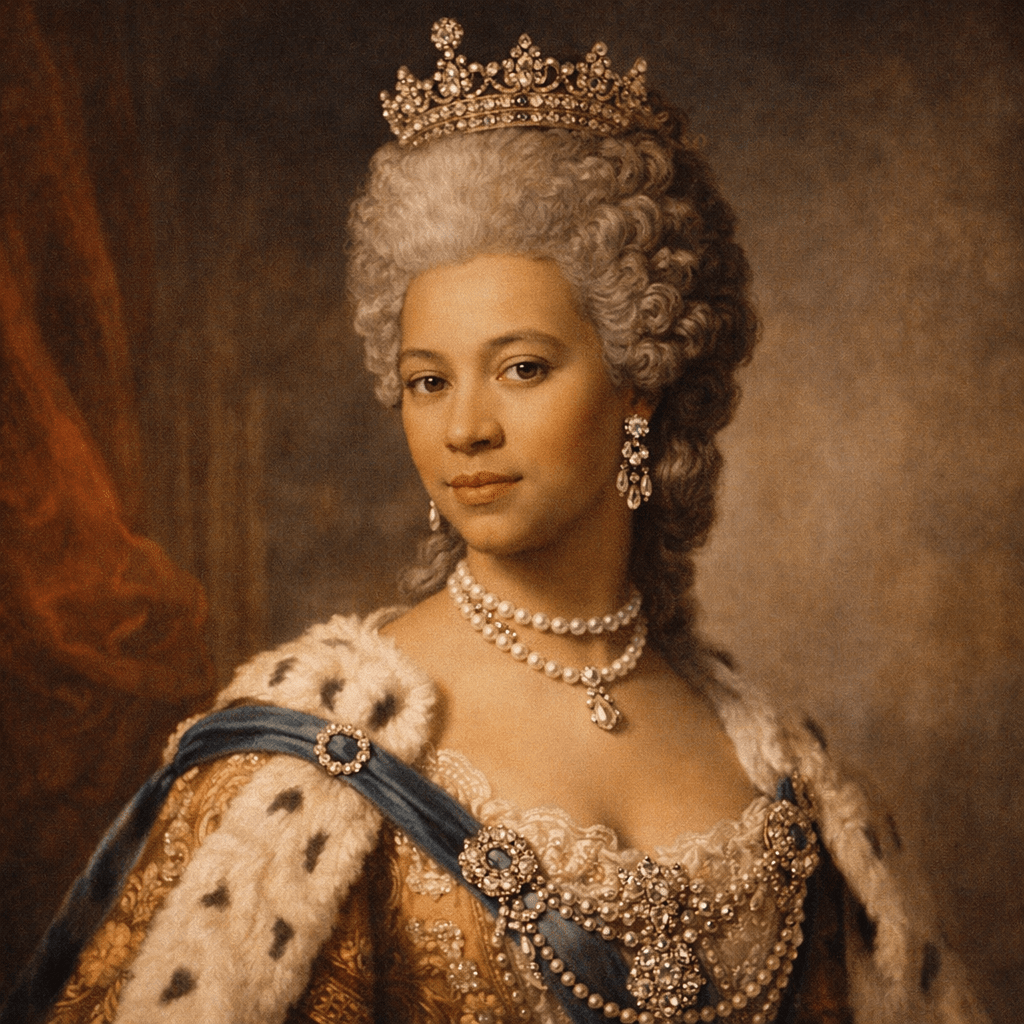
What makes Queen Charlotte particularly unique is not only her lineage, but how she was visually represented. Several contemporary portraits painted during her lifetime depict her with visibly African facial features: a broad nose, full lips, darker complexion, and tightly curled hair. Artists such as Allan Ramsay and Sir Thomas Lawrence painted Charlotte in ways that differed significantly from the idealized European beauty standards of the time.

Allan Ramsay, a known abolitionist, intentionally emphasized Charlotte’s African traits in his royal portraits. This was a political act, as Ramsay believed art could challenge white supremacist ideologies by showing Black presence in elite European spaces. His portraits stand in contrast to later revisions that whitened her appearance.

British society during the 18th century was deeply racialized, yet paradoxically fascinated by Blackness. While enslaved Africans existed in England, the presence of a biracial queen was never publicly acknowledged or celebrated. Instead, her African ancestry was quietly ignored, softened, or erased in official royal discourse.

Queen Charlotte herself never publicly claimed African identity, which would have been politically impossible in a monarchy built on white European supremacy. Her legitimacy depended on assimilation, not racial visibility. Thus, her Black ancestry existed as an unspoken truth hidden within aristocratic genealogy.

Despite this silence, many contemporaries commented on her appearance. Some British courtiers privately referred to her as having a “mulatto face,” while foreign diplomats described her features as “unusual for a German princess.” These coded racial descriptions reveal that her difference was noticed, even if never openly discussed.

Charlotte gave birth to fifteen children, making her the matriarch of modern European royal bloodlines. Through her descendants, African ancestry entered nearly every royal house in Europe, including the current British monarchy. This fact alone radically challenges the myth of racial purity in European royalty.

Her influence extended beyond race into culture, education, and abolitionist politics. She was a patron of Black composers, supported the education of poor children, and advocated for anti-slavery reforms through private influence on King George III.

Queen Charlotte’s story disrupts the dominant narrative that Black history exists only in Africa or the Americas. Her existence proves that Africans and their descendants have always been embedded in European power structures, even at the highest levels of monarchy.

Modern historians increasingly recognize Charlotte as a symbol of erased Black presence in European history. Her whitening in textbooks and portraits reflects a broader pattern of historical revisionism designed to maintain white exclusivity in narratives of power.

The popular television series Bridgerton did not invent the idea of a Black Queen Charlotte — it revived a truth long buried by racial politics. While dramatized, the concept is grounded in legitimate historical research.

Queen Charlotte stands today as a powerful reminder that Black history is not marginal, peripheral, or modern. It is ancient, royal, and deeply woven into the foundations of Western civilization itself.


References

Adams, G. (2019). The Queen’s Hidden Heritage: African Ancestry in the British Royal Family. Journal of Black Studies, 50(3), 234–251.

Ramsay, A. (1762–1780). Royal Portraits of Queen Charlotte. Royal Collection Trust.

Oliveira, M. (2008). Moorish Lineages in the Portuguese Royal House. Lisbon Historical Review.

Fryer, P. (1984). Staying Power: The History of Black People in Britain. Pluto Press.

Jeffries, S. (2018). “Was Queen Charlotte Black? The Real History Behind Bridgerton.” The Guardian.

BBC History. (2020). Queen Charlotte: Britain’s First Black Queen? British Broadcasting Corporation.

Royal Collection Trust. (2021). Queen Charlotte of Mecklenburg-Strelitz: Portraits and Legacy.

Black History: Harlem Renaissance Icons

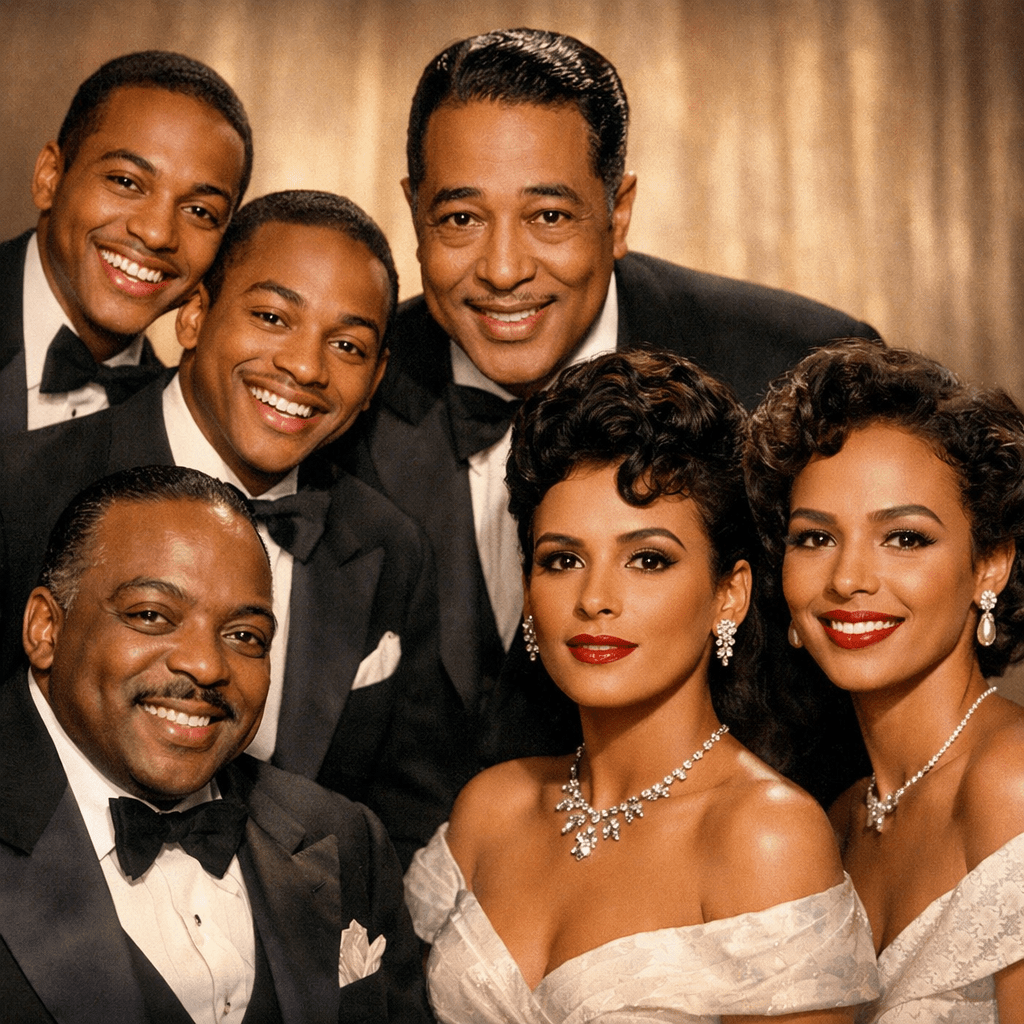
The Harlem Renaissance is often remembered as a golden age of Black brilliance, a period when music, theater, literature, and fashion converged into a global statement of cultural power. Yet behind the elegance, tuxedos, and spotlight glamour existed a harsher reality of emotional trauma, racial exploitation, violent relationships, and broken families. The icons of this era were not only cultural heroes but also human beings navigating fame inside a deeply racist society that consumed their talent while disregarding their humanity.

At the center of this world stood Duke Ellington, whose orchestra became the sound of Black sophistication. Ellington’s genius reshaped American music, elevating jazz into an art form worthy of concert halls and classical comparison. Yet his personal life reflected the era’s contradictions. Constant touring strained his marriage, and his emotional distance from his family mirrored a broader pattern among male entertainers whose careers required near-total devotion at the cost of intimacy and fatherhood.

Ellington’s rise was inseparable from the Cotton Club, a glamorous but deeply ironic institution. The club showcased the finest Black talent in America, yet barred Black patrons entirely, catering exclusively to wealthy white audiences. Black performers were celebrated on stage but segregated in the audience, reinforcing a system where Black excellence was profitable but Black dignity remained negotiable.

Another towering figure was Count Basie, whose Kansas City swing style brought raw energy and improvisation into the mainstream. Basie’s orchestra became legendary for its tight rhythms and blues-infused arrangements. Yet like many musicians of the era, Basie endured exhausting schedules, exploitative contracts, and a culture of heavy drinking, gambling, and infidelity that destroyed numerous marriages and family structures.

The Harlem Renaissance was not only sound but spectacle, and no performers embodied physical artistry more than the Nicholas Brothers. Fayard and Harold Nicholas stunned audiences with gravity-defying acrobatics and revolutionary tap technique. Their performances symbolized Black excellence at its most athletic and joyful, yet Hollywood consistently limited them to specialty acts, cutting their scenes from films to avoid placing Black men too centrally in white narratives.

One of the most significant cultural artifacts of the era was the film Stormy Weather, a rare Hollywood production centered entirely on Black performers. The film showcased Lena Horne, Bill Robinson, and the Nicholas Brothers, and became a landmark in Black cinematic history. Its impact was both empowering and bittersweet, as it represented possibility within an industry that still refused to grant Black actors complex, romantic, or authoritative roles.

At the emotional core of Harlem glamour stood Lena Horne, whose beauty and voice made her one of the first Black women marketed as a global sex symbol. Horne broke color barriers in Hollywood but paid a severe psychological price. She faced constant racism, was prohibited from romantic scenes with white actors, and lived under surveillance from studios that feared interracial desire more than injustice.

Horne’s personal life exposed even deeper wounds, particularly her relationship with Joe Louis, the most famous Black athlete in the world at the time. Their affair was passionate but devastating. Louis repeatedly cheated on Horne, humiliating her publicly and reinforcing a pattern of emotional abandonment that haunted many Black women whose partners were consumed by fame, ego, and unhealed trauma.

The image of Black male celebrity during this era was often violent beneath the surface. Many stars engaged in domestic abuse, alcoholism, and emotional neglect, behaviors rooted in unresolved rage from racism, poverty, and emasculation. Fame did not heal these wounds; it amplified them, turning private pain into public dysfunction and generational trauma.

Another tragic icon was Dorothy Dandridge, the first Black woman nominated for an Academy Award for Best Actress. Dandridge’s beauty made her famous, but her vulnerability made her exploitable. She endured abusive relationships, financial mismanagement, studio manipulation, and the emotional devastation of raising a daughter with severe disabilities while being denied meaningful roles.

Dandridge’s love life was marked by violent men, emotional instability, and betrayal. She was beaten by partners, financially drained by managers, and psychologically crushed by Hollywood’s rejection. Her story represents how Black women were hypersexualized, commodified, and discarded once their youth or novelty faded.

Beneath the elegance of Harlem nightlife existed a culture of physical violence, emotional neglect, and fractured families. Many entertainers fathered children they barely raised, leaving behind single mothers and emotionally abandoned sons and daughters. These children grew up in the shadow of famous names but without stability, guidance, or protection.

The psychological toll of passing, colorism, and racial performance also shaped these lives. Lighter-skinned stars like Lena Horne and Dorothy Dandridge were promoted more aggressively, reinforcing internal hierarchies within the Black community itself. Darker-skinned performers were often excluded from leading roles, feeding cycles of resentment, insecurity, and identity conflict.

The Harlem Renaissance thus produced not only artistic revolutions but psychological casualties. Many stars self-medicated through alcohol, drugs, gambling, and sex. The pressure to represent an entire race while being denied full humanity created emotional contradictions that manifested as addiction, narcissism, and relational dysfunction.

Even male icons like Duke Ellington and Count Basie struggled with emotional availability. Their dedication to craft demanded emotional withdrawal from family life. The myth of the brilliant Black genius often came paired with the reality of absent fathers and emotionally distant husbands.

The Cotton Club itself symbolized this contradiction perfectly. Black bodies created white pleasure, Black culture generated white profit, and Black suffering remained invisible behind velvet curtains and champagne glasses. Harlem glittered, but it was built on structural inequality.

The Nicholas Brothers, despite their brilliance, were never allowed narrative depth. They were celebrated for physicality but denied psychological complexity, reinforcing a stereotype of Black men as entertainers rather than thinkers, lovers, or leaders.

Stormy Weather remains iconic because it briefly shattered that ceiling, allowing Black performers to exist without white intermediaries. Yet even that film existed as an exception, not a new rule.

The legacies of Lena Horne and Dorothy Dandridge reveal how Black women paid the highest emotional price for proximity to fame. Their bodies were adored, their souls neglected, and their pain silenced beneath glamour.

Joe Louis represents the darker side of Black male hero worship, where athletic power replaced emotional maturity, and fame excused infidelity, neglect, and misogyny.

Ultimately, the Harlem Renaissance was not only a cultural awakening but a psychological battlefield. These icons were pioneers navigating fame inside a system designed to exploit them, isolate them, and emotionally fracture them.

Their stories remind us that Black excellence has always coexisted with Black suffering, and that beauty, talent, and legacy do not erase trauma. Behind the tuxedos, stage lights, and platinum records were slashed emotions, broken homes, and souls trying to survive history itself.


References

Bogle, D. (2016). Toms, Coons, Mulattoes, Mammies, and Bucks: An Interpretive History of Blacks in American Films. Bloomsbury Academic.

Cohen, H. G. (2010). Duke Ellington’s America. University of Chicago Press.

Giddins, G. (2014). Visions of Jazz: The First Century. Oxford University Press.

Horne, L. (2018). Lena: A Personal and Professional Biography. Da Capo Press.

Lewis, D. L. (2004). When Harlem Was in Vogue. Penguin Books.

Shipton, A. (2007). A New History of Jazz. Continuum.

Dandridge, D. (1999). Everything and Nothing: The Dorothy Dandridge Story. Hyperion.

Bogle, D. (2001). Dorothy Dandridge: A Biography. Amistad.

Erenberg, L. A. (1981). Steppin’ Out: New York Nightlife and the Transformation of American Culture. Greenwood Press.

Black History: Ebony, Jet, Negro Digest, Ebony Fashion Fair & Fashion Fair Cosmetics.

Building the Black Standard of Beauty, Intelligence, and Power.

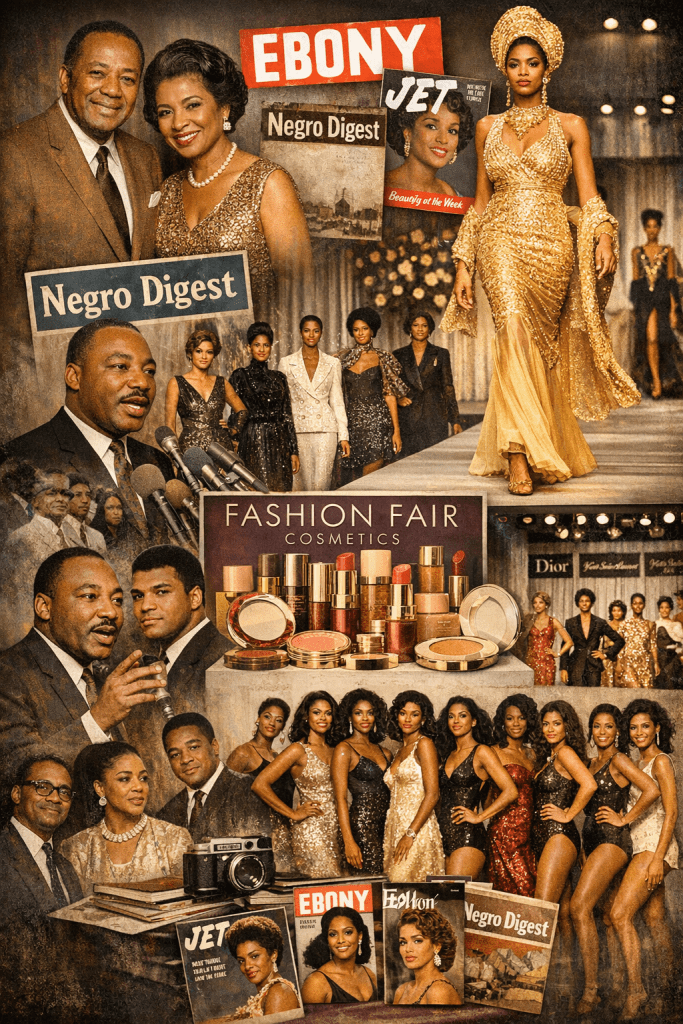
The story of Ebony, Jet, Negro Digest, Ebony Fashion Fair, and Fashion Fair Cosmetics represents one of the most important cultural revolutions in Black history. These institutions did far more than publish magazines or sell beauty products; they created a complete Black world—one in which Black people could finally see themselves reflected with dignity, intelligence, luxury, and divine beauty. At a time when American society systematically erased or distorted Black identity, this media and beauty empire boldly declared that Black people were not inferior, invisible, or marginal, but central to history, culture, and global excellence.

This revolutionary movement was founded by John H. Johnson, one of the most influential Black businessmen and publishers in American history. Born in 1918 in Arkansas and raised in Chicago, Johnson understood that representation was not simply about images, but about psychological power. In 1942, he launched the Johnson Publishing Company, which would grow into the largest Black-owned publishing company in the world. Johnson believed that Black people needed more than civil rights; they needed cultural authority, self-definition, and platforms that affirmed their humanity.

Standing alongside him was his wife, Eunice Johnson, a visionary entrepreneur, fashion editor, and cultural architect. Eunice Johnson was not merely a supportive spouse—she was the creative engine behind the Black beauty and fashion revolution. As the fashion director of Ebony, she reshaped how Black women were represented in style, luxury, and global elegance. Together, the Johnsons did something unprecedented in American history: they created a complete Black cultural mirror, one that allowed Black people to see themselves not through the distorted lens of racism, but through their own truth.

Founded in 1945, Ebony was created as the Black answer to Life magazine. Its mission was simple yet radical—to portray Black people as successful, educated, cultured, and aspirational. Ebony featured Black doctors, lawyers, professors, entrepreneurs, and political leaders. It showcased Black families, marriages, homes, and generational wealth. It highlighted African royalty, global Black leadership, and diasporic excellence. At a time when mainstream media associated Blackness with poverty, crime, and pathology, Ebony unapologetically presented Black affluence, Black intellect, and Black dignity. The magazine created what can be described as a visual theology of Black excellence, teaching Black people that they belonged in luxury, history, and greatness.

In 1951, Johnson expanded this vision with the launch of Jet, known as The Weekly Negro News Digest. Smaller in size but massive in cultural impact, Jet became the visual pulse of Black America. It documented the Civil Rights Movement in real time, including police brutality, racial violence, and social injustice that mainstream media often ignored. It also celebrated everyday Black life—weddings, graduations, church events, and community milestones—proving that Black life was worthy of documentation and historical memory.

One of Jet’s most powerful contributions was its iconic “Beauty of the Week” feature. This single section revolutionized global beauty standards by consistently centering Black women of every complexion, body type, and background. Dark-skinned women, light-skinned women, natural hair, Afro-textured beauty—Jet made visible what the world had erased. Long before diversity became a marketing trend, Jet declared that Black women were not exceptions to beauty, but the standard of beauty itself.

Before Ebony and Jet, Johnson also launched Negro Digest, later renamed Black World. This publication became the intellectual backbone of Black consciousness in America. Negro Digest published Black scholars, historians, theologians, and political thinkers who addressed African history, racism, colonialism, Pan-Africanism, and Black psychology. It served as a philosophical and political platform during the rise of Black Power and global liberation movements. Through Negro Digest, Johnson proved that Black media was not only aesthetic, but deeply intellectual and revolutionary—it nurtured the Black mind.

Across all these platforms, a single unspoken message echoed powerfully: “Look at Black people.” Not as slaves. Not as criminals. Not as stereotypes. But as stylish, educated, intelligent, wealthy, cultured, and global. These publications functioned as psychological counter-propaganda to white supremacy. They repaired centuries of racial misrepresentation by producing positive Black mirrors. They did not simply inform Black audiences; they healed identity and reprogrammed self-perception.

One of the most extraordinary extensions of this cultural revolution was the creation of the Ebony Fashion Fair, founded by Eunice Johnson in 1958. The Ebony Fashion Fair was a traveling luxury fashion show that brought Paris haute couture directly into Black communities across America. For the first time in U.S. history, Black women exclusively modeled designs from elite fashion houses such as Dior, Givenchy, and Yves Saint Laurent. At a time when the fashion industry was segregated and excluded Black models, Eunice Johnson forced global fashion to recognize Black women as symbols of elegance, luxury, and high culture. Ebony Fashion Fair transformed churches, auditoriums, and community centers into international runways, allowing Black audiences to see themselves as part of the global elite.

Out of Ebony Fashion Fair emerged one of the most important Black-owned beauty companies in history: Fashion Fair Cosmetics. Founded in 1973 by Eunice Johnson, Fashion Fair became the largest and most successful Black-owned cosmetics brand in the world. It was created because mainstream cosmetic companies refused to make products for darker skin tones. Fashion Fair developed foundations, powders, and lipsticks specifically for Black undertones and deep complexions. It was sold in major department stores such as Macy’s and became the official makeup brand for Black models and professional fashion shows.

For the first time, Black women could walk into luxury retail spaces and find makeup designed for their skin—not approximations of whiteness, but products made with Black beauty in mind. Fashion Fair Cosmetics sent a revolutionary message: Black women did not need to lighten, hide, or dilute their appearance. They were not a niche market. They were the standard.

Together, Ebony, Jet, Negro Digest, Ebony Fashion Fair, and Fashion Fair Cosmetics created the most powerful Black cultural ecosystem in modern history. This empire produced Black news, Black beauty, Black fashion, Black intellect, Black luxury, and Black self-worth. It set global beauty standards, built Black middle-class identity, preserved Black historical memory, created Black celebrity culture, and rewired Black self-esteem.

Ebony: The Black Answer to Life Magazine

Founded in 1945, Ebony was created to showcase Black people the way white magazines showcased white America—successful, educated, aspirational, and human. Ebony featured:

  • Black doctors, lawyers, professors, and CEOs
  • Black families, marriages, and generational wealth
  • African royalty and global Black leaders
  • Black entertainers, scholars, and activists

At a time when Blackness was associated with poverty and pathology, Ebony portrayed Black affluence, Black intellect, and Black excellence. It created the visual theology of the Black middle and upper class.

The unspoken message was radical:
Black people belong in history, luxury, and greatness.


Jet: The Visual Pulse of Black America

Founded in 1951, Jet became the heartbeat of Black America. Known as The Weekly Negro News Digest, Jet documented Black life in real time:

  • Civil Rights Movement coverage
  • Police brutality and racial injustice
  • Black celebrities and athletes
  • Weddings, graduations, and community milestones

One of Jet’s most revolutionary contributions was “Beauty of the Week.” This single feature redefined global beauty standards by consistently centering Black women of all shades, textures, and body types—long before diversity was fashionable.

Dark-skinned women, light-skinned women, natural hair, Afro-textured beauty—Jet said to the world:
Black women are the beauty standard.


Negro Digest: The Black Intellectual Renaissance

Before Ebony and Jet, Johnson launched Negro Digest, later renamed Black World. This magazine became the intellectual backbone of Black consciousness.

It published:

  • Black scholars and theologians
  • African historians and Pan-African thinkers
  • Writers on racism, colonialism, and psychology
  • Political philosophy and liberation theology

Negro Digest proved that Black media was not just visual—it was philosophical, theological, and revolutionary. It nurtured the Black mind.


“Look at Black People”: Reprogramming the Black Image

Across all Johnson platforms, one message echoed loudly:

Look at Black people.

Not as slaves.
Not as criminals.
Not as stereotypes.

But as:

  • Stylish
  • Intelligent
  • Educated
  • Wealthy
  • Global
  • Elegant

This media empire functioned as counter-propaganda to white supremacy. It repaired the psychological damage of racism by showing Black people who they really were.

These publications didn’t just inform—they healed identity.


Ebony Fashion Fair: Black Models, Global Luxury

One of Eunice Johnson’s greatest achievements was the creation of the Ebony Fashion Fair, a traveling luxury fashion show that brought Paris couture directly into Black communities.

For the first time in American history:

  • Black women modeled Dior, Givenchy, and Yves Saint Laurent
  • Black audiences saw luxury on Black bodies
  • Black beauty entered the global elite fashion world

This was revolutionary. In a segregated fashion industry that excluded Black models, Eunice Johnson forced haute couture to recognize Black women as luxury incarnate.

She didn’t just put Black women in fashion—
She placed Black women at the center of global elegance.


Fashion Fair Cosmetics: The Largest Black-Owned Beauty Brand

Out of Ebony Fashion Fair emerged one of the most important Black-owned companies in beauty history: Fashion Fair Cosmetics.

Founded in 1973 by Eunice Johnson, Fashion Fair became the largest and most successful Black-owned cosmetics brand in the world. It was created because mainstream brands refused to make makeup for darker skin tones.

Fashion Fair:

  • Created foundations for deep complexions
  • Produced lipsticks and powders for Black undertones
  • Sold in major department stores like Macy’s
  • Served professional Black models and everyday women

For the first time, Black women could walk into luxury stores and find makeup designed for their skin—not approximations of whiteness.

Fashion Fair Cosmetics told Black women:

You do not need to lighten, hide, or dilute your beauty.
You are the market. You are the standard.


The Greatest Black Media Empire Ever Created

Together, Ebony, Jet, Negro Digest, Ebony Fashion Fair, and Fashion Fair Cosmetics created a complete Black ecosystem:

  • Black news
  • Black beauty
  • Black fashion
  • Black intellect
  • Black luxury
  • Black self-worth

This empire:

  • Set global Black beauty standards
  • Built Black middle-class identity
  • Preserved Black historical memory
  • Created Black celebrity culture
  • Rewired Black self-esteem

These institutions functioned as:

  • Cultural archives
  • Psychological liberation tools
  • Visual theology of Black excellence

John H. Johnson and Eunice Johnson did not just build magazines and makeup brands.
They reprogrammed Black consciousness.

They taught generations of Black people how to see themselves:
Not through white validation.
Not through colonial distortion.
But through Black truth, Black dignity, and Black divine beauty.

These institutions were not merely businesses; they were cultural liberation tools, psychological healing systems, and visual archives of Black greatness. John H. Johnson and Eunice Johnson did not simply build magazines and makeup brands. They built a Black world within a society that tried to erase Black humanity. They taught generations of Black people how to see themselves—not through white validation, colonial distortion, or racist ideology—but through Black truth, Black dignity, and Black divine beauty.

This was not just media.
This was nation-building.

References

Johnson, J. H. (1989). Succeeding against the odds. Warner Books.

Autobiography of John H. Johnson detailing the founding of Johnson Publishing, Ebony, and Jet, including philosophy of Black representation.

Johnson, E. (2003). Ebony fashion fair: 50 years of style. Johnson Publishing Company.

Primary source on the history, mission, and cultural impact of Ebony Fashion Fair, written by Eunice Johnson herself.

Smith, J. L. (2004). Becoming something: The story of Ebony magazine. Northwestern University Press.

Scholarly history of Ebony’s role in shaping Black middle-class identity and visual culture.

Byrd, R. P., & Gates, H. L. Jr. (2009). The Black intellectual tradition. Harvard University Press.

Context for Negro Digest and Black World as intellectual platforms.

Davis, A. Y. (2016). Freedom is a constant struggle: Ferguson, Palestine, and the foundations of a movement. Haymarket Books.

Used for cultural and political framing of Black media as resistance.

Weems, R. E. (1998). Desegregating the dollar: African American consumerism in the twentieth century. New York University Press.

Key academic text on Black-owned businesses, including Johnson Publishing and Fashion Fair Cosmetics.

Walker, S. (2002). Style and status: Selling beauty to African American women, 1920–1975. University Press of Kentucky.

Scholarly source on Black beauty culture and cosmetics history.

Craig, M. L. (2002). Ain’t I a beauty queen? Black women, beauty, and the politics of race. Oxford University Press.

Supports analysis of Jet’s “Beauty of the Week” and Black beauty standards.

Bennett, J. (2015). Being property once myself: Blackness and the end of man. Harvard University Press.

Theoretical grounding for psychological impact of representation.

Hine, D. C., Hine, W. C., & Harrold, S. (2014). The African American odyssey (6th ed.). Pearson.

General Black history reference supporting media, civil rights, and cultural institutions.

National Museum of African American History and Culture. (n.d.). Ebony and Jet magazines collection. Smithsonian Institution.

Archival institutional source confirming historical importance and preservation.

🌹 1000 Roses 🌹

From Author: I want to take a moment to express my gratitude to the men who have honored me with roses throughout my life—1,000 roses, given on 11 different occasions. Some were gestures from royalty, others from friends, and some from my late husband, whose love and memory remain etched in my heart. Every 1000 roses, no matter the giver, has been a symbol of affection, devotion, and the moments of beauty that have graced my journey. This poem, 1000 Roses, is a reflection of that gratitude and the emotions woven into every petal.


1000 Roses

A thousand roses, each a whispered vow,
In moments fleeting, I remember them now.
Blush of dawn, crimson fire, softest white,
Each bloom a story, a memory alight.

Some came with crowns, from men of high place,
Royalty’s hand, a gesture of grace.
Their petals spoke of elegance, rare,
A fleeting dance of splendor and care.

Some came from friends, steady and true,
With laughter and warmth in every hue.
No titles, no crowns, just hearts aligned,
In the giving, love’s simplicity I find.

And some came from the one who shared my days,
My late husband, whose love lit my way.
Each rose a heartbeat, tender and near,
A fragrance of comfort that lingers here.

I traced their petals, soft as whispered prayer,
Felt their presence, their thoughtfulness rare.
A thousand roses, yet each distinct,
A tapestry of hearts, delicately linked.

Some roses wore the blush of shy delight,
Some burned with passion, fierce as night.
Some whispered secrets only I could hear,
Some held laughter, some held a tear.

Each occasion, a mark upon my soul,
A thousand roses, making me whole.
The numbers grow, yet the feeling stays,
In silent reflection, in sunlight rays.

I thank the givers, known and unknown,
For every rose, how my heart has grown.
In velvet folds, love’s language unfurls,
A thousand roses, a thousand worlds.

They remind me that love wears many hues,
In red and gold, and gentle blues.
In every petal, a story of grace,
A thousand roses, a thousand embraces.

Through time and memory, each bloom survives,
A fragrant echo of cherished lives.
And though some hands now rest beyond,
Their roses remain, forever fond.

A thousand roses, yet still I see,
The depth of love that surrounds me.
Royalty, friendship, a husband’s devotion,
All carried to me on petals’ motion.

So here I stand, with gratitude deep,
For every rose, for every keep.
A thousand roses, eleven times given,
Each a whisper of heaven, a fragment of heaven.

Dermal Divinity: When God Painted Her Brown.

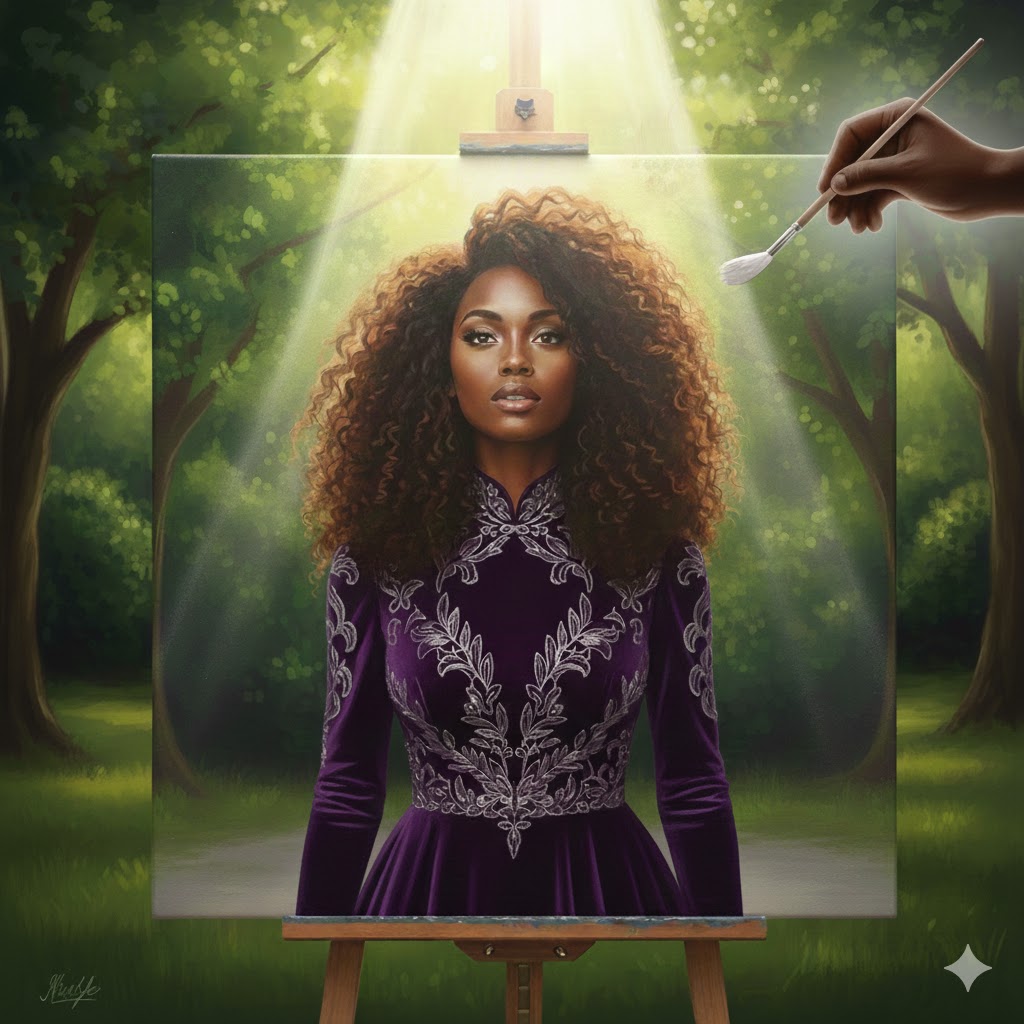
Dermal divinity is the sacred truth that her skin is not an accident, not a mistake, and not a burden—but a masterpiece crafted with intentionality. When God painted her brown, He dipped His brush into centuries of resilience, wisdom, and ancestral strength. Her melanin is theology written in pigment, a divine proclamation that she is fearfully, wonderfully, and beautifully made (Psalm 139:14, KJV).

When God painted her brown, He thought of sunlight and soil, of beginnings and blessings. Brown is the color of the earth that nourishes life, the foundation beneath nations, the cradle of humanity itself. Science confirms Africa as the birthplace of mankind (Stringer, 2016), and scripture affirms God formed humanity from the dust of the ground (Genesis 2:7, KJV). Her shade is not merely melanin—it is memory, origin, and divine intention.

Her brown skin carries history that cannot be erased. Within its tones lie stories of queens, warriors, mothers, and visionaries. From Kush to Nubia, from the banks of the Nile to the diasporic world, her ancestors walked with a dignity that no empire could destroy. The strength in her skin is not just biological but spiritual, encoded through generations.

Dermal divinity is the understanding that her complexion exists beyond beauty—it is inheritance. Her skin is a living testament to survival through systems that sought to devalue it. Yet no chain, law, or ideology could diminish what God declared good from the beginning. Her brownness has outlived every attempt to shame it.

When God painted her brown, He adorned her with richness that absorbs light and reflects radiance. Melanin is a biological miracle—protective, powerful, and purposeful. It shields, strengthens, and sustains. Studies show melanin plays a crucial role in biological protection and adaptive evolution (Jablonski, 2021). God wove science into her skin before science learned to name it.

Her brownness is also emotional terrain. It holds the complexities of joy and trauma, of cultural pride and societal misunderstanding. She learns, sometimes slowly, that the world’s discomfort with her hue is not her burden to carry. Colorism, racism, and misogynoir may attempt to dim her, but they cannot undo divine craftsmanship.

The sacredness of her skin becomes clearer as she grows. She learns to see her body not through colonized lenses but through the eyes of the One who created her. The Bible teaches that all creation reflects God’s glory (Isaiah 60:1, KJV). Her brownness, therefore, shines with holy intention, a reminder that beauty is not Eurocentric—it is God-designed.

When God painted her brown, He gifted her a crown of textured glory. Coils, curls, and kinks spiral like galaxies, echoing divine creativity. Her hair is not a rebellion; it is a revelation. It testifies to her lineage, to the creative diversity of a God who delights in variety, complexity, and bold expression.

Dermal divinity also acknowledges that her body is not merely aesthetic—it is prophetic. Her skin tells a story before she speaks, declaring the triumphs and trials of people who refused to break. Layers of pigment hold generations of laughter, tears, labor, and liberation. She carries her people with her, even when she walks alone.

When God painted her brown, He placed her in communities of richness and cultural brilliance. She belongs to a tapestry of traditions, languages, rhythms, and spiritualities that stretch across continents. Her identity is not isolated; it is collective, woven into global Blackness.

Her brownness holds a beauty that is both inward and outward. It reflects confidence that has been hard-earned, reclaimed from the distortions of media, history, and hierarchy. She realizes beauty is not a comparison but an awakening—a recognition that her reflection has always been worthy.

Dermal divinity means embracing herself without apology. She does not shrink to make others comfortable or dilute her light to fit into narrow expectations. Her brownness is not negotiable; it is divine signature. To dim it would be to distort God’s artistry.

When God painted her brown, He knew the battles she would face. He equipped her with resilience stitched into her spiritual DNA. Biblical narratives show God’s favor upon those who endure hardship with faith (James 1:12, KJV). Her strength is not accidental—it is appointed.

Her skin becomes sacred armor, not because it is impenetrable, but because it is intentional. She learns that the beauty of being brown is not in perfection but in perseverance. Each shade of melanin carries sacred meaning, a reminder that she survives because she was designed to.

Her brownness makes her a living reflection of divine diversity. God did not create a monochrome world; He created a spectrum of human beauty. To love her skin is to honor the Creator who crafted it. To reject it would be to reject His vision.

As she matures, she learns to love the parts of herself she once questioned. Healing becomes part of blooming, and self-love becomes part of worship. Affirming her beauty aligns her with God’s truth, not the world’s distortions.

When God painted her brown, He planted within her the power to heal others. Her testimony strengthens, inspires, and liberates. She becomes a voice for girls still learning to see themselves through divine eyes. Her presence shifts atmospheres; her story births courage.

Dermal divinity is a calling to walk boldly in identity. It is the understanding that her skin is not a barrier but a blessing. She rises knowing she is seen, chosen, valued, and intentionally crafted. Her brownness is a reflection of glory, not deficit.

And finally, when God painted her brown, He made her a masterpiece—timeless, necessary, and unrepeatable. Her melanin is ministry. Her skin is scripture in color. She is the evidence of holy creativity. She is divine art in human form.


References

Jablonski, N. G. (2021). Living color: The biological and social meaning of skin color. University of California Press.

King James Bible. (1611). Authorized Version.

Stringer, C. (2016). The origin and evolution of Homo sapiens. Philosophical Transactions of the Royal Society B: Biological Sciences, 371(1698), 20150237.

Wells, I. B. (2020). Crusade for justice: The autobiography of Ida B. Wells. University of Chicago Press. (Original work published 1928)

Truth, S. (1995). Narrative of Sojourner Truth. Penguin Books. (Original work published 1850)

Brown Girl Blooming

Brown girl blooming is the sacred story of becoming—an unfolding that resists erasure and outgrows every attempt to confine it. Her bloom is not accidental but intentional, watered by ancestors who endured storms she will never fully see. She rises with the memory of those who survived, those who fought, and those who refused to let the world define their worth. Her beauty grows from lineage, truth, and unbreakable Black resilience.

Brown girl blooming means learning to love the soil you were planted in, even when that soil feels too heavy, too harsh, or too overlooked. The richness of melanin carries a testimony of survival, a melody of triumph sung through generations. No flower is judged for the darkness of its petals; rather, it is celebrated for its rare and incomparable brilliance. So too is the brown girl who steps into her own light.

Her bloom is not simply external but deeply spiritual. She learns that God did not make a mistake when He shaped her features, deepened her tones, and crowned her with textured glory. She discovers scriptures that affirm her value, reminding her that she is “fearfully and wonderfully made” (Psalm 139:14, KJV). This truth becomes the wind that pushes her toward self-acceptance.

Brown girl blooming is transformative because it requires the courage to reclaim what society taught her to reject. For decades, she was told that her hair needed to be tamed, her voice softened, her presence minimized. Now, she blooms by taking up space unapologetically, stepping into rooms that were never built with her in mind, yet cannot thrive without her influence.

Society often demanded her labor while dismissing her identity. Yet she continues to rise, drawing from the legacy of women like Sojourner Truth, Ida B. Wells, and Maya Angelou—women who bloomed defiantly in the face of oppression. Their courage becomes fertilizer for her growth, reminding her that blooming is both a right and a responsibility.

Every brown girl carries stories in her skin—stories of migration, resistance, creativity, and spiritual strength. These stories are not burdens; they are seeds. When nurtured, they bloom into purpose, wisdom, and generational healing. Her body becomes a living archive of her people’s triumph.

Some seasons of blooming come through pain. Colorism, misogynoir, and systemic bias attempt to stunt her growth. But even broken branches can sprout again. Research on racial identity development shows how affirming environments help women of color thrive despite systemic oppression (Cross & Vandiver, 2001). Brown girl blooming is not a denial of hardship but a declaration of perseverance.

And when she blooms, she helps others bloom too. Her glow becomes a mirror for her sisters, reflecting possibility and belonging. She becomes a sanctuary for other brown girls who are still learning to see their own beauty, offering encouragement and empathy as they fight to bloom in unfriendly soil.

Brown girl blooming is also intellectual. She reads, studies, questions, and innovates. She pursues degrees, builds businesses, writes books, and reconstructs narratives that once excluded her. Education becomes a form of blossoming—a quiet rebellion against historic attempts to keep her mind unwatered.

Her bloom is emotional as well. She learns to love herself in full dimension, not just the polished parts. Healing from trauma, anxiety, and generational wounds is part of her process. She embraces therapy, sisterhood, and faith as tools that prune her soul, making room for new blossoms.

Spiritually, she blooms by understanding her divine identity. She realizes she is made in the image of the Most High (Genesis 1:27, KJV), and that truth radiates through her confidence. Prayer becomes her sunlight; scripture becomes her living water. Her relationship with God sustains her growth even in barren seasons.

Brown girl blooming is cultural. She adorns herself in braids, curls, coils, locs, Ankara fabrics, and sacred traditions that remind her of home. She celebrates her ancestry unapologetically, allowing heritage to be both her root and her blossom.

Her bloom strengthens when she learns to love her voice. For centuries, society silenced Black women’s truths. Now, she speaks with clarity, power, and purpose. She becomes an advocate, a visionary, a storyteller, and a protector of her community.

The world does not always know how to honor her bloom, but that has never stopped her from flowering. She is not fragile—she is resilient, adaptable, and divinely crafted. Her bloom can withstand harsh winds and still grow toward the sun.

Each stage of blooming reveals a new dimension of her identity. Sometimes she is a bud—still closed, still developing. Other times she is in full bloom—radiant, confident, and unstoppable. There is no shame in her process; blooming takes time.

Brown girl blooming also means unlearning the lies of Eurocentric beauty standards. Studies show that internalized colorism and bias affect the self-esteem and mental health of Black women (Huber & Solorzano, 2015). Yet she uproots these lies and plants new truths: she is beautiful, worthy, and complete in her God-given design.

Her bloom inspires the next generation—girls watching their mothers, aunties, teachers, and mentors flourish with dignity and self-love. They learn from her example that beauty is not measured by complexion but by character, brilliance, and inner strength.

Brown girl blooming is not a trend; it is a lifelong journey. It is the ongoing process of learning who she is, what she carries, and why she matters. Each chapter of her life adds new petals to her story.

She blooms when she builds healthy relationships. She surrounds herself with people who see her, honor her, and water her growth. She releases those who only drain her soul, trusting that God will provide better companions for her journey.

She blooms when she chooses joy—unapologetic joy that refuses to be dimmed. She dances, laughs, celebrates, and embraces her own softness. In doing so, she shows the world that Black women deserve pleasure, ease, and rest.

And ultimately, brown girl blooming is a testament to divine promise. Despite every force that tried to bury her, she grew. She survived. She blossomed. And she will continue to bloom for generations to come.


References

Angelou, M. (1986). All God’s children need traveling shoes. Random House.

Cross, W. E., & Vandiver, B. J. (2001). Nigrescence theory and measurement: Introducing the Cross Racial Identity Scale (CRIS). Journal of Counseling Psychology, 48(3), 278–287.

Huber, L. P., & Solorzano, D. G. (2015). Racial microaggressions as a tool for critical race research. Race Ethnicity and Education, 18(3), 297–320.

King James Bible. (1611). Authorized Version.

Truth, S. (1995). Narrative of Sojourner Truth. Penguin Books. (Original work published 1850)

Wells, I. B. (2020). Crusade for justice: The autobiography of Ida B. Wells. University of Chicago Press. (Original work published 1928)

Fearfully and Wonderfully Made: The Brown Girl’s Psalm.

This photograph is the property of its respective owner. No copyright infringement intended.

The story of the Brown girl is a sacred hymn written not in ink, but in the richness of melanin and the quiet endurance of her soul. She walks through the world as a living psalm — a testimony of divine craftsmanship and unbroken lineage. In her reflection, we see God’s artistry, not merely in the hue of her skin but in the rhythm of her spirit. “I will praise thee; for I am fearfully and wonderfully made” (Psalm 139:14, KJV) is not just a verse—it is her anthem, one that echoes against centuries of rejection and redefinition.

For generations, the Brown girl has been taught to question her worth, to compare her glow against a false light. But the Creator never designed her to mimic another’s reflection. Her shade, like the soil of Eden, carries the very breath of life. From her crown of coiled glory to the curve of her hips, every part of her was formed with intention and reverence. Her beauty does not seek validation—it speaks of divine origin.

History tried to dim her brilliance through the politics of color and the hierarchy of skin. Yet, even in bondage, she remained radiant. The same sun that darkened her skin also kissed her strength. From the plantations to the pulpits, from the cotton fields to classrooms, she became a bearer of wisdom, resistance, and grace. She survived, not by accident, but by divine decree.

Her skin tells the story of her ancestors’ resilience—those who toiled in chains but dreamed of freedom. Each melanin cell is a monument to survival, each curl a scripture of identity. The Brown girl’s body is not a battleground of beauty standards; it is sacred architecture built by the hands of a Holy God. Her existence itself refutes every lie told by colonial mirrors.

In a world where Eurocentric beauty was exalted, the Brown girl was forced to unlearn self-hate disguised as admiration. She was told that to be lighter was to be lovelier, that proximity to whiteness meant worthiness. Yet the Spirit whispered truth: you were never meant to blend in with those who were never meant to define you. Her beauty, like a psalm, was meant to stand apart and lift the hearts of those who forgot that the Creator does not make mistakes.

The Brown girl’s psalm is also a declaration of liberation. It reminds her that she does not have to bleach her blessings, straighten her identity, or silence her power to be accepted. She can rest in the truth that her image was shaped in the likeness of divinity. When she walks, heaven recognizes her gait, for she carries the DNA of queens, prophets, and poets who have spoken life over deserts of despair.

In her eyes shines the reflection of generations—of Sarah’s faith, Hagar’s endurance, Esther’s courage, and Mary’s devotion. Her story, though rewritten by men, is restored by God. The Brown girl’s psalm teaches her that her scars are not shame but sacred ink—proof that she has survived what was meant to erase her.

This psalm also calls her to rise in purpose. Her voice was not meant to be background harmony but a solo of strength. She must reclaim the narrative that her foremothers were forced to whisper. Each time she affirms, I am fearfully and wonderfully made, she restores what history tried to erase—her identity as both divine creation and divine reflection.

The Brown girl’s confidence does not rest in external admiration but in internal revelation. She understands that self-love is not vanity but victory. When she adores her reflection, she honors the God who shaped her. When she embraces her hair, her nose, her skin, she offers praise not to herself but to the One who called her good from the beginning.

Psalm 139 becomes her mirror, not as a verse recited but as a truth embodied. It reminds her that she was known before she was born, loved before she was named, and chosen before she was celebrated. The Brown girl is not an afterthought—she is the first light after a long night of erasure.

The Brown girl’s psalm is also a lament. It grieves for the little girls who once hated their skin, who longed for lighter shades and looser curls, who never saw themselves in dolls or dreams. But the lament transforms into healing as she learns to sing again, her melody now one of restoration and self-acceptance.

Through time, her presence has always symbolized the sacred balance between beauty and strength. She can nurture nations and lead revolutions, pray with power and walk in poise. Her softness is not weakness—it is divine wisdom wrapped in compassion. Her resilience is not hardness—it is the evidence of God’s sustaining hand.

Her psalm also speaks to men, children, and generations yet unborn. It calls the world to see her not as an object of desire or envy but as an image of God’s glory. The world must unlearn its gaze and see her not as a symbol of struggle but of sacredness. She is the divine feminine in her purest form, clothed in majesty, kissed by creation.

The Brown girl’s existence is a prayer fulfilled. Her laughter is a hymn, her tears are baptisms, her dreams are prophecies. When she walks in truth, she resurrects the legacy of those who died never knowing they were beautiful. She becomes both the psalmist and the psalm.

In this psalm, love becomes her language. She learns to love the reflection that was once foreign to her. Her body becomes a temple of gratitude, her mind a sanctuary of peace. The beauty she carries is not confined to appearance—it is a moral, spiritual, and ancestral inheritance.

Every Brown girl who reads this psalm is invited to rewrite her story with grace. To forgive herself for believing lies. To anoint herself with truth. To declare, “I am my ancestors’ answered prayer.” For in her smile is the dawn, and in her voice, the echo of freedom.

She is not defined by society’s metrics but by heaven’s masterpiece. When she embraces her reflection, she sees more than beauty—she sees purpose. The Brown girl’s psalm teaches her to stand unapologetically in the fullness of her creation, unbothered by comparison, anchored in divine affirmation.

Her life is an offering. Each day she awakens, she adds another verse to the sacred song of womanhood. And as she learns to walk in love, justice, and truth, she becomes the melody of hope for those still finding their way to the mirror.

The Brown girl is fearfully and wonderfully made—an everlasting psalm written by the hand of God and sung through the ages. Her beauty is not a trend but a testimony. Her existence is not accidental—it is divine poetry in motion.

References

  • The Holy Bible, King James Version. (Psalm 139:14).
  • hooks, b. (1992). Black Looks: Race and Representation. South End Press.
  • Morrison, T. (1970). The Bluest Eye. Holt, Rinehart and Winston.
  • Lorde, A. (1984). Sister Outsider: Essays and Speeches. Crossing Press.
  • Davis, A. (1981). Women, Race, & Class. Random House.
  • Hill Collins, P. (2000). Black Feminist Thought: Knowledge, Consciousness, and the Politics of Empowerment. Routledge.
  • Cooper, B. (2018). Eloquent Rage: A Black Feminist Discovers Her Superpower. St. Martin’s Press.