Tag Archives: the brown girl dilemma

Crowns Shorn: Black Hair, Wealth, Tribal Identity, and the Economics of Enslavement in Africa and the Atlantic World

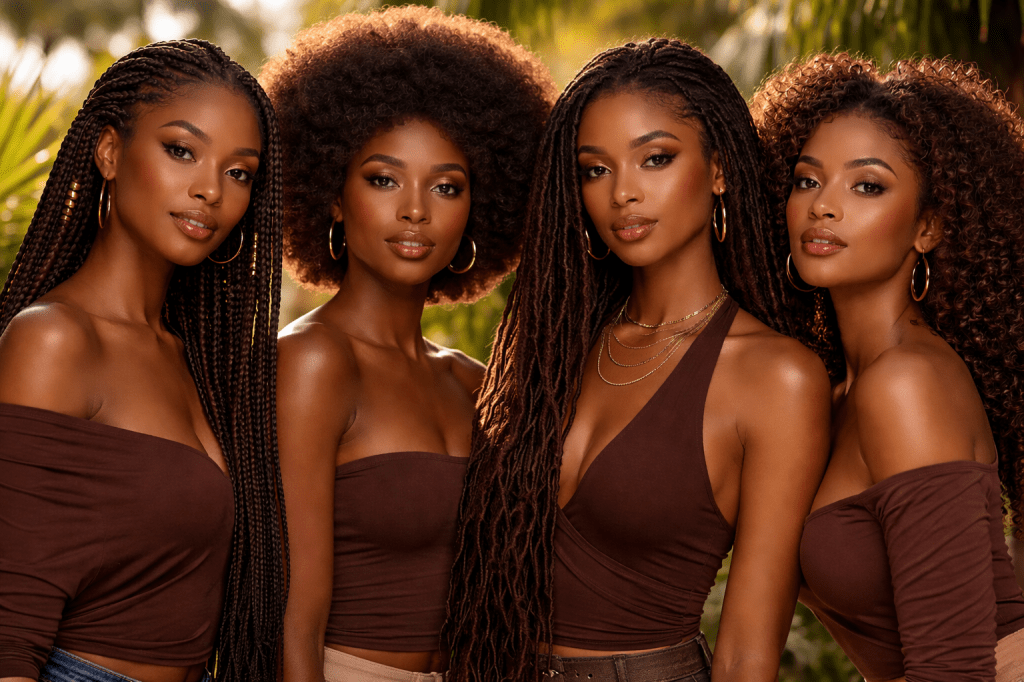
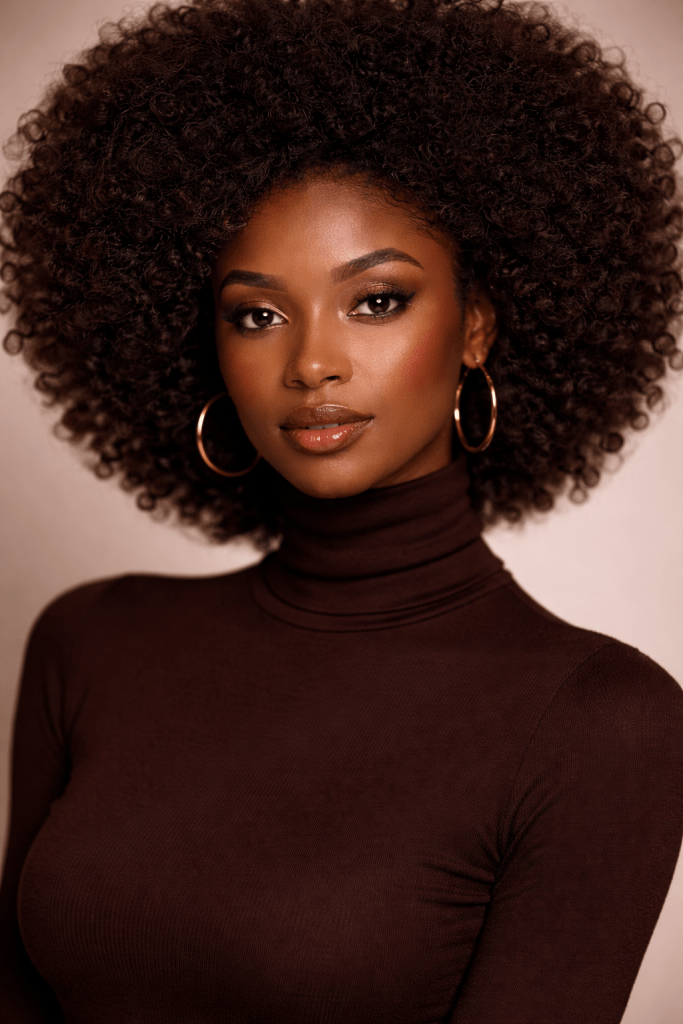
Black hair has long functioned as a cultural archive in Africa, encoding information about lineage, spirituality, marital status, age, occupation, and wealth. Across the continent, hair was never merely aesthetic; it was social language. Intricate braiding, sculptural coiffures, and the use of oils, beads, shells, gold thread, and cowries communicated rank and prosperity, situating the individual within a complex web of kinship and economy.

In many West and Central African societies, the care and styling of hair signified time, labor, and communal investment. Hairstyles that took hours or days to complete demonstrated access to leisure, skilled labor, and social networks—markers of wealth in precolonial economies where time itself was a resource. Hair thus operated as visible capital, reflecting one’s position within agrarian, mercantile, or royal systems.

Among the Yoruba, hair (irun) was closely associated with ori, the spiritual head believed to house destiny. Elaborate hairstyles accompanied rites of passage and royal ceremonies, underscoring hair’s sacred dimension. To damage or desecrate the hair was to threaten both social standing and spiritual integrity, a concept widely shared across African cosmologies.

In Wolof, Mandé, Akan, and Fulani cultures, hairstyles distinguished nobility from commoners and free people from the enslaved. Certain styles were restricted to royal households or warrior classes, while others marked griots, healers, or married women. Hair was a regulated symbol, reinforcing social order and economic hierarchy without written law.

Wealth in Africa was not only material but relational. Hairstyles often incorporated trade goods—beads from trans-Saharan routes, gold dust from Akan fields, or indigo-dyed threads—linking hair to continental and global commerce. These adornments made the head a site of economic display and interregional exchange.

Gendered meanings of hair further reflected socioeconomic status. Women’s hair often communicated fertility, marital eligibility, and household stability, while men’s hair could signify age-grade, military readiness, or priestly calling. In both cases, hair connected the body to productive and reproductive labor essential to wealth creation.

The violent rupture of the transatlantic slave trade deliberately targeted these meanings. Upon capture, African men, women, and children were often forcibly shaved. This act was not incidental hygiene; it was a calculated assault on identity, dignity, and memory. Shaving erased tribal markers, spiritual protections, and visible signs of status, rendering captives symbolically “blank.”

European slave traders justified head-shaving as a means to control lice and disease, yet the practice also facilitated commodification. Stripped of recognizable cultural signifiers, enslaved Africans were transformed into fungible labor units. The removal of hair assisted in breaking communal bonds and accelerating psychological disorientation.

On the auction block, shaved heads standardized bodies for sale. Without hairstyles to indicate nobility, skill, or ethnic origin, buyers assessed Africans primarily by age, musculature, and perceived productivity. The economics of slavery demanded depersonalization, and hair—once a ledger of social wealth—became an obstacle to profit.

The plantation regime extended this logic. Enslaved Africans were denied time, tools, and autonomy to care for their hair according to tradition. Scarcity of oils, combs, and communal grooming spaces disrupted cultural continuity. Over time, coerced neglect was weaponized as evidence of supposed African inferiority.

Colonial ideologies later pathologized African hair textures, labeling them “woolly” or “unkempt” in contrast to European norms. These racial hierarchies mapped aesthetics onto economics, positioning straight hair as “professional” and kinky hair as “primitive,” a legacy that persisted into post-emancipation labor markets.

After emancipation, hair became a site of survival. Many Black people altered or concealed natural hair to access employment and safety within white-dominated economies. Straightening practices, while often framed as assimilation, were pragmatic responses to structural exclusion rooted in slavery’s visual economy.

Despite this, African-descended communities preserved hair knowledge through oral tradition and innovation. Braiding patterns carried maps, kinship codes, and resistance strategies during enslavement, while post-slavery styles became acts of reclamation. Hair quietly remembered what history tried to erase.

In the twentieth century, Pan-Africanism and Black liberation movements explicitly reclaimed natural hair as political economy. Afros and locs rejected Eurocentric beauty standards and asserted continuity with African heritage, reframing hair as cultural wealth rather than liability.

Contemporary Africa and the diaspora continue to negotiate hair within global capitalism. The multibillion-dollar hair industry—often dominated by non-Black ownership—extracts value from Black bodies while stigmatizing natural textures. This paradox mirrors earlier patterns of exploitation, albeit in modern form.

Yet natural hair movements challenge this imbalance by re-centering African aesthetics as assets. Locally sourced shea butter, palm oil, and traditional grooming practices reconnect hair to indigenous economies and ecological knowledge, echoing precolonial systems of value.

Hair discrimination laws emerging in the United States and elsewhere acknowledge that hair-based bias is a civil rights issue, not mere preference. These policies implicitly recognize that hair has always been tied to access, labor, and economic mobility—just as it was during slavery.

Understanding the history of Black hair reveals slavery as not only a system of forced labor but of cultural theft. The shaving of African heads was an opening move in a broader project to sever people from their wealth—material, spiritual, and social.

To study Black hair is to study African political economy, cosmology, and resistance. It is a reminder that what grows from the head once carried nations, and that reclaiming it is an act of historical repair.

Today, as African and diasporic communities reassert control over their hair, they also reclaim narratives of wealth and worth long denied. In this sense, Black hair remains what it has always been: a crown, once shorn, now rising again.


References

Byrd, A. D., & Tharps, L. L. (2014). Hair story: Untangling the roots of Black hair in America. St. Martin’s Press.

Gomez, M. A. (1998). Exchanging our country marks: The transformation of African identities in the colonial and antebellum South. University of North Carolina Press.

Herskovits, M. J. (1958). The myth of the Negro past. Beacon Press.

Lovejoy, P. E. (2012). Transformations in slavery: A history of slavery in Africa (3rd ed.). Cambridge University Press. https://doi.org/10.1017/CBO9781139030116

Patton, T. O. (2006). Hey girl, am I more than my hair?: African American women and their struggles with beauty, body image, and hair. NWSA Journal, 18(2), 24–51. https://doi.org/10.2979/NWS.2006.18.2.24

Raboteau, A. J. (2004). Slave religion: The “invisible institution” in the antebellum South. Oxford University Press.

Sieber, R., & Herreman, F. (Eds.). (2000). Hair in African art and culture. Museum for African Art / Prestel.

Thornton, J. (1998). Africa and Africans in the making of the Atlantic world, 1400–1800 (2nd ed.). Cambridge University Press. https://doi.org/10.1017/CBO9780511583749
Study of Black Hair

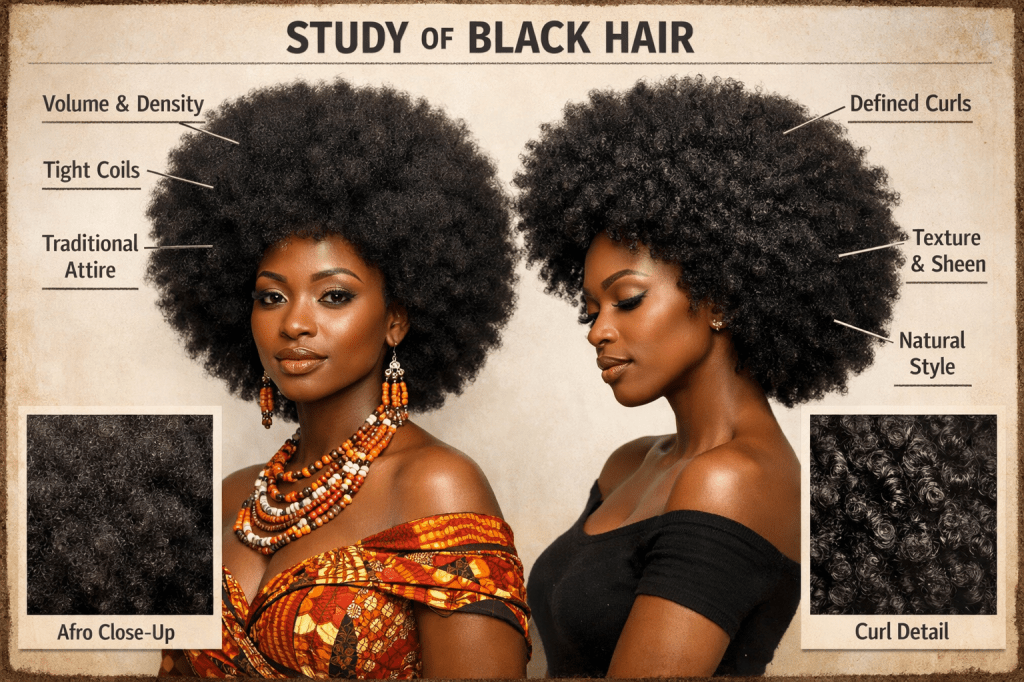
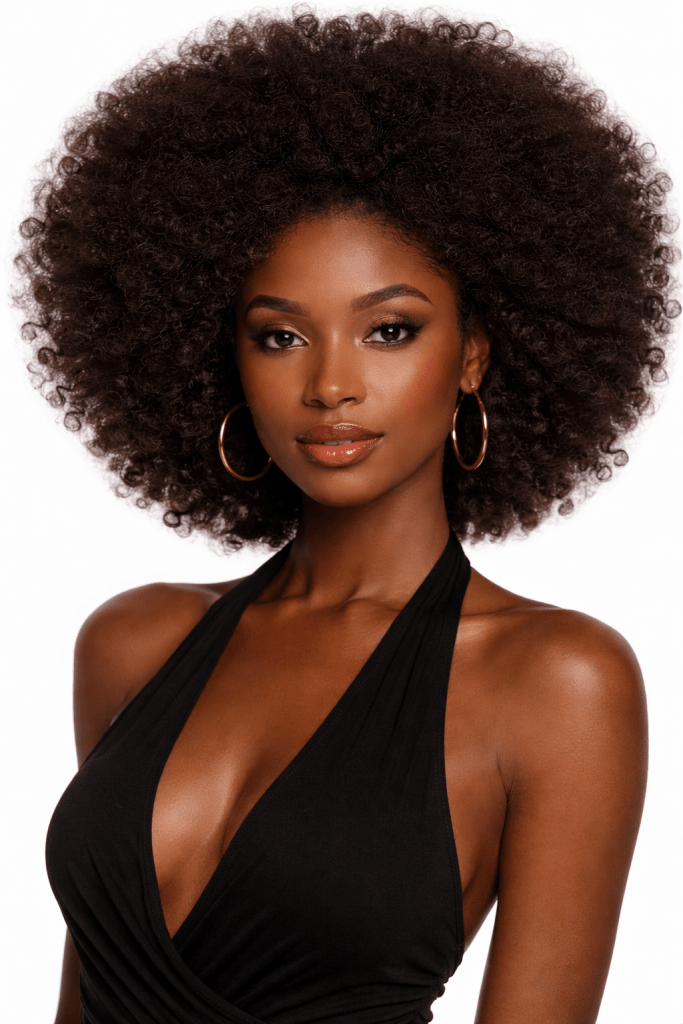
Black hair is not merely a biological feature but a profound cultural, historical, and spiritual marker that has shaped identity across the African continent and the African diaspora. Its textures, patterns, and styles communicate lineage, status, resistance, creativity, and survival. To study Black hair is to study a living archive of African civilizations, colonial disruption, and modern reclamation.

From an anthropological perspective, Black hair exhibits the widest range of natural textures found in human populations, particularly tightly coiled and spiral patterns commonly categorized as Type 4 hair. These textures are not accidental; they are adaptive traits shaped by evolution in equatorial climates, aiding thermoregulation and protecting the scalp from intense ultraviolet radiation (Jablonski, 2012).

In precolonial African societies, hair functioned as a sophisticated language. Styles signified age, marital status, ethnic affiliation, wealth, fertility, and spiritual rank. Among the Yoruba, Himba, Maasai, and Wolof peoples, hair was adorned with beads, cowrie shells, clay, and oils, transforming the head into a crown that reflected both communal belonging and divine order (Sieber & Herreman, 2000).

Hair care itself was a communal ritual. Grooming involved social bonding, storytelling, and intergenerational knowledge transfer. Natural oils such as shea butter and palm oil were used not only for aesthetics but for scalp health and protection, underscoring an advanced understanding of cosmetic science long before Western industrial products emerged (Byrd & Tharps, 2014).

The transatlantic slave trade violently disrupted these traditions. Enslaved Africans were often forcibly shaved upon capture, a symbolic stripping of identity, dignity, and ancestry. This act was not hygienic alone; it was psychological warfare designed to erase memory and enforce submission (White & White, 1995).

During slavery in the Americas, Black hair became politicized. European beauty standards elevated straight hair as “civilized” and denigrated African textures as inferior. These ideologies were embedded into laws, social hierarchies, and labor systems, reinforcing racial domination through aesthetics (Banks, 2000).

Post-emancipation, many Black people adopted hair straightening practices as survival strategies within hostile racial economies. Straight hair often afforded greater access to employment and social mobility. This was not self-hatred, but adaptation within systems that punished African appearance (Rooks, 1996).

The 20th century marked a turning point as Black intellectuals and artists challenged Eurocentric norms. The Harlem Renaissance and later the Black Power Movement reframed natural hair as political resistance. The Afro became a visible declaration of pride, autonomy, and rejection of assimilation (Van Deburg, 1992).

Scientifically, Black hair has been misunderstood and understudied. Traditional cosmetology training and dermatological research historically centered straight hair models, leading to misclassification of Black hair as “problematic” rather than biologically distinct. Contemporary research now recognizes the unique elliptical follicle shape and curl geometry of Afro-textured hair (Franbourg et al., 2003).

Psychologically, hair plays a critical role in self-concept and racial identity development. Studies show that acceptance of natural hair correlates with higher self-esteem among Black women and girls, while hair discrimination is linked to anxiety, workplace bias, and internalized racism (Rosette & Dumas, 2007).

Black women, in particular, bear the heaviest social burden regarding hair. Their hair has been hyper-policed in schools, workplaces, and the military, prompting legal interventions such as the CROWN Act, which affirms natural hairstyles as protected expressions of racial identity (Greene, 2021).

In African spiritual systems, hair is often seen as sacred—an extension of the soul and a conduit of spiritual energy. Many traditions hold that the head is the highest point of the body and closest to the divine, making hair an integral component of ritual purity and spiritual discipline (Mbiti, 1990).

The global natural hair movement of the 21st century represents a reclamation of ancestral knowledge. Social media, digital archives, and grassroots education have empowered millions to unlearn colonial beauty myths and embrace their God-given design. This movement is both aesthetic and epistemological.

Economically, Black hair has fueled a multibillion-dollar global industry, yet Black communities have historically been excluded from ownership and profit. Recent shifts toward Black-owned brands and ethical sourcing reflect a growing demand for economic justice within beauty culture (Wilkinson-Weber & DeNicola, 2016).

From a genetic standpoint, African hair diversity mirrors the deep genetic diversity of African populations themselves. Africa contains the oldest and most varied human gene pools, and hair texture variation is a visible testament to this biological richness (Tishkoff et al., 2009).

Education systems are increasingly recognizing the importance of inclusive representation. When Black hair is normalized in textbooks, media, and academic studies, it disrupts deficit narratives and affirms Black children’s embodied identities as worthy of study and respect.

In media and visual culture, the afro, locs, braids, and twists function as counter-hegemonic symbols. They resist homogenization and assert presence in spaces that once demanded erasure. Representation of natural hair is thus inseparable from struggles for visibility and equity.

The study of Black hair also intersects with gender, class, and theology. In many faith traditions, debates around modesty, submission, and beauty are projected onto Black women’s hair, revealing how control over hair often mirrors control over bodies and voices.

In diasporic contexts, Black hair connects past and present, Africa and the Americas. It carries memory even when language and geography are lost. Each coil becomes a lineage marker, a living genealogy etched into the body.

Ultimately, Black hair is evidence of survival. Despite centuries of violence, ridicule, and regulation, it continues to grow—defiant, adaptive, and beautiful. To study Black hair is to study resilience written in keratin and culture.

As scholarship expands, Black hair must be treated not as a niche topic but as a legitimate interdisciplinary field encompassing anthropology, biology, history, psychology, theology, and cultural studies. Its significance reaches far beyond appearance into the core of human identity.

In honoring Black hair, academia participates in restorative justice—correcting historical distortions and affirming that what was once marginalized is, in truth, central to understanding humanity itself.


References

Banks, I. (2000). Hair matters: Beauty, power, and Black women’s consciousness. NYU Press.

Byrd, A. D., & Tharps, L. L. (2014). Hair story: Untangling the roots of Black hair in America (2nd ed.). St. Martin’s Press.

Franbourg, A., Hallegot, P., Baltenneck, F., Toutain, C., & Leroy, F. (2003). Current research on ethnic hair. Journal of the American Academy of Dermatology, 48(6), S115–S119.

Greene, T. (2021). The CROWN Act and the fight against hair discrimination. Harvard Civil Rights–Civil Liberties Law Review, 56, 487–515.

Jablonski, N. G. (2012). Living color: The biological and social meaning of skin color. University of California Press.

Mbiti, J. S. (1990). African religions and philosophy (2nd ed.). Heinemann.

Rooks, N. (1996). Hair raising: Beauty, culture, and African American women. Rutgers University Press.

Rosette, A. S., & Dumas, T. L. (2007). The hair dilemma: Conformity versus authenticity in corporate America. Academy of Management Journal, 50(4), 785–807.

Sieber, R., & Herreman, F. (2000). Hair in African art and culture. The Museum for African Art.

Tishkoff, S. A., et al. (2009). The genetic structure and history of Africans and African Americans. Science, 324(5930), 1035–1044.

Van Deburg, W. L. (1992). New day in Babylon: The Black Power movement and American culture. University of Chicago Press.

Wilkinson-Weber, C. M., & DeNicola, A. (2016). Critical craft: Technology, globalization, and capitalism. Bloomsbury.

The Beautiful Brown Paradox: Beauty, Society, and Self.

The lived experience of a beautiful brown woman in today’s world is layered with complexity, triumph, and contradiction. She exists in a space where beauty is simultaneously a blessing and a battlefield—a lens through which society sees her, yet often fails to truly know her. The beautiful brown paradox is the tension between being visually adored but socially dismissed, culturally exalted but systemically constrained, desired yet rarely protected. In this paradox, beauty does not erase oppression; instead, it often highlights it.

Within the Black and brown community, beauty is a cultural inheritance—an embodied legacy of ancestry, geography, and divine artistry. From rich melanin tones to textured hair and regal facial architecture, brown beauty is rooted in history older than empires. Yet colonialism distorted this reality, making brown beauty invisible, inferior, or conditional. The beautiful brown woman today carries not only the gift of her appearance but the weight of reclaiming its truth.

Society weaponizes beauty standards, often rewarding proximity to whiteness. Even when brown beauty is praised, it is sometimes praised selectively—lighter shades, looser curls, delicate features. The brown woman whose beauty does not align with Eurocentric norms may find herself celebrated within her culture but overlooked in mainstream spaces. This hierarchy shapes identity and experience, forcing her to navigate the politics of complexion and attractiveness.

In public perception, the beautiful brown woman is often exoticized. She is labeled “different,” “rare,” or “special”—descriptors cloaked as compliments yet rooted in the idea that brown beauty is exceptional rather than foundational. She becomes spectacle instead of standard, admired but othered, desired yet misunderstood. Her identity becomes an aesthetic, not a humanity.

Social desirability does not translate into social safety. A beautiful brown woman may attract attention but not advocacy. She may be admired in music videos, but ignored in boardrooms. Emulated in style and beauty trends, yet excluded from leadership. Loved on screen, but unprotected in real life when injustice strikes. Her beauty, instead of armor, becomes exposure.

Colorism complicates her world further. Privilege may come with lighter complexion, yet scrutiny may intensify with deeper melanin. Brown beauty exists on a spectrum where each shade bears its own burdens. Light-skinned women may face accusations of arrogance or “passing privilege,” while dark-skinned women may fight invisibility and devaluation. Each lives a different verse of the same song: beauty politicized.

The paradox extends to relationships. The beautiful brown woman may be desired romantically, yet objectified more than cherished. She may attract suitors fascinated by her appearance but intimidated by her intellect or strength. Love becomes a negotiation between being adored and being truly seen. Her heart longs for recognition beyond the physical—a love that honors her essence, not just her allure.

In professional spaces, her beauty can be double-edged. It may draw opportunity but also unwanted assumption. She may be seen as capable because she “looks polished,” or underestimated because beauty is mistaken for superficiality. She must work twice as hard to prove she is not merely ornamental. Intelligence becomes her shield, and excellence her language.

Psychologically, beauty can become a mask. The world applauds her appearance but often overlooks her pain. She learns early that vulnerability contradicts image, so she smiles when tired, succeeds when overwhelmed, and forgives when wounded. She carries grace because she must, but inside, she seeks safe spaces to rest her soul and remove the armor of expectation.

Spiritually, her journey carries deep significance. Scripture reminds us that external beauty is fleeting, but inward beauty—wisdom, humility, and faith—endures (1 Peter 3:3–4, KJV). The beautiful brown woman’s strength lies not only in how she looks, but in the resilience she embodies. Her radiance is divine, not merely cosmetic. Her worth is eternal, not algorithmic.

Modern beauty culture complicates her reflection. Filters, trends, and visibility metrics tell her that beauty must be perfected, performed, and proven. Yet ancestral wisdom whispers that true beauty is rooted in identity and dignity—not validation. Her challenge is to see herself clearly in a world that constantly distorts mirrors.

In media, representation grows but remains incomplete. When she sees herself, it is often in curated roles—strong, sensual, supportive. Rarely soft, complex, or unguarded. She longs to see narratives where brown women exist without stereotype or performance; where they breathe fully, laugh freely, and heal publicly.

Community plays a healing role. Among other brown women, she finds recognition without explanation. Shared experience becomes sanctuary. Yet even within community, internalized color hierarchies must be dismantled so beauty becomes celebration, not competition.

The beautiful brown paradox teaches resilience. She learns to define herself rather than be defined. She cultivates internal wealth: character, purpose, vision. Beauty becomes her introduction, not her identity. Her value is no longer measured by perception, but by purpose.

She raises daughters and sons with new language—affirmation rooted in heritage and holiness. She reminds them that melanin is majesty, hair is crown, and beauty is inheritance, not achievement. In doing so, she interrupts generations of distortion and chooses liberation over imitation.

Her presence challenges the world. Brown beauty stands as testimony: that Blackness is not deviation from beauty but the blueprint of it. That her body carries history, culture, and divine intention. That she is not anomaly but origin.

Ultimately, the paradox dissolves in truth: she is more than the gaze that looks at her. She is soul, mind, spirit, destiny. She is chosen, crafted, and crowned by God—not by trends or opinions. Her beauty is not dilemma, but design.

In this revelation, the brown woman walks boldly. She no longer asks for space—she embodies it. She no longer seeks validation—she knows who she is. She no longer battles identity—she rests in it. Her beauty becomes witness to a greater glory: that she is fearfully and wonderfully made (Psalm 139:14, KJV).

The beautiful brown paradox becomes, ultimately, a beautiful brown awakening. And in her awakening, she redefines beauty not only for herself, but for the world.


References

Hunter, M. (2007). The persistent problem of colorism: Skin tone, status, and inequality. Sociology Compass, 1(1), 237–254.

Nash, J. C. (2019). Black feminism reimagined: After intersectionality. Duke University Press.

Russell, K., Wilson, M., & Hall, R. (2013). The color complex: The politics of skin color in a new millennium. Anchor Books.

Wolf, N. (1991). The beauty myth: How images of beauty are used against women. HarperCollins.

Psalm 139:14 (KJV); 1 Peter 3:3–4 (KJV).

Aesthetics, Access, and Anti-Blackness

Aesthetics have never been neutral. From art and architecture to beauty standards and branding, what a society deems “beautiful” often reflects who holds power. In the Western world, aesthetic norms were constructed alongside colonialism, elevating Eurocentric features while devaluing African phenotypes, cultures, and expressions. This hierarchy of beauty became a quiet but powerful mechanism of anti-Blackness.

Anti-Black aesthetics operate by rendering Blackness undesirable, excessive, or threatening. Dark skin, broad noses, full lips, coily hair, and African body types were historically caricatured and pathologized. These representations did not arise organically; they were crafted to justify enslavement, segregation, and social exclusion.

Colonial visual culture played a central role in this process. European art and early scientific illustrations depicted Africans as primitive or animalistic, contrasting sharply with idealized white bodies portrayed as rational and refined. These images circulated widely, shaping public perception and reinforcing racial hierarchies.

Access became the material consequence of aesthetic hierarchy. Beauty standards dictated who could enter certain spaces, industries, and opportunities. From employment and housing to education and media visibility, proximity to whiteness often determined access to social mobility.

The beauty industry institutionalized this bias. For decades, cosmetic products, hair care lines, and advertising excluded darker skin tones and natural hair textures. Black consumers were forced to assimilate or self-alter in order to be seen as professional or acceptable.

Colorism emerged as a byproduct of anti-Black aesthetics. Within Black communities themselves, lighter skin and looser curls were rewarded, while darker skin was stigmatized. This internalized hierarchy reflects the psychological residue of colonial domination.

Media representation continues to shape aesthetic access. Black characters are often relegated to stereotypes, while darker-skinned women and men are underrepresented in leading or romantic roles. Visibility becomes conditional upon conformity to palatable forms of Blackness.

Fashion and luxury spaces also function as aesthetic gatekeepers. Black bodies are celebrated as inspiration yet policed as consumers. Cultural appropriation allows Black style to be commodified while Black people themselves face exclusion from elite spaces.

Educational institutions reinforce aesthetic norms through Eurocentric curricula that privilege Western art, philosophy, and standards of excellence. African aesthetics are often treated as supplemental or folkloric rather than foundational.

In the workplace, aesthetics dictate professionalism. Natural Black hair has been labeled unkempt, braids deemed unprofessional, and dark skin subtly associated with incompetence. These judgments translate into hiring bias, wage gaps, and limited advancement.

The criminalization of Black aesthetics further exposes anti-Blackness. Hoodies, sagging pants, and Afros have been used to justify surveillance, harassment, and lethal force. Black style becomes evidence of threat rather than expression.

Social media has intensified aesthetic policing while offering new avenues of resistance. Algorithms often favor Eurocentric beauty, yet digital platforms also allow Black creators to reclaim narrative control and redefine beauty on their own terms.

Historically, Black resistance has always included aesthetic rebellion. From African textiles and hairstyles to the Black Arts Movement, aesthetic expression has functioned as cultural preservation and political defiance.

Access to health and wellness is also shaped by aesthetics. Studies show that darker-skinned individuals receive less attentive medical care, as pain tolerance and credibility are racially biased. Appearance influences who is believed and who is neglected.

Aesthetics intersect with capitalism by determining market value. Black beauty generates billions in revenue, yet ownership and profit remain largely outside Black communities. Extraction persists even in celebration.

The psychological toll of aesthetic exclusion is profound. Anti-Black beauty standards contribute to low self-esteem, body dysmorphia, and identity fragmentation, particularly among Black youth.

Policy interventions such as the CROWN Act reveal how deeply aesthetics are tied to civil rights. Laws protecting natural hair underscore that beauty norms are not merely cultural preferences but mechanisms of discrimination.

Challenging anti-Black aesthetics requires structural change, not just representation. It demands redistribution of access, ownership, and authority over cultural production.

Reclaiming Black aesthetics is an act of liberation. When Black people define beauty on their own terms, they disrupt systems that profit from their erasure while consuming their culture.

Ultimately, aesthetics are about power—who is seen, who is valued, and who belongs. Until Blackness is no longer a barrier to beauty, access, and dignity, anti-Blackness will remain embedded in the visual and social fabric of society.


References

Bourdieu, P. (1984). Distinction: A social critique of the judgement of taste. Harvard University Press.

Collins, P. H. (2000). Black feminist thought: Knowledge, consciousness, and the politics of empowerment. Routledge.

Craig, M. L. (2002). Ain’t I a beauty queen? Black women, beauty, and the politics of race. Oxford University Press.

Fanon, F. (1952/2008). Black skin, white masks. Grove Press.

Hunter, M. (2007). The persistent problem of colorism. Sociology Compass, 1(1), 237–254.

Tate, S. A. (2015). Skin bleaching in black Atlantic zones. Palgrave Macmillan.

Wilkerson, I. (2020). Caste: The origins of our discontents. Random House.

🌺 The Radiance of Righteousness: How Modesty and Purity Shapes True Beauty 🌺

Photo by M Zass on Pexels.com

In a culture obsessed with appearance, it is easy to forget that true beauty is more than skin deep. The Bible emphasizes that the foundation of beauty is righteousness and purity. Proverbs 20:7 (KJV) states: “The just man walketh in his integrity: his children are blessed after him.” Purity of heart, integrity, and moral discipline are the qualities that radiate true beauty, far surpassing fleeting physical charm.

Purity, both in thought and action, shapes how a person interacts with the world. Psychologically, individuals who demonstrate honesty, self-control, and moral consistency inspire trust and admiration in others (Miller & Lynam, 2001). A pure heart allows one to form healthy relationships, make ethical decisions, and maintain a reputation that is respected and lasting. In essence, righteousness makes someone attractive in ways that superficial beauty cannot.

Modesty is a concept that encompasses humility, self-respect, and restraint in one’s behavior, speech, appearance, and attitude. It involves presenting oneself in a way that does not draw unnecessary attention or provoke vanity, pride, or lust. Modesty is both an inner disposition (a humble heart) and an outer expression (behavior, dress, and speech).

From a biblical perspective, modesty is closely tied to humility and godliness. The Bible teaches:

  • “Whose adorning let it not be that outward adorning… But let it be the hidden man of the heart, in that which is not corruptible, even the ornament of a meek and quiet spirit, which is in the sight of God of great price” (1 Peter 3:3–4, KJV).
  • “Likewise, ye wives, be in subjection to your own husbands; that, if any obey not the word, they also may without the word be won by the conversation of the wives” (1 Peter 3:1, KJV). Here, modesty includes behavior that reflects respect, wisdom, and self-control.

Modesty also extends to speech and conduct, meaning avoiding boastfulness, arrogance, or sexual provocation. It is not shame or self-denial, but a way of valuing oneself and others properly, emphasizing inner character over outward appearance.

In practice, a modest person dresses, speaks, and acts in a way that honors God, respects others, and reflects self-discipline, while keeping the focus on character, not vanity.

The Bible provides clear examples of women whose inner purity defined their beauty. Abigail, though not described for her looks, prevented disaster through wisdom and discernment (1 Samuel 25:32–33 KJV). Her righteous choices protected lives and earned respect, proving that true beauty is measured by the impact of one’s character. Similarly, Mary, the mother of Jesus, was called “highly favoured” (Luke 1:28 KJV) because of her obedience and humility, demonstrating that God prizes purity of heart above outward appearance.

Modern examples also illustrate the radiance of righteousness. Consider a young woman in her community who mentors at-risk youth, guiding them with integrity and love. Her physical appearance may be unnoticed by many, but her influence and moral courage leave a lasting impression. Similarly, a businesswoman who maintains honesty in her dealings, even under pressure, inspires trust and admiration, reflecting the beauty of righteousness in practical life.

Purity is not just about morality—it also shapes social and emotional health. Psychology highlights that self-regulation, ethical conduct, and living according to one’s values contribute to well-being and social success (Baumeister et al., 2007). Individuals who cultivate purity and integrity tend to experience lower stress and stronger, more meaningful relationships. This aligns perfectly with biblical teachings that emphasize the blessings of a righteous life.

Joseph, in the Old Testament, faced temptation in Potiphar’s house yet refused to sin against God (Genesis 39:9 KJV). His purity not only protected his soul but positioned him for future leadership and blessing. Similarly, Daniel’s adherence to God’s laws, despite being in a foreign and morally challenging environment, earned him favor and respect (Daniel 6:4 KJV). These examples show that righteousness amplifies inner beauty and establishes a lasting legacy.

A woman of purity influences her family and community positively. As a mother, she instills values of honesty and integrity; as a friend, she encourages uprightness; as a wife, she nurtures trust and faithfulness. Proverbs 31:26 (KJV) says: “She openeth her mouth with wisdom; and in her tongue is the law of kindness.” Her words, actions, and moral discipline reflect God’s radiance, making her beauty enduring.

Ultimately, “The Radiance of Righteousness” teaches that beauty rooted in purity and godly character is eternal. While makeup fades and fashion changes, righteousness endures and leaves a transformative impact on others. True beauty is revealed when a person’s heart aligns with God’s will, their choices reflect integrity, and their life shines with moral courage, blessing everyone they encounter.


References

  • The Holy Bible, King James Version.
  • Baumeister, R. F., Vohs, K. D., & Tice, D. M. (2007). The strength model of self-control. Current Directions in Psychological Science, 16(6), 351–355.
  • Miller, J. D., & Lynam, D. R. (2001). Structural models of personality and their relation to antisocial behavior: A meta-analytic review. Journal of Personality, 69(2), 335–368.
  • Koenig, H. G. (2012). Religion, spirituality, and health: The research and clinical implications. ISRN Psychiatry, 2012, 278730. https://doi.org/10.5402/2012/278730

Threads of Sisterhood

Sisterhood is one of the most powerful yet misunderstood bonds among women. It is not merely friendship, nor is it automatic by shared gender or proximity. True sisterhood is a deliberate weaving of trust, empathy, accountability, and mutual care that strengthens women individually and collectively.

Across cultures and generations, women have survived, healed, and thrived through communal bonds. In many societies, sisterhood functioned as an informal institution—transmitting wisdom, nurturing children, preserving culture, and sustaining emotional health. These bonds were often the quiet backbone of communities.

Within the Black community especially, sisterhood has been both a refuge and a resistance. Enslavement, segregation, and systemic marginalization forced Black women to rely on one another for survival, emotional support, and shared knowledge. Sisterhood was not a luxury; it was a necessity.

Yet sisterhood has also been strained by forces designed to divide. Colorism, competition, scarcity, and internalized oppression have frayed the threads that once held women together. When systems reward comparison over collaboration, unity becomes difficult to sustain.

At its core, sisterhood requires vulnerability. It asks women to be seen fully—strengths, wounds, fears, and flaws included. This vulnerability creates trust, and trust is the thread that holds the fabric together.

Psychologically, sisterhood offers protective benefits. Research shows that strong female social bonds reduce stress, improve mental health, and increase resilience. Women who feel supported by other women are more likely to navigate adversity with confidence and hope.

However, authentic sisterhood is not built on flattery or avoidance of truth. It requires accountability. A sister is one who loves enough to correct, not just comfort. This balance distinguishes healthy bonds from superficial alliances.

Biblically, sisterhood reflects God’s design for communal strength. Scripture teaches that believers are members of one body, each responsible for the care of the other (1 Corinthians 12:25–26, KJV). Though often applied broadly, this principle holds profound relevance for women walking together in faith.

The Bible also affirms the power of unity: “Two are better than one… for if they fall, the one will lift up his fellow” (Ecclesiastes 4:9–10, KJV). Sisterhood embodies this truth through shared burdens and collective healing.

Competition undermines sisterhood by fostering comparison. When women are conditioned to view one another as rivals—for beauty, validation, or opportunity—the fabric weakens. True sisterhood rejects scarcity thinking and affirms that one woman’s success does not diminish another’s worth.

Shadeism and favoritism further strain these bonds. When women internalize hierarchies based on skin tone, class, or proximity to dominant standards, unity fractures. Healing sisterhood requires confronting these biases with honesty and courage.

Sisterhood also demands emotional maturity. Not every woman will occupy the same role or depth in one’s life. Discernment allows for healthy boundaries without bitterness, preserving peace while honoring connection.

Intergenerational sisterhood is particularly vital. When elders and younger women exchange wisdom and perspective, communities gain stability. Scripture encourages this exchange, emphasizing the teaching and nurturing role of mature women (Titus 2:3–5, KJV).

In times of crisis, sisterhood becomes most visible. Women often show up quietly—bringing meals, prayers, childcare, and listening ears. These unseen acts form the strongest threads, binding hearts through service.

Sisterhood is also a space for celebration. Rejoicing together strengthens bonds just as much as mourning together. Shared joy reinforces belonging and counters narratives of isolation.

In a digital age, sisterhood faces new challenges. Social media can create the illusion of connection while deepening comparison. Intentional, embodied relationships remain essential for authentic bonding.

Healing fractured sisterhood requires humility. Apology, forgiveness, and grace repair torn threads. Without these practices, wounds calcify and division persists.

Sisterhood flourishes where safety exists. Women must feel protected from judgment, betrayal, and exploitation. Safe spaces allow authenticity to breathe and trust to grow.

Spiritually, sisterhood reflects divine intention. God often works through collective obedience and shared faith, reminding women they were never meant to walk alone (Hebrews 10:24–25, KJV).

The threads of sisterhood are not self-sustaining; they require care. Neglect leads to unraveling, while intentionality strengthens the weave. Time, honesty, and compassion are the tools that maintain it.

Ultimately, sisterhood is both a gift and a responsibility. When women choose unity over division, healing over harm, and collaboration over competition, they create a fabric strong enough to cover generations. Threads of sisterhood, once woven with purpose, become a legacy of strength, love, and collective restoration.


References

Collins, P. H. (2000). Black feminist thought: Knowledge, consciousness, and the politics of empowerment. Routledge.

hooks, b. (2000). Feminist theory: From margin to center. South End Press.

Taylor, S. E. (2011). Tend-and-befriend: Biobehavioral bases of affiliation under stress. Current Directions in Psychological Science, 20(4), 273–277.

Ecclesiastes 4:9–10 (King James Version). Holy Bible.

1 Corinthians 12:25–26 (King James Version). Holy Bible.

Titus 2:3–5 (King James Version). Holy Bible.

Hebrews 10:24–25 (King James Version). Holy Bible.

Dilemma: Over-familarization with POC and expecting them to teach white people.

Photo by Safari Consoler on Pexels.com

The concept of People of Color (POC) refers to a collective term encompassing nonwhite racial and ethnic groups who have historically experienced marginalization, discrimination, and systemic exclusion under white-dominated structures. The term emerged as an inclusive response to the divisive racial categorizations of the past, aiming to unite Black, Indigenous, Asian, Latinx, and other marginalized communities against the shared experiences of racism and colonial oppression (Aguirre & Turner, 2011). While the phrase was designed to foster solidarity, it has also become a tool that, when misused, can blur the specificity of the Black experience within systems of racial injustice.

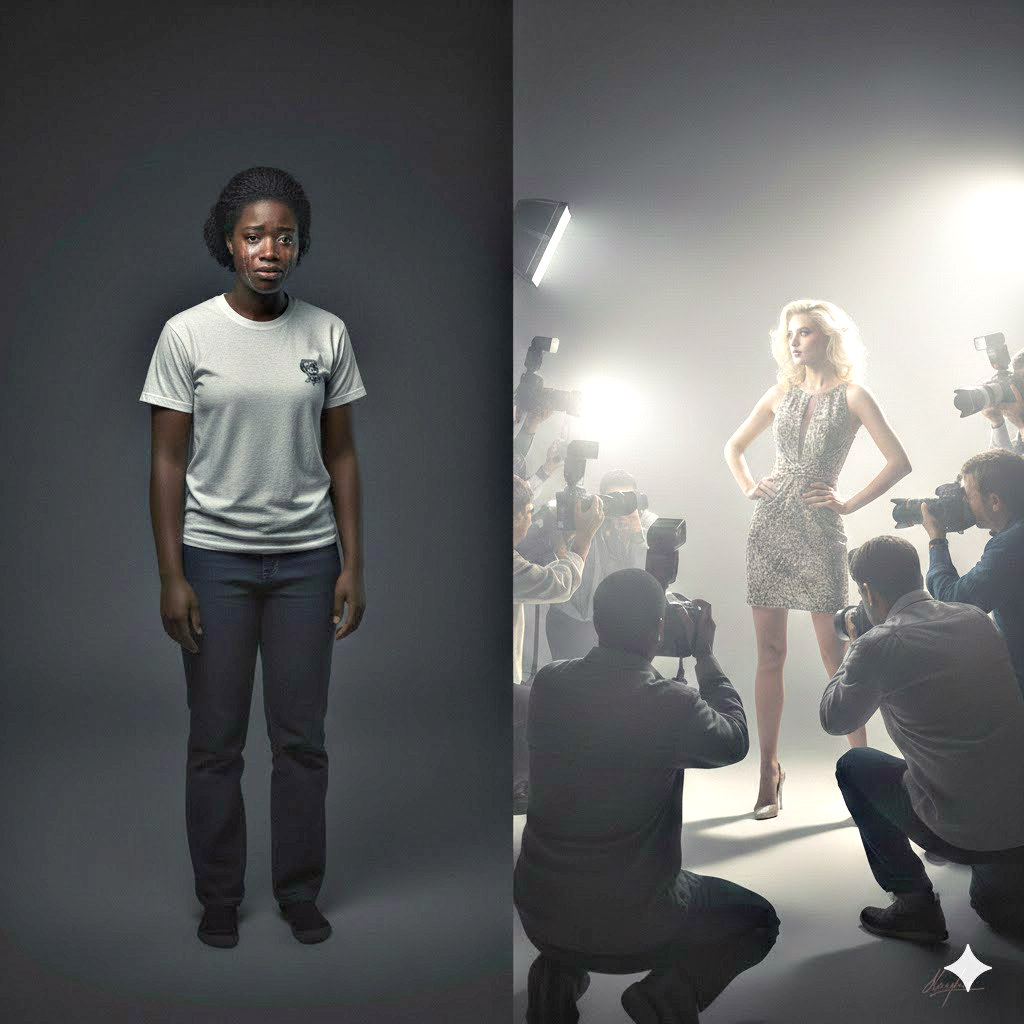
In contemporary culture, over-familiarization with POC often manifests as an unconscious entitlement from white individuals who assume they can casually enter or appropriate the cultural, emotional, or intellectual spaces of nonwhite people. This dynamic creates a tension between genuine intercultural understanding and the exploitative demand that POC educate white individuals about racism and identity. The expectation that people of color must serve as teachers of racial awareness imposes an unfair emotional labor burden, forcing them to relive trauma and articulate systemic pain that should be studied and understood independently by those benefiting from privilege (DiAngelo, 2018).

For Black people, this over-familiarization becomes particularly invasive. It often disguises itself as “allyship,” but in reality, it is a form of racial proximity that undermines autonomy. When white individuals overstep into Black spaces under the guise of solidarity, they inadvertently reinforce the same power dynamics they claim to resist. The expectation that every Black person must be a spokesperson or educator erases individuality, turning lived experience into a public classroom rather than a private, human reality.

The purpose of the POC framework was originally to unite marginalized groups under shared struggles, but it has also diluted the unique historical and systemic realities of Blackness. Anti-Blackness operates differently from other forms of racism, rooted in chattel slavery, the transatlantic slave trade, and ongoing dehumanization. When white individuals treat all POC experiences as interchangeable, they fail to grasp the singularity of the Black struggle—a struggle that has shaped the very foundation of Western economies and societies (Coates, 2015).

In educational and workplace settings, Black individuals are often expected to guide diversity efforts or explain microaggressions, even when such roles are unpaid and emotionally exhausting. The expectation becomes a cycle of psychological taxation—where the very people oppressed by racism must also be responsible for dismantling it. This undermines equity by placing the weight of re-education on those who already endure systemic injustice (Sue et al., 2007).

This dilemma extends into social and digital spaces. Online activism has created platforms for awareness, but it has also led to performative allyship, where white individuals engage with POC content superficially—sharing posts or quoting activists—without engaging in the deeper self-reflection required to dismantle racist ideologies. Black creators are often exploited for their intellectual and emotional labor, while white audiences consume and commodify their experiences without reciprocating in meaningful systemic change.

Culturally, this over-familiarization leads to appropriation. The imitation of Black speech, fashion, and music without acknowledgment of its origins reflects a historical continuity of exploitation. What was once penalized or mocked when practiced by Black people becomes celebrated when adopted by white individuals. This cultural theft, though masked as appreciation, perpetuates erasure and reinforces the illusion of equality while maintaining the structures of white dominance (hooks, 1992).

Psychologically, the demand that POC educate others about racism can induce fatigue and resentment. It forces them to manage white guilt and fragility while suppressing their own anger or exhaustion to maintain social harmony. The emotional toll of constantly explaining why racism is wrong deepens the trauma of living under racial oppression and silences the authentic emotional range of Black people (Moses, 2020).

The purpose of racial education should not fall on the oppressed but on those in power. White individuals must actively engage with anti-racist scholarship, history, and personal introspection. Works by scholars like bell hooks, Frantz Fanon, and Ibram X. Kendi offer pathways for understanding without exploiting the lived experiences of Black people. True allyship requires listening, humility, and accountability rather than over-familiarization and intrusion.

Over-familiarization also obscures boundaries. When white individuals presume intimacy with POC—calling them by colloquial names, imitating cultural behaviors, or entering spaces meant for healing—they blur the line between solidarity and dominance. This false sense of comfort reinforces the myth that racial inequities have been resolved, masking the persistent power imbalance that governs interpersonal and institutional relationships.

The expectation that every POC can represent all of their race is dehumanizing. Black individuals are diverse in ideology, class, and experience. Reducing them to educators of race or cultural ambassadors denies their complexity and individuality. It shifts attention away from systemic accountability toward interpersonal comfort for white individuals who wish to feel “included” in anti-racist discourse without surrendering privilege.

This dynamic also reinforces racial capitalism. Black pain and resilience become consumable narratives in media and entertainment. Documentaries, social posts, and academic discussions about racism generate profit and prestige for institutions that rarely redistribute resources to the communities being discussed. Thus, over-familiarization becomes another avenue through which white supremacy sustains itself under a façade of multicultural awareness.

The intersection of over-familiarization and tokenism compounds the issue. Many institutions showcase a handful of Black individuals as representatives of diversity while failing to dismantle exclusionary policies or systemic inequities. The “teacher” role is thus institutionalized, and POC find themselves both celebrated and exploited simultaneously—a contradictory position of visibility without power.

Historically, Black people have always been forced to teach their oppressors humanity—from the abolitionist movements to the Civil Rights era. Yet, centuries later, the demand continues. This suggests that the white conscience prefers comfort over change. Genuine transformation begins when those in privilege stop expecting emotional guidance and start committing to self-education and reparative action.

The effects of over-familiarization are subtle but profound. They erode trust, trivialize lived experiences, and perpetuate a racial dynamic where POC exist for the emotional benefit of white individuals. When white comfort becomes the measure of progress, Black liberation is delayed, and systemic inequities remain untouched beneath the surface of false harmony.

The role of POC should be self-determined, not socially assigned. They are creators, thinkers, and leaders—not tools for moral instruction. The over-familiarization problem stems from a deep societal reluctance to accept responsibility. Until white individuals internalize that learning about racism is their obligation, not a favor extended by POC, the cycle of exploitation will persist.

Community healing among POC requires establishing boundaries and reclaiming autonomy. This involves recognizing when sharing becomes self-harm and when silence becomes resistance. As Audre Lorde (1984) wrote, “The master’s tools will never dismantle the master’s house.” Educating oppressors cannot liberate the oppressed; only collective power and systemic change can.

In conclusion, the over-familiarization of POC and the expectation that they teach white individuals about racism is a modern form of exploitation wrapped in the language of inclusion. It drains emotional energy, obscures systemic issues, and recenters whiteness even within anti-racist spaces. To honor the purpose of the POC framework, society must move from extraction to equity, from over-familiarization to respect, and from learning about people of color to learning from within systems that restore their rightful power and dignity.

References
Aguirre, A., & Turner, J. H. (2011). American ethnicity: The dynamics and consequences of discrimination. McGraw-Hill.
Coates, T.-N. (2015). Between the world and me. Spiegel & Grau.
DiAngelo, R. (2018). White fragility: Why it’s so hard for white people to talk about racism. Beacon Press.
hooks, b. (1992). Black looks: Race and representation. South End Press.
Lorde, A. (1984). Sister outsider: Essays and speeches. Crossing Press.
Moses, M. (2020). Emotional labor and the racial burden: The hidden cost of educating others. Journal of Black Psychology, 46(4), 273–289.
Sue, D. W., Capodilupo, C. M., Torino, G. C., Bucceri, J. M., Holder, A. M. B., Nadal, K. L., & Esquilin, M. (2007). Racial microaggressions in everyday life: Implications for clinical practice. American Psychologist, 62(4), 271–286.

🌹 Beyond the Mirror: Discovering God’s Definition of Beauty 🌹

Photo by Al Ameen Saddiq on Pexels.com

When a person stands before a mirror, the reflection that stares back often determines their mood, confidence, or sense of worth. Yet the Bible reminds us that beauty cannot be fully captured by glass or surface. “For the Lord seeth not as man seeth; for man looketh on the outward appearance, but the Lord looketh on the heart” (1 Samuel 16:7, KJV). God’s definition of beauty goes beyond what is visible—it is rooted in the heart, character, and the fear of the Lord.

The world often sets unrealistic standards of beauty, equating it with youth, body type, skin tone, or fashion trends. These standards shift with culture and time, leaving many feeling inadequate. Psychology confirms that society’s obsession with appearance can lead to anxiety, depression, and body dissatisfaction (Cash & Smolak, 2011). In contrast, God’s design frees us from this endless comparison by grounding beauty in eternal virtues like love, humility, and kindness.

Scripture provides clear examples of this truth. Sarah was admired for her physical beauty (Genesis 12:11 KJV), but it was her faith in God’s promises that secured her place in history. Similarly, Ruth’s loyalty and courage, not her outward form, drew Boaz’s admiration and favor (Ruth 3:11 KJV). Their stories highlight that God values inner faithfulness far above fleeting appearances.

The Apostle Peter addressed women directly about this issue: “Whose adorning let it not be that outward adorning of plaiting the hair, and of wearing of gold… But let it be the hidden man of the heart… the ornament of a meek and quiet spirit, which is in the sight of God of great price” (1 Peter 3:3–4, KJV). Here, beauty is portrayed as something incorruptible—a spiritual adornment more precious than pearls or jewels.

Psychological studies echo this wisdom. Research shows that personality traits such as warmth, honesty, and compassion strongly influence perceptions of attractiveness (Zebrowitz & Montepare, 2008). In other words, a person who radiates kindness and confidence is often seen as more beautiful than someone with perfect features but a harsh spirit. This is why Proverbs 31:26 (KJV) praises the virtuous woman: “She openeth her mouth with wisdom; and in her tongue is the law of kindness.”

Modern life provides countless opportunities to live out God’s definition of beauty. A woman who comforts the grieving, a man who serves the poor, or a youth who stands firm in purity all embody beauty that no mirror can reflect. Their actions mirror Christ’s love and bring light into dark spaces. True beauty shines not through selfies or admiration, but through service, compassion, and faith.

The story of Mary, the mother of Jesus, further exemplifies this. Though not described in Scripture by her appearance, she was called “highly favoured” (Luke 1:28 KJV) because of her obedience and humility. Her legacy demonstrates that God elevates character above all else. This truth reminds believers today that they need not chase worldly standards—they are already beautiful in God’s eyes when they walk in faith.

Ultimately, the mirror shows what time will fade, but God’s definition of beauty is eternal. Outward appearance may open doors for a moment, but character, wisdom, and righteousness leave a lasting legacy. To discover God’s beauty is to embrace the heart He transforms, reflecting His glory in every act of love and every word of truth.

True beauty, then, is not what you see—it’s what you give, how you love, and who you glorify.


References

  • The Holy Bible, King James Version.
  • Cash, T. F., & Smolak, L. (2011). Body Image: A Handbook of Science, Practice, and Prevention. New York: Guilford Press.
  • Zebrowitz, L. A., & Montepare, J. M. (2008). Social psychological face perception: Why appearance matters. Social and Personality Psychology Compass, 2(3), 1497–1517.
  • Koenig, H. G. (2012). Religion, spirituality, and health: The research and clinical implications. ISRN Psychiatry, 2012, 278730. https://doi.org/10.5402/2012/278730

Does Having Light Skin = Pretty?

Beauty has long been tied to social hierarchies and cultural perceptions, with lighter skin often privileged in many societies. Yet equating light skin with attractiveness is misleading and overly simplistic. True beauty is a combination of facial features, symmetry, proportion, expression, and character. While society may focus on skin color, psychology and aesthetics show that light skin does not guarantee beauty, nor does dark skin preclude it.

The Cultural Obsession with Light Skin

Throughout history, light skin has been associated with wealth, status, and desirability. From colonialism to modern media, lighter skin has been positioned as aspirational. Colorism perpetuates the false belief that fairness equals beauty, ignoring the complexity of human aesthetics (Hunter, 2007).

The Science of Facial Harmony

Research in facial aesthetics shows that facial harmony—balanced proportions between the eyes, nose, lips, and jaw—is a primary determinant of attractiveness. Features aligned with the golden ratio (approximately 1.618) are perceived as more aesthetically pleasing, regardless of skin tone (Rhodes, 2006).

Symmetry and Perceived Beauty

Facial symmetry is another critical factor. Symmetrical faces are often rated as healthier, more attractive, and genetically fit. Both light-skinned and dark-skinned individuals can possess perfect symmetry, demonstrating that attractiveness is independent of melanin content.

The Eye of the Beholder

Beauty is subjective and culturally mediated. The famous adage, “beauty is in the eye of the beholder,” reflects the role of personal preference, social context, and cultural standards in shaping who is considered attractive (Jones & Hill, 1993). A face admired in one culture may be overlooked in another.

Dark Skin Can Be Beautiful

Many dark-skinned individuals possess features that are considered conventionally beautiful—high cheekbones, symmetrical eyes, balanced lips, and radiant skin. Natural beauty cannot be measured solely by complexion, and dark skin often carries a richness and depth that enhances aesthetic appeal.

Light Skin Does Not Guarantee Beauty

Light-skinned individuals may not have the facial harmony or symmetry that contributes to attractiveness. There are light-skinned people with disproportionate or less balanced facial features, showing that skin tone alone is not an indicator of beauty.

Facial Features Over Skin Tone

Studies demonstrate that eye shape, nose width, lip fullness, and jawline prominence are central to perceptions of beauty. Skin tone plays a role in contrast and highlight but is secondary to feature harmony (Rhodes, 2006).

Expression and Emotional Appeal

Beyond structure, facial expression contributes to perceived attractiveness. A warm smile, expressive eyes, and confident posture enhance beauty in all skin tones, proving that emotional appeal matters more than melanin content.

Cultural Perceptions and Media Bias

Media often reinforces the myth that light skin equals beauty. Advertising, film, and social media tend to feature light-skinned models, skewing public perception and perpetuating colorist ideals. This bias fails to acknowledge the diversity of beautiful faces across all skin tones.

The Role of Confidence

Confidence and self-assurance influence attractiveness. Someone who carries themselves with dignity and self-love is perceived as beautiful regardless of complexion. Inner beauty radiates outward, affecting how others perceive physical appearance (1 Peter 3:3-4).

The Psychology of Preference

Human attraction is influenced by evolutionary psychology—signals of health, fertility, and genetic fitness. Symmetry, proportionality, and skin health signal vitality and influence perception more than skin lightness.

Historical Context

Historically, societies with darker-skinned populations have had their own beauty ideals that did not privilege lightness. African, Indigenous, and Asian cultures have celebrated diverse features, demonstrating that beauty is culturally and biologically multifaceted.

Misconceptions About Fairness

The belief that fair skin guarantees beauty erases diversity and harms self-esteem in darker-skinned populations. People often internalize these messages, creating a false hierarchy of attractiveness.

Beauty Across Skin Tones

Research confirms that both light-skinned and dark-skinned individuals can be beautiful. Symmetry, proportion, facial harmony, and personal presence are universal indicators of attractiveness, not melanin content.

Faith and True Beauty

Scripture reminds us that outward appearance is secondary to the heart. God sees the heart, and His value system is not tied to skin tone (1 Samuel 16:7). True beauty includes character, kindness, and alignment with God’s design.

Examples in Society

Numerous public figures illustrate that beauty transcends skin tone. Dark-skinned models, actors, and leaders are celebrated globally for their aesthetic appeal, disproving the myth that lightness equals prettiness.

The Eye of the Beholder Revisited

Beauty is subjective and socially mediated. While one person may value lighter skin, another may be captivated by facial features, expression, or charisma. Recognizing subjectivity challenges rigid beauty hierarchies.

Challenging Colorist Ideals

Rejecting the notion that light skin is inherently superior empowers individuals to appreciate diverse beauty. Colorism is socially constructed, but feature harmony, symmetry, and confidence are universally admired.

Conclusion

Light skin does not automatically equal beauty. True attractiveness is determined by facial harmony, symmetry, expression, and character. Dark-skinned individuals can be stunningly beautiful, while light-skinned individuals may lack these aesthetic qualities. Beauty is subjective, culturally influenced, and deeply rooted in both physical features and the spirit. Recognizing this truth helps dismantle harmful stereotypes and celebrates God’s diverse creation (Psalm 139:14).


References

  • Hunter, M. L. (2007). The persistent problem of colorism: Skin tone, status, and inequality. Sociology Compass, 1(1), 237–254. https://doi.org/10.1111/j.1751-9020.2007.00006.x
  • Rhodes, G. (2006). The evolutionary psychology of facial beauty. Annual Review of Psychology, 57(1), 199–226. https://doi.org/10.1146/annurev.psych.57.102904.190208
  • Jones, D., & Hill, K. (1993). Criteria of facial attractiveness in five populations. Human Nature, 4(3), 271–296.
  • Psalm 139:14 (KJV) – “I am fearfully and wonderfully made.”
  • 1 Samuel 16:7 (KJV) – “Man looketh on the outward appearance, but the LORD looketh on the heart.”
  • 1 Peter 3:3-4 (KJV) – Emphasis on inner beauty over outward adornment.

Brown and Bold: Owning Your Look, Your Voice, Your Power.

Photo by RDNE Stock project on Pexels.com

Being brown is more than a skin tone—it is a statement, a legacy, and a form of power. In a world where Eurocentric beauty standards dominate media and culture, claiming one’s brown skin, voice, and presence is an act of courage and self-determination. To be brown and bold is to assert identity unapologetically, embracing heritage, individuality, and influence in every facet of life.

Owning Your Look

Your appearance is a canvas that tells your story. Brown skin, in its many shades, reflects ancestry, resilience, and beauty. From deep cocoa to light caramel, each tone carries its own narrative, influenced by genetics, culture, and history. Embracing your natural look—including skin tone, hair texture, and style—is an act of self-love and defiance against societal pressures that seek to standardize beauty. Celebrities like Lupita Nyong’o, Tracee Ellis Ross, and Adut Akech exemplify how embracing natural beauty can shift perceptions globally. By owning your look, you claim authority over how the world sees you and how you see yourself.

Owning Your Voice

Boldness is not only visual—it is verbal. Speaking your truth, sharing your ideas, and asserting your perspective are vital components of personal power. Historically, Black and brown voices have been silenced or undervalued. Yet, modern movements, social media platforms, and cultural spaces offer opportunities to reclaim narrative authority. Writers, activists, and leaders like Chimamanda Ngozi Adichie, Ava DuVernay, and Issa Rae demonstrate that a confident voice—articulated with clarity and conviction—can inspire change, representation, and empowerment. Owning your voice means refusing to shrink, to apologize, or to be invisible.

Owning Your Power

Power is cultivated when look and voice align with self-awareness and purpose. It is the confidence to navigate spaces that were historically unwelcoming, to excel in careers, relationships, and creative pursuits. Brown individuals often carry the weight of societal bias, yet choosing boldness transforms that weight into strength. Power is expressed through education, entrepreneurship, artistry, advocacy, and leadership. It is the recognition that your identity is an asset, not a limitation.

Brown and Bold Manifesto: Owning Your Look, Your Voice, Your Power

1. Own Your Look
Affirmation: “My skin, my hair, my style are my crown. I honor my heritage and radiate confidence.”

Action Steps:

  • Stand before a mirror daily and affirm the beauty of your skin tone.
  • Experiment with hairstyles, fashion, or makeup that makes you feel authentic.
  • Document your style journey in photos or journaling to celebrate growth.

2. Own Your Voice
Affirmation: “My words matter. I speak with clarity, courage, and conviction.”

Action Steps:

  • Practice speaking your ideas aloud, even in small, private spaces.
  • Share your thoughts through writing, social media, or creative outlets.
  • Join communities or groups that uplift and amplify brown voices.

3. Own Your Power
Affirmation: “I am a force of resilience, creativity, and influence. My power is undeniable.”

Action Steps:

  • Set personal goals in career, education, or artistry and take daily steps toward them.
  • Celebrate achievements—big or small—without minimizing your accomplishments.
  • Engage in mentorship or community projects that allow you to uplift others.

4. Cultivate Confidence
Affirmation: “I embrace every shade of me. Confidence flows from acceptance and pride.”

Action Steps:

  • Identify moments of self-doubt and counter them with empowering affirmations.
  • Limit exposure to media or environments that diminish your self-worth.
  • Surround yourself with people who celebrate your identity.

5. Celebrate Heritage and Legacy
Affirmation: “I honor the stories of those who came before me. Their resilience is my foundation.”

Action Steps:

  • Learn about your ancestry and cultural heritage.
  • Share stories of empowerment from your community or family.
  • Use rituals, art, or reflection to honor the legacy of brown excellence.

6. Daily Boldness Practice
Affirmation: “Each day, I choose to be unapologetically me.”

Action Steps:

  • Take one small bold action every day: a statement outfit, a confident opinion, or a new endeavor.
  • Journal reflections on how these actions make you feel empowered.
  • Recognize that boldness is a muscle—strength grows with daily practice.

Psychology of Boldness and Confidence

Psychological research shows that self-affirmation, representation, and cultural pride enhance confidence and resilience (Hunter, 2007). When brown individuals see themselves reflected in positions of influence and media, it validates their worth and encourages bold self-expression. Boldness is thus both an internal practice and a social statement—building confidence while challenging external bias.

Cultural and Spiritual Dimensions

Culturally, brownness is a celebration of lineage, ancestry, and shared history. Spiritually, it is affirmed as beautiful and worthy (Song of Solomon 1:5 KJV). Embracing skin, voice, and power is not vanity—it is reclamation. It is honoring the legacy of those who endured oppression, yet persevered, leaving a foundation upon which boldness can thrive today.

Conclusion

To be brown and bold is to live authentically, unapologetically, and courageously. It is to honor your look, amplify your voice, and wield your power. Every choice—to speak, to create, to lead—is a testament to resilience and self-determination. Brownness is not merely a shade; it is a force, a legacy, and a declaration: we see ourselves, we value ourselves, and we shape the world boldly. The Brown and Bold Manifesto is a daily roadmap to self-empowerment. By intentionally embracing your look, voice, and power, you cultivate confidence, resilience, and pride. Boldness is not about perfection—it’s about authenticity, self-love, and the courage to inhabit your full identity unapologetically.


References

  • Hunter, M. (2007). The Persistent Problem of Colorism: Skin Tone, Status, and Inequality. Sociology Compass, 1(1), 237–254.
  • The Holy Bible, King James Version. (1611). Song of Solomon 1:5.