Tag Archives: spirituality

Narcissism Series: Energy Vampires

Photo by Andrea Piacquadio on Pexels.com

Energy vampires are not fictional monsters — they are real people who drain your mental, emotional, and spiritual energy. They may be found in families, workplaces, friendships, and even church communities. These individuals thrive on constant attention, drama, and emotional reactions, leaving others feeling exhausted and discouraged. The Christian’s challenge is to balance compassion with wisdom — to love as Christ commands, yet guard the heart and protect peace.

The Psychology Behind Energy Vampires

1. Emotional Dysregulation

Energy vampires often struggle with managing their own emotions. They may have poor coping skills, which causes them to offload their stress, anger, or sadness onto others. This constant emotional dumping creates a cycle where they temporarily feel better — but you feel drained.

  • Psychology connection: This behavior is linked to emotional dysregulation, often seen in people with untreated anxiety, depression, or personality disorders.
  • Biblical connection: “Cast thy burden upon the Lord, and he shall sustain thee” (Psalm 55:22, KJV) — those who do not give their burdens to God often put them on other people.

2. Narcissistic Traits

Some energy vampires display narcissistic tendencies — craving attention, admiration, and control. They drain others by constantly talking about themselves, belittling others, or creating drama to stay the center of focus.

  • Psychology connection: Narcissistic Personality Disorder (NPD) is marked by entitlement, lack of empathy, and manipulation (APA, 2022).
  • Biblical connection: “This know also, that in the last days perilous times shall come. For men shall be lovers of their own selves…” (2 Timothy 3:1–2, KJV).

3. Codependency

Some energy vampires are not malicious but codependent — they feel incomplete or unsafe unless they are constantly connected to others. This leads to clinginess, over-reliance on your emotional support, and resentment when you set limits.

  • Psychology connection: Codependency is a learned behavior often formed in dysfunctional families, where a person’s worth is tied to “fixing” or rescuing others.
  • Biblical connection: “Cursed be the man that trusteth in man, and maketh flesh his arm…” (Jeremiah 17:5, KJV).

4. Chronic Negativity Bias

Energy vampires often have a negative worldview. They may complain excessively, gossip, or focus only on problems. This triggers your brain’s natural empathy response — but eventually leaves you emotionally exhausted.

  • Psychology connection: Research shows negativity bias makes negative events feel more significant and attention-grabbing than positive ones (Rozin & Royzman, 2001).
  • Biblical connection: “Do all things without murmurings and disputings” (Philippians 2:14, KJV).

5. Drama Addiction

Some people are addicted to emotional chaos. Conflict gives them a rush of adrenaline, so they unconsciously create drama to feel alive. They may pick fights, exaggerate situations, or stir gossip just to keep the emotional energy flowing.

  • Psychology connection: This can be linked to high cortisol/adrenaline cycles that train the brain to crave stress, similar to an addiction pattern.
  • Biblical connection: “Blessed are the peacemakers: for they shall be called the children of God” (Matthew 5:9, KJV).

6. Lack of Self-Awareness

Many energy vampires simply do not realize the impact they have on others. They may not be evil — just unaware that their constant venting, complaining, or emotional dependence drains the people around them.

  • Psychology connection: This relates to low emotional intelligence (EQ), which makes it hard for them to empathize with how their actions affect others.
  • Biblical connection: “The simple believeth every word: but the prudent man looketh well to his going” (Proverbs 14:15, KJV).

7. Projection & Emotional Dumping

Energy vampires often project their unresolved pain onto others. If they feel angry, they try to make you angry. If they feel fearful, they want you to worry too. They transfer their emotional state onto you to feel temporary relief.

  • Psychology connection: This is a classic defense mechanism — projection — where a person attributes their feelings to someone else.
  • Biblical connection: “The wicked are like the troubled sea, when it cannot rest” (Isaiah 57:20, KJV).

8. Secondary Gain

Some people unconsciously benefit from staying “needy” — they get attention, sympathy, or control over others. This is called secondary gain. It reinforces their draining behavior because it rewards them with emotional fuel.

  • Psychology connection: Secondary gain is often discussed in behavioral psychology as reinforcement for maladaptive patterns.
  • Biblical connection: “The soul of the sluggard desireth, and hath nothing: but the soul of the diligent shall be made fat” (Proverbs 13:4, KJV).

9. Unhealed Trauma

Many energy vampires carry childhood wounds or past hurts that were never processed. They may unconsciously seek others to fill the void, becoming overly demanding or emotionally draining.

  • Psychology connection: Trauma can create attachment wounds, leading to anxious attachment styles or emotional dependency.
  • Biblical connection: “He healeth the broken in heart, and bindeth up their wounds” (Psalm 147:3, KJV).

10. Spiritual Warfare

Some draining interactions go beyond psychology — they are spiritual battles. Energy vampires can be used as tools of distraction to keep you off your purpose and away from God’s peace.

  • Psychology & Bible link: While psychology explains behaviors, the Bible reminds us that “we wrestle not against flesh and blood” (Ephesians 6:12, KJV).

Understanding Energy Vampires
In psychology, “energy vampires” are often classified as individuals with high-conflict personalities, narcissistic traits, or codependent tendencies (Brown, 2021). They may not intend harm, but their behavior leaves others feeling depleted. Scripture cautions us about these draining interactions: “Be not deceived: evil communications corrupt good manners” (1 Corinthians 15:33, KJV).

The Emotional Toll
Research shows that toxic relationships increase stress hormones such as cortisol, leading to anxiety, burnout, and even weakened immune function (Kiecolt-Glaser & Newton, 2001). Proverbs 22:24–25 warns: “Make no friendship with an angry man… lest thou learn his ways, and get a snare to thy soul.” The emotional and spiritual cost of tolerating constant negativity is high.

The Dilemma of Compassion vs. Self-Protection
Christians sometimes feel guilty when distancing themselves from draining people. But Jesus set boundaries — He withdrew from crowds (Luke 5:16), said “no” to premature exposure (John 7:8), and rebuked Peter when Peter spoke contrary to His mission (Matthew 16:23). Love does not mean enabling toxic patterns (Cloud & Townsend, 2017).

Category 1: The Perpetual Victim
This energy vampire lives in a constant state of crisis and resists taking responsibility. They seek sympathy but reject solutions. Galatians 6:5 reminds us that “every man shall bear his own burden.” Continually rescuing them may enable their victim mindset.

Strategy for the Perpetual Victim
Offer compassion but redirect toward action: “What steps can you take to change this?” If they refuse to take responsibility, create space and avoid being their emotional dumping ground.

Category 2: The Narcissist
Narcissistic energy vampires crave admiration, attention, and control (Campbell & Miller, 2011). They may use gaslighting, criticism, or love-bombing to keep others dependent on them. Scripture warns that pride precedes destruction (Proverbs 16:18).

Strategy for the Narcissist
Stay calm, factual, and avoid feeding their need for drama. Set firm boundaries and refuse to be manipulated. Jesus’ words are instructive: “Give not that which is holy unto the dogs” (Matthew 7:6), meaning do not give your emotional energy to those who trample it.

Category 3: The Drama Creator
These individuals thrive on conflict, gossip, and emotional chaos. Research links chronic gossip and drama-seeking behavior to low self-regulation and high neuroticism (Ellwardt et al., 2012). Proverbs 6:19 lists “he that soweth discord among brethren” as one of the things the Lord hates.

Strategy for the Drama Creator
Do not fuel the fire. Refuse to participate in gossip or arguments. Proverbs 26:20 states, “Where no wood is, there the fire goeth out.” Your refusal to engage ends the cycle.

Category 4: The Controller/Manipulator
This type uses guilt, passive-aggressiveness, or even Scripture-twisting to control others. This is a subtle form of emotional abuse, which can have lasting psychological effects (Forward & Frazier, 2018). Galatians 5:1 reminds believers to stand firm in liberty.

Strategy for the Controller/Manipulator
Be direct and concise: “No, I cannot do that.” Avoid lengthy explanations, which give them room to argue. Jesus taught: “Let your communication be, Yea, yea; Nay, nay” (Matthew 5:37).

Category 5: The Chronically Negative Person
Pessimistic energy vampires focus on problems rather than solutions. Their negativity can trigger emotional contagion — the phenomenon where moods spread through social interaction (Hatfield, Cacioppo, & Rapson, 1994). Philippians 2:14 tells believers to do all things without murmuring or disputing.

Strategy for the Negative Person
Redirect to gratitude or solutions. If the conversation continues to be negative, exit respectfully. Your mental and spiritual atmosphere must remain protected.

Recognizing the Signs You Are Being Drained
Symptoms of energy drain include tension headaches, irritability, dread before contact, and guilt after setting boundaries. These signs reveal that a relationship is taking more than it is giving — a red flag for emotional stewardship.

Guarding Your Spiritual Energy
Prayer, fasting, and time in the Word recharge your spirit. Ephesians 6:10 commands: “Be strong in the Lord, and in the power of his might.” Spiritual disciplines act as armor, protecting your mind from manipulation and emotional depletion.

Using Silence as Your Shield
Psychologists recommend the “gray rock technique” — remaining emotionally neutral to discourage toxic engagement (Shahida, 2020). Proverbs 17:27 affirms, “He that hath knowledge spareth his words.” Quietness frustrates manipulators.

Healthy Detachment
Detachment allows you to care for someone without being consumed by their chaos. Jesus loved the multitudes yet frequently withdrew to pray (Luke 5:16). Healthy detachment helps you stay tuned to God’s voice rather than drowning in others’ emotional demands.

Choosing Distance When Necessary
Romans 16:17 advises believers to “mark them… and avoid them” when people persist in divisive or harmful behavior. Distance may be temporary or permanent, depending on the situation, but it is sometimes the only way to preserve mental and spiritual health.

Healing After Emotional Drain
Psalm 23:3 promises, “He restoreth my soul.” Healing involves rest, prayer, journaling, therapy, and surrounding yourself with healthy, life-giving relationships that build you up instead of draining you.

How to Stay Clear of Energy Vampires

  1. Discern Early – Pay attention to how you feel after interacting with someone. If you consistently feel drained, anxious, or resentful, that’s a warning sign. (1 Corinthians 15:33)
  2. Set Firm Boundaries – Politely but clearly limit your time and emotional availability. Example: “I can’t talk right now, let’s connect later.”
  3. Use the Power of “No” – Learn to say no without guilt or long explanations. (Matthew 5:37 – Let your yea be yea; and your nay, nay)
  4. Limit Access to Your Energy – You don’t have to answer every call, text, or message right away. Protect your emotional bandwidth.
  5. Avoid Oversharing – Keep some things private. Energy vampires may use your personal information against you later. (Proverbs 13:3 – He that keepeth his mouth keepeth his life)
  6. Stay Calm & Neutral – Don’t feed their drama. Use short, calm, factual responses (the “gray rock technique”).
  7. Redirect the Conversation – Shift focus from gossip, negativity, or complaining to solutions or positive topics.
  8. Physically Step Away – If the conversation turns toxic, excuse yourself. Sometimes a simple “I have to go now” is enough.
  9. Pray Before & After Interaction – Ask God for discernment and protection of your peace. (Philippians 4:7 – The peace of God shall keep your hearts and minds)
  10. Surround Yourself with Positive People – Build relationships with those who uplift, encourage, and sharpen you spiritually. (Proverbs 27:17 – Iron sharpeneth iron)
  11. Maintain Emotional Detachment – Care about them but don’t carry their emotional baggage as your own.
  12. Guard Your Time – Schedule conversations and visits so you remain in control of your energy, not at their mercy.
  13. Watch for Manipulation – Don’t allow guilt, flattery, or fear to force you into actions that compromise your well-being.
  14. Fast From Toxic Interaction – Take intentional breaks from draining relationships to recharge spiritually.
  15. Seek Wise Counsel – Talk to a pastor, mentor, or counselor if you struggle with cutting ties or setting limits.
  16. Stay Rooted in Scripture – Fill your mind with the Word so you can respond with wisdom instead of emotion. (Proverbs 4:23 – Keep thy heart with all diligence)
  17. Let Go of the Need to Fix Them – You are not their savior; point them to Christ but do not sacrifice your mental health to change them.
  18. Prioritize Self-Care – Rest, worship, and do things that bring you joy to refill what was drained.
  19. Walk Away When Necessary – If someone refuses to respect boundaries, create distance. (Romans 16:17 – Mark them… and avoid them)
  20. Trust God With the Relationship – Pray for their healing and deliverance, but trust God to work in their life without sacrificing your peace.

Conclusion: Loving Without Losing Yourself
Energy vampires are a reality every believer will face. The goal is not to hate them but to set godly boundaries that honor both God and yourself. Compassion without wisdom leads to burnout. When you stay anchored in Christ, guard your heart, and use discernment, you can love others without losing yourself.


References

  • Brown, J. (2021). Toxic people: Strategies for dealing with difficult personalities. HarperCollins.
  • Campbell, W. K., & Miller, J. D. (2011). The handbook of narcissism and narcissistic personality disorder. Wiley.
  • Cloud, H., & Townsend, J. (2017). Boundaries: When to say yes, how to say no to take control of your life. Zondervan.
  • Ellwardt, L., Labianca, G. J., & Wittek, R. (2012). Who are the objects of positive and negative gossip at work? Social Networks, 34(2), 193–205.
  • Figley, C. R. (2017). Compassion fatigue: Psychotherapists’ chronic lack of self-care. Journal of Clinical Psychology, 58(11), 1433–1441.
  • Forward, S., & Frazier, C. (2018). Emotional blackmail: When the people in your life use fear, obligation, and guilt to manipulate you. Harper.
  • Hatfield, E., Cacioppo, J. T., & Rapson, R. L. (1994). Emotional contagion. Cambridge University Press.
  • Kiecolt-Glaser, J. K., & Newton, T. L. (2001). Marriage and health: His and hers. Psychological Bulletin, 127(4), 472–503.
  • Shahida, S. (2020). The highly sensitive person’s guide to dealing with toxic people. New Harbinger.


The Radiance of Manhood: Inner Glory and Outer Grace. #thebrownboydilemma

Photo by nappy on Pexels.com

The concept of manhood has long been a subject of philosophical, theological, and sociocultural exploration. In every civilization, men have been seen as bearers of strength, leadership, and wisdom. Yet, the true essence of manhood extends far beyond physical power or dominance—it is a divine harmony between inner glory and outer grace. This balance, rooted in spiritual integrity, moral courage, and emotional intelligence, reflects the full radiance of what it means to be a man created in the image of God (Genesis 1:27, KJV).

The inner glory of manhood begins with the soul’s alignment to divine purpose. A man’s strength is first spiritual, derived not from material possessions or societal approval but from his relationship with his Creator. Proverbs 20:7 (KJV) declares, “The just man walketh in his integrity: his children are blessed after him.” This passage captures how righteousness and virtue illuminate a man’s life, allowing his inner light to guide others. True manhood therefore begins with the cultivation of moral discipline and faith.

Grace, on the other hand, adorns this inner glory with humility and gentleness. In a world that often equates masculinity with aggression, the gracious man stands apart—his demeanor balanced with empathy and self-control. As Ephesians 4:2 advises, “With all lowliness and meekness, with longsuffering, forbearing one another in love,” grace becomes not weakness but refined strength. Outer grace reflects a man’s spiritual maturity, showing that power, when guided by love, becomes sacred.

The biblical model of manhood presents figures who embody this radiance. King David’s courage and repentance, Joseph’s integrity in adversity, and Christ’s sacrificial love each reveal dimensions of masculine glory. These men were not flawless, yet their willingness to confront their weaknesses and seek divine correction magnified their greatness. Their inner struggles produced outer brilliance—proof that manhood is a spiritual evolution, not a static identity.

In society today, however, masculinity is often distorted by hyper-individualism and materialism. Many men measure their worth through status, wealth, or appearance, rather than through character. This cultural shift has led to emotional detachment and identity crises among men, who feel pressured to perform rather than to be. Modern psychology identifies this as “toxic masculinity,” a behavioral pattern rooted in repression and domination rather than authentic self-expression (Connell, 2005).

Restoring the radiance of manhood thus requires spiritual renewal. When a man learns to reconcile his strength with vulnerability, he begins to reflect divine balance. Vulnerability allows empathy, creativity, and connection—attributes essential to emotional and relational well-being. As Christ wept and yet led nations to salvation, so too must men learn that expressing emotion is not a betrayal of manhood but a testament to humanity.

Manhood’s outer grace is also expressed through physical bearing and presence. The body itself, designed by divine wisdom, is a vessel of beauty and dignity. In art and scripture, the male form often symbolizes strength under control—power refined by discipline. The psalmist affirms this divine craftsmanship: “I will praise thee; for I am fearfully and wonderfully made” (Psalm 139:14, KJV). Physical grace, when aligned with spiritual purpose, becomes an outward manifestation of inner harmony.

Furthermore, the radiant man honors his responsibilities—to his family, his community, and his nation. Leadership is not about dominance but service. Christ’s model of servant leadership in John 13:14–15—washing His disciples’ feet—redefines authority as humility in action. A man’s greatness is not measured by how many serve him but by how many he serves with compassion and justice.

Historically, men of great virtue have understood this principle. From African kings who ruled with moral order to civil rights leaders who fought for justice through nonviolence, true masculine power has always been intertwined with purpose. Men like Dr. Martin Luther King Jr. embodied the dual essence of strength and grace—fearless in conviction yet tender in compassion. His life was an example of spiritual radiance channeled through righteous leadership.

In the realm of aesthetics, manhood’s grace has often been misunderstood. The celebration of male beauty is frequently reduced to superficiality, neglecting the soul beneath the surface. Yet, outer beauty, when expressed through dignity, posture, and poise, mirrors the divine order of creation. Just as the sun’s light reveals the earth’s splendor, so a man’s countenance can reveal the brightness of his spirit.

The radiance of manhood also involves intellectual depth. A wise man cultivates knowledge not to dominate others but to enlighten himself and uplift his community. Proverbs 4:7 teaches, “Wisdom is the principal thing; therefore get wisdom: and with all thy getting get understanding.” Knowledge without humility leads to arrogance, but wisdom with grace births discernment—the ability to lead with empathy and vision.

In relationships, radiant men are protectors, not possessors. They nurture love through emotional safety and mutual respect. The Apostle Paul wrote, “Husbands, love your wives, even as Christ also loved the church, and gave himself for it” (Ephesians 5:25, KJV). This sacrificial love demonstrates that authentic manhood thrives on giving, not taking; on cherishing, not controlling.

A man’s inner glory also shines brightest in adversity. Trials refine the soul like fire purifies gold. Each challenge endured with faith and humility strengthens his character. James 1:12 reminds, “Blessed is the man that endureth temptation: for when he is tried, he shall receive the crown of life.” Resilience, therefore, is a radiant virtue—the ability to rise, learn, and grow even through suffering.

Community plays a vital role in shaping manhood. Brotherhood, mentorship, and accountability nurture spiritual maturity. In Proverbs 27:17, it is written, “Iron sharpeneth iron; so a man sharpeneth the countenance of his friend.” Through fellowship, men learn compassion, wisdom, and purpose. The radiant man uplifts other men, creating a legacy of empowerment rather than competition.

In the modern era, the crisis of identity among men calls for a return to sacred principles. Masculinity must be redefined not by domination or stoicism but by balance—spirit and body, intellect and emotion, strength and tenderness. This integration restores divine order within the male soul and, consequently, within society.

Art, literature, and theology all affirm that beauty and power coexist within manhood. Whether in Michelangelo’s David or in the poetic psalms of David himself, we see how form and faith intertwine. Both express the eternal truth that the body is a temple and the soul its light. To behold a man walking in integrity and grace is to witness divine art in motion.

The radiance of manhood, then, is a call to restoration—a return to God’s original design where men embody holiness in every dimension. When a man honors his Creator, he honors his being; when he loves others selflessly, his light expands beyond himself. Such men transform families, nations, and generations.

Ultimately, manhood’s radiance is not self-derived but divinely bestowed. It is the reflection of God’s image through human form and spirit. Every act of kindness, every word of truth, every display of courage is a beam of that heavenly light shining through the vessel of man.

The world today yearns for men who live with inner glory and outer grace—men whose presence heals, whose strength uplifts, and whose humility inspires. These are the radiant men, the bearers of divine brilliance, who walk not by sight but by faith, illuminating the world with the glory of God’s love.


References

Connell, R. W. (2005). Masculinities (2nd ed.). University of California Press.

Holy Bible, King James Version. (2017). Cambridge University Press.

King, M. L. Jr. (1963). Strength to love. Harper & Row.

Lewis, C. S. (1943). The abolition of man. Oxford University Press.

Wilcox, W. B., & Kline, K. (2019). Gender and the soul: A sociological and theological exploration of masculinity and virtue. Oxford University Press.

Wright, N. T. (2012). After you believe: Why Christian character matters. HarperOne.

Complexion Confessions: The Psychology of Skin and Self-Perception.

Photo by Thirdman on Pexels.com

The psychology of complexion is not only skin-deep—it is embedded in the consciousness of how individuals see themselves and how the world sees them. Skin color, often perceived as a biological characteristic, has become one of the most psychologically charged markers of identity. Within Black and brown communities, complexion functions as both a mirror and a memory, shaping self-esteem, belonging, and even spirituality. Beneath the melanin lies a narrative of struggle and survival that stretches across continents and centuries.

Self-perception begins with the gaze—the way others reflect our image back to us. For people of African descent, this gaze has historically been distorted by colonialism, slavery, and media representations that privilege whiteness. The colonized mind was taught to view dark skin as a deficiency rather than divinity. Consequently, psychological trauma became intertwined with beauty and identity. When one’s reflection is filtered through systems of racial bias, self-perception becomes an act of resistance rather than vanity.

From early childhood, messages about beauty and worth are absorbed subconsciously. Studies reveal that Black children often internalize negative associations with darker skin tones due to social conditioning and lack of positive representation (Clark & Clark, 1947). This phenomenon, known as internalized colorism, impacts not only how individuals feel about themselves but also how they navigate social hierarchies. The skin becomes a psychological boundary—one that dictates access to opportunity, love, and acceptance.

In the post-slavery era, the politics of pigmentation became an unspoken hierarchy. Lighter skin was associated with privilege, education, and refinement, while darker skin was unjustly linked to labor and inferiority. This psychological conditioning created divisions within Black communities that persist today. These hierarchies were reinforced through institutions, social clubs, and even churches that practiced exclusion based on complexion. The result was a fractured identity where one’s skin tone determined perceived value.

Modern psychology describes this phenomenon as “color-based identity threat”—a condition where individuals feel judged or limited by their skin tone. The internal dialogue that emerges is complex: “Am I enough?” “Am I too dark?” “Am I too light to belong?” This psychological tension erodes self-worth and feeds cycles of comparison and insecurity. The media amplifies this through Eurocentric beauty standards, subtly teaching that proximity to whiteness equals success.

Yet, the human psyche yearns for balance between external validation and internal truth. The journey toward self-acceptance begins when one acknowledges how deeply these biases have been ingrained. For many, healing requires unlearning centuries of propaganda. It means challenging the myth that beauty exists on a spectrum where darkness is deficiency. It is the rediscovery of divine design within melanin—the acceptance that God’s artistry is diverse, deliberate, and dignified.

The concept of the “color complex,” explored by Hall (1995), refers to the internal conflict experienced by individuals navigating the psychological effects of colorism. This conflict is often inherited through family dynamics, where elders unconsciously pass down preferences or prejudices about skin tone. Generations of children have grown up hearing phrases like “stay out of the sun” or “you’re pretty for a dark girl,” which reinforce conditional acceptance. These seemingly harmless comments plant seeds of lifelong insecurity.

Social media has both challenged and perpetuated these issues. Platforms like Instagram and TikTok have created new spaces for visibility, yet they often reward Eurocentric beauty algorithms—favoring lighter skin and straighter features. Filters, lighting, and editing tools have become digital manifestations of colorism, allowing users to “lighten” themselves subconsciously to meet online beauty expectations. In this sense, the psychology of complexion has evolved but not disappeared—it has been rebranded for the digital age.

Conversely, movements such as #MelaninMagic and #BlackIsBeautiful have helped counteract these damaging narratives. They provide communal validation for shades once deemed undesirable. When individuals post unfiltered photos celebrating their dark skin, they engage in a psychological rebellion. The act of self-celebration becomes a therapeutic ritual—a public affirmation that dismantles centuries of silent shame. Representation, therefore, becomes a psychological lifeline.

Faith and spirituality also play crucial roles in reshaping self-perception. When people rediscover themselves through the lens of divine creation, they transcend colonial beauty paradigms. The Bible declares, “I will praise thee; for I am fearfully and wonderfully made” (Psalm 139:14, KJV). For many, this scripture is not merely poetic—it is liberating. It restores the belief that their reflection mirrors God’s intention, not society’s distortion. Such theological validation heals both the heart and the mirror.

Psychologists argue that self-perception is inseparable from social context. The human brain seeks affirmation through patterns of belonging. When entire societies reward lighter skin with privilege, darker-skinned individuals must work twice as hard to maintain self-esteem. This creates a psychological paradox: the desire to belong to a world that often rejects one’s appearance. Overcoming this paradox requires redefining beauty not as conformity but as authenticity.

In educational environments, the psychology of complexion manifests in subtle ways. Teachers, peers, and institutions often display implicit bias—praising lighter-skinned students as “well-spoken” or “articulate,” while darker-skinned peers are unfairly labeled as aggressive or defiant. These microaggressions compound over time, shaping academic identity and confidence. Awareness training and representation within curricula can disrupt these biases, allowing students to see their reflection in both literature and leadership.

The entertainment industry remains a powerful force in shaping collective self-perception. When casting directors consistently favor light-skinned actors for romantic or heroic roles, they reinforce harmful hierarchies. Darker-skinned characters are too often relegated to secondary or suffering positions. Each image broadcast on screen becomes a psychological suggestion, subtly influencing what audiences—and even children—deem desirable. Representation, therefore, is not just cultural but clinical in its effect on the psyche.

In relationships, complexion can unconsciously influence attraction and compatibility. Psychological studies show that colorism affects dating patterns, with lighter skin often being perceived as more socially desirable (Burke, 2018). This reflects a deeper conditioning rather than genuine preference. True love requires deconstructing these inherited biases—learning to see beyond hue into the humanity of the heart. Healing from color-based attraction biases demands vulnerability, awareness, and spiritual renewal.

Therapeutic approaches to colorism emphasize self-compassion and cognitive reframing. Cognitive-behavioral therapy (CBT) helps individuals challenge distorted beliefs about their appearance. By replacing self-critical thoughts with affirming truths, people begin to detach their worth from external validation. Healing from colorism is not merely emotional—it is neurological. Each new thought of self-acceptance rewires the brain toward liberation.

Art, poetry, and storytelling remain powerful vehicles for healing the complexion psyche. When artists depict melanin as sacred and strong, they reconstruct cultural consciousness. Visual representations of dark beauty remind communities of their inherent value. This cultural reimagining is more than aesthetic—it is psychological warfare against centuries of whitewashed imagery. Beauty, in this sense, becomes a political and spiritual reclamation.

At the community level, intergenerational dialogues are vital. Grandmothers, mothers, and daughters must speak truth to the color narratives passed down. Conversations about self-worth and complexion must occur openly, replacing shame with understanding. When families affirm diverse shades within their lineage, they plant seeds of wholeness. Each word of affirmation dismantles a lie once whispered by oppression.

The psychology of skin is not only about individual healing but collective transformation. When communities reject colorism, they dismantle an invisible hierarchy that has long divided them. Education, art, faith, and activism converge to create a new psychological narrative—one that honors melanin as majesty, not margin. Beneath the surface of every shade lies a shared resilience, a history of divine endurance.

Ultimately, self-perception becomes the final frontier of freedom. When individuals look into the mirror and see not shame but strength, not comparison but creation, they fulfill the psychological prophecy of liberation. Skin becomes no longer a site of struggle but of sovereignty. The mind and the mirror align, revealing that true beauty is not in shade but in self-recognition.

To confess the truth of complexion is to reclaim the right to define oneself. The psychology of skin is the story of rebirth—of learning to see with healed eyes and love with healed hearts. When the spirit governs the perception of the flesh, the reflection becomes holy. Self-perception, then, is no longer a battleground but a blessing—a declaration that every hue of humanity is a reflection of divine artistry.


References

Burke, M. (2018). Colorism and romantic relationships: Perceptions of beauty and desirability. Journal of Black Psychology, 44(5), 399–417. https://doi.org/10.1177/0095798418763212

Clark, K. B., & Clark, M. P. (1947). Racial identification and preference in Negro children. In T. M. Newcomb & E. L. Hartley (Eds.), Readings in social psychology (pp. 169–178). Holt.

Hall, R. E. (1995). The bleaching syndrome: African Americans’ response to cultural domination vis-à-vis skin color. Journal of Black Studies, 26(2), 172–184. https://doi.org/10.1177/002193479502600203

Hunter, M. (2007). The persistent problem of colorism: Skin tone, status, and inequality. Sociology Compass, 1(1), 237–254. https://doi.org/10.1111/j.1751-9020.2007.00006.x

Thompson, C. (2019). Skin deep: The psychological impact of colorism in modern society. Cultural Psychology Review, 12(3), 214–231. https://doi.org/10.1080/21507619.2019.1678913

Wilkerson, I. (2020). Caste: The origins of our discontents. Random House.

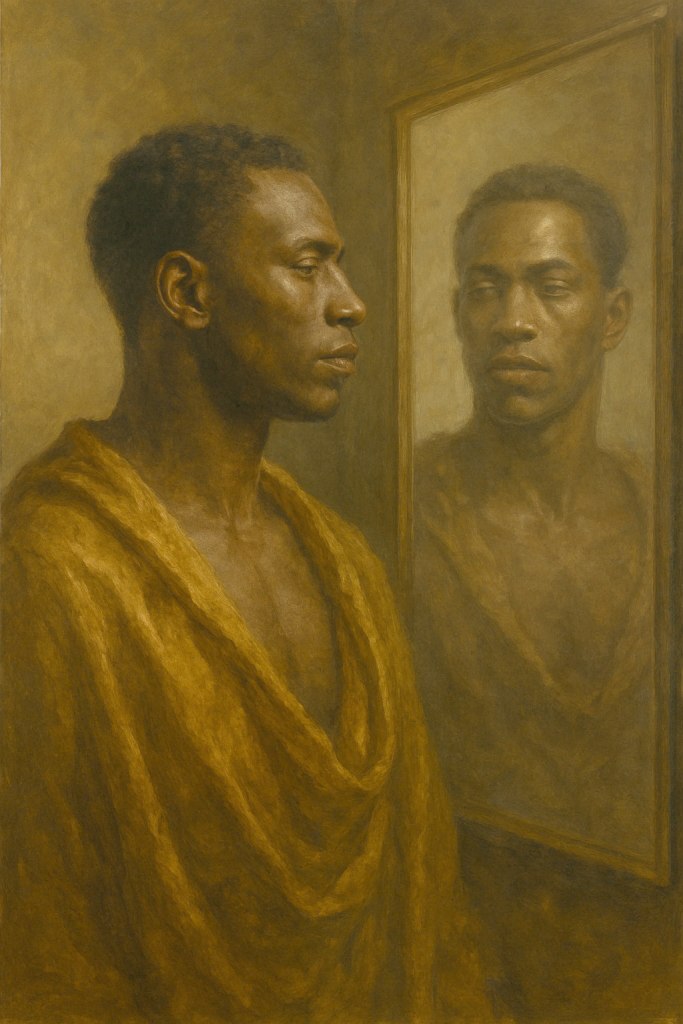
The Beauty of Strength: Black Masculinity in the Mirror of History.

The story of Black masculinity is one of both suffering and sublimity—of men whose beauty has been distorted by oppression yet refined by endurance. From the chains of slavery to the boardrooms of modern society, the image of the Black man has continually evolved, reflecting a history of resistance, resilience, and redemption. The beauty of his strength lies not in brute force but in the spiritual, intellectual, and emotional fortitude that has allowed him to survive centuries of dehumanization.

To understand Black masculinity, one must look into the mirror of history, where reflection becomes revelation. The first distortion appeared under colonialism, when European powers constructed false hierarchies of humanity. The Black man was cast as savage, incapable of reason or refinement, his physical strength seen as both his value and his curse (Fanon, 1952). Yet beneath these imposed identities existed a sacred masculinity shaped by ancient African civilizations—nations that valued wisdom, artistry, and spirituality as measures of true manhood.

In precolonial Africa, masculinity was integrative, not dominating. Kings, warriors, and priests carried the dual duty of protection and provision with humility before the divine. Empires like Mali and Kush celebrated male beauty as divine order, where strength was married to grace, and leadership to love. Such conceptions were violently disrupted by the slave trade, which turned the Black male body into an economic commodity rather than a sacred vessel (Gomez, 1998).

The transatlantic slave trade fractured identity and redefined manhood under bondage. The Black man’s physical strength was exploited for labor, while his emotional expression was suppressed to prevent rebellion. In these conditions, strength became survival. Yet even in the most brutal systems, enslaved men found ways to redefine masculinity—through song, brotherhood, and faith. Their resilience was a spiritual act of resistance, preserving fragments of humanity within an inhumane world (Franklin & Moss, 2000).

The Reconstruction era offered a fleeting glimpse of restored dignity. Freed Black men sought to build families, own land, and educate themselves, embodying the beauty of responsibility and renewal. But white supremacist backlash sought to reimpose dominance, inventing myths like the “Black brute” stereotype to criminalize strength and reassert racial hierarchy (Alexander, 2010). Even today, this narrative persists through media caricatures that equate Black masculinity with danger rather than discipline.

Yet throughout history, the Black man’s image has also been self-reclaimed. The Harlem Renaissance redefined masculine beauty through art, intellect, and poise. Figures like Langston Hughes, Duke Ellington, and Alain Locke offered new models of manhood that combined confidence with creativity. Their aesthetic grace challenged America’s obsession with fear-based masculinity, celebrating a balance of strength and sensitivity (Huggins, 2007).

The Civil Rights Movement further revealed the moral beauty of Black masculinity. Men like Martin Luther King Jr. and Malcolm X embodied courage rooted in conviction, using moral authority as a weapon stronger than any sword. Their leadership showed that real power flows not from domination but from disciplined love—a love that demands justice. Their public images, often demonized, actually reflected divine fortitude in human form.

In this mirror of history, one also sees the emotional cost of constant resilience. The Black man has often been denied the right to be vulnerable, to express pain without judgment. Society’s expectation of hypermasculinity has become both armor and prison. Yet, when he allows his authentic emotions to emerge, his humanity shines. This emotional transparency reclaims beauty from the battlefield of survival.

The modern Black man stands at a crossroads—torn between ancestral wisdom and contemporary pressure. While Western society continues to commodify and caricature his body, he is learning to define himself anew: as lover, father, thinker, and spiritual being. The rise of movements like “Black Men Heal” and “Brotherhood Circles” mark a cultural shift toward holistic manhood rooted in wellness and self-awareness (Akbar, 1996).

Physical beauty has always been central to the mythologizing of Black masculinity. From the statuesque athletes to the stoic revolutionaries, his physique evokes awe and envy. Yet, to reduce him to mere muscle is to miss the poetry in his posture—the story written in his skin. His form carries ancestral memory; his eyes hold a depth forged by generations of endurance. His beauty is not performance but persistence.

In the arts, new visual and literary movements seek to restore balance to the image of the Black man. Photographers like Gordon Parks and painters like Kehinde Wiley reimagine him with royal dignity—no longer subject but sovereign. These representations undo centuries of degradation and invite viewers to see what history tried to conceal: that the Black man is both warrior and work of art.

Spiritually, the Black man’s strength is mirrored in his faith journey. From the spirituals of the fields to the sermons of the pulpit, he has drawn divine power from affliction. His relationship with God has always been intimate, rooted in the belief that suffering births purpose. As scripture declares, “My strength is made perfect in weakness” (2 Corinthians 12:9, KJV). His beauty lies in this paradox—the capacity to endure without hardening his heart.

The legacy of fatherhood also reveals the beauty of strength. Despite systemic attempts to dismantle the Black family, many men have restored their lineage through love and guidance. Their nurturing presence redefines masculinity not as dominance but stewardship. To lead a household with patience and principle is one of the highest forms of strength.

The psychological struggle of the Black man cannot be separated from his social context. The trauma of racial profiling, economic exclusion, and intergenerational pain continues to shape self-image. Yet, healing begins when he sees himself not through the lens of oppression but reflection—when he recognizes his worth as created, not constructed. Therapy, faith, and community serve as mirrors that restore the vision blurred by history’s distortion.

Education and artistry have always been liberating forces for the Black man. The intellectual elegance of W. E. B. Du Bois, the musical mastery of Miles Davis, and the poetic boldness of Tupac Shakur represent beauty expressed through brilliance. Knowledge and creativity become new forms of strength—unseen but transformative.

Black masculinity today exists in many forms: the activist, the artist, the scholar, the father, the dreamer. Each expression expands the definition of beauty and strength. No longer confined to Eurocentric ideals or media stereotypes, these men reflect a truth as old as Africa itself—that strength is not oppression, but the ability to stand with grace under fire.

When the Black man looks in the mirror of history, he sees scars—but he also sees survival. He sees the reflection of kings, prophets, laborers, and poets. He sees divine design where others saw degradation. The mirror becomes a portal of remembrance, not regret.

The beauty of strength in Black masculinity, therefore, is both ancient and evolving. It is found in the quiet moments as much as in the heroic ones. It is not just a reflection of what was, but a prophecy of what will be: the restoration of dignity, the reconciliation of power and peace. In that reflection, the Black man finally beholds himself—not as the world has seen him, but as God has made him.


References (APA 7th Edition)

Akbar, N. (1996). Breaking the chains of psychological slavery. Mind Productions.
Alexander, M. (2010). The new Jim Crow: Mass incarceration in the age of colorblindness. The New Press.
Fanon, F. (1952). Black skin, white masks. Grove Press.
Franklin, J. H., & Moss, A. A. (2000). From slavery to freedom: A history of African Americans. McGraw-Hill.
Gomez, M. A. (1998). Exchanging our country marks: The transformation of African identities in the colonial and antebellum South. University of North Carolina Press.
Huggins, N. I. (2007). Harlem Renaissance. Oxford University Press.
The Holy Bible, King James Version. (1611/2017). King James Bible Online. https://www.kingjamesbibleonline.org/

Narcissism Series: Narcissistic Pseudo-Spirituality.

Photo by yugdas manandhar on Pexels.com

In an age where self-love, manifestation, and “energy alignment” dominate digital discourse, spirituality has increasingly become intertwined with narcissistic ideology. Narcissistic pseudo-spirituality refers to the performative and self-centered use of spiritual language and practices to elevate one’s ego rather than foster humility, compassion, or divine connection. The modern self-help movement, influenced by individualism and consumerism, often distorts sacred wisdom into tools for self-aggrandizement. This phenomenon reflects what psychologists term spiritual bypassing—using spirituality to avoid confronting one’s ego, wounds, or moral responsibility (Masters, 2010).

At its core, pseudo-spiritual narcissism masks itself as enlightenment. It cloaks self-worship in affirmations of “self-awareness” and “divine energy.” Rather than true humility before the Creator, it promotes the self as god-like—an ultimate authority of truth and morality. This distortion is not new; scriptural warnings against “false prophets” and “wolves in sheep’s clothing” (Matthew 7:15, KJV) reveal that even in ancient times, spiritual manipulation was a tool for self-exaltation. The contemporary expression of this deception has found a fertile home in social media, where attention functions as a modern currency of divinity.

Psychologically, narcissistic pseudo-spirituality fulfills the ego’s craving for validation under the guise of enlightenment. The narcissist’s grandiose self-concept seeks constant affirmation, and spirituality becomes another arena for self-display. Phrases like “I’m vibrating too high for you” or “You’re just not on my frequency” reveal how spiritual elitism replaces empathy and accountability with superiority. According to Campbell and Miller (2011), narcissistic individuals reinterpret interpersonal and moral experiences to maintain self-importance and avoid vulnerability. Spiritual language simply provides a convenient justification.

This phenomenon is particularly visible in influencer culture, where “gurus” market spiritual products, courses, or rituals as pathways to transcendence. Instead of emphasizing surrender or repentance, they promise success, beauty, and abundance. Thus, pseudo-spirituality commodifies transcendence into lifestyle aesthetics. As Fromm (1976) argued, modern capitalism transforms even spiritual pursuits into commodities to be consumed rather than internalized. The narcissist thrives in this context, where self-promotion masquerades as sacred wisdom.

In contrast, authentic spirituality centers on humility, service, and alignment with transcendent truth. The narcissistic counterfeit reverses this order—making the self the center of worship. The biblical model of humility, demonstrated by Christ washing the feet of His disciples (John 13:5, KJV), is antithetical to the performative spirituality that seeks followers, likes, or fame. The narcissistic spiritualist cannot grasp true surrender, for surrender implies the dissolution of the false self that narcissism depends upon.

Social media platforms like Instagram and TikTok have amplified the visibility of spiritual narcissism. Through polished aesthetics and poetic affirmations, influencers project an image of “divine perfection” that often belies inner emptiness. Lasch (1979) foresaw this cultural shift, describing the “culture of narcissism” as one in which individuals perform their identities for validation. In the digital temple of self-image, spirituality becomes another brand—curated, commodified, and devoid of accountability.

Spiritually, this pseudo-enlightenment represents a counterfeit awakening. It borrows sacred language—“light,” “vibration,” “manifestation,” “awakening”—but severs them from moral and divine context. The self becomes both priest and god. Such distortions align with ancient warnings: “professing themselves to be wise, they became fools” (Romans 1:22, KJV). The narcissist’s enlightenment is intellectual but not transformative; it lacks repentance and reverence.

Pseudo-spiritual narcissism also exploits vulnerability. Many seekers, disillusioned by organized religion, turn to spirituality for healing and identity. Narcissistic leaders prey on this hunger, offering emotional intimacy while subtly cultivating dependency. Studies on spiritual abuse reveal patterns of manipulation, gaslighting, and exploitation under the guise of divine authority (Ward, 2011). The narcissist thrives where boundaries blur between spiritual guidance and personal control.

At a societal level, this trend reflects the merging of secular individualism and spiritual relativism. Postmodern thought dismantled absolute truth, making every belief a matter of personal perspective. While this allows for diversity of thought, it also opens the door for narcissistic self-deification. When truth becomes subjective, the narcissist’s self-perception faces no challenge. As McAdams and Pals (2006) note, narcissists construct grand narratives to sustain coherence in their inflated identities. Spiritual language becomes one such narrative framework.

In gender dynamics, narcissistic pseudo-spirituality often manifests differently. Male spiritual narcissists may present as prophetic or visionary figures, commanding loyalty through charisma and authority. Female counterparts often embody the “divine feminine” archetype, using sensuality and self-worship to symbolize empowerment. While empowerment itself is not problematic, its distortion into self-idolatry echoes Isaiah’s lament: “For thou hast said in thine heart, I will ascend into heaven… I will be like the Most High” (Isaiah 14:13–14, KJV).

The emotional tone of pseudo-spiritual narcissism is often one of detachment masked as peace. It claims transcendence while avoiding emotional intimacy. True spiritual maturity, however, embraces both love and accountability. Narcissistic spirituality lacks empathy; it recycles spiritual jargon without genuine compassion. According to Pargament (1997), authentic spirituality promotes connection—to others, to the divine, and to moral purpose. Narcissism severs these connections, isolating the self in its own illusion of divinity.

There is also a racial and cultural dimension to consider. In Black and diasporic communities, where spirituality has long been tied to resistance and healing, pseudo-spiritual narcissism can distort ancestral practices into self-serving spectacle. The ancestral altar becomes a fashion accessory; traditional rituals are repackaged for clout. This commodification dilutes sacred heritage, replacing communal faith with performative identity. True spirituality in these contexts historically aimed toward liberation and collective empowerment, not self-promotion.

Biblically, narcissistic pseudo-spirituality is a form of idolatry—the worship of self as god. This mirrors the sin of Lucifer, who sought glory that belonged to the Creator alone. Paul’s warning to Timothy captures the essence of this age: “For men shall be lovers of their own selves… having a form of godliness, but denying the power thereof” (2 Timothy 3:2, 5, KJV). The form of godliness is maintained through language, crystals, and candles, yet the power of transformation—repentance, humility, obedience—is absent.

Psychologically, narcissistic pseudo-spirituality can lead to cognitive dissonance and spiritual burnout. Because the individual’s sense of enlightenment is externally validated, any criticism or doubt threatens their fragile identity. This leads to defensiveness, projection, or spiritual gaslighting (“you’re just not awakened enough to understand”). As Ellis (2020) observes, this cycle creates a feedback loop where narcissists reinterpret failure or conflict as proof of their higher consciousness.

Healing from this distortion requires confronting the ego’s shadow. Jung (1959) taught that individuation—the integration of the shadow self—is essential for authentic spiritual growth. The narcissist resists this process, as it demands vulnerability and humility. Only through confronting one’s flaws can the spirit evolve beyond illusion. The pseudo-spiritual narcissist, however, denies imperfection, mistaking image for essence.

True spirituality involves death of the ego—a concept echoed in multiple traditions. In Christianity, it is the call to “die daily” (1 Corinthians 15:31, KJV). In psychology, it is the transcendence of the false self. The narcissistic counterfeit, however, glorifies the ego while pretending to transcend it. This paradox creates an illusion of progress without transformation. Spiritual symbols become costumes, and enlightenment becomes performance.

In communities of faith, discernment is critical. Believers are urged to “test the spirits” (1 John 4:1, KJV), discerning authenticity from deception. Not all who speak of love, light, or awakening are aligned with truth. The mark of true spirituality is humility, service, and fruitfulness. As Christ taught, “Ye shall know them by their fruits” (Matthew 7:16, KJV). The fruits of narcissistic pseudo-spirituality are division, pride, and confusion.

Educators, counselors, and clergy must recognize this dynamic in spiritual communities and therapeutic spaces. Integrating psychology and theology allows for holistic discernment of authentic growth versus narcissistic inflation. Interventions must balance empathy with accountability, guiding individuals from illusion toward self-awareness and moral responsibility (Miller & Campbell, 2008).

Ultimately, the antidote to narcissistic pseudo-spirituality is surrender—an act the narcissistic self fears most. Surrender acknowledges that enlightenment does not originate from the self but from divine grace. The path of humility restores balance to the spirit, dismantling the illusion of self-deification. Only by emptying oneself of pride can true spiritual fullness emerge. As Christ declared, “He that humbleth himself shall be exalted” (Luke 14:11, KJV).

In the end, pseudo-spiritual narcissism reveals both the hunger and the distortion of the modern soul. It seeks transcendence but fears submission. The journey back to truth begins with the simple act of remembering that spirituality is not about becoming gods but becoming whole through God. The mirror of narcissism must shatter for the spirit to see clearly.


References

Campbell, W. K., & Miller, J. D. (2011). The handbook of narcissism and narcissistic personality disorder: Theoretical approaches, empirical findings, and treatments. Wiley.
Ellis, A. (2020). Ego and enlightenment: The paradox of spiritual narcissism. Journal of Transpersonal Psychology, 52(1), 45–59.
Fromm, E. (1976). To have or to be? Harper & Row.
Jung, C. G. (1959). Aion: Researches into the phenomenology of the self. Princeton University Press.
Lasch, C. (1979). The culture of narcissism: American life in an age of diminishing expectations. Norton.
Masters, R. A. (2010). Spiritual bypassing: When spirituality disconnects us from what really matters. North Atlantic Books.
McAdams, D. P., & Pals, J. L. (2006). A new Big Five: Fundamental principles for an integrative science of personality. American Psychologist, 61(3), 204–217.
Miller, J. D., & Campbell, W. K. (2008). Comparing clinical and social-personality conceptualizations of narcissism. Journal of Personality, 76(3), 449–476.
Pargament, K. I. (1997). The psychology of religion and coping: Theory, research, practice. Guilford Press.
Ward, T. (2011). The subtle power of spiritual abuse. Bethany House.

Are You an Empath? Understanding the Science, Psychology, and Spirituality of Empathy.

Photo by Ivan Samkov on Pexels.com

Empathy is a defining human capacity — the ability to feel, understand, and share the emotions of others. While compassion and kindness are universal virtues, some individuals are wired with an unusually heightened sensitivity to other people’s feelings. These individuals are commonly referred to as empaths. In psychology and neuroscience, empathy is not just a personality trait but also a complex interaction between emotional intelligence, brain function, and social learning. The concept of the “dark empath” and the personality profiles associated with empathy, grounding the discussion in science, psychology, and spirituality.

Defining Empathy
Empathy is classically defined as the ability to recognize, understand, and share the feelings of others (Decety & Cowell, 2014). In neuroscience, it is associated with activity in the anterior insula, anterior cingulate cortex, and mirror neuron system, which allows us to “mirror” others’ emotions as if they were our own. The Bible reflects this principle when it commands, “Rejoice with them that do rejoice, and weep with them that weep” (Romans 12:15, KJV). This ability to emotionally attune to others is foundational to compassion, healthy relationships, and moral behavior.

Signs of an Empath
An empath typically exhibits a range of signs: heightened emotional sensitivity, deep compassion, intuition about others’ feelings, and a tendency to absorb the emotional energy of a room. Empaths often feel overwhelmed in crowds, need time alone to recharge, and are drawn to helping professions. Psychology also notes that empaths may experience “emotional contagion” — the automatic sharing of emotions — more intensely than the average person.

Different Types of Empaths
Research and popular psychology identify several categories of empaths:

  • Emotional Empath – Feels others’ emotions deeply.
  • Physical Empath – Senses other people’s physical pain or discomfort.
  • Intuitive Empath – Has strong gut feelings or spiritual discernment about others.
  • Cognitive Empath – Understands others’ perspectives intellectually.
  • Animal Empath – Connects strongly with animals’ emotions and needs.
  • Plant/Nature Empath – Feels restored and connected to nature’s rhythms.
  • Dark Empath – Possesses high empathy but uses it manipulatively.

This classification demonstrates that empathy is not one-size-fits-all; it expresses itself differently depending on personality, environment, and moral orientation.

The Dark Empath and the Dark Triad
Psychologists have recently explored the concept of the “dark empath” — someone with high emotional intelligence who uses it for manipulation rather than compassion. This overlaps with the “Dark Triad” personality traits: narcissism, Machiavellianism, and psychopathy. A dark empath can exploit others’ vulnerabilities while appearing compassionate. This is why discernment is key — not all who appear empathetic have pure motives. Proverbs 26:23 warns, “Burning lips and a wicked heart are like a potsherd covered with silver dross.”

Empathy and Personality Types
Certain personality traits correlate with empathy. Individuals high in agreeableness (from the Big Five personality model) tend to have greater empathic concern. Highly sensitive persons (HSPs) also score higher on measures of emotional empathy. Conversely, those with antisocial traits show reduced empathic processing. Empaths may gravitate toward roles as counselors, mediators, or caregivers, embodying a nurturing and compassionate personality style.

Example of an Empathic Person
Mother Teresa is a well-known example of an empathic individual. She dedicated her life to caring for the poorest and most destitute, embodying compassion and sacrificial service. Her empathy was both emotional (sharing in the suffering of others) and active (motivating concrete acts of care). Neuroscientific studies suggest that acts of empathy release oxytocin, which reinforces feelings of connection and prosocial behavior.

Neuroscience of Empathy
Empathy is rooted in brain circuitry. Mirror neurons — first discovered in primates — allow humans to internally “simulate” the actions and feelings of others. Functional MRI studies show that empathic people display heightened activation in brain regions responsible for emotion regulation, perspective-taking, and compassion. This biological foundation highlights that empathy is both a learned and innate capacity, one that can be strengthened through mindfulness, prayer, and relational practice.

Psychological Benefits and Challenges
While empathy is essential for healthy relationships, it can also be burdensome. Empaths may suffer from compassion fatigue, emotional burnout, or difficulty distinguishing their own feelings from those of others. Boundaries are essential — even Jesus withdrew from the crowds to pray (Luke 5:16), modeling emotional rest and spiritual renewal. Learning to regulate empathy helps individuals avoid codependency and maintain mental health.

Spiritual Dimension of Empathy
Empathy reflects the heart of God, who is described as “touched with the feeling of our infirmities” (Hebrews 4:15). In the Christian life, empathy becomes a vehicle for Christlike love, encouraging believers to bear one another’s burdens (Galatians 6:2). Spiritually mature empathy moves beyond sentiment into action — advocating for justice, caring for the marginalized, and offering forgiveness. When guided by the Holy Spirit, empathy becomes not just emotional resonance but a force for kingdom transformation.


Conclusion
Empathy is a profound human capacity that integrates neuroscience, psychology, and spirituality. Whether expressed as emotional sensitivity, intuitive discernment, or compassionate action, empathy allows us to connect deeply with others. However, it must be balanced with wisdom, boundaries, and discernment to avoid manipulation or emotional exhaustion. The study of empaths — including the dark empath — reminds us that empathy is powerful, and like all power, it must be stewarded well.


References

  • Decety, J., & Cowell, J. M. (2014). The complex relation between morality and empathy. Trends in Cognitive Sciences, 18(7), 337–339.
  • Heym, N., Firth, J., Kibowski, F., Sumich, A., Egan, V., & Bowler, D. M. (2020). The dark empath: Characterising dark triad traits in empathy. Personality and Individual Differences, 167, 110261.
  • Neff, K. D. (2011). Self-Compassion: The Proven Power of Being Kind to Yourself. HarperCollins.
  • Siegel, D. J. (2010). Mindsight: The New Science of Personal Transformation. Bantam.
  • The Holy Bible, King James Version. (1769/2023). (Romans 12:15; Proverbs 26:23; Galatians 6:2; Hebrews 4:15; Luke 5:16).

The Golden Fleece and Its Connection to Black Skin.

Beneath the sun, our skin ignites,
A molten glow of ancient lights.
From river, sea, or morning ray,
The gold within cannot decay.


Photo by Gifty Dzenyo on Pexels.com

The Golden Fleece, in classical mythology, was a symbol of ultimate power, wealth, and divine favor. While often imagined as a literal object in Greek legend, symbolically, it represents the sacred, coveted essence of life and vitality. In Afrocentric interpretations, the Golden Fleece parallels the natural golden undertones of melanated skin, celebrating the richness, resilience, and uniqueness of Black bodies.

When a Black man or woman emerges from water, sunlight reveals a golden glow, a phenomenon that occurs across the spectrum of dark skin tones. This luminous effect reflects the melanin-rich composition of the skin, which absorbs and diffuses light in ways that give a subtle, warm radiance. The glow has been described as a visual testament to the divine and ancestral heritage carried in every melanated body.

Frances Cress Welsing, in her seminal work The Isis Papers, addresses the psychology of melanated skin, emphasizing how white-dominant societies have historically envied the physical, intellectual, and spiritual capacities associated with Blackness. She posits that melanin is not merely pigment but a symbol of power, and the natural golden glow of the skin is a manifestation of life-force and genetic vitality, evoking both admiration and subconscious fear in societies conditioned to reject Black excellence.

The Golden Fleece, then, becomes a metaphor for the sacred value inherent in Black skin—a treasure of beauty, resilience, and divine design. It is a reminder that melanated bodies are not only aesthetically radiant but spiritually significant, carrying a legacy that cannot be replicated or diminished.

Biblical References (KJV)

  • Exodus 3:21-22. King James Version.
  • Deuteronomy 28:12. King James Version.
  • Psalm 139:14. King James Version.

Secondary Sources

Welsing, F. C. (1991). The Isis Papers: The Keys to the Colors. Third World Press.

Fanon, F. (1967). Black Skin, White Masks. Grove Press.

Grier, W. H., & Cobbs, P. M. (1968). Black Rage. Basic Books.

Harris, S. (2015). The Psychological Effects of Racism on African Americans. American Psychological Association.

Choosing Self-Worth Over Societal Expectation.

Photo by AY photographer on Pexels.com

In a world that constantly tells people who they should be, what they should look like, and how they should live, the act of choosing self-worth over societal expectation becomes both radical and necessary. The struggle lies not only in resisting external pressures but also in dismantling the internalized voices that echo those expectations. Self-worth, unlike societal approval, is rooted in intrinsic value, dignity, and authenticity.

The Weight of Societal Expectation

Society often creates rigid templates for success, beauty, gender roles, and achievement. These standards are reinforced through media, institutions, and cultural narratives. For women and marginalized groups in particular, expectation can manifest as an invisible cage—dictating behavior, career paths, body image, and even spiritual identity. Such demands cultivate anxiety, imposter syndrome, and a constant pursuit of validation (Hewitt & Flett, 1991).

The Power of Self-Worth

By contrast, self-worth emerges from within. It is the recognition of inherent value independent of external measurement. The Bible reminds us, “Ye are of more value than many sparrows” (Matthew 10:31, KJV), emphasizing that worth is divinely ordained, not socially assigned. Psychology also affirms that when individuals ground their identity in self-acceptance, they develop resilience against rejection, criticism, and failure (Deci & Ryan, 2000).

The Conflict Between the Two

The tension between societal expectation and self-worth often leads to compromise. Many chase status symbols, titles, or appearances to fit cultural molds, even at the cost of their happiness. This is seen in the pressures of consumerism, perfectionism, and social comparison. Yet, true fulfillment comes when people break from this cycle and embrace authenticity. As bell hooks (2000) notes, self-love is an act of political resistance in a society that profits from insecurity.

Choosing Differently

Choosing self-worth requires courage. It means refusing to conform when conformity silences individuality. It involves setting boundaries, pursuing passions not prestige, and honoring mental and spiritual well-being over external validation. This choice is not selfish but liberating. In fact, it is through authentic self-love that individuals can contribute more meaningfully to their families, communities, and the world.

Conclusion

To choose self-worth over societal expectation is to reclaim power. It is to affirm that identity is not dictated by trends, systems, or stereotypes but by divine design and inner truth. As the psalmist declared, “I will praise thee; for I am fearfully and wonderfully made” (Psalm 139:14, KJV). In choosing self-worth, one chooses freedom, authenticity, and lasting peace—the kind of life that no societal mold can ever define.


References

  • Deci, E. L., & Ryan, R. M. (2000). Self-determination theory and the facilitation of intrinsic motivation, social development, and well-being. American Psychologist, 55(1), 68–78.
  • Hewitt, P. L., & Flett, G. L. (1991). Perfectionism in the self and social contexts: Conceptualization, assessment, and association with psychopathology. Journal of Personality and Social Psychology, 60(3), 456–470.
  • hooks, b. (2000). All about love: New visions. Harper Perennial.

Navigating Dating as a Dark-Skinned Woman.

Photo by Kindel Media on Pexels.com

Dating as a dark-skinned woman in contemporary society presents unique challenges shaped by historical, social, and psychological factors. Colorism, the preferential treatment of lighter-skinned individuals within the same racial group, continues to influence perceptions of attractiveness, desirability, and romantic opportunity. These dynamics impact the dating experiences of dark-skinned women, often requiring heightened resilience, self-awareness, and faith-based grounding.

Historically, colorism in the Black community originates from slavery and colonialism, where lighter-skinned individuals—often the children of white slave owners—received preferential treatment, education, and access to resources (Hunter, 2007). This social hierarchy extended into notions of beauty and desirability, privileging lighter skin and marginalizing darker complexions. As a result, dark-skinned women often face societal pressures that devalue their natural beauty and influence romantic opportunities.

In contemporary dating, media representations continue to reinforce colorist ideals. Dark-skinned women are frequently underrepresented in romantic lead roles and advertising campaigns, while lighter-skinned women are celebrated as the standard of beauty (Keith & Herring, 1991). This persistent disparity can influence male preferences in dating, where unconscious biases favor lighter skin. Dark-skinned women may experience fewer opportunities for romantic attention or may face fetishization, both of which can affect self-esteem and emotional well-being.

Psychologically, navigating dating as a dark-skinned woman requires developing strong self-worth and resilience. Exposure to rejection or societal bias can lead to internalized colorism, self-doubt, or feelings of invisibility (Bryant, 2013). Strategies to counteract these effects include affirming one’s value through personal reflection, cultivating supportive social networks, and prioritizing relationships that honor character and integrity over superficial attributes.

Social media and dating apps further complicate the experience, as algorithmic and societal biases often favor lighter-skinned individuals (Hunter, 2002). The curated nature of online profiles can exacerbate feelings of inadequacy or marginalization. Dark-skinned women may need to develop intentional strategies, such as limiting app usage, setting boundaries, and focusing on meaningful engagement rather than validation through likes or matches.

Faith and spirituality can serve as essential tools for navigating these challenges. The Bible emphasizes the intrinsic worth of all individuals regardless of outward appearance. “But the Lord said unto Samuel, Look not on his countenance, or on the height of his stature; because I have refused him: for the Lord seeth not as man seeth; for man looketh on the outward appearance, but the Lord looketh on the heart” (1 Samuel 16:7, KJV). Anchoring self-worth in spiritual identity can provide resilience against external biases in the dating world.

Understanding male psychology in dating contexts is also important. Studies suggest that men often internalize societal beauty standards, which may include colorist preferences (Monk, 2014). Awareness of these biases allows dark-skinned women to navigate relationships with clarity, identifying partners who appreciate them holistically and rejecting those influenced solely by superficial factors.

Practical strategies include cultivating personal confidence, developing a strong sense of identity, and maintaining standards aligned with one’s values. Emphasizing qualities such as faith, intelligence, kindness, and emotional stability over external validation creates a foundation for healthier, more fulfilling relationships. Engaging in communities and support networks that celebrate dark-skinned beauty also reinforces positive self-perception.

Dating Toolkit for Dark-Skinned Women: Confidence, Boundaries, and Faith

1. Ground Your Self-Worth in Faith

  • Remember that your value comes from God, not external validation.
  • “The Lord seeth not as man seeth; for man looketh on the outward appearance, but the Lord looketh on the heart” (1 Samuel 16:7, KJV).
  • Daily affirmations: “I am fearfully and wonderfully made” (Psalm 139:14).

2. Embrace Your Natural Beauty

  • Celebrate your skin tone, hair texture, and natural features.
  • Follow and engage with communities that uplift dark-skinned beauty (#MelaninMagic, #BlackGirlMagic).
  • Avoid comparing yourself to lighter-skinned beauty standards on social media.

3. Identify Red Flags Early

  • Superficial interest focused only on appearance or skin tone.
  • Disrespect for boundaries or emotional manipulation.
  • Rushing intimacy or inconsistent communication.

4. Prioritize Character Over Looks

  • Ask questions about values, faith, family, and life goals.
  • Observe actions, not just words or online charm.
  • Look for consistency and emotional intelligence.

5. Set Clear Boundaries

  • Decide what behavior is acceptable in both online and offline dating.
  • Limit time on dating apps to prevent emotional fatigue.
  • Protect personal information until trust is established.

6. Build Confidence and Emotional Resilience

  • Practice self-care: exercise, hobbies, and social connections.
  • Journal thoughts and feelings to process rejection or bias.
  • Celebrate small wins: meaningful conversations, setting boundaries, or staying authentic.

7. Be Mindful of Colorism

  • Recognize societal and internalized biases.
  • Avoid internalizing rejection as a reflection of your value.
  • Seek partners who celebrate your authentic self, not just skin tone.

8. Cultivate Support Networks

  • Surround yourself with family, friends, and mentors who affirm your worth.
  • Engage in communities that celebrate dark-skinned beauty and achievement.
  • Share experiences and advice with peers to strengthen resilience.

9. Maintain Perspective on Dating Apps

  • Use them as tools, not measures of self-worth.
  • Focus on meaningful connections rather than swiping endlessly for validation.
  • Take breaks when overwhelmed by online comparisons or rejection.

10. Pray and Seek Divine Guidance

  • Pray for discernment in evaluating potential partners.
  • Meditate on scriptures about love, patience, and wisdom before engaging in dating.
  • Trust that God will guide you to a partner who values your heart and character.

Mentorship and representation are critical. Seeing successful dark-skinned women in media, leadership, and professional spheres provides aspirational models and counters narratives of marginalization. Public figures such as Lupita Nyong’o, Viola Davis, and Janelle Monáe exemplify beauty, success, and authenticity, empowering dark-skinned women in their romantic and personal journeys.

In conclusion, dating as a dark-skinned woman requires navigating the compounded effects of colorism, media bias, and societal preferences. By cultivating resilience, affirming intrinsic worth, setting standards aligned with values, and grounding identity in faith, dark-skinned women can pursue meaningful romantic relationships while embracing their authentic selves. Understanding these dynamics empowers women to reject superficial judgments and prioritize partners who value character, faith, and integrity above all.


References

  • Bryant, C. (2013). The Impact of Colorism on African American Women’s Self-Perceptions. Journal of Black Studies, 44(7), 775–790.
  • Hunter, M. (2002). If you’re light you’re alright: Light skin color as social capital for women of color. Gender & Society, 16(2), 175–193.
  • Hunter, M. (2007). The persistent problem of colorism: Skin tone, status, and inequality. Sociology Compass, 1(1), 237–254.
  • Keith, V. M., & Herring, C. (1991). Skin tone and stratification in the Black community. American Journal of Sociology, 97(3), 760–778.
  • Monk, E. P. (2014). Skin tone stratification among Black Americans, 2001–2003. Social Forces, 92(4), 1313–1337.
  • The Holy Bible, King James Version.

🌱 How Not to Become Toxic: A Guide to Healthy Living and Relationships 🌱

Photo by Godisable Jacob on Pexels.com

🌱🌱🌱

Toxicity is not always intentional. Many people who exhibit toxic behaviors repeat patterns learned from pain, insecurity, or culture. The good news is that no one is doomed to stay toxic—healing, growth, and spiritual renewal are possible. Here are key steps to prevent yourself from becoming toxic in relationships and communities.


1. Develop Self-Awareness

Self-reflection is the first defense against toxicity. Journaling, prayer, or therapy helps you identify negative habits like blaming, criticizing, or manipulating. Psychology emphasizes “emotional intelligence” (Goleman, 1995), the ability to recognize and regulate your emotions while understanding how they affect others. The Bible encourages the same: “Examine yourselves, whether ye be in the faith” (2 Corinthians 13:5).


2. Heal from Past Trauma

Unresolved pain is one of the strongest roots of toxic behavior. Seek professional counseling, spiritual mentorship, or support groups to process grief, abuse, or rejection. Trauma unhealed will often resurface as anger, control, or envy. Psalm 147:3 reminds us: “He healeth the broken in heart, and bindeth up their wounds.”


3. Practice Accountability

Toxic people deflect blame, but growth comes when we admit faults. Surround yourself with honest friends, mentors, or faith leaders who will lovingly correct you. Accountability prevents pride from hardening into toxicity. Proverbs 27:6 says: “Faithful are the wounds of a friend; but the kisses of an enemy are deceitful.”


4. Cultivate Gratitude and Contentment

Envy and jealousy are at the heart of toxic behavior. Instead of comparing, focus on gratitude for your blessings. Gratitude rewires the brain for joy and reduces envy (Emmons & McCullough, 2003). Spiritually, Philippians 4:11 teaches contentment: “I have learned, in whatsoever state I am, therewith to be content.”


5. Strengthen Empathy

Empathy—the ability to feel and understand others’ experiences—counters selfishness and narcissism. Actively listen, validate others’ feelings, and celebrate their victories. Psychology calls this “prosocial behavior,” which fosters cooperation and trust (Batson, 2011). Romans 12:15 reinforces empathy: “Rejoice with them that do rejoice, and weep with them that weep.”


6. Set and Respect Boundaries

Healthy people understand that love is not control. Practice saying “no” respectfully and allow others to do the same. Boundaries prevent manipulation, resentment, and unhealthy dependency. Biblically, even Jesus set boundaries by retreating to pray alone (Mark 1:35), showing that separation can be holy and necessary.


7. Choose Growth Over Ego

Toxicity thrives on pride, stubbornness, and resistance to change. Instead, adopt a growth mindset—believing you can learn, improve, and be transformed. Carol Dweck’s research (2006) shows that people with growth mindsets build resilience and healthier relationships. Spiritually, James 4:10 instructs: “Humble yourselves in the sight of the Lord, and he shall lift you up.”


8. Seek Godly Transformation

Ultimately, breaking the cycle of toxicity requires more than psychology—it requires spiritual renewal. Through repentance, prayer, and the guidance of the Holy Spirit, toxic traits can be replaced with the fruit of the Spirit: “love, joy, peace, longsuffering, gentleness, goodness, faith, meekness, temperance” (Galatians 5:22–23).


Summary: To avoid becoming toxic, one must heal old wounds, embrace accountability, and cultivate gratitude, empathy, and humility. Toxicity is a choice—but so is transformation. By guarding your heart and seeking wisdom, you can become a source of life, not poison, in the lives of others.


📚 References (APA Style)

  • Batson, C. D. (2011). Altruism in humans. Oxford University Press.
  • Dweck, C. S. (2006). Mindset: The new psychology of success. Random House.
  • Emmons, R. A., & McCullough, M. E. (2003). Counting blessings versus burdens: Experimental studies of gratitude and subjective well-being. Journal of Personality and Social Psychology, 84(2), 377–389.
  • Goleman, D. (1995). Emotional intelligence. Bantam Books.