Tag Archives: Relationships

The Marriage Series: Endless Love

Endless love begins with God, for Scripture teaches that “God is love” (1 John 4:8, KJV). His love is not fleeting, shallow, or dependent on mood. It is eternal, steadfast, sacrificial, and unconditional. When we speak of “endless love” in marriage, dating, or courting, we are ultimately speaking of the divine example set by the Most High Himself. Human relationships can only reflect this kind of love when they are rooted in God’s nature rather than human emotion.

Love, according to Scripture, is not merely an emotion—it is a decision and a commitment. Feelings rise and fall, but love endures because it is anchored in choice. The Bible defines love in powerful terms: “Charity suffereth long, and is kind… seeketh not her own… beareth all things, believeth all things, hopeth all things, endureth all things” (1 Corinthians 13:4–7, KJV). This description emphasizes loving actions, not emotional highs. Real love chooses patience when irritation is easier, kindness when anger feels justified, and forgiveness when resentment feels deserved.

In dating, love begins with discernment—seeking a partner whose character, values, and spiritual life align with God’s will. Dating, when done properly, is not aimless entertainment; it is preparation for a covenant. A relationship must be grounded in spiritual compatibility, emotional maturity, and mutual respect. Godly dating involves intentional conversations about faith, purpose, family, and future. It avoids emotional entanglement without clarity and seeks purity in both behavior and thought.

Courting takes this intention deeper. Biblical courting focuses on purposeful relationship-building through prayer, wise counsel, and boundaries that protect the heart. Courting says, “I am exploring this relationship with marriage in mind.” It reflects Proverbs 4:23 (KJV): “Keep thy heart with all diligence; for out of it are the issues of life.” In courts, physical attraction is acknowledged but not idolized. True love is tested through communication, character, and consistency—not physical intimacy.

Marriage, however, is where endless love becomes a covenant. The Bible describes marriage as two becoming one flesh (Genesis 2:24, KJV). This unity is spiritual, emotional, and physical. Marriage is not simply a romantic partnership but a sacred assignment. Spouses are called to love one another with the same sacrificial commitment Christ shows His church (Ephesians 5:25, KJV). That means loving when tired, loving when hurt, loving when misunderstood, and loving when the feelings are not as strong as they used to be.

Because feelings change. This is one of the greatest truths about love that many overlook. Infatuation fades. Attraction fluctuates. Excitement rises and falls. But love, when anchored in God, remains stable. Feelings are like the wind—unpredictable and inconsistent. Love is like the foundation—unshakable, dependable, and enduring. In marriage, couples must decide repeatedly to choose each other, honor each other, forgive each other, and serve each other, even on days when emotions do not cooperate.

God’s love teaches us how to do this. His love is patient with our flaws, gentle with our weaknesses, and merciful with our failures. Marriage requires the same posture. Endless love means seeing your spouse’s humanity and choosing grace instead of criticism. It means remembering that your marriage is not just between two people but between three: husband, wife, and God. With God at the center, love becomes stronger than storms, conflicts, and trials.

Communication plays a vital role in endless love. Couples must speak truth in love (Ephesians 4:15, KJV), listening with humility and expressing feelings with kindness. Many marriages fail not because love disappears but because communication breaks down. Endless love requires transparency, vulnerability, and a willingness to resolve issues rather than avoid them.

Forgiveness is another essential part of enduring love. Scripture teaches, “Forbearing one another, and forgiving one another” (Colossians 3:13, KJV). In marriage, forgiveness is not optional; it is a necessity. People who live together, build together, and share life together will make mistakes. Endless love chooses peace over pride, unity over ego, and healing over punishment.

Intimacy—emotional, spiritual, and physical—also strengthens endless love. Couples must maintain connection through prayer, affection, shared goals, and time together. Intimacy is not merely physical; it is the weaving of two hearts through consistency, trust, and compassion. When spouses nurture intimacy, their love becomes resilient and deeply rooted.

Endless love also requires selflessness. In dating, courting, and marriage, selfishness destroys relationships. The Bible commands us to “look not every man on his own things, but every man also on the things of others” (Philippians 2:4, KJV). In marriage, this means considering your spouse’s needs, dreams, and emotional well-being. It means showing love through service, empathy, and generosity.

Spiritual unity is one of the strongest pillars of endless love. Couples who pray together stay connected through God’s strength. Prayer builds humility, breaks pride, and aligns hearts with divine purpose. When a man and woman seek God together, they find supernatural stability in their relationship. Love becomes fueled by the Holy Spirit rather than by human limitation.

Endless love is also protective. Love does not expose weaknesses, embarrass a partner, or diminish their worth. Instead, love covers, nurtures, and safeguards. “Above all things have fervent charity among yourselves: for charity shall cover the multitude of sins” (1 Peter 4:8, KJV). Protecting your spouse’s dignity is an act of godly love.

In dating and courting, protection means guarding purity. In marriage, protection means prioritizing fidelity, boundaries, and emotional loyalty. Endless love recognizes that the covenant must be guarded from external influences, temptations, and distractions. A marriage that is not protected is a marriage that becomes vulnerable.

Endless love also requires perseverance. Every marriage will face seasons of difficulty—financial hardships, health issues, loss, misunderstandings, or spiritual dryness. But love “endureth all things” (1 Corinthians 13:7, KJV). Perseverance is what transforms ordinary love into extraordinary love. It is the refusal to give up.

Lastly, endless love reflects God. When couples love each other with patience, sacrificial care, honesty, loyalty, and faithfulness, they mirror Christ’s heart to the world. Marriage becomes a ministry. Dating becomes preparation. Courting becomes intentional. Every stage reflects God’s divine purpose for relationships.

In the end, endless love is not a feeling—it is a decision. It is the daily choice to love as God loves: faithfully, sacrificially, and eternally.

References

American Psychological Association. (2019). The road to commitment: Psychological foundations of long-term relationships. APA Publishing.

Benson, H. (2017). Marriage in the light of Scripture: A Christian guide to love and covenant. Crossway.

Bowlby, J. (1988). A secure base: Parent-child attachment and healthy human development. Basic Books.

Chapman, G. (2015). The five love languages: The secret to love that lasts. Northfield Publishing.

Cohen, O. (2020). Emotional regulation in marriage: Understanding the role of feelings in long-term commitment. Journal of Family Psychology, 34(2), 210–223.

Evans, T. (2014). Kingdom marriage: Connecting God’s purpose with your pleasure. Focus on the Family Publishing.

Fletcher, G. J. O., & Kerr, P. S. G. (2010). Through a glass darkly: Understanding commitment and sacrifice in romantic relationships. Journal of Social and Personal Relationships, 27(5), 623–638.

Gottman, J., & Silver, N. (2015). The seven principles for making marriage work. Harmony Books.

Hazan, C., & Shaver, P. (1987). Romantic love conceptualized as an attachment process. Journal of Personality and Social Psychology, 52(3), 511–524.

Johnson, S. (2019). Created for connection: The “hold me tight” guide for Christian couples. Little, Brown & Company.

Keller, T., & Keller, K. (2011). The meaning of marriage: Facing the complexities of commitment with the wisdom of God. Penguin Random House.

Lambert, N. M., & Dollahite, D. C. (2010). The role of prayer in strengthening relationships. Review of Religious Research, 52(2), 201–219.

Markman, H. J., Stanley, S., & Blumberg, S. (2010). Fighting for your marriage: A positive plan for preventing and surviving marital conflict. Jossey-Bass.

Murray, S. L., & Holmes, J. G. (2000). The commitment accelerator: How trust and sacrifice shape long-term relationships. Journal of Personality and Social Psychology, 78(4), 557–573.

Roberts, R. C. (2007). Spiritual emotions: Reflections on Christian affection. Eerdmans Publishing.

Rosenberg, E. L. (2020). Regulation of love: The difference between feelings and loving actions. Emotion Review, 12(2), 124–134.

Schnarch, D. (2011). Passionate marriage: Keeping love and intimacy alive. W. W. Norton & Company.

Stanley, S. M. (2005). The power of commitment: A guide to active, lifelong love. Jossey-Bass.

Thomas, G. (2015). Sacred marriage: What if God designed marriage to make us holy more than to make us happy? Zondervan.

Worthington, E. L. (2005). Hope-focused marriage counseling: A guide to brief therapy. InterVarsity Press.

Biblical References (KJV)
Holy Bible, King James Version. (2017). Thomas Nelson Publishing. (Original work published 1611)


The Phenomenon of Blackness

Blackness is not merely a skin color; it is a lived experience, a cultural identity, a historical journey, and a spiritual inheritance. It carries the weight of ancestry, the rhythm of heritage, and the resilience of a people who have endured centuries of oppression and still flourish.

The phenomenon of Blackness is both visible and invisible. It is seen in skin, hair, and features, but its essence is found in culture, knowledge, spirituality, and shared memory. Blackness embodies history and identity simultaneously.

Historically, Blackness has been racialized and criminalized, shaped by the transatlantic slave trade, colonialism, and systemic oppression. Yet, despite these forces, Black people have maintained a sense of collective self and cultural continuity.

Blackness is an expression of resistance. From revolts on slave ships to the civil rights movement, it has embodied the refusal to be erased. Its power lies in the persistent assertion of dignity, intellect, and humanity in the face of dehumanization.

Spiritually, Blackness has been a vehicle of survival. Enslaved Africans and their descendants transformed suffering into faith. Spirituals, hymns, and religious gatherings sustained the soul, creating a framework of hope that transcended the physical hardships of bondage.

The phenomenon of Blackness is artistic. Music, dance, literature, and visual arts have always been vessels for expression, protest, and storytelling. Jazz, blues, hip-hop, and African diasporic art forms are not merely entertainment—they are cultural testimony.

Blackness also carries a linguistic richness. From African languages adapted in the diaspora to African American Vernacular English, speech has been a tool of identity, solidarity, and resistance. Language preserves memory, encodes history, and signals belonging.

Culturally, Blackness fosters community. Families, neighborhoods, and churches have historically been sanctuaries of support and education. The collective ethos emphasizes survival, teaching, mentorship, and protection, which has enabled Black communities to flourish despite systemic obstacles.

Blackness intersects with science and genetics. Studies of Y-DNA haplogroups, such as E1B1A, trace the lineage and migrations of African peoples, revealing resilience in continuity and adaptation across continents and centuries. Biological identity reinforces cultural and historical identity.

The phenomenon of Blackness is political. Black communities have historically mobilized to secure rights, challenge oppression, and redefine narratives. Leaders like Marcus Garvey, Malcolm X, and Fannie Lou Hamer exemplify the political consciousness inherent in Black identity.

Blackness is also intellectual. Black scholars, scientists, and thinkers have made profound contributions to global knowledge. Despite educational barriers, Black intellectualism has persisted, forming a continuous legacy of inquiry, creativity, and excellence.

Colorism, within and outside of the Black community, has complicated the perception of Blackness. Shades of skin carry social meanings shaped by colonial hierarchies, but true Black identity transcends pigment, existing as an internalized consciousness of heritage and self-worth.

Blackness manifests in spirituality beyond organized religion. African spiritual traditions, rituals, and cosmologies survived the Middle Passage and influenced diasporic religious practices. These systems provided moral, ethical, and cosmological frameworks that sustained communities.

Blackness is global. From the Americas to Europe, the Caribbean, and Africa, the Black experience is interconnected. The diaspora carries shared histories of struggle, resistance, and triumph that transcend national borders.

The phenomenon of Blackness is generational. Ancestral memory, oral traditions, and historical knowledge link generations. African Americans and Africans alike draw strength from the wisdom and resilience of forebears, creating a bridge between past and future.

Blackness is also aesthetic. Beauty standards, fashion, hairstyles, and adornment reflect cultural pride and identity. These expressions communicate dignity, creativity, and self-affirmation, challenging Eurocentric ideals.

Economically, Blackness has navigated systemic barriers to achieve entrepreneurship, wealth creation, and innovation. From Black Wall Street to contemporary Black-owned businesses, economic resilience is central to the ongoing expression of Black identity.

Blackness is emotional and psychological. The legacy of trauma intersects with pride, hope, and joy. This duality—pain tempered by celebration—reflects a complex consciousness that is both historical and present, personal and collective.

The phenomenon of Blackness continues to evolve. Migration, globalization, and digital media have expanded the expression of culture, creating new avenues for cultural exchange, identity formation, and social influence. Blackness remains dynamic, resilient, and adaptive.

Ultimately, Blackness is a testament to endurance, creativity, and divine purpose. It embodies a spiritual, cultural, and historical continuum that cannot be erased. To study Blackness is to witness resilience, intelligence, artistry, and faith manifested over centuries.


References

Diop, C. A. (1989). The African origin of civilization: Myth or reality. Lawrence Hill Books.

Gates, H. L. (2011). In search of our roots: How 19 extraordinary African Americans reclaimed their past. Crown.

Graves, J. L. (2017). The emperor’s new clothes: Biological theories of race at the millennium. Rutgers University Press.

Hine, D. C., McCluskey, A. T., & McDaniel, A. (2012). The African American odyssey. Pearson.

Woodson, C. G. (2021). The mis-education of the Negro. Dover.

West, C. (2017). Race matters. Beacon Press.

When the Black Sista Speaks, Nations Listen. 

When the Black sista speaks, she carries the weight of generations in her breath. Her voice is not merely sound—it is testimony, memory, rhythm, and revelation. She speaks from the depths of survival, the heights of spiritual knowing, and the center of a divine identity shaped by struggle and brilliance. Her voice is a vessel of truth in a world that often attempts to silence, distort, or overlook her presence. Yet still she speaks, and when she does, nations shift.

Her voice is rooted in the ancestral echo of women who endured storms that would have destroyed others. When she speaks, she carries the prayers of foremothers who sang in fields, whispered in basements, and taught their daughters to keep their heads high no matter the weight of the world. She speaks with the strength of Harriet, the dignity of Rosa, the elegance of Maya, and the fire of Assata. She speaks with wisdom earned through resilience and a love for her people that can’t be manufactured.

The Black sista speaks with authority because she has lived through experiences that demanded endurance. Her voice is shaped by overcoming—overcoming stereotypes, microaggressions, broken systems, and unspoken expectations placed on her shoulders. She has learned to navigate spaces that were never built for her, and yet she thrives anyway. Her ability to rise again and again gives her speech credibility and power.

When she speaks, she speaks not only for herself but for sisters who cannot yet articulate their pain, joy, or potential. She stands in the gap for the muted, the misrepresented, and the misunderstood. She speaks for her daughters, for her community, and for the world that has benefited from her labor but often denies her recognition. Her voice becomes a bridge between silence and liberation.

The world listens—sometimes reluctantly—because the Black sista speaks truth that cannot be ignored. Her words expose injustice, illuminate beauty, and challenge systems designed to remain unchallenged. She disrupts the lies that society has taught about womanhood, intelligence, and worth. She unmasks false narratives and replaces them with stories rooted in authenticity and dignity.

Her voice also heals. With every word of affirmation, encouragement, and wisdom, she restores what the world has tried to break. She counsels younger sisters, uplifts her brothers, and comforts wounded hearts. Her speech is seasoned with faith, compassion, and discernment. She knows how to speak life where there has been death and hope where there has been doubt.

The Black sista speaks with spiritual depth. Her voice is shaped by scripture, testimony, prayer, and a relationship with God that sustains her in quiet and loud battles. She understands that her voice is not her own—it is an instrument in God’s hands. When she speaks, she speaks with the authority of a woman who knows she is chosen, covered, and called.

She also speaks beauty into existence. In a world that constantly redefines beauty standards, the Black sista reclaims her glory. Her voice affirms natural hair, melanin, curves, intellect, and identity. She speaks against colorism, sexism, and racism, reminding the world that her presence is not accidental—it is intentional, divine, and necessary.

When the Black sista speaks, she shapes culture. She influences music, fashion, politics, art, language, and spirituality. From boardrooms to classrooms, from pulpits to stages, her voice sets trends and shifts paradigms. She carries innovation in her mind and brilliance in her tongue. Nations listen because they know that her insight has power.

And above all, when the Black sista speaks, she alters the atmosphere. Her voice calls forth justice, dignity, sisterhood, and transformation. She speaks because she must. She speaks because she is anointed to. She speaks because her silence would be too expensive for the world to afford. And as long as she speaks—unapologetically and undeniably—nations will continue to listen.

http://www.thebrowngirldilemma.com

💛When a Woman Loves a Man 💛

When a woman loves a man 💛, her affection becomes a sanctuary—soft enough to comfort yet strong enough to sustain. This love is not casual or fleeting; it is intentional, wholehearted, and deeply rooted in care.

A woman’s love carries depth. She does not merely admire; she invests emotionally, spiritually, and mentally. Her presence evolves into both a haven and a guiding force for the man she cherishes.

When a woman loves a man 💛, she sees beyond flaws. She recognizes his humanity and still believes in his potential. Her love encourages him to grow while assuring him that he is enough.

This love is protective—not possessive, but nurturing. She guards his heart, his dreams, and his peace with quiet diligence, praying for his strength and covering him with loyalty.

A woman in love listens deeply. She pays attention not just to words but to silence, body language, and emotions unspoken. Her intuition becomes a compass, guiding her understanding of his inner world.

Her love is encouragement. She affirms his identity and celebrates his achievements. Even when he doubts himself, she holds space for his greatness until he can see it too.

When she loves a man 💛, she honors him publicly and privately. Respect becomes one of her primary love languages, and she expresses it through tone, actions, and the way she speaks of him to others.

Her love cultivates emotional safety. The man who receives her devotion finds a place where he can be vulnerable without fear of judgment or dismissal.

A woman’s love is patient. She does not rush his process of healing or growth. Instead, she stands beside him with grace, trusting that time and intention will yield transformation.

Spiritually, her love can be intercessory. She prays for him, over him, and with him, believing that divine alignment strengthens the bond they share.

When a woman loves a man 💛, she builds with him. She envisions a future where their partnership thrives, and she contributes to that vision with her effort, wisdom, and presence.

Her love is expressed through sacrifice—small and large. She gives freely, whether in time, energy, or compassion, because her heart is anchored in commitment.

This love softens her, but it also strengthens her. Loving deeply challenges her to mature emotionally and spiritually, shaping her into a more grounded and giving version of herself.

A woman’s love brings stability. Her consistency becomes a pillar, offering the man reassurance that he is not walking through life alone.

When she loves a man 💛, she embraces his flaws without enabling harmful patterns. Her love holds him accountable because she desires his wholeness, not just his affection.

Her presence becomes healing. She brings calm to his storms, clarity to his confusion, and joy to his long days. Her love has the power to renew him.

This love is reciprocal at its healthiest. She blossoms most beautifully when her love is honored, cherished, and protected by the man who receives it.

A woman’s love is expressive—through words, touch, service, or devotion. Her heart communicates in ways that go beyond language, reflecting sincerity and depth.

When a woman loves a man 💛, she becomes a partner, a confidante, and a friend. Her loyalty anchors their relationship, fostering unity that endures challenges and celebrates triumphs.

Ultimately, a woman’s love is a gift—rare, powerful, and transformative. When nurtured, it elevates both the woman and the man, creating a bond built on trust, honor, and sacred connection. 💛


References

  • Bell, H. (2012). The nature of romantic attachment in adult relationships. Journal of Social Psychology, 148(3), 325–340.
  • hooks, bell. (2000). All about love: New visions. William Morrow.
  • Johnson, S. (2008). Hold me tight: Seven conversations for a lifetime of love. Little, Brown Spark.
  • Markman, H., Stanley, S., & Blumberg, S. (2010). Fighting for your marriage. Jossey-Bass.
  • Myers, D. (2014). Psychology of love and emotional intimacy. Oxford University Press.
  • Wilkinson, R. (2019). Emotional trust and partnership development. Journal of Marriage & Family Studies, 52(4), 412–429.

Sugar Daddies & Sugar Babies

In contemporary society, the phenomenon of sugar daddies and sugar babies has become increasingly visible. A “sugar daddy” is typically an older man who provides financial support, gifts, or a lavish lifestyle to a younger woman, referred to as a “sugar baby,” in exchange for companionship, intimacy, or attention. At first glance, the arrangement can appear mutually beneficial: financial support for the young woman and company, admiration, or influence for the man. Scripture encourages wise stewardship and provision: “But if any provide not for his own, and specially for those of his own house, he hath denied the faith” (1 Timothy 5:8, KJV). In theory, this dynamic reflects a biblical principle—men providing for women—but it often departs from God’s design in practice.

One of the positive aspects is that sugar daddies can serve as providers, teaching younger women financial discipline and giving them resources to pursue education, business opportunities, or stability. When structured responsibly, some young women gain mentorship, career advice, and financial literacy. In a controlled context, this dynamic could be seen as an extension of biblical provision and mentorship principles, where older, experienced men assist younger women in establishing security. “The prudent see danger and take refuge, but the simple keep going and pay the penalty” (Proverbs 22:3, KJV).

However, the dangers far outweigh the potential benefits in most cases. Sugar arrangements often blur boundaries between genuine companionship and transactional relationships. A transactional approach can cultivate emotional dependency, skewed expectations, or exposure to abuse. Because the foundation is financial, many arrangements attract men with selfish motives, seeking control or indulgence rather than mutual respect and love.

Sugar babies must also consider personal safety. Numerous reports have documented abuse, assault, and even murder in these relationships. One notable case is that of a young woman who tragically lost her life due to a sugar daddy’s violent intentions—a stark reminder that appearances can be deceiving. While the media often romanticizes these arrangements, Scripture warns, “The prudent man foreseeth the evil, and hideth himself” (Proverbs 27:12, KJV). Discernment and caution are essential.

Another danger is emotional compromise. Sugar babies may become attached to men who do not have their spiritual or long-term interests at heart. Emotional entanglement can lead to heartbreak, manipulation, or spiritual disconnection. Women must weigh whether the relationship draws them closer to God or further into dependency. “For what shall it profit a man, if he shall gain the whole world, and lose his own soul?” (Mark 8:36, KJV).

Financial dependence can also limit personal growth. Some young women may postpone education, career goals, or independence because of reliance on a sugar daddy. While financial support is beneficial, long-term independence ensures safety, autonomy, and a God-honoring lifestyle. “Go to the ant, thou sluggard; consider her ways, and be wise” (Proverbs 6:6, KJV).

In some cases, sugar arrangements have led to love, respect, or marriage. A few couples have transitioned from financial mentorship into genuine, God-centered relationships. These instances are exceptions, often requiring spiritual alignment, mutual respect, and transparency. True love develops where God’s principles govern interactions, not where money dominates. “And above all these things put on charity, which is the bond of perfectness” (Colossians 3:14, KJV).

Setting clear boundaries is essential for sugar babies. They should establish non-negotiable standards around intimacy, time, and finances. Transparency with trusted mentors or family members provides oversight and guidance. Involving a community of accountability reduces the risk of abuse or isolation. “Where no counsel is, the people fall: but in the multitude of counsellors there is safety” (Proverbs 11:14, KJV).

Digital communication introduces additional risks. Sharing personal information, locations, or financial details with sugar daddies online can lead to stalking, blackmail, or exploitation. Modern wisdom encourages caution in online interactions. “Be ye wise as serpents, and harmless as doves” (Matthew 10:16, KJV).

Emotional detachment and discernment are crucial. Sugar babies must ask themselves whether their attachment is rooted in genuine respect or the illusion of security. A transactional relationship can feed insecurity rather than build character. Spiritual maturity helps identify whether a connection aligns with God’s purpose.

It is also important for sugar daddies to examine motives. Are they providing guidance and support out of genuine care, or merely seeking selfish gain? True provision reflects biblical principles—sacrificial, ethical, and God-centered. “Husbands, love your wives, even as Christ also loved the church” (Ephesians 5:25, KJV).

Mentorship within financial support should emphasize empowerment. The goal is to equip sugar babies to thrive independently, not create dependence. Financial guidance, educational support, and emotional mentorship transform the dynamic into something resembling godly provision rather than indulgence or exploitation.

Spiritual alignment is non-negotiable. Relationships that pull women away from the Most High or compromise their holiness are spiritually dangerous. A sugar daddy who pressures for sinful behavior is a hazard, not a mentor. “Flee also youthful lusts: but follow righteousness, faith, charity, peace, with them that call on the Lord out of a pure heart” (2 Timothy 2:22, KJV).

Regular prayer and discernment help clarify intentions. Before engaging in such arrangements, women should seek God’s guidance and confirm His will. Spiritual confirmation acts as a shield against deception and harm. “If any of you lack wisdom, let him ask of God, that giveth to all men liberally” (James 1:5, KJV).

Emotional resilience must be cultivated. Sugar babies should maintain personal goals, hobbies, friendships, and independence to prevent over-reliance on one person. Healthy boundaries preserve dignity, safety, and identity. “A wise woman buildeth her house: but the foolish plucketh it down with her hands” (Proverbs 14:1, KJV).

Physical safety is paramount. Meeting in public spaces, sharing plans with trusted friends, and maintaining privacy of personal assets reduces vulnerability. Abusive patterns often escalate when isolation occurs. “The prudent seeth the evil, and hideth himself” (Proverbs 27:12, KJV).

Transparency about expectations is critical. Sugar babies must define the nature of the relationship, limits of intimacy, and financial terms. Misunderstandings can lead to manipulation or danger. A well-defined arrangement reduces emotional and physical risk.

Spiritual accountability is also necessary. Confiding in mature mentors or spiritual leaders ensures the relationship does not compromise faith or values. God’s perspective serves as a moral compass and protective shield.

Lastly, recognizing when to exit is vital. If the relationship becomes unsafe, exploitative, or spiritually harmful, ending it is not failure—it is survival. Scripture encourages discernment: “Withdraw thy foot from thy neighbor’s house; lest he be weary of thee, and so hate thee” (Proverbs 25:17, KJV). Safety, peace, and God’s favor must never be compromised.

In conclusion, sugar arrangements can provide temporary financial support or mentorship, but they carry substantial risk. Love and godliness cannot be bought. Spiritual discernment, prayer, boundaries, and accountability protect the young women navigating these relationships. The Most High calls His daughters to relationships rooted in covenant, righteousness, and divine purpose—not in transactions or convenience. True provision aligns with God’s will, safeguards the heart, and builds a legacy that money alone cannot purchase.


References (KJV):
1 Timothy 5:8; Proverbs 22:3; Proverbs 27:12; Mark 8:36; Colossians 3:14; Proverbs 11:14; Matthew 10:16; Ephesians 5:25; 2 Timothy 2:22; James 1:5; Proverbs 14:1; Proverbs 25:17.

Chosen Royalty: Marriage for the Sons and Daughters of Zion (The Marriage Series)

Marriage, in the eyes of the Most High, is not merely a social custom or cultural expectation. It is a divine covenant, a sacred union designed to reflect His glory, His order, and His love. For the sons and daughters of Zion, marriage carries an even deeper significance: it is a representation of covenant identity, spiritual inheritance, and kingdom legacy. You are not ordinary people. You are chosen vessels, called to manifest God’s intention for love, leadership, unity, and righteousness on the earth.

A royal marriage begins with knowing who you are. Before a man becomes a husband and before a woman becomes a wife, both must know their identity as God’s elect. Scripture declares, “Ye are a chosen generation, a royal priesthood, an holy nation, a peculiar people” (1 Peter 2:9, KJV). When you understand that you come from royalty, you will not settle for broken love, counterfeit partnerships, or relationships that compromise your calling. Royalty requires discernment.

For the daughters of Zion, preparing for marriage does not begin with finding a man but with finding purpose. A queen develops inward beauty—wisdom, modesty, strength, and virtue—long before she wears a crown. Like the Proverbs 31 woman, she is clothed with strength and honor, and she opens her mouth with wisdom (Proverbs 31:25–26). She knows that her value is spiritual before it is physical. Her worth is not in curves, complexion, or outward adornment, but in her God-given identity.

For the sons of Zion, preparing for marriage begins with learning to lead under God’s authority. A king cannot love his queen properly until he learns to submit to the King of Kings. Scripture instructs husbands to love their wives “even as Christ also loved the church, and gave himself for it” (Ephesians 5:25, KJV). This is sacrificial love—protective, patient, righteous, and accountable. A royal husband is not a tyrant; he is a shepherd, a covering, and a pillar.

When both king and queen understand God’s order, marriage becomes a partnership of purpose. The Most High never intended for men and women to compete with one another. Instead, He designed them to complement each other—both bearing divine strength, both walking in unity. “Two are better than one; because they have a good reward for their labour” (Ecclesiastes 4:9, KJV). Royal marriages are not accidental; they are intentional.

Communication is one of the foundations of a royal covenant. The tongue can build or destroy a household. Scripture teaches, “A soft answer turneth away wrath: but grievous words stir up anger” (Proverbs 15:1, KJV). Kings and queens must learn the discipline of loving speech—words that heal, uplift, and guide. A royal home is governed by peace, not chaos.

Purity is another pillar. In a world saturated with lust, temptation, and impulsive desires, the Most High calls His people to holiness. “For this is the will of God, even your sanctification, that ye should abstain from fornication” (1 Thessalonians 4:3, KJV). Purity protects the mind. Purity guards the heart. Purity prepares the soul to love without bondage or brokenness.

Forgiveness is the oil that keeps the royal covenant from growing brittle. No marriage is perfect. No partner is flawless. Yet the Most High commands us to forgive one another, even as He forgave us (Colossians 3:13). A king forgives. A queen forgives. They choose restoration over resentment, healing over distance, unity over pride.

A royal marriage also requires spiritual warfare. The enemy hates godly unions because they produce righteous generations. Therefore, couples must pray together, read scripture together, and stand in agreement. “When the enemy shall come in like a flood, the Spirit of the LORD shall lift up a standard against him” (Isaiah 59:19, KJV). A praying marriage is a powerful marriage.

Accountability is the shield of royalty. Wise couples surround themselves with elders, mentors, or spiritual leadership who can correct and counsel them. “Where no counsel is, the people fall” (Proverbs 11:14, KJV). A royal house is not built alone—it is built within a community of righteousness.

Financial stewardship is also part of royal order. Money is one of the top causes of marital conflict, but God’s wisdom provides clarity. “Be thou diligent to know the state of thy flocks” (Proverbs 27:23, KJV). Kings and queens budget together, plan together, save together, and build generational wealth—not just for themselves but for their children.

Speaking of children, they are the arrows of the kingdom. “Lo, children are an heritage of the LORD” (Psalm 127:3, KJV). A royal marriage understands that parenting is part of the covenant. The spiritual, emotional, and educational well-being of the next generation is a divine responsibility. Sons must be trained as kings. Daughters must be nurtured as queens.

Love in a royal marriage must be active, not passive. It is patient, kind, stable, and enduring (1 Corinthians 13:4–7). It is not dependent on feelings alone but on commitment and covenant. Real love works. Real love forgives. Real love stays.

Humility is the crown jewel of a godly union. Pride destroys, but humility restores. Scripture says, “With the lowly is wisdom” (Proverbs 11:2, KJV). Kings lead with humility. Queens carry themselves with grace. Humility keeps the marriage teachable and flexible.

Submission—often misunderstood—is a two-way principle rooted in respect and order. Wives are called to submit to their husbands as unto the Lord (Ephesians 5:22), and husbands are commanded to love sacrificially. Submission is not domination; it is alignment with God’s structure for protection and harmony.

A royal marriage also requires emotional maturity. You cannot bring unresolved wounds into a covenant and expect peace. Healing—inner, spiritual, and emotional—is essential. “He healeth the broken in heart” (Psalm 147:3, KJV). The Most High restores what trauma has stolen.

Celebration is another key practice. Kings and queens honor each other. They affirm each other. They celebrate each other’s achievements, strengths, and growth. Royal marriages thrive in an atmosphere of appreciation.

Service is the heart of Christ-like love. Yeshua taught that the greatest among us is the servant (Matthew 23:11). In a royal marriage, each partner serves the other—not out of obligation but out of devotion.

Finally, the covenant stands unshaken. A royal marriage is not built on convenience but on divine purpose. It is a representation of God’s eternal love for His people—a love that endures, protects, and restores. For the sons and daughters of Zion, marriage is more than companionship. It is a kingdom assignment.

Chosen Royalty means you marry with vision. You love with intention. You build with faith. You walk as living examples of God’s order and righteousness. Your union becomes a testimony, a legacy, and a royal lineage that reflects the glory of the Most High.


References (KJV):
1 Peter 2:9; Proverbs 31:25–26; Ephesians 5:25; Ecclesiastes 4:9; Proverbs 15:1; 1 Thessalonians 4:3; Colossians 3:13; Isaiah 59:19; Proverbs 11:14; Proverbs 27:23; Psalm 127:3; 1 Corinthians 13:4–7; Proverbs 11:2; Ephesians 5:22; Psalm 147:3; Matthew 23:11.

How to Know if He is the One?

Every woman of God desires clarity when it comes to choosing a husband. The Most High did not design you to stumble blindly into love, confusion, or emotional chaos. He calls you to walk in wisdom, discernment, and spiritual maturity as you prepare for covenant. Recognizing “the one” is not about butterflies, chemistry, or excitement alone—it is about alignment with God’s will. “In all thy ways acknowledge Him, and He shall direct thy paths” (Proverbs 3:6, KJV). When Yah is involved, the relationship carries peace, purpose, and divine confirmation.

First, he must genuinely love God. Not with words, but with lifestyle. A man who fears the Most High will honor you because he honors God. A man who prays, seeks righteousness, and submits to divine authority is far more trustworthy than a man guided by emotions or ego. Scripture states, “Ye shall know them by their fruits” (Matthew 7:16, KJV). His spiritual fruit will reveal his true character.

Second, he should not be a distraction, but a divine push. The right man will not pull you away from your prayer life, your calling, or your spiritual growth. He will encourage you to know God more deeply. A man who disrupts your peace, weakens your discipline, or pulls you into sin is not sent by the Most High. The right man sharpens you. “Iron sharpeneth iron” (Proverbs 27:17, KJV).

Third, he must demonstrate consistent godliness. This includes integrity, accountability, good stewardship, humility, and respect. A godly man lives by biblical principles, not worldly trends. He honors his family, controls his emotions, and treats others with kindness. “He that walketh uprightly walketh surely” (Proverbs 10:9, KJV). His walk should match his words.

Fourth, he brings you closer to the Most High, not further away. When he speaks, you feel encouraged. When he prays, you feel covered. When he leads, you feel alignment with God’s purpose. The right man produces spiritual fruit in your life—greater peace, stronger faith, deeper commitment to holiness. “Two are better than one” (Ecclesiastes 4:9, KJV) when God is at the center.

Fifth, discernment is essential. The Holy Spirit will warn you about counterfeits. Sometimes the voice of God is a gentle nudge, a lack of peace, or a red flag that won’t go away. “Beloved, believe not every spirit, but try the spirits whether they are of God” (1 John 4:1, KJV). Discernment protects you from heartbreak and deception.

Sixth, he must be a man of prayer. Not a man who prays occasionally, but one who understands that prayer is his lifeline. A praying man carries strength, wisdom, and divine insight. When a man seeks God first, his decisions, leadership, and love will flow from a righteous foundation. “Pray without ceasing” (1 Thessalonians 5:17, KJV) applies to him too.

Seventh, he will show signs of being a provider, even during the dating phase. A godly man does not wait until marriage to demonstrate responsibility. He shows early patterns of provision, planning, and protection. This does not mean riches—it means consistency. “But if any provide not for his own… he hath denied the faith” (1 Timothy 5:8, KJV). Provision is part of his calling.

Eighth, he demonstrates emotional maturity. He resolves conflict peacefully, listens attentively, and communicates respectfully. A man who is easily angered, unstable, or manipulative is not prepared for covenant. “He that is slow to anger is better than the mighty” (Proverbs 16:32, KJV). Maturity is a sign of spiritual growth.

Ninth, he shows intentionality. The one sent by God pursues you with clarity, not confusion. He does not play games, entertain multiple women, or keep you guessing. He makes his intentions known. God is not the author of confusion (1 Corinthians 14:33, KJV), and neither is a godly man.

Tenth, he honors your boundaries. A man who respects your desire for purity, prayer, and emotional protection is a man who values you. If he pressures you into sin, he is not from God. A righteous man supports holiness in the relationship.

Eleventh, he values godly counsel. If he rejects advice, refuses accountability, or isolates you from others, he is operating in pride. A man with a humble, teachable spirit is more likely to lead a home in righteousness. “In the multitude of counsellors there is safety” (Proverbs 11:14, KJV).

Twelfth, he has vision. A husband must know where he is going spiritually, financially, and relationally. A man with no direction will lead you into stagnation. Vision is part of divine order. “Where there is no vision, the people perish” (Proverbs 29:18, KJV).

Thirteenth, he honors his family. How a man treats his mother, children, father, and siblings reveals how he will eventually treat you. If he is disrespectful, irresponsible, or unaccountable at home, marriage will not change that.

Fourteenth, he displays self-control. A man ruled by anger, lust, jealousy, or addiction is not prepared for covenant. Self-control is a fruit of the Spirit (Galatians 5:22–23). It is a requirement, not a suggestion.

Fifteenth, he brings peace, not chaos. You should feel safe, grounded, and emotionally stable in his presence. Confusion, tension, fear, and unease are not from God. “The fruit of righteousness shall be peace” (Isaiah 32:17, KJV).

Sixteenth, he practices generosity. A godly man gives his time, attention, compassion, and resources. Generosity reveals a man’s heart.

Seventeenth, he is consistent, not seasonal. The wrong man shows effort only when convenient. The right man is steady, dependable, and intentional in every season. Consistency is evidence of character.

Eighteenth, he can handle correction. When he is wrong, he repents. When he hurts you, he apologizes. Pride destroys relationships, but humility strengthens them.

Nineteenth, he pushes you toward purpose. The one sent by God will encourage your calling, gifts, and destiny. He does not silence your voice—he celebrates it.

Twentieth, he aligns with God’s timing, not impatience or pressure. The right man seeks God, honors the process, and builds the relationship slowly and righteously. When God wrote the love story, the signs will be clear, the peace will be present, and the covenant will be confirmed by Scripture, prayer, and discernment.

When he is “the one,” everything aligns—your spirit is at peace, your purpose expands, and your walk with the Most High grows stronger. Love becomes less about emotion and more about divine assignment.


References (KJV):
Proverbs 3:6; Matthew 7:16; Proverbs 27:17; Proverbs 10:9; Ecclesiastes 4:9; 1 John 4:1; 1 Thessalonians 5:17; 1 Timothy 5:8; Proverbs 16:32; 1 Corinthians 14:33; Proverbs 11:14; Proverbs 29:18; Galatians 5:22–23; Isaiah 32:17.

Superficial Love vs. True Love: Understanding the Difference

Love is one of the most celebrated yet misunderstood aspects of human experience. From movies to music, society often glorifies romance without emphasizing its depth or permanence. Many people fall into the trap of superficial love, mistaking fleeting attraction or convenience for genuine connection. Understanding what true love is—and what it is not—is essential for cultivating meaningful relationships.

Superficial love is often characterized by an excessive focus on appearances or external factors. Physical beauty, material possessions, or social status can become the primary reasons someone feels “in love.” While attraction is natural and important, it is not sufficient to sustain a lasting relationship. Love rooted solely in what is visible tends to fade when circumstances change.

Another hallmark of superficial love is its conditional nature. People may express affection only when their partner meets certain expectations or provides specific benefits. When these conditions are not met, the affection often disappears. This kind of love is transactional rather than sacrificial, prioritizing self-interest over the well-being of the other person.

Emotions in superficial love are typically shallow and fleeting. Infatuation may feel intense, but it rarely deepens into commitment. This is why relationships based on superficial love often experience frequent misunderstandings, breakups, and disappointment. The emotional bond lacks resilience against the inevitable challenges of life.

In contrast, true love is deep, enduring, and unconditional. It is grounded in character, integrity, and a genuine desire for the good of the other person. True love does not vanish when circumstances change; it grows stronger through trials and adversity. It is patient, kind, and willing to sacrifice for the well-being of the loved one.

Biblically, love is described as more than mere feelings. In 1 Corinthians 13:4–7 (KJV), it is written: “Charity suffereth long, and is kind; charity envieth not; charity vaunteth not itself, is not puffed up…beareth all things, believeth all things, hopeth all things, endureth all things.” True love reflects this standard—it is selfless, enduring, and rooted in moral and spiritual values.

Superficial love often fails because it ignores the inner dimensions of a person. Personality, values, faith, and emotional maturity are essential components of lasting connection. Ignoring these qualities in favor of surface-level traits creates relationships that are fragile and ultimately unfulfilling.

Many people confuse infatuation with love. Infatuation is intense attraction or excitement that often feels irresistible but is temporary. Superficial love frequently begins this way, relying on physical chemistry or novelty. True love, however, develops over time, requiring understanding, patience, and consistent care.

Communication is another key difference. In superficial love, conversations may focus on trivial matters or admiration of external qualities. In true love, communication is intentional, honest, and empathetic. Partners actively listen, seek to understand, and work together to resolve conflicts rather than avoid them.

Trust and loyalty are often weak or absent in superficial love. Because the attachment is conditional, partners may feel insecure or hesitant to fully commit. In contrast, true love fosters trust, openness, and the confidence that each partner is committed to the other, even when life becomes challenging.

Superficial love also tends to prioritize instant gratification. The focus is on what feels good in the moment rather than what builds long-term stability and mutual growth. True love, by contrast, is patient and willing to invest in the relationship over years, understanding that enduring love requires effort and discipline.

Sacrifice is rarely present in superficial love. Love that is conditional or self-centered will avoid inconvenience or discomfort. True love, however, embraces sacrifice. It is willing to prioritize the needs of the partner, sometimes putting their well-being above personal convenience or comfort.

Forgiveness is another critical differentiator. In superficial love, mistakes or misunderstandings often lead to resentment, withdrawal, or breakups. True love embodies the biblical principle of forgiveness, recognizing that human imperfection is inevitable and grace is essential for sustaining long-term connection.

Emotional intimacy is shallow in superficial love. Without genuine vulnerability, partners cannot truly understand or support one another. True love encourages openness, sharing fears, dreams, and struggles, and creating a safe environment where both individuals feel valued and seen.

Faith often plays a central role in true love. Couples who center their relationship around shared spiritual principles develop a bond that transcends physical attraction. Superficial love lacks this spiritual dimension and is therefore more vulnerable to decay over time.

Superficial love can be alluring because it provides excitement and instant validation. Society frequently glamorizes it through media portrayals of romance, making it tempting to mistake passion for enduring commitment. Awareness and discernment are necessary to recognize the difference.

Investing in true love requires patience, self-reflection, and intentional effort. Couples must learn to prioritize emotional connection, character development, and spiritual alignment over fleeting desires. This investment is what builds a marriage or partnership that can withstand life’s trials.

True love also celebrates and uplifts the other person. It rejoices in their successes, supports them in failure, and encourages growth. Superficial love, focused on self-interest or appearance, often resents change or growth that does not directly benefit the observer.

Ultimately, the difference between superficial love and true love is one of depth, resilience, and purpose. Superficial love is temporary and conditional, while true love is enduring, sacrificial, and rooted in the desire for mutual flourishing. Recognizing this distinction is crucial for anyone seeking a meaningful and lasting relationship.

In conclusion, love is more than a fleeting emotion or physical attraction. True love, as modeled in Scripture, calls for patience, kindness, forgiveness, and enduring commitment. By understanding the contrast between superficial love and true love, individuals can pursue relationships that are not only fulfilling but also aligned with divine principles, resulting in bonds that truly last.

References

  1. Holy Bible, King James Version. (1611). Thomas Nelson.
    (Reference for 1 Corinthians 13:4–7 and general biblical principles of love.)
  2. Chapman, G. (2015). The 5 love languages: The secret to love that lasts. Northfield Publishing.
    (Discusses ways to understand and express love beyond superficial attraction.)
  3. Lewis, C. S. (1960). The four loves. Harcourt, Brace & World.
    (Explores different types of love, including affection, friendship, and romantic love, highlighting superficial vs. true love.)
  4. Carson, D. A., & Beale, G. K. (2007). Commentary on the New Testament use of the Old Testament. Baker Academic.
    (Biblical context for understanding love and relational principles.)
  5. White, J. D. (2019). Love and relationships: A biblical perspective on enduring partnerships. Christian Focus Publications.
    (Focus on how biblical principles guide healthy, lasting relationships.)
  6. Myers, D. G. (2020). Social psychology (14th ed.). McGraw-Hill Education.
    (Provides psychological perspective on attraction, infatuation, and relationship dynamics.)
  7. Wright, N. T. (2010). After you believe: Why Christian character matters. HarperOne.
    (Insight into spiritual maturity and sacrificial love in relationships.)

Soulmates

A soulmate is one of the most romanticized ideas in modern conversations about love. Many describe a soulmate as the one person perfectly designed to complete them, understand them, and share a deep emotional, spiritual, and relational bond unlike any other. The concept sounds beautiful, yet the question remains: is this idea truly biblical, or is it more cultural than scriptural?

In Scripture, the word soulmate never appears. The Bible does not speak of a single predestined human who completes another, but it does speak about the joining of two lives under God’s divine guidance. While the modern word “soulmate” may not exist in the biblical text, the spiritual reality of God-ordained connection does appear throughout the narrative of human relationships.

One of the clearest biblical foundations surrounding relationships and connection is found in Genesis. When God created Eve for Adam, the Scripture says she was “a help meet for him” (Genesis 2:18, KJV). This phrase describes someone corresponding to him, someone who complements him, someone suitable and compatible. This is deeper than physical attraction; it is spiritual alignment and purpose.

When Adam saw Eve, he recognized something divine, something destined. He declared, “This is now bone of my bones, and flesh of my flesh” (Genesis 2:23, KJV). Adam did not call Eve his soulmate, but he acknowledged a God-made union—a sacred connection created by the Father Himself. This sets a precedent: God creates relationships that carry divine purpose.

Some people believe a soulmate is someone who understands their soul so deeply that the bond feels supernatural. In Scripture, the closest example to this type of connection is the bond between David and Jonathan. The Bible says, “the soul of Jonathan was knit with the soul of David” (1 Samuel 18:1, KJV). Though this relationship was friendship, not marriage, it shows that God can knit souls together with loyalty, unity, and spiritual strength.

When talking about marriage, the Bible frames it as a covenant, not merely a connection of souls. Marriage is spiritual, emotional, physical, and purposeful. Scripture tells us, “Therefore shall a man leave his father and his mother, and shall cleave unto his wife: and they shall be one flesh” (Genesis 2:24, KJV). Becoming one flesh is more than romance—it is oneness in purpose, unity, and destiny.

The idea of a soulmate can sometimes be misleading because it implies a person cannot be whole without another human being. Scripture teaches the opposite. The Bible emphasizes that wholeness comes from God, not from a partner. We are made complete in Christ, not in another person. Yet God often brings someone who aligns with one’s purpose and spiritual walk.

Do soulmates truly exist? If by “soulmate” we mean someone God ordains for your life, someone whose spirit aligns with yours, someone who strengthens your walk with Him—then yes, God does orchestrate divine connections. But if by “soulmate” we mean a perfect person who never conflicts with us or disappoints us, that is not biblical. Marriage requires work, forgiveness, humility, and grace.

Marriage in the Bible is a covenant designed to reflect God’s relationship with His people. Husbands are instructed to love their wives “even as Christ also loved the church” (Ephesians 5:25, KJV). Wives are instructed to honor and support their husbands. Marriage is divine teamwork, where both partners strive to glorify God through unity.

Many people seek a soulmate for emotional fulfillment. Yet Scripture teaches that marriage is more than emotional satisfaction. It is a sacred assignment. A husband and wife together build a family, carry a generational legacy, and model the love of Christ. Marriage is a ministry, not just a romance.

Relationships become strongest when both partners are connected to God first. A so-called “soulmate” relationship is really one where both individuals seek God and allow Him to lead the partnership. When God is at the center, the union becomes spiritually aligned and deeply rooted.

Marriage reflects the mystery of Christ and the church, showing that love is not just passion but sacrifice. A soulmate, in the biblical sense, is someone who walks with you into your divine calling, helps you grow in holiness, and stands with you in covenant.

A soulmate is not fate; it is divine alignment. It is not magical; it is spiritual. It is not about completion; it is about companionship under God’s direction. The Bible teaches that “two are better than one” (Ecclesiastes 4:9, KJV), because together they can fulfill what one cannot accomplish alone.

What does the Bible say about finding such a partner? Scripture tells believers not to be “unequally yoked” (2 Corinthians 6:14, KJV). A true soulmate-like connection is one where both partners share spiritual values and walk the same path of righteousness. Alignment matters.

Marriage is therefore less about finding a soulmate and more about becoming the right partner—holy, loving, and mature in Christ. God brings two prepared hearts together, forming a union that honors Him.

Ultimately, the meaning of marriage is covenant. It is loyalty, sacrifice, unity, and a lifelong commitment. Marriage mirrors God’s faithfulness, and when two people honor God together, their bond can feel as deep and profound as what many call “soulmates.”

A soulmate might be better described as a God-ordained partner—one who complements your purpose, strengthens your faith, and loves you through the lens of Scripture. This type of relationship exists not because the universe aligned something, but because God authored it.

At its core, biblical love is not about finding the perfect soul to match yours. It is about two imperfect souls surrendering to a perfect God, allowing Him to shape their hearts, guide their union, and reveal His glory through their covenant.

References (KJV)
Genesis 2:18
Genesis 2:23
Genesis 2:24
1 Samuel 18:1
Ecclesiastes 4:9–12
2 Corinthians 6:14
Ephesians 5:25

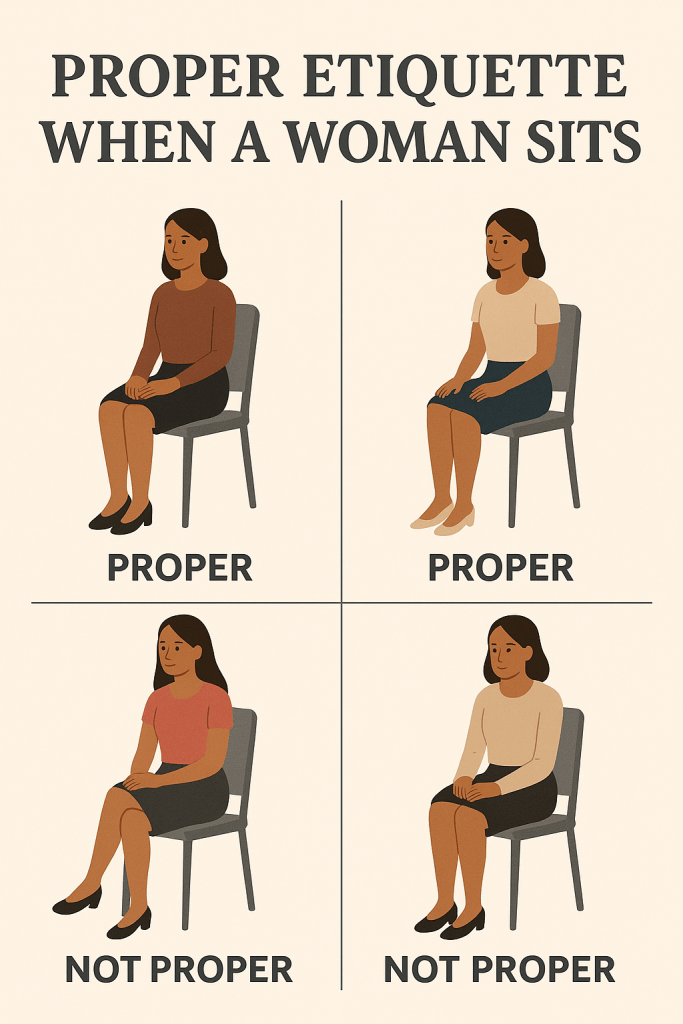
The Proper Etiquette Series: How to Sit Properly?

Sitting properly is one of the most foundational elements of etiquette, communicating poise, confidence, and self-respect without a single word spoken. Whether in professional, social, or formal settings, the way a woman sits creates an immediate impression. Proper posture reflects inner discipline, elegance, and an understanding of decorum—qualities that never go out of style.

A proper seated posture begins with how one approaches the chair. Instead of collapsing into the seat or sitting hastily, a woman should move with intention and grace. She steps toward the chair, turns slightly, and lowers herself gently with control, keeping her back straight as she sits. This simple act sets the tone for polished behavior.

Once seated, posture becomes key. The back should remain straight with the shoulders relaxed, avoiding both stiffness and slouching. Good posture not only looks refined but also conveys attentiveness and dignity. It supports healthy breathing and reduces strain on the spine, merging etiquette with physical wellness.

Leg placement is one of the most important elements of proper sitting etiquette. There are two traditionally accepted positions: the “duchess slant” and the “ankle cross.” In the duchess slant, the knees are kept together while the legs are angled slightly to one side—soft, feminine, and modest. In the ankle cross, the knees remain together while the ankles are crossed discreetly. Both positions maintain modesty and balance.

What should be avoided are positions that convey carelessness or lack of awareness. This includes sitting with knees apart, legs wide, or slouching deeply into the seat. While modern culture sometimes normalizes casual posture, traditional etiquette emphasizes composure, especially in settings requiring professionalism or formality. How one sits reflects how one values the environment and the company present.

Hand placement also contributes to overall poise. Hands should rest lightly on the lap—never fidgeting, tapping, or gripping the seat. Gentle stillness communicates confidence and calm. Avoiding restless movements prevents unnecessary distractions and keeps the posture looking serene and controlled.

In skirt or dress attire, proper sitting technique becomes even more essential. A woman should subtly smooth her clothing beneath her as she sits to avoid wrinkling and to maintain coverage. Crossing the legs at the knee is traditionally discouraged for formal settings because it may appear overly casual or create wardrobe challenges, whereas the duchess slant remains universally polished.

Awareness of one’s environment is also part of correct etiquette. Whether at dinner, in a meeting, or at a ceremony, a woman should sit in a way that does not intrude upon the space of others. Leaning excessively, swinging legs, or resting arms over chair backs can appear disrespectful. Elegance remains controlled, balanced, and contained.

Body language completes the picture. A proper seated posture includes calm facial expression, gentle eye engagement, and a composed presence. Sitting correctly enhances communication by allowing others to see the individual as attentive, confident, and respectful. Etiquette is as much about what one conveys silently as what one speaks aloud.

Ultimately, sitting properly is an art that merges modesty, poise, and mindfulness. It elevates everyday behavior into purposeful elegance. When a woman understands how to sit with grace, she communicates not only refinement but also self-dignity—two traits that remain timeless across cultures and eras. Proper etiquette is not about restriction; it is about presenting oneself with honor and intentionality.


References

Bixler, S. (2018). The etiquette edge: Modern manners for business success. HarperCollins.

Forni, P. M. (2002). Choosing civility: The twenty-five rules of considerate conduct. St. Martin’s Press.

Hixson, K. (2016). The art of poise: Graceful living in a modern world. Etiquette Press.

Post, P. (2021). Emily Post’s etiquette (19th ed.). HarperCollins.

Udall, A. (2015). The essentials of modern etiquette: Social graces for contemporary women. Silver Leaf Press.