Tag Archives: race

Intersectionality: Race, Gender, and Identity.

Photo by Polina Tankilevitch on Pexels.com

Intersectionality is a framework for understanding how multiple aspects of identity—such as race, gender, class, and sexuality—intersect to create unique experiences of privilege and oppression. Coined by legal scholar Kimberlé Crenshaw in 1989, intersectionality highlights how social systems and power structures do not affect everyone equally but instead produce layered, complex forms of discrimination, particularly for Black women and other marginalized populations.

Race and gender are two central axes in intersectional analysis. Black women, for example, experience discrimination that is not merely additive (race + gender) but intertwined, producing distinctive challenges that cannot be fully understood by examining either race or gender alone (Crenshaw, 1989). This approach allows for a more nuanced understanding of social inequality, as it acknowledges that identities are interconnected and context-specific.

Identity formation is profoundly shaped by these intersecting factors. A Black woman’s self-perception is influenced by societal messages regarding both race and gender, as well as by cultural heritage, family, and community. These overlapping identities can result in heightened awareness of societal biases, but they also provide resilience, cultural pride, and a multifaceted sense of self (Collins, 2000).

Intersectionality: Understanding Overlapping Identities

Core Concept

  • Intersectionality: How multiple social identities (race, gender, class, sexuality) intersect to create unique experiences of privilege and oppression (Crenshaw, 1989).

Visual Layout

Central Circle: Individual Identity
Surrounding Overlapping Circles:

  1. Race
  2. Gender
  3. Class
  4. Sexuality
  5. Religion/Culture

Overlapping Areas: Show how combinations produce distinct experiences.

  • Race + Gender: Unique discrimination experienced by women of color (“double jeopardy”).
  • Race + Class: Economic disparities and systemic barriers.
  • Gender + Sexuality: Gendered expectations compounded by sexual orientation.
  • All Intersecting: Complex lived realities shaped by multiple layers of identity.

Key Examples

  • Black Women in the Workplace: Face both gendered and racial bias, requiring intersectional policies.
  • Media Representation: Stereotypes often ignore overlapping identities; intersectional visibility fosters empowerment.
  • Health Outcomes: Intersectional stress contributes to mental health disparities.

Strategies for Applying Intersectionality

  • Policy design that considers multiple identity factors.
  • Awareness of biases in personal and professional contexts.
  • Representation and inclusion in media, education, and leadership.
  • Spiritual grounding: “Ye are all one in Christ Jesus” (Galatians 3:28, KJV).

Visual Design Notes

  • Colors: Different shades for each circle to show overlaps.
  • Icons: Workplace, media, health, education symbols around outer circles.
  • Text Highlights: Key phrases like “Privilege,” “Oppression,” “Unique Experiences,” “Empowerment.”

In practical terms, intersectionality reveals why certain policies or social interventions may fail. For instance, workplace diversity initiatives that focus solely on gender may not address the unique challenges faced by women of color, while race-focused programs may overlook gendered experiences. Intersectional analysis thus informs more equitable solutions and highlights the necessity of inclusive policymaking.

Psychologically, intersectionality affects mental health and well-being. Black women often experience compounded stress from navigating both racial and gendered expectations, a phenomenon sometimes referred to as “double jeopardy” (Beal, 1970). Recognizing and addressing these intersecting pressures is critical for developing coping strategies, resilience, and community support systems.

Culturally, intersectionality informs representation in media and public life. Black women are frequently underrepresented or stereotyped, reflecting biases that marginalize their complex identities. Accurate and multidimensional representation fosters empowerment and challenges societal norms, enabling individuals to see themselves as whole and valued.

The Bible provides spiritual guidance relevant to understanding identity and intersectional challenges. “There is neither Jew nor Greek, there is neither bond nor free, there is neither male nor female: for ye are all one in Christ Jesus” (Galatians 3:28, KJV). This verse underscores the inherent worth of individuals beyond social hierarchies and biases, reminding believers that identity in God transcends societal discrimination.

Intersectionality also has implications for activism and social justice. Movements such as Black Lives Matter incorporate intersectional frameworks to address not only race but also gender, sexuality, and class, emphasizing the need for solutions that acknowledge the complexity of lived experiences. Recognizing the interconnectedness of oppressions allows advocates to craft more comprehensive and effective strategies.

Education plays a critical role in applying intersectionality. Scholars, educators, and students must be equipped to recognize overlapping systems of privilege and oppression. Curricula that integrate intersectional perspectives foster critical thinking, empathy, and awareness of social inequities, preparing individuals to navigate diverse social contexts responsibly.

In conclusion, intersectionality provides a vital lens for understanding the complex ways race, gender, and identity intersect to shape experiences of privilege and oppression. By acknowledging the interconnectedness of social categories, individuals, policymakers, and communities can develop more nuanced, equitable approaches to social justice, representation, and personal empowerment. For Black women and other marginalized groups, intersectional awareness fosters resilience, cultural pride, and advocacy for systemic change.


References

  • Beal, F. M. (1970). Double jeopardy: To be Black and female. Meridians, 1(2), 1–10.
  • Collins, P. H. (2000). Black Feminist Thought: Knowledge, Consciousness, and the Politics of Empowerment. Routledge.
  • Crenshaw, K. (1989). Demarginalizing the intersection of race and sex: A Black feminist critique of antidiscrimination doctrine, feminist theory and antiracist politics. University of Chicago Legal Forum, 1989(1), 139–167.
  • The Holy Bible, King James Version.

Racial Caste Systems: The Architecture of Hierarchy and Human Division.

Throughout history, societies have constructed hierarchies that determine human worth, access, and opportunity. A racial caste system is one of the most enduring forms of social stratification—an arrangement where race determines an individual’s status, mobility, and humanity within a society. Rooted in power, these systems are not merely social constructs but political technologies designed to preserve dominance and justify inequality (Feagin, 2013).

In the United States, the racial caste system originated with the transatlantic slave trade. Africans were systematically dehumanized, defined legally as property, and positioned at the bottom of the social order. This structure created a rigid racial hierarchy that survived emancipation and evolved through segregation, mass incarceration, and economic disparity (Alexander, 2010).

The American racial caste system was not accidental but deliberate. It was engineered through laws such as the Virginia Slave Codes of 1705 and later solidified through Jim Crow legislation. These legal instruments established whiteness as a form of property and superiority, ensuring that freedom and rights were racially distributed (Harris, 1993).

Caste systems rely on ideology to sustain themselves. In America, white supremacy functioned as the central narrative that rationalized subjugation. Pseudoscientific racism, biblical distortions, and economic exploitation merged to construct a worldview that depicted Africans and their descendants as inferior, thus justifying their oppression (Fields & Fields, 2012).

Globally, racial caste systems have appeared in various forms. The Indian caste system, though based on purity and birth rather than race, parallels the racial hierarchy of the West in its systemic exclusion of the Dalits (“untouchables”). Similarly, the apartheid regime in South Africa created a codified racial order that privileged whites and oppressed Africans through political and economic control (Fredrickson, 1981).

In Latin America, colonial powers instituted the casta system, which ranked individuals by racial mixture—from pure-blooded Spaniards at the top to Indigenous and African peoples at the bottom. This system demonstrates how racial stratification was a global phenomenon rooted in European imperialism (Martínez, 2008).

The concept of a racial caste system in modern America was revived in contemporary discourse by Michelle Alexander’s The New Jim Crow (2010). She argues that mass incarceration functions as a new racial caste, disenfranchising Black men through criminalization, restricted employment, and civic exclusion. Though slavery and segregation are abolished, their logic persists in the criminal justice system.

Caste systems persist because they evolve with society. When one form of racial control becomes untenable, it is replaced by another—slavery gave way to segregation, segregation to redlining, and redlining to mass incarceration. Each transformation preserves hierarchy while maintaining the illusion of progress (Wilkerson, 2020).

Sociologists describe racial caste systems as “closed systems,” where mobility is nearly impossible. The barriers are both structural and psychological, reinforced by stereotypes, institutional bias, and intergenerational trauma. These systems teach both the oppressed and the privileged their “place” within the social order (Omi & Winant, 2014).

The psychological impact of racial caste systems cannot be overstated. Black and brown individuals internalize inferiority through constant exposure to racism, while dominant groups internalize superiority as cultural normalcy. This dual conditioning ensures the persistence of inequality even without overt enforcement (Fanon, 1952).

Education plays a central role in reinforcing or dismantling caste systems. Historically, Black Americans were denied literacy and access to higher education to prevent empowerment. Even today, educational inequity, biased testing, and underfunded schools perpetuate the old caste boundaries in subtler forms (Ladson-Billings, 2006).

Economics also undergirds the racial caste hierarchy. Wealth accumulation among white Americans is directly tied to centuries of land theft, free Black labor, and discriminatory housing policies. Economic inequality thus becomes a material expression of the racial caste system, sustaining privilege through capital inheritance (Rothstein, 2017).

Religion has been used both to justify and to resist racial caste systems. Slaveholders once cited scripture to defend bondage, while liberation theologians and civil rights leaders later used the same texts to challenge oppression. Theological interpretations have therefore mirrored the moral tensions within society’s caste structures (Cone, 1975).

Media representation contributes to the perpetuation of caste by shaping public perception. Stereotypical portrayals of Black criminality, Asian servitude, or Latino illegality reinforce cultural hierarchies that align with economic and political control (hooks, 1992). These narratives normalize subordination and invisibility for marginalized groups.

The persistence of racial caste systems in democratic societies exposes a contradiction between declared ideals and lived realities. Nations that claim liberty and equality often maintain invisible systems of exclusion, allowing structural racism to flourish under the guise of meritocracy and neutrality (Bonilla-Silva, 2014).

Breaking racial caste systems requires more than moral outrage—it demands institutional transformation. Policies addressing education, housing, healthcare, and criminal justice must confront the racialized roots of inequality, not merely its symptoms (Kendi, 2019).

Social movements have historically played a critical role in challenging caste structures. From abolitionists to civil rights activists and the modern Black Lives Matter movement, collective resistance has been the most effective counterforce to entrenched hierarchy. These struggles reveal that caste is maintained by compliance but undone by courage (Taylor, 2016).

Globally, the persistence of racial hierarchy shows that caste is not uniquely American. From Australia’s treatment of Aboriginal peoples to Europe’s anti-immigrant rhetoric, the global order still privileges whiteness as the dominant standard of humanity and civilization (Painter, 2010).

The modern concept of race was not a natural or scientific discovery—it was a social and political invention that emerged primarily during the Age of Exploration (15th–18th centuries). Its purpose was to justify European colonization, slavery, and the exploitation of non-European peoples.

Origins in Pseudo-Science and Colonialism

1. Early European Encounters (15th–16th centuries)
Before the transatlantic slave trade, people were classified mainly by nationality, religion, or social status—not by skin color. However, when European explorers like the Portuguese and Spanish began to explore Africa, Asia, and the Americas, they encountered physical and cultural differences they sought to explain and control.

2. Justifying Enslavement and Colonial Rule
As the Atlantic slave trade grew, European powers needed a moral and theological rationale to enslave millions of Africans and seize Indigenous lands. They began to argue that nonwhite peoples were “inferior” or “subhuman.” This was a man-made ideology, not a scientific fact.

3. The Role of Enlightenment Thinkers (17th–18th centuries)
Ironically, during the so-called “Age of Reason,” European philosophers and scientists began categorizing humans by skin color and appearance, using false “scientific” reasoning.

  • Carl Linnaeus (1735), a Swedish naturalist, classified humans into subspecies based on continent and color (e.g., Homo europaeus albus for Europeans and Homo afer niger for Africans).
  • Johann Friedrich Blumenbach (1779) introduced five racial categories (Caucasian, Mongolian, Ethiopian, American, and Malay). His use of “Caucasian” helped cement whiteness as the ideal standard of beauty and intelligence.
  • Georges-Louis Leclerc de Buffon and others claimed environmental factors shaped human differences, but their theories were later distorted into racial hierarchies.

4. Race as a Tool of Power
By the 18th and 19th centuries, race became embedded in law, science, and religion. European colonizers institutionalized racial differences through:

  • Slave codes in the Americas
  • Jim Crow laws in the United States
  • Casta systems in Latin America
  • Apartheid in South Africa

These systems legally and socially defined who was considered “white” or “nonwhite,” determining access to education, property, and freedom.

5. The Myth of Scientific Racism (19th century)
So-called scientists like Samuel Morton (craniometry) and Josiah Nott claimed that skull size and brain shape determined intelligence. Their findings, later proven false, were used to argue for white superiority. These theories justified slavery and segregation by presenting racism as “scientific truth.”

6. The Shift in the 20th Century
After World War II and the Holocaust, when racial ideologies led to genocide, anthropologists like Franz Boas and Ashley Montagu dismantled the biological concept of race. They proved that genetic differences among humans are too small to justify racial divisions—humans share over 99.9% of the same DNA.

7. Modern Understanding
Today, race is understood as a social construct, not a biological reality. It has real consequences—shaping identity, privilege, and oppression—but it is rooted in historical systems of control.

The concept of race was created by European thinkers and colonial powers between the 15th and 18th centuries as a tool to legitimize inequality, slavery, and empire. Over time, it evolved into a global system of social hierarchy, deeply influencing how societies perceive and treat one another.


Ultimately, the racial caste system is an architecture of power—designed, maintained, and justified through centuries of policy, ideology, and violence. To dismantle it requires not only equity in law but equality in humanity. The reconstruction of society demands recognition that no human being should be bound by the color of their skin, the shape of their face, or the history of their birth. The future of justice depends on the collective dismantling of the myths that sustain racial caste systems. When truth replaces denial and love replaces hierarchy, humanity will finally step beyond the shadow of its own divisions. Until then, the work of liberation remains unfinished, and the echoes of caste still whisper through the walls of every institution built upon its foundation.


References

Alexander, M. (2010). The new Jim Crow: Mass incarceration in the age of colorblindness. The New Press.
Bonilla-Silva, E. (2014). Racism without racists: Color-blind racism and the persistence of racial inequality in America. Rowman & Littlefield.
Cone, J. H. (1975). God of the oppressed. Orbis Books.
Fanon, F. (1952). Black skin, white masks. Grove Press.
Feagin, J. R. (2013). Systemic racism: A theory of oppression. Routledge.
Fields, K. E., & Fields, B. J. (2012). Racecraft: The soul of inequality in American life. Verso.
Fredrickson, G. M. (1981). White supremacy: A comparative study in American and South African history. Oxford University Press.
Harris, C. I. (1993). Whiteness as property. Harvard Law Review, 106(8), 1707–1791.
hooks, b. (1992). Black looks: Race and representation. South End Press.
Kendi, I. X. (2019). How to be an antiracist. One World.
Ladson-Billings, G. (2006). From the achievement gap to the education debt. Educational Researcher, 35(7), 3–12.
Martínez, M. E. (2008). Genealogical fictions: Limpieza de sangre, religion, and gender in colonial Mexico. Stanford University Press.
Omi, M., & Winant, H. (2014). Racial formation in the United States. Routledge.
Painter, N. I. (2010). The history of white people. W. W. Norton.
Rothstein, R. (2017). The color of law: A forgotten history of how our government segregated America. Liveright Publishing.
Taylor, K.-Y. (2016). From #BlackLivesMatter to Black liberation. Haymarket Books.
Wilkerson, I. (2020). Caste: The origins of our discontents. Random House.Fredrickson, G. M. (2002). Racism: A Short History. Princeton University Press.

Smedley, A., & Smedley, B. D. (2005). Race as biology is fiction, racism as a social problem is real. American Psychologist, 60(1), 16–26.

Gould, S. J. (1981). The Mismeasure of Man. W. W. Norton.

Fields, B. J., & Fields, K. (2012). Racecraft: The Soul of Inequality in American Life. Verso.

Painter, N. I. (2010). The History of White People. W. W. Norton.

Boas, F. (1940). Race, Language, and Culture. University of Chicago Press.

Types of Racism

Racism is not a singular phenomenon but a complex system of beliefs, policies, and practices that establish and maintain racial hierarchies. It operates on individual, institutional, and structural levels, shaping everything from identity formation to social mobility. Understanding the types of racism is critical for dismantling the deeply embedded inequities that continue to define societies around the world (Bonilla-Silva, 2014).

Individual racism occurs when a person’s beliefs, attitudes, or actions consciously or unconsciously perpetuate racial prejudice or discrimination. It is expressed through personal bias, stereotyping, and direct acts of hostility toward people of another race. Though often the most visible form of racism, it is only one layer of a much larger system (Tatum, 2017).

Interpersonal racism happens in day-to-day interactions, often disguised as microaggressions. These subtle acts—such as questioning a person’s intelligence or making assumptions about their background—communicate inferiority and reinforce racial hierarchies. The cumulative impact of such encounters can result in significant psychological harm (Sue et al., 2007).

Internalized racism occurs when individuals from marginalized racial groups adopt the negative beliefs or stereotypes perpetuated by dominant groups. This internal oppression manifests through self-doubt, assimilation, and the devaluation of one’s cultural heritage. It often results from centuries of colonization, media misrepresentation, and social exclusion (Pyke, 2010).

Institutional racism refers to policies and practices embedded within organizations—such as schools, corporations, or law enforcement—that produce unequal outcomes along racial lines. Even when not explicitly racist, these structures perpetuate disparities in employment, housing, education, and criminal justice (Carmichael & Hamilton, 1967).

Structural racism extends beyond individual institutions and reflects the historical accumulation of inequality across systems. It is the totality of social, economic, and political mechanisms that normalize racial disadvantage and privilege. Structural racism is both pervasive and self-reinforcing, making it one of the most difficult forms to dismantle (Gee & Ford, 2011).

Systemic racism operates as a comprehensive framework that upholds racial inequality in virtually every sphere of life. It is the “normalization and legitimization” of various dynamics—historical, cultural, and institutional—that routinely advantage white people while disadvantaging people of color (Feagin, 2013).

Cultural racism manifests through the promotion of one group’s norms, values, and aesthetics as the universal standard. This form of racism is deeply embedded in media, beauty ideals, education, and religion. It often leads to the marginalization of cultural expressions that do not align with dominant ideals (hooks, 1992).

Colorism—a byproduct of cultural and systemic racism—favors lighter skin tones over darker ones, even within the same racial group. This phenomenon originates from colonial hierarchies that equated proximity to whiteness with superiority and privilege. Colorism affects access to opportunities, social status, and self-worth (Hunter, 2007).

Environmental racism refers to the disproportionate exposure of marginalized racial communities to environmental hazards. Examples include toxic waste sites, polluted neighborhoods, and limited access to clean water and green spaces. This form of racism connects race directly to public health outcomes (Bullard, 2000).

Economic racism operates through inequitable labor systems, wage disparities, and barriers to financial mobility. The racial wealth gap in the United States, for instance, is not accidental but the result of centuries of discriminatory practices—from slavery and sharecropping to redlining and employment discrimination (Oliver & Shapiro, 2019).

Educational racism is evident in underfunded schools, biased curricula, and tracking systems that disadvantage students of color. These inequities reinforce generational poverty and limit access to higher education, perpetuating systemic disparities (Ladson-Billings, 2006).

Political racism manifests when laws, policies, or voting systems suppress the political power of racial minorities. Gerrymandering, voter ID laws, and disenfranchisement are tools historically used to limit Black and brown representation in governance (Anderson, 2016).

Medical racism exposes racial disparities in health care access, treatment, and outcomes. From the exploitation of enslaved Black bodies in early medical research to the ongoing neglect of pain reports by Black patients, racism remains a critical determinant of health inequality (Washington, 2006).

Linguistic racism operates through language hierarchies that stigmatize certain dialects or accents as “less educated” or “unprofessional.” This form of bias privileges white, Western speech norms and penalizes linguistic diversity within communities of color (Flores & Rosa, 2015).

Religious racism merges ethnocentrism with theological bias, often using religion to justify racial domination. Historically, Christianity was weaponized to validate slavery and colonization, presenting whiteness as divine and Blackness as cursed (Cone, 1969). The aftershocks of this manipulation still influence racialized theology today.

Spatial racism refers to the deliberate segregation of communities through housing policies and urban planning. Practices like redlining, restrictive covenants, and gentrification maintain racial boundaries, limiting access to resources and generational wealth (Rothstein, 2017).

Media racism perpetuates stereotypes that frame people of color as dangerous, inferior, or hypersexualized. Such portrayals shape public perception, influence policy, and justify violence. The absence of nuanced representation contributes to cultural erasure (Entman & Rojecki, 2001).

Colorblind racism is a contemporary form that denies the existence of racial inequality by asserting that race “no longer matters.” This ideology ignores systemic inequities and discourages meaningful discussions about race, ultimately maintaining the status quo (Bonilla-Silva, 2014).

Ultimately, racism manifests in diverse but interconnected ways—individual prejudice feeding institutional policy, cultural bias informing structural design. These interlocking forms ensure that racial inequality is both normalized and invisible to those who benefit from it. Understanding the many faces of racism is not an intellectual exercise but a moral imperative toward dismantling its hold on humanity.


References (APA 7th Edition)

Anderson, C. (2016). White rage: The unspoken truth of our racial divide. Bloomsbury.

Bonilla-Silva, E. (2014). Racism without racists: Color-blind racism and the persistence of racial inequality in America. Rowman & Littlefield.

Bullard, R. D. (2000). Dumping in Dixie: Race, class, and environmental quality. Westview Press.

Carmichael, S., & Hamilton, C. V. (1967). Black power: The politics of liberation. Vintage Books.

Cone, J. H. (1969). Black theology and Black power. Seabury Press.

Entman, R. M., & Rojecki, A. (2001). The Black image in the White mind: Media and race in America. University of Chicago Press.
Feagin, J. R. (2013). Systemic racism: A theory of oppression. Routledge.

Flores, N., & Rosa, J. (2015). Undoing appropriateness: Raciolinguistic ideologies and language diversity in education. Harvard Educational Review, 85(2), 149–171.

Gee, G. C., & Ford, C. L. (2011). Structural racism and health inequities. Du Bois Review, 8(1), 115–132.

hooks, b. (1992). Black looks: Race and representation. South End Press.

Hunter, M. (2007). The persistent problem of colorism: Skin tone, status, and inequality. Sociology Compass, 1(1), 237–254.

Ladson-Billings, G. (2006). From the achievement gap to the education debt. Educational Researcher, 35(7), 3–12.

Oliver, M. L., & Shapiro, T. M. (2019). Black wealth/White wealth: A new perspective on racial inequality. Routledge.

Pyke, K. D. (2010). What is internalized racial oppression and why don’t we study it? Sociological Perspectives, 53(4), 551–572.

Rothstein, R. (2017). The color of law: A forgotten history of how our government segregated America. Liveright Publishing.

Sue, D. W., Capodilupo, C. M., & Holder, A. M. B. (2007). Racial microaggressions in everyday life. American Psychologist, 62(4), 271–286.

Tatum, B. D. (2017). Why are all the Black kids sitting together in the cafeteria? Basic Books.

Washington, H. A. (2006). Medical apartheid: The dark history of medical experimentation on Black Americans from colonial times to the present. Doubleday.

ChatGPT can make mistakes. Check important info.

The Brown Boy Dilemma: Identity, Masculinity, and the Burden of Perception.

This photograph is the property of its respective owner. No copyright infringement intended.

The struggle of the “Brown Boy” in contemporary society represents a complex intersection of race, colorism, masculinity, and identity. It is not merely a question of visibility but of valuation—how the world perceives darker-skinned men of African descent, and how they, in turn, perceive themselves. In a world that constantly dictates beauty, strength, and worth through Eurocentric ideals, the brown-skinned boy grows up negotiating his humanity in spaces that either fear or fetishize him. His story is both sociological and spiritual, a narrative woven through generations of marginalization and resilience.

From childhood, many brown boys encounter subtle yet persistent forms of rejection. Whether through teasing, biased praise toward lighter peers, or the absence of representation in media, they learn early that their skin tone shapes how others respond to them. Studies on colorism confirm that lighter skin is often associated with higher social status, attractiveness, and opportunity, while darker skin triggers stereotypes of aggression or inferiority (Hunter, 2007). These biases distort self-esteem, forcing brown boys to internalize shame before they even understand its source.

The media perpetuates these disparities through selective glorification. In film and advertising, lighter-skinned men are more likely to be portrayed as romantic leads, while darker men are typecast as villains or hypermasculine figures (Russell, Wilson, & Hall, 1992). This limited representation teaches brown boys that their value lies not in emotional intelligence or creativity, but in physical dominance or stoicism. Such portrayals strip away the complexity of Black and brown male identity, reducing humanity to stereotype.

Masculinity becomes a double-edged sword for the brown boy. On one hand, he is expected to embody strength, resilience, and control; on the other, these same traits are used to justify fear and criminalization. Society tells him to “man up” while simultaneously punishing him for appearing “too masculine.” This contradiction leaves little room for vulnerability—a key ingredient of emotional health. As bell hooks (2004) notes, patriarchal masculinity denies men access to their full humanity, trapping them behind masks of silence and anger.

The burden of perception extends beyond media and social norms into institutional life. In schools, brown boys are disproportionately disciplined compared to their lighter or white peers for the same behaviors (Ferguson, 2001). They are labeled “troublemakers” or “disruptive” rather than “leaders” or “gifted.” This early criminalization creates a psychological prison that follows them into adulthood, shaping their self-concept and limiting future possibilities. The result is an invisible cage built from others’ expectations.

Colorism also manifests within the Black community itself, where colonial hierarchies of complexion persist. Brown boys often find themselves “too dark” to be considered desirable in mainstream spaces yet “not dark enough” to be validated as authentically Black in others. This in-between identity can create deep internal conflict. It is a wound inherited from slavery, when lighter-skinned slaves were given preferential treatment as house servants while darker-skinned individuals labored in the fields (Hall, 1992). These divisions fractured unity and continue to echo through generations.

In romantic relationships, the brown boy’s dilemma is intensified. Studies have shown that women across many racial groups often rate lighter-skinned men as more attractive or “safe” partners (Harrison & Thomas, 2009). Meanwhile, darker men are either stigmatized as threatening or exotified as hypersexual. Both extremes deny them full personhood. Such experiences can breed insecurity and mistrust, complicating intimacy and self-acceptance.

Spiritually, the brown boy wrestles with a deeper question: “Who am I beyond what the world sees?” In a biblical sense, he is a reflection of divine creation, made in the image of God (Genesis 1:27). Yet societal conditioning distorts this truth, teaching him to equate his reflection with rejection. The book of Psalms reminds him that he is “fearfully and wonderfully made” (Psalm 139:14, KJV), but without affirmation, he struggles to believe it. His dilemma becomes not only social but spiritual—a battle for his soul’s self-worth.

The psychological toll of colorism on men is often overlooked. While much of the discourse on colorism focuses on women, men also endure its scars in silence. They are taught that emotions are weakness, so they suppress their pain. Over time, this repression manifests as anger, isolation, or detachment. As psychologists have found, unresolved racial trauma can lead to chronic stress and depressive symptoms among men of color (Williams & Mohammed, 2009). Healing thus requires both communal empathy and individual vulnerability.

In the realm of economics, the brown boy’s complexion can even influence professional advancement. Research indicates that darker-skinned men earn less on average than their lighter-skinned peers, even within the same racial group (Hersch, 2006). These disparities reveal that colorism is not just emotional but structural—a system that rewards proximity to whiteness. For many brown men, every professional achievement comes with the burden of overperformance to prove worthiness.

Culturally, however, the brown boy carries within him the strength of his ancestors. His melanin is a testament to resilience, survival, and divine design. African traditions often viewed dark skin as a sign of strength and connection to the earth—a physical manifestation of spiritual power. To reclaim that heritage is to undo centuries of colonial indoctrination. The brown boy must rediscover that his identity is sacred, not shameful.

The brown boy dilemma also reveals the fragility of Western beauty standards. Society’s preference for fair skin stems from colonialism, slavery, and white supremacy—systems designed to devalue darker bodies while exploiting their labor and culture. Undoing this mindset requires conscious re-education. Schools, churches, and families must affirm that beauty, intelligence, and virtue are not determined by shade but by spirit.

In art and literature, the reclamation of the brown male image has begun. Figures like Chadwick Boseman, Daniel Kaluuya, and John Boyega have challenged color hierarchies by embodying grace, intellect, and humanity in their performances. Their visibility offers young brown boys a mirror of possibility. Representation matters—not as tokenism, but as liberation from erasure.

Despite the obstacles, many brown men rise as leaders, scholars, and visionaries. They transform pain into purpose, channeling rejection into creativity and service. Their triumph is quiet yet profound: to love themselves in a world that taught them not to. This act of self-love is revolutionary. As Frantz Fanon (1952) wrote in Black Skin, White Masks, the oppressed must reclaim their identity through self-definition rather than external validation.

The journey of the brown boy is ultimately one toward wholeness. Healing begins when he confronts the lies that equate his worth with whiteness. It continues when he embraces his complexity—strong yet sensitive, dark yet luminous, masculine yet nurturing. His liberation is not the denial of his pain but the transformation of it.

Faith plays a central role in this restoration. In God’s eyes, there is no hierarchy of hue; the soul’s radiance transcends skin. The brown boy must learn to see himself through divine rather than colonial eyes. When he does, he becomes a vessel of light, a living rebuke to the systems that tried to dim him.

In conclusion, The Brown Boy Dilemma is not simply a racial or aesthetic issue—it is a moral one. It challenges humanity to dismantle the illusions of color-based worth and to restore dignity to all shades of creation. The brown boy’s struggle mirrors the world’s sickness, but his healing reflects its hope. His existence testifies that beauty, power, and divinity cannot be measured by tone—they are written in the soul, where no shadow can reach.


References

Fanon, F. (1952). Black Skin, White Masks. Grove Press.
Ferguson, A. A. (2001). Bad Boys: Public Schools in the Making of Black Masculinity. University of Michigan Press.
Hall, R. E. (1992). Bias among African Americans regarding skin color: Implications for social work practice. Research on Social Work Practice, 2(4), 479–486.
Harrison, M. S., & Thomas, K. M. (2009). The hidden prejudice in selection: A research agenda to examine color bias in organizations. Journal of Organizational Behavior, 30(8), 1031–1046.
Hersch, J. (2006). Skin tone effects among African Americans: Perceptions and reality. American Economic Review, 96(2), 251–255.
hooks, b. (2004). The Will to Change: Men, Masculinity, and Love. Atria Books.
Hunter, M. (2007). The persistent problem of colorism: Skin tone, status, and inequality. Sociology Compass, 1(1), 237–254.
Russell, K., Wilson, M., & Hall, R. (1992). The Color Complex: The Politics of Skin Color among African Americans. Harcourt Brace Jovanovich.
Williams, D. R., & Mohammed, S. A. (2009). Discrimination and racial disparities in health: Evidence and needed research. Journal of Behavioral Medicine, 32(1), 20–47.

Pretty Privilege Series: The Dark History of Being Dark-Skinned.

Photo by Abenezer Shewaga on Pexels.com

The experience of being dark-skinned carries a unique and often painful history that intersects with colonialism, racism, and internalized colorism. While lighter-skinned individuals historically benefited from proximity to whiteness, dark-skinned individuals often bore the brunt of systemic oppression, both from the outside world and within their own communities (Hunter, 2007). The narrative of dark skin has been shaped by centuries of stereotypes portraying it as undesirable, inferior, or threatening, creating a long-lasting psychological and social wound.

During the transatlantic slave trade, darker-skinned Africans were often subjected to the harshest labor. They were placed in the fields, working from sunrise to sunset, enduring grueling conditions. This division between “field slaves” and “house slaves” not only created social stratification within enslaved populations but also reinforced the idea that dark skin was associated with physical toil and subjugation (Williams, 1987).

Colonial propaganda deepened these associations by depicting dark skin as savage and uncivilized. European colonizers crafted pseudoscientific racial hierarchies in which darker skin was seen as a marker of primitivism. These ideas were spread globally through education, religion, and media, becoming ingrained in colonized societies and influencing beauty ideals for generations (Smedley, 1999).

The psychological toll of this history is profound. Dark-skinned children often face teasing and bullying from a young age, even within their own racial group. Terms like “blick,” “charcoal,” or “tar baby” have historically been used as insults, shaping children’s self-esteem and leading to what researchers call color-based trauma (Wilder, 2010). This trauma can result in internalized self-hate and a lifelong struggle to embrace one’s own beauty.

In the early 20th century, darker-skinned African Americans were excluded from certain social clubs, churches, and sororities that required passing the “paper bag test.” These exclusions further marginalized dark-skinned individuals, denying them access to elite Black spaces and perpetuating class and color divides (Russell, Wilson, & Hall, 2013).

In Hollywood and the entertainment industry, darker-skinned actors and actresses were often given subservient, villainous, or hypersexualized roles. The “mammy,” “brute,” and “jezebel” stereotypes became staples in film, associating dark skin with servitude, aggression, and moral looseness (Bogle, 2016). This limited representation reinforced negative societal perceptions and deprived darker-skinned individuals of complex, heroic portrayals.

Music videos, fashion magazines, and advertising have historically elevated lighter-skinned models while sidelining their darker counterparts. Even in hip-hop culture, where Blackness is celebrated, the phrase “redbone” became synonymous with desirable women, leaving dark-skinned women out of the narrative or objectified as exotic rarities (Neal, 2013).

The economic cost of being dark-skinned is measurable. Research shows that darker-skinned Black men and women often receive lower wages, harsher prison sentences, and fewer job opportunities than lighter-skinned peers with similar qualifications (Goldsmith, Hamilton, & Darity, 2006). This phenomenon, known as colorism wage disparity, shows that discrimination operates on a spectrum, not just a binary of Black and white.

Dark-skinned women in particular face what sociologists call “double discrimination”—experiencing both racism and colorism, and often sexism as well. This triple burden affects dating, hiring, and representation in ways that make their fight for recognition uniquely challenging (Hill, 2002).

Psychologically, the message that “lighter is better” leads some dark-skinned individuals to attempt to lighten their skin using bleaching creams. This dangerous practice is still common in parts of Africa, the Caribbean, and Asia, and is marketed as a way to achieve success and beauty (Charles, 2003). The very existence of a multibillion-dollar skin-lightening industry demonstrates how deep this bias runs.

Biblically, dark skin is not a curse but part of God’s design. Passages like Song of Solomon 1:5 (“I am black, but comely…”) celebrate dark beauty, reminding believers that melanin is not a mark of shame but of divine artistry. Scripture affirms that all are created in God’s image (Genesis 1:27), directly opposing the colonial lie that whiteness equates to godliness.

Dark-skinned men often face criminalization in ways that lighter-skinned men do not. Studies show they are more likely to be perceived as threatening, face higher rates of police brutality, and receive harsher punishments for the same crimes (Monk, 2014). This contributes to overrepresentation in prisons and a cycle of generational trauma.

In romantic relationships, dark-skinned women often face exclusion. Social experiments reveal that dating apps and social spaces show a bias toward lighter-skinned Black women, while darker-skinned women are frequently ranked as the least desirable group (Wilder, 2010). This leads to pain, frustration, and a struggle for self-worth in the context of intimacy and partnership.

Popular culture has slowly begun to challenge these narratives. The rise of actresses like Lupita Nyong’o, Danai Gurira, and Viola Davis has shifted the beauty conversation, showing the world that dark-skinned women can be glamorous, powerful, and leading ladies. Lupita’s Oscar-winning performance and her vocal advocacy for dark-skinned representation have been particularly transformative (Tate, 2016).

The natural hair movement and hashtags like #MelaninPoppin have helped reframe dark skin as a symbol of pride and resilience. Social media has created a platform where dark-skinned influencers and activists can celebrate their beauty without waiting for mainstream approval.

Despite these strides, the work is far from over. Dark-skinned children still report feeling excluded in classrooms, underrepresented in dolls and storybooks, and pressured to aspire to lighter ideals of beauty. Representation in media and education must continue to evolve to normalize and affirm all shades of Blackness.

Healing from the dark history of being dark-skinned requires both systemic and personal change. Communities must confront internalized colorism, reject harmful jokes and language, and uplift dark-skinned individuals in leadership, media, and relationships.

Spiritually, the process of healing calls for a renewal of the mind (Romans 12:2). Believers must learn to see beauty as God sees it—beyond colonial standards and rooted in dignity. Churches can play a role by affirming Black beauty from the pulpit and resisting Eurocentric portrayals of holiness.

Ultimately, the dark history of being dark-skinned is a story of survival and defiance. Despite centuries of marginalization, dark-skinned people have continued to create culture, lead movements, and inspire revolutions. The future demands that we not only acknowledge the pain but also celebrate the power of melanin as part of our collective liberation.


References

  • Bogle, D. (2016). Toms, Coons, Mulattoes, Mammies, and Bucks: An Interpretive History of Blacks in American Films. Bloomsbury.
  • Charles, C. (2003). Skin Bleaching, Self-Hate, and Black Identity in Jamaica. Journal of Black Studies, 33(6), 711–728.
  • Goldsmith, A., Hamilton, D., & Darity, W. (2006). Shades of Discrimination: Skin Tone and Wages. American Economic Review, 96(2), 242–245.
  • Hall, R. E. (1992). Bias Among African Americans Regarding Skin Color: Implications for Social Work Practice. Research on Social Work Practice, 2(4), 479–486.
  • Hill, M. (2002). Skin Color and the Perception of Attractiveness Among African Americans. Social Psychology Quarterly, 65(1), 77–91.
  • Hunter, M. (2007). The Persistent Problem of Colorism: Skin Tone, Status, and Inequality. Sociology Compass, 1(1), 237–254.
  • Monk, E. P. (2014). Skin Tone Stratification among Black Americans, 2001–2003. Social Forces, 92(4), 1313–1337.
  • Neal, M. A. (2013). What the Music Said: Black Popular Music and Black Public Culture. Routledge.
  • Russell, K., Wilson, M., & Hall, R. (2013). The Color Complex: The Politics of Skin Color Among African Americans. Anchor Books.
  • Smedley, A. (1999). Race in North America: Origin and Evolution of a Worldview. Westview Press.
  • Tate, S. (2016). Black Beauty: Aesthetics, Stylization, Politics. Routledge.
  • Wilder, J. (2010). Revisiting “Color Names and Color Notions”: A Contemporary Examination of the Language and Attitudes of Skin Color among Young Black Women. Journal of Black Studies, 41(1), 184–206.
  • Williams, E. (1987). Capitalism and Slavery. UNC Press.

THE COLORIST Gaze: Skin Tone Prejudice and the Politics of Proximity to Whiteness.

Photo by cottonbro studio on Pexels.com

Introduction: Who Is a Colorist?

A colorist is an individual who perpetuates or enforces discriminatory practices based on skin tone—favoring lighter skin over darker shades, even within the same racial or ethnic group. This behavior reflects colorism, a form of bias that upholds white or Eurocentric standards of beauty, professionalism, and desirability. While the term “colorism” was first coined by acclaimed African American author Alice Walker in her 1983 collection In Search of Our Mothers’ Gardens, the practice long predates the term—rooted in slavery, colonialism, caste systems, and global white supremacy.

A colorist can be of any race, but most often, colorists are individuals of color who have internalized societal messages that associate lightness with beauty, intelligence, and social mobility. Colorism is not just an interpersonal issue—it reflects deep systemic structures that impact everything from employment to education, marriage, and media representation.


The Race of the Colorist: Internalized Bias Across Cultures

While colorism is often highlighted within the Black community, it is by no means exclusive to it. In fact, some of the most pervasive colorist systems exist in countries like India, the Philippines, Brazil, South Africa, and Dominican Republic—all legacies of colonization and the global exportation of white beauty ideals.

In India, the caste system historically tied fair skin with higher caste status, and today, skin-lightening creams remain a billion-dollar industry. In Latin America, “mejorar la raza” (improve the race) is a common phrase that encourages marrying lighter-skinned partners to produce lighter children—reflecting long-standing colorist ideologies.

Thus, a colorist may be Black, Brown, Asian, or Indigenous—anyone who participates in or benefits from the stratification of people based on skin tone. Often, they have internalized whiteness as the standard and actively judge others who do not conform.


Prejudices and Practices of a Colorist

A colorist upholds several dangerous assumptions:

  • Lighter skin is more attractive, clean, and educated.
  • Darker skin is associated with poverty, aggression, or inferiority.
  • Romantic partners or children are more desirable if they have fair skin.
  • Certain hairstyles or cultural markers are acceptable only if paired with light skin.

These prejudices manifest in hiring practices, school discipline, healthcare disparities, and media exposure. A study by the National Bureau of Economic Research found that light-skinned Black men earn 15% more than their darker-skinned peers, even with identical resumes (Goldsmith, Hamilton, & Darity, 2006). This proves that colorist bias has material, not just emotional, consequences.


Example of a Colorist: The Case of Mathew Knowles

One public example is Mathew Knowles, father and former manager of Beyoncé. In interviews, he admitted that colorism influenced his dating preferences and how the music industry markets artists:

“When it comes to Black women, who are the people who get their music played on pop radio? Mariah Carey, Rihanna, Beyoncé. Do you think that’s an accident?”
—Mathew Knowles (Vulture, 2018)

His comment underscores how light-skinned artists are often elevated in mainstream media while darker-skinned artists with equal or greater talent struggle for visibility and recognition.


Effects of Colorism in Jobs and Daily Life

The impact of colorist thinking is far-reaching:

  • Employment: Lighter-skinned candidates are perceived as more “professional” or “polished,” particularly in customer-facing roles.
  • Legal System: Studies show that darker-skinned individuals receive longer prison sentences than lighter-skinned counterparts for the same crimes (Monk, 2015).
  • Healthcare: Dark-skinned patients are often undertreated for pain or misdiagnosed due to implicit bias.
  • Dating and Marriage: Colorists may seek partners of lighter skin tone as a form of social elevation or to have “fair-skinned” children.
  • Education: Teachers may unconsciously perceive lighter-skinned students as better behaved or more intelligent.

Do Colorists Marry Outside Their Race?

In many cases, yes—colorists may choose to marry outside their race, particularly into groups that offer closer proximity to whiteness, whether through skin tone or phenotype. However, even within the same racial or ethnic community, colorists may strategically pursue partners with lighter complexions in a conscious or unconscious attempt to “upgrade” their lineage. This reflects the internalized colonial logic that lighter is inherently better.


How to Overcome Colorism and the Colorist Mentality

Overcoming colorism—and dismantling the mindset of the colorist—requires both personal and collective transformation:

  1. Education: Learn the historical roots of colorism and its global impact.
  2. Representation: Support diverse portrayals of beauty and excellence across all skin tones.
  3. Affirmation: Celebrate melanin-rich skin and reject Eurocentric beauty standards.
  4. Policy Change: Enact workplace protections and anti-discrimination laws that address hair and appearance bias.
  5. Healing: Address the psychological trauma caused by years of shaming and invisibility.

As Dr. Yaba Blay writes:

“Colorism is not about preference; it’s about power. When your preference is shaped by systems of domination, it’s not just personal—it’s political.”


Conclusion

A colorist is not merely someone with a personal preference for lighter skin; they are a product and perpetrator of a global system that devalues Blackness and glorifies whiteness. From the beauty aisle to the boardroom, colorism shapes lives, relationships, and opportunities. But this system is neither natural nor irreversible. Through education, accountability, and a redefinition of beauty and worth, it is possible to unlearn colorist thinking and affirm the richness and dignity of all shades. To dismantle the colorist gaze is to reclaim not only the spectrum of Black and Brown beauty—but the humanity long denied to those furthest from the colonial ideal.


References

Blay, Y. (2021). One Drop: Shifting the Lens on Race. Beacon Press.
Goldsmith, A. H., Hamilton, D., & Darity, W. (2006). Shades of discrimination: Skin tone and wages. American Economic Review, 96(2), 242–245.
Monk, E. P., Jr. (2015). The cost of color: Skin color, discrimination, and health among African-Americans. American Journal of Sociology, 121(2), 396–444.
Walker, A. (1983). In Search of Our Mothers’ Gardens: Womanist Prose. Harcourt Brace Jovanovich.
Vulture. (2018). Mathew Knowles Talks Colorism in the Music Industry. https://www.vulture.com/2018/01/mathew-knowles-on-colorism-and-beyonce.html

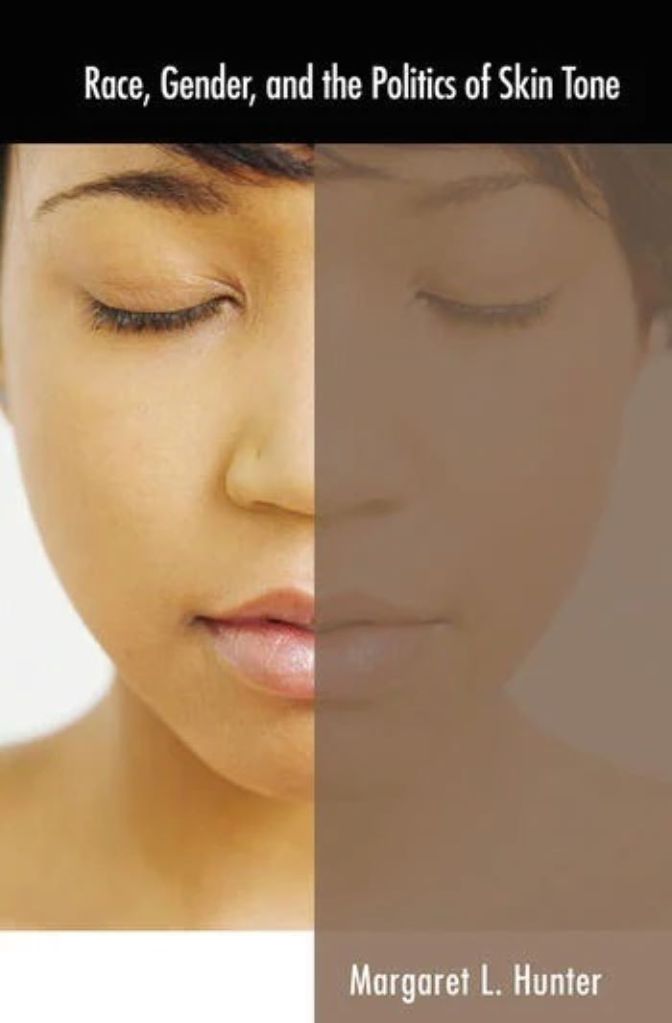
📖Book Review: Race, Gender, and the Politics of Skin Tone by Margaret L. Hunter.

⭐⭐⭐⭐⭐ 5/5 Stars

Race, Gender, and the Politics of Skin Tone

Published in 2005, this book examines how skin tone operates as a system of privilege and discrimination within African American and Mexican American communities. Drawing from in-depth interviews, historical records, and social analysis, Hunter demonstrates how lighter-skinned women often experience greater access to education, employment, and marriage opportunities, while darker-skinned women endure bias, invisibility, and stigmatization. The book situates colorism as both a legacy of colonialism and a persistent barrier to equality in modern society.

Key Points
Hunter highlights several key insights:

  • Historical Foundations: She situates colorism within slavery and colonization, exposing how whiteness and lightness were tied to power.
  • Socioeconomic Disparities: Lighter-skinned women are statistically more likely to access higher-paying jobs, higher levels of education, and “marry up.”
  • Beauty and Body Politics: The text addresses cosmetic pressures, including skin-lightening and surgery to alter facial features, showing how systemic bias reshapes physical identity.
  • Community Paradoxes: Dark-skinned women are often seen as “authentic,” while lighter-skinned women are more widely valued in mainstream society—a painful double standard.

Awards and Reception
Although not listed among mainstream literary award winners, Race, Gender, and the Politics of Skin Tone is regarded as a groundbreaking scholarly text and is widely adopted in college courses on race, gender, sociology, and African American studies. Scholars have praised it for being the first major sociological study to center on colorism across both African American and Mexican American contexts. Its academic influence is measured not in trophies but in citations, class adoptions, and the shaping of future research.

Groundbreaking and Life-Changing Appeal
The book is groundbreaking because it shifts the conversation from race alone to skin tone as an independent and powerful axis of inequality. For readers, it is often life-changing: it validates the lived experiences of women who have faced color-based bias, offering language and evidence where silence once reigned. By connecting personal testimony to systemic inequality, Hunter’s work affirms that the struggles surrounding beauty, identity, and skin tone are not individual failings but social constructions that must be dismantled.

Comparison with Other Works on Colorism
Hunter’s work stands alongside other landmark texts in the study of colorism. For example, Russell, Wilson, and Hall’s The Color Complex (1992, revised 2013) offered one of the earliest explorations of colorism in Black communities, focusing on the psychological effects of shade hierarchies. While The Color Complex is accessible and widely read, Hunter builds on this foundation with a more rigorous sociological methodology and a comparative lens that includes Mexican American experiences. Similarly, Melissa V. Harris-Perry’s Sister Citizen (2011) examines stereotypes and identity struggles of Black women in politics and culture; however, Hunter’s work is narrower in scope, diving deeply into skin tone stratification. Together, these books complement each other—The Color Complex exposing cultural wounds, Race, Gender, and the Politics of Skin Tone providing sociological depth, and Sister Citizen situating those struggles in broader systems of power.

Cultural and Media References
Though exact counts of media and blog citations are difficult to track, Hunter’s book is heavily referenced in academic articles, blogs on colorism, and grassroots discussions about skin tone politics. It frequently appears in bibliographies of colorism studies and has influenced cultural commentary from scholarly circles to online forums. Its resonance lies not only in academia but also in popular conversations about beauty, identity, and racial equity.

Author Bio
Margaret L. Hunter, a distinguished sociologist and professor, is widely recognized for her pioneering scholarship on race, gender, and inequality. Her academic career and cultural analyses have cemented her reputation as one of the leading voices on the study of colorism. As a faculty member at Loyola Marymount University and later at Mills College, Hunter has built her career on amplifying the voices of marginalized communities, specifically African American and Mexican American women.

Conclusion
Hunter’s Race, Gender, and the Politics of Skin Tone stands as one of the most significant works on colorism to date. Compared to The Color Complex and Sister Citizen, it represents the sociological anchor of colorism studies: data-driven, intersectional, and cross-cultural. It offers both a mirror—revealing the painful realities of shade bias—and a compass, pointing toward new ways of affirming beauty and worth beyond oppressive hierarchies. For scholars, activists, and readers seeking understanding, it remains a 5-star, essential text that is as relevant today as when it was first published.


References

Craig, M. L. (2002). Ain’t I a Beauty Queen?: Black Women, Beauty, and the Politics of Race. Oxford University Press.

Glenn, E. N. (2008). Yearning for lightness: Transnational circuits in the marketing and consumption of skin lighteners. Gender & Society, 22(3), 281–302.

Hunter, M. (2005). Race, Gender, and the Politics of Skin Tone. Routledge.

Keith, V. M., & Herring, C. (1991). Skin tone and stratification in the Black community. American Journal of Sociology, 97(3), 760–778.

Russell, K., Wilson, M., & Hall, R. (2013). The Color Complex: The Politics of Skin Color in a New Millennium. Anchor Books.

Harris-Perry, M. V. (2011). Sister Citizen: Shame, Stereotypes, and Black Women in America. Yale University Press.

From Ancestors to Algorithms: The Historical Roots of Colorism

Photo by Vitu00f3ria Santos on Pexels.com

Colorism, the preferential treatment of lighter-skinned individuals within the same racial or ethnic group, has deep historical roots that stretch from slavery and colonialism to modern-day digital culture. Unlike racism, which enforces hierarchies between racial groups, colorism operates within communities, producing internalized standards of beauty, privilege, and social status. Understanding the historical evolution of colorism reveals how social, economic, and technological forces continue to perpetuate biases based on skin tone.

During the transatlantic slave trade, lighter-skinned enslaved Africans often received preferential treatment because of partial European ancestry or proximity to white slaveholders. These individuals were frequently assigned domestic work instead of grueling field labor, gaining slightly better living conditions and social positioning within the enslaved community (Hunter, 2007). Over generations, lighter skin became associated with privilege, status, and survival, embedding hierarchies that extended beyond slavery into post-emancipation society.

Colonialism further entrenched colorism across the African diaspora. European colonizers promoted ideals of light skin, straight hair, and Eurocentric features as markers of civilization, morality, and sophistication. These standards infiltrated education, employment, and cultural norms, reinforcing the notion that proximity to whiteness equated with social and economic advantage (Byrd & Tharps, 2014). As a result, communities of color internalized these hierarchies, valuing lighter skin and devaluing darker complexions even within their own populations.

Media representation amplified these preferences during the 20th century. Hollywood films, fashion magazines, and advertising frequently highlighted lighter-skinned actors and models as ideals of beauty and success. Even within Black communities, light-skinned women and men received disproportionate visibility and admiration, while darker-skinned individuals were marginalized or stereotyped (Hunter, 2007). These cultural narratives solidified the association between complexion, desirability, and opportunity, perpetuating bias across generations.

With the rise of digital technology and social media, colorism has entered the realm of algorithms. Platforms like Instagram, TikTok, and Facebook often amplify content that aligns with dominant beauty ideals, including lighter skin tones, through engagement-driven algorithms. Likes, shares, and viral visibility create feedback loops that validate and reward lighter-skinned features, while darker-skinned users may experience relative invisibility or reduced exposure (Fardouly et al., 2015). In this way, historical hierarchies are reinforced and scaled by modern technology, linking ancestral bias to contemporary social media dynamics.

Psychologically, these persistent patterns of colorism affect self-esteem, confidence, and social identity. Individuals with darker complexions may internalize negative perceptions, experience body dissatisfaction, or feel excluded from cultural ideals of beauty (Festinger, 1954). Conversely, lighter-skinned individuals often benefit from societal affirmation, creating disparities in perceived social and aesthetic value. Recognizing these effects is essential for addressing both historical and modern manifestations of colorism.

Spiritual and ethical guidance provides a corrective lens for navigating the enduring impact of colorism. Proverbs 31:30 (KJV) declares, “Favour is deceitful, and beauty is vain: but a woman that feareth the LORD, she shall be praised.” True worth and dignity transcend social validation or algorithmic reinforcement, emphasizing character, faith, and virtue over skin tone. By grounding identity in spiritual and moral values, individuals can resist internalized bias and reclaim pride in authentic appearance.

In conclusion, colorism is a historical and contemporary phenomenon shaped by slavery, colonialism, media, and modern algorithms. From ancestral hierarchies to digital amplification, lighter skin has been privileged while darker complexions were marginalized. Understanding this evolution illuminates how systemic and cultural forces influence perception, self-worth, and social opportunity. Combating colorism requires both cultural representation and spiritual grounding, affirming that true value rests in character, faith, and the divine artistry inherent in every individual.


References

Byrd, A. D., & Tharps, L. L. (2014). Hair Story: Untangling the Roots of Black Hair in America. New York, NY: St. Martin’s Press.

Fardouly, J., Diedrichs, P. C., Vartanian, L. R., & Halliwell, E. (2015). Social comparisons on social media: The impact of Facebook on young women’s body image concerns and mood. Body Image, 13, 38–45.

Festinger, L. (1954). A theory of social comparison processes. Human Relations, 7(2), 117–140.

Hunter, M. (2007). The persistent problem of colorism: Skin tone, status, and inequality. Sociology Compass, 1(1), 237–254.

Dilemma: White Supremacy

Photo by David Henry on Pexels.com

“The white race is the dominant race in America, and the black race is inferior.” — David Duke, former Grand Wizard of the Ku Klux Klan .Southern Poverty Law Center

White supremacy is a deeply ingrained ideology asserting the inherent superiority of white people over all other races. This belief system has been central to the social, political, and economic structures of many societies, particularly in the United States. Its origins can be traced back to the colonial era, where European powers justified the enslavement and subjugation of African peoples through pseudo-scientific and theological rationales.


Historical Origins and the Role of the Ku Klux Klan

The formalization of white supremacy in the United States was significantly influenced by the founding of the Ku Klux Klan (KKK) in 1865. Established by six Confederate veterans in Pulaski, Tennessee, the Klan aimed to restore white dominance in the post-Civil War South through terror and intimidation. The KKK’s activities included lynchings, arson, and other forms of violence directed at Black individuals and their allies.TIMEWikipedia+1

While the Klan was officially disbanded in the 1870s, its ideology persisted and resurfaced in various forms throughout American history, including during the Civil Rights Movement of the 1960s and in contemporary white nationalist groups.


The Premise of White Supremacy

At its core, white supremacy posits that white people are inherently superior to people of all other races and therefore should dominate society. This belief has been perpetuated through various means, including legislation, cultural norms, and institutional practices that privilege white individuals while marginalizing others.

The premise of white supremacy is often supported by distorted interpretations of religious texts and pseudo-scientific theories that dehumanize non-white populations. For instance, the “Curse of Ham” narrative was historically used to justify the enslavement of Black people by misinterpreting biblical passages .The Banner


Manifestations in Contemporary Society

In modern times, white supremacy manifests in various aspects of life, including employment, education, housing, and criminal justice. Black individuals often face systemic barriers such as discriminatory hiring practices, unequal educational opportunities, and over-policing, which hinder their ability to achieve economic stability and social mobility.

Psychologically, the pervasive nature of white supremacy can lead to internalized racism among Black individuals, affecting their self-esteem and mental health. Studies have shown that exposure to racial discrimination is associated with increased stress and adverse health outcomes .American Psychological Association


Biblical Perspectives and Misinterpretations

The Bible does not support the notion of racial superiority. In fact, passages such as Galatians 3:28 emphasize the equality of all people in Christ: “There is neither Jew nor Greek, slave nor free, male nor female, for you are all one in Christ Jesus.” However, throughout history, certain groups have misused scripture to justify racial hierarchies, citing misinterpretations like the “Curse of Ham” to rationalize the enslavement and oppression of Black people .GotQuestions.blogThe Banner


Psychological Impact on Black Americans

The psychological effects of white supremacy on Black Americans are profound and multifaceted. Chronic exposure to racism can lead to mental health issues such as anxiety, depression, and post-traumatic stress disorder (PTSD). Moreover, the constant need to navigate a society that devalues their existence can result in a diminished sense of self-worth and identity .


Global Perspectives on White Supremacy

While white supremacy is most prominently associated with the United States, it is not confined to its borders. Countries like Israel, Myanmar, and South Korea have faced criticism for racial discrimination and human rights violations against minority groups . These global instances highlight the pervasive nature of racial hierarchies and the need for international efforts to combat them.U.S. News & World Report


Steps of White Supremacy

White supremacy operates through several key mechanisms:

  1. Ideological Justification: Promoting beliefs and narratives that dehumanize non-white populations.
  2. Institutionalization: Embedding discriminatory practices within societal institutions such as schools, workplaces, and the legal system.
  3. Cultural Reinforcement: Perpetuating stereotypes and biases through media and cultural representations.
  4. Violence and Intimidation: Employing physical force and threats to maintain dominance and suppress resistance.

Accountability and Responsibility

Responsibility for perpetuating white supremacy lies not only with overt hate groups but also with institutions and individuals who uphold and benefit from systemic racism. This includes policymakers, educators, and media figures who perpetuate or fail to challenge discriminatory practices and narratives.


Personal Narratives and Experiences

Individuals who have experienced white supremacy often recount stories of exclusion, discrimination, and violence. For example, during the Civil Rights Movement, activists like Rosa Parks and Martin Luther King Jr. faced systemic oppression and personal threats as they challenged racial injustices. Their resilience underscores the profound impact of white supremacy on personal lives and the collective struggle for equality.


The Esteem of Whiteness

The elevation of whiteness can be attributed to historical power dynamics where white individuals established and maintained control over resources, institutions, and narratives. This dominance was reinforced through laws, social norms, and economic systems that privileged white people and marginalized others.


Global Impact and Worst Offenders

Globally, white supremacy manifests in various forms, including colonialism, apartheid, and neo-imperialism. Countries with histories of colonial exploitation, such as Belgium in the Congo and the United Kingdom in India, have legacies of racial hierarchies that continue to affect post-colonial societies.


Conclusion

White supremacy is a pervasive ideology with deep historical roots and widespread contemporary implications. Its impact on Black Americans is profound, affecting their psychological well-being, social mobility, and sense of identity. Addressing white supremacy requires a concerted effort to dismantle systemic racism, promote equity, and foster a culture of inclusion and respect for all individuals, regardless of race.

References

  • Southern Poverty Law Center. (n.d.). David Duke. Retrieved from
  • History.com Editors. (2020, June 25). Ku Klux Klan: Origin, Members & Facts. HISTORY. Retrieved from
  • American Psychological Association. (n.d.). Racism and Mental Health. Retrieved from
  • Bible Odyssey. (n.d.). The Legacy of the Bible in Justifying Slavery. Retrieved from
  • Boston Review. (2019, November 14). Toward a Global History of White Supremacy. Retrieved from
  • Southern Poverty Law Center. (2018, August 14). White Shadow: David Duke’s Lasting Influence on American White Supremacy. Retrieved from
  • Wikipedia contributors. (2023, December 24). Ku Klux Klan. In Wikipedia, The Free Encyclopedia. Retrieved from
  • Wikipedia contributors. (2023, December 24). White supremacy. In Wikipedia, The Free Encyclopedia. Retrieved from

Neely Fuller Jr: The Architect of Counter-Racist Logic and Black Empowerment.

Neely Fuller Jr. is a highly influential yet often underrecognized figure in the realm of African American thought, particularly known for his work on racism, white supremacy, and Black empowerment. Born in the United States during the era of Jim Crow segregation, Fuller developed a worldview deeply shaped by systemic racial oppression. Though many of the personal details of his life—including his date of birth, marital status, and family life—remain private, what stands out is his lifelong dedication to analyzing and dismantling the global system of white supremacy through logic, language, and behavioral code.


Who Is Neely Fuller Jr.?

Neely Fuller Jr. is best known as a theorist and author who introduced a unique, structured framework for understanding and addressing racism in America and worldwide. His life’s work revolves around his central thesis: “If you do not understand white supremacy—what it is and how it works—everything else that you think you understand will only confuse you.” This statement has become a foundational mantra for many in the modern Black liberation and Afrocentric consciousness movements.

Fuller served in the U.S. military and worked as a government employee, experiences that contributed to his understanding of institutionalized racism. Despite lacking the mainstream visibility of figures like Malcolm X or Dr. Martin Luther King Jr., Fuller’s teachings have profoundly impacted generations of Black thinkers, including Dr. Frances Cress Welsing, who credited Fuller’s framework as the intellectual foundation for her own work, The Isis Papers.


His Major Work: A Compensatory Counter-Racist Code

Neely Fuller Jr.’s most well-known book is titled The United Independent Compensatory Code/System/Concept: A Compensatory Counter-Racist Code (first published in 1984 and revised in later editions). The book is not a traditional narrative or academic text; rather, it is a manual—a code of conduct designed to guide non-white people in navigating and countering racism in everyday life.

The book is grounded in logic, clarity, and a precise use of language. Fuller argues that white supremacy is a global system that dominates all areas of people activity: economics, education, entertainment, labor, law, politics, religion, sex, and war. His book offers a “code” of behaviors and linguistic patterns that help non-white people avoid conflict, think critically, and engage in constructive activity rather than reacting emotionally or violently to racism.


Highlights of the Code

  1. Definition of White Supremacy: Fuller defines racism and white supremacy as the same thing, a unified system with the primary goal of maintaining power over all non-white people.
  2. Logic-Based Living: He urges Black people to think, speak, and act in ways that produce justice and eliminate confusion.
  3. Constructive Speech: Fuller teaches the use of precise language—coining the term “codification”—to avoid being manipulated by racist ideology hidden in words.
  4. Sexual Politics: He outlines how sex and relationships are also controlled by the system of white supremacy, emphasizing self-discipline and mutual respect in Black relationships.
  5. Compensatory Code: Non-white people must act independently but in a unified and compensatory way—that is, in a manner that “makes up for” the imbalance caused by racism without engaging in emotional retaliation or disorder.
  6. Universal Man and Universal Woman: Fuller envisions a future where justice is the norm and individuals function without needing the system of racism for identity or value.

Reception and Legacy in the Black Community

While Neely Fuller Jr. has never been a household name, his influence in the conscious Black community is immeasurable. He is widely respected by scholars, activists, and critical thinkers who study race and systems of power. Podcasts, YouTube channels, and online forums continue to analyze and promote his teachings, often referring to him as “the master of logic.”

Figures like Dr. Frances Cress Welsing have publicly praised him, and his concepts are foundational in Afrocentric educational spaces, particularly those focused on mental liberation, cultural sovereignty, and counter-colonial thought. Many regard him as a philosophical giant, especially for his emphasis on the psychological dimensions of racial control.

However, his work has also been critiqued by some as overly methodical or lacking in revolutionary emotion. Yet Fuller deliberately avoided traditional activism or protest methods, believing that emotion-driven movements were easier for white supremacy to manipulate or destroy.


What He Is Known For

  • Creating the Counter-Racist Codification System
  • Influencing critical race theorists like Frances Cress Welsing
  • Highlighting the totalizing nature of white supremacy across all domains of human activity
  • Promoting logic, calmness, and consistency in Black liberation thought
  • Developing a philosophy of “maximum thought, speech, and action to produce justice”

Conclusion

Neely Fuller Jr. is a towering intellectual in the struggle for Black liberation and truth. Through his logical, disciplined framework, he provided tools for African Americans and all non-white people to analyze and dismantle the deceptive and destructive power of white supremacy. While his personal life remains largely hidden from public view, his public legacy—one of clarity, code, and consciousness—continues to shape the minds and strategies of freedom fighters around the globe.


Recommended Reading

  • Fuller, N. (2016). The United Independent Compensatory Code/System/Concept: A Compensatory Counter-Racist Code (Revised Edition). Neely Fuller Publications.
  • Welsing, F. C. (1991). The Isis Papers: The Keys to the Colors. Third World Press.
  • Black Dot, T. (2005). Hip Hop Decoded. Momi Publishing.