
The representation of Black people has never been neutral; it has been shaped by power, history, and ideology. From colonial narratives to modern media, images of Blackness have been constructed to serve political, economic, and psychological agendas rather than truth. Representation functions not merely as visibility, but as meaning-making—determining who is seen as human, valuable, intelligent, dangerous, beautiful, or disposable.
Historically, Western representation of Black people emerged through the lens of enslavement and colonial domination. Early depictions framed Africans as primitive, savage, and inferior, providing moral justification for conquest and exploitation. These narratives were not accidental but foundational to the racial hierarchy that undergirded the modern world-system (Fanon, 1952; Said, 1978).
During transatlantic slavery, Black bodies were represented as labor units rather than persons. Art, literature, and pseudoscience portrayed Black people as biologically suited for servitude, stripping them of complexity, spirituality, and intellect. These portrayals reinforced dehumanization and normalized violence against Black communities (Davis, 1981).
Biblical misrepresentation also played a role. Scripture was selectively interpreted to portray Blackness as cursed, despite no such racial designation existing in the biblical text. This theological distortion shaped Western Christian consciousness and cemented racialized representations that persist today (Haynes, 2002).
Post-emancipation representation did not immediately improve. Minstrelsy, caricatures, and early film continued to depict Black people as comic relief, criminals, or hypersexual figures. These images reassured white audiences of racial superiority while limiting Black social mobility (Bogle, 2016).
The rise of mass media in the twentieth century amplified these portrayals globally. Hollywood became a powerful tool for exporting distorted images of Black life, often disconnected from lived reality. Representation became repetition, and repetition hardened stereotype into assumed truth.
Black women faced a distinct burden within representation. Tropes such as the Jezebel, Mammy, Sapphire, and Welfare Queen confined Black womanhood to narrow, degrading roles. These images justified both sexual exploitation and social neglect while erasing vulnerability and dignity (Collins, 2000).
Black men were similarly constrained through representations of hypermasculinity, aggression, and criminality. Media narratives disproportionately linked Black male identity to violence and threat, shaping public perception and policy, including over-policing and mass incarceration (Alexander, 2010).
Representation also operates through absence. The exclusion of Black people from narratives of intellect, leadership, romance, and innocence communicates inferiority just as powerfully as negative imagery. What is not shown can be as damaging as what is shown.
In response, Black communities have consistently resisted imposed representations. From slave narratives to the Harlem Renaissance, Black creators reclaimed authorship and asserted humanity through literature, music, art, and theology. Representation became a site of survival and self-definition.
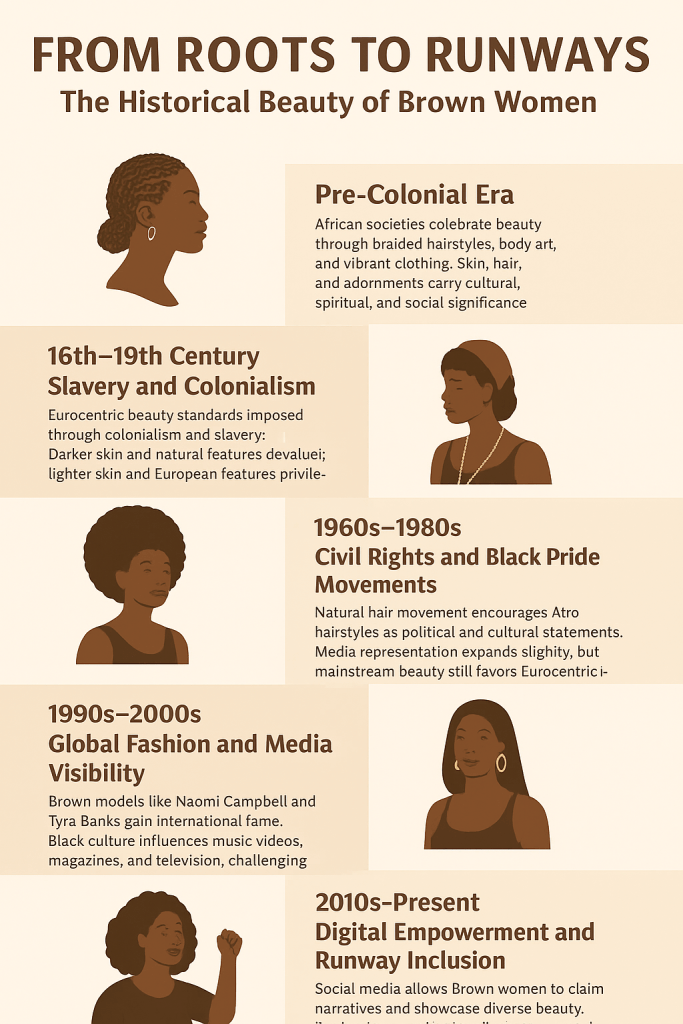
The Civil Rights and Black Power movements challenged not only legal inequality but symbolic domination. Slogans like “Black is Beautiful” directly confronted Eurocentric standards and re-centered Black aesthetics and self-worth. Representation shifted from apology to affirmation.
Contemporary media has seen increased Black visibility, yet representation remains contested. Tokenism, colorism, and commodified diversity often replace genuine inclusion. Visibility without power risks reproducing the same hierarchies under new language (hooks, 1992).
Colorism remains a critical issue within representation. Lighter skin, looser hair textures, and Eurocentric features continue to be privileged in media portrayals, reinforcing internalized anti-Blackness and stratification within Black communities (Hunter, 2007).
Social media has democratized representation, allowing Black individuals to tell their own stories outside institutional gatekeeping. However, it has also intensified surveillance, commodification, and performance pressures, complicating authenticity and agency.
Representation affects material outcomes. Studies show that media portrayals shape public opinion, educational expectations, employment opportunities, and criminal justice outcomes. Representation is not symbolic alone—it is structural (Entman & Rojecki, 2000).
Spiritual representation also matters. Depictions of God, holiness, and virtue overwhelmingly coded as white distort theological imagination and alienate Black believers. Reclaiming sacred representation is central to psychological and spiritual liberation.
Authentic representation requires more than inclusion; it demands narrative control. Who writes, directs, edits, funds, and distributes stories determines how Black life is framed and understood. Power behind the image is as important as the image itself.
True representation must reflect complexity—joy and pain, faith and doubt, intellect and emotion. Black people are not a monolith, and any representation that flattens diversity perpetuates harm, even when well-intentioned.
Decolonizing representation involves interrogating whose standards define excellence, beauty, and normalcy. It requires dismantling Eurocentric frameworks and honoring African diasporic histories, epistemologies, and aesthetics.
The future of Black representation depends on sustained cultural literacy, institutional accountability, and community self-definition. Representation must move from reaction to creation, from correction to sovereignty.
Ultimately, the representation of Black people is a moral issue. It reflects how society understands humanity itself. When Black life is represented truthfully and fully, it expands the moral imagination and affirms the dignity of all people.
References
Alexander, M. (2010). The new Jim Crow: Mass incarceration in the age of colorblindness. The New Press.
Bogle, D. (2016). Toms, coons, mulattoes, mammies, and bucks: An interpretive history of Blacks in American films. Bloomsbury.
Collins, P. H. (2000). Black feminist thought: Knowledge, consciousness, and the politics of empowerment. Routledge.
Davis, A. Y. (1981). Women, race & class. Vintage Books.
Entman, R. M., & Rojecki, A. (2000). The Black image in the white mind: Media and race in America. University of Chicago Press.
Fanon, F. (1952). Black skin, white masks. Grove Press.
Haynes, S. R. (2002). Noah’s curse: The biblical justification of American slavery. Oxford University Press.
hooks, b. (1992). Black looks: Race and representation. South End Press.
Hunter, M. (2007). The persistent problem of colorism. Sociology Compass, 1(1), 237–254.
Said, E. W. (1978). Orientalism. Pantheon Books.
 THE BROWN GIRL DILEMMA