
Tag Archives: Pride

The Golden Cage

Materialism is the golden cage that glitters so beautifully it blinds the eyes of the beholder. It promises freedom, comfort, and power, yet silently imprisons the soul behind the bars of greed, vanity, and endless desire. The Bible warns in 1 Timothy 6:10 (KJV), “For the love of money is the root of all evil.” It is not money itself that destroys, but the affection and obsession with it—the worship of the gift rather than the Giver. In today’s society, where material success defines worth, the heart becomes chained to things that perish, forgetting the eternal riches of God.

The love of money distorts the soul’s priorities. Many trust wealth more than the One who provides it, seeking security in numbers rather than in divine providence. Proverbs 11:28 (KJV) declares, “He that trusteth in his riches shall fall: but the righteous shall flourish as a branch.” God calls us to depend on Him, not the fleeting comfort of possessions. When man begins to believe that wealth sustains him, pride replaces humility, and faith becomes conditional upon prosperity rather than purpose.

Christ Himself warned in Matthew 6:24 (KJV), “No man can serve two masters… Ye cannot serve God and mammon.” To serve mammon—the spirit of greed and material gain—is to surrender spiritual clarity for worldly satisfaction. This battle is not about currency but allegiance. When our hearts long more for luxury than for the presence of God, we have already built our own golden cage, adorned with success but devoid of peace.

Comparison is another bar of this golden prison. In constantly measuring ourselves against others, we become trapped in envy, chasing after illusions of happiness built on possessions. Galatians 6:4–5 (KJV) reminds us, “But let every man prove his own work… for every man shall bear his own burden.” The spirit of comparison leads to covetousness, the quiet killer of gratitude.

Gratitude, once replaced by greed, transforms blessings into burdens. The heart that once thanked God for daily bread begins to demand more, forgetting that “a man’s life consisteth not in the abundance of the things which he possesseth” (Luke 12:15, KJV). The desire for “more” becomes insatiable, and soon enough, contentment feels like poverty to the one addicted to acquisition.

The story of the rich young ruler (Matthew 19:16–22) serves as a solemn reminder. He desired eternal life but was unwilling to release his wealth. His possessions had possessed him. Christ’s invitation to “sell that thou hast, and give to the poor” was not merely about money—it was about surrender. God seeks hearts free from attachment to temporary treasures.

The lovers of money are never satisfied. Ecclesiastes 5:10 (KJV) warns, “He that loveth silver shall not be satisfied with silver.” Wealth multiplies desires instead of fulfilling them. It demands maintenance, protection, and worry. True peace cannot coexist with insatiable want. The wealthy without God are often the poorest in spirit.

Between the crown and the cross lies the choice of devotion. The crown represents self-glory, while the cross represents self-sacrifice. Christ chose the cross, teaching that eternal victory comes not through possession but through surrender. The golden cage tempts us with crowns, but freedom lies in carrying the cross of humility and service.

God wants your heart, not your hoarded treasures. In Matthew 6:21 (KJV), Jesus says, “For where your treasure is, there will your heart be also.” When our treasure lies in earthly wealth, our hearts remain earthbound. But when our treasure is in heaven, our spirit soars beyond material limits.

Materialism thrives on fear—fear of lack, fear of insignificance, fear of failure. This fear drives many to hoard and save beyond reason, believing that money can buy security. Yet Proverbs 23:5 (KJV) cautions, “Wilt thou set thine eyes upon that which is not? for riches certainly make themselves wings.” Wealth is fleeting; trust in it is fragile.

Jesus addressed this fear when He said, “Take no thought for your life, what ye shall eat, or what ye shall drink” (Matthew 6:25, KJV). The obsession with “what shall we eat or what shall we wear” reveals a heart that doubts divine provision. God, who feeds the birds and clothes the lilies, surely knows how to care for His children.

Seeking God’s kingdom first is the antidote to the golden cage. “But seek ye first the kingdom of God, and his righteousness; and all these things shall be added unto you” (Matthew 6:33, KJV). When we prioritize righteousness, material needs fall into place naturally. Faith transforms fear into freedom.

Money can serve as a ministry when used wisely. The more one gives, the lighter the heart feels. Acts 20:35 (KJV) says, “It is more blessed to give than to receive.” Generosity breaks the chains of materialism and transforms wealth into worship. Money becomes a tool of blessing rather than a symbol of bondage.

To spread wealth is to reflect the nature of God, who gives abundantly and freely. The golden cage is shattered when we learn to share. 2 Corinthians 9:7 (KJV) teaches, “God loveth a cheerful giver.” Giving aligns us with divine character and reminds us that we are stewards, not owners.

Hoarding wealth leads to heaviness of soul. The more one clings to possessions, the more burdened the heart becomes. True freedom is found in release. When we give, we participate in God’s economy—a system built not on scarcity, but on trust and generosity.

The golden cage promises power but delivers isolation. It feeds pride and starves compassion. Those consumed by wealth often lose touch with empathy, believing their riches are self-earned rather than divinely permitted. James 1:17 (KJV) reminds us, “Every good gift and every perfect gift is from above.”

Greed can disguise itself as ambition. The desire to achieve becomes corrupted when it seeks self-exaltation instead of service. Ambition rooted in God glorifies Him; ambition rooted in self glorifies man. The golden cage thrives on self-centered striving.

To escape this cage, one must learn contentment. Philippians 4:11 (KJV) says, “For I have learned, in whatsoever state I am, therewith to be content.” Contentment is not complacency—it is peace in provision. It recognizes that joy is not in having more, but in trusting the One who provides enough.

When gratitude replaces greed, the soul finds rest. The pursuit of wealth no longer defines success; obedience and faith do. The heart once enslaved by gold now glows with grace.

To escape the golden cage is to rediscover simplicity and sufficiency in God. It is to realize that true riches are spiritual, not material. When you stop chasing what glitters, you find the light of Christ shining within.

References

  • Holy Bible, King James Version (KJV): Matthew 6:24, Matthew 19:16–22, Matthew 6:25–33, 1 Timothy 6:10, Luke 12:15, Proverbs 11:28, Proverbs 23:5, Ecclesiastes 5:10, Acts 20:35, Philippians 4:11, James 1:17, Galatians 6:4–5, 2 Corinthians 9:7.
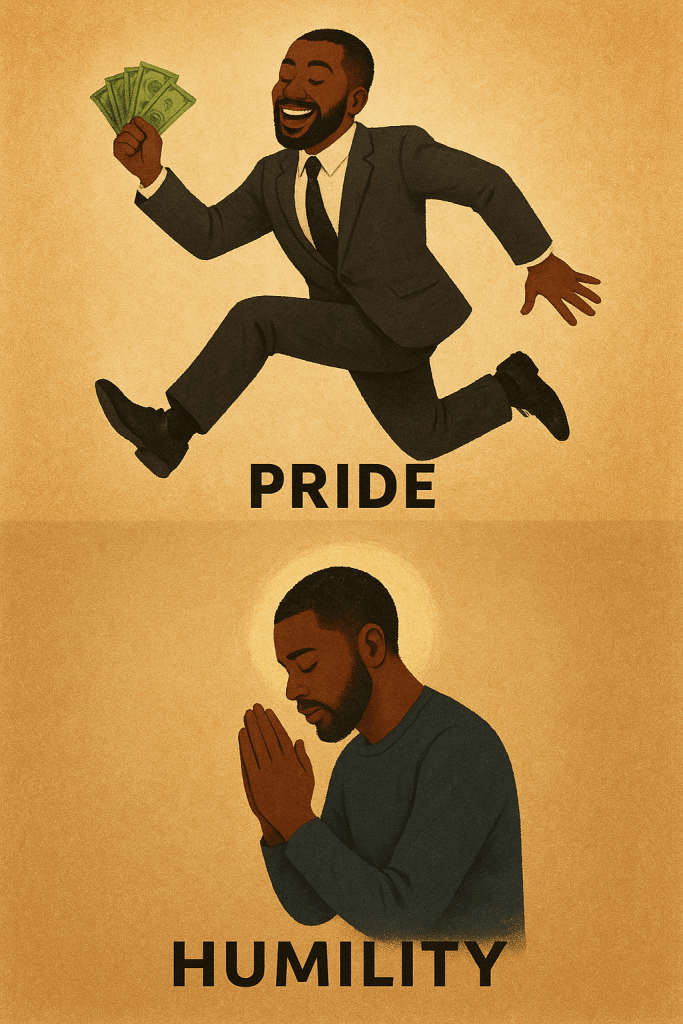

Pride or Humility?

Pride and humility represent two opposing forces in the spiritual and moral life of every believer. Pride exalts the self, while humility exalts God. The Bible often contrasts these traits to show how one leads to destruction and the other to divine favor. Pride focuses inward, seeking recognition and control, whereas humility focuses upward, seeking submission to the Most High. Understanding the nature of both helps us discern the path that aligns with righteousness and truth.

Pride, at its core, is self-exaltation. It is the elevation of one’s own will, wisdom, or worth above others—and even above God. Scripture describes pride as the root of rebellion, the seed of disobedience, and the foundation of sin. In Proverbs 16:18 (KJV), it warns, “Pride goeth before destruction, and an haughty spirit before a fall.” This verse reveals that pride precedes downfall, for it blinds a person to correction, truth, and repentance.

The origin of pride can be traced back to Satan himself. Once known as Lucifer, he was an angel of light who allowed pride to consume his heart. In Isaiah 14:12–15 (KJV), it says, “How art thou fallen from heaven, O Lucifer, son of the morning!… For thou hast said in thine heart, I will ascend into heaven, I will exalt my throne above the stars of God.” His desire to be like the Most High led to his downfall. Pride transformed a glorious being into the adversary of all righteousness.

Lucifer’s pride was rooted in self-glorification. He desired worship, power, and independence from God’s authority. This spirit of pride did not end with his fall; it entered humanity in the Garden of Eden. When Satan tempted Eve, he promised that eating the forbidden fruit would make her “as gods, knowing good and evil” (Genesis 3:5, KJV). That temptation was pride disguised as enlightenment—the same rebellion that led to Lucifer’s expulsion from heaven.

The danger of pride lies in its subtlety. It often disguises itself as confidence, ambition, or success, yet its core motive is self-centeredness. Pride closes the heart to instruction and correction. It blinds the eyes of the proud so that they no longer see their faults or need for God. In Obadiah 1:3 (KJV), it declares, “The pride of thine heart hath deceived thee.” Pride deceives the soul, leading it into false security and spiritual blindness.

Pride not only affects individuals but also nations and societies. Babylon, Egypt, and even Israel fell because of pride. In Daniel 4, King Nebuchadnezzar learned this lesson when his arrogance caused God to humble him. After losing his kingdom and living among beasts, he finally acknowledged, “Those that walk in pride he is able to abase” (Daniel 4:37, KJV). Pride brings humiliation, but humility brings restoration.

Ten Attributes of Pride

  1. Arrogance – A sense of superiority that elevates oneself above others. (Proverbs 8:13) “Pride, and arrogancy, and the evil way, and the froward mouth, do I hate.”
  2. Self-Reliance – Depending on one’s own wisdom and strength instead of trusting in God. (Proverbs 3:5–6) “Lean not unto thine own understanding.”
  3. Boastfulness – Constantly speaking of one’s achievements or abilities to gain praise. (Proverbs 27:2) “Let another man praise thee, and not thine own mouth.”
  4. Unteachableness – Refusing correction, counsel, or instruction from others. (Proverbs 13:10) “Only by pride cometh contention: but with the well advised is wisdom.”
  5. Judgmental Spirit – Looking down on others and magnifying their flaws while excusing one’s own. (Luke 18:11–12) The Pharisee who exalted himself in prayer.
  6. Desire for Recognition – Craving validation, admiration, and honor from men instead of from God. (Matthew 6:1–2) “Take heed that ye do not your alms before men, to be seen of them.”
  7. Rebellion – Resisting authority and divine instruction; refusing to submit to God’s will. (1 Samuel 15:23) “Rebellion is as the sin of witchcraft, and stubbornness is as iniquity and idolatry.”
  8. Envy and Competition – Comparing oneself to others and striving to outshine them. (Galatians 5:26) “Let us not be desirous of vain glory, provoking one another, envying one another.”
  9. Hypocrisy – Pretending righteousness while harboring pride in the heart. (Matthew 23:27) “Ye are like unto whited sepulchres… within full of hypocrisy and iniquity.”
  10. Ingratitude – Failing to acknowledge God as the source of all blessings. (Deuteronomy 8:14, 17) “Then thine heart be lifted up… and thou say in thine heart, My power and the might of mine hand hath gotten me this wealth.”

The attributes of prideful people are easy to recognize in Scripture. They are boastful, arrogant, unteachable, and often quick to judge others. They rely on their own understanding rather than God’s wisdom. Proverbs 21:4 (KJV) describes pride as a sin of the heart: “An high look, and a proud heart… is sin.” The proud speak more than they listen, seek praise rather than peace, and strive to be served rather than to serve.

In contrast, humility is the posture of submission and reverence before God. It is not weakness but strength under control. A humble person recognizes their dependence on the Creator and acknowledges that all wisdom, success, and life flow from Him. James 4:6 (KJV) reminds believers, “God resisteth the proud, but giveth grace unto the humble.” Grace is the reward of humility—it opens doors that pride closes.

The Bible gives us many examples of humble men and women who found favor with God. Moses is called “very meek, above all the men which were upon the face of the earth” (Numbers 12:3, KJV). Despite leading an entire nation, Moses never exalted himself; he depended on God for guidance. His humility allowed him to be used mightily by the Most High.

King David also exemplified humility when confronted by the prophet Nathan after his sin with Bathsheba. Rather than defending himself, David repented deeply, saying, “Create in me a clean heart, O God” (Psalm 51:10, KJV). His willingness to confess and seek forgiveness restored his relationship with the Lord. Humility brought redemption where pride would have brought destruction.

The ultimate model of humility is Yahusha HaMashiach (Jesus Christ). Philippians 2:5–8 (KJV) declares that though He was in the form of God, He “made himself of no reputation, and took upon him the form of a servant.” His humility led Him to the cross, where He laid down His life for others. True humility, therefore, is sacrificial—it seeks to serve, not to be served.

Humility produces a spirit of gratitude. The humble recognize that all blessings come from God and not from personal merit. They walk in thankfulness, not entitlement. This attitude keeps them grounded even in seasons of success. 1 Peter 5:6 (KJV) instructs, “Humble yourselves therefore under the mighty hand of God, that he may exalt you in due time.” Exaltation comes through surrender, not self-promotion.

The danger of pride is not only moral but spiritual. Pride distances a person from God’s presence. It was pride that caused Saul to lose his kingdom, while humility crowned David. Pride whispers, “I don’t need God,” but humility cries, “Without You, I can do nothing.” This distinction determines the outcome of one’s destiny.

Those who possess humility often demonstrate patience, gentleness, and compassion. They listen more than they speak and give more than they receive. Their speech is seasoned with grace, and their actions reflect love. Colossians 3:12 (KJV) encourages believers to “put on therefore… humbleness of mind, meekness, longsuffering.” These attributes reflect the very heart of the Messiah.

Humility also invites wisdom. Proverbs 11:2 (KJV) states, “When pride cometh, then cometh shame: but with the lowly is wisdom.” Pride closes the ears to instruction, but humility opens the heart to learning. Those who are humble are teachable, willing to grow, and quick to correct their wrongs. This posture of openness allows God to shape their character.

Pride, on the other hand, isolates. It separates people from community and from truth. A proud heart cannot fellowship because it always seeks to dominate. Pride makes one defensive and resentful of correction. In contrast, humility builds relationships because it values peace over ego. The humble understand that strength lies in unity and love.

Spiritually, humility is essential for prayer and repentance. The Most High does not hear the prayers of the proud-hearted, for they approach Him without reverence. 2 Chronicles 7:14 (KJV) declares, “If my people, which are called by my name, shall humble themselves, and pray… then will I hear from heaven.” Humility opens the door to divine mercy and restoration.

Ten Attributes of Humility

  1. Meekness – A gentle and patient spirit that endures without anger or pride. (Matthew 5:5) “Blessed are the meek: for they shall inherit the earth.”
  2. Teachability – A willingness to receive correction, wisdom, and instruction. (Proverbs 9:9) “Give instruction to a wise man, and he will be yet wiser.”
  3. Gratitude – Recognizing that every blessing and ability comes from God. (1 Thessalonians 5:18) “In every thing give thanks: for this is the will of God in Christ Jesus concerning you.”
  4. Dependence on God – Trusting in the Lord rather than in one’s own strength or understanding. (Proverbs 3:5–6) “Trust in the Lord with all thine heart… and he shall direct thy paths.”
  5. Repentance – A heart that quickly acknowledges sin and seeks forgiveness. (Psalm 51:17) “A broken and a contrite heart, O God, thou wilt not despise.”
  6. Servanthood – A desire to serve others rather than to be served. (Mark 10:44–45) “Whosoever of you will be the chiefest, shall be servant of all.”
  7. Obedience – Submitting to God’s will and commandments without resistance. (Philippians 2:8) “He humbled himself, and became obedient unto death, even the death of the cross.”
  8. Patience – Enduring trials, offenses, and delays without murmuring or resentment. (Ephesians 4:2) “With all lowliness and meekness, with longsuffering, forbearing one another in love.”
  9. Compassion – Showing mercy and understanding toward others, even those who do wrong. (Colossians 3:12) “Put on therefore… bowels of mercies, kindness, humbleness of mind, meekness, longsuffering.”
  10. God-Centeredness – Living to glorify God rather than self. (James 4:10) “Humble yourselves in the sight of the Lord, and he shall lift you up.”

The fruit of humility is peace. A humble spirit does not strive or compare but rests in God’s will. Pride produces envy and contention, while humility produces contentment. The humble can rejoice in others’ success because they know their worth comes from God, not human approval. This mindset frees them from jealousy and self-ambition.

In the end, pride and humility determine our spiritual trajectory. Pride leads to a fall, but humility leads to exaltation. The proud seek glory for themselves; the humble give glory to God. Micah 6:8 (KJV) summarizes this truth beautifully: “What doth the Lord require of thee, but to do justly, and to love mercy, and to walk humbly with thy God?”

Therefore, believers are called to reject pride in all its forms and to cultivate humility daily. Pride is the spirit of Satan—rebellion and self-worship—while humility is the spirit of Christ—obedience and love. Choosing humility is choosing life, for it invites grace, wisdom, and divine favor. The humble will be lifted up in due time, for God honors those who walk low before Him.


References (KJV Bible)

  • Proverbs 16:18
  • Isaiah 14:12–15
  • Genesis 3:5
  • Obadiah 1:3
  • Daniel 4:37
  • Proverbs 21:4
  • James 4:6
  • Numbers 12:3
  • Psalm 51:10
  • Philippians 2:5–8
  • 1 Peter 5:6
  • Proverbs 11:2
  • Colossians 3:12
  • 2 Chronicles 7:14
  • Micah 6:8

Self Worship: Look at Me.

In modern culture, self-worship has become a pervasive phenomenon. Rooted in narcissism, pride, and the desire for constant validation, self-worship manifests as an insatiable need to be noticed, admired, and glorified. “Pride goeth before destruction, and an haughty spirit before a fall” (Proverbs 16:18, KJV). Those who seek constant adoration often elevate themselves above moral and spiritual law, pursuing influence at any cost.

Self-worship is distinct from healthy self-esteem. While confidence honors God’s creation, narcissism elevates the self to an almost divine status, demanding attention, admiration, and often worship from others. “Ye shall be as gods, knowing good and evil” (Genesis 3:5, KJV) illustrates humanity’s temptation to elevate itself beyond divine authority.

Arrogance is a hallmark of self-worship. Individuals act superior to peers, dismissing counsel, humility, or accountability. This behavior aligns with the psychological concept of grandiose narcissism, characterized by an inflated sense of importance and entitlement (Miller et al., 2011).

Haughtiness is often performed publicly. Social media amplifies the desire for visibility, likes, and followers, creating a feedback loop where attention fuels ego. “When pride cometh, then cometh shame: but with the lowly is wisdom” (Proverbs 11:2, KJV). The pursuit of recognition can blind individuals to consequences or ethical responsibility.

Many celebrities embody this phenomenon, whether by design or circumstance. Kanye West, for example, has spoken publicly about feeling like a genius and has sought near-divine reverence in his performances and public statements. His persona illustrates the psychological intersection of narcissism, ambition, and fame.

Self-worship often involves performing acts meant to display power, wealth, or talent, not for service, but for adoration. Lavish lifestyles, designer clothing, and public gestures can signal superiority and attract followers who reinforce the worship of the self. “Their throat is an open sepulchre; with their tongues they have used deceit” (Romans 3:13, KJV).

The desire to see one’s name in lights reflects deep-seated ego gratification. Whether on stage, social media, or in headlines, self-worship thrives on visibility. The individual’s sense of worth becomes externally measured, not internally grounded or spiritually aligned.

Psychology identifies this behavior as a combination of narcissistic personality traits, entitlement, and attention-seeking. Constant admiration reinforces self-concept, creating dependency on public validation rather than God-centered identity (American Psychiatric Association, 2013).

A haughty spirit often leads to moral compromise. To maintain image or power, individuals may disregard ethical boundaries, relationships, or spiritual obligations. “The way of a fool is right in his own eyes: but he that hearkeneth unto counsel is wise” (Proverbs 12:15, KJV). Pride blinds judgment and fosters destructive patterns.

Self-worship can extend to spiritual distortion. Some claim prophetic or divine authority over others, implicitly or explicitly encouraging worship directed at the self rather than God. “Thou shalt worship the Lord thy God, and him only shalt thou serve” (Matthew 4:10, KJV). Worship diverted to the self becomes idolatry.

The “selling of one’s soul” is a metaphorical extension of this behavior, representing the pursuit of power, fame, or influence at the expense of integrity or divine alignment. “The heart is deceitful above all things, and desperately wicked” (Jeremiah 17:9, KJV). Elevating the self above God carries eternal consequences.

Psychologically, self-worship can mask insecurity. The outward display of confidence, superiority, and arrogance often hides deep vulnerability, fear of insignificance, and existential anxiety (Twenge & Campbell, 2009). Attention-seeking becomes a coping mechanism for internal emptiness.

Self-worship is addictive. Praise, fame, and admiration trigger dopamine release in the brain, creating cycles of reinforcement. Over time, the individual prioritizes personal glorification above relationships, ethics, and spiritual devotion, aligning with modern understandings of behavioral reinforcement in psychology.

A public example of self-worship gone to extremes is Michael Jackson, whose public persona, need for validation, and life decisions reflected the psychological and social pressures of fame, identity, and the pursuit of adulation. His struggles highlight the destructive potential of elevating self above God or community.

Celebrity culture fuels self-worship in broader society. Young audiences emulate ostentatious lifestyles, seeking attention, validation, and affirmation through likes, follows, and public visibility. Social learning theory explains how observation of admired figures shapes behavior and self-perception.

Theological warnings abound. “Every one that is proud in heart is an abomination to the Lord” (Proverbs 16:5, KJV). Scripture consistently contrasts humility with pride, warning of divine judgment and the spiritual peril of self-idolatry.

Vanity, often celebrated in media, is a visible manifestation of self-worship. Physical appearance, talent, or achievements become vehicles for ego elevation rather than instruments of service or gratitude. “All that is in the world, the lust of the flesh, and the lust of the eyes, and the pride of life, is not of the Father” (1 John 2:16, KJV).

Consequences of self-worship include isolation, estrangement, and spiritual emptiness. Relationships suffer as the individual prioritizes self-interest over empathy, loyalty, and shared values. “Pride goeth before destruction, and an haughty spirit before a fall” (Proverbs 16:18, KJV).

Humility counters self-worship. Recognizing God as the source of talent, beauty, and influence restores perspective. “Humble yourselves therefore under the mighty hand of God, that he may exalt you in due time” (1 Peter 5:6, KJV). God-centered identity replaces the need for personal glorification.

Self-worship is ultimately a spiritual danger, aligning the heart with pride, deception, and temporary earthly accolades rather than eternal purpose. Awareness, self-examination, and submission to God’s authority provide a path to freedom from the compulsions of ego-driven adulation.


References

  1. American Psychiatric Association. (2013). Diagnostic and statistical manual of mental disorders (5th ed.). Arlington, VA: American Psychiatric Publishing.
  2. Miller, J. D., et al. (2011). Grandiose and vulnerable narcissism: A nomological network analysis. Journal of Personality, 79(5), 1013–1042.
  3. Twenge, J. M., & Campbell, W. K. (2009). The narcissism epidemic: Living in the age of entitlement. Free Press.
  4. The Holy Bible, King James Version. (1611). Cambridge Edition.
  5. Campbell, W. K., & Miller, J. D. (2011). The handbook of narcissism and narcissistic personality disorder. Wiley.
  6. Jackson, M. (2009). Moonwalk: The autobiography. New York: Doubleday.

Spiritual Pride and Arrogance: The Silent Sin That Separates Man from God.

Photo by magapls . on Pexels.com

Spiritual pride and arrogance are among the most deceptive and destructive sins in the life of a believer. Unlike visible transgressions such as adultery or theft, this sin disguises itself as righteousness. It creeps into the heart of a person who believes they are walking in close fellowship with God, whispering lies of superiority and holiness. This inward corruption often takes root in those who have achieved spiritual maturity or influence, convincing them that their understanding or obedience elevates them above others. It is a silent cancer of the soul that blinds the believer to their own need for humility and grace.

The danger of spiritual pride lies in its subtlety. A person may begin with sincere devotion, fasting, praying, and studying scripture daily, yet unknowingly begin to exalt themselves in their mind. They may start to measure others’ faith by their own standards and assume that their relationship with God is deeper, purer, or more enlightened. In that deception, their heart slowly hardens, and humility—one of the greatest signs of true godliness—begins to fade. As Proverbs 16:18 (KJV) warns, “Pride goeth before destruction, and a haughty spirit before a fall.”

This sin is especially dangerous because it disguises itself as holiness. A spiritually proud person may think, “I am not like other Christians; I fast more, I pray more, I know more Scripture.” These are the very thoughts that separate them from the essence of Christ’s teaching, which is love, meekness, and servanthood. Even the most devoted believers are not exempt from this temptation. The closer one walks with God, the greater the temptation becomes to believe that closeness is earned rather than given by grace.

In the Gospels, Jesus repeatedly warned against such attitudes. The Pharisees are the ultimate biblical example of spiritual arrogance. They knew the Law, they prayed publicly, and they boasted in their knowledge of Scripture. Yet Jesus declared in Matthew 23:27 (KJV), “Woe unto you, scribes and Pharisees, hypocrites! for ye are like unto whited sepulchres, which indeed appear beautiful outward, but are within full of dead men’s bones.” Their pride blinded them from recognizing the very Messiah they had long awaited.

King Uzziah’s story provides a sobering example of how spiritual pride can destroy even the most anointed lives. Uzziah began as a godly king who sought the Lord, and as long as he did so, God caused him to prosper. But as his fame grew, his heart was lifted up in pride. He entered the temple to burn incense, a duty reserved for the priests, defying the sacred order of God. When the priests confronted him, his anger flared, and leprosy broke out on his forehead as judgment from the Lord (2 Chronicles 26:16–21, KJV). Uzziah’s downfall was not due to sexual sin or greed—it was pride.

This story illustrates how pride can lead even the righteous to overstep divine boundaries. Uzziah’s heart shifted from dependence to dominance; he mistook God’s favor for personal greatness. In the end, he was isolated, living as a leper until his death—a tragic picture of how pride isolates the soul from God and community.

Another often-overlooked example of spiritual pride appears in the apocryphal narrative of Eleazar ben Simon, a Jewish zealot leader during the siege of Jerusalem. Although not a canonical figure, his spirit reflects the same arrogance seen throughout Scripture. Eleazar, convinced of his divine favor, led rebellions that contributed to the fall of his people. He believed his zeal for purity made him holier than others, yet his pride blinded him to the cost of his actions. Like many today, he mistook his self-righteousness for God’s righteousness, leading to ruin.

The danger of pride lies not only in its ability to deceive but in its resistance to correction. A proud spirit rarely listens, even to the voice of God. Proverbs 11:2 (KJV) declares, “When pride cometh, then cometh shame: but with the lowly is wisdom.” A person walking in humility can be corrected, guided, and renewed; but a proud soul resists repentance, seeing themselves as already righteous.

Even Lucifer’s fall originated from spiritual pride. Isaiah 14:13–15 (KJV) records his heart’s arrogance: “For thou hast said in thine heart, I will ascend into heaven, I will exalt my throne above the stars of God.” His desire to be equal with God led to his eternal separation from divine presence. Thus, pride was the first sin ever committed, setting the precedent for all rebellion.

Pride also distorts one’s view of others. A spiritually arrogant person begins to judge rather than intercede. Instead of seeing others through the eyes of grace, they see them through a lens of spiritual hierarchy. They may secretly think, “If only others were as faithful as I am.” This judgmental mindset hardens the heart and creates division within the body of Christ, which directly opposes the spirit of unity and love that God commands (Ephesians 4:2–3, KJV).

The thoughts of a spiritually proud person are often self-elevating and comparative. They compare their devotion, purity, and obedience to others, feeling superior in their perceived closeness to God. This internal dialogue sounds spiritual but is rooted in the flesh. The devil uses these thoughts to distance the believer from grace, for as James 4:6 (KJV) says, “God resisteth the proud, but giveth grace unto the humble.”

Spiritual pride is far more dangerous than sexual sin because it blinds the soul to its need for repentance. A fornicator may know they are sinning, but a spiritually proud person believes they are righteous while actively rebelling against God in heart. This blindness makes pride a greater barrier to salvation than many outward sins. Jesus said in Luke 18:9–14 that the humble tax collector, who beat his chest and cried for mercy, was justified before God, while the self-righteous Pharisee, who boasted of his holiness, was not.

Many believers fall into this trap after spiritual breakthroughs. When one begins to receive revelations, prophetic gifts, or leadership roles, the temptation arises to think that their spirituality is unique or superior. Yet these gifts are not signs of personal greatness but of divine grace. Pride turns gifts into idols, making the believer worship their spiritual status rather than the Giver.

The Apostle Paul is a model of humility amidst great revelation. Despite his spiritual authority, he confessed in 2 Corinthians 12:7 (KJV) that a “thorn in the flesh” was given to him to keep him humble. He understood that without divine restraint, he could easily fall into pride. This admission demonstrates that even the holiest must guard their hearts from arrogance.

Another danger of spiritual pride is its impact on worship. When pride fills the heart, worship becomes performance. The focus shifts from glorifying God to displaying spiritual power or eloquence. True worship, however, flows from brokenness and humility, as seen in Psalm 51:17 (KJV): “The sacrifices of God are a broken spirit: a broken and a contrite heart, O God, thou wilt not despise.”

Pride also disrupts prayer. The self-righteous pray not to commune with God but to be seen or validated. Jesus condemned this in Matthew 6:5 (KJV): “And when thou prayest, thou shalt not be as the hypocrites are… for they love to pray standing in the synagogues… that they may be seen of men.” Prayer rooted in pride is noise to heaven, but prayer rooted in humility reaches the throne of grace.

Spiritual arrogance may even manifest in acts of service. A person may serve faithfully in ministry, but if their motive is recognition, their service becomes self-exaltation. True humility serves quietly, knowing that the only reward worth receiving comes from God alone (Matthew 6:1–4, KJV).

The greatest defense against spiritual pride is continual self-examination and repentance. 2 Corinthians 13:5 (KJV) instructs, “Examine yourselves, whether ye be in the faith.” The humble heart continually checks its motives and acknowledges its dependence on God’s mercy.

Even holy people like Moses, Elijah, and Peter had moments where pride tempted them to act independently of God. Peter, confident in his loyalty, declared that he would never deny Christ, but his pride led him into weakness. Yet through repentance, Peter was restored, showing that humility is the gateway to restoration.

Pride robs believers of intimacy with God. The Lord draws near to the humble but distances Himself from those who exalt themselves. Isaiah 57:15 (KJV) declares that God dwells “with him also that is of a contrite and humble spirit.” Humility invites God’s presence; pride drives it away.

In the end, spiritual pride destroys ministries, relationships, and souls. It blinds the eyes, deafens the ears, and hardens the heart. It can turn a prophet into a Pharisee, a teacher into a tyrant, and a believer into a stumbling block.

To overcome this sin, one must daily surrender to God, remembering that all righteousness comes through Christ alone. The more one beholds His holiness, the more they see their own need for mercy. True spirituality is not about being above others but serving others in love and humility, as Christ did when He washed His disciples’ feet (John 13:14–15, KJV).

Ultimately, spiritual pride is the devil’s masterpiece—a counterfeit of holiness. It convinces people that they are walking with God while they are walking in self-exaltation. The only antidote is a heart of repentance, gratitude, and surrender. For only when the believer humbles themselves under the mighty hand of God will He lift them up in due time (1 Peter 5:6, KJV).

References
Holy Bible, King James Version (KJV).
2 Chronicles 26:16–21; Isaiah 14:13–15; Matthew 6:5; Matthew 23:27; Luke 18:9–14; Proverbs 11:2; Proverbs 16:18; Ephesians 4:2–3; James 4:6; 2 Corinthians 12:7; 2 Corinthians 13:5; Psalm 51:17; Isaiah 57:15; John 13:14–15; 1 Peter 5:6.