Tag Archives: hebrews

2 Paths Within the Black Community: Assimilation, Identity, and God-Conscious Restoration

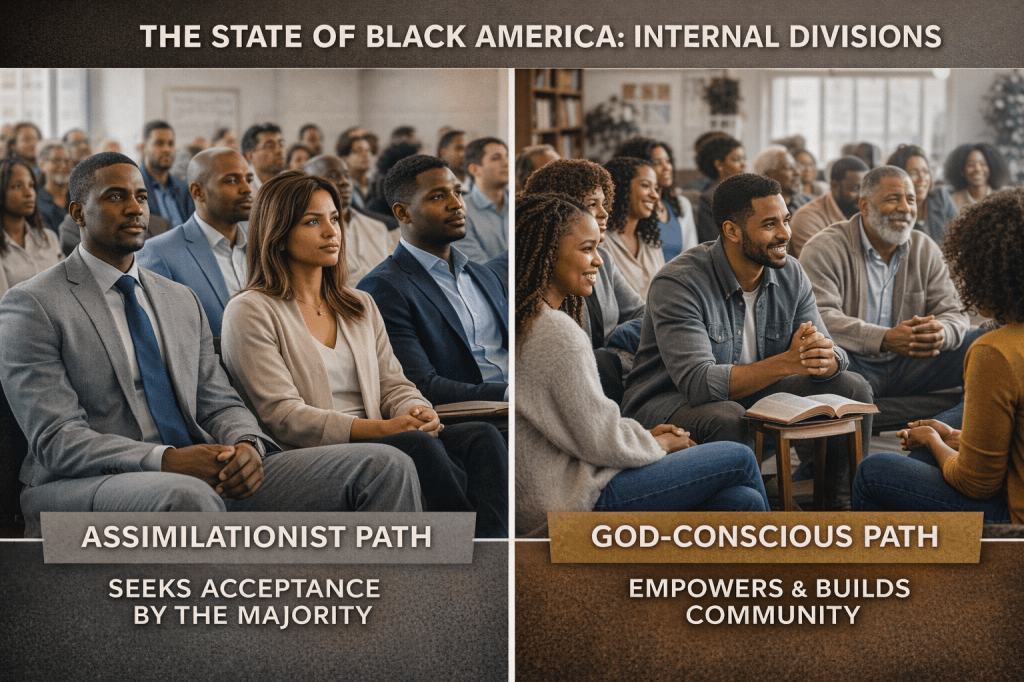
Throughout history, oppressed communities have wrestled with two primary survival responses: assimilation into the dominant power structure or resistance through identity preservation and collective empowerment. Within the African American experience in the United States, this tension has manifested in visible ideological and behavioral distinctions shaped by slavery, segregation, systemic racism, and theological interpretation.

The legacy of American chattel slavery created not only economic devastation but psychological fractures. Scholars such as Frantz Fanon (1967) argued that colonized people often internalize the worldview of the colonizer as a survival mechanism. This internalization can result in identification with the dominant culture as a means of perceived safety or advancement.

In the American context, the character “Uncle Tom,” from Harriet Beecher Stowe’s novel Uncle Tom’s Cabin, became a cultural symbol—though often misinterpreted—of perceived submission to white authority. Over time, the term evolved into a pejorative label describing individuals believed to prioritize white approval over communal solidarity.

Assimilation, however, must be examined sociologically rather than emotionally. Sociologist W.E.B. Du Bois described “double consciousness” as the tension Black Americans feel between their African heritage and American citizenship (Du Bois, 1903). For some, minimizing racial conflict or denying systemic racism is not necessarily ignorance but an adaptation strategy shaped by generational trauma.

Research in racial identity development theory, particularly by William E. Cross Jr., shows that Black identity formation progresses through stages. Some individuals remain in earlier phases characterized by assimilationist leanings or a preference for proximity to dominant culture standards.

Internalized racism, defined as the acceptance of societal beliefs about Black inferiority, has been documented extensively in psychological literature (Pyke, 2010). These dynamics often manifest in beauty standards, speech patterns, cultural preferences, and political alignments.

At the same time, it is overly simplistic to categorize individuals as entirely unaware of racism. Many who emphasize cross-racial harmony may genuinely believe that integration and meritocracy are viable pathways toward equality.

Conversely, there exists another path rooted in cultural preservation, spiritual consciousness, and collective empowerment. This path emphasizes group solidarity, historical awareness, and theological identity.

The Black church historically functioned as the epicenter of resistance and social organization. Leaders such as Martin Luther King Jr. articulated liberation through Christian ethics grounded in agape love and justice.

Similarly, figures like Malcolm X emphasized self-respect, self-defense, and psychological decolonization. Though their methods differed, both leaders promoted dignity and communal uplift.

Theologically, many Black faith traditions interpret biblical narratives as parallel to the African American experience. The Exodus story and passages like Deuteronomy 28 have been understood as frameworks for interpreting suffering and covenant identity.

God-conscious empowerment emphasizes spiritual rebirth alongside cultural restoration. It teaches that liberation is not merely political but moral and spiritual.

Community builders focus on economic cooperation, educational advancement, and intergenerational teaching. The philosophy echoes the principles of collective economics articulated by Marcus Garvey and the Universal Negro Improvement Association.

Intra-community conflict, however, often undermines these efforts. Social dominance theory suggests marginalized groups can replicate hierarchical thinking internally (Sidanius & Pratto, 1999).

The call for unity does not mean uniformity. It requires shared goals centered on dignity, spiritual awareness, and structural progress.

Teaching children cultural literacy and historical truth is central to empowerment. Scholars like Carter G. Woodson argued that miseducation perpetuates subjugation.

Spiritual formation also plays a role. Biblical anthropology emphasizes identity in both flesh and spirit, reinforcing inherent worth beyond societal labels.

God-conscious frameworks encourage reconciliation within the community before external transformation.

This perspective rejects self-hatred while also avoiding racial supremacism. It affirms dignity without dehumanizing others.

Economic empowerment initiatives, cooperative models, and entrepreneurship align with this restorative vision.

Psychologically, collective pride correlates with higher resilience and well-being among marginalized populations (Neblett et al., 2012).

Faith-based empowerment movements often stress repentance from destructive behaviors such as internal violence, colorism, and fragmentation.

The metaphor of “needles in a haystack” captures the rarity of individuals fully committed to spiritual discipline and communal sacrifice.

Such builders prioritize generational legacy over short-term validation.

They recognize racism as structural rather than merely interpersonal, supported by scholarship from Michelle Alexander in The New Jim Crow.

At the same time, they resist fatalism. Faith sustains hope amid systemic obstacles.

Christ-centered identity reframes suffering through redemptive theology rather than victimhood.

Recognizing oneself as chosen does not imply superiority but covenant responsibility.

The call to stop fighting one another echoes both biblical admonition and sociological necessity.

Group progress historically required strategic unity, as evidenced during the Civil Rights Movement.

Yet even within movements, ideological differences persisted, illustrating the complexity of Black thought.

Ultimately, these two paths are not fixed identities but developmental positions shaped by history, psychology, and theology.

Healing requires compassion, education, and spiritual maturity.

Rather than condemnation, transformation must be the goal.

The future of Black empowerment lies not in caricatures but in consciousness, character, and Christ-centered community building.


References

Alexander, M. (2010). The New Jim Crow.

Cross, W. E. (1991). Shades of Black: Diversity in African-American Identity.

Du Bois, W. E. B. (1903). The Souls of Black Folk.

Fanon, F. (1967). Black Skin, White Masks.

Neblett, E. W., et al. (2012). Racial identity and psychological health.

Pyke, K. (2010). What is internalized racial oppression? Sociological Perspectives, 53(4), 551–572.

Sidanius, J., & Pratto, F. (1999). Social Dominance: An Intergroup Theory of Social Hierarchy and Oppression.

Woodson, C. G. (1933). The Mis-Education of the Negro.

The Journey to God: Spiritual Habits that Transform Your Life.

Developing a deep and meaningful relationship with God requires intentionality, discipline, and spiritual focus. The Christian life is often described as a journey—a process of growth, transformation, and alignment with divine purpose (Philippians 3:12–14, KJV). Spiritual habits, when practiced consistently, form the foundation of this journey, shaping character, strengthening faith, and fostering intimacy with the Lord.

Prayer is one of the most fundamental habits for spiritual transformation. Through prayer, believers communicate with God, express gratitude, seek guidance, and intercede for others (1 Thessalonians 5:16–18). Consistent prayer cultivates dependence on God and trains the heart to align with His will. The practice of private, uninterrupted prayer develops patience, self-discipline, and sensitivity to the Holy Spirit (Matthew 6:6).

Scripture study is another essential habit. The Bible is described as “the sword of the Spirit” and a lamp to guide the believer’s path (Ephesians 6:17; Psalm 119:105). Daily engagement with Scripture allows the mind to be renewed (Romans 12:2), equips believers for spiritual battles, and teaches wisdom, discernment, and godly living. Meditating on God’s Word fosters internal transformation by embedding divine truth in thought patterns and behavior.

Worship and praise—both private and corporate—help believers experience God’s presence and cultivate gratitude. Worship is not limited to music but includes acts of obedience, service, and thanksgiving (Psalm 100:2; Colossians 3:16). Regular praise reorients the heart away from self-reliance and toward recognition of God’s sovereignty. It strengthens faith, increases joy, and fosters a sense of spiritual community.

Fasting and self-discipline play a critical role in focusing the believer’s spiritual energy. Fasting is a biblical practice for humbling oneself, seeking clarity, and deepening reliance on God (Matthew 4:1–2; Isaiah 58:6). By denying the flesh, believers cultivate spiritual sensitivity, patience, and resilience. Self-discipline in other areas, such as controlling speech, thoughts, and desires, reinforces obedience to God and encourages a Christ-centered life (1 Corinthians 9:27).

Service and acts of love are practical habits that transform the believer’s heart while honoring God. Serving others reflects Christ’s love and fulfills the command to love one’s neighbor (Matthew 22:37–39; James 1:27). Regular acts of service cultivate humility, empathy, and a broader perspective that transcends self-interest. Spiritual growth is inseparable from outward expressions of God’s love in action.

Fellowship and accountability with other believers are also crucial. The Bible emphasizes the importance of mutual encouragement and correction in spiritual communities (Hebrews 10:24–25; Proverbs 27:17). Consistent fellowship helps believers stay steadfast, gain wisdom, and receive guidance from mature Christians. Accountability encourages integrity, reduces spiritual drift, and reinforces the application of spiritual habits in daily life.

Finally, gratitude and reflection are habits that nurture a continuous awareness of God’s presence. Reflecting on His faithfulness and recording answered prayers or spiritual lessons can strengthen faith during trials and maintain perspective in success (1 Thessalonians 5:18; Psalm 77:11–12). Gratitude reorients the heart toward God and fosters joy, peace, and contentment.

In essence, the journey to God is not a single event but a lifelong process of intentional spiritual practice. By cultivating prayer, Scripture study, worship, fasting, service, fellowship, and gratitude, believers align their hearts and minds with God’s will. These spiritual habits transform character, deepen intimacy with the Lord, and empower the believer to navigate life’s challenges with wisdom, faith, and perseverance. The Christian journey is a sacred rhythm of learning, growing, and reflecting God’s love in every aspect of life.


References

Alexander, T. D. (2001). 1 & 2 Timothy and Titus: An exegetical and theological exposition of Holy Scripture. B&H Publishing.

Dever, M. (2012). A display of God’s glory: The beauty of living the gospel. Crossway.

Foster, R. (1998). Celebration of discipline: The path to spiritual growth. HarperCollins.

Keller, T. (2012). Every good endeavor: Connecting your work to God’s work. Dutton.

Willard, D. (2002). Renovation of the heart: Putting on the character of Christ. NavPress.

The Holy Bible, King James Version. (1611/2017). Cambridge University Press.

The Male Files: From Enslavement to Empowerment.

The psychological and spiritual formation of Black masculinity cannot be understood apart from the historical reality of enslavement and its ongoing consequences in modern society. Chattel slavery in the Americas was not merely an economic institution, but a comprehensive system of psychological domination designed to dismantle identity, authority, and manhood itself. Black men were systematically stripped of autonomy, kinship power, literacy, and bodily sovereignty, reducing their existence to labor and control rather than personhood created in the image of God (Patterson, 1982).

Biblically, this condition mirrors the logic of bondage found throughout Scripture. The enslavement of the Israelites in Egypt reveals how oppression functions to erase memory, dignity, and covenant identity (Exodus 1). Pharaoh’s strategy—forced labor, family disruption, and the targeting of male offspring—parallels the transatlantic slave system and its destruction of Black male lineage. Yet the biblical narrative affirms that bondage is never God’s final word: “I have surely seen the affliction of my people… and I am come down to deliver them” (Exodus 3:7–8, KJV).

Psychologically, slavery produced what sociologists describe as social death—the erasure of ancestry, honor, and recognized humanity (Patterson, 1982). For Black men, this resulted in intergenerational trauma expressed through emotional suppression, hypervigilance, fractured fatherhood, and conflicted identity formation. Contemporary trauma research confirms that the psychological effects of historical violence persist through epigenetic stress responses and inherited survival behaviors (DeGruy, 2005; Yehuda et al., 2016). These conditions continue to shape the mind of the modern Black man.

Post-emancipation systems such as Jim Crow, racial terror lynching, convict leasing, and mass incarceration functioned as re-enslavement mechanisms. As Alexander (2010) argues, the modern prison system operates as a racialized structure of social control, disproportionately criminalizing Black male existence. Sociologically, Black masculinity has been constructed as threatening, hypersexual, and deviant—narratives engineered to justify surveillance, economic exclusion, and institutional neglect. These scripts shape how Black men see themselves and how society perceives them.

At the same time, the modern man faces a broader psychological crisis. Western masculinity is increasingly defined by emotional suppression, performative strength, sexual conquest, and economic dominance—what Connell (2005) terms hegemonic masculinity. Psychological studies show that these norms contribute to high rates of depression, anxiety, substance abuse, and suicide among men (APA, 2018). For Black men, these struggles are intensified by racial stress, identity fragmentation, and what scholars call racial battle fatigue (Smith et al., 2007).

Digitally, the modern male psyche is further shaped by social media, pornography, and hyper-visual culture. Men are conditioned to measure self-worth through appearance, sexual access, and economic performance. This creates a fragmented identity between the authentic self and the performed self—a phenomenon aligned with Goffman’s (1959) theory of social performance. The mind becomes overstimulated but undernourished, informed by algorithms rather than wisdom.

Biblically, however, the mind of man is framed through spiritual orientation rather than cultural conditioning. Scripture teaches that psychological transformation is inseparable from spiritual renewal: “Be not conformed to this world: but be ye transformed by the renewing of your mind” (Romans 12:2, KJV). The biblical man is called to cultivate wisdom, emotional discipline, humility, and moral clarity rather than dominance or ego (Proverbs 4:23; Galatians 5:22–23).

Christ offers the ultimate model of liberated masculinity. He rejects the world’s archetype of man as conqueror and instead embodies man as servant, healer, and sacrificial leader (Mark 10:45). His emotional expressiveness—grief, compassion, vulnerability—directly challenges modern masculinity’s emotional repression. In Christ, power is redefined as self-mastery, and leadership as moral responsibility: “He that ruleth his spirit is better than he that taketh a city” (Proverbs 16:32).

Empowerment, therefore, must be understood as both psychological and spiritual restoration. Psychologically, it involves reclaiming agency, emotional literacy, and coherent identity beyond imposed stereotypes (hooks, 2004). Spiritually, it requires deliverance from internalized oppression and alignment with divine purpose: “The righteous are bold as a lion” (Proverbs 28:1). Empowerment is not domination over others, but governance of the self.

Ultimately, From Enslavement to Empowerment – The Mind of Modern Man argues that Black male liberation is an unfinished sacred project. It requires historical truth, trauma healing, spiritual renewal, and structural justice. The journey from chains to consciousness, from captivity to clarity, is not merely political—it is theological and psychological. The modern Black man’s crisis is not a lack of strength, but a loss of meaning. His restoration lies not in external validation, but in internal alignment—between history, mind, soul, and God.


References

Alexander, M. (2010). The new Jim Crow: Mass incarceration in the age of colorblindness. The New Press.

American Psychological Association. (2018). Guidelines for psychological practice with boys and men. APA.

Connell, R. W. (2005). Masculinities (2nd ed.). University of California Press.

DeGruy, J. (2005). Post traumatic slave syndrome: America’s legacy of enduring injury and healing. Uptone Press.

Goffman, E. (1959). The presentation of self in everyday life. Anchor Books.

hooks, b. (2004). We real cool: Black men and masculinity. Routledge.

Patterson, O. (1982). Slavery and social death: A comparative study. Harvard University Press.

Smith, W. A., Hung, M., & Franklin, J. D. (2007). Racial battle fatigue and the miseducation of Black men. Journal of Black Studies, 37(4), 551–578.

Yehuda, R., Daskalakis, N. P., Bierer, L. M., Bader, H. N., Klengel, T., Holsboer, F., & Binder, E. B. (2016). Holocaust exposure induced intergenerational effects on FKBP5 methylation. Biological Psychiatry, 80(5), 372–380.

The Holy Bible, King James Version. (1611/2017). Cambridge University Press.

Girl Talk Series: The Matters of a Broken Heart.

This photograph is the property of its respective owner. No copyright infringement intended

Ladies – The matters of the heart are among the most sacred and sensitive aspects of a woman’s spiritual and emotional life. Many women carry wounds from abandonment, betrayal, rejection, and unmet expectations, often wondering if a man will ever truly love them in a way that heals rather than harms. Yet Scripture teaches that before any man can love us well, we must first understand the nature of God’s love, because all healthy love flows from Him. This series is an encouragement to women to seek not just romance, but restoration, wholeness, and divine alignment with a man who has a heart after God.

A woman gets over a broken heart not by erasing the pain, but by healing through it with truth, time, and transformation. Healing is not denial; it is intentional restoration of the soul, the mind, and the spirit. Biblically and psychologically, heartbreak is a form of grief—you are mourning not just a person, but a dream, an attachment, and a future you imagined. That loss must be processed, not suppressed.

First, she must allow herself to grieve honestly. Many women rush to “be strong” and pretend they are fine, but unprocessed pain becomes emotional scars. Scripture reminds us that even Jesus wept (John 11:35). Tears are not weakness; they are release. A broken heart needs permission to feel before it can heal.

Second, she must detach emotionally and spiritually from what hurt her. This includes cutting unhealthy soul ties, limiting contact, and resisting the urge to revisit memories that reopen wounds. From a psychological standpoint, attachment bonds activate the same neural pathways as addiction—so withdrawal is real. Healing requires space (Proverbs 4:23).

Third, she must rebuild her identity outside of the relationship. Many women lose themselves in love—adopting someone else’s needs, habits, and emotional rhythms. Heartbreak forces a woman to ask: Who am I without him? Healing begins when she reconnects to her own purpose, gifts, and calling (Jeremiah 29:11).

Fourth, she must release forgiveness, not for his benefit, but for her freedom. Forgiveness is not excusing behavior—it is choosing not to let pain control your future. Unforgiveness keeps emotional ties alive. Forgiveness breaks the psychological loop of replaying the trauma (Ephesians 4:31–32).

Fifth, she must renew her mind. The thoughts that follow heartbreak are often distorted: I wasn’t enough. I’ll never love again. Everyone leaves. These are trauma-based beliefs, not truth. Scripture teaches, “Be ye transformed by the renewing of your mind” (Romans 12:2). Healing requires replacing lies with reality.

Sixth, she must return to God as her emotional source. Many women unknowingly turn men into emotional idols—looking to them for validation, security, and self-worth. When the relationship ends, so does the emotional foundation. God restores the heart by becoming the primary source of love again (Psalm 62:5).

Seventh, she must set new boundaries. Heartbreak often reveals patterns—choosing unavailable men, ignoring red flags, over-giving, or tolerating disrespect. Growth comes when pain becomes wisdom. Boundaries are not walls; they are filters for future peace.

Eighth, she must move her body and environment. Trauma is stored in the nervous system, not just the mind. Exercise, sunlight, walking, cleaning, and changing surroundings help regulate emotions and reduce depressive symptoms. Healing is physiological as well as spiritual.

Ninth, she must stop romanticizing the past. The brain tends to remember the good and minimize the harm. This is called selective memory bias. Healing requires remembering the truth, not the fantasy. If it was healthy, it wouldn’t have broken her.

Tenth, she must stop seeking closure from the person who broke her. Closure comes from within, not from conversations, apologies, or explanations. A person who couldn’t love you properly cannot heal what they damaged.

Eleventh, she must invest in supportive relationships—friends, mentors, counselors, and faith communities. Isolation intensifies heartbreak. Safe people provide perspective, accountability, and emotional grounding (Proverbs 11:14).

Twelfth, she must grieve the illusion, not just the person. Many women are hurt more by losing the idea of what could have been than the actual man. Healing means accepting reality, not chasing potential.

Thirteenth, she must reclaim her self-worth. Heartbreak often damages confidence and desirability. But worth does not come from being chosen—it comes from being created by God. “I am fearfully and wonderfully made” (Psalm 139:14).

Fourteenth, she must learn to be alone without being lonely. Solitude builds emotional independence. A healed woman does not fear being alone—she fears being emotionally unsafe.

Fifteenth, she must stop numbing the pain through rebound relationships, substances, overworking, or distractions. Avoidance delays healing. Pain that is numbed returns stronger.

Sixteenth, she must develop emotional discernment. Not every man who is kind is sent by God. Not every connection is alignment. Discernment protects future peace more than attraction ever could.

Seventeenth, she must rewrite the narrative. Heartbreak is not proof she failed—it is evidence she outgrew what could not sustain her. Many relationships end not because you were unlovable, but because you were becoming someone incompatible with dysfunction.

Eighteenth, she must trust time, not urgency. Healing is not linear. Some days feel strong, others feel fragile. This is normal. The nervous system needs time to recalibrate.

Nineteenth, she must believe love is still possible without desperation. A healed woman does not chase love—she attracts it through wholeness. She no longer needs to be chosen; she chooses wisely.

Finally, she must understand this truth: A broken heart is not the end of her story—it is the beginning of her awakening. Pain reveals where she gave too much, tolerated too little, and expected God from a human. When the heart heals, it does not become harder—it becomes wiser, softer, and spiritually stronger.

A woman does not get over a broken heart—she grows through it and emerges as a version of herself who no longer abandons her own needs for someone else’s love.

A broken heart is not merely emotional pain; it is a spiritual injury that affects self-worth, identity, and trust. The Bible acknowledges this reality when it says, “The Lord is nigh unto them that are of a broken heart; and saveth such as be of a contrite spirit” (Psalm 34:18, KJV). God does not dismiss heartbreak—He draws near to it. Healing begins when a woman allows God to mend what people have damaged.

Many women ask, Will he heal my broken heart? Will he make me feel special? Will he love me endlessly? These are not shallow questions; they reflect a deep longing to be seen, cherished, and emotionally safe. However, no man can replace God as the ultimate healer. A man can support the healing process, but only God can restore the soul (Psalm 23:3). When a woman expects a man to do what only God can do, she risks entering relationships rooted in emotional dependency rather than spiritual health.

God’s love is fundamentally different from human love. Scripture defines it as agape love—a selfless, unconditional, sacrificial love that seeks the good of the other (1 Corinthians 13:4–7). God’s love is patient, kind, not abusive, not manipulative, not temporary, and not based on performance. Unlike human affection, God’s love does not fluctuate with mood, appearance, or mistakes (Romans 8:38–39).

A major question many women carry is, How will I know if he really loves me? Biblical love is not proven through words, gifts, or sexual chemistry—it is proven through consistent character, spiritual leadership, protection, and sacrifice (Ephesians 5:25). A man who truly loves you will not rush your body while neglecting your soul. He will desire your holiness more than your availability.

The Bible is clear about sexual boundaries: no fornication. “Flee fornication” (1 Corinthians 6:18) is not a suggestion; it is a command. God restricts sex to marriage not to punish women, but to protect their emotional, spiritual, and psychological well-being. Sex creates soul ties, and when formed outside of covenant, those ties often produce trauma, confusion, and delayed healing.

One of the most dangerous traps is mistaking lust for love. Lust is driven by desire for the body; love is driven by commitment to the soul. Many women are loved physically but not emotionally, desired sexually but not honored spiritually. A godly man will not reduce you to your looks—he will recognize you as a daughter of God, not an object of pleasure.

The Bible warns, “The heart is deceitful above all things, and desperately wicked: who can know it?” (Jeremiah 17:9). This verse reminds women not to rely solely on feelings when choosing a partner. Emotions can lie, attraction can blind, and chemistry can override discernment. Wisdom comes from the Spirit, not from butterflies.

A godly man is defined not by charm, income, or physical appearance, but by character and integrity. He fears God, honors women, keeps his word, practices self-control, and walks in humility (Proverbs 1:7; Galatians 5:22–23). He does not manipulate, ghost, exploit, or emotionally withhold.

Integrity means a man is the same in private as he is in public. He does not perform righteousness; he lives it. His lifestyle aligns with his language. His actions match his promises. He does not lead with ego but with accountability and spiritual discipline.

The Bible also describes a godly man as a provider, not just financially, but emotionally, spiritually, and intellectually. “If any provide not for his own… he hath denied the faith” (1 Timothy 5:8). Provision includes money, yes—but also wisdom, stability, protection, and leadership. A man who cannot manage his own life cannot lead a woman’s heart.

A man heals a broken heart not by being perfect, but by being safe. Safety means emotional consistency, respect for boundaries, honest communication, and spiritual covering. Healing happens when a woman is no longer anxious about abandonment, betrayal, or emotional games.

A healed relationship feels peaceful, not chaotic. It feels secure, not confusing. God is not the author of emotional torment. “For God is not the author of confusion, but of peace” (1 Corinthians 14:33). If a man brings anxiety, instability, and constant doubt, he is not sent by God.

True love does not rush intimacy; it cultivates trust. It allows space for healing, growth, prayer, and self-discovery. A godly man will never pressure a woman to compromise her values to keep him.

Many women secretly ask, Does he want me for my looks? Physical attraction is natural, but it must never be the foundation. Beauty fades, bodies change, but character sustains love (Proverbs 31:30). A man who only praises your appearance will leave when it no longer satisfies his ego.

God’s intention for love is not consumption but covenant. Covenant means commitment, sacrifice, responsibility, and accountability before God. Love is not about being chosen—it is about being covered.

The ultimate goal of dating is not validation, marriage, or companionship—it is alignment with God’s will. A relationship should bring you closer to God, not farther from Him. If you have to disobey God to keep a man, he is not your blessing.

Healing also requires women to stop romanticizing broken men. A woman is not called to be a therapist, savior, or rehabilitation center. You are called to be a daughter of God, not a fixer of wounded masculinity.

A man with a heart of God will pray with you, not prey on you. He will protect your purity, not exploit your vulnerability. He will value your peace more than his pleasure.

In the end, the greatest love story is not between a woman and a man—it is between a woman and God. When God heals the heart first, He attracts the right partner later. Wholeness precedes union. Healing comes before romance.

The true question is not Will he love me endlessly? but Am I rooted in the One whose love never ends? Because when God fills the heart, no man can break it again.


References

The Holy Bible, King James Version. (1769/2017). Cambridge University Press.

Cloud, H., & Townsend, J. (2002). Boundaries in dating: How healthy choices grow healthy relationships. Zondervan.

Chapman, G. (2010). The five love languages: The secret to love that lasts. Northfield Publishing.

Lewis, C. S. (1960). The four loves. Harcourt, Brace & World.

Peck, M. S. (1978). The road less traveled: A new psychology of love, traditional values, and spiritual growth. Simon & Schuster.

Piper, J. (2012). This momentary marriage: A parable of permanence. Crossway.

Stanley, A. (2011). The new rules for love, sex, and dating. Zondervan.

Worthington, E. L. (2005). Relationship repair: Healing the wounds of a troubled marriage. InterVarsity Press.

Wilkinson, B. (2000). The prayer of Jabez. Multnomah Publishers.

Smith, C. (2003). Soul searching: The religious and spiritual lives of American teenagers. Oxford University Press.

The Male Files: The Truth About Men — No Filter.

Photo by Ali Drabo on Pexels.com

The truth about men is not always easy to say, but it is necessary. Men are often painted in extremes—either as stoic protectors who never feel or as reckless pursuers of sex and power. But in reality, men live in a space where strength collides with vulnerability, and where desires often wrestle against fears. No filter means speaking plainly about what men deal with, even if it’s uncomfortable.

Sex is one of the biggest areas where men are misunderstood. For many, sex is not just about physical pleasure—it is deeply tied to identity, validation, and self-worth. Men often measure their value by their ability to attract women, perform sexually, and maintain dominance. This pressure distorts healthy intimacy into performance, creating cycles of insecurity when men fall short.

At the root of this is fear. Many men fear rejection more than they fear failure. Rejection strikes at a man’s sense of masculinity, raising questions about whether he is desirable or enough. Psychology explains this through self-determination theory: humans crave competence, relatedness, and autonomy (Ryan & Deci, 2000). When men feel rejected, competence and relatedness are shattered, leaving insecurity behind.

Men also fear vulnerability. Society trains boys to suppress emotions, equating tears with weakness. As Proverbs 29:25 (KJV) warns, “The fear of man bringeth a snare.” This cultural snare traps men in silence, unable to express pain. In relationships, this silence becomes misinterpreted as indifference, when in reality it is fear of exposure.

Insecurity about provision is another deep truth. Many men are raised to believe their worth rests in financial success. If they cannot provide, they often feel emasculated. Studies show that unemployment or underemployment strongly correlates with depression in men, not just because of economic loss but because of an identity crisis (Wilkinson, 2001).

Sexual performance anxiety also weighs heavily. Men fear being inadequate in bed, as performance has been culturally tied to masculinity. Failure in this area can cause shame, silence, and avoidance. This creates a paradox: men crave sexual intimacy but fear it because it risks exposing their insecurities.

Pornography intensifies these struggles. Men are conditioned to view sex as conquest, comparing themselves to exaggerated performances on screen. This distorts expectations, leaving many dissatisfied with reality and unprepared for real intimacy. Proverbs 6:25 (KJV) warns against lustful illusions: “Lust not after her beauty in thine heart; neither let her take thee with her eyelids.”

Commitment is another area clouded by fear. Many men desire stability but fear losing freedom. This creates tension between wanting a lifelong partner and clinging to independence. Psychology calls this avoidant attachment, where closeness feels threatening because it means potential loss (Mikulincer & Shaver, 2007).

For others, commitment is frightening because it exposes the possibility of failure. Divorce, heartbreak, and betrayal leave scars, teaching men that intimacy is dangerous. Instead of healing, many retreat into casual sex or emotional withdrawal. It feels safer, but it leaves them lonely.

Trust is a battlefield for men. Some carry deep wounds from betrayal—whether from mothers, past lovers, or absent fathers. These betrayals create a reluctance to fully invest in women, out of fear of being hurt again. As a result, many men love halfway, holding back pieces of themselves.

Ego is another powerful force. Men often protect their egos with silence, pride, or anger. To admit fear feels like weakness, so many hide behind bravado. But as the Bible reminds us in 2 Corinthians 12:9 (KJV), “My strength is made perfect in weakness.” True strength for men lies not in hiding fears but in owning them.

Friendship is another misunderstood need. Men crave brotherhood, but modern masculinity often isolates them. Without trusted male friends, they place all emotional needs on women, which strains relationships. Research confirms that men with strong male friendships experience greater mental health and marital satisfaction (Mahalik et al., 2003).

Fatherhood also reveals deep insecurities. Many men wrestle with the fear of becoming the same fathers who wounded them—or of failing their children altogether. This fear pushes some into abandonment, while others overcompensate through over-discipline. The balance is difficult, especially when men themselves were never nurtured.

Spiritually, men wrestle with temptation. The struggle against lust, pride, and greed is ongoing. Paul describes this inner battle in Romans 7:19 (KJV): “For the good that I would I do not: but the evil which I would not, that I do.” Men know right from wrong but often find themselves doing the very things they despise.

Communication is another truth. Men are often labeled as emotionally unavailable, but many simply lack the vocabulary for vulnerability. They were never taught to name feelings beyond anger, so frustration becomes the default. This miscommunication fuels conflict in relationships, leaving women feeling unloved while men feel misunderstood.

Financial insecurity intersects with relational fear. Men fear being loved only for what they provide. This suspicion creates defensiveness, leading them to test women’s loyalty. Unfortunately, this defensive posture can drive away genuine partners, reinforcing their fears.

Another truth is men’s longing for respect. Ephesians 5:33 (KJV) highlights this dynamic: “Let the wife see that she reverence her husband.” Men crave respect as deeply as women crave love. When men feel disrespected, they withdraw, often silently, creating distance in relationships.

Men also struggle with aging. Gray hair, slowing bodies, and decreased strength remind men of mortality. Fear of losing virility leads some to chase younger women or cling to shallow displays of masculinity. Others grow resentful, fearing they are no longer attractive or useful.

Another hidden truth is men’s battle with mental health. Depression in men often manifests as anger, workaholism, or substance abuse. Yet men are less likely to seek help, fearing stigma. This silent suffering devastates relationships, as unaddressed pain spills over into destructive behavior.

Yet, despite these fears and insecurities, men deeply desire love. They may not always show it in words, but most crave companionship, partnership, and legacy. This truth cuts through the myths: men want intimacy, not just sex, but fear often distorts how they pursue it.

The key to healing lies in honesty. Men must learn to admit their weaknesses without shame. Vulnerability opens the door to authentic connection. When men speak plainly about their struggles, they discover they are not alone.

Women, too, play a role in this process. Patience, respect, and encouragement help men lower their defenses. But men must also take responsibility—learning to communicate, seeking therapy when needed, and grounding their worth not in sex or money but in God’s design.

Spiritually, men find strength when they root their identity in Christ. 1 Corinthians 16:13 (KJV) says, “Watch ye, stand fast in the faith, quit you like men, be strong.” This strength is not bravado but courage rooted in faith. True manhood is not about hiding fear but walking through it with integrity.

The truth about men, no filter, is that they are human. They fear, they fail, they hurt, and they love. Behind the masks of pride and performance lies a deep longing to be seen, respected, and loved for who they are. The more men embrace this truth, the more honest and whole their relationships become.


References

  • Mahalik, J. R., Burns, S. M., & Syzdek, M. (2003). Masculinity and perceived normative health behaviors as predictors of men’s health behaviors. Social Science & Medicine, 57(8), 1559–1569.
  • Mikulincer, M., & Shaver, P. R. (2007). Attachment in adulthood: Structure, dynamics, and change. Guilford Press.
  • Ryan, R. M., & Deci, E. L. (2000). Self-determination theory and the facilitation of intrinsic motivation, social development, and well-being. American Psychologist, 55(1), 68–78.
  • Wilkinson, R. (2001). Unemployment and health: A review. Public Health, 115(3), 153–160.
  • The Holy Bible, King James Version.

Your Earthly Hunger for Connection

Human beings are inherently social creatures, designed to seek connection and belonging from birth. From families to communities, culture, and friendships, the need to connect is deeply ingrained in our nature and essential for survival, growth, and emotional well-being.

The desire to belong is not merely social but psychological. Abraham Maslow identified belonging as a fundamental human need, central to motivation, self-esteem, and identity formation. Without connection, individuals often experience isolation, anxiety, and diminished purpose.

Connection provides validation. When people feel seen, heard, and understood, their sense of worth and self-efficacy grows. Conversely, disconnection can lead to feelings of inadequacy, loneliness, and existential unrest.

In modern society, the avenues for connection have multiplied. Social media, virtual communities, and global networks allow unprecedented interaction, yet they often substitute superficial engagement for deep, meaningful bonds, leaving many still yearning for authentic connection.

Spiritual traditions throughout history recognize the hunger for connection as more than social—it is also sacred. From communal worship to shared rituals, humans seek to connect with something greater than themselves, whether God, nature, or collective purpose.

The longing to belong often manifests in cultural expression. Music, art, literature, and storytelling serve as mediums through which people resonate with shared experiences, creating a sense of unity across time and space.

In interpersonal relationships, the desire to connect drives friendship, romance, mentorship, and familial bonds. Emotional intimacy, trust, and vulnerability are the cornerstones of deep human connection, allowing individuals to feel truly seen and valued.

Belonging influences behavior. People often conform to social norms, adopt group values, or seek validation to maintain inclusion, highlighting both the power and the potential risk of the human need to connect.

Community provides resilience. Individuals embedded in supportive networks are better able to navigate adversity, reduce stress, and maintain mental health, illustrating that connection is not only emotional but protective.

The internet and social media offer connection but can also amplify isolation. Online interactions may provide quantity of connection without quality, leaving individuals with many contacts but few genuine relationships.

Human connection has a biological basis. Oxytocin, dopamine, and other neurochemicals are released during social interaction, reinforcing attachment, empathy, and the pleasure of shared experiences.

Spiritual connection often complements social connection. Practices like prayer, meditation, or communal worship provide a sense of purpose, guidance, and belonging that transcends earthly interactions.

Connection is central to identity. People often define themselves through relationships, community roles, and shared values, highlighting that belonging is intertwined with self-concept and purpose.

Loneliness is increasingly recognized as a public health concern. Chronic disconnection is linked to depression, anxiety, heart disease, and even premature mortality, underscoring the vital need for meaningful bonds.

Connection can be cultivated intentionally. Practices such as active listening, empathy, shared experiences, and community involvement strengthen relationships and fulfill the innate human need to belong.

Family remains the primary arena for connection. Childhood attachment, parental support, and sibling relationships provide the first foundation for understanding love, trust, and belonging.

Friendships and mentorship offer complementary spaces for growth. Choosing friends and mentors who align with one’s values nurtures emotional support, personal development, and a sense of mutual belonging.

Romantic partnerships deepen the need for intimacy and belonging. Love that respects individuality while fostering mutual growth satisfies both emotional and spiritual hungers for connection.

Human connection is dynamic, requiring effort, empathy, and reciprocity. Relationships flourish when both parties invest time, attention, and care, reinforcing the mutual fulfillment of the desire to belong.

Ultimately, the earthly hunger for connection points toward the eternal. While social bonds satisfy immediate needs, the deepest longings are often spiritual, calling humans to connect with God, divine purpose, and the greater story of existence.

References
Maslow, A. H. (1943). A theory of human motivation. Psychological Review, 50(4), 370–396.
Baumeister, R. F., & Leary, M. R. (1995). The need to belong: Desire for interpersonal attachments as a fundamental human motivation. Psychological Bulletin, 117(3), 497–529.
Cacioppo, J. T., & Patrick, W. (2008). Loneliness: Human nature and the need for social connection. W. W. Norton & Company.
Putnam, R. D. (2000). Bowling alone: The collapse and revival of American community. Simon & Schuster.
Keller, T. (2017). The meaning of marriage: Facing the complexities of commitment with the wisdom of God. Dutton.

The Onyx Stone: A Family Affair — Joseph and His Brothers.

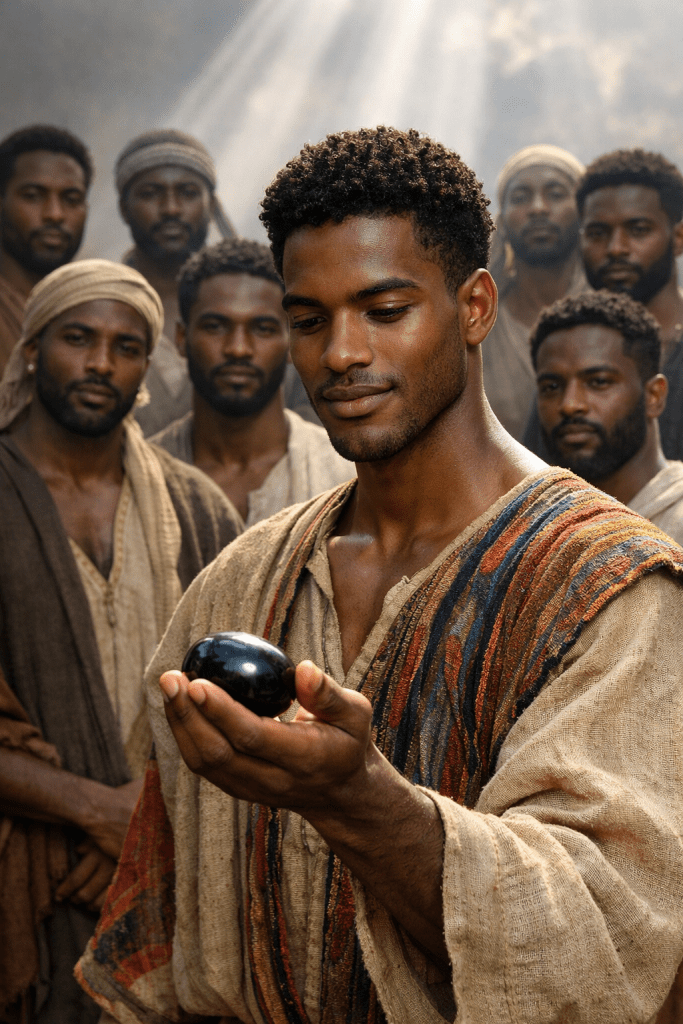
Onyx, dark as the midnight sky yet polished with hidden light,
a stone of mystery shaped by time and pressure,
a gem that carries both beauty and burden,
whispering of destinies forged through suffering,
and of souls refined in the fire of betrayal.

Onyx holds deep symbolic meaning in the biblical tradition, representing endurance, spiritual depth, and divine remembrance. In Scripture, onyx is one of the stones set in the high priest’s breastplate, engraved with the names of the tribes of Israel, signifying that each tribe was carried before God in sacred memory.

Joseph, the eleventh son of Jacob and the firstborn of Rachel, stands as one of the most compelling figures among the twelve tribes of Israel. His life narrative is not merely historical but theological, illustrating divine providence, generational conflict, and the mystery of chosenness within a fractured family system.

According to rabbinic and later symbolic traditions, Joseph is associated with the onyx stone, reflecting both his dark trials and radiant destiny. Onyx becomes a metaphor for Joseph’s life—polished through suffering, yet ultimately exalted through divine purpose.

Joseph’s story begins with favor, as he is given the coat of many colors by his father, a garment symbolizing distinction, authority, and emotional preference. This visible sign of love ignites jealousy among his brothers, sowing the seeds of betrayal long before the act itself unfolds.

The dreams Joseph receives intensify this conflict. In his visions, the sun, moon, and stars bow before him, along with sheaves of grain belonging to his brothers. These dreams are not merely youthful imagination but prophetic revelations that foreshadow his future role as a ruler and preserver of life.

Yet divine insight does not shield Joseph from human cruelty. His brothers, consumed by envy, conspire against him, stripping him of his garment and casting him into a pit before selling him to Midianite traders for silver, effectively turning family into traffickers and blood into profit.

This act of betrayal reflects one of the Bible’s deepest moral tensions: how God’s purpose often unfolds through human sin. Joseph is innocent, yet he becomes the vessel through which divine redemption will later flow, revealing the paradox of suffering as preparation.

Joseph’s descent into Egypt marks the beginning of his transformation. Though enslaved, he maintains integrity, resisting moral compromise even when falsely accused and imprisoned. His righteousness becomes a quiet rebellion against despair.

In prison, Joseph’s gift of dream interpretation resurfaces, proving that divine calling cannot be silenced by circumstance. His spiritual insight becomes the very instrument that elevates him from prisoner to prince.

Pharaoh’s dreams of famine and abundance position Joseph as a savior figure, entrusted with authority over Egypt’s economy. He rises not by lineage but by wisdom, embodying the principle that divine favor transcends social status.

Joseph’s beauty is also noted in Scripture, described as fair in form and appearance, making him both desired and tested. His physical attractiveness parallels his spiritual calling, showing how outward beauty can coexist with inner discipline.

When famine strikes, Joseph’s brothers unknowingly come before him in search of food, fulfilling the very dreams they once mocked. Their bowing becomes not an act of submission to a man, but to the divine orchestration behind his life.

Joseph’s emotional response reveals the complexity of forgiveness. He weeps privately, torn between memory and mercy, justice and compassion. His power is not in revenge, but in restraint.

The moment of reconciliation becomes one of the Bible’s most profound theological revelations. Joseph declares that what his brothers meant for evil, God intended for good, reframing trauma as testimony.

This declaration does not erase the pain of betrayal but redeems it. Joseph becomes the preserver of the family that once sought his destruction, turning the wound into a wellspring of survival.

Onyx, in this context, becomes more than a gemstone; it is a symbol of Joseph himself—darkened by suffering, refined by pressure, and set in divine memory as part of Israel’s eternal identity.

The family affair of Joseph is not merely about sibling rivalry but about generational inheritance, divine election, and moral responsibility. His story challenges the illusion of fairness and exposes the deeper logic of providence.

Joseph’s life reveals that destiny is not destroyed by betrayal, but often activated by it. The pit becomes the passageway, the prison becomes the platform, and the wound becomes the witness.

Through Joseph, the tribe associated with onyx emerges as a testament to spiritual endurance. He becomes a living stone in the architecture of Israel’s story, bearing both the scars of rejection and the seal of divine favor.

Onyx thus stands as a sacred metaphor for Joseph’s journey, reminding readers that God often engraves glory upon the darkest surfaces, and that what is polished by suffering may one day shine in sovereignty.


References
The Holy Bible, King James Version. (2017). Hendrickson Publishers. (Original work published 1611).
Exodus 28:9–12, 28:20 (KJV).
Genesis 37–50 (KJV).
Alter, R. (2018). The Hebrew Bible: A translation with commentary. W. W. Norton & Company.
Sarna, N. M. (1989). Genesis: The traditional Hebrew text with the new JPS translation. Jewish Publication Society.
Brown, F., Driver, S. R., & Briggs, C. A. (2001). The Brown-Driver-Briggs Hebrew and English lexicon. Hendrickson.

Seed of the Promise: How DNA and the Bible Reveal a Chosen People.

Photo by Yan Krukau on Pexels.com

From the beginning of Genesis, the concept of “seed” carries profound meaning. God’s promises to Abraham were not vague blessings, but covenantal assurances tied to his descendants: “And I will establish my covenant between me and thee and thy seed after thee in their generations for an everlasting covenant” (Genesis 17:7, KJV). The “seed of the promise” became a recurring theme throughout Scripture, linking identity, inheritance, and destiny. Today, science provides new tools to understand that promise, as genetics reveals the enduring bloodlines of peoples who have carried covenantal identity across millennia.

DNA, with its intricate coding of ancestry, functions almost like a modern “book of generations.” Haplogroups—clusters of genetic signatures inherited through paternal (Y-DNA) and maternal (mtDNA) lines—trace the migrations of peoples and preserve the record of dispersion. For many within the African diaspora, haplogroups such as E1b1a (E-M2) on the paternal side and L2/L3 on the maternal side establish direct connections to West and Central Africa, regions heavily impacted by the transatlantic slave trade (Tishkoff et al., 2009). Yet beyond geography, these markers symbolize continuity: a seed that could not be extinguished despite enslavement, exile, and systemic oppression.

This intertwining of genetics and Scripture challenges the narrative of erasure. Deuteronomy 28 speaks prophetically of a scattered people, yet Isaiah 44:3 declares, “I will pour my spirit upon thy seed, and my blessing upon thine offspring.” Just as the genetic record testifies to survival through dispersion, the biblical record testifies to divine preservation. The seed remains alive—not only biologically through DNA, but spiritually through covenant.

The revelation here is twofold: science provides evidence of origin, while the Bible provides evidence of purpose. Together they affirm that identity is not an accident of history, but a fulfillment of prophecy. The seed of the promise is both biological and spiritual, pointing toward a chosen people who, though scattered, remain bound by covenant and destined for restoration.


📖 References

  • Holy Bible, King James Version.
  • Tishkoff, S. A., Reed, F. A., Friedlaender, F. R., Ehret, C., Ranciaro, A., Froment, A., … & Williams, S. M. (2009). The genetic structure and history of Africans and African Americans. Science, 324(5930), 1035–1044.

Genetics of a People: Deuteronomy 28 and the Diaspora.

Photo by Innocent Khumbuza on Pexels.com

The story of a people is written not only in sacred texts and historical records, but also in the very code of their DNA. For descendants of the African diaspora, the intersection of Scripture and science reveals a profound truth: identity cannot be erased, no matter the depth of dispersion or oppression. Deuteronomy 28, one of the most sobering chapters of the Hebrew Scriptures, outlines blessings for obedience and curses for disobedience. Many have drawn parallels between its prophetic warnings and the lived experiences of Africans scattered through the transatlantic slave trade.

The Bible declares, “And the LORD shall scatter thee among all people, from the one end of the earth even unto the other” (Deuteronomy 28:64, KJV). Historically, this scattering is vividly mirrored in the forced displacement of millions of Africans from West and Central Africa to the Americas, Europe, and beyond. Genetic studies confirm these origins: Y-DNA haplogroup E1b1a (E-M2) and mtDNA lineages such as L2 and L3 are dominant among African Americans and Afro-Caribbean populations, directly tying them to regions historically involved in the slave trade (Salas et al., 2002; Tishkoff et al., 2009).

What is striking is how prophecy, history, and genetics intersect. Deuteronomy 28:68 warns of a return to Egypt “with ships,” a verse many connect with the Middle Passage. Ships became the vessels of bondage, scattering families and bloodlines across continents. Yet even in this rupture, the genetic markers remain unbroken—silent witnesses of survival. Each haplogroup is a testimony that no empire, chain, or auction block could erase God’s covenantal design.

The diaspora, then, is not simply a tragic result of history; it is a prophetic unfolding. Genetics confirms dispersion, but Scripture provides meaning. In the double helix of DNA, one sees both the curse of scattering and the promise of eventual regathering. As Isaiah declares, “He shall set up an ensign for the nations, and shall assemble the outcasts of Israel” (Isaiah 11:12, KJV). The science of ancestry maps the scattering; the Word of God points toward the gathering.


📖 References

  • Holy Bible, King James Version.
  • Salas, A., Richards, M., De la Fe, T., Lareu, M. V., Sobrino, B., Sánchez-Diz, P., … & Carracedo, Á. (2002). The making of the African mtDNA landscape. American Journal of Human Genetics, 71(5), 1082–1111.
  • Tishkoff, S. A., Reed, F. A., Friedlaender, F. R., Ehret, C., Ranciaro, A., Froment, A., … & Williams, S. M. (2009). The genetic structure and history of Africans and African Americans. Science, 324(5930), 1035–1044.

Sanctified Romance: Why Courtship Still Matters.

Sanctified romance is the pursuit of love in a manner that honors God, protects purity, and prepares the heart for covenant rather than convenience. In a culture driven by instant gratification and casual intimacy, courtship stands as a countercultural model rooted in intentionality, holiness, and obedience to divine order. Scripture consistently calls believers to relationships marked by sanctification rather than self-indulgence (1 Thessalonians 4:3–5, KJV).

Courtship matters because it restores purpose to romantic pursuit. Unlike casual dating, which often centers on emotional enjoyment or physical attraction, courtship is oriented toward discernment and marriage. Proverbs 19:21 reminds us that while human plans may be many, it is the Lord’s counsel that prevails. Courtship places God’s will above personal desire.

Purity is central to sanctified romance. God’s design reserves sexual intimacy for marriage, where it is protected and honored. Hebrews 13:4 declares that marriage is honorable and the bed undefiled, underscoring that any romantic pursuit must guard the body and heart from fornication. Courtship intentionally creates space for obedience.

Courtship teaches discipline over desire. Feelings are acknowledged but not allowed to rule behavior. Scripture warns that the heart can be deceitful (Jeremiah 17:9), which is why boundaries are essential. Sanctified romance chooses restraint not because desire is evil, but because obedience is greater.

In courtship, intention replaces ambiguity. Each party understands the goal is to evaluate compatibility for marriage, not to fill emotional voids or seek validation. Jesus taught that integrity begins with clarity: “Let your communication be, Yea, yea; Nay, nay” (Matthew 5:37, KJV). Courtship reflects this honesty.

Prayer is foundational in sanctified romance. Courtship invites God into the process rather than asking Him to bless decisions already made. Proverbs 3:5–6 instructs believers to trust in the Lord and acknowledge Him in all ways, including matters of the heart. Prayer aligns desire with divine wisdom.

Courtship also restores accountability. Involving family, spiritual mentors, or trusted community provides protection against self-deception and temptation. Ecclesiastes 4:12 teaches that a threefold cord is not quickly broken, illustrating the strength found in godly oversight.

Sanctified romance values character over chemistry. Physical attraction may spark interest, but courtship evaluates spiritual fruit, moral integrity, and consistency. The Bible emphasizes inner beauty and godly character, reminding us that favor is deceitful and beauty is vain, but the fear of the Lord endures (Proverbs 31:30).

Courtship honors emotional purity as well. Guarding the heart prevents premature attachment that can cloud judgment. Proverbs 4:23 commands diligence in protecting the heart because it influences every area of life. Courtship slows emotional intimacy until commitment is established.

The modern dating culture often encourages physical closeness before spiritual alignment. Courtship reverses this order, placing faith, values, and purpose first. Jesus taught that wisdom builds on a firm foundation, not shifting sand (Matthew 7:24–25). Courtship builds on obedience.

Sanctified romance acknowledges temptation but does not flirt with it. Scripture commands believers to flee fornication, not negotiate with it (1 Corinthians 6:18). Courtship minimizes situations that provoke lust by maintaining appropriate settings and boundaries.

Courtship also fosters mutual respect. Each individual is treated as a future spouse, not an object of pleasure or emotional convenience. Philippians 2:3 encourages humility and consideration of others above oneself, a principle deeply embedded in courtship.

Waiting is a spiritual discipline cultivated through courtship. Song of Solomon 2:7 warns against awakening love before its time. Sanctified romance trusts God’s timing, believing that delayed gratification produces lasting joy rather than regret.

Courtship protects against relational manipulation. Without clear boundaries, relationships can drift into emotional dependency or sexual compromise. Sanctified romance calls for honesty, restraint, and respect, reflecting God’s character rather than human impulse.

Courtship prepares individuals for covenant. Marriage is not merely romantic; it is a lifelong commitment before God. Amos 3:3 asks whether two can walk together unless they are agreed, highlighting the importance of shared faith and values cultivated during courtship.

Sanctified romance also refines self-control. Galatians 5:22–23 identifies temperance as fruit of the Spirit. Courtship allows believers to grow in spiritual maturity, demonstrating love that waits rather than consumes.

Courtship glorifies God by reflecting His order. God is not the author of confusion (1 Corinthians 14:33). Clear expectations, boundaries, and accountability bring peace and clarity to romantic pursuit.

In a world that normalizes fornication and emotional excess, courtship stands as a testimony of obedience. Romans 12:1–2 calls believers to present their bodies as living sacrifices and to resist conformity to worldly patterns. Courtship embodies this transformation.

Sanctified romance does not deny desire; it redeems it. Desire submitted to God becomes purposeful, disciplined, and life-giving. Courtship channels affection toward covenant rather than chaos.

Courtship still matters because it reflects God’s heart for holiness, protection, and covenant love. It safeguards purity, honors divine timing, and prepares individuals for marriage that glorifies God. In choosing courtship, believers choose obedience over impulse and sanctification over satisfaction, trusting that God’s design is always worth the wait (Psalm 37:4).


References (KJV Bible)

1 Thessalonians 4:3–5
Hebrews 13:4
Proverbs 3:5–6; 4:23; 19:21; 31:30
Jeremiah 17:9
Matthew 5:37; 7:24–25
Ecclesiastes 4:12
Song of Solomon 2:7
1 Corinthians 6:18; 14:33
Philippians 2:3
Galatians 5:22–23
Romans 12:1–2
Amos 3:3
Psalm 37:4