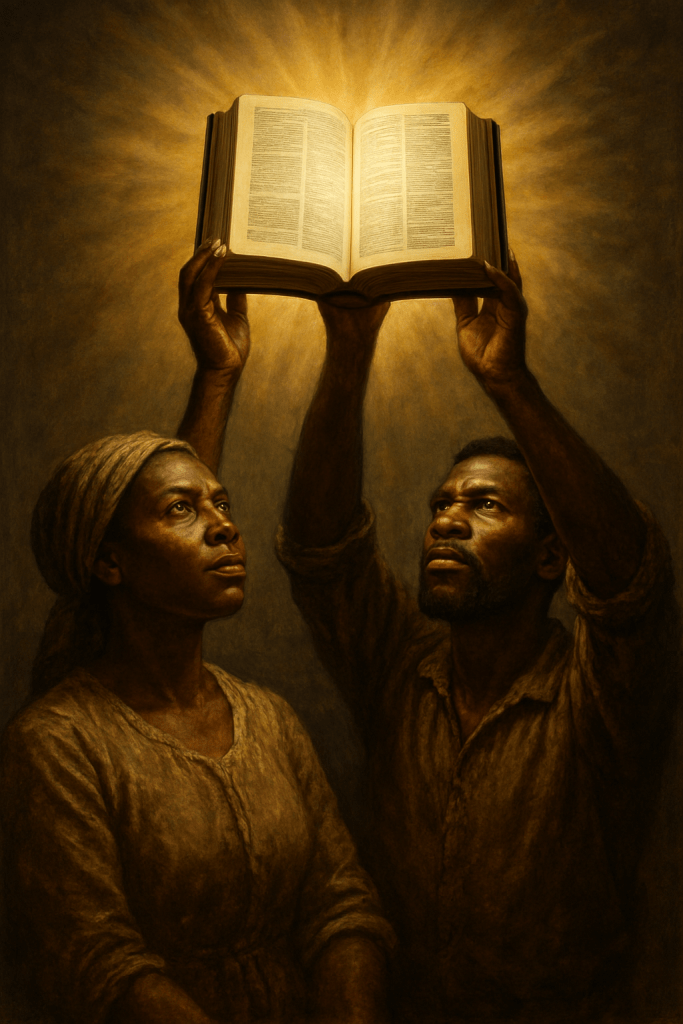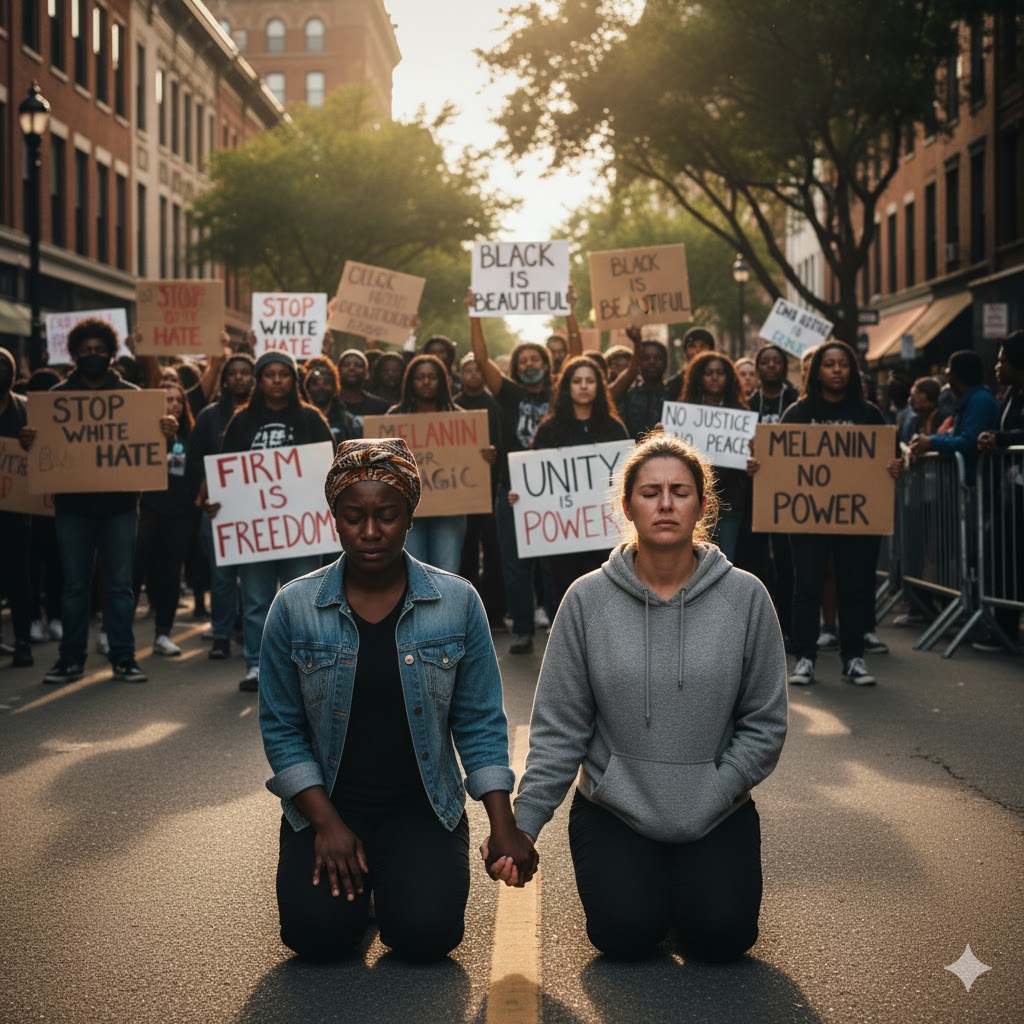
Tag Archives: dilemmas

Dilemma: The Architecture of Anti-Blackness: How White Supremacy Manufactured Inferiority

The dilemma of how white supremacy, the racial hierarchy in the Western world, did not emerge spontaneously; it was intentionally crafted, narrated, and repeated until it became a cultural reflex. The idea that Black people were inferior was never rooted in fact, science, or scripture. Rather, it was a constructed narrative, projected outward by white societies to justify domination, economic exploitation, and colonial expansion. This false narrative became a psychological weapon—one that shaped nations, policies, and personal identities.

Anti-Blackness did not emerge by accident. It was deliberately engineered, brick by brick, to justify conquest, theft, and domination. White supremacy constructed a worldview that framed Black humanity as deficient so that European power structures could expand without moral restraint. This architecture was not simply ideological; it was legal, economic, religious, and cultural—a total system designed to redefine an entire people as less than human.

The earliest foundations were laid during the transatlantic slave trade, when European empires required a moral rationale for kidnapping, trafficking, and exploiting millions of African people. To soothe their consciences and maintain social order, they developed narratives portraying Africans as uncivilized, chaotic, or cursed. These ideas became the ideological scaffolding for slavery, turning brutality into “civilization,” and oppression into “progress.”

Religion was an essential tool in this construction. European theologians and clergy misused scripture to claim divine sanction for racial hierarchy, weaponizing biblical texts to portray Africans as descendants of the cursed. This manipulation reframed slavery as benevolence—a “civilizing mission” rather than a system of terror. The lie of inferiority became sacred doctrine in the minds of many, giving theological legitimacy to violence.

Law was the second load-bearing wall in this system. Slave codes, Black codes, and Jim Crow laws formalized a racial caste system in which whiteness meant citizenship and Blackness meant subjugation. The legal architecture enforced the belief that Black people were incapable of autonomy, intellect, or moral agency. Inferiority was not only an idea; it became a legal identity.

Science, too, was recruited to reinforce racial dominance. Enlightenment-era thinkers authored treatises classifying African people as biologically inferior—a distortion now known as scientific racism. Phrenology, craniometry, and fabricated racial taxonomies were presented as objective truth. These pseudosciences spread globally, embedding the myth of Black inferiority into academic and medical institutions.

Culture played a critical role in turning these narratives into everyday common sense. Literature, art, theater, and later film depicted Black people as caricatures—brutes, savages, servants, or comic relief. These images were not accidental misrepresentations; they were strategic distortions reflecting and reinforcing white anxieties about power, purity, and control. Culture became propaganda, shaping emotions as effectively as laws shaped behavior.

Economic interests further cemented anti-Black ideology. The wealth of Europe and the Americas was built on African labor, and maintaining this economic engine required the perpetual devaluation of Black life. The more inferior Black people were perceived to be, the more justifiable their exploitation became. Thus, racial ideology functioned as a financial instrument as much as a social one.

Psychologically, white supremacy fostered a collective identity rooted in superiority. To maintain this fragile sense of dominance, whiteness required an “other” to contrast itself against. Anti-Blackness became the foundation of that identity—the stabilizing force of white self-conception. Without a myth of inferiority, the myth of white superiority could not survive.

Education became a mechanism for transmitting these narratives across generations. Curricula erased African civilizations, downplayed the horrors of slavery, and glorified European expansion. By controlling what children learned, white supremacy ensured its own reproduction, making anti-Black narratives appear natural and inevitable.

Media institutions amplified these messages, creating feedback loops where stereotypes justified discrimination and discrimination reinforced stereotypes. Newspapers portrayed Black communities as violent or unfit for citizenship. Early Hollywood films like Birth of a Nation mythologized Black criminality and celebrated white vigilantism. These representations shaped national consciousness in ways more powerful than policy.

During Reconstruction and the Civil Rights Movement, white resistance intensified as Black progress challenged the architecture of inferiority. Every advancement by Black communities—land acquisition, education, political participation—was met with backlash, violence, or policy reversals. White supremacy adapted, evolving from slavery to segregation, from segregation to mass incarceration, and from overt racism to coded language.

The criminal legal system emerged as a modern extension of earlier racial regimes. Stereotypes created during slavery—Black people as dangerous, impulsive, or criminal—were used to justify policing, surveillance, and disproportionate punishment. The prison system became a new economic mechanism for exploiting Black labor while maintaining racial control.

Housing policies like redlining institutionalized racial inequality on geographic lines. Black communities were systematically denied homeownership, wealth accumulation, and access to quality schools. Inferiority became spatial, built into neighborhoods, resources, and opportunities. These disparities were later interpreted as natural “community problems,” reinforcing stereotypes that justified their existence.

Anti-Blackness also infiltrated interpersonal relations. Microaggressions, racial biases, and assumptions about intelligence or professionalism stem from centuries of propaganda. These everyday interactions reflect the deeper structural architecture that taught society how to see—and not see—Black humanity.

Globally, anti-Black narratives spread through colonialism. European empires exported their racial ideologies across Africa, Asia, and the Caribbean, shaping local hierarchies and perceptions of Blackness. The myth of inferiority became a global lingua franca that served imperial expansion.

The psychological impact on Black communities has been profound. Internalized oppression, colorism, and cultural trauma are legacies of a world constructed to diminish Black worth. Yet despite these forces, Black resistance has continually exposed the lie of inferiority and affirmed the truth of Black resilience, intellect, and brilliance.

The architecture of anti-Blackness is not static; it evolves with each generation. New technologies, political rhetoric, and economic systems mold old ideas into new forms. But the foundation remains the same: a lie constructed for the benefit of the powerful.

Dismantling this architecture requires truth-telling and historical reckoning. It demands that society confront the origins of its racial hierarchies and acknowledge the deliberate engineering behind them. Inferiority was manufactured; it was never real.

Black humanity, dignity, and brilliance have always existed independent of white imagination. What must be destroyed is not Black identity, but the false architecture built to oppress it. Only then can justice become more than a dream—it can become a structure of its own.

The origins of this racial myth can be traced to early European encounters with Africa. When European empires entered the African continent, they encountered civilizations with rich cultures, kingdoms, and intellectual traditions. But to enslave, extract, and colonize, they needed a worldview that placed Africans beneath them. And so the lie was born. The apostle Paul warned against such strategies of deception, reminding believers that “Satan himself is transformed into an angel of light” (2 Corinthians 11:14, KJV). Lies that appear logical, profitable, or convenient often masquerade as truth.

This narrative of inferiority became institutionalized during the transatlantic slave trade. Enslaved Africans were portrayed as subhuman, needing “civilization,” and devoid of intellect or morality. These portrayals served economic interests, allowing slaveholders to reconcile inhumane actions with their professed Christian identities. Yet the Bible had long declared the opposite: that all nations of the earth were made “of one blood” (Acts 17:26, KJV). In other words, the foundation of racial hierarchy was in direct contradiction to divine truth.

Over time, white societies refined these narratives into scientific-sounding theories. Pseudoscience emerged—phrenology, eugenics, and social Darwinism—each cloaked in academic language that gave validity to bigotry. The Bible warns that “professing themselves to be wise, they became fools” (Romans 1:22, KJV). These theories did not illuminate human diversity; rather, they darkened human compassion.

The narrative of Black inferiority was further reinforced by media, textbooks, and political speeches. Early depictions of Black people in Western literature and news portrayed them as threats, savages, or burdens. These images formed an ecosystem of propaganda that shaped public fear and public policy. Proverbs 6:16–19 speaks of those who sow discord among brethren—indeed, the manufacturing of racial hierarchy was a deliberate sowing of discord on a global scale.

Colonial missionaries also played a role, often using distorted interpretations of scripture to endorse oppression. Passages like the story of Noah’s sons were twisted to justify enslavement, even though the Bible never says anything about race-based servitude. Jesus Himself declared that loving one’s neighbor is the fulfillment of the law (Matthew 22:39, KJV), exposing the hypocrisy of those who claimed Christianity while practicing cruelty.

Over centuries, white societies began to internalize their own myth-making. What started as a political tool became a social identity. Whiteness became associated with superiority, purity, beauty, intelligence, and divine favor. Meanwhile, Blackness was framed as the opposite. This reinforced a dilemma not only for the oppressed, but also for the oppressor—how to maintain a false sense of superiority in a world where evidence repeatedly disproved it.

Black people, too, were impacted psychologically. Generations grew up in societies that undervalued their existence, distorted their history, and denied their humanity. Yet even in these conditions, African-descended people consistently demonstrated brilliance, resilience, and spiritual depth. The Bible affirms the strength of the oppressed, declaring that “the last shall be first” (Matthew 20:16, KJV). Oppression may wound, but it also reveals character and endurance.

White societies often used fear as the root justification for maintaining these narratives. Fear of Black intelligence, fear of retribution, fear of equality, and fear of losing power all contributed to the reinforcement of harmful stereotypes. King Solomon wrote that “the wicked flee when no man pursueth” (Proverbs 28:1, KJV). Fear—especially irrational fear—creates enemies where there are none.

One of the most damaging elements of this narrative was the portrayal of Black identity as needing validation from white institutions. Education, employment, beauty standards, and social acceptance became filtered through whiteness as the reference point. This contradicted scripture, for God alone defines worth: “For ye are fearfully and wonderfully made” (Psalm 139:14, KJV).

The dilemma also lies in the fact that white supremacy was never just a personal belief; it was a system. It permeated laws, housing policies, policing, and economic structures. These systems were designed to maintain the illusion of superiority through material advantage. Ecclesiastes 4:1 speaks of those who “have no comforter” under systems of oppression—an ancient truth that echoed through plantations, courtrooms, and schoolhouses.

Yet, throughout history, Black communities resisted this narrative through literacy, faith, artistry, and collective unity. The African American church became a center of truth-telling, reminding congregations that “the truth shall make you free” (John 8:32, KJV). Spiritual fortitude challenged societal lies and affirmed divine identity.

The civil rights movement exposed the moral contradiction of a nation claiming liberty while denying it to millions. As cameras captured violence against peaceful protestors, much of the world began to recognize the lie behind the narrative of Black inferiority. Darkness was brought into the light, fulfilling the scripture: “For nothing is secret, that shall not be made manifest” (Luke 8:17, KJV).

Still, remnants of this narrative persist today. Media bias, educational erasure, and structural inequities continue the old mythology in contemporary forms. The oppressor’s dilemma now becomes how to reconcile modern ideals of equality with centuries of racial conditioning. Many wrestle with guilt, denial, or fragility because the truth disrupts the comfort of inherited narratives.

For Black people, modern challenges include healing from the psychological residue of that false identity. Learning one’s history, celebrating one’s heritage, and embracing faith become acts of restoration. Isaiah 61:7 declares, “For your shame ye shall have double.” God promises divine compensation for historical dishonor.

The narrative of inferiority also fractures relationships between ethnic groups, creating suspicion and distance. True reconciliation requires more than silence—it requires repentance, acknowledgment, and structural transformation. Scripture teaches, “Confess your faults one to another” (James 5:16, KJV), suggesting that healing is communal, not individual.

The truth is that racial hierarchy has always been incompatible with God’s design. No group is ordained to dominance, nor is any group inherently inferior. The lies of the past may linger, but they cannot stand against the weight of truth. As Jesus said, “Every plant, which my heavenly Father hath not planted, shall be rooted up” (Matthew 15:13, KJV). White supremacy is one such plant.

Today, we stand at a crossroads where societies must choose honesty over tradition, truth over myth, and justice over comfort. The dismantling of the false narrative of Black inferiority is not merely a political act—it is a spiritual one. It aligns humanity with God’s vision of dignity for all His creation.

Ultimately, the dilemma is not whether Black people are inferior—they are not and never were. The true dilemma is whether societies built on lies are willing to confront the truth. And the truth, according to the Word, is unyielding: God shows no partiality, and neither should humanity. “For there is no respect of persons with God” (Romans 2:11, KJV).


References (KJV Bible):
Acts 17:26; 2 Corinthians 11:14; Romans 1:22; Proverbs 6:16–19; Matthew 22:39; Matthew 20:16; Proverbs 28:1; Psalm 139:14; Ecclesiastes 4:1; John 8:32; Luke 8:17; Isaiah 61:7; James 5:16; Matthew 15:13; Romans 2:11.

Bonilla-Silva, E. (2018). Racism without racists: Color-blind racism and the persistence of racial inequality in the United States. Rowman & Littlefield.
Du Bois, W. E. B. (1903). The souls of Black folk. A. C. McClurg.
Feagin, J. R. (2014). Racist America: Roots, current realities, and future reparations (3rd ed.). Routledge.
Fields, K., & Fields, B. (2012). Racecraft: The soul of inequality in American life. Verso.
Fredrickson, G. M. (2002). Racism: A short history. Princeton University Press.
Muhammad, K. G. (2010). The condemnation of Blackness: Race, crime, and the making of modern urban America. Harvard University Press.
Painter, N. I. (2010). The history of White people. W. W. Norton.
Williams, E. (1944). Capitalism and slavery. University of North Carolina Press.


The Marriage Series: Togetherness

Marriage is a divine institution established by God to reflect His covenant of love and faithfulness. It is more than a social contract; it is a spiritual union designed to cultivate intimacy, trust, and lifelong companionship. Togetherness in marriage is built upon a foundation of mutual commitment, respect, and shared purpose.

God’s design for marriage is clear in Genesis 2:24 (KJV): “Therefore shall a man leave his father and his mother, and shall cleave unto his wife: and they shall be one flesh.” Cleaving signifies total devotion, unity of purpose, and the willingness to prioritize one another above all else. True togetherness requires emotional, spiritual, and physical alignment.

Faithfulness is the cornerstone of a strong marital bond. Proverbs 5:18-19 (KJV) encourages delight in one’s spouse: “Let thy fountain be blessed: and rejoice with the wife of thy youth. Let her be as the loving hind and pleasant roe; let her breasts satisfy thee at all times; and be thou ravished always with her love.” Fidelity nurtures trust and allows intimacy to flourish.

Sexual purity before marriage is a critical element in building a lasting foundation. Hebrews 13:4 (KJV) reminds, “Marriage is honourable in all, and the bed undefiled: but whoremongers and adulterers God will judge.” Waiting to engage in sexual intimacy until marriage strengthens emotional bonds and aligns the couple with God’s design, ensuring a sacred and unifying experience.

The vow “let no man put asunder” echoes Jesus’ teaching in Matthew 19:6 (KJV): “Wherefore they are no more twain, but one flesh. What therefore God hath joined together, let not man put asunder.” Togetherness requires the couple to resist external pressures, conflict, and temptation that seek to divide the union.

Guarding one’s spouse is both an act of love and spiritual responsibility. 1 Corinthians 7:3-4 (KJV) instructs, “Let the husband render unto the wife due benevolence: and likewise also the wife unto the husband. The wife hath not power of her own body, but the husband: and likewise also the husband hath not power of his own body, but the wife.” Protecting the physical, emotional, and spiritual well-being of one another fosters safety and trust.

Mutual respect forms the heart of togetherness. Ephesians 5:33 (KJV) exhorts, “Nevertheless let every one of you in particular so love his wife even as himself; and the wife see that she reverence her husband.” When both partners honor one another’s dignity, the marriage becomes a reflection of Christ’s love for the Church.

Communication is a vital tool in maintaining unity. James 1:19 (KJV) teaches, “Wherefore, my beloved brethren, let every man be swift to hear, slow to speak, slow to wrath.” Open, honest, and patient communication strengthens emotional intimacy and prevents misunderstandings from eroding the bond.

Shared spiritual growth anchors the marriage in God’s truth. Couples who pray together, study the Word, and worship together cultivate alignment of purpose and vision. Amos 3:3 (KJV) asks, “Can two walk together, except they be agreed?” Agreement in spiritual priorities ensures resilience in times of trial.

Patience is essential for togetherness, especially during seasons of conflict or growth. Colossians 3:13 (KJV) instructs, “Forbearing one another, and forgiving one another, if any man have a quarrel against any: even as Christ forgave you, so also do ye.” Marriage requires grace, understanding, and willingness to forgive to maintain unity.

Financial stewardship is another aspect of marital togetherness. Couples who plan, budget, and work toward shared goals strengthen trust and reduce tension. Proverbs 21:20 (KJV) notes, “There is treasure to be desired and oil in the dwelling of the wise; but a foolish man spendeth it up.” Joint responsibility in finances reflects cooperation and foresight.

Physical affection and emotional presence deepen marital connection. Song of Solomon 2:16 (KJV) expresses romantic devotion: “My beloved is mine, and I am his: he feedeth among the lilies.” Regular expressions of love, encouragement, and intimacy reinforce the bond of togetherness.

Equality in decision-making and mutual support fosters a sense of partnership. Ecclesiastes 4:9-10 (KJV) highlights, “Two are better than one; because they have a good reward for their labour. For if they fall, the one will lift up his fellow.” Marriage thrives when both partners share responsibilities and celebrate successes together.

Conflict resolution grounded in humility preserves togetherness. Matthew 18:15-17 (KJV) provides guidance on reconciliation and addressing grievances directly. Couples who approach disagreements with a desire for resolution rather than victory maintain trust and unity.

Celebration of milestones strengthens the sense of partnership. Whether through anniversaries, achievements, or personal growth, acknowledging each other’s contributions fosters gratitude and shared joy. Philippians 1:3 (KJV) states, “I thank my God upon every remembrance of you.” Gratitude nurtures emotional intimacy.

Commitment to one another in sickness and in health reflects steadfast togetherness. 1 Corinthians 13:7 (KJV) affirms, “Love endureth all things, believeth all things, hopeth all things, endureth all things.” Enduring challenges together reinforces the depth and resilience of marital love.

Shared vision and goal-setting align life paths. Couples who discuss dreams, family planning, and personal aspirations ensure that the marriage is dynamic, forward-looking, and collaborative. Amos 3:3 (KJV) reinforces walking together in agreement, highlighting the importance of alignment in purpose.

Encouragement and affirmation of one another’s strengths enhance self-esteem and relational satisfaction. Proverbs 31:28 (KJV) celebrates a faithful wife: “Her children arise up, and call her blessed; her husband also, and he praiseth her.” Mutual encouragement fosters togetherness and nurtures individual growth.

Spiritual protection of the marriage ensures that togetherness is preserved against external threats. Ephesians 6:10-11 (KJV) calls believers to “Put on the whole armour of God, that ye may be able to stand against the wiles of the devil.” A spiritually fortified marriage withstands temptations, trials, and societal pressures.

Togetherness requires ongoing effort, intentionality, and prioritization. Ecclesiastes 9:9 (KJV) reminds, “Live joyfully with the wife whom thou lovest all the days of the life of thy vanity…” Actively investing in the relationship daily ensures longevity, satisfaction, and a reflective witness of God’s love.

Finally, marriage is a testimony to God’s covenantal love. Malachi 2:14 (KJV) declares, “Yet ye say, Wherefore? Because the LORD hath been witness between thee and the wife of thy youth…” Togetherness is a reflection of divine faithfulness, showing the world the power of love, commitment, and unity as ordained by God.


References

Genesis 2:24, KJV.
Matthew 19:6, KJV.
Proverbs 5:18-19, KJV.
Hebrews 13:4, KJV.
1 Corinthians 7:3-4, KJV.
Ephesians 5:33, KJV.
James 1:19, KJV.
Amos 3:3, KJV.
Colossians 3:13, KJV.
Proverbs 21:20, KJV.
Song of Solomon 2:16, KJV.
Ecclesiastes 4:9-10, KJV.
1 Corinthians 13:7, KJV.
Proverbs 31:28, KJV.
Ephesians 6:10-11, KJV.
Ecclesiastes 9:9, KJV.
Malachi 2:14, KJV.
Guerrero, L. K., & Floyd, K. (2006). Nonverbal communication in close relationships. Mahwah, NJ: Lawrence Erlbaum.
Chapman, G. (2015). The 5 Love Languages: The Secret to Love That Lasts. Chicago: Northfield Publishing.

Dilemma: Black Skin

The dilemma of Black skin is not biological—it is psychological, historical, and inherited through trauma. A pigment that should signify life, lineage, and divine creativity was weaponized into a mark of subjugation and dehumanization, though scripture never framed hue as inferiority. “I am black, but comely” (Song of Sol. 1:5, KJV).

Slavery altered more than labor systems; it attempted to rewrite identity itself. Black skin became a symbol falsely associated with divine rejection, though the Bible affirms that God formed all mankind intentionally. “The Lord hath made all things for himself” (Prov. 16:4, KJV).

The transatlantic slave trade kidnapped the body, but racism imprisoned the mind. Europeans repainted the theology of beauty with whiteness centered at the altar, planting a spiritual lie that melanated bodies were errors, not divine authorship. Yet God is the original designer. “Thine eyes did see my substance, yet being unperfect” (Psa. 139:16, KJV).

Negativity surrounding Black skin was not seeded in scripture but in propaganda. Colonizers inverted Ham’s lineage in Genesis into a false theology of skin-based curses, though the Bible speaks no such thing. The curse in Genesis was upon Canaan’s servitude, not complexion (Gen. 9:25, KJV).

Africa was the first cradle of human expansion. Ham’s sons—Cush, Mizraim, Put—are founders of African nations (Gen. 10:6, KJV). This means Black presence was at creation, migration, and worship’s dawn, not its aftermath.

Racism engineered theology into hierarchy. Whiteness monopolized the image of God, angels, and salvation, even though scripture gives cosmic freedom in who God calls by name. “Princes shall come out of Egypt; Ethiopia shall soon stretch out her hands unto God” (Psa. 68:31, KJV).

Colorism is racism’s domestic offspring. When a system wounds a nation long enough, the wounded begin competing in hue rather than healing in humanity. But God’s salvation is soul-deep, not skin-deep. “For man looketh on the outward appearance, but the Lord looketh on the heart” (1 Sam. 16:7, KJV).

Dark skin was mislabeled as labor-grade, not beauty-laced. The marketplace economy of slavery placed price tags on phenotype: lighter brought economic advantage, darker brought harsher labor assignment. This distortion still echoes in modern Black cultural psychology.

Black children grew up watching the world praise fairness while punishing richness. This interior conflict creates a dilemma: loving the color you wear while living in a society that still worships the opposite.

Racism convinces Black women that beauty requires editing Blackness itself. From skin bleaching to hair humiliation, the world teaches Black women to apologize for melanin instead of honoring it. Yet scripture reverses the shame of appearance. “He hath made every thing beautiful in his time” (Eccl. 3:11, KJV).

Black men carry the burden of being feared because of their shade and frame. Their complexion was interpreted socially as aggression rather than image-bearer dignity, though the Bible describes strength without equating it to moral corruption. “Be strong and of a good courage” (Josh. 1:9, KJV).

Negativity surrounding Black skin created a spiritual orphaning. Many Blacks converted into religions that used the Bible to comfort them but never used theology to defend their identity’s sacred legitimacy.

Melanin became a theological insecurity rather than a cultural crown. Black skin was reinterpreted into a social problem instead of a sacred narrative of ancestral resilience, divine endurance, and survival.

Scripture affirms that God stands with the suffering and oppressed, not the complexion they are suffering in. “He shall judge the poor of the people, he shall save the children of the needy” (Psa. 72:4, KJV) makes it clear that injustice draws God’s advocacy, not His agreement.

Christianity as preached on plantations tried to pacify revolt while ignoring identity theft. But scripture tells another story: God delivers the oppressed into restored dignity, not silent submission. “Let my people go” (Exo. 5:1, KJV).

Black skin was the canvas on which oppression attempted to permanently paint shame. But the Bible shows that suffering does not rewrite chosenness. “If ye endure chastening, God dealeth with you as sons” (Heb. 12:7, KJV).

Colorism wounded Black women into ranks of attractiveness based on gradients. The dilemma of pigmentation hierarchy taught Black mothers to desire lighter children, reflecting trauma rather than preference.

Racism built entire institutions to oppose Black elevation. Still, scripture promises divine reversal in seasons of suffering. “And the Lord thy God will turn thy captivity… and have compassion upon thee” (Deut. 30:3, KJV).

Black skin is now undergoing reclamation. The dilemma remains, but so does restoration theology. “Be renewed in the spirit of your mind” (Eph. 4:23, KJV) suggests transformation is mental liberation first.

The world tried to make Blackness symbolic of sin, foolishness, servitude, and ugliness. But scripture gives voice to beauty where culture denied it. “I will make mention of Rahab and Babylon to them that know me: behold Philistia, and Tyre, with Ethiopia; this man was born there” (Psa. 87:4, KJV).

The dilemma of Black skin is therefore a theological confrontation: rejecting the doctrine of racial inferiority, dismantling internalized oppression, calling melanin beautiful without apology, and reclaiming skin not as dilemma but testimony.

Black identity was not born in chains, curse, or erasure—it was born under heaven’s architecture, exiled through suffering, yet promised redemption. “For I know the thoughts that I think toward you, saith the Lord, thoughts of peace, and not of evil” (Jer. 29:11, KJV).

The final transformation is from shame to sacred remembrance. The original mark of identity was not color—but creation intent. And creation intent cannot be rewritten by captivity. “The gifts and calling of God are without repentance” (Rom. 11:29, KJV).


References

The Holy Bible, King James Version. (1611). Cambridge University Press.
Douglass, F. (1845). Narrative of the Life of Frederick Douglass, an American Slave. Anti-Slavery Office.
Hunter, M. (2007). “The Persistent Problem of Colorism.” Sociology Compass, 1(1), 237-254.
Walker, A. (1983). In Search of Our Mothers’ Gardens. Harcourt.

Dilemma: First Black Religion?!

The question of the first Black religion is not merely historical—it is existential, cultural, and theological. For many, religion is tied to identity, ancestry, trauma, and liberation. The dilemma emerges when history asserts one origin, scripture hints another, and lived experience narrates yet another.

Long before colonization, African spirituality flourished in elaborate cosmologies. These systems honored divine hierarchy, ancestral intercession, sacred symbols, covenantal obedience, and moral law. In parallel, biblical scripture references lands populated by Cushites, Egyptians, Ethiopians, and early civilizations where Black peoples interfaced with God’s unfolding plan (Gen. 10:6).

The lineage of Ham—particularly through Cush, Mizraim, and Canaan—places Africa at the dawn of human migration, culture, and worship. Though often misrepresented due to later interpretations, scripture never describes Ham as cursed in skin, but in lineage outcome concerning Canaan only (Gen. 9:25).

The Bible clearly presents Cush as a progenitor of nations in Africa. The Hebrew term Cush historically corresponds to regions of Northeast Africa, modern Sudan, Ethiopia, Eritrea, and the Nile Valley. These were lands where worship, civilization, and monarchal structures first developed.

African spirituality centered upon the belief in a supreme creator long before Western intrusions. This mirrors biblical revelation that God made Himself known to early nations, even outside later Israelite identity formation. Scripture affirms that all nations descend from one blood under God’s dominion (Acts 17:26).

Black contact with biblical worship begins even in patriarchal narratives. Moses married a Black Cushite woman, indicating cultural and religious intersections before formalized Judaic religion emerged (Num. 12:1). This disrupts the narrative that Black spiritual identity began only through Western Christianity.

Ethiopia is mentioned dozens of times in scripture, often as a land already acquainted with monarchy, worship, prophecy, and divine awareness. “Princes shall come out of Egypt; Ethiopia shall soon stretch out her hands unto God” (Psa. 68:31). This implies pre-existing spiritual consciousness and later global alignment toward Yahweh.

The dilemma intensifies when analyzing the transatlantic slave trade. Enslaved Africans were forcibly baptized into Christianity—a religion used both to console the oppressed and to justify the oppressor. Yet scripture declares that God sides with the afflicted: “He shall deliver the needy when he crieth; the poor also, and him that hath no helper” (Psa. 72:12).

Colonial Christianity reframed African spirituality as pagan, though much of it was built on a belief in one high God, sacred law, covenant allegiance, and moral accountability. This resembles the biblical world before the codified Torah existed—where God spoke, not systems.

Abraham encountered Melchizedek, a priest outside his nation, already worshipping the most high God (Gen. 14:18). This supports the theological idea that God’s first priesthood and worship were not geographically European.

Egypt, a Black African empire, was the first nation where God demonstrated Himself in national judgment and spiritual distinction. The Exodus confrontations show Yahweh contending with Egypt’s religion, not introducing spirituality to the world for the first time (Exo. 7:5).

God made Himself known in Egypt through plague and judgment: “And the Egyptians shall know that I am the Lord, when I stretch forth mine hand upon Egypt” (Exo. 7:5). This verifies Africa as the stage for one of God’s earliest religious confrontations.

Africa was not spiritually empty—it was spiritually contested. The world’s first recorded civilization, religious systems, libraries, priesthoods, temple economies, astronomy, sacred initiations, and moral codes began on African soil.

The Queen of Sheba—an African monarch—recognized Solomon through divine fascination, wealth exchange, and theological awe (1 Kings 10). This demonstrates that African worship already operated in sacred curiosity toward Yahweh before forced conversions ever existed.

Another scriptural Ethiopian, Ebed-melech, feared God, rescued the prophet Jeremiah, and was divinely delivered for his faithfulness, showing independent African knowledge of Yahweh before Christian imperialism (Jer. 38:7-13; 39:16-18).

Then comes Philip and the Ethiopian eunuch, a royal treasury official already reading the prophet Isaiah before being instructed and baptized (Acts 8:27-38). This passage is central to the argument that Black peoples engaged biblical religion before Western mediation, dismantling the claim that Christianity was Africa’s first encounter with God.

“He was led as a sheep to the slaughter” (Isa. 53:7; Acts 8:32) foreshadows Christ’s redemptive suffering—a passage preserved in Africa’s royal religious archives long before institutional Christianity dominated the continent.

Some assert that the “slave Bible” created a counterfeit Christian origin for Black people. But scripture pre-dates slavery and repeatedly spotlights African worshipers siding with God’s prophets, kings, and divine revelation (Psa. 87:4).

African spirituality practiced sacred law long before Western religion arrived. This reflects biblical truth: “I have put my law in their inward parts, and write it in their hearts” (Jer. 31:33). God embedded spiritual cognition into early peoples before institutions claimed ownership of Him.

Faithful obedience—not geographical religion—is the foundation of true worship. Jesus confirms this principle: “They that worship him must worship him in spirit and in truth” (John 4:24). Truth existed before titles like Christianity even did.

The real dilemma is not whether Black religion began in Africa or in the Bible—the crisis is when the world convinced Black people their spirituality came from chains, not the covenant.

God foretold long suffering for His chosen people: “And ye shall be sold unto your enemies… and no man shall buy you” (Deut. 28:68). Many scholars connect this to the transatlantic captivity as a prophetic cycle, showing that biblical identity could explain the Black religious experience more than colonial religion ever did.

Still, the truth remains: scripture shows Black peoples worshiping God, protecting prophets, reading prophecy, engaging the priesthood, serving royal courts, and stretching hands toward Yahweh before Christianity baptized Africa by force.

The dilemma of First Black Religion confronts three realities: Africa birthed the world’s oldest spiritual systems, the Bible records Africa’s earliest interactions with God, and slavery weaponized Christianity into both comfort and confusion.

Black religion did not begin in Europe, in plantations, or in forced baptism. It began wherever God first spoke to Black peoples—and scripture confirms that Africa heard His voice early, often, and sovereignly.

The question now shifts from origins to inheritance. God promised restoration: “And the Lord thy God will turn thy captivity… and have compassion upon thee, and will return and gather thee from all the nations” (Deut. 30:3).

The future of Black religion, identity, and covenant is not found in the hands that rewrote history, but in the God who wrote ancestry, suffering, deliverance, and spiritual consciousness into scripture from the beginning.


References

The Holy Bible, King James Version.
American Bible Society. (1611). KJV.

Dilemma: Staying Focused on God

Staying focused on God is one of the most universal spiritual struggles, not because God is distant, but because distraction is loud; Scripture shows this pattern from Eden to the wilderness (Genesis 3:1–6, KJV).

To stay focused, the believer must first guard the mind, for the enemy battles through thought before behavior, and we are commanded to “bring into captivity every thought to the obedience of Christ” (2 Corinthians 10:5, KJV).

Focus on God begins with hunger—“Blessed are they which do hunger and thirst after righteousness: for they shall be filled” (Matthew 5:6, KJV), showing that spiritual focus is fueled by appetite for Him.

Prayer anchors the wandering heart; Jesus modeled intentional withdrawal to pray so that purpose would outweigh pressure (Mark 1:35, KJV).

Meditation on the Word is commanded day and night, because consistency prevents drifting—“Then shalt thou make thy way prosperous, and then thou shalt have good success” (Joshua 1:8, KJV).

Speaking the Word out loud shifts the atmosphere and focus, for faith responds to hearing—“faith cometh by hearing, and hearing by the word of God” (Romans 10:17, KJV).

David strengthened his focus by declaring God’s greatness to his own soul—“Bless the LORD, O my soul, and all that is within me…” (Psalm 103:1, KJV).

The tongue has life-directional power, so spiritual focus requires verbal alignment—“death and life are in the power of the tongue” (Proverbs 18:21, KJV).

Spiritual discipline protects focus; Paul compared the walk with Christ to intentional training, not aimless movement (1 Corinthians 9:24–27, KJV).

Fasting removes spiritual dullness and weakens fleshly noise, allowing God’s voice to regain center stage (Matthew 6:16–18, KJV).

Peter lost focus when fear overshadowed faith, sinking only when his eyes left Christ, reminding us that emotions must never outrank our gaze (Matthew 14:29–31, KJV).

Worship recenters focus more quickly than worry derails it, because God inhabits the place where He is exalted (Psalm 22:3, KJV).

Staying focused on God means rejecting double-mindedness, for an unstable mind cannot sustain spiritual direction (James 1:8, KJV).

We must also guard what we watch and absorb, knowing the eye is a gateway—“the light of the body is the eye…” (Matthew 6:22, KJV).

The believer remains focused by walking in obedience even when understanding trails behind, trusting that God orders steps, not explanations (Proverbs 3:5–6, KJV; Psalm 37:23, KJV).

Focus is fortified when believers surround themselves with those who also seek God, for company shapes continuity (Proverbs 27:17, KJV).

Memorizing Scripture protects focus in moments where the physical Bible is not present, following Christ’s example in spiritual combat (Matthew 4:1–11 where Jesus repeatedly said “It is written…”, KJV).

Staying focused also means rehearsing God’s past faithfulness, because remembrance is resistance to doubt (Lamentations 3:21–23, KJV).

Daily surrender keeps God in view; Jesus taught we must deny self and carry the cross continually, not occasionally (Luke 9:23, KJV).

Even when the heart feels pulled, focus is restored by returning to first love, guarding devotion above distraction (Revelation 2:4–5, KJV).

Spiritual focus is not attained by emotional force, but by covenant decision—choosing God repeatedly until distraction gives up, mirroring Ruth’s resolute declaration (Ruth 1:16–17, KJV).

The Word must not only be read but spoken, written on hearts, and repeated from mouths until our internal world obeys heaven’s voice (Deuteronomy 6:6–9, KJV).

The believer stays focused by clothing the spirit with God’s armor daily, for focus unprotected becomes focus attacked (Ephesians 6:10–18, KJV).

Focus on God must be a lifestyle, not a response plan, because a prepared believer cannot be a panicked one (Psalm 119:11, KJV).

Refusing distraction means sometimes standing alone, like Elijah who listened for God not in noise but the still small voice (1 Kings 19:11–12, KJV).

Staying focused means speaking God’s Word over circumstances, even when the world speaks louder than Scripture (Psalm 107:20, KJV).

The mind focused on God becomes the mind kept by God—“Thou wilt keep him in perfect peace, whose mind is stayed on thee…” (Isaiah 26:3, KJV).

Focus is strengthened by obedience and weakened by open compromise, shown when Lot’s divided vision led him too close to Sodom (Genesis 13:10–12, KJV).

A believer remains focused by choosing God’s approval over human applause, rejecting pride that seeks visibility over obedience (Galatians 1:10, KJV principle).

God must be spoken of constantly, not silently followed only inwardly, because testimony is focus spoken (Psalm 66:16, KJV).

Staying spiritually focused requires renewing the mind, replacing the old worldview with God’s blueprint (Romans 12:2, KJV).

Distraction grows where devotion shrinks, so the key is never feeding what fights your focus while starving what fuels it (Colossians 3:1–2, KJV principle of setting affections above).

Temptation is defeated by spoken Scripture, modeled by Christ Himself—He fought distraction with declaration, not silence (Matthew 4:4,7,10, KJV).

Staying focused means loving God not halfway, but wholly—“with all thy heart, and with all thy soul, and with all thy mind” (Matthew 22:37, KJV).

Clarity grows from Scripture saturation; confusion grows from spiritual starvation (Hosea 4:6, KJV warning principle).

To stay focused, you must stay filled, because an empty spirit is a wandering spirit (Psalm 81:10, KJV principle).

Staying focused on God means choosing God again at every crossroads, because focus is a series of decisions, not a moment of arrival (Deuteronomy 30:19, KJV choose-life command).

A focused believer becomes unshakeable because their foundation is a Person, not a season (Psalm 62:5–7, KJV).

Focus is kept when believers walk by Spirit, not flesh, letting God lead the lens of the heart (Galatians 5:16, KJV).

The final secret to staying focused is staying surrendered—God does not fight for a throne already occupied by self, but He defends the one yielded fully to Him (Exodus 14:14, KJV principle of stillness and trust).


References

  • The Holy Bible, King James Version. (1611). Cambridge Edition.
  • Washington, T., & Watson, J. (2023). Spiritual Discipline and Scriptural Internalization in African Diasporic Faith Practice. Journal of Biblical Psychology, 12(2), 44–60.

Dilemma: 400 years later…

The arrival of the first documented Africans to the shores of what would become the United States began in 1619, initiating a 400-year historical continuum that cannot be reduced to a single era or chapter but must be read as an unfolding system of captivity and racial stratification rooted in both economic exploitation and social demonization. The transatlantic slave trade expanded across the Americas over the next two centuries, cementing a global architecture of forced labor that built Western wealth while systematically devastating African communities and fracturing family lineage. This reality fulfills the ancient warning that curses follow a disobedient and oppressed people, for scripture foretold a nation that would experience alien ruin, humiliation, and subjugation: “The stranger that is within thee shall get up above thee very high; and thou shalt come down very low” (Deuteronomy 28:43, KJV).

Slavery did not begin by accident but by law, religion, and commerce. By the mid-1600s, colonial legislatures had codified Africans and their descendants into permanent hereditary servitude, legally positioning Black bodies as property rather than persons, creating a condition where captivity could be inherited like a surname. Plantations multiplied across the Southern colonies, where cotton would later emerge as “king,” demanding labor on a scale that turned land into empire and humans into fuel. Yet the Bible condemns the very foundation of such enterprise: “He that stealeth a man, and selleth him… shall surely be put to death” (Exodus 21:16, KJV). The theft was never the land alone — it was identity, labor, movement, and posterity.

Even after the Thirteenth Amendment of 1865 formally abolished chattel slavery, its exception clause allowed a rapid pivot into criminalized bondage, birthing the era of convict leasing, where Black men were arrested on arbitrary charges, leased to corporations, and worked under conditions nearly indistinguishable from plantation labor. The cotton field remained, only relabeled. This legislative loophole reframed chains as “justice,” transforming freedom into illusion. Scripture again provides clarity: “The wicked walk on every side, when the vilest men are exalted” (Psalm 12:8, KJV). When power itself is corrupt, deliverance cannot be legal alone — it must also be spiritual.

Reconstruction offered a brief but luminous disruption of bondage. Black Americans built schools, entered political office, established land ownership, and reconnected fragments of stolen ancestry. But progress provoked terror, and by 1877, federal retreat enabled Southern states to regenerate racial hierarchy through Jim Crow laws, insulating white privilege and criminalizing Black mobility. Between 1870 and 1950, thousands of Black Americans were lynched in public acts of racial terrorism, not as random violence but as a national message: Black advancement would be met with blood. The psalmist described this spirit precisely: “They have said, Come, and let us cut them off from being a nation” (Psalm 83:4, KJV). The objective was erasure.

The Great Migration (1916–1970) relocated millions of Black families from the agricultural South to the industrial North, seeking wages rather than whipping posts, safety rather than spectacle deaths. But northern opportunity carried its own forms of apartheid: redlining maps, restricted labor unions, segregated schools, employment ceilings, and policing systems that followed Black communities like a shadow. The physical field changed, but the captivity matured into systems rather than signposts. Scripture declared the emotional condition of displaced people longing for justice and homeland: “By the rivers of Babylon, there we sat down, yea, we wept” (Psalm 137:1, KJV).

The 1960s Civil Rights Movement confronted segregation at its legal roots, demanding equal access to education, voting, housing, and public participation. Its leaders spoke like prophets disrupting empires: “Let judgment run down as waters, and righteousness as a mighty stream” (Amos 5:24, KJV). Yet many of the same state systems that resisted abolition resisted civil rights — governors blocking doors, officers turning hoses, lawmakers filibustering dignity. Progress was wrestled, never gifted.

Following civil rights legislation came a new form of containment — the War on Drugs, hyper-policing, and mass incarceration. From the 1980s onward, prisons expanded faster than schools, sentencing laws grew harsher, and policing strategies militarized, targeting Black neighborhoods with a disproportionality that mirrors an economic draft. Men descended from sharecroppers became inmates leased through labor programs inside industrial prisons. The plantation evolved into a complex, adaptable organism. As Proverbs illuminated the mechanics of inequality: “The rich ruleth over the poor” (22:7, KJV). For Black America, poverty was not incidental but intentional infrastructure.

In modern expression, hatred manifests not in auction blocks but in algorithms, policing districts, wage gaps, and judicial disparities. Hate crimes continue at alarming frequency, motivated by the same racial animus that once governed slave patrols, lynch mobs, and segregated institutions. Police brutality killings operate as extrajudicial punishments disproportionately borne by Black citizens, echoing the terror logic of the past. “They break in pieces thy people, O Lord, and afflict thine heritage” (Psalm 94:5, KJV). The cries are the same; only the arenas differ.

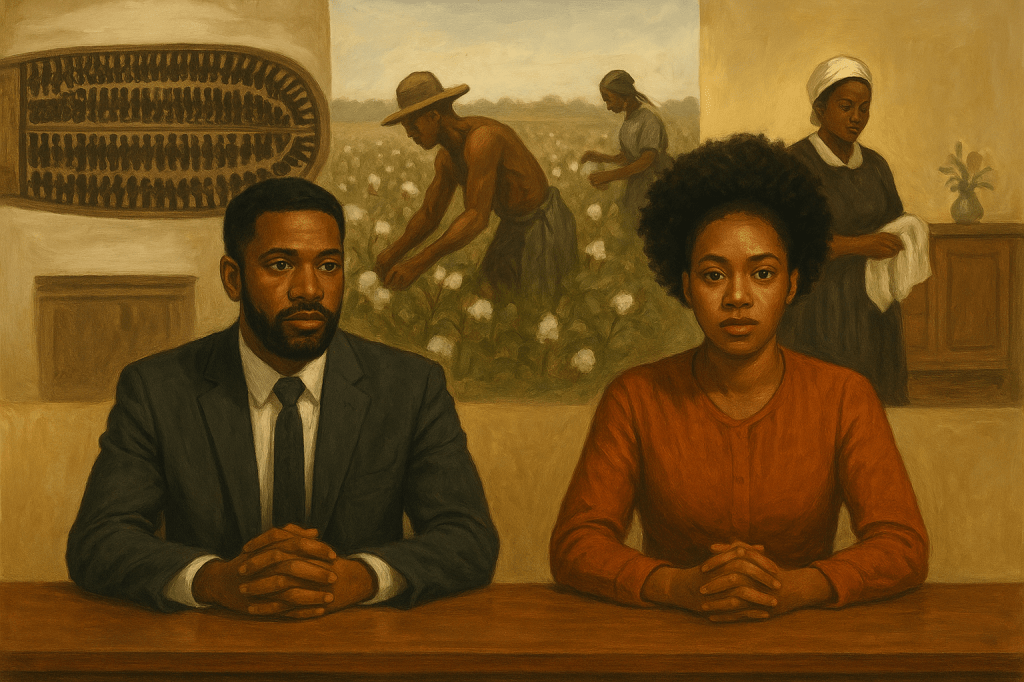
Reparations promised in 1865 through “40 acres and a mule” never materialized nationally, representing not only a breach of contract but a breach of justice. No federal reparative policy has been enacted despite centuries of documented theft, labor extraction, and structural disenfranchisement. The field and the counter today form an economic diptych — continuity rather than contrast: from unpaid cotton labor to underpaid service labor, from stolen land to inaccessible mortgages, from patrolled movement to policed existence, from literal chains to institutional ones.

The psychological captivity is often strongest. Media systems still export narratives that position Black identity as inferior, criminal, or disposable, reproducing a cognitive caste system that shapes public perception, opportunity distribution, and even self-esteem. Solomon teaches that perception becomes self-governing: “As he thinketh in his heart, so is he” (Proverbs 23:7, KJV). When a people lives under 400 years of negative mirrors, liberation must reconstruct the mind, not only the nation.

Understanding the Biblical “400-Year” Hardship Motif

In the Bible, long periods of suffering are often tied to exile, purification, oppression, and divine timing, not arbitrary catastrophe. The closest explicit reference to 400 years appears in Genesis 15:13–14 (KJV), where God tells Abram:

“Know of a surety that thy seed shall be a stranger in a land that is not theirs, and shall serve them; and they shall afflict them four hundred years; And also that nation, whom they shall serve, will I judge: and afterward shall they come out with great substance.”

This passage establishes three key principles:

  1. Suffering within foreign lands can be part of divine assignment — “a land that is not theirs.”
  2. The suffering serves a formative purpose for a chosen lineage — Abram’s seed is not destroyed, but shaped.
  3. The timeline ends with judgment of the oppressor and advancement of the oppressed — “I will judge” + “come out with great substance.”

Other biblical exiles follow similar structure, though without the number 400 attached. Israel’s bondage in Egypt, Judah’s exile into Babylon, and the scattering of tribes under imperial conquest all follow a recognizable pattern:

  • Identity is attacked
  • Oppression is used as endurance training
  • God times deliverance to align with spiritual readiness rather than political apology
  • Restoration is communal, covenantal, and spiritual before material

(Deuteronomy 30:3–5, Jeremiah 29:10–14, Psalm 126:1-3, KJV)

Thus, when people today speak of “400 years later,” they are usually drawing a parallel between African-descended suffering in America (beginning in 1619) and the Genesis 15 captivity framework, combining historical trauma with biblical typology. This is a symbolic theological claim, not a literal prophetic decree.

Du Bois (1903) noted that Black history in America has often been interpreted through a dual lens of diaspora and spiritual yearning, mirroring Hebraic exile themes. This interpretive tradition became especially strong in the African-American church and in later Afro-Hebraic movements. (Du Bois, 1903; Wilkerson, 2010)


Why 2025 Is Being Discussed as the “Cycle’s End”

The belief that “the 400-year test ends in 2025” is an example of contemporary sacred-historical reinterpretation, similar to how different generations calculated messianic or jubilee timelines in their own eras. The Bible shows that humans frequently attach chronology to hope:

  • Daniel expected restoration after 70 years because Jeremiah prophesied it (Daniel 9:2, KJV)
  • Israelites expected the Messiah based on timeline readings of prophets (Luke 3:15, KJV)
  • The Jubilee cycle (Leviticus 25) shaped conversations of liberation and return

Likewise, many Black thought movements today use 1619 → 2019/2025 as a rhetorical timeline to emphasize:

  • How long has injustice persisted
  • How delayed deliverance feels
  • How captivity keeps evolving
  • The moral debt owed to Black descendants has not been acknowledged or repaired

(Rothstein, 2017; Stevenson, 2014)

However, the Bible consistently teaches that God’s deliverance is not triggered by the clock alone, but by covenant remembrance and collective turning toward Him:

“Then ye shall call upon me, and ye shall go and pray unto me, and I will hearken unto you. And ye shall seek me, and find me, when ye shall search for me with all your heart.”
(Jeremiah 29:12-13, KJV)

This shows that spiritual awakening precedes systemic reversal in God’s economy.


What Has Changed vs. What Hasn’t

What has changed since 1619:

  • Black Americans are no longer enslaved as legal property
  • Literacy, land ownership, political office, scholarship, and cultural expression are possible
  • The Bible is now read by Black communities rather than read at them

(Woodson, 1933; Du Bois, 1903)

What has not changed at the root level :

  • Violence against Black bodies continues through hate-motivated crimes
  • Law enforcement injustice appears through disproportionate lethal force and brutality
  • No federal reparative restoration has been enacted for descendants of slavery
  • The wealth gap persists, restricting intergenerational mobility
  • Oppression remains structural, not individual alone
  • Bondage evolved from chains on bodies → chains on systems → chains on narratives → chains on economics → chains on mobility and life expectancy

(Muhammad, 2011; Rothstein, 2017; Stevenson, 2014)

Biblically, this mirrors a shift like captivity rather than the removal of it. Egypt began as physical bondage, but later exile became psychological, political, and spiritual scattering.


Yet transformation, though unfinished, remains possible. The biblical arc of exodus shows that freedom is not immediate but fought for, walked into, prayed into, and inherited by those who refuse to remain Egypt-minded. “Stand fast therefore in the liberty wherewith Christ hath made us free, and be not entangled again with the yoke of bondage” (Galatians 5:1, KJV). Black America has been made free in spirit — the labor left is to be made free in systems, policies, safety, economy, body, and legacy.

Bondage persists, but so does chosen resistance. The cotton field, the counter, the classroom, the courtroom, the wealth gap, the police district — these are the new Red Seas, new wildernesses, and new pleas for divine justice. Deliverance is still in motion. Liberation has begun, but emancipation is still the mission. And the question is no longer “Were we enslaved?” but “Why are the chains so adaptive, and where will exodus lead next?”

References

Bibb, H. (1849). Narrative of the Life and Adventures of Henry Bibb, an American Slave. Author.

Du Bois, W. E. B. (1903). The Souls of Black Folk. A. C. McClurg & Co.

Equal Justice Initiative. (2022). Lynching in America: Confronting the Legacy of Racial Terror (3rd ed.). Author.

Feagin, J. (2020). The racism: A short history (2nd ed.). Routledge.

Genovese, E. D. (1976). Roll, Jordan, Roll: The World the Slaves Made. Pantheon Books.

Higginbotham, A. L. (1978). In the Matter of Color: Race and the American Legal Process. Oxford University Press.

King James Bible. (1611). King James Version (KJV).

King, M. L., Jr. (1963). “I Have a Dream.” Speech presented at the March on Washington for Jobs and Freedom, Washington, D.C.

Muhammad, K. G. (2011). The Condemnation of Blackness: Race, Crime, and the Making of Modern Urban America. Harvard University Press.

National Archives. (2024). 13th Amendment to the U.S. Constitution: Abolition of Slavery (except as punishment for crime). U.S. Government.

Rothstein, R. (2017). The Color of Law: A Forgotten History of How Our Government Segregated America. Liveright Publishing.

Smith, S. (2016). Generations of captivity: A history of African-American slavery. Journal of Cultural History, 12(4), 45–67.

Stevenson, B. (2014). Just Mercy: A Story of Justice and Redemption. Spiegel & Grau.

Wilkerson, I. (2010). The Warmth of Other Suns: The Epic Story of America’s Great Migration. Random House.

Woodson, C. G. (1933). The Mis-Education of the Negro. Associated Publishers.

Exodus 21:16 – “He that stealeth a man, and selleth him… shall surely be put to death.”

Deuteronomy 28:37 – “Thou shalt become an astonishment, a proverb, and a byword, among all nations.”

Deuteronomy 28:43 – “The stranger that is within thee shall get up above thee very high; and thou shalt come down very low.”

Proverbs 22:7 – “The borrower is servant to the lender.”

Proverbs 23:7 – “As he thinketh in his heart, so is he.”

Psalm 12:8 – “The wicked walk on every side, when the vilest men are exalted.”

Psalm 83:4 – “Let us cut them off from being a nation.”Psalm 94:5 – “They break in pieces thy people, O Lord, and afflict thine heritage.”

Galatians 5:1 – “Stand fast therefore in the liberty wherewith Christ hath made us free, and be not entangled again with the yoke of bondage.”

Dilemma: Being Pro-Black Does Not Mean Being Anti-White.

I believe that in every nation, there are both good and bad people. I do not believe that every white person is evil, nor do I subscribe to the idea that being pro-Black requires hating anyone of another race. Some of my closest friends are white, and many of the greatest opportunities and support I have received in life have come from individuals who do not look like me. However, I do not like how Black people were treated at the hands of white people throughout history. They did some evil things to my people—enslaving, dehumanizing, and oppressing generations in ways that still echo today. Yet even in my pain, I do not excuse treating people badly with racism and hate. My faith and conscience teach me that evil should not be repaid with evil. I believe in accountability, truth, and love that heals rather than destroys.

The phrase “being pro-Black” has been misunderstood by many, often distorted by social media and political rhetoric. To be pro-Black is to affirm, protect, and uplift the value of Black life, culture, and history in a world that has too often devalued it. It means loving who we are without apology, restoring what has been stolen, and healing what has been broken. Yet it does not mean to hate or reject others. It is possible—and necessary—to celebrate one’s heritage while still embracing universal humanity (hooks, 1992).

The false assumption that pro-Blackness equals anti-whiteness often stems from fear and guilt rather than understanding. Historically, those in power have portrayed Black pride as a threat to the status quo. During the Civil Rights Movement, for instance, calls for equality were met with accusations of aggression or reverse racism. But love of self is not hatred of others. The same world that celebrates Italian heritage or Irish pride should not condemn Black people for loving themselves and seeking liberation (West, 2001).

To be pro-Black is to reject oppression, not to reject individuals. It is to stand against systems that perpetuate inequality, from slavery to segregation to modern-day mass incarceration. When Black people advocate for justice, they are not attacking white people—they are attacking racism, a sin and a structure that dehumanizes both the oppressed and the oppressor (King, 1963).

The Bible itself speaks to the unity of humanity and the diversity of creation. Acts 17:26 (KJV) declares, “And hath made of one blood all nations of men for to dwell on all the face of the earth.” This scripture reveals that ethnic difference was never meant to divide us but to display the beauty of divine variety. Therefore, affirming Black identity aligns with biblical truth, not contradiction. God does not erase our color; He sanctifies it for His glory.

I have personally encountered compassion and understanding from white allies who have listened, supported, and helped amplify Black voices. Their actions remind me that allyship is not about guilt—it’s about shared humanity. Many white individuals throughout history have stood against racial injustice, from the abolitionists who risked their lives to end slavery to modern-day activists who march beside us in solidarity (Alexander, 2010).

Being pro-Black means loving the legacy of our ancestors—the kings and queens, the inventors, scholars, artists, and visionaries who built civilizations long before colonial contact. It means unlearning internalized inferiority and celebrating the brilliance of melanin, rhythm, creativity, and resilience. None of this requires hatred toward others. It requires healing, remembrance, and restoration of self-worth.

Racism thrives when people believe they must compete for dignity. The truth is, dignity is not a scarce resource—it is divinely infinite. Every race can celebrate its heritage without diminishing another’s. The problem arises when celebration turns into supremacy. White supremacy, not whiteness, is the enemy of humanity; it is the spiritual and social lie that some people are inherently superior to others.

Being pro-Black is an act of spiritual alignment. It is about returning to the image of God within the Black man and woman, distorted for centuries by slavery, colonialism, and Eurocentric theology. It is a declaration that our skin is not a curse but a crown. To affirm this truth does not exclude others from divine love but insists that all people recognize and respect Black humanity as equal in worth and wonder.

Many misunderstandings about pro-Blackness arise from the pain of history. The trauma of slavery and racial violence has left scars across generations. For some, anger toward injustice may appear as hatred toward white people, but more often it is grief, unhealed pain, and frustration over centuries of inequity. True pro-Black love transforms that pain into purpose—it heals instead of hardens.

Cultural pride must be rooted in love, not resentment. The late theologian Howard Thurman (1949) wrote that hatred “confuses the issues” and “distorts the personality.” Hatred consumes both victim and perpetrator. Therefore, being pro-Black should never mean exchanging one form of prejudice for another. Instead, it should mean striving for freedom of the soul, mind, and body while extending grace toward others who walk a different path.

Social progress has always depended on cooperation between people of different races. The abolition of slavery, the Civil Rights Movement, and today’s justice movements all demonstrate that racial equality cannot be achieved in isolation. It requires solidarity—a shared vision for humanity’s moral and spiritual evolution. To be pro-Black is to contribute to that evolution by affirming one’s identity while respecting others’.

Love of one’s people does not require permission or apology. Black pride should not be seen as separatist, but as a necessary corrective to centuries of oppression. When others learn to see pro-Blackness as love rather than hate, dialogue replaces division. Dr. Martin Luther King Jr. reminded us that “love is the only force capable of transforming an enemy into a friend.” Such love is active, courageous, and rooted in justice (King, 1963).

To be pro-Black also means telling the truth about history. It means confronting uncomfortable realities—colonialism, slavery, Jim Crow, redlining, and ongoing discrimination—without bitterness but with moral clarity. A people cannot heal from what they refuse to face. Truth-telling is not anti-white; it is pro-truth, and truth sets everyone free (John 8:32).

Pro-Black identity challenges everyone to reflect on their own cultural roots. Just as Black people reclaim their heritage, so can white people embrace theirs responsibly—without superiority, guilt, or shame. Healing the racial divide begins when each group honors its past, learns from it, and walks in humility toward reconciliation.

It is essential to remember that allyship and accountability can coexist. Being pro-Black does not mean excusing racism among non-Black communities; it means calling for transformation in love. Genuine allies understand that fighting racism benefits all humanity, not just one race. The liberation of one group uplifts the moral consciousness of the whole.

The heart of pro-Blackness is not division but divine order. It seeks the restoration of balance—a world where Black children see their worth reflected in books, films, and leadership. When that balance is restored, everyone benefits. A tree that grows strong in its roots provides shade for all who rest beneath it.

In my journey, I have learned that love for my people deepens my compassion for all people. When I see the suffering of others, regardless of race, I am moved by the same empathy that compels me to uplift my own community. The closer one walks with God, the more one recognizes that love cannot be confined by color.

To be pro-Black is to walk in truth, to heal from generational wounds, and to stand tall in divine dignity. It is to know that we can love ourselves without diminishing anyone else. The world becomes more just when every race celebrates its own identity while respecting others’. True power is not found in domination but in understanding.

Ultimately, being pro-Black is about love—love for self, love for community, and love for humanity. It is about breaking the chains of oppression through education, unity, and spiritual awakening. It is a call to rise without resentment, to build without bitterness, and to shine without shade. In the words of Galatians 3:28 (KJV), “There is neither Jew nor Greek, bond nor free… for ye are all one in Christ Jesus.”


References

  • Alexander, M. (2010). The New Jim Crow: Mass Incarceration in the Age of Colorblindness. The New Press.
  • hooks, b. (1992). Black Looks: Race and Representation. South End Press.
  • King, M. L. Jr. (1963). Strength to Love. Harper & Row.
  • Thurman, H. (1949). Jesus and the Disinherited. Abingdon-Cokesbury Press.
  • West, C. (2001). Race Matters. Beacon Press.

The Dilemmas that Black People Face Today #blackpeopleproblems

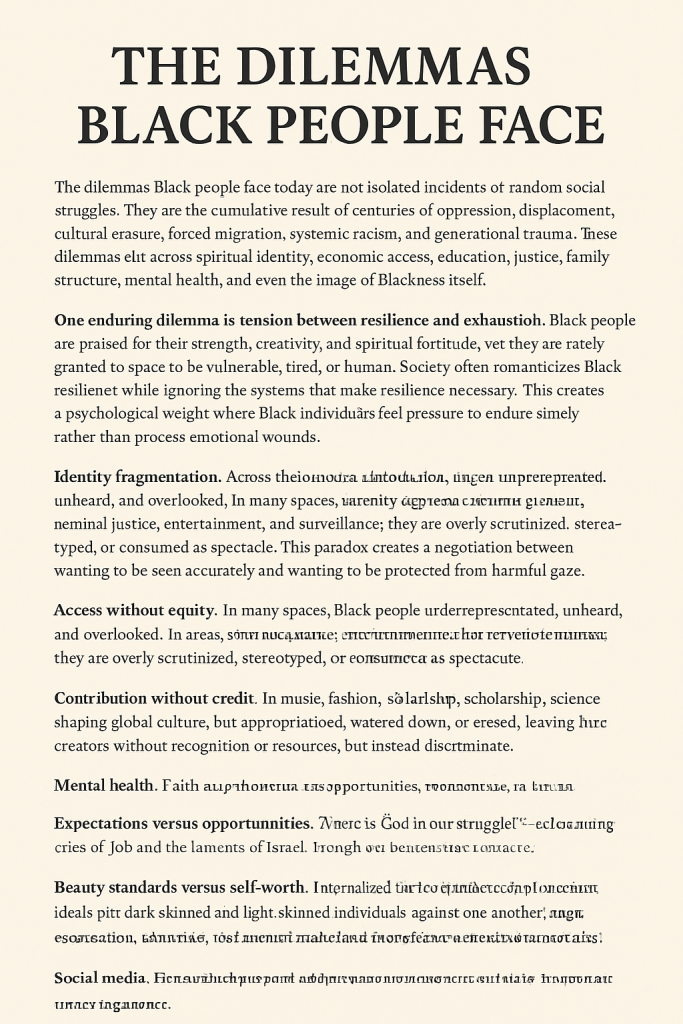
The dilemmas Black people face today are not isolated incidents or random social struggles. They are the cumulative result of centuries of oppression, displacement, cultural erasure, forced migration, systemic racism, and generational trauma. These dilemmas cut across spiritual identity, economic access, education, justice, family structure, mental health, and even the image of Blackness itself. They form a complex landscape that Black people must navigate daily while still fighting to build dignity, community, and hope.

One enduring dilemma is the tension between resilience and exhaustion. Black people are praised for their strength, creativity, and spiritual fortitude, yet they are rarely granted the space to be vulnerable, tired, or human. Society often romanticizes Black resilience while ignoring the systems that make resilience necessary. This creates a psychological weight where Black individuals feel pressure to endure silently rather than process emotional wounds.

Another dilemma lies in the legacy of identity fragmentation. Across the diaspora, Black people wrestle with questions of origin, belonging, and cultural continuity. The transatlantic slave trade severed language, history, names, and lineage—leaving many African Americans searching for spiritual and ancestral clarity. This leads to an internal conflict between who society has labeled them to be and who they truly are in God, history, and heritage.

Black people also face the dilemma of visibility versus hypervisibility. In many spaces, they are underrepresented, unheard, and overlooked. In other areas—such as criminal justice, entertainment, and surveillance—they are overly scrutinized, stereotyped, or consumed as spectacle. This paradox creates a constant negotiation between wanting to be seen accurately and wanting to be protected from harmful gaze.

Economically, the dilemma of access without equity remains a major barrier. While Black people may have access to schools, jobs, loans, and housing on paper, systemic practices—such as redlining, wage gaps, discriminatory hiring, and unequal school funding—undermine true equality. The presence of opportunity does not guarantee fairness, and this gap breeds frustration, fatigue, and generational stagnation.

Culturally, Black people face the dilemma of contribution without credit. From music to fashion, science scholarship, the Black world has shaped global culture. Yet those contributions are often appropriated, watered down, or erased, leaving Black creators without recognition or resources. Even in faith spaces, Black biblical history is minimized despite its foundational importance.

Within families, Black communities often face dilemmas created by historical disruption, including mass incarceration, economic instability, and systemic attacks on the Black home. These pressures can create strain in marriages, parenting, and generational continuity, forcing Black families to build structure while battling forces that aim to dismantle it.

Spiritually, there is a dilemma between faith and suffering. Black people often ask, “Where is God in our struggle?”—echoing the cries of Job and the laments of Israel. Yet faith has also been a source of resistance, identity, and liberation throughout Black history. The struggle lies in reconciling divine purpose with earthly injustice.

Colorism creates another dilemma: beauty standards versus self-worth. Internalized Eurocentric ideals can pit dark-skinned and light-skinned individuals against one another, producing wounds that trace back to slavery’s hierarchy. This dilemma shapes relationships, confidence, employment, desirability, and mental health.

In the area of justice, Black people face the dilemma of legal rights versus lived reality. Though laws promise equality, the outcomes—from traffic stops to sentencing—tell a different story. This dissonance reinforces a mistrust in systems meant to protect but instead discriminate.

Mental health remains a growing dilemma, as Black people contend with trauma, stress, discrimination, financial pressure, and societal expectations, all while lacking equitable access to culturally relevant care. Silence around therapy and emotional vulnerability can hinder healing.

Educationally, Black students face the dilemma of expectations versus opportunities. While excellence is often demanded, support is not always given. This leads to underfunded schools, biased assessments, and unequal advancement.

Social media has introduced new dilemmas—hyperexposure, comparison culture, cyberbullying, and the performative nature of modern identity. Though it allows Black voices to rise, it also magnifies criticism, competition, and unrealistic ideals.

And at the heart of all dilemmas lies a deeper spiritual one: the ongoing struggle for self-definition. Black people are constantly reclaiming a narrative that the world has tried to rewrite. This dilemma fuels movements, art, scholarship, and faith-based awakenings that reconnect Black people to origin, dignity, and divine purpose.

Despite these challenges, Black people continue to rise, resist, create, and believe. The dilemmas are real, but so is the power, brilliance, and spiritual calling placed upon the descendants of survival.


References

Alexander, M. (2010). The new Jim Crow: Mass incarceration in the age of colorblindness. The New Press.
Branch, T. (1988). Parting the waters: America in the King years, 1954–1963. Simon & Schuster.
Du Bois, W. E. B. (1903). The souls of Black folk. A. C. McClurg & Co.
hooks, b. (1995). Killing rage: Ending racism. Henry Holt.
Painter, N. I. (2006). Creating Black Americans: African-American history and its meanings. Oxford University Press.
Wilkerson, I. (2020). Caste: The origins of our discontents. Random House.
Woodson, C. G. (1933). The mis-education of the Negro. Associated Publishers.

Dilemma: The Isms

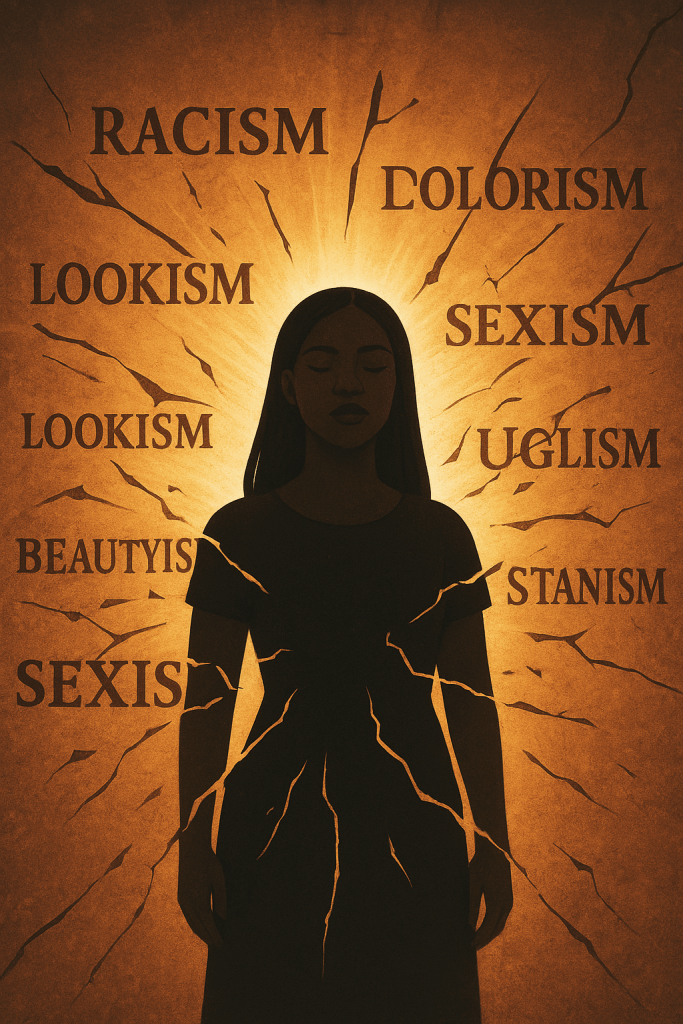
In the grand theater of human existence, few scripts are as persistent and poisonous as the “isms.” Racism, colorism, lookism, beautyism, sexism, oldism, shadeism, uglyism, and even satanism—all are manifestations of a fallen world obsessed with hierarchy, appearance, and power. Each “ism” reflects the corrosion of love and the rebellion of pride. Together, they create a network of deception that distorts identity, destroys unity, and desecrates the divine image in which humanity was made. Nowhere are the scars of these “isms” more deeply etched than within the Black experience. For centuries, Black people have stood at the crossroads of all these prejudices, bearing their weight in body, mind, and soul.

Racism remains the root—a centuries-old ideology that devalues melanin while exalting whiteness. It began as a tool of control and exploitation, branding Blackness as inferior to justify enslavement, colonization, and systemic oppression. The result is a world where Black people must constantly prove their worth in spaces that were built to exclude them. Yet God created man “of one blood” (Acts 17:26, KJV), and He did not rank His creation by hue or heritage. Racism, therefore, is not merely a social construct—it is a sin against divine design.

Colorism, birthed from the same soil, has fractured the Black community itself. It is the preference for lighter skin tones and the degradation of darker shades, a poison inherited from colonialism and slavery. Within entertainment, corporate spaces, and even family structures, darker-skinned individuals often face invisibility or bias. The pain of colorism is internal and generational—it teaches people to love themselves in fragments. Blackness, in all its shades, becomes a battlefield instead of a brotherhood.

Shadeism, a close cousin to colorism, digs deeper into the nuances of melanin politics. It is not just about dark or light, but about the subtle gradients that dictate beauty, opportunity, and social treatment. A few shades lighter can mean a world of difference in media representation or romantic desirability. This artificial hierarchy was never God’s plan. The Bible declares that “we are fearfully and wonderfully made” (Psalm 139:14, KJV), yet man continues to divide what God made whole.

Lookism extends these divisions into the realm of physical features. Society’s obsession with symmetrical faces, certain nose shapes, or body proportions reinforces Eurocentric ideals and marginalizes Black aesthetics. African features—broad noses, full lips, coily hair—have been mocked, exoticized, or appropriated, rarely celebrated for their divine authenticity. For Black people, lookism means being measured by standards that were never meant to reflect them.

Beautyism makes this discrimination even more insidious. It teaches that worth is equal to desirability and that physical beauty is a form of social capital. This idolization of beauty enslaves both the admired and the overlooked. The Black woman, in particular, stands at the intersection of racial, aesthetic, and gender bias—praised for her strength but rarely protected, desired for her body but dismissed for her humanity. Proverbs 31:30 (KJV) reminds us that “beauty is vain,” yet the world worships it as god.

Sexism compounds these struggles by defining womanhood through subservience and silence. Within the Black experience, sexism manifests uniquely. Black women are often denied softness, labeled as too strong, too loud, or too masculine. Their pain is minimized, their brilliance overlooked. Meanwhile, Black men face a different battle—emasculated by stereotypes yet pressured to perform dominance to prove their manhood. Both genders suffer when the divine order of respect and balance is replaced with competition and oppression.

Oldism, or ageism, is another hidden form of injustice. It affects the elders of the Black community, whose wisdom and history are often ignored by a youth-obsessed culture. In Western societies, aging is seen as decline rather than dignity. Yet Scripture says, “The hoary head is a crown of glory, if it be found in the way of righteousness” (Proverbs 16:31, KJV). Elders are living libraries, but oldism silences their stories, causing younger generations to repeat cycles of trauma.

Uglyism is perhaps the cruelest of the superficial “isms.” It labels people as unworthy of admiration based on arbitrary ideals of attractiveness. Within Black culture, uglyism often targets those with the darkest complexions or most African features. This cruel bias leads to deep-seated self-hate, psychological wounds, and lifelong insecurities. The truth, however, is that beauty cannot be defined by the eye of man—it must be defined by the heart of God. What the world calls “ugly,” God often calls chosen.

Satanism, though seemingly distinct from the others, undergirds them all. These “isms” are not merely social patterns—they are spiritual strategies. They divide humanity through pride, envy, and hatred, which are tools of the adversary. Satanism glorifies self-worship, vanity, and hierarchy—all principles seen in the other “isms.” The adversary’s goal is to make creation despise itself, to pit shade against shade, gender against gender, and soul against soul. Ephesians 6:12 (KJV) warns us that “we wrestle not against flesh and blood, but against principalities.” The “isms” are not random—they are orchestrated.

For Black people, the impact of these “isms” is multiplied. Racism devalues them, colorism divides them, lookism mocks them, and beautyism excludes them. Sexism silences their women, oldism forgets their elders, uglyism shames their features, and satanism blinds their spiritual identity. The Black experience becomes a battlefield not just for equality, but for wholeness.

Generational trauma has taught many Black individuals to conform in order to survive. Skin bleaching, hair alteration, and assimilation into Western beauty norms are all symptoms of a deeper wound—the internalized belief that to be accepted, one must erase oneself. But God never intended for His people to conform to the image of man. Romans 12:2 (KJV) commands, “Be not conformed to this world: but be ye transformed by the renewing of your mind.”

Each “ism” robs something sacred. Racism steals dignity. Colorism steals unity. Lookism steals authenticity. Beautyism steals peace. Sexism steals purpose. Oldism steals legacy. Uglyism steals confidence. Shadeism steals harmony. And satanism steals souls. Together, they create a system of distraction—a matrix designed to keep people fixated on the external rather than the eternal.

Healing begins with awareness but is completed through righteousness. God calls His people to live beyond the world’s labels. The Kingdom of Heaven does not rank based on skin tone, age, or beauty; it honors righteousness and humility. The true mark of greatness is not appearance, but obedience.

Black people, as descendants of resilience and divine heritage, must reclaim their image through the eyes of the Creator. Melanin is not a curse but a covering. Afrocentric features are not imperfections but imprints of glory. Elders are not outdated but anointed. Every shade, every texture, every curve is a verse in the poetry of creation.

The path to liberation lies in spiritual reprogramming—replacing the lies of the “isms” with the truth of divine identity. When Black people remember who they are and whose they are, the “isms” lose their grip. For the Most High sees not as man sees. He looks on the heart.

In the end, the true enemy is not color, beauty, or gender—it is corruption. The ultimate “ism” is ego, the self elevated above God. But those who walk in love, humility, and righteousness will transcend the world’s systems. As it is written, “If any man be in Christ, he is a new creature” (2 Corinthians 5:17, KJV).

Let the “isms” fall away, and let divine identity rise. For when we see ourselves and others as God sees us—fearfully, wonderfully, and equally made—the chains of vanity, prejudice, and pride are broken forever.


References

  • The Holy Bible, King James Version (KJV) – Genesis 1:27; Psalm 139:14; Acts 17:26; 1 Samuel 16:7; Proverbs 31:30; Proverbs 16:31; Romans 12:2; Galatians 5:22–23; Ephesians 6:12; 2 Corinthians 5:17.
  • hooks, b. (1981). Ain’t I a Woman: Black Women and Feminism. South End Press.
  • Hill Collins, P. (2000). Black Feminist Thought. Routledge.
  • Russell, K., Wilson, M., & Hall, R. (2013). The Color Complex: The Politics of Skin Color Among African Americans. Anchor Books.
  • Wolf, N. (1991). The Beauty Myth: How Images of Beauty Are Used Against Women. HarperCollins.
  • West, C. (1993). Race Matters. Beacon Press.
  • Bailey, C. (2020). Misogynoir Transformed: Black Women’s Digital Resistance. NYU Press.

Dilemma: Racial Profiling

Racial profiling is one of the most pervasive forms of systemic racism in modern society. At its core, it refers to law enforcement, institutions, or individuals targeting or treating people differently primarily because of their race, ethnicity, or national origin, rather than their behavior or credible evidence. (ACLU, n.d.)

The term has its roots in historical forms of discrimination, including slave patrols and discriminatory policing in the post-slavery United States. Over time, it evolved into a widespread practice used to justify surveillance, stops, and searches of Black communities disproportionately.

Racial profiling is not limited to policing. It manifests in education, housing, lending, employment, retail spaces, and travel, affecting Black individuals at almost every stage of life. The cumulative impact is systemic disadvantage and heightened exposure to social, economic, and legal risks.

In law enforcement, studies consistently show that Black people are more likely to be stopped, searched, and arrested than their White counterparts. For example, research using large-scale smartphone location data found that police presence is disproportionately concentrated in Black neighborhoods, independent of crime rates. (Chen et al., 2021)

Traffic stops provide a clear example. Black drivers are more likely to be stopped, searched, and ticketed than White drivers, even when controlling for behavior and location. (Phillips et al., 2017) These interactions reinforce the perception that Black individuals are inherently suspicious, perpetuating mistrust between communities and law enforcement.

Data from the Kaiser Family Foundation shows that nearly 70% of Black Americans report experiencing discrimination or police mistreatment in their lifetime, with almost half stating they felt their lives were in danger during these encounters. (KFF, 2020)

The psychological impact of racial profiling is profound. Exposure to profiling increases stress, anxiety, and trauma among Black individuals. Research shows that both direct and vicarious experiences of profiling contribute to long-term mental health disparities. (PubMed, 2020)

In the workplace, racial profiling can take the form of heightened scrutiny, biased disciplinary actions, and assumptions of incompetence. Black employees often report feeling monitored or distrusted by supervisors and colleagues based solely on racial assumptions.

Educational settings also reflect these patterns. Black students are disproportionately disciplined, searched, or subject to zero-tolerance policies. This early exposure to profiling shapes perceptions of authority and social justice, affecting educational outcomes and long-term life trajectories.

Retail environments often engage in what is called “shopping while Black.” Black shoppers are more likely to be followed, questioned, or suspected of theft compared to White shoppers. Local studies indicate that such profiling contributes to feelings of exclusion and social marginalization.

Housing policies also reflect profiling. Landlords, property managers, and neighborhood associations may treat Black applicants as higher risk, enforce codes more strictly in Black neighborhoods, or limit access to desirable housing. These practices contribute to residential segregation and wealth disparities.

Lending institutions also profile Black borrowers. Studies demonstrate that Black applicants are more likely to be denied loans, offered higher interest rates, or subjected to stricter scrutiny, even when controlling for income and creditworthiness. (Federal Reserve, 2019)

In travel and airports, profiling manifests as disproportionately high rates of stops and security screenings of Black travelers. For example, a news report highlighted that Black passengers at major U.S. airports faced more frequent detentions than their share of overall travelers. (People, 2023)

The legal system is deeply affected by profiling. Black defendants are more likely to face harsher charges, longer sentences, and pretrial detention compared to White defendants. Profiling perpetuates inequities in criminal justice outcomes, reinforcing structural racism.

Community trust is eroded when profiling is widespread. Black communities often report fear and suspicion of authorities, limiting cooperation and civic participation. This distrust has long-term consequences for social cohesion and public safety.

Profiling also exacerbates economic disparities. Encounters with law enforcement and legal systems disrupt employment, schooling, and economic productivity, perpetuating cycles of poverty in Black communities.

The historical roots of profiling, including slave patrols and Jim Crow policing, continue to shape modern practice. These legacies demonstrate how profiling is less an isolated problem and more a systemic feature of racialized institutions.

Structural factors, including zoning, policing budgets, and data collection practices, perpetuate profiling. Lack of transparency and accountability in stop-and-search procedures allows discriminatory practices to continue largely unchecked.

Policy interventions are critical. Mandatory data collection on stops, searches, and arrests, coupled with community oversight and bias training, can mitigate racial profiling. Redress mechanisms for victims are essential to ensure accountability.

Technology can both help and harm. While data analytics may identify discriminatory patterns, surveillance technologies, facial recognition, and predictive policing often disproportionately target Black neighborhoods, exacerbating profiling.

Education and public awareness campaigns are necessary to reduce the social acceptability of profiling. Community engagement, anti-bias training, and advocacy for civil rights strengthen resilience against discriminatory practices.

Culturally, racial profiling affects Black identity and experience. The cumulative stress of profiling contributes to racial battle fatigue, affecting physical health, mental health, and social cohesion. (Clark et al., 1999)

Media representation shapes perception. Over-representation of Black people in crime reporting reinforces stereotypes and justifies profiling in the public imagination. Counter-narratives are critical to challenging systemic bias.

Racial profiling is an ethical dilemma. It violates principles of justice, fairness, and equal protection under law. The practice undermines democratic norms and perpetuates intergenerational trauma.

Ultimately, racial profiling affects every facet of life for Black people: safety, employment, education, health, housing, and community life. Combating it requires structural, cultural, and legal interventions.

References

American Civil Liberties Union. (n.d.). Racial profiling | Race and criminal justice. Retrieved from https://www.aclu.org/issues/racial-justice/race-and-criminal-justice/racial-profiling

Chen, M. K., Christensen, K. L., John, E., Owens, E., & Zhuo, Y. (2021). Smartphone data reveal neighborhood-level racial disparities in police presence. arXiv. Retrieved from https://arxiv.org/abs/2109.12491

Clark, R., Anderson, N. B., Clark, V. R., & Williams, D. R. (1999). Racism as a stressor for African Americans: A biopsychosocial model. American Psychologist, 54(10), 805–816.

Federal Reserve. (2019). Discrimination in lending: Evidence and policy. Retrieved from https://www.federalreserve.gov/publications/files/2019-discrimination-lending.pdf

Kaiser Family Foundation. (2020, June 18). Poll: 7 in 10 Black Americans say they have experienced incidents of discrimination or police mistreatment in their lifetime. Retrieved from https://www.kff.org/racial-equity-and-health-policy/press-release/poll-7-in-10-black-americans-say-they-have-experienced-incidents-of-discrimination-or-police-mistreatment-in-their-lifetime-including-nearly-half-who-felt-their-lives-were-in-danger/

Phillips, C., Goel, S., et al. (2017). A large-scale analysis of racial disparities in police stops across the United States. arXiv. Retrieved from https://arxiv.org/abs/1706.05678

PBS NewsHour. (2016, August 31). Nearly a quarter of young Black people say they’ve been harassed by police, poll finds. Retrieved from https://www.pbs.org/newshour/nation/young-black-adults-less-trusting-police-poll-finds/

People. (2023). Tyler Perry calls out racial profiling of Black airport travelers. Retrieved from https://people.com/tyler-perry-calls-out-racial-profiling-of-black-airport-travelers-8659849

PubMed. (2020). Racial interactions and health consequences: A systematic review. Retrieved from https://pubmed.ncbi.nlm.nih.gov/32253746/