The dilemma of Black skin is not biological—it is psychological, historical, and inherited through trauma. A pigment that should signify life, lineage, and divine creativity was weaponized into a mark of subjugation and dehumanization, though scripture never framed hue as inferiority. “I am black, but comely” (Song of Sol. 1:5, KJV).
Slavery altered more than labor systems; it attempted to rewrite identity itself. Black skin became a symbol falsely associated with divine rejection, though the Bible affirms that God formed all mankind intentionally. “The Lord hath made all things for himself” (Prov. 16:4, KJV).
The transatlantic slave trade kidnapped the body, but racism imprisoned the mind. Europeans repainted the theology of beauty with whiteness centered at the altar, planting a spiritual lie that melanated bodies were errors, not divine authorship. Yet God is the original designer. “Thine eyes did see my substance, yet being unperfect” (Psa. 139:16, KJV).
Negativity surrounding Black skin was not seeded in scripture but in propaganda. Colonizers inverted Ham’s lineage in Genesis into a false theology of skin-based curses, though the Bible speaks no such thing. The curse in Genesis was upon Canaan’s servitude, not complexion (Gen. 9:25, KJV).
Africa was the first cradle of human expansion. Ham’s sons—Cush, Mizraim, Put—are founders of African nations (Gen. 10:6, KJV). This means Black presence was at creation, migration, and worship’s dawn, not its aftermath.
Racism engineered theology into hierarchy. Whiteness monopolized the image of God, angels, and salvation, even though scripture gives cosmic freedom in who God calls by name. “Princes shall come out of Egypt; Ethiopia shall soon stretch out her hands unto God” (Psa. 68:31, KJV).
Colorism is racism’s domestic offspring. When a system wounds a nation long enough, the wounded begin competing in hue rather than healing in humanity. But God’s salvation is soul-deep, not skin-deep. “For man looketh on the outward appearance, but the Lord looketh on the heart” (1 Sam. 16:7, KJV).
Dark skin was mislabeled as labor-grade, not beauty-laced. The marketplace economy of slavery placed price tags on phenotype: lighter brought economic advantage, darker brought harsher labor assignment. This distortion still echoes in modern Black cultural psychology.
Black children grew up watching the world praise fairness while punishing richness. This interior conflict creates a dilemma: loving the color you wear while living in a society that still worships the opposite.
Racism convinces Black women that beauty requires editing Blackness itself. From skin bleaching to hair humiliation, the world teaches Black women to apologize for melanin instead of honoring it. Yet scripture reverses the shame of appearance. “He hath made every thing beautiful in his time” (Eccl. 3:11, KJV).
Black men carry the burden of being feared because of their shade and frame. Their complexion was interpreted socially as aggression rather than image-bearer dignity, though the Bible describes strength without equating it to moral corruption. “Be strong and of a good courage” (Josh. 1:9, KJV).
Negativity surrounding Black skin created a spiritual orphaning. Many Blacks converted into religions that used the Bible to comfort them but never used theology to defend their identity’s sacred legitimacy.
Melanin became a theological insecurity rather than a cultural crown. Black skin was reinterpreted into a social problem instead of a sacred narrative of ancestral resilience, divine endurance, and survival.
Scripture affirms that God stands with the suffering and oppressed, not the complexion they are suffering in. “He shall judge the poor of the people, he shall save the children of the needy” (Psa. 72:4, KJV) makes it clear that injustice draws God’s advocacy, not His agreement.
Christianity as preached on plantations tried to pacify revolt while ignoring identity theft. But scripture tells another story: God delivers the oppressed into restored dignity, not silent submission. “Let my people go” (Exo. 5:1, KJV).
Black skin was the canvas on which oppression attempted to permanently paint shame. But the Bible shows that suffering does not rewrite chosenness. “If ye endure chastening, God dealeth with you as sons” (Heb. 12:7, KJV).
Colorism wounded Black women into ranks of attractiveness based on gradients. The dilemma of pigmentation hierarchy taught Black mothers to desire lighter children, reflecting trauma rather than preference.
Racism built entire institutions to oppose Black elevation. Still, scripture promises divine reversal in seasons of suffering. “And the Lord thy God will turn thy captivity… and have compassion upon thee” (Deut. 30:3, KJV).
Black skin is now undergoing reclamation. The dilemma remains, but so does restoration theology. “Be renewed in the spirit of your mind” (Eph. 4:23, KJV) suggests transformation is mental liberation first.
The world tried to make Blackness symbolic of sin, foolishness, servitude, and ugliness. But scripture gives voice to beauty where culture denied it. “I will make mention of Rahab and Babylon to them that know me: behold Philistia, and Tyre, with Ethiopia; this man was born there” (Psa. 87:4, KJV).
The dilemma of Black skin is therefore a theological confrontation: rejecting the doctrine of racial inferiority, dismantling internalized oppression, calling melanin beautiful without apology, and reclaiming skin not as dilemma but testimony.
Black identity was not born in chains, curse, or erasure—it was born under heaven’s architecture, exiled through suffering, yet promised redemption. “For I know the thoughts that I think toward you, saith the Lord, thoughts of peace, and not of evil” (Jer. 29:11, KJV).
The final transformation is from shame to sacred remembrance. The original mark of identity was not color—but creation intent. And creation intent cannot be rewritten by captivity. “The gifts and calling of God are without repentance” (Rom. 11:29, KJV).
References
The Holy Bible, King James Version. (1611). Cambridge University Press. Douglass, F. (1845). Narrative of the Life of Frederick Douglass, an American Slave. Anti-Slavery Office. Hunter, M. (2007). “The Persistent Problem of Colorism.” Sociology Compass, 1(1), 237-254. Walker, A. (1983). In Search of Our Mothers’ Gardens. Harcourt.
This photograph is the property of its respective owner. No copyright infringement intended.
Melanin has long been viewed through a social, aesthetic, and at times oppressive lens, yet beneath surface narratives lies profound biological, historical, and spiritual significance. Melanin is not merely pigment—it is a biochemical treasure, a molecular shield, and a marker of resilience. To speak of melanin is to enter a conversation about identity, memory, divinity, and survival.
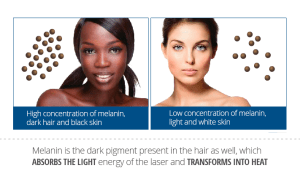
Biologically, melanin is a natural polymer responsible for skin, hair, and eye color. It exists in eumelanin, pheomelanin, and neuromelanin forms, each with precise biological functions (Simon et al., 2009). Eumelanin produces rich brown and black hues, functioning as the body’s natural armor against ultraviolet radiation. Those richly endowed with melanin possess enhanced protection from sun damage and oxidative stress.
The molecular properties of melanin have led many scholars and thinkers to call it a biochemical jewel. It absorbs and transforms light, protects DNA, neutralizes free radicals, and supports cellular stability (Hill, 1992). It is a biological blessing—an evolutionary adaptation honed to thrive under intense sunlight. In this way, melanin becomes symbolic of ancestral endurance in equatorial regions, where ancient civilizations flourished.
Neuromelanin—found in the brain—invites deeper conversation. It is concentrated in regions associated with movement, memory, and emotional regulation (Zecca et al., 2008). The presence of melanin in neural structures has fueled scientific curiosity and cultural pride. Though still under study, neuromelanin may play a role in neurological health, stress resilience, and cognitive processes.
The historical framing of melanin diverges sharply from its biological brilliance. Colonial narratives weaponized skin tone, divorcing melanin from its scientific majesty. People with higher melanin content were cast into artificial hierarchies designed to devalue their humanity and legacy. Yet the very trait used to marginalize Black people is one of nature’s greatest evolutionary triumphs.
Melanin’s perceived mystical value predates colonial discourse. Ancient African civilizations viewed dark skin as a sign of divine power, lineage, and sacred connection to the sun. In Kemet (Egypt), the term Khem symbolized Blackness, fertility, and sacred life (Diop, 1974). To be melanated was to be spiritually potent and cosmically aligned.
Thus arises the metaphor of melanin as “the Golden Fleece.” In Greek mythology, the Golden Fleece symbolized royalty, cosmic blessing, and divine right. To liken melanin to the Golden Fleece is to reclaim the narrative—it is a crown, not a curse. This metaphor challenges societies to re-evaluate the value systems that commodified white aesthetics and vilified Black embodiment.
Spiritually, melanin carries a symbolic weight in Black consciousness movements. The Bible proclaims, “I am black, but comely” (Song of Solomon 1:5, KJV), affirming beauty and dignity in dark skin. Scripture often references dark skin in contexts of royalty, ancestral lineage, and divine intimacy. Spiritual identity and physical identity intertwine.
Social narratives around melanin continue to evolve. The reclamation of Black beauty, culture, and identity represents a collective unshackling from Eurocentric paradigms. Melanin becomes not simply a biological trait, but a cultural banner—a reminder of ancestral legacy and global influence. It is an emblem of survival in systems designed to erase it.
Psychologically, embracing melanin strengthens self-concept and mental resilience. When individuals internalize pride in their natural features—skin, hair, facial structure—they reclaim agency from colorist and racist conditioning (Banks, 2010). The mind becomes liberated when the body is no longer viewed as inferior.
Colorism remains a lingering shadow over melanin discourse. Preference for lighter skin persists globally, rooted in colonial history and social stratification. Yet the global shift toward celebrating dark skin disrupts this narrative, signaling a cultural renaissance. The body becomes a site of revolution and rebirth.
Social media contributes to this awakening. While it has perpetuated beauty hierarchies, it has also become a platform for melanated celebration. Campaigns honoring dark skin tones challenge historical erasure and elevate diverse aesthetics. Visibility becomes liberation.
Scientifically, melanin may hold future technological and medical promise. Research explores melanin’s potential in radiation shielding, bioelectronics, and regenerative medicine (Kim et al., 2019). The same pigment marginalized socially may become a key to future innovation. Such irony underscores the disconnect between perception and reality.
Economically, “melanin markets” emerge in beauty and media spaces. The world profits from Black style, culture, and features even as Black bodies fight for recognition and safety. To claim melanin’s value is to demand equity, representation, and ownership in industries enriched by Black aesthetics.
The spiritual dimension remains profound. Melanin symbolizes creation, depth, and cosmic mystery. It evokes earth, night, and universe—the fertile darkness from which life emerges. In Genesis, creation begins in darkness before light. Darkness is not absence; it is origin.
To honor melanin is not to elevate one group above another, but to correct historical lies. It is a restoration of dignity and truth. Melanin becomes metaphor, biology, legacy, and prophecy—a reminder that identity is both physical and sacred.
The Golden Fleece metaphor anchors melanin as treasure, not because others lack value, but because Blackness has been historically undervalued. To value melanin is to heal collective wounds and uplift future generations. The world flourishes when every hue is honored.
Ultimately, melanin embodies resilience and radiance. It reflects sunlight, history, struggle, and triumph. Those who carry it inherit a story of survival and sacredness. Melanin is memory written into flesh.
To know melanin is to honor the past and walk boldly into the future. It is a science, a symbol, and a song. It is the Golden Fleece—rare, royal, radiant.
References
Banks, K. H. (2010). African American college students’ experiences with racial discrimination and the role of racism socialization. Journal of Applied Social Psychology, 40(6). Diop, C. A. (1974). The African origin of civilization: Myth or reality. Lawrence Hill Books. Hill, H. Z. (1992). The function of melanin or six blind people examine an elephant. BioEssays, 14(1). Kim, Y. J., et al. (2019). Melanin’s applications in bioelectronics and medicine. Biomaterials, 214. Simon, J. D., Peles, D., & Wakamatsu, K. (2009). Current challenges in understanding melanogenesis. Pigment Cell & Melanoma Research, 22(5). Zecca, L., et al. (2008). The role of neuromelanin in neurological disorders. Journal of Neural Transmission, 115(11).
The Golden Fleece, in classical mythology, was a symbol of ultimate power, wealth, and divine favor. While often imagined as a literal object in Greek legend, symbolically, it represents the sacred, coveted essence of life and vitality. In Afrocentric interpretations, the Golden Fleece parallels the natural golden undertones of melanated skin, celebrating the richness, resilience, and uniqueness of Black bodies.
When a Black man or woman emerges from water, sunlight reveals a golden glow, a phenomenon that occurs across the spectrum of dark skin tones. This luminous effect reflects the melanin-rich composition of the skin, which absorbs and diffuses light in ways that give a subtle, warm radiance. The glow has been described as a visual testament to the divine and ancestral heritage carried in every melanated body.
Frances Cress Welsing, in her seminal work The Isis Papers, addresses the psychology of melanated skin, emphasizing how white-dominant societies have historically envied the physical, intellectual, and spiritual capacities associated with Blackness. She posits that melanin is not merely pigment but a symbol of power, and the natural golden glow of the skin is a manifestation of life-force and genetic vitality, evoking both admiration and subconscious fear in societies conditioned to reject Black excellence.
The Golden Fleece, then, becomes a metaphor for the sacred value inherent in Black skin—a treasure of beauty, resilience, and divine design. It is a reminder that melanated bodies are not only aesthetically radiant but spiritually significant, carrying a legacy that cannot be replicated or diminished.
Biblical References (KJV)
Exodus 3:21-22. King James Version.
Deuteronomy 28:12. King James Version.
Psalm 139:14. King James Version.
Secondary Sources
Welsing, F. C. (1991). The Isis Papers: The Keys to the Colors. Third World Press.
Fanon, F. (1967). Black Skin, White Masks. Grove Press.
Grier, W. H., & Cobbs, P. M. (1968). Black Rage. Basic Books.
Harris, S. (2015). The Psychological Effects of Racism on African Americans. American Psychological Association.
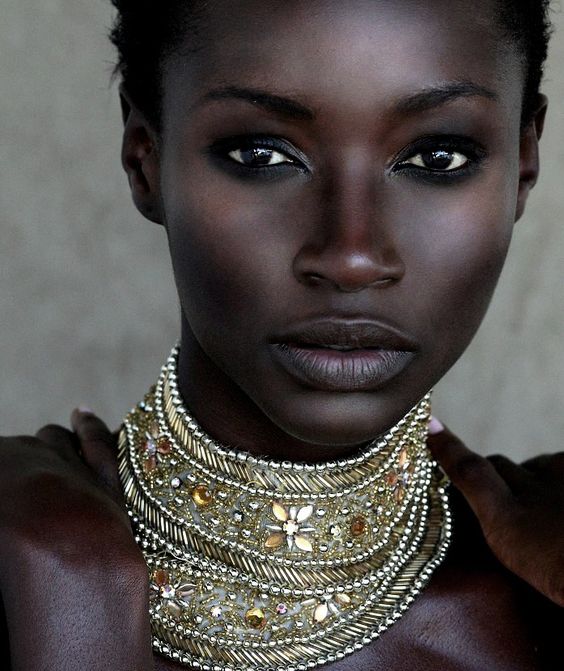
A skin that glistens in the sun, ranging from satin black to golden brown is Melanated skin. Melanin is organic crystallized carbon, it actually runs through your blood, ravages your skin and was created by the Most High God. The dark nations possess it, although, they don’t want to own it, the lighter nations of people try to put it in a bottle to manufacture it through tanning sprays and creams.
All photographs are the property of their respective owners.
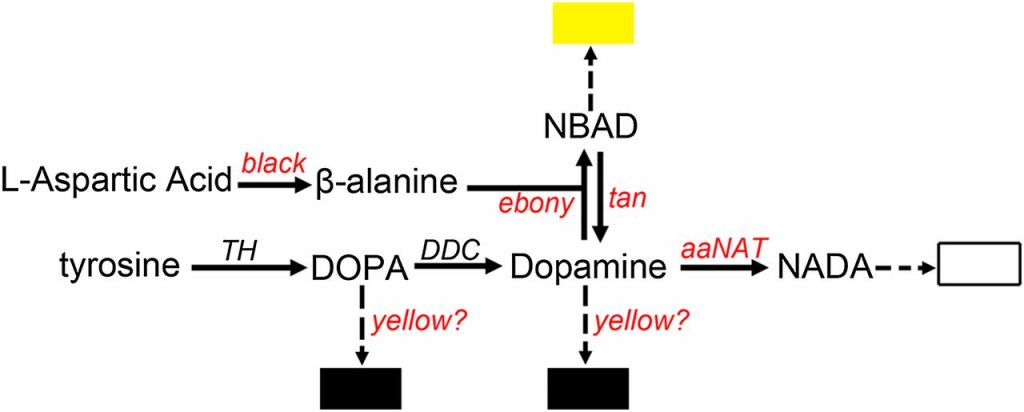
Melanin, which is Carbon, is any of a class of insoluble pigments, found in all forms of animal life, that account for the dark color of skin.
According to Dr. Francis Cress Welling on pg 205, in her book “The Isis Papers:, stated, The phrase “Golden Fleece” is made up of two words associated with Black people: “gold,” denoting black or brown skin and “fleece,” denoting lambs wool or kinky hair. The search for the Golden Fleece becomes the search for melanin. J.D. Cirlot’s dictionary of symbols says that the Golden Fleece ” is one of the symbols denoting the conquest of the impossible or the ultra=reasonable.” For white-skinned people, it is impossible to produce melanin or golden brown or black.
There is a golden hue that radiates out from dark skin, it is present no matter how dark the hue is.
The subject of color to most is probably somewhat idiosyncratic. What we think scientifically and historically about the origins of ‘race’ and the complex ways that skin color has influenced our perception of one another. The effects of colorism and racism on society within various communities. Though modern conceptions of ‘white beauty’ have evolved and become progressively more artificial in recent decades, which has led people to believe that having melanated skin is a curse and not a blessing. I must admit that it was very cathartic and endearing for me to write on this topic of “melanin.” Although, I didn’t want to appear to be a narcissist or presumptuous. I think when I first actually, thought of my skin color was when a friend compared me to a sunset, amazed at how the golden hues, brown, and orangey glow radiated from my skin. While others, always assumed that I was wearing pantyhose on my legs or foundation on my face, sorry no such thing that is the power of melanin. I believe that physical beauty is measured by your features and symmetry, not skin color. It’s really in the eye of the beholder literally. I have traveled the world, there are much beautiful dark and light women the world over, all possess one common thing – their facial features are harmony together. So the theory that your skin color makes you attractive only is a fallacy. Not to be believed. The whole premise of a debate of light vs. dark is unsettling and ignorant, and not edifying the unity between women of all shades of brown. Willie Lynch created a prevalent method for teaching slaves divisive behavior and through colonization, people around the world have adopted these self-denigrating issues that white skin is the best and anything that deviates from that theory is not good. Lynch supported division to keep the light slaves against the dark slaves to prevent rebellion and unity among blacks. Still, today that residue from the past has conditioned people around the world to adopt “white skin” as the best. This is a wide worldwide problem not just for black people but many nations face this reality daily in America, India, Africa, Latin American, South America, Brazil, Dominican Republic, the West Indies, Mexico, Puerto Rico, and Cuba just to name a few. In these countries the lighter you are the more beautiful you are perceived as, the smarter, and the nicer. The Darker you are the more you are perceived as a menace to society, evil, and ugly. These stereotypes are far from the truth, people of color are still suffering from strong delusional thinking based on skin color. Most feel that a white person has attained a status, and reached a level of success because they are the progenitors of the European standard of beauty that dark-skinned people could never measure up to. As for the white (Aryan/Nordic) men and women, they don’t have to try, they woke up in privilege. They have been born this way. They have become gods in their own eyes.
Photo Credit: blackexcellence.com
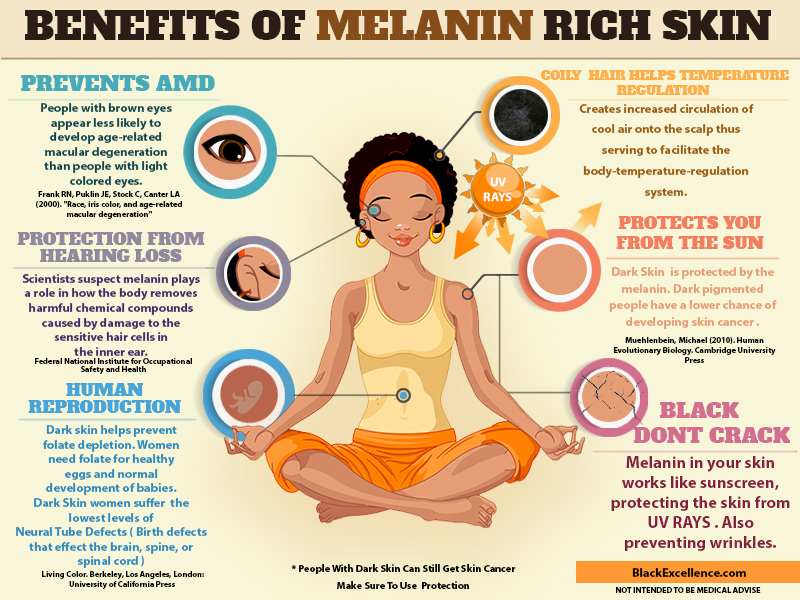
1. BLACK DOESN’T CRACK! The most celebrated quality of possessing melanated skin is its uncanny ability to be anti-aging, whereas, dark skin shows less visible signs of aging when compared to white skin. Dark-skinned people tend to look younger than their chronological age.
2. Protection from the sun, melanated skin has a natural SPF.
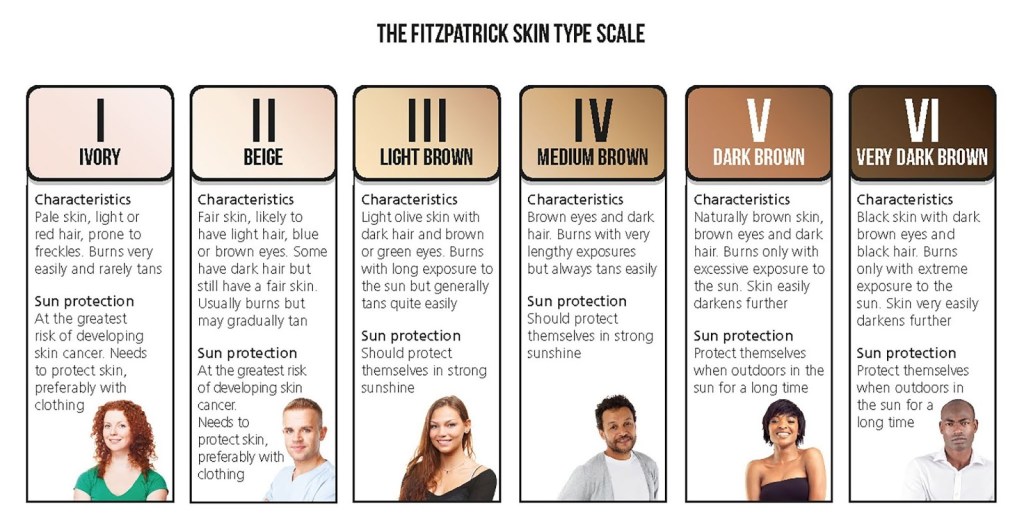
The Fitzpatrick scale (above) is a numerical classification that was created in the 1970s by Thomas Fitzpatrick, an American dermatologist. The study of human skin color underlines the categories of skin color where it relates to how it measures in terms of being exposed to the sun. It identifies that darker skin is less likely to develop skin cancer when exposed to the sun.
In his article, “Why the sun is good for Afrikan people”, Dr. Kwame Osei says,
This lack of melanin cover explains why Europeans/White people especially the albino whites burn in the sun and in the worst circumstances turn pink and get skin cancer- hence why they need to wear sunscreen because their white skin has been damaged by the sun’s UV rays because their pineal gland, an organ between the eyes has been calcified. What this means in effect that they cannot generate energy from the sun’s UV rays due to their lack of melanin. Melanin in its most concentrated form is black. It is black because its chemical structure will not allow any energy to escape once that energy has come in contact with it. This gives us insight and shows that melanin-dominant people do not require the same amount of minerals and nutrients in their diet as people with less melanin.(modernghana.com)
Nearly all black and brown skins are beautiful, but beautiful white skin is rare. Where dark complexions are massed, they make the whites look bleached-out, unwholesome, and sometimes frankly ghastly. I could notice this as a boy, down South in the slavery days before the war. The splendid black satin skin of the South African Zulus of Durban seemed to me to come very close to perfection. The white man’s complexion makes no concealments. It can’t. It seemed to have been designed as a catch-all for everything that can damage it. Ladies have to paint it, and powder it, and cosmetic it, and diet it with arsenic, and enamel it, and be always enticing it, and persuading it, and pestering it, and fussing at it, to make it beautiful; and they do not succeed. But these efforts show what they think of the natural complexion, as distributed. As distributed it needs these helps. The complexion which they try to counterfeit is one that nature restricts to the few–to the very few. To ninety-nine persons, she gives a bad complexion, to the hundredth a good one. The hundredth can keep it–how long? Ten years, perhaps. The advantage is with the Zulu, I think. He starts with a beautiful complexion, and it will last him through. And as for the Indian brown–firm, smooth, blemish free, pleasant, and restful to the eye, afraid of no color, harmonizing with all colors and adding a grace to them all–I think there is no sort of chance for the average white complexion against that rich and perfect tint. — Mark Twain, Skin Deep – Complexions
The Black skin is not a badge of shame, but rather a glorious symbol of national greatness. — Marcus Garvey
The recipients of the phenomenon we know as “MELANIN” are the people, that are referred to as Black, Colored, African, Sub-Saharan, and African American.
In his book, “The Chemical Key to Black Greatness” American Biochemist, Carol Barnes, described melanin as, “a civilizing chemical that acts as a sedative to help keep the black human calm, relaxed, caring, creative, energetic and civilized”. Research also revealed that melanin enables black skin to actively interact with the sun, to produce Vitamin D from a biochemical substance, 7- dehydrocholesterol. The study also detected that, melanin has spiritual dynamics as well as physical, since it acts as a sensory ‘receptor’ and ‘transmitter’; communicating with cosmic energy fields in the vast universe converting light energy to sound energy and back. Dr. Richard King, MD, stated that, “melanin, by its ability to capture light and hold it in a memory mode, reveals that blackness converts light into knowledge”.
All photographs are the property of their respective owners.
Melanin refines the nervous system in such a way that messages from the brain reach other areas of the body most rapidly in dark people, the first race. The abundance of melanin in our skin gives us genetic inferiority. We are physically stronger. Mentally sounder. Spiritually more connected. High absorption of vitamins, full-color range, taste of the full flavor of food, and more intelligence. Melanin (Carbon) is essential to brain, nerve, and organ function it can be found in every part of the body where cells are to reproduce and regenerate. Let’s not forget the anti-aging effects of melanin in dark skin, on average a white-skinned person will look much older than their black counterpart.
“ Melanin (Carbon) is the fundamental unit of the universe and exists in four forms: Cosmic, Planetary, plant kingdom (chlorophyll), and animal kingdom melanin. Melanin is black (carbon) because its chemical structure allows no energy to escape.. making black melanin the super absorber of energy and light. Melanin is found in almost every organ of the body and is necessary in order for the brain and nerves to operate, the eyes to see, and the cells to reproduce. Melanin can rearrange its chemical structure to absorb all energy across the radiant energy spectrum (i.e. sunlight, Xirays, music, sound, radar, radio waves, etc) The black human can charge up his/her melanin just by being in the sun or around the right type of musical sounds or other energy sources. Our body is electrical, with currents of nerves sending signals through our brain daily. Melanin itself, on a philosophical plane, is a black chemical/biological door through which the life force of African spirituality passes in moving from the spirit to the material realm. You will we learn to accept and embrace the fact that Black is not only beautiful but it comes in a variety of different shades, textures, and tones; None of which is better or worse than the other. Proof of a creator? You exist and there are no copies of you anywhere. The facial features of a person of color are more pronounced than any other nation around the world. Did you know that many white people in the Americas tan their skin and are vast consumers of tanning bronzing gels ,etc? Just the other day I saw a white woman at my local market she was as dark as me, but with a orangey tint to her face. So with the lie that states that dark skin is less desired but the hate is more a product of self-hatred and taught behavior, than a total social preference. There is a reason we have been conditioned this way.
As has its advantages dark skin so does dark eyes which can see the full-color range as it is exactly it is.
My conversation with Pascal, a professional photographer from France.
Q: What is it like to work with models/people of color?
Pascal: Let me start with you… photographing you and applying makeup to your face what a pleasure, you have the most beautiful eyes, face, and skin. Up close you are so physically beautiful, physically compelling, I’m hypnotized by your good looks. Your skin is always so soft, smooth, and creamy like churned butter, I love your light skin color. Women of color are the most beautiful creatures on earth, the skin is so deep and rich, they are the best to work with.
Q: Do you have a preference for light or dark?
Pascal: No but in my work, the darker the girl is the more light she becomes to the camera like a rare occurrence with the view. Dark skin really is the best.
Carbon is really the correct word.. but Melanin is the black man’s ace and intelligence. Our skin has the highest amount of Melanin of all nations, also, This is the color of the Savior. And his feet like unto fine brass, as if they burned in a furnace; and his voice as the sound of many waters. Revelation 1:15-17 KJV
Basking in the hot sun for hours While becoming sun-kissed to perfection The salt of our tears raped our face As we picked cotton in the southern heat No other skin could take such a beating Like the Melanin in our skin. Our skin is just like butter burned to make you want to devour it Symbolic of the melting of dark chocolate and How sweet it is Some are like coffee with milk while others are like hot chocolate Only one term to describe the beauty and dimension of the colors of our skin Resplendently Like the melanin in our skin.
The Black skin is not a badge of shame, but rather a glorious symbol of national greatness. — Marcus Garvey
All photographs are the property of their respective owners.
4 things the other nations COVET from us.
1. Lips
So they say that Angelina Jolie made our lips famous? Way before there was Angelina, there were our ancestors that possessed those ancient lumps we call lips, yes full and luscious all the way. Now today with millions of collagen injections being dished out annually for something we have been blessed with.
2. Darker Skin
Who said only white porcelain skin was all the rage with millions of dollars being spent annually on tan salons, bronzing powders, and spray tans all to achieve our sun-kissed skin?
Our melanin is a gift from the Most High God. So cherish it.
3. Our Round Bottoms
It is no secret that black women are known for their big bottoms, but we were born with them. Butt implants have become the norm like brushing your teeth, and many women have become disfigured by infecting fat into their bottoms. Hmmm, wouldn’t have been nice to be born with it.
5. Black Men
Are Truly the most desired men by all nations. The Greatest Gift to the black woman is the black man. So what if so or you are rough around the edges but so are we black women? Everyone can see your greatness, you are our King. So raise and love the black woman back. The other nations may love you, but your roots are with the black woman.
5 Great things about melanin in the skin:
1. Some of the greatest Inventors and Innovators.
Despite such impressive credentials, black people are the innovators and inventors of just about everything on earth from toothpaste to electricity.
2. The Melanin in our Skin.
Beyond a shadow of a doubt, black doesn’t crack, which contributes to our anti-aging, but more importantly, the high concentration of melanin has its benefits such as protection from the sun and produces our Vitamin D.
3. Our hair is unique and fascinating.
Everyone else grows fur. Black hair can maintain its state, whether it be kinky, coily, relaxed, fro, or cornrows can keep its shape in the harsh climates in the world.
4. A black man’s body is superior, genetically stronger than that of any other race.
It has been proven that throughout history that the black man has built the constructs of building and foundations for many nations, including America through slavery, etc.
5. A black woman’s features are highly coveted.
Our skin and facial features are highly coveted by other races, such as our lips, booty, and skin. Many Nordic/Aryan races have emulated our features in mainstream media.
Where faith, history, and truth illuminate the Black experience.






 THE BROWN GIRL DILEMMA