Tag Archives: black beauty

The Ebony Dolls: Joyce Bryant

The Bronze Blonde Bombshell Who Redefined Black Glamour
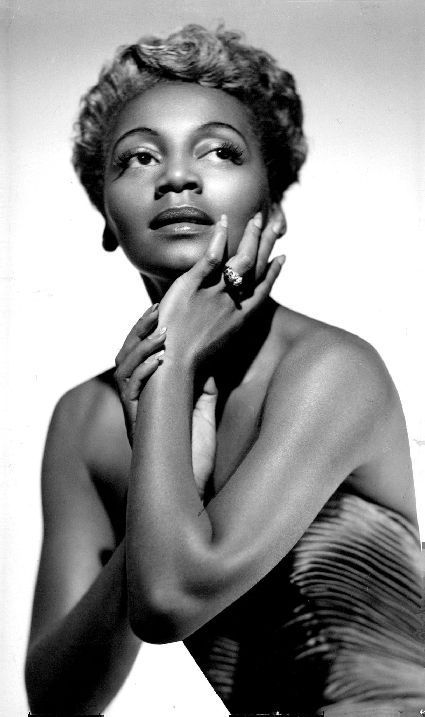
In the golden age of American nightlife, before the Civil Rights Movement reshaped the nation’s moral compass, one woman stood beneath the spotlight with silver hair gleaming and a voice that silenced entire rooms. Joyce Bryant was not merely a nightclub singer — she was spectacle, defiance, elegance, and contradiction embodied. She was called “The Bronze Blonde Bombshell,” “The Black Marilyn Monroe,” and “The Voice You’ll Always Remember.” Yet beyond the glamour was a woman of discipline, faith, and conviction whose life defied the industry that made her famous.

Born Ione Emily Bryant on October 14, 1927, in Oakland, California, and raised in San Francisco in a strict Seventh-day Adventist household, Bryant’s upbringing was conservative and deeply religious. Her early life did not forecast the sensual icon she would become. At fourteen, she briefly eloped — a youthful rebellion that ended almost as quickly as it began. It would not be the last time she surprised those who tried to define her.

Her entry into entertainment was accidental. In 1946, while visiting Los Angeles, she accepted a dare to sing at a nightclub to earn money for her return home. The club owner paid her $25 and invited her back. That impromptu performance marked the birth of a career that would soon electrify New York’s nightclub circuit.

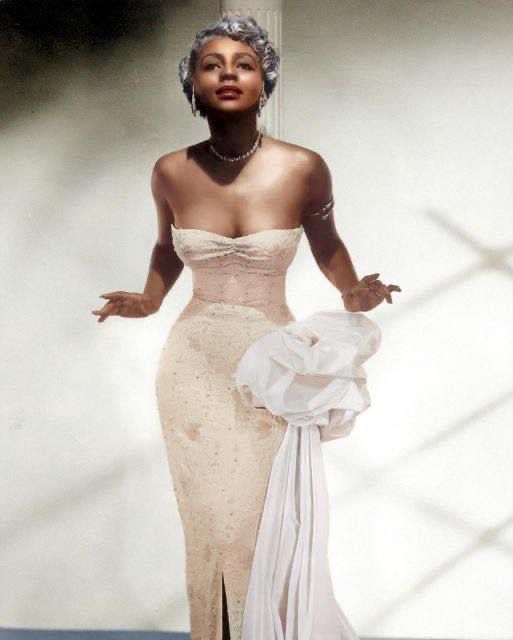
By the late 1940s and early 1950s, Bryant was headlining major venues, reportedly earning thousands per week — an extraordinary sum for a Black woman in segregated America. Her four-octave vocal range captivated audiences, but it was her appearance that made her unforgettable. She dyed her hair metallic silver — initially using radiator paint — and wore impossibly tight mermaid gowns that required her to be sewn into them before performances. She moved minimally on stage, creating an aura of mystique that intensified her sensual presence.

Her aesthetic was deliberate. In an era when Black women were often denied glamorous representation, Bryant constructed herself as living art. In 1954, Ebony magazine named her one of the five most beautiful Black women in the world, alongside icons such as Lena Horne, Eartha Kitt, and Dorothy Dandridge. That recognition solidified her place within the visual lineage of celebrated Black femininity — what cultural historians often describe metaphorically as “Ebony Dolls”: women whose beauty, poise, and cultural visibility reshaped aesthetic standards.

Bryant’s recordings included songs such as “Love for Sale,” “Runnin’ Wild,” and “Drunk with Love.” Some were banned from radio due to perceived suggestiveness. Yet the controversy only amplified her allure. She was daring but never vulgar; provocative yet controlled. She understood that power in performance was not merely about exposure, but about command.

Her impact extended beyond aesthetics. Bryant broke racial barriers by performing in previously segregated venues, including Miami Beach nightclubs that rarely booked Black entertainers. She received threats from white supremacist groups but continued performing, quietly challenging Jim Crow norms with every booking.

Despite reaching the height of nightclub fame, Bryant walked away from it all in the mid-1950s. Disillusioned with the exploitation and moral compromises demanded by the entertainment industry, she returned to her religious roots. She studied at Oakwood College and devoted herself to faith-based service and activism. She also participated in civil rights fundraising efforts and supported the broader movement for racial justice emerging under leaders such as Martin Luther King Jr..

Unlike many performers who fade into obscurity after leaving the spotlight, Bryant reinvented herself. In the 1960s, she returned as a classically trained vocalist, studying opera and performing with respected companies including the New York City Opera. Her transition from nightclub bombshell to operatic soprano confounded critics who had underestimated her discipline and artistry.
Her film work was limited but historically noted. She appeared in the 1946 crime film Mr. Ace, performing as a nightclub singer. While Hollywood never fully capitalized on her magnetism, her screen presence remains a testament to her versatility.

Personally, Bryant’s life was marked more by independence than domestic publicity. Aside from her teenage elopement, she did not build her legacy around marriage or publicized romantic partnerships. Instead, she cultivated a life of artistic growth, spiritual conviction, and community service.

In later years, renewed interest in her story led to documentaries and retrospectives, reintroducing her to audiences who had never witnessed her reign firsthand. She passed away in Los Angeles in 2022 at the age of 95, leaving behind a legacy that spans glamour, resistance, faith, and reinvention.

Why is Joyce Bryant considered an Ebony Doll? Because she represented an archetype rarely afforded to Black women in mid-20th-century America: high glamour without apology, sensuality without shame, beauty without concession to Eurocentric standards. She crafted her image intentionally and then relinquished it on her own terms. She proved that beauty and righteousness, performance and principle, could coexist within one woman.

Joyce Bryant was not merely a nightclub sensation. She was a cultural architect of Black glamour. She was a pioneer who stood radiant in silver hair beneath hostile skies — and she remains a symbol of elegance forged in resistance.


References

Bryant, J. (n.d.). Official Biography. JoyceBryant.net.

Joyce Bryant. (2024). In Wikipedia.

Ebony. (1954). “The World’s Most Beautiful Black Women.” Ebony Magazine.

Mr. Ace. (1946). Republic Pictures.

Black Women Radicals. (n.d.). Joyce Bryant Biography.

Ebony Magazine. (2022). “Acclaimed Singer Joyce Bryant Passes Away at 95.”
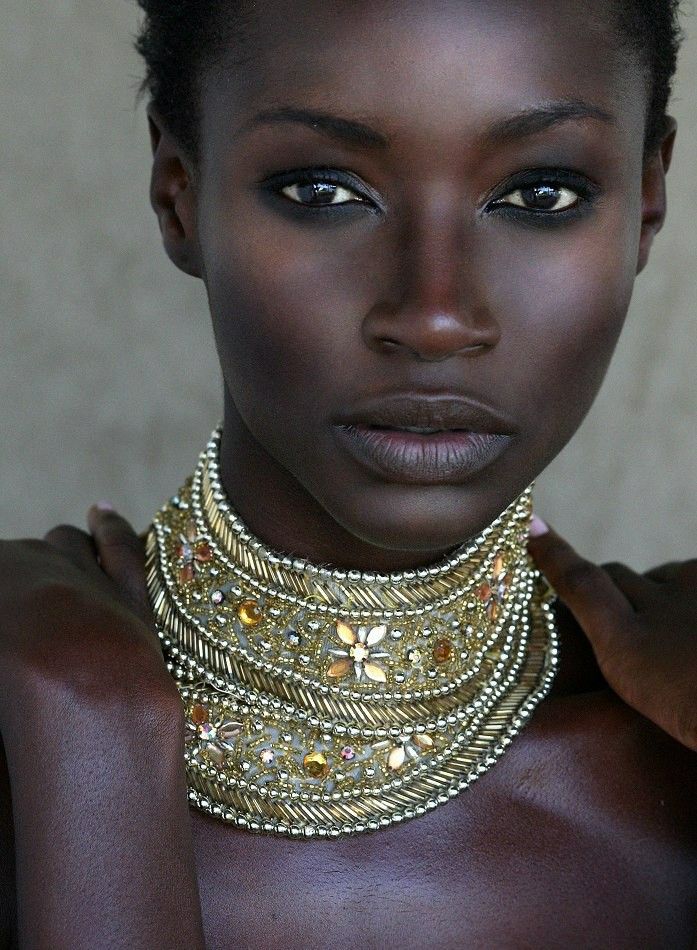
Ethereal Beauty of Brownness

This photograph is the property of its respective owner. No copyright infringement intended.

The concept of “brownness” as beauty transcends mere pigmentation; it reflects a complex interplay of history, biology, culture, and aesthetic perception. Brown skin, whether light caramel, golden bronze, deep chestnut, or rich ebony, embodies a spectrum of human variation that has been historically undervalued yet remains one of the most genetically adaptive and visually striking expressions of humanity. In contemporary discourse, browness is increasingly recognized not as a deviation from a Eurocentric standard but as a distinct and ethereal form of beauty rooted in both science and lived experience.

Outer beauty, though often dismissed as superficial, plays a powerful role in social identity and self-concept. Physical appearance shapes how individuals are perceived and how they navigate social spaces, including employment, romance, and media representation. For brown women and men, beauty has historically been filtered through systems of colorism and racial hierarchy, yet despite these barriers, brownness continues to produce some of the most globally celebrated faces, bodies, and aesthetic ideals.

From a genetic standpoint, brown skin is the result of higher concentrations of melanin, a natural pigment produced by melanocytes. Melanin is not only visually significant but biologically protective, shielding the skin from ultraviolet radiation and reducing the risk of skin cancers and premature aging (Jablonski & Chaplin, 2010). Thus, what society often labels as “darkness” is, in scientific terms, a sophisticated evolutionary advantage.

Melanin also contributes to what many describe as the “glow” of brown skin. This glow is not mystical but physiological—melanin reflects light differently, creating depth, warmth, and luminosity across the skin’s surface. Photographers and visual artists have long noted that brown skin captures light with a richness and dimensionality that lighter skin often cannot, making it especially striking in portraiture and cinema (Banks, 2015).

For women, brown beauty has historically been framed through contradiction—simultaneously exoticized and marginalized. Yet brown women possess a unique aesthetic versatility: their skin complements a wide range of colors, fabrics, and textures, from bold jewel tones to soft pastels. This chromatic harmony enhances the visual impact of brown femininity, making it both adaptable and visually powerful in the fashion and beauty industries.

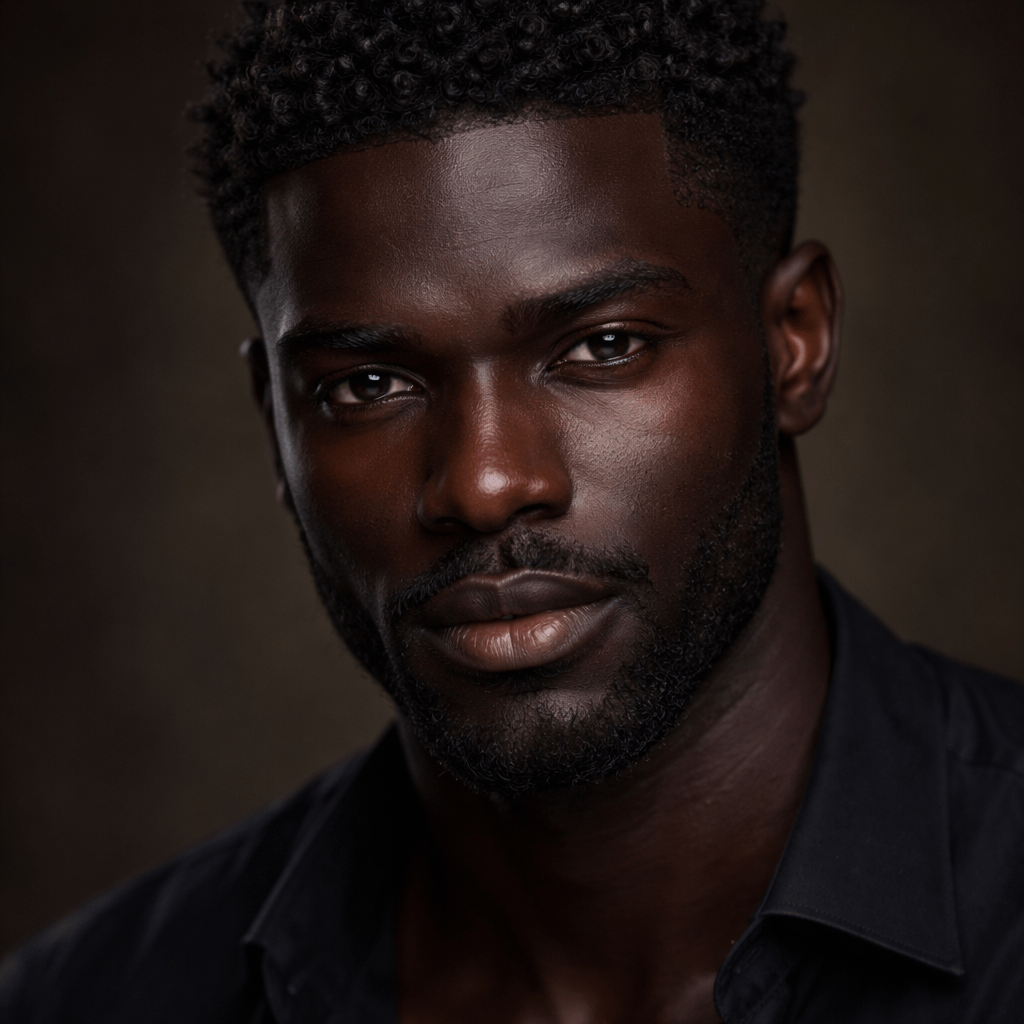
Brown male beauty similarly reflects a blend of strength and softness. High melanin levels often correlate with strong bone density, facial symmetry, and robust physical features shaped by evolutionary adaptation (Jablonski, 2012). These traits contribute to widespread perceptions of brown men as physically striking, athletic, and visually commanding across global cultures.

Facial structure also plays a role in the aesthetics of browness. Many populations with brown skin display prominent cheekbones, fuller lips, broader nasal bridges, and almond-shaped eyes—features increasingly celebrated in contemporary beauty standards. Ironically, these traits were once stigmatized but are now widely emulated through cosmetic surgery and digital filters, revealing how brown features have been culturally appropriated while brown bodies themselves were marginalized (Hunter, 2007).

Hair texture further amplifies the ethereal quality of brown beauty. Coily, curly, wavy, and kinky hair patterns represent a vast genetic spectrum that allows for artistic expression, volume, and sculptural aesthetics. Afro-textured hair, in particular, is biologically engineered for heat regulation and protection, yet culturally functions as a powerful symbol of identity, creativity, and visual presence (Byrd & Tharps, 2014).

The eyes of brown individuals also carry unique aesthetic significance. Higher melanin often produces deep brown or near-black irises that convey intensity, emotional depth, and warmth. The most beautiful eyes are the large, dark, mirrored eyes. Psychologically, darker eyes are associated with perceptions of trustworthiness, strength, and emotional richness, beauty, adding another layer to the perceived beauty of brown populations (Swami & Furnham, 2008).

From an evolutionary psychology perspective, humans are naturally drawn to traits that signal health, fertility, and resilience. Brown skin, protected by melanin, resists environmental stressors more effectively, often maintaining elasticity and smoothness well into older age. This contributes to the common observation that brown individuals “age more slowly,” a phenomenon supported by dermatological research (Taylor, 2002).

Historically, civilizations across Africa, Asia, the Middle East, and the Americas celebrated brown bodies as divine, royal, and sacred. Ancient Egyptian art, for instance, consistently depicted deities and royalty with brown or bronze skin, associating these tones with power, fertility, and cosmic balance (Assmann, 2001). Thus, browness was once the default aesthetic of divinity itself.

Colonialism disrupted these perceptions by imposing Eurocentric standards that privileged paleness as a marker of status and beauty. Colorism emerged within non-white communities, creating internal hierarchies based on skin shade rather than shared humanity. Yet modern scholarship increasingly frames brownness not as a deficiency but as a site of resistance, resilience, and aesthetic sovereignty (Hill, 2009).

In media and popular culture, brown beauty is now reclaiming space. Models, actors, and influencers of brown complexion dominate global fashion campaigns, redefining desirability through representation. Figures such as Lupita Nyong’o, Idris Elba, Naomi Campbell, and Zendaya exemplify how brown skin commands visual attention without needing to conform to Eurocentric norms.

The term “ethereal” is often reserved for lightness and delicacy, yet brown beauty embodies an alternative ethereality—one rooted in warmth, depth, and radiance rather than fragility. This form of beauty feels grounded yet transcendent, earthly yet luminous, reflecting what many describe as a soulful presence rather than a sterile aesthetic.

Genetically, all humans originated from melanated populations in Africa, meaning browness is not an anomaly but the ancestral template of humanity itself (Stringer, 2016). In this sense, brown beauty is not a minority aesthetic but the original human aesthetic, from which all other variations emerged.

Psychologically, embracing brown beauty fosters healthier self-concept among brown individuals, countering internalized racism and color-based shame. Studies show that positive racial and physical identity correlate with higher self-esteem, emotional resilience, and mental well-being (Neblett et al., 2012).

Outer beauty also shapes romantic and social desirability. Despite systemic bias, research indicates growing cross-cultural attraction toward brown features, especially in globalized societies where beauty standards are becoming more diverse and less racially rigid (Rhodes, 2006). This shift reflects a broader cultural awakening to the richness of human variation.

Brown beauty is also dynamic rather than static. Skin tones shift with seasons, lighting, health, and emotional states, creating a living canvas that responds to life itself. This fluidity gives brown skin an organic, almost poetic quality—beauty that moves, adapts, and evolves.

For both women and men, brown beauty challenges the notion that attractiveness must align with narrow ideals. Instead, it affirms that beauty is plural, genetic, and culturally constructed, shaped by biology but interpreted through social meaning. Brownness stands as evidence that diversity itself is aesthetically superior to uniformity.

Ultimately, the ethereal beauty of browness lies not only in its visual qualities but in its symbolic power. Black people with brown skin carry ancestral memory, evolutionary brilliance, and cultural depth. It reflects humanity in its most original form—resilient, radiant, and irreducibly beautiful.


References

Assmann, J. (2001). The search for God in ancient Egypt. Cornell University Press.

Banks, T. L. (2015). Colorism: A darker shade of pale. UCLA Law Review, 47(6), 1705–1745.

Byrd, A. D., & Tharps, L. L. (2014). Hair story: Untangling the roots of Black hair in America. St. Martin’s Press.

Hill, M. E. (2009). Skin color and the perception of attractiveness among African Americans. Journal of Black Psychology, 35(3), 358–374.

Hunter, M. (2007). The persistent problem of colorism: Skin tone, status, and inequality. Sociology Compass, 1(1), 237–254.

Jablonski, N. G. (2012). Living color: The biological and social meaning of skin color. University of California Press.

Jablonski, N. G., & Chaplin, G. (2010). Human skin pigmentation as an adaptation to UV radiation. Proceedings of the National Academy of Sciences, 107(Supplement 2), 8962–8968.

Neblett, E. W., Rivas-Drake, D., & Umaña-Taylor, A. J. (2012). The promise of racial and ethnic protective factors in promoting ethnic minority youth development. Child Development Perspectives, 6(3), 295–303.

Rhodes, G. (2006). The evolutionary psychology of facial beauty. Annual Review of Psychology, 57, 199–226.

Stringer, C. (2016). The origin of our species. Penguin Books.

Swami, V., & Furnham, A. (2008). The psychology of physical attraction. In V. Swami & A. Furnham (Eds.), The body beautiful: Evolutionary and sociocultural perspectives (pp. 3–18). Palgrave Macmillan.

Taylor, S. C. (2002). Skin of color: Biology, structure, function, and implications for dermatologic disease. Journal of the American Academy of Dermatology, 46(2), S41–S62.

The Global Allure: What Makes Black Women Beautiful? #blackbeauty

Beauty is often described as both universal and culturally specific, yet when it comes to Black women, their beauty holds a transcendent quality that blends strength, heritage, and physical distinctiveness. Across history and continents, the attributes of Black women’s appearance have not only been celebrated within their own communities but also mimicked and admired around the world. From their radiant skin tones to their sculpted bone structures and captivating eyes, Black women embody an aesthetic that challenges and redefines global standards of beauty.

One of the most celebrated attributes of Black women is their skin tone. Ranging from deep ebony to warm café au lait, their melanin-rich complexions are often associated with vitality, health, and timeless youthfulness (Russell, Wilson, & Hall, 2013). In fact, many cosmetic brands now attempt to market products that replicate the “glow” of melanin. Another defining feature is the diversity of facial structures—high cheekbones, expressive almond-shaped eyes, and full lips—which create a sense of balance and harmony that aligns with principles of facial symmetry often linked to attractiveness (Little et al., 2011).

Globally, women of other races have long sought to mimic elements of Black women’s physicality. In the West, the pursuit of full lips has become one of the most obvious examples, with lip fillers and cosmetic procedures inspired by the natural beauty of Black women. Additionally, curvaceous body types—once marginalized—are now celebrated, with emphasis on rounded hips, narrow waists, and toned figures, reflecting the global fascination with Black women’s natural silhouettes (Patton, 2006). Hairstyles, too, have been widely imitated, with braids, twists, and natural textures moving from cultural tradition to global fashion trends.

Around the world, the admiration often focuses on both face and body, though in different contexts. Western beauty markets tend to idolize Black women’s curves, while fashion and modeling industries highlight their striking facial features and versatility in style. This dual admiration underscores the holistic nature of Black beauty—embodying both power and delicacy, sensuality and elegance.

Hollywood has offered a stage where the beauty of Black women has shone in diverse ways. Consider Lupita Nyong’o, whose deep, luminous skin and regal bone structure epitomize classic African beauty; her features challenge Eurocentric ideals while affirming natural radiance. Kenya Moore, celebrated for her pageant-winning beauty, combines high cheekbones with a radiant smile that exudes confidence and allure. Halle Berry, often hailed as one of the most beautiful women in the world, blends striking hazel eyes, a delicate nose, and flawless symmetry, making her a symbol of crossover appeal.

Nia Long embodies girl-next-door charm with soulful eyes and a glowing complexion, while Gabrielle Union is admired for her timeless smile and smooth, youthful skin that seems untouched by time. Vanessa L. Williams, the first Black Miss America, captivated audiences with her green-blue eyes and luminous skin, offering a rare blend of features that challenged stereotypical norms of beauty. Salli Richardson dazzles with her elegant bone structure and silky complexion, while Stacey Dash became a 90s icon with her doll-like features and expressive eyes.

Completing this constellation of Hollywood beauty are Sanaa Lathan, with her soft yet commanding features and effortlessly natural look, and Sandra Justice, a model and actress whose statuesque frame and bold facial features reflect both strength and sophistication. Together, these women demonstrate the range of Black beauty, from delicate to striking, natural to glamorous, affirming that there is no single definition—only a celebration of diversity.

Ultimately, the beauty of Black women lies not only in their physical appearance but in the way their features embody history, resilience, and cultural pride. Their influence is seen in the global beauty industry, fashion runways, and popular culture, where elements of Black aesthetics are both imitated and celebrated. As the world continues to expand its definitions of beauty, Black women remain at the forefront—timeless, trendsetting, and undeniably powerful.


References

Little, A. C., Jones, B. C., & DeBruine, L. M. (2011). Facial attractiveness: Evolutionary based research. Philosophical Transactions of the Royal Society B: Biological Sciences, 366(1571), 1638–1659.

Patton, T. O. (2006). Hey girl, am I more than my hair?: African American women and their struggles with beauty, body image, and hair. NWSA Journal, 18(2), 24–51.

Russell, K., Wilson, M., & Hall, R. (2013). The Color Complex: The Politics of Skin Color in a New Millennium. Anchor.

Black Beauty Through the Decades

Black beauty is not a trend, a season, or a reaction to outside validation. It is an inheritance—carried through ancestry, memory, and survival. From the earliest days of displacement and resistance, Black women have expressed beauty as a language of identity, dignity, and self-definition. Even when dominant societies attempted to erase, ridicule, or redefine Black features, Black women preserved their beauty through ritual, care, adornment, and community knowledge passed from generation to generation.

To speak of Black beauty is to speak of resilience made visible. Hair, skin, body, and style have long served as sites of both oppression and power, shaped by historical forces yet continuously reclaimed. In times when Eurocentric standards were enforced as the measure of worth, Black women transformed beauty into an act of resistance—refusing invisibility and asserting presence. Each braid, curl, wrap, and adornment carried meaning beyond aesthetics, reflecting survival, creativity, and cultural memory.

Black beauty has never been singular. It exists across a spectrum of skin tones, textures, facial features, and expressions that defy narrow definitions. It evolves across time while remaining rooted in African heritage and diasporic experience. Whether expressed through restraint or boldness, tradition or innovation, Black beauty has always reflected autonomy—the right to define oneself without permission.

In the modern era, the reclamation of Black beauty marks a profound cultural shift. What was once marginalized is now celebrated, studied, and emulated, yet its deepest meaning remains internal rather than performative. Black beauty is not merely what is seen, but what is carried—confidence forged through history, grace born of endurance, and a self-love that persists despite centuries of contradiction. It is both personal and collective, timeless and ever-renewing.

Ultimately, Black beauty is a testament. It testifies to the ability of Black women to remain radiant in the face of erasure, to create elegance from limitation, and to transform survival into art. It is not defined by approval, but by continuity—a living expression of identity that honors the past, affirms the present, and shapes the future.

All photographs are the property of their respective owners. No copyright infringement intended.

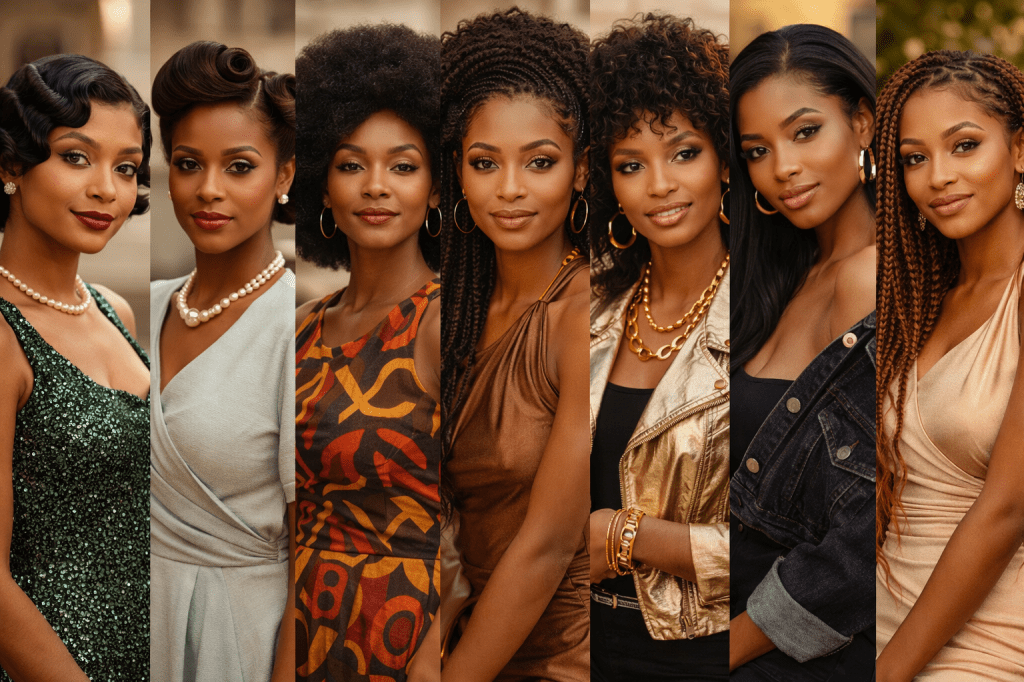
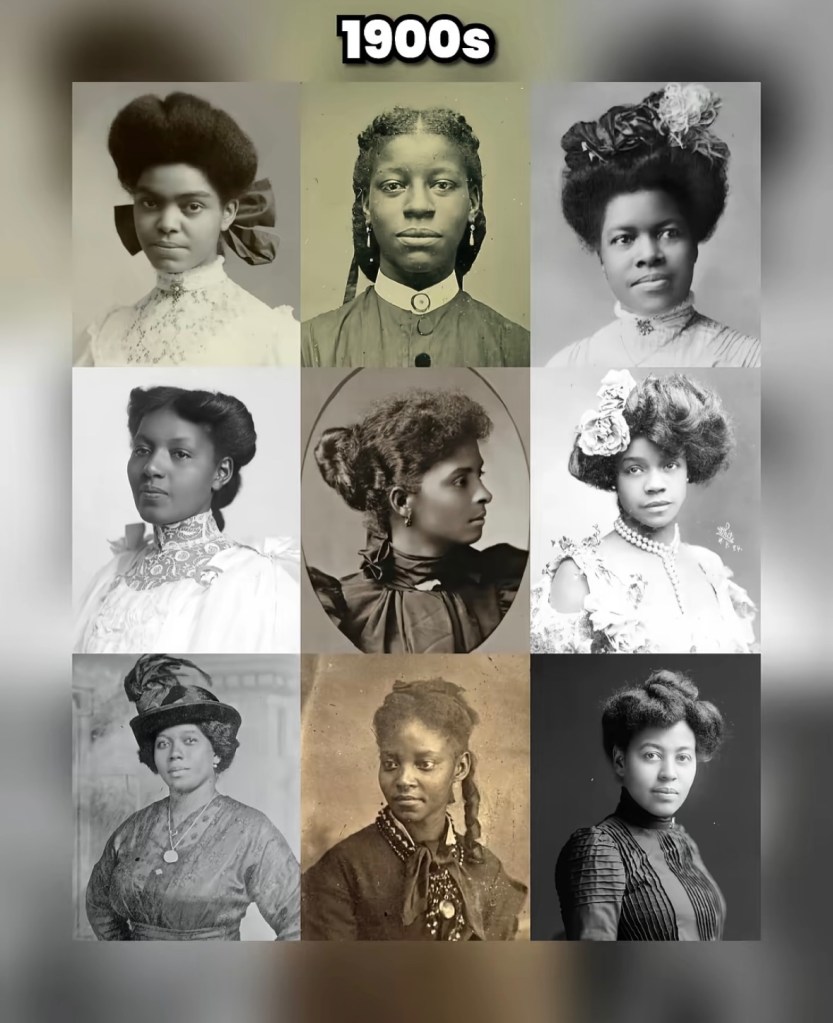
1900s1910s
At the turn of the twentieth century, Black women’s beauty was deeply shaped by resilience, modesty, and self-definition within a racially hostile society. Hairstyles were often practical and protective, including wraps, headscarves, and neatly pressed styles influenced by African traditions and Victorian norms. Despite social limitations, Black women maintained dignity through careful grooming, skin care using natural oils, and adornment that reflected pride and self-respect rather than excess.
During the 1910s, migration from rural Southern communities to urban centers began reshaping Black aesthetics. Hair was frequently styled in soft waves, buns, and pompadours, often achieved through hot combing—a controversial yet common tool of the era. Beauty culture expanded through Black-owned businesses, notably Madam C. J. Walker, who emphasized cleanliness, confidence, and economic independence rather than Eurocentric imitation.

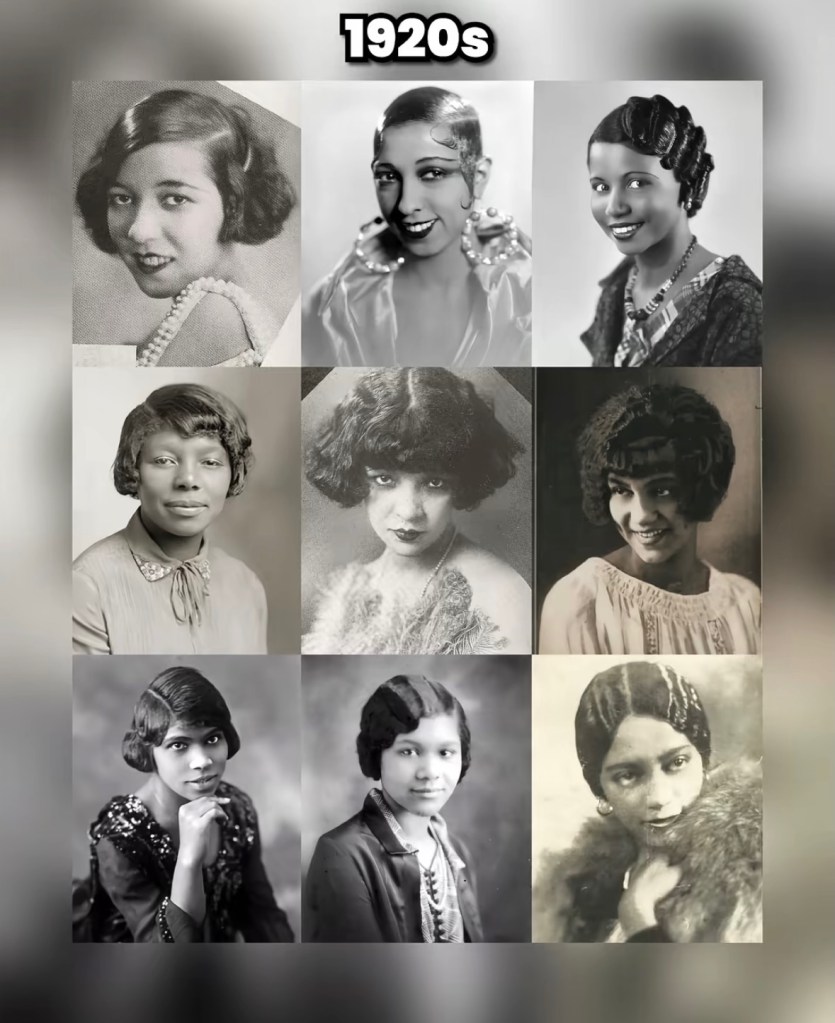
1920s
The Harlem Renaissance of the 1920s marked a cultural awakening in which Black beauty became visible, expressive, and artistic. Shorter hairstyles, finger waves, and sleek bobs emerged, paired with bold lipstick and refined fashion. Black women embodied modernity and glamour, asserting intellectual and aesthetic authority through music, literature, and visual style that celebrated sophistication and cultural pride.

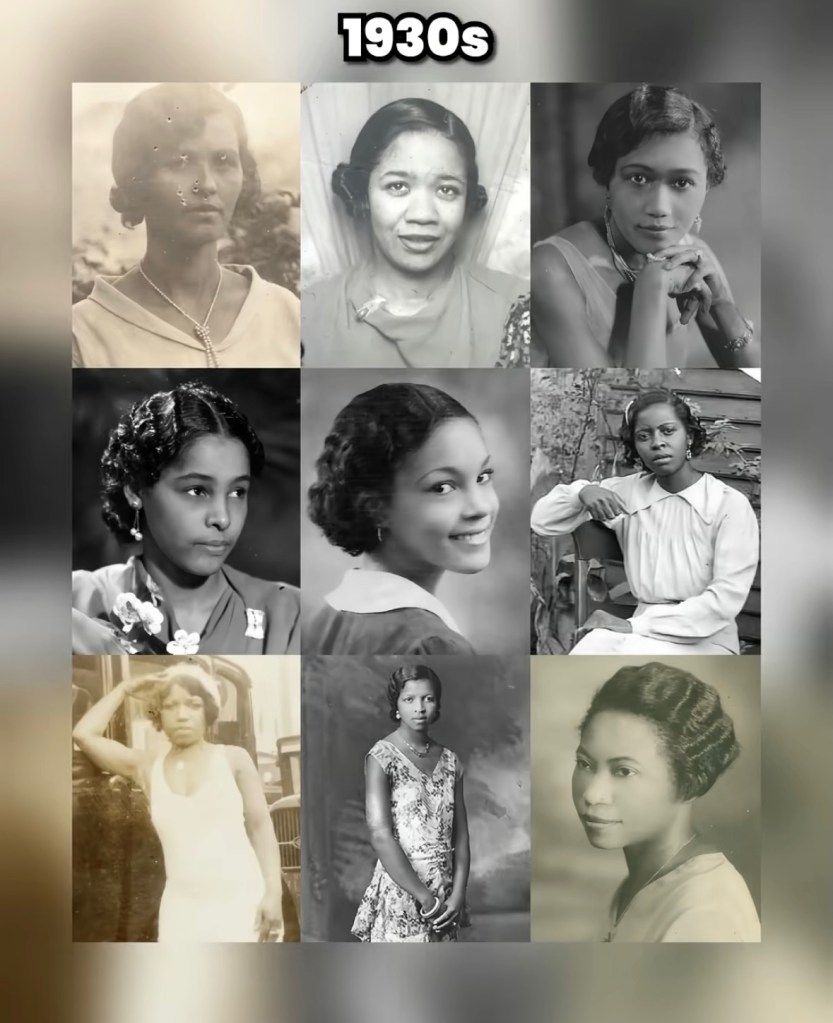
1930s
In the 1930s, amid the Great Depression, Black beauty reflected elegance under constraint. Hairstyles favored sculpted waves, rolls, and pinned curls, while makeup remained polished but understated. Beauty became an act of resistance—maintaining poise, femininity, and grace despite economic hardship. Hollywood films influenced aesthetics, though Black women adapted these styles to their own textures and features.

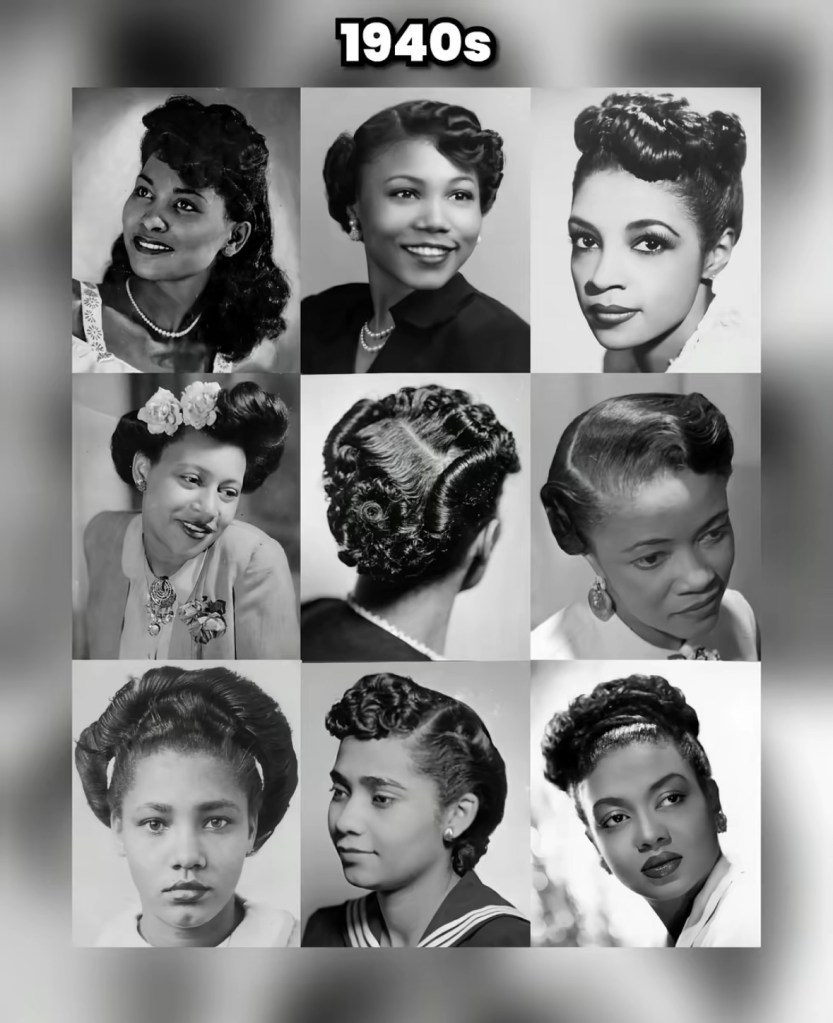
1940s
World War II reshaped Black womanhood and beauty in the 1940s as women entered industrial labor and military support roles. Hairstyles were practical yet stylish, including victory rolls, headscarves, and neatly set curls. Beauty symbolized strength and patriotism, with emphasis on clean lines, red lips, and confident posture reflecting both femininity and fortitude.

1950s
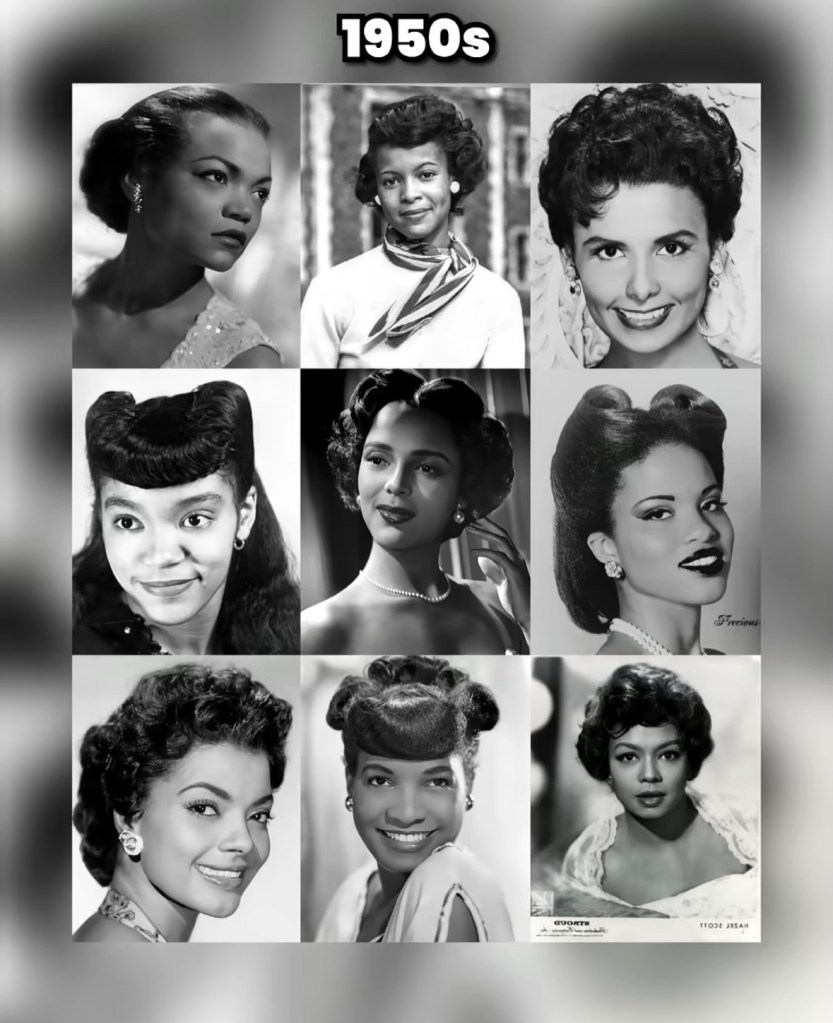
The 1950s emphasized polish, domestic elegance, and hyper-femininity. Black women wore structured dresses, gloves, and coiffed hairstyles, often straightened or softly curled. Beauty standards leaned toward refinement and respectability, particularly within Black middle-class communities, as appearance was closely tied to social mobility, morality, and dignity in a segregated society.

1960s
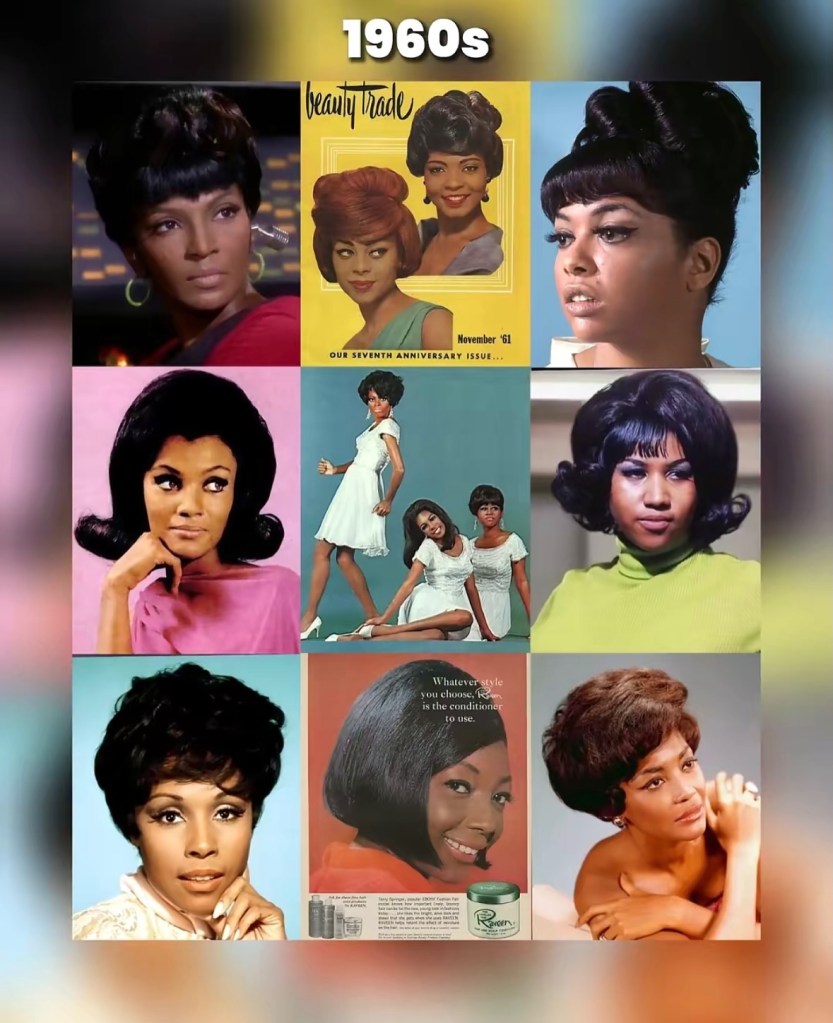
The 1960s ushered in a radical transformation as the Civil Rights and Black Power movements reframed beauty as political identity. The Afro emerged as a powerful symbol of self-acceptance and resistance, rejecting assimilationist standards. Natural hair, dark skin, and African-inspired clothing were embraced as declarations of pride, autonomy, and cultural truth.

1970s
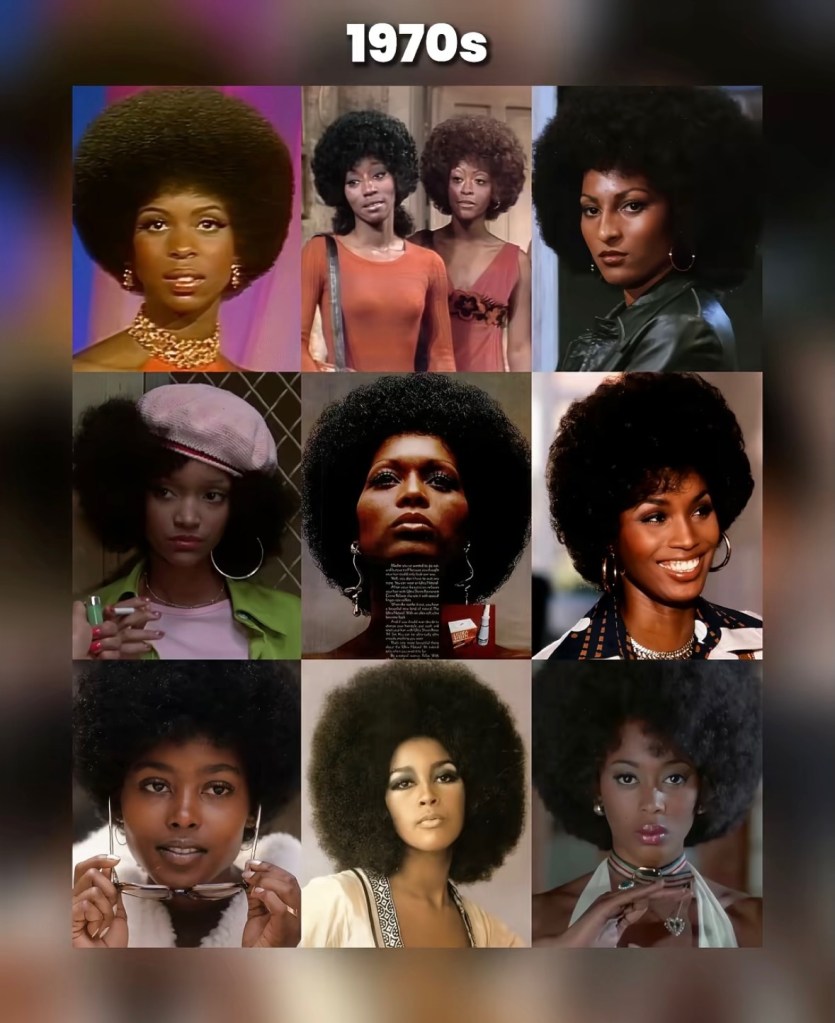
In the 1970s, Black beauty flourished in boldness, freedom, and Afrocentric expression. Large Afros, braids, cornrows, and natural textures dominated, paired with vibrant makeup and fashion. Icons like Pam Grier and Cicely Tyson embodied a confident sensuality rooted in authenticity rather than approval. Beauty became expansive, expressive, and unapologetically Black.

1980s
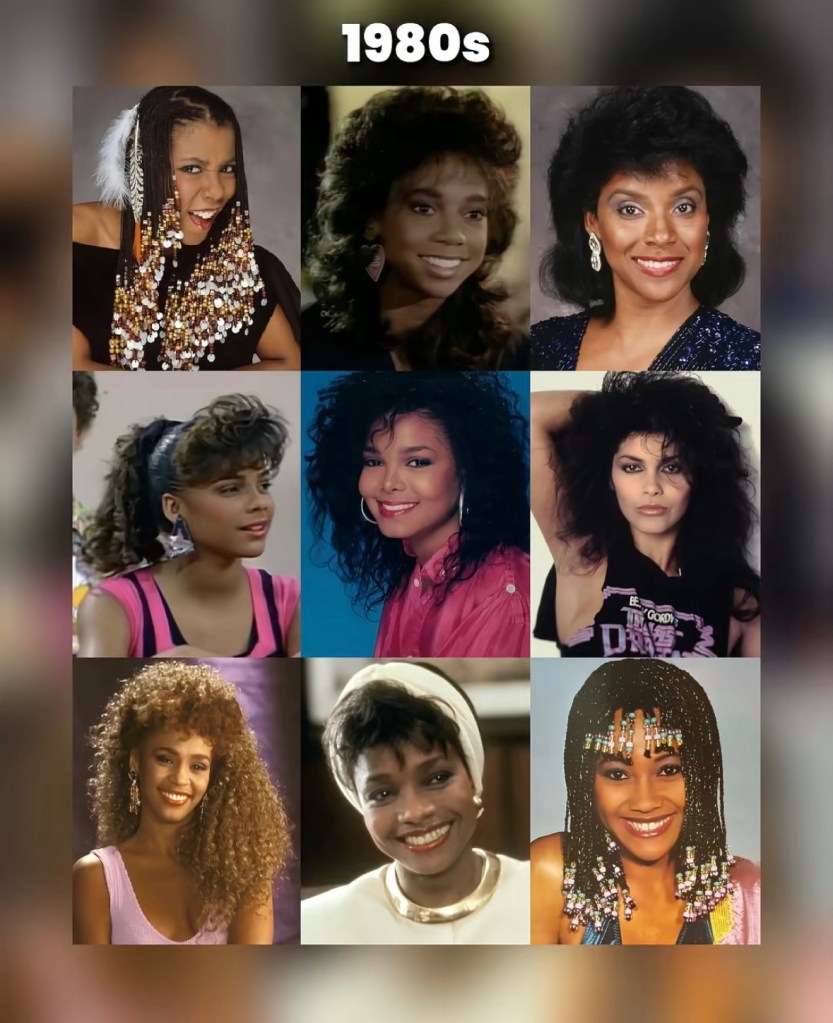
The 1980s brought excess, experimentation, and glamour. Black women embraced voluminous hairstyles, including jheri curls, blowouts, and elaborate braids. Makeup was bold, featuring strong eyes and glossy lips. Beauty aligned with success, visibility, and power, reflecting growing representation in music, television, and corporate spaces.

1990s
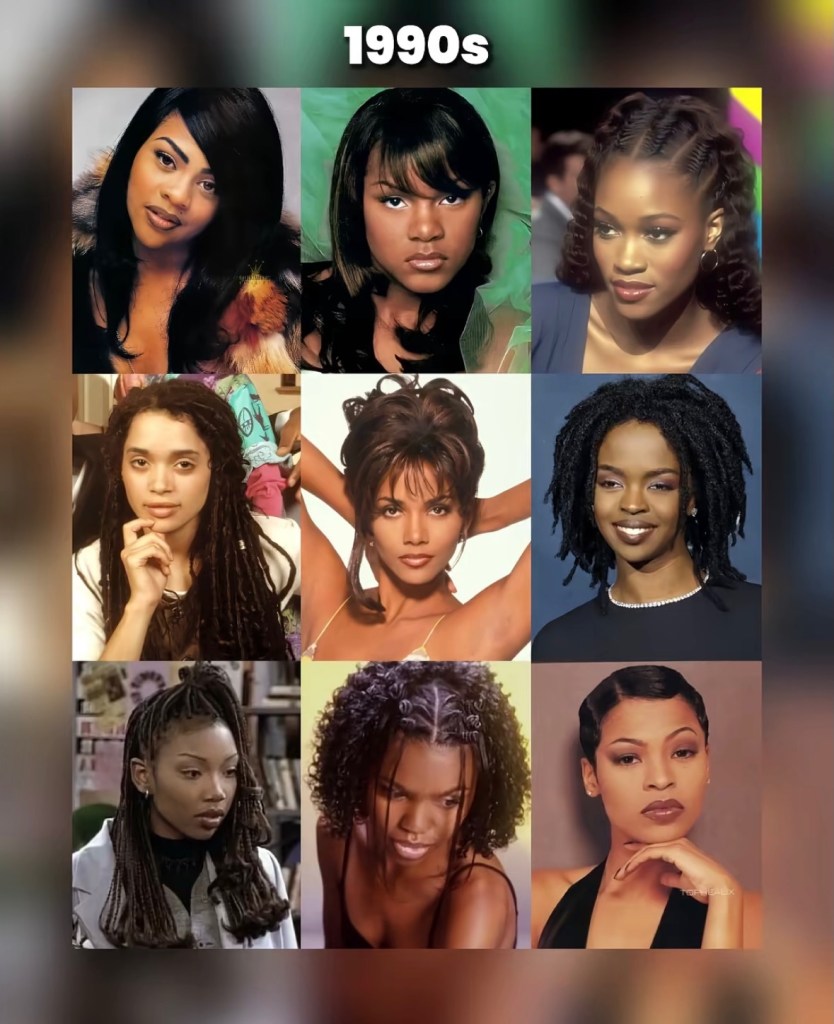
The 1990s balanced minimalism with cultural edge. Box braids, microbraids, finger waves, and sleek bobs coexisted alongside understated makeup and fashion. Black beauty icons such as Naomi Campbell and Angela Bassett represented strength, athleticism, and global elegance. Authenticity and individuality increasingly defined attractiveness.

2000s
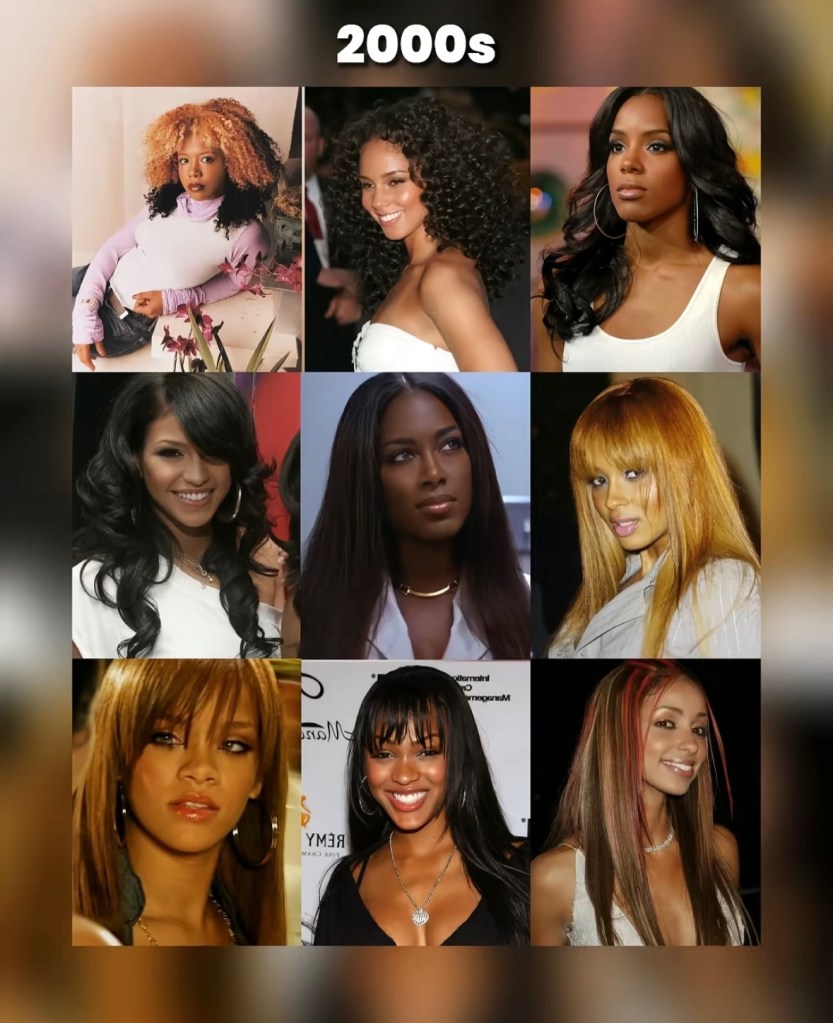
In the 2000s, Black beauty diversified across mainstream and niche aesthetics. Lace fronts, silk presses, locs, and protective styles gained popularity, alongside experimental makeup and fashion. Media visibility expanded through music videos, magazines, and early digital platforms, allowing Black women to define beauty on their own terms across multiple expressions.

2010s
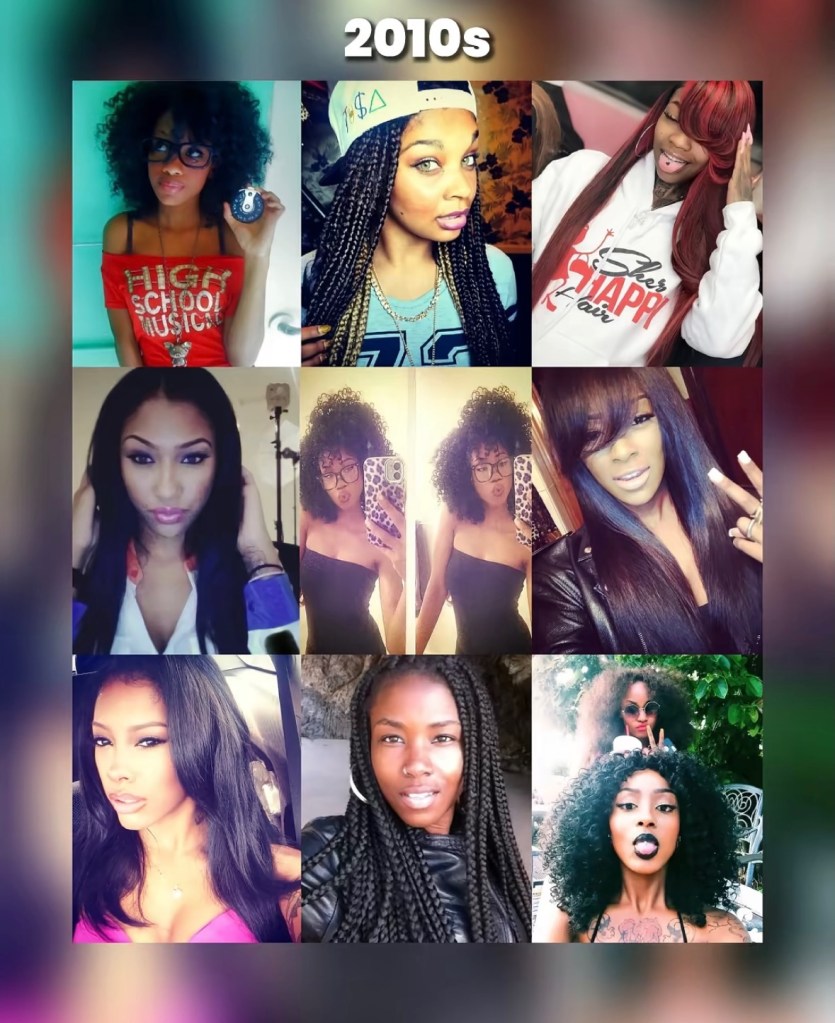
The 2010s marked a renaissance of natural hair and digital empowerment. Social media amplified Black women’s voices, celebrating coils, curls, dark skin, and wide features once marginalized. Beauty became inclusive, instructional, and affirming, with natural hair movements and makeup brands explicitly centering Black women’s needs and aesthetics.

2020s
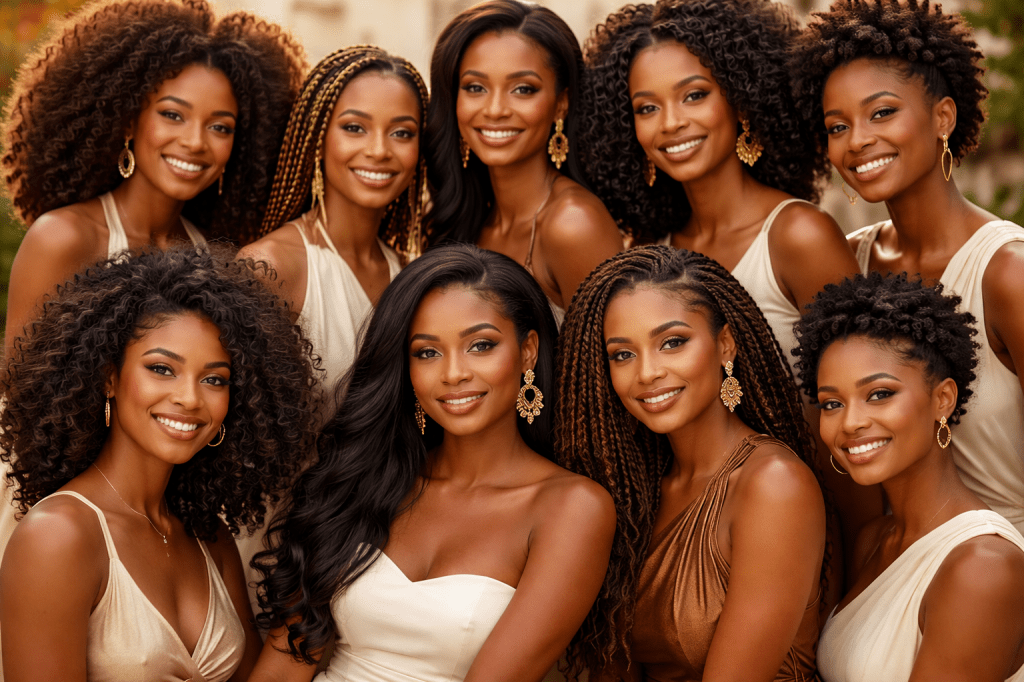
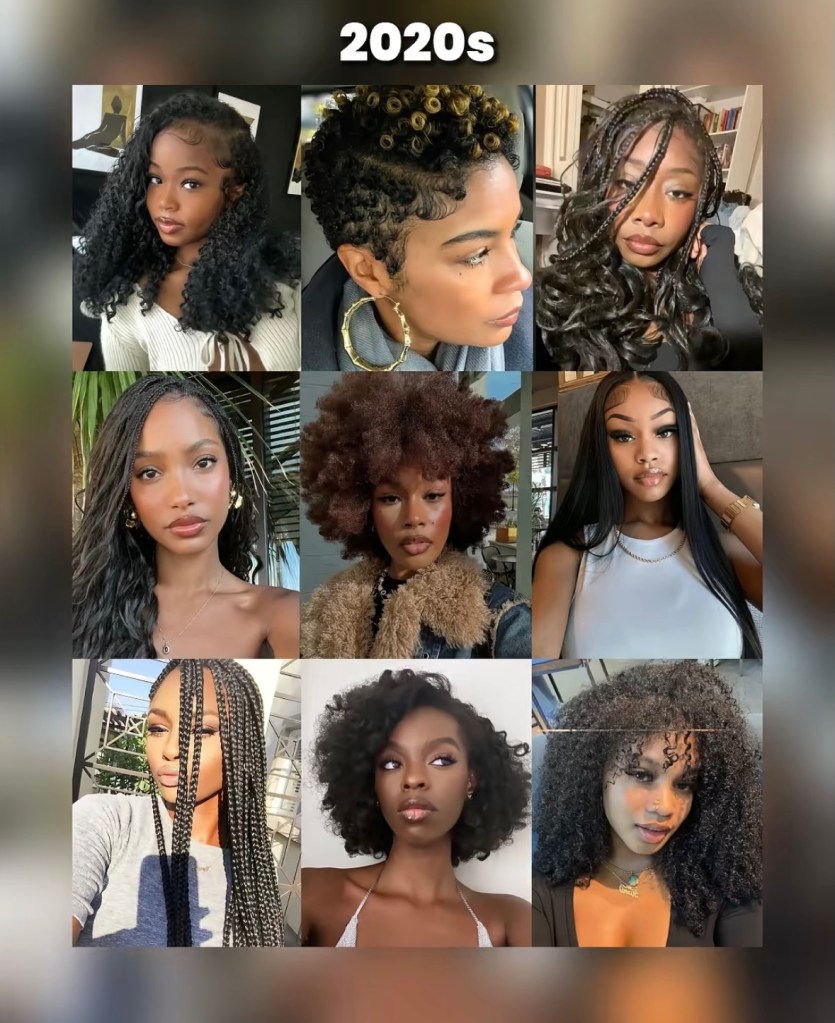
In the 2020s, Black beauty stands fully autonomous, expansive, and global. There is no single standard—locs, Afros, braids, shaved heads, bold colors, and minimalist looks coexist without hierarchy. Beauty is now framed as wellness, self-definition, and cultural inheritance. Black women lead beauty innovation, redefine luxury, and affirm that Blackness itself is timelessly beautiful.


Black beauty endures because it is rooted in truth rather than approval. It is not borrowed, diluted, or dependent on trends—it is ancestral, self-defined, and ever-evolving. Across centuries of challenge and transformation, Black beauty has remained a quiet force and a bold declaration, reflecting dignity, creativity, and spiritual strength. It is the beauty of survival refined into grace, of history carried with pride, and of identity claimed without apology. In every generation, Black beauty stands as living evidence that what was once denied has always been divine, whole, and worthy.

References

Byrd, A. D., & Tharps, L. L. (2014). Hair story: Untangling the roots of Black hair in America (2nd ed.). St. Martin’s Press.

Craig, M. L. (2002). Ain’t I a beauty queen? Black women, beauty, and the politics of race. Oxford University Press.

Hobson, J. (2005). Venus in the dark: Blackness and beauty in popular culture. Routledge.

Peiss, K. (2011). Hope in a jar: The making of America’s beauty culture. University of Pennsylvania Press.

Walker, S. B. (2007). Style and status: Selling beauty to African American women, 1920–1975. University Press of Kentucky.

Wilson, J. (2016). Black beauty: Aesthetic politics in modern African American culture. University of Illinois Press.

The Commodification of Black Beauty

Black beauty has long existed as a site of contradiction—celebrated for its cultural power while simultaneously exploited for profit. The commodification of Black beauty refers to the process by which Black bodies, features, aesthetics, and cultural expressions are transformed into marketable assets, often detached from the people and histories that created them. This process operates within racial capitalism, where value is extracted from Blackness while Black lives remain devalued.

Historically, Black beauty was framed as inferior under slavery and colonialism. African features were caricatured, exoticized, or erased to justify domination. At the same time, Black women’s bodies were exploited for labor, reproduction, and spectacle. This duality—dehumanization alongside consumption—laid the foundation for modern beauty industries.

In contemporary culture, Black beauty is increasingly visible yet still controlled. Dark skin, full lips, thick bodies, and textured hair are celebrated when separated from Black people themselves. These traits are often deemed fashionable only after being filtered through non-Black bodies, granting profit and praise without the burden of racial stigma.

The global beauty industry profits enormously from Black consumers while promoting standards that marginalize them. Skin-lightening products, relaxers, and cosmetic procedures reinforce the idea that Black features require modification to be acceptable. Even “inclusive” marketing often reproduces hierarchy by privileging lighter skin and Eurocentric features.

Social media has accelerated commodification by turning Black beauty into content. Influencers monetize aesthetics through visibility, sponsorships, and algorithms that reward conformity to dominant standards. Authenticity becomes a brand, and self-expression becomes labor. Black beauty is no longer simply lived; it is performed for consumption.

Colorism remains a central mechanism in this economy. Lighter-skinned Black women are disproportionately chosen as brand ambassadors, romantic leads, and beauty icons. Darker-skinned women, when included, are often exoticized or tokenized, reinforcing a tiered system of value within Blackness itself.

The commodification of Black beauty also distorts self-perception. When worth is measured through market response—likes, sales, attention—identity becomes unstable. Beauty becomes something to manage, maintain, and monetize rather than an inherent expression of self and ancestry.

Gender intensifies these dynamics. Black women bear the heaviest burden of beauty commodification, facing both hypervisibility and erasure. They are expected to embody strength, sexuality, and resilience while remaining palatable to consumer markets that profit from their image.

Resistance emerges through reclamation. Natural hair movements, Afrocentric fashion, and Black-owned beauty brands challenge extraction by centering cultural ownership and self-definition. These movements insist that Black beauty is not a trend but a lineage.

Yet even resistance risks co-optation. Once profitable, counter-aesthetics are often absorbed into mainstream markets, stripped of political meaning. This cycle reveals the limits of representation without structural change.

True liberation requires decoupling Black beauty from market value. Visibility alone is insufficient if it serves consumption rather than dignity. Beauty must be allowed to exist without being sold.

The commodification of Black beauty ultimately reflects a deeper moral failure: a society willing to profit from Black aesthetics while refusing full respect for Black humanity. Undoing this contradiction demands ethical consumption, cultural accountability, and collective self-affirmation.

References

Banks, I. (2000). Hair matters: Beauty, power, and Black women’s consciousness. NYU Press.

Collins, P. H. (2004). Black sexual politics: African Americans, gender, and the new racism. Routledge.

Crenshaw, K. (1991). Mapping the margins: Intersectionality, identity politics, and violence against women of color. Stanford Law Review, 43(6), 1241–1299.

Hunter, M. (2007). The persistent problem of colorism: Skin tone, status, and inequality. Sociology Compass, 1(1), 237–254.

hooks, b. (1992). Black looks: Race and representation. South End Press.

Roberts, D. (1997). Killing the Black body: Race, reproduction, and the meaning of liberty. Pantheon Books.

Tate, S. A. (2015). Black beauty: Aesthetics, stylization, politics. Ashgate.

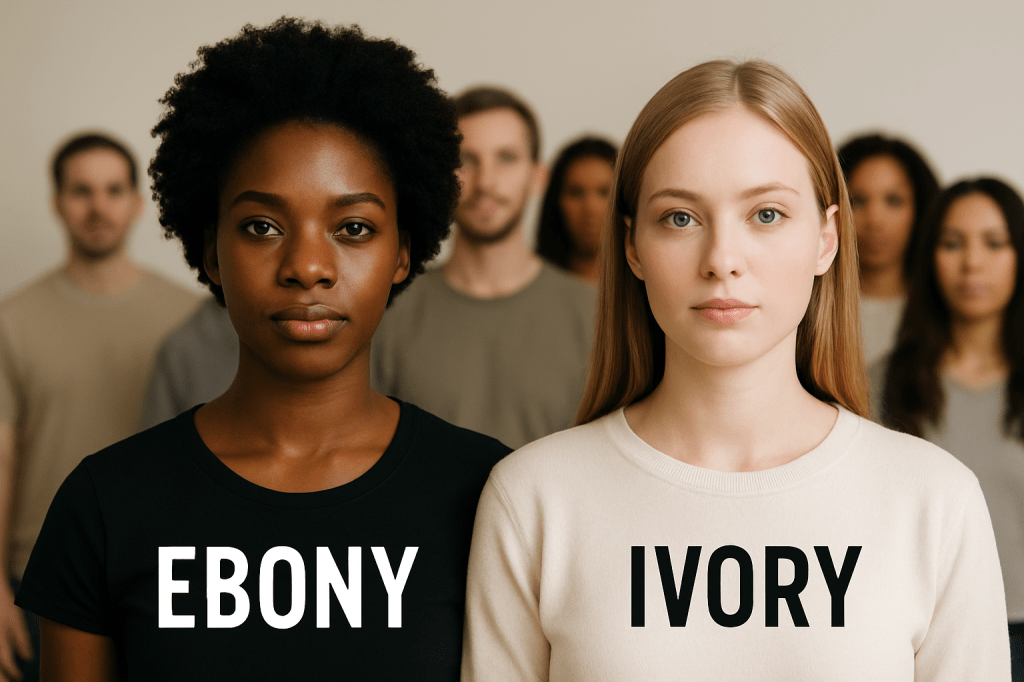
Ebony and Ivory: Two Shades, One Standard of Beauty.

From the dawn of civilization, beauty has been both a mirror and a weapon—reflecting ideals shaped by power and privilege, and wielded to define worth within social hierarchies. Within the globalized gaze of modernity, the politics of skin color continue to influence how femininity and desirability are perceived, especially among women of African descent. The notion of “Ebony and Ivory” evokes more than just color; it symbolizes the ongoing dialogue between light and dark, between acceptance and exclusion, and between the internalized and externalized standards of beauty that shape identity (hooks, 1992).

The idea of “two shades, one standard” captures the paradox of colorism: the simultaneous elevation and devaluation of Blackness within the same racial group. While “ivory” tones have historically been exalted as closer to Western ideals, “ebony” skin has often been marginalized, caricatured, or fetishized. Both ends of the spectrum, however, are measured against the same Eurocentric barometer that privileges whiteness as the ultimate aesthetic reference (Hunter, 2005).

This phenomenon, deeply rooted in colonialism, reveals how beauty became a tool of control. During the transatlantic slave trade, lighter-skinned enslaved individuals were often granted domestic positions and social proximity to white power structures, breeding intra-racial hierarchies that persist today. These legacies still echo in media representation, where lighter skin is frequently coded as “refined,” while darker tones are portrayed as “exotic” or “primitive” (Craig, 2006).

For many women of color, navigating these coded perceptions can be exhausting. The “brown girl dilemma” emerges when one feels too dark to be celebrated and too light to be considered authentically Black. This liminal existence is both a burden and a revelation—proof that beauty, as defined by Western constructs, remains an unattainable illusion that fractures rather than unites.

Beauty standards, much like colonial borders, were imposed rather than chosen. From the powdered faces of the Victorian era to the filtered glow of Instagram, the valuation of lightness has remained a constant aesthetic undercurrent. Yet, even within African and Afro-diasporic communities, this colonial inheritance continues to dictate preferences in partners, media icons, and even professional opportunities (Glenn, 2008).

In popular culture, colorism is often masked by phrases like “preference” or “type.” However, these preferences are rarely organic—they are sociologically constructed through centuries of imagery that equate lightness with purity and success, and darkness with defiance and struggle. The entertainment industry’s casting choices often reinforce these biases, rewarding lighter skin with visibility while relegating darker complexions to supporting or stereotypical roles (Russell, Wilson, & Hall, 2013).

This bias extends beyond film and television. In the global beauty market, skin-lightening creams generate billions annually, a grim testament to the internalization of Eurocentric ideals (Glenn, 2008). The psychological effects of such products are profound, suggesting that beauty is not only skin-deep but soul-deep, affecting one’s perception of self-worth and belonging.

For Black women, beauty is an act of survival. To adorn oneself becomes an assertion of existence in a world that often demands invisibility. From the regal hairstyles of precolonial Africa to the natural hair movement, Black women have continuously redefined and reclaimed their beauty on their own terms (Byrd & Tharps, 2014).

Yet, this reclamation is not without struggle. Within the Black community itself, hierarchies persist. The glorification of lighter women as more “marriageable” or “acceptable” continues to fracture solidarity. It is an unspoken inheritance of slavery’s psychological residue, perpetuated by both men and women who unconsciously valorize proximity to whiteness.

The darker-skinned woman often bears the weight of invisibility and hypervisibility simultaneously—ignored in spaces of admiration, yet scrutinized as the embodiment of resistance or rebellion. This double-bind mirrors W.E.B. Du Bois’ concept of “double consciousness,” wherein one is forced to see oneself through the lens of a world that refuses full recognition (Du Bois, 1903).

Light-skinned women, conversely, navigate their own complexities. While society may privilege them aesthetically, they are often accused of benefiting from colorism or being “not Black enough.” Thus, both ebony and ivory tones bear distinct forms of cultural alienation, tied together by an oppressive standard neither created (Monk, 2014).

In this context, beauty becomes not celebration but negotiation. Every compliment, every criticism, every casting call, and every social media post reinforces the invisible hierarchy of shade. The struggle is not between dark and light, but against the system that pits them against each other.

Media representation plays a critical role in dismantling or reinforcing these divides. When dark-skinned actresses like Lupita Nyong’o or Viola Davis are celebrated, it signals progress—but also exposes how rare such representation remains. Likewise, the inclusion of mixed-race models in campaigns may appear inclusive, yet often centers features still aligned with Eurocentric beauty (Tate, 2009).

To heal from this color divide, we must first acknowledge that beauty is not a monolith. It is plural, diverse, and spiritually rooted. In the biblical sense, humanity was created “in the image of God” (Genesis 1:27, KJV), meaning all shades reflect divine artistry. The rejection of any hue is, therefore, a rejection of the Creator’s design.

Moreover, Proverbs 31:30 reminds us that “favor is deceitful, and beauty is vain: but a woman that feareth the Lord, she shall be praised.” This verse redirects the gaze from the external to the eternal, urging women to seek validation not from comparison but from divine purpose.

Ebony and ivory are not opposites but complements, each contributing to the symphony of creation. Just as piano keys of contrasting colors produce harmony, so too can diverse complexions coexist in mutual admiration and respect. The beauty of one does not diminish the beauty of the other; together, they reveal the fullness of God’s palette.

True beauty transcends complexion—it emanates from character, compassion, and conviction. In a world obsessed with appearances, spiritual and cultural consciousness must redefine the standard. Beauty should not divide but dignify, not exclude but exalt.

To love one’s shade is to reclaim agency over identity. When Black women, in all their hues, embrace their reflection without apology, they dismantle centuries of aesthetic oppression. “Ebony and Ivory” then becomes more than a contrast—it becomes a covenant of self-acceptance and collective healing.

As we move forward, let beauty be measured not by shade but by soul. For when light and dark come together, they create balance, harmony, and wholeness—the true reflection of divine beauty.


References

Byrd, A. D., & Tharps, L. L. (2014). Hair Story: Untangling the Roots of Black Hair in America. St. Martin’s Press.
Craig, M. L. (2006). Race, beauty, and the tangled knot of a guilty pleasure. Feminist Theory, 7(2), 159–177.
Du Bois, W. E. B. (1903). The Souls of Black Folk. Chicago: A.C. McClurg.
Glenn, E. N. (2008). Yearning for lightness: Transnational circuits in the marketing and consumption of skin lighteners. Gender & Society, 22(3), 281–302.
hooks, b. (1992). Black Looks: Race and Representation. South End Press.
Hunter, M. L. (2005). Race, gender, and the politics of skin tone. Routledge.
Monk, E. P. (2014). Skin tone stratification among Black Americans, 2001–2003. Social Psychology Quarterly, 77(4), 360–379.
Russell, K., Wilson, M., & Hall, R. (2013). The Color Complex (Revised): The Politics of Skin Color Among African Americans. Anchor.
Tate, S. A. (2009). Black Beauty: Aesthetics, Stylization, Politics. Ashgate Publishing.
The Holy Bible, King James Version (KJV). (1611).

Black Beauty: A Curse or a Blessing?

Photo by Adedamola Adetoyi on Pexels.com

The question of whether Black beauty is a curse or a blessing has haunted generations. For centuries, it has been both revered and reviled, celebrated and scorned. To grapple with this paradox is to acknowledge the deep history of how the world perceives Black bodies and how those perceptions have shaped the lived experience of Black people. What society has too often treated as a curse, Scripture and science reveal as a profound blessing.

Historically, the beauty of Black people has been weaponized against them. During slavery, enslaved Black women were simultaneously sexualized and dehumanized. Their features — full lips, wide noses, dark skin, and coiled hair — were ridiculed as evidence of inferiority while being exploited for labor and reproduction (Collins, 2000). This duality created a legacy of shame, where traits of Black beauty were framed as a curse, even while secretly desired.

From a sociological standpoint, the dominance of Eurocentric beauty standards reinforced this distortion. Pale skin, straight hair, and narrow features were upheld as the “universal” ideal, marginalizing African aesthetics. Black people were pressured to straighten their hair, lighten their skin, or alter their features to fit in. This erasure implied that natural Black beauty was somehow less worthy. Yet, these same features, when adopted by non-Black women through tanning, lip fillers, or curly hair perms, were suddenly praised. This contradiction reveals that the problem was never Black beauty itself, but society’s biased lens.

Psychologically, this tension has left deep scars. Colorism, a byproduct of racism, continues to divide communities, privileging lighter skin over darker tones (Hunter, 2007). Dark-skinned women often face harsher discrimination in dating, work, and media representation, while lighter-skinned women are deemed more “acceptable.” Black men, too, experience a contradictory dynamic: their athletic bodies and masculine strength are admired in sports and entertainment, yet feared in daily life. These contradictions fuel the perception that Black beauty is a burden, something to carry rather than something to celebrate.

Yet, when we turn to Scripture, a different narrative emerges. God’s Word affirms the value of every feature He created. In Genesis 1:27, it says: “So God created man in his own image, in the image of God created he him; male and female created he them” (KJV). Black beauty, like all human beauty, reflects the divine image. Song of Solomon 1:5 offers an even more direct affirmation, where the Shulamite woman proclaims, “I am black, but comely, O ye daughters of Jerusalem” (KJV). Her words echo across centuries as a declaration that Blackness and beauty are inseparable, divinely designed.

Biologically, Black beauty is also a blessing. Melanin, often celebrated as “Black gold,” is more than skin deep. It provides protection against the sun’s harmful rays, slows aging, and contributes to unique variations in skin tone, eye color, and hair texture (Jablonski, 2014). Strong bone density, muscular builds, and symmetrical facial features — often found in African-descended populations — align with what science recognizes as markers of physical health and attractiveness (Little et al., 2011). These genetic gifts are not curses but blessings of adaptation and survival.

The cultural reclamation of Black beauty further affirms its blessing. The natural hair movement, the rise of melanin-positive campaigns, and the increasing global embrace of African aesthetics reflect a turning tide. Traits once despised are now celebrated as fashionable and aspirational. What was once shamed is now crowned. Black beauty has become a movement of self-love and resistance against centuries of erasure.

Still, the struggles remain. The media often continues to underrepresent darker-skinned women, and when represented, they are frequently portrayed through stereotypes. Black men’s physiques are admired in sports but criminalized in society. These double standards illustrate how the world continues to twist Black beauty into something threatening or undesirable. The real curse, then, is not in Black beauty itself, but in the systems that refuse to honor it.

Spiritually, the enemy has always sought to distort what God made good. The same way sin corrupted creation, racism and colorism distort beauty. But Romans 8:28 reminds us that God works all things for good for those who love Him. Even in the face of rejection, Black beauty has been a source of resilience, creativity, and community pride. From gospel music to fashion to visual art, Black aesthetics have shaped global culture, often without due credit. What the world tried to curse, God turned into blessing.

To answer the question — Black beauty is not a curse, though it has been treated as one. It is a blessing, intricately woven into God’s creation, carrying strength, resilience, and elegance. The so-called curse lies in society’s refusal to embrace diversity, in the oppressive systems that shame what they do not understand.

For women, Black beauty is a crown that does not need the approval of Western standards. For men, it is the strength of kings and warriors written into their DNA. For children, it is a heritage to be celebrated, not hidden. The more we reclaim and affirm it, the more the illusion of the curse fades, and the truth of the blessing shines.

Psychology affirms this too. Studies show that self-acceptance and positive racial identity are linked to higher self-esteem and resilience among Black individuals (Mandara & Murray, 2000). Choosing to embrace one’s beauty is both an act of healing and defiance. Where society once defined Black beauty as “less than,” psychology and faith remind us it is more than enough.

In closing, the question itself reveals the depth of the struggle: to see oneself through the eyes of God rather than the eyes of a broken world. Black beauty is not a curse — it is a divine blessing, radiant with purpose. As the psalmist declares, “I will praise thee; for I am fearfully and wonderfully made” (Psalm 139:14, KJV). Black beauty is living proof of this truth.


References

  • Collins, P. H. (2000). Black feminist thought: Knowledge, consciousness, and the politics of empowerment. Routledge.
  • Hunter, M. (2007). The persistent problem of colorism: Skin tone, status, and inequality. Sociology Compass, 1(1), 237–254.
  • Jablonski, N. G. (2014). Living color: The biological and social meaning of skin color. University of California Press.
  • Little, A. C., Jones, B. C., & DeBruine, L. M. (2011). Facial attractiveness: Evolutionary based research. Philosophical Transactions of the Royal Society B, 366(1571), 1638–1659.
  • Mandara, J., & Murray, C. B. (2000). Effects of parental marital status, income, and education on the self-esteem of African American adolescents. Journal of Family Psychology, 14(3), 475–490.

The Evolution of Black Beauty. #thescienceofblackbeauty

Photo by Ali Drabo on Pexels.com

The story of Black beauty is one of resilience, transformation, and self-definition. It is a history woven through genetics, culture, struggle, and celebration. The evolution of Black beauty reflects not only the physical adaptations of African-descended peoples but also the social forces that sought to erase them and the courageous reclamation that continues today. From the golden courts of African kingdoms to the global stage of fashion and film, Black beauty has endured as both a natural inheritance and a cultural statement of identity.

The origins of Black beauty are rooted in biology and the African environment. Dark skin rich in eumelanin evolved as a protective adaptation against intense ultraviolet radiation, safeguarding against skin cancer and preserving folate levels vital for reproduction (Jablonski & Chaplin, 2010). Afro-textured hair, with its coiled structure, served as insulation, cooling the scalp in hot climates. Broader noses and fuller lips facilitated air regulation and hydration. These features were not only functional but celebrated within ancient African societies, where adornment, scarification, and hairstyles carried spiritual and cultural meaning. Beauty was a reflection of harmony with nature and community.

In African kingdoms such as Nubia, Kush, and Mali, beauty was also tied to power and refinement. Women adorned themselves with jewelry, intricate hairstyles, and natural cosmetics made from minerals and plants. Mansa Musa’s Mali, for example, valued the elegance of dress and presentation as signs of wealth and spiritual dignity. Ancient Egypt revered dark skin as a symbol of fertility and divine blessing, with goddesses like Hathor often represented with rich pigmentation. Within these societies, beauty was never divorced from identity; it was both natural and sacred.

The transatlantic slave trade fractured this organic celebration. Enslaved Africans were torn from cultural practices of adornment and subjected to Eurocentric hierarchies that devalued their features. Skin tone, hair texture, and facial structure became grounds for stereotyping and degradation. Lighter-skinned individuals were often given preferential treatment under slavery, planting the seeds of colorism that persist today (Hunter, 2007). Black beauty, once celebrated, was weaponized as a marker of inferiority.

Despite these oppressive systems, enslaved Africans and their descendants found ways to preserve beauty as resistance. Hair braiding carried coded maps and messages of escape. Sunday church services became occasions for dignified dress, asserting humanity against the indignities of bondage. Beauty practices were acts of survival—quiet rebellions against erasure, affirmations that their bodies held value and dignity beyond the gaze of the oppressor.

The early 20th century introduced new challenges and opportunities. The rise of segregation-era media continued to glorify whiteness, relegating Black features to caricature. Yet, in the Harlem Renaissance of the 1920s, Black artists, writers, and performers redefined beauty through cultural pride. Figures like Josephine Baker challenged stereotypes with her iconic performances, while Black publications such as Ebony and Jet celebrated darker skin, natural hair, and African-inspired fashion. Beauty became intertwined with racial pride and cultural awakening.

The Civil Rights and Black Power movements of the 1960s and 1970s propelled this evolution further. The slogan “Black is Beautiful” declared an unapologetic embrace of African aesthetics. Natural hairstyles such as afros symbolized liberation and self-love, rejecting chemical straightening as a symptom of imposed Eurocentric standards (Byrd & Tharps, 2014). Black beauty shifted from mere aesthetics to political activism, a visible challenge to centuries of marginalization.

Even as these movements gained momentum, mainstream media continued to impose narrow ideals. Black women were often excluded from global standards of beauty unless they fit lighter-skinned, straighter-haired molds. Supermodels like Naomi Sims and later Naomi Campbell carved spaces within the fashion industry, but representation remained limited and conditional. The struggle for full recognition persisted.

The late 20th and early 21st centuries, however, have marked a new renaissance. Celebrities such as Erykah Badu, Lauryn Hill, and later Lupita Nyong’o redefined beauty on their own terms, celebrating natural features and melanin-rich skin. Social media platforms further amplified diverse representations, allowing Black creators to showcase beauty outside of mainstream filters. The natural hair movement gained traction globally, encouraging millions of women to embrace their textured hair as beautiful and worthy.

Corporate industries began to take notice. Rihanna’s Fenty Beauty disrupted cosmetics in 2017 by offering 40 foundation shades, directly addressing the exclusion of darker tones from the beauty market. This inclusivity sparked a revolution in the industry, forcing major brands to rethink representation. Black-owned beauty companies also flourished, ensuring that definitions of beauty were set by the community itself rather than imposed from outside.

The evolution of Black beauty is not merely external—it is psychological and spiritual. Centuries of denigration created scars of internalized racism and colorism, but communities have turned toward healing. Celebrating melanin, natural features, and cultural adornments has become a path to collective empowerment. Scripture reinforces this deeper understanding, reminding us that true beauty is not only in appearance but in spirit: “The king’s daughter is all glorious within” (Psalm 45:13, KJV). This truth has grounded generations of Black people who find strength in both inner character and outer identity.

Yet, challenges remain. Media continues to perpetuate colorism, often privileging lighter-skinned models and actresses. Eurocentric beauty standards still influence surgery trends, skin-lightening practices, and hair straightening industries, especially in regions of Africa and the Caribbean. The battle for holistic acceptance of Black beauty is ongoing, demanding vigilance and continued cultural affirmation (Tate, 2009).

Still, progress cannot be denied. From the braided crowns of ancestors to the afros of revolutionaries and the natural hair influencers of today, Black beauty has proven to be ever-evolving and self-renewing. It is a beauty that adapts without losing its roots, a beauty that radiates resilience even under pressure. Its evolution is not linear but cyclical—always returning to the truth that Black beauty is whole, worthy, and divine.

In conclusion, the evolution of Black beauty is a testament to survival and self-definition. From biological origins to ancient kingdoms, from the horrors of slavery to the triumphs of cultural renaissance, Black beauty has endured and blossomed. Today, it stands as both a scientific marvel and a cultural force, reminding the world that beauty is not dictated by dominance but by dignity. Black beauty, in its many forms, continues to evolve—not toward assimilation but toward liberation, glowing with the radiance of resilience.


References

  • Byrd, A., & Tharps, L. (2014). Hair story: Untangling the roots of Black hair in America. St. Martin’s Press.
  • Hunter, M. (2007). The persistent problem of colorism: Skin tone, status, and inequality. Sociology Compass, 1(1), 237–254.
  • Jablonski, N. G., & Chaplin, G. (2010). Human skin pigmentation as an adaptation to UV radiation. Proceedings of the National Academy of Sciences, 107(Suppl 2), 8962–8968.
  • Mercer, K. (1994). Welcome to the jungle: New positions in Black cultural studies. Routledge.
  • Tate, S. A. (2009). Black beauty: Aesthetics, stylization, politics. Ashgate.

Beyond Skin Deep: The Science and Sociology of Black Beauty #thescienceofblackbeauty

Photo by Mwabonje Ringa on Pexels.com

Black beauty is more than a matter of physical appearance; it is an embodiment of science, history, and cultural meaning. To move “beyond skin deep” is to recognize that beauty among people of African descent has been shaped by biology, interpreted through social structures, and expressed in cultural identity. Understanding Black beauty requires examining the interplay of genetics, aesthetics, and sociology, all of which reveal a narrative of resilience and radiance.

From a scientific perspective, the features commonly associated with African ancestry are products of adaptation. Dark skin, rich in melanin, developed as a natural shield against ultraviolet radiation, protecting folate and preserving reproductive health while enabling vitamin D synthesis (Jablonski & Chaplin, 2010). Afro-textured hair, with its tightly coiled strands, regulates heat by shielding the scalp from sunlight while permitting airflow (Robins, 2009). These traits, often devalued under Eurocentric beauty standards, testify to evolutionary brilliance and biological resilience.

Facial diversity within Black populations further illustrates the scientific depth of beauty. Broader nasal passages aid in humidifying and cooling air in warmer climates, while varied bone structures reflect the genetic richness of African populations—the most diverse in the world (Tishkoff et al., 2009). This diversity challenges narrow beauty ideals, showing that Black beauty cannot be confined to a single standard but encompasses a spectrum of scientifically grounded traits.

Sociologically, however, beauty has long been entangled with systems of power. Eurocentric ideals, rooted in colonialism, constructed whiteness as the norm and devalued African features (Hunter, 2007). This hierarchy produced colorism within and beyond Black communities, where lighter skin was privileged and darker skin marginalized. Beauty thus became not just biological but political, reinforcing racial inequality and internalized oppression.

Despite these challenges, Black communities have consistently redefined and reclaimed beauty. The “Black is Beautiful” movement of the 1960s, alongside the natural hair renaissance of recent decades, reframed melanin and Afrocentric aesthetics as sources of pride and identity (Byrd & Tharps, 2014). These cultural shifts represent acts of resistance, undermining imposed standards and affirming self-worth.

Representation in media and industry also plays a critical role in shaping beauty. For much of history, darker-skinned models and actresses were excluded or stereotyped, while lighter skin tones were more widely accepted. Yet contemporary figures such as Lupita Nyong’o, Viola Davis, and the inclusive cosmetics of Rihanna’s Fenty Beauty have expanded definitions of beauty, elevating African features and diverse skin tones to global prominence (Tate, 2009). Such representation transforms beauty into a sociological tool of empowerment.

Spiritually and socially, beauty extends beyond appearance to character and resilience. The Bible emphasizes that true beauty is “the hidden man of the heart” rather than outward adornment (1 Peter 3:3–4, KJV). For Black people, whose external beauty was historically denied, inner strength, dignity, and cultural creativity became markers of radiance. This spiritual depth underscores that Black beauty is not fragile but fortified by endurance.

In conclusion, the science and sociology of Black beauty reveal it to be multifaceted—rooted in biology yet shaped by cultural and social forces. It is a narrative of survival written in melanin, identity articulated in aesthetics, and resilience expressed in representation. Beyond skin deep, Black beauty is both science and story: a testimony to the enduring strength, creativity, and dignity of African-descended peoples.


References

  • Byrd, A., & Tharps, L. (2014). Hair story: Untangling the roots of Black hair in America. St. Martin’s Press.
  • Hunter, M. (2007). The persistent problem of colorism: Skin tone, status, and inequality. Sociology Compass, 1(1), 237–254.
  • Jablonski, N. G., & Chaplin, G. (2010). Human skin pigmentation as an adaptation to UV radiation. Proceedings of the National Academy of Sciences, 107(Suppl 2), 8962–8968.
  • Robins, A. H. (2009). Biological perspectives on human pigmentation. Cambridge University Press.
  • Tate, S. A. (2009). Black beauty: Aesthetics, stylization, politics. Ashgate.
  • Tishkoff, S. A., et al. (2009). The genetic structure and history of Africans and African Americans. Science, 324(5930), 1035–1044.

The Science of Black Beauty: From Biology to Cultural Expression. #thescienceofblackbeauty

Photo by snazzy Photography on Pexels.com

Black beauty is a multifaceted phenomenon shaped by evolution, history, psychology, and cultural representation. It is both a biological inheritance and a cultural expression, a story of resilience inscribed in the body and articulated through identity and artistry. To examine the science of Black beauty is to recognize how biology and culture work together to produce a radiance that has endured despite systemic erasure and oppression.

From a biological standpoint, the features associated with African ancestry are the products of adaptation and survival. Melanin-rich skin evolved to protect against harmful ultraviolet rays, preserving essential nutrients like folate while allowing for sufficient vitamin D synthesis (Jablonski & Chaplin, 2010). Similarly, tightly coiled hair acts as a natural regulator, shielding the scalp from heat while allowing airflow for cooling (Robins, 2009). These traits, often marginalized in Western standards, reflect evolutionary brilliance and resilience.

Facial diversity within African-descended populations further illustrates this complexity. Broader nasal passages facilitate air regulation in warmer climates, while fuller lips and diverse bone structures reveal the genetic depth of African populations, which are the most genetically varied in the world (Tishkoff et al., 2009). This diversity highlights that Black beauty cannot be confined to a single standard, but instead exists as a spectrum of biological expressions foundational to humanity itself.

Psychology, however, reveals how beauty is experienced and judged in society. For centuries, Eurocentric standards have distorted perceptions of beauty, leading to colorism, hair discrimination, and internalized racism within Black communities (Hunter, 2007). Such biases caused lasting psychological harm, shaping how individuals viewed themselves. Yet movements such as “Black is Beautiful” and the natural hair renaissance have countered these narratives, reframing beauty as pride in melanin, hair texture, and African aesthetics (Byrd & Tharps, 2014).

Cultural representation plays a powerful role in this redefinition. Historically, Black people were excluded from mainstream beauty imagery or depicted through degrading stereotypes. Icons like Cicely Tyson and Angela Davis challenged these norms by embracing natural hair and Afrocentric styles that carried political meaning. In the 21st century, Lupita Nyong’o and Rihanna’s Fenty Beauty expanded global beauty standards, affirming darker skin tones and inclusive cosmetics as worthy of admiration (Tate, 2009). Representation thus shifts beauty from marginalization to empowerment.

Historically, beauty within Black communities has also functioned as survival and resistance. Enslaved Africans braided hair not only as an aesthetic practice but also as a means of preserving cultural memory and transmitting coded messages for liberation (Byrd & Tharps, 2014). In these contexts, beauty was never superficial but deeply tied to resilience, dignity, and the struggle for freedom. This historical reality underscores how Black beauty is inseparable from cultural expression and survival.

Spiritually, beauty is defined by values deeper than the physical. Biblical scripture emphasizes inner beauty: “Whose adorning let it not be that outward adorning… but the hidden man of the heart” (1 Peter 3:3–4, KJV). For Black people, whose beauty was historically devalued, spiritual strength and inner radiance provided a foundation for self-worth and endurance. Thus, Black beauty extends beyond the surface, embodying faith, character, and the divine imprint of creation.

In conclusion, the science of Black beauty reveals it as both biological and cultural. Evolution crafted traits that ensured survival, while cultural expression transformed those traits into symbols of pride, identity, and resistance. From biology to psychology, from history to spirituality, Black beauty reflects resilience and radiance. It is a testimony not only to adaptation but also to the enduring power of a people who continue to shape global definitions of what it means to be beautiful.


References

  • Byrd, A., & Tharps, L. (2014). Hair story: Untangling the roots of Black hair in America. St. Martin’s Press.
  • Hunter, M. (2007). The persistent problem of colorism: Skin tone, status, and inequality. Sociology Compass, 1(1), 237–254.
  • Jablonski, N. G., & Chaplin, G. (2010). Human skin pigmentation as an adaptation to UV radiation. Proceedings of the National Academy of Sciences, 107(Suppl 2), 8962–8968.
  • Robins, A. H. (2009). Biological perspectives on human pigmentation. Cambridge University Press.
  • Tate, S. A. (2009). Black beauty: Aesthetics, stylization, politics. Ashgate.
  • Tishkoff, S. A., et al. (2009). The genetic structure and history of Africans and African Americans. Science, 324(5930), 1035–1044.