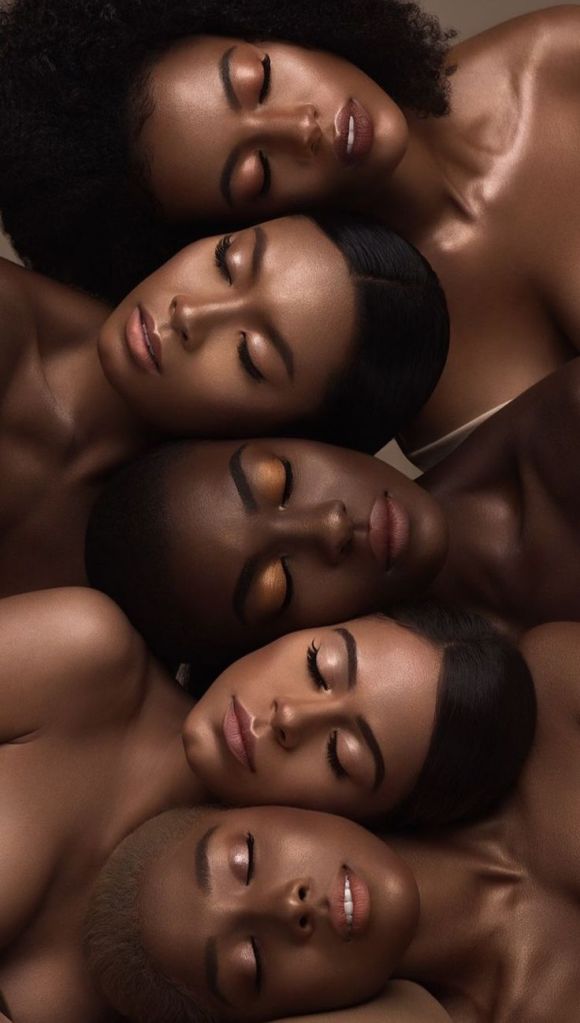
Category Archives: The Brown Girl Experience

Skin Deep Secrets: Confessions of a Brown Woman.

This photograph is the property of its respective owner. No copyright infringement intended.

In a world where skin tone often determines social acceptance, professional opportunity, and even perceived beauty, the “brown woman” stands at the crossroads of identity and judgment. Her complexion is both her armor and her battlefield, a silent storyteller of ancestral roots, resilience, and rejection. Yet beneath the surface lies a profound narrative of self-discovery — the confessions of a woman learning to love the skin she’s been taught to hide.

Colorism, a byproduct of colonialism and slavery, remains an insidious force in modern society. While racism distinguishes between races, colorism divides within them, privileging lighter complexions and marginalizing darker tones. The brown woman, often caught between societal ideals and her true self, is forced to reconcile with internalized hierarchies of shade and desirability.

In beauty culture, brown skin is often commodified — praised when exoticized yet criticized when authentic. The media portrays it as “sun-kissed,” “mocha,” or “golden,” terms that sanitize Blackness and dilute cultural identity. The brown woman’s skin becomes a marketing strategy rather than a manifestation of divine creation. Her image is reshaped not to celebrate her but to fit neatly into Eurocentric standards of beauty.

Growing up, many brown girls are told to “stay out of the sun” or “use this cream to lighten your skin.” These comments, passed down through generations, become psychological chains. They create a self-image dependent on proximity to whiteness. What begins as casual advice becomes an internalized inferiority complex, teaching young women to see themselves as “almost enough,” but never fully beautiful.

For many, this painful legacy begins at home. Families unconsciously perpetuate colorism through praise and criticism rooted in shade. “You’re pretty for a dark girl,” a common backhanded compliment, suggests that beauty is exceptional when found in darker tones. Such words wound deeply, shaping how brown women view themselves and others.

The entertainment industry reinforces these wounds. Light-skinned actresses and models often receive more roles, endorsements, and visibility. Meanwhile, brown women are relegated to the margins, portrayed as side characters, helpers, or symbols of struggle rather than elegance. The camera’s gaze has long been biased, framing beauty through a colonial lens.

In music videos, advertisements, and fashion campaigns, the ideal woman often resembles a hybrid — ethnically ambiguous yet close enough to whiteness to be universally marketable. This aesthetic erases brown women who reflect the majority of the global population, especially within the African diaspora, South Asia, and Latin America.

But amidst these systemic structures, the brown woman has begun reclaiming her power. Social media has become both her platform and her protest. Movements like #MelaninMagic and #BrownSkinGirl have amplified voices once silenced. Through self-photography, digital storytelling, and community building, women of color are redefining the narrative.

Still, empowerment comes with complexity. Online validation can be double-edged, reinforcing beauty hierarchies based on features, filters, and follower counts. The brown woman must navigate between self-love and digital performance, questioning whether the praise she receives is genuine or conditional.

Behind every confident selfie lies years of unlearning. It takes courage to stand before the mirror and see beauty rather than burden. It takes faith to reject billion-dollar industries built on bleaching creams and color-correcting foundations. To love brown skin is a political act — a rebellion against centuries of imposed shame.

The confessions of a brown woman are not only about pain; they are about survival. They are stories whispered in dressing rooms, sung in poetry, and written in journals — testaments to endurance and grace. Each confession is a declaration that says, “I am enough as I am.”

Brown women often discover that their beauty lies not in comparison but in contrast. Their tones mirror the earth, the cocoa bean, the sun at dusk — elements of nature itself. They are the shades of continuity, the living tapestry of humanity.

Education plays a crucial role in dismantling colorism. Teaching children about historical oppression, media literacy, and representation cultivates self-acceptance. When young brown girls see women like Lupita Nyong’o, Viola Davis, or Mindy Kaling celebrated for their achievements, it reshapes the standard of beauty for future generations.

Faith also anchors this transformation. Many brown women turn to spirituality to heal internalized wounds. Biblical affirmations such as “I am fearfully and wonderfully made” (Psalm 139:14, KJV) remind them that divine creation does not discriminate by shade. Their melanin is sacred, not shameful.

The global beauty market is slowly shifting. Brands are beginning to expand shade ranges and highlight diverse models, though often for profit rather than principle. True progress will come when darker skin is normalized, not exoticized — when representation reflects authenticity, not tokenism.

Yet the struggle continues. The brown woman’s journey toward self-acceptance is not linear but layered — a process of peeling back colonial residue to uncover divine identity. She learns that her worth cannot be defined by tone, trends, or validation, but by truth.

Her confession ends not in bitterness but in rebirth. She realizes that her melanin holds memory of sun, soil, ancestors, and God’s artistry. The very skin she once prayed to lighten now glows with confidence and consciousness.

The brown woman, once silenced, now speaks boldly. Her skin tells stories of resilience, rebellion, and revelation. She is no longer asking for recognition — she commands it. Her beauty is not skin-deep; it is soul-deep.

References

Ali, S. (2021). Colorism: The social and psychological impact of shadeism. Oxford University Press.
Hunter, M. (2017). Race, gender, and the politics of skin tone. Routledge.
Nyong’o, L. (2014). Lupita Nyong’o’s speech on beauty and self-acceptance. Essence Magazine.
Russell, K., Wilson, M., & Hall, R. (2013). The color complex: The politics of skin color among African Americans (2nd ed.). Anchor Books.
Walker, A. (1983). In search of our mothers’ gardens: Womanist prose. Harcourt.
Wilder, J. (2015). Color stories: Black women and colorism in the 21st century. Praeger.
Black & Blooming

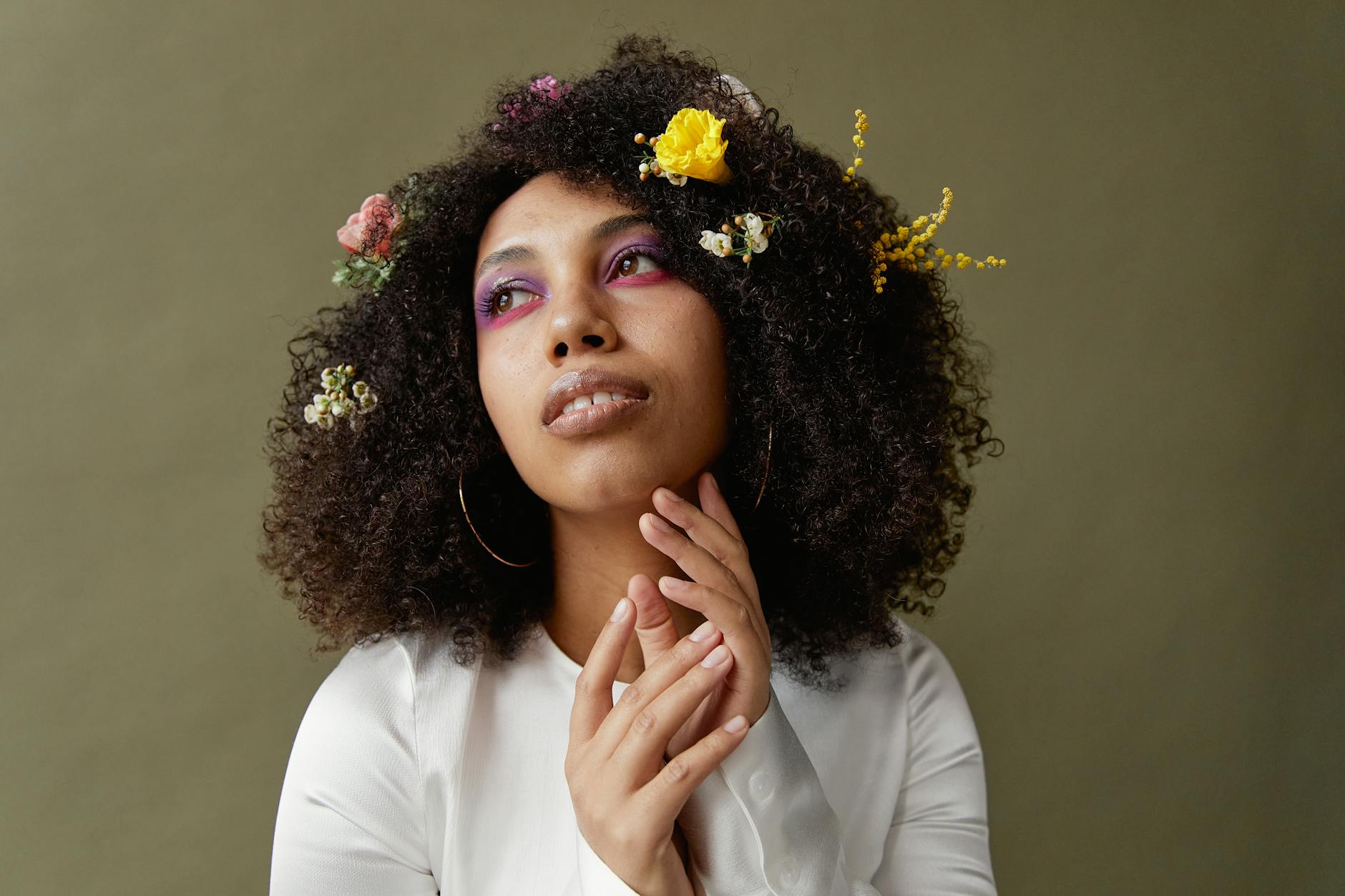
Photo by Darina Belonogova on Pexels.com

To be Black and blooming is to flourish despite the trials of the world. It is a declaration of resilience, rooted in divine purpose and identity. Jeremiah 29:11 reminds us, “For I know the thoughts that I think toward you, saith the Lord, thoughts of peace, and not of evil, to give you an expected end.” Blooming is not by chance—it is by God’s design.

The Black individual who blooms recognizes inherent worth and dignity. Psalm 139:14 declares, “I will praise thee; for I am fearfully and wonderfully made: marvellous are thy works; and that my soul knoweth right well.” Self-acknowledgment of God’s craftsmanship fosters confidence and purpose.

Flourishing begins with faith. Trust in God provides strength when the world seeks to diminish or marginalize. Proverbs 3:5-6 exhorts, “Trust in the Lord with all thine heart; and lean not unto thine own understanding. In all thy ways acknowledge him, and he shall direct thy paths.” Faith guides growth and sustains hope.

Blooming is marked by resilience in adversity. Trials refine character and deepen spiritual maturity. James 1:2-4 reminds, “My brethren, count it all joy when ye fall into divers temptations; Knowing this, that the trying of your faith worketh patience. But let patience have her perfect work, that ye may be perfect and entire, wanting nothing.” Challenges become catalysts for growth.

Education and knowledge are tools for blooming. Proverbs 4:7 teaches, “Wisdom is the principal thing; therefore get wisdom: and with all thy getting get understanding.” Knowledge empowers and equips for influence and leadership.

A Black individual who blooms demonstrates integrity in all spheres of life. Proverbs 10:9 notes, “He that walketh uprightly walketh surely: but he that perverteth his ways shall be known.” Integrity protects legacy and cultivates trust in relationships.

Creativity and talent reflect God’s glory. Whether in art, business, or scholarship, the Black individual blossoms when gifts are nurtured and shared. Exodus 31:3-5 describes God’s endowment of skill and creativity: “And I have filled him with the spirit of God, in wisdom, and in understanding, and in knowledge, and in all manner of workmanship…”

Community and kinship are central to blooming. Ecclesiastes 4:9-10 teaches, “Two are better than one; because they have a good reward for their labour. For if they fall, the one will lift up his fellow…” Flourishing occurs in solidarity and mutual support.

Spiritual devotion fuels continued growth. Prayer, worship, and study of Scripture anchor identity and purpose. Psalm 1:3 affirms, “And he shall be like a tree planted by the rivers of water, that bringeth forth his fruit in his season; his leaf also shall not wither; and whatsoever he doeth shall prosper.” Spiritual nourishment sustains bloom.

Black and blooming means embracing culture and heritage. Exodus 3:22 celebrates God’s chosen people: “And ye shall spoil the Egyptians.” Recognizing historical roots affirms identity and instills pride.

Self-care and wellness are integral. Blooming requires attention to body, mind, and spirit. 1 Corinthians 6:19-20 reminds, “What? know ye not that your body is the temple of the Holy Ghost…glorify God in your body, and in your spirit, which are God’s.” Holistic care honors God and supports growth.

A blooming life involves generosity and mentorship. Proverbs 11:25 teaches, “The liberal soul shall be made fat: and he that watereth shall be watered also himself.” Sharing wisdom and resources amplifies impact and legacy.

Patience and perseverance allow full bloom to manifest. Galatians 6:9 encourages, “And let us not be weary in well doing: for in due season we shall reap, if we faint not.” Growth unfolds in God’s timing, requiring endurance.

Blooming is an act of joy and celebration. Psalm 118:24 declares, “This is the day which the Lord hath made; we will rejoice and be glad in it.” Joy is both a spiritual posture and an expression of victory.

Faithful stewardship of gifts ensures lasting bloom. Luke 16:10 reminds, “He that is faithful in that which is least is faithful also in much…” Stewardship multiplies influence and reflects God’s glory.

A Black individual who blooms exercises courage and vision. Joshua 1:9 commands, “Be strong and of a good courage; be not afraid, neither be thou dismayed: for the Lord thy God is with thee whithersoever thou goest.” Courage fosters new paths and opportunities.

Black and blooming embodies excellence in character, intellect, and spirituality. 1 Peter 2:9 proclaims, “But ye are a chosen generation, a royal priesthood, an holy nation, a peculiar people; that ye should shew forth the praises of him who hath called you out of darkness into his marvellous light.” Excellence is a reflection of divine calling.

Blooming thrives in gratitude and reflection. 1 Thessalonians 5:18 teaches, “In every thing give thanks: for this is the will of God in Christ Jesus concerning you.” Gratitude nurtures contentment and spiritual flourishing.

Faith-driven activism and influence mark full bloom. Isaiah 58:12 promises, “…thou shalt be called, The repairer of the breach, The restorer of paths to dwell in.” Blooming is purposeful and transforms community.

Ultimately, to be Black and blooming is to live fully in God’s purpose, celebrating identity, nurturing gifts, and cultivating spiritual, mental, and emotional excellence. Psalm 92:12-14 illustrates, “The righteous shall flourish like the palm tree…they shall still bring forth fruit in old age; they shall be fat and flourishing.” Flourishing is eternal, intentional, and divinely ordained.

The Beautiful Lie: How Society Profits from Insecurity.

Photo by Anchau on Pexels.com

Beauty, once a divine reflection of the Creator’s artistry, has been reduced to a calculated illusion—a “beautiful lie” designed to manipulate desire, monetize insecurity, and manufacture self-doubt. In today’s global marketplace, appearance has become currency, and perfection is the most profitable deception of all. Beneath the gloss of glamour lies a darker truth: entire industries thrive because people have been taught to hate themselves.

The business of insecurity is one of the most lucrative empires in history. From cosmetic conglomerates to social media platforms, corporations profit from the human yearning to feel valuable. Advertisers do not sell products—they sell the promise of acceptance. Their genius lies in first convincing consumers that something is wrong with them, then offering a remedy. As Jean Kilbourne famously noted, advertising doesn’t just reflect culture—it creates it. The beauty industry’s success depends on perpetual dissatisfaction.

From a young age, people are conditioned to equate worth with appearance. Billboards, television ads, and digital influencers bombard the psyche with unrealistic standards. Women are told that youth equals beauty and that aging is failure. Men are taught that strength equals worth and vulnerability equals weakness. This conditioning shapes self-perception long before individuals are conscious of it. In essence, society manufactures insecurity, then monetizes the cure.

The “beautiful lie” is reinforced through repetition and aspiration. The more we see an image, the more we internalize it as truth. The faces on magazine covers, filtered social media feeds, and cosmetic advertisements become the blueprint for desirability. Yet these images are often digitally manipulated, creating an unattainable ideal. When people fail to live up to these illusions, they blame themselves instead of the system designed to deceive them.

In this way, insecurity becomes an economic engine. The global beauty and self-improvement industry generates hundreds of billions annually, feeding off dissatisfaction. Each wrinkle cream, diet pill, or surgical enhancement is marketed as liberation, yet it only deepens bondage. As Naomi Wolf (1991) argued, the beauty myth keeps people, especially women, distracted from power by keeping them preoccupied with appearance. What masquerades as empowerment often conceals economic exploitation.

Social media has intensified this cycle by transforming self-presentation into performance. Platforms like Instagram and TikTok reward conformity to specific aesthetics. Filters erase imperfections, while algorithms amplify idealized content. Users learn to edit their own faces and lives in real time, curating an image that aligns with societal approval. This performative culture traps millions in digital mirrors—comparing, competing, and consuming in pursuit of validation that never satisfies.

For communities of color, the beautiful lie carries an additional layer of violence. Eurocentric standards have long defined beauty as whiteness, rendering African, Asian, and Indigenous features “other.” Colorism, hair discrimination, and body shaming are not accidental—they are the residual tools of colonialism, weaponized to enforce inferiority. The global skin-lightening industry, worth billions, proves that racialized beauty standards remain profitable centuries after slavery’s end.

The irony is that the traits once mocked—full lips, darker skin, textured hair—are now commodified when worn by non-Black bodies. This cultural theft exposes how beauty capitalism does not celebrate diversity; it exploits it. By extracting elements of Blackness without acknowledging Black humanity, society continues to profit from the same features it historically oppressed. The beautiful lie thus perpetuates both aesthetic and racial inequality.

Psychologically, this system operates like an addiction. Each purchase offers temporary relief from insecurity but deepens dependency on external validation. The mirror becomes a site of anxiety rather than appreciation. As bell hooks (1992) observed, this psychological colonization convinces people to view themselves through the eyes of the oppressor. True liberation requires breaking the gaze—learning to see oneself as God intended, not as marketing demands.

Spiritually, the beautiful lie represents the fall of humanity’s original design. In Genesis 1:27, Scripture declares that mankind was created in the image of God. This divine image (imago Dei) bestowed inherent worth and beauty upon every soul. Yet the serpent’s deception in the Garden of Eden was rooted in the same strategy that drives today’s marketing: convincing people that what God made was not enough. The modern beauty industry continues this ancient lie—“You will be better if you buy.”

When appearance replaces character as the measure of worth, society loses its moral compass. The culture of comparison breeds envy, pride, and despair. People are no longer content to be; they must appear. This illusion of perfection erodes authenticity and replaces identity with branding. In this context, beauty becomes not an expression of individuality, but a performance for approval.

The consequences extend beyond the psychological to the economic. Billions are spent annually on products and procedures that promise transformation but deliver dependence. Corporations profit most when consumers are never satisfied. The model is designed not for fulfillment but for repetition. Insecurity is thus not a flaw of the system—it is the system. Without self-doubt, capitalism would lose one of its most reliable markets.

In the African diaspora, the rejection of this system has become an act of resistance. Movements like “Black is Beautiful,” “Melanin Magic,” and “Love Your Hair” reclaim identity from colonial deception. They remind the world that beauty is not the property of whiteness but the reflection of divine diversity. To love oneself as God created is a radical act in a world that profits from self-hate.

For men, too, the lie is evolving. The rise of male beauty industries and gym culture has produced a new kind of insecurity. Men are now taught to chase hypermasculine physiques and external success at the expense of emotional wholeness. The result is silent suffering masked by muscle and materialism. Cosmetic capitalism thus exploits all genders, reshaping the soul through the scalpel of profit.

Breaking free from the beautiful lie requires reclaiming truth. The truth that beauty is not a currency, but a calling. That self-worth is not purchased, but inherited from divine origin. The book of Psalms declares, “I will praise thee; for I am fearfully and wonderfully made” (Psalm 139:14, KJV). This is not poetic sentiment—it is spiritual revelation. To accept oneself as God made is the ultimate rejection of the capitalist lie.

Communities, educators, and faith leaders must play a role in restoring healthy identity. Teaching children to value character over cosmetics, and purpose over popularity, reclaims the narrative from corporations that exploit innocence. Spiritual formation must replace self-marketing; self-acceptance must triumph over self-alteration. In this way, beauty becomes testimony, not transaction.

Ultimately, the beautiful lie thrives only as long as people believe they are broken. The moment individuals rediscover their divine reflection, the illusion collapses. The mirrors of capitalism shatter when faced with the light of truth. True beauty—rooted in integrity, compassion, and divine creation—cannot be sold, filtered, or franchised. It is freedom made visible.

In rejecting the beautiful lie, humanity rediscovers its original design: whole, worthy, and radiant in the image of God. When we stop buying insecurity and start living truth, beauty ceases to be an industry—and becomes what it was always meant to be: the visible echo of the Creator’s love.


References

Blay, Y. (2017). Pretty. Period.: The politics of being Black and beautiful. Blackprint Press.
Davis, A. Y. (1981). Women, race, & class. Random House.
Fanon, F. (1952). Black skin, white masks. Grove Press.
hooks, b. (1992). Black looks: Race and representation. South End Press.
Kilbourne, J. (1999). Can’t buy my love: How advertising changes the way we think and feel. Touchstone.
Mercer, K. (1994). Welcome to the jungle: New positions in Black cultural studies. Routledge.
Nyong’o, L. (2014). Lupita Nyong’o’s speech on beauty and self-love [Video]. Essence Black Women in Hollywood.
Tate, S. (2016). Black beauty: Aesthetics, stylization, politics. Routledge.
Thomas, C. (2019). God, image, and identity: Reclaiming beauty from a biblical lens. Faith & Reason Press.
Walker, A. (1983). In search of our mothers’ gardens: Womanist prose. Harcourt Brace Jovanovich.
Wilkerson, I. (2020). Caste: The origins of our discontents. Random House.
Wolf, N. (1991). The beauty myth: How images of beauty are used against women. HarperCollins.
Wynter, S. (2003). Unsettling the coloniality of being/power/truth/freedom. The New Centennial Review, 3(3), 257–337.
The Holy Bible, King James Version. (1611). Thomas Nelson.
West, C. (1993). Race matters. Beacon Press.
Johnson, K. (2021). Beauty in resistance: Black aesthetics and cultural power. Duke University Press.

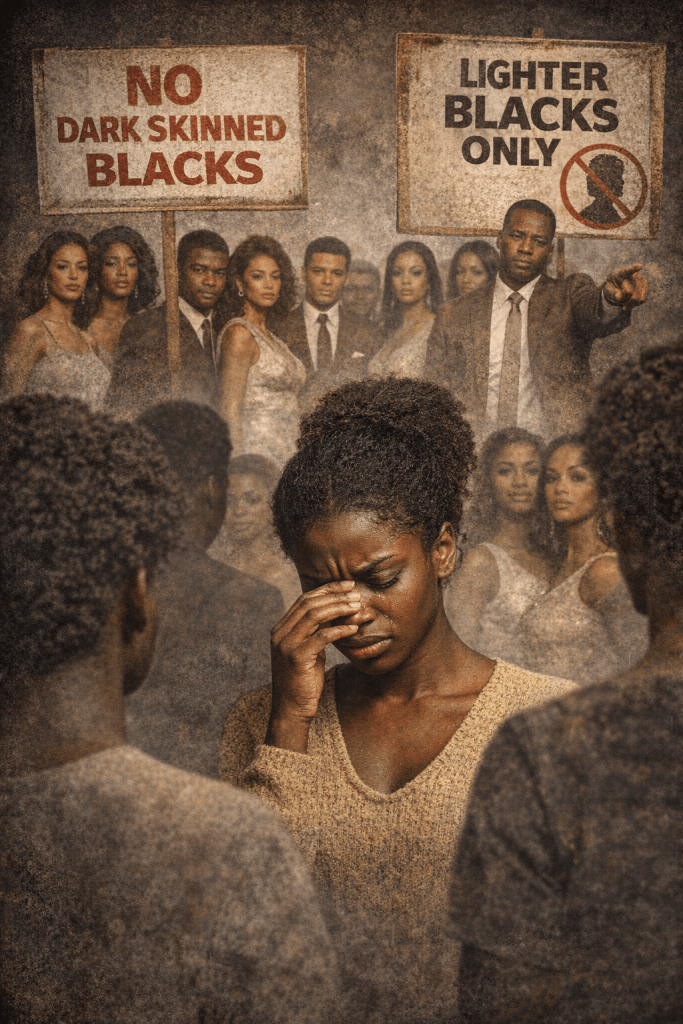
Self-Hating Blacks Banned Darker Blacks

Self-hatred within the Black community is one of the most tragic psychological legacies of slavery, colonialism, and white supremacy. It is a condition where Black people unconsciously absorb anti-Black ideologies and then reproduce those same systems of hierarchy and exclusion among themselves. One of the clearest manifestations of this internalized racism is colorism, where darker-skinned Black people are marginalized, excluded, or deemed inferior by lighter-skinned Black people who have been socially conditioned to associate proximity to whiteness with value, intelligence, beauty, and success.

Colorism did not originate within the Black community. It was engineered through slavery, where lighter-skinned enslaved people, often the offspring of enslaved women and white slave masters, were granted closer proximity to the house, while darker-skinned Africans were relegated to the fields. This created a racial caste system within Blackness itself, embedding the idea that lighter skin meant higher status, better treatment, and greater access to resources.

Over time, this system evolved beyond physical labor into a psychological hierarchy. Lighter-skinned Blacks were often given better education, more opportunities, and greater representation in media, while darker-skinned Blacks were systematically portrayed as aggressive, undesirable, unintelligent, or hypersexual. These narratives were not accidental; they were tools of social control designed to fracture Black unity and create internal competition instead of collective resistance.

Self-hating Blacks did not create these structures, but many unconsciously enforced them. By adopting Eurocentric beauty standards and internalizing anti-Black imagery, some Black people became gatekeepers of whiteness within Black spaces. This is why darker Blacks were often excluded from leadership roles, romantic desirability, media representation, and even religious platforms, despite being the most genetically and historically African.

In many Black communities, darker-skinned children grow up receiving different treatment than their lighter-skinned peers. They are disciplined more harshly, praised less frequently, and rarely affirmed as beautiful. Meanwhile, lighter-skinned children are often subconsciously favored, described as “pretty,” “articulate,” or “well-behaved,” reinforcing a psychological message that darkness is a deficit.

This internal hierarchy becomes even more visible in dating and marriage patterns. Numerous sociological studies show that lighter-skinned Black women are more likely to be perceived as attractive and marriageable, while darker-skinned women are more likely to be stereotyped as aggressive or undesirable. This has nothing to do with biology and everything to do with centuries of racial conditioning.

Dark-skinned Black men are similarly affected, often being hypersexualized, criminalized, or depicted as dangerous. Yet lighter-skinned Black men are more likely to be portrayed as romantic leads, intellectuals, or socially acceptable partners. The result is a racial double consciousness where Blackness is tolerated only when diluted.

Media has played a major role in this psychological warfare. For decades, Black magazines, music videos, television shows, and advertisements overwhelmingly featured light-skinned models and actors, reinforcing the idea that success and beauty required proximity to whiteness. Darker Blacks were either erased or reduced to background characters, comic relief, or symbols of dysfunction.

This phenomenon produced what Frantz Fanon described as the “colonized mind,” where the oppressed adopt the values and worldview of the oppressor. In this condition, Black people begin to see themselves through white eyes and judge their own people according to white standards. The darkest among them become the most dehumanized.

Self-hatred becomes structural when Black institutions themselves participate in this exclusion. Churches, schools, social clubs, sororities, fraternities, and professional networks have historically favored lighter-skinned Blacks, creating social filters that replicate colonial hierarchies even in supposedly Black-controlled spaces.

This is why darker Blacks were often banned from certain social circles, beauty contests, modeling agencies, and elite organizations. Not officially, but psychologically and culturally. They were “too dark,” “not the right look,” or “not marketable,” which are simply coded ways of saying not close enough to whiteness.

The tragedy is that darker-skinned Blacks are the closest living descendants to the original African populations from which all humans originate. Genetically, melanated skin is the ancestral human phenotype. Yet through racial conditioning, this biological truth was inverted into a social lie where darkness became associated with inferiority.

This internal division weakened Black collective power. Instead of uniting against systemic racism, Black communities were fractured into internal hierarchies of worth. Lighter Blacks were taught to distance themselves from darker Blacks, while darker Blacks were taught to aspire toward lighter identity, leading to generational psychological trauma.

Colorism also created economic consequences. Darker Blacks face higher rates of unemployment, lower wages, harsher sentencing in the criminal justice system, and reduced access to healthcare and housing. These outcomes are not random; they reflect how deeply skin tone influences institutional decision-making.

The most devastating effect of this system is spiritual. When Black people internalize self-hatred, they disconnect from their ancestral identity, cultural memory, and collective purpose. They begin to measure their worth by standards that were never designed for their liberation, only their management.

This is why self-hating Blacks often police darker Blacks more harshly than white people do. They become enforcers of respectability politics, assimilation, and aesthetic conformity. In psychological terms, this is called identification with the oppressor.

Dark-skinned Blacks, in turn, are forced to develop double resilience: resisting external racism while also surviving internal rejection. Many grow up with deep wounds around self-worth, desirability, and visibility, despite being the very foundation of Black history and genetic continuity.

The modern movement of Black consciousness seeks to reverse this damage. It rejects Eurocentric beauty standards and re-centers African aesthetics, melanin, natural hair, and cultural authenticity as sources of pride rather than shame. It exposes colorism as a colonial weapon, not a natural preference.

Healing requires collective psychological decolonization. Black people must unlearn the lies embedded in their subconscious and recognize that all shades of Blackness are sacred, powerful, and historically significant. Darkness is not a defect; it is the original human design.

Until Black communities dismantle internalized racism, they will continue reproducing the same systems that were designed to destroy them. Self-hating Blacks banning darker Blacks is not just a social issue; it is a spiritual crisis rooted in colonial trauma.

True Black liberation begins when Black people stop measuring themselves against whiteness and start honoring the full spectrum of their own identity. Only then can the community heal the internal fractures created by slavery, colonialism, and psychological warfare.

Colorism is not about preference. It is about power, history, and psychological conditioning. And the first step toward freedom is telling the truth about how deeply it has shaped Black self-perception.

The ultimate irony is that the darkest Blacks, once marginalized and excluded, are now leading the global reawakening of Black identity, pride, and ancestral remembrance. What was once rejected is now being reclaimed as divine.

This is not a coincidence. It is historical correction.


References

Fanon, F. (1967). Black skin, white masks. Grove Press.

Harrison, M. S., & Thomas, K. M. (2009). The hidden prejudice in selection: A research investigation on skin color bias. Journal of Applied Social Psychology, 39(6), 1346–1364.

Hunter, M. (2007). The persistent problem of colorism: Skin tone, status, and inequality. Sociology Compass, 1(1), 237–254.

Hunter, M. (2011). Buying racial capital: Skin-bleaching and cosmetic surgery in a globalized world. The Journal of Pan African Studies, 4(4), 142–164.

Keith, V. M., & Herring, C. (1991). Skin tone and stratification in the Black community. American Journal of Sociology, 97(3), 760–778.

Russell, K., Wilson, M., & Hall, R. (2013). The color complex: The politics of skin color among African Americans. Anchor Books.

Tummala-Narra, P. (2007). Conceptualizing colorism and its implications for mental health. American Psychologist, 62(4), 352–360.

Walker, S. (2002). Style and status: Selling beauty to African American women, 1920–1975. University Press of Kentucky.

Wilkerson, I. (2020). Caste: The origins of our discontents. Random House.

Byrd, R. P., & Gates, H. L. Jr. (2009). The Black intellectual tradition. Harvard University Press.

The Brown Girl Chronicle: Truth, Trials, and Triumphs.

Photo by Marcelo Chagas on Pexels.com

The story of the Brown girl is one of layered resilience—a quiet strength forged in centuries of misunderstanding, marginalization, and misrepresentation. She stands as a symbol of continuity, bearing the weight of her foremothers’ prayers and the echoes of a culture often silenced. Her truth is not simply personal; it is collective, a reflection of generations who fought to be seen in full color in a world that blurred their brilliance into shadows.

For the Brown girl, beauty has always been both a gift and a battlefield. She was told she was too dark to be delicate, too bold to be beautiful, too strong to be loved. Her complexion became an unspoken social script, assigning her a role that rarely mirrored her reality. From childhood, she learned to navigate the politics of shade—how a few tones lighter could mean acceptance, opportunity, or desirability. This unrelenting calculus of complexion carved scars invisible to the eye but deeply etched in her psyche.

Colorism became a cruel whisper passed down through family lines, often masked as advice or preference. “Stay out of the sun,” some would say, or “you’re pretty for a dark girl.” These words, though softly spoken, carried centuries of colonial distortion that equated light with purity and darkness with inferiority. Yet, beneath this imposed hierarchy, the Brown girl began to unlearn. Her awakening was gradual but powerful—she came to realize that her melanin was not a mark of shame but of divine craftsmanship.

Historically, the Brown girl has been the cornerstone of her community yet seldom its celebrated image. In the fields, in the factories, in the fight for civil rights, her labor built nations while her name remained unsung. Her trials were both economic and emotional, shaped by a system that exploited her body, dismissed her intellect, and commodified her image. Despite these wounds, she rose with the quiet defiance of survival—a survival that redefined what it means to be beautiful and whole.

In modern society, the Brown girl’s narrative continues to evolve amid shifting ideals of representation. The rise of social media has given her a stage, yet also a mirror that reflects society’s unfinished biases. The filters and edits of digital beauty reinforce old hierarchies under new guises. But she is fighting back—with every unfiltered photo, every natural curl, every unapologetic post declaring, “I am enough.” Her voice, once dismissed, now echoes across screens and spaces, demanding to be heard on her own terms.

The trials of the Brown girl are deeply intertwined with the psychological legacies of slavery and colonialism. These systems not only exploited her ancestors’ labor but sought to fracture their sense of self. Through generations, trauma was internalized, manifesting as self-doubt and color bias. Yet, within this pain lies the possibility of transformation—a re-rooting of identity grounded in historical truth and ancestral pride. Healing, for her, is not forgetting but remembering differently.

To speak of her truth is to acknowledge the contradictions she lives with: praised for her strength yet denied tenderness, admired for her resilience yet rarely protected. The world expects her to be unbreakable, but inside, she yearns for softness—the kind that affirms she doesn’t have to always be the strong one. Her triumphs are not always loud; sometimes, they are found in the quiet decision to love herself in a world that profits from her insecurities.

In her career, the Brown girl must work twice as hard for half the recognition. Her tone and texture often determine how she is perceived before her talent is even seen. This intersection of racism, colorism, and lookism shapes not just her professional journey but her emotional health. Yet she persists, embodying excellence in spaces not built for her. Each promotion, each degree, each creative expression is an act of reclamation—a rewriting of history in her favor.

Her trials also find expression in love. Romantic rejection often carries the residue of societal bias, where lighter skin is still coded as more desirable. She learns early that beauty is political, and affection is filtered through centuries of conditioning. Still, she does not surrender to bitterness. Her love becomes revolutionary—rooted in self-acceptance, radiating confidence, and defying the colonial gaze that once defined her worth.

Spiritually, the Brown girl’s journey mirrors the biblical archetypes of endurance and faith. Like Hagar in the wilderness, she has been cast aside yet still seen by God. Her melanin is not merely biological—it is theological. It connects her to the dust from which humanity was formed, to the warmth of the African sun, to the divine imprint of creation itself. In embracing her hue, she honors the Creator who called all things “good.”

Culturally, she represents the heart of the diaspora. Her music, her dance, her language, and her laughter carry fragments of Africa’s rhythm and the Americas’ resilience. Every hairstyle, every garment, every prayer whispered in pain or joy becomes a piece of resistance art. Through her cultural expression, she not only survives but teaches the world what beauty born of struggle looks like.

Her triumphs are not defined by fame or validation but by freedom—the freedom to exist without apology. To wear her natural hair at work without judgment. To be chosen in films, books, and art not as the sidekick or the suffering figure, but as the centerpiece. To see little girls who look like her represented on screens and in classrooms, learning early that brown is not a burden but a blessing.

The Brown girl’s chronicle is one of duality: both fragile and formidable, silenced and outspoken, ordinary and extraordinary. She embodies the tension between societal perception and self-realization. Her story disrupts stereotypes and reclaims narratives long distorted by white supremacy and patriarchy. In her voice lies the testimony of countless others who refused to fade.

Her truth is not a monolith. Brown girls come in a spectrum of shades, shapes, and stories. Some grew up in privilege, others in poverty. Some found affirmation early; others are still searching. Yet all share an unspoken understanding—that their color carries history, pain, and possibility. Together, they form a living archive of endurance and evolution.

Her trials have taught her empathy. She sees through the illusions of beauty standards and the fragility of external validation. Her compassion extends even to those who once looked down upon her, for she understands that their prejudice is learned, not innate. In this way, she rises above bitterness, embodying grace even when the world offers none.

Each triumph, no matter how small, is monumental. The Brown girl who walks into a boardroom wearing her afro is reclaiming space. The one who publishes her poetry, paints her truth, or raises her children with love untouched by shame—each is a monument of healing. Her triumphs are living testimonies of survival transfigured into power.

Psychologically, her evolution represents a return to wholeness. She learns to detach her worth from European beauty ideals and anchor it in self-knowledge. She redefines beauty as authenticity, not conformity. Her confidence becomes contagious, inspiring others to do the same. The mirror, once her enemy, becomes her altar of affirmation.

The Brown girl’s chronicle is also a historical record. It speaks to how media, colonialism, and capitalism have commodified color. From bleaching creams to casting biases, her image has been shaped by profit rather than truth. But as she tells her story, she dismantles those systems one confession at a time.

Her truth is sacred. It reminds us that melanin is not a curse to overcome but a covenant to honor. Her existence itself challenges the lie that whiteness is the measure of beauty or worth. By simply being, she redefines the human aesthetic and restores balance to a world distorted by artificial hierarchies.

Her trials teach endurance, but her triumphs teach transcendence. The Brown girl does not just survive oppression—she transforms it into art, advocacy, and an anthem of hope. Her laughter in the face of pain becomes prophecy. Her joy is resistance. Her beauty, reclaimed and radiant, is her final rebellion.

And so, the chronicle continues—written in her own words, in her own time, in her own tone. She speaks not just for herself but for generations of women who bore silence like armor. Her truth, once hidden, now burns with the brilliance of her skin under the sun. Her trials shaped her, but her triumphs define her. She is the Brown girl, and she is finally free.

References

Banks, T. A. (2019). Colorism and the politics of beauty. Journal of Black Studies, 50(3), 243–261.
Hill, M. (2021). The psychology of colorism: Identity, bias, and belonging. American Journal of Cultural Psychology, 12(4), 411–430.
Hunter, M. (2007). The persistent problem of colorism: Skin tone, status, and inequality. Sociology Compass, 1(1), 237–254.
Russell, K., Wilson, M., & Hall, R. (2013). The color complex: The politics of skin color in a new millennium. Anchor Books.
Walker-Barnes, C. (2020). Too heavy a yoke: Black women and the burden of strength. Cascade Books.
West, C. (1993). Race matters. Beacon Press.

The Brown Girl Dating Diaries: Gifts that Speak.

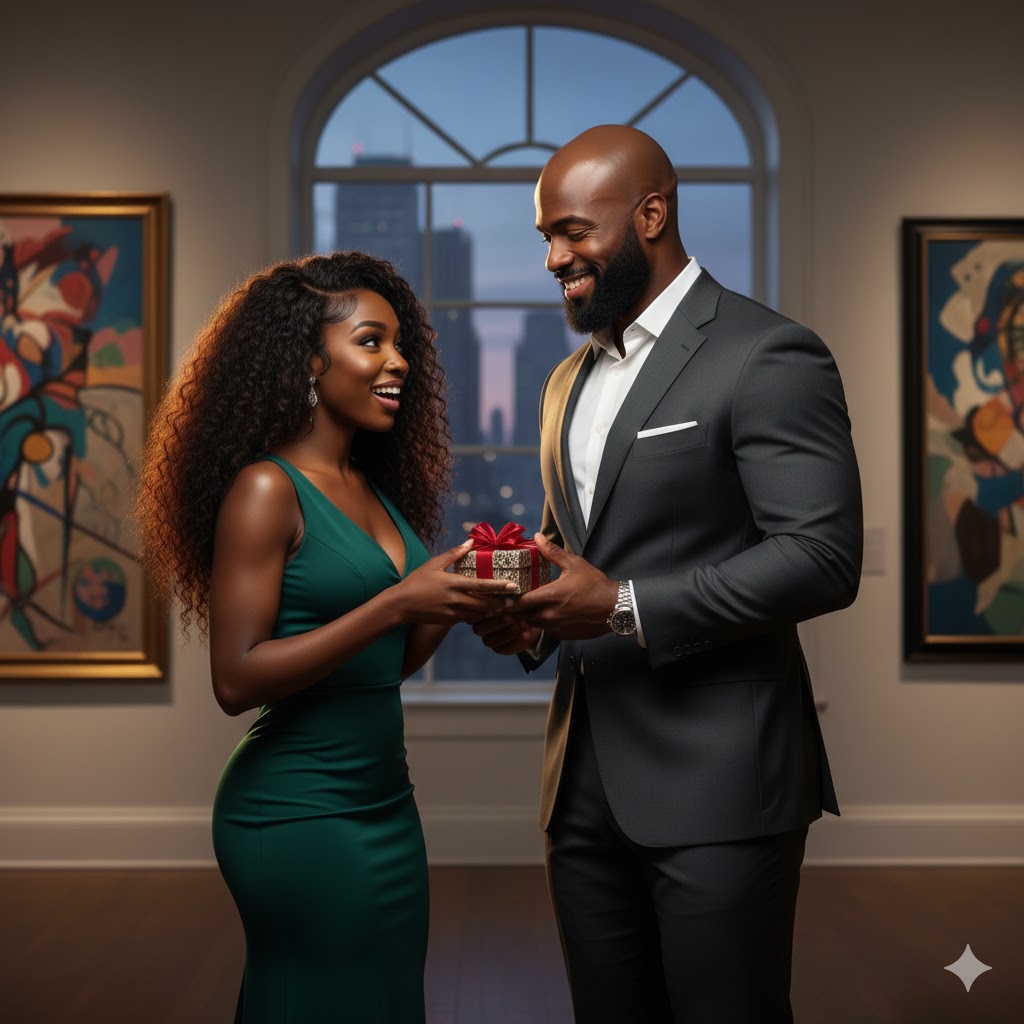
In the journey of dating as a brown girl, gifts are more than objects—they are symbols, messages, and mirrors reflecting intentions. From the very beginning, it is crucial to recognize that gifts carry meaning beyond their material value. They speak of thoughtfulness, attention to detail, and, most importantly, respect. Understanding this allows one to navigate the dating world with discernment, recognizing which gestures are genuine and which may be performative.

Gifts from men in dating can serve as expressions of care, interest, and investment in a relationship. A simple bouquet, a thoughtful note, or even a small token can communicate attentiveness and a desire to connect. However, the essence of these gifts must be weighed against the character of the giver. The act of giving should not become transactional, and the recipient must remain discerning, recognizing the alignment of actions with values.

Yet, gifts are not limited to men. Gifts from God are the most profound, offering guidance, patience, and discernment in choosing the right partner. Spiritual gifts manifest as wisdom, emotional maturity, and the ability to love rightly. Recognizing divine gifts in oneself allows for a grounded sense of self-worth that is not reliant solely on the approval or offerings of a partner.

The humility to accept gifts graciously is often overlooked. In dating, a brown girl may struggle with pride or skepticism, questioning whether she deserves the gestures she receives. Accepting gifts with gratitude demonstrates an understanding that love and attention are not entitlements but blessings, whether they come from God or a thoughtful partner. Gratitude transforms even a simple gesture into a moment of connection and reflection.

Material gifts from men must always be balanced with observation of their actions. Consistency, respect, and integrity cannot be replaced by lavish items or grand gestures. A true gift in dating is not measured solely in dollars but in sincerity. The quality of character and the intention behind the gesture speak louder than any wrapped box or handwritten card.

Gifts from God, however, are invisible yet deeply tangible in their effects. Spiritual insight, timing, and divine protection guide the dating journey. Praying for discernment before accepting gifts, both tangible and intangible, ensures that one is not misled by appearances. Divine gifts often come through patience, clarity, and the soft inner voice that cautions against haste or compromise.

In receiving gifts from men, the principle of humility remains vital. Pride or entitlement can distort perception, leading to the misinterpretation of intentions. A humble heart allows one to see the true message behind a gesture, whether it is a loving act, a test of commitment, or a reflection of deeper character. Humility aligns the heart with God’s perspective, ensuring that gratitude, not arrogance, defines the response.

Dating as a brown girl also involves understanding boundaries. Gifts are never a tool to manipulate, coerce, or demand reciprocity. Recognizing the difference between generosity and obligation is key. A gift should invite appreciation, not create indebtedness, and a wise recipient evaluates the heart of the giver rather than the size or cost of the present.

The lessons of gifts extend beyond romantic relationships. They teach about self-worth, discernment, and emotional intelligence. Every thoughtful gesture becomes a learning moment: how to receive, how to respond, and how to assess the intentions behind actions. These lessons cultivate maturity, which is essential in choosing a partner aligned with both personal values and spiritual calling.

In navigating dating, one must also acknowledge that not all gifts are meant to be kept. Some come with lessons, guiding decisions about compatibility and long-term alignment. Letting go of gifts that mask deeper incompatibilities or unhealthy patterns demonstrates wisdom and reverence for the higher purpose of love.

Gratitude transforms the reception of gifts into a spiritual exercise. Whether a small token from a man or a subtle sign from God, embracing gifts with thankfulness cultivates a heart attuned to love, patience, and discernment. Recognizing the divine orchestration behind timing and provision brings clarity, reducing the temptation to rely solely on human gestures for affirmation.

Understanding gifts also intersects with self-awareness. A brown girl must recognize her own value, gifts, and boundaries before fully appreciating the offerings of others. Confidence rooted in God’s love allows one to receive thoughtfully without compromising standards or integrity. Self-awareness creates a framework where gifts enhance, rather than define, a relationship.

Communication is another essential dimension of gifts. Discussing intentions, expectations, and feelings ensures that both giver and recipient are aligned. Misunderstandings about gestures can cause unnecessary tension or misinterpretation, and clear communication nurtures a culture of transparency, honesty, and mutual respect.

Ultimately, gifts in dating are more than tangible items—they are reflections of intent, character, and spiritual alignment. When approached with discernment, humility, and gratitude, they become tools for connection, insight, and growth. They remind the brown girl that love, whether human or divine, is both an act and a lesson, a dialogue between hearts.

The Brown Girl Dating Diaries remind us that gifts speak when we listen carefully. They carry meaning beyond their surface, teaching patience, humility, and discernment. Whether a token from a man or a divine provision, every gift shapes the narrative of love, guiding the heart toward the right partner while nurturing a life anchored in gratitude and grace.


References

Carter, R. T. (2013). Race and racial identity in psychology: Emerging perspectives. Wiley.

Garza, A. (2014). A herstory of the #BlackLivesMatter movement. The Feminist Wire.

Maxwell, J. C. (2018). The 5 levels of leadership: Proven steps to maximize your potential. Center Street.

Tannen, D. (1990). You just don’t understand: Women and men in conversation. William Morrow.

Warren, R. (2014). The purpose-driven life: What on earth am I here for? Zondervan.

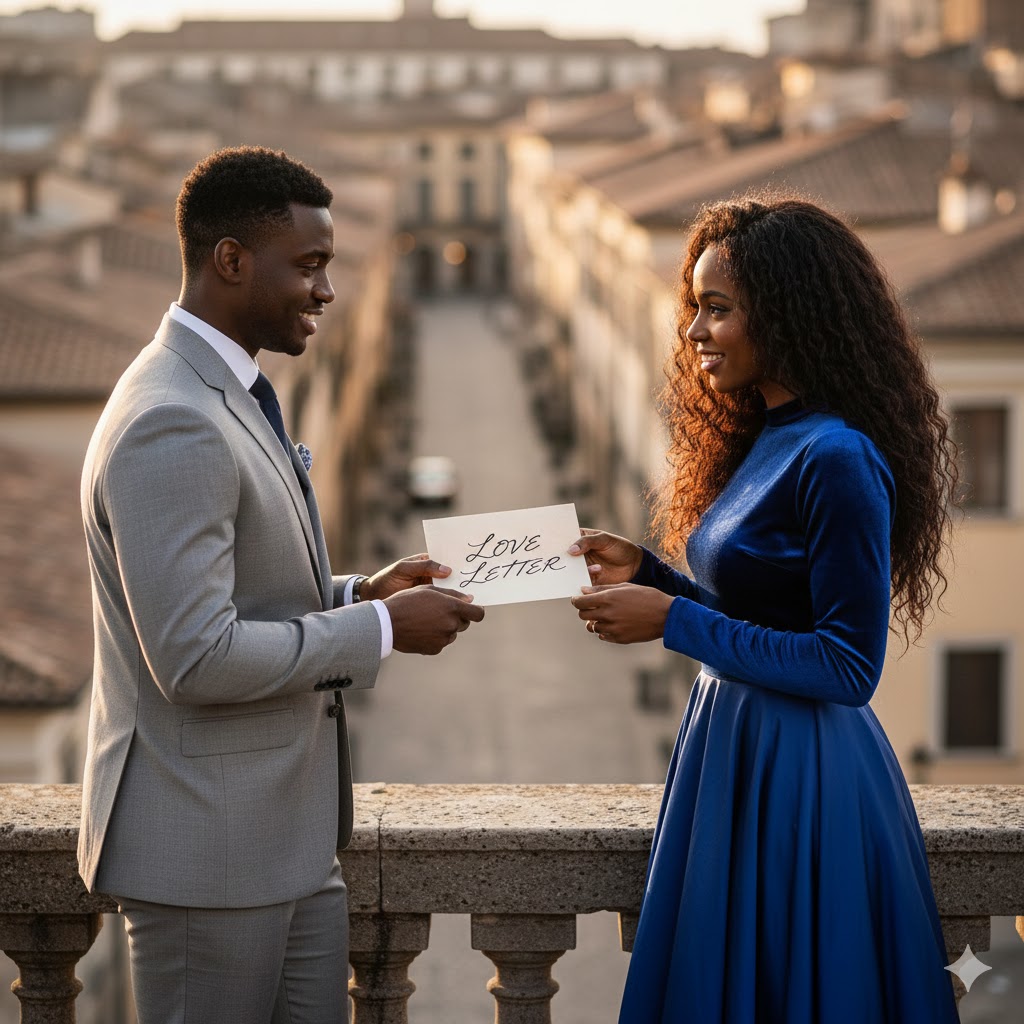
A Love Letter to the Girl in Brown Skin

The girl in brown skin is a testament to beauty that transcends superficial standards. In a world that often elevates fairness as the ideal, her richness in hue becomes a symbol of resilience, heritage, and divine creation. Scripture reminds us, “Thou art all fair, my love; there is no spot in thee” (Song of Solomon 4:7, KJV), affirming that beauty is inherent, complete, and divinely ordained. Her brown skin is not a flaw to be corrected but a canvas upon which the Creator’s artistry is evident.

Her skin carries the warmth of the sun, a reflection of ancestry rooted in kingdoms and empires that shaped civilizations. It tells the story of generations who survived slavery, colonization, and systemic oppression. As historian Henry Louis Gates Jr. (2011) emphasizes, Black identity is inextricably tied to resilience and history. Brown skin is not merely a pigment but a living archive of endurance and triumph.

To the girl with brown skin, know that your beauty is multifaceted. It is found in the curve of your cheekbones, the depth of your eyes, and the grace in your posture. Psychologically, colorism can distort self-perception, but embracing the fullness of your melanin affirms self-love and mental wellness (Hunter, 2007). Each shade of brown is unique, a celebration of diversity within unity.

Your hair, whether braided, curled, or coiled, crowns you with a heritage rich in symbolism. In biblical times, hair often signified strength and sanctity (1 Samuel 16:7, KJV). Your texture is a living reminder of cultural continuity and spiritual dignity. Embracing your natural hair is a declaration that you honor the temple God has given you.

Brown skin, in its luminous tones, is a mirror to your spirit. It radiates warmth and invites connection. Studies in social psychology indicate that people often respond positively to those who exude confidence in their natural selves (Ashikali & Dittmar, 2010). Your self-assurance becomes magnetic, and your presence leaves an imprint on the world around you.

The girl with brown skin walks with a quiet power. Her strength is subtle, often overlooked by those who equate loudness with authority. Yet the Scriptures teach that “she is clothed with strength and dignity; and she laugheth without fear of the future” (Proverbs 31:25, KJV). Your poise is revolutionary in a society that has historically sought to diminish your worth.

Every mark, every freckle, and every nuance of your skin tells a story of survival and grace. They are reminders of battles fought, victories won, and lessons learned. In embracing them, you resist narratives that seek to erase your identity and affirm the beauty of authenticity.

Brown skin shines in the sun not just physically, but symbolically. It represents light overcoming shadow, hope enduring hardship, and life flourishing against odds. Just as the Bible celebrates God’s creation in its diversity (Psalm 139:13-14, KJV), your existence is a living hymn to divine artistry.

In the mirror, you may sometimes see flaws magnified by societal critique. Yet these are illusions born of prejudice, not truth. Biblical truth reminds us that we are “fearfully and wonderfully made” (Psalm 139:14, KJV), and no external judgment can diminish the intrinsic beauty given by the Creator.

Your eyes hold the depth of history, reflecting the resilience of your ancestors. They are windows to wisdom forged through struggle, compassion learned through pain, and vision sharpened by hope. Just as light passes through amber, illuminating what is within, your gaze reveals the richness of your inner world.

To the girl in brown skin, your love story is sacred. It begins with the self—learning to see your own value and claim your rightful place in a world that often undervalues you. Self-love is radical, revolutionary, and necessary for the flourishing of your soul (Hooks, 2000).

The media may attempt to define beauty narrowly, but your essence defies reduction. From the glow of your skin to the rhythm of your walk, your presence commands a narrative that is unapologetically yours. Brown skin is not just beautiful; it is a statement of history, culture, and divine intention.

In relationships, your worth is immeasurable. The boy who truly sees you understands that your value is not contingent on comparison but rooted in the depth of your character. Love that honors your brown skin reflects the biblical principle that beauty without virtue is fleeting (Proverbs 31:30, KJV).

Every compliment you receive is deserved, yet it is your self-recognition that sustains you. The world can applaud, but true affirmation arises from within. By acknowledging your brilliance, you nurture resilience against societal pressures that seek to demean or undervalue you.

Your laughter is a melody that carries across spaces, a testament to joy that persists even in trials. Brown skin does not dull this joy; it amplifies it, like sunlight refracted through amber glass, warming everything it touches.

The girl in brown skin is also a scholar, an innovator, a leader. Her mind is a treasure, her intellect sharp, and her creativity boundless. Brown skin is not a barrier but a beacon, signaling wisdom, capability, and vision. History is replete with examples of brilliant Black women whose contributions were inseparable from their identity (Davis, 1983).

Spirituality intertwines with your physical beauty. The glow of your skin mirrors the light within, cultivated through prayer, faith, and purpose. Scripture affirms that true beauty emanates from the heart, “a meek and quiet spirit” being precious in the sight of God (1 Peter 3:4, KJV).

To the girl in brown skin, your voice matters. Speak, sing, and proclaim, for your words carry weight. Your stories, when shared, empower others and dismantle misconceptions. You are not invisible; you are luminous, and your testimony shapes collective consciousness.

In fashion, art, and self-expression, your brown skin is a palette upon which endless creativity is possible. Colors, textures, and patterns respond differently on melanin-rich skin, offering an aesthetic richness unmatched in its vibrancy and versatility.

Finally, know that the girl with brown skin is loved beyond measure. By God, by ancestors, by those who recognize true beauty and worth. You are a living poem, a masterpiece of creation, a reflection of divine intention. Embrace yourself fully, unapologetically, and with pride, for your brown skin is a love letter written by God Himself.


References

  • Ashikali, E., & Dittmar, H. (2010). Clothes, sex, and self-esteem: The impact of appearance-related social comparison on self-evaluation. Psychology of Women Quarterly, 34(2), 179–191.
  • Davis, A. Y. (1983). Women, race, & class. Random House.
  • Gates, H. L. Jr. (2011). Life upon these shores: Looking at African American history, 1513–2008. Knopf.
  • Hooks, B. (2000). All about love: New visions. William Morrow & Company.
  • Hunter, M. L. (2007). The persistent problem of colorism: Skin tone, status, and inequality. Sociology Compass, 1(1), 237–254.
  • King James Bible. (1611). Song of Solomon 4:7; 1 Samuel 16:7; Proverbs 31:25; Psalm 139:13-14; 1 Peter 3:4.

Dilemma: Black Hair Discrimination

The Politics of Policing Black Identity

Angela Davis

“I had been looking at pictures of women who were free, and they were wearing their hair the way it grows out of their heads.”
(Davis, A. Y., Women, Race & Class, 1981)

Chimamanda Ngozi Adichie

“Hair is political. Hair is personal. Hair is identity.”
(Adichie, C. N., Americanah, 2013)

Bell Hooks

“Straightening our hair is one of the many ways we try to erase the reality of our Blackness.”
(Hooks, b., Black Looks: Race and Representation, 1992)

Lupita Nyong’o

“What I learned is that when the world tells you you’re not enough, you don’t have to believe it.”
(Nyong’o, L., Sulwe, 2019)

“Black hair is not a trend, a problem, or a phase—it is a living archive of survival, resistance, and ancestral memory.”

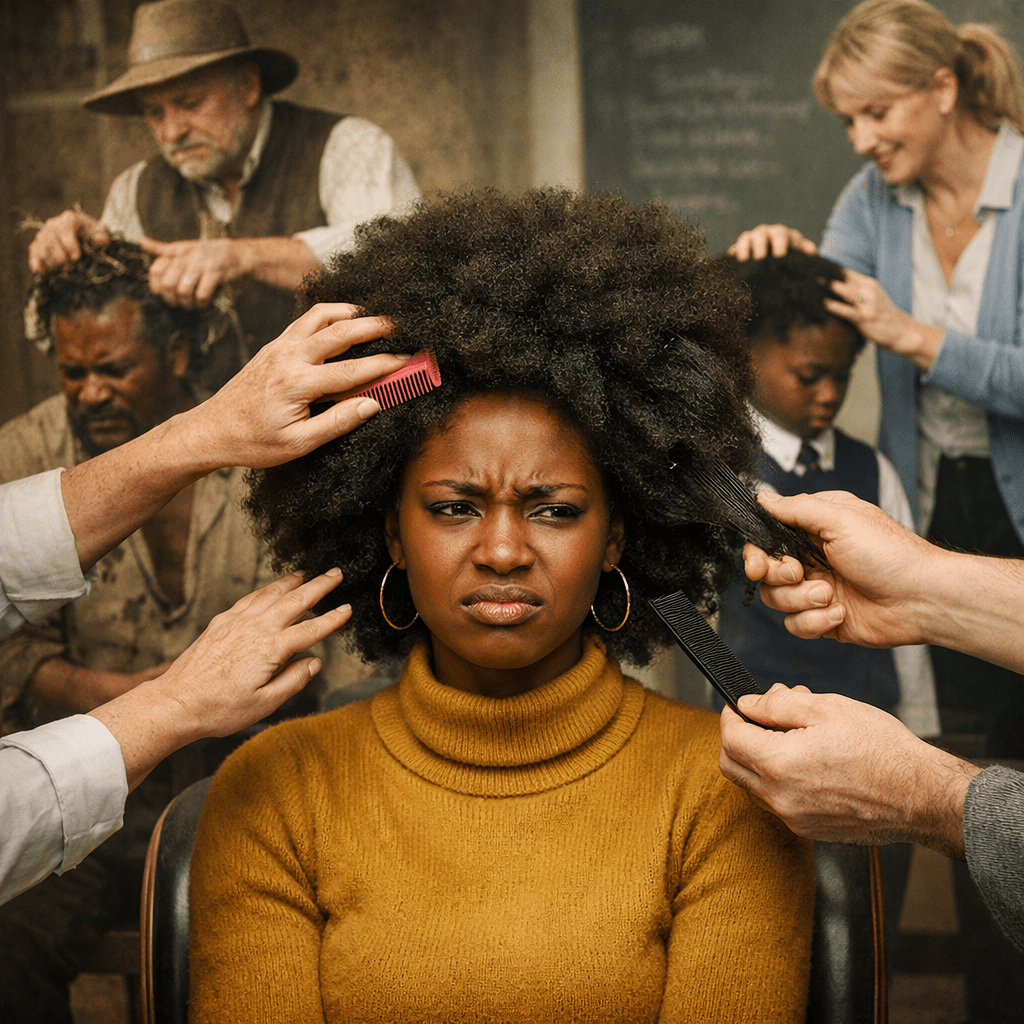
Black hair discrimination remains one of the most visible and normalized forms of racial bias in modern society. From classrooms to corporate offices, Black hair is disproportionately scrutinized, regulated, and punished under the guise of “professionalism,” “neatness,” or “dress code policies.” These standards are not neutral; they are rooted in Eurocentric ideals that define straight, loose, and non-textured hair as the default measure of beauty and respectability. As a result, Black people are often forced to alter their natural hair to gain acceptance, employment, or basic dignity.

In schools, Black children are suspended, sent home, or humiliated for wearing braids, locs, Afros, twists, or even natural curls. These disciplinary practices communicate a dangerous message: that Black identity itself is disruptive and unacceptable. When a child’s natural hair becomes grounds for punishment, the educational system participates in psychological harm that can shape self-esteem and identity formation for life. The classroom becomes not a place of learning, but a site of racial conditioning.

In the workplace, similar patterns persist. Black professionals are routinely told their hair is “unprofessional,” “distracting,” or “unkept,” even when it is clean, styled, and culturally appropriate. This forces many to chemically straighten their hair, wear wigs, or suppress their natural texture in order to be perceived as competent. Such pressures reveal how deeply white norms are embedded in institutional culture, where assimilation is often required for survival.

The hatred toward Black hair did not originate in modern offices or schools—it was cultivated during slavery. Enslaved Africans were stripped of their cultural grooming practices and taught to associate straight hair with proximity to whiteness and social advantage. Field laborers, who often had tightly coiled hair, were deemed inferior, while those with looser textures were privileged within the plantation hierarchy. Hair became a racial marker used to rank human worth.

This legacy did not disappear after emancipation. It evolved into colorism and texture discrimination, where straighter hair is still associated with beauty, intelligence, and professionalism, while kinky or coiled hair is labeled “nappy,” “bad,” or “ugly.” These terms, passed down through generations, reflect internalized racism—a psychological inheritance from white supremacy that continues to shape how Black people see themselves.

One of the most painful aspects of Black hair discrimination is that it is often reinforced within Black families themselves. Many Black parents, conditioned by their own experiences of rejection and survival, teach their children that their natural hair is something to be fixed, relaxed, or hidden. Phrases like “your hair is too nappy” or “you need a perm” are not harmless—they transmit shame and self-rejection at the most formative stages of identity.

This internalization is not accidental; it is a direct result of systemic oppression. When society consistently rewards whiteness and penalizes Blackness, marginalized communities may adopt those standards as coping mechanisms. However, survival strategies should not become permanent ideologies. Black parents must wake up to the reality that teaching children to hate their natural features only perpetuates the same system that devalues them.

White supremacy plays a central role in Black hair discrimination because it establishes whiteness as the universal standard of normality. Under this system, anything outside of European phenotypes is constructed as deviant, exotic, or inferior. Hair texture becomes political, not because Black people made it so, but because racism made Black bodies sites of control.

The concept of “professionalism” itself is racially coded. There is no scientific or moral basis for associating straight hair with competence or intelligence. These associations are cultural myths that developed within colonial and capitalist systems that centered white identity as the model citizen. Black hair challenges these myths simply by existing in its natural state.

Black hair has also been criminalized. From police stops to courtroom bias, Afro-textured hair has been associated with deviance and threat. Studies show that Black people with natural hairstyles are more likely to be perceived as aggressive, untrustworthy, or less intelligent, even when all other factors are controlled. This demonstrates how aesthetic bias becomes a mechanism of social exclusion.

The rise of movements like the Natural Hair Movement and the passing of the CROWN Act represent resistance against these injustices. These efforts aim to legally protect individuals from discrimination based on hair texture and style. However, legal reform alone cannot dismantle deeply ingrained psychological and cultural beliefs. Laws can change policies, but they cannot instantly heal internalized self-hatred.

True liberation requires a cultural shift in how Black beauty is defined and taught. Black hair must be reframed not as a problem to manage, but as a sacred inheritance—genetically rich, biologically diverse, and historically powerful. The same coils once mocked were used to map escape routes during slavery, braid seeds for survival, and encode communal identity.

Education plays a crucial role in this transformation. Schools must incorporate Black history and African aesthetics into curricula, not as side notes, but as central narratives. When children learn that their features have historical meaning and cultural value, they are less likely to internalize racist hierarchies imposed by society.

Media representation is equally important. For decades, Black beauty was only celebrated when it approximated whiteness—light skin, straight hair, narrow features. Today, although representation has expanded, Eurocentric beauty standards still dominate advertising, film, and fashion industries. The normalization of natural Black hair must move beyond trends and become structural.

The policing of Black hair is ultimately about control. It is about who gets to define beauty, respectability, and humanity. When institutions regulate how Black people wear their hair, they are not managing aesthetics—they are managing identity. Hair becomes a battlefield where cultural memory confronts colonial ideology.

Psychologically, hair discrimination contributes to identity fragmentation. Black individuals are often forced to perform different versions of themselves depending on context—natural at home, altered at work, cautious in public. This constant self-monitoring produces emotional fatigue and reinforces the idea that authenticity is unsafe.

Black parents, educators, and leaders have a responsibility to disrupt this cycle. Teaching children that their hair is “good” exactly as it grows is not a trivial affirmation—it is a radical act of resistance. It challenges centuries of propaganda designed to disconnect Black people from their bodies and ancestry.

Healing from hair discrimination requires both structural and spiritual work. Structurally, institutions must dismantle biased policies. Spiritually and psychologically, Black communities must unlearn the lie that proximity to whiteness equals worth. The reclamation of Black hair is inseparable from the reclamation of Black identity.

Black hair is not unprofessional, unclean, or undesirable. It is African. It is genetic. It is historical. It is political because oppression made it so. And until society confronts the racial logic behind its beauty standards, Black hair will continue to be policed—not because it is wrong, but because it refuses to conform to a system built on white supremacy.

Ultimately, the hatred of Black hair reflects a deeper hatred of Black existence. To love Black hair fully is to reject the entire hierarchy that ranks human value by proximity to Europe. In that sense, every Afro worn freely, every loc grown proudly, and every child taught to love their coils is an act of cultural revolution.


References

Banks, I. (2000). Hair matters: Beauty, power, and Black women’s consciousness. New York, NY: New York University Press.

Byrd, A. D., & Tharps, L. L. (2014). Hair story: Untangling the roots of Black hair in America. New York, NY: St. Martin’s Press.

Collins, P. H. (2004). Black sexual politics: African Americans, gender, and the new racism. New York, NY: Routledge.

Crenshaw, K. (1991). Mapping the margins: Intersectionality, identity politics, and violence against women of color. Stanford Law Review, 43(6), 1241–1299.

Johnson, T. R., & Bankhead, T. (2014). Hair it is: Examining the experiences of Black women with natural hair. Open Journal of Social Sciences, 2(1), 86–100.

Rooks, N. (1996). Hair raising: Beauty, culture, and African American women. New Brunswick, NJ: Rutgers University Press.

Rosette, A. S., & Dumas, T. L. (2007). The hair dilemma: Conformity versus authenticity. Journal of Applied Psychology, 92(6), 1601–1616.

Tate, S. A. (2009). Black beauty: Aesthetics, stylization, politics. Farnham, UK: Ashgate.

The CROWN Act. (2019). Creating a Respectful and Open World for Natural Hair. U.S. legislation on hair discrimination.

Girl Talk Series: The Illusion of 50/50 Relationships.

Listen, Ladies: A Man is Called to Provide

Listen, ladies — it is not wrong for a woman to desire a man who provides for her. My late husband always reminded me that provision is a man’s duty and honor, not a burden. When a man loves a woman, he does not see caring for her needs as a chore but as a privilege that reflects his role as leader and protector. The Bible is clear about this responsibility. First Timothy 5:8 warns, “But if any provide not for his own, and especially for those of his own house, he hath denied the faith, and is worse than an infidel.” This is not a light statement — it means that failing to provide for one’s household is a spiritual and moral failure. When a man provides, he demonstrates sacrificial love, mirroring Christ’s care for the church (Ephesians 5:25–28). He creates an environment where a woman feels safe, secure, and valued, allowing her to flourish in her calling. Provision is not just financial — it is emotional, spiritual, and physical care that establishes stability for the entire family. Women should not feel guilty for expecting this. It is not greed; it is alignment with God’s design for marriage. A man’s willingness to provide reveals his maturity, character, and readiness for covenant commitment.

The modern cultural push for “50/50 relationships” promises fairness and equality between partners, yet many women discover that this model can still leave them emotionally, financially, and spiritually depleted. On the surface, splitting bills, chores, and responsibilities seems fair, but when a man avoids leadership and provision, the relationship quickly becomes unbalanced. The woman may end up carrying the weight of both provider and nurturer, which goes against the biblical design for marriage.

God’s Word establishes a clear picture of headship and provision. Ephesians 5:25–28 commands husbands to love their wives “even as Christ also loved the church, and gave himself for it.” Christ did not share the burden of salvation equally with the church—He bore it entirely. Likewise, a husband’s role is one of sacrificial leadership, taking primary responsibility for the welfare of his wife and household. When a man shirks this responsibility, the woman becomes vulnerable to exhaustion and resentment.

The 50/50 model also creates confusion in roles. When financial and emotional labor is divided down the middle, leadership often becomes negotiable, leading to power struggles or passivity. Scripture does not teach mutual passivity but calls men to lead with humility and love. A man who abdicates this role leaves a vacuum that the woman may feel forced to fill, creating a dynamic that undermines trust and respect.

Psychology sheds light on why such arrangements often fail. Research on learned helplessness shows that when one partner refuses to carry their share of responsibility, the other partner may overfunction, doing more and more to keep the relationship afloat. Over time, this can lead to emotional burnout, anxiety, and even depression. The imbalance of power can create a subtle form of exploitation, where one partner benefits at the expense of the other.

Financially, many women have found themselves paying half the bills, contributing to a man’s dreams, and even funding his education—only to have him leave once he is stable. This pattern is so common that it has been discussed in popular media and relationship studies. The emotional toll is devastating because the woman not only loses the relationship but also feels robbed of the investment she made into his life.

One well-known media example is the breakup of singer Mary J. Blige’s marriage to Kendu Isaacs. During the divorce, it became public that Blige had supported Isaacs financially for years, only for him to allegedly misuse funds and engage in infidelity. This public case highlights the painful reality many women face when they invest financially in men who do not share the same loyalty or commitment (Gonzalez, 2017).

Biblically, men are called to be providers. First Timothy 5:8 warns, “But if any provide not for his own, and specially for those of his own house, he hath denied the faith, and is worse than an infidel.” This is a serious charge: a man who refuses to take responsibility for his household is living in disobedience. A 50/50 arrangement may seem modern and progressive, but if it allows a man to neglect his God-given duty, it ultimately harms the spiritual order of the home.

Women can protect themselves from one-sided emotional labor by establishing clear boundaries early in relationships. If a man expects financial partnership, she must ask whether he is also prepared to lead spiritually, emotionally, and sacrificially. Leadership is not domination; it is service. If he only wants to split bills but not bear the weight of provision, he is asking for partnership without accountability.

Self-protection also means paying attention to patterns of behavior. A man who frequently “borrows” money, avoids discussing finances, or becomes defensive when asked about spending habits may be signaling irresponsibility. Proverbs 27:12 says, “A prudent man foreseeth the evil, and hideth himself.” Women must be vigilant and not ignore early warning signs.

Another safeguard is financial independence before marriage. Women should maintain their own savings, credit, and emergency fund until they are in a covenant where mutual provision is clear. This is not distrustful but wise stewardship. If the relationship ends, she will not be left destitute.

From a psychological perspective, women must resist the trap of overfunctioning. Doing more than your fair share may feel noble, but it fosters resentment and reinforces a man’s avoidance of growth. Boundaries are not punishment; they are invitations for the man to step up. If he does not rise to the occasion, that reveals his character.

Spiritually, women must pray for discernment. James 1:5 promises wisdom to those who ask God. Discernment helps a woman recognize whether a man’s intentions are honorable or self-serving. Godly headship is seen in consistent character, not just charm or romantic gestures.

Teaching men biblical manhood is also part of the solution. Men must understand that provision is not optional but part of reflecting Christ’s image. Churches and mentors should call men to accountability, teaching them to view marriage not as a financial arrangement but as a covenant requiring sacrifice.

For women already in 50/50 relationships, communication is key. Honest conversations about expectations, finances, and future plans can bring clarity. If the man is unwilling to discuss or adjust, she must decide whether the relationship is sustainable long-term.

Emotional labor must also be addressed. Many women carry the emotional weight of the relationship—planning dates, managing household tasks, and maintaining communication—while the man coasts. This imbalance can be corrected by delegating responsibilities or refusing to do tasks he is capable of doing.

Ultimately, the illusion of 50/50 relationships is that they are fair. True fairness is not mathematical equality but mutual giving according to each person’s capacity and role. A godly man will give more than 50% because he loves sacrificially. A godly woman will respond with respect and support, creating a dynamic of harmony rather than competition.

Relationships thrive when both partners embrace their biblical roles. The man leads, provides, and protects. The woman nurtures, supports, and helps. When these roles are honored, there is peace. When they are reversed or neglected, there is confusion and pain.

50/50 Relationship vs. Biblical Covenant Relationship

Category50/50 RelationshipBiblical Covenant Relationship (Ephesians 5:25–28)
LeadershipNegotiated or shared — often leaves a power vacuum or power struggle.The man lovingly leads, sacrifices, and takes spiritual responsibility.
ProvisionSplit equally — may leave the woman vulnerable if he withdraws support.The man provides for his household (1 Tim. 5:8) and prioritizes her well-being.
Emotional LaborOften falls disproportionately on the woman (planning, nurturing, problem-solving).Shared — the man takes initiative to care for her emotional needs.
Conflict ResolutionCan become transactional (“I did my half, you do yours”).Built on grace, humility, and sacrificial love, not score-keeping.
Financial SecurityDepends on both parties keeping their share. If one stops, the other is overburdened.The husband bears the main responsibility so the wife feels secure.
Spiritual DirectionUsually absent or inconsistent; spiritual growth is optional.The man leads prayer, worship, and sets a Christ-centered tone for the home.
View of RolesGender roles are blurred or dismissed.Roles are distinct yet complementary — the man leads, the woman supports.
Decision-MakingRequires constant negotiation; can breed resentment.Man leads with humility, consults his wife, and seeks God’s will.
Motivation for GivingConditional — “I will give my half if you give yours.”Unconditional — he loves and gives first, as Christ gave to the church.
Long-Term StabilityCan collapse if one partner stops contributing or loses interest.Endures through trials because it is built on covenant, not contract.

The call to women is not to settle for half-hearted leadership or a man who uses partnership as an excuse to avoid responsibility. Your worth is too great to finance your own exploitation. Trust God to send a man who reflects Christ’s love—a man who gives, leads, and sacrifices.


References

  • Holy Bible, King James Version (KJV).
  • Gonzalez, S. (2017). Mary J. Blige on Divorce: “I’m Gonna Be Just Fine.” Billboard.
  • Beck, J. S. (2021). Cognitive Behavior Therapy: Basics and Beyond. Guilford Press.
  • Cloud, H., & Townsend, J. (2017). Boundaries in Dating. Zondervan.
  • Smith, C. A. (2020). The Psychology of Power Imbalance in Romantic Relationships. Journal of Family Psychology, 34(4), 512–523.

Living in the Middle Hue

Photo by Dellon Thomas on Pexels.com

To live in the middle hue is to exist in a space that is simultaneously visible and invisible. Brown-skinned women occupy a unique position within the color spectrum of Black beauty, standing between the lighter complexions that society often privileges and the darker complexions that increasingly symbolize resistance and resilience. This positioning creates a distinctive lived experience marked by tension, invisibility, and resilience.

Historically, colorism has shaped the trajectory of Black identity in profound ways. During slavery, skin tone was a marker of social hierarchy, with lighter-skinned individuals often placed in domestic roles and darker-skinned individuals subjected to field labor (Hunter, 2007). Brown-skinned women often stood somewhere in between, navigating ambiguous roles that reflected neither full privilege nor complete marginalization.

The legacy of these hierarchies remains. Contemporary psychology shows that skin tone significantly influences perceptions of attractiveness, intelligence, and competence (Hill, 2002). Brown-skinned women frequently find themselves overlooked, as if their shade renders them “neutral”—not exalted, not despised, but quietly ignored. This invisibility defines much of the “middle hue” experience.

Celebrities like Gabrielle Union, Nia Long, Sanaa Lathan, and Regina King exemplify this dynamic. Each has built a successful career, yet their complexions have not been consistently framed as cultural standards of beauty. Instead, they are remembered for talent, relatability, or resilience—qualities that, while admirable, subtly reflect society’s tendency to place brown-skinned women in the background rather than at the center.

The Bible offers an antidote to these hierarchies. Song of Solomon 1:5 (KJV) declares: “I am black, but comely, O ye daughters of Jerusalem.” The Shulamite’s affirmation reminds us that all shades of melanin, including the middle hues, are divinely beautiful. God’s design resists society’s categories, declaring beauty where humanity places division.

The psychological toll of colorism cannot be ignored. Social identity theory suggests that individuals derive worth from group belonging (Tajfel & Turner, 1986). When brown-skinned women are neither fully included in the praise of light skin nor in the pride of dark skin, they experience a fractured sense of belonging, resulting in anxiety, insecurity, and disconnection.

This fractured identity is especially pronounced in adolescence. Many young brown-skinned girls grow up hearing remarks such as, “You’re not light enough to be pretty” or “You’re not dark enough to be bold.” These microaggressions plant seeds of confusion and create internal struggles with identity. Living in the middle hue becomes a quiet battle for self-worth.

Romantic dynamics further illustrate this struggle. Research demonstrates that skin tone plays a role in partner preference and marriage patterns (Keith & Herring, 1991). Light-skinned women are often idealized as “trophy wives,” while dark-skinned women are increasingly celebrated for embodying cultural pride. Brown-skinned women, however, are frequently relegated to the “safe” or “average” category, reinforcing the pain of invisibility.

Yet, living in the middle hue also fosters resilience. Brown-skinned women often cultivate strength in navigating spaces that fail to affirm them. Celebrities like Regina King demonstrate this resilience, using their influence to expand representation and redefine what beauty, leadership, and artistry look like for women in the middle hue.

In popular culture, the erasure of brown skin persists. Spike Lee’s School Daze highlighted the tension between light and dark, but women of middle hues were largely sidelined, reflecting society’s reluctance to acknowledge their struggle. The middle hue continues to be minimized, even when discussions of colorism are at the forefront.

Anthropology describes this as liminality—existing on thresholds without belonging fully to either category (Turner, 1969). Brown-skinned women embody this liminal state, straddling two poles but never fully claimed by either. Living in the middle hue is, therefore, a cultural limbo marked by complexity and nuance.

Theologically, this liminality contradicts God’s design. Genesis 1:27 (KJV) affirms, “So God created man in his own image.” This declaration dismantles any human-created hierarchies. In God’s view, brown skin is not “middle” or secondary—it is equally part of His image, carrying the fullness of divine artistry.

Healing begins when brown-skinned women embrace this truth. Spiritual grounding reminds them that they are “fearfully and wonderfully made” (Psalm 139:14, KJV). Psychology echoes this, emphasizing that self-affirmation practices empower marginalized groups to resist internalized bias (Steele, 1988). Living in the middle hue can shift from invisibility to empowerment when women affirm their worth daily.

Representation in media is essential for healing. When brown-skinned women are centered as protagonists, love interests, and cultural icons, they redefine the narrative. Icons like Gabrielle Union, who has spoken openly about her experiences, help dismantle the silence surrounding the middle hue.

Intergenerational affirmation also plays a critical role. Brown-skinned mothers and mentors must teach young girls that their skin tone is not a compromise but a crown. Affirmation at home combats the cultural messages that reinforce invisibility, ensuring that the next generation lives confidently in their middle hue.

Community is another vital tool. Sisterhood spaces, where women affirm one another regardless of complexion, dismantle color hierarchies. Ecclesiastes 4:9-10 (KJV) emphasizes the power of support: “For if they fall, the one will lift up his fellow.” Healing requires unity, not competition, across the spectrum of Black womanhood.

The middle hue also represents balance. Brown skin carries the warmth of light tones and the richness of dark ones, embodying a harmony that reflects cultural wholeness. Rather than existing as a compromise, the middle hue symbolizes the blending of beauty across the spectrum.

Ultimately, living in the middle hue is both a challenge and an opportunity. The challenge lies in navigating invisibility, stereotypes, and comparison. The opportunity lies in embracing resilience, balance, and divine affirmation. Brown-skinned women represent a richness that society must learn to celebrate, not sideline.

In the end, living in the middle hue is not about being “in between”—it is about standing in fullness. Brown-skinned women are not halfway to beauty, nor shadows of extremes. They are radiant in their own right, carrying the glory of divine creation. When this truth is embraced, the blues of invisibility give way to the joy of affirmation.


References

  • Hill, M. E. (2002). Skin color and the perception of attractiveness among African Americans: Does gender make a difference? Social Psychology Quarterly, 65(1), 77–91.
  • Hunter, M. (2007). The persistent problem of colorism: Skin tone, status, and inequality. Sociology Compass, 1(1), 237–254.
  • Keith, V. M., & Herring, C. (1991). Skin tone and stratification in the Black community. American Journal of Sociology, 97(3), 760–778.
  • Steele, C. M. (1988). The psychology of self-affirmation: Sustaining the integrity of the self. Advances in Experimental Social Psychology, 21, 261–302.
  • Tajfel, H., & Turner, J. (1986). The social identity theory of intergroup behavior. In S. Worchel & L. W. Austin (Eds.), Psychology of intergroup relations (pp. 7–24). Nelson-Hall.
  • Turner, V. (1969). The ritual process: Structure and anti-structure. Aldine.
  • The Holy Bible, King James Version.