Category Archives: the brown boy dilemma

The Male Files: Melanin, Muscle & Meaning.

Black male bodies tell stories long before words are spoken. Melanin, muscle, and meaning converge as visual language—each layer communicating history, resilience, and divine intention. To observe Black men fully is to witness biology, theology, and culture moving together in embodied form.

Melanin is not simply pigment; it is protection, adaptation, and ancestral memory encoded in the skin. Scientific research confirms that higher melanin concentration evolved as a biological response to intense ultraviolet radiation, preserving folate and protecting cellular integrity (Jablonski, 2012). What has been racialized as inferior is, in truth, a marker of intelligent design.

Muscle, often emphasized in depictions of Black men, has been misunderstood and weaponized. While physical strength is a visible attribute, it is only one dimension of embodied intelligence. In Scripture, strength is consistently paired with discipline and restraint, suggesting that true power lies in control, not excess (Proverbs 16:32, KJV).

The Black male form has historically been reduced to labor and spectacle. During slavery and colonial expansion, Black men were framed as bodies without minds, tools without souls—a distortion necessary to justify exploitation (Fanon, 1952). This legacy still shapes contemporary perceptions, making reclamation essential.

Meaning restores what distortion removed. Black men exist not as reactions to trauma but as original carriers of purpose. Genesis affirms that humanity was created intentionally, endowed with dominion, stewardship, and moral responsibility (Genesis 1:26–27, KJV). Black manhood is included fully within this divine mandate.

Genetically, Black men represent humanity’s deepest roots. Africa holds the greatest genetic diversity on Earth, meaning Black bodies contain the widest range of human variation (Tishkoff et al., 2009). This reality reframes Blackness as foundational rather than peripheral to human identity.

Hair—whether cropped, coiled, locked, or curled—functions as both biology and symbol. Coiled hair protects the scalp and regulates heat, while culturally it communicates identity, resistance, and continuity (Jablonski & Chaplin, 2010). Grooming becomes an act of self-definition.

Muscle also reflects survival. Generations of forced labor, physical endurance, and resilience shaped not just bodies but collective memory. Yet Scripture reminds us that the body is a temple, worthy of care and honor, not exploitation (1 Corinthians 6:19–20, KJV).

Black male beauty has often been policed, feared, or eroticized rather than honored. Psychological research shows that racialized surveillance of Black men’s bodies contributes to chronic stress and identity fragmentation (Williams & Mohammed, 2009). Visibility without humanity becomes a burden.

Meaning, therefore, must be reclaimed internally as well as externally. When Black men define themselves rather than accepting imposed narratives, healing begins. Proverbs teaches that wisdom guards the heart and mind, offering stability amid distortion (Proverbs 4:23, KJV).

In art and photography, intentional representation challenges inherited myths. To depict Black men with dignity, softness, confidence, and complexity is to correct historical imbalance. Visual culture shapes belief as powerfully as written text.

The biblical image of manhood emphasizes leadership through service. Christ-centered masculinity models sacrifice, accountability, and love rather than domination (Mark 10:42–45, KJV). Muscle without meaning becomes threat; meaning without embodiment becomes abstraction.

Black men’s voices—deep, varied, rhythmic—carry authority shaped by experience. Whether speaking truth in intimate spaces or public arenas, their voices echo the breath of life God placed within humanity (Genesis 2:7, KJV).

Fatherhood reveals another dimension of meaning. Black men who nurture, protect, and instruct restore what systemic disruption sought to erase. Scripture links generational healing to the restoration of fathers’ hearts (Malachi 4:6, KJV).

Fashion and presentation also carry meaning. Tailored suits, casual wear, cultural garments—all communicate self-respect and intentionality. Scripture recognizes clothing as symbolic of position and honor, not vanity (Genesis 41:42, KJV).

Melanin, muscle, and meaning together form a complete narrative. Remove any element, and the picture distorts. Black men are not only seen—they are interpreted, and interpretation must be rooted in truth.

Psychologically, affirming Black male wholeness strengthens identity and resilience. Research in racial identity development demonstrates that positive self-concept buffers against systemic stressors (Helms, 1990).

Spiritually, Black men are not accidents of history. Jeremiah’s call narrative reminds us that God’s knowledge and purpose precede birth itself (Jeremiah 1:5, KJV). Purpose is embedded, not assigned later.

The Male Files seeks not to idolize bodies but to restore balance—to see Black men as whole beings: physical, intellectual, emotional, and spiritual. This wholeness resists reduction.

When melanin is honored, muscle disciplined, and meaning embraced, Black men stand not as symbols but as sons, leaders, creators, and stewards. This is not reclamation alone—it is alignment with divine truth.

To affirm Black men fully is to affirm God’s design. What has been fragmented by history can be made whole through truth, intention, and reverence. Melanin, muscle, and meaning were never meant to be separated.


References

Fanon, F. (1952). Black skin, white masks. Grove Press.

Helms, J. E. (1990). Black and White racial identity: Theory, research, and practice. Greenwood Press.

Jablonski, N. G. (2012). Living color: The biological and social meaning of skin color. University of California Press.

Jablonski, N. G., & Chaplin, G. (2010). Human skin pigmentation as an adaptation to UV radiation. Proceedings of the National Academy of Sciences, 107(Supplement 2), 8962–8968.

Tishkoff, S. A., et al. (2009). The genetic structure and history of Africans and African Americans. Science, 324(5930), 1035–1044.

Williams, D. R., & Mohammed, S. A. (2009). Discrimination and racial disparities in health. Journal of Behavioral Medicine, 32(1), 20–47.

The Holy Bible, King James Version. (1611/2017). Cambridge University Press.
Dilemma: Over-familarization with POC and expecting them to teach white people.

Photo by Safari Consoler on Pexels.com

The concept of People of Color (POC) refers to a collective term encompassing nonwhite racial and ethnic groups who have historically experienced marginalization, discrimination, and systemic exclusion under white-dominated structures. The term emerged as an inclusive response to the divisive racial categorizations of the past, aiming to unite Black, Indigenous, Asian, Latinx, and other marginalized communities against the shared experiences of racism and colonial oppression (Aguirre & Turner, 2011). While the phrase was designed to foster solidarity, it has also become a tool that, when misused, can blur the specificity of the Black experience within systems of racial injustice.

In contemporary culture, over-familiarization with POC often manifests as an unconscious entitlement from white individuals who assume they can casually enter or appropriate the cultural, emotional, or intellectual spaces of nonwhite people. This dynamic creates a tension between genuine intercultural understanding and the exploitative demand that POC educate white individuals about racism and identity. The expectation that people of color must serve as teachers of racial awareness imposes an unfair emotional labor burden, forcing them to relive trauma and articulate systemic pain that should be studied and understood independently by those benefiting from privilege (DiAngelo, 2018).

For Black people, this over-familiarization becomes particularly invasive. It often disguises itself as “allyship,” but in reality, it is a form of racial proximity that undermines autonomy. When white individuals overstep into Black spaces under the guise of solidarity, they inadvertently reinforce the same power dynamics they claim to resist. The expectation that every Black person must be a spokesperson or educator erases individuality, turning lived experience into a public classroom rather than a private, human reality.

The purpose of the POC framework was originally to unite marginalized groups under shared struggles, but it has also diluted the unique historical and systemic realities of Blackness. Anti-Blackness operates differently from other forms of racism, rooted in chattel slavery, the transatlantic slave trade, and ongoing dehumanization. When white individuals treat all POC experiences as interchangeable, they fail to grasp the singularity of the Black struggle—a struggle that has shaped the very foundation of Western economies and societies (Coates, 2015).

In educational and workplace settings, Black individuals are often expected to guide diversity efforts or explain microaggressions, even when such roles are unpaid and emotionally exhausting. The expectation becomes a cycle of psychological taxation—where the very people oppressed by racism must also be responsible for dismantling it. This undermines equity by placing the weight of re-education on those who already endure systemic injustice (Sue et al., 2007).

This dilemma extends into social and digital spaces. Online activism has created platforms for awareness, but it has also led to performative allyship, where white individuals engage with POC content superficially—sharing posts or quoting activists—without engaging in the deeper self-reflection required to dismantle racist ideologies. Black creators are often exploited for their intellectual and emotional labor, while white audiences consume and commodify their experiences without reciprocating in meaningful systemic change.

Culturally, this over-familiarization leads to appropriation. The imitation of Black speech, fashion, and music without acknowledgment of its origins reflects a historical continuity of exploitation. What was once penalized or mocked when practiced by Black people becomes celebrated when adopted by white individuals. This cultural theft, though masked as appreciation, perpetuates erasure and reinforces the illusion of equality while maintaining the structures of white dominance (hooks, 1992).

Psychologically, the demand that POC educate others about racism can induce fatigue and resentment. It forces them to manage white guilt and fragility while suppressing their own anger or exhaustion to maintain social harmony. The emotional toll of constantly explaining why racism is wrong deepens the trauma of living under racial oppression and silences the authentic emotional range of Black people (Moses, 2020).

The purpose of racial education should not fall on the oppressed but on those in power. White individuals must actively engage with anti-racist scholarship, history, and personal introspection. Works by scholars like bell hooks, Frantz Fanon, and Ibram X. Kendi offer pathways for understanding without exploiting the lived experiences of Black people. True allyship requires listening, humility, and accountability rather than over-familiarization and intrusion.

Over-familiarization also obscures boundaries. When white individuals presume intimacy with POC—calling them by colloquial names, imitating cultural behaviors, or entering spaces meant for healing—they blur the line between solidarity and dominance. This false sense of comfort reinforces the myth that racial inequities have been resolved, masking the persistent power imbalance that governs interpersonal and institutional relationships.

The expectation that every POC can represent all of their race is dehumanizing. Black individuals are diverse in ideology, class, and experience. Reducing them to educators of race or cultural ambassadors denies their complexity and individuality. It shifts attention away from systemic accountability toward interpersonal comfort for white individuals who wish to feel “included” in anti-racist discourse without surrendering privilege.

This dynamic also reinforces racial capitalism. Black pain and resilience become consumable narratives in media and entertainment. Documentaries, social posts, and academic discussions about racism generate profit and prestige for institutions that rarely redistribute resources to the communities being discussed. Thus, over-familiarization becomes another avenue through which white supremacy sustains itself under a façade of multicultural awareness.

The intersection of over-familiarization and tokenism compounds the issue. Many institutions showcase a handful of Black individuals as representatives of diversity while failing to dismantle exclusionary policies or systemic inequities. The “teacher” role is thus institutionalized, and POC find themselves both celebrated and exploited simultaneously—a contradictory position of visibility without power.

Historically, Black people have always been forced to teach their oppressors humanity—from the abolitionist movements to the Civil Rights era. Yet, centuries later, the demand continues. This suggests that the white conscience prefers comfort over change. Genuine transformation begins when those in privilege stop expecting emotional guidance and start committing to self-education and reparative action.

The effects of over-familiarization are subtle but profound. They erode trust, trivialize lived experiences, and perpetuate a racial dynamic where POC exist for the emotional benefit of white individuals. When white comfort becomes the measure of progress, Black liberation is delayed, and systemic inequities remain untouched beneath the surface of false harmony.

The role of POC should be self-determined, not socially assigned. They are creators, thinkers, and leaders—not tools for moral instruction. The over-familiarization problem stems from a deep societal reluctance to accept responsibility. Until white individuals internalize that learning about racism is their obligation, not a favor extended by POC, the cycle of exploitation will persist.

Community healing among POC requires establishing boundaries and reclaiming autonomy. This involves recognizing when sharing becomes self-harm and when silence becomes resistance. As Audre Lorde (1984) wrote, “The master’s tools will never dismantle the master’s house.” Educating oppressors cannot liberate the oppressed; only collective power and systemic change can.

In conclusion, the over-familiarization of POC and the expectation that they teach white individuals about racism is a modern form of exploitation wrapped in the language of inclusion. It drains emotional energy, obscures systemic issues, and recenters whiteness even within anti-racist spaces. To honor the purpose of the POC framework, society must move from extraction to equity, from over-familiarization to respect, and from learning about people of color to learning from within systems that restore their rightful power and dignity.

References
Aguirre, A., & Turner, J. H. (2011). American ethnicity: The dynamics and consequences of discrimination. McGraw-Hill.
Coates, T.-N. (2015). Between the world and me. Spiegel & Grau.
DiAngelo, R. (2018). White fragility: Why it’s so hard for white people to talk about racism. Beacon Press.
hooks, b. (1992). Black looks: Race and representation. South End Press.
Lorde, A. (1984). Sister outsider: Essays and speeches. Crossing Press.
Moses, M. (2020). Emotional labor and the racial burden: The hidden cost of educating others. Journal of Black Psychology, 46(4), 273–289.
Sue, D. W., Capodilupo, C. M., Torino, G. C., Bucceri, J. M., Holder, A. M. B., Nadal, K. L., & Esquilin, M. (2007). Racial microaggressions in everyday life: Implications for clinical practice. American Psychologist, 62(4), 271–286.

A Watchman in the Shadows

A watchman in the shadows is a rare figure, often unnoticed by the crowd yet deeply known by God. He is the needle in the haystack, not because he seeks distinction, but because his character is forged in obedience, restraint, and reverence for the Most High. In a world drawn to noise and spectacle, his strength is quiet, disciplined, and immovable.

Scripture presents the watchman as one appointed by God to observe, discern, and warn, not for personal glory, but for communal preservation. “Son of man, I have made thee a watchman unto the house of Israel” (Ezekiel 33:7, KJV). This role demands spiritual alertness, moral clarity, and a willingness to stand firm even when few are listening.

This man is a leader not by title but by example. His authority flows from integrity rather than charisma. Like David before his anointing, he learns governance in obscurity, tending what God has already placed in his hands while awaiting divine timing (1 Samuel 16:11–13).

He is a provider in the fullest biblical sense, understanding that provision extends beyond finances into protection, guidance, and spiritual covering. Scripture teaches that a man who fails to care for his household has “denied the faith” (1 Timothy 5:8, KJV). The watchman takes this charge seriously, preparing himself mentally, emotionally, spiritually, and economically.

As a man of God, his private life aligns with his public confession. He fears the Lord, not with terror, but with awe, reverence, and submission. “The fear of the Lord is the beginning of wisdom” (Proverbs 9:10, KJV), and wisdom shapes his decisions, relationships, and priorities.

He teaches the Bible not as performance, but as stewardship. Whether from a pulpit, a living room, or quiet conversation, he rightly divides the Word of truth (2 Timothy 2:15). His teaching is rooted in context, humility, and a desire to see lives transformed rather than applauded.

This watchman understands spiritual warfare. He knows that leadership attracts resistance, and obedience provokes opposition. Therefore, he remains vigilant in prayer, armored in righteousness, and grounded in truth (Ephesians 6:11–18). His strength is sustained by communion with God rather than public validation.

He is a needle in the haystack because he resists cultural distortions of masculinity. He does not confuse dominance with strength or silence with apathy. Instead, he embodies biblical manhood marked by accountability, discipline, compassion, and courage (Micah 6:8).

Like the sons of Issachar, he understands the times and knows what must be done (1 Chronicles 12:32). He discerns seasons, recognizes patterns, and responds with wisdom rather than impulse. His insight makes him valuable, even when misunderstood.

The watchman walks with restraint in matters of desire and pleasure. He guards his eyes, his thoughts, and his heart, recognizing that purity is power, not deprivation. “Keep thy heart with all diligence; for out of it are the issues of life” (Proverbs 4:23, KJV).

He is often hidden because God develops leaders in isolation before elevation. Jesus Himself spent thirty years in relative obscurity before three years of ministry that changed the world. Preparation precedes manifestation (Luke 2:52).

This man is after God’s own heart, not because he is flawless, but because he is repentant, teachable, and aligned with God’s will (Acts 13:22). When corrected, he submits. When humbled, he learns. When called, he responds.

He understands covenant responsibility. If married, he loves his wife as Christ loved the church, sacrificially and intentionally (Ephesians 5:25). If single, he honors God with patience and discipline, refusing to compromise purpose for convenience.

The watchman carries the burden of intercession. He prays not only for himself, but for his family, his community, and future generations. Like Job, he stands in the gap, offering prayers of protection and alignment (Job 1:5).

He does not chase platforms, but he is prepared for them. When opportunity comes, he is rooted enough to withstand scrutiny and pressure. His foundation has been laid in truth, not image.

Though he dwells in the shadows, heaven knows his name. Angels are dispatched at the prayers he whispers. God weighs his obedience and records his faithfulness (Malachi 3:16).

The watchman is misunderstood because he refuses shortcuts. He chooses longevity over popularity, holiness over hype, and obedience over applause. His path is narrow, but it is secure (Matthew 7:13–14).

He recognizes that leadership begins with self-governance. He disciplines his body, renews his mind, and submits his spirit to God daily (1 Corinthians 9:27; Romans 12:2).

When crisis arises, he is steady. When confusion spreads, he brings clarity. When fear grips others, he remains anchored. His confidence is not in circumstance, but in God’s sovereignty (Psalm 46:1).

A watchman in the shadows may not trend, but he transforms. His impact is generational, his influence eternal. Long after noise fades, his obedience echoes in lives changed and destinies aligned.

Such a man is rare, refined by God, hidden until appointed. He stands alert on the wall, faithful at his post, watching not for recognition, but for the glory of the Most High.


References

Carson, D. A. (1996). Exegetical fallacies (2nd ed.). Grand Rapids, MI: Baker Academic.

Holy Bible, King James Version. (1769/2017). Cambridge Edition.

Piper, J. (2013). Desiring God: Meditations of a Christian hedonist. Colorado Springs, CO: Multnomah.

Tozer, A. W. (1948). The pursuit of God. Harrisburg, PA: Christian Publications.

Wright, N. T. (2012). How God became king. New York, NY: HarperOne.

Boy Meets Girl Series: Episode 1 — When His Eyes Found Hers.

When his eyes found hers, time did not rush forward; it stood still, as though creation itself paused to witness a divine appointment. This was not a glance rooted in appetite or impulse, but a recognition that reached beyond the surface and into the depths of the soul. In her mirrored eyes, he did not merely see beauty—he saw memory, calling, and promise intertwined.

Her eyes reflected his past, not as shame, but as refinement. Every trial that had shaped him, every lesson carved by obedience and repentance, found meaning in that moment. Scripture teaches that God orders the steps of the righteous, and this meeting was not random but arranged by a Sovereign hand that wastes nothing (Psalm 37:23, KJV).

In her gaze, he also saw his present self clearly. There was no need for performance or pretense. Truth stood uncovered, steady and unashamed. “As in water face answereth to face, so the heart of man to man” (Proverbs 27:19, KJV). What he saw reflected back was alignment—two hearts standing honestly before God.

Yet it was the future that startled him most. Within her eyes lived vision: family, legacy, spiritual fruit, and covenant. This was not fantasy, but foresight rooted in purpose. The Word declares that God knows the end from the beginning (Isaiah 46:10, KJV), and when He introduces two lives, He does so with destiny already written.

This encounter moved beyond romance because romance alone cannot sustain a covenant. Attraction may initiate interest, but purpose sustains union. “Except the LORD build the house, they labour in vain that build it” (Psalm 127:1, KJV). What God joins is not merely emotional—it is architectural, intentional, and enduring.

Their meeting was marked by purity, not passion out of control. Desire existed, but it was governed. Beauty was admired without being consumed. He saw her form, yet honored her frame as a temple, not an object. Job’s declaration echoed silently between them: “I made a covenant with mine eyes; why then should I think upon a maid?” (Job 31:1, KJV).

This was admiration without lust, affection without fornication, intimacy without trespass. Scripture does not condemn attraction; it disciplines it. “Flee fornication” (1 Corinthians 6:18, KJV) is not a rejection of desire, but a protection of destiny. They understood that purity preserves clarity.

In a culture that rushes physical closeness while neglecting spiritual alignment, their restraint became revolutionary. They refused to awaken love before its time (Song of Solomon 2:7, KJV). Waiting was not weakness—it was wisdom. Their patience testified that what God ordains, He also sustains.

When their eyes met, they did not speak immediately, yet understanding passed between them. The Spirit bore witness where words would have fallen short. “The Spirit itself beareth witness with our spirit” (Romans 8:16, KJV). This was recognition at the level of calling.

Marriage, in the biblical sense, is never accidental. “He which made them at the beginning made them male and female… What therefore God hath joined together, let not man put asunder” (Matthew 19:4–6, KJV). Their meeting echoed this truth—not ownership, but union under God’s authority.

He did not pursue her to conquer; he approached to cover. She did not entice him to consume; she inspired him to protect. Their interaction reflected Christ and the Church, a pattern rooted in sacrifice, honor, and order (Ephesians 5:25–27, KJV).

This moment affirmed that destiny does not shout; it often whispers. It does not overwhelm the senses but settles the spirit. Peace accompanied their connection, for “God is not the author of confusion, but of peace” (1 Corinthians 14:33, KJV).

Beyond romance, there was an assignment. Beyond affection, there was agreement. Their lives aligned not merely emotionally, but missionally. Amos asks, “Can two walk together, except they be agreed?” (Amos 3:3, KJV). Agreement preceded movement.

They understood that love defined by God is patient, disciplined, and enduring. It seeks the other’s holiness before its own pleasure. Charity “seeketh not her own” (1 Corinthians 13:5, KJV), and so they guarded one another’s virtue as a sacred trust.

In that first meeting, their eyes spoke what their mouths would later confirm: this was not a chance. Heaven had already spoken. The Most High, who establishes households and uproots them, had seen fit to align two paths into one covenant future (Proverbs 18:22, KJV).

Thus, when his eyes found hers, it was not merely a beginning—it was a remembrance of something God had already written. Past refined, present aligned, future revealed. A divine meeting where purity guarded promise, and destiny waited patiently for its appointed time.


References

The Holy Bible, King James Version. (1769/2017). Cambridge University Press.

Additional biblical references used:
Amos 3:3; Ephesians 5:25–27; Isaiah 46:10; Job 31:1; Matthew 19:4–6; Psalm 37:23; Psalm 127:1; Proverbs 18:22; Proverbs 27:19; Romans 8:16; Song of Solomon 2:7; 1 Corinthians 6:18; 1 Corinthians 13:5; 1 Corinthians 14:33.

Dilemma: Power Struggles in America

Power in America has never been neutral. From its inception, the nation’s economic, political, and cultural systems were constructed alongside chattel slavery, colonial extraction, and racial hierarchy. For Black America, modern inequality is not accidental or cultural—it is structural, historical, and systemic. The dilemma lies in navigating institutions that were never designed for Black flourishing, yet demand Black participation for survival.

Wall Street, often celebrated as the engine of American prosperity, traces its origins directly to slavery. The original Wall Street was a literal wall built by the Dutch in New Amsterdam, adjacent to a slave market where Africans were bought, sold, and traded. Early American capital accumulation relied heavily on enslaved labor, plantation profits, and transatlantic trade, making slavery foundational—not peripheral—to American finance.

Beyond geography, Wall Street institutionalized slavery through financial instruments. Bonds, mortgages, and commodities markets treated enslaved Africans as collateral and capital. Enslaved people were insured, leveraged, and securitized, embedding Black bodies into the architecture of global capitalism. This legacy persists in wealth inequality, where Black Americans hold a fraction of the wealth accumulated through centuries of racialized exploitation.

The insurance industry followed a similar trajectory. Early insurers such as Lloyd’s of London and American firms underwrote slave ships, plantations, and enslaved people themselves. Policies protected slave owners against rebellion, death, or loss of “property,” transforming human suffering into actuarial risk. This normalized the monetization of Black death and trauma.

Today, the insurance industry still reflects racial bias through redlining, discriminatory premiums, and unequal access to coverage. Black communities are more likely to be underinsured or denied protection, perpetuating vulnerability while insulating wealthier, whiter populations from risk.

Banking institutions also grew by financing slavery. Banks issued loans to purchase enslaved people, expand plantations, and sustain the plantation economy. Enslaved Africans were listed on balance sheets as assets. When slavery ended, no reparative restructuring followed—banks retained the wealth while Black people were released into poverty.

Modern banking continues this pattern through predatory lending, subprime mortgages, and unequal access to credit. These practices drain wealth from Black communities while reinforcing cycles of debt and dependency, echoing earlier forms of economic bondage.

Silicon Valley now represents a new form of power—control over technology, data, and the future. Algorithms determine employment, creditworthiness, policing, and visibility. Yet these systems are trained on biased data shaped by historical racism, reproducing discrimination under the guise of neutrality.

For Black America, technological control often means surveillance rather than empowerment. Facial recognition misidentifies Black faces, predictive policing targets Black neighborhoods, and digital platforms exploit Black culture without equitable compensation or ownership.

The pharmaceutical and medical industries wield immense power over health and survival. Historically, Black bodies were subjected to medical experimentation, from slavery-era surgeries without anesthesia to the Tuskegee Syphilis Study. These abuses created generational distrust.

Today, Black Americans experience higher mortality rates, inadequate care, and medical neglect. Pharmaceutical profit models prioritize treatment over prevention, while systemic racism ensures unequal access to quality healthcare, reinforcing the biological consequences of social inequality.

The prison-industrial complex represents one of the most direct continuations of slavery. The 13th Amendment abolished slavery “except as punishment for crime,” creating a legal pathway for forced labor. Prisons became sites where Black bodies were again exploited for economic gain.

Mass incarceration disproportionately targets Black men and women, extracting labor, destabilizing families, and generating profit for private corporations. This system functions as racial control, not public safety, maintaining a captive population for economic and political purposes.

The military-industrial complex controls violence and war, both abroad and at home. Black Americans have historically fought in wars for freedoms they were denied domestically. Military spending diverts resources from education, housing, and health needs that disproportionately affect Black communities.

Media power shapes perception, truth, and narrative. From minstrel imagery to modern news cycles, Black people are often portrayed as criminals, victims, or anomalies. Media framing influences public policy, jury decisions, and social attitudes.

This narrative control dehumanizes Black life while obscuring systemic causes of inequality. When the media defines reality, it also defines whose suffering matters and whose humanity is negotiable.

Religious institutions wield spiritual authority, yet American Christianity was deeply complicit in slavery. Churches provided theological justification for bondage, segregation, and racial hierarchy, often quoting scripture selectively to sanctify oppression.

Even today, many churches avoid confronting racial injustice, emphasizing personal salvation over structural sin. This spiritual deflection can pacify resistance and discourage critical engagement with power.

Government power enforces laws that have historically criminalized Black existence—from slave codes to Jim Crow to modern voter suppression. Legal frameworks often present themselves as neutral while producing racially unequal outcomes.

The education system controls knowledge and historical memory. Textbooks frequently sanitize slavery, omit Black resistance, and marginalize African contributions. This intellectual erasure shapes national identity and limits Black self-understanding.

Police power represents the most visible arm of state control. Originating from slave patrols, American policing has long functioned to protect property and enforce racial order. Black communities experience policing as occupation rather than protection.

The cumulative effect of these power structures is not coincidence but coordination. Each system reinforces the other—economic control supports political dominance, narrative control legitimizes violence, and spiritual control discourages rebellion.

For Black America, the dilemma is survival within systems that extract value while denying dignity. Resistance requires not only individual success but collective consciousness, historical literacy, and structural transformation.

Understanding these power struggles is the first step toward liberation. Without truth, there can be no justice—and without justice, America remains trapped in a moral contradiction of its own making.


References

Baptist, E. E. (2014). The half has never been told: Slavery and the making of American capitalism. Basic Books.

Du Bois, W. E. B. (1935). Black reconstruction in America. Free Press.

Hannah-Jones, N. (2019). The 1619 Project. The New York Times Magazine.

Kendi, I. X. (2016). Stamped from the beginning: The definitive history of racist ideas in America. Nation Books.

Rothstein, R. (2017). The color of law: A forgotten history of how our government segregated America. Liveright.

Alexander, M. (2012). The new Jim Crow: Mass incarceration in the age of colorblindness. The New Press.

Dilemma : The Beast Nation

The term Beast Nation is not merely rhetorical; it is biblical, symbolic, and historical. In Scripture, beasts represent empires built on domination, violence, deception, and exploitation (Daniel 7; Revelation 13). America, when examined through its treatment of Black and Indigenous peoples, mirrors the characteristics of a prophetic beast—powerful, wealthy, religious in language, yet ruthless in practice.

Colonialism marks the first stage of the Beast Nation. European powers arrived under the banner of “discovery,” yet what followed was invasion, land theft, and cultural annihilation. Indigenous nations were displaced, murdered, and erased to establish settler dominance, fulfilling the biblical pattern of conquest through bloodshed (Habakkuk 2:12, KJV).

Colonial theology weaponized Christianity to justify conquest. Scripture was distorted to portray Europeans as divinely ordained rulers while Africans and Indigenous peoples were cast as subhuman. This manipulation of God’s Word mirrors the beast that speaks “great things and blasphemies” (Revelation 13:5, KJV).

Chattel slavery institutionalized this evil into law. Unlike other forms of servitude, chattel slavery reduced Africans to lifelong, inheritable property. Black bodies became commodities—bought, sold, bred, insured, and punished—stripped of humanity and covenantal identity.

The Bible condemns manstealing explicitly: “He that stealeth a man, and selleth him…shall surely be put to death” (Exodus 21:16, KJV). Yet America built its wealth in direct violation of this command, revealing the moral contradiction at its core.

Reconstruction briefly exposed the Beast Nation’s fear of Black autonomy. Promises of “40 acres and a mule” symbolized restitution and independence, yet these promises were rescinded. Land was returned to former enslavers, while Black families were thrust into sharecropping and debt peonage.

This betrayal echoed Proverbs 20:10: “Divers weights, and divers measures, both of them are alike abomination to the LORD” (KJV). America promised justice publicly while practicing theft privately.

Jim Crow followed as a system of racial terror disguised as law. Segregation, lynching, and voter suppression enforced white supremacy through fear. Black progress was criminalized, and racial hierarchy was violently preserved.

Lynching functioned as public ritual—Black bodies displayed as warnings. Crosses burned beside corpses while churches remained silent or complicit. This hypocrisy fulfilled Isaiah 1:15: “Your hands are full of blood” (KJV).

Surveillance evolved as a modern method of control. Slave patrols became police departments; plantation ledgers became data systems. Black neighborhoods were watched, tracked, and criminalized long before digital technology made surveillance ubiquitous.

The civil rights movement revealed the Beast Nation’s resistance to righteousness. Peaceful protestors were beaten, jailed, assassinated, and vilified. America condemned foreign tyranny while unleashing state violence on its own citizens.

Dr. King’s assassination symbolized the cost of prophetic truth. Like the prophets before him, he confronted power—and paid with his life (Matthew 23:37, KJV).

The War on Drugs marked a new era of legalized oppression. Though drug use was statistically similar across races, Black communities were targeted disproportionately. Mandatory minimums, three-strikes laws, and police militarization fueled mass incarceration.

Scripture warns of unjust laws: “Woe unto them that decree unrighteous decrees” (Isaiah 10:1, KJV). The prison system became a modern plantation, extracting labor and removing generations of Black men and women from their communities.

America proclaims itself the “Land of the Free,” yet millions of Black people lived and died in bondage on that very soil. Freedom was declared selectively, revealing liberty as conditional rather than universal.

It calls itself the “Home of the Brave,” while Indigenous nations were slaughtered, displaced, and confined to reservations. Courage was claimed by conquerors, while resistance was labeled savagery.

“In God We Trust” is stamped on currency that once financed human trafficking, slave ships, and plantations. Mammon was worshiped while God’s commandments were violated (Matthew 6:24, KJV).

“One Nation Under God” rang hollow as Black bodies swung from trees and crosses burned in terror campaigns. God’s name was invoked while His image-bearers were desecrated.

“Liberty and justice for all” existed only for white citizens. Black Americans were excluded from the social contract, taxed without representation, and punished without protection.

Education systems sanitized this history, presenting America as a flawed but noble experiment rather than a predatory empire. Truth was buried beneath patriotism.

Media reinforced the beast’s image, portraying Black resistance as threat and Black suffering as deserved. Narrative control became psychological warfare.

Churches often chose comfort over conviction. Many preached obedience to the state while ignoring God’s demand for justice (Micah 6:8, KJV).

The Beast Nation thrives on amnesia. Forgetting allows repetition; silence permits continuation.

Biblically, beasts fall when truth is revealed and judgment arrives (Daniel 7:26). Empires collapse not from external enemies alone, but from internal corruption.

For Black America, survival has always required spiritual discernment—recognizing systems not merely as flawed, but as adversarial.

The Exodus narrative reminds us that God hears the cries of the oppressed (Exodus 3:7, KJV). Liberation is divine, not granted by empires.

The Beast Nation fears awakening. Knowledge of history, identity, and covenant threatens its legitimacy.

Judgment begins with truth. Repentance demands restitution, not rhetoric.

Until justice flows “like waters, and righteousness like a mighty stream” (Amos 5:24, KJV), America remains a beast clothed in religious language and democratic symbols.


References

Alexander, M. (2012). The new Jim Crow: Mass incarceration in the age of colorblindness. The New Press.

Baptist, E. E. (2014). The half has never been told: Slavery and the making of American capitalism. Basic Books.

Du Bois, W. E. B. (1935). Black reconstruction in America. Free Press.

Horsman, R. (1981). Race and manifest destiny. Harvard University Press.

KJV Bible. (1769/2017). Authorized King James Version.

Wilkerson, I. (2020). Caste: The origins of our discontents. Random House.

Dilemma: Racism and Race Baiting

Racism remains one of the most persistent and destructive forces in society, functioning as a systemic power structure designed to maintain the dominance of one group over another (Feagin, 2006). Unlike individual prejudice, which reflects personal bias, racism involves institutional, cultural, and historical mechanisms that enforce inequality. Understanding racism as a power structure is critical to distinguishing it from race-baiting.

Race-baiting, in contrast, refers to tactics that manipulate racial tension for personal, political, or financial gain. It does not necessarily rely on structural dominance but rather exploits societal divisions, often inciting anger, fear, or resentment. While both racism and race-baiting are harmful, their mechanisms and intent differ.

Racism operates at multiple levels: individual, institutional, and systemic. Individual racism involves personal prejudice or discriminatory acts, whereas institutional racism manifests in policies, practices, and norms that advantage one racial group over others. Systemic racism describes the entrenched nature of these structures over generations.

Race-baiting exploits visible racial differences to provoke a reaction. Unlike racism, which is rooted in power dynamics and structural advantage, race-baiting may be opportunistic, focusing on rhetoric and emotional appeal rather than systemic control. Politicians, media personalities, and even social influencers often use race-baiting to advance agendas or gain attention.

In biblical terms, oppression and favoritism have long been condemned. James 2:1 warns, “My brethren, have not the faith of our Lord Jesus Christ, the Lord of glory, with respect of persons” (KJV). Partiality and systemic oppression violate God’s design for justice and equality. Racism is, therefore, fundamentally anti-biblical because it enforces inequality and diminishes the image of God in humanity (Genesis 1:27).

Understanding the difference between racism and race-baiting requires examining the intent behind actions. Racism seeks to preserve hierarchy, maintain privilege, and control resources. Race-baiting seeks to provoke emotional reaction and division, often for personal gain or notoriety. While a racist agenda benefits the oppressor materially or socially, race-baiting primarily manipulates perception.

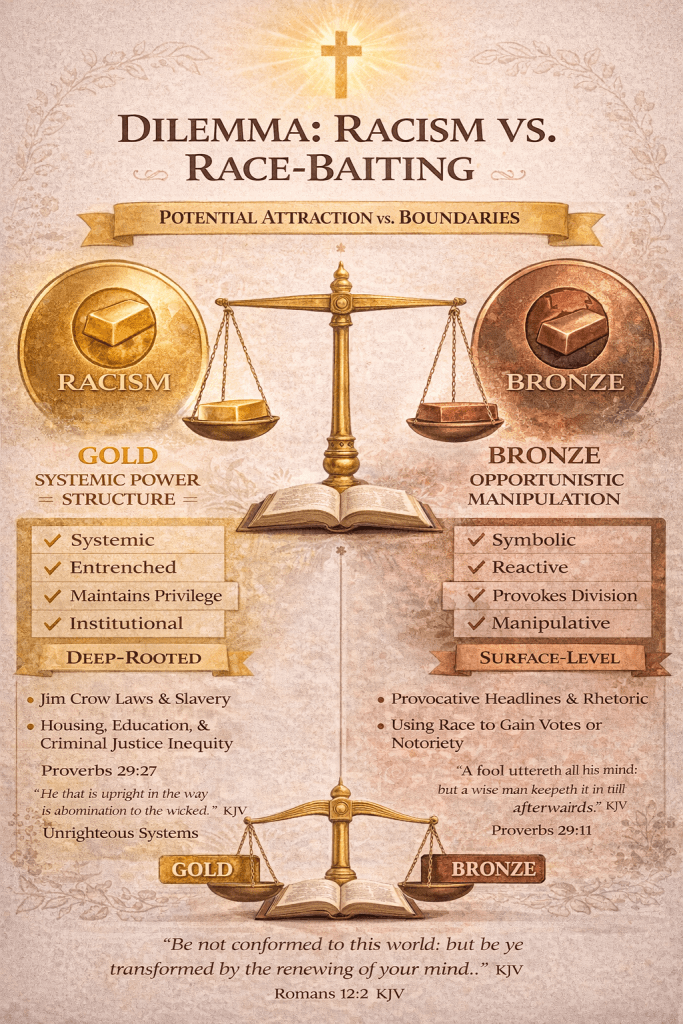
The metaphor of bronze versus gold can help clarify the distinction. Bronze represents the superficial provocation, often symbolic and reactive—this is race-baiting. Gold represents the deep, entrenched systemic mechanisms—this is racism in its structural form. Observing whether an act addresses the root of inequality or merely agitates emotion can reveal its nature.

Racism and race-baiting intersect in public discourse. Some individuals and media sources may exaggerate or misrepresent incidents of racial tension for attention, funding, or political leverage. This blurs public understanding, making it difficult to address genuine structural injustice. As Proverbs 18:17 notes, “The first to plead his cause seemeth just; but his neighbor cometh and searcheth him” (KJV). Truth requires deeper investigation.

Racism thrives on normalization. When societal structures systematically advantage one group, discriminatory practices are often invisible or dismissed as “tradition” or “meritocracy.” Understanding this helps differentiate between acts that are opportunistic (race-baiting) and those that are embedded within the system (racism).

Race-baiting frequently misdirects anger away from systemic causes toward individual actors, scapegoating specific groups for broader structural problems. This manipulation can polarize communities and hinder meaningful solutions. Micah 6:8 reminds us of justice and humility: “He hath shewed thee, O man, what is good; and what doth the Lord require of thee, but to do justly, and to love mercy, and to walk humbly with thy God?” (KJV).

Media literacy is essential to recognize the distinction. Headlines and social media often amplify emotionally charged narratives without context. Racism is systemic, historically rooted, and persistent, while race-baiting relies on immediate reaction. Educated discernment enables individuals to see beyond sensationalism.

Racism is often intergenerational, perpetuated through education, housing, employment, criminal justice, and healthcare disparities. Race-baiting is usually episodic, emerging around specific incidents, speeches, or events. Understanding historical context is therefore critical to interpreting current racial discourse accurately.

Race-baiting can also occur within oppressed communities, where individuals or groups exploit internal divisions to gain influence. This demonstrates that race-baiting is less about power structures and more about manipulation, contrasting with racism’s reliance on systemic advantage.

The Bible condemns hypocrisy and manipulation. Proverbs 6:16–19 lists pride, false witness, and sowing discord among brethren as abominations to God. Race-baiting falls into the category of sowing discord, whereas racism violates divine law by enforcing inequality. Both are sin, but their mechanisms differ.

Recognizing racism requires assessing who benefits. True racism confers social, economic, and political advantage to a particular racial group. Race-baiting may inflame perceptions of injustice but does not create structural advantage. This distinction clarifies policy debates and moral accountability.

Racism also often hides behind ideology, meritocracy, or cultural norms. The systemic nature makes it less visible than race-baiting, which is loud, overt, and performative. Understanding the bronze versus gold distinction allows individuals to respond with strategic solutions rather than reactive emotion.

Education and awareness are key tools in dismantling both racism and race-baiting. Combatting racism requires structural reform, anti-discrimination policy, and societal accountability. Countering race-baiting requires critical thinking, media literacy, and spiritual discernment (Proverbs 14:15).

Christians are called to pursue justice and reconciliation. Isaiah 1:17 commands, “Learn to do well; seek judgment, relieve the oppressed, judge the fatherless, plead for the widow” (KJV). Responding to racism requires action and advocacy; responding to race-baiting requires wisdom, prayer, and discernment.

Racism is a deep societal disease, while race-baiting is a symptom that exploits and amplifies divisions. One targets systemic change; the other targets immediate perception. Addressing the root cause requires education, advocacy, and awareness of historical context, as well as spiritual discernment.

In conclusion, distinguishing between racism and race-baiting is essential for effective response. Bronze may flare in anger and reaction; gold endures in system and power. Both demand moral responsibility, but the solutions differ. Recognizing the systemic nature of racism while refusing to be manipulated by race-baiting is a critical skill for spiritual and social maturity (Romans 12:2).


References

Feagin, J. (2006). Systemic racism: A theory of oppression. Routledge.
Alexander, M. (2012). The New Jim Crow: Mass incarceration in the age of colorblindness. The New Press.
Kendi, I. X. (2019). How to be an antiracist. One World.
Proverbs 4:23; 14:15; 18:17; 6:16–19
Isaiah 1:17; Micah 6:8; James 2:1; Genesis 1:27
Romans 12:2; Hebrews 13:4
Matthew 10:16; Matthew 26:41

Dilemma: Integration

Integration has long been presented as a moral victory and social cure for America’s racial sickness, yet for Black people it has often functioned as a double-edged sword. While access to public institutions increased, the cost was frequently the erosion of independent Black systems that had been built under segregation out of necessity and communal discipline. Integration promised equality but delivered exposure to structures that were never designed with Black flourishing in mind.

Before integration, Black communities cultivated parallel economies, educational institutions, and social networks that circulated wealth internally. Black-owned banks, schools, newspapers, and business districts were not merely economic centers but cultural strongholds. These spaces fostered dignity, self-determination, and accountability rooted in shared experience and survival.

Integration disrupted this ecosystem by redirecting Black dollars outward. When Black consumers were allowed to shop, bank, and educate elsewhere, Black-owned institutions were slowly starved of resources. What was framed as progress often resulted in dependency, not empowerment, as economic power shifted away from the community.

Scripture warns of the dangers of dependence on hostile systems. “The borrower is servant to the lender” (Proverbs KJV) speaks not only to individuals but to nations and communities. Integration without economic sovereignty placed Black communities in a perpetual position of borrowing access rather than owning infrastructure.

Historically, whenever Black people achieved visible prosperity, it was met with white backlash. The destruction of Black Wall Street in Tulsa and the massacre of Rosewood were not random acts of violence but calculated responses to Black success. Prosperity challenged the lie of Black inferiority, and that challenge was answered with terror.

These attacks reveal a deeper psychological conflict. Black excellence exposed the moral contradiction of white supremacy, creating fear that the racial hierarchy could not sustain itself if Black people thrived independently. Scripture acknowledges this dynamic when it states, “For every one that doeth evil hateth the light” (John KJV).

White women have historically played a critical role in triggering these violent outcomes, particularly through false accusations against Black men. The mythology of white female purity was weaponized to justify lynchings, massacres, and the destruction of entire communities. These narratives provided moral cover for economic and racial warfare.

The Bible repeatedly condemns false witness. “A false witness shall not be unpunished” (Proverbs KJV) underscores the spiritual gravity of lies that destroy lives and nations. Yet American history shows that these falsehoods were not only tolerated but rewarded when they reinforced racial dominance.

Integration did not dismantle this psychological framework; it merely relocated it. Black children integrated into hostile school environments often encountered lowered expectations, cultural erasure, and internalized inferiority. Black professionals integrated into white institutions faced glass ceilings and tokenism rather than true inclusion.

Meanwhile, Black communal discipline weakened. When survival no longer required collective responsibility, individualism replaced mutual obligation. Scripture emphasizes communal accountability: “Bear ye one another’s burdens” (Galatians KJV). Integration diluted this ethic by prioritizing access over unity.

The intimidation of Black prosperity remains visible today. Successful Black neighborhoods are frequently targeted for gentrification, policy neglect, or over-policing. Prosperity that cannot be controlled is perceived as a threat, echoing ancient patterns of dominance and suppression.

Biblically, this mirrors the experience of Israel in captivity, where prosperity among the oppressed provoked fear among the ruling class. “Behold, the people of the children of Israel are more and mightier than we” (Exodus KJV) reveals how growth among the oppressed is framed as danger by those in power.

The question, then, is not whether Black people can thrive, but under what conditions thriving is sustainable. History suggests that unity, ownership, and cultural coherence are essential. Prosperity without control invites exploitation; integration without power invites erasure.

Thriving requires rebuilding internal economies that circulate wealth within the community. Supporting Black-owned businesses, financial institutions, and educational initiatives restores economic leverage. Scripture affirms this principle: “Let us not be weary in well doing” (Galatians KJV), emphasizing long-term commitment.

Equally important is the restoration of narrative control. Black history, theology, and identity must be taught accurately and unapologetically. “My people are destroyed for lack of knowledge” (Hosea KJV) warns that ignorance is a tool of oppression.

Spiritual grounding is central to resilience. Faith provided enslaved Africans with a framework for dignity when the world denied their humanity. The same faith, rightly understood, can guide modern restoration through justice, wisdom, and discipline.

Thriving also demands discernment. Integration should be strategic, not sentimental. Scripture instructs, “Be ye wise as serpents, and harmless as doves” (Matthew KJV). Engagement with broader society must never come at the cost of sovereignty or truth.

The future of Black prosperity lies in reclaiming what integration weakened: unity, ownership, and purpose. Togetherness is not segregation; it is strategy. Independence is not hatred; it is self-respect.

Ultimately, the dilemma of integration forces a reckoning. Access without power is an illusion, and inclusion without protection is vulnerability. True progress emerges when Black people define success on their own terms, rooted in faith, history, and collective strength.

The path forward is neither isolation nor assimilation, but restoration. As scripture declares, “And ye shall know the truth, and the truth shall make you free” (John KJV). Freedom, for Black people, has always been tied to truth, unity, and the courage to build for ourselves.

References

The Holy Bible, King James Version. (1769/2017). Cambridge University Press.
Anderson, J. D. (1988). The education of Blacks in the South, 1860–1935. University of North Carolina Press.

Baldwin, J. (1963). The fire next time. Dial Press.

Baradaran, M. (2017). The color of money: Black banks and the racial wealth gap. Harvard University Press. https://doi.org/10.4159/9780674978535

Du Bois, W. E. B. (1903). The souls of Black folk. A.C. McClurg & Co.

Exodus 1:9–10 (King James Version).

Galatians 6:2, 9 (King James Version).

Hosea 4:6 (King James Version).

John 3:20; John 8:32 (King James Version).

Lemann, N. (1991). The promised land: The great Black migration and how it changed America. Alfred A. Knopf.

Litwack, L. F. (1998). Trouble in mind: Black southerners in the age of Jim Crow. Alfred A. Knopf.

Loewen, J. W. (2005). Sundown towns: A hidden dimension of American racism. The New Press.

Matthew 10:16 (King James Version).

Myrdal, G. (1944). An American dilemma: The Negro problem and modern democracy. Harper & Brothers.

Oklahoma Commission to Study the Tulsa Race Riot of 1921. (2001). Tulsa Race Riot: A report by the Oklahoma Commission. State of Oklahoma.

Proverbs 6:16–19; Proverbs 14:31; Proverbs 22:7 (King James Version).

Rothstein, R. (2017). The color of law: A forgotten history of how our government segregated America. Liveright Publishing.

Shapiro, T. M. (2004). The hidden cost of being African American: How wealth perpetuates inequality. Oxford University Press.

Taylor, K.-Y. (2016). From #BlackLivesMatter to Black liberation. Haymarket Books.

Washington, B. T. (1901). Up from slavery. Doubleday, Page & Company.

Williams, M. J., & Mohammed, S. A. (2009). Discrimination and racial disparities in health: Evidence and needed research. Journal of Behavioral Medicine, 32(1), 20–47. https://doi.org/10.1007/s10865-008-9185-0

Woodson, C. G. (1933). The mis-education of the Negro. Associated Publishers.

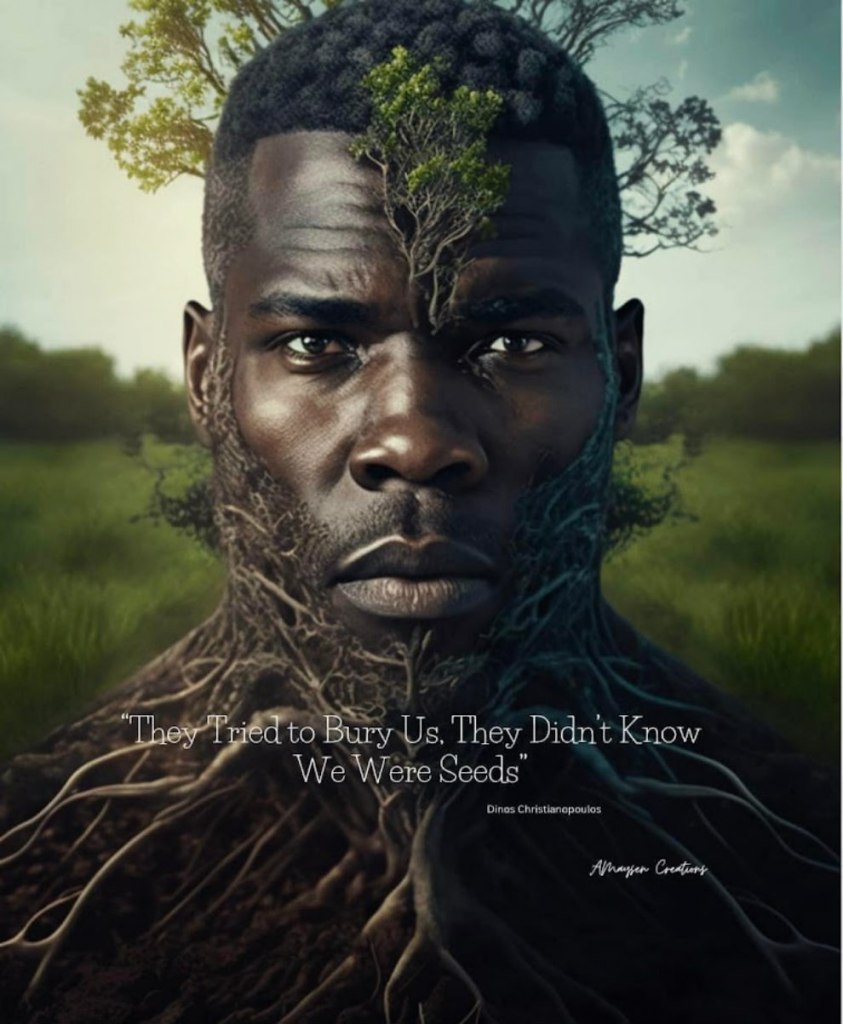
The Seeds of the Promise.

This artwork is the property of its respective owner. No copyright infringement intended.

The story of God’s chosen people is deeply rooted in Scripture, prophecy, and history. Deuteronomy 28 (KJV) outlines blessings for obedience and curses for disobedience, serving as both a covenant promise and a prophetic warning. Many within the African diaspora identify their struggles and resilience with these verses, seeing themselves as the “seeds of the promise,” scattered across the earth yet preserved by God’s hand. Like trees planted by rivers of living water, they endure oppression, displacement, and hardship while continuing to grow, flourish, and bear fruit.

The Seeds and the Promise
Seeds carry potential and continuity. Spiritually, the descendants of Israel are seeds of the covenant God made with Abraham (Genesis 17:7, KJV). Psychologically, seeds represent identity and generational transmission. Black people, despite systemic oppression, have carried cultural, spiritual, and intellectual seeds across continents, preserving language, rhythm, faith, and resilience. These seeds testify to survival against all odds.

Deuteronomy 28 and the Black Experience
The curses in Deuteronomy 28:15–68 resonate profoundly with the history of Black people. Enslavement, scattering across nations, oppression by enemies, and loss of identity parallel the transatlantic slave trade and subsequent struggles of the African diaspora. Verse 68 speaks of returning to Egypt “again with ships,” a striking image that mirrors the ships that carried millions into bondage. Many interpret these prophecies as evidence that Black people are part of God’s chosen covenant people.

Trees Planted by Living Water
Psalm 1:3 (KJV) describes the blessed man as being “like a tree planted by the rivers of water, that bringeth forth his fruit in his season.” This metaphor speaks to endurance and divine sustenance. Despite centuries of slavery, segregation, and systemic oppression, Black communities have remained rooted in faith, producing leaders, artists, scholars, and prophets who have blessed the world. The psychology of Black resilience reveals a deep wellspring of spiritual and cultural resources that mirror this biblical imagery.

Psychologically, Black people have carried generational trauma from enslavement, colonization, and racism. Yet, alongside trauma exists resilience—expressed through music, oral tradition, communal bonds, and faith in God. Na’im Akbar (1984) noted that African-descended people maintain strength by reclaiming identity, resisting oppression, and drawing on spirituality. This resilience is evidence of the “living water” that sustains God’s chosen, nourishing them in the face of systemic attempts to uproot them.

The history of Black people stretches far beyond the African continent. Evidence of African presence is found in ancient Israel, Mesopotamia, and early Christian communities. African contributions shaped global civilizations through science, mathematics, philosophy, and theology. From the Kingdom of Kush to the Moors in Spain, Black history reveals a legacy of leadership and brilliance that extends into the Americas, the Caribbean, and beyond. These contributions reveal a scattered yet resilient people, reflecting the biblical narrative of God’s chosen seed dispersed among nations.

Being chosen does not mean privilege without responsibility; it means bearing the covenant of obedience. Deuteronomy 7:6 (KJV) declares, “For thou art an holy people unto the LORD thy God: the LORD thy God hath chosen thee to be a special people unto himself, above all people that are upon the face of the earth.” This chosenness is marked not only by blessings but also by trials meant to refine and bring the people back to God. Black people’s journey through slavery, segregation, and systemic oppression mirrors this refining fire.

The transatlantic slave trade attempted to erase identity, yet language, song, and spirituality preserved the covenant consciousness of the people. Spirituals like “Go Down, Moses” encoded biblical identity, likening the plight of enslaved Africans to the Israelites in Egypt. This connection shows how deeply the promise of God was embedded in the psychology of Black communities, even in the darkest times.

Conclusion
The seeds of the promise remain alive in God’s chosen. Though scattered, bruised, and oppressed, they continue to grow like trees planted by the rivers of water, sustained by the living Word of God. Black history—beyond Africa and into the Americas, Europe, and beyond—bears witness to the fulfillment of prophecy and the preservation of a covenant people. To live as God’s chosen is to embrace both identity and responsibility, walking in obedience, resilience, and faith. The story of the seeds of the promise is not only a history lesson—it is a living testimony of God’s hand upon His people.


References

  • Akbar, N. (1984). Africentric Social Sciences for Human Liberation. Journal of Black Studies.
  • The Holy Bible, King James Version (KJV).

Proverbs 31 Woman

The Proverbs 31 woman is an enduring biblical archetype of strength, wisdom, and godly character. Her influence extends beyond her household into her community, reflecting the integration of faith, diligence, and compassion in everyday life. She embodies what it means to be a woman after God’s heart.

She is virtuous and capable. “Who can find a virtuous woman? for her price is far above rubies” (Proverbs 31:10, KJV). Her value is not measured by beauty alone but by integrity, wisdom, and the impact she has on those around her.

Hard work defines her character. She rises early and labors diligently to care for her household, manage resources, and contribute to her family’s well-being. “She riseth also while it is yet night, and giveth meat to her household” (Proverbs 31:15, KJV).

The Proverbs 31 woman is financially wise. She invests thoughtfully, engages in trade or business, and ensures stability and provision. “She considereth a field, and buyeth it: with the fruit of her hands she planteth a vineyard” (Proverbs 31:16, KJV).

Strength and honor are her clothing. She faces challenges with courage and confidence, embodying dignity and resilience. “Strength and honour are her clothing; and she shall rejoice in time to come” (Proverbs 31:25, KJV).

Her wisdom guides her household. She instructs her children in faith and morality, and she manages her home with discernment and order. “She openeth her mouth with wisdom; and in her tongue is the law of kindness” (Proverbs 31:26, KJV).

She is compassionate and generous. The Proverbs 31 woman extends care to the poor, the marginalized, and those in need, reflecting God’s heart through action. “She stretcheth out her hand to the poor; yea, she reacheth forth her hands to the needy” (Proverbs 31:20, KJV).

Faith anchors her life. Her trust in God shapes her decisions, her interactions, and her priorities. She fears the Lord above all else, understanding that reverence is the foundation of her strength. “The heart of her husband doth safely trust in her” (Proverbs 31:11, KJV).

She exemplifies dignity in speech. Her words uplift, guide, and encourage. She does not engage in gossip or empty talk but speaks with purpose and grace. “She openeth her mouth with wisdom; and in her tongue is the law of kindness” (Proverbs 31:26, KJV).

Time management and diligence are her allies. She balances responsibilities with precision, ensuring her household, work, and spiritual life are aligned. “She looketh well to the ways of her household, and eateth not the bread of idleness” (Proverbs 31:27, KJV).

Her beauty is both internal and external. While she takes care of her appearance, her inner strength, humility, and godliness shine brighter than jewels. “Her price is far above rubies” (Proverbs 31:10, KJV).

She earns respect from her family and community. Her consistent character, reliability, and integrity make her a role model for younger women and an anchor for her household.

Her husband benefits from her wisdom and partnership. He can trust her guidance, counsel, and judgment in managing household and financial matters. “The heart of her husband doth safely trust in her” (Proverbs 31:11, KJV).

She demonstrates courage in business and decision-making. She is proactive, discerning, and bold when investing in resources or taking steps to grow her household.

Her faith inspires joy. Even in trials, she maintains hope, laughter, and optimism, influencing her family and community positively.

She is adaptable. Life’s challenges do not overwhelm her; she adjusts strategies, manages crises, and continues forward with resilience.

The Proverbs 31 woman practices humility. Though capable and accomplished, she acknowledges God as the source of her strength and success. “She is not afraid of the snow for her household: for all her household are clothed with scarlet” (Proverbs 31:21, KJV).

She nurtures relationships. Family, friends, and community members experience her care, wisdom, and generosity. Her life demonstrates the balance between ambition and empathy.

She leaves a lasting legacy. Her children and community witness a model of virtue, strength, and faith that continues through generations. “Many daughters have done virtuously, but thou excellest them all” (Proverbs 31:29, KJV).

Ultimately, the Proverbs 31 woman embodies the ideal of godly womanhood. She is strong, compassionate, wise, and diligent, with faith guiding her every decision. Modern women can aspire to this standard, not for perfection, but to walk faithfully, serve others, and honor God in every area of life.


References

The Holy Bible, King James Version. (1769/2017). Cambridge University Press.

Collins, P. H. (2000). Black feminist thought: Knowledge, consciousness, and the politics of empowerment. Routledge.

Brown, T. N., & Taylor, S. (2019). Faith and feminine strength: Applying Proverbs 31 in contemporary life. Journal of Biblical Studies, 23(2), 145–162.

Hobbs, R. (2018). Women of virtue: Lessons from Proverbs 31. HarperCollins.