Category Archives: the brown boy dilemma

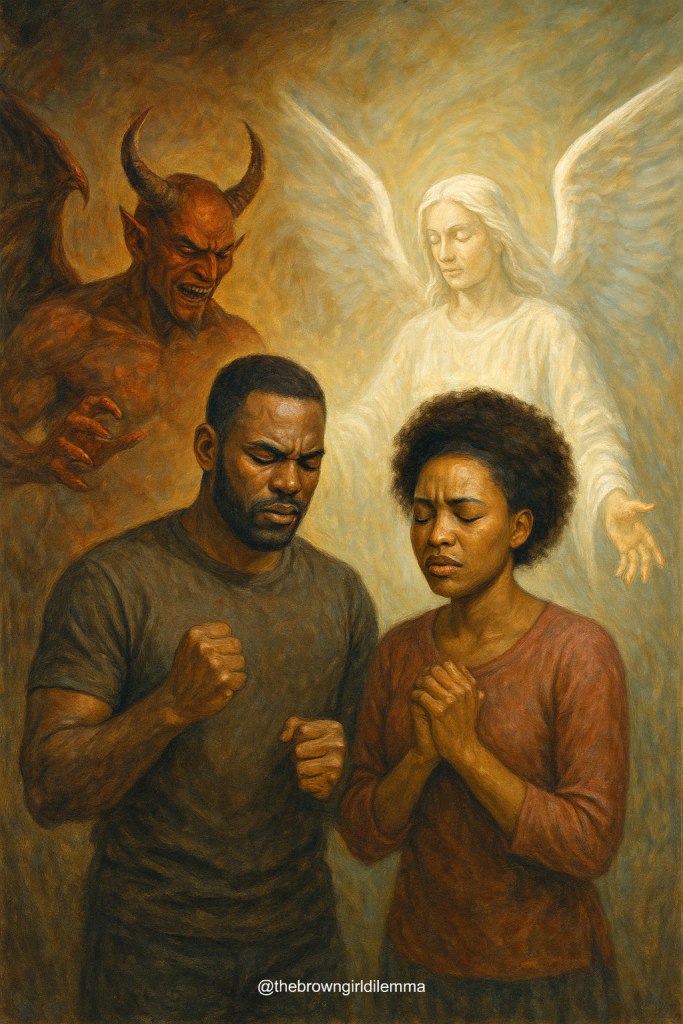
The War for Black Manhood

Photo by Dayvison Tadeu on Pexels.com

The war for Black manhood is not fought solely in streets, prisons, courtrooms, or schools—it is waged in the soul, the psyche, and the spiritual realm. From slavery’s plantations to modern digital plantations of propaganda, the Black man has endured relentless attacks against his identity, dignity, and divine purpose. This struggle is not merely social, political, or economic; it is spiritual warfare targeting the very essence of who God created him to be.

The biblical foundation of Black manhood is rooted in creation. Man was formed first, charged with leadership, responsibility, and stewardship (Genesis 2:7, 15). Yet the same adversary who sought to destroy Adam’s authority continues to target the sons of Africa today. To diminish the Black man is to weaken the family, fracture the community, and disrupt divine order. Satan’s assault on Black men is strategic warfare, designed to sever the image of God reflected in them.

The transatlantic slave trade was not just a historical event—it was a spiritual attack meant to strip Black men of identity, masculinity, and kingship. Enslaved men were separated from wives, children, culture, and language, systematically humiliated to destroy their sense of authority. This trauma reverberates through generations, echoing the curses described in Deuteronomy 28, where the chosen would suffer captivity, family division, and oppression. Slavery targeted the Black man’s crown before it ever touched his chains.

White supremacy sought to redefine Black manhood from divinely appointed leader to threat, beast, or commodity. During Jim Crow, the Black man’s dignity was so feared that false accusations and violence were used to maintain domination. To oppress a man, one must first demonize him. Propaganda turned the Black man from imago Dei into public enemy, justifying violence and control. These lies became law, media narrative, and belief.

Modern systems continue the war through mass incarceration, economic disenfranchisement, and educational inequity. Policies like the War on Drugs disproportionately targeted Black men, creating cycles of fatherlessness and poverty. The judicial system frequently punishes Black masculinity more than crime. When a man is caged, a community is crippled. One cannot separate the prison crisis from the spiritual agenda to dismantle Black manhood.

But the battlefield is not just external. Many Black men wrestle with internalized oppression, identity confusion, and emotional scars. Centuries of emasculation, exploitation, and systemic barriers weigh heavy. Depression, anxiety, and trauma are often masked behind stoicism, anger, or silence. The world permits everyone to be vulnerable except the Black man. Yet Christ calls all to cast burdens upon Him (1 Peter 5:7). Healing begins where honesty begins.

Media has become a weapon as well. Where once the Black man was criminalized, now he is hyper-sexualized, feminized, or portrayed as irresponsible and violent. Hollywood, music, and social platforms often glorify dysfunction while diminishing images of honorable, God-fearing Black men. A war of images is a war of identities. If he does not control his narrative, someone else will.

The family remains the primary target. A man who leads his home with faith, discipline, and love becomes a fortress against societal chaos. But if he is removed, the gates fall. Fatherhood is divine assignment (Ephesians 6:4). When fatherhood is weakened, so is the nation. Systems knew this—so they removed him from the home economically, psychologically, or physically. Yet God calls Black men back to priesthood, protection, and provision.

The war also seeks to distort masculinity. Strength is labeled aggression, authority is called toxicity, and biblical leadership is framed as oppression. But true masculinity is not tyranny—it is sacrificial love modeled by Christ. Headship is not domination—it is service, responsibility, and covering (Ephesians 5:23-25). The world wants the Black man soft, silent, or sinful; God wants him righteous, wise, and unshakable.

Spiritually, the enemy fears the Black man’s awakening to his identity as chosen, royal, and called by God. When Black men understand their scriptural heritage, ancestral power, and divine calling, they become unstoppable. Knowledge of self aligned with knowledge of God is liberation. That is why Christ is the cornerstone of restoration. Only God can rebuild what oppression tried to break.

Education, wealth building, and empowerment are weapons of victory. Yet without spiritual foundation, success becomes fragile. True transformation requires renewing the mind (Romans 12:2). Black men must return to wisdom, discipline, and purpose, rejecting distractions that weaken leadership—lust, pride, idleness, addiction, and rebellion against God’s order.

Brotherhood is also essential. Iron sharpens iron (Proverbs 27:17). Men need mentors, elders, and brothers who pray together, build together, hold one another accountable, and refuse to abandon each other. Isolation makes a man vulnerable; unity makes him powerful. Community is armor.

Marriage and family are battlegrounds of restoration. A righteous man loving a righteous woman, raising children in truth, becomes a warrior for generational change. The enemy knows this—so he attacks relationships, fuels lust over love, and fosters division between Black men and Black women. But God calls them back into covenant, unity, and honor (Ecclesiastes 4:9-12).

Purpose is the cure to wandering. When a man knows his calling, he walks differently. Black men are called to build, protect, teach, lead, and worship. Destiny demands discipline. A king cannot live like a slave to sin. God calls Black men to rise in integrity, prayer, strategy, and service.

Healing requires truth, therapy, prayer, and brotherhood. Trauma must be acknowledged, not buried. The past must be confronted, not escaped. God restores broken identities and heals father wounds. The Holy Spirit rebuilds confidence, clarity, and courage.

The future requires generational vision. Each Black man must ask: What legacy will I leave? What son will I raise? What world will I help shape? Legacy is leadership stretched across time. To win the war, he must build beyond himself.

Above all, the Black man must return to God. His strength is not in muscles, money, or status—but in righteousness, wisdom, and obedience. “The righteous are bold as a lion” (Proverbs 28:1). His true identity is not defined by oppression but ordained by heaven.

The war for Black manhood is fierce, but victory is promised. God has not abandoned His sons; He calls them to rise as kings, priests, and warriors of purpose. When Black men reclaim faith, identity, and leadership, families heal, communities rise, and nations shift. The battle is great—but so is the calling. The world fears the restored Black man because a restored Black man restores a people.

This is not the fall of Black manhood—it is the awakening.

When I See You, I Don’t See Black — And Other Microaggressions of Erasure”

Photo by Vitor Diniz on Pexels.com

It is a curious thing to be told, “When I see you, I don’t see Black.” On the surface, it sounds like a compliment — a supposed sign of acceptance. But beneath those words lies a deep and painful reality: erasure. To “not see Black” is to refuse to see a person fully. Blackness is not an insult that must be airbrushed away. It is a heritage, a culture, and a divine design that carries resilience, beauty, and history.

The phrase “What are you mixed with?” often accompanies this colorblind assertion. It suggests that the person’s beauty, intelligence, or refinement must have come from something other than pure African ancestry. This is the residue of white supremacy — the idea that to be fully Black is to be less than, and that any perceived excellence must be explained by proximity to whiteness (Bell, 1992).

These phrases are examples of racial microaggressions, subtle verbal slights that communicate bias, even when unintended (Sue et al., 2007). “I don’t see color” is often framed as a way to express equality, but research shows that colorblindness actually perpetuates racial inequality by ignoring structural racism (Neville et al., 2013). To deny race is to deny racism — and thus to deny the need for justice.

Biblically, God is not colorblind. Revelation 7:9 (KJV) paints a vision of heaven where “a great multitude… of all nations, and kindreds, and people, and tongues” stand before the throne. God sees color, ethnicity, and culture — and calls it good. To erase Blackness is to erase part of the divine mosaic of humanity.

For many Black people, hearing “When I see you, I don’t see Black” is a reminder that Blackness is still considered something one must look past in order to value someone. “It felt like they were saying, ‘I only respect you because you’re not like the others,’” said Renee, 28. “As if being Black is inherently negative.” This is a classic case of the “exceptional Negro” trope — praising an individual while degrading the group.

Similarly, “What are you mixed with?” is a coded way of expressing surprise that a Black person could be attractive or articulate. “People ask me that all the time,” said Marcus, 31. “When I tell them I’m just Black, they look confused, like I should apologize for not having some exotic backstory.” This curiosity reveals a hierarchy of desirability rooted in colorism — the privileging of light skin and mixed features over darker skin and African features (Hunter, 2007).

The historical roots of this hierarchy run deep. During slavery, lighter-skinned enslaved people — often the children of white masters — were sometimes given preferential treatment, fueling division within the Black community (Williamson, 1980). This legacy lingers, as seen in modern media where lighter-skinned actors, models, and musicians are often elevated as the “acceptable” face of Blackness.

Celebrities have spoken out about this painful phenomenon. Actress Lupita Nyong’o shared that she once prayed for lighter skin, believing it would make her beautiful. “I was teased and taunted about my dark skin,” she said in her powerful 2014 speech on beauty. “And my one prayer to God was that I would wake up lighter-skinned.” Nyong’o’s testimony underscores the damage caused by a culture that treats dark skin as undesirable.

Other celebrities have shared their personal experiences with these exact microaggressions. Meghan Markle has spoken openly about being asked repeatedly, “What are you?” growing up. In her interview with Oprah Winfrey, she revealed how her biracial identity was scrutinized both by the media and behind palace walls, with questions about how dark her son’s skin might be (Winfrey, 2021). Her story illustrates how curiosity about mixed heritage can carry undertones of fear and exclusion.

Zendaya has also used her platform to discuss colorism and the privilege of being a lighter-skinned Black woman in Hollywood. In interviews, she has admitted that her lighter complexion has allowed her access to roles and opportunities that darker-skinned actresses are often denied. “I have to be honest about my privilege,” she said, “and make sure I’m using my platform to showcase darker-skinned women too” (Robinson, 2018).

Colin Kaepernick, who is biracial, has shared how his identity was questioned from both sides. In his Netflix series Colin in Black & White, he recalls being constantly asked what he was “mixed with” and feeling like an outsider in both Black and white spaces. This experience reflects Du Bois’ (1903) concept of double-consciousness — the constant negotiation of identity in a society that categorizes by race.

The question “What are you mixed with?” can also exoticize and objectify. It turns identity into a guessing game, as if the person must justify their existence. “I’m not a math equation,” said Jasmine, 25. “I don’t owe anyone a breakdown of my ancestry so they can decide how to treat me.”

This line of questioning also erases the beauty of being fully African-descended. Psalm 68:31 (KJV) prophetically declares, “Princes shall come out of Egypt; Ethiopia shall soon stretch out her hands unto God.” African heritage is not a stain to be diluted but a glory to be embraced.

The deeper harm is that these statements normalize whiteness as the default and Blackness as the deviation. Saying “I don’t see you as Black” implies that Black is something negative to overcome. It also denies the lived reality of racism. As Dr. Beverly Daniel Tatum argues, to say you are colorblind is to close your eyes to injustice — and people who claim not to see race are less likely to notice or confront discrimination (Tatum, 2017).

Moreover, these phrases pressure Black individuals to perform a palatable version of Blackness. They subtly reward assimilation, encouraging people to soften their dialect, straighten their hair, or distance themselves from stereotypical “Blackness” to gain approval. This double-consciousness, as W.E.B. Du Bois (1903) called it, is the struggle to see oneself through both one’s own eyes and the eyes of a society that devalues you.

Some people genuinely believe they are being kind when they say these things. They intend to affirm equality, but true equality does not erase difference — it celebrates it. Paul’s words in 1 Corinthians 12:18 (KJV) remind us that “God set the members every one of them in the body, as it hath pleased him.” Diversity is divine design, not a problem to be solved.

The work of dismantling this erasure requires both education and empathy. Non-Black people must learn why colorblindness harms rather than heals. They must also recognize how fetishizing mixed heritage reinforces harmful hierarchies. Black people must reclaim their identity unapologetically, refusing to let others define their worth by proximity to whiteness.

Representation plays a crucial role here. When Blackness is portrayed in its full spectrum — from deep mahogany to golden brown — it challenges the idea that only certain shades are beautiful or acceptable. Campaigns like #MelaninPoppin and #BlackGirlMagic have helped shift cultural narratives, reminding the world that Blackness needs no qualifier to be celebrated.

Healing from these microaggressions is both personal and collective. It means telling children that their Blackness is not something to overcome but something to rejoice in. It means calling out subtle biases when they occur, with both grace and truth. It means creating spaces where Black identity can be expressed in all its complexity — natural hair, vernacular speech, cultural traditions — without apology.

The next time someone says, “I don’t see Black,” we must gently but firmly reply: “See me fully — my Blackness included.” To be truly seen is to be known, and to be known is to be loved. And when someone asks, “What are you mixed with?” we can answer with pride: “I am fearfully and wonderfully made — fully, beautifully, unapologetically who God created me to be.”


References

  • Bell, D. (1992). Faces at the bottom of the well: The permanence of racism. Basic Books.
  • Du Bois, W. E. B. (1903). The souls of Black folk. A.C. McClurg & Co.
  • Hunter, M. (2007). The persistent problem of colorism: Skin tone, status, and inequality. Sociology Compass, 1(1), 237–254.
  • Neville, H. A., Awad, G. H., Brooks, J. E., Flores, M. P., & Bluemel, J. (2013). Color-blind racial ideology: Theory, training, and measurement implications in psychology. American Psychologist, 68(6), 455–466.
  • Sue, D. W., Capodilupo, C. M., Torino, G. C., Bucceri, J. M., Holder, A. M. B., Nadal, K. L., & Esquilin, M. (2007). Racial microaggressions in everyday life: Implications for clinical practice. American Psychologist, 62(4), 271–286.
  • Tatum, B. D. (2017). Why are all the Black kids sitting together in the cafeteria? (Rev. ed.). Basic Books.
  • Williamson, J. (1980). New people: Miscegenation and mulattoes in the United States. Free Press.

A Thousand Posts, A Thousand Lessons, One Community💛✨💛✨💛✨💛✨

God is Guide

1,000 posts of sharing, learning, and growing together. To my sisters, brothers, and community—thank you for being part of this journey. Every like, comment, and share has been a step in building this space of inspiration, empowerment, and truth. Here’s to continuing to uplift, educate, and inspire for the next 1,000! 💛✨ #1000Strong #CommunityMatters #Gratitude #GrowthTogether”

The Awakening: Brown Children of the Covenant.

The awakening of the Brown children of the covenant represents both a spiritual and historical restoration. For centuries, the truth about a chosen lineage scattered across the earth has been obscured by deception, colonialism, and false doctrine. Yet, as prophesied, there comes a time when the dry bones would rise, knowledge would increase, and identity would be restored (Ezekiel 37:1–10, KJV). This awakening is not a movement of race but of revelation—an unveiling of divine truth hidden within the pages of Scripture and the annals of history.

The Brown children of the covenant are not awakening to arrogance but to alignment. Their story begins in the covenantal promise God made with Abraham: “In thy seed shall all the nations of the earth be blessed” (Genesis 22:18, KJV). That seed endured captivity, exile, and dispersion, yet the promise remained intact. Though scattered by ships and oppression, they would one day remember who they were (Deuteronomy 28:64; Baruch 2:30–32, Apocrypha).

This awakening is a spiritual resurrection. It transcends skin tone, calling instead for the recognition of divine purpose. The covenant was never about superiority but about responsibility—to keep God’s laws, statutes, and commandments and to serve as a light to the nations (Isaiah 49:6, KJV). The awakening restores not only historical truth but also spiritual accountability.

The awakening also challenges the lies of miseducation. For centuries, the Brown child has been taught that their history began in slavery, when in truth it began in royalty. Ancient civilizations such as Kush, Nubia, and Israel were led by melanated people who built temples, governed nations, and communed with the divine. The prophets, priests, and kings of the Bible were not European but descendants of the very soil that birthed the first human life.

The enemy’s greatest weapon has always been ignorance. By erasing the identity of the covenant people, oppression could continue unchallenged. But as knowledge returns, chains of mental captivity are broken. The Brown child learns that being chosen is not a privilege to boast in but a covenant to uphold—a divine duty to walk in righteousness and truth (Amos 3:2, KJV).

Scripture foretold that the true Israelites would suffer captivity, poverty, and ridicule among all nations until their appointed time of awakening (Deuteronomy 28:37). The transatlantic slave trade and global diaspora align with these prophecies, marking not just a historical tragedy but a prophetic fulfillment. Yet, through it all, God preserved a remnant—a people who would rise again in truth and spirit.

The awakening calls for repentance, not revenge. “If my people, which are called by my name, shall humble themselves, and pray…then will I hear from heaven” (2 Chronicles 7:14, KJV). The restoration of the Brown nation begins with returning to God, not the systems of man. Holiness, discipline, and obedience become the new revolution.

The Brown girl, awakened, sees herself as a daughter of Zion. She rejects societal beauty standards that demean her and embraces the divine craftsmanship of her melanin and features. Her hair, her hue, and her heritage become sacred symbols of covenant identity. She is not a product of colonization but a vessel of divine creativity (Song of Solomon 1:5, KJV).

The Brown boy, awakened, stands as a son of kings and prophets. No longer enslaved by self-hatred or false narratives, he reclaims his authority as protector, builder, and leader. His strength is spiritual before it is physical; his kingship is rooted in humility before the Most High (Psalm 82:6, KJV).

In this awakening, family restoration becomes crucial. The enemy once targeted the Brown household to destroy generational strength. But as men return to priesthood and women to virtue, the household mirrors divine order once again. Marriage, parenting, and community are redefined through faith and covenant.

Education becomes liberation when truth is integrated. The Brown child studies Scripture alongside history and science, discovering the harmony between them. Archaeological evidence, genetic studies, and linguistic traces all confirm the ancient presence of melanated peoples in biblical lands. The awakening bridges faith and fact, revelation and research.

The arts, too, become a prophetic instrument. Music, poetry, and visual storytelling carry ancestral memory and divine messages. The cries, songs, and dances of the Brown people become a sacred liturgy, echoing the Psalms of David and the songs of Moses—melodies of deliverance.

As prophecy unfolds, nations begin to reckon with their histories. The awakening confronts global systems built on deceit and exploitation. It calls for restitution, not only in material form but in truth. For the Scripture declares, “The truth shall make you free” (John 8:32, KJV).

The covenant is also awakening through global unity. Brown communities across the world—whether in Africa, the Americas, or the Caribbean—are rediscovering shared roots and faith. This unity transcends borders and tribal divisions, fulfilling Christ’s prayer that His people be one (John 17:21, KJV).

Spiritual warfare intensifies as awakening spreads. The powers of darkness thrive on ignorance and division, but as light increases, deception weakens. The Brown child learns that their battle is “not against flesh and blood” but against spiritual forces (Ephesians 6:12, KJV). Prayer, fasting, and study become their weapons of victory.

The awakening also redefines wealth. True prosperity is not in luxury but in wisdom, faith, and community strength. The early Israelites prospered not because of greed but because they obeyed divine order. Likewise, modern Brown believers must embrace biblical stewardship and collective empowerment (Deuteronomy 8:18, KJV).

In the diaspora, this awakening manifests as a cultural renaissance. The return to natural living, modesty, and scriptural alignment signifies a break from Western materialism. The Brown woman’s modesty becomes her armor; the Brown man’s wisdom becomes his weapon.

Leadership among the Brown community must now evolve. Prophets, teachers, and scholars are being raised to guide the people with truth, not tradition. This new generation of leaders values character over charisma, scripture over superstition. They restore knowledge once hidden in colonial archives and theological distortions.

The awakening is also intergenerational. Elders serve as keepers of wisdom, while youth become torchbearers of revival. The Brown child learns to see history as inheritance, not trauma. Through education and mentorship, they rise beyond the limitations imposed by systemic oppression.

The covenant people’s return to their Creator is the climax of the awakening. It is the restoration of relationship—the realization that identity without obedience is incomplete. To know who you are is powerful; to walk in that truth with holiness is divine.

The awakening stirs not only identity but justice. God’s promise of vindication and restoration remains steadfast: “I will bring again the captivity of my people Israel” (Jeremiah 30:3, KJV). The Brown children of the covenant stand at the threshold of fulfillment, witnessing prophecy come alive in their generation.

This divine awakening is contagious. As the Brown child awakens, so too do others across nations—seeing the beauty in diversity and the unity of divine creation. The world begins to recognize that God’s covenant extends not through bloodline alone but through faith, obedience, and truth (Galatians 3:29, KJV).

The awakening is not rebellion; it is remembrance. It calls a people back to purpose, integrity, and divine love. The Brown child realizes that to be chosen means to serve—to heal, teach, and lead in righteousness.

This movement toward truth will not be televised but spiritualized. It unfolds in quiet moments of revelation, in study, in prayer, and in the whisper of the Spirit calling hearts back to covenant. It is a revolution of the soul.

As knowledge spreads, the once-forgotten people rise with wisdom that cannot be colonized. Their language, art, and theology are resurrected as they breathe life into a history long buried. They are the fulfillment of God’s promise that the last shall be first (Matthew 19:30, KJV).

In the end, the awakening leads to restoration and redemption. “And they shall be my people, and I will be their God” (Ezekiel 37:27, KJV). The Brown children of the covenant, long despised and scattered, now stand radiant with purpose—chosen not for privilege but for divine service.

Their tears have turned to triumph, their sorrow into song. They are the living testimony of God’s enduring faithfulness. The awakening has begun—and it will not be silenced.

References (KJV Bible):

  • Genesis 22:18
  • Deuteronomy 8:18; 28:37; 28:64
  • 2 Chronicles 7:14
  • Psalm 82:6
  • Song of Solomon 1:5
  • Isaiah 49:6
  • Jeremiah 30:3
  • Ezekiel 37:1–10; 37:27
  • Amos 3:2
  • Matthew 19:30
  • John 8:32; 17:21
  • Ephesians 6:12
  • Galatians 3:29

The Pulse of Divine Intentions

Photo by Ron Lach on Pexels.com

The pulse of divine intentions beats beneath the surface of every life moment, whether joyful or sorrowful, clear or confusing. The Most High moves with purpose, and nothing He ordains is without meaning. When we learn to see beyond the natural and perceive the spiritual rhythm of His will, we realize we are never drifting. We are being directed (Jeremiah 29:11, KJV).

Divine intentions are not accidental; they are shaped by eternal wisdom. What may seem uncertain to us is fully known to Him, for He sees the end from the beginning and orders every step with precision (Isaiah 46:10, KJV). Even when life feels unpredictable, His plan remains steady and unshaken.

The pulse of divine intentions carries us through seasons. Some seasons stretch us, some prune us, and some elevate us. In each season, God is shaping character, purifying motives, and strengthening faith. Nothing is wasted when placed in His hands (Ecclesiastes 3:1, KJV).

Sometimes the Most High allows storms not to destroy, but to reveal. Storms strip away illusions, expose foundations, and push us toward deeper dependency on Him. Through pressure, faith is refined, and trust grows roots (1 Peter 1:6-7, KJV).

Divine intentions often unfold silently. God works behind the scenes, molding hearts and orchestrating connections long before His plan is visible. His timing is perfect, and His silence is never absence—only preparation (Habakkuk 2:3, KJV).

There are moments when divine intentions challenge our comfort. Growth seldom happens in softness alone. Trials and discipline draw us into maturity and obedience, proving His love rather than contradicting it (Hebrews 12:6, KJV).

The pulse of divine intentions invites surrender. We are not commanded to understand everything, but to trust in His wisdom above our own limited sight (Proverbs 3:5-6, KJV). Surrender is not weakness—it is alignment with divine authority.

God leads in ways that protect us, though sometimes we do not see the danger avoided. His denials are protections, His delays are mercies, and His redirections are deliverances. Divine purpose guides even closed doors (Psalm 84:11, KJV).

The pulse of divine intentions beats strongest in the hearts of those who seek Him. As we draw near, our desires transform, and we begin to want what He wants. Prayer becomes not just a request, but a synchronization of spirit and will (Psalm 37:4, KJV).

Divine intentions are rooted in love so deep that it cannot be measured. His love is not fragile or conditional—it is steadfast, patient, and eternal. Even discipline flows from love, not anger (1 John 4:9-10, KJV).

Sometimes divine intentions separate us from people, places, or habits that no longer align with His plan. These separations may hurt, yet they sanctify, protecting destiny from contamination (2 Corinthians 6:17, KJV).

God’s intentions for His children are always righteous. He does not lead into confusion or chaos; He leads into truth, peace, and clarity. When confusion arises, it is not from Him—He is not the author of disorder (1 Corinthians 14:33, KJV).

The pulse of divine intentions strengthens faith through obedience. When we align with His commands, blessings follow—not always material, but always spiritual and eternal (Deuteronomy 28:2, KJV).

Divine intentions shape identity. The world attempts to define us by flaws, failures, or achievements, but God calls us by purpose, destiny, and belovedness. Our identity is secure in Him (1 Peter 2:9, KJV).

Sometimes divine intentions unfold gradually, each step revealing enough light for the moment. Faith is walking when the path ahead is still forming, trusting that God never misguides those who follow Him (Psalm 119:105, KJV).

The pulse of divine intentions reminds us that pain has purpose. Brokenness becomes the soil where glory grows. What the enemy meant for harm, the Most High turns into testimony and triumph (Genesis 50:20, KJV).

Divine intentions call us to holiness. God’s desire is not only to bless us, but to sanctify us, refining our hearts and aligning our lives with His righteousness (1 Thessalonians 4:7, KJV).

The pulse of divine intentions draws us closer to His voice. The more we listen, the clearer His whisper becomes. His sheep know His voice, and they follow Him with confidence (John 10:27, KJV).

In the fulfillment of divine intentions, we witness His glory. When His plans unfold, they reflect His greatness, not ours. Miracles, breakthroughs, and answered prayers remind us that He alone is worthy of praise (Psalm 115:1, KJV).

Ultimately, the pulse of divine intentions leads to eternal hope. Every step in His will draws us closer to His kingdom, His presence, and His promise. The journey is guided, the purpose is sure, and the outcome is victory for those who trust Him (Romans 8:28, KJV).


References
Holy Bible, King James Version.
Ecclesiastes 3:1; Deuteronomy 28:2; Genesis 50:20; Habakkuk 2:3; Hebrews 12:6; Isaiah 46:10; Jeremiah 29:11; John 10:27; 1 Corinthians 14:33; 1 Corinthians 13:4-7; 1 John 4:9-10; 1 Peter 1:6-7; 1 Peter 2:9; 2 Corinthians 6:17; Proverbs 3:5-6; Psalm 37:4; Psalm 84:11; Psalm 115:1; Psalm 119:105; Romans 8:28.

Dilemma: Lynching

Strange Fruit: The Lingering Shadow of Lynching.

Photo by Alexey Demidov on Pexels.com

Lynching, a brutal form of extrajudicial killing, has left an indelible mark on American history. While its most notorious period occurred during the late 19th and early 20th centuries, the echoes of this violence have persisted into more recent times. This narrative delves into the story of Trey Reed, a fictional character whose life and death mirror the tragic realities faced by Black individuals subjected to racial terror. Lynching refers to the act of a mob executing an individual without legal authority, often in a public setting, and typically motivated by racial hatred. Historically, these acts were used to enforce white supremacy and instill fear within Black communities.

The Case of Trey Reed

In the summer of 1975, Trey Reed, a 22-year-old Black man from Georgia, was found hanging from a tree in a rural area. Authorities quickly labeled his death a suicide, but inconsistencies in the investigation raised suspicions. Reed had been outspoken about racial injustices in his community, leading many to believe his death was a targeted act of violence.

Community Response

Reed’s death sparked outrage among local civil rights groups. Protests and vigils were held, demanding a thorough investigation and accountability. Despite the public outcry, the case remained officially closed, with no charges filed.

The Role of Media

National media coverage of Reed’s death brought attention to the ongoing issue of racial violence in America. Journalists uncovered patterns of similar incidents in the region, suggesting a broader, systemic problem.

Legal Challenges

In 1980, the Reed family filed a civil lawsuit against local law enforcement, alleging misconduct and negligence. The case drew attention to the lack of legal recourse available to families of lynching victims.

The Legacy of Trey Reed

Although no one was ever convicted in Reed’s death, his story became a symbol of the fight against racial injustice. Memorials and scholarships were established in his name, ensuring that his legacy would continue to inspire future generations.

Comparative Cases: The Lynching of Mack Charles Parker

In 1959, Mack Charles Parker, a Black man in Mississippi, was accused of raping a white woman. Before he could stand trial, a mob abducted him from jail, beat him, and shot him dead. Despite confessions from the perpetrators, no one was ever indicted, highlighting the impunity often afforded to those committing such acts.

The Murder of Mary Turner

In 1918, Mary Turner, a pregnant Black woman in Georgia, was lynched after protesting the killing of her husband. Her brutal death underscored the extreme lengths to which white supremacists would go to silence dissent and maintain control.

The Case of George Armwood

George Armwood was lynched in Maryland in 1933 after being accused of assaulting a white woman. His death marked the last recorded lynching in the state, reflecting the persistence of racial violence even in the mid-20th century.

The Impact of the Civil Rights Movement

The Civil Rights Movement of the 1950s and 1960s brought national attention to the issue of lynching. Activists like Rosa Parks and Martin Luther King Jr. highlighted these atrocities, pushing for legal reforms and greater societal awareness.

The Emmett Till Case

In 1955, 14-year-old Emmett Till was lynched in Mississippi after allegedly offending a white woman. His open-casket funeral and the subsequent trial brought international attention to the brutality of racial violence in America.

The Role of Photography

Photographs of lynching victims, such as the iconic image of Till’s disfigured body, played a crucial role in galvanizing public opinion and spurring the civil rights movement.

The Decline of Lynching

Following increased activism and legal challenges, the frequency of lynchings declined in the latter half of the 20th century. However, the legacy of these acts continues to affect communities today.

The Importance of Memorialization

Institutions like the Equal Justice Initiative have worked to document and memorialize the victims of lynching, ensuring that their stories are not forgotten.

The Role of Education

Educating the public about the history of lynching is essential for fostering understanding and reconciliation. Programs and curricula have been developed to teach about this dark chapter in American history.

Ongoing Racial Injustice

While lynching may no longer be as prevalent, racial violence and discrimination persist in various forms. Addressing these issues requires continued vigilance and activism.

The Need for Legal Reform

Advocates continue to push for legal reforms to address hate crimes and ensure justice for victims of racial violence. This includes efforts to strengthen laws and improve the accountability of law enforcement agencies.

The Role of Community Engagement

Community involvement is crucial in combating racial injustice. Local organizations and leaders play a vital role in advocating for change and supporting affected individuals and families.

Conclusion: Remembering the Past, Shaping the Future

The story of Trey Reed serves as a poignant reminder of the enduring impact of lynching and racial violence in America. By remembering these atrocities and honoring the victims, society can work towards healing and ensuring that such injustices are never repeated.

References

Brown Girl/Brown Boy: Reshaping History

The story of the Brown girl and Brown boy is not merely one of color, but of divine inheritance, resilience, and reawakening. For centuries, the identity and narrative of melanated people have been distorted by colonial forces that sought to erase their divine origin and replace it with inferiority. Yet the truth remains inscribed in the sacred pages of Scripture, where the lineage of a chosen people, kissed by the sun, is both hidden and revealed to those who seek knowledge with a spiritual lens (Deuteronomy 28:64–68, KJV).

The Brown girl and Brown boy descend from a royal priesthood whose identity has been fragmented by the chains of enslavement and systemic deception. Their story begins not on the shores of the Atlantic but in the cradle of civilization—Africa and the Near East—where the first man was formed from the dust of the ground (Genesis 2:7, KJV). That dust, rich in melanin, was symbolic of divine craftsmanship, representing both the beauty and the burden of being created in the image of the Most High (Genesis 1:27, KJV).

The reshaping of history begins with truth-telling. Truth, as Christ declared, is what sets humanity free (John 8:32, KJV). For too long, the Brown child has been taught to see his reflection through the distorted mirror of colonial narratives. History textbooks have exalted the conqueror while silencing the conquered, rewriting the legacy of Egypt, Cush, and Sheba as mere myth instead of reality (Psalm 68:31, KJV).

When we examine Scripture closely, we find that the presence of melanated nations is consistent and prophetic. Ham, the father of Cush, Mizraim, Phut, and Canaan, became the progenitor of nations across Africa and the ancient Near East (Genesis 10:6, KJV). These nations were not cursed as popular misinterpretations claim but were builders of empires, mathematicians, and theologians—carriers of divine knowledge that later civilizations borrowed yet failed to acknowledge.

The Brown girl stands as a living monument to divine beauty and strength. In the Song of Solomon, the Shulamite woman boldly proclaims, “I am black, but comely” (Song of Solomon 1:5, KJV). Her statement was not an apology but an affirmation—an early declaration of self-love and divine worth. It is a message the Brown girl must reclaim in a world that still struggles to honor her hue.

The Brown boy, too, must rediscover his kingship. In an age where masculinity has been criminalized and misrepresented, the restoration of the Hebrew man’s dignity is both prophetic and necessary. The Scripture reminds him that he is “fearfully and wonderfully made” (Psalm 139:14, KJV) and called to walk in righteousness, not rebellion. His existence is a testimony of survival—descended from those who endured whips, ships, and chains yet never lost their soul.

Reshaping history requires unlearning colonial theology that justified slavery and segregation. Many churches were complicit in weaponizing the Bible against the very people who lived its prophecies. The curse of Ham was mistranslated, misapplied, and misused to perpetuate systemic oppression. Yet, when read with spiritual discernment, Scripture reveals not a curse but a covenant—one that God promised would be restored in the last days (Isaiah 60:14–16, KJV).

The reawakening of the Brown mind begins in the renewing of thought (Romans 12:2, KJV). Colonization did not simply steal land; it colonized the mind, convincing the oppressed to accept a lesser narrative. But when knowledge returns, the chains of deception fall. To reshape history, the Brown community must become both scholar and scribe, documenting their truth through faith, research, and revelation.

Education becomes a tool of liberation. The Brown girl who studies the Scriptures alongside anthropology and genetics discovers that her story predates enslavement. The Y-DNA haplogroups and mitochondrial lines trace back to Africa’s earliest civilizations—proof of divine design and prophetic continuity. The Bible, archaeology, and science converge to affirm what has long been hidden in plain sight.

Spiritual warfare accompanies this awakening. The adversary seeks to keep the Brown man and woman divided—through colorism, classism, and confusion. But unity in truth breaks every chain. Christ’s message of love and righteousness was not colorless; it was covenantal, directed toward restoring a lost and scattered people to their rightful identity (Matthew 15:24, KJV).

Reshaping history also means healing from internal wounds. The trauma of slavery and colonization fractured self-image, leading to generational cycles of pain. But through prayer, knowledge, and repentance, the Brown soul finds restoration. “He healeth the broken in heart, and bindeth up their wounds” (Psalm 147:3, KJV).

Art, music, and literature become instruments of remembrance. The rhythm of drums, the harmonies of gospel, and the verses of poets carry the ancestral memory that slavery could not destroy. The Brown artist becomes a modern psalmist, retelling the story of deliverance in every song and stroke.

In the home, mothers and fathers must teach their children truth before the world teaches them lies. “Train up a child in the way he should go” (Proverbs 22:6, KJV) is not merely moral advice—it is cultural preservation. The Brown child must know that their melanin is not a curse but a covenantal signature of divine creation.

As the Brown boy grows into a man, he must see himself not as the product of oppression but as the seed of kings. The lineage of David, Solomon, and the prophets flows through his veins. This understanding transforms his posture—from survival to sovereignty, from oppression to ordained purpose.

The Brown girl’s crown must also be restored. Too long has she been told that her beauty must be altered to be accepted. But Scripture and science agree: her natural features—the coiled hair, full lips, and radiant skin—speak of divine artistry. Her reflection is both ancient and eternal, echoing the wisdom of the earth from which humanity came.

Reshaping history also requires accountability. The institutions that profited from slavery and miseducation must acknowledge their sins and participate in reparative justice. Yet even without apology, the Brown people rise through divine strength, echoing Joseph’s testimony: “Ye thought evil against me; but God meant it unto good” (Genesis 50:20, KJV).

In scholarship, the Brown intellectual stands as a modern-day prophet—using data, theology, and discernment to reconstruct erased timelines. Each discovery restores fragments of a story long buried beneath European revisionism. Truth becomes a weapon of light.

The Brown community’s economic power must also be reclaimed. Biblical stewardship and communal economics were the foundation of ancient Israel’s success. The early believers in Acts shared resources equitably, creating systems that honored justice and compassion (Acts 4:32–35, KJV). Economic restoration follows spiritual restoration.

In the realm of relationships, the Brown man and woman must also heal from division. The colonial system strategically divided the family unit to weaken generational strength. But when both align under God’s order—mutual respect, love, and holiness—their union becomes prophetic, reflecting the covenant between Christ and His church (Ephesians 5:25–27, KJV).

Media and modern education must be challenged to reflect truth. Representation matters because imagery shapes identity. The continual portrayal of Brown faces in subservient or criminal roles is psychological warfare. Thus, storytelling becomes an act of revolution, reclaiming the lens through which the world sees Blackness.

Reshaping history is also a spiritual awakening. The prophecy of dry bones in Ezekiel 37 mirrors the revival of a scattered, sleeping people. “Son of man, can these bones live?” God asked. And through breath—through Spirit—they rose as “an exceeding great army” (Ezekiel 37:10, KJV). This vision symbolizes the reawakening of the Brown nation.

The modern Hebrew awakening among descendants of the transatlantic slave trade signals that prophecy is being fulfilled. The rediscovery of identity, Sabbath, and covenant law represents the beginning of national restoration. It is not racial pride—it is biblical alignment.

The Brown girl and boy of today must walk with royal humility. Knowing their origin in divine covenant should lead not to arrogance but to service. They are chosen not to dominate but to illuminate the world with righteousness, justice, and mercy (Micah 6:8, KJV).

Cultural restoration must coincide with moral discipline. True liberation is not achieved through vengeance but through obedience to God’s law. “If ye continue in my word, then are ye my disciples indeed” (John 8:31, KJV). The Brown community’s return to holiness will bring collective elevation.

As history reshapes, so does destiny. The global recognition of Africa’s role in human origin and civilization challenges centuries of lies. But more importantly, it restores spiritual equilibrium—affirming that God’s people have always been diverse, and His covenant has always been rooted in justice.

In this generation, the Brown girl writes, the Brown boy builds, and together they restore. They no longer ask permission to exist—they walk in divine appointment. Their art, scholarship, and faith converge into a renaissance of revelation.

The reshaping of history is not just about uncovering facts; it is about restoring faith. For every Brown child who opens the Bible and sees themselves in its pages, the chains of mental slavery are broken. The truth lives, breathes, and reigns.

The final chapter belongs to God, who declares, “Behold, I make all things new” (Revelation 21:5, KJV). In that renewal, the Brown girl and Brown boy find their place—not as forgotten victims of history, but as chosen vessels of divine purpose, rising again with wisdom, beauty, and power.

References (KJV Bible):

  • Genesis 1:27; 2:7; 10:6
  • Exodus 3:7–10
  • Deuteronomy 28:64–68
  • Psalm 68:31; 139:14; 147:3
  • Proverbs 22:6
  • Song of Solomon 1:5
  • Isaiah 60:14–16
  • Ezekiel 37:10
  • Matthew 15:24
  • John 8:31–32
  • Romans 12:2
  • Acts 4:32–35
  • Ephesians 5:25–27
  • Micah 6:8
  • Revelation 21:5

Media, Money, and Melanin: How Culture Shapes Perception.

Photo by Oladimeji Ajegbile on Pexels.com

Media is one of the most powerful forces in shaping societal perceptions of beauty, success, and desirability, and it often reinforces colorism, especially against Brown and Black women. Representation is tightly linked to economics, as visibility in advertising, television, film, and digital platforms directly correlates with financial opportunity. The intersection of media and money amplifies certain standards of beauty—typically lighter skin, Eurocentric features, and straight hair—while marginalizing darker-skinned individuals (Hunter, 2007).

The economic incentives of media shape perception by privileging images that attract attention, engagement, and revenue. Brands often market beauty products, clothing, and lifestyles that align with Eurocentric ideals, perpetuating narrow standards that exclude Brown-skinned and dark-skinned women. Television shows, films, and music videos frequently cast lighter-skinned actors and models, signaling societal value and desirability while creating a visual hierarchy rooted in complexion (Byrd & Tharps, 2014).

Digital media accelerates these patterns through algorithmic amplification. Platforms like Instagram, TikTok, and YouTube favor images that generate high engagement, often reinforcing Eurocentric aesthetics. Influencers with lighter skin tend to gain broader visibility, while darker-skinned users may receive less exposure. These algorithmic biases replicate historical colorist hierarchies, merging cultural perception with financial reward, and demonstrating how melanin becomes both a marker of identity and a determinant of social and economic value (Fardouly et al., 2015).

However, counter-narratives are emerging. Movements like #BlackGirlMagic, #UnapologeticallyBlack, and #MelaninPoppin celebrate darker complexions, natural hair textures, and culturally distinct features. These campaigns challenge traditional media standards while creating market demand for products, representation, and content that reflect authentic diversity. Brands are beginning to invest in campaigns featuring dark-skinned women, demonstrating that cultural affirmation and economic value can align.

Media also influences self-perception. Continuous exposure to lighter-skinned ideals fosters comparison and internalized bias, which can impact confidence, self-esteem, and career ambition. Psychological studies show that individuals who consume media lacking representation of their skin tone and features often experience diminished self-worth (Festinger, 1954). Providing positive, diverse portrayals allows Brown girls to see themselves in aspirational roles, countering centuries of exclusion.

Cultural context further shapes these dynamics. The historical legacy of colonialism and slavery has ingrained Eurocentric beauty standards within global media. Skin tone hierarchy, hair texture preference, and facial feature bias are all culturally mediated constructs that persist through advertising, film, and music. Recognizing the economic and cultural forces behind these standards equips communities to challenge bias and demand authentic representation (Hunter, 2007).

Faith and ethical perspective provide guidance in navigating these pressures. Proverbs 31:30 (KJV) reminds, “Favour is deceitful, and beauty is vain: but a woman that feareth the LORD, she shall be praised.” True value transcends media-driven metrics of desirability and economic reward. By rooting self-worth in character and faith, Brown girls can navigate the influence of media while preserving confidence and authenticity.

In conclusion, the interplay of media, money, and melanin shapes perception in profound ways, influencing societal beauty standards, financial opportunity, and self-esteem. While historical and algorithmic biases have favored lighter-skinned ideals, emerging cultural movements, diverse representation, and conscious media consumption provide avenues for empowerment. Recognizing the economics behind visibility enables Brown girls to understand both the influence of media and their power to redefine perception, asserting their worth in all spheres of life.


Exoticized and Erased: Brown Girls in Global Pop Culture

Brown girls occupy a complicated space in global pop culture, often simultaneously exoticized and erased. While their features, skin tone, and cultural markers are fetishized in music, fashion, and film, their full humanity, voices, and stories are frequently overlooked. This duality—being celebrated for appearance yet marginalized in representation—creates unique challenges for self-perception, identity formation, and societal inclusion (Hunter, 2007).

Exoticization occurs when Brown girls are portrayed as “other,” framed as alluring, mysterious, or hypersexualized, rather than as individuals with diverse talents, ambitions, and personalities. Fashion editorials, music videos, and film often employ tropes that commodify brownness for visual appeal, catering to a Eurocentric or Western gaze. While these portrayals provide visibility, they reduce complex identities to aesthetic consumption, reinforcing limited narratives about desirability and cultural value (Byrd & Tharps, 2014).

Erasure manifests when Brown girls are absent from leading roles, influential positions, and decision-making spaces in media and culture. Hollywood, global advertising, and international modeling frequently favor lighter-skinned actors and models, marginalizing darker-skinned or ethnically ambiguous performers. This absence diminishes representation, leaving Brown girls without aspirational figures in mainstream media while reinforcing colorist hierarchies and internalized bias (Hunter, 2007).

Celebrity culture both reflects and challenges these dynamics. Figures like Lupita Nyong’o, Issa Rae, and Priyanka Chopra have broken barriers, using visibility to showcase talent and authentic cultural identity. Lupita Nyong’o’s red carpet appearances celebrate her dark, radiant skin and African heritage, while Issa Rae’s work in media emphasizes narratives of Black life that are rarely centered globally. These successes demonstrate that Brown girls can redefine cultural perception when given opportunity, platform, and recognition.

Digital platforms provide new avenues to combat exoticization and erasure. Social media campaigns like #BrownSkinGirls and #UnapologeticallyBrown allow young women to claim narratives of beauty, talent, and intellect. User-generated content democratizes representation, enabling Brown girls to showcase their artistry, voice, and personal style beyond the limitations imposed by traditional media. This visibility challenges global audiences to recognize and value their full humanity.

The psychological impact of exoticization and erasure is significant. Internalizing limited portrayals can produce self-doubt, low self-esteem, and identity confusion. Conversely, positive representation strengthens resilience, cultural pride, and confidence. Exposure to authentic role models, media literacy education, and supportive community networks enables Brown girls to navigate cultural pressures while embracing their identity fully (Festinger, 1954).

Spiritual grounding also offers a corrective lens. As Proverbs 31:30 (KJV) states, “Favour is deceitful, and beauty is vain: but a woman that feareth the LORD, she shall be praised.” True recognition is not contingent on exoticization, social validation, or media presence. Anchoring identity in character, virtue, and faith equips Brown girls to value themselves beyond global narratives that often distort or minimize their significance.

In conclusion, Brown girls face the dual challenge of being exoticized yet erased in global pop culture. While these forces can distort self-perception, digital platforms, celebrity advocacy, and cultural affirmation provide tools to reclaim identity and celebrate authentic beauty. By resisting reductive narratives and embracing representation, Brown girls can assert agency, redefine cultural standards, and inspire a future in which their presence, talent, and beauty are fully recognized and celebrated.


References

Byrd, A. D., & Tharps, L. L. (2014). Hair Story: Untangling the Roots of Black Hair in America. St. Martin’s Press.

Fardouly, J., Diedrichs, P. C., Vartanian, L. R., & Halliwell, E. (2015). Social comparisons on social media: The impact of Facebook on young women’s body image concerns and mood. Body Image, 13, 38–45.

Festinger, L. (1954). A theory of social comparison processes. Human Relations, 7(2), 117–140.

Hunter, M. (2007). The persistent problem of colorism: Skin tone, status, and inequality. Sociology Compass, 1(1), 237–254.

The Invisible War: The Battle of Good vs. Evil, Flesh vs. Spirit.

From the beginning of time, humanity has been caught in an invisible yet undeniable war—a conflict not fought with swords or guns, but within the soul. The Apostle Paul describes this battle vividly, saying, “For the flesh lusteth against the Spirit, and the Spirit against the flesh: and these are contrary the one to the other” (Galatians 5:17, KJV). This unseen war shapes the destiny of every believer, revealing the ongoing struggle between good and evil, righteousness and sin, obedience and rebellion.

The invisible war began in the heavens when Lucifer, once a radiant angel, allowed pride to corrupt his heart (Isaiah 14:12–15). His rebellion against God established the archetype of disobedience that would later infect humankind. When Adam and Eve succumbed to the serpent’s temptation in the Garden of Eden, the war was transferred from the celestial realm to the earthly one. Humanity became both the battleground and the prize.

The flesh represents the human inclination toward sin, self-gratification, and rebellion against divine order. It is not merely the body but the fallen nature inherited from Adam. Romans 8:7 declares, “Because the carnal mind is enmity against God: for it is not subject to the law of God.” This means the flesh naturally resists holiness, preferring what pleases the senses rather than what honors the Spirit.

In contrast, the Spirit represents the divine influence that draws believers toward righteousness. It is the breath of God that renews, convicts, and empowers the heart to overcome sin. When one is born again, the Spirit of Christ enters, creating a new nature. Yet, the old self still lingers, creating tension between who we were and who we are becoming.

The war between flesh and spirit is constant. Every thought, decision, and desire becomes a battlefield. Paul laments this struggle in Romans 7:19, “For the good that I would I do not: but the evil which I would not, that I do.” This internal war proves that spiritual warfare is not only external—against demons or dark forces—but deeply internal, waged within the human heart.

Good and evil are not equal powers; evil is parasitic, existing only by twisting what was once good. The flesh, therefore, is not evil by creation but by corruption. It has been infected by sin, making it resistant to the Spirit’s guidance. The victory over this corruption can only come through Christ, who declared, “The spirit indeed is willing, but the flesh is weak” (Matthew 26:41, KJV).

In the invisible war, Satan uses deception, distraction, and doubt as his weapons. He aims to separate man from his Creator through subtle temptations that appeal to pride and desire. Just as he tempted Eve with the fruit, he tempts believers today with the lust of the eyes, the lust of the flesh, and the pride of life (1 John 2:16).

The Spirit, however, equips believers with divine armor. Paul writes, “Put on the whole armour of God, that ye may be able to stand against the wiles of the devil” (Ephesians 6:11, KJV). This armor—truth, righteousness, faith, salvation, and the Word of God—protects the soul from spiritual defeat. Prayer is the believer’s communication line in this battle, strengthening faith and aligning the heart with the will of God.

Victory in this invisible war requires surrender. Ironically, the path to overcoming the flesh is not through human effort but divine submission. “Submit yourselves therefore to God. Resist the devil, and he will flee from you” (James 4:7, KJV). True strength lies in humility, allowing the Spirit to guide where pride once ruled.

The battleground extends beyond personal struggles; it permeates culture, society, and the world’s moral landscape. We see good and evil clash in politics, media, family structures, and education. The normalization of sin and rejection of holiness demonstrate how far humanity has drifted from spiritual sensitivity.

This conflict also manifests in relationships, where love is often replaced by lust, and commitment by convenience. The flesh seeks immediate satisfaction, while the Spirit calls for patience, purity, and self-control (Galatians 5:22–23). Each choice we make reveals which master we serve—the flesh or the Spirit.

In the life of a believer, spiritual discipline—fasting, prayer, and studying the Word—acts as training for this war. The more one feeds the Spirit, the weaker the flesh becomes. Conversely, neglecting spiritual growth allows the flesh to regain dominance, blurring moral clarity and quenching the Spirit’s voice.

The invisible war also exposes the reality that human beings cannot serve two masters (Matthew 6:24). The soul cannot walk in light and darkness simultaneously. Every day is a choice between obedience and rebellion, purity and corruption, truth and deception. The stakes are eternal, for the outcome of this war determines one’s spiritual destiny.

Christ’s sacrifice on the cross marked the decisive victory in this war. Through His death and resurrection, believers gained power over sin and death. “For sin shall not have dominion over you: for ye are not under the law, but under grace” (Romans 6:14, KJV). Yet, this victory must be continually enforced through faith and obedience.

Satan continues to wage guerrilla warfare against the redeemed, hoping to reclaim territory in the heart through guilt, fear, and temptation. But Scripture assures us, “Greater is he that is in you, than he that is in the world” (1 John 4:4, KJV). The Spirit within is stronger than the darkness without.

In the final analysis, this invisible war is not one of equal opposites but of divine sovereignty reclaiming what was lost. The Spirit’s ultimate victory will culminate when Christ returns to judge evil and establish eternal peace. Until then, believers must fight the good fight of faith (1 Timothy 6:12).

Each trial, temptation, and tear is part of this cosmic conflict, but it also becomes an opportunity for spiritual refinement. The fire of affliction burns away the impurities of the flesh, leaving the believer stronger and more radiant in spirit. The victory of good over evil begins within.

Thus, the invisible war is not hopeless—it is holy. It is the process through which God transforms weakness into strength and mortality into immortality. Though unseen, its effects are eternal. Every act of obedience, every prayer, and every moment of repentance contributes to the triumph of light over darkness.

As the Apostle Paul concludes, “Be not overcome of evil, but overcome evil with good” (Romans 12:21, KJV). The invisible war continues, but the end has already been written. Those who walk in the Spirit shall not fulfill the lust of the flesh but will rise victorious in the power of God’s love.

References

  • The Holy Bible, King James Version (KJV): Galatians 5:17; Romans 8:7; Romans 7:19; Matthew 26:41; Ephesians 6:11; James 4:7; 1 John 4:4; Romans 12:21.
  • Isaiah 14:12–15; Genesis 3; 1 John 2:16; Galatians 5:22–23; 1 Timothy 6:12; Matthew 6:24; Romans 6:14.

The Male Files: The psychology behind commitment and fear of vulnerability.

Photo by RDNE Stock project on Pexels.com

Commitment in relationships is more than a decision to stay; it is a psychological, emotional, and even neurological state that involves risk, trust, and intimacy. At its core, commitment requires vulnerability—an openness to expose one’s emotions, fears, and needs to another person. For many, the fear of vulnerability underpins hesitancy toward commitment. Understanding this fear requires exploring attachment theory, past trauma, cognitive biases, and social conditioning.

Attachment Styles and Commitment

Attachment theory, first articulated by Bowlby (1969) and later expanded by Ainsworth (1978), explains how early caregiver interactions shape our approach to intimacy. Individuals with secure attachment are generally comfortable with emotional closeness and trust, making commitment less threatening. Conversely, those with avoidant or anxious attachment styles may struggle. Avoidant individuals fear dependency and may reject intimacy to maintain independence, while anxious individuals crave closeness but fear abandonment, which can create ambivalence toward commitment (Mikulincer & Shaver, 2016).

For instance, an avoidant partner may resist cohabitation or long-term engagement, citing a need for freedom. While this may appear as selfishness, psychologically, it is a defense against perceived emotional danger. The fear is not of the partner themselves but of losing control, being engulfed, or experiencing rejection.

Trauma and Emotional Guarding

Past trauma—especially in childhood or previous relationships—can significantly heighten the fear of vulnerability. Experiences of betrayal, neglect, or abuse can lead individuals to anticipate pain in future relationships. This hypervigilance manifests as emotional walls, avoidance of intimacy, or rapid disengagement when feelings intensify. Research shows that unresolved trauma is strongly correlated with commitment phobia and attachment avoidance (Levine, 2010).

For example, someone who was emotionally neglected as a child may view commitment as a potential trap, fearing that opening up will result in abandonment. The psychological defense mechanism here is protective: it reduces perceived emotional risk but also prevents the formation of deep, enduring connections.

Cognitive Biases and Fear of Loss

Fear of vulnerability is reinforced by cognitive distortions such as catastrophizing and overgeneralization. Individuals may convince themselves that commitment inevitably leads to betrayal, loss, or suffocation. This mental framework is often reinforced by observing failed relationships in their social circles, media portrayals, or parental divorce.

Furthermore, the psychological cost of vulnerability can feel disproportionately high. Committing requires self-disclosure, dependence, and trust. Social psychology suggests that humans are wired to avoid loss and harm more strongly than they pursue gain—a principle known as loss aversion (Kahneman & Tversky, 1979). This evolutionary bias makes the potential pain of vulnerability feel more immediate and threatening than the long-term benefits of intimacy.

Neurobiology of Commitment and Fear

Neurologically, commitment and vulnerability involve complex interactions between the brain’s reward, fear, and attachment systems. Oxytocin, often called the “bonding hormone,” encourages trust and emotional closeness, while the amygdala, responsible for fear and threat detection, can trigger protective withdrawal. When past experiences signal danger, the amygdala may override the reward pathways, leading to avoidance behaviors despite conscious desire for connection (Coan, Schaefer, & Davidson, 2006).

Social and Cultural Factors

Societal conditioning can exacerbate fear of commitment. In cultures that emphasize independence, self-sufficiency, or male stoicism, vulnerability may be perceived as weakness. Social expectations—such as the fear of losing identity, autonomy, or social status—can deter individuals from fully investing emotionally. This cultural overlay interacts with personal psychology, amplifying hesitation toward long-term commitment.

The Role of Self-Esteem and Self-Worth

Low self-esteem is closely linked to fear of vulnerability. Individuals who doubt their worth may fear that committing will expose flaws, lead to rejection, or require them to perform for approval. Narcissistic tendencies can also emerge as a protective strategy: maintaining emotional distance allows the individual to appear confident while masking fear of intimacy. Secure self-esteem, in contrast, allows for healthier risk-taking in relationships and greater willingness to commit.

Overcoming Fear of Vulnerability

Addressing fear of vulnerability and commitment requires conscious effort. Therapy—particularly attachment-based, cognitive-behavioral, or trauma-informed approaches—can help individuals recognize defensive patterns, reframe cognitive distortions, and develop trust in safe relational contexts. Practicing small acts of vulnerability and communicating openly with partners also strengthens neural pathways for intimacy, allowing the reward centers of the brain to outweigh fear responses over time.

Conclusion

Commitment and fear of vulnerability are deeply intertwined. Psychological defenses, attachment histories, trauma, cognitive biases, and social influences all contribute to hesitancy in intimate relationships. Yet understanding these mechanisms provides a path toward growth. By cultivating self-awareness, emotional regulation, and trust, individuals can move beyond fear, embrace vulnerability, and experience the deep, enduring bonds that commitment offers. True intimacy is always a balance between courage and caution, and overcoming the fear of vulnerability is essential for authentic relational fulfillment.


References

  • Ainsworth, M. D. S. (1978). Patterns of attachment: A psychological study of the strange situation. Hillsdale, NJ: Erlbaum.
  • Bowlby, J. (1969). Attachment and loss: Vol. 1. Attachment. New York: Basic Books.
  • Coan, J. A., Schaefer, H. S., & Davidson, R. J. (2006). Lending a hand: Social regulation of the neural response to threat. Psychological Science, 17(12), 1032–1039.
  • Kahneman, D., & Tversky, A. (1979). Prospect theory: An analysis of decision under risk. Econometrica, 47(2), 263–292.
  • Levine, A. (2010). Attached: The new science of adult attachment and how it can help you find—and keep—love. New York: TarcherPerigee.
  • Mikulincer, M., & Shaver, P. R. (2016). Attachment in adulthood: Structure, dynamics, and change (2nd ed.). New York: Guilford Press.