Category Archives: racism

Weaponizing Scripture: How the Bible Was Used to Justify Enslavement

This photograph is the property of its respective owner. No copyright infringement intended

Weaponizing Scripture was one of the most devastating tools used to sustain the transatlantic slave system. The Bible, a text meant to proclaim liberation, justice, and the dignity of humanity, was distorted into an instrument of control. Enslavers did not merely use chains and whips; they used theology, selectively interpreted and strategically taught, to shape belief, obedience, and identity.

European slaveholders understood that physical domination alone was insufficient. To maintain long-term control, they needed mental and spiritual submission. Christianity, when stripped of its liberatory core, became a mechanism for conditioning enslaved Africans to accept suffering as divinely ordained rather than violently imposed.

One of the most common tactics was the selective reading of Scripture. Enslavers emphasized verses that appeared to support servitude while suppressing passages that spoke of freedom, justice, and God’s judgment against oppression. This manipulation created a counterfeit Christianity that served the empire rather than God.

A frequently cited passage was Ephesians 6:5, “Servants, be obedient to them that are your masters” (KJV). This verse was taught without context, stripped of its historical setting, and severed from the broader biblical narrative. Enslavers ignored that the same chapter commands masters to act justly and warns that God shows no partiality.

Similarly, Colossians 3:22 and 1 Peter 2:18 were weaponized to portray submission to abuse as holy obedience. These verses were never intended to endorse racialized, chattel slavery, yet they were recast to sanctify lifelong bondage based on skin color, a concept entirely foreign to the biblical world.

At the same time, enslavers deliberately removed or discouraged engagement with texts that threatened their power. The book of Exodus, which narrates God’s deliverance of an enslaved people, was often censored or reframed. Moses was rarely preached as a liberator, and Pharaoh’s defeat was downplayed or spiritualized to avoid political implications.

In many plantations, enslaved Africans were given a heavily edited text known as the “Slave Bible.” This version removed large portions of the Old Testament and New Testament passages that emphasized freedom, equality, or divine justice. What remained was a hollowed-out gospel engineered for compliance.

This theological distortion extended beyond omission into outright deception. Enslavers taught that Black people were cursed by God, often invoking a twisted interpretation of the so-called “Curse of Ham” in Genesis 9. This lie ignores the text itself, which never condemns Ham’s descendants to perpetual slavery and never mentions race.

By redefining God as a white authoritarian figure aligned with European power, enslavers reshaped spiritual imagination. Blackness became associated with sin, inferiority, and divine disfavor, while whiteness was falsely aligned with righteousness and authority. This inversion was not biblical; it was ideological.

Such misuse of Scripture produced mental slavery, a condition where the enslaved internalized the oppressor’s theology. Over time, some came to believe their suffering was God’s will, that resistance was rebellion against heaven, and that liberation was spiritually dangerous.

Yet even under these conditions, enslaved Africans demonstrated remarkable theological resistance. Through spirituals, coded language, and communal worship, they reclaimed biblical themes of deliverance, judgment, and hope. Songs about crossing Jordan, escaping Egypt, and seeing the promised land were not metaphorical escapism; they were theological protest.

The Bible itself consistently condemns man-stealing, the foundation of chattel slavery. Exodus 21:16 declares that kidnapping a human being and selling them is a capital crime. This verse alone dismantles the moral legitimacy of the slave trade, yet it was systematically ignored.

The prophets repeatedly denounce exploitation of the poor and vulnerable. Isaiah, Jeremiah, and Amos all portray God as hostile toward nations that enrich themselves through oppression. These texts reveal that the God of Scripture sides with the crushed, not the conqueror.

Jesus’ ministry further exposes the lie of slaveholding theology. Christ announced His mission as one to “preach deliverance to the captives” and to set the oppressed free (Luke 4:18). Any theology that sanctifies captivity directly contradicts the words of Christ Himself.

The apostolic message affirms spiritual equality among believers. Galatians 3:28 declares that there is neither slave nor free in Christ, undermining any doctrine that elevates one group over another. While early Christians lived within existing social systems, the gospel planted seeds that inevitably challenged them.

Weaponized Scripture also served to fracture Black identity. African spiritual systems were demonized, ancestral memory was erased, and biblical literacy was restricted. This was not evangelism; it was cultural warfare masquerading as salvation.

The long-term consequences of this distortion persist today. Many descendants of the enslaved wrestle with inherited religious trauma, mistrust of Christianity, or internalized inferiority rooted in centuries of theological abuse. This is one of slavery’s most enduring scars.

Yet the Bible itself is not the enemy. The problem has never been Scripture, but who interprets it, how it is taught, and whose interests it serves. When read holistically, the Bible exposes slavery as sin and oppression as rebellion against God.

Reclaiming Scripture requires restoring context, history, and truth. It demands confronting how Christianity was used as a colonial tool while also recognizing how Black faith communities preserved the liberating heart of the gospel against all odds.

Weaponized Scripture enslaved bodies for centuries, but redeemed Scripture continues to awaken minds. When the Bible is freed from manipulation, it testifies not to chains, but to justice, dignity, and divine judgment against every system built on human suffering.


References

Cone, J. H. (1975). God of the oppressed. New York, NY: Seabury Press.

Douglas, K. B. (1994). The black Christ. Maryknoll, NY: Orbis Books.

Haynes, S. R. (2002). Noah’s curse: The biblical justification of American slavery. Oxford, UK: Oxford University Press.

Raboteau, A. J. (2004). Slave religion: The “invisible institution” in the antebellum South. New York, NY: Oxford University Press.

The Holy Bible, King James Version. (1769/2017). Cambridge Edition.

Wilmore, G. S. (1998). Black religion and Black radicalism (3rd ed.). Maryknoll, NY: Orbis Books.

Dilemma: Power Struggles in America

Power in America has never been neutral. From its inception, the nation’s economic, political, and cultural systems were constructed alongside chattel slavery, colonial extraction, and racial hierarchy. For Black America, modern inequality is not accidental or cultural—it is structural, historical, and systemic. The dilemma lies in navigating institutions that were never designed for Black flourishing, yet demand Black participation for survival.

Wall Street, often celebrated as the engine of American prosperity, traces its origins directly to slavery. The original Wall Street was a literal wall built by the Dutch in New Amsterdam, adjacent to a slave market where Africans were bought, sold, and traded. Early American capital accumulation relied heavily on enslaved labor, plantation profits, and transatlantic trade, making slavery foundational—not peripheral—to American finance.

Beyond geography, Wall Street institutionalized slavery through financial instruments. Bonds, mortgages, and commodities markets treated enslaved Africans as collateral and capital. Enslaved people were insured, leveraged, and securitized, embedding Black bodies into the architecture of global capitalism. This legacy persists in wealth inequality, where Black Americans hold a fraction of the wealth accumulated through centuries of racialized exploitation.

The insurance industry followed a similar trajectory. Early insurers such as Lloyd’s of London and American firms underwrote slave ships, plantations, and enslaved people themselves. Policies protected slave owners against rebellion, death, or loss of “property,” transforming human suffering into actuarial risk. This normalized the monetization of Black death and trauma.

Today, the insurance industry still reflects racial bias through redlining, discriminatory premiums, and unequal access to coverage. Black communities are more likely to be underinsured or denied protection, perpetuating vulnerability while insulating wealthier, whiter populations from risk.

Banking institutions also grew by financing slavery. Banks issued loans to purchase enslaved people, expand plantations, and sustain the plantation economy. Enslaved Africans were listed on balance sheets as assets. When slavery ended, no reparative restructuring followed—banks retained the wealth while Black people were released into poverty.

Modern banking continues this pattern through predatory lending, subprime mortgages, and unequal access to credit. These practices drain wealth from Black communities while reinforcing cycles of debt and dependency, echoing earlier forms of economic bondage.

Silicon Valley now represents a new form of power—control over technology, data, and the future. Algorithms determine employment, creditworthiness, policing, and visibility. Yet these systems are trained on biased data shaped by historical racism, reproducing discrimination under the guise of neutrality.

For Black America, technological control often means surveillance rather than empowerment. Facial recognition misidentifies Black faces, predictive policing targets Black neighborhoods, and digital platforms exploit Black culture without equitable compensation or ownership.

The pharmaceutical and medical industries wield immense power over health and survival. Historically, Black bodies were subjected to medical experimentation, from slavery-era surgeries without anesthesia to the Tuskegee Syphilis Study. These abuses created generational distrust.

Today, Black Americans experience higher mortality rates, inadequate care, and medical neglect. Pharmaceutical profit models prioritize treatment over prevention, while systemic racism ensures unequal access to quality healthcare, reinforcing the biological consequences of social inequality.

The prison-industrial complex represents one of the most direct continuations of slavery. The 13th Amendment abolished slavery “except as punishment for crime,” creating a legal pathway for forced labor. Prisons became sites where Black bodies were again exploited for economic gain.

Mass incarceration disproportionately targets Black men and women, extracting labor, destabilizing families, and generating profit for private corporations. This system functions as racial control, not public safety, maintaining a captive population for economic and political purposes.

The military-industrial complex controls violence and war, both abroad and at home. Black Americans have historically fought in wars for freedoms they were denied domestically. Military spending diverts resources from education, housing, and health needs that disproportionately affect Black communities.

Media power shapes perception, truth, and narrative. From minstrel imagery to modern news cycles, Black people are often portrayed as criminals, victims, or anomalies. Media framing influences public policy, jury decisions, and social attitudes.

This narrative control dehumanizes Black life while obscuring systemic causes of inequality. When the media defines reality, it also defines whose suffering matters and whose humanity is negotiable.

Religious institutions wield spiritual authority, yet American Christianity was deeply complicit in slavery. Churches provided theological justification for bondage, segregation, and racial hierarchy, often quoting scripture selectively to sanctify oppression.

Even today, many churches avoid confronting racial injustice, emphasizing personal salvation over structural sin. This spiritual deflection can pacify resistance and discourage critical engagement with power.

Government power enforces laws that have historically criminalized Black existence—from slave codes to Jim Crow to modern voter suppression. Legal frameworks often present themselves as neutral while producing racially unequal outcomes.

The education system controls knowledge and historical memory. Textbooks frequently sanitize slavery, omit Black resistance, and marginalize African contributions. This intellectual erasure shapes national identity and limits Black self-understanding.

Police power represents the most visible arm of state control. Originating from slave patrols, American policing has long functioned to protect property and enforce racial order. Black communities experience policing as occupation rather than protection.

The cumulative effect of these power structures is not coincidence but coordination. Each system reinforces the other—economic control supports political dominance, narrative control legitimizes violence, and spiritual control discourages rebellion.

For Black America, the dilemma is survival within systems that extract value while denying dignity. Resistance requires not only individual success but collective consciousness, historical literacy, and structural transformation.

Understanding these power struggles is the first step toward liberation. Without truth, there can be no justice—and without justice, America remains trapped in a moral contradiction of its own making.


References

Baptist, E. E. (2014). The half has never been told: Slavery and the making of American capitalism. Basic Books.

Du Bois, W. E. B. (1935). Black reconstruction in America. Free Press.

Hannah-Jones, N. (2019). The 1619 Project. The New York Times Magazine.

Kendi, I. X. (2016). Stamped from the beginning: The definitive history of racist ideas in America. Nation Books.

Rothstein, R. (2017). The color of law: A forgotten history of how our government segregated America. Liveright.

Alexander, M. (2012). The new Jim Crow: Mass incarceration in the age of colorblindness. The New Press.

The Cost of Being Black: How Systemic Racism Drains Wealth, Health, and Hope.

Photo by Zack Jarosz on Pexels.com

“Priced in Shadows”

Black skin, a crown the world can’t see,
Yet measured in chains of false decree.
We pay in blood for each small breath,
Our wealth denied, our dreams met death.
Health stolen by the weight of stress,
Hope rationed in the wilderness.
Still we rise, though markets cheat,
And march with fire in tired feet.
The cost is high, but worth it

For the seeds we plant will one day grow.


The Hidden Ledger of Oppression

The cost of being Black is not solely an economic figure—it is a compounded debt extracted from the soul, body, and spirit across generations. Systemic racism functions as both an economic apparatus and a psychological weapon, strategically designed to maintain social stratification (Feagin, 2013). From slavery to Jim Crow, and from redlining to mass incarceration, the financial, health, and emotional toll has been incalculable. The King James Bible acknowledges the burden of oppression, stating, “Woe unto them that decree unrighteous decrees, and that write grievousness which they have prescribed” (Isaiah 10:1, KJV). This divine warning frames systemic racism not as an accidental byproduct, but as an intentional social construct that exacts a tangible cost for simply existing while Black.


Wealth: Economic Theft as a System of Control

The economic cost of being Black is rooted in the generational theft of wealth. Slavery extracted centuries of unpaid labor, creating an economic deficit that remains largely unrepaired (Coates, 2014). Post-emancipation, policies such as sharecropping, discriminatory banking practices, and exclusion from the GI Bill perpetuated disparities. Today, the median wealth of Black families is roughly one-tenth that of white families in the United States (Federal Reserve, 2019). Wealth, in this context, is not merely financial but encompasses access to quality education, home ownership, and intergenerational security. Systemic racism has ensured that economic upward mobility for Black communities is statistically hindered, keeping many in a cycle of debt and economic vulnerability.


Health: The Biological Toll of Racial Inequity

The physical cost of being Black manifests in disproportionately high rates of hypertension, diabetes, maternal mortality, and chronic illness. Research in health psychology identifies “weathering”—the cumulative effect of chronic racial stress on the body—as a primary cause for the accelerated aging and higher disease burden among Black populations (Geronimus, 1992). Environmental racism compounds these effects through disproportionate exposure to pollutants and lack of access to quality healthcare. The Bible affirms that the body is sacred, “Know ye not that ye are the temple of God, and that the Spirit of God dwelleth in you?” (1 Corinthians 3:16, KJV). Yet, systemic racism desecrates this temple by denying Black communities the resources needed to thrive physically.


Hope: Psychological Warfare and Emotional Fatigue

Hope is one of the most fragile yet essential currencies for survival. Systemic racism drains hope through persistent discrimination, underrepresentation in leadership, and the erasure of Black narratives from history. The psychological toll includes racial battle fatigue, depression, and diminished self-worth, often reinforced by mass media portrayals that devalue Black life. Cornel West notes, “Never forget that justice is what love looks like in public.” Without justice, the capacity to hope is eroded, leading to cycles of despair. Psychology identifies hope as a critical factor in resilience, yet systemic oppression targets this very resource to ensure compliance and subjugation.


The Ringleaders: Power, Privilege, and Profit

Systemic racism is upheld by entrenched power structures composed of political elites, corporate monopolies, and institutional gatekeepers who profit from racial inequity. These ringleaders operate through legislation, economic policies, and cultural propaganda to maintain dominance. The Bible warns, “For the love of money is the root of all evil” (1 Timothy 6:10, KJV), highlighting the profit motive behind oppression. White supremacy functions not only as a racial ideology but as an economic strategy, ensuring that wealth and resources remain concentrated in the hands of a few while extracting value from the marginalized.


Breaking the Cost: Restitution, Resistance, and Renewal

Addressing the cost of being Black requires multi-layered solutions: reparations to address the economic gap, healthcare reforms to reduce racial disparities, and educational overhauls to restore accurate Black history. Culturally, restoring dignity and self-love through affirmations of Black beauty, excellence, and achievement is vital. Faith and scripture remain powerful tools of survival, as reflected in Psalm 68:31 (KJV), “Princes shall come out of Egypt; Ethiopia shall soon stretch out her hands unto God.” The chains of systemic racism can only be broken when economic justice, health equity, and psychological restoration are pursued simultaneously, creating a future where Blackness is no longer a liability but a celebrated inheritance.


References

  • Coates, T. (2014). The Case for Reparations. The Atlantic.
  • Feagin, J. R. (2013). Systemic Racism: A Theory of Oppression. Routledge.
  • Federal Reserve. (2019). Survey of Consumer Finances.
  • Geronimus, A. T. (1992). The weathering hypothesis and the health of African-American women and infants: Evidence and speculations. Ethnicity & Disease, 2(3), 207–221.
  • Holy Bible, King James Version.

Dilemma: Racism and Race Baiting

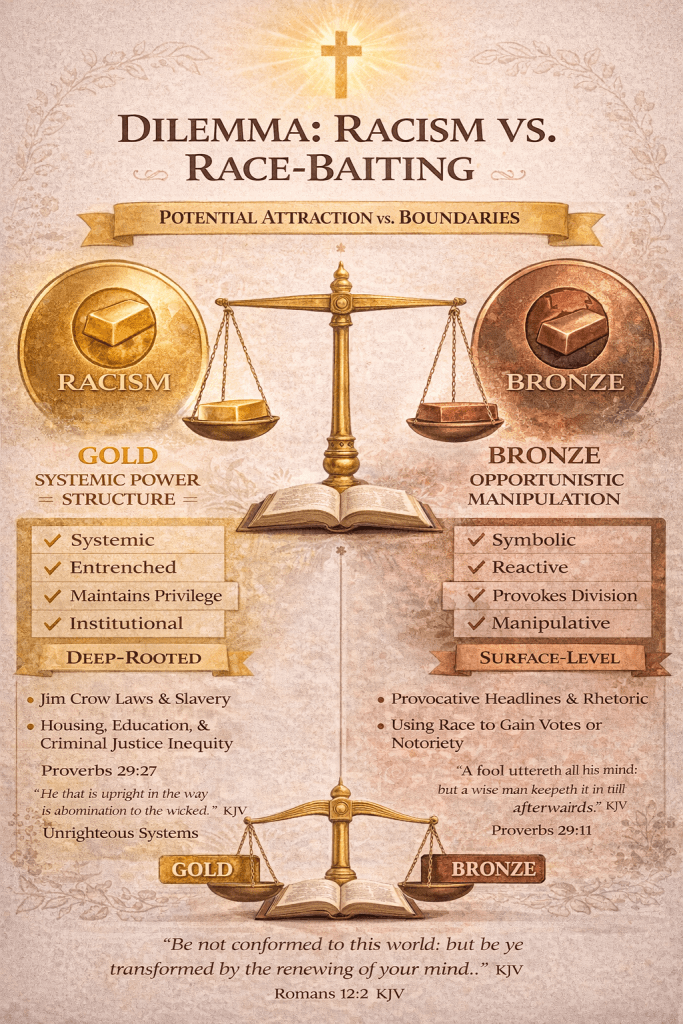
Racism remains one of the most persistent and destructive forces in society, functioning as a systemic power structure designed to maintain the dominance of one group over another (Feagin, 2006). Unlike individual prejudice, which reflects personal bias, racism involves institutional, cultural, and historical mechanisms that enforce inequality. Understanding racism as a power structure is critical to distinguishing it from race-baiting.

Race-baiting, in contrast, refers to tactics that manipulate racial tension for personal, political, or financial gain. It does not necessarily rely on structural dominance but rather exploits societal divisions, often inciting anger, fear, or resentment. While both racism and race-baiting are harmful, their mechanisms and intent differ.

Racism operates at multiple levels: individual, institutional, and systemic. Individual racism involves personal prejudice or discriminatory acts, whereas institutional racism manifests in policies, practices, and norms that advantage one racial group over others. Systemic racism describes the entrenched nature of these structures over generations.

Race-baiting exploits visible racial differences to provoke a reaction. Unlike racism, which is rooted in power dynamics and structural advantage, race-baiting may be opportunistic, focusing on rhetoric and emotional appeal rather than systemic control. Politicians, media personalities, and even social influencers often use race-baiting to advance agendas or gain attention.

In biblical terms, oppression and favoritism have long been condemned. James 2:1 warns, “My brethren, have not the faith of our Lord Jesus Christ, the Lord of glory, with respect of persons” (KJV). Partiality and systemic oppression violate God’s design for justice and equality. Racism is, therefore, fundamentally anti-biblical because it enforces inequality and diminishes the image of God in humanity (Genesis 1:27).

Understanding the difference between racism and race-baiting requires examining the intent behind actions. Racism seeks to preserve hierarchy, maintain privilege, and control resources. Race-baiting seeks to provoke emotional reaction and division, often for personal gain or notoriety. While a racist agenda benefits the oppressor materially or socially, race-baiting primarily manipulates perception.

The metaphor of bronze versus gold can help clarify the distinction. Bronze represents the superficial provocation, often symbolic and reactive—this is race-baiting. Gold represents the deep, entrenched systemic mechanisms—this is racism in its structural form. Observing whether an act addresses the root of inequality or merely agitates emotion can reveal its nature.

Racism and race-baiting intersect in public discourse. Some individuals and media sources may exaggerate or misrepresent incidents of racial tension for attention, funding, or political leverage. This blurs public understanding, making it difficult to address genuine structural injustice. As Proverbs 18:17 notes, “The first to plead his cause seemeth just; but his neighbor cometh and searcheth him” (KJV). Truth requires deeper investigation.

Racism thrives on normalization. When societal structures systematically advantage one group, discriminatory practices are often invisible or dismissed as “tradition” or “meritocracy.” Understanding this helps differentiate between acts that are opportunistic (race-baiting) and those that are embedded within the system (racism).

Race-baiting frequently misdirects anger away from systemic causes toward individual actors, scapegoating specific groups for broader structural problems. This manipulation can polarize communities and hinder meaningful solutions. Micah 6:8 reminds us of justice and humility: “He hath shewed thee, O man, what is good; and what doth the Lord require of thee, but to do justly, and to love mercy, and to walk humbly with thy God?” (KJV).

Media literacy is essential to recognize the distinction. Headlines and social media often amplify emotionally charged narratives without context. Racism is systemic, historically rooted, and persistent, while race-baiting relies on immediate reaction. Educated discernment enables individuals to see beyond sensationalism.

Racism is often intergenerational, perpetuated through education, housing, employment, criminal justice, and healthcare disparities. Race-baiting is usually episodic, emerging around specific incidents, speeches, or events. Understanding historical context is therefore critical to interpreting current racial discourse accurately.

Race-baiting can also occur within oppressed communities, where individuals or groups exploit internal divisions to gain influence. This demonstrates that race-baiting is less about power structures and more about manipulation, contrasting with racism’s reliance on systemic advantage.

The Bible condemns hypocrisy and manipulation. Proverbs 6:16–19 lists pride, false witness, and sowing discord among brethren as abominations to God. Race-baiting falls into the category of sowing discord, whereas racism violates divine law by enforcing inequality. Both are sin, but their mechanisms differ.

Recognizing racism requires assessing who benefits. True racism confers social, economic, and political advantage to a particular racial group. Race-baiting may inflame perceptions of injustice but does not create structural advantage. This distinction clarifies policy debates and moral accountability.

Racism also often hides behind ideology, meritocracy, or cultural norms. The systemic nature makes it less visible than race-baiting, which is loud, overt, and performative. Understanding the bronze versus gold distinction allows individuals to respond with strategic solutions rather than reactive emotion.

Education and awareness are key tools in dismantling both racism and race-baiting. Combatting racism requires structural reform, anti-discrimination policy, and societal accountability. Countering race-baiting requires critical thinking, media literacy, and spiritual discernment (Proverbs 14:15).

Christians are called to pursue justice and reconciliation. Isaiah 1:17 commands, “Learn to do well; seek judgment, relieve the oppressed, judge the fatherless, plead for the widow” (KJV). Responding to racism requires action and advocacy; responding to race-baiting requires wisdom, prayer, and discernment.

Racism is a deep societal disease, while race-baiting is a symptom that exploits and amplifies divisions. One targets systemic change; the other targets immediate perception. Addressing the root cause requires education, advocacy, and awareness of historical context, as well as spiritual discernment.

In conclusion, distinguishing between racism and race-baiting is essential for effective response. Bronze may flare in anger and reaction; gold endures in system and power. Both demand moral responsibility, but the solutions differ. Recognizing the systemic nature of racism while refusing to be manipulated by race-baiting is a critical skill for spiritual and social maturity (Romans 12:2).


References

Feagin, J. (2006). Systemic racism: A theory of oppression. Routledge.
Alexander, M. (2012). The New Jim Crow: Mass incarceration in the age of colorblindness. The New Press.
Kendi, I. X. (2019). How to be an antiracist. One World.
Proverbs 4:23; 14:15; 18:17; 6:16–19
Isaiah 1:17; Micah 6:8; James 2:1; Genesis 1:27
Romans 12:2; Hebrews 13:4
Matthew 10:16; Matthew 26:41

Dilemma: Integration

Integration has long been presented as a moral victory and social cure for America’s racial sickness, yet for Black people it has often functioned as a double-edged sword. While access to public institutions increased, the cost was frequently the erosion of independent Black systems that had been built under segregation out of necessity and communal discipline. Integration promised equality but delivered exposure to structures that were never designed with Black flourishing in mind.

Before integration, Black communities cultivated parallel economies, educational institutions, and social networks that circulated wealth internally. Black-owned banks, schools, newspapers, and business districts were not merely economic centers but cultural strongholds. These spaces fostered dignity, self-determination, and accountability rooted in shared experience and survival.

Integration disrupted this ecosystem by redirecting Black dollars outward. When Black consumers were allowed to shop, bank, and educate elsewhere, Black-owned institutions were slowly starved of resources. What was framed as progress often resulted in dependency, not empowerment, as economic power shifted away from the community.

Scripture warns of the dangers of dependence on hostile systems. “The borrower is servant to the lender” (Proverbs KJV) speaks not only to individuals but to nations and communities. Integration without economic sovereignty placed Black communities in a perpetual position of borrowing access rather than owning infrastructure.

Historically, whenever Black people achieved visible prosperity, it was met with white backlash. The destruction of Black Wall Street in Tulsa and the massacre of Rosewood were not random acts of violence but calculated responses to Black success. Prosperity challenged the lie of Black inferiority, and that challenge was answered with terror.

These attacks reveal a deeper psychological conflict. Black excellence exposed the moral contradiction of white supremacy, creating fear that the racial hierarchy could not sustain itself if Black people thrived independently. Scripture acknowledges this dynamic when it states, “For every one that doeth evil hateth the light” (John KJV).

White women have historically played a critical role in triggering these violent outcomes, particularly through false accusations against Black men. The mythology of white female purity was weaponized to justify lynchings, massacres, and the destruction of entire communities. These narratives provided moral cover for economic and racial warfare.

The Bible repeatedly condemns false witness. “A false witness shall not be unpunished” (Proverbs KJV) underscores the spiritual gravity of lies that destroy lives and nations. Yet American history shows that these falsehoods were not only tolerated but rewarded when they reinforced racial dominance.

Integration did not dismantle this psychological framework; it merely relocated it. Black children integrated into hostile school environments often encountered lowered expectations, cultural erasure, and internalized inferiority. Black professionals integrated into white institutions faced glass ceilings and tokenism rather than true inclusion.

Meanwhile, Black communal discipline weakened. When survival no longer required collective responsibility, individualism replaced mutual obligation. Scripture emphasizes communal accountability: “Bear ye one another’s burdens” (Galatians KJV). Integration diluted this ethic by prioritizing access over unity.

The intimidation of Black prosperity remains visible today. Successful Black neighborhoods are frequently targeted for gentrification, policy neglect, or over-policing. Prosperity that cannot be controlled is perceived as a threat, echoing ancient patterns of dominance and suppression.

Biblically, this mirrors the experience of Israel in captivity, where prosperity among the oppressed provoked fear among the ruling class. “Behold, the people of the children of Israel are more and mightier than we” (Exodus KJV) reveals how growth among the oppressed is framed as danger by those in power.

The question, then, is not whether Black people can thrive, but under what conditions thriving is sustainable. History suggests that unity, ownership, and cultural coherence are essential. Prosperity without control invites exploitation; integration without power invites erasure.

Thriving requires rebuilding internal economies that circulate wealth within the community. Supporting Black-owned businesses, financial institutions, and educational initiatives restores economic leverage. Scripture affirms this principle: “Let us not be weary in well doing” (Galatians KJV), emphasizing long-term commitment.

Equally important is the restoration of narrative control. Black history, theology, and identity must be taught accurately and unapologetically. “My people are destroyed for lack of knowledge” (Hosea KJV) warns that ignorance is a tool of oppression.

Spiritual grounding is central to resilience. Faith provided enslaved Africans with a framework for dignity when the world denied their humanity. The same faith, rightly understood, can guide modern restoration through justice, wisdom, and discipline.

Thriving also demands discernment. Integration should be strategic, not sentimental. Scripture instructs, “Be ye wise as serpents, and harmless as doves” (Matthew KJV). Engagement with broader society must never come at the cost of sovereignty or truth.

The future of Black prosperity lies in reclaiming what integration weakened: unity, ownership, and purpose. Togetherness is not segregation; it is strategy. Independence is not hatred; it is self-respect.

Ultimately, the dilemma of integration forces a reckoning. Access without power is an illusion, and inclusion without protection is vulnerability. True progress emerges when Black people define success on their own terms, rooted in faith, history, and collective strength.

The path forward is neither isolation nor assimilation, but restoration. As scripture declares, “And ye shall know the truth, and the truth shall make you free” (John KJV). Freedom, for Black people, has always been tied to truth, unity, and the courage to build for ourselves.

References

The Holy Bible, King James Version. (1769/2017). Cambridge University Press.

Anderson, J. D. (1988). The education of Blacks in the South, 1860–1935. University of North Carolina Press.

Baldwin, J. (1963). The fire next time. Dial Press.

Baradaran, M. (2017). The color of money: Black banks and the racial wealth gap. Harvard University Press. https://doi.org/10.4159/9780674978535

Du Bois, W. E. B. (1903). The souls of Black folk. A.C. McClurg & Co.

Exodus 1:9–10 (King James Version).

Galatians 6:2, 9 (King James Version).

Hosea 4:6 (King James Version).

John 3:20; John 8:32 (King James Version).

Lemann, N. (1991). The promised land: The great Black migration and how it changed America. Alfred A. Knopf.

Litwack, L. F. (1998). Trouble in mind: Black southerners in the age of Jim Crow. Alfred A. Knopf.

Loewen, J. W. (2005). Sundown towns: A hidden dimension of American racism. The New Press.

Matthew 10:16 (King James Version).

Myrdal, G. (1944). An American dilemma: The Negro problem and modern democracy. Harper & Brothers.

Oklahoma Commission to Study the Tulsa Race Riot of 1921. (2001). Tulsa Race Riot: A report by the Oklahoma Commission. State of Oklahoma.

Proverbs 6:16–19; Proverbs 14:31; Proverbs 22:7 (King James Version).

Rothstein, R. (2017). The color of law: A forgotten history of how our government segregated America. Liveright Publishing.

Shapiro, T. M. (2004). The hidden cost of being African American: How wealth perpetuates inequality. Oxford University Press.

Taylor, K.-Y. (2016). From #BlackLivesMatter to Black liberation. Haymarket Books.

Washington, B. T. (1901). Up from slavery. Doubleday, Page & Company.

Williams, M. J., & Mohammed, S. A. (2009). Discrimination and racial disparities in health: Evidence and needed research. Journal of Behavioral Medicine, 32(1), 20–47. https://doi.org/10.1007/s10865-008-9185-0

Woodson, C. G. (1933). The mis-education of the Negro. Associated Publishers.

The Dark History of Being Light-Skinned and Dark-Skinned Black Person Around the World.

The history of light-skinned Black people in the Atlantic world is inseparable from the violence of slavery, colonialism, and racial domination. Lighter complexions did not emerge as a neutral genetic variation but, in many cases, as the direct result of coercion, sexual violence, and unequal power relations between enslaved African women and European men. To discuss light skin in Black history honestly requires confronting this brutal origin story and the enduring psychological and social consequences that followed.

During chattel slavery, rape was not an aberration but a systemic feature of the institution. Enslaved women had no legal right to consent, and white slaveholders exercised near-absolute power over their bodies. The children born from these assaults often inherited lighter skin, straighter hair textures, or other Eurocentric features, marking their very existence as living evidence of sexual violence and domination.

These mixed-ancestry children were frequently labeled “mulatto,” a term rooted in dehumanization and animalization. The classification was not simply descriptive; it functioned as a legal and social category that helped slave societies manage hierarchy within Blackness. Skin tone became a tool of division, reinforcing white supremacy while fracturing solidarity among the enslaved.

Light-skinned enslaved people were often assigned domestic labor rather than field work. This distinction produced the infamous dichotomy between the “house negro” and the field slave, a hierarchy that was imposed, not chosen. Domestic labor sometimes spared individuals from the harshest physical toil, but it exposed them to constant surveillance, sexual exploitation, and proximity to white power.

Being inside the slaveholder’s home did not equate to safety or privilege in any meaningful sense. House servants were more accessible targets for abuse, especially young girls and women. The home was often the site of repeated assaults, emotional manipulation, and forced compliance masquerading as favor.

Incest further complicates this history. Because slavery followed the legal principle of partus sequitur ventrem, children inherited the status of the enslaved mother regardless of the father’s identity. This meant white men could rape their own enslaved daughters and grandchildren without legal consequence, creating generational cycles of abuse that literally lightened the complexion of the enslaved population over time.

Light-skinned children were sometimes recognized as the biological offspring of white men, yet this recognition rarely translated into protection or freedom. More often, it produced resentment, secrecy, or further exploitation. These children occupied a liminal space—never white, yet treated differently within Black communities because of their appearance.

Colorism did not end with emancipation. After slavery, lighter skin continued to carry social currency within Black communities, a legacy of plantation hierarchies and white aesthetic standards. Access to education, employment, social clubs, and marriage prospects was often influenced by complexion, reinforcing divisions rooted in trauma rather than choice.

The psychological burden placed on light-skinned Black people is rarely discussed with nuance. Many carried the stigma of being perceived as products of rape or favoritism, while simultaneously being resented for “privileges” they neither requested nor controlled. This double bind created identity conflicts that reverberate across generations.

At the same time, darker-skinned Black people bore the brunt of systemic violence and exclusion, creating a false narrative that light skin equaled safety or advantage. This obscured the reality that all Black people, regardless of shade, remained subject to racial terror, disenfranchisement, and economic exploitation.

White supremacy strategically used color hierarchies to weaken collective resistance. By elevating lighter skin as closer to whiteness, slave societies encouraged internalized racism and competition. This divide-and-conquer strategy proved effective, leaving lasting scars in Black social relations long after formal slavery ended.

The myth of the “favored” light-skinned enslaved person ignores the constant precarity of their position. Favor could be revoked at any moment, and proximity to power often meant proximity to punishment. Psychological violence—humiliation, erasure, and forced loyalty—was as real as physical brutality.

In religious and moral discourse, enslaved women were blamed for their own assaults, reinforcing misogynoir and sexual shame. Light-skinned children became symbols onto which communities projected unresolved grief, anger, and confusion about sexual violence that was never acknowledged or healed.

Post-slavery societies institutionalized colorism through laws, media, and social norms. Paper bag tests, “blue vein” societies, and caste-like systems in the Caribbean and Americas continued to privilege lighter skin while stigmatizing darker tones. These practices reflected colonial logic rather than African worldviews.

Light skin thus became a paradoxical inheritance: a marker of survival through violence, yet also a source of alienation. Many light-skinned Black people struggled with belonging, questioned their legitimacy within Blackness, or felt compelled to overperform loyalty to counter suspicions of superiority.

Modern conversations about colorism often flatten this history, framing light skin solely as advantage without acknowledging its traumatic origins. This simplification risks reproducing harm by ignoring how sexual violence, incest, and coercion shaped Black bodies and identities.

Healing requires truth-telling. Acknowledging that many light-skinned Black people exist because of rape does not indict them; it indicts the system that produced them. It reframes colorism as a legacy of white supremacy rather than a natural preference within Black communities.

Reclaiming Black unity demands rejecting plantation hierarchies in all forms. Skin tone must be understood as a consequence of history, not a measure of worth, purity, or authenticity. Both light- and dark-skinned Black people inherit trauma from the same system, expressed differently but rooted in the same violence.

To confront the dark history of being light-skinned is to confront slavery honestly. It requires resisting romanticized narratives of privilege and instead centering the realities of rape, incest, coercion, and psychological harm. Only then can colorism be dismantled at its root.

True liberation lies in dismantling the myths that slavery created about skin, beauty, and value. When Black people collectively reject these imposed hierarchies, they reclaim the dignity that was denied to their ancestors—regardless of shade.

The history of dark-skinned Black people is inseparable from the foundations of global white supremacy and the transatlantic slave system. Darkness of skin was deliberately constructed as a marker of inferiority, danger, and disposability, used to justify enslavement, colonization, and dehumanization on a massive scale. From the earliest encounters between Africa and Europe, dark skin became a visual shorthand for domination.

During chattel slavery, darker skin was closely associated with field labor, brutality, and physical exhaustion. Enslaved Africans with the darkest complexions were often assigned the harshest work under the most violent conditions, reinforcing an imposed hierarchy where darkness equaled expendability. This association was not natural but engineered to align Blackness with suffering.

Slaveholders and overseers frequently treated darker-skinned enslaved people with heightened cruelty. Punishments were more public and severe, intended to terrorize others into submission. Darkness of skin was read as strength and resistance, which paradoxically made dark-skinned bodies targets for extreme violence meant to break both body and spirit.

European racial ideology framed dark skin as evidence of savagery, hypersexuality, and moral inferiority. Pseudoscientific racism used skin color to rank humanity, placing the darkest Africans at the bottom of fabricated racial hierarchies. These ideas were embedded in law, religion, and education, ensuring their persistence beyond slavery.

Dark-skinned women endured a unique intersection of racial and gendered violence. They were depicted as unfeminine, animalistic, and unrapeable, narratives that excused sexual assault while denying their victimhood. Their pain was minimized, and their bodies were exploited without acknowledgment or protection.

Unlike their lighter-skinned counterparts, dark-skinned enslaved women were less likely to be brought into the slaveholder’s home. Instead, they were forced into grueling labor while remaining vulnerable to sexual violence without the contradictory myths of “favor” or proximity to power. Their suffering was both hypervisible and ignored.

After emancipation, the devaluation of dark skin did not disappear. Reconstruction and Jim Crow regimes continued to associate darkness with criminality, poverty, and intellectual inferiority. Dark-skinned Black people were more likely to face harsher sentencing, economic exclusion, and social ostracism.

Within Black communities, colorism took root as an internalized inheritance of slavery. Dark-skinned individuals were often subjected to ridicule, diminished marriage prospects, and limited social mobility. These biases reflected plantation hierarchies rather than African cultural values, yet they became normalized through repetition.

Dark-skinned children frequently absorbed messages that their appearance was something to overcome rather than celebrate. Insults, teasing, and media representation taught them early that beauty, intelligence, and desirability were linked to lighter skin. This psychological conditioning produced long-term effects on self-worth and identity.

In education and employment, studies have shown that darker-skinned Black people often face greater discrimination than lighter-skinned peers. Teachers, employers, and institutions unconsciously reproduce racial hierarchies by associating darkness with incompetence or threat, reinforcing inequality under the guise of neutrality.

The criminal justice system has disproportionately punished dark-skinned Black people, who are more likely to be perceived as dangerous or aggressive. Skin tone bias affects policing, sentencing, and jury decisions, revealing how deeply colorism is embedded in modern systems of control.

Media representations have historically erased or caricatured dark-skinned people. When present, they were cast as villains, servants, or comic relief, rarely afforded complexity or humanity. This absence of dignified representation reinforced societal disdain for dark skin.

Dark-skinned men have often been portrayed as inherently violent or hypermasculine, narratives used to justify surveillance, incarceration, and extrajudicial violence. These stereotypes trace directly back to slavery-era fears of rebellion and resistance.

Despite these conditions, dark-skinned Black people have consistently embodied resilience and leadership. Many of the most vocal resisters, abolitionists, and freedom fighters bore the brunt of racial hatred precisely because their appearance symbolized unapologetic Blackness.

The global preference for lighter skin, seen in bleaching practices and beauty standards, reflects unresolved trauma rather than truth. Dark skin became a site of shame not because it lacked value, but because white supremacy taught the world to fear and reject it.

Healing requires confronting how darkness was weaponized against Black people. It demands rejecting the lie that proximity to whiteness equals humanity and acknowledging that the most violently oppressed bodies were often the darkest.

Reclaiming dark skin as beautiful and sacred is an act of resistance. It challenges centuries of conditioning that equated darkness with evil and lightness with virtue. This reclamation restores dignity stolen by slavery and colonialism.

True racial justice cannot exist without addressing colorism. Ignoring skin tone hierarchies allows slavery’s legacy to persist under new names. Justice requires naming how dark-skinned people have been uniquely targeted and harmed.

The dark history of being dark-skinned is not merely a story of suffering but of survival. Against overwhelming forces designed to erase them, dark-skinned Black people endured, resisted, and shaped the world.

Honoring this history means dismantling the systems that still punish darkness today. Only by confronting the truth of how dark skin was treated can society move toward genuine liberation, healing, and collective Black unity.

The histories of being light-skinned and dark-skinned are not opposing narratives, but parallel wounds carved by the same violent system. Color hierarchies were never born within Black communities; they were engineered by slavery and colonialism to rank, divide, and control. Whether through the sexual violence that produced lighter complexions or the intensified brutality directed at darker bodies, skin tone became a tool of domination rather than a reflection of worth.

Both histories reveal how white supremacy manipulated Black bodies into symbols—of proximity or distance, favor or punishment—while denying all Black people full humanity. These imposed distinctions fractured families, distorted identity, and seeded internalized bias that continues to echo across generations. The pain attached to skin tone is not accidental; it is historical, intentional, and unresolved.

True healing requires rejecting plantation logic in every form. It demands that Black communities confront colorism honestly, without competition or denial, and recognize it as inherited trauma rather than personal failure. Light skin and dark skin alike carry the memory of survival under oppression, not moral ranking or superiority.

Liberation begins when Black people refuse to measure themselves by standards forged in violence. When the false hierarchy of shade is dismantled, space is created for collective dignity, restoration, and unity. In reclaiming the fullness of Blackness—across every tone—we reject the lies of the past and affirm a future rooted in truth, justice, and wholeness.

References

Berlin, I. (1998). Many thousands gone: The first two centuries of slavery in North America. Harvard University Press.

Davis, A. Y. (1981). Women, race, & class. Random House.

Douglass, F. (1845). Narrative of the life of Frederick Douglass, an American slave. Anti-Slavery Office.

hooks, b. (1992). Black looks: Race and representation. South End Press.

Hunter, M. (2007). The persistent problem of colorism: Skin tone, status, and inequality. Sociology Compass, 1(1), 237–254. https://doi.org/10.1111/j.1751-9020.2007.00006.x

Morgan, J. L. (2004). Laboring women: Reproduction and gender in New World slavery. University of Pennsylvania Press.

Painter, N. I. (2010). The history of white people. W. W. Norton & Company.

Smallwood, S. (2007). Saltwater slavery: A middle passage from Africa to American diaspora. Harvard University Press.

Spillers, H. J. (1987). Mama’s baby, papa’s maybe: An American grammar book. Diacritics, 17(2), 65–81.

Wood, B. (2003). Women’s work, men’s work: The informal slave economies of lowcountry Georgia. University of Georgia Press.


Davis, A. Y. (1981). Women, race, & class. Random House.

Du Bois, W. E. B. (1903). The souls of Black folk. A. C. McClurg & Co.

Fanon, F. (1952). Black skin, white masks. Éditions du Seuil.

Hall, R. E. (1995). The bleaching syndrome: African Americans’ response to cultural domination vis-à-vis skin color. Journal of Black Studies, 26(2), 172–184.

Hunter, M. (2007). The persistent problem of colorism: Skin tone, status, and inequality. Sociology Compass, 1(1), 237–254. https://doi.org/10.1111/j.1751-9020.2007.00006.x

Jordan, W. D. (1968). White over Black: American attitudes toward the Negro, 1550–1812. University of North Carolina Press.

Spillers, H. J. (1987). Mama’s baby, papa’s maybe: An American grammar book. Diacritics, 17(2), 65–81.

Thompson, C. (2009). Black women, beauty, and hair as a matter of being. Women’s Studies, 38(8), 831–856.

Wilson, M., Hugenberg, K., & Rule, N. O. (2017). Racial bias in judgments of physical size and formidability. Psychological Science, 28(8), 1136–1144.

Wood, B. (2003). Women’s work, men’s work: The informal slave economies of lowcountry Georgia. University of Georgia Press.

The Isms of Black People: Racism, Colorism, and Beyond.

Photo by Kindel Media on Pexels.com

The history of Black people across the diaspora is marked by survival under systems of oppression, division, and erasure. To understand this history, one must examine the many “isms” that have shaped both external conditions and internal realities. Racism, colorism, classism, sexism, and materialism each stand as forces that distort identity, fracture unity, and reproduce inequality. Yet through these trials, Black people have also demonstrated resilience, faith, and creativity that transcend systemic barriers.

Racism stands at the foundation of oppression against Black people. Rooted in slavery, colonialism, and segregation, racism created a system of economic exploitation and social dehumanization. Enslavement reduced people to property, and post-slavery policies institutionalized inequality through Jim Crow laws, redlining, and mass incarceration. Racism is more than individual prejudice; it is structural, shaping opportunity, wealth, and health. Scripture reminds us of the cruelty of oppression: “They afflict the just, they take a bribe, and they turn aside the poor in the gate from their right” (Amos 5:12, KJV).

Colorism, though a product of racism, operates as a unique internal “ism.” Defined as prejudice or discrimination based on skin shade within the same racial or ethnic group, colorism privileges lightness and stigmatizes darkness. This hierarchy dates back to slavery, when lighter-skinned enslaved people were sometimes granted household work, while darker-skinned people labored in the fields. Today, this legacy persists in beauty standards, employment opportunities, and social perceptions. As Hunter (2007) notes, skin tone continues to influence social mobility within Black communities.

The psychological impact of colorism is profound. Dark-skinned individuals often face diminished self-esteem, while lighter-skinned individuals may struggle with authenticity and belonging. The Bible warns against valuing outward appearance: “For the Lord seeth not as man seeth; for man looketh on the outward appearance, but the Lord looketh on the heart” (1 Samuel 16:7, KJV). True worth is not measured by complexion, but by the character shaped by God.

Classism is another “ism” that plagues Black people. Historically, systemic barriers restricted access to land ownership, wealth accumulation, and higher education. Today, the racial wealth gap continues to mirror these inequalities, with Black households on average holding significantly less wealth than White households (Oliver & Shapiro, 2006). Within Black communities, however, class divisions can also produce elitism, where those who attain success may distance themselves from those still struggling.

This elitism can erode solidarity, creating divisions where unity is most needed. The talented tenth, the Black elite, and the upwardly mobile sometimes face accusations of abandoning their communities. Others are judged as “not doing enough” for collective uplift. These tensions demonstrate how classism operates both externally through systemic exclusion and internally through fractured relationships.

Sexism also shapes the Black experience. Black women, in particular, navigate the intersection of race and gender oppression, often referred to as “double jeopardy.” They face barriers in employment, healthcare, and representation, while simultaneously carrying cultural expectations of strength and endurance. Yet, Black women have been the backbone of movements for freedom, justice, and faith. Proverbs 31 honors such women: “Strength and honour are her clothing; and she shall rejoice in time to come” (Proverbs 31:25, KJV).

Internalized sexism within Black communities can also manifest in the devaluing of women’s voices or the pressure placed upon men to dominate rather than partner. These attitudes reflect both the legacy of patriarchal systems and the scars of slavery that disrupted family structures. Healing requires both men and women reclaiming biblical partnership and honoring the dignity of one another.

Materialism is another challenge—one that often emerges as a response to systemic poverty. In societies where consumerism defines worth, material possessions become a way to prove success and resist historical narratives of lack. Yet, materialism also traps people in cycles of debt and emptiness. Jesus warned, “Take heed, and beware of covetousness: for a man’s life consisteth not in the abundance of the things which he possesseth” (Luke 12:15, KJV).

This pursuit of material validation is compounded by media representations. From music videos to advertisements, Black culture is often associated with displays of wealth, fashion, and consumption. While cultural expression should not be dismissed, it is important to question whether such portrayals empower communities or reinforce destructive values.

Nationalism and ethnocentrism can also be considered part of the “isms” Black people navigate. Movements such as Pan-Africanism have provided pride and unity across the diaspora, but they can sometimes exclude or create tensions among different groups. For example, tensions between continental Africans and African Americans have occasionally emerged due to differing historical experiences. While these divisions are understandable, they must be overcome in the pursuit of global solidarity.

Religious elitism has also impacted Black communities. Denominationalism, doctrinal disputes, and church hierarchies sometimes divide believers rather than unify them. This contradicts Christ’s prayer for unity: “That they all may be one; as thou, Father, art in me, and I in thee” (John 17:21, KJV). Faith must function not as a divider, but as a healer of fractures caused by oppression.

Psychologically, these “isms” contribute to identity struggles, self-hatred, and internalized oppression. Frantz Fanon (1967) argued that colonialism implanted inferiority in the minds of the colonized, creating cycles of self-doubt and division. For Black people, this has meant carrying not only the weight of external racism but also the burden of internalized narratives of inadequacy.

Yet resilience remains central to the Black story. Despite racism, colorism, classism, sexism, and materialism, Black communities have birthed cultural movements, spiritual awakenings, and liberation struggles that inspire the world. From gospel music to civil rights activism, from African spirituality to biblical faith, Black people have consistently transformed oppression into creativity and survival.

Theologically, the “isms” faced by Black people mirror biblical exile and restoration. Just as Israel endured scattering, captivity, and oppression, so too have Black communities faced displacement and systemic bondage. Yet the Bible promises hope: “I will gather you out of all countries, and will bring you into your own land” (Ezekiel 36:24, KJV). For many, this speaks not only to spiritual restoration but to cultural reclamation.

Unity is the ultimate antidote to these “isms.” The divisions imposed by racism, colorism, classism, and other forces cannot be healed without collective solidarity. As Paul wrote, “There is neither Jew nor Greek, there is neither bond nor free, there is neither male nor female: for ye are all one in Christ Jesus” (Galatians 3:28, KJV). Unity does not erase difference, but it transforms difference into strength.

Education is also a key weapon against the “isms.” By teaching history, exposing systemic inequities, and reclaiming cultural heritage, communities can break cycles of ignorance and division. Knowledge allows people to recognize oppression not as personal failure but as structural injustice, while also equipping them to resist and rebuild.

Healing from these “isms” also requires spiritual renewal. Faith provides a framework for forgiveness, restoration, and hope. Prayer, scripture, and community worship serve as antidotes to despair and division, empowering individuals to rise above the weight of systemic oppression.

Ultimately, the “isms” of Black people must be confronted both within and without. Externally, systems of racism and inequality must be dismantled. Internally, the psychological scars of colorism, classism, and sexism must be healed. This dual work requires both social activism and spiritual transformation.

In conclusion, the “isms” of Black people reveal a history of wounds, but also a story of resilience. Each “ism” highlights the complexity of oppression, yet within each struggle lies the possibility of renewal. By grounding identity in faith, reclaiming cultural pride, and pursuing unity, Black people can move beyond the chains of “isms” and embody the freedom promised by God.


📖 References

  • Holy Bible, King James Version.
  • Hunter, M. (2007). The persistent problem of colorism: Skin tone, status, and inequality. Sociology Compass, 1(1), 237–254.
  • Oliver, M. L., & Shapiro, T. M. (2006). Black wealth/white wealth: A new perspective on racial inequality. Taylor & Francis.
  • Fanon, F. (1967). Black skin, white masks. Grove Press.

The Genesis of Colorism

Colorism is a deeply rooted social phenomenon that continues to shape perceptions of beauty, worth, and opportunity within racial and ethnic communities. Unlike racism, which primarily operates across racial lines, colorism is the preferential treatment of lighter-skinned individuals over darker-skinned individuals within the same racial or ethnic group. It is a subtle yet pervasive force that influences personal identity, social mobility, and cultural norms.

The term “colorism” was popularized by Alice Walker in the 1980s, though the phenomenon existed long before it had a name. Walker defined it as a form of prejudice or discrimination in which people are treated differently based on the social meanings attached to skin color. Her work drew attention to the complex ways in which intra-racial discrimination intersects with historical oppression.

Colorism is sometimes referred to by other names, including “shadeism,” “toneism,” and “skin tone bias.” Each term highlights the focus on skin color rather than racial categorization, emphasizing the internalized hierarchies that exist within communities. These labels help distinguish colorism from broader racial prejudice.

While racism involves power dynamics between different racial groups, colorism operates primarily within racial communities, privileging lighter skin over darker skin. It often aligns with Eurocentric standards of beauty and social value, elevating those whose appearance more closely resembles the historically dominant group. This intra-racial discrimination can lead to unequal treatment in employment, relationships, and media representation.

The origins of colorism are deeply intertwined with colonialism, slavery, and the historical imposition of European standards. In the Americas, enslaved Africans were often subjected to differential treatment based on skin tone, with lighter-skinned individuals sometimes receiving preferential roles or treatment due to mixed ancestry with white enslavers. This historical precedent laid the groundwork for modern color hierarchies.

Colorism is reinforced by media and cultural representation. Television, film, advertising, and beauty industries often prioritize lighter-skinned models and actors, equating light skin with beauty, success, and desirability. This reinforces the perception that darker skin is less valuable, perpetuating social and psychological inequality.

Within families, colorism can manifest in preferential treatment of lighter-skinned children. Praise, attention, and expectations may be skewed toward those with lighter complexions, while darker-skinned siblings are subtly or overtly marginalized. These patterns of bias create internalized hierarchies from an early age.

Economic and professional opportunities are also affected by colorism. Studies show that lighter-skinned individuals often earn higher wages, experience fewer workplace biases, and receive more favorable treatment in professional settings than darker-skinned peers. This economic disparity illustrates how colorism extends beyond aesthetics to tangible social consequences.

Colorism intersects with gender, often compounding disadvantage for darker-skinned women. Historically, European beauty ideals equated lighter skin with femininity and desirability, marginalizing women whose appearance did not align with these norms. The pressure to conform to Eurocentric beauty standards has long-lasting social and psychological implications.

Educational opportunities have historically been influenced by colorism. In some communities, lighter-skinned individuals were prioritized for schooling or professional training, reflecting entrenched societal hierarchies that valorized proximity to whiteness. These disparities contributed to cycles of privilege and marginalization.

The perpetuation of colorism is often subtle and implicit, making it difficult to challenge. Compliments, social preferences, and assumptions about intelligence or behavior can all be influenced by skin tone. While often framed as benign or accidental, these biases accumulate over a lifetime to reinforce social inequality.

Colorism also shapes interpersonal relationships, influencing dating and marriage preferences. Lighter-skinned individuals are often deemed more desirable partners, while darker-skinned individuals may face stigma or reduced romantic opportunities. These biases reinforce the notion that worth and attractiveness are correlated with skin tone.

Global perspectives reveal that colorism is not confined to the United States or the African diaspora. Across Asia, Latin America, and the Caribbean, lighter skin is often associated with higher social status, wealth, and beauty. The global nature of colorism underscores its roots in historical power dynamics and colonization.

Education and awareness are critical in addressing colorism. Scholars, activists, and cultural commentators work to expose the ways color hierarchies are maintained and internalized. By naming and examining the phenomenon, communities can begin to challenge ingrained biases and foster more equitable social norms.

Toni Morrison, the acclaimed novelist, addressed colorism in her works, particularly in The Bluest Eye. Morrison explored how internalized racism and the valorization of Eurocentric beauty standards inflicted emotional and psychological harm on dark-skinned children. Her writings continue to illuminate the personal and societal consequences of colorism.

Media representation plays a dual role, both reinforcing and challenging colorism. While mainstream media often privileges lighter skin, contemporary Black media and cultural productions increasingly celebrate diverse shades of beauty. These shifts help challenge long-standing biases and expand cultural narratives around beauty and worth.

Colorism often affects self-esteem and identity formation. Darker-skinned individuals may internalize negative perceptions, experiencing shame or diminished confidence. Conversely, lighter-skinned individuals may experience privilege but also pressure to conform to external expectations, creating complex psychological dynamics.

The beauty industry has historically capitalized on colorism. Skin-lightening products, hair straightening, and other treatments marketed toward darker-skinned individuals reinforce the notion that lighter skin is superior. This commercialization both exploits and perpetuates color-based hierarchies.

Colorism can influence social mobility. Lighter-skinned individuals may gain access to elite social networks or higher-status opportunities more readily than darker-skinned peers. These advantages often accumulate across generations, reinforcing systemic disparities within communities.

Educational curricula and historical narratives can obscure the origins of colorism, leaving many unaware of its systemic roots. Understanding colorism as part of a larger history of colonialism, slavery, and European cultural dominance is crucial to dismantling it. Awareness fosters empathy and challenges internalized biases.

Colorism also affects leadership and representation. Lighter-skinned individuals are often more visible in political, cultural, and business leadership positions, creating role models who may not fully reflect the diversity of their communities. This disparity reinforces societal hierarchies and perpetuates bias.

Colorism influences fashion, music, and art, shaping aesthetic norms and cultural production. Historically, lighter-skinned performers were favored for commercial exposure, while darker-skinned artists faced barriers to mainstream acceptance. This dynamic both reflects and perpetuates cultural hierarchies based on skin tone.

Addressing colorism requires both individual and collective action. Self-awareness, open dialogue, and community initiatives can challenge bias. Encouraging inclusive representation and celebrating all shades fosters equity and cultural pride. Confronting colorism is an act of both social justice and personal liberation.

Ultimately, colorism reflects society’s struggle with internalized hierarchies, historical oppression, and beauty standards rooted in power. Recognizing the origins and effects of colorism is the first step toward equity, healing, and cultural transformation. By examining privilege, dismantling bias, and celebrating diversity, communities can move toward a future where skin tone does not dictate worth or opportunity.


References

Walker, A. (1983). In Search of Our Mothers’ Gardens: Womanist Prose. Harcourt Brace Jovanovich.

Morrison, T. (1970). The Bluest Eye. Holt, Rinehart & Winston.

Hunter, M. L. (2007). The Persistent Problem of Colorism: Skin Tone, Status, and Inequality. Sociology Compass, 1(1), 237–254.

Russell-Cole, K., Wilson, M., & Hall, R. E. (2013). The Color Complex: The Politics of Skin Color in a New Millennium. Anchor Books.

Bennett, L. (2020). Shadeism and Colorism: Historical Origins and Contemporary Effects. Journal of African American Studies, 24(2), 145–163.

Biblical Slavery Decoded

Biblical slavery is one of the most misunderstood and misused subjects in religious history, often weaponized to justify chattel slavery while stripping Scripture of its historical, linguistic, and moral context. A careful reading of the King James Version (KJV), alongside ancient Near Eastern customs, reveals that biblical servitude was fundamentally different from the race-based, perpetual, dehumanizing system imposed on Africans in the transatlantic slave trade.

In Scripture, the English word slave often translates from the Hebrew word ʿeḇeḏ, which broadly means servant, laborer, or bondman. This term encompassed a wide range of social arrangements, including hired workers, indentured servants, royal officials, and covenantal servants of God. Context, not modern assumptions, determines its meaning.

Biblical servitude was primarily economic, not racial. Israelites could enter servitude to repay debts, survive famine, or restore family stability. This system functioned as a form of social welfare in an agrarian society without modern banking or safety nets (Leviticus 25:35–39, KJV).

Unlike chattel slavery, biblical servants retained personhood and legal protections. Exodus 21 outlines clear limits on treatment, including punishment for abuse. If a servant was permanently injured, they were to be released free as compensation (Exodus 21:26–27, KJV).

Time limits are central to understanding biblical servitude. Hebrew servants could not be held indefinitely. They were released in the seventh year, known as the Sabbath year, without payment or penalty (Exodus 21:2, KJV; Deuteronomy 15:12).

The Jubilee year further reinforced freedom. Every fiftieth year, all Israelite servants were released, debts forgiven, and land restored to ancestral families. This system prevented generational poverty and perpetual bondage (Leviticus 25:10, KJV).

The Bible explicitly forbids manstealing, the very foundation of transatlantic slavery. Kidnapping a human being to sell or enslave them was a capital offense under biblical law (Exodus 21:16, KJV; Deuteronomy 24:7).

This prohibition directly condemns the capture, transport, sale, and hereditary enslavement of Africans. Any attempt to justify race-based slavery using the Bible ignores this clear and uncompromising command.

Foreign servants in Israel were also protected under divine law. While non-Israelites could enter long-term servitude, they were still bound by covenantal ethics, Sabbath rest, and humane treatment (Exodus 20:10, KJV).

The Bible commands empathy toward servants by reminding Israel of their own history of oppression in Egypt. God repeatedly anchors social justice in remembrance of slavery and divine deliverance (Deuteronomy 5:15, KJV).

Servants were entitled to rest on the Sabbath, placing them on equal footing with their masters before God. This alone dismantles the notion of absolute ownership (Exodus 23:12, KJV).

Biblical slavery also included voluntary lifelong service. If a servant chose to remain with a master out of love and security, it was a consensual covenant—not coercion (Exodus 21:5–6, KJV).

In the New Testament, the Greek word doulos is often translated servant or bondservant. It is used metaphorically to describe believers’ relationship to Christ, emphasizing devotion, not degradation (Romans 1:1, KJV).

Jesus never endorsed oppression. Instead, He confronted systems of exploitation and emphasized mercy, justice, and love of neighbor (Matthew 23:23, KJV).

Christ’s mission was liberation at every level—spiritual, social, and moral. He declared freedom for the captives and release for the oppressed (Luke 4:18, KJV).

Paul’s epistles address servants and masters within the Roman system, not as approval of slavery, but as guidance for ethical conduct within existing structures. He undermined slavery by affirming spiritual equality (Galatians 3:28, KJV).

Paul explicitly condemns enslavers in his list of lawless sinners, using language that echoes the Old Testament ban on manstealing (1 Timothy 1:9–10, KJV).

The letter to Philemon reveals the heart of biblical ethics. Paul urges Philemon to receive Onesimus not as a servant, but as a beloved brother—an appeal that dismantles hierarchical bondage (Philemon 1:15–16, KJV).

Biblical law consistently places God as the ultimate owner of all people. Humans are stewards, not masters of souls (Leviticus 25:55, KJV).

This divine ownership nullifies the idea that one human can permanently own another. All authority is subordinate to God’s righteousness.

The prophets fiercely rebuked oppression, exploitation, and abuse of the vulnerable. Slavery that crushed dignity was treated as a sin that provoked divine judgment (Isaiah 58:6, KJV).

Biblical justice demanded fair wages, humane conditions, and accountability. The exploitation of labor was never portrayed as righteous (Jeremiah 22:13, KJV).

The misuse of Scripture to justify American slavery represents a theological betrayal, not biblical fidelity. Selective reading severed verses from context to sanctify greed and racial domination.

Chattel slavery violated every biblical principle: it was racial, perpetual, violent, hereditary, and rooted in kidnapping. It mocked Sabbath rest, denied Jubilee, and erased personhood.

The curse of Ham narrative was never about Black people and was distorted centuries later to rationalize European colonialism. Scripture does not assign racial destiny through curses (Genesis 9:25–27, KJV).

Biblical slavery must be understood within covenantal law, not colonial ideology. God’s statutes consistently aimed at restoration, not destruction.

Freedom is central to God’s character. From the Exodus to the Cross, liberation defines His intervention in human history.

When Scripture is read honestly, it condemns systems that thrive on cruelty and profit from suffering. God sides with the oppressed, not the oppressor (Psalm 103:6, KJV).

The Bible does not sanitize suffering, but it never sanctifies it either. Justice, mercy, and humility remain the standard (Micah 6:8, KJV).

Understanding biblical slavery correctly dismantles false theology and restores truth. It exposes how Scripture was manipulated to uphold racism rather than righteousness.

Biblical slavery, decoded properly, reveals a God who regulates human brokenness while pointing relentlessly toward freedom. Any theology that excuses dehumanization stands in opposition to the God of the Bible.


References (KJV)

Exodus 20:10; Exodus 21:2, 16, 26–27; Exodus 23:12
Leviticus 25:10, 35–39, 55
Deuteronomy 5:15; Deuteronomy 15:12; Deuteronomy 24:7
Psalm 103:6
Isaiah 58:6
Jeremiah 22:13
Matthew 23:23
Luke 4:18
Romans 1:1
Galatians 3:28
1 Timothy 1:9–10
Philemon 1:15–16
Micah 6:8

Dilemma: Earthy Injustice

Earthly injustice is not an abstract concept but a lived reality etched into human history through conquest, enslavement, exploitation, and systemic inequality. It manifests wherever power divorces itself from morality and institutions prioritize profit, dominance, or comfort over human dignity.

From ancient empires to modern nation-states, injustice has been sustained by laws that favor the powerful and narratives that normalize suffering. These systems rarely collapse on their own; they persist until confronted by truth, resistance, and moral reckoning.

Scripture consistently identifies injustice as a violation of divine order. The Bible portrays God as attentive to imbalance, especially when the poor, the stranger, and the captive are crushed under unjust structures.

Earthly injustice thrives on dehumanization. When a group is stripped of identity, history, or worth, oppression becomes administratively easy and morally invisible to those who benefit from it.

Slavery represents one of the clearest examples of institutionalized injustice. Human beings were transformed into commodities, families into property, and labor into stolen wealth, all under legal and theological justification.

The transatlantic slave trade fused economic ambition with racial ideology, producing a hierarchy that outlived slavery itself. Its aftershocks remain embedded in wealth disparities, social stratification, and global inequality.

Colonialism extended injustice across continents, extracting resources while erasing cultures. Colonized peoples were taught to doubt their own humanity while serving the prosperity of distant empires.

Earthly injustice is often maintained through selective morality. Religious texts are quoted to demand obedience while passages condemning oppression are ignored or reinterpreted.

The Bible’s prophets repeatedly confronted this hypocrisy. They condemned societies that upheld ritual purity while neglecting justice, mercy, and compassion.

Injustice also operates psychologically. Generations exposed to domination may internalize inferiority, fulfilling the goals of oppression without the need for constant force.

Modern injustice frequently disguises itself as neutrality. Policies framed as fair or colorblind often perpetuate historical inequities by refusing to address unequal starting points.

Earthly courts can legalize injustice, but legality does not equate to righteousness. History records many laws that were lawful yet morally indefensible.

Scripture insists that injustice leaves a moral residue. Blood cries from the ground, wages withheld cry out, and suffering demands divine attention.

Those who endure injustice often develop alternative moral visions rooted in survival, faith, and communal care. These visions challenge dominant definitions of success and power.

Resistance to injustice takes many forms, from open rebellion to quiet endurance. Each asserts that oppression does not have the final word.

Earthly injustice is sustained by forgetting. When societies erase past crimes, they create conditions for repetition rather than repair.

Justice requires more than condemnation; it requires restoration. Repairing harm involves truth-telling, accountability, and material redress.

The Bible warns that unchecked injustice invites judgment. Nations that exalt themselves through exploitation eventually encounter collapse, whether through internal decay or external consequence.

Earthly injustice exposes the limits of human systems. It reveals the need for a higher moral authority beyond political power or economic interest.

The persistence of injustice does not negate justice’s existence. Rather, it testifies to the urgency of aligning human action with divine standards of righteousness.


References

The Holy Bible, King James Version. (1611/1769).

Cone, J. H. (1997). God of the oppressed. Orbis Books.

Du Bois, W. E. B. (1903). The souls of Black folk. A. C. McClurg & Co.

Heschel, A. J. (2001). The prophets. Harper Perennial.

Williams, E. (1944). Capitalism and slavery. University of North Carolina Press.