Category Archives: racism

From Chains to Challenges: The Black Journey from Slavery to Modern Struggle.

The story of Black people in the Americas is a long arc of suffering, survival, and strength. Slavery was one of the most devastating atrocities in human history, yet it became the soil out of which resilience, culture, and faith blossomed. To understand where we stand today, we must revisit the beginning—how slavery started, how it ended, and what challenges remain in the present day. This narrative is not merely about the past; it is about the enduring struggle for freedom, dignity, and equality.

Black History Timeline: From Slavery to Modern Struggle

  • 1619 – First enslaved Africans arrive in Virginia, marking the beginning of chattel slavery in the English colonies.
  • 1863 – President Abraham Lincoln issues the Emancipation Proclamation, declaring enslaved people in Confederate states free.
  • 1865 – The 13th Amendment is ratified, officially abolishing slavery in the United States.
  • 1868 – The 14th Amendment grants citizenship and equal protection under the law to formerly enslaved people.
  • 1870 – The 15th Amendment grants Black men the right to vote.
  • 1896Plessy v. Ferguson Supreme Court decision establishes “separate but equal,” legalizing racial segregation.
  • 1954Brown v. Board of Education Supreme Court decision declares school segregation unconstitutional.
  • 1964 – The Civil Rights Act is passed, outlawing discrimination based on race, color, religion, sex, or national origin.
  • 1965 – The Voting Rights Act is signed into law, protecting Black Americans’ right to vote.
  • 2008 – Barack Obama is elected the first Black President of the United States.
  • 2013 – The Black Lives Matter movement is founded in response to police violence and systemic racism.
  • 2020 – Global protests erupt after the murder of George Floyd, sparking renewed calls for racial justice worldwide.

The transatlantic slave trade began in the 15th century when European powers discovered the economic potential of African labor for their colonies in the Americas. Enslaved Africans were kidnapped, sold, and shipped under brutal conditions across the Atlantic in what became known as the Middle Passage. Millions perished along the way, their bodies thrown overboard. Those who survived were forced into chattel slavery, treated as property with no rights, and subjected to physical abuse, family separation, and cultural erasure (Smallwood, 2007).

Slavery in the United States was particularly harsh because it was racialized and hereditary. The legal system ensured that children born to enslaved mothers were automatically slaves, cementing generational bondage (Baptist, 2014). Plantations thrived on cotton, sugar, and tobacco, and the wealth of the American South—and much of the North—depended on unpaid African labor. This institution became so entrenched that it divided the nation politically, socially, and economically.
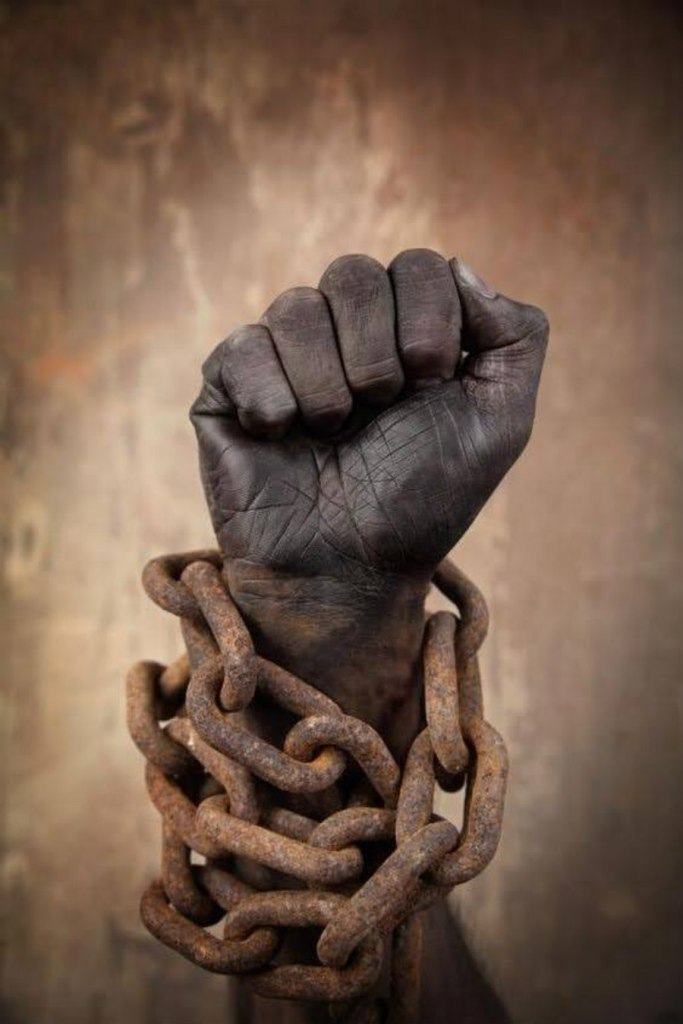
Resistance was always present. Enslaved people rebelled in overt and covert ways, from uprisings like Nat Turner’s rebellion to everyday acts of defiance such as breaking tools, escaping via the Underground Railroad, or maintaining African traditions in music and religion. These acts of resistance preserved Black humanity and spirit even in the face of dehumanization (Berlin, 2003).

The formal end of slavery in the United States came with the Civil War (1861–1865). President Abraham Lincoln’s Emancipation Proclamation in 1863 declared freedom for enslaved people in Confederate states, though true liberation came only with the Union victory and the ratification of the 13th Amendment in 1865. Yet freedom was only partial—many enslavers resisted, and newly freed people faced systemic violence and oppression (Foner, 2014).

Reconstruction (1865–1877) was a critical but short-lived moment of hope. Freedmen’s schools were established, Black men gained the right to vote, and several Black politicians were elected to office. However, white supremacist backlash soon reversed these gains through Black Codes, sharecropping systems, and domestic terrorism by groups such as the Ku Klux Klan. Reconstruction’s collapse ushered in the era of Jim Crow segregation (Litwack, 1998).

Jim Crow laws legally enforced racial segregation, keeping Black Americans in a second-class status for nearly a century. Public spaces, schools, and neighborhoods were divided, with Black people denied equal access to education, housing, and voting rights. Lynchings became a tool of terror, and entire communities were burned to the ground, as in Tulsa’s 1921 massacre (Gates, 2019). Despite this, Black Americans built their own thriving institutions, from HBCUs to churches that became pillars of community life.

The Civil Rights Movement of the 1950s and 1960s was a turning point. Leaders like Martin Luther King Jr., Rosa Parks, and Malcolm X challenged racial injustice through marches, boycotts, and powerful speeches. Landmark victories included the Brown v. Board of Education decision (1954), the Civil Rights Act (1964), and the Voting Rights Act (1965). These legal changes dismantled de jure segregation, though de facto inequalities persisted (Branch, 1988).

Key Figures Who Made a Difference

  • Abraham Lincoln – Issued the Emancipation Proclamation and pushed for the 13th Amendment to abolish slavery.
  • Frederick Douglass – Escaped slave, abolitionist, writer, and orator who advocated for freedom and equality.
  • Harriet Tubman – Led hundreds to freedom through the Underground Railroad, symbolizing courage and liberation.
  • Sojourner Truth – Abolitionist and women’s rights advocate, known for her “Ain’t I a Woman?” speech.
  • W.E.B. Du Bois – Scholar and co-founder of the NAACP, championed civil rights and Pan-African unity.
  • Marcus Garvey – Advocated Black pride, economic independence, and Pan-Africanism.
  • Martin Luther King Jr. – Leader of the Civil Rights Movement, preached nonviolent resistance and racial equality.
  • Malcolm X – Spokesman for Black empowerment and self-defense, encouraged pride in African heritage.
  • Rosa Parks – Sparked the Montgomery Bus Boycott by refusing to give up her seat, inspiring nationwide action.
  • Thurgood Marshall – First Black Supreme Court Justice, fought segregation through legal challenges.
  • Ida B. Wells – Journalist and anti-lynching crusader, raised awareness of racial terror.
  • Barack Obama – First Black President of the United States, symbolizing progress and representation.

After the Civil Rights era, there were significant advances: greater representation in politics, the election of mayors, governors, and, eventually, President Barack Obama. Economic opportunities slowly expanded, but wealth disparities, mass incarceration, and systemic racism remained. The War on Drugs disproportionately targeted Black communities, leading to generations of Black men being imprisoned and families being destabilized (Alexander, 2010).

In today’s world, slavery no longer wears chains but manifests economically and psychologically. Financial bondage can be seen in predatory lending, wage disparities, and a lack of generational wealth. Black households, on average, hold a fraction of the wealth of white households due to historical exclusion from homeownership programs like the GI Bill and redlining practices (Oliver & Shapiro, 2006).

One of the clearest examples of modern-day economic slavery is student debt. Black students are more likely to take on loans for college and graduate with higher debt burdens than their white counterparts, limiting their ability to buy homes, invest, and build wealth (Scott-Clayton & Li, 2016). Education, once seen as a tool of liberation, can trap graduates in decades of repayment, mirroring the cycle of sharecropping debt from the Reconstruction era.

Prison labor is another form of present-day slavery. The 13th Amendment abolished slavery “except as punishment for crime,” allowing prisons to exploit incarcerated individuals for little to no pay. Many major corporations profit from prison labor, making mass incarceration an economic engine that disproportionately affects Black men (Davis, 2003). This system echoes the convict leasing programs of the late 19th century, where newly freed Black men were arrested for minor infractions and leased out to plantations and factories.

Corporate exploitation also plays a role in the new slavery. Many Black communities are targeted by payday lenders, fast-food chains, and predatory retailers who profit from economic desperation. Food deserts—neighborhoods with little access to fresh produce—force residents to rely on unhealthy options, contributing to poor health outcomes and reinforcing a cycle of dependency (Walker et al., 2010).

Employment discrimination continues to be a barrier. Studies have shown that resumes with “Black-sounding” names receive fewer callbacks than those with “white-sounding” names despite identical qualifications (Bertrand & Mullainathan, 2004). This systemic bias reinforces cycles of poverty and limits access to economic mobility.

Education remains a battleground. Predominantly Black schools often receive less funding, leading to fewer resources, overcrowded classrooms, and lower graduation rates. Yet, despite these challenges, Black students continue to excel, breaking barriers in academia, science, and entrepreneurship (Ladson-Billings, 2006).

Cultural slavery persists in the form of media stereotypes that shape perceptions of Black identity. From harmful tropes of the “thug” or “angry Black woman” to colorism within the Black community, these narratives influence hiring decisions, policing, and self-esteem. Representation in media, however, is slowly shifting, with more nuanced and empowering portrayals emerging.

Financial literacy has become a tool of modern liberation. Black entrepreneurs, activists, and educators are teaching about credit, investments, and ownership. Movements like #BuyBlack encourage the circulation of dollars within Black communities to build sustainable economic power (Anderson, 2017).

Social justice movements have reignited the fight against systemic oppression. These movements use technology and social media to expose police brutality, advocate for criminal justice reform, and mobilize global solidarity. The digital age has given new tools to an old struggle for freedom.

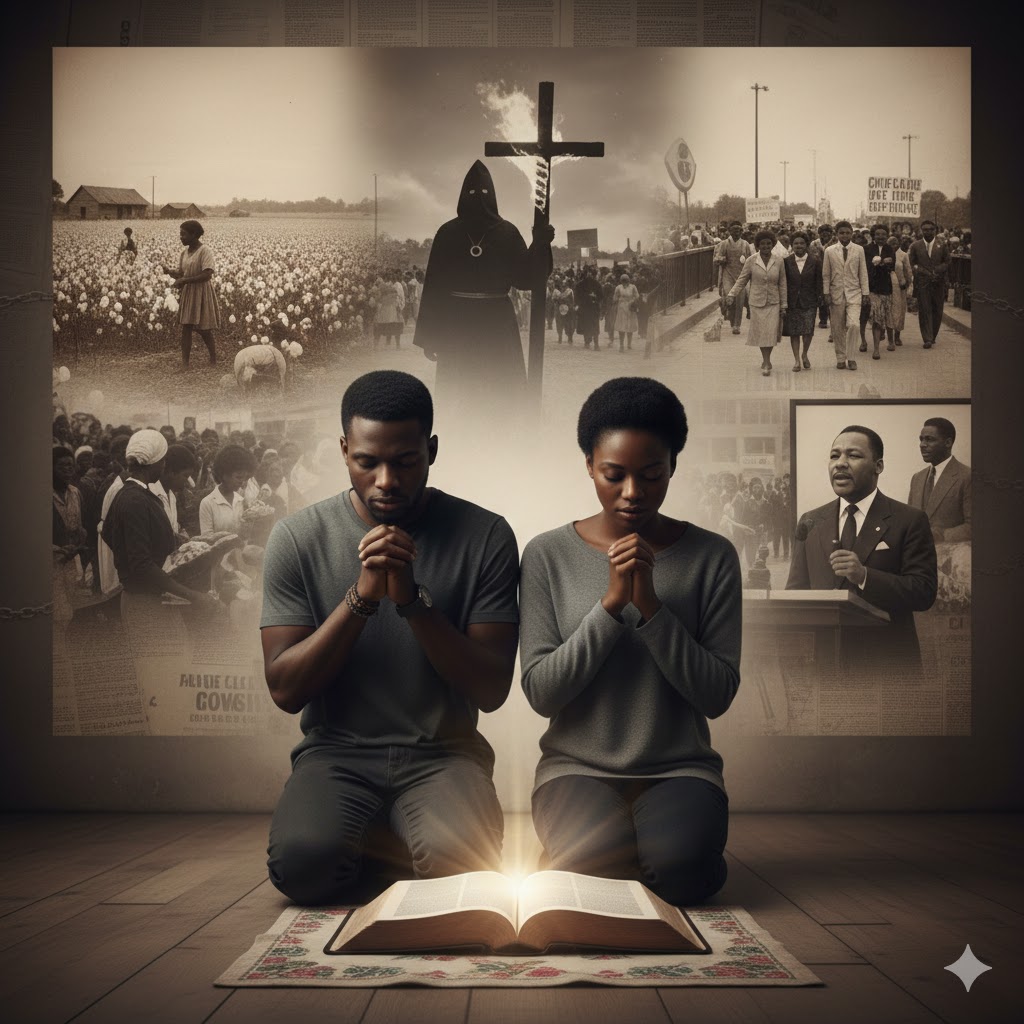
Spiritually, many in the Black community turn to faith as a source of endurance. Churches remain hubs for organizing, political activism, and community care. The Black church has historically been a place where the enslaved could sing freedom songs, where civil rights leaders could strategize, and where today’s generation continues to find hope.

Globally, the African diaspora faces similar challenges. In places like Brazil, the Caribbean, and the UK, Afro-descendant communities grapple with racial inequality, police violence, and underrepresentation. The struggle for Black liberation is international, linking us to a global human rights movement.

Despite the challenges, the Black journey is marked by incredible achievements in arts, science, sports, politics, and beyond. The cultural contributions of African Americans—from jazz to hip-hop, from literature to fashion—have transformed the world and redefined what it means to be resilient.

Today, being “enslaved” can also mean mental enslavement: internalized racism, self-hate, and the pursuit of material validation rather than true freedom. Breaking free requires education, healing, and a reorientation toward self-love and community empowerment.

This journey is not only about survival but about thriving. The legacy of slavery can be transformed into a legacy of greatness when knowledge, faith, and economic empowerment are combined. The fight is not over, but the foundation has been laid by those who came before us.


References
Alexander, M. (2010). The new Jim Crow: Mass incarceration in the age of colorblindness. The New Press.
Anderson, C. (2017). PowerNomics: The national plan to empower Black America. PowerNomics Corporation of America.
Baptist, E. (2014). The half has never been told: Slavery and the making of American capitalism. Basic Books.
Berlin, I. (2003). Generations of captivity: A history of African-American slaves. Harvard University Press.
Bertrand, M., & Mullainathan, S. (2004). Are Emily and Greg more employable than Lakisha and Jamal? American Economic Review, 94(4), 991–1013.
Branch, T. (1988). Parting the waters: America in the King years 1954-63. Simon & Schuster.
Davis, A. (2003). Are prisons obsolete? Seven Stories Press.
Foner, E. (2014). Reconstruction: America’s unfinished revolution, 1863-1877. Harper Perennial.
Gates, H. L. (2019). Stony the road: Reconstruction, white supremacy, and the rise of Jim Crow. Penguin Press.
Ladson-Billings, G. (2006). From the achievement gap to the education debt: Understanding achievement in U.S. schools. Educational Researcher, 35(7), 3–12.
Litwack, L. F. (1998). Trouble in mind: Black southerners in the age of Jim Crow. Vintage.
Oliver, M. L., & Shapiro, T. M. (2006). Black wealth/white wealth: A new perspective on racial inequality. Routledge.
Scott-Clayton, J., & Li, J. (2016). Black-white disparity in student loan debt more than triples after graduation. Brookings Institution.
Smallwood, S. (2007). Saltwater slavery: A middle passage from Africa to American diaspora. Harvard University Press.
Walker, R. E., Keane, C. R., & Burke, J. G. (2010). Disparities and access to healthy food in the United States: A review of food deserts literature. Health & Place, 16(5), 876–884.
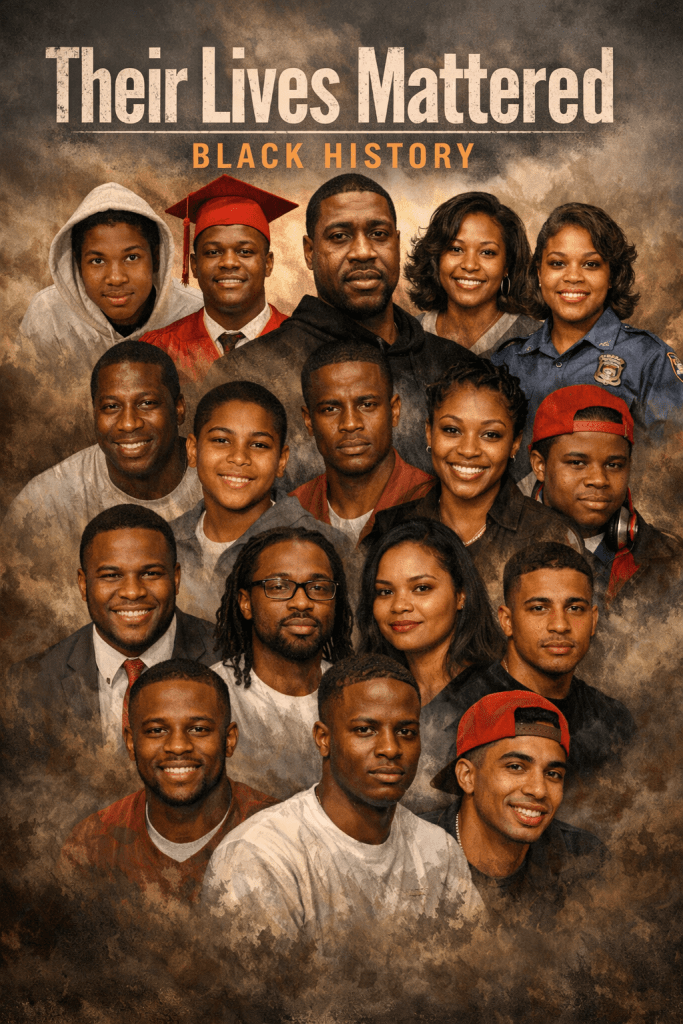
Their Lives Mattered: A Black History Lament.

Their lives mattered not as statistics, not as hashtags, not as passing headlines, but as human beings whose existence was violently interrupted by systems meant to protect. The stories of Trayvon Martin, La’Quan McDonald, Sonya Massey, George Floyd, Breonna Taylor, Eric Garner, Tamir Rice, Freddie Gray, Sandra Bland, Michael Brown, Botham Jean, Philando Castile, Atatiana Jefferson, Stephon Clark, Daunte Wright, and countless others reveal a recurring pattern of racialized state violence, criminalization of Black bodies, and the persistent failure of American justice.

Trayvon Martin was a 17-year-old unarmed Black teenager who was fatally shot in 2012 by George Zimmerman in Sanford, Florida, while walking home from a convenience store. Despite being unarmed and posing no threat, Trayvon was followed, confronted, and killed under the logic of “suspicion.” Zimmerman was acquitted under Florida’s “Stand Your Ground” law, igniting national outrage and becoming a catalyst for the Black Lives Matter movement.

La’Quan McDonald was a 17-year-old Black teenager who was shot 16 times by Chicago police officer Jason Van Dyke in 2014. Dashcam footage later revealed that La’Quan was walking away from police when he was killed, contradicting official police reports. The city suppressed the video for over a year. Van Dyke was eventually convicted of second-degree murder, a rare outcome in police killings.

Sonya Massey, a 36-year-old Black woman, was killed in 2024 by an Illinois sheriff’s deputy after calling 911 for help. While experiencing a mental health crisis, she was shot in her own home. Her death raised renewed concerns about how Black women, especially those in psychological distress, are treated as threats rather than victims in need of care.

George Floyd was a 46-year-old Black man killed in 2020 after Minneapolis police officer Derek Chauvin knelt on his neck for over nine minutes while Floyd was handcuffed and pleading for his life. His death was captured on video and sparked the largest global protests against racial injustice in modern history. Chauvin was later convicted of murder, marking a rare moment of legal accountability.

Breonna Taylor was a 26-year-old Black emergency medical technician who was shot and killed in her Louisville apartment in 2020 when police executed a no-knock warrant while she was asleep. Officers fired over 30 bullets, killing her in her own home. No officer was charged directly for her death, reinforcing public outrage over the lack of accountability.

Eric Garner was a 43-year-old Black man who died in 2014 after being placed in a chokehold by NYPD officer Daniel Pantaleo for allegedly selling loose cigarettes. Garner’s final words, “I can’t breathe,” became a global symbol of police brutality. A grand jury declined to indict the officer, and Pantaleo was only fired years later.

Tamir Rice was a 12-year-old Black child who was shot and killed by Cleveland police in 2014 while playing with a toy gun in a park. Officers arrived and shot him within seconds, without attempting de-escalation. No criminal charges were filed, despite Tamir being a minor posing no imminent threat.

Freddie Gray was a 25-year-old Black man who died in 2015 from a spinal injury sustained while in police custody in Baltimore. He had been arrested and transported in a police van without being properly restrained. His death led to mass protests, but none of the officers involved were ultimately convicted.

Sandra Bland was a 28-year-old Black woman found dead in a Texas jail cell in 2015 after being arrested during a traffic stop. Her death was ruled a suicide, but her treatment, arrest, and the circumstances of her death raised serious questions about racial profiling, police aggression, and custodial negligence.

Michael Brown was an 18-year-old Black teenager shot and killed by police officer Darren Wilson in Ferguson, Missouri, in 2014. Brown was unarmed at the time. His body was left in the street for hours, igniting national protests. A grand jury declined to indict Wilson, fueling global outrage.

Botham Jean was a 26-year-old Black accountant who was shot and killed in his own apartment in 2018 by off-duty Dallas police officer Amber Guyger, who claimed she mistook his home for hers. Guyger was convicted of murder, but her sentence was widely criticized as lenient.

Philando Castile was a 32-year-old Black school cafeteria worker who was shot and killed by police during a traffic stop in Minnesota in 2016. He had calmly informed the officer that he was legally carrying a firearm. His girlfriend livestreamed the aftermath. The officer was acquitted.

Atatiana Jefferson was a 28-year-old Black woman shot and killed by police in 2019 while inside her home in Fort Worth, Texas, after a neighbor requested a wellness check. She was playing video games with her nephew when she was killed. The officer was later convicted of manslaughter.

Stephon Clark was a 22-year-old Black man shot and killed by Sacramento police in 2018 while standing in his grandmother’s backyard. Officers claimed he had a gun; he was holding a cellphone. He was shot 20 times. No officers were charged.

Daunte Wright was a 20-year-old Black man killed in 2021 during a traffic stop in Minnesota when an officer claimed she mistakenly drew her gun instead of her taser. Wright’s death occurred during the trial of Derek Chauvin and reignited national protests. The officer was convicted of manslaughter.

These deaths are not isolated incidents but part of a historical continuum rooted in slavery, Jim Crow, mass incarceration, and racialized policing. The criminal justice system has repeatedly failed to protect Black lives while excusing or minimizing state violence through qualified immunity, grand jury non-indictments, and legal doctrines that prioritize police narratives over Black testimony.

Their lives mattered because they were sons, daughters, parents, workers, students, and dreamers. They mattered because their deaths exposed the moral contradictions of a nation that proclaims liberty while systematically devaluing Black existence. To remember them is not simply an act of mourning, but a political demand for truth, accountability, and structural transformation.

Their names and many others live on not only in memory but in resistance. They have become ancestral witnesses to injustice and sacred symbols in a global struggle for Black dignity. Their blood cries out from the ground, demanding not silence, but justice.


References

Alexander, M. (2012). The New Jim Crow: Mass incarceration in the age of colorblindness. The New Press.

Black Lives Matter. (n.d.). Say Their Names. https://blacklivesmatter.com

Equal Justice Initiative. (2020). Lynching in America: Confronting the legacy of racial terror. https://eji.org

Garner, E. (2014). NYPD case files and DOJ Civil Rights Investigation. U.S. Department of Justice.

Mapping Police Violence. (2023). Police killings database. https://mappingpoliceviolence.org

New York Times. (2014–2024). Police brutality and racial justice reporting.

U.S. Department of Justice. (2020). Investigation into the Minneapolis Police Department.

Washington Post. (2015–2024). Fatal force: Police shootings database. https://www.washingtonpost.com/graphics/investigations/police-shootings-database/

Williams, P. J. (1991). The Alchemy of Race and Rights. Harvard University Press.

Dilemma: Jim Crow – The Legacy of Prejudice and Oppression

Jim Crow laws were a system of legalized racial segregation in the United States, primarily in the South, which lasted from the late 19th century until the mid-1960s. These laws enforced the notion that Black Americans were inferior to whites, systematically restricting their access to public spaces, education, voting rights, and economic opportunity. The name “Jim Crow” itself originated from a racist minstrel show character, highlighting the deeply dehumanizing cultural underpinnings of the system.

The origins of Jim Crow can be traced to the post-Reconstruction era, when Southern states sought to maintain white supremacy after the abolition of slavery. Despite the promises of freedom under the 13th, 14th, and 15th Amendments, white elites implemented laws and practices designed to limit Black advancement, ensuring that social, political, and economic power remained concentrated in white hands.

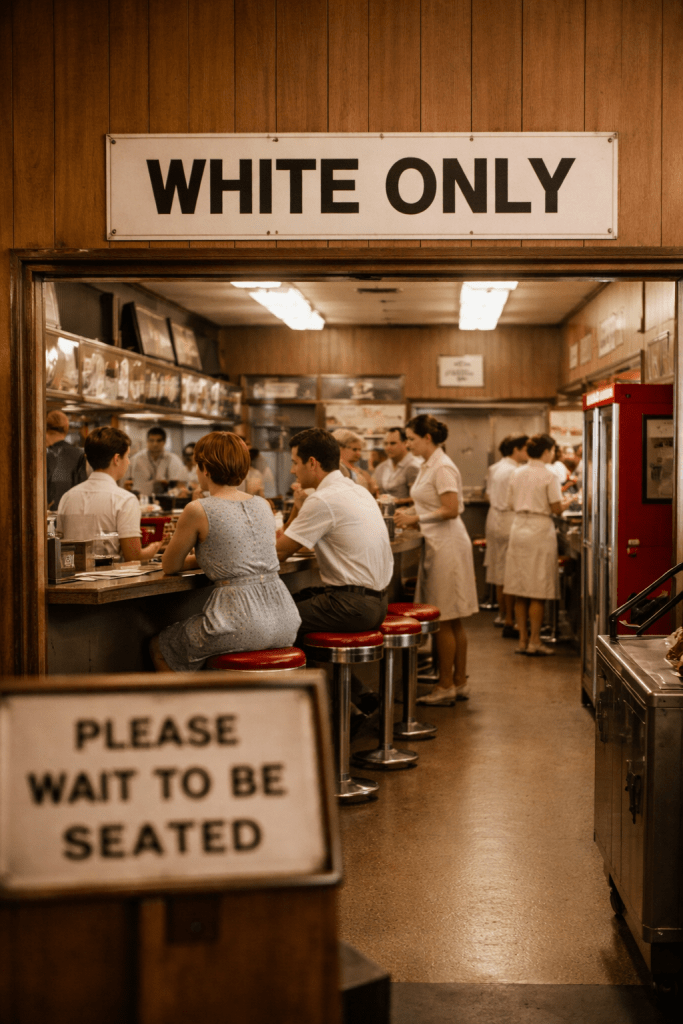
A “White Only” sign in a restaurant during the 1960s was a stark and visible symbol of Jim Crow segregation in the United States. Such signs were legally enforced in many Southern states, designating public spaces—restaurants, theaters, restrooms, water fountains, and more—where Black Americans were either denied entry entirely or relegated to inferior facilities.

These signs were not merely about seating; they reinforced a racial hierarchy, signaling that Black people were considered second-class citizens, unworthy of equal service or treatment. They were part of a broader system designed to maintain white supremacy socially, economically, and politically.

The presence of “White Only” signs had profound psychological and social effects. They dehumanized Black Americans, normalizing exclusion and instilling fear and shame. They also reinforced cultural prejudices in white communities, teaching white patrons that segregation was natural and morally acceptable.

Many Black Americans resisted these injustices through civil rights activism. Sit-ins at “White Only” lunch counters, such as the Greensboro sit-ins in 1960, challenged segregation directly, exposing the cruelty of the system and helping to galvanize national support for desegregation.

Legally, such signs were rendered unenforceable with the passage of the Civil Rights Act of 1964, which outlawed segregation in public accommodations. The removal of these signs symbolized the end of legal segregation, though the social and economic legacies of this discrimination persisted.

In short, a “White Only” sign in a 1960s restaurant was more than a notice—it was a tool of systemic oppression, a daily reminder of racial injustice, and a target for courageous activism in the fight for civil rights.

Under Jim Crow, public facilities were segregated, including schools, transportation, restrooms, restaurants, and theaters. Black citizens were forced into inferior accommodations, often with drastically fewer resources. This system reinforced the message that Black lives were less valuable and less deserving of dignity and opportunity.

Education for Black children under Jim Crow was deliberately underfunded. Schools were overcrowded, lacked textbooks and supplies, and were often housed in dilapidated buildings. This educational inequality limited social mobility, trapping generations of Black Americans in cycles of poverty and exclusion.

Voting rights were systematically restricted through measures such as literacy tests, poll taxes, and grandfather clauses. These tactics effectively disenfranchised most Black citizens in the South, silencing their political voices and denying them the ability to influence policies that affected their communities.

The economic effects of Jim Crow were devastating. Black workers were often relegated to low-paying, unstable jobs while being denied access to higher-paying, skilled labor opportunities. Sharecropping, tenant farming, and discriminatory hiring practices perpetuated economic dependency and vulnerability.

Segregation extended into healthcare, where Black patients faced limited access to hospitals, clinics, and trained physicians. Facilities for Black individuals were often under-resourced, and medical experimentation sometimes targeted Black communities without consent, reflecting the deeply embedded racial prejudice of the era.

Housing discrimination was another major consequence. Redlining and racially restrictive covenants prevented Black families from purchasing homes in certain neighborhoods. This not only limited wealth accumulation but also reinforced social segregation and concentrated poverty.

The legal system was complicit in maintaining Jim Crow. Black Americans were disproportionately targeted, arrested, and harshly sentenced, while white perpetrators often received lenient treatment. Courts upheld segregation and discriminatory laws, cementing structural racism in law and practice.

Social norms under Jim Crow reinforced the ideology of white superiority. Black individuals were subject to constant surveillance, harassment, and intimidation. Even minor perceived infractions of social etiquette could result in violent punishment, including lynching, which was often public and unpunished.

Lynching became a tool of terror used to enforce racial hierarchy. Thousands of Black men and women were murdered or brutally attacked for resisting oppression or simply existing outside the boundaries imposed by white supremacists. These acts were meant to instill fear and reinforce the perceived dominance of whites.

Jim Crow also affected the psychological well-being of Black communities. Continuous exposure to discrimination, exclusion, and violence created trauma that transcended generations. Black individuals internalized societal messages of inferiority, impacting self-esteem, mental health, and aspirations.

Resistance to Jim Crow took many forms. Organizations like the NAACP worked through legal challenges, advocacy, and education to dismantle segregation. Grassroots activism, boycotts, and acts of civil disobedience highlighted the courage and resilience of Black communities under oppression.

The Civil Rights Movement of the 1950s and 1960s directly confronted the injustices of Jim Crow. Landmark legislation, including the Civil Rights Act of 1964 and the Voting Rights Act of 1965, legally ended segregation and restored voting rights. However, the legacy of these laws persists in systemic inequalities and social attitudes.

Jim Crow fostered prejudice not only through law but also through cultural reinforcement. Media, literature, and everyday social interactions perpetuated stereotypes of Black inferiority, laziness, and criminality, creating a society that normalized racial hierarchy.

Racial prejudice under Jim Crow was enforced through both fear and ideology. Black Americans were taught to accept a subordinate status, while whites were socialized to view dominance as natural and justified. This dual reinforcement maintained systemic oppression for decades.

Family life was disrupted by Jim Crow. Economic constraints, restricted mobility, and threats of violence affected Black households, limiting opportunities for generational wealth and stability. Despite this, Black families often cultivated strong networks of support, faith, and community resilience.

Jim Crow shaped urban and rural landscapes. Segregated neighborhoods, schools, and institutions created spatial boundaries that reinforced inequality and restricted access to resources. These patterns of segregation continue to affect cities today.

The legacy of Jim Crow is evident in contemporary racial disparities. Disproportionate incarceration, educational inequities, and wealth gaps trace their roots to the structures and prejudices entrenched during this era. Understanding Jim Crow is essential to addressing these ongoing injustices.

Ultimately, Jim Crow represents the deliberate manipulation of law, culture, and social norms to maintain racial hierarchy. Its effects were profound, extending beyond the immediate physical restrictions to shape generational experiences of Black Americans. The struggle against Jim Crow is a testament to the resilience, courage, and enduring pursuit of justice by Black communities.

References

Woodward, C. V. (2002). The strange career of Jim Crow. Oxford University Press.

Litwack, L. F. (2009). Trouble in mind: Black southerners in the age of Jim Crow. Vintage.

Anderson, J. D. (1988). The education of Blacks in the South, 1860–1935. University of North Carolina Press.

Du Bois, W. E. B. (1935). Black reconstruction in America. Free Press.

Perman, M. (2001). Struggle for mastery: Disfranchisement in the South, 1888–1908. University of North Carolina Press.

Tolnay, S. E., & Beck, E. M. (1995). A festival of violence: An analysis of Southern lynchings, 1882–1930. University of Illinois Press.

Foner, E. (2011). Reconstruction: America’s unfinished revolution, 1863–1877. Harper Perennial.

The Brown Boy Dilemma: Colorism

This photograph is the property of its respective owner. No copyright infringement intended.

Colorism—the prejudice or discrimination against individuals with darker skin tones, often within the same racial group—has long been recognized as a pervasive issue affecting Black communities. While much attention has been given to the experiences of Black women, it’s crucial to examine how colorism impacts Black men, whether differently or similarly, and to understand the nuances of this phenomenon.

Understanding Colorism and Its Origins

Colorism is rooted in historical and societal structures that have privileged lighter skin tones, often associating them with beauty, intelligence, and higher social status. This bias has been perpetuated through various means, including media representation, employment opportunities, and social interactions. The Guardian

The Impact of Colorism on Black Men

Black men, like their female counterparts, experience colorism, though the manifestations and societal perceptions may differ. Studies have shown that darker-skinned Black men often face challenges in areas such as employment and social acceptance. ScholarWorks

Media Representation and Stereotyping

In media portrayals, Black men with darker skin tones are frequently depicted in roles that emphasize aggression or criminality, reinforcing negative stereotypes. Conversely, lighter-skinned Black men may be portrayed in more favorable or diverse roles, contributing to a skewed representation that favors lighter skin tones. Verywell Mind

Colorism in Dating and Relationships

Within the dating scene, preferences often lean towards lighter-skinned individuals, a bias that extends to Black men. This preference can lead to feelings of inadequacy or rejection among darker-skinned Black men, affecting their self-esteem and social interactions. Frontiers

Internalized Colorism Among Black Men

Some Black men may internalize colorist attitudes, leading to a preference for lighter-skinned partners or associates. This internalization can perpetuate the cycle of colorism within the community, as individuals may unconsciously uphold and propagate these biases. Medium

Colorism in Professional Environments

In professional settings, lighter-skinned Black men may experience advantages in hiring and promotions due to perceived proximity to Eurocentric beauty standards. Darker-skinned Black men, on the other hand, may face biases that hinder their career advancement, despite equal qualifications. Verywell Mind

The Role of Family and Community

Family and community dynamics can either challenge or reinforce colorism. In some cases, darker-skinned Black men may receive support and affirmation from their families, helping to counteract societal biases. In other instances, families may unknowingly perpetuate colorist attitudes, influencing the individual’s self-perception. The Guardian

Intersectionality and the Experience of Colorism

The experience of colorism among Black men is also shaped by other intersecting factors such as socioeconomic status, education, and geographic location. These intersections can amplify or mitigate the effects of colorism, leading to diverse experiences within the community. Verywell Mind

Addressing Colorism: Steps Toward Equity

Combatting colorism requires a multifaceted approach, including education, media reform, and community engagement. Initiatives aimed at promoting diversity and inclusion can help challenge colorist norms and create a more equitable society for all Black individuals. The Guardian

Conclusion

Colorism affects Black men in complex and multifaceted ways, often intersecting with other forms of discrimination and bias. While the experiences may differ from those of Black women, the underlying issue remains the same: a societal preference for lighter skin tones that marginalizes those with darker complexions. Addressing colorism requires collective effort and a commitment to dismantling the structures that perpetuate these biases.

References:

Dilemma: Bid ’Em Up

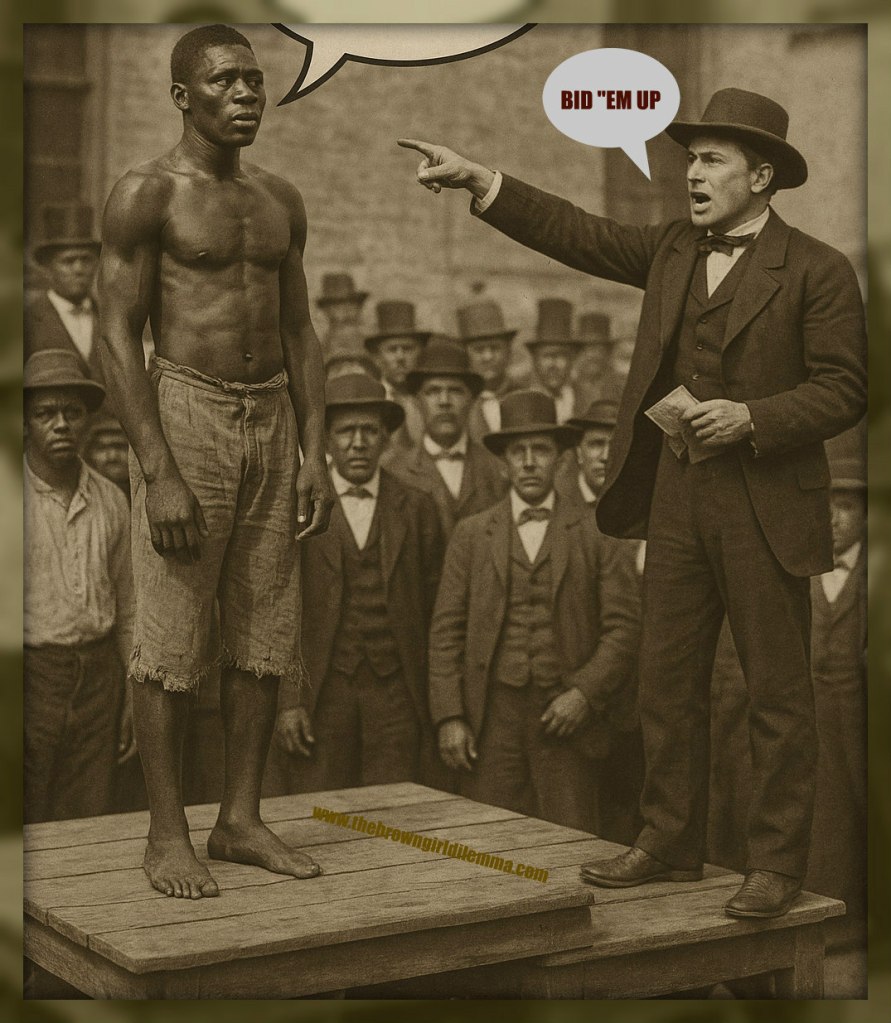
The phrase “Bid ’em up” refers to one of the most dehumanizing practices of the transatlantic slave trade: the process of auctioning African men, women, and children to the highest bidder. It was a command shouted at buyers during slave auctions, urging them to increase their bids as if the people on the block were livestock rather than human beings. This phrase captures the brutality, humiliation, and commercial greed embedded in American slavery.

Slave auctions operated as public markets where enslaved Africans were bought and sold, primarily in the 1700s–1800s, with the largest waves occurring from the early 18th century up to the Civil War in 1861. These auctions were often loud, crowded, and emotionally devastating events. Families were torn apart as husbands, wives, and children were separated, sold to different plantations, and sent to different states based solely on profit margins. “Bid ’em up” was not merely a business tactic—it was a reflection of how deeply racism shaped the economic and social system of the United States.

The auctions often took place in major Southern cities such as New Orleans, Charleston, Richmond, and Savannah. These markets drew slave traders, planters, wealthy merchants, and speculators eager to expand their labor force. In these spaces, the racial hierarchy of America was not hidden or subtle—it was on full display. Black people were forced onto platforms, examined, touched, and evaluated like property. Their bodies were scrutinized for strength, fertility, and obedience.

The enslaved were stripped of humanity through language. Terms like “bucks,” “breeders,” and “hands” reduced people to economic tools. The phrase “Bid ’em up” reveals the cold transactional nature of slavery, where human lives became items in an economic system built entirely on violence and racial domination.

Racism played a central role in justifying these practices. Europeans and white Americans constructed ideologies claiming Black people were inferior, subhuman, or naturally suited for enslavement. These racist beliefs formed the moral foundation for buying and selling millions of Africans. Without racism, the brutality of the slave market could not have been rationalized or sustained.

Slave auctions were not isolated events—they were central to the expansion of American agriculture. The rise of cotton, sugar, and rice industries increased demand for enslaved labor. The years following the 1808 ban on international slave importation saw the rise of the domestic slave trade, where enslaved people were sold from the Upper South to the Deep South in massive numbers.

These auctions were emotional battlegrounds. Many enslaved people prayed, cried, or resisted in small ways as they were forced onto the blocks. Mothers clung to their children, couples begged to stay together, and countless individuals were separated forever. The psychological trauma of these auctions rippled across generations.

The sight of chains, ropes, and shackles haunted the enslaved. Their names were replaced with auction numbers. Their futures were determined not by God or family but by the greed of bidders. The auction block became a symbol of absolute powerlessness.

Even children were not spared. Boys and girls as young as five or six were sold for their future labor value. Infants were sold with their mothers or separated from them, depending on what yielded higher profits. Slave traders calculated the price of innocence.

The practice reached its most infamous moment in 1859 during the largest recorded slave auction in U.S. history: The Weeping Time in Georgia, where over 400 enslaved people were sold over two days. The rain that fell during the event was described as the tears of heaven, mourning the suffering.

The economic impact of these auctions built generational wealth for white families while simultaneously creating generational poverty for Black Americans. Plantations, banks, and insurance companies all profited from human sale and exploitation.

The culture around slave auctions normalized cruelty. Newspapers advertised upcoming sales, listing children alongside horses. Hotels hosted bidders. Judges and sheriffs enforced fugitive slave laws to protect the system. Churches often remained silent, and in some cases participated.

After the Civil War and emancipation, the memory of the auction block became a permanent wound in African American history. It shaped family structures, migration patterns, and the cultural resilience of Black communities. Many African Americans today trace their lineage to ancestors sold on those blocks.

The legacy of “Bid ’em up” exposes how slavery was not just a labor system—it was an industry, a psychology, and a national economic engine grounded in racial violence. Understanding this context helps illuminate the roots of systemic racism in modern America.

The phrase also reminds us of the strength of the ancestors who survived unimaginable pain. Their endurance, faith, and determination laid the foundation for Black progress in the centuries that followed. They were bought and sold, yet they remained unbroken.

Remembering these auctions is not simply an act of historical reflection. It is a testimony to the resilience of a people who were denied humanity but ultimately reclaimed their identity, dignity, and voice. The auction block is a scar, but it is also a monument to survival.

In studying this painful history, we confront the truth of America’s origins. Slavery was not a footnote—it was central. And phrases like “Bid ’em up” force us to acknowledge the systems of racism that endured long after the auctions ended.

This history calls us to honor the ancestors by telling their stories truthfully, challenging systemic injustice, and ensuring that the trauma of the auction block is never forgotten.

References
Berlin, I. (2003). Generations of captivity: A history of African-American slaves. Harvard University Press.
Fett, S. (2002). Working cures: Healing, health, and power on Southern slave plantations. University of North Carolina Press.
Johnson, W. (1999). Soul by soul: Life inside the antebellum slave market. Harvard University Press.
Smallwood, S. (2007). Saltwater slavery: A Middle Passage from Africa to American diaspora. Harvard University Press.
Smith, C. (2012). The Weeping Time: Slave auctions and the economy of the South. Yale University Press.

Black History Is Holy Ground

Black history is not merely a sequence of dates or the retelling of oppression; it is sacred terrain. It is a landscape shaped by the footprints of a people who carried faith, culture, dignity, and divine resilience across centuries. To stand in the presence of Black history is to stand on holy ground, because the journey of African-descended people bears witness to a God who walked with them through fire, flood, chains, and liberation.

Black history is holy ground because it begins long before slavery. It stretches back to kingdoms and civilizations where Black people ruled, built, studied, invented, and worshiped. From Nubia to Kush, from Ghana to Songhai, from Kemet to Ethiopia, Africa cultivated intellectual and spiritual traditions that the world still draws from. This heritage elevates Black history beyond pain; it anchors it in glory.

The holiness of this history is also found in its endurance. A people torn from their homeland survived one of the greatest atrocities in human history. They survived not by accident, but by providence. Their survival testifies to a divine hand at work in the shadows of suffering, shaping a remnant that would rise again. Every preserved family line, every song sung in the cotton fields, every whispered prayer in the midnight hour speaks of sacred resilience.

Black history is holy ground because it contains a narrative of faith that never died. Enslaved Africans did not inherit Christianity from their oppressors; they discovered in Scripture a God who understood bondage, deliverance, and covenant. Through the stories of Israel, they recognized themselves. Through the Psalms, they voiced their heartbreak. Through the Gospels, they found a Messiah who stood with the broken. Their faith was not borrowed but reborn.

The holiness of this narrative deepens when we consider the spiritual resistance embedded in Black culture. Spirituals were not just songs; they were coded prayers, liberation messages, and theological declarations. The rhythmic moans of the fields became a liturgy of survival. These traditions laid the foundation for the Black church, a sacred institution that shaped activism, family, and identity for generations.

Black history is holy ground because of its prophets and pioneers. Figures like Harriet Tubman, Frederick Douglass, Sojourner Truth, and countless unnamed leaders operated with a calling that mirrored biblical deliverers. They challenged systems, freed the oppressed, and stood firmly on righteousness. Their bravery was not merely political; it was spiritual warfare.

The holiness of this story extends to the mothers of the movement. Women whose names never made textbooks carried families on their backs. They prayed children into safety, held together broken homes, and passed down wisdom that sustained the community. Their hands were altars, their kitchens sanctuaries, their lives sermons of endurance and love.

Black history is holy ground because it carries the scent of sacrifice. Countless lives were laid down—from the Middle Passage to Jim Crow, from lynching trees to segregated streets. Their blood cries out like Abel’s, reminding the world that injustice is seen by God. Their sacrifices fertilized the soil from which future generations would rise.

That rising continues through the dreamers, scholars, activists, and artists who broadened the path toward freedom. Each breakthrough was a step deeper into holy territory—a reminder that progress is not simply social, but spiritual. Civil rights victories were not just legal milestones; they were manifestations of divine justice.

Black history is holy ground because it illuminates a people who refused to be erased. Despite centuries of oppression, their culture, creativity, and identity could not be destroyed. Instead, they transformed suffering into song, brokenness into brilliance, and hardship into hope. This divine alchemy marks their journey as sacred.

Modern Black life continues this sacredness. Every achievement—from academia to art, from science to business, from ministry to music—is a continuation of a holy lineage. Each accomplishment is a chapter in a story that began thousands of years before American soil ever felt the presence of African feet.

Black history is holy ground because it challenges the world to see humanity through a divine lens. The struggle for justice reflects God’s heart for righteousness. The fight for dignity reflects God’s image within humanity. Every act of resistance is a declaration that Black life is sacred and cannot be diminished.

The sacredness of Black history is also found in its wounds. Healing requires honesty, and Black history invites the world to confront painful truths without running. Yet this truth-telling is not meant to reopen scars but to restore what was lost. There is holiness in remembering, because memory heals and honors.

Black history is holy ground because it holds prophetic power. It warns against repeating the sins of the past, calls nations to repent, and demands transformation. It speaks with the authority of a testimony shaped by centuries of struggle and triumph. It teaches that liberation is a divine mandate, not a political suggestion.

This holiness also lies in the future. Black children today inherit not just a history of suffering but a legacy of brilliance. They stand on the shoulders of kings, queens, scholars, inventors, freedom fighters, and saints. Their existence is a continuation of the sacred promise that a people once enslaved would rise beyond anything intended to destroy them.

Black history is holy ground because it reveals God’s faithfulness. In every generation, He preserved a remnant, raised leaders, empowered movements, and poured creativity into a people who refused to surrender. Their story is evidence of divine purpose. Nothing about their survival is accidental.

To walk through Black history is to walk through a sacred story—one that encompasses creation, covenant, oppression, deliverance, restoration, and glory. It is a story intertwined with Scripture, echoing the journeys of ancient Israel and the hope of future redemption. It is a holy narrative wrapped in melanin and majesty.

Ultimately, Black history is holy ground because it embodies the miracle of endurance. It reveals that no chain is stronger than the human spirit, no system stronger than divine justice, and no hatred stronger than the love planted deep within a people chosen to carry light through centuries of darkness. Black history is not just remembered; it is revered.

And for those who study it, teach it, write it, or live it—it calls them to remove their shoes. For the place where they stand is sacred.

References:
Genesis 15:13–14 (KJV); Exodus 3:5; Psalm 68:31; Isaiah 61:1–4; Luke 4:18; Revelation 7:9; Curtin, P. The Atlantic Slave Trade; Gates, H. L. Africa in World History; Raboteau, A. Slave Religion; Franklin, J. H. From Slavery to Freedom.

Black History Month: History, Struggle, and Why It Matters.

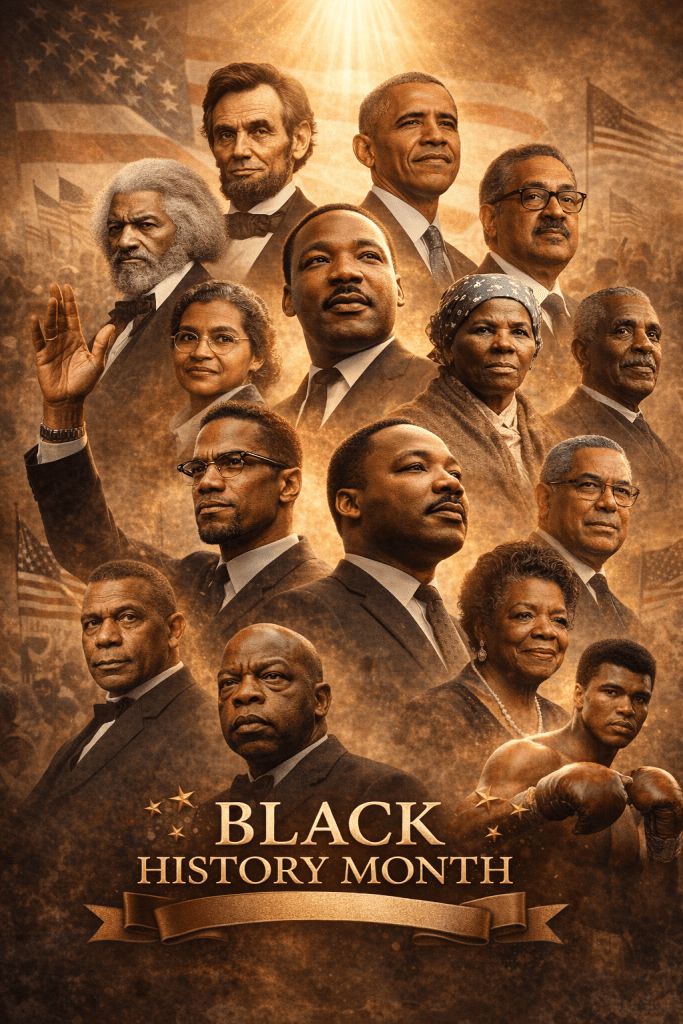
Black History Month is a nationally recognized observance in the United States dedicated to honoring the history, culture, contributions, and resilience of African Americans. It originated from the work of historian Carter G. Woodson, who established “Negro History Week” in 1926 to counter the exclusion of Black achievements from mainstream historical narratives (Woodson, 1915). The celebration expanded to a full month in 1976, officially recognized by President Gerald Ford, who urged Americans to acknowledge the “too-often neglected accomplishments of Black Americans.”

The importance of Black History Month lies in historical correction. For centuries, Black people in America were either erased from history books or portrayed only through the lens of slavery. This observance restores truth by centering Black voices, experiences, and intellectual contributions that shaped the nation politically, economically, culturally, and spiritually.

One of the foundational experiences Black Americans endured was the transatlantic slave trade, where millions of Africans were forcibly transported, enslaved, dehumanized, and exploited for labor in agriculture, infrastructure, and domestic work. Enslaved people were stripped of language, names, family structures, and legal personhood, treated as property rather than human beings (Berlin, 2003).

After emancipation in 1865, Black Americans faced Black Codes and Jim Crow laws that enforced segregation, restricted voting rights, and maintained economic dependency. Sharecropping replaced slavery with debt bondage, ensuring that many formerly enslaved people remained trapped in poverty (Du Bois, 1935).

Black Americans were subjected to widespread racial terrorism. Thousands were lynched between the late 19th and mid-20th centuries, often publicly, as a tool of social control. These acts were rarely punished and were sometimes encouraged by local authorities (Equal Justice Initiative, 2017).

The struggle for civil rights defined much of the 20th century. Black Americans fought for desegregation, voting rights, and equal protection under the law through movements led by figures such as Martin Luther King Jr., Malcolm X, Rosa Parks, and countless grassroots activists (Morris, 1984).

Despite legal progress, systemic racism persisted through redlining, housing discrimination, employment inequality, and mass incarceration. Black communities were denied access to quality education, wealth-building opportunities, and fair treatment within the criminal justice system (Alexander, 2010).

Black Americans have endured medical exploitation, including the Tuskegee Syphilis Study, where Black men were intentionally left untreated for decades without informed consent, revealing deep ethical violations in U.S. medical history (Brandt, 1978).

Culturally, Black people have faced appropriation, censorship, and marginalization, even as they created some of the most influential artistic forms in the world, including jazz, blues, hip-hop, gospel, soul, and modern dance (Gates, 2014).

Economically, Black Americans were historically excluded from the GI Bill, homeownership programs, and business funding, creating a persistent racial wealth gap that still exists today (Rothstein, 2017).

Psychologically, Black people have endured generational trauma, internalized racism, colorism, and social devaluation, which continue to shape mental health outcomes and identity development (Cross, 1991).

Black History Month is important because it affirms dignity. It reminds Black communities of their resilience, brilliance, and survival in the face of systemic oppression.

It is also important for national accountability. The United States cannot address present inequalities without understanding historical causes. Black History Month provides the context necessary for meaningful dialogue about race, justice, and equity.

The month serves as an educational intervention. Many U.S. school systems still under-teach Black history outside of slavery and civil rights. This observance creates space to explore African civilizations, Black inventors, scholars, scientists, and leaders whose contributions are often ignored.

Black History Month is a tool of empowerment. Representation shapes identity, and seeing Black excellence in history strengthens self-concept, especially for Black youth.

It is also a form of resistance. Remembering is an act of defiance against erasure. Historical memory challenges dominant narratives that portray Black people only through deficit and suffering.

Finally, Black History Month matters because Black history is American history. The United States was built through Black labor, culture, struggle, and innovation. To ignore this is to misunderstand the nation itself.

Black History Month is not about separation, but inclusion. It exists not to isolate Black history, but to correct a system that excluded it for centuries.

The ultimate purpose of Black History Month is truth, healing, and transformation. It invites the nation to confront its past honestly, honor those who endured it, and commit to building a more just future.


References

Alexander, M. (2010). The new Jim Crow: Mass incarceration in the age of colorblindness. The New Press.

Berlin, I. (2003). Generations of captivity: A history of African-American slaves. Harvard University Press.

Brandt, A. M. (1978). Racism and research: The case of the Tuskegee Syphilis Study. Hastings Center Report, 8(6), 21–29.

Cross, W. E. (1991). Shades of Black: Diversity in African-American identity. Temple University Press.

Du Bois, W. E. B. (1935). Black reconstruction in America, 1860–1880. Free Press.

Equal Justice Initiative. (2017). Lynching in America: Confronting the legacy of racial terror.

Gates, H. L. (2014). Life upon these shores: Looking at African American history, 1513–2008. Knopf.

Morris, A. D. (1984). The origins of the civil rights movement. Free Press.

Rothstein, R. (2017). The color of law: A forgotten history of how our government segregated America. Liveright.

Woodson, C. G. (1915). The education of the Negro prior to 1861. G.P. Putnam’s Sons.

Racism Through Multiple Lenses.

Photo by Andrea Piacquadio on Pexels.com

Historical-Political Lens
Racism, as a historical and political construct, has been deeply tied to the legacy of colonialism and slavery. European colonizers justified the transatlantic slave trade by constructing a racial hierarchy that dehumanized African people, reducing them to property while elevating whiteness as a marker of superiority. This ideology became embedded in legal and political systems, shaping institutions from plantation economies to segregation laws. Jim Crow legislation in the United States, apartheid in South Africa, and colonial laws across the Caribbean and Africa exemplify how racism was codified into structures that controlled land, labor, and liberty. The ripple effect of these policies continues to impact education, wealth distribution, and incarceration rates, leaving a deep scar on the Black diaspora.

Psychological-Social Lens
Racism also functions as a psychological weapon, embedding inferiority in the minds of the oppressed while sustaining superiority in the oppressor. Socially, it manifests in stereotypes, microaggressions, and discriminatory practices that mark Blackness as “less than.” The theory of internalized racism explains how marginalized people sometimes adopt negative beliefs about their own group, perpetuating self-doubt and division (Pyke, 2010). Colorism, an internal byproduct of racism, privileges lighter skin tones and stigmatizes darker ones, creating hierarchies within the Black community itself. This psychological warfare produces identity conflicts, where individuals grapple with reconciling pride in their heritage with the societal messages that devalue it.

Faith-Based Lens
From a biblical perspective, racism stands in direct contradiction to God’s creation. Scripture affirms that all people are made in the image of God: “So God created man in his own image… male and female created he them” (Genesis 1:27, KJV). Racism is not only a social evil but a spiritual one, seeking to divide what God has united. For covenant people, racism echoes the warnings of Deuteronomy 28, where disobedience would lead to scattering, oppression, and subjugation under foreign nations. Yet the Bible also provides a vision of hope: “There is neither Jew nor Greek… for ye are all one in Christ Jesus” (Galatians 3:28, KJV). This does not erase cultural or ethnic identity but calls covenant people to rise above the divisions imposed by man and reclaim their God-given dignity.

Contemporary Lens
In today’s world, racism persists in both overt and subtle forms. While laws against segregation and discrimination exist, systemic inequities remain. Policing disparities, environmental racism, and unequal access to healthcare and education demonstrate how racism evolves with the times. Social media has become a double-edged sword: on one hand, it exposes racist incidents and provides platforms for movements like Black Lives Matter; on the other, it amplifies racist rhetoric and misinformation. Capitalism, too, has commodified Black culture, profiting from music, fashion, and language while often excluding Black creators from ownership and wealth. Racism adapts to modern contexts, proving it is not a relic of the past but a present-day reality that demands vigilance.

Restorative Lens
Healing from racism requires both collective and personal restoration. On a societal level, it involves dismantling oppressive systems and addressing the structural inequalities that perpetuate racial disparities. On a personal and communal level, it demands confronting internalized racism, affirming Black identity, and fostering pride in heritage. Spiritually, healing is rooted in reconciliation with God’s design, remembering that oppression was never His intent. Unity must be cultivated within the Black community, bridging divisions of color, class, and status. As Scripture declares, “How good and how pleasant it is for brethren to dwell together in unity!” (Psalm 133:1, KJV). True restoration involves reclaiming history, reshaping narratives, and building a future where dignity is no longer denied but celebrated.


📖 References

  • Holy Bible, King James Version.
  • Pyke, K. D. (2010). What is internalized racial oppression and why don’t we study it? Sociological Perspectives, 53(4), 551–572.

Dilemma: The Slave Bible

The history of the Slave Bible reveals one of the most calculated spiritual manipulations in modern history—an intentional distortion of sacred scripture used to justify racial domination and suppress liberation. Far from promoting Christian faith in its fullness, the Slave Bible was engineered as a tool of control, ensuring that enslaved Africans would encounter a theology of obedience rather than a gospel of freedom.

Christianity was introduced to enslaved Africans under coercive conditions. European slaveholders claimed religious benevolence while simultaneously denying enslaved people access to the full biblical text. Literacy itself was criminalized; laws across the American South forbade enslaved Africans from learning to read, as literacy was directly linked to resistance, organization, and revolt (Williams, 2005).

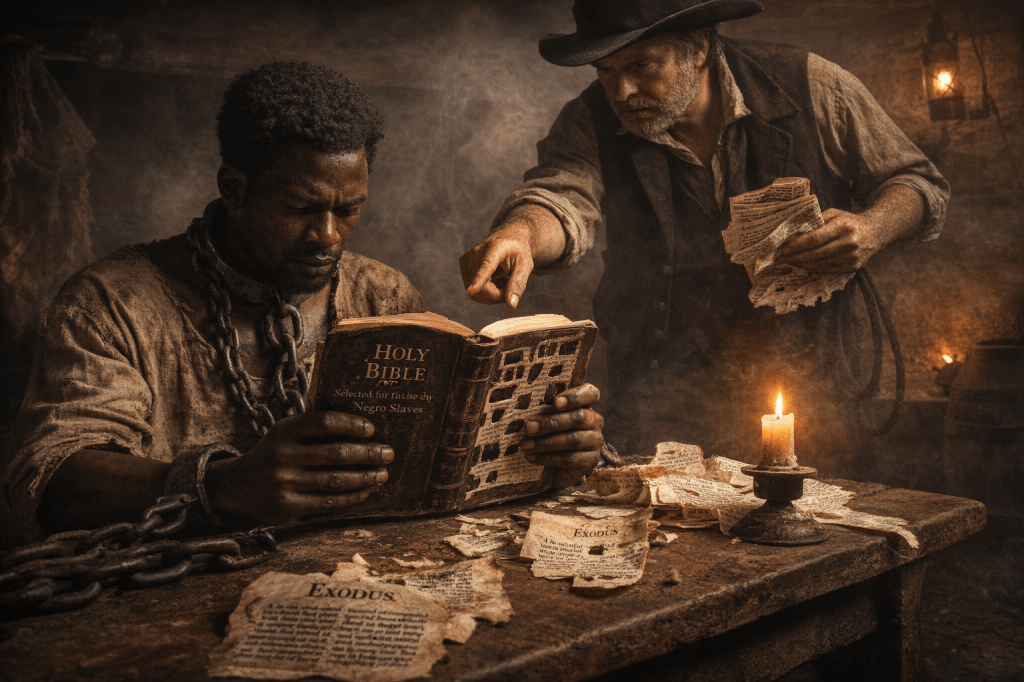
The Slave Bible, formally titled Parts of the Holy Bible, Selected for the Use of the Negro Slaves, in the British West-India Islands (1807), was produced by Anglican missionaries affiliated with the Society for the Conversion of Negro Slaves. This was not a complete Bible but a heavily redacted version designed to serve plantation interests rather than spiritual truth (Thompson, 1998).

Of the 1,189 chapters in the Protestant Bible, approximately 90 percent of the Old Testament was removed, along with nearly half of the New Testament. Entire books central to liberation theology—Exodus, Deuteronomy, Joshua, Judges, and large portions of the prophets—were omitted because they emphasized deliverance from bondage and divine justice against oppressors.

Exodus was especially dangerous to slaveholders. The story of Israel’s deliverance from Egypt offered enslaved Africans a clear theological parallel: a God who hears the cries of the oppressed, confronts empire, and breaks chains. By removing Exodus 1–20 almost entirely, slaveholders eliminated the most explicit biblical narrative of emancipation (Raboteau, 2004).

Passages affirming equality before God were likewise excised. Galatians 3:28—“There is neither Jew nor Greek, bond nor free”—was absent. So too were scriptures condemning manstealing, such as Exodus 21:16 and 1 Timothy 1:10, which explicitly define kidnapping humans as a crime punishable by death under Mosaic law.

What remained were verses emphasizing submission, obedience, and silence. Ephesians 6:5—“Servants, be obedient to them that are your masters”—was retained without its broader theological context. Colossians and 1 Peter were selectively edited to reinforce a one-sided doctrine of servitude stripped of moral accountability for masters.

This selective theology created a distorted Christ—one who demanded submission but never confronted injustice. The radical Jesus who overturned tables, rebuked elites, and proclaimed freedom to the captives (Luke 4:18) was minimized or erased entirely.

The suppression of biblical literacy extended beyond redaction. Enslaved Africans caught with books or attempting to read scripture independently faced brutal punishment. Slaveholders understood that the Bible, when read holistically, posed a direct threat to the institution of slavery (Douglass, 1845/2003).

Despite these restrictions, enslaved Africans developed clandestine religious practices. “Hush harbors” and secret prayer meetings allowed them to reinterpret scripture orally, often preserving the liberation themes that slaveholders sought to erase. Oral theology became a form of resistance and survival (Raboteau, 2004).

Enslaved preachers often re-centered Exodus, Revelation, and prophetic justice through song, spirituals, and coded language. Songs like Go Down, Moses were not merely hymns but theological declarations of impending freedom and divine judgment against Pharaoh-like systems.

The Slave Bible also reveals the racialization of God. White supremacy reimagined Christianity as inherently European, positioning whiteness as godly and Blackness as cursed—often through misinterpretations of the so-called “Curse of Ham,” a doctrine now widely rejected by scholars (Haynes, 2002).

This theological distortion had lasting psychological consequences. By weaponizing scripture, slaveholders attempted to sever enslaved Africans from a God of justice and reframe oppression as divine order. This contributed to generational trauma and religious confusion within Black communities.

Yet, history shows that the strategy ultimately failed. Enslaved Africans did not abandon God; they reclaimed Him. Black Christianity emerged as a counter-theology—one rooted in liberation, survival, and divine reversal of power structures.

The legacy of the Slave Bible demands critical reflection today. It exposes how scripture can be manipulated when removed from historical, linguistic, and ethical context. It also warns against any theology that aligns God with the empire rather than the oppressed.

Modern scholarship recognizes the Slave Bible as evidence not of Christian faithfulness, but of moral corruption. It stands as a testament to how religion can be weaponized when truth threatens power.

Importantly, the Slave Bible also affirms why unrestricted access to scripture matters. When people read the Bible for themselves, they encounter a God who repeatedly sides with the marginalized, condemns exploitation, and demands justice.

The full biblical canon—especially the prophets, the law, and the teachings of Christ—cannot coexist with chattel slavery without contradiction. This is precisely why it had to be edited.

Today, the Slave Bible is preserved in museums not as a sacred text, but as a warning. It reminds us that oppression often fears education more than rebellion and that truth, once uncovered, cannot remain chained.

Ultimately, the story of the Slave Bible is not just about what was removed, but about what endured. Faith survived censorship. Hope survived mutilation. And the God of the oppressed could not be erased—even when His words were.


References

Douglass, F. (2003). Narrative of the life of Frederick Douglass, an American slave (Original work published 1845). Penguin Classics.

Haynes, S. R. (2002). Noah’s curse: The biblical justification of American slavery. Oxford University Press.

Raboteau, A. J. (2004). Slave religion: The “invisible institution” in the antebellum South (Updated ed.). Oxford University Press.

Thompson, V. B. (1998). The making of the African diaspora in the Americas, 1441–1900. Longman.

Williams, J. E. (2005). Religion and violence in early American slavery. Routledge.

Society for the Conversion of Negro Slaves. (1807). Parts of the Holy Bible, selected for the use of the Negro slaves, in the British West-India Islands. London: Law and Gilbert.

The Holy Bible, King James Version. (1611/1769). Cambridge University Press.

Aesthetics, Access, and Anti-Blackness

Aesthetics have never been neutral. From art and architecture to beauty standards and branding, what a society deems “beautiful” often reflects who holds power. In the Western world, aesthetic norms were constructed alongside colonialism, elevating Eurocentric features while devaluing African phenotypes, cultures, and expressions. This hierarchy of beauty became a quiet but powerful mechanism of anti-Blackness.

Anti-Black aesthetics operate by rendering Blackness undesirable, excessive, or threatening. Dark skin, broad noses, full lips, coily hair, and African body types were historically caricatured and pathologized. These representations did not arise organically; they were crafted to justify enslavement, segregation, and social exclusion.

Colonial visual culture played a central role in this process. European art and early scientific illustrations depicted Africans as primitive or animalistic, contrasting sharply with idealized white bodies portrayed as rational and refined. These images circulated widely, shaping public perception and reinforcing racial hierarchies.

Access became the material consequence of aesthetic hierarchy. Beauty standards dictated who could enter certain spaces, industries, and opportunities. From employment and housing to education and media visibility, proximity to whiteness often determined access to social mobility.

The beauty industry institutionalized this bias. For decades, cosmetic products, hair care lines, and advertising excluded darker skin tones and natural hair textures. Black consumers were forced to assimilate or self-alter in order to be seen as professional or acceptable.

Colorism emerged as a byproduct of anti-Black aesthetics. Within Black communities themselves, lighter skin and looser curls were rewarded, while darker skin was stigmatized. This internalized hierarchy reflects the psychological residue of colonial domination.

Media representation continues to shape aesthetic access. Black characters are often relegated to stereotypes, while darker-skinned women and men are underrepresented in leading or romantic roles. Visibility becomes conditional upon conformity to palatable forms of Blackness.

Fashion and luxury spaces also function as aesthetic gatekeepers. Black bodies are celebrated as inspiration yet policed as consumers. Cultural appropriation allows Black style to be commodified while Black people themselves face exclusion from elite spaces.

Educational institutions reinforce aesthetic norms through Eurocentric curricula that privilege Western art, philosophy, and standards of excellence. African aesthetics are often treated as supplemental or folkloric rather than foundational.

In the workplace, aesthetics dictate professionalism. Natural Black hair has been labeled unkempt, braids deemed unprofessional, and dark skin subtly associated with incompetence. These judgments translate into hiring bias, wage gaps, and limited advancement.

The criminalization of Black aesthetics further exposes anti-Blackness. Hoodies, sagging pants, and Afros have been used to justify surveillance, harassment, and lethal force. Black style becomes evidence of threat rather than expression.

Social media has intensified aesthetic policing while offering new avenues of resistance. Algorithms often favor Eurocentric beauty, yet digital platforms also allow Black creators to reclaim narrative control and redefine beauty on their own terms.

Historically, Black resistance has always included aesthetic rebellion. From African textiles and hairstyles to the Black Arts Movement, aesthetic expression has functioned as cultural preservation and political defiance.

Access to health and wellness is also shaped by aesthetics. Studies show that darker-skinned individuals receive less attentive medical care, as pain tolerance and credibility are racially biased. Appearance influences who is believed and who is neglected.

Aesthetics intersect with capitalism by determining market value. Black beauty generates billions in revenue, yet ownership and profit remain largely outside Black communities. Extraction persists even in celebration.

The psychological toll of aesthetic exclusion is profound. Anti-Black beauty standards contribute to low self-esteem, body dysmorphia, and identity fragmentation, particularly among Black youth.

Policy interventions such as the CROWN Act reveal how deeply aesthetics are tied to civil rights. Laws protecting natural hair underscore that beauty norms are not merely cultural preferences but mechanisms of discrimination.

Challenging anti-Black aesthetics requires structural change, not just representation. It demands redistribution of access, ownership, and authority over cultural production.

Reclaiming Black aesthetics is an act of liberation. When Black people define beauty on their own terms, they disrupt systems that profit from their erasure while consuming their culture.

Ultimately, aesthetics are about power—who is seen, who is valued, and who belongs. Until Blackness is no longer a barrier to beauty, access, and dignity, anti-Blackness will remain embedded in the visual and social fabric of society.


References

Bourdieu, P. (1984). Distinction: A social critique of the judgement of taste. Harvard University Press.

Collins, P. H. (2000). Black feminist thought: Knowledge, consciousness, and the politics of empowerment. Routledge.

Craig, M. L. (2002). Ain’t I a beauty queen? Black women, beauty, and the politics of race. Oxford University Press.

Fanon, F. (1952/2008). Black skin, white masks. Grove Press.

Hunter, M. (2007). The persistent problem of colorism. Sociology Compass, 1(1), 237–254.

Tate, S. A. (2015). Skin bleaching in black Atlantic zones. Palgrave Macmillan.

Wilkerson, I. (2020). Caste: The origins of our discontents. Random House.