Category Archives: america

America, the Great? Power, Paradox, and the Price of Progress.

This photograph is the property of its respective owner.

America has long been celebrated as a beacon of freedom, democracy, and opportunity. The phrase “America the Great” echoes through political speeches, national anthems, and cultural narratives. Yet beneath this polished identity lies a complex and often troubling history shaped by conquest, exploitation, racial hierarchy, and systemic inequality. To understand why America considers itself “great,” one must examine both its achievements and the deeply rooted injustices that have defined its development.

The notion of American greatness is largely tied to its economic power, global influence, and foundational ideals of liberty outlined in the Declaration of Independence. These ideals, however, were not extended to all people. From its inception, the nation operated within contradictions—proclaiming freedom while institutionalizing slavery.

The economic foundation of the United States was built significantly through the exploitation of enslaved Africans during the Transatlantic Slave Trade. Millions of Black bodies were commodified, stripped of identity, and subjected to chattel slavery, a system in which human beings were treated as property. This system fueled agricultural wealth, particularly in cotton and tobacco industries, making America a global economic force.

Chattel slavery in America was uniquely brutal. Enslaved people were denied legal rights, family stability, and bodily autonomy. Their labor was extracted without compensation, and violence was used to maintain control. The wealth generated from slavery directly contributed to the nation’s infrastructure, banking systems, and early industrialization.

The myth of meritocracy often overshadows the reality that America’s prosperity was not built on equal opportunity but on unequal exploitation. Black labor laid the foundation of American capitalism while Black people themselves remained excluded from its benefits.

The presidency of Abraham Lincoln is often highlighted as a turning point in American history. Lincoln’s issuance of the Emancipation Proclamation symbolized a shift toward ending slavery. However, it is important to recognize that this act was as much a strategic wartime decision as it was a moral one.

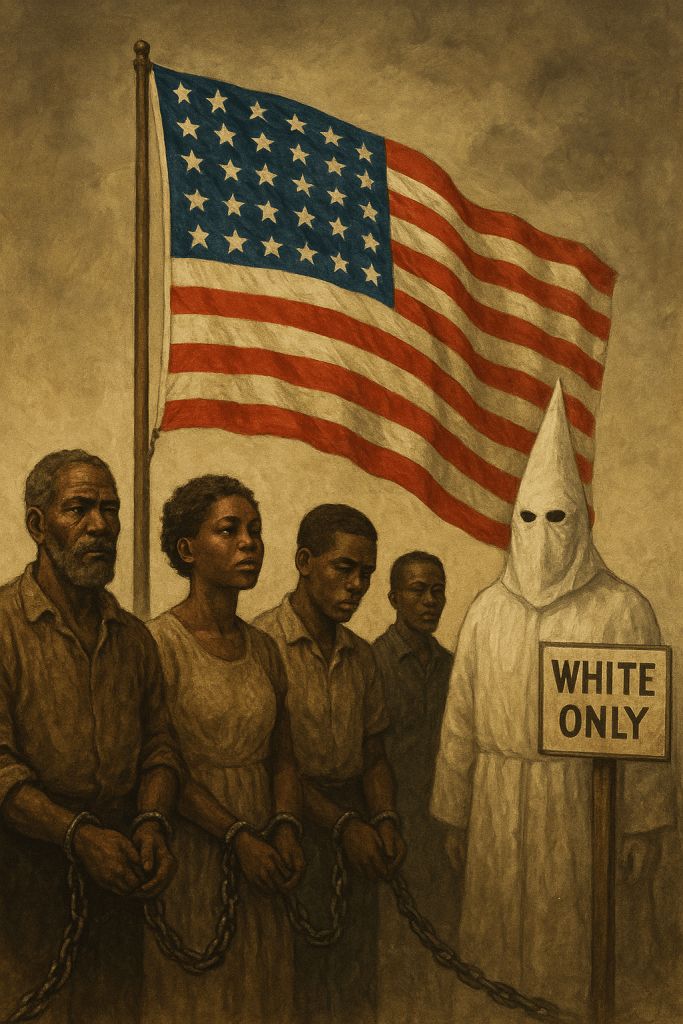
While Lincoln played a role in the abolition of slavery, freedom did not equate to equality. The end of slavery ushered in a new era of oppression through systems like Black Codes and later the Jim Crow Laws, which legally enforced racial segregation and disenfranchisement.

The Jim Crow era institutionalized racial inequality across the South and beyond. Black Americans were subjected to separate and unequal facilities, denied voting rights, and lived under constant threat of racial violence. Lynching became a tool of terror, reinforcing white supremacy.

The Civil Rights Movement emerged as a response to these injustices. Leaders like Martin Luther King Jr., Malcolm X, and Rosa Parks challenged systemic racism and demanded equal rights under the law.

Legislation such as the Civil Rights Act of 1964 and the Voting Rights Act of 1965 marked significant victories. However, these legal gains did not dismantle the structural inequalities embedded within American society.

The concept of “shadow slavery” refers to modern systems that disproportionately affect Black communities, such as mass incarceration, economic disenfranchisement, and exploitative labor practices. These systems mirror aspects of slavery by controlling bodies and limiting freedom through institutional mechanisms.

Mass incarceration, often referred to as the “New Jim Crow,” disproportionately targets Black men, perpetuating cycles of poverty and marginalization. Policies such as the War on Drugs intensified these disparities, criminalizing entire communities.

Economic inequality remains a defining feature of American society. Despite being one of the wealthiest nations in the world, millions of Americans live in poverty. Black Americans, in particular, face systemic barriers to wealth accumulation, including discriminatory housing practices like redlining.

The American Dream promises upward mobility through hard work, yet this ideal is not equally accessible. Structural inequalities in education, employment, and healthcare continue to hinder progress for marginalized groups.

America’s global image as a land of opportunity often obscures the lived realities of its most vulnerable populations. Homelessness, food insecurity, and wage stagnation challenge the narrative of greatness.

The treatment of Black people in America cannot be divorced from its history. From slavery to segregation to systemic racism, each era has left an indelible mark on the social and economic fabric of the nation.

In recent years, Diversity, Equity, and Inclusion (DEI) initiatives have attempted to address these disparities. However, there has been significant backlash, with many institutions rolling back or eliminating such programs.

The dismantling of DEI efforts reflects a broader resistance to acknowledging and addressing systemic inequality. Critics argue that these programs are divisive, while proponents see them as necessary for achieving equity.

The tension surrounding DEI highlights the ongoing struggle over America’s identity. Is it a nation committed to equality, or one that resists confronting its past?

Education plays a critical role in shaping national narratives. The omission or sanitization of historical truths in curricula perpetuates ignorance and hinders progress.

The legacy of slavery and segregation continues to influence contemporary issues such as police brutality, racial profiling, and voter suppression.

Movements like Black Lives Matter have brought renewed attention to these injustices, challenging the notion that America has moved beyond its racist past.

The concept of greatness is often tied to power and dominance. America’s military strength and economic influence contribute to its global standing, but these factors do not necessarily equate to moral or ethical superiority.

Patriotism can sometimes function as a barrier to critical reflection. Questioning America’s history is often met with resistance, as it challenges deeply held beliefs about national identity.

The idea of American exceptionalism suggests that the United States is inherently different from and superior to other nations. This belief can obscure the need for accountability and reform.

Historical amnesia allows injustices to persist. Without a full reckoning with the past, systemic inequalities remain entrenched.

The labor of enslaved Africans was not merely a footnote in American history—it was central to the nation’s development. Acknowledging this truth is essential to understanding present-day disparities.

Reparations have been proposed as a means of addressing the enduring impact of slavery and systemic racism. This debate continues to spark controversy and resistance.

The criminal justice system reflects broader societal inequalities. Disparities in sentencing, policing, and incarceration rates reveal deep-rooted biases.

Healthcare inequality is another manifestation of systemic racism. Black Americans face higher rates of chronic illness and lower access to quality care.

Housing discrimination has long-term effects on wealth accumulation and community stability. Redlining and discriminatory lending practices have created lasting disparities.

Education inequality limits opportunities for upward mobility. Underfunded schools in predominantly Black communities perpetuate cycles of disadvantage.

The media plays a role in shaping perceptions of Black people, often reinforcing stereotypes and biases.

Cultural contributions of Black Americans—music, art, language—have profoundly influenced American identity, yet the creators are often marginalized.

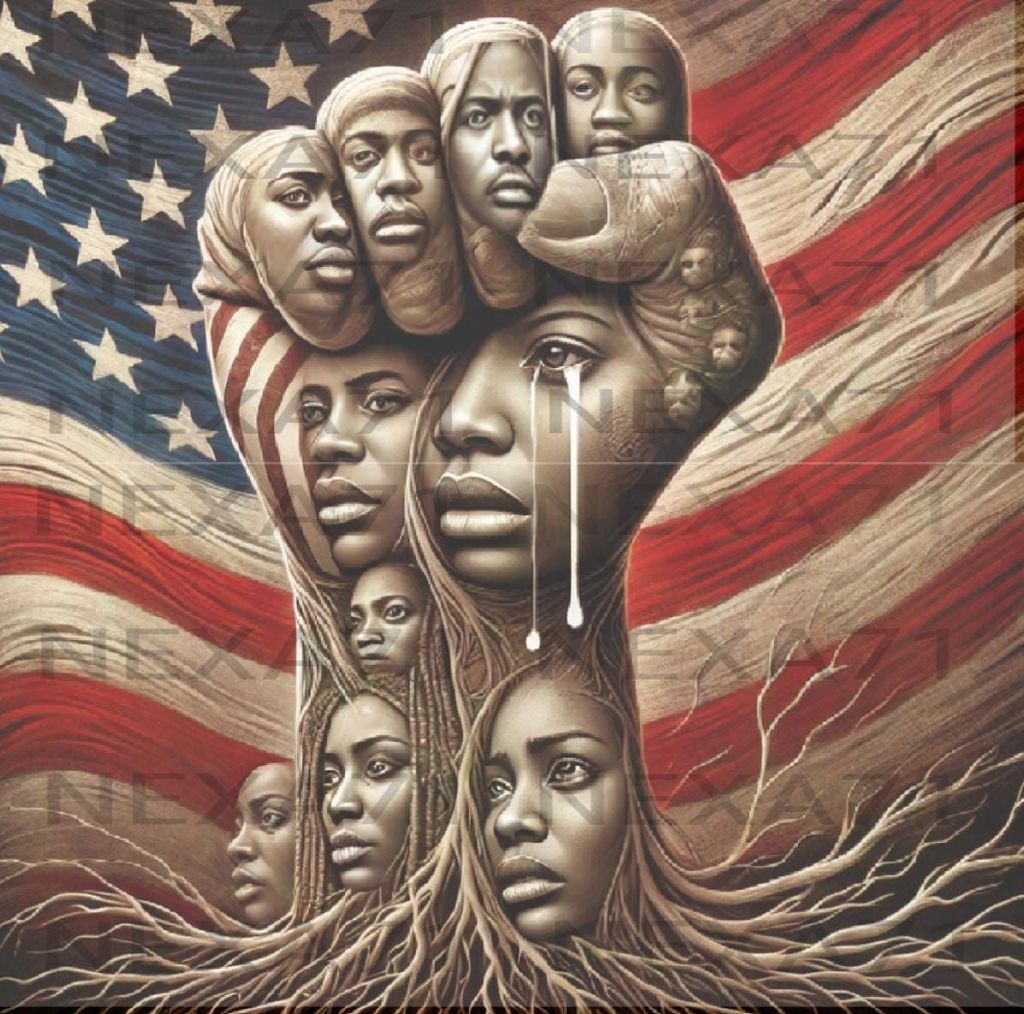
The resilience of Black communities in the face of systemic oppression is a testament to strength and perseverance.

America’s greatness, if it exists, may lie not in its perfection but in its potential for growth and transformation.

True greatness requires accountability, justice, and a commitment to equity. Without these, the label becomes hollow.

The question is not whether America is great, but for whom it has been great—and at what cost.

A nation cannot fully realize its ideals while ignoring the suffering that built it.

The path forward requires honest dialogue, systemic change, and a willingness to confront uncomfortable truths.

Only then can America begin to reconcile its identity with its reality.


References

Alexander, M. (2010). The New Jim Crow: Mass incarceration in the age of colorblindness. The New Press.

Anderson, C. (2016). White Rage: The unspoken truth of our racial divide. Bloomsbury.

Baptist, E. E. (2014). The half has never been told: Slavery and the making of American capitalism. Basic Books.

Du Bois, W. E. B. (1903). The souls of Black folk. A.C. McClurg & Co.

Foner, E. (2010). The fiery trial: Abraham Lincoln and American slavery. W.W. Norton.

Hannah-Jones, N. (2019). The 1619 Project. The New York Times Magazine.

Massey, D. S., & Denton, N. A. (1993). American apartheid: Segregation and the making of the underclass. Harvard University Press.

Muhammad, K. G. (2010). The condemnation of Blackness: Race, crime, and the making of modern urban America. Harvard University Press.

Omi, M., & Winant, H. (2014). Racial formation in the United States. Routledge.

Wilkerson, I. (2020). Caste: The origins of our discontents. Random House.
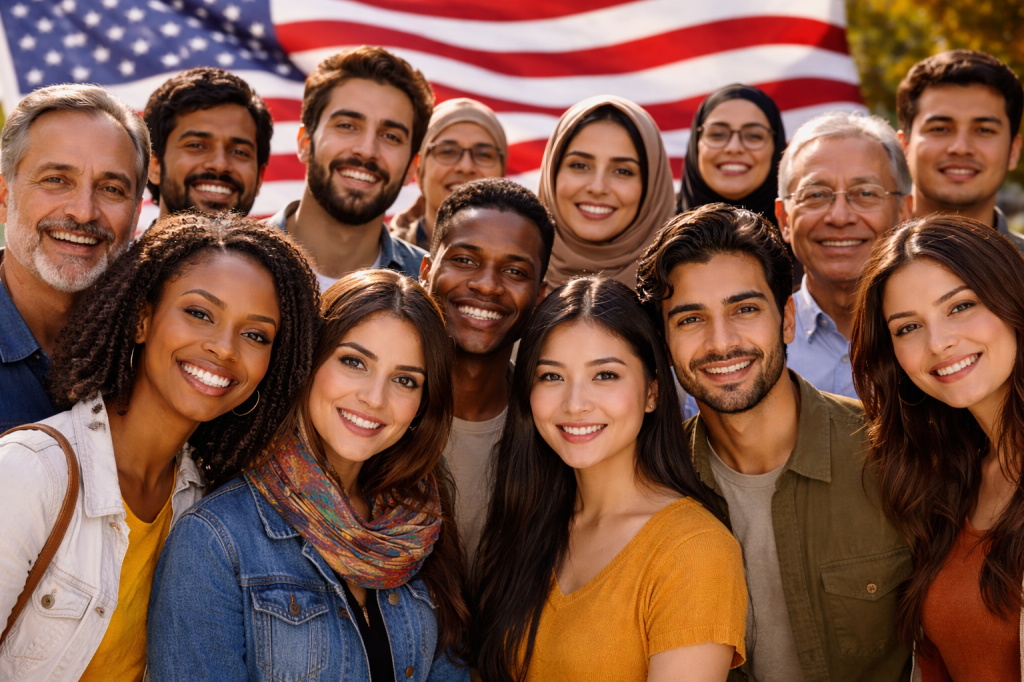
Voices of the Americas: Black, Hispanic, Asian, Italian, and the Tapestry of Minority Sacrifice

The story of the United States is inseparable from the stories of its minorities. America’s economic strength, cultural vitality, and democratic evolution were built not by a single people, but by a convergence of nations, languages, and bloodlines. From forced migration to voluntary arrival, each community has carried both hope and hardship into the American narrative.

African Americans represent one of the oldest continuous minority presences in the nation, arriving first through the transatlantic slave trade in 1619. Enslaved Africans were forcibly transported, stripped of homeland and lineage, yet they laid the agricultural and economic foundation of early America. Their labor undergirded plantation wealth and national expansion, even as their humanity was denied.

Following emancipation, Black Americans faced Reconstruction’s collapse, Jim Crow segregation, racial terror, and systemic exclusion. The Great Migration reshaped northern cities as millions sought industrial opportunity and safety. The Civil Rights Movement, led by figures such as Martin Luther King Jr., transformed American law and conscience, yet disparities in wealth, policing, and healthcare persist.

Hispanic and Latino Americans trace their roots to Spanish colonization long before the United States existed. Regions such as California, Texas, and Florida were once part of Spain and later Mexico. After the Mexican-American War, many Mexicans became Americans overnight when borders shifted rather than people moving.

Immigration from Mexico, Puerto Rico, Cuba, and Central America increased in the twentieth century due to labor demands, political instability, and economic opportunity. Programs such as the Bracero Program recruited Mexican workers during World War II. Today, Latinos face immigration debates, labor inequities, and language-based discrimination, even as they contribute profoundly to agriculture, construction, military service, and entrepreneurship.

Asian Americans arrived in significant numbers during the nineteenth century, beginning with Chinese laborers who helped build the Transcontinental Railroad. Their sacrifice was met with exclusionary policies such as the Chinese Exclusion Act of 1882. Despite this discrimination, Chinese communities established resilient cultural and economic enclaves.

Japanese immigrants faced incarceration during World War II under Executive Order 9066, despite many being American citizens. Korean, Filipino, Indian, and Vietnamese immigrants followed in later waves, often shaped by war, colonial ties, or refugee resettlement policies. Asian Americans today continue to confront stereotypes and periodic surges of xenophobia, particularly during geopolitical tensions.

Italian Americans migrated in large numbers between 1880 and 1920, fleeing poverty and political instability in southern Italy. Upon arrival, they often encountered nativist hostility and were stereotyped as criminals or anarchists. Over time, they built tight-knit communities, contributing to urban labor, cuisine, art, and public service.

Irish Americans, though now often perceived as fully integrated, endured severe discrimination during the nineteenth century. Fleeing the Great Famine, they were met with “No Irish Need Apply” sentiments. They filled industrial jobs, shaped urban political machines, and gradually ascended into mainstream civic life.

Native Americans represent the original inhabitants of the Americas and have endured forced displacement, broken treaties, and cultural suppression. The Trail of Tears and the reservation system stand as painful reminders of conquest and survival. Despite systemic marginalization, Indigenous communities preserve language, sovereignty, and cultural identity.

Arab Americans began migrating in the late nineteenth century, often from Lebanon and Syria, and later from other parts of the Middle East. Many arrived seeking economic opportunity. Post-9/11 suspicion intensified scrutiny and discrimination, yet Arab Americans remain active in business, medicine, and public service.

Caribbean Americans, including Haitian and Jamaican immigrants, have shaped music, healthcare, and entrepreneurship. Migration increased in the twentieth century due to economic and political pressures in the Caribbean basin. These communities often navigate racial identity within broader Black American experiences while maintaining distinct cultural traditions.

African immigrants, distinct from descendants of enslaved Africans, have arrived in increasing numbers since the Immigration and Nationality Act of 1965. Highly educated and entrepreneurial, they contribute to academia, healthcare, and technology sectors while adapting to America’s racial frameworks.

Filipino Americans, whose migration ties date to U.S. colonial governance of the Philippines, have long served in the U.S. Navy and healthcare professions. Their presence illustrates how imperial history shaped migration patterns.

South Asian Americans, including Indian and Pakistani immigrants, expanded significantly after 1965 immigration reforms favored skilled labor. They have made substantial contributions in medicine, engineering, and technology while navigating religious discrimination and post-9/11 scrutiny.

Latina and Asian women have played pivotal roles in garment factories, domestic labor, and nursing, often underpaid and underrecognized. Their sacrifices fueled urban economies while supporting transnational families.

Military service stands as a shared thread across minority communities. From the Buffalo Soldiers to Hispanic Medal of Honor recipients, from Japanese American units in World War II to contemporary immigrant enlistments, minority sacrifice has defended freedoms not always fully extended to them.

Today, minorities collectively face wealth gaps, educational inequities, healthcare disparities, and political polarization. Yet they also represent demographic growth, entrepreneurial dynamism, and cultural innovation. American music, cuisine, language, and art reflect their imprint.

The American experiment is thus not a singular inheritance but a chorus. Black resilience, Hispanic heritage, Asian diligence, Italian and Irish perseverance, Jewish scholarship, Indigenous endurance, Arab entrepreneurship, Caribbean rhythm, and African ambition form a mosaic rather than a monolith.

Voices of the Americas are not peripheral to the nation’s story—they are foundational. Their migrations, whether forced or chosen, their sacrifices in labor and war, and their ongoing pursuit of equity define the evolving meaning of American identity.


References

Daniels, R. (2002). Coming to America: A History of Immigration and Ethnicity in American Life. HarperCollins.

Foner, E. (2014). Give Me Liberty!: An American History. W.W. Norton.

Takaki, R. (2008). A Different Mirror: A History of Multicultural America. Back Bay Books.

The Holy Bible, King James Version (for general themes of migration and diaspora).

U.S. Census Bureau. (2023). Demographic Profile of the United States.

Black History Month: Trayvon Martin – A Life Stolen, A Nation Awakened.

Trayvon Benjamin Martin was born on February 5, 1995, in Miami, Florida. He was a young African American teenager known by his family and friends as kind-hearted, playful, and full of potential. Trayvon enjoyed sports, especially football and basketball, and aspired to become an aviation mechanic. Like many young Black boys in America, his life reflected both ordinary youthful dreams and the inherited weight of navigating a society shaped by racial stereotypes and systemic inequality.


What Happened to Trayvon Martin

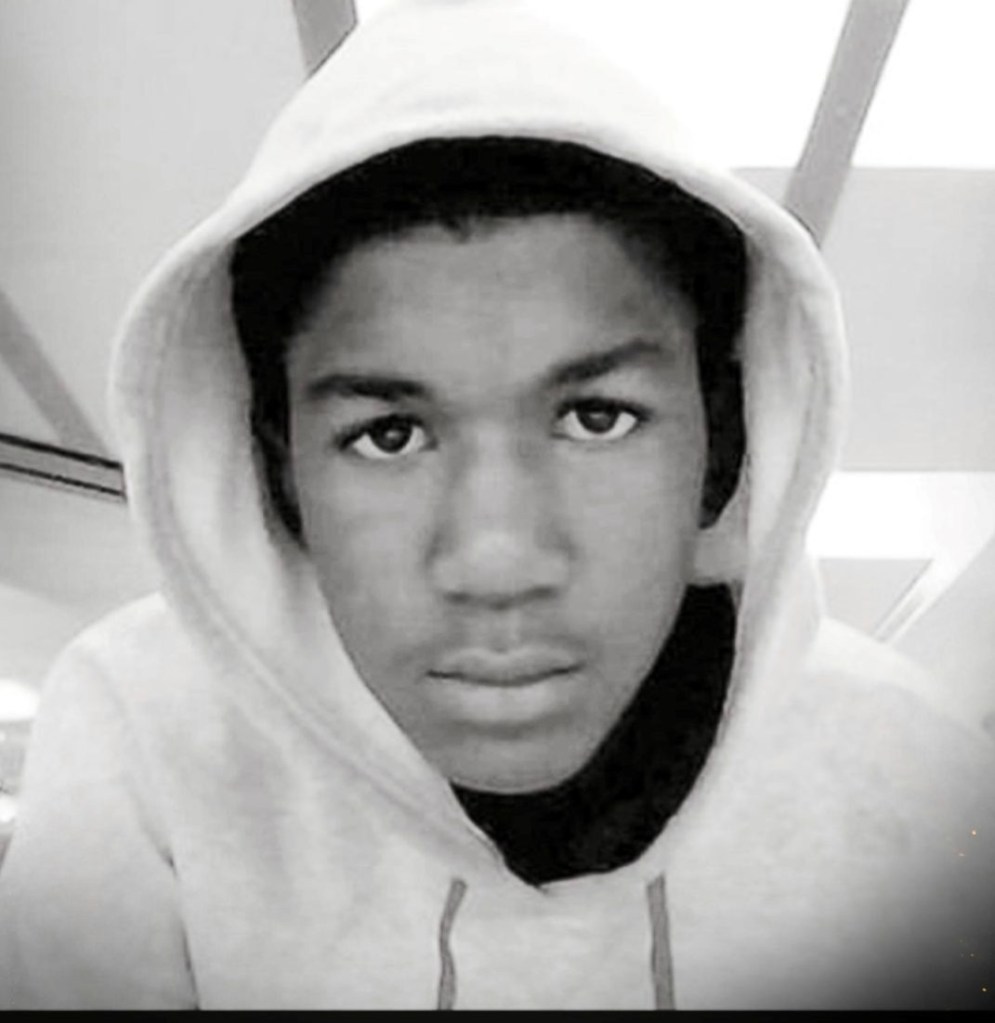
On the evening of February 26, 2012, Trayvon Martin was walking back to his father’s fiancée’s home in Sanford, Florida, after purchasing snacks from a convenience store. He was unarmed, wearing a hoodie, and talking on the phone with a friend. George Zimmerman, a neighborhood watch volunteer, reported Trayvon as “suspicious” to police, followed him despite being advised not to, and ultimately shot and killed him.

Zimmerman claimed self-defense and was later acquitted of all charges in 2013. The verdict sparked national and international outrage, as many saw the case as a reflection of how Black bodies are often criminalized, feared, and devalued within American society.


His Impact on the World

Though his life was tragically cut short at just 17 years old, Trayvon Martin’s death became a historical turning point. His name became a symbol of racial injustice and the dangerous consequences of racial profiling. The case helped ignite the modern civil rights movement known as Black Lives Matter, founded in 2013 by Alicia Garza, Patrisse Cullors, and Opal Tometi in response to Trayvon’s killing and Zimmerman’s acquittal.

Trayvon’s story forced America to confront uncomfortable truths about race, surveillance, fear, and the unequal application of justice. His hoodie became a global symbol of protest, representing how something as simple as clothing could become a perceived threat when worn by a Black male.


He Would Have Been 31 This Year

In 2026, Trayvon Martin would have been 31 years old. He could have been a husband, a father, a professional, or a leader in his community. Instead, his life exists in collective memory as a reminder of stolen futures and unrealized potential. His age now represents not just time passed, but the depth of loss — a life that never had the chance to fully begin.


Racism in America: A Broader Context

Trayvon Martin’s death cannot be understood in isolation. It exists within a long historical continuum of racial violence in America, from slavery and lynching to mass incarceration and police brutality. Sociologists describe this phenomenon as systemic racism — a structure in which laws, institutions, and cultural narratives disproportionately harm Black people.

The fear that led to Trayvon’s death reflects what scholars call implicit racial bias, where Black males are often subconsciously associated with danger, criminality, and threat. These biases influence everything from policing and surveillance to legal outcomes and media portrayals.

Trayvon’s case exposed how even in the absence of a crime, Black existence itself can be treated as suspicious. His death became a mirror held up to American society, forcing the nation to ask: Who is allowed to be innocent? Who is allowed to be safe? And whose life is presumed valuable?


Legacy

Trayvon Martin’s legacy is not defined by his death, but by the global movement that arose because of it. His name is spoken alongside others — Michael Brown, Tamir Rice, Sandra Bland, Breonna Taylor, George Floyd — as part of a growing historical archive of racial injustice.

Yet Trayvon remains unique: he was not arrested, not resisting, not committing a crime. He was simply walking home.

His life and death continue to educate, mobilize, and challenge the world to build a society where Black children can exist without fear, where justice is not selective, and where no family must bury a child for simply being seen as “out of place.”


References

Alexander, M. (2012). The new Jim Crow: Mass incarceration in the age of colorblindness. The New Press.

Bonilla-Silva, E. (2018). Racism without racists: Color-blind racism and the persistence of racial inequality in America (5th ed.). Rowman & Littlefield.

CBS News. (2013). George Zimmerman acquitted in Trayvon Martin case.

Garza, A. (2014). A herstory of the #BlackLivesMatter movement. The Feminist Wire.

Newman, K. S., & Cohen, A. (2014). Race, place, and building a youth movement: The case of Trayvon Martin. American Sociological Review, 79(3), 449–476.

Pew Research Center. (2016). On views of race and inequality, Blacks and Whites are worlds apart.

U.S. Department of Justice. (2013). Investigation of the Sanford Police Department’s handling of the Trayvon Martin shooting.

We Are the Story America Cannot Edit

Black history in America has always been more than a chapter—it is the spine of the national narrative. Yet for centuries, this story has been edited, erased, softened, or rewritten to soothe the conscience of a nation deeply shaped by the labor, blood, and brilliance of a people it tried to silence. Still, despite redactions and revisions, the truth endures: we are the story America cannot edit.

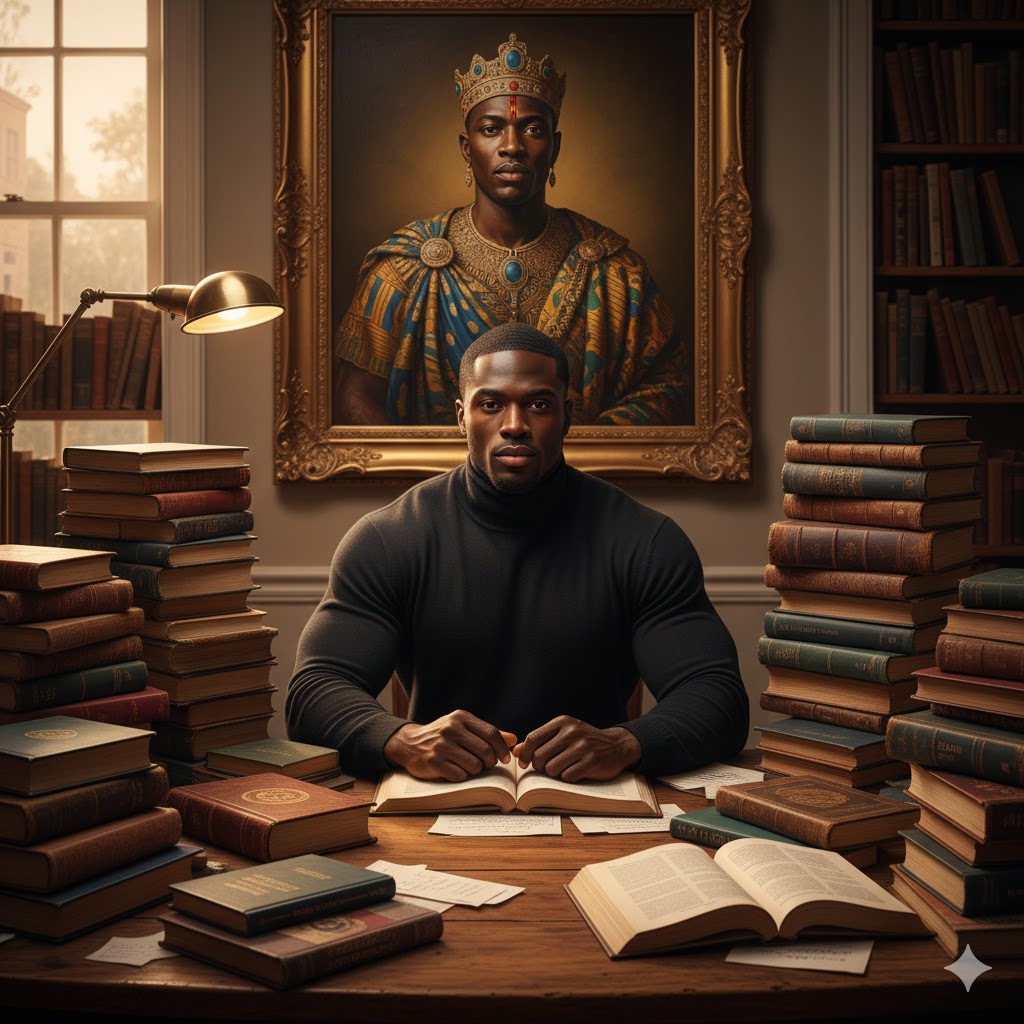
This story begins long before ships touched the Atlantic coast. It begins in African kingdoms where art, astronomy, architecture, and theology flourished. The brilliance of the ancestors did not begin in bondage; it began in royalty, innovation, and legacy. No revisionist textbook can erase the origins of a people whose civilizations helped advance global knowledge.

When the Middle Passage shattered families and scattered bodies across the ocean, America inherited a people it tried to dehumanize but could not destroy. The nation wrote laws to silence Black voices, but those voices survived. They survived in spirituals, in whispered prayers, in maroon communities, in the coded footsteps of escape routes carved in the night. The ink of this story was not blacklisted—it was carved in courage.

America tried to enslave people into subservience, but instead they became prophets, builders, warriors, and liberators. Harriet Tubman turned the Underground Railroad into a living testament of freedom. Frederick Douglass transformed literacy into a revolution. Sojourner Truth took the podium and shook the conscience of a country pretending not to hear her. These names refuse erasure.

The Civil War and Reconstruction wrote a brief chapter of possibility—Black senators, congressmen, teachers, and landowners rose swiftly. But America attempted another revision: Jim Crow. Segregation, lynching, and systemic disenfranchisement were designed to rewrite the Black story into one of subjugation. Yet the people refused the edits. Every protest, every church meeting, every organizing circle was a declaration that the pen of oppression could not overrule the pen of destiny.

The Civil Rights Movement authored a new wave of transformation. Martin Luther King Jr.’s dream, Malcolm X’s fire, Rosa Parks’ quiet firmness, and Fannie Lou Hamer’s thunderous truth-telling exposed the nation’s moral contradictions. Their lives demonstrate that Black people did not just endure history—they shaped it. They re-inked the American narrative with justice.

America has long tried to reduce Black identity to struggle, but Black culture refuses to be footnoted. Jazz, gospel, blues, soul, hip-hop, theatre, literature, and film—all are chapters written in brilliance, not brokenness. These art forms do not ask permission; they testify. They preserve memory. They uplift. They correct the historical record by embodying the power and creativity of a people the nation tried to underestimate.

Black resilience has always been inconvenient for America’s preferred storyline. It challenges myths of meritocracy, exposes the violence of past and present systems, and proves that progress was never given—only won. This is why so many attempts have been made to censor, dilute, or distort Black history. Yet truth has a way of resurfacing, even through the cracks of suppression.

The story America cannot edit also includes everyday heroes—grandmothers who kept families together, fathers who worked two and three jobs, children who dared to learn in schools that did not want them, freedom fighters whose names never made headlines, teachers who planted dreams in young minds, and church mothers who prayed communities through storms. These lives are sacred scripture for a people who built resilience into their DNA.

Even today, as political forces attempt to ban books, restrict curriculum, or sanitize the past, the story resists. Black scholars, artists, pastors, activists, and youth are documenting the truth in new ways—through digital archives, spoken word, classrooms, podcasts, and movements for justice. The story is not just preserved; it is expanding.

We are the story America cannot edit because our existence defies the narrative of inferiority that once dominated the national imagination. Every achievement in science, politics, sports, education, business, and ministry disproves the lies that once served as historical “facts.” Black excellence is not an anomaly—it is a continuation of ancestral greatness.

We are the story America cannot edit because the evidence is everywhere. It is in the economic foundation Black labor built. It is in the culture Black creativity shaped. It is in the democracy Black activism strengthened. It is in the global influence Black innovation commands. America has benefitted too deeply from Black genius to pretend it did not exist.

Our story remains uneditable because it is woven into Scripture as well as history. From Cush to Ethiopia, from the Queen of Sheba to the early church, the Bible itself records the presence, power, and purpose of African-descended people. The sacred text affirms what oppression tried to deny: that Blackness has always been part of God’s design and destiny.

We are the story America cannot edit because the truth is living, breathing, and continually unfolding. It shows up in every generation—Black children with brilliance in their eyes, Black elders carrying the wisdom of survivors, Black communities redefining strength, joy, and possibility.

Ultimately, America cannot edit what God Himself has preserved. The story of Black people is marked by divine protection, ancestral strength, and spiritual authority. It is a story of survival, transformation, and triumph. It is a story that exposes injustice but also reveals hope. It is a story bigger than slavery, bigger than segregation, bigger than racism.

We are the story America cannot edit because the truth is too powerful, too resilient, too sacred to be silenced. And as long as we continue to speak it, write it, live it, and teach it—the story will remain unaltered, unstoppable, and unforgettable.

References:
Exodus 1–3 (KJV); Psalm 68:31; Acts 8:27–39; Franklin, J. H. From Slavery to Freedom; Gates, H. L. The African Americans: Many Rivers to Cross; Hannah-Jones, N. The 1619 Project; Litwack, L. Trouble in Mind; Stevenson, B. Just Mercy; Anderson, C. White Rage; Raboteau, A. Slave Religion.

Dilemma : The Beast Nation

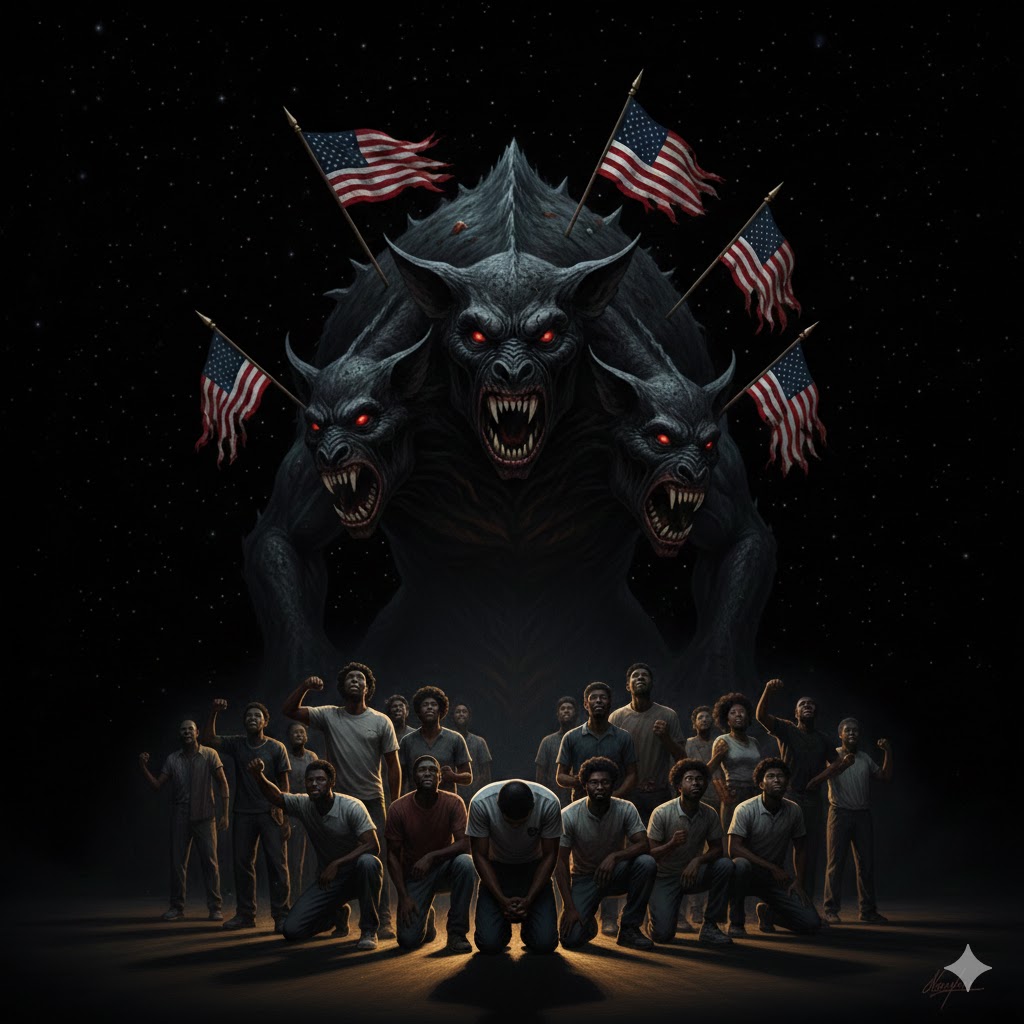
The term Beast Nation is not merely rhetorical; it is biblical, symbolic, and historical. In Scripture, beasts represent empires built on domination, violence, deception, and exploitation (Daniel 7; Revelation 13). America, when examined through its treatment of Black and Indigenous peoples, mirrors the characteristics of a prophetic beast—powerful, wealthy, religious in language, yet ruthless in practice.

Colonialism marks the first stage of the Beast Nation. European powers arrived under the banner of “discovery,” yet what followed was invasion, land theft, and cultural annihilation. Indigenous nations were displaced, murdered, and erased to establish settler dominance, fulfilling the biblical pattern of conquest through bloodshed (Habakkuk 2:12, KJV).

Colonial theology weaponized Christianity to justify conquest. Scripture was distorted to portray Europeans as divinely ordained rulers while Africans and Indigenous peoples were cast as subhuman. This manipulation of God’s Word mirrors the beast that speaks “great things and blasphemies” (Revelation 13:5, KJV).

Chattel slavery institutionalized this evil into law. Unlike other forms of servitude, chattel slavery reduced Africans to lifelong, inheritable property. Black bodies became commodities—bought, sold, bred, insured, and punished—stripped of humanity and covenantal identity.

The Bible condemns manstealing explicitly: “He that stealeth a man, and selleth him…shall surely be put to death” (Exodus 21:16, KJV). Yet America built its wealth in direct violation of this command, revealing the moral contradiction at its core.

Reconstruction briefly exposed the Beast Nation’s fear of Black autonomy. Promises of “40 acres and a mule” symbolized restitution and independence, yet these promises were rescinded. Land was returned to former enslavers, while Black families were thrust into sharecropping and debt peonage.

This betrayal echoed Proverbs 20:10: “Divers weights, and divers measures, both of them are alike abomination to the LORD” (KJV). America promised justice publicly while practicing theft privately.

Jim Crow followed as a system of racial terror disguised as law. Segregation, lynching, and voter suppression enforced white supremacy through fear. Black progress was criminalized, and racial hierarchy was violently preserved.

Lynching functioned as public ritual—Black bodies displayed as warnings. Crosses burned beside corpses while churches remained silent or complicit. This hypocrisy fulfilled Isaiah 1:15: “Your hands are full of blood” (KJV).

Surveillance evolved as a modern method of control. Slave patrols became police departments; plantation ledgers became data systems. Black neighborhoods were watched, tracked, and criminalized long before digital technology made surveillance ubiquitous.

The civil rights movement revealed the Beast Nation’s resistance to righteousness. Peaceful protestors were beaten, jailed, assassinated, and vilified. America condemned foreign tyranny while unleashing state violence on its own citizens.

Dr. King’s assassination symbolized the cost of prophetic truth. Like the prophets before him, he confronted power—and paid with his life (Matthew 23:37, KJV).

The War on Drugs marked a new era of legalized oppression. Though drug use was statistically similar across races, Black communities were targeted disproportionately. Mandatory minimums, three-strikes laws, and police militarization fueled mass incarceration.

Scripture warns of unjust laws: “Woe unto them that decree unrighteous decrees” (Isaiah 10:1, KJV). The prison system became a modern plantation, extracting labor and removing generations of Black men and women from their communities.

America proclaims itself the “Land of the Free,” yet millions of Black people lived and died in bondage on that very soil. Freedom was declared selectively, revealing liberty as conditional rather than universal.

It calls itself the “Home of the Brave,” while Indigenous nations were slaughtered, displaced, and confined to reservations. Courage was claimed by conquerors, while resistance was labeled savagery.

“In God We Trust” is stamped on currency that once financed human trafficking, slave ships, and plantations. Mammon was worshiped while God’s commandments were violated (Matthew 6:24, KJV).

“One Nation Under God” rang hollow as Black bodies swung from trees and crosses burned in terror campaigns. God’s name was invoked while His image-bearers were desecrated.

“Liberty and justice for all” existed only for white citizens. Black Americans were excluded from the social contract, taxed without representation, and punished without protection.

Education systems sanitized this history, presenting America as a flawed but noble experiment rather than a predatory empire. Truth was buried beneath patriotism.

Media reinforced the beast’s image, portraying Black resistance as threat and Black suffering as deserved. Narrative control became psychological warfare.

Churches often chose comfort over conviction. Many preached obedience to the state while ignoring God’s demand for justice (Micah 6:8, KJV).

The Beast Nation thrives on amnesia. Forgetting allows repetition; silence permits continuation.

Biblically, beasts fall when truth is revealed and judgment arrives (Daniel 7:26). Empires collapse not from external enemies alone, but from internal corruption.

For Black America, survival has always required spiritual discernment—recognizing systems not merely as flawed, but as adversarial.

The Exodus narrative reminds us that God hears the cries of the oppressed (Exodus 3:7, KJV). Liberation is divine, not granted by empires.

The Beast Nation fears awakening. Knowledge of history, identity, and covenant threatens its legitimacy.

Judgment begins with truth. Repentance demands restitution, not rhetoric.

Until justice flows “like waters, and righteousness like a mighty stream” (Amos 5:24, KJV), America remains a beast clothed in religious language and democratic symbols.


References

Alexander, M. (2012). The new Jim Crow: Mass incarceration in the age of colorblindness. The New Press.

Baptist, E. E. (2014). The half has never been told: Slavery and the making of American capitalism. Basic Books.

Du Bois, W. E. B. (1935). Black reconstruction in America. Free Press.

Horsman, R. (1981). Race and manifest destiny. Harvard University Press.

KJV Bible. (1769/2017). Authorized King James Version.

Wilkerson, I. (2020). Caste: The origins of our discontents. Random House.
The Altar of American Exceptionalism: Promise, Peril, and Consequence.

American exceptionalism is the belief that the United States occupies a unique moral, political, and historical position among nations. Rooted in Puritan theology, Enlightenment ideals, and revolutionary mythology, it has long framed the nation as chosen, exemplary, and destined for leadership. This belief has functioned as both a guiding philosophy and a civic religion, shaping national identity and public policy across generations.

At its best, American exceptionalism has inspired aspirational ideals. The language of liberty, equality, and self-governance provided a moral vocabulary that fueled abolitionism, civil rights movements, and democratic reforms. By holding itself to a proclaimed higher standard, the nation created a framework through which citizens could critique injustice and demand alignment between principle and practice.

The Declaration of Independence stands as a canonical text of exceptionalist thought, asserting universal rights while situating the American experiment as historically unprecedented. This rhetoric energized oppressed groups who invoked its promises to expose hypocrisy. Frederick Douglass’s famous question—what to the slave is the Fourth of July—demonstrates how exceptionalist ideals could be turned inward as a moral indictment rather than an excuse for complacency.

Yet American exceptionalism has also functioned as an altar upon which truth is sacrificed. When national myth hardens into unquestionable dogma, it suppresses historical accountability. Slavery, Indigenous dispossession, segregation, and imperial expansion were often justified or minimized under the assumption that America’s intentions were inherently benevolent, regardless of outcomes.

The doctrine has repeatedly blurred the line between patriotism and moral exemption. Foreign interventions, from Manifest Destiny to twentieth-century wars, were frequently framed as civilizing missions rather than power pursuits. Exceptionalism provided the moral cover for empire, allowing violence to be narrated as virtue and domination as destiny.

Domestically, exceptionalism has obscured structural inequality. The insistence that America is uniquely free and just has been used to delegitimize claims of systemic racism, economic exploitation, and gender inequality. If the nation is already exceptional, then disparities are framed as personal failures rather than institutional designs.

This mindset has been particularly damaging to Black Americans. The contradiction between exceptionalist rhetoric and lived reality produced what W.E.B. Du Bois called “double consciousness,” a constant negotiation between national belonging and exclusion. Black resistance movements have historically navigated the tension between appealing to American ideals and rejecting America’s false innocence.

American exceptionalism also reshaped capitalism into a moral narrative. Wealth accumulation became equated with virtue, and poverty with moral deficiency. The “American Dream” promised upward mobility while masking the racialized and class-based barriers that structured opportunity. Exceptionalism thus sanctified inequality under the guise of meritocracy.

In education, exceptionalist narratives often sanitize history. Textbooks emphasize triumph while minimizing atrocity, creating citizens who inherit pride without responsibility. This selective memory weakens democratic capacity, as honest self-critique is replaced with defensive nationalism.

Religiously, exceptionalism has fused with Christian nationalism, transforming the state into a quasi-divine instrument. Biblical language of chosenness has been selectively applied to America, displacing its original covenantal context. This theological distortion elevates the nation above moral law rather than subjecting it to prophetic judgment.

The psychological effects of exceptionalism are equally profound. It fosters cognitive dissonance when reality contradicts belief, leading to denial rather than reform. Citizens may experience identity threat when confronted with injustice, responding with hostility instead of empathy.

Globally, exceptionalism damages credibility. When the United States preaches democracy while tolerating human rights abuses at home and abroad, its moral authority erodes. Allies perceive hypocrisy, while adversaries exploit inconsistency, weakening international trust.

However, rejecting blind exceptionalism does not require abandoning national aspiration. A critical patriotism can preserve ethical commitment without mythological arrogance. Nations, like individuals, mature through accountability rather than denial.

Some scholars argue for a post-exceptionalist identity grounded in democratic humility. This approach views the United States not as above history but within it—capable of learning from other nations and from its own marginalized voices. Such humility strengthens rather than weakens democratic life.

The civil rights movement offers a model of reformed exceptionalism. Leaders like Martin Luther King Jr. appealed to America’s professed ideals while exposing its moral bankruptcy. Their vision did not worship the nation; it called it to repentance.

In this sense, American exceptionalism becomes most ethical when desacralized. When stripped of infallibility, it can function as an aspirational ethic rather than a shield against critique. The danger lies not in national ideals, but in their absolutization.

The future of American democracy depends on whether exceptionalism remains an altar or becomes a mirror. A mirror reflects both beauty and blemish, demanding growth. An altar demands worship and excuses failure.

Ultimately, the question is not whether America is exceptional, but how it understands exceptionality. If exceptionalism justifies power without justice, it corrodes the nation’s soul. If it compels responsibility proportional to power, it may yet serve a moral purpose.

The effects of American exceptionalism are therefore paradoxical. It has empowered liberation and legitimated oppression, inspired reform and excused violence. Its legacy demands discernment rather than devotion.

A transformed national consciousness would replace myth with memory, arrogance with accountability, and supremacy with service. Only then can the United States pursue greatness without sacrificing truth upon the altar of its own exceptionalism.


References

Appleby, J. (2018). The virtues of liberalism. Oxford University Press.

Bellah, R. N. (1967). Civil religion in America. Daedalus, 96(1), 1–21.

Du Bois, W. E. B. (1903). The souls of Black folk. A.C. McClurg & Co.

King, M. L., Jr. (1963). Why we can’t wait. Harper & Row.

Lipset, S. M. (1996). American exceptionalism: A double-edged sword. W.W. Norton.

Mills, C. W. (1997). The racial contract. Cornell University Press.

Zinn, H. (2003). A people’s history of the United States. HarperCollins.