
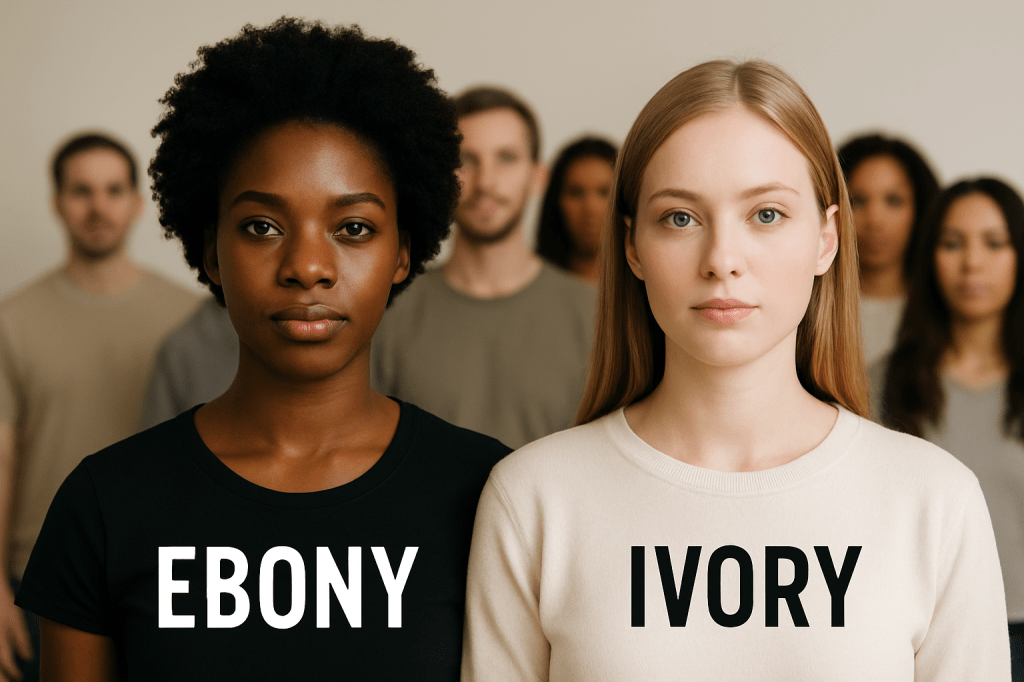
From the dawn of civilization, beauty has been both a mirror and a weapon—reflecting ideals shaped by power and privilege, and wielded to define worth within social hierarchies. Within the globalized gaze of modernity, the politics of skin color continue to influence how femininity and desirability are perceived, especially among women of African descent. The notion of “Ebony and Ivory” evokes more than just color; it symbolizes the ongoing dialogue between light and dark, between acceptance and exclusion, and between the internalized and externalized standards of beauty that shape identity (hooks, 1992).
The idea of “two shades, one standard” captures the paradox of colorism: the simultaneous elevation and devaluation of Blackness within the same racial group. While “ivory” tones have historically been exalted as closer to Western ideals, “ebony” skin has often been marginalized, caricatured, or fetishized. Both ends of the spectrum, however, are measured against the same Eurocentric barometer that privileges whiteness as the ultimate aesthetic reference (Hunter, 2005).
This phenomenon, deeply rooted in colonialism, reveals how beauty became a tool of control. During the transatlantic slave trade, lighter-skinned enslaved individuals were often granted domestic positions and social proximity to white power structures, breeding intra-racial hierarchies that persist today. These legacies still echo in media representation, where lighter skin is frequently coded as “refined,” while darker tones are portrayed as “exotic” or “primitive” (Craig, 2006).
For many women of color, navigating these coded perceptions can be exhausting. The “brown girl dilemma” emerges when one feels too dark to be celebrated and too light to be considered authentically Black. This liminal existence is both a burden and a revelation—proof that beauty, as defined by Western constructs, remains an unattainable illusion that fractures rather than unites.
Beauty standards, much like colonial borders, were imposed rather than chosen. From the powdered faces of the Victorian era to the filtered glow of Instagram, the valuation of lightness has remained a constant aesthetic undercurrent. Yet, even within African and Afro-diasporic communities, this colonial inheritance continues to dictate preferences in partners, media icons, and even professional opportunities (Glenn, 2008).
In popular culture, colorism is often masked by phrases like “preference” or “type.” However, these preferences are rarely organic—they are sociologically constructed through centuries of imagery that equate lightness with purity and success, and darkness with defiance and struggle. The entertainment industry’s casting choices often reinforce these biases, rewarding lighter skin with visibility while relegating darker complexions to supporting or stereotypical roles (Russell, Wilson, & Hall, 2013).
This bias extends beyond film and television. In the global beauty market, skin-lightening creams generate billions annually, a grim testament to the internalization of Eurocentric ideals (Glenn, 2008). The psychological effects of such products are profound, suggesting that beauty is not only skin-deep but soul-deep, affecting one’s perception of self-worth and belonging.
For Black women, beauty is an act of survival. To adorn oneself becomes an assertion of existence in a world that often demands invisibility. From the regal hairstyles of precolonial Africa to the natural hair movement, Black women have continuously redefined and reclaimed their beauty on their own terms (Byrd & Tharps, 2014).
Yet, this reclamation is not without struggle. Within the Black community itself, hierarchies persist. The glorification of lighter women as more “marriageable” or “acceptable” continues to fracture solidarity. It is an unspoken inheritance of slavery’s psychological residue, perpetuated by both men and women who unconsciously valorize proximity to whiteness.
The darker-skinned woman often bears the weight of invisibility and hypervisibility simultaneously—ignored in spaces of admiration, yet scrutinized as the embodiment of resistance or rebellion. This double-bind mirrors W.E.B. Du Bois’ concept of “double consciousness,” wherein one is forced to see oneself through the lens of a world that refuses full recognition (Du Bois, 1903).
Light-skinned women, conversely, navigate their own complexities. While society may privilege them aesthetically, they are often accused of benefiting from colorism or being “not Black enough.” Thus, both ebony and ivory tones bear distinct forms of cultural alienation, tied together by an oppressive standard neither created (Monk, 2014).
In this context, beauty becomes not celebration but negotiation. Every compliment, every criticism, every casting call, and every social media post reinforces the invisible hierarchy of shade. The struggle is not between dark and light, but against the system that pits them against each other.
Media representation plays a critical role in dismantling or reinforcing these divides. When dark-skinned actresses like Lupita Nyong’o or Viola Davis are celebrated, it signals progress—but also exposes how rare such representation remains. Likewise, the inclusion of mixed-race models in campaigns may appear inclusive, yet often centers features still aligned with Eurocentric beauty (Tate, 2009).
To heal from this color divide, we must first acknowledge that beauty is not a monolith. It is plural, diverse, and spiritually rooted. In the biblical sense, humanity was created “in the image of God” (Genesis 1:27, KJV), meaning all shades reflect divine artistry. The rejection of any hue is, therefore, a rejection of the Creator’s design.
Moreover, Proverbs 31:30 reminds us that “favor is deceitful, and beauty is vain: but a woman that feareth the Lord, she shall be praised.” This verse redirects the gaze from the external to the eternal, urging women to seek validation not from comparison but from divine purpose.
Ebony and ivory are not opposites but complements, each contributing to the symphony of creation. Just as piano keys of contrasting colors produce harmony, so too can diverse complexions coexist in mutual admiration and respect. The beauty of one does not diminish the beauty of the other; together, they reveal the fullness of God’s palette.
True beauty transcends complexion—it emanates from character, compassion, and conviction. In a world obsessed with appearances, spiritual and cultural consciousness must redefine the standard. Beauty should not divide but dignify, not exclude but exalt.
To love one’s shade is to reclaim agency over identity. When Black women, in all their hues, embrace their reflection without apology, they dismantle centuries of aesthetic oppression. “Ebony and Ivory” then becomes more than a contrast—it becomes a covenant of self-acceptance and collective healing.
As we move forward, let beauty be measured not by shade but by soul. For when light and dark come together, they create balance, harmony, and wholeness—the true reflection of divine beauty.
References
Byrd, A. D., & Tharps, L. L. (2014). Hair Story: Untangling the Roots of Black Hair in America. St. Martin’s Press.
Craig, M. L. (2006). Race, beauty, and the tangled knot of a guilty pleasure. Feminist Theory, 7(2), 159–177.
Du Bois, W. E. B. (1903). The Souls of Black Folk. Chicago: A.C. McClurg.
Glenn, E. N. (2008). Yearning for lightness: Transnational circuits in the marketing and consumption of skin lighteners. Gender & Society, 22(3), 281–302.
hooks, b. (1992). Black Looks: Race and Representation. South End Press.
Hunter, M. L. (2005). Race, gender, and the politics of skin tone. Routledge.
Monk, E. P. (2014). Skin tone stratification among Black Americans, 2001–2003. Social Psychology Quarterly, 77(4), 360–379.
Russell, K., Wilson, M., & Hall, R. (2013). The Color Complex (Revised): The Politics of Skin Color Among African Americans. Anchor.
Tate, S. A. (2009). Black Beauty: Aesthetics, Stylization, Politics. Ashgate Publishing.
The Holy Bible, King James Version (KJV). (1611).
Discover more from THE BROWN GIRL DILEMMA
Subscribe to get the latest posts sent to your email.
 THE BROWN GIRL DILEMMA