Tag Archives: the brown boy dilemma

Welfare Over Fathers: Policy, Power, and the Fragmentation of the Black Family.

The relationship between welfare policy and the structure of the Black family in the United States has long been a subject of intense debate, scholarship, and controversy. The phrase “welfare over fathers” reflects a critique that certain government assistance programs historically incentivized the absence of Black men from the home. To understand this claim, it is necessary to examine the origins of welfare, its regulations, and the broader historical forces that shaped Black family life.

The foundation of modern welfare policy can be traced to the New Deal era under Franklin D. Roosevelt, particularly through the Social Security Act of 1935. One of its key provisions, Aid to Dependent Children (ADC), was designed to provide financial assistance to single mothers. While initially intended for widowed white women, the program gradually expanded to include Black women, especially during the mid-twentieth century.

However, the expansion of welfare to Black families did not occur without conditions. Local welfare agencies, particularly in the South, imposed strict and often discriminatory rules that governed eligibility. One of the most controversial policies was the “man-in-the-house” rule, which denied benefits to households where an able-bodied adult male was present.

This rule effectively forced many Black families into a painful choice: receive financial assistance necessary for survival or maintain a two-parent household. In practice, this meant that Black fathers were often excluded from the home, either physically or officially, to ensure that mothers and children could qualify for aid.

The enforcement of these policies disproportionately impacted Black communities, where economic opportunities for men were already severely limited due to systemic racism. Employment discrimination, segregation, and unequal access to education made it difficult for Black men to fulfill the traditional role of provider, increasing reliance on welfare systems.

The roots of this dynamic can be traced back even further to slavery. Under slavery, Black families were routinely separated, with husbands, wives, and children sold to different plantations. The institution itself disrupted family bonds and undermined the stability of Black households, creating a legacy of forced fragmentation.

After emancipation, Black families sought to reunite and establish stable households, but they faced new forms of systemic interference. Jim Crow laws, economic exploitation, and racial violence continued to destabilize Black communities, limiting opportunities for family cohesion and economic independence.

The introduction of welfare policies in the twentieth century must be understood within this broader historical context. While these programs provided essential support, they also operated within a system that had long devalued Black fatherhood and autonomy. The “man-in-the-house” rule became a modern mechanism that echoed earlier patterns of separation.

Scholars such as Daniel Patrick Moynihan brought national attention to the issue with the 1965 report The Negro Family: The Case for National Action. Moynihan argued that the rise in single-parent households, particularly among Black families, was a central factor in economic and social challenges. However, his conclusions were widely debated and criticized for placing blame on Black families rather than systemic conditions.

Critics of welfare policy argue that these regulations created perverse incentives that discouraged marriage and father involvement. By tying financial support to the absence of a male figure, the system may have unintentionally reinforced family separation, particularly in economically vulnerable communities.

Others contend that this perspective oversimplifies the issue, ignoring the structural inequalities that limit opportunities for Black men. High unemployment rates, mass incarceration, and educational disparities have all contributed to the challenges faced by Black families, independent of welfare policy.

The War on Poverty under Lyndon B. Johnson expanded welfare programs in the 1960s, increasing access to aid for low-income families. While these initiatives helped reduce poverty, they also intensified debates about dependency, family structure, and government intervention.

The “man-in-the-house” rule was eventually challenged in court and deemed unconstitutional in the 1968 Supreme Court case King v. Smith. This ruling marked a significant shift, removing one of the most explicit barriers to father presence in welfare-recipient households.

Despite these legal changes, the cultural and structural impacts of earlier policies continued to reverberate. Generations of families had already been shaped by systems that discouraged or penalized the presence of Black men in the home, contributing to long-term social and psychological effects.

The question of whether welfare “destroyed” the Black family is complex and contested. Some scholars argue that it played a significant role in altering family dynamics, while others emphasize that systemic racism and economic inequality are the primary drivers of family instability.

Mass incarceration, particularly from the late twentieth century onward, further compounded the issue. Policies that disproportionately targeted Black men removed them from their families and communities, reinforcing patterns of absence that had historical roots.

Today, welfare policy has evolved significantly, with programs such as Temporary Assistance for Needy Families (TANF) emphasizing work requirements and time limits. These changes reflect a shift toward encouraging employment and reducing long-term dependency.

Public perception of welfare and Black family structure remains deeply influenced by stereotypes and political narratives. Media portrayals have often reinforced negative images of Black motherhood and absent fathers, obscuring the structural realities behind these issues.

At the same time, there has been a growing recognition of the importance of father involvement and family stability. Community organizations, faith-based initiatives, and policy reforms increasingly seek to support holistic family structures rather than undermine them.

Understanding the historical relationship between welfare and the Black family requires a nuanced approach that considers both policy and context. It is not merely a question of individual choices but of systems that have shaped those choices over generations.

Ultimately, the story of “welfare over fathers” is not just about policy but about power—who defines family, who controls resources, and whose lives are shaped by those decisions. It calls for a critical examination of the past and a commitment to building policies that strengthen, rather than divide, families.

References

Acs, G., & Nelson, S. (2004). Changes in welfare caseloads and the status of black families. Urban Institute.

Daniel Patrick Moynihan. (1965). The Negro Family: The Case for National Action. U.S. Department of Labor.

Katz, M. B. (2013). The Undeserving Poor: America’s Enduring Confrontation with Poverty. Oxford University Press.

King v. Smith, 392 U.S. 309 (1968).

Mincy, R. B. (2006). Black Males Left Behind. Urban Institute Press.

Franklin D. Roosevelt. (1935). Social Security Act.

Lyndon B. Johnson. (1964). War on Poverty Speech.
Dilemma: Denial of Racism and the Racist Mascots.

Racism is more than individual prejudice—it is a system of power, privilege, and oppression that shapes every level of society. It is the belief, whether conscious or unconscious, that one race is superior to another, and this ideology has fueled centuries of injustice toward Black people and other nonwhite groups. Denial of racism, therefore, is a form of complicity. It allows prejudice to persist unchecked, normalizing discrimination under the illusion of equality. In modern America, this denial manifests not only in speech and policy but also in symbols—especially racist mascots that trivialize entire cultures for entertainment and profit (Tatum, 2017).

Racist mascots are public symbols, images, or characters that depict racial or ethnic groups through stereotypes. They include sports team names, cartoon logos, and advertising imagery that caricature people of color, particularly Indigenous, Asian, and Black individuals. The purpose of such mascots has historically been to create a sense of fun or team spirit, but beneath the surface lies the dehumanization of real people. These mascots perpetuate racism by turning living identities into costumes or cartoons, mocking heritage and reinforcing white dominance (King, Davis-Delano, Staurowsky, & Baca, 2006).

Examples of racist mascots include the Washington Redskins (now Commanders), Cleveland Indians (now Guardians), and the use of Native caricatures like “Chief Wahoo.” In addition, Black caricatures such as “Aunt Jemima,” “Uncle Ben,” and the “Sambo” figures have long stood as consumer symbols rooted in slavery and Jim Crow imagery. These depictions present people of color as servile, ignorant, or primitive—images designed to comfort white audiences while reminding Black people of their social “place” (Pilgrim, 2012).

The denial of racism allows these symbols to persist under the justification of “tradition” or “harmless fun.” Yet such arguments ignore the historical and emotional damage caused by these portrayals. To deny racism is to silence the voices of those who endure its consequences. White individuals who resist the removal of racist mascots often do so because acknowledging their harm would mean confronting uncomfortable truths about privilege and the legacies of colonization (Sue et al., 2019).

For Black people, racism manifests not only through overt hatred but also through the cultural symbols that reinforce inferiority. Racist mascots, jokes, and media portrayals perpetuate the myth of white superiority, making it harder for Black individuals to assert pride and dignity. These representations influence how others perceive them—affecting hiring decisions, media representation, and even internalized self-worth. When a culture is continually mocked or minimized, it becomes a psychological burden that echoes across generations (Williams & Mohammed, 2009).

The psychological effect of racist imagery cannot be overstated. Studies show that exposure to racial caricatures can reinforce stereotypes, reduce empathy toward minority groups, and diminish the sense of belonging among young people of color. For Black children, seeing racist imagery in public life communicates a painful message: that their identity is a joke, their culture a costume, and their history unworthy of respect. The harm of these images is cumulative and intergenerational (Clark, 2019).

White supremacy, the ideology that whiteness is inherently superior, underpins both the denial of racism and the creation of racist mascots. It is the invisible hand guiding policies, media narratives, and cultural norms that prioritize white comfort over Black liberation. White supremacy thrives in denial—it insists that racism is a relic of the past while continuing to shape the present. It operates through coded language like “heritage” and “pride,” which often mask bigotry behind nostalgia (Kendi, 2019).

The most blatant expression of white supremacy in American history is the Ku Klux Klan (KKK). Founded after the Civil War, the KKK terrorized Black communities through violence, lynchings, and intimidation. Its mission was to maintain white dominance in political, social, and economic spheres. Members of the Klan saw themselves as defenders of a “pure” America, using fear and brutality to suppress Black advancement. Their robes, burning crosses, and public parades became symbols of white terror and racial hatred (Alexander, 2010).

The impact of the KKK on Black people was devastating. Generations were traumatized by violence and systemic exclusion. Families were torn apart, homes burned, and entire towns destroyed under the pretext of racial purity. Even today, the Klan’s legacy persists in modern hate groups, racial profiling, and police violence. The ideology never died—it evolved into new forms of systemic control such as mass incarceration and economic disenfranchisement.

White supremacy continues to hurt Black people by limiting access to wealth, education, and justice. Redlining, discriminatory hiring, and unequal school funding are structural extensions of the same mindset that birthed the KKK and racist mascots. These systems rely on the same falsehood—that Black people are less deserving of opportunity. By denying racism’s existence, society allows these injustices to flourish behind the facade of fairness (Bonilla-Silva, 2018).

Denial of racism often appears as “colorblindness.” When white individuals claim they “don’t see race,” they erase the lived experiences of Black people who face racism daily. Colorblindness is not equality—it is avoidance. It refuses to confront historical trauma or acknowledge current inequalities. This denial maintains white innocence and blocks progress toward reconciliation and justice (Wise, 2010).

Racist mascots are powerful tools of denial because they hide oppression behind art and entertainment. They turn centuries of suffering into amusement, trivializing racism itself. By normalizing these caricatures, society teaches future generations to see racism as exaggerated or irrelevant. The mascot becomes a smiling mask covering a violent history of enslavement and dehumanization (Fryberg et al., 2008).

To overcome this, institutions must replace symbols of oppression with those of truth and empowerment. Education is key—students should learn the origins of these images and why they are harmful. Removing racist mascots and replacing them with culturally respectful symbols is not “erasing history,” but correcting it. True history must expose oppression, not celebrate it.

Community conversations about race and symbolism are also essential. Many white Americans cling to racist mascots because they lack understanding of their impact. Honest dialogue, paired with empathy and accountability, can transform ignorance into awareness. This process requires humility—the willingness to listen rather than defend.

Faith-based and moral frameworks remind us that racism is a sin of pride. The Bible teaches that all people are created in the image of God (Genesis 1:27, KJV). To deny racism or perpetuate racist symbols is to deny God’s design for equality and justice. The work of dismantling white supremacy is therefore both a social and spiritual responsibility.

For Black people, confronting racist mascots is an act of liberation. It is a declaration that identity will no longer be mocked or commodified. Cultural restoration begins with reclaiming representation—telling stories from within rather than allowing others to define Blackness from without. Every statue removed, logo retired, and stereotype challenged marks a step toward collective healing.

The denial of racism also prevents national unity. A country that refuses to face its truth cannot heal from it. Reconciliation requires repentance—an acknowledgment of harm and a commitment to change. Only when the truth of racism is faced with courage can justice begin to take root.

Ultimately, racist mascots are symptoms of a deeper disease: the refusal to see Black humanity. The denial of racism enables the disease to spread unchecked, poisoning institutions and relationships. Challenging these symbols is not about political correctness—it is about moral clarity. Racism cannot die where denial lives.

The path forward requires truth-telling, accountability, and love rooted in justice. Dismantling racist mascots, confronting white supremacy, and rejecting the lies of the KKK are not acts of division—they are acts of restoration. The goal is not revenge but righteousness. As James Baldwin wrote, “Not everything that is faced can be changed, but nothing can be changed until it is faced.”

References
Alexander, M. (2010). The new Jim Crow: Mass incarceration in the age of colorblindness. The New Press.
Bonilla-Silva, E. (2018). Racism without racists: Color-blind racism and the persistence of racial inequality in America. Rowman & Littlefield.
Clark, C. R. (2019). Psychological impact of racial imagery on youth. Journal of Black Psychology, 45(2), 105–122.
Fryberg, S. A., Markus, H. R., Oyserman, D., & Stone, J. M. (2008). Of warrior chiefs and Indian princesses: The psychological consequences of American Indian mascots. Basic and Applied Social Psychology, 30(3), 208–218.
Kendi, I. X. (2019). How to be an antiracist. One World.
King, C. R., Davis-Delano, L. R., Staurowsky, E. J., & Baca, L. (2006). The Native American mascot controversy: A handbook. Scarecrow Press.
Pilgrim, D. (2012). Understanding Jim Crow: Using racist memorabilia to teach tolerance and promote social justice. Ferris State University.
Sue, D. W., Alsaidi, S., Awad, M. N., Calle, C. Z., & Mendez, N. (2019). Disarming racial microaggressions: Microintervention strategies for targets, White allies, and bystanders. American Psychologist, 74(1), 128–142.
Tatum, B. D. (2017). Why are all the Black kids sitting together in the cafeteria? Basic Books.
Wise, T. (2010). Colorblind: The rise of post-racial politics and the retreat from racial equity. City Lights Books.
Williams, D. R., & Mohammed, S. A. (2009). Discrimination and racial disparities in health: Evidence and needed research. Journal of Behavioral Medicine, 32(1), 20–47.

Lack of Knowlege

Hosea 4:6 (KJV) declares, “My people are destroyed for lack of knowledge: because thou hast rejected knowledge, I will also reject thee.” This scripture is a sobering reminder that ignorance is not just a personal issue—it can have generational, spiritual, and societal consequences. When people reject truth, they open the door to destruction, confusion, and bondage. Knowledge, in the biblical sense, is not merely intellectual information but deep understanding, discernment, and wisdom that lead to righteous living.

The danger of lacking knowledge begins with spiritual blindness. Without understanding who God is and what His Word says, people are vulnerable to false doctrines, manipulative leaders, and destructive choices. Proverbs 29:18 (KJV) warns, “Where there is no vision, the people perish: but he that keepeth the law, happy is he.” Vision here refers to divine revelation and guidance. When revelation is absent, chaos reigns.

Lack of knowledge also leads to cycles of oppression. History shows that when people are kept from education, they are easier to control. During slavery in America, it was illegal to teach enslaved Africans to read, precisely because knowledge would empower them to question their oppression and fight for freedom. This is why the Bible, literacy, and education were such powerful tools of liberation.

Psychologically, ignorance breeds fear and superstition. People without knowledge often rely on rumor, myth, or cultural tradition rather than truth. This can lead to destructive behaviors, prejudice, and generational curses. When individuals gain understanding—through study, therapy, and self-reflection—they can break free from unhealthy patterns and make wiser decisions.

Another danger of lacking knowledge is exploitation. Unscrupulous people take advantage of those who do not know their rights, their worth, or their purpose. Proverbs 22:3 (KJV) says, “A prudent man foreseeth the evil, and hideth himself: but the simple pass on, and are punished.” Without discernment, people fall into traps—whether financial scams, abusive relationships, or spiritual deception.

Lack of biblical knowledge specifically puts believers at risk of spiritual death. Jesus told the Sadducees, “Ye do err, not knowing the scriptures, nor the power of God” (Matthew 22:29, KJV). Without Scripture, people rely on human wisdom or popular culture for moral guidance, which often leads them away from God’s truth.

Overcoming ignorance requires an intentional pursuit of knowledge. Proverbs 4:7 (KJV) instructs, “Wisdom is the principal thing; therefore get wisdom: and with all thy getting get understanding.” This means believers must actively study, learn, and seek understanding—not only from books but from God through prayer, fasting, and fellowship.

Knowledge of the Bible is the foundation of true wisdom. Psalm 119:105 (KJV) says, “Thy word is a lamp unto my feet, and a light unto my path.” Scripture illuminates the right path and exposes lies. Regular Bible study, meditation on Scripture, and hearing sound teaching help believers grow in spiritual maturity and avoid deception.

Knowledge of self is also essential. Socrates famously said, “Know thyself,” and this wisdom aligns with Scripture’s call to self-examination. 2 Corinthians 13:5 (KJV) instructs, “Examine yourselves, whether ye be in the faith.” Understanding one’s identity in Christ brings confidence, purpose, and resilience against manipulation.

Psychology affirms that self-awareness is key to emotional intelligence and healthy decision-making. When people understand their strengths, weaknesses, and triggers, they are better equipped to respond rather than react, and to pursue growth rather than repeat mistakes.

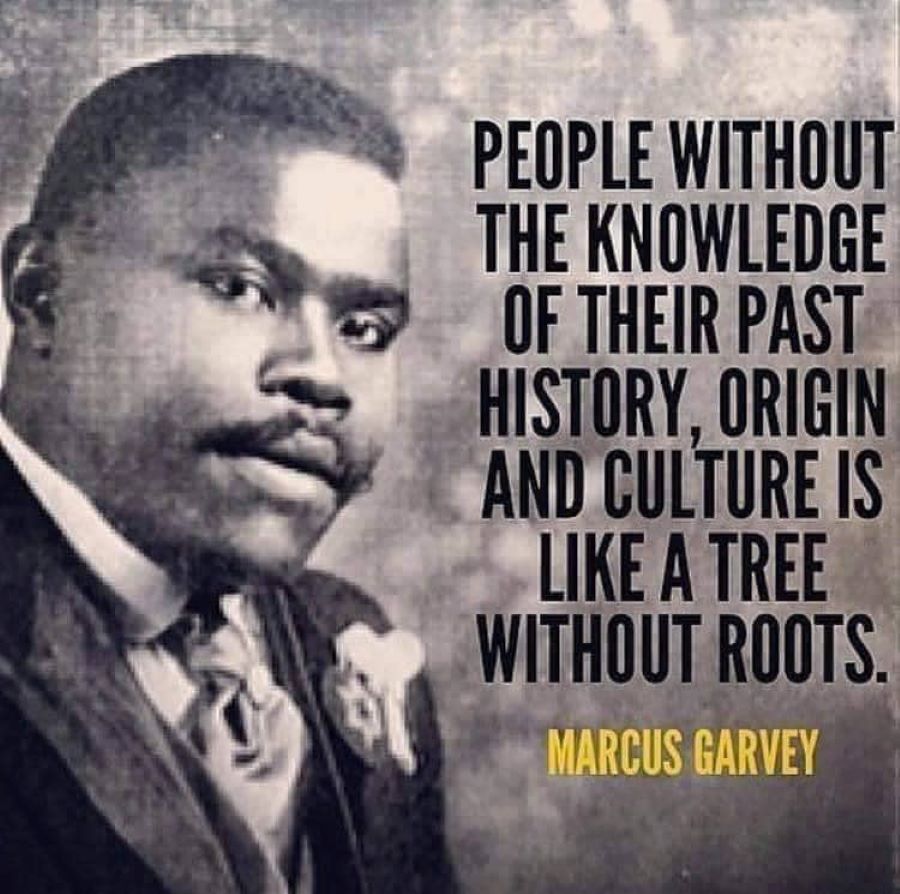
Communal knowledge is just as important as individual knowledge. Black history, for instance, has often been suppressed or whitewashed, leaving generations disconnected from their heritage. Reclaiming historical knowledge restores dignity, pride, and collective power. Hosea’s warning applies here too: forgetting the past leads to cultural and spiritual destruction.

Another way to overcome lack of knowledge is mentorship and discipleship. In the Bible, knowledge was often passed down orally and through apprenticeship. Paul discipled Timothy (2 Timothy 2:2, KJV), teaching him sound doctrine so that he could teach others. Today, mentorship helps people grow spiritually, professionally, and personally.

The Holy Spirit also plays a critical role in imparting knowledge. John 14:26 (KJV) promises that the Comforter will “teach you all things, and bring all things to your remembrance.” This means that divine revelation is not limited to human intellect—God Himself is willing to teach those who are willing to learn.

A lack of knowledge about health and wellness can also lead to destruction. Many illnesses are preventable through education about nutrition, exercise, and mental health. The Bible encourages stewardship of the body: “Know ye not that your body is the temple of the Holy Ghost?” (1 Corinthians 6:19, KJV).

Financial ignorance is another area where people perish. Proverbs 21:20 (KJV) notes that “There is treasure to be desired and oil in the dwelling of the wise; but a foolish man spendeth it up.” Learning budgeting, saving, and investing protects families from generational poverty and exploitation.

Overcoming lack of knowledge also requires humility. Proverbs 12:1 (KJV) says, “Whoso loveth instruction loveth knowledge: but he that hateth reproof is brutish.” Some reject knowledge because it challenges their worldview or pride. A teachable spirit allows one to grow and avoid destruction.

Social media can be both a danger and a blessing in this regard. While misinformation spreads quickly online, digital platforms also provide access to education, theology, and history. The key is discernment—testing every message against Scripture and credible sources.

Ultimately, knowledge must lead to action. James 1:22 (KJV) warns, “But be ye doers of the word, and not hearers only, deceiving your own selves.” Knowing what is right without doing it is self-deception. True knowledge transforms character and behavior.

In conclusion, lack of knowledge is dangerous because it leads to destruction—spiritually, emotionally, financially, and culturally. The solution is a relentless pursuit of truth: knowledge of God through His Word, knowledge of self through reflection, and knowledge of the world through study and discernment. When we seek wisdom, God promises to give it liberally (James 1:5, KJV). Knowledge is not just power—it is protection, freedom, and the life path.


References

  • DeGruy, J. (2005). Post Traumatic Slave Syndrome: America’s Legacy of Enduring Injury and Healing. Joy DeGruy Publications.
  • Goleman, D. (1995). Emotional Intelligence: Why It Can Matter More Than IQ. Bantam Books.
  • hooks, b. (1995). Killing Rage: Ending Racism. Henry Holt and Company.
  • Tatum, B. D. (2017). Why Are All the Black Kids Sitting Together in the Cafeteria? Basic Books.

Key KJV Scriptures: Hosea 4:6; Proverbs 29:18; Proverbs 4:7; Psalm 119:105; 2 Corinthians 13:5; 1 Corinthians 6:19; Proverbs 21:20; James 1:22; Matthew 22:29; John 14:26.

Internalized Whiteness: Beauty Standards and the Reverence for Eurocentric Features.

Black people in the United States and around the world have long contended with beauty ideals that place white, Eurocentric features at the top of a global hierarchy. These standards influence perceptions of skin, hair, facial structure, and desirability — shaping how individuals see themselves and each other. This phenomenon, when adopted within marginalized groups, is often referred to as internalized whiteness or internalized racism.

Internalized whiteness emerges when dominant cultural norms — rooted in white supremacy — become so embedded that they influence individuals’ self-value and self-image. This includes prioritizing lighter skin, straight hair, narrower noses, and thinner lips — traits historically associated with whiteness — over features more common among Black people.

At its core, internalized whiteness is not simply a matter of preference. It is a psychological and social legacy of historical oppression and exclusion — the aftermath of centuries in which European features were valorized while African features were devalued. This dynamic can play out within Black communities themselves, manifesting in preferences that mimic wider societal biases.

Research in psychology has found that internalized endorsement of Eurocentric beauty standards is associated with negative psychological outcomes for Black women, including increased anxiety and depression. This illustrates how deeply these aesthetic norms can penetrate individual self-worth.

Much of this beauty hierarchy has historical roots in colonialism and slavery. During slavery in the United States and Europe’s colonial enterprises globally, lighter skin was sometimes associated with proximity to enslaved persons’ masters or privileges — creating a rudimentary hierarchy of skin tone. This early color hierarchy evolved into modern colorism, where lighter skin and Eurocentric physical traits are socially rewarded.

Colorism — discrimination based on skin tone — is shaped by these beauty standards and operates both between and within racial groups. Studies have shown that within Black communities, lighter skin is often associated with social advantages, while darker skin correlates with disadvantage in socioeconomic status, relationships, and self-esteem.

This internalized ranking contributes to phenomena such as Black mothers complimenting mixed-race children for being “cute” while overlooking the beauty of darker-skinned children. Embedded beauty hierarchies can lead to intracommunity bias that privileges proximity to whiteness — a painful echo of larger societal values.

Internalized whiteness also shapes dating ideals. Within many Black communities, lighter or Eurocentric features are often perceived as more desirable. Researchers have documented how colorism can influence romantic relationships, with lighter-skinned individuals sometimes given preferential social attention or perceived as more attractive.

This dynamic is reinforced by media portrayals that celebrate Eurocentric standards. Television, film, and social media often highlight lighter skin and straighter hair as ideals of attractiveness, while darker skin and natural hair textures are marginalized or exoticized.

The entertainment industry itself reflects these norms. Colorism has long affected casting decisions, where lighter or Eurocentric Black actors may receive more visibility or roles reinforcing beauty ideals closer to whiteness. This can subtly encourage audiences to associate desirability with a closer resemblance to white aesthetics.

Prominent individuals have spoken about their own struggles with internalized beauty norms. Actor Taye Diggs has shared that he experienced self-esteem issues due to his dark skin during his youth and that seeing a dark-skinned model like Tyson Beckford celebrated for his looks helped shift his self-perception.

Diggs recounted that after seeing such representation, he felt more pride in his appearance — illustrating how affirming depictions can counteract internalized negative values.

Despite these pressures, there is a long tradition of movements that push back against internalized whiteness. The “Black Is Beautiful” movement, for example, explicitly affirmed the beauty of all African features and encouraged pride in Black identity and aesthetics.

Nonetheless, everyday social interactions continue to reflect internalized standards. Many within Black communities witness attitudes where darker skin or kinkier hair is overlooked or undervalued — sometimes even compared unfavorably to lighter skin or straighter hair. These preferences can create tension between generations and within peer groups.

Colorism also affects self-image in deeper ways. Adolescent Black girls who internalize beauty norms tied to whiteness often show lower body esteem and self-confidence, especially when media representations seldom reflect their own appearance.

The internalized gaze — the tendency to view oneself and one’s group through the lens of dominant Eurocentric ideals — is a psychological burden that can shape life choices, aspirations, and identity development.

Black individuals may also project these norms onto others. Stories of Black men and women expressing preferences for lighter-skinned or mixed partners indicate that societal beauty hierarchies persist even within marginalized groups. These patterns often reflect deeper social conditioning rather than genuine individual aesthetics.

For some, these preferences result in Black-on-Black criticism — for example, targeting darker-skinned individuals for perceived unattractiveness. Such intragroup conflict reflects the broader influence of external beauty standards internalized over time.

Within families, these dynamics can influence how children are treated and perceived. Some Black parents may unconsciously praise lighter or mixed-heritage children more frequently, reinforcing beauty standards rooted in whiteness.

However, research suggests that strong racial identity and cultural affirmation can mitigate the psychological effects of internalized whiteness. Black feminist consciousness and pride in African aesthetics have been linked to better body satisfaction and resilience against beauty ideals imposed by dominant culture.

Colorism and internalized whiteness do not only affect women. Men in Black communities may also internalize beauty hierarchies, influencing their preferences in partners and perceptions of themselves. These internalized biases can contribute to harmful social norms around desirability and masculinity.

Despite the deep roots of these issues, many in the Black community are actively resisting internalized beauty standards. Grassroots movements, cultural affirmations of natural hair care, skin tone diversity celebrations, and educational campaigns all challenge the notion that whiteness equals beauty.

Social media has become a space for Black creators to celebrate Afrocentric features, natural hair textures, and darker skin tones — offering counter-narratives to historical beauty hierarchies.

These cultural shifts are important because representation matters. Seeing diverse Black beauty celebrated publicly can weaken the internalized gaze and make space for fuller self-acceptance.

Fostering dialogue within families and communities about these issues can help dismantle internalized beauty standards. Education about the historical origins of these preferences can reveal how deeply they are rooted in systemic inequities, not biological superiority.

Ultimately, internalized whiteness and the reverence for Eurocentric features represent not an inherent flaw within Black people but the lingering psychological impact of centuries of racial domination and cultural marginalization.

Embracing Black aesthetics — in all their diversity — is part of the healing process. It involves reclaiming beauty definitions and affirming that Black features, skin tones, and hair textures are not only valid but inherently beautiful.

By understanding and challenging the internalized gaze, individuals and communities can move toward greater self-acceptance and collective pride.

Breaking free from these internalized hierarchies is not just a cultural shift — it’s a step toward racial justice and psychological liberation.


References

Dennis, A. C., DeAngelis, R., Hargrove, T. W., & Pearson, J. A. (2025). Colorism and health inequities among Black Americans: A biopsychosocial perspective. PMC. https://pmc.ncbi.nlm.nih.gov/articles/PMC12573201/?utm_source=chatgpt.com

Phoenix, A., & Craddock, N. (2024). Skin shade and relationships: How colourism pits Black and mixed Black-White women against each other. Frontiers in Sociology. https://pubmed.ncbi.nlm.nih.gov/39758188/?utm_source=chatgpt.com

Walker, S. T. (2014). Black beauty, white standards: Impacts on Black women and resources for resistance and resilience. University of Massachusetts Boston. https://scholarworks.umb.edu/doctoral_dissertations/147?utm_source=chatgpt.com

Williams, T. R., Sanders, S. M., Bass, J. E., Tookes-Williams, K., Popplewell, R., Hooper, V., & Garcia-Aguilera, C. (2025). Investigating the effects of racial identity on the relationship between Black women’s endorsement of Eurocentric beauty standards and psychological health. Women & Therapy. https://www.tandfonline.com/doi/full/10.1080/02703149.2025.2515013?utm_source=chatgpt.com

Internalized racism – Wikipedia. https://en.wikipedia.org/wiki/Internalized_racism?utm_source=chatgpt.com

Black is Beautiful – Wikipedia. https://en.wikipedia.org/wiki/Black_is_beautiful?utm_source=chatgpt.com

Taye Diggs commentary on colorism and self-esteem – Atlanta Black Star. https://atlantablackstar.com/2012/01/19/taye-diggs-reveals-black-men-are-scarred-by-colorism/?utm_source=chatgpt.com

The Woman Diaries: Why Waiting Until Marriage Is Beneficial to a Woman.

Flee fornication

(1 Corinthians 6:18, KJV)

Is a direct and urgent admonition found in Scripture, reminding believers to avoid sexual immorality because of its profound spiritual and physical implications. The apostle Paul emphasizes that sexual sin is uniquely significant because it is committed against one’s own body, which God has created with sacred purpose and design. For women in particular, this biblical instruction calls for wisdom, discernment, and the guarding of one’s personal and spiritual integrity.

A woman should therefore be mindful to guard her essence, recognizing the sacred value of her body and spirit. From both a theological and moral perspective, the female body is not merely physical but deeply spiritual in nature. Scripture teaches that the body is the temple of the Holy Spirit (1 Corinthians 6:19–20, KJV), emphasizing that it is to be treated with reverence, discipline, and honor. Within this framework, a woman’s physical being carries divine significance and should not be approached casually or without discernment.

Women are uniquely designed to receive, nurture, and cultivate life—physically, emotionally, and spiritually. Because of this profound capacity, the intimate act of sexual union holds deeper implications than simple physical pleasure. It is an exchange that involves emotional bonding, spiritual connection, and psychological attachment. For this reason, guarding one’s intimacy is an act of wisdom and self-respect, acknowledging that such a union was divinely intended to occur within the covenant of marriage.

To safeguard one’s body is therefore to safeguard one’s dignity, identity, and spiritual well-being. A woman’s body is precious, worthy of honor, and deserving of protection. Within biblical teaching, the fullness of physical intimacy is reserved for the sacred bond between husband and wife, where love, commitment, and covenant provide the proper foundation for such a profound union. In this sense, a woman who guards her intimacy affirms both her intrinsic worth and the divine purpose for which her body was created.

In a culture that often promotes instant gratification and casual relationships, the idea of waiting until marriage for sexual intimacy can seem outdated or “old-fashioned.” Yet for many women—both young and mature—this decision remains deeply meaningful. Waiting is not merely about tradition or religious rules; it is about emotional health, spiritual alignment, personal dignity, and long-term well-being.

For women exploring relationship and life choices, the conversation about sexual boundaries deserves thoughtful reflection rather than social pressure. Understanding how intimacy affects the body, mind, and spirit can empower women to make decisions that honor themselves and their values. From a biblical perspective, the body is sacred before God, and sexual union was designed to exist within the covenant of marriage (1 Corinthians 6:18–20; Hebrews 13:4, King James Version).

Waiting until marriage is therefore not a limitation—it can be a powerful act of self-respect and wisdom.


Understanding What Happens During Sexual Intimacy

Sexual intimacy is not merely physical. It involves complex biological, psychological, and emotional processes that affect men and women differently.

Research shows that the female brain releases bonding hormones such as oxytocin and vasopressin during sexual intimacy. Oxytocin is sometimes called the “bonding hormone” because it increases emotional attachment and trust between partners (Carter, 1998). This means that sexual activity can naturally deepen a woman’s emotional connection to a partner, even if the relationship itself lacks stability or commitment.

Men, however, are often socialized differently in many cultures. While men also release bonding hormones, evolutionary psychology research suggests that men may experience sexual encounters with less immediate emotional bonding compared to women (Fisher, 2004). This difference does not mean men do not care, but it highlights how intimacy can impact women’s emotional well-being more intensely.

When a woman becomes sexually involved with a man outside the covenant of marriage, the emotional attachment formed may not always be reciprocated with equal commitment. This imbalance can lead to heartbreak, confusion, and emotional wounds.

From a biblical standpoint, sexual intimacy is intended to unite two people in covenant. Scripture teaches that sexual union creates a “one flesh” bond (Genesis 2:24). When this union occurs outside marriage, it can create emotional and spiritual conflict because the relationship lacks the covenantal protection God designed.


Three Research-Supported Benefits of Waiting Until Marriage

1. Stronger Emotional and Relationship Stability

Women who wait until marriage often report greater relationship satisfaction and stability.

A study from the Institute for Family Studies found that couples who waited until marriage to have sex reported higher levels of marital satisfaction and communication compared to those who were sexually involved earlier in the relationship (Busby, Carroll, & Willoughby, 2010).

Benefits include:

  • Deeper emotional intimacy before physical intimacy
  • Stronger communication and trust
  • Reduced comparison with previous partners
  • Greater long-term relationship satisfaction

When intimacy is reserved for marriage, couples often build a stronger foundation of friendship, shared values, and spiritual connection first. These elements are essential for lasting relationships.

From a biblical perspective, patience in relationships reflects wisdom and self-control, qualities praised throughout scripture (Proverbs 4:7; Galatians 5:22–23).


2. Protection from Physical Health Risks

Waiting until marriage also significantly reduces exposure to sexually transmitted infections (STIs) and other health risks.

According to the Centers for Disease Control and Prevention, nearly 20 million new sexually transmitted infections occur each year in the United States, with young adults representing a large portion of new cases (CDC, 2023).

Some of these infections include:

  • Human papillomavirus (HPV)
  • Chlamydia
  • Gonorrhea
  • HIV
  • Herpes

Certain infections can lead to long-term health complications such as infertility, cervical cancer, and chronic illness. While modern medicine offers treatment options, prevention remains the safest approach.

Waiting until marriage with a committed partner greatly reduces these risks and allows both partners to enter intimacy with greater health security.

The biblical principle behind sexual boundaries also emphasizes protection. Scripture repeatedly warns against fornication because it harms the body and spirit (1 Corinthians 6:18).


3. Greater Self-Worth and Personal Empowerment

Contrary to the idea that waiting is restrictive, many women find that setting sexual boundaries strengthens their sense of self-worth.

Choosing to wait can help women:

  • Maintain control over their bodies and life choices
  • Avoid emotional entanglements that hinder personal growth
  • Focus on education, career, and spiritual development
  • Seek partners who value commitment and respect

Women who establish clear boundaries often attract partners who are serious about long-term commitment rather than temporary pleasure.

From a spiritual perspective, the Bible teaches that the body is a temple of the Holy Spirit (1 Corinthians 6:19). Viewing the body as sacred encourages women to treat themselves with dignity and purpose.

Waiting until marriage becomes an expression of self-respect rather than a restriction imposed by society.


Addressing Common Misconceptions

“Waiting Until Marriage Is Old Fashioned”

Some argue that waiting until marriage is outdated in modern society. However, personal values are not determined by cultural trends. Many women today intentionally choose this path because it aligns with their emotional, spiritual, and personal goals.

True empowerment involves making choices that reflect one’s values rather than simply following societal expectations.

“Sex Is Necessary to Test Compatibility”

Another common argument suggests that couples must have sex before marriage to determine compatibility. Yet research indicates that communication, shared values, emotional intimacy, and conflict resolution skills are far stronger predictors of relationship success than sexual experience alone (Stanley, Rhoades, & Markman, 2006).

Healthy marriages are built on trust, respect, and commitment—not experimentation.


Building Strong Emotional and Spiritual Foundations

Waiting until marriage encourages women to cultivate relationships that prioritize emotional and spiritual connection first.

This process may include:

  • Developing meaningful friendships within the relationship
  • Praying and seeking spiritual guidance
  • Learning communication and conflict resolution skills
  • Establishing mutual respect and shared goals

When physical intimacy finally occurs within marriage, it becomes a celebration of covenant rather than a source of confusion or regret.

The Bible emphasizes the beauty of intimacy within marriage, describing it as honorable and blessed (Hebrews 13:4).


Final Thoughts: Honoring Your Sacred Worth

Every woman deserves love that is committed, respectful, and honorable. Waiting until marriage is not about shame, restriction, or judgment—it is about protecting the heart, honoring the body, and building relationships rooted in trust and covenant.

Key takeaways include:

  • Sexual intimacy creates powerful emotional bonds.
  • Waiting until marriage can strengthen relationships and reduce emotional harm.
  • It protects physical health and reduces exposure to disease.
  • It reinforces self-respect and spiritual alignment.

Your body is sacred before God, and the choices you make about intimacy carry both emotional and spiritual significance.

For women navigating the complexities of modern relationships, choosing patience and discernment can be one of the most empowering decisions you make. Waiting is not weakness—it is wisdom, dignity, and faith in action.

And when the right covenant relationship arrives, intimacy becomes not just physical pleasure, but a profound union blessed by love, commitment, and God.


References

Busby, D. M., Carroll, J. S., & Willoughby, B. J. (2010). Compatibility or restraint? The effects of sexual timing on marriage relationships. Journal of Family Psychology, 24(6), 766–774.

Carter, C. S. (1998). Neuroendocrine perspectives on social attachment and love. Psychoneuroendocrinology, 23(8), 779–818.

Centers for Disease Control and Prevention. (2023). Sexually transmitted infections surveillance report. https://www.cdc.gov

Fisher, H. (2004). Why we love: The nature and chemistry of romantic love. Henry Holt.

Stanley, S. M., Rhoades, G. K., & Markman, H. J. (2006). Sliding versus deciding: Inertia and the premarital cohabitation effect. Family Relations, 55(4), 499–509.

The Holy Bible, King James Version. (1611/2017).

The Chosen Ones Series: The Battles That The Most High God told You to Avoid.

For those who believe they are called, appointed, or set apart by God, life often comes with a heightened awareness of spiritual responsibility. Many individuals who walk a faith-centered path feel compelled to intervene in every conflict, defend every injustice, and solve every problem they encounter. Yet scripture repeatedly teaches that not every battle belongs to us. Some conflicts are spiritual tests of restraint, humility, and trust in divine justice.

The Bible reminds believers that God Himself is the ultimate judge and avenger. In a world filled with offense, betrayal, and misunderstanding, the temptation to retaliate or defend one’s honor can be powerful. However, spiritual maturity requires the discipline to release personal revenge and allow God to act according to His perfect will and timing.

Personal revenge may feel justified when someone has been wronged, but scripture clearly warns against it. The human desire to settle scores can easily lead to bitterness, anger, and destructive cycles of retaliation. The Apostle Paul instructed believers to resist this urge and instead trust that God sees every injustice.

In Romans 12:19, the Apostle Paul writes, “Dearly beloved, avenge not yourselves, but rather give place unto wrath: for it is written, Vengeance is mine; I will repay, saith the Lord.” This passage reminds believers that retaliation is not their responsibility. Divine justice operates beyond human perception, and God ultimately restores balance in ways people cannot.

Many spiritual people exhaust themselves trying to prove their worth to others. Seeking approval, admiration, or validation from people can become a quiet spiritual trap. When individuals base their identity on the opinions of others, they become emotionally dependent on external affirmation.

The desire for admiration often stems from a deeper need for acceptance and belonging. Social media culture, public recognition, and societal pressures encourage people to measure their value through applause and popularity. Yet spiritual identity is not determined by human approval but by divine purpose.

Jesus Himself warned against living for public admiration. In Matthew 6:1, He cautioned His followers to avoid performing acts of righteousness merely to be seen by others. Faith, according to Christ, is meant to be genuine and sincere, not a performance for applause.

People pleasing can quietly drain the spirit. When a person constantly adjusts their behavior to keep everyone happy, they sacrifice their own emotional and spiritual well-being. This cycle creates exhaustion because no human being can satisfy every expectation placed upon them.

Those who feel spiritually chosen often believe they must carry everyone’s burdens. They feel responsible for fixing every broken situation, mediating every conflict, and rescuing others from their problems. While compassion is a noble quality, assuming the role of savior for everyone is neither healthy nor biblical.

Scripture teaches that God alone is the ultimate burden bearer. Believers are called to help others, but they are not responsible for solving every problem. Attempting to carry burdens that belong to God often leads to burnout, anxiety, and spiritual fatigue.

Jesus invites believers to release their burdens in Matthew 11:28 when He says, “Come unto me, all ye that labour and are heavy laden, and I will give you rest.” This invitation reflects a central principle of faith: God does not expect His followers to carry the weight of the world alone.

The battle of self often proves more difficult than conflicts with others. Internal struggles such as pride, insecurity, and the need for validation can become spiritual obstacles. These inner battles require humility and self-reflection rather than confrontation with others.

Many conflicts that people engage in are rooted in ego rather than righteousness. The need to prove oneself right, defend reputation, or win arguments often disguises itself as moral courage. In reality, these battles can distract believers from their spiritual calling.

Wisdom involves discerning which battles are worth fighting. The Book of Proverbs frequently emphasizes restraint, teaching that wise individuals avoid unnecessary conflict. Silence, patience, and humility can often be more powerful than confrontation.

In Proverbs 20:3, scripture declares, “It is an honour for a man to cease from strife: but every fool will be meddling.” This verse highlights the virtue of restraint. Walking away from certain conflicts is not weakness but wisdom.

Another draining battle is the constant need to explain oneself. People often feel pressured to justify their decisions, beliefs, or boundaries to everyone around them. Yet spiritually grounded individuals understand that not everyone will understand their path.

Jesus Himself faced misunderstanding and criticism throughout His ministry. Despite this, He did not spend His time trying to win over every skeptic or satisfy every critic. Instead, He remained focused on His mission.

When individuals attempt to gain universal approval, they often lose sight of their purpose. The Apostle Paul acknowledged this tension in Galatians 1:10 when he wrote that seeking the approval of people rather than God would make him a servant of men rather than a servant of Christ.

Another hidden battle is the pressure to always be strong for others. People who are viewed as spiritually mature or emotionally resilient are often expected to carry the emotional weight of everyone around them. This expectation can become overwhelming.

Even the strongest spiritual leaders needed rest and solitude. Throughout the Gospels, Jesus frequently withdrew from crowds to pray and restore His strength. These moments reveal that spiritual renewal requires intentional withdrawal from constant demands.

Trying to fight battles that do not belong to you can drain both emotional energy and spiritual clarity. When individuals become entangled in every conflict around them, they lose the ability to focus on their own spiritual growth.

Boundaries are essential for spiritual health. Recognizing which battles belong to you and which belong to God requires discernment and humility. Not every injustice requires your intervention.

There are moments when silence is more powerful than argument. Walking away from conflict allows God to intervene in ways that human confrontation cannot achieve.

Spiritual wisdom involves trusting God’s timing. Immediate retaliation may feel satisfying, but divine justice often unfolds in ways that require patience and faith.

When believers release the need for revenge, validation, and approval, they experience freedom. Their identity becomes rooted in God rather than the shifting opinions of others.

Learning to surrender battles to God requires faith. It involves trusting that God sees every injustice, hears every prayer, and understands every hidden struggle.

The process of surrender is not passive; it is an act of spiritual discipline. It requires resisting the urge to intervene where God has instructed patience.

When individuals stop fighting unnecessary battles, they conserve their strength for the battles that truly matter—those involving justice, truth, faith, and righteousness.

Peace often arrives when people release the need to control outcomes. By allowing God to carry burdens that were never meant for human shoulders, believers experience spiritual clarity and emotional relief.

Ultimately, the chosen path is not about fighting every battle but about discerning the ones God has called you to face. Some battles are meant to be fought with courage, while others are meant to be surrendered in faith.

The wisdom of the faithful lies in knowing the difference.


References

The Holy Bible, King James Version.

Cloud, H., & Townsend, J. (2017). Boundaries: When to Say Yes, How to Say No to Take Control of Your Life. Zondervan.

Peterson, E. H. (2002). The Message: The Bible in Contemporary Language. NavPress.

Willard, D. (1998). The Divine Conspiracy: Rediscovering Our Hidden Life in God. HarperOne.

Smedes, L. B. (1996). Forgive and Forget: Healing the Hurts We Don’t Deserve. HarperOne.

Boy Meets Girl Series: Episode 2 — The First Look

The first look was not born of haste, but of recognition. It carried weight, not urgency, as though something ancient stirred beneath the surface of the moment. He did not see her as a conquest to be claimed, but as a mystery to be honored. In that first exchange, the spirit spoke before the flesh ever dared to respond.

From the beginning, God established that union is His idea, not man’s invention. When Adam first beheld Eve, his words were not lustful, but revelatory: “This is now bone of my bones, and flesh of my flesh” (Genesis 2:23, KJV). The first look in Scripture was a moment of divine unveiling, not indulgence, showing that recognition precedes possession.

Adam did not search the garden for Eve; God brought her to him. This pattern matters. Man does not manufacture covenant by desire alone. Scripture is clear that God is the one who presents, aligns, and authorizes union. “And the LORD God said, It is not good that the man should be alone” (Genesis 2:18, KJV). The solution came from God, not from Adam’s effort.

In a culture that encourages self-selection driven by appetite, the Word offers correction. One cannot simply pick a spouse apart from divine order. “A man that findeth a wife findeth a good thing, and obtaineth favour of the LORD” (Proverbs 18:22, KJV). Finding, in biblical context, is discovery through obedience, not impulsive choosing.

The first look, therefore, must be guarded. What begins in the eyes often seeks permission in the heart. Scripture warns that desire unrestrained becomes destruction. “Flee fornication” (1 Corinthians 6:18, KJV) is not fear-based instruction, but wisdom that protects the covenant before it forms.

Avoiding fornication preserves clarity. When intimacy is rushed, discernment is clouded. God’s design calls for restraint so that love may mature without contamination. “For this is the will of God, even your sanctification” (1 Thessalonians 4:3, KJV). Purity keeps the first look holy rather than hungry.

True love mirrors Christ’s posture toward the Church. It is sacrificial, patient, and protective. Scripture commands, “Husbands, love your wives, even as Christ also loved the church, and gave himself for it” (Ephesians 5:25, KJV). This kind of love does not take; it gives. It does not rush; it waits.

A man who looks with covenant in mind will not reduce a woman to her body. He understands that beauty without character fades, but a virtuous heart endures. “Favour is deceitful, and beauty is vain: but a woman that feareth the LORD, she shall be praised” (Proverbs 31:30, KJV).

Her true beauty is revealed not by cosmetics but by conduct. Peter writes that adornment should not merely be external, but rooted in “the hidden man of the heart” (1 Peter 3:3–4, KJV). The first look must therefore look deeper, beyond symmetry and shape, into spirit and substance.

Character cannot be manufactured to match desire. No amount of attraction can compensate for misalignment of values. Scripture asks plainly, “Can two walk together, except they be agreed?” (Amos 3:3, KJV). Agreement in faith and purpose matters more than physical chemistry.

God promises to bring what He ordains. Isaac did not wander in search of Rebekah; she was brought to him through prayer and obedience (Genesis 24). This reinforces a timeless truth: when God brings your spouse, peace accompanies the process, not confusion or compromise.

The first look, when guided by God, is gentle rather than demanding. It respects boundaries because it anticipates a covenant. It understands that the body belongs to the Lord before it belongs to another. “Know ye not that your body is the temple of the Holy Ghost?” (1 Corinthians 6:19, KJV).

Lust demands immediacy, but love exercises discipline. Lust asks what it can take; love asks what it must protect. This distinction defines whether the first look leads toward life or loss. “Charity suffereth long, and is kind” (1 Corinthians 13:4, KJV).

What God joins together begins with recognition, not consumption. The first look is a sacred threshold where reverence must outweigh impulse. When eyes are submitted to God, they become instruments of discernment rather than desire.

Thus, the first look is not the beginning of possession, but of prayer. It is the quiet acknowledgment that if this is of God, He will bring it to pass in His time and His way. Until then, the eyes remain guarded, the heart remains patient, and faith remains steadfast, trusting the Most High to bring together what He alone has ordained.


References

The Holy Bible, King James Version. (1769/2017). Cambridge University Press.

Scriptures referenced:
Amos 3:3; Ephesians 5:25; Genesis 2:18, 2:23; Genesis 24; Proverbs 18:22; Proverbs 31:30; 1 Corinthians 6:18–19; 1 Corinthians 13:4; 1 Peter 3:3–4; 1 Thessalonians 4:3.

Dilemmas

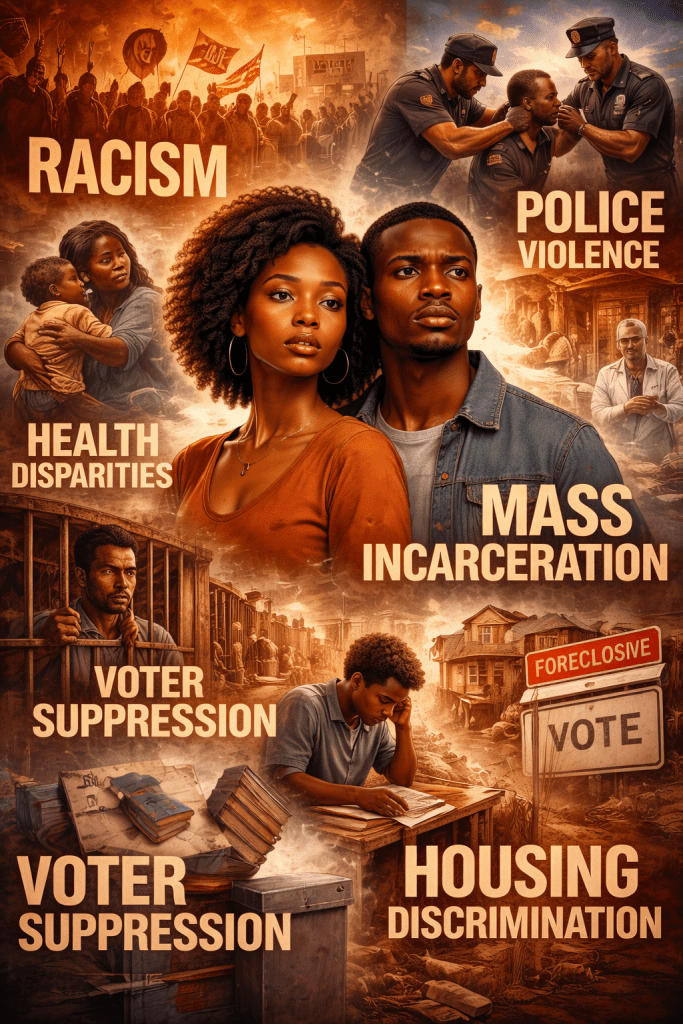
The biggest dilemma Black people face in the United States and globally is not a single issue—it is a complex intersection of systemic racism, historical oppression, and structural inequality. Scholars, historians, and social scientists generally agree that these challenges are interconnected, affecting economic opportunity, health, education, justice, and political representation simultaneously. Here’s a breakdown of the major dimensions of this dilemma:

The Weight of Structural Oppression: The Biggest Dilemma Black People Face

Black people in the United States face a complex web of challenges shaped by centuries of systemic racism, economic inequality, and social marginalization. These intersecting factors have created structural barriers that affect nearly every aspect of life, from housing and education to healthcare and political participation. Understanding the depth of this dilemma requires an examination of historical patterns and contemporary consequences.

Systemic Racism

Systemic or structural racism refers to the ways in which laws, policies, and social institutions create and perpetuate inequality based on race. This includes discriminatory practices in housing, education, employment, and criminal justice. Examples include:

  • Redlining and housing discrimination – Black families were historically denied access to mortgages and homeownership, creating generational wealth gaps.
  • Urban renewal and “Negro removal” – Black neighborhoods were destroyed for highways and development, displacing communities.

2. Economic Inequality

Black people consistently face disparities in income, wealth, and access to employment opportunities. According to Federal Reserve data:

  • The median wealth of Black families is significantly lower than that of white families.
  • Access to high-paying jobs is restricted by both educational and systemic barriers, including bias in hiring and promotion.

Economic inequality compounds other challenges, like housing, healthcare, and education.


3. Criminal Justice and Mass Incarceration

The U.S. criminal justice system disproportionately targets Black individuals:

  • Black Americans are more likely to be stopped, arrested, convicted, and given longer sentences than white Americans for similar offenses.
  • Systems like convict leasing historically re-enslaved Black men after emancipation, while modern mass incarceration continues this legacy in a more subtle form.

This creates cycles of poverty, family disruption, and social stigma.


4. Health Disparities

Black people experience disproportionate health challenges, both from systemic barriers and social determinants:

  • Higher rates of chronic disease, infant mortality, and maternal mortality.
  • Less access to quality healthcare and insurance.
  • The legacy of medical exploitation, such as the Tuskegee Syphilis Study, contributes to mistrust of medical institutions.

5. Educational Inequality

Education is a key pathway to social mobility, yet Black students often face:

  • Segregated schools due to district zoning and residential patterns.
  • Underfunded schools with fewer resources, larger class sizes, and limited access to advanced programs.
  • Bias in curriculum and disciplinary practices that disproportionately penalize Black students.

6. Cultural Stereotypes and Social Perceptions

Black people are frequently subjected to harmful stereotypes:

  • Men: “threatening,” “criminal,” or “hyper-masculine” tropes.
  • Women: “angry,” “jezebel,” or “mammy” archetypes.
  • These stereotypes affect employment, policing, mental health, and social interactions.

7. Political Disenfranchisement

Efforts to suppress Black votes through gerrymandering, voter ID laws, and intimidation continue to limit political influence. Without political power, communities struggle to advocate for systemic change in housing, education, and law enforcement.


8. Intergenerational Trauma

The cumulative effect of slavery, segregation, discrimination, and systemic oppression has created intergenerational trauma. This affects:

  • Mental health outcomes
  • Economic behaviors and financial stability
  • Family structures and community cohesion

One of the most pervasive forces shaping Black life is systemic racism. This form of oppression is embedded within institutions, laws, and social practices that disadvantage Black individuals collectively. Systemic racism manifests in policies that limit access to economic resources, enforce segregation, and perpetuate disparities across generations.

Housing discrimination has historically reinforced racial inequality. Practices such as redlining, blockbusting, and contract selling restricted Black families’ access to safe neighborhoods and homeownership. Redlining, for example, denied mortgages to residents in predominantly Black neighborhoods, preventing them from accumulating wealth through property ownership.

Urban renewal projects in the mid-twentieth century, often referred to as “Negro removal,” further disrupted Black communities. Entire neighborhoods were demolished for highways, commercial developments, and government buildings, displacing families and erasing community networks. These policies reinforced segregation while simultaneously enriching developers and local governments.

Economic inequality remains a central challenge. Black Americans experience higher unemployment rates and lower wages compared with white counterparts. This disparity is compounded by limited intergenerational wealth, which restricts opportunities for education, homeownership, and investment. As a result, economic mobility is often constrained by systemic barriers beyond individual control.

Education is similarly affected by structural inequities. School district zoning often ties educational resources to property taxes, leaving Black students in underfunded schools with fewer academic opportunities. Segregated schools continue to produce gaps in achievement and limit access to higher education and professional careers.

Healthcare disparities also exemplify systemic inequities. Black individuals experience higher rates of chronic illnesses, maternal mortality, and limited access to quality care. Historical exploitation, such as the Tuskegee Syphilis Study, has fostered mistrust toward medical institutions, further complicating healthcare outcomes for Black communities.

Criminal justice disparities are another critical component of structural oppression. Black Americans are disproportionately targeted for policing, incarceration, and harsher sentencing. Practices such as convict leasing in the post-Civil War South and contemporary mass incarceration policies have created cycles of poverty and social instability, particularly affecting Black men.

The labor market has not been immune to racial inequities. Occupational segregation, hiring discrimination, and wage gaps limit economic opportunities for Black workers. Even with equal qualifications, Black individuals frequently face systemic barriers that affect promotions, career progression, and job security.

Political disenfranchisement continues to hinder Black communities. Gerrymandering, voter suppression laws, and historical exclusion from voting limit the ability to influence policies that affect housing, education, healthcare, and criminal justice. This reduces accountability and reinforces systemic inequities.

Cultural and media representation also shapes social experiences. Black people are often portrayed through stereotypes that influence perceptions in employment, law enforcement, and interpersonal interactions. These portrayals contribute to bias, discrimination, and the psychological burden of navigating misrepresentation.

Intergenerational trauma compounds these structural challenges. The cumulative effects of slavery, segregation, and systemic discrimination influence mental health, economic behavior, family dynamics, and community cohesion. This trauma persists across generations, creating challenges that extend beyond immediate social conditions.

Health outcomes are further affected by social determinants such as neighborhood safety, food access, and environmental hazards. Many Black communities live in areas with limited resources, higher exposure to pollution, and reduced access to recreational spaces, exacerbating health disparities.

Despite these challenges, Black communities have demonstrated resilience and agency. Historically, Black churches, civic organizations, and grassroots movements have provided support networks, leadership opportunities, and platforms for advocacy. These institutions have played a critical role in fostering community cohesion and social advancement.

Cultural contributions by Black Americans, from music and literature to art and entrepreneurship, have not only enriched society but also served as forms of resistance and empowerment. Cultural production has allowed Black communities to assert identity, challenge oppression, and build intergenerational pride.

Family and community structures within Black communities have historically been sites of strength. Extended kin networks, cooperative child-rearing, and communal support have mitigated the effects of systemic oppression while fostering resilience.

Economic strategies, including mutual aid, cooperative business ventures, and community investment, have also served as tools to counter structural inequality. These efforts, while often limited by systemic barriers, demonstrate agency and resourcefulness in the face of adversity.

Policy interventions are essential to addressing the multifaceted challenges facing Black Americans. Measures to reduce income inequality, expand access to quality education and healthcare, reform the criminal justice system, and combat discriminatory housing practices are critical to creating equitable opportunities.

Understanding the Black experience requires recognizing both systemic barriers and the resilience of the community. Black Americans navigate a society that historically and continuously marginalizes them, yet they maintain cultural, economic, and social strength that contributes to societal advancement.

The overarching dilemma is that Black people are forced to navigate systems designed historically to exclude them. Every aspect of life—education, work, healthcare, criminal justice, housing—is influenced by these systemic barriers. While resilience, cultural strength, and community networks have enabled survival and progress, the structural challenges continue to create cycles of inequality that affect generations.

In short, the biggest dilemma Black people face is systemic oppression combined with persistent structural inequities, which compound across generations to limit access to opportunity, safety, and wealth.

Ultimately, the biggest dilemma facing Black people is not a matter of individual shortcomings but of persistent systemic inequality and structural oppression. Addressing these interrelated challenges requires comprehensive policy reforms, societal commitment to racial equity, and recognition of the historical context that created these disparities.


References

Alexander, M. (2012). The new Jim Crow: Mass incarceration in the age of colorblindness. The New Press.

Blackmon, D. A. (2008). Slavery by another name: The re-enslavement of Black Americans from the Civil War to World War II. Anchor Books.

Collins, P. H. (2000). Black feminist thought: Knowledge, consciousness, and the politics of empowerment. Routledge.

Crenshaw, K. (1989). Demarginalizing the intersection of race and sex. University of Chicago Legal Forum.

Foner, E. (1988). Reconstruction: America’s unfinished revolution, 1863–1877. Harper & Row.

Hirsch, A. R. (1983). Making the second ghetto: Race and housing in Chicago 1940–1960. University of Chicago Press.

Rothstein, R. (2017). The color of law: A forgotten history of how our government segregated America. Liveright Publishing.

Sugrue, T. J. (2014). The origins of the urban crisis: Race and inequality in postwar Detroit. Princeton University Press.

U.S. Department of Housing and Urban Development. (2023). History of housing discrimination and segregation in the United States.

Wingfield, A. H. (2013). No more invisible man: Race and gender in men’s work. Temple University Press.

Right Calling, Wrong Posture

Many people are blessed with a divine calling, a purpose, or a gift from God. Yet, possessing a calling is not enough; the posture with which we approach it determines whether we fulfill our destiny or miss it entirely. A right calling in the wrong posture can lead to frustration, stagnation, and spiritual misalignment.

1. God Honors Posture, Not Just Talent

1 Samuel 16:7 (KJV) teaches: “But the Lord said unto Samuel, Look not on his countenance, or on the height of his stature; because I have refused him: for the Lord seeth not as man seeth; for man looketh on the outward appearance, but the Lord looketh on the heart.”
God values heart posture—humility, obedience, and faith—more than natural talent or outward appearance. You may be gifted, but without the right heart posture, your calling can be misused or ignored.

2. Pride Misaligns the Call

Proverbs 16:18 (KJV) warns: “Pride goeth before destruction, and an haughty spirit before a fall.”
Many individuals pursue their calling with arrogance, entitlement, or impatience. A posture of pride can blind a person to divine guidance, causing missteps even in areas where they are skilled. True readiness requires humility and teachability.

3. Impatience Can Distort the Mission

Ecclesiastes 3:1 (KJV) reminds us: “To everything there is a season, and a time to every purpose under the heaven.”
Rushing ahead of God’s timing, seeking recognition too early, or forcing results creates friction. The right calling requires patience; the wrong posture invites burnout and frustration.

4. Lack of Faith Weakens Impact

Hebrews 11:6 (KJV) teaches: “But without faith it is impossible to please him: for he that cometh to God must believe that he is, and that he is a rewarder of them that diligently seek him.”
Even with a correct calling, if faith is absent, one will fail to execute it effectively. Fear, doubt, or inaction undermine potential. Posture of trust and obedience strengthens calling.

5. Disobedience Nullifies Blessing

Joshua 1:7–8 (KJV) instructs: “Only be thou strong and very courageous, that thou mayest observe to do according to all the law…that thou mayest prosper whithersoever thou goest. This book of the law shall not depart out of thy mouth…that thou mayest make thy way prosperous, and that thou mayest have good success.”
Divine calling must align with God’s instructions. Talent without obedience is like a river without water—it looks promising but fails to nourish. Wrong posture in disobedience prevents true success.

6. Humility and Servanthood Elevate the Calling

Matthew 23:11 (KJV) declares: “But he that is greatest among you shall be your servant.”
God’s kingdom prioritizes servant leadership. Even when called to greatness, the posture of humility, service, and love ensures that the calling fulfills its divine purpose.

7. Listening and Aligning Your Spirit

Proverbs 3:5–6 (KJV) states: “Trust in the Lord with all thine heart; and lean not unto thine own understanding. In all thy ways acknowledge him, and he shall direct thy paths.”
Right posture involves continual spiritual alignment—prayer, discernment, and submission. A misaligned heart or ego can distort God’s calling into personal ambition.


Conclusion

A divine calling is a gift, but posture determines impact. Right calling, wrong posture, leads to wasted potential, frustration, and misalignment with God’s will. The correct posture—humility, obedience, patience, faith, and servanthood—ensures that the calling becomes a blessing, both spiritually and practically. Aligning posture with purpose allows God’s promises to manifest fully in one’s life.


References

Grudem, W. (2004). Systematic theology: An introduction to biblical doctrine. Inter-Varsity Press.

Stanley, A. (2012). The principle of posture in purpose: Aligning heart and calling. Thomas Nelson.

The Holy Bible, King James Version. (1769/2017). Cambridge University Press.

Oswald, R. (2015). Living in your calling: Posture, obedience, and impact. Moody Publishers.

The Dilemma of the Black Man and the Black Woman.

The dilemma of the Black man and Black woman is a spiritual, historical, and cultural paradox. Chosen by God, endowed with divine purpose and ancestral greatness, yet marginalized, oppressed, and misrepresented by the world. “For the Lord shall judge His people, and repent Himself for His servants, when He seeth that their power is gone” (Deuteronomy 32:36, KJV). Our divine worth has often clashed with societal perception.

Black men are called to leadership, protection, and spiritual headship. Scripture shows that a godly man is disciplined, righteous, and sacrificial. “He that ruleth his spirit is better than he that taketh a city” (Proverbs 16:32, KJV). Yet, society often diminishes his authority, questions his integrity, and criminalizes his presence. This creates tension between divine calling and worldly expectation.

Black women are called to honor, nurture, and uphold righteousness. The virtuous woman is praised for her fear of God and strength of character. “Who can find a virtuous woman? for her price is far above rubies” (Proverbs 31:10, KJV). Yet, she is often stereotyped, undervalued, and overburdened. The world demands perfection while failing to recognize her godly worth.

The dilemma begins in history. Black men and women have been enslaved, colonized, and systematically oppressed. They were denied education, autonomy, and wealth, yet their spiritual and cultural legacies endured. “They that wait upon the Lord shall renew their strength” (Isaiah 40:31, KJV). Faith sustained their identity through oppression.

For the Black man, societal misrepresentation often targets masculinity. His leadership and strength are viewed with suspicion rather than admiration. Scripture calls men to love and lead with humility: “Husbands, love your wives, even as Christ also loved the church” (Ephesians 5:25, KJV). Yet society frequently equates Black masculinity with aggression or threat.

For the Black woman, the world often reduces her worth to physical appearance or labor. She is resilient, yet society demands emotional perfection. Scripture reminds women of their eternal value: “Favour is deceitful, and beauty is vain: but a woman that feareth the Lord, she shall be praised” (Proverbs 31:30, KJV). Her worth is divine, not superficial.

The dilemma extends to relationships. The Black man struggles to lead spiritually, financially, and morally in a world that often undermines his authority. The Black woman struggles to honor God and maintain dignity in a culture that diminishes her voice. Yet Scripture instructs unity, obedience to God, and mutual respect: “Likewise, ye husbands, dwell with them according to knowledge, giving honour unto the wife” (1 Peter 3:7, KJV).

Education is another battlefield. Black men and women have historically had access denied, yet have produced scholars, thinkers, and inventors. “The heart of the prudent getteth knowledge; and the ear of the wise seeketh knowledge” (Proverbs 18:15, KJV). The dilemma is access and recognition despite capability.

Economically, Black men and women face systemic barriers. They are often denied fair wages, business opportunities, and generational wealth. Yet Scripture teaches diligence and provision: “If any provide not for his own, and specially for those of his own house, he hath denied the faith” (1 Timothy 5:8, KJV). Faith and persistence remain their anchors.

Spiritually, the Black man may wrestle with societal judgment while maintaining leadership and integrity. The Black woman may wrestle with societal objectification while nurturing faith and family. Scripture affirms that God’s view defines true worth: “Man looketh on the outward appearance, but the Lord looketh on the heart” (1 Samuel 16:7, KJV).

Cultural misrepresentation further complicates identity. Black men are often stereotyped as aggressive; Black women as angry or hypersexualized. Both distortions obscure God’s design. The Bible warns against judging by appearance or hearsay: “Judge not according to the appearance, but judge righteous judgment” (John 7:24, KJV).

Health disparities create another layer. Black men face high rates of disease, incarceration, and early mortality. Black women face maternal and systemic health inequities. Yet spiritual endurance sustains them: “Even the youths shall faint and be weary, and the young men shall utterly fall: But they that wait upon the Lord shall renew their strength” (Isaiah 40:30-31, KJV).

Black men and women are often forced to overperform to prove worth. Excellence is expected; failure is punished. Yet Scripture encourages perseverance and faith-driven identity: “But let patience have her perfect work, that ye may be perfect and entire, wanting nothing” (James 1:4, KJV).

The dilemma is compounded by colorism within the community. Lighter skin may be praised; darker skin criticized. Yet beauty and value are rooted in divine creation, not pigment. “So God created man in his own image, in the image of God created he him; male and female created he them” (Genesis 1:27, KJV).

Black men and women must navigate family dynamics where generational trauma persists. Healing and restoration require wisdom and faith. “Train up a child in the way he should go: and when he is old, he will not depart from it” (Proverbs 22:6, KJV). Spiritual and emotional nurturing is central.

The dilemma also affects love and partnership. Black men may struggle to lead without being misjudged. Black women may struggle to honor themselves while nurturing others. Godly love, patience, and discernment are the remedy: “Charity suffereth long, and is kind; charity envieth not; charity vaunteth not itself” (1 Corinthians 13:4, KJV).

Community expectation weighs heavily. Success is celebrated selectively; failure is amplified. Both men and women carry burdens not of their choosing. Scripture encourages unity and support: “Bear ye one another’s burdens, and so fulfil the law of Christ” (Galatians 6:2, KJV).

Despite these dilemmas, God equips His people with purpose. Black men and women are called to honor, wisdom, and influence. “And he said unto me, My grace is sufficient for thee: for my strength is made perfect in weakness” (2 Corinthians 12:9, KJV). Weakness is a canvas for divine strength.

Education, faith, family, and community become tools to navigate systemic obstacles. Black men lead with humility; Black women nurture with resilience. Both serve God’s higher calling while confronting societal injustice. “Trust in the Lord with all thine heart; and lean not unto thine own understanding” (Proverbs 3:5, KJV).

Ultimately, the dilemma is temporal; God’s perspective is eternal. Black identity, when rooted in divine truth, transcends cultural misrepresentation. “For I know the thoughts that I think toward you, saith the Lord, thoughts of peace, and not of evil, to give you an expected end” (Jeremiah 29:11, KJV).

Black men and women are divine reflections, created with purpose, intelligence, and sacred value. Their struggle is real, but their legacy is eternal. “Therefore all things whatsoever ye would that men should do to you, do ye even so to them” (Matthew 7:12, KJV). Treating oneself and each other with Godly love affirms identity.

The dilemma of the Black man and Black woman is multi-layered: historical, social, psychological, and spiritual. Yet, through faith, perseverance, and adherence to God’s Word, it becomes a pathway to triumph, restoration, and divine fulfillment. “Be strong and of a good courage, fear not, nor be afraid of them: for the Lord thy God, he it is that doth go with thee” (Deuteronomy 31:6, KJV).

Biblical References (KJV)

  • Genesis 1:27 — God created man in His image
  • Proverbs 3:5 — Trust in the Lord
  • Proverbs 16:32 — Self-control is better than conquering a city
  • Proverbs 18:15 — The heart of the prudent seeks knowledge
  • Proverbs 22:6 — Train up a child in the way he should go
  • Proverbs 31:10, 30 — The virtuous woman is above rubies
  • Isaiah 40:30-31 — Renewal of strength
  • Isaiah 54:17 — No weapon formed against thee shall prosper
  • Jeremiah 29:11 — God’s thoughts for peace and purpose
  • Matthew 7:12 — The Golden Rule
  • Ephesians 5:25 — Husbands love your wives as Christ loved the church
  • 1 Corinthians 13:4-6 — Charity suffereth long
  • 1 Peter 2:9 — Chosen generation, royal priesthood
  • 1 Peter 3:7 — Husbands dwell with knowledge, giving honor to wives
  • 2 Corinthians 12:9 — God’s strength made perfect in weakness
  • Galatians 6:2 — Bear one another’s burdens
  • Deuteronomy 31:6 — Be strong and courageous
  • Deuteronomy 32:36 — God judges His people
  • Psalm 68:31 — Ethiopia shall stretch out her hands to God
  • Exodus 5:1 — Let my people go

References

Asante, M. K. (1988). Afrocentricity: The theory of social change. African American Images.

Bell, D. (1992). Faces at the bottom of the well: The permanence of racism. Basic Books.

Diop, C. A. (1974). The African origin of civilization: Myth or reality. Lawrence Hill Books.

Du Bois, W. E. B. (1903). The souls of Black folk. A. C. McClurg & Co.

Fanon, F. (1967). Black skin, white masks. Grove Press.

hooks, b. (1995). Killing rage: Ending racism. Henry Holt and Co.

Muhammad, K. G. (2010). The condemnation of Blackness: Race, crime, and the making of modern urban America. Harvard University Press.

Woodson, C. G. (1933). The mis-education of the Negro. Associated Publishers.

Karenga, M. (2002). Introduction to Black studies (3rd ed.). University of Sankore Press.

Oyěwùmí, O. (1997). The invention of women: Making an African sense of Western gender discourses. University of Minnesota Press.