Tag Archives: slavery

Dilemma: The Slave Bible

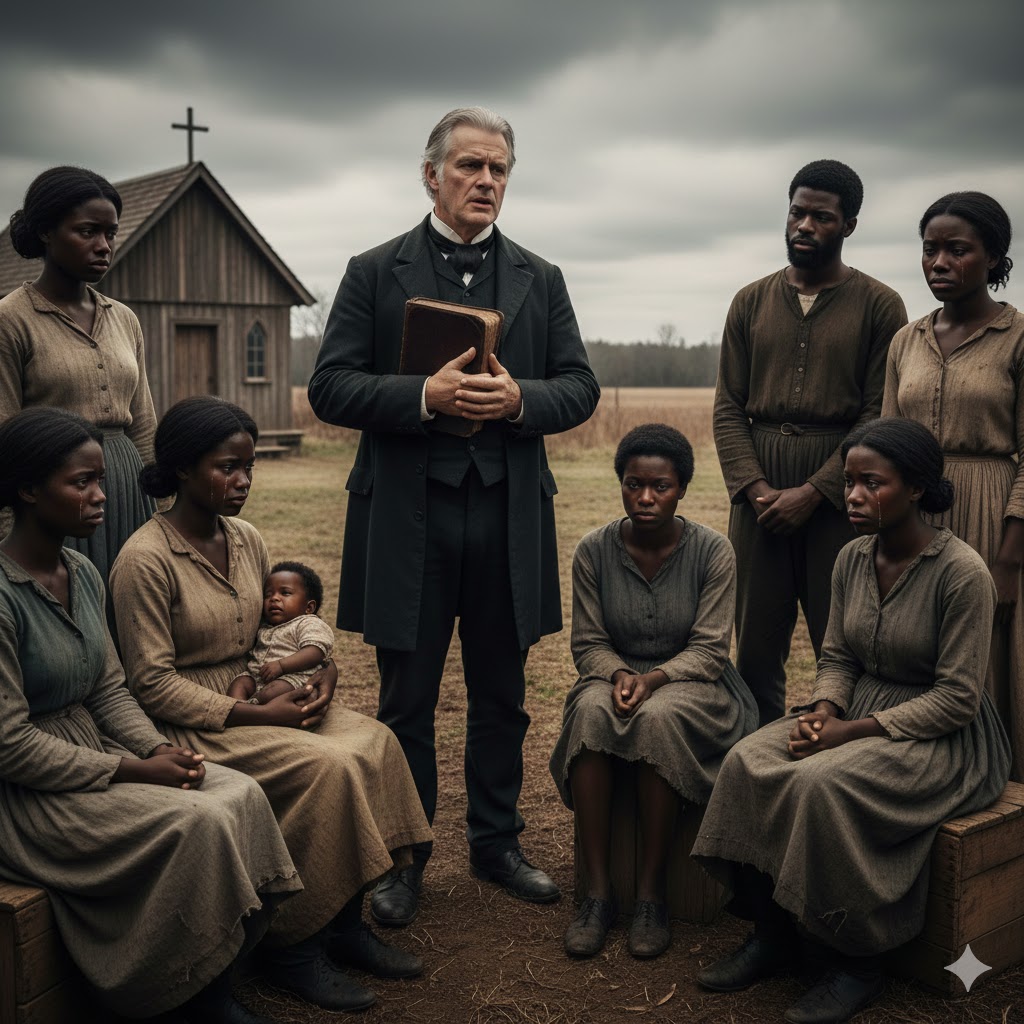
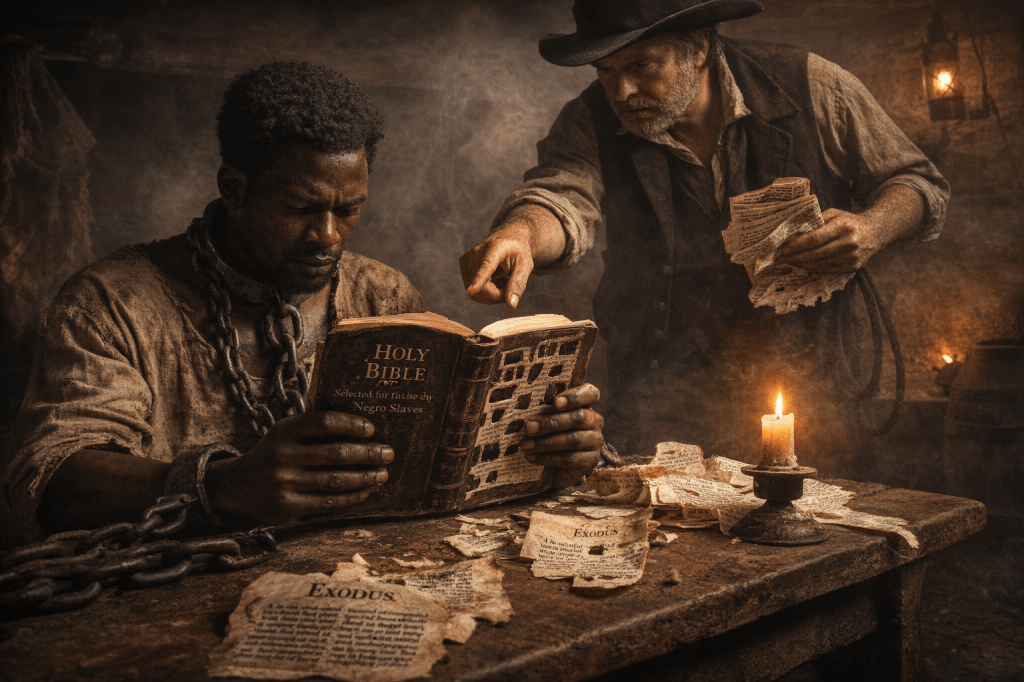
The history of the Slave Bible reveals one of the most calculated spiritual manipulations in modern history—an intentional distortion of sacred scripture used to justify racial domination and suppress liberation. Far from promoting Christian faith in its fullness, the Slave Bible was engineered as a tool of control, ensuring that enslaved Africans would encounter a theology of obedience rather than a gospel of freedom.

Christianity was introduced to enslaved Africans under coercive conditions. European slaveholders claimed religious benevolence while simultaneously denying enslaved people access to the full biblical text. Literacy itself was criminalized; laws across the American South forbade enslaved Africans from learning to read, as literacy was directly linked to resistance, organization, and revolt (Williams, 2005).

The Slave Bible, formally titled Parts of the Holy Bible, Selected for the Use of the Negro Slaves, in the British West-India Islands (1807), was produced by Anglican missionaries affiliated with the Society for the Conversion of Negro Slaves. This was not a complete Bible but a heavily redacted version designed to serve plantation interests rather than spiritual truth (Thompson, 1998).

Of the 1,189 chapters in the Protestant Bible, approximately 90 percent of the Old Testament was removed, along with nearly half of the New Testament. Entire books central to liberation theology—Exodus, Deuteronomy, Joshua, Judges, and large portions of the prophets—were omitted because they emphasized deliverance from bondage and divine justice against oppressors.

Exodus was especially dangerous to slaveholders. The story of Israel’s deliverance from Egypt offered enslaved Africans a clear theological parallel: a God who hears the cries of the oppressed, confronts empire, and breaks chains. By removing Exodus 1–20 almost entirely, slaveholders eliminated the most explicit biblical narrative of emancipation (Raboteau, 2004).

Passages affirming equality before God were likewise excised. Galatians 3:28—“There is neither Jew nor Greek, bond nor free”—was absent. So too were scriptures condemning manstealing, such as Exodus 21:16 and 1 Timothy 1:10, which explicitly define kidnapping humans as a crime punishable by death under Mosaic law.

What remained were verses emphasizing submission, obedience, and silence. Ephesians 6:5—“Servants, be obedient to them that are your masters”—was retained without its broader theological context. Colossians and 1 Peter were selectively edited to reinforce a one-sided doctrine of servitude stripped of moral accountability for masters.

This selective theology created a distorted Christ—one who demanded submission but never confronted injustice. The radical Jesus who overturned tables, rebuked elites, and proclaimed freedom to the captives (Luke 4:18) was minimized or erased entirely.

The suppression of biblical literacy extended beyond redaction. Enslaved Africans caught with books or attempting to read scripture independently faced brutal punishment. Slaveholders understood that the Bible, when read holistically, posed a direct threat to the institution of slavery (Douglass, 1845/2003).

Despite these restrictions, enslaved Africans developed clandestine religious practices. “Hush harbors” and secret prayer meetings allowed them to reinterpret scripture orally, often preserving the liberation themes that slaveholders sought to erase. Oral theology became a form of resistance and survival (Raboteau, 2004).

Enslaved preachers often re-centered Exodus, Revelation, and prophetic justice through song, spirituals, and coded language. Songs like Go Down, Moses were not merely hymns but theological declarations of impending freedom and divine judgment against Pharaoh-like systems.

The Slave Bible also reveals the racialization of God. White supremacy reimagined Christianity as inherently European, positioning whiteness as godly and Blackness as cursed—often through misinterpretations of the so-called “Curse of Ham,” a doctrine now widely rejected by scholars (Haynes, 2002).

This theological distortion had lasting psychological consequences. By weaponizing scripture, slaveholders attempted to sever enslaved Africans from a God of justice and reframe oppression as divine order. This contributed to generational trauma and religious confusion within Black communities.

Yet, history shows that the strategy ultimately failed. Enslaved Africans did not abandon God; they reclaimed Him. Black Christianity emerged as a counter-theology—one rooted in liberation, survival, and divine reversal of power structures.

The legacy of the Slave Bible demands critical reflection today. It exposes how scripture can be manipulated when removed from historical, linguistic, and ethical context. It also warns against any theology that aligns God with the empire rather than the oppressed.

Modern scholarship recognizes the Slave Bible as evidence not of Christian faithfulness, but of moral corruption. It stands as a testament to how religion can be weaponized when truth threatens power.

Importantly, the Slave Bible also affirms why unrestricted access to scripture matters. When people read the Bible for themselves, they encounter a God who repeatedly sides with the marginalized, condemns exploitation, and demands justice.

The full biblical canon—especially the prophets, the law, and the teachings of Christ—cannot coexist with chattel slavery without contradiction. This is precisely why it had to be edited.

Today, the Slave Bible is preserved in museums not as a sacred text, but as a warning. It reminds us that oppression often fears education more than rebellion and that truth, once uncovered, cannot remain chained.

Ultimately, the story of the Slave Bible is not just about what was removed, but about what endured. Faith survived censorship. Hope survived mutilation. And the God of the oppressed could not be erased—even when His words were.


References

Douglass, F. (2003). Narrative of the life of Frederick Douglass, an American slave (Original work published 1845). Penguin Classics.

Haynes, S. R. (2002). Noah’s curse: The biblical justification of American slavery. Oxford University Press.

Raboteau, A. J. (2004). Slave religion: The “invisible institution” in the antebellum South (Updated ed.). Oxford University Press.

Thompson, V. B. (1998). The making of the African diaspora in the Americas, 1441–1900. Longman.

Williams, J. E. (2005). Religion and violence in early American slavery. Routledge.

Society for the Conversion of Negro Slaves. (1807). Parts of the Holy Bible, selected for the use of the Negro slaves, in the British West-India Islands. London: Law and Gilbert.

The Holy Bible, King James Version. (1611/1769). Cambridge University Press.
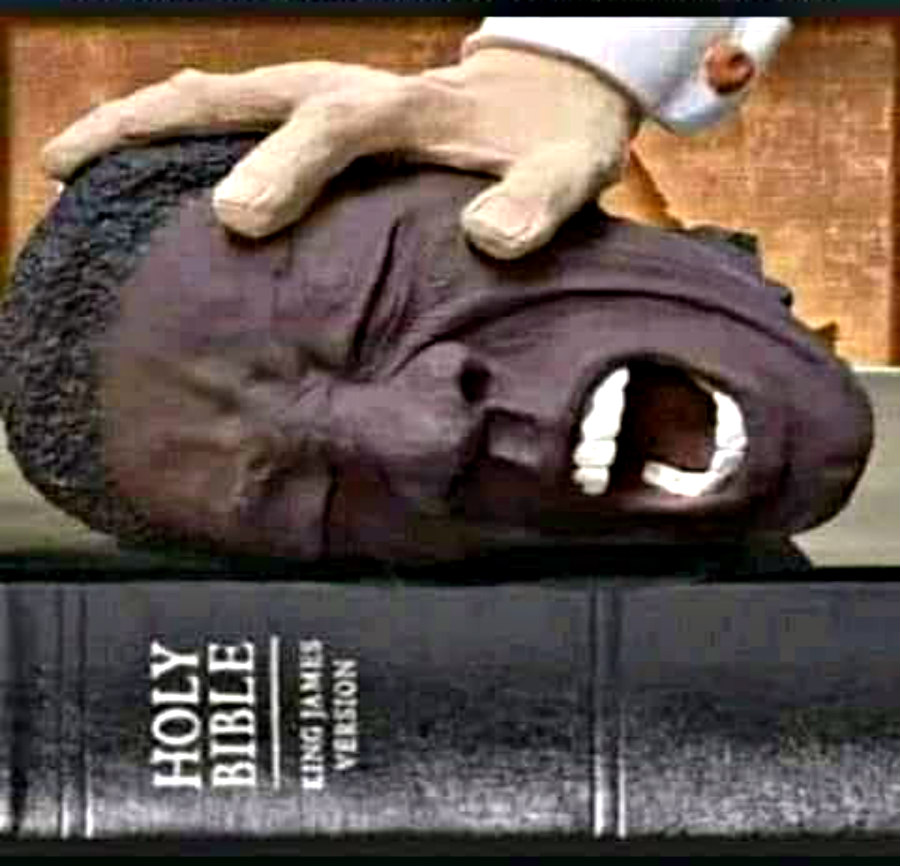
Weaponizing Scripture: How the Bible Was Used to Justify Enslavement

This photograph is the property of its respective owner. No copyright infringement intended

Weaponizing Scripture was one of the most devastating tools used to sustain the transatlantic slave system. The Bible, a text meant to proclaim liberation, justice, and the dignity of humanity, was distorted into an instrument of control. Enslavers did not merely use chains and whips; they used theology, selectively interpreted and strategically taught, to shape belief, obedience, and identity.

European slaveholders understood that physical domination alone was insufficient. To maintain long-term control, they needed mental and spiritual submission. Christianity, when stripped of its liberatory core, became a mechanism for conditioning enslaved Africans to accept suffering as divinely ordained rather than violently imposed.

One of the most common tactics was the selective reading of Scripture. Enslavers emphasized verses that appeared to support servitude while suppressing passages that spoke of freedom, justice, and God’s judgment against oppression. This manipulation created a counterfeit Christianity that served the empire rather than God.

A frequently cited passage was Ephesians 6:5, “Servants, be obedient to them that are your masters” (KJV). This verse was taught without context, stripped of its historical setting, and severed from the broader biblical narrative. Enslavers ignored that the same chapter commands masters to act justly and warns that God shows no partiality.

Similarly, Colossians 3:22 and 1 Peter 2:18 were weaponized to portray submission to abuse as holy obedience. These verses were never intended to endorse racialized, chattel slavery, yet they were recast to sanctify lifelong bondage based on skin color, a concept entirely foreign to the biblical world.

At the same time, enslavers deliberately removed or discouraged engagement with texts that threatened their power. The book of Exodus, which narrates God’s deliverance of an enslaved people, was often censored or reframed. Moses was rarely preached as a liberator, and Pharaoh’s defeat was downplayed or spiritualized to avoid political implications.

In many plantations, enslaved Africans were given a heavily edited text known as the “Slave Bible.” This version removed large portions of the Old Testament and New Testament passages that emphasized freedom, equality, or divine justice. What remained was a hollowed-out gospel engineered for compliance.

This theological distortion extended beyond omission into outright deception. Enslavers taught that Black people were cursed by God, often invoking a twisted interpretation of the so-called “Curse of Ham” in Genesis 9. This lie ignores the text itself, which never condemns Ham’s descendants to perpetual slavery and never mentions race.

By redefining God as a white authoritarian figure aligned with European power, enslavers reshaped spiritual imagination. Blackness became associated with sin, inferiority, and divine disfavor, while whiteness was falsely aligned with righteousness and authority. This inversion was not biblical; it was ideological.

Such misuse of Scripture produced mental slavery, a condition where the enslaved internalized the oppressor’s theology. Over time, some came to believe their suffering was God’s will, that resistance was rebellion against heaven, and that liberation was spiritually dangerous.

Yet even under these conditions, enslaved Africans demonstrated remarkable theological resistance. Through spirituals, coded language, and communal worship, they reclaimed biblical themes of deliverance, judgment, and hope. Songs about crossing Jordan, escaping Egypt, and seeing the promised land were not metaphorical escapism; they were theological protest.

The Bible itself consistently condemns man-stealing, the foundation of chattel slavery. Exodus 21:16 declares that kidnapping a human being and selling them is a capital crime. This verse alone dismantles the moral legitimacy of the slave trade, yet it was systematically ignored.

The prophets repeatedly denounce exploitation of the poor and vulnerable. Isaiah, Jeremiah, and Amos all portray God as hostile toward nations that enrich themselves through oppression. These texts reveal that the God of Scripture sides with the crushed, not the conqueror.

Jesus’ ministry further exposes the lie of slaveholding theology. Christ announced His mission as one to “preach deliverance to the captives” and to set the oppressed free (Luke 4:18). Any theology that sanctifies captivity directly contradicts the words of Christ Himself.

The apostolic message affirms spiritual equality among believers. Galatians 3:28 declares that there is neither slave nor free in Christ, undermining any doctrine that elevates one group over another. While early Christians lived within existing social systems, the gospel planted seeds that inevitably challenged them.

Weaponized Scripture also served to fracture Black identity. African spiritual systems were demonized, ancestral memory was erased, and biblical literacy was restricted. This was not evangelism; it was cultural warfare masquerading as salvation.

The long-term consequences of this distortion persist today. Many descendants of the enslaved wrestle with inherited religious trauma, mistrust of Christianity, or internalized inferiority rooted in centuries of theological abuse. This is one of slavery’s most enduring scars.

Yet the Bible itself is not the enemy. The problem has never been Scripture, but who interprets it, how it is taught, and whose interests it serves. When read holistically, the Bible exposes slavery as sin and oppression as rebellion against God.

Reclaiming Scripture requires restoring context, history, and truth. It demands confronting how Christianity was used as a colonial tool while also recognizing how Black faith communities preserved the liberating heart of the gospel against all odds.

Weaponized Scripture enslaved bodies for centuries, but redeemed Scripture continues to awaken minds. When the Bible is freed from manipulation, it testifies not to chains, but to justice, dignity, and divine judgment against every system built on human suffering.


References

Cone, J. H. (1975). God of the oppressed. New York, NY: Seabury Press.

Douglas, K. B. (1994). The black Christ. Maryknoll, NY: Orbis Books.

Haynes, S. R. (2002). Noah’s curse: The biblical justification of American slavery. Oxford, UK: Oxford University Press.

Raboteau, A. J. (2004). Slave religion: The “invisible institution” in the antebellum South. New York, NY: Oxford University Press.

The Holy Bible, King James Version. (1769/2017). Cambridge Edition.

Wilmore, G. S. (1998). Black religion and Black radicalism (3rd ed.). Maryknoll, NY: Orbis Books.

Dilemma : The Beast Nation

The term Beast Nation is not merely rhetorical; it is biblical, symbolic, and historical. In Scripture, beasts represent empires built on domination, violence, deception, and exploitation (Daniel 7; Revelation 13). America, when examined through its treatment of Black and Indigenous peoples, mirrors the characteristics of a prophetic beast—powerful, wealthy, religious in language, yet ruthless in practice.

Colonialism marks the first stage of the Beast Nation. European powers arrived under the banner of “discovery,” yet what followed was invasion, land theft, and cultural annihilation. Indigenous nations were displaced, murdered, and erased to establish settler dominance, fulfilling the biblical pattern of conquest through bloodshed (Habakkuk 2:12, KJV).

Colonial theology weaponized Christianity to justify conquest. Scripture was distorted to portray Europeans as divinely ordained rulers while Africans and Indigenous peoples were cast as subhuman. This manipulation of God’s Word mirrors the beast that speaks “great things and blasphemies” (Revelation 13:5, KJV).

Chattel slavery institutionalized this evil into law. Unlike other forms of servitude, chattel slavery reduced Africans to lifelong, inheritable property. Black bodies became commodities—bought, sold, bred, insured, and punished—stripped of humanity and covenantal identity.

The Bible condemns manstealing explicitly: “He that stealeth a man, and selleth him…shall surely be put to death” (Exodus 21:16, KJV). Yet America built its wealth in direct violation of this command, revealing the moral contradiction at its core.

Reconstruction briefly exposed the Beast Nation’s fear of Black autonomy. Promises of “40 acres and a mule” symbolized restitution and independence, yet these promises were rescinded. Land was returned to former enslavers, while Black families were thrust into sharecropping and debt peonage.

This betrayal echoed Proverbs 20:10: “Divers weights, and divers measures, both of them are alike abomination to the LORD” (KJV). America promised justice publicly while practicing theft privately.

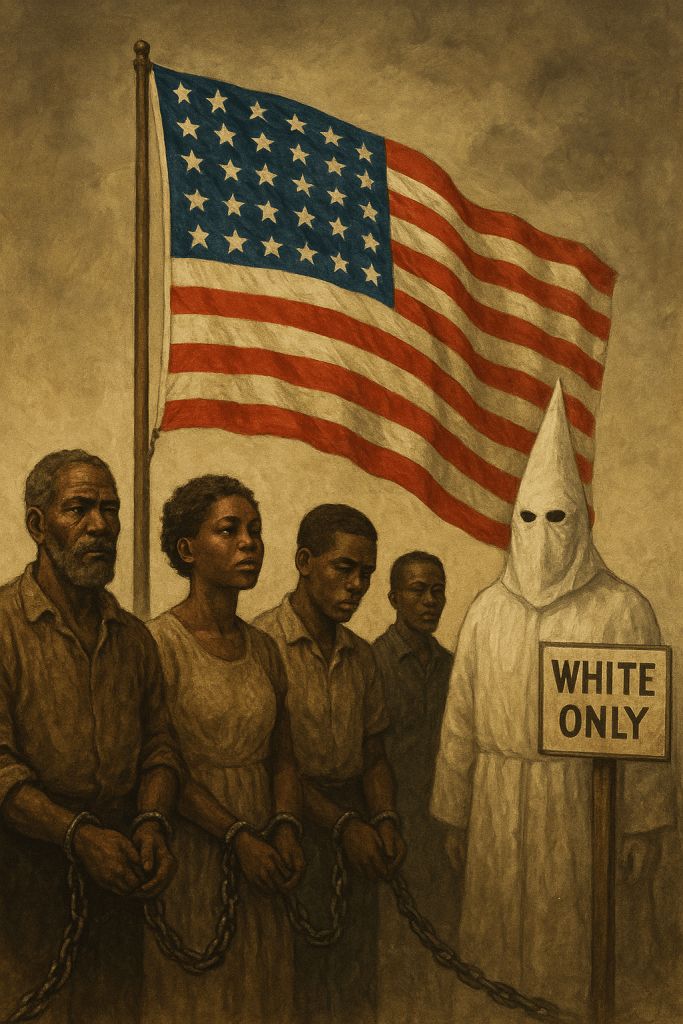
Jim Crow followed as a system of racial terror disguised as law. Segregation, lynching, and voter suppression enforced white supremacy through fear. Black progress was criminalized, and racial hierarchy was violently preserved.

Lynching functioned as public ritual—Black bodies displayed as warnings. Crosses burned beside corpses while churches remained silent or complicit. This hypocrisy fulfilled Isaiah 1:15: “Your hands are full of blood” (KJV).

Surveillance evolved as a modern method of control. Slave patrols became police departments; plantation ledgers became data systems. Black neighborhoods were watched, tracked, and criminalized long before digital technology made surveillance ubiquitous.

The civil rights movement revealed the Beast Nation’s resistance to righteousness. Peaceful protestors were beaten, jailed, assassinated, and vilified. America condemned foreign tyranny while unleashing state violence on its own citizens.

Dr. King’s assassination symbolized the cost of prophetic truth. Like the prophets before him, he confronted power—and paid with his life (Matthew 23:37, KJV).

The War on Drugs marked a new era of legalized oppression. Though drug use was statistically similar across races, Black communities were targeted disproportionately. Mandatory minimums, three-strikes laws, and police militarization fueled mass incarceration.

Scripture warns of unjust laws: “Woe unto them that decree unrighteous decrees” (Isaiah 10:1, KJV). The prison system became a modern plantation, extracting labor and removing generations of Black men and women from their communities.

America proclaims itself the “Land of the Free,” yet millions of Black people lived and died in bondage on that very soil. Freedom was declared selectively, revealing liberty as conditional rather than universal.

It calls itself the “Home of the Brave,” while Indigenous nations were slaughtered, displaced, and confined to reservations. Courage was claimed by conquerors, while resistance was labeled savagery.

“In God We Trust” is stamped on currency that once financed human trafficking, slave ships, and plantations. Mammon was worshiped while God’s commandments were violated (Matthew 6:24, KJV).

“One Nation Under God” rang hollow as Black bodies swung from trees and crosses burned in terror campaigns. God’s name was invoked while His image-bearers were desecrated.

“Liberty and justice for all” existed only for white citizens. Black Americans were excluded from the social contract, taxed without representation, and punished without protection.

Education systems sanitized this history, presenting America as a flawed but noble experiment rather than a predatory empire. Truth was buried beneath patriotism.

Media reinforced the beast’s image, portraying Black resistance as threat and Black suffering as deserved. Narrative control became psychological warfare.

Churches often chose comfort over conviction. Many preached obedience to the state while ignoring God’s demand for justice (Micah 6:8, KJV).

The Beast Nation thrives on amnesia. Forgetting allows repetition; silence permits continuation.

Biblically, beasts fall when truth is revealed and judgment arrives (Daniel 7:26). Empires collapse not from external enemies alone, but from internal corruption.

For Black America, survival has always required spiritual discernment—recognizing systems not merely as flawed, but as adversarial.

The Exodus narrative reminds us that God hears the cries of the oppressed (Exodus 3:7, KJV). Liberation is divine, not granted by empires.

The Beast Nation fears awakening. Knowledge of history, identity, and covenant threatens its legitimacy.

Judgment begins with truth. Repentance demands restitution, not rhetoric.

Until justice flows “like waters, and righteousness like a mighty stream” (Amos 5:24, KJV), America remains a beast clothed in religious language and democratic symbols.


References

Alexander, M. (2012). The new Jim Crow: Mass incarceration in the age of colorblindness. The New Press.

Baptist, E. E. (2014). The half has never been told: Slavery and the making of American capitalism. Basic Books.

Du Bois, W. E. B. (1935). Black reconstruction in America. Free Press.

Horsman, R. (1981). Race and manifest destiny. Harvard University Press.

KJV Bible. (1769/2017). Authorized King James Version.

Wilkerson, I. (2020). Caste: The origins of our discontents. Random House.

Dilemma: Slavery, Colonialism, and Racial Hierarchy

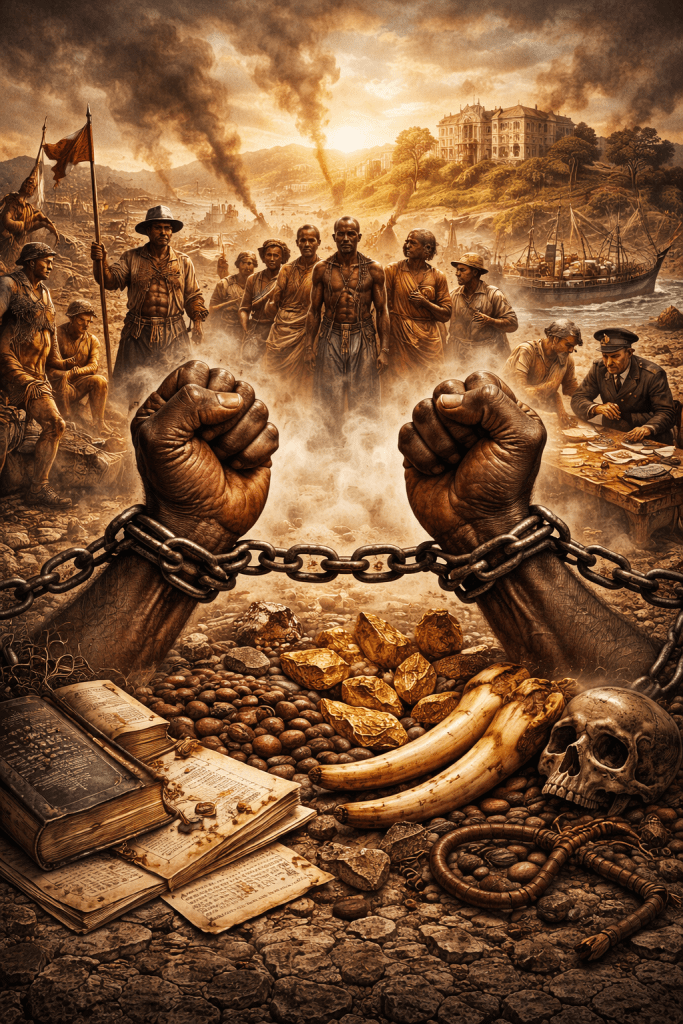
Slavery and colonialism did not emerge as isolated historical accidents but as deliberate systems engineered to extract labor, land, and life from subordinated peoples. At the center of these systems stood the construction of racial hierarchy, a framework that transformed domination into ideology and violence into normalcy.

The transatlantic slave trade marked a pivotal rupture in human history. Africans were captured, commodified, and transported across oceans under conditions designed to erase personhood. This was not merely economic exploitation; it was an ontological assault on humanity itself.

Colonialism expanded this logic globally. European empires occupied territories across Africa, the Americas, Asia, and the Caribbean, imposing foreign rule while dismantling indigenous governance, economies, and epistemologies. Control of land was accompanied by control of meaning.

Racial hierarchy emerged as the moral justification for these practices. Europeans increasingly defined themselves as fully human, rational, and civilized, while Africans and other colonized peoples were cast as primitive, inferior, or subhuman. This hierarchy was not natural; it was manufactured.

Theological distortion played a central role in legitimizing oppression. Biblical texts were selectively interpreted to sanctify slavery and empire, while passages emphasizing justice, liberation, and divine judgment against oppressors were muted or ignored.

One of the most egregious examples was the misuse of the so-called “Curse of Ham.” Though the Genesis narrative never mentions skin color or Africa as justification for enslavement, European theologians weaponized this passage to racialize bondage and claim divine approval for Black subjugation.

At the same time, enslaved Africans encountered the Bible through contradiction. The same text used to justify their chains also spoke of Exodus, covenant, judgment, and liberation. Enslaved readers discerned truths their oppressors refused to see.

The plantation economy reveals the intimate link between slavery and modern capitalism. Sugar, cotton, tobacco, and rice generated immense wealth for European nations and American colonies, laying the financial foundation of global modernity.

Colonial powers did not merely exploit labor; they extracted knowledge. African technologies, agricultural practices, metallurgy, and governance systems were appropriated, while African peoples were denied authorship of their own civilizations.

Colonial education systems reinforced inferiority by teaching colonized subjects to admire Europe and despise themselves. Language suppression, cultural erasure, and religious coercion produced psychological captivity alongside political domination.

Racial hierarchy was further codified through law. Slave codes, colonial ordinances, and later segregationist policies transformed racial inequality into legal structure, ensuring that injustice persisted beyond individual prejudice.

Even after formal abolition, slavery mutated rather than disappeared. Sharecropping, convict leasing, forced labor camps, and colonial labor systems continued extraction under new names, maintaining racial stratification.

The Bible’s prophetic tradition stands in direct opposition to such systems. Prophets repeatedly condemned societies that enriched themselves through exploitation, warning that injustice invites divine judgment regardless of national power.

Deuteronomy, Isaiah, Amos, and Jeremiah articulate a theology in which God sides with the oppressed and holds nations accountable for how they treat the vulnerable, the captive, and the poor.

Colonial Christianity often severed salvation from justice, emphasizing heaven while tolerating hell on earth. This theological bifurcation enabled believers to pray while profiting from suffering.

Black and African theology rejected this split. Faith became inseparable from survival, resistance, and hope. Worship functioned not as escapism but as protest against a world out of alignment with divine order.

Resistance to slavery and colonialism took multiple forms: revolts, maroon communities, abolitionist movements, pan-Africanism, and decolonization struggles. These movements testified that domination was never fully total.

The twentieth century witnessed formal decolonization, yet political independence did not erase economic dependency. Former colonies inherited borders, debts, and institutions designed for extraction, not flourishing.

Racial hierarchy adapted to new global arrangements. Development discourse replaced overt racism, yet inequality persisted through trade imbalances, resource exploitation, and global financial systems.

Within Western societies, the descendants of the enslaved continued to face exclusion through housing discrimination, educational inequity, mass incarceration, and economic marginalization—echoes of the original hierarchy.

Psychological consequences remain profound. Internalized inferiority, historical amnesia, and fractured identity are among the most enduring legacies of racial domination.

Scripture speaks to these realities not through denial but through remembrance. Biblical faith insists that history matters, that suffering is seen, and that injustice leaves a moral residue demanding response.

Divine justice in the biblical vision is neither rushed nor forgetful. It unfolds across generations, confronting systems rather than merely individuals.

The dilemma of slavery, colonialism, and racial hierarchy therefore confronts both history and theology. It demands honest reckoning rather than selective memory.

Healing requires truth, accountability, and restoration. Justice is not achieved through symbolic gestures alone but through material repair and transformed relationships.

The Bible ultimately refuses the permanence of oppression. Empires rise and fall, but divine justice endures beyond human power.

The continued struggle for racial justice is not a deviation from faith but a fulfillment of its ethical demand. To pursue justice is to align human action with divine intent.

Slavery and colonialism reveal the depths of human cruelty, but they also reveal the resilience of those who survived them. Survival itself stands as testimony against the lie of inferiority.

The racial hierarchy constructed to justify domination is historically contingent and morally bankrupt. It cannot withstand sustained truth.

This dilemma remains unresolved not because justice is absent, but because humanity continues to resist its demands.

Yet Scripture insists that injustice is unsustainable. The arc of history bends not by accident, but by moral weight.

The work of dismantling racial hierarchy is therefore sacred labor—historical, ethical, and spiritual—calling this generation to choose truth over comfort and justice over denial.


References

The Holy Bible, King James Version. (1611/1769).

Cone, J. H. (1997). God of the oppressed. Orbis Books.

Fanon, F. (1963). The wretched of the earth. Grove Press.

Rodney, W. (1972). How Europe underdeveloped Africa. Howard University Press.

Williams, E. (1944). Capitalism and slavery. University of North Carolina Press.

Du Bois, W. E. B. (1903). The souls of Black folk. A. C. McClurg & Co.

Heschel, A. J. (2001). The prophets. Harper Perennial.

The Genesis of Colorism

Colorism is a deeply rooted social phenomenon that continues to shape perceptions of beauty, worth, and opportunity within racial and ethnic communities. Unlike racism, which primarily operates across racial lines, colorism is the preferential treatment of lighter-skinned individuals over darker-skinned individuals within the same racial or ethnic group. It is a subtle yet pervasive force that influences personal identity, social mobility, and cultural norms.

The term “colorism” was popularized by Alice Walker in the 1980s, though the phenomenon existed long before it had a name. Walker defined it as a form of prejudice or discrimination in which people are treated differently based on the social meanings attached to skin color. Her work drew attention to the complex ways in which intra-racial discrimination intersects with historical oppression.

Colorism is sometimes referred to by other names, including “shadeism,” “toneism,” and “skin tone bias.” Each term highlights the focus on skin color rather than racial categorization, emphasizing the internalized hierarchies that exist within communities. These labels help distinguish colorism from broader racial prejudice.

While racism involves power dynamics between different racial groups, colorism operates primarily within racial communities, privileging lighter skin over darker skin. It often aligns with Eurocentric standards of beauty and social value, elevating those whose appearance more closely resembles the historically dominant group. This intra-racial discrimination can lead to unequal treatment in employment, relationships, and media representation.

The origins of colorism are deeply intertwined with colonialism, slavery, and the historical imposition of European standards. In the Americas, enslaved Africans were often subjected to differential treatment based on skin tone, with lighter-skinned individuals sometimes receiving preferential roles or treatment due to mixed ancestry with white enslavers. This historical precedent laid the groundwork for modern color hierarchies.

Colorism is reinforced by media and cultural representation. Television, film, advertising, and beauty industries often prioritize lighter-skinned models and actors, equating light skin with beauty, success, and desirability. This reinforces the perception that darker skin is less valuable, perpetuating social and psychological inequality.

Within families, colorism can manifest in preferential treatment of lighter-skinned children. Praise, attention, and expectations may be skewed toward those with lighter complexions, while darker-skinned siblings are subtly or overtly marginalized. These patterns of bias create internalized hierarchies from an early age.

Economic and professional opportunities are also affected by colorism. Studies show that lighter-skinned individuals often earn higher wages, experience fewer workplace biases, and receive more favorable treatment in professional settings than darker-skinned peers. This economic disparity illustrates how colorism extends beyond aesthetics to tangible social consequences.

Colorism intersects with gender, often compounding disadvantage for darker-skinned women. Historically, European beauty ideals equated lighter skin with femininity and desirability, marginalizing women whose appearance did not align with these norms. The pressure to conform to Eurocentric beauty standards has long-lasting social and psychological implications.

Educational opportunities have historically been influenced by colorism. In some communities, lighter-skinned individuals were prioritized for schooling or professional training, reflecting entrenched societal hierarchies that valorized proximity to whiteness. These disparities contributed to cycles of privilege and marginalization.

The perpetuation of colorism is often subtle and implicit, making it difficult to challenge. Compliments, social preferences, and assumptions about intelligence or behavior can all be influenced by skin tone. While often framed as benign or accidental, these biases accumulate over a lifetime to reinforce social inequality.

Colorism also shapes interpersonal relationships, influencing dating and marriage preferences. Lighter-skinned individuals are often deemed more desirable partners, while darker-skinned individuals may face stigma or reduced romantic opportunities. These biases reinforce the notion that worth and attractiveness are correlated with skin tone.

Global perspectives reveal that colorism is not confined to the United States or the African diaspora. Across Asia, Latin America, and the Caribbean, lighter skin is often associated with higher social status, wealth, and beauty. The global nature of colorism underscores its roots in historical power dynamics and colonization.

Education and awareness are critical in addressing colorism. Scholars, activists, and cultural commentators work to expose the ways color hierarchies are maintained and internalized. By naming and examining the phenomenon, communities can begin to challenge ingrained biases and foster more equitable social norms.

Toni Morrison, the acclaimed novelist, addressed colorism in her works, particularly in The Bluest Eye. Morrison explored how internalized racism and the valorization of Eurocentric beauty standards inflicted emotional and psychological harm on dark-skinned children. Her writings continue to illuminate the personal and societal consequences of colorism.

Media representation plays a dual role, both reinforcing and challenging colorism. While mainstream media often privileges lighter skin, contemporary Black media and cultural productions increasingly celebrate diverse shades of beauty. These shifts help challenge long-standing biases and expand cultural narratives around beauty and worth.

Colorism often affects self-esteem and identity formation. Darker-skinned individuals may internalize negative perceptions, experiencing shame or diminished confidence. Conversely, lighter-skinned individuals may experience privilege but also pressure to conform to external expectations, creating complex psychological dynamics.

The beauty industry has historically capitalized on colorism. Skin-lightening products, hair straightening, and other treatments marketed toward darker-skinned individuals reinforce the notion that lighter skin is superior. This commercialization both exploits and perpetuates color-based hierarchies.

Colorism can influence social mobility. Lighter-skinned individuals may gain access to elite social networks or higher-status opportunities more readily than darker-skinned peers. These advantages often accumulate across generations, reinforcing systemic disparities within communities.

Educational curricula and historical narratives can obscure the origins of colorism, leaving many unaware of its systemic roots. Understanding colorism as part of a larger history of colonialism, slavery, and European cultural dominance is crucial to dismantling it. Awareness fosters empathy and challenges internalized biases.

Colorism also affects leadership and representation. Lighter-skinned individuals are often more visible in political, cultural, and business leadership positions, creating role models who may not fully reflect the diversity of their communities. This disparity reinforces societal hierarchies and perpetuates bias.

Colorism influences fashion, music, and art, shaping aesthetic norms and cultural production. Historically, lighter-skinned performers were favored for commercial exposure, while darker-skinned artists faced barriers to mainstream acceptance. This dynamic both reflects and perpetuates cultural hierarchies based on skin tone.

Addressing colorism requires both individual and collective action. Self-awareness, open dialogue, and community initiatives can challenge bias. Encouraging inclusive representation and celebrating all shades fosters equity and cultural pride. Confronting colorism is an act of both social justice and personal liberation.

Ultimately, colorism reflects society’s struggle with internalized hierarchies, historical oppression, and beauty standards rooted in power. Recognizing the origins and effects of colorism is the first step toward equity, healing, and cultural transformation. By examining privilege, dismantling bias, and celebrating diversity, communities can move toward a future where skin tone does not dictate worth or opportunity.


References

Walker, A. (1983). In Search of Our Mothers’ Gardens: Womanist Prose. Harcourt Brace Jovanovich.

Morrison, T. (1970). The Bluest Eye. Holt, Rinehart & Winston.

Hunter, M. L. (2007). The Persistent Problem of Colorism: Skin Tone, Status, and Inequality. Sociology Compass, 1(1), 237–254.

Russell-Cole, K., Wilson, M., & Hall, R. E. (2013). The Color Complex: The Politics of Skin Color in a New Millennium. Anchor Books.

Bennett, L. (2020). Shadeism and Colorism: Historical Origins and Contemporary Effects. Journal of African American Studies, 24(2), 145–163.

Biblical Slavery Decoded

Biblical slavery is one of the most misunderstood and misused subjects in religious history, often weaponized to justify chattel slavery while stripping Scripture of its historical, linguistic, and moral context. A careful reading of the King James Version (KJV), alongside ancient Near Eastern customs, reveals that biblical servitude was fundamentally different from the race-based, perpetual, dehumanizing system imposed on Africans in the transatlantic slave trade.

In Scripture, the English word slave often translates from the Hebrew word ʿeḇeḏ, which broadly means servant, laborer, or bondman. This term encompassed a wide range of social arrangements, including hired workers, indentured servants, royal officials, and covenantal servants of God. Context, not modern assumptions, determines its meaning.

Biblical servitude was primarily economic, not racial. Israelites could enter servitude to repay debts, survive famine, or restore family stability. This system functioned as a form of social welfare in an agrarian society without modern banking or safety nets (Leviticus 25:35–39, KJV).

Unlike chattel slavery, biblical servants retained personhood and legal protections. Exodus 21 outlines clear limits on treatment, including punishment for abuse. If a servant was permanently injured, they were to be released free as compensation (Exodus 21:26–27, KJV).

Time limits are central to understanding biblical servitude. Hebrew servants could not be held indefinitely. They were released in the seventh year, known as the Sabbath year, without payment or penalty (Exodus 21:2, KJV; Deuteronomy 15:12).

The Jubilee year further reinforced freedom. Every fiftieth year, all Israelite servants were released, debts forgiven, and land restored to ancestral families. This system prevented generational poverty and perpetual bondage (Leviticus 25:10, KJV).

The Bible explicitly forbids manstealing, the very foundation of transatlantic slavery. Kidnapping a human being to sell or enslave them was a capital offense under biblical law (Exodus 21:16, KJV; Deuteronomy 24:7).

This prohibition directly condemns the capture, transport, sale, and hereditary enslavement of Africans. Any attempt to justify race-based slavery using the Bible ignores this clear and uncompromising command.

Foreign servants in Israel were also protected under divine law. While non-Israelites could enter long-term servitude, they were still bound by covenantal ethics, Sabbath rest, and humane treatment (Exodus 20:10, KJV).

The Bible commands empathy toward servants by reminding Israel of their own history of oppression in Egypt. God repeatedly anchors social justice in remembrance of slavery and divine deliverance (Deuteronomy 5:15, KJV).

Servants were entitled to rest on the Sabbath, placing them on equal footing with their masters before God. This alone dismantles the notion of absolute ownership (Exodus 23:12, KJV).

Biblical slavery also included voluntary lifelong service. If a servant chose to remain with a master out of love and security, it was a consensual covenant—not coercion (Exodus 21:5–6, KJV).

In the New Testament, the Greek word doulos is often translated servant or bondservant. It is used metaphorically to describe believers’ relationship to Christ, emphasizing devotion, not degradation (Romans 1:1, KJV).

Jesus never endorsed oppression. Instead, He confronted systems of exploitation and emphasized mercy, justice, and love of neighbor (Matthew 23:23, KJV).

Christ’s mission was liberation at every level—spiritual, social, and moral. He declared freedom for the captives and release for the oppressed (Luke 4:18, KJV).

Paul’s epistles address servants and masters within the Roman system, not as approval of slavery, but as guidance for ethical conduct within existing structures. He undermined slavery by affirming spiritual equality (Galatians 3:28, KJV).

Paul explicitly condemns enslavers in his list of lawless sinners, using language that echoes the Old Testament ban on manstealing (1 Timothy 1:9–10, KJV).

The letter to Philemon reveals the heart of biblical ethics. Paul urges Philemon to receive Onesimus not as a servant, but as a beloved brother—an appeal that dismantles hierarchical bondage (Philemon 1:15–16, KJV).

Biblical law consistently places God as the ultimate owner of all people. Humans are stewards, not masters of souls (Leviticus 25:55, KJV).

This divine ownership nullifies the idea that one human can permanently own another. All authority is subordinate to God’s righteousness.

The prophets fiercely rebuked oppression, exploitation, and abuse of the vulnerable. Slavery that crushed dignity was treated as a sin that provoked divine judgment (Isaiah 58:6, KJV).

Biblical justice demanded fair wages, humane conditions, and accountability. The exploitation of labor was never portrayed as righteous (Jeremiah 22:13, KJV).

The misuse of Scripture to justify American slavery represents a theological betrayal, not biblical fidelity. Selective reading severed verses from context to sanctify greed and racial domination.

Chattel slavery violated every biblical principle: it was racial, perpetual, violent, hereditary, and rooted in kidnapping. It mocked Sabbath rest, denied Jubilee, and erased personhood.

The curse of Ham narrative was never about Black people and was distorted centuries later to rationalize European colonialism. Scripture does not assign racial destiny through curses (Genesis 9:25–27, KJV).

Biblical slavery must be understood within covenantal law, not colonial ideology. God’s statutes consistently aimed at restoration, not destruction.

Freedom is central to God’s character. From the Exodus to the Cross, liberation defines His intervention in human history.

When Scripture is read honestly, it condemns systems that thrive on cruelty and profit from suffering. God sides with the oppressed, not the oppressor (Psalm 103:6, KJV).

The Bible does not sanitize suffering, but it never sanctifies it either. Justice, mercy, and humility remain the standard (Micah 6:8, KJV).

Understanding biblical slavery correctly dismantles false theology and restores truth. It exposes how Scripture was manipulated to uphold racism rather than righteousness.

Biblical slavery, decoded properly, reveals a God who regulates human brokenness while pointing relentlessly toward freedom. Any theology that excuses dehumanization stands in opposition to the God of the Bible.


References (KJV)

Exodus 20:10; Exodus 21:2, 16, 26–27; Exodus 23:12
Leviticus 25:10, 35–39, 55
Deuteronomy 5:15; Deuteronomy 15:12; Deuteronomy 24:7
Psalm 103:6
Isaiah 58:6
Jeremiah 22:13
Matthew 23:23
Luke 4:18
Romans 1:1
Galatians 3:28
1 Timothy 1:9–10
Philemon 1:15–16
Micah 6:8

Dilemma: Earthy Injustice

Earthly injustice is not an abstract concept but a lived reality etched into human history through conquest, enslavement, exploitation, and systemic inequality. It manifests wherever power divorces itself from morality and institutions prioritize profit, dominance, or comfort over human dignity.

From ancient empires to modern nation-states, injustice has been sustained by laws that favor the powerful and narratives that normalize suffering. These systems rarely collapse on their own; they persist until confronted by truth, resistance, and moral reckoning.

Scripture consistently identifies injustice as a violation of divine order. The Bible portrays God as attentive to imbalance, especially when the poor, the stranger, and the captive are crushed under unjust structures.

Earthly injustice thrives on dehumanization. When a group is stripped of identity, history, or worth, oppression becomes administratively easy and morally invisible to those who benefit from it.

Slavery represents one of the clearest examples of institutionalized injustice. Human beings were transformed into commodities, families into property, and labor into stolen wealth, all under legal and theological justification.

The transatlantic slave trade fused economic ambition with racial ideology, producing a hierarchy that outlived slavery itself. Its aftershocks remain embedded in wealth disparities, social stratification, and global inequality.

Colonialism extended injustice across continents, extracting resources while erasing cultures. Colonized peoples were taught to doubt their own humanity while serving the prosperity of distant empires.

Earthly injustice is often maintained through selective morality. Religious texts are quoted to demand obedience while passages condemning oppression are ignored or reinterpreted.

The Bible’s prophets repeatedly confronted this hypocrisy. They condemned societies that upheld ritual purity while neglecting justice, mercy, and compassion.

Injustice also operates psychologically. Generations exposed to domination may internalize inferiority, fulfilling the goals of oppression without the need for constant force.

Modern injustice frequently disguises itself as neutrality. Policies framed as fair or colorblind often perpetuate historical inequities by refusing to address unequal starting points.

Earthly courts can legalize injustice, but legality does not equate to righteousness. History records many laws that were lawful yet morally indefensible.

Scripture insists that injustice leaves a moral residue. Blood cries from the ground, wages withheld cry out, and suffering demands divine attention.

Those who endure injustice often develop alternative moral visions rooted in survival, faith, and communal care. These visions challenge dominant definitions of success and power.

Resistance to injustice takes many forms, from open rebellion to quiet endurance. Each asserts that oppression does not have the final word.

Earthly injustice is sustained by forgetting. When societies erase past crimes, they create conditions for repetition rather than repair.

Justice requires more than condemnation; it requires restoration. Repairing harm involves truth-telling, accountability, and material redress.

The Bible warns that unchecked injustice invites judgment. Nations that exalt themselves through exploitation eventually encounter collapse, whether through internal decay or external consequence.

Earthly injustice exposes the limits of human systems. It reveals the need for a higher moral authority beyond political power or economic interest.

The persistence of injustice does not negate justice’s existence. Rather, it testifies to the urgency of aligning human action with divine standards of righteousness.


References

The Holy Bible, King James Version. (1611/1769).

Cone, J. H. (1997). God of the oppressed. Orbis Books.

Du Bois, W. E. B. (1903). The souls of Black folk. A. C. McClurg & Co.

Heschel, A. J. (2001). The prophets. Harper Perennial.

Williams, E. (1944). Capitalism and slavery. University of North Carolina Press.

Dilemma: Colonialism

Colonialism represents one of the most enduring and destructive systems in human history, shaping global inequalities that persist long after formal empires collapsed. At its core, colonialism involved the domination of one people by another through force, dispossession, and ideological control. The dilemma of colonialism lies not only in its historical brutality but in its long-term consequences, which continue to structure economic systems, cultural identities, and psychological realities across the modern world.

European colonial expansion was driven by the pursuit of land, labor, and resources, justified through doctrines of racial superiority and civilizational hierarchy. Indigenous societies were not encountered as equals but as obstacles to be conquered or “improved.” This worldview allowed colonial powers to rationalize enslavement, genocide, and cultural erasure as moral and economic necessities.

Economic exploitation was central to the colonial project. Colonized lands were reorganized to serve imperial markets, transforming self-sustaining economies into extractive systems dependent on the export of raw materials. Wealth flowed outward to imperial centers, while poverty was institutionalized in the colonies, laying the groundwork for global inequality.

The transatlantic slave trade functioned as a pillar of colonial capitalism. Millions of Africans were forcibly displaced, commodified, and exploited to fuel plantation economies in the Americas and the Caribbean. This system generated immense wealth for European powers while devastating African societies socially, demographically, and politically.

Colonialism also dismantled indigenous governance structures. Traditional political systems were replaced with colonial administrations designed to extract resources and suppress resistance. Artificial borders divided ethnic groups and forced rival communities into single political units, creating instability that continues to affect postcolonial states.

Cultural domination accompanied economic and political control. Colonial powers imposed their languages, religions, and value systems while denigrating indigenous cultures as primitive or inferior. This process stripped colonized peoples of historical continuity and disrupted intergenerational transmission of knowledge and identity.

Education under colonial rule was not designed to empower but to discipline. Schools trained a small elite to serve colonial administrations while teaching them to internalize European superiority. As Frantz Fanon observed, colonial education often produced alienation rather than enlightenment.

Religion was frequently weaponized to legitimize colonial expansion. Biblical narratives were selectively interpreted to justify conquest, enslavement, and submission. While Christianity offered spiritual comfort to many, it was also used as a tool of social control, obscuring the moral contradictions of colonial violence.

The psychological effects of colonialism were profound. Colonized peoples were subjected to constant messages of inferiority, leading to internalized racism and fractured self-perception. Fanon described this condition as a divided consciousness, where the oppressed come to see themselves through the eyes of the oppressor.

Racial hierarchies were meticulously constructed and enforced. Whiteness became synonymous with intelligence, beauty, and authority, while Blackness and indigeneity were associated with backwardness. These hierarchies did not disappear with independence; they were absorbed into global culture and continue to influence social relations.

Colonialism reshaped gender roles in destructive ways. Indigenous gender systems were often more fluid or complementary, but colonial rule imposed rigid patriarchal norms that marginalized women and erased their leadership roles. Colonial economies also relied heavily on the exploitation of women’s labor.

Environmental destruction was another hallmark of colonial rule. Land was treated as property rather than a sacred resource, leading to deforestation, soil depletion, and ecological imbalance. These practices prioritized short-term profit over sustainability, leaving lasting environmental scars.

Resistance to colonialism was constant, though often erased from dominant historical narratives. Enslaved Africans revolted, indigenous peoples fought invasions, and anti-colonial movements emerged across continents. Freedom was not granted by empires; it was wrested through struggle and sacrifice.

The transition from colonial rule to independence was frequently incomplete. Many nations inherited economies designed for extraction, not development, and political systems modeled on colonial governance. Independence without structural transformation left former colonies vulnerable to continued domination.

Colonial legacies remain visible in global wealth disparities. Former colonial powers continue to benefit from accumulated capital, while former colonies face debt, underdevelopment, and external interference. These inequalities are not accidental but historical outcomes of exploitation.

Colonialism also distorted historical memory. Textbooks and public narratives often minimize imperial violence while celebrating exploration and “progress.” This selective memory impedes reconciliation and allows injustice to persist without accountability.

From a moral and spiritual perspective, colonialism represents a profound violation of divine principles of justice and human dignity. Scripture condemns oppression, theft, and the exploitation of the vulnerable, warning that nations built on injustice cannot stand indefinitely.

The dilemma of colonialism is not simply whether it was harmful, but whether the world is willing to confront its consequences honestly. Apologies without reparative action risk becoming symbolic gestures rather than pathways to healing.

Decolonization requires more than political independence. It demands economic justice, cultural restoration, psychological healing, and historical truth-telling. Without these elements, colonialism merely changes form rather than ending.

Ultimately, colonialism challenges humanity to reckon with power, morality, and memory. Until its legacies are addressed with humility and justice, the wounds it created will continue to shape the present, reminding the world that history is never truly past.


References

Fanon, F. (1963). The wretched of the earth. Grove Press.

Fanon, F. (1967). Black skin, white masks. Grove Press.

Nkrumah, K. (1965). Neocolonialism: The last stage of imperialism. Thomas Nelson & Sons.

Rodney, W. (1972). How Europe underdeveloped Africa. Bogle-L’Ouverture Publications.

Said, E. W. (1978). Orientalism. Pantheon Books.

Smith, A. (1776/2007). An inquiry into the nature and causes of the wealth of nations. MetaLibri.

The Holy Bible, King James Version. (1611/1987). Cambridge University Press.

The Altar of American Exceptionalism: Promise, Peril, and Consequence.

American exceptionalism is the belief that the United States occupies a unique moral, political, and historical position among nations. Rooted in Puritan theology, Enlightenment ideals, and revolutionary mythology, it has long framed the nation as chosen, exemplary, and destined for leadership. This belief has functioned as both a guiding philosophy and a civic religion, shaping national identity and public policy across generations.

At its best, American exceptionalism has inspired aspirational ideals. The language of liberty, equality, and self-governance provided a moral vocabulary that fueled abolitionism, civil rights movements, and democratic reforms. By holding itself to a proclaimed higher standard, the nation created a framework through which citizens could critique injustice and demand alignment between principle and practice.

The Declaration of Independence stands as a canonical text of exceptionalist thought, asserting universal rights while situating the American experiment as historically unprecedented. This rhetoric energized oppressed groups who invoked its promises to expose hypocrisy. Frederick Douglass’s famous question—what to the slave is the Fourth of July—demonstrates how exceptionalist ideals could be turned inward as a moral indictment rather than an excuse for complacency.

Yet American exceptionalism has also functioned as an altar upon which truth is sacrificed. When national myth hardens into unquestionable dogma, it suppresses historical accountability. Slavery, Indigenous dispossession, segregation, and imperial expansion were often justified or minimized under the assumption that America’s intentions were inherently benevolent, regardless of outcomes.

The doctrine has repeatedly blurred the line between patriotism and moral exemption. Foreign interventions, from Manifest Destiny to twentieth-century wars, were frequently framed as civilizing missions rather than power pursuits. Exceptionalism provided the moral cover for empire, allowing violence to be narrated as virtue and domination as destiny.

Domestically, exceptionalism has obscured structural inequality. The insistence that America is uniquely free and just has been used to delegitimize claims of systemic racism, economic exploitation, and gender inequality. If the nation is already exceptional, then disparities are framed as personal failures rather than institutional designs.

This mindset has been particularly damaging to Black Americans. The contradiction between exceptionalist rhetoric and lived reality produced what W.E.B. Du Bois called “double consciousness,” a constant negotiation between national belonging and exclusion. Black resistance movements have historically navigated the tension between appealing to American ideals and rejecting America’s false innocence.

American exceptionalism also reshaped capitalism into a moral narrative. Wealth accumulation became equated with virtue, and poverty with moral deficiency. The “American Dream” promised upward mobility while masking the racialized and class-based barriers that structured opportunity. Exceptionalism thus sanctified inequality under the guise of meritocracy.

In education, exceptionalist narratives often sanitize history. Textbooks emphasize triumph while minimizing atrocity, creating citizens who inherit pride without responsibility. This selective memory weakens democratic capacity, as honest self-critique is replaced with defensive nationalism.

Religiously, exceptionalism has fused with Christian nationalism, transforming the state into a quasi-divine instrument. Biblical language of chosenness has been selectively applied to America, displacing its original covenantal context. This theological distortion elevates the nation above moral law rather than subjecting it to prophetic judgment.

The psychological effects of exceptionalism are equally profound. It fosters cognitive dissonance when reality contradicts belief, leading to denial rather than reform. Citizens may experience identity threat when confronted with injustice, responding with hostility instead of empathy.

Globally, exceptionalism damages credibility. When the United States preaches democracy while tolerating human rights abuses at home and abroad, its moral authority erodes. Allies perceive hypocrisy, while adversaries exploit inconsistency, weakening international trust.

However, rejecting blind exceptionalism does not require abandoning national aspiration. A critical patriotism can preserve ethical commitment without mythological arrogance. Nations, like individuals, mature through accountability rather than denial.

Some scholars argue for a post-exceptionalist identity grounded in democratic humility. This approach views the United States not as above history but within it—capable of learning from other nations and from its own marginalized voices. Such humility strengthens rather than weakens democratic life.

The civil rights movement offers a model of reformed exceptionalism. Leaders like Martin Luther King Jr. appealed to America’s professed ideals while exposing its moral bankruptcy. Their vision did not worship the nation; it called it to repentance.

In this sense, American exceptionalism becomes most ethical when desacralized. When stripped of infallibility, it can function as an aspirational ethic rather than a shield against critique. The danger lies not in national ideals, but in their absolutization.

The future of American democracy depends on whether exceptionalism remains an altar or becomes a mirror. A mirror reflects both beauty and blemish, demanding growth. An altar demands worship and excuses failure.

Ultimately, the question is not whether America is exceptional, but how it understands exceptionality. If exceptionalism justifies power without justice, it corrodes the nation’s soul. If it compels responsibility proportional to power, it may yet serve a moral purpose.

The effects of American exceptionalism are therefore paradoxical. It has empowered liberation and legitimated oppression, inspired reform and excused violence. Its legacy demands discernment rather than devotion.

A transformed national consciousness would replace myth with memory, arrogance with accountability, and supremacy with service. Only then can the United States pursue greatness without sacrificing truth upon the altar of its own exceptionalism.


References

Appleby, J. (2018). The virtues of liberalism. Oxford University Press.

Bellah, R. N. (1967). Civil religion in America. Daedalus, 96(1), 1–21.

Du Bois, W. E. B. (1903). The souls of Black folk. A.C. McClurg & Co.

King, M. L., Jr. (1963). Why we can’t wait. Harper & Row.

Lipset, S. M. (1996). American exceptionalism: A double-edged sword. W.W. Norton.

Mills, C. W. (1997). The racial contract. Cornell University Press.

Zinn, H. (2003). A people’s history of the United States. HarperCollins.

Dilemma: Dark Skin Penalty

The dark skin penalty refers to the systematic disadvantages imposed on individuals with darker complexions within societies shaped by white supremacy and colonial hierarchy. Unlike overt racism, this penalty operates subtly, often normalized as preference or coincidence, yet its consequences are profound and measurable. It represents the inverse of light skin privilege and functions as a social tax placed on visible Blackness.

Historically, the dark skin penalty was engineered during slavery and colonialism, where darkness was equated with inferiority, savagery, and danger. European racial ideology constructed Blackness as a problem to be controlled, while lighter skin was positioned as closer to civility and trustworthiness. These ideas were enforced through law, theology, and violence.

Within slavery, darker-skinned enslaved people were disproportionately assigned to the most brutal labor, exposed to harsher punishment, and denied even marginal privileges afforded to lighter-skinned individuals. Darkness became associated with disposability, while lighter skin functioned as a buffer within the racial caste system.

After emancipation, these hierarchies did not dissolve. They were absorbed into Black communities as internalized beliefs. Dark skin came to symbolize struggle, unattractiveness, and threat, while lightness symbolized opportunity. This psychological inheritance transformed external oppression into internal policing.

Beauty standards remain one of the most visible expressions of the dark skin penalty. Darker-skinned women are frequently excluded from dominant beauty narratives, described as less feminine, less soft, or less desirable. Empirical research confirms that darker skin is rated as less attractive due to entrenched Eurocentric aesthetics (Hunter, 2007).

In romantic and marital contexts, darker-skinned women experience higher rates of rejection and lower likelihood of marriage offers. They are often sexualized without being valued for long-term partnership, reflecting a dehumanizing pattern rooted in colonial hypersexualization (Russell et al., 1992).

Darker-skinned men also bear a severe penalty. They are more likely to be perceived as aggressive, criminal, or intellectually inferior. These stereotypes follow them into schools, workplaces, and public spaces, shaping expectations and treatment regardless of behavior.

The criminal justice system magnifies this penalty. Studies demonstrate that darker-skinned Black men receive longer sentences and harsher punishment than lighter-skinned Black men for similar crimes, revealing that skin tone itself influences legal outcomes (Monk, 2019).

In the job market, darker skin correlates with lower wages, fewer promotions, and higher unemployment rates. Employers often unconsciously associate darker skin with incompetence or danger, despite identical credentials (Monk, 2014). Professionalism becomes racially coded.

Educational environments also reflect this bias. Darker-skinned children are disciplined more harshly, perceived as less capable, and tracked into lower academic pathways. Early exposure to penalty shapes confidence and long-term achievement.

Within families, the dark skin penalty is often reinforced through differential treatment. Darker-skinned children may receive less praise, harsher discipline, or fewer resources, while lighter-skinned siblings are protected and celebrated. These dynamics communicate worth long before language can articulate it.

The psychological consequences are severe. Dark-skinned individuals face higher risks of depression, anxiety, and diminished self-esteem due to chronic devaluation. Fanon described this as epidermalization of inferiority, where the body itself becomes a site of shame (Fanon, 1952).

Media representation compounds the penalty. Darker-skinned people are underrepresented or typecast as villains, aggressors, or side characters, while lighter-skinned individuals dominate narratives of love, success, and heroism. Repetition normalizes hierarchy.

Spiritually, the dark skin penalty contradicts biblical truth. Scripture affirms that God is no respecter of persons and judges by the heart rather than appearance (1 Samuel 16:7; Acts 10:34, KJV). Color-based judgment is therefore a moral failure.

The Bible explicitly condemns partiality. James warns that favoring one person over another based on external markers makes one guilty of sin (James 2:1–9, KJV). Colorism violates divine law as surely as overt injustice.

The dark skin penalty fractures communal solidarity. It redirects pain inward, encouraging comparison and resentment rather than collective resistance. This fragmentation benefits oppressive systems by weakening unity.

Healing requires intentional confrontation of these biases. Naming the penalty dismantles denial. Silence allows harm to masquerade as normalcy. Scripture teaches that truth precedes freedom (John 8:32, KJV).

Cultural restoration demands redefining beauty, intelligence, and worth outside colonial frameworks. African history and theology affirm darkness as original, powerful, and divine in its own right (Diop, 1974).

Psychological healing must accompany social reform. Therapeutic approaches that address racial trauma align with Scripture’s call for renewal of the mind (Romans 12:2, KJV). Without healing, internalized penalty persists even in success.

The abolition of the dark skin penalty requires both structural change and spiritual repentance. Institutions must address bias, and individuals must unlearn inherited hierarchies. Liberation is incomplete without both.

Ultimately, the dark skin penalty is not a reflection of deficiency but of distortion. It reveals the depth of colonial damage, not the worth of those who bear it. Divine justice demands its dismantling.

Until dark skin is affirmed as fully human, fully beautiful, and fully worthy, inequality will continue to reproduce itself within oppressed communities. God’s standard remains unchanged: all flesh stands equal before Him.


References

The Holy Bible, King James Version. (1611). Various passages.

Russell, K., Wilson, M., & Hall, R. (1992). The color complex: The politics of skin color among African Americans. Anchor Books.

Hunter, M. (2007). “The persistent problem of colorism.” Sociology Compass, 1(1), 237–254.

Monk, E. P. (2014). “Skin tone stratification among Black Americans.” Social Forces, 92(4), 1317–1337.

Monk, E. P. (2019). “The color of punishment.” Ethnic and Racial Studies, 42(10), 1593–1612.

Fanon, F. (1952). Black skin, white masks. Grove Press.

Cross, W. E. (1991). Shades of Black: Diversity in African-American identity. Temple University Press.

Diop, C. A. (1974). The African origin of civilization: Myth or reality. Lawrence Hill Books.

Wilkerson, I. (2020). Caste: The origins of our discontents. Random House.