
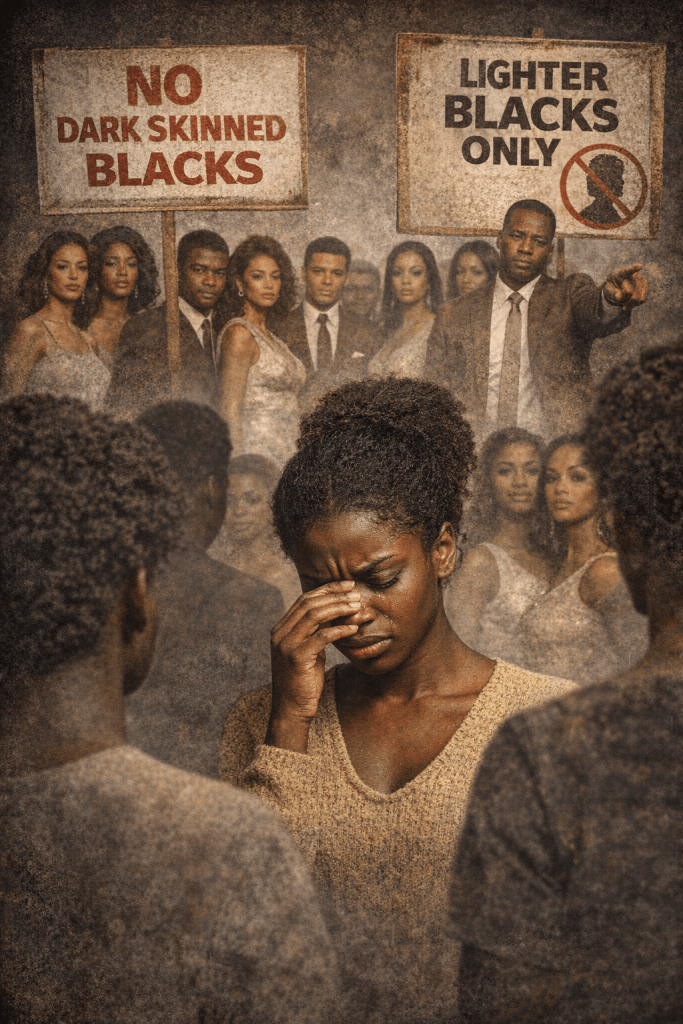
Self-hatred within the Black community is one of the most tragic psychological legacies of slavery, colonialism, and white supremacy. It is a condition where Black people unconsciously absorb anti-Black ideologies and then reproduce those same systems of hierarchy and exclusion among themselves. One of the clearest manifestations of this internalized racism is colorism, where darker-skinned Black people are marginalized, excluded, or deemed inferior by lighter-skinned Black people who have been socially conditioned to associate proximity to whiteness with value, intelligence, beauty, and success.
Colorism did not originate within the Black community. It was engineered through slavery, where lighter-skinned enslaved people, often the offspring of enslaved women and white slave masters, were granted closer proximity to the house, while darker-skinned Africans were relegated to the fields. This created a racial caste system within Blackness itself, embedding the idea that lighter skin meant higher status, better treatment, and greater access to resources.
Over time, this system evolved beyond physical labor into a psychological hierarchy. Lighter-skinned Blacks were often given better education, more opportunities, and greater representation in media, while darker-skinned Blacks were systematically portrayed as aggressive, undesirable, unintelligent, or hypersexual. These narratives were not accidental; they were tools of social control designed to fracture Black unity and create internal competition instead of collective resistance.
Self-hating Blacks did not create these structures, but many unconsciously enforced them. By adopting Eurocentric beauty standards and internalizing anti-Black imagery, some Black people became gatekeepers of whiteness within Black spaces. This is why darker Blacks were often excluded from leadership roles, romantic desirability, media representation, and even religious platforms, despite being the most genetically and historically African.
In many Black communities, darker-skinned children grow up receiving different treatment than their lighter-skinned peers. They are disciplined more harshly, praised less frequently, and rarely affirmed as beautiful. Meanwhile, lighter-skinned children are often subconsciously favored, described as “pretty,” “articulate,” or “well-behaved,” reinforcing a psychological message that darkness is a deficit.
This internal hierarchy becomes even more visible in dating and marriage patterns. Numerous sociological studies show that lighter-skinned Black women are more likely to be perceived as attractive and marriageable, while darker-skinned women are more likely to be stereotyped as aggressive or undesirable. This has nothing to do with biology and everything to do with centuries of racial conditioning.
Dark-skinned Black men are similarly affected, often being hypersexualized, criminalized, or depicted as dangerous. Yet lighter-skinned Black men are more likely to be portrayed as romantic leads, intellectuals, or socially acceptable partners. The result is a racial double consciousness where Blackness is tolerated only when diluted.
Media has played a major role in this psychological warfare. For decades, Black magazines, music videos, television shows, and advertisements overwhelmingly featured light-skinned models and actors, reinforcing the idea that success and beauty required proximity to whiteness. Darker Blacks were either erased or reduced to background characters, comic relief, or symbols of dysfunction.
This phenomenon produced what Frantz Fanon described as the “colonized mind,” where the oppressed adopt the values and worldview of the oppressor. In this condition, Black people begin to see themselves through white eyes and judge their own people according to white standards. The darkest among them become the most dehumanized.
Self-hatred becomes structural when Black institutions themselves participate in this exclusion. Churches, schools, social clubs, sororities, fraternities, and professional networks have historically favored lighter-skinned Blacks, creating social filters that replicate colonial hierarchies even in supposedly Black-controlled spaces.
This is why darker Blacks were often banned from certain social circles, beauty contests, modeling agencies, and elite organizations. Not officially, but psychologically and culturally. They were “too dark,” “not the right look,” or “not marketable,” which are simply coded ways of saying not close enough to whiteness.
The tragedy is that darker-skinned Blacks are the closest living descendants to the original African populations from which all humans originate. Genetically, melanated skin is the ancestral human phenotype. Yet through racial conditioning, this biological truth was inverted into a social lie where darkness became associated with inferiority.
This internal division weakened Black collective power. Instead of uniting against systemic racism, Black communities were fractured into internal hierarchies of worth. Lighter Blacks were taught to distance themselves from darker Blacks, while darker Blacks were taught to aspire toward lighter identity, leading to generational psychological trauma.
Colorism also created economic consequences. Darker Blacks face higher rates of unemployment, lower wages, harsher sentencing in the criminal justice system, and reduced access to healthcare and housing. These outcomes are not random; they reflect how deeply skin tone influences institutional decision-making.
The most devastating effect of this system is spiritual. When Black people internalize self-hatred, they disconnect from their ancestral identity, cultural memory, and collective purpose. They begin to measure their worth by standards that were never designed for their liberation, only their management.
This is why self-hating Blacks often police darker Blacks more harshly than white people do. They become enforcers of respectability politics, assimilation, and aesthetic conformity. In psychological terms, this is called identification with the oppressor.
Dark-skinned Blacks, in turn, are forced to develop double resilience: resisting external racism while also surviving internal rejection. Many grow up with deep wounds around self-worth, desirability, and visibility, despite being the very foundation of Black history and genetic continuity.
The modern movement of Black consciousness seeks to reverse this damage. It rejects Eurocentric beauty standards and re-centers African aesthetics, melanin, natural hair, and cultural authenticity as sources of pride rather than shame. It exposes colorism as a colonial weapon, not a natural preference.
Healing requires collective psychological decolonization. Black people must unlearn the lies embedded in their subconscious and recognize that all shades of Blackness are sacred, powerful, and historically significant. Darkness is not a defect; it is the original human design.
Until Black communities dismantle internalized racism, they will continue reproducing the same systems that were designed to destroy them. Self-hating Blacks banning darker Blacks is not just a social issue; it is a spiritual crisis rooted in colonial trauma.
True Black liberation begins when Black people stop measuring themselves against whiteness and start honoring the full spectrum of their own identity. Only then can the community heal the internal fractures created by slavery, colonialism, and psychological warfare.
Colorism is not about preference. It is about power, history, and psychological conditioning. And the first step toward freedom is telling the truth about how deeply it has shaped Black self-perception.
The ultimate irony is that the darkest Blacks, once marginalized and excluded, are now leading the global reawakening of Black identity, pride, and ancestral remembrance. What was once rejected is now being reclaimed as divine.
This is not a coincidence. It is historical correction.
References
Fanon, F. (1967). Black skin, white masks. Grove Press.
Harrison, M. S., & Thomas, K. M. (2009). The hidden prejudice in selection: A research investigation on skin color bias. Journal of Applied Social Psychology, 39(6), 1346–1364.
Hunter, M. (2007). The persistent problem of colorism: Skin tone, status, and inequality. Sociology Compass, 1(1), 237–254.
Hunter, M. (2011). Buying racial capital: Skin-bleaching and cosmetic surgery in a globalized world. The Journal of Pan African Studies, 4(4), 142–164.
Keith, V. M., & Herring, C. (1991). Skin tone and stratification in the Black community. American Journal of Sociology, 97(3), 760–778.
Russell, K., Wilson, M., & Hall, R. (2013). The color complex: The politics of skin color among African Americans. Anchor Books.
Tummala-Narra, P. (2007). Conceptualizing colorism and its implications for mental health. American Psychologist, 62(4), 352–360.
Walker, S. (2002). Style and status: Selling beauty to African American women, 1920–1975. University Press of Kentucky.
Wilkerson, I. (2020). Caste: The origins of our discontents. Random House.
Byrd, R. P., & Gates, H. L. Jr. (2009). The Black intellectual tradition. Harvard University Press.
 THE BROWN GIRL DILEMMA