
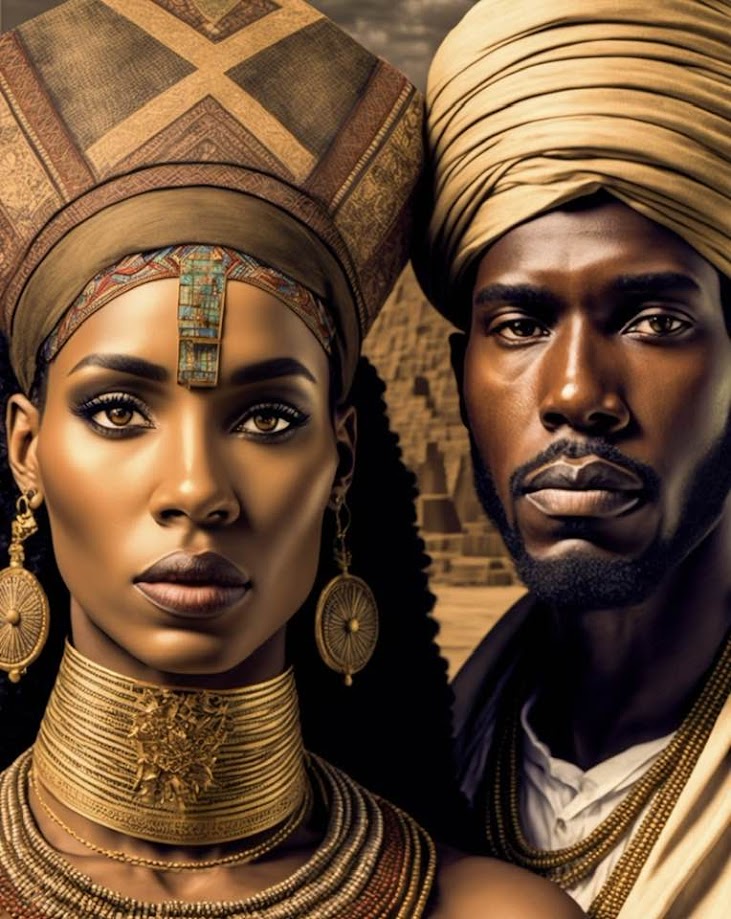
“Two souls divinely woven in time,
One from sorrow, one steadfast and kind.
She gleaned in the fields with faith as her guide,
He opened his heart, with honor as pride.
Their love was not sudden, but rooted in grace,
A story eternal no culture can replace.
Ruth and Boaz, a union so pure,
A testament of love that forever endures.”
The love story of Ruth and Boaz is among the most beautiful narratives of covenant faith, devotion, and divine providence in the Bible. Ruth was a Moabite woman, widowed after her marriage to Mahlon, the son of Elimelech and Naomi (Ruth 1:2-5, KJV). After her husband’s death, Ruth chose to remain faithful to Naomi, declaring, “whither thou goest, I will go; and where thou lodgest, I will lodge: thy people shall be my people, and thy God my God” (Ruth 1:16, KJV). Boaz, on the other hand, was a wealthy landowner of Bethlehem, a kinsman of Elimelech, known for his honor, kindness, and godly character.
From the beginning of the account, Ruth’s loyalty sets her apart. Though she could have returned to her own family and gods, she committed herself to Naomi and to the God of Israel. This choice was more than a gesture of affection—it was a declaration of faith and identity. In leaving Moab, she symbolically left behind idolatry and embraced the covenant people of God. This shows how love and faith intertwine; Ruth’s devotion was not just emotional, but deeply spiritual.
When Ruth and Naomi returned to Bethlehem during barley harvest, Ruth went to glean in the fields, an act permitted by Mosaic law for the poor and strangers (Leviticus 19:9-10, KJV). Providence guided her steps to the field of Boaz, where she would not only find provision, but also destiny. Boaz immediately noticed her diligence, humility, and grace, even before knowing her full story. His first words to her were words of protection and kindness, instructing her to remain in his fields and assuring her safety (Ruth 2:8-9, KJV).
Boaz’s actions reflected a man of noble character. He was a protector, provider, and a man sensitive to God’s law. Unlike many who could have ignored Ruth’s plight as a poor foreigner, Boaz went beyond obligation and showed compassion. He even commanded his reapers to leave extra grain for her (Ruth 2:15-16, KJV). His treatment of Ruth demonstrates that true love is not predatory or self-seeking, but nurturing, honorable, and rooted in respect.
Ruth, in turn, demonstrated her humility and gratitude. She asked Boaz why he would show her such kindness as a stranger, to which he responded that he had heard of her loyalty to Naomi and her faithfulness after her husband’s death (Ruth 2:11-12, KJV). This exchange highlights how character and reputation play a role in forming godly unions. Ruth’s heart and actions preceded her, and Boaz valued her inner beauty as much as her outward grace.
Naomi, recognizing the favor Ruth had found, instructed her in the custom of the kinsman-redeemer (Leviticus 25:25, KJV). A close relative of a deceased man could redeem the widow, securing lineage and inheritance. Naomi guided Ruth to approach Boaz at the threshing floor, a symbolic and delicate act of trust. Ruth obeyed, laying herself at Boaz’s feet, a gesture of humility and request for covering (Ruth 3:7-9, KJV). Her request was not one of seduction, but of covenant—seeking the shelter of his role as redeemer.
Boaz, again proving his integrity, did not take advantage of her vulnerability. Instead, he blessed her for her kindness and noble character. He promised to fulfill his duty, yet also acknowledged there was a nearer kinsman who had first right (Ruth 3:12-13, KJV). This shows his righteousness in following the law of God rather than rushing into desire. Even in love, he placed honor and God’s order above personal inclination.
The next day, Boaz presented the matter before the elders at the gate. The nearer kinsman declined, unwilling to jeopardize his own inheritance, thereby leaving the right to Boaz. In the presence of witnesses, Boaz formally redeemed Ruth, securing her as his wife and perpetuating the name of her late husband (Ruth 4:9-10, KJV). This moment marked the union of love, law, and legacy.
Their marriage was blessed not only by the community but by God. Ruth bore Obed, who became the father of Jesse, and the grandfather of King David (Ruth 4:17, KJV). This makes Ruth a part of the direct lineage of Christ, underscoring the divine significance of her love story. A Moabite widow, once an outsider, became central in God’s redemptive plan.
The love story of Ruth and Boaz teaches many timeless lessons. First, it shows the beauty of faithfulness and loyalty, as Ruth’s devotion positioned her for blessings beyond imagination. Second, it highlights the importance of character, as Boaz’s integrity and compassion made him a man worthy of trust. Third, it demonstrates that true love is grounded in covenant, not just emotion—it is about responsibility, faith, and legacy.
For modern relationships, Ruth and Boaz serve as the ultimate example. They remind us that love should be God-centered, respectful, and marked by patience. Boaz did not rush the process, and Ruth did not manipulate the outcome. Instead, both walked in faith, and God orchestrated their union at the right time. Their story assures us that when love is aligned with God’s will, it leads not just to romance, but to generational blessings.
The poetic beauty of Ruth and Boaz is that their love was never just about themselves. It was about God’s larger plan of redemption. What began as sorrow and loss for Ruth became the pathway to hope and restoration. Her story teaches that God can turn grief into joy, emptiness into fullness, and ordinary faithfulness into extraordinary legacy.
Ruth and Boaz’s story also elevates the dignity of women. Ruth was not seen as a mere possession or burden, but as a woman of virtue. Boaz acknowledged her worth and honored her as such. This narrative challenges cultures that devalue women and instead celebrates the woman of strength and loyalty as precious in God’s sight.
The legacy of their love continues to inspire because it was rooted not in superficial attraction but in covenant. Unlike many modern relationships that emphasize fleeting passion, their union stood on respect, faith, and divine timing. Theirs is not only a love story—it is a God story.
In the end, Ruth and Boaz show us what happens when faith and love meet in obedience. It is a reminder that love, when consecrated by God, becomes more than personal satisfaction—it becomes part of divine history. Their union produced not only joy for themselves but hope for the world, culminating in the birth of Christ centuries later.
As the book of Ruth concludes, the once-bitter Naomi rejoiced, the widowed Ruth was restored, and the honorable Boaz was blessed. Their story reminds us of the words of 1 Corinthians 13:13 (KJV): “And now abideth faith, hope, charity, these three; but the greatest of these is charity.” Their love was charity in action—faithful, enduring, and eternal.
📖 KJV Bible References
- Ruth 1:2-5, 16
- Ruth 2:8-12, 15-16
- Ruth 3:7-13
- Ruth 4:9-10, 17
- Leviticus 19:9-10
- Leviticus 25:25
- 1 Corinthians 13:13
 THE BROWN GIRL DILEMMA