
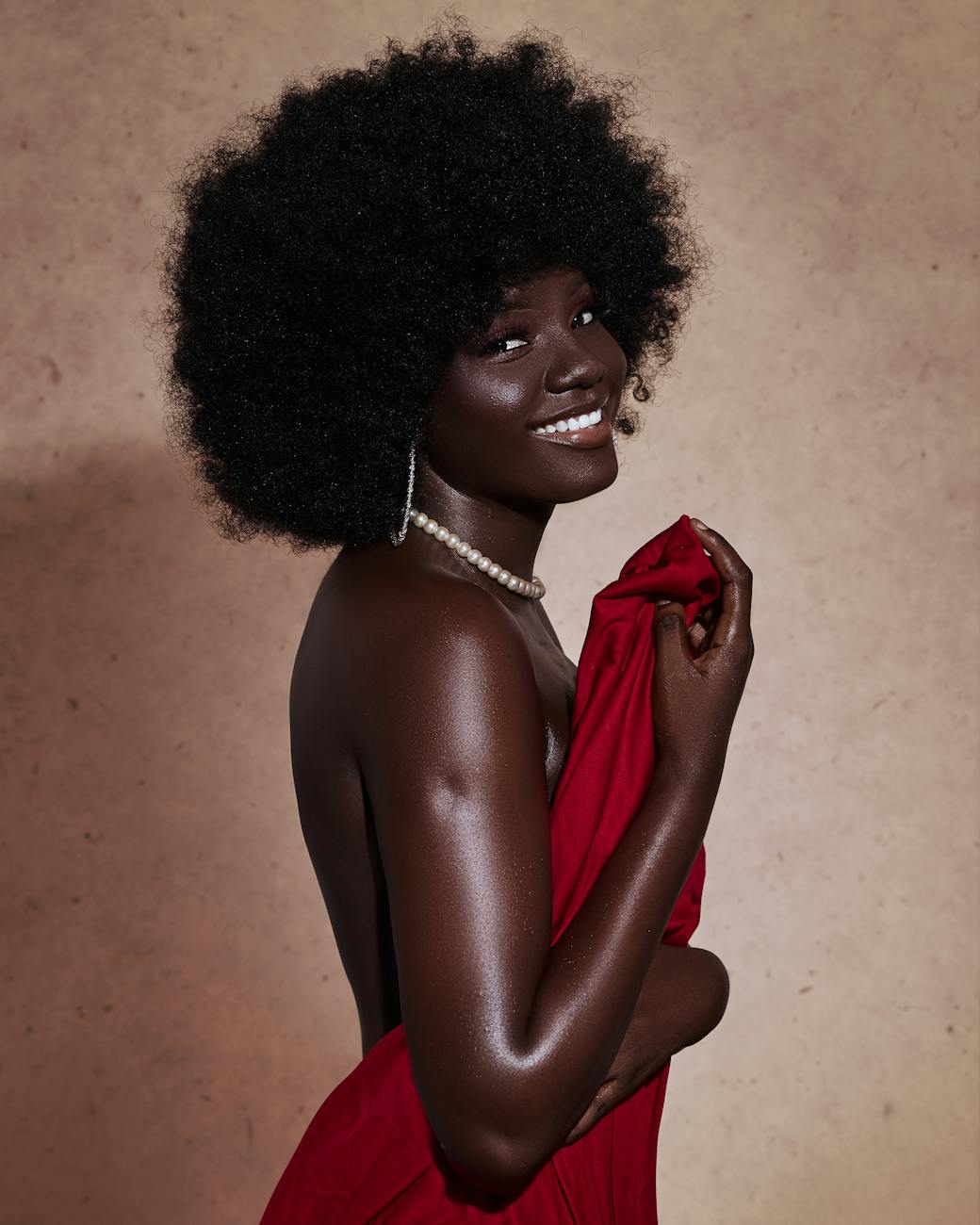
Black beauty is a multidimensional construct shaped by biology, cultural history, and sociopolitical forces. Unlike mainstream Eurocentric beauty standards, which often reduce attractiveness to narrow features, Black beauty encompasses genetic diversity, evolutionary resilience, and cultural expression. To understand it requires an interdisciplinary lens—examining the evolutionary science of melanin, the psychological impacts of beauty ideals, and the representation of Black aesthetics in society.
Evolutionary Foundations of Black Beauty
From an evolutionary perspective, darker skin pigmentation is a result of natural selection. Melanin, particularly eumelanin, provides protection against ultraviolet (UV) radiation while preserving folate reserves essential for reproduction (Jablonski & Chaplin, 2010). Features common within populations of African descent, such as fuller lips, broader noses, and tightly coiled hair, are not merely aesthetic traits but adaptive markers designed for survival in hot and variable climates (Robins, 2009). These traits, once stigmatized under colonial rule, reflect a scientific truth: Black beauty is evolutionarily advantageous, biologically diverse, and deeply tied to human survival.
Psychological Dimensions of Black Beauty
Psychology reveals how beauty standards affect identity and self-esteem. Eurocentric ideals historically marginalized Black features, creating internalized biases and what Fanon (1967) described as a “racial epidermal schema.” The preference for lighter skin—colorism—illustrates how systemic racism infiltrates concepts of beauty (Hunter, 2007). Conversely, the natural hair movement and celebration of melanin-rich skin highlight the psychological liberation that comes from embracing authentic Black beauty. Self-acceptance, in this context, becomes both a personal act of healing and a political statement.
Representation and Cultural Visibility
Representation of Black beauty in media has historically oscillated between invisibility and exoticization. Early depictions often reinforced stereotypes, while mainstream fashion and entertainment industries celebrated only a limited spectrum of Black aesthetics (Craig, 2006). Today, however, global icons like Lupita Nyong’o, Viola Davis, and Naomi Campbell expand representation by embodying diverse shades, textures, and body types. Social media platforms also empower everyday voices, allowing new narratives to challenge Eurocentric dominance and redefine beauty on global terms.
Intersection of Science and Culture
The study of Black beauty requires bridging scientific objectivity with cultural subjectivity. Facial symmetry, the golden ratio, and evolutionary psychology offer biological explanations for attractiveness (Little et al., 2011). Yet, beauty is also socially constructed, shaped by history, politics, and resistance. For Black communities, beauty is more than appearance—it is identity, resilience, and cultural pride.
Conclusion
The science of Black beauty cannot be divorced from its history of misrepresentation and resistance. Evolutionary biology highlights its adaptive strength; psychology reveals its role in identity formation; and representation underscores its sociopolitical weight. To honor Black beauty is to affirm both its scientific roots and its cultural power, recognizing it as central to human diversity and dignity.
References
- Craig, M. L. (2006). Race, beauty, and the tangled knot of a guilty pleasure. Feminist Theory, 7(2), 159–177.
- Fanon, F. (1967). Black skin, white masks. Grove Press.
- Hunter, M. (2007). The persistent problem of colorism: Skin tone, status, and inequality. Sociology Compass, 1(1), 237–254.
- Jablonski, N. G., & Chaplin, G. (2010). Human skin pigmentation as an adaptation to UV radiation. Proceedings of the National Academy of Sciences, 107(Supplement 2), 8962–8968.
- Little, A. C., Jones, B. C., & DeBruine, L. M. (2011). Facial attractiveness: Evolutionary based research. Philosophical Transactions of the Royal Society B: Biological Sciences, 366(1571), 1638–1659.
- Robins, A. H. (2009). Biological perspectives on human pigmentation. Cambridge University Press.
 THE BROWN GIRL DILEMMA