
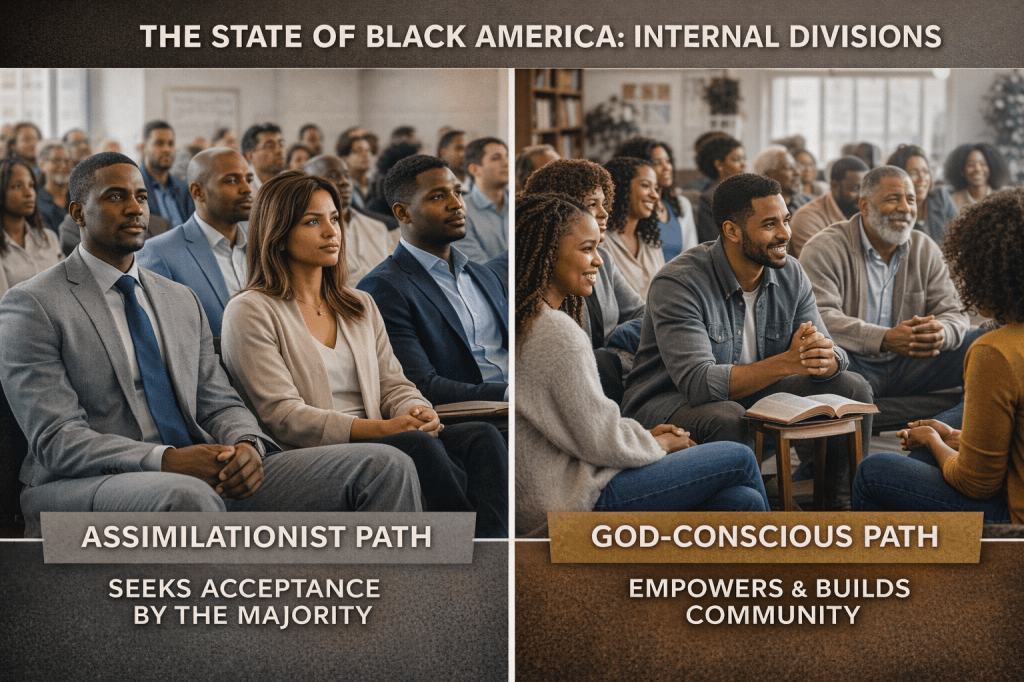
Throughout history, oppressed communities have wrestled with two primary survival responses: assimilation into the dominant power structure or resistance through identity preservation and collective empowerment. Within the African American experience in the United States, this tension has manifested in visible ideological and behavioral distinctions shaped by slavery, segregation, systemic racism, and theological interpretation.
The legacy of American chattel slavery created not only economic devastation but psychological fractures. Scholars such as Frantz Fanon (1967) argued that colonized people often internalize the worldview of the colonizer as a survival mechanism. This internalization can result in identification with the dominant culture as a means of perceived safety or advancement.
In the American context, the character “Uncle Tom,” from Harriet Beecher Stowe’s novel Uncle Tom’s Cabin, became a cultural symbol—though often misinterpreted—of perceived submission to white authority. Over time, the term evolved into a pejorative label describing individuals believed to prioritize white approval over communal solidarity.
Assimilation, however, must be examined sociologically rather than emotionally. Sociologist W.E.B. Du Bois described “double consciousness” as the tension Black Americans feel between their African heritage and American citizenship (Du Bois, 1903). For some, minimizing racial conflict or denying systemic racism is not necessarily ignorance but an adaptation strategy shaped by generational trauma.
Research in racial identity development theory, particularly by William E. Cross Jr., shows that Black identity formation progresses through stages. Some individuals remain in earlier phases characterized by assimilationist leanings or a preference for proximity to dominant culture standards.
Internalized racism, defined as the acceptance of societal beliefs about Black inferiority, has been documented extensively in psychological literature (Pyke, 2010). These dynamics often manifest in beauty standards, speech patterns, cultural preferences, and political alignments.
At the same time, it is overly simplistic to categorize individuals as entirely unaware of racism. Many who emphasize cross-racial harmony may genuinely believe that integration and meritocracy are viable pathways toward equality.
Conversely, there exists another path rooted in cultural preservation, spiritual consciousness, and collective empowerment. This path emphasizes group solidarity, historical awareness, and theological identity.
The Black church historically functioned as the epicenter of resistance and social organization. Leaders such as Martin Luther King Jr. articulated liberation through Christian ethics grounded in agape love and justice.
Similarly, figures like Malcolm X emphasized self-respect, self-defense, and psychological decolonization. Though their methods differed, both leaders promoted dignity and communal uplift.
Theologically, many Black faith traditions interpret biblical narratives as parallel to the African American experience. The Exodus story and passages like Deuteronomy 28 have been understood as frameworks for interpreting suffering and covenant identity.
God-conscious empowerment emphasizes spiritual rebirth alongside cultural restoration. It teaches that liberation is not merely political but moral and spiritual.
Community builders focus on economic cooperation, educational advancement, and intergenerational teaching. The philosophy echoes the principles of collective economics articulated by Marcus Garvey and the Universal Negro Improvement Association.
Intra-community conflict, however, often undermines these efforts. Social dominance theory suggests marginalized groups can replicate hierarchical thinking internally (Sidanius & Pratto, 1999).
The call for unity does not mean uniformity. It requires shared goals centered on dignity, spiritual awareness, and structural progress.
Teaching children cultural literacy and historical truth is central to empowerment. Scholars like Carter G. Woodson argued that miseducation perpetuates subjugation.
Spiritual formation also plays a role. Biblical anthropology emphasizes identity in both flesh and spirit, reinforcing inherent worth beyond societal labels.
God-conscious frameworks encourage reconciliation within the community before external transformation.
This perspective rejects self-hatred while also avoiding racial supremacism. It affirms dignity without dehumanizing others.
Economic empowerment initiatives, cooperative models, and entrepreneurship align with this restorative vision.
Psychologically, collective pride correlates with higher resilience and well-being among marginalized populations (Neblett et al., 2012).
Faith-based empowerment movements often stress repentance from destructive behaviors such as internal violence, colorism, and fragmentation.
The metaphor of “needles in a haystack” captures the rarity of individuals fully committed to spiritual discipline and communal sacrifice.
Such builders prioritize generational legacy over short-term validation.
They recognize racism as structural rather than merely interpersonal, supported by scholarship from Michelle Alexander in The New Jim Crow.
At the same time, they resist fatalism. Faith sustains hope amid systemic obstacles.
Christ-centered identity reframes suffering through redemptive theology rather than victimhood.
Recognizing oneself as chosen does not imply superiority but covenant responsibility.
The call to stop fighting one another echoes both biblical admonition and sociological necessity.
Group progress historically required strategic unity, as evidenced during the Civil Rights Movement.
Yet even within movements, ideological differences persisted, illustrating the complexity of Black thought.
Ultimately, these two paths are not fixed identities but developmental positions shaped by history, psychology, and theology.
Healing requires compassion, education, and spiritual maturity.
Rather than condemnation, transformation must be the goal.
The future of Black empowerment lies not in caricatures but in consciousness, character, and Christ-centered community building.
References
Alexander, M. (2010). The New Jim Crow.
Cross, W. E. (1991). Shades of Black: Diversity in African-American Identity.
Du Bois, W. E. B. (1903). The Souls of Black Folk.
Fanon, F. (1967). Black Skin, White Masks.
Neblett, E. W., et al. (2012). Racial identity and psychological health.
Pyke, K. (2010). What is internalized racial oppression? Sociological Perspectives, 53(4), 551–572.
Sidanius, J., & Pratto, F. (1999). Social Dominance: An Intergroup Theory of Social Hierarchy and Oppression.
Woodson, C. G. (1933). The Mis-Education of the Negro.
 THE BROWN GIRL DILEMMA