
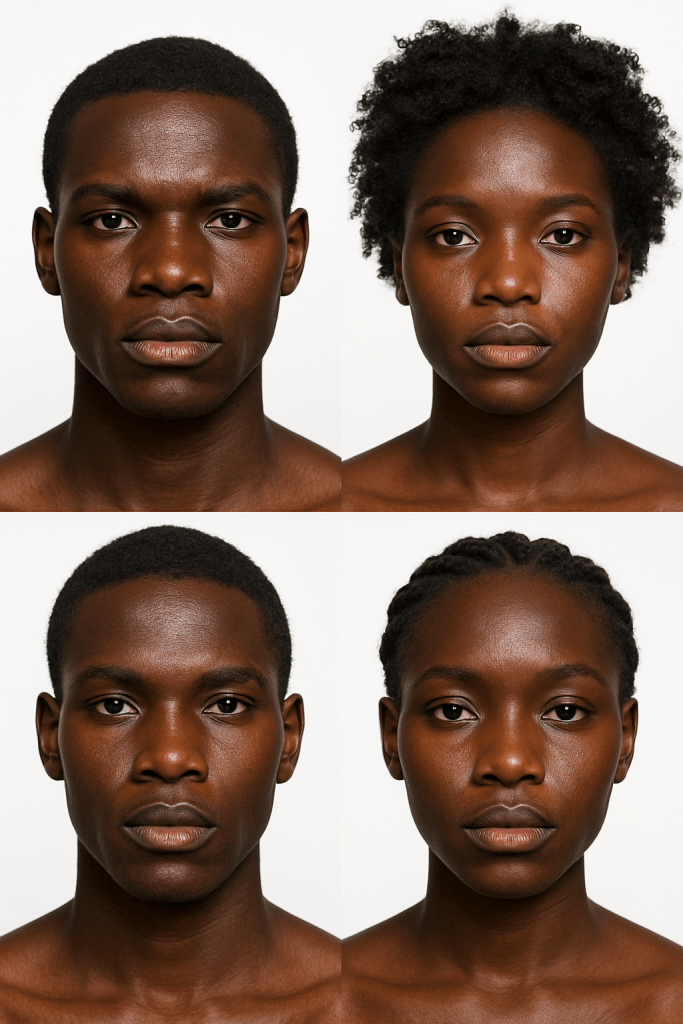
The term Negroid has long been one of the most controversial concepts in the study of human variation. Once used by anthropologists to categorize people of African descent, it has since become emblematic of the pseudo-scientific ideologies that underpinned racism, colonialism, and slavery. Yet, beyond its misuse, the study of African physical diversity, genetics, and spirituality reveals a deeper truth: the African phenotype represents the foundation of humanity itself.
Origins of the Term
The classification “Negroid” emerged in the late eighteenth and nineteenth centuries as part of the typological system developed by European naturalists such as Johann Friedrich Blumenbach. Blumenbach (1779) divided humankind into five “races”: Caucasoid, Mongoloid, Malayan, American, and Negroid. These categories, though influential, were based on superficial physical traits such as skin color, hair texture, and cranial measurements—not on actual biological lineage.
Scientific Racism and Colonial Expansion
Throughout the nineteenth century, the concept of the Negroid type became weaponized to justify slavery, imperialism, and racial hierarchy. Scientists like Samuel George Morton and Josiah C. Nott collected skulls and measured crania, falsely concluding that Africans had smaller brains and thus lesser intelligence. These ideas, later termed “scientific racism,” provided a veneer of legitimacy to the transatlantic slave trade and segregationist ideologies (Gould, 1996).
The Myth of Racial Purity
Racial typologies assumed that human groups were biologically distinct and hierarchically ordered. However, modern genetics has decisively refuted the notion of “pure races.” The Human Genome Project revealed that all humans share over 99.9% of their DNA, and that genetic variation within Africa is greater than that found between all other continents combined (Tishkoff et al., 2009). Thus, Africa is not a singular type, but the cradle of all human diversity.
Anthropological Evolution
Contemporary anthropology has moved away from fixed racial typologies toward an understanding of clinal variation—continuous, overlapping patterns of traits shaped by environment and adaptation. Features once associated with the so-called Negroid type—broad noses, full lips, dark skin, and tightly curled hair—are now recognized as adaptive responses to tropical climates, offering protection against ultraviolet radiation and dehydration (Jablonski, 2004).
Reclaiming the African Image
Despite its colonial misuse, many Afrocentric scholars have sought to reclaim the imagery associated with African phenotypes. The so-called Negroid features are not markers of inferiority but signatures of ancestral distinction and beauty. From the pyramids of Kemet to the kingdoms of Mali, Songhai, and Benin, these features have been celebrated in sculpture, iconography, and divine representation (Diop, 1974).
Theological Dimensions
In biblical interpretation, several theologians and Hebraic scholars suggest that many of the ancient Israelites and patriarchal figures were people of African or Afro-Asiatic descent (Hotep, 2012). Scriptures such as Jeremiah 8:21 and Song of Solomon 1:5 (“I am black but comely”) reflect an awareness of dark skin within sacred contexts. The “Negroid” image thus becomes not merely anthropological but theological—a reflection of divine creation in melanin.
The Melanin Doctrine
Melanin, the pigment responsible for skin color, has become central to Afrocentric spirituality and scientific theology. It is viewed not only as a biological substance but as a symbol of resilience, energy absorption, and divine intelligence. Modern science supports its importance as a natural protector against solar radiation and free radicals, granting both physiological and psychological strength (Barnes, 1998).
The Role of Genetics
Genetic anthropology has revealed that haplogroups such as E1B1A, prevalent among West and Central Africans, trace back tens of thousands of years and connect to ancient migrations across the Nile Valley and the Levant. This lineage further challenges Eurocentric narratives by demonstrating that African ancestry is central to the genesis of civilization, language, and spirituality (Keita & Boyce, 2005).
African Beauty and the Divine Aesthetic
Throughout art, history, and media, features once denigrated under “Negroid typology” have reemerged as powerful symbols of divine beauty. Full lips, coiled hair, and rich melanin have become icons of aesthetic authenticity. Artists, scholars, and theologians alike now celebrate these traits as reflections of the Imago Dei—the image of God expressed through African physiognomy.
The Psychological Aftermath of Typology
The lasting effects of racial classification systems manifest in colorism, internalized racism, and self-rejection among people of African descent. The colonial distortion of beauty and worth has caused generational trauma. However, through education, cultural pride, and spiritual renewal, many communities are redefining blackness as a state of sacred dignity rather than inherited shame (hooks, 1992).
Decolonizing Anthropology
To move forward, anthropology must continue to deconstruct Eurocentric frameworks and amplify African epistemologies. Decolonized scholarship acknowledges that Africa is not a peripheral contributor to human evolution—it is the epicenter. This perspective redefines the so-called Negroid type not as a scientific label but as an ancestral spectrum of human origin and identity.
The Biblical Lineage of Nations
Several biblical genealogies align with African migrations. Ham, the progenitor of Cush, Mizraim, and Canaan, is traditionally associated with African civilizations. Afro-Hebraic interpretations propose that the original Israelites shared ancestral links with these Afro-Asiatic peoples, connecting scriptural heritage to African identity (Ben-Yehuda, 2018).
Africa as Mother of Civilization
Civilizations such as ancient Nubia, Egypt, and Ethiopia challenge Western assumptions of white antiquity. These empires exhibited complex governance, literacy, architecture, and theology millennia before Europe’s Renaissance. Thus, the “Negroid” type, once portrayed as primitive, is historically proven to be the architect of civilization itself (Diop, 1974).
The Curse Narrative Debunked
The misuse of the biblical “curse of Ham” narrative historically justified slavery and segregation. However, critical exegesis reveals no divine condemnation of blackness; rather, this interpretation was fabricated to sustain white supremacy (Goldenberg, 2003). Modern theology restores the African presence in scripture as one of blessing, innovation, and covenantal purpose.
The Beauty of Diversity Within Africa
The African continent hosts immense phenotypic and cultural diversity—from the tall Nilotic peoples to the compact Bantu and the ancient Khoisan. Such variety proves the inadequacy of “Negroid” as a unifying label. Instead, Africa embodies a mosaic of adaptation, creativity, and divine design, representing the full expression of human potential.
The Modern Genetic Synthesis
Modern population genetics reinforces that all non-African peoples descend from small groups of Africans who migrated out of the continent roughly 60,000 years ago. Thus, every human phenotype, whether European or Asian, carries ancestral African DNA. Humanity, in essence, is a global expression of African origin (Stringer, 2016).
Cultural Redemption and Reeducation
To reclaim African identity, education must confront the falsehoods of racial hierarchy. Cultural and genetic literacy can restore self-worth among diasporic peoples. The truth that humanity originated in Africa dismantles the lie of inferiority and honors the spiritual narrative of creation found in Genesis: “And God formed man of the dust of the ground.”
Spiritual Anthropology
Beyond science, spiritual anthropology recognizes that the human form is a vessel of divine wisdom. The so-called Negroid type, with its radiant melanin and ancestral features, becomes a living testimony to divine craftsmanship. Through faith, knowledge, and cultural restoration, African descendants rediscover their sacred lineage as both biological and spiritual heirs of humanity.
Conclusion
The term Negroid type should no longer signify a scientific category but a journey—from misclassification to reclamation, from pseudoscience to sacred truth. Africa is not merely the continent of blackness; it is the womb of the world. By reinterpreting the narrative through historical critique, Afrocentric pride, and theological revelation, we affirm that to study the African face is to gaze upon the mirror of creation itself.
References (APA 7th Edition)
Barnes, J. (1998). Melanin: The key to freedom. Black Classic Press.
Ben-Yehuda, Y. (2018). Hebrew Israelites and the African connection: An Afrocentric biblical interpretation. Africana Studies Review, 12(3), 45–62.
Blumenbach, J. F. (1779). On the natural varieties of mankind. Göttingen.
Diop, C. A. (1974). The African origin of civilization: Myth or reality. Lawrence Hill Books.
Goldenberg, D. M. (2003). The curse of Ham: Race and slavery in early Judaism, Christianity, and Islam. Princeton University Press.
Gould, S. J. (1996). The mismeasure of man. W. W. Norton & Company.
hooks, b. (1992). Black looks: Race and representation. South End Press.
Hotep, U. (2012). The African origins of the Hebrew people. Kemet University Journal of African Spirituality, 8(2), 33–58.
Jablonski, N. G. (2004). The evolution of human skin and skin color. Annual Review of Anthropology, 33, 585–623.
Keita, S. O. Y., & Boyce, A. J. (2005). Genetics, history, and identity: The case of the African peoples. American Anthropologist, 107(1), 12–23.
Stringer, C. (2016). The origin of our species. Penguin Books.
Tishkoff, S. A., et al. (2009). The genetic structure and history of Africans and African Americans. Science, 324(5930), 1035–1044.
 THE BROWN GIRL DILEMMA