
Tag Archives: police brutality

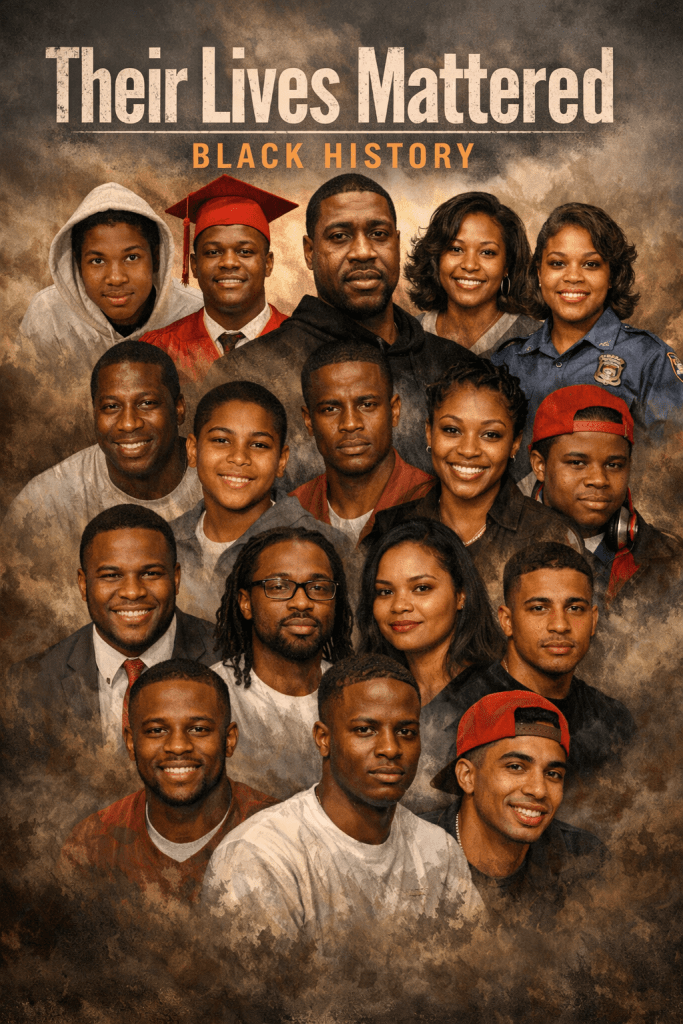
Their Lives Mattered: A Black History Lament.

Their lives mattered not as statistics, not as hashtags, not as passing headlines, but as human beings whose existence was violently interrupted by systems meant to protect. The stories of Trayvon Martin, La’Quan McDonald, Sonya Massey, George Floyd, Breonna Taylor, Eric Garner, Tamir Rice, Freddie Gray, Sandra Bland, Michael Brown, Botham Jean, Philando Castile, Atatiana Jefferson, Stephon Clark, Daunte Wright, and countless others reveal a recurring pattern of racialized state violence, criminalization of Black bodies, and the persistent failure of American justice.

Trayvon Martin was a 17-year-old unarmed Black teenager who was fatally shot in 2012 by George Zimmerman in Sanford, Florida, while walking home from a convenience store. Despite being unarmed and posing no threat, Trayvon was followed, confronted, and killed under the logic of “suspicion.” Zimmerman was acquitted under Florida’s “Stand Your Ground” law, igniting national outrage and becoming a catalyst for the Black Lives Matter movement.

La’Quan McDonald was a 17-year-old Black teenager who was shot 16 times by Chicago police officer Jason Van Dyke in 2014. Dashcam footage later revealed that La’Quan was walking away from police when he was killed, contradicting official police reports. The city suppressed the video for over a year. Van Dyke was eventually convicted of second-degree murder, a rare outcome in police killings.

Sonya Massey, a 36-year-old Black woman, was killed in 2024 by an Illinois sheriff’s deputy after calling 911 for help. While experiencing a mental health crisis, she was shot in her own home. Her death raised renewed concerns about how Black women, especially those in psychological distress, are treated as threats rather than victims in need of care.

George Floyd was a 46-year-old Black man killed in 2020 after Minneapolis police officer Derek Chauvin knelt on his neck for over nine minutes while Floyd was handcuffed and pleading for his life. His death was captured on video and sparked the largest global protests against racial injustice in modern history. Chauvin was later convicted of murder, marking a rare moment of legal accountability.

Breonna Taylor was a 26-year-old Black emergency medical technician who was shot and killed in her Louisville apartment in 2020 when police executed a no-knock warrant while she was asleep. Officers fired over 30 bullets, killing her in her own home. No officer was charged directly for her death, reinforcing public outrage over the lack of accountability.

Eric Garner was a 43-year-old Black man who died in 2014 after being placed in a chokehold by NYPD officer Daniel Pantaleo for allegedly selling loose cigarettes. Garner’s final words, “I can’t breathe,” became a global symbol of police brutality. A grand jury declined to indict the officer, and Pantaleo was only fired years later.

Tamir Rice was a 12-year-old Black child who was shot and killed by Cleveland police in 2014 while playing with a toy gun in a park. Officers arrived and shot him within seconds, without attempting de-escalation. No criminal charges were filed, despite Tamir being a minor posing no imminent threat.

Freddie Gray was a 25-year-old Black man who died in 2015 from a spinal injury sustained while in police custody in Baltimore. He had been arrested and transported in a police van without being properly restrained. His death led to mass protests, but none of the officers involved were ultimately convicted.

Sandra Bland was a 28-year-old Black woman found dead in a Texas jail cell in 2015 after being arrested during a traffic stop. Her death was ruled a suicide, but her treatment, arrest, and the circumstances of her death raised serious questions about racial profiling, police aggression, and custodial negligence.

Michael Brown was an 18-year-old Black teenager shot and killed by police officer Darren Wilson in Ferguson, Missouri, in 2014. Brown was unarmed at the time. His body was left in the street for hours, igniting national protests. A grand jury declined to indict Wilson, fueling global outrage.

Botham Jean was a 26-year-old Black accountant who was shot and killed in his own apartment in 2018 by off-duty Dallas police officer Amber Guyger, who claimed she mistook his home for hers. Guyger was convicted of murder, but her sentence was widely criticized as lenient.

Philando Castile was a 32-year-old Black school cafeteria worker who was shot and killed by police during a traffic stop in Minnesota in 2016. He had calmly informed the officer that he was legally carrying a firearm. His girlfriend livestreamed the aftermath. The officer was acquitted.

Atatiana Jefferson was a 28-year-old Black woman shot and killed by police in 2019 while inside her home in Fort Worth, Texas, after a neighbor requested a wellness check. She was playing video games with her nephew when she was killed. The officer was later convicted of manslaughter.

Stephon Clark was a 22-year-old Black man shot and killed by Sacramento police in 2018 while standing in his grandmother’s backyard. Officers claimed he had a gun; he was holding a cellphone. He was shot 20 times. No officers were charged.

Daunte Wright was a 20-year-old Black man killed in 2021 during a traffic stop in Minnesota when an officer claimed she mistakenly drew her gun instead of her taser. Wright’s death occurred during the trial of Derek Chauvin and reignited national protests. The officer was convicted of manslaughter.

These deaths are not isolated incidents but part of a historical continuum rooted in slavery, Jim Crow, mass incarceration, and racialized policing. The criminal justice system has repeatedly failed to protect Black lives while excusing or minimizing state violence through qualified immunity, grand jury non-indictments, and legal doctrines that prioritize police narratives over Black testimony.

Their lives mattered because they were sons, daughters, parents, workers, students, and dreamers. They mattered because their deaths exposed the moral contradictions of a nation that proclaims liberty while systematically devaluing Black existence. To remember them is not simply an act of mourning, but a political demand for truth, accountability, and structural transformation.

Their names and many others live on not only in memory but in resistance. They have become ancestral witnesses to injustice and sacred symbols in a global struggle for Black dignity. Their blood cries out from the ground, demanding not silence, but justice.


References

Alexander, M. (2012). The New Jim Crow: Mass incarceration in the age of colorblindness. The New Press.

Black Lives Matter. (n.d.). Say Their Names. https://blacklivesmatter.com

Equal Justice Initiative. (2020). Lynching in America: Confronting the legacy of racial terror. https://eji.org

Garner, E. (2014). NYPD case files and DOJ Civil Rights Investigation. U.S. Department of Justice.

Mapping Police Violence. (2023). Police killings database. https://mappingpoliceviolence.org

New York Times. (2014–2024). Police brutality and racial justice reporting.

U.S. Department of Justice. (2020). Investigation into the Minneapolis Police Department.

Washington Post. (2015–2024). Fatal force: Police shootings database. https://www.washingtonpost.com/graphics/investigations/police-shootings-database/

Williams, P. J. (1991). The Alchemy of Race and Rights. Harvard University Press.
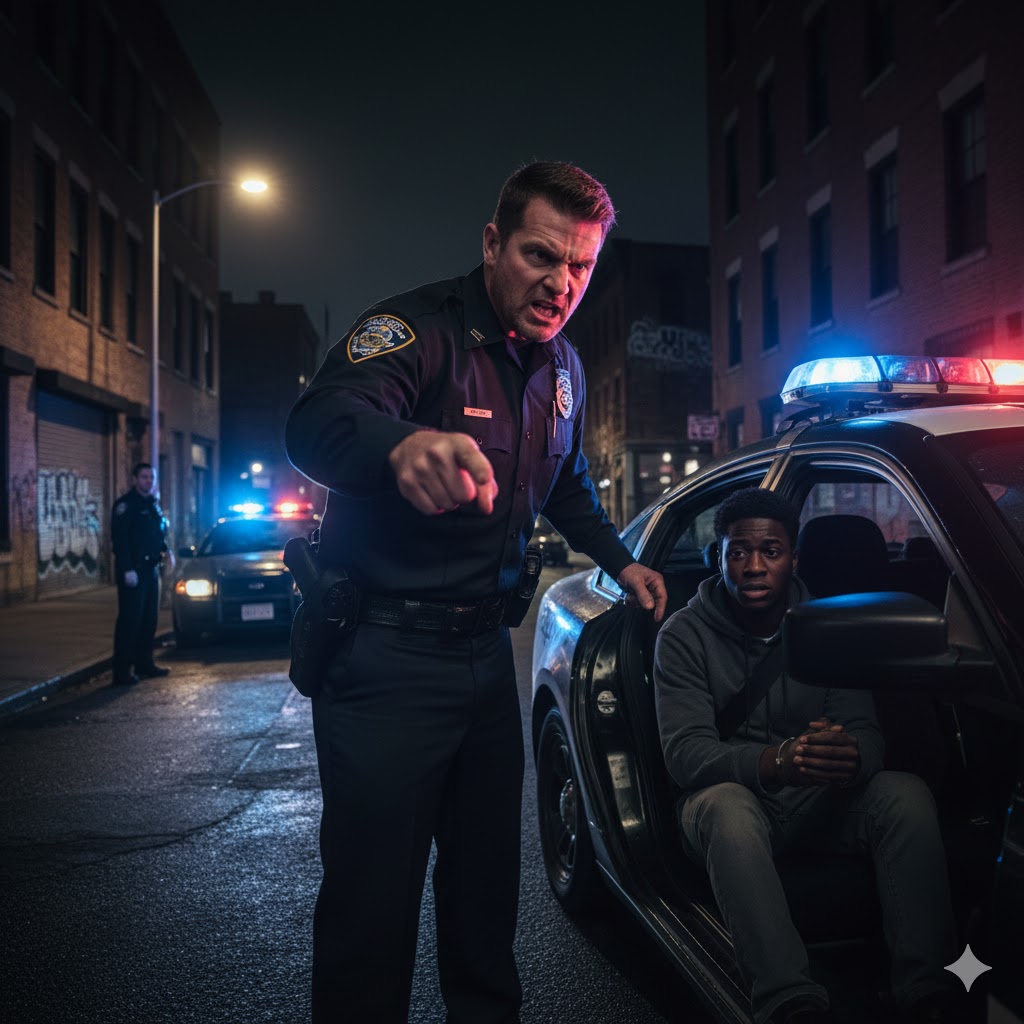
Dilemma: Police Harassment

Police harassment of Black Americans remains a pressing moral, social, and structural crisis in the United States. It is not limited to isolated incidents, but reflects recurring patterns of enforcement, disrespect, and disproportionate force, tied intimately to racialised histories and institutional practices. Understanding why this occurs demands engagement with racism, power, training, neighbourhood conditions, and the embedded culture of policing.

One reason police harassment happens with such frequency and racial skew is the legacy of racialised policing practices—rooted in slave patrols, segregation era policing, and the enforcement of racial hierarchy. These historical antecedents help explain why Black people are often treated as suspects, targets, or threats rather than equal citizens. The institutional memory of policing still carries layers of the “othering” of Black bodies.

Data show the disparity clearly. According to the Prison Policy Initiative, in 2022, Black people were over three times as likely as white people to experience the threat or use of force in their most recent police encounter. Prison Policy Initiative. The same dataset found that Black people reported higher rates of being handcuffed, searched, or having weapons used against them, even when controlling for initiation.

Another survey revealed that 42 % of African Americans said they personally experienced unfair treatment by police—being stopped, searched, questioned, physically threatened, or abused. Among those, 22 % reported such mistreatment in the past year. Equity in America. A separate poll found that 24 % of young Black adults reported being harassed by police, compared to significantly lower rates among whites. PBS

More dramatically, research from the Harvard T.H. Chan School of Public Health shows that Black Americans are approximately 3.23 times more likely than white Americans to be killed during a police encounter. Harvard Public Health. Meanwhile, a database from Statista indicates that in 2024 to November, there were 277 Black people killed by police in the U.S., at a rate of 6.2 per million, compared to 2.4 per million for white Americans. Statista

Why do so many officers harass Black people or treat them more harshly? There are several interacting factors: implicit and explicit racial bias, discretionary power in stops/searches/enforcement, law enforcement cultures that valorise control and suspicion, and the spatial realities of policing in predominantly Black communities. Research using smartphone data showed police presence is higher in Black neighbourhoods after controlling for density and crime—thus exposure alone increases the chance of harassment. arXiv

Police discretion plays a major role: when an officer stops an individual, the decision to search, question, or use force is shaped by perceptions of threat, compliance, demeanour—and research suggests that for Black individuals, this threshold is lower. A large‑scale study of state patrol stops found that Black drivers were stopped, searched, and arrested at higher rates than white drivers, controlling for many variables. arXiv

The institutional placement of many police forces in neighbourhoods with concentrated disadvantage and racial segregation exacerbates the dynamic. Black communities have historically been over‑policed, under‑resourced, and subject to environmental stressors—thus law enforcement becomes a vector of control rather than a partner of community safety. The deployment patterns, stop frequencies and local enforcement priorities all contribute to disparate harassment outcomes.

The role of racism is foundational. Racism doesn’t mean every officer consciously hates Black people, but it means the system of policing—and the broader criminal‐legal system—is structured in ways that devalue Black lives, normalise suspicion of Black persons, and grant officers broad latitude to treat Black bodies as less deserving of dignity. The repeated pattern of harassment, stops, searches, and use of force underscores this structural dimension.

Harassment is not just about physical force—it includes psychological stress, demeaning interaction, being treated like a criminal before any crime is committed, being over‐policed for minor infractions, and being more likely to have force used or threatened. The cumulative effect of multiple daily exposures to disrespect and coercion produces what some scholars call “racialised trauma”.

Consider the case of George Floyd. On May 25, 2020, George Floyd, a 46‑year‑old Black man, was arrested by the Minneapolis Police Department after being accused of using a counterfeit $20 bill. Officer Derek Chauvin, who is white, pressed his knee into Floyd’s neck for over nine minutes while Floyd was handcuffed and lying face down. Floyd repeatedly said he could not breathe. Al Jazeera+2PBS+2

Chauvin was found guilty on all charges—second‑degree unintentional murder, third‐degree murder, and second‐degree manslaughter—on April 20, 2021. PBS+1 He was later sentenced to 22.5 years in prison. Al Jazeera The case became a global symbol of police violence against Black people and sparked huge protests through the Black Lives Matter movement and beyond.

The Floyd case illustrates many of the themes of harassment: an officer treating a Black man as a threat, using excessive force, ignoring pleas of distress, and being held accountable only after overwhelming public outrage and video evidence. It reminds us that even when overt hatred may not be the driver, the system allows and legitimates harassment.

In analysing harassment, one must note that harassment in policing doesn’t just occur in fatal encounters. The bulk of harassment consists of non‑fatal stops, handcuffing, searches, threats of force, shouting and demeaning conduct. The 2022 Survey by the Bureau of Justice Statistics (via Prison Policy Initiative summary) found that Black people experienced enforcement actions in 18 % of street stops (versus 15 % for whites) and 8 % were searched or arrested (versus 6 % for whites). Prison Policy Initiative

Educationally and economically, the toll of police harassment is severe. Black individuals facing repeated policing are more likely to experience stress, distrust of legal institutions, disruption in job search or mobility, and negative health outcomes—including heightened risk of hypertension, mental‑health disorders and premature mortality. The linkage from harassment to broader life outcomes is increasingly recognised in social science.

From a theological perspective, the dignity of Black persons is undermined when harassment becomes routine. The imago Dei (Genesis 1:27) is ignored when state agents treat Black bodies as disposable or suspect. The prophetic tradition calling for justice (Isaiah 1, Amos 5) demands that the church and polity recognise and resist the systemic dehumanisation of Black people through police harassment.

In practical terms, addressing police harassment requires multi‑layered reform: changing officer training and culture; limiting discretionary stops, searches and use of force; increasing accountability and transparency; reducing over‑policing of Black neighbourhoods; empowering community oversight; and de‑racialising perceptions of threat. Structural changes must accompany individual reform.

The dilemma remains deeply stubborn because the system of policing is woven into larger economic, social, and racial structures: poverty, residential segregation, educational inequality and criminal‐legal system entanglement. Reform of policing alone, without addressing these root conditions will not fully dismantle the pattern of harassment.

In sum, police harassment of Black Americans is not an occasional anomaly but a predictable outcome of racialised policing, discretion, structural inequality, and institutional culture. The data confirm what lived experience tells us: Black people are more likely to be stopped, searched, threatened, handcuffed, and killed by police than white people—simply because they are Black. The case of George Floyd underscores the severity of the consequences when the system fails utterly. Recognition, repentance, systemic reform, and reparative action are necessary if we are to move toward justice.

References