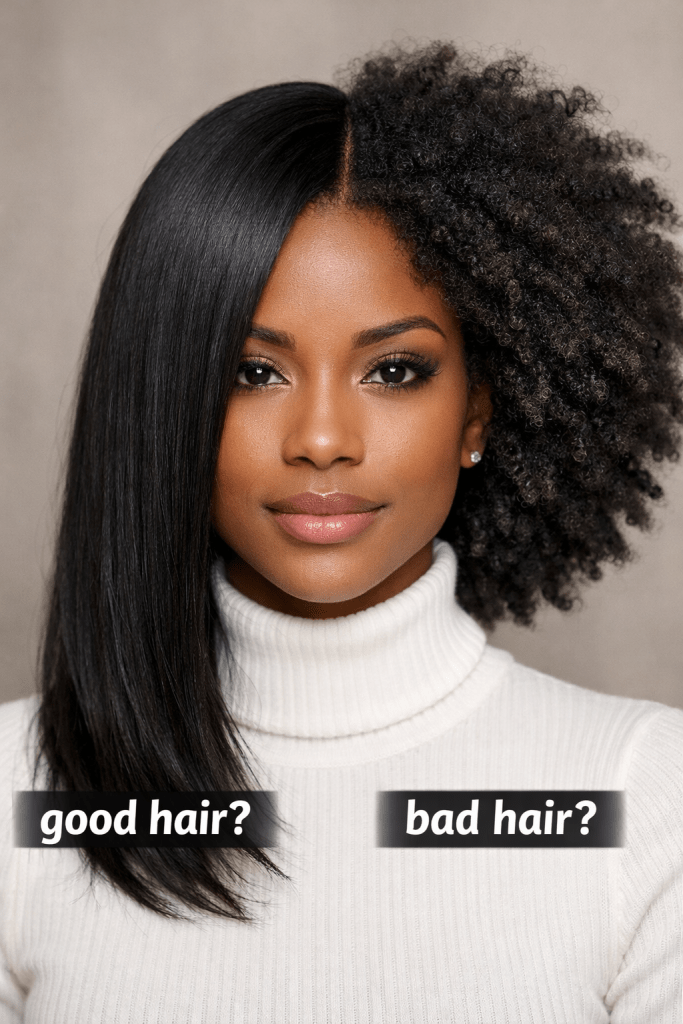
The conversation around “good hair” and “bad hair” has long been a source of tension, pride, and pain within the Black community. The term “good hair” often refers to straighter, silkier textures associated with European standards of beauty, while “bad hair” is used to describe tightly coiled, kinky textures often associated with African heritage. But what does the Bible say about hair, and how can we reclaim a healthy, godly perspective?
The Bible affirms that all hair is good because it is created by God. Matthew 10:30 (KJV) declares, “But the very hairs of your head are all numbered.” This scripture shows the Most High’s care and intentionality regarding hair. There is no biblical basis for labeling one texture as superior to another. Instead, hair is seen as a natural part of God’s design, a symbol of identity, and, in many cases, a spiritual covering (1 Corinthians 11:15, KJV).
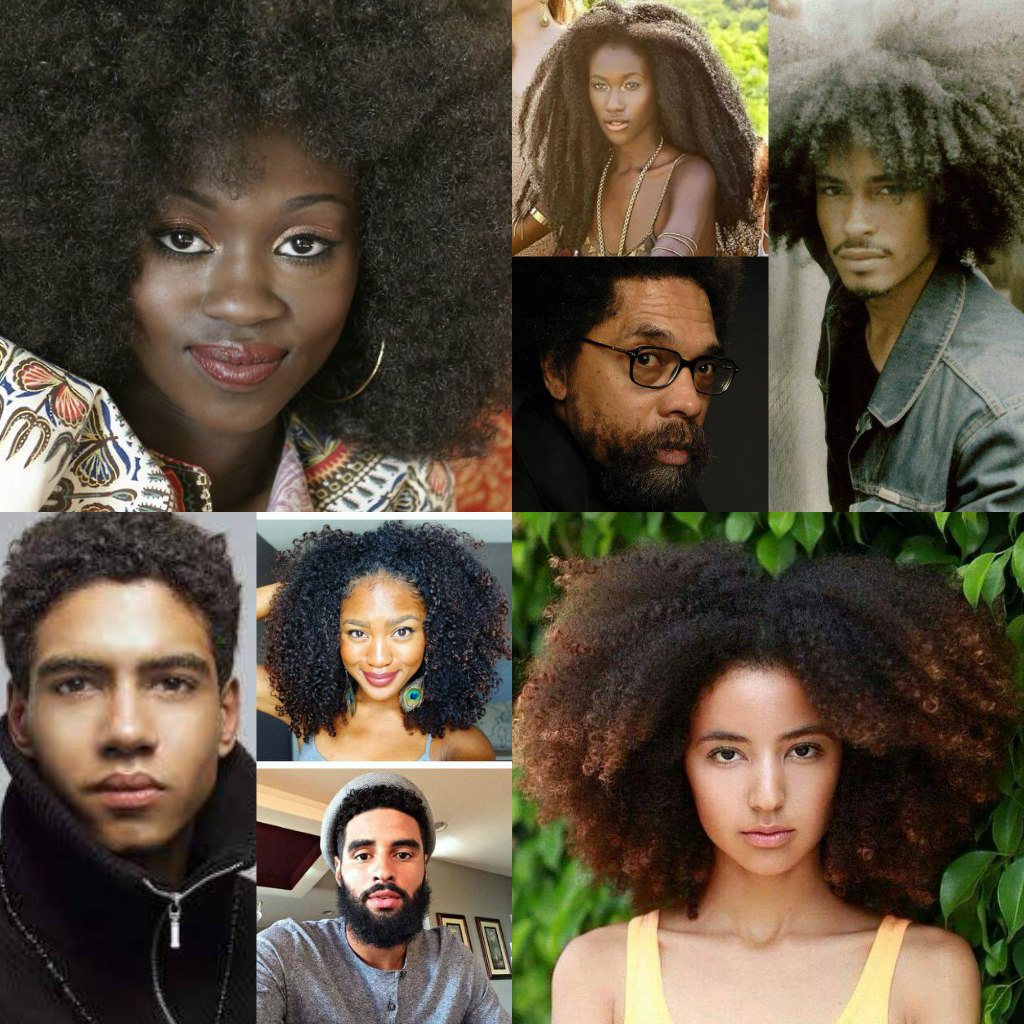
All photographs are the property of their respective owners. No copyright infringement intended.
The notion of “bad hair” largely stems from the legacy of slavery and colonialism. During slavery in America, Africans’ natural hair was often ridiculed and seen as “wild” or “unkempt” by European enslavers. This ridicule was strategic—it sought to strip enslaved Africans of pride in their natural appearance, to convince them that European features and styles were superior.
Psychologically, this produced internalized racism. Over time, many Black people began to associate straight hair with beauty, respectability, and even success. This association was reinforced in media, workplaces, and schools that penalized or banned natural hairstyles. Such systemic discrimination can lead to what scholars call “cultural trauma,” where a group learns to devalue aspects of its own identity.
The term “nappy” historically was used as a derogatory word. It mocked the tight coils and kinks of African hair, equating them with roughness or uncleanliness. The phrase “nappy-headed” became a slur that reinforced the idea that natural Black hair was undesirable. This is a psychological residue of enslavement that still impacts Black self-esteem today.
In truth, there is no such thing as “bad hair.” All hair grows according to the genetic blueprint given by God. Psalm 139:14 (KJV) reminds us, “I will praise thee; for I am fearfully and wonderfully made.” The texture, thickness, and curl pattern of one’s hair is divinely designed, not a mistake.
The love-hate relationship with hair in the Black community also reveals a longing for acceptance. Many Black people invest heavily in hair products, wigs, and chemical treatments to conform to mainstream standards. This is not just vanity—it is often a survival mechanism in a society that discriminates based on appearance.
Hollywood, advertising, and fashion industries have historically promoted Eurocentric beauty ideals, making straight hair the default standard of attractiveness. This has led to generations of Black children growing up believing that their natural hair was unprofessional or unattractive unless it was altered.
The Bible warns against adopting the world’s standard of beauty. 1 Samuel 16:7 (KJV) says, “For man looketh on the outward appearance, but the Lord looketh on the heart.” God is not concerned with whether hair is curly, straight, or coiled—He is concerned with the condition of our spirit.
Hair is also deeply symbolic in the Bible. Samson’s hair represented his covenant with God (Judges 16:17, KJV). The Nazarites were instructed not to cut their hair as a sign of consecration (Numbers 6:5, KJV). These examples remind us that hair has spiritual meaning, but no texture or style makes one holier than another.
Solutions to the “good hair” vs. “bad hair” divide must begin with education and affirmation. Parents can teach children from an early age to embrace their natural hair textures, using affirmations and showing them examples of beauty that look like them. Representation matters.
The natural hair movement has been one powerful response to centuries of hair-shaming. By wearing afros, locs, braids, and twists proudly, Black people reclaim their heritage and reject the lie that straight hair is superior. This movement echoes Romans 12:2 (KJV): “And be not conformed to this world: but be ye transformed by the renewing of your mind.”
Workplaces and schools must also be challenged. Laws like the CROWN Act, which bans hair discrimination, are steps toward justice. Discrimination against natural hair is not merely a fashion issue—it is a civil rights issue rooted in systemic racism.
Spiritually, the solution also involves repentance and deliverance from self-hatred. Generational trauma and the colonial mindset must be broken. Believers can pray for a renewed mind and ask God to restore confidence in His design.
Men must also be part of this conversation. In many cases, Black men have been conditioned to prefer straight hair on women, reinforcing Eurocentric standards. Re-educating men about the beauty and versatility of natural hair is part of community healing.
Media creators and influencers have a responsibility to showcase diverse hair textures positively. When children see actresses, news anchors, and professionals wearing natural styles proudly, it normalizes their beauty. This can shift psychological perceptions over time.
The church can play a role by teaching that hair should not be a source of pride, shame, or division. James 2:1-4 (KJV) warns against showing partiality based on outward appearance. The body of Christ should be the first place where people of all textures feel celebrated.
Healing the Next Generation
The conversation around hair identity must address its impact on children, because early experiences with hair-shaming or affirmation often shape a child’s self-image for life. Developmental psychology teaches that children form a sense of self-worth between ages 3 and 7. If a child repeatedly hears that their hair is “nappy,” “ugly,” or “unprofessional,” those words can leave a deep emotional wound that lasts into adulthood.
Hair bullying is a real issue. In many schools, Black children have been suspended or sent home for wearing braids, locs, or afros—styles that are natural and culturally significant. These incidents teach children that who they are is unacceptable unless they conform to Eurocentric beauty standards. This form of discrimination not only harms self-esteem but also creates anxiety and shame.
From a psychological standpoint, children who internalize negative messages about their hair often struggle with identity development. They may wish they looked different, leading to feelings of inadequacy. Erik Erikson’s theory of psychosocial development identifies this as an “identity vs. role confusion” stage—when children are trying to discover who they are, acceptance plays a critical role.
Biblically, this issue is critical because self-hatred contradicts God’s design. Psalm 8:5 (KJV) declares, “For thou hast made him a little lower than the angels, and hast crowned him with glory and honour.” Every child is made in God’s image (Genesis 1:27, KJV) and should be celebrated as such. Teaching children to love their hair is teaching them to love God’s creation.
Parents play the most important role in reversing the harm of “good hair vs. bad hair” conditioning. Affirmations like “Your hair is beautiful just the way God made it” can help children internalize positive messages. Taking time to gently care for and style their hair with love turns grooming into a time of bonding and affirmation.
Representation in books, toys, and media is also crucial. When children see dolls, superheroes, and princesses with afros, braids, and coils, they learn that beauty comes in many forms. Christian parents can incorporate Bible lessons on diversity and God’s intentional creation to reinforce this truth.
People must create spaces where natural beauty is affirmed rather than criticized. Sadly, some church cultures have pressured women and girls to straighten their hair to look “presentable” for service. Instead, churches should teach that modesty and holiness are about the heart (1 Peter 3:3-4, KJV), not about imitating European hairstyles.
Schools need cultural sensitivity training to prevent hair discrimination. The CROWN Act (Creating a Respectful and Open World for Natural Hair) is now law in several U.S. states and should be advocated for everywhere. This legislation protects children from unfair discipline or exclusion based on hair.
Psychologists recommend early intervention when children experience hair-based bullying. Parents should validate the child’s feelings, teach coping strategies, and involve teachers if necessary. Healing from these experiences prevents long-term damage to self-esteem.
Mentorship programs can also make a difference. When children see older peers or adults proudly rocking natural hair, they have role models to look up to. This helps normalize natural hair and removes the stigma.
Hair care education is another solution. Many parents and teachers simply do not know how to care for natural hair, which can lead to frustration or neglect. Workshops on proper styling, maintenance, and products empower families to care for their hair healthily.
From a community perspective, celebrating natural hair through events like hair shows, heritage days, or social media campaigns can build pride. These events allow children to see that their hair is not just normal—it is special and worth celebrating.
Men and fathers have a special responsibility to speak life into their daughters. A father who compliments his daughter’s natural hair can shield her from seeking validation from harmful sources. Proverbs 18:21 (KJV) reminds us that “death and life are in the power of the tongue.”
Mental health support is also important. If a child’s self-esteem has been deeply harmed, counseling can help them rebuild a healthy self-image. Christian counseling can integrate biblical truths with therapeutic strategies to restore confidence.
The natural hair conversation should also extend to young boys. Boys with locs or afros have been stereotyped as “unprofessional” or even “criminal.” Parents must teach their sons that their hair is not a marker of delinquency but of heritage, creativity, and pride.
Psychologically, embracing natural hair is part of decolonizing the mind. It is a way of rejecting oppressive beauty standards and embracing cultural authenticity. Romans 12:2 (KJV) calls us to “be transformed by the renewing of your mind.” Renewing the mind means unlearning lies that say Blackness must be hidden or altered to be acceptable.
Education on African history is also a solution. When children learn about ancient African civilizations—Egypt, Kush, Mali—and their rich culture, they develop pride in their heritage. This context reframes hair as part of a royal, powerful legacy rather than something to be ashamed of.
Finally, prayer and community support are vital. Families can pray over their children’s self-esteem and ask God to protect them from the spirit of rejection. James 5:16 (KJV) promises that “the effectual fervent prayer of a righteous man availeth much.” Community support groups can also provide encouragement and resources for families committed to embracing natural beauty.
In conclusion, healing the next generation from the trauma of “good hair vs. bad hair” is not just a beauty issue—it is a spiritual and cultural mission. By affirming children early, reforming schools and churches, and providing mentorship and representation, we can raise a generation that celebrates what God has given them. When we teach children that all hair is good hair, we teach them that they themselves are good—fearfully and wonderfully made.
Ultimately, the conversation about “good hair” vs. “bad hair” is about much more than hair. It is about freedom—freedom from colonial thinking, from internalized racism, and from societal pressure to conform. True freedom comes from knowing who you are in Christ and embracing every part of your God-given identity.
In conclusion, all hair is good hair. It is numbered by God, designed with purpose, and worthy of care and respect. The challenge before us is to uproot the lies of slavery, colonization, and white supremacy that taught generations of Black people to hate what God made. Only then can we walk fully in the truth that we are fearfully and wonderfully made—kinks, curls, coils, and all.
Good Hair? YES
References
Banks, I. (2000). Hair Matters: Beauty, Power, and Black Women’s Consciousness. NYU Press.
Byrd, A., & Tharps, L. (2014). Hair Story: Untangling the Roots of Black Hair in America. St. Martin’s Griffin.
hooks, b. (1992). Black Looks: Race and Representation. South End Press.
DeGruy, J. (2005). Post Traumatic Slave Syndrome. Joy DeGruy Publications.
Key KJV Scriptures: Matthew 10:30; 1 Corinthians 11:15; Psalm 139:14; 1 Samuel 16:7; Judges 16:17; Numbers 6:5; Romans 12:2; James 2:1-4.
The question “Why don’t you do something with your hair?” carries weight far beyond casual conversation. It reflects the long, complicated history of hair politics within the Black community, where hair is not merely aesthetic but deeply tied to identity, culture, and social status. The question assumes that the natural hair that grows out of a Black woman’s scalp is insufficient, needing alteration to be considered beautiful or presentable. This dilemma plays out daily in salons, workplaces, and even among friends, revealing the enduring tension between assimilation and authenticity.
Hair politics in the Black community have roots that trace back to pre-colonial Africa. African hairstyles once symbolized tribe, social rank, marital status, and even spiritual beliefs (Byrd & Tharps, 2014). Intricate braids, twists, and natural textures were celebrated as markers of identity and belonging. This changed dramatically during the transatlantic slave trade. Enslaved Africans were often forced to shave their heads, stripping them of cultural identity and dignity (White & White, 1998). This dehumanizing act laid the groundwork for centuries of stigma against African hair textures.
During slavery and later segregation, Eurocentric beauty standards dominated. Straight hair was viewed as a marker of respectability and proximity to whiteness. Many Black women began straightening their hair as a means of survival, using hot combs and later chemical relaxers to fit into white society’s expectations (Rooks, 1996). This survival strategy was both empowering—opening doors to employment and social acceptance—and damaging, as it subtly communicated that natural hair was unkempt or undesirable.
This tension birthed the concept of “good hair” versus “bad hair.” “Good hair” was typically defined as straighter, looser, and more European-like, while “bad hair” referred to tightly coiled, kinky textures. This language continues to shape how Black girls grow up viewing themselves. The woman in the store who questioned another’s natural fro echoed centuries of conditioning that privileges one texture over another.
Biblically, this judgment contradicts the affirmation of divine creation. Psalm 139:14 (KJV) declares, “I will praise thee; for I am fearfully and wonderfully made: marvellous are thy works.” If God made hair textures diverse, then natural Black hair is good by design. The cultural insistence on altering hair to be acceptable reflects a deeper issue of internalized oppression rather than divine truth.
Hair also became a political statement during the Civil Rights and Black Power movements of the 1960s and 1970s. The Afro emerged as a symbol of pride, rebellion, and resistance against white supremacy. To wear one’s hair in its natural state became an act of defiance and self-acceptance. Angela Davis famously wore her iconic Afro as both a personal choice and a political statement, making natural hair synonymous with the fight for liberation (Davis, 1981).
However, as mainstream culture commodified Black style, the natural hair movement lost some of its radical edge. The emergence of weaves, wigs, and chemical relaxers in the 1980s and 1990s introduced new standards of glamour and professionalism. While these styles offered versatility and creative expression, they also reinforced the idea that natural hair was only acceptable if controlled or hidden.
Celebrities have weighed in on this hair dilemma, often sparking debate. Viola Davis removed her wig on the hit show How to Get Away With Murder in a powerful scene that revealed her natural hair, stating in interviews that she wanted to normalize textured hair on television (Dockterman, 2014). Solange Knowles has also been vocal about the politics of natural hair, penning the song “Don’t Touch My Hair” as an anthem of autonomy and identity.
On the other side, some celebrities have been criticized for perpetuating Eurocentric beauty ideals. Rapper Lil’ Kim and others who have dramatically lightened their skin and straightened their hair have been accused of reflecting the deep scars of colorism and texturism. These choices are not simply personal but political, given the influence celebrities have on shaping beauty standards.
Workplace politics also play a major role in the natural-versus-straight hair conversation. For years, natural hairstyles such as locs, braids, and twists were deemed “unprofessional” in many corporate environments. It wasn’t until the passing of laws like the CROWN Act (2019) that discrimination against natural hairstyles began to be legally challenged in several U.S. states. This shows that hair policing is not just cultural but institutional.
The debate over natural hair versus weaves or wigs is complex. On one hand, weaves allow Black women to experiment with style, color, and length without damaging their natural hair. On the other, they can become a crutch if they are used to hide self-hatred or avoid confronting the stigma against natural textures. The key issue is not the style chosen but the motivation behind it—whether it flows from freedom or from shame.
Mentally, constant scrutiny over hair can lead to stress and self-esteem issues. Black girls as young as five report feeling pressured to straighten their hair for special occasions or school pictures (Opie & Phillips, 2015). This teaches them early that their natural state is less acceptable, planting seeds of insecurity that can take years to unlearn.
Spiritually, the church can play a role in affirming natural hair. Unfortunately, some church communities have perpetuated respectability politics by favoring women with straightened hair or wigs, especially in leadership roles. This contradicts the biblical principle in 1 Peter 3:3-4 (KJV), which states that beauty should not merely be about “plaiting the hair” or outward adornment but about “the hidden man of the heart.” This verse calls believers to focus on character rather than conformity to beauty standards.
The natural hair movement of the 21st century has made significant strides in reversing stigma. Social media platforms like Instagram and YouTube have created spaces for Black women to share tips, tutorials, and encouragement for embracing natural curls and coils. This digital sisterhood has birthed a new generation of women who proudly wear their afros, twist-outs, and locs as declarations of self-love.
Nevertheless, the pressure to conform to a certain standard of natural hair perfection—“curl envy”—has emerged as a new form of hair politics. Women with looser curl patterns are often celebrated more in natural hair campaigns than those with tighter coils, revealing that even within the movement, hierarchies still exist.
The Politics, Pain, and Power of Black Hair
I was standing in line at a neighborhood store when I overheard two women talking. One wore a sleek weave, carefully laid edges, and perfectly straightened strands; the other rocked a short, natural fro. With a laugh, the first woman asked, “Girl, why don’t you do something with your hair?” The second woman smiled politely, but her face betrayed the familiar sting that so many Black women know too well. That small exchange speaks volumes about the history and politics of Black hair — a history that stretches from the villages of West Africa to the plantations of the Americas, from the barbershops and beauty salons of the Jim Crow era to the hashtags and viral videos of today.
Hair has never been just hair for Black people. In pre-colonial Africa, hair was identity. Styles communicated tribe, social status, fertility, and even spiritual meaning (Byrd & Tharps, 2014). To cut someone’s hair was to humiliate them, stripping away dignity. Enslavers understood this, which is why many Africans brought to the Americas had their heads forcibly shaved, severing a crucial connection to their homeland (White & White, 1998). This trauma planted the seed for centuries of stigma against African textures.
In America, Black hair became a site of both survival and rebellion. For many, straightening hair was a way to gain access to jobs, education, and respectability in a white-dominated society (Rooks, 1996). The hot comb, famously popularized by Madam C.J. Walker, was both a tool of empowerment and a symbol of assimilation. “My grandmother told me that straightening her hair helped her get her first job as a teacher,” said Sharon, 62, in an interview. “But she also told me she always felt like she was wearing a mask.”
The language of “good hair” versus “bad hair” emerged from these survival tactics. “Good hair” was associated with looser, straighter textures — often linked to mixed ancestry — while “bad hair” was used to describe kinky, coily textures. “I grew up in the 90s, and my aunties would sigh whenever I wore my hair natural,” said Angela, 33. “They would say, ‘We gotta do something with this nappy mess.’ It made me feel like who I was naturally was a problem to be fixed.”
Biblically, this tension challenges what Scripture teaches about God’s creation. Genesis 1:31 (KJV) declares, “And God saw every thing that he had made, and, behold, it was very good.” If every hair texture is created by God, then none can be deemed “bad.” Psalm 139:14 reminds us that we are “fearfully and wonderfully made.” To degrade natural hair is to deny the Creator’s artistry.
The Civil Rights and Black Power era redefined hair politics. The Afro became a crown of pride and a political statement. “When I wear my Afro, I am making a statement that I am Black and proud,” Angela Davis wrote (Davis, 1981). To wear one’s hair naturally was to reject assimilation and embrace African identity. This was a time when hair became activism — the body itself was a protest sign.
But as the decades passed, relaxers, weaves, and wigs became mainstream again. For some, this was a matter of convenience and creative expression. For others, it was a return to old pressures to conform. “I love my weave because I can switch up my look,” said Monique, 27, during a focus group. “But I also hate that people assume I don’t love myself when I wear it. It’s not that — I just like the versatility.”
The natural hair movement of the 2010s reignited the call for authenticity. YouTube vloggers and Instagram influencers created a renaissance of tutorials, hair care tips, and motivational content celebrating curls, coils, and kinks. Yet, even within the natural hair community, hierarchies emerged. Looser curl patterns (3A–3C) were celebrated more prominently than tightly coiled textures (4B–4C), leading to what some call “texturism” (Robinson, 2011).
Celebrities have weighed in powerfully on the conversation. Viola Davis’s decision to remove her wig on How to Get Away with Murder was more than just a TV moment — it was a cultural reset. “I wanted to humanize her,” Davis explained. “And part of that is letting her be who she really is — natural hair and all” (Dockterman, 2014). Solange Knowles, in her song “Don’t Touch My Hair,” transformed her experience of unwanted hair-policing into an anthem of bodily autonomy.
Despite these victories, discrimination remains a reality. Studies show that Black women with natural hairstyles are often rated as less professional or less competent in corporate settings (Opie & Phillips, 2015). The passage of the CROWN Act (2019) in multiple U.S. states is a step toward protecting Black hair from workplace discrimination — but the cultural bias runs deep.
The question “Why don’t you do something with your hair?” carries an assumption: that natural hair is undone, messy, or unacceptable. But natural hair is done the moment it grows from the scalp. It does not need fixing to be valid. Romans 12:2 (KJV) reminds us, “Be not conformed to this world: but be ye transformed by the renewing of your mind.” Breaking free from the belief that straight is the only acceptable form is a mental and spiritual renewal.
Healing hair trauma requires unlearning generations of internalized shame. “I had to stop calling my daughter’s hair ‘difficult,’” said Candace, 40. “Now I tell her it’s beautiful, full, and strong — just like her.” This kind of language shift is revolutionary. It teaches young girls that their hair is a source of pride, not a burden.
There is also space for freedom of choice. Some women wear wigs or relaxers not out of shame but for self-expression. The issue is not the style but the root motivation. Galatians 5:1 (KJV) declares, “Stand fast therefore in the liberty wherewith Christ hath made us free.” Freedom in Christ includes freedom from the bondage of beauty standards — whether those standards push toward assimilation or prescribe a rigid idea of “natural purity.”
The politics of hair also affect men, though they are often left out of the conversation. Dreadlocks, cornrows, and afros on Black men have been criminalized, labeled as unkempt or threatening. Celebrities like J. Cole and Bob Marley used their hair as political and spiritual statements, reminding the world that natural hair is not just style but identity.
Moving forward, education is key. Schools, churches, and community spaces must normalize the full spectrum of Black hair. Representation in media matters — children need to see characters who look like them wearing braids, locs, fros, and curls with confidence and beauty.
Ultimately, the woman in the store who questioned the natural fro was voicing a generational script — one we must now rewrite. By embracing natural hair as inherently good, by affirming every style chosen freely, and by dismantling the good-hair/bad-hair dichotomy, the Black community can heal from centuries of hair trauma.
In the end, the question is no longer “Why don’t you do something with your hair?” but “What will we do with the legacy of hair politics?” Will we pass down shame or pass down pride? Will we perpetuate Eurocentric hierarchies or celebrate the God-given diversity of our crowns? The choice is ours — and it is time to choose freedom.
Healing from hair politics requires both internal and communal work. Internally, Black women must embrace that their hair—whatever its texture—is inherently good and worthy of care. Communally, there must be a shift in language, moving away from “good hair” and “bad hair” to affirming the full spectrum of textures as beautiful.
Parents play a critical role in shaping hair identity. Teaching young girls to love their hair early on, letting them see positive representations of their texture in books, movies, and social media, helps inoculate them against the pressures they will face. Such affirmation can prevent the painful moment when a stranger or even a friend asks, “Why don’t you do something with your hair?”
In conclusion, hair politics in the Black community are both a burden and an opportunity. The burden lies in centuries of stigma and division, but the opportunity lies in reclaiming hair as a site of freedom, creativity, and identity. When a woman chooses a fro, a weave, braids, or a bald head from a place of self-love, she resists the narrative that her natural state is not enough. By rooting our worth in biblical truth and affirming the diversity of Black beauty, the Black community can end the cycle of judgment and instead celebrate the crown that God has given.
References
Byrd, A., & Tharps, L. (2014). Hair story: Untangling the roots of Black hair in America (2nd ed.). St. Martin’s Press.
Davis, A. (1981). Women, race, & class. Vintage Books.
Dockterman, E. (2014, October 17). Viola Davis explains why she took off her wig on How to Get Away With Murder. TIME.
Opie, T., & Phillips, K. W. (2015). Hair penalties: The negative influence of Afrocentric hair on ratings of Black women’s dominance and professionalism. Frontiers in Psychology, 6, 1311.
Rooks, N. (1996). Hair raising: Beauty, culture, and African American women. Rutgers University Press.
White, S., & White, G. (1998). Slave hair and African American culture in the eighteenth and nineteenth centuries. Journal of Southern History, 63(1), 45–76.
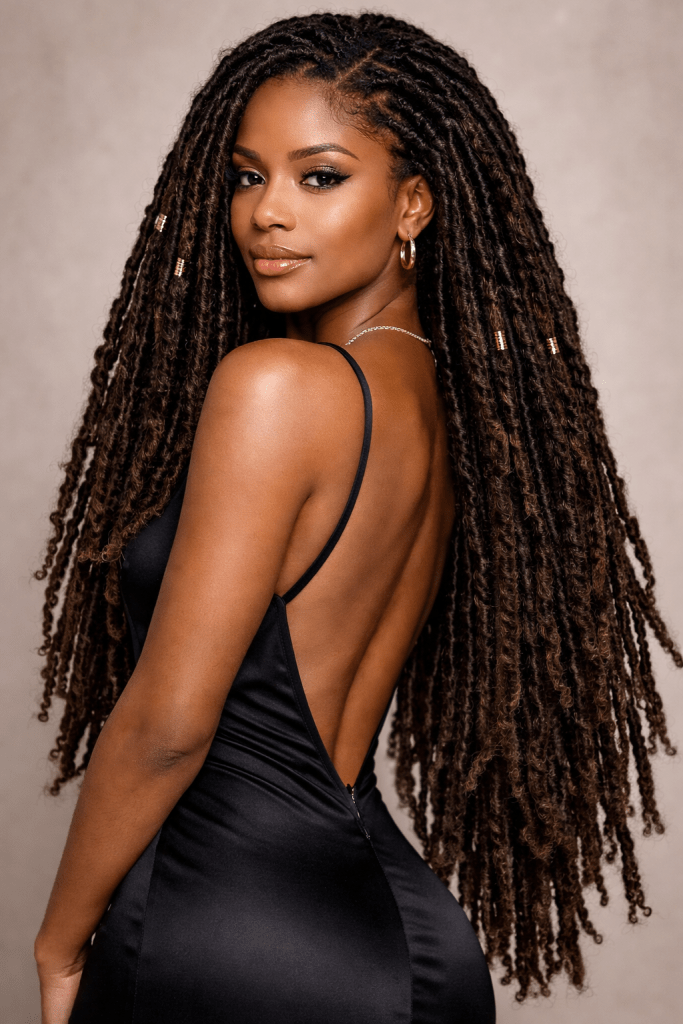
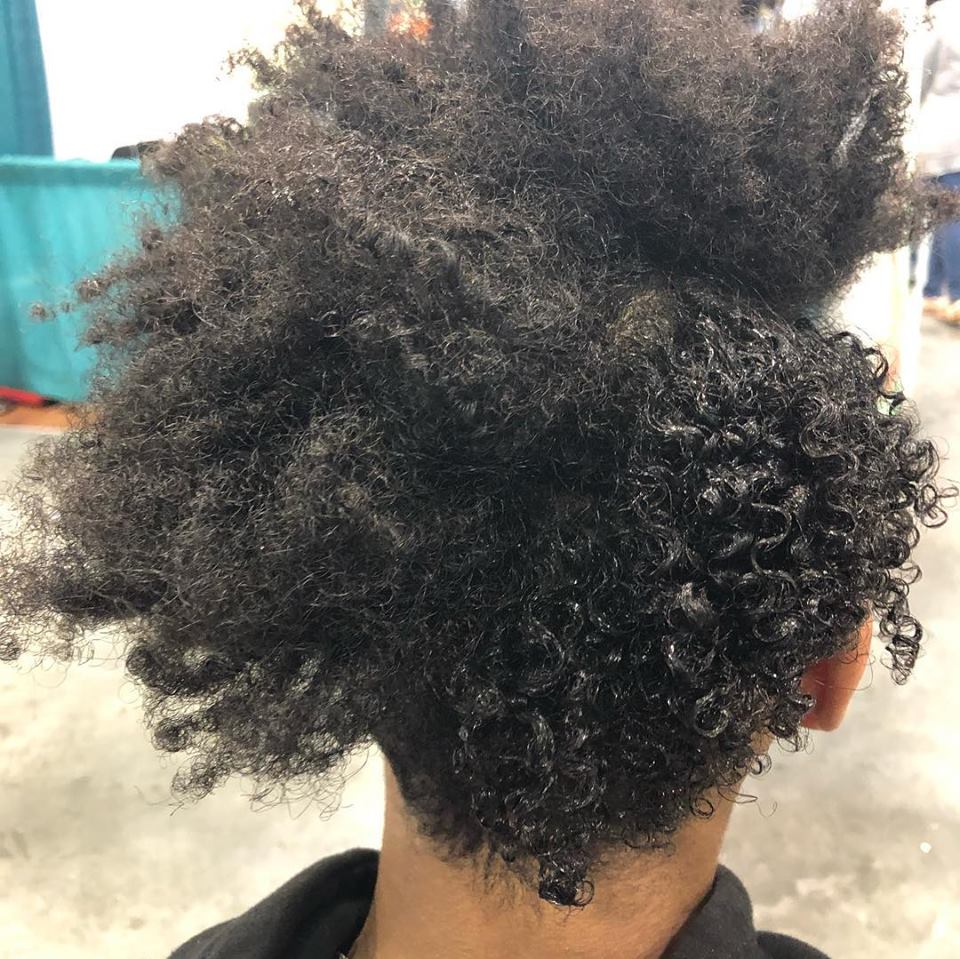
This photograph is the property of its respective owner. No copyright infringement intended.
Hair has always carried meaning far beyond aesthetics—it reflects identity, history, politics, and even survival. For Black women, the politics of hair have long been tied to standards of beauty, professionalism, and self-worth. The debate between natural and relaxed hair is not simply cosmetic but deeply rooted in cultural history, racial oppression, and personal empowerment.
The Politics of Professionalism: Why Straight Hair Still Rules Corporate America
Employers in professional spaces often view straight hair as “neat,” “polished,” and “professional,” while Black kinky or coily hair is stereotyped as “unruly,” “unkept,” or “distracting” (Opie & Phillips, 2015). This bias is rooted in Eurocentric beauty standards that equate professionalism with whiteness. Because historically, straight hair aligns with the dominant white cultural norm, it is unconsciously perceived as the standard of acceptability.
Psychologically, this is linked to implicit bias—where people associate straight hair with competence, intelligence, and leadership, while natural Afro-textured hair triggers stereotypes of defiance or lack of refinement (Rosette & Dumas, 2007). Such perceptions are not about actual job performance but about conformity to white workplace culture.
Professionalism is not just about skill, education, or work ethic—it is often policed through appearance. For Black women, the workplace has historically imposed Eurocentric standards of beauty, particularly regarding hair. Employers frequently equate straight hair with professionalism, while natural kinky or coily textures are deemed “unruly,” “distracting,” or even “unprofessional.” This double standard has real consequences for Black women navigating corporate spaces.
The Legacy of Eurocentric Standards
The preference for straight hair in professional environments is rooted in colonial and Eurocentric ideals. Whiteness became the cultural baseline for what is considered polished, disciplined, and professional. Straight hair has long symbolized assimilation into white norms, whereas natural Afro-textured hair is often stigmatized as resistant or defiant. This has less to do with workplace performance and more to do with conformity to dominant cultural values.
Psychology and Bias
Psychological studies reveal how implicit bias shapes perceptions of hair. Research by Opie and Phillips (2015) shows that Black women with Afrocentric hairstyles (such as braids, Afros, or dreadlocks) are more likely to be rated as less professional, less competent, and less dominant compared to women with straightened hair. These evaluations are not objective assessments of skill, but rather cultural biases projected onto appearance. In essence, natural Black hair challenges white-centered notions of professionalism.
A Real-World Example: The Case of Chastity Jones
One of the most well-known workplace discrimination cases involving hair was Chastity Jones v. Catastrophe Management Solutions (2016). Jones, a Black woman, was offered a job at a call center but had her offer rescinded when she refused to cut her dreadlocks. The employer claimed that dreadlocks “tend to get messy,” despite the fact that her hair was neat and well-kept. Jones sued for racial discrimination, but the U.S. Court of Appeals ruled in favor of the employer, stating that hairstyle is not an “immutable characteristic” like race itself, and therefore not legally protected under Title VII. This case highlights how Black women’s natural hair continues to be penalized in ways straight hair never is.
The Emotional and Professional Toll
This bias creates psychological burdens for Black women who feel pressured to chemically relax, straighten, or otherwise alter their hair to fit workplace expectations. The choice is not simply aesthetic—it becomes a question of employability, respect, and economic survival. Constantly managing one’s hair to avoid discrimination can lead to stress, anxiety, and a diminished sense of authenticity. It also forces many Black women to choose between professional advancement and cultural self-expression.
The Rise of Natural Hair Movements
Despite this discrimination, movements like the Natural Hair Movement and campaigns such as #BlackGirlMagic and #CROWNAct have gained momentum. The CROWN Act (Create a Respectful and Open Workplace for Natural Hair) seeks to legally ban hair-based discrimination, affirming that Black hair in its natural state—braids, locs, twists, Afros—should be respected as professional. States like California, New York, and New Jersey have already passed the CROWN Act, with efforts expanding nationally.
The Science of Hair and Health Risks
Beyond social pressure, many relaxers and chemical straighteners carry health risks. Studies link long-term relaxer use to uterine fibroids, early puberty, and even increased cancer risk (Wise et al., 2012; Rosenberg et al., 2022). Straight hair may align with workplace expectations, but at the cost of Black women’s health. Natural kinky hair, on the other hand, is structurally stronger, better at retaining moisture, and scientifically designed to protect the scalp from the sun. What employers deem “unprofessional” is biologically one of the healthiest hair types.
The History of Hair Relaxers
Chemical hair relaxers first appeared in the early 20th century, pioneered by Madam C.J. Walker and other entrepreneurs who created products marketed to straighten Black hair for easier manageability and social acceptance (Bundles, 2001). By the mid-1900s, relaxers had become normalized, especially during the Civil Rights era when assimilation into white-dominated professional spaces was often tied to straightened hair. However, the rise of the natural hair movement in the 1960s and 1970s reintroduced Afrocentric pride, with natural hair symbolizing resistance and authenticity.
Relaxers use harsh chemicals such as sodium hydroxide, guanidine hydroxide, or ammonium thioglycolate to break down protein bonds in the hair shaft, permanently altering curl patterns (Robinson, 2011). Studies have shown that prolonged relaxer use can lead to scalp burns, hair thinning, breakage, and alopecia (Nkwocha, 2018). More concerning are the potential health risks: research suggests a correlation between chemical relaxer use and higher risks of fibroids, reproductive health issues, and even certain cancers (Wise et al., 2012). This raises the question of whether beauty should come at the expense of health.
The Love for Straight Hair and Its History
Many Black women’s affinity for straight hair is rooted in centuries of Eurocentric beauty ideals imposed during slavery and colonialism. Straight hair was historically associated with whiteness, cleanliness, and professionalism, while kinky or coily textures were stigmatized as “unkempt” or “inferior” (Patton, 2006). Assimilation into mainstream culture often meant altering one’s natural texture to access opportunities and avoid discrimination. Thus, the preference for straight hair is less about beauty alone and more about survival and acceptance in systems of white supremacy.
Why Natural Hair is Better
Natural hair carries cultural, spiritual, and health advantages. It allows the scalp and strands to thrive without chemical damage, preserving thickness and elasticity. It also honors heritage and affirms identity, serving as a visual declaration of authenticity and self-love. From a health perspective, embracing natural hair reduces exposure to toxic chemicals, supporting overall well-being (Byrd & Tharps, 2014).
The Science of Kinky Hair
Kinky and coily hair is structurally different from straight or wavy hair. Research shows that the elliptical shape of the hair follicle creates tight curls, which are more prone to dryness since natural oils have difficulty traveling down the shaft (Tate, 2009). While this fragility requires special care, it also provides unique styling versatility and natural volume unmatched by other hair types. Rather than being seen as “difficult,” kinky hair is scientifically a crown of complexity and resilience.
Biblical Reflections on Hair
The Bible references hair as a symbol of glory, strength, and consecration. “But if a woman have long hair, it is a glory to her: for her hair is given her for a covering” (1 Corinthians 11:15, KJV). While the Bible does not specify texture, it underscores hair as a natural gift from God. Altering it for societal acceptance raises questions about identity and divine intention. Thus, natural hair can be embraced as a reflection of God’s design rather than something to be suppressed.
The Psychology of Black Hair
Hair is central to self-concept and cultural belonging. For Black women, hair-related stress is well documented, with many experiencing “hair anxiety” in professional settings due to bias (Opie & Phillips, 2015). Psychologically, choosing natural hair often leads to greater self-acceptance and reduced internalized racism, while reliance on relaxers may be tied to conformity and fear of rejection. Hair, then, becomes both a personal and political battlefield, influencing mental health and identity formation.
Conclusion: Hair as Liberation
Ultimately, the debate between natural and relaxed hair is about more than style; it is about health, freedom, and authenticity. Natural hair resists centuries of oppression, honors cultural heritage, and prioritizes well-being. While each woman has the autonomy to choose, the growing embrace of natural textures in professional spaces signals a shift toward liberation. The politics of hair remind us that Black beauty is not something to be corrected—it is something to be celebrated. The real question is not whether natural Black hair is professional—it always has been—but rather why workplaces continue to uphold Eurocentric standards as the benchmark. By associating straight hair with competence, corporate America perpetuates racial inequality under the guise of professionalism. A shift toward inclusivity means challenging these assumptions and affirming that professionalism is about skills, not conformity to white aesthetics.
References
Bundles, A. L. (2001). On Her Own Ground: The Life and Times of Madam C.J. Walker. Scribner.
Byrd, A., & Tharps, L. (2014). Hair Story: Untangling the Roots of Black Hair in America. St. Martin’s Press.
Nkwocha, I. (2018). The harmful effects of hair relaxers: A health review. Journal of Public Health and Epidemiology, 10(3), 99–106.
Opie, T., & Phillips, K. W. (2015). Hair penalties: The negative influence of Afrocentric hair on ratings of Black women’s dominance and professionalism. Frontiers in Psychology, 6, 1311.
Patton, T. O. (2006). Hey girl, am I more than my hair? African American women and their struggles with beauty, body image, and hair. NWSA Journal, 18(2), 24–51.
Robinson, C. (2011). Hair Loss Disorders in Ethnic Populations. Springer.
Tate, S. A. (2009). Black Beauty: Aesthetics, Stylization, Politics. Ashgate.
Wise, L. A., Palmer, J. R., Reich, D., & Rosenberg, L. (2012). Hair relaxer use and risk of uterine leiomyomata in African-American women. American Journal of Epidemiology, 175(5), 432–440.
Opie, T., & Phillips, K. W. (2015). Hair penalties: The negative influence of Afrocentric hair on ratings of Black women’s dominance and professionalism. Frontiers in Psychology, 6, 1311.
Rosette, A. S., & Dumas, T. L. (2007). The hair dilemma: Conform to mainstream expectations or emphasize racial identity. Duke Journal of Gender Law & Policy, 14(1), 407–421.
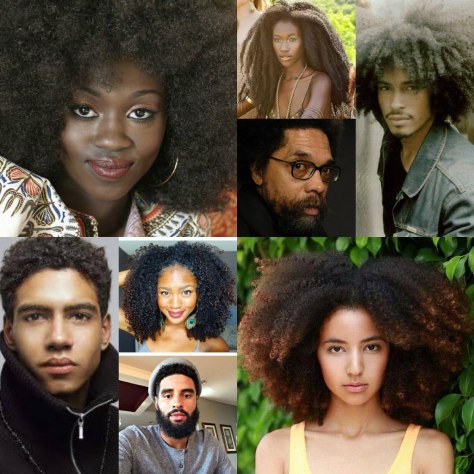
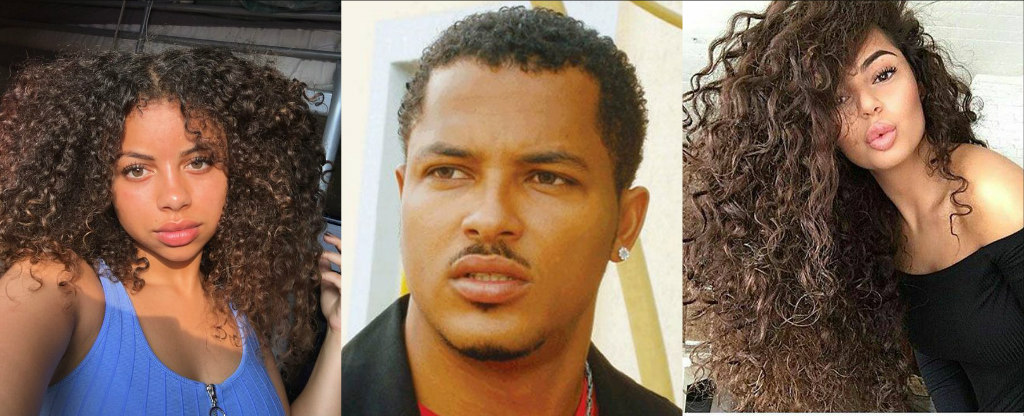
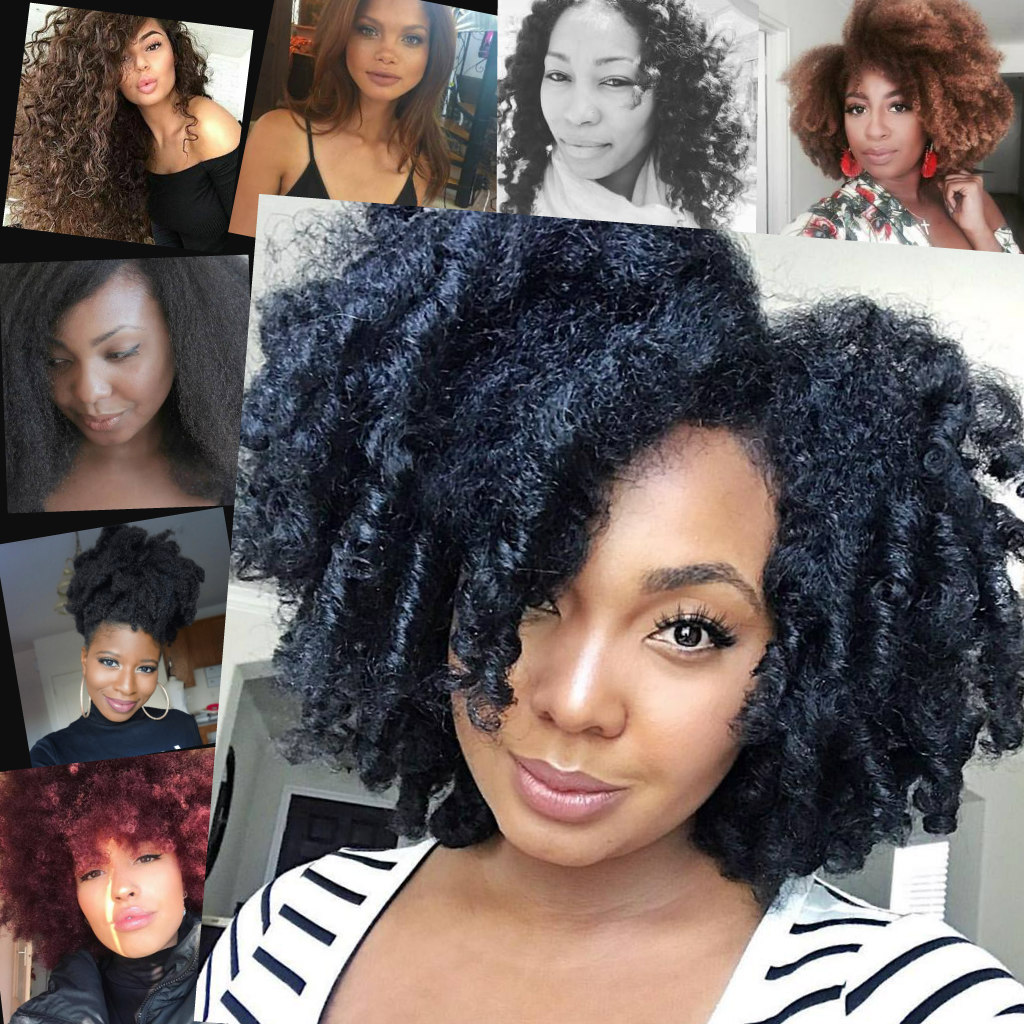
These photographs are the property of their respective owners.
Hair is more than an aesthetic expression; it is an emblem of identity, culture, power, and resistance. In racialized societies, however, the natural hair textures of African-descended peoples have long been devalued and stigmatized. One of the most insidious manifestations of this stigma is texturism—a form of discrimination based on hair texture that prioritizes looser, straighter, or more “manageable” hair over tightly coiled, kinkier hair. Closely linked to hairism, which broadly encompasses prejudice based on hair type and style, texturism reflects internalized racism and the lingering colonial legacies that shape beauty standards globally. This essay explores the roots, meanings, and consequences of texturism and hairism, tracing their origins through enslavement, Eurocentric aesthetics, and media representation, while also examining pathways toward hair acceptance and reclamation.
Defining Texturism and Hairism
Texturism is the preferential treatment of individuals with loosely curled or straight hair textures over those with tightly coiled or kinky hair. The term was coined by natural hair advocate Chassity Jones in the early 2010s, though the concept existed long before. Hairism, a broader term, refers to discrimination based on hair—whether through texture, length, or perceived neatness. Both terms expose a hierarchy that privileges proximity to Eurocentric beauty ideals, reflecting deeply entrenched social and racial structures.
Historically, hairism and texturism are legacies of colonialism and slavery. Enslaved Africans in the Americas were mocked and punished for their hair, which was seen as wild, untamed, or inferior to the smooth, straight hair of Europeans. Over time, this bias became internalized within Black communities, creating harmful classifications like “good hair” (straight or loosely curled) and “bad hair” (kinky or tightly coiled). These distinctions perpetuated social divisions, reinforcing white supremacist ideologies under the guise of grooming and professionalism.
Hair Texture Types and Their Racial Associations
Hair texture is commonly categorized using the Andre Walker Hair Typing System, developed by Oprah Winfrey’s stylist in the 1990s. It breaks down hair types into four major categories:
Type 1: Straight hair (most commonly found among East Asians and Europeans).
Type 2: Wavy hair
2A-2C: Light waves to coarse, frizzy waves (found in some Latinx, Middle Eastern, and European populations).
Type 3: Curly hair
3A-3C: Loose, springy curls to tight corkscrews (common among mixed-race individuals and some Black and Latinx people).
Type 4: Coily or kinky hair
4A-4C: Soft, tight coils to densely packed Z-shaped kinks (predominantly found in people of African descent).
Type 4 hair, particularly 4B and 4C, is often mislabeled as “nappy,” “unkempt,” or “unprofessional,” despite its remarkable versatility and strength. This classification system, while useful in describing curl patterns, has also unintentionally contributed to a hierarchy in which looser curls are perceived as more attractive and acceptable than tighter coils.
“Good Hair” vs. “Bad Hair”: Origins and Impact
The phrase “good hair” emerged during the antebellum era in the United States, when lighter-skinned enslaved people with straighter hair—often the children of white slave owners—were granted preferential treatment. “Good hair” was hair that mimicked the European aesthetic: straight, smooth, and easily tamed. Conversely, “bad hair” referred to the coarser, kinkier textures of African people, which were labeled undesirable.
The legacy of these terms endures today. Black children still experience discrimination in schools for wearing their natural hair. Black professionals are pressured to straighten their hair or wear wigs and weaves to conform to Eurocentric corporate standards. The CROWN Act (Creating a Respectful and Open World for Natural Hair), first passed in California in 2019, had to be introduced precisely because hair-based discrimination remains legal in many parts of the U.S.
“I had to learn that my hair is not the problem—the world’s refusal to see my beauty is.” —Lupita Nyong’o
“Our hair is political, spiritual, historical, and beautiful. It tells the story of who we are.” —Dr. Yaba Blay
These quotes reflect a growing cultural movement toward reclaiming natural hair and affirming Black identity on its own terms, rather than through the gaze of whiteness.
The Origins of the Term “Nappy”
The term “nappy” is believed to have originated during slavery, used derogatorily to describe the tightly coiled hair of Africans, likening it to the coarse texture of cotton or the naps in sheep’s wool. Its use was designed to dehumanize and shame enslaved Africans, stripping their hair—and by extension, their identity—of any value or beauty. While some have sought to reclaim “nappy” as a term of empowerment, its historical weight continues to stir deep emotions and debate within Black communities.
Kinky Hair / Tightly Coiled Hair
Kinky or coily hair refers to hair textures that form tight curls or zig-zag patterns, often classified as Type 4. This hair type is rich in cultural and genetic heritage, yet is frequently misunderstood. Contrary to myths of unmanageability, kinky hair is incredibly versatile and can be styled in braids, locs, afros, twists, and bantu knots. However, due to its tendency to shrink and its fragility, it requires specific care and moisture retention.
Why is this hair type stigmatized? The answer lies in colonial aesthetics: beauty standards were built around whiteness. Kinky hair was demonized as evidence of racial inferiority and disorder—ideas perpetuated by pseudo-scientific racism. As a result, even within Black communities, looser curls or silkier textures have been idealized, creating a painful hierarchy of desirability.
Why Do Some Black People Struggle to Love Their Hair?
Centuries of anti-Blackness have conditioned many Black individuals to see their natural hair as burdensome or ugly. The media, education, and even family dynamics have reinforced these messages. Hair relaxers, hot combs, and weaves became tools of survival—ways to assimilate and escape ridicule. These practices, while empowering for some, also reflect a historical pressure to conform.
This struggle is not due to self-hate in isolation but to systemic programming. As author Chimamanda Ngozi Adichie once said:
“The problem with stereotypes is not that they are untrue, but that they are incomplete. They make one story become the only story.”
The dominant story about Black hair has been one of shame. It is time to replace that narrative with one of pride, knowledge, and celebration.
Toward Hair Liberation: Learning to Appreciate All Hair
Appreciating all hair types begins with education, representation, and liberation from Eurocentric norms. Schools and workplaces must eliminate discriminatory policies and embrace cultural diversity. Media outlets should highlight a broader spectrum of beauty. Families must unlearn generational biases and uplift natural beauty from early childhood.
Hair appreciation means understanding that no one texture is inherently better than another. Each type has unique needs, characteristics, and histories. Straight hair is not superior—just different. Looser curls are not more professional—just more familiar to a colonized eye.
When we affirm all hair textures, we affirm the humanity, dignity, and worth of all people.
Conclusion
Texturism and hairism are not simply issues of personal preference—they are extensions of colonial legacies, white supremacy, and internalized racism. They operate through language, beauty standards, school policies, and job opportunities, creating tiers of acceptance based on proximity to whiteness. But within this struggle lies opportunity: to reclaim, redefine, and rejoice in the beauty of all textures. Black hair is not “bad hair”; it is cultural memory made visible, it is resistance in every coil, it is ancestral glory written in strands. The journey to dismantle texturism begins not with hair products, but with truth—and with a collective commitment to healing.
References
Blay, Y. (2021). One Drop: Shifting the Lens on Race. Beacon Press.
Byrd, A. D., & Tharps, L. L. (2014). Hair Story: Untangling the Roots of Black Hair in America (Revised Edition). St. Martin’s Press.
Craig, M. L. (2002). Ain’t I a Beauty Queen? Black Women, Beauty, and the Politics of Race. Oxford University Press.
Hunter, M. (2011). Buying racial capital: Skin-bleaching and cosmetic surgery in a globalized world. The Journal of Pan African Studies, 4(4), 142–164.
Opie, T. (2019). The CROWN Act and the fight against hair discrimination. Harvard Business Review. Retrieved from https://hbr.org
Our hair stands in awe of the Most High, the creator of all creation. The sunbeams of the golden fleece that raptures our skins (no matter the hue) and the heat crystalize the tones in wooly hair. What a fabulous creation we are.
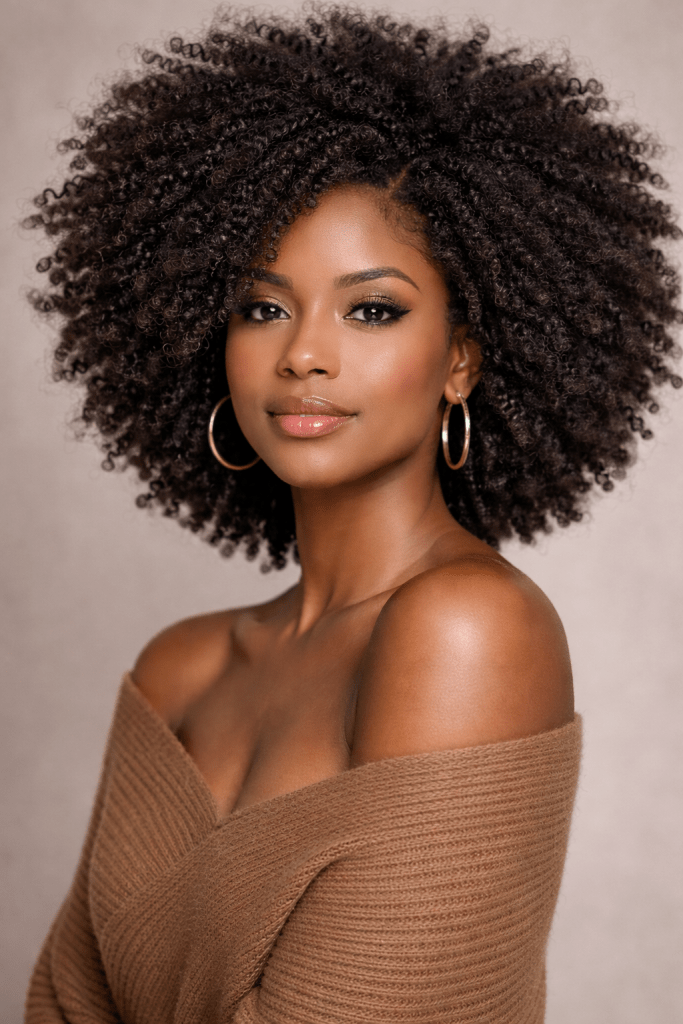
All photographs are the property of their respective owners.
In his book, “The Chemical Key to Black Greatness” American Biochemist, Carol Barnes, described melanin as, “a civilizing chemical that acts as a sedative to help keep the black human calm, relaxed, caring, creative, energetic and civilized.” Research also revealed that melanin enables black skin to actively interact with the sun, to produce Vitamin D from a biochemical substance, 7- dehydrocholesterol. The study also detected that melanin has spiritual dynamics as well as physical since it acts as a sensory ‘receptor’ and ‘transmitter’; communicating with cosmic energy fields in the vast universe converting light energy to sound energy and back. Dr. Richard King, MD, stated that “melanin, by its ability to capture light and hold it in a memory mode, reveals that blackness converts light into knowledge.”
Melanin refines the nervous system in such a way that messages from the brain reach other areas of the body most rapidly in dark people, the primary race. The abundance of melanin in our skin gives us genetic inferiority. We are physically stronger. Mentally sounder. Spiritually more connected.
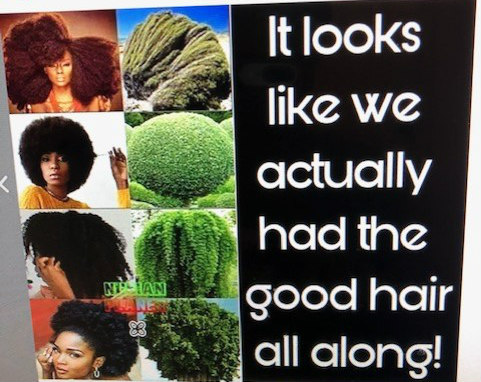
Wooly hair is the tree that points to the heavens.
His head and his hairs were white like wool, as white as snow; and his eyes were as a flame of fire; Revelation 1:14 KJV.
Our roots run long straight to the sky. Wooly hair can withstand heat at high temperatures. ‘Although there are no biochemical differences among black, Caucasian, and Asian hair types, there are differences in the hair morphology (8). Black hair appears elliptical or flattened in cross-section, whereas Caucasian hair is oval, and Asian hair is round. The follicle of black hair is curved, in contrast to a straight follicle in Caucasians and Asians.’ – Callender, V. D., McMichael, A. J. and Cohen, G. F. (2004), Medical and surgical therapies for alopecias in black women. Dermatologic Therapy, 17: 164–176. doi:10.1111/j.1396-0296.2004.04017.x
Khumalo NP, Doe PT, Dawber PR, Ferguson DJP.What is healthy black African hair? A light and scanning electron microscopic study. J Am Acad Dermatol 2000: 43:814–820. ‘African hair is curly and frequently exhibits knots ‘However, increased evidence of wearing with some loss of the cuticular pattern was observed towards the tip of the nose in all 3 racial groups most extreme wearing, with complete loss of cuticular structure, was seen toward the tip of the hairs of the Caucasian subject with the most extended hair. However, the hair shafts of the African volunteers did exhibit structural damage with evidence of longitudinal fissures, resulting in the splitting of the hair shafts. The splitting was also associated with knot formation. Longitudinal cracks were not observed in the Caucasian or Asian hairs. It was also found that many of the black African hairs (approximately 40%) were fractured with no attached roots.
‘The African hair shafts were enclosed by a well-preserved cuticle similar to that observed for the other racial groups. ‘The most significant feature was that the majority of the tips of the African hair had fractured ends …Similarly, the basal end also exhibited evidence of breakage in contrast to the Caucasian and Asian samples in which the majority of hairs had attached roots.’
‘From these observations, it could be proposed that any procedure that reduces knotting of hair and/or the need for combing would result in an increase in the length of the hair by reducing the incidence of breaks in the hair shafts.’
Konishi, S., (2008). Tied in rolled knots and powdered with ochre’: Aboriginal hair and eighteenth-century cross-cultural encounters. Borderlands, 7(2), 1-20. Through the influential work of the great taxonomer, Carolus Linnaeus,… Homo europaeus ‘yellow, brown, flowing’, Homo asiaticus ‘abundant black,’ and Homo after ‘black, frizzled’ (cited in Rosenthal, 2004: 2).
This eighteenth-century definition and conceptualization of African hair as ‘woolly’ intersected with slavery discourses that dehumanized the African body to justify its abject treatment. The Oxford English Dictionary indicates that this derogatory term signifying ‘the short, tightly-curled hair of Negroid peoples’ was first used in a runaway slave advertisement in 1697. This type of hair was also ascribed to sexual connotations, according to Allan Peterkin, ‘frizzy’ hair was seen as ‘demonic, licentious, and public.’
… ‘Negro’ possessed ‘wool instead of hair,’ and this difference, in concert with others concerning skin and facial features, suggested that they ‘appear to constitute a new species of man’ (in Diderot and d’Alembert, 1765, v. 11: 76). uaresma, M. V., Martinez Velasco, M. A., & Tosti, A. (2015). Hair Breakage in Patients of African Descent: Role of Dermoscopy. Skin Appendage Disorders, 1(2), 99–104. http://doi.org/10.1159/000436981
In addition to these properties, the water content in African descent hair is slightly lower than in Caucasian hair, and the sebaceous glands often secrete a small amount of sebum, which has an uneven distribution along the shaft due to its spiral shape, leaving the hair with a dry appearance. M [17,20]
When we associate the term “Mixed Race Hair” we get a visual that it is wild, unruly, hard-to-tame hair. The curly, wavy, coiled, or full-bodied curls, are mostly the combination of different genetic factors that contribute to the texture of feel, the length, the volume, and the plethora of different hair textures. the truth is mixed race hair has more ortho-cortical cells which make it less prone to breakage and damage than finely coiled hair from the scalp. However, the bottom strands are closer to the coily nature of an afro.
Mixed hair, curly or wavy is often referred to as “Good Hair,” All hair is good hair, it all was created by the Most High.
The great phenomenon of wooly hair, the spiral-shaped, tightly coiled, excessive curly mass that tends to hold its shape and grows as a tree straight up on the head. Who are the recipients of such hair? The E1B1A gene carriers – the descendants are the biologically related ancestors far beyond the African diaspora. This is one topic that science has been perplexed by the origin of wooly hair. Geneticists will often say, “The genetic determinants of hair texture in humans are largely not found by science.” It’s either pleiotropic, and selection was for its research fails in comparison to the impact of genetically putting a stamp on its true origin. What genes of phenotypes put together have created such hair type? What is clear is that wooly hair has been passed down from Adam to each generation after his existence.
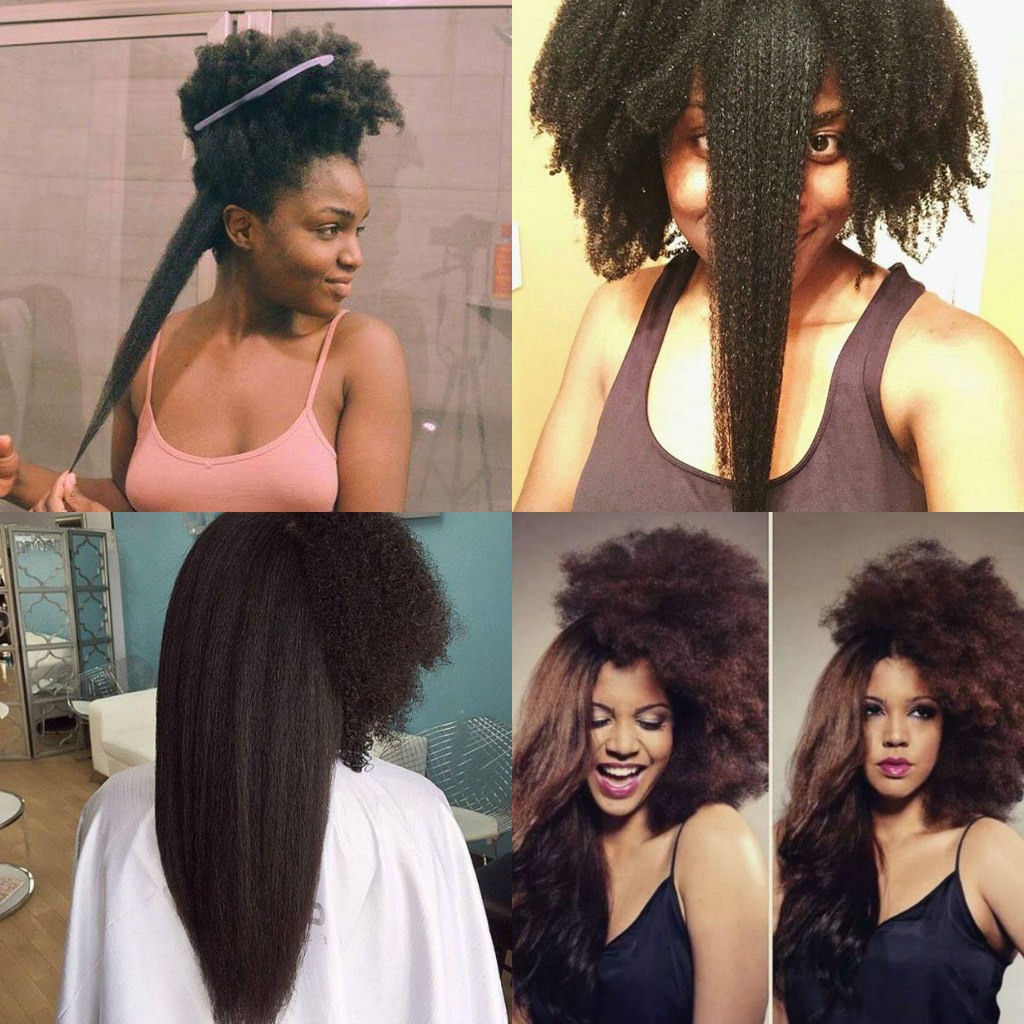
Most black women testify that perms, pressing combs, and relaxers make their hair more manageable. Who is the inventor of the relaxer? In 1877, the relaxer was created by accident by Garrett A. Morgan the same man that invented the traffic signal. This allowed women and men of color to have straight hair like their white counterparts for hundreds of years. The perm was referred to as “ creamy crack” in Chris Rock’s “Good Hair Documentary” A must-see if you haven’t seen it already it exposes the dangers and chemicals found in the hair treatments. Natural Hair is the best it is at its healthiest, free of chemicals and it grows fast! The chemicals in the relaxer treatments may be damaging but many women will argue the fact that having a relaxer has contributed to their back length hair if it is taken care of.
Black hair is a target of “texturism.” The question is, “Why has the world scrutinized our hair?” While we are burning it with chemicals and heating tools, and tearing it out with weaves and glue. For 400 years +, the general population of black people has been imparted to by white people that their hair texture and skin are superior to that of black hair and black skin. This welcomed the birth of a hair obsession. A majority of blacks perceive straight, silky, and soft hair as best. When in fact, wooly hair is scientifically superior to straight hair. Coiled hair acts as antennae conducting the electromagnetic energies of the sun. These are the benefits that our ancestors had in the cotton fields in intense heat. Kinky, afros, nappy, curly, pressed, permed, weaves, or smooth flow? What is our obsession with hair, and how does it affect our perceptions of what is considered attractive? This differentiation of various textures of hair that disregards our hair as being good sociological programming still continues today.
For as long as I remember people often asked me after examining my mid-back length hair, “Is all that hair yours?” or “Do you have Indian in your family?“ In the literal sense of logic or even common sense what they are saying to me is that a black female can’t have long hair unless she is mixed with something. Now, this thought process was first initiated by Willie Lynch back in slavery times and is still relevant today. So the term “Nappy” was created by the white man and was adopted for centuries by black people, but in reality, our hair has a helix (spiral) pattern. It’s the same pattern as whirlwinds and sound waves and DNA. Our hair is meant to grow outward like a tree, not downward like a cascading waterfall. When our hair is given proper care, it’s fluffy and soft. Not only that, our hair is high-volume, high-definition. Our hair doesn’t hang down, it’s not limp, lifeless, and flat, it never lacks volume, and you’ll never see a sister wearing a “bump-it” to get the illusion of voluminous hair. We don’t need it. We can take our wool from kinky to curly to wavy to straight and back to kinky again if that’s our desire. Our hair can even defy gravity and do so naturally. Others can’t. Our hair is a glorious crown, the “original” crown. Look how a head is designed! So, when you see these so-called European royalty women wearing a top. They are imitating the beauty of our hair! Wow isn’t that amazing! For black women, the straight hair bias is the culprit of texture prejudice that privileges the white woman’s texture as the supreme texture of hair. Black women are not aware that our hair is rich with soil, the color of dark chocolate rises to the sky, vastness as space, coiled to perfection, and a mystery of the Most High.
I must admit I love running my fingers through my hair while showering, the curls embrace my face as the water runs the length of my back. I get attention on the comeliness of my hair they suggest that it’s a prized possession but in reality, to my nation, it’s a god. Yes, it is possible to worship hair, I have never been guilty of such worship.. frankly, I always had long hair. It was never a concern of mine. But for many of my sisters, it is, after all, it’s our crowning glory. Black women have always been guilty of false glory due to the fact that you are adorning your head with someone else’s glory. How do we get our own glory? By nourishing our own glory and owning it. I know we own our cars, clothes, or even homes but we must own our hair. We must be thankful and take care of what the Most High gave us.
My interview with Khalifa Musical, a professor of African American Studies
Q. Do you think that as children we are programmed to say that our hair is bad?
Khalifa: Yes, I remember my mother said to my sister about her kinky hair, you need to get your hair done by that she meant to straighten it with perms of straightening combs. As a man, I grow up conditioned to perceive black hair as something terrible that needed to be fixed. I used to look at the women on the commercial and think that was beauty, it was not until I because a student of consciousness that I realize my thinking was wrong. In fact with most of my students, when asked about black hair – 43% (over 200 black male students) said they prepared black women with their natural hair, apart from wigs, weaves, and perms. While 57 % preferred the look of Caucasian straight hair as most attractive and 90% voted that this was conditioned by slavery misconceptions and fallacies about our hair.
Redefining the standard of beauty in terms of hair.
The hair texture closely associated with European straight hair is considered almost heavenly good and esteemed most attractive. This straight hair blows in the wind, cascading down the back, smooth to the touch, and easy to comb. Is this perfection? How can this hair be the best? Willie Lynch is to blame for this one dividing and conquering the slaves based on hair texture. But who says this is true? The fault lies with the mother who never taught the daughter the beauty of her hair. The world has brought into this lie, pure and simple for some, there is no turning back from this theory. In West Africa, Nigeria to be specific the boys and young girls cut their hair off not to deal with the texture and opt to wear wigs. While in the United States, black women are literally tearing their hair out of their heads through the wearing of the weave so they can slang it back and forth. The ignorance of our people is undoubtedly devastating to know that something that was created with sheer brilliance is a beast of burden to many.
How to take care of black hair?
My Q & A with my hairdresser Diana, note she has natural hair all the way down her back.
Q: What do you think about this Good hair, Bad hair situation among black people?
Diane: I think black people are some of the most ignorant people on earth, surely they have bought into the lie of slavery. All hair is good, if it grows out of your head, it is good. What has ruined our noses is the perms and the weaves.
Q: What are some tips for the maintenance and growth of natural hair?
Diane:
1. There is a huge misconception that black hair is coarse, strong, and can take a beating. That is true, in fact, black hair is the most fragile of every hair type, my Asian clients have the strongest hair very coarse now their hair can take a beating.
2. Co-washes your hair once a week with a natural moisturizing conditioner and not shampoo because it dries out the hair which can cause breakage.
3. Keep your hair moisturized with a natural moisturizer and seal the ends with olive oil. Choose natural organic products and try to avoid products with mineral oils and petroleum oil. Natural oils like almond, coconut oil, olive oil, grape seed oil, and jojoba oils are much better.
4. If you use heat styling products (blow dryers, Flatirons) on your hair, try and cut it down to 1-2 times a month if you can, and make sure you use a heat protection shampoo and/or moisturizer, or a good heat protective serum/spray on your hair before flat ironing or curling.
5. Make sure you sleep on a satin pillowcase or tie your hair up in a silk scarf so your hair can stay healthy and won’t break or tear. Silk or satin pillowcases, bonnets, and scarves will protect your hair from breakage while rubbing against certain fabrics that cause breakage.
6. Moisturize your ends nightly with coconut oil before you go to sleep
7. Once a month only use a protein treatment for deep conditioning.
8. To extend hair growth I recommend a diet of fresh fruits and vegetables and exercised weekly to get the blood flowing to your hair.
9. Massage your scalp a few times a week for extra blood flow for hair growth.
10. Use a wide tooth comb to comb your hair, stop buying bristle brushes or thin combs which will get caught in your hair and snap it off. Go for low maintenance. We should never comb our hair every day just detangle it with your fingers, after applying moisturizer.
Unfortunately, that is the gospel that most black or brown women preach. The truth is that if you keep all the weaves and chemicals off your hair, it will grow with some easy maintenance, it will grow in no time. A black woman’s hair will grow if she maintains to keep it healthy and nourished with the right natural products, contrary to popular belief, the black woman is not alone, there are some cases where the white woman’s hair won’t grow either, or it’s fragile — Diane (my hairdresser)
The Curse
Moreover the LORD saith, Because the daughters of Zion are haughty, and walk with stretched forth necks and wanton eyes, walking and mincing as they go, and making a tinkling with their feet: Therefore the Lord will smite with a scab the crown of the head of the daughters of Zion, and the LORD will discover their secret parts. — Isaiah 3: 16-17 –
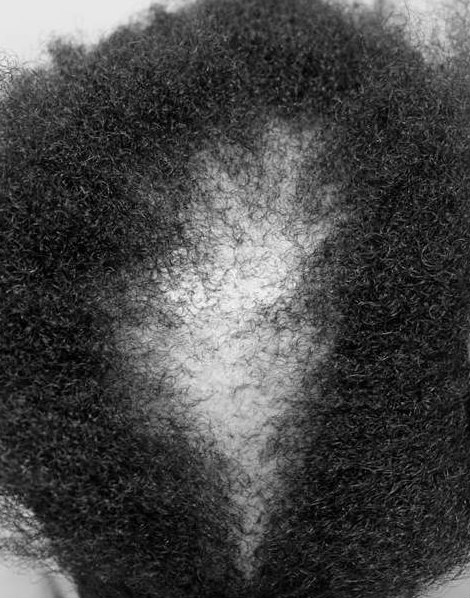
Because of the haughtiness toward our men, our head was smitten with baldness, which would explain the lust for long hair. We had the beauty everyone wanted at that time. We are the Daughters of Zion. That was a curse! Now today… I believe that curse is lifted… With all the beautiful hair treatments, perms, hair styling, relaxers, weaves, chemicals from shampoos, our diet, hormones, what we drink, rest, environment, etc. All these elements affect the health of our hair. What is paramount is the way we care for our hair. Is long hair possible? Yes.
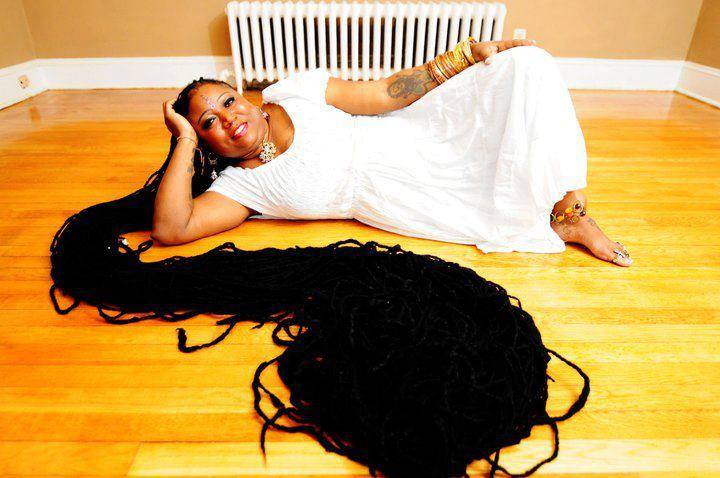
Asha Mandela, who reportedly has the most extended hair, and dreads in the world at a whopping 22 feet long, her extremely long tresses were documented by the Guinness World Record in 2009. Many of us on this day have long hair. Your hair grows! Take care of the hair that grows out of your head. Black women are waking up to their true identity according to the Bible all over the world & learning to love the skin they’re in, wooly hair & all through the natural hair movement and it is absolutely awe-inspiring.
But if a woman has long hair, it is a glory to her: for her hair is given her for a covering.1 Corinthians 11:15 KJV
Black hair is a target of the famous “Ism,” known as “Texturism.” The question is, “Why has the world scrutinized our hair?” While we are burning it with chemicals and heating tools, and tearing it out with weaves and glue. For 400 years +, the general population of black people has been imparted to by white people that their hair texture and skin is superior to that of black hair and black leather. This welcomed the birth of a hair obsession. A majority of blacks perceive straight, silky, and soft hair as best. When in fact, wooly hair is scientifically superior to straight hair. Coiled hair acts as antennae conducting the electromagnetic energies of the sun. These are the benefits that our ancestors had in the cotton fields in intense heat. Kinky, afros, nappy, curly, pressed, permed, weaves, or smooth flow? What is our obsession with hair, and how does it affect our perceptions of what is considered attractive? This differentiation of various textures of hair that disregards our hair as being good sociological programming still continues today.
For as long as I remember people often asked me after examining my mid-back length hair, “Is all that hair yours?” or “Do you have Indian in your family?“ In the literal sense of logic or even common sense what they are saying to me is that a black female can’t have long hair unless she is mixed with something. Now, this thought process was first initiated by Willie Lynch back in slavery times and is still relevant today. So the term “Nappy” was created by the white man and was adopted for centuries by black people, but in reality, our hair has a helix (spiral) pattern. It’s the same pattern as whirlwinds and sound waves and DNA. Our hair is meant to grow outward like a tree, not downward like a cascading waterfall. When our hair is given proper care, it’s fluffy and soft. Not only that, our hair is high-volume, high-definition. Our hair doesn’t hang down, it’s not limp, lifeless, and flat, it never lacks volume, and you’ll never see a sister wearing a “bump-it” to get the illusion of voluminous hair. We don’t need it. We can take our wool from kinky to curly to wavy to straight and back to kinky again if that’s our desire. Our hair can even defy gravity and do so naturally. Others can’t. Our hair is a glorious crown, the “original” crown. Look how a head is designed! So, when you see these so-called European royalty women wearing a top. They are imitating the beauty of our hair! Wow isn’t that amazing! For black women, the straight hair bias is the culprit of texture prejudice that privileges the white woman’s texture as the supreme texture of hair. Black women are not aware that our hair is rich with soil, the color of dark chocolate rises to the sky, vast as space, coiled to perfection, and a mystery of the Most High.
My interview with Khalifa Musfai, a professor of African American Studies
Q. Do you think that as children we are programmed to say that our hair is bad?
Khalifa: Yes, I remember my mother said to my sister about her kinky hair, you need to get your hair done by that she meant to straighten it with perms of straightening combs. As a man, I grow up conditioned to perceive black hair as something terrible that needed to be fixed. I used to look at the women on the commercial and think that was beauty, it was not until I because a student of consciousness that I realize my thinking was wrong. In fact with most of my students, when asked about black hair – 43% (over 200 black male students) said they prepared black women with their natural hair, apart from wigs, weaves, and perms. While 57 % preferred the look of Caucasian straight hair as most attractive and 90% voted that this was conditioned by slavery misconceptions and fallacies about our hair.
Redefining the standard of beauty in terms of hair.
I must admit I love running my fingers through my hair while showering, the curls embrace my face as the water runs the length of my back. I get attention on the comeliness of my hair they suggest that it’s a prized possession, but in reality, to my nation, it’s a god. Yes, it is possible to worship hair, I have never been guilty of such worship.. frankly, I always had long hair. It was never a concern of mine. But for many of my sisters, it is, after all, it’s our crowning glory. Black women have always been guilty of false glory because they are adorning their heads with someone else’s beauty. How do we get our own vision? By nourishing our own glory and owning it. I know we own our cars, clothes, or even homes but we must hold our hair. We must be thankful and take care of what the Most High gave us. The hair texture closely associated with European straight hair is considered almost heavenly good and esteemed most attractive. This straight hair blows in the wind, cascading down the back, smooth to the touch, and easy to comb.
Is this perfection? How can this hair be the best? Willie Lynch is to blame for this one dividing and conquering the slaves based on hair texture. But who says this is true? The fault lies with the mother who never taught the daughter the beauty of her hair. The world has brought into this lie, pure and simple for some, there is no turning back from this theory. In West Africa, Nigeria to be specific the boys and young girls cut their hair off not to deal with the texture and opt to wear wigs. While in the United States, black women are literally tearing their hair out of their heads through the wearing of the weave so they can slang it back and forth. The ignorance of our people is undoubtedly devastating to know that something that was created with sheer brilliance is a beast of pardon to many.
My conversation with a random woman I encountered at a boutique.
Woman: Girl you got some excellent hair —
Me: All hair is good. Woman: I wish my hair were long and pretty like yours. You’re so cute.
Me: Your hair is pretty.
Woman: But not like yours
Me: You know that is a fallacy created by our people that goes back to slavery. There is no right or bad hair. The Most High created all hair and it’s good hair. (That comment left her speechless and puzzled there was no reply)
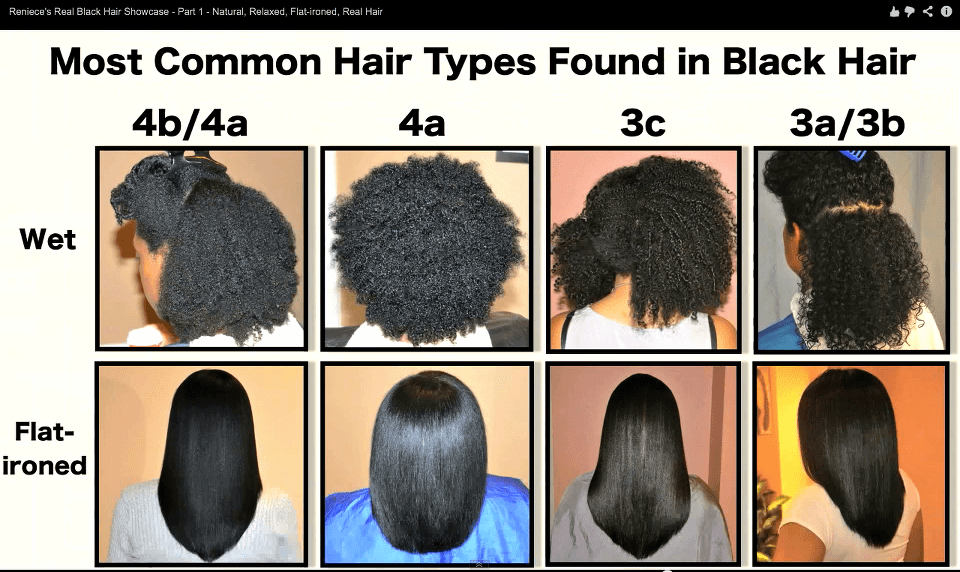
The contemptuous terms such as ‘good hair’ or ‘bad hair’ came out of the era of slavery, during the Willie Lynch period. Where slaves were put into groups according to the lightness of skin and hair textures the closer your hair was to Caucasian hair the better you were perceived which meant you would be considered “a house negro” and receive preferential treatment than the darker slaves. Our hair is our crowning glory; there are various textures of hair that black people have due to genetics and racial mixing. These textures vary from 3A to 4D, beautiful to tightly curled.
3 a – fine curl pattern
3 b – medium curl pattern
3 c – loose curly pattern
4a – thicker curly pattern
4b – thicker medium pattern
4c – medium curly pattern
4d – excessively tighter curls
COMMON THINGS SPOKEN ABOUT HAIR TYPE 3A – 4C:
Coily Hair
You need to straighten it, unkept! Do something with your hair. It is nappy, you look ugly, and you need a weave, go and rectify it. I like you better with straight hair.
Permed Hair
If you don’t love yourself, go natural! Trying to be something you are not.
Curly Hair
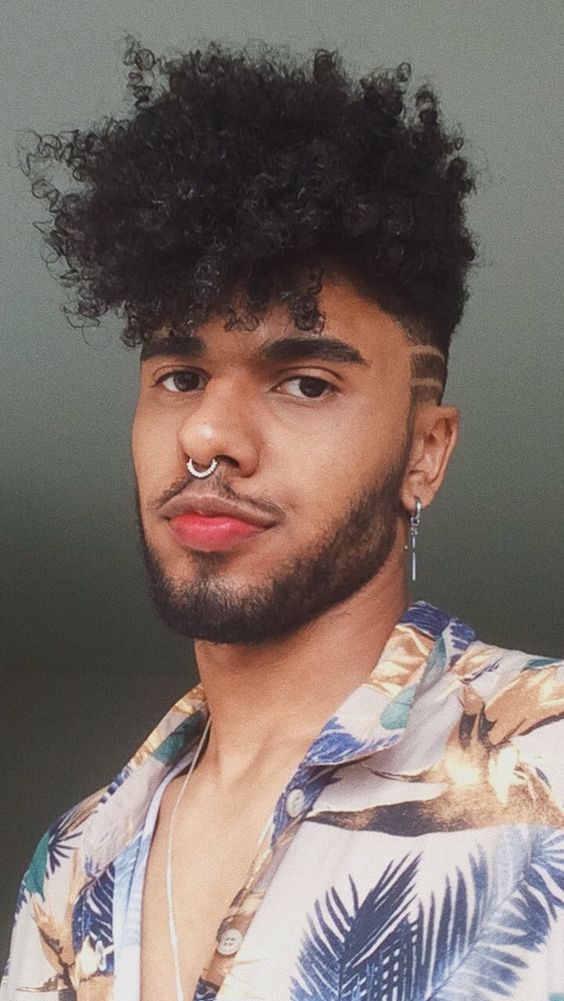
You have some good hair. It is too wild and needs to be straight. What are you mixed with?
Straight Hair
Ideal with the masses, the universal standard of hair beauty.
Facts about black hair:
It keeps you cool and protects you from the sun.
Our hair is our crowning glory; there are many textures of hair that black people have due to genetics and interracial rations.
There is more money spent on hair care around the world than products to actually make the hair grow.
There is no such thing as bad hair, the strains of our hair were created by the Most High, and trust me, he knew what He was doing in creation but through colonization and the media which suggests that long bone straight flowing hair is most attractive.
We as people have bought into that “Lie” Yes I said it, that lie because that is what it is. You have been brainwashed into thinking that excessively curly or wooly hair isn’t as good as straight hair.
The Savior of this world has wooly hair.
My nation is so ignorant, of how they talk about their hair. All hair is good. Embrace your wool.
I was taught I had terrible hair, so I relaxed it and added weave now I am bald-headed — Brittany (a 31-year-old black woman)
I wish my parents would have taught me that my hair wasn’t bad — Erica Wilson (18-year-old female)
There is nothing better than a black woman that wears her natural hair — Jonathan (white male married to a black woman)
Often people ask me if my hair is real because it’s thick and long.
Male Store clerk: Is all that hair yours?
Me: Yes
Male Store clerk: Can I touch it?
Today in 2018, I walk proudly with my hair covered sometimes, it gives the mystery of what is underneath. Is it short or is it long? In late 18th century Louisiana, black women were ordered to cover their hair in public. This system was called the “Bando du Buen Gobierno,” “Edict for Good Government.” These rules were meant to change certain so-called “unacceptable” behaviors of free black women. specifically overly ostentatious hairstyles,(designed to impress or attract notice) which drew the attention of white men, and the jealousy of white women. These rules are called the “Tignon Laws” A tignon (pronounced “yon”) is a headdress. They are still doing this today! Where a lot of people go on interviews and are turned away because of their natural hair, The employers say they must straighten their hair. But finally, we are waking back up to our beauty! They even fear our hair!
When wearing a weave or perming your hair, you are playing roulette with your hair, please handle it with care. — Diane (my hairdresser)
ALL HAIR IS GOOD!
LITTLE GIRL IN THE STORE: Look at her hair Mom. LITTLE GIRL’S MOM: That is a weave. ME: No, it’s my hair.
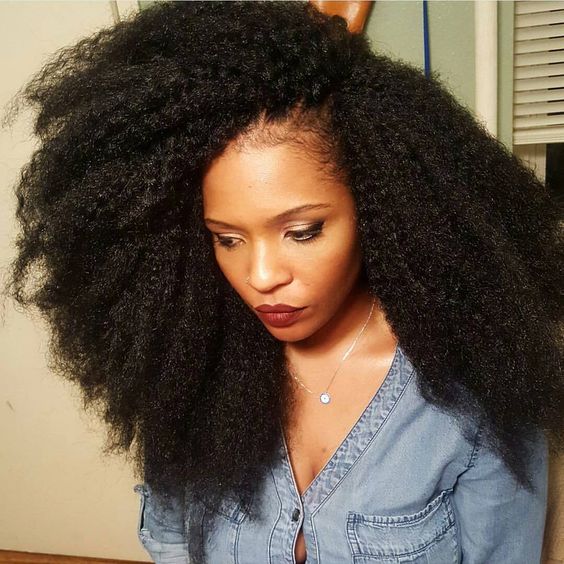
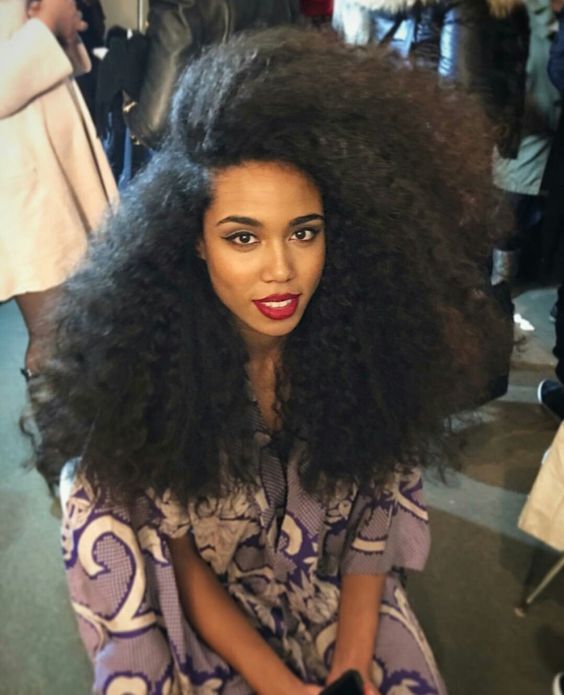
It is a mere fact that we women that have long natural hair like me that grow out of our heads, always manage to get a hater or naysayers that believe that our hair is not real. In a society with all the fakers, weave wearers, and wig junkies it makes it hard for those of us that like to keep it real. It is also true that we were conditioned through slavery to hate ourselves and the texture of our hair so we commit our scalps to abusive chemicals and hair that did not grow from our scalp. The truth of the matter is that all hair is good, the creator of all made it. This hate is correlated with the term “Texturism.”
Good Hair (we have it.)
Reference: The Brown Girl Dilemma Book, 2017
Where faith, history, and truth illuminate the Black experience.


 THE BROWN GIRL DILEMMA