
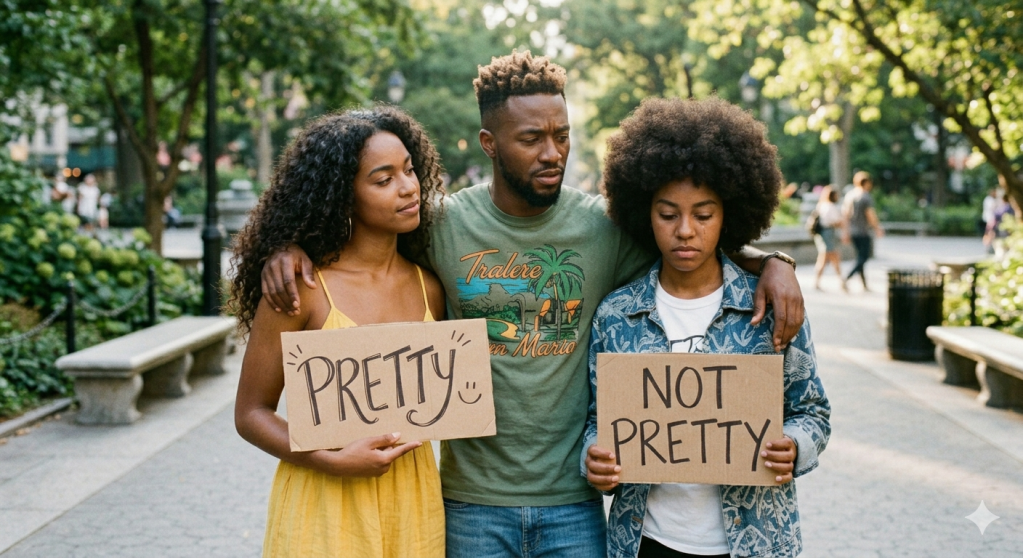
Colorism is not merely an external system of bias—it is an internalized framework that conditions individuals to constantly measure themselves and others against a hierarchy of skin tone. “Conditioned to compare” reflects a learned behavior, one shaped by generations of socialization, media influence, and historical oppression.
From early childhood, individuals are subtly taught to associate lighter skin with beauty, goodness, and success, while darker skin is often unfairly linked to negativity or inferiority. These associations are reinforced through family dynamics, peer interactions, and institutional messaging (Hunter, 2007).
This conditioning is deeply rooted in colonial history, where European standards of beauty and worth were imposed on colonized populations. Over time, these standards became normalized, embedding themselves into the cultural psyche and influencing how individuals perceive themselves and others.
Within the Black community, this has created a complex and often painful dynamic where individuals are not only judged by external groups but also within their own communities. Comparisons based on skin tone can affect friendships, relationships, and social standing.
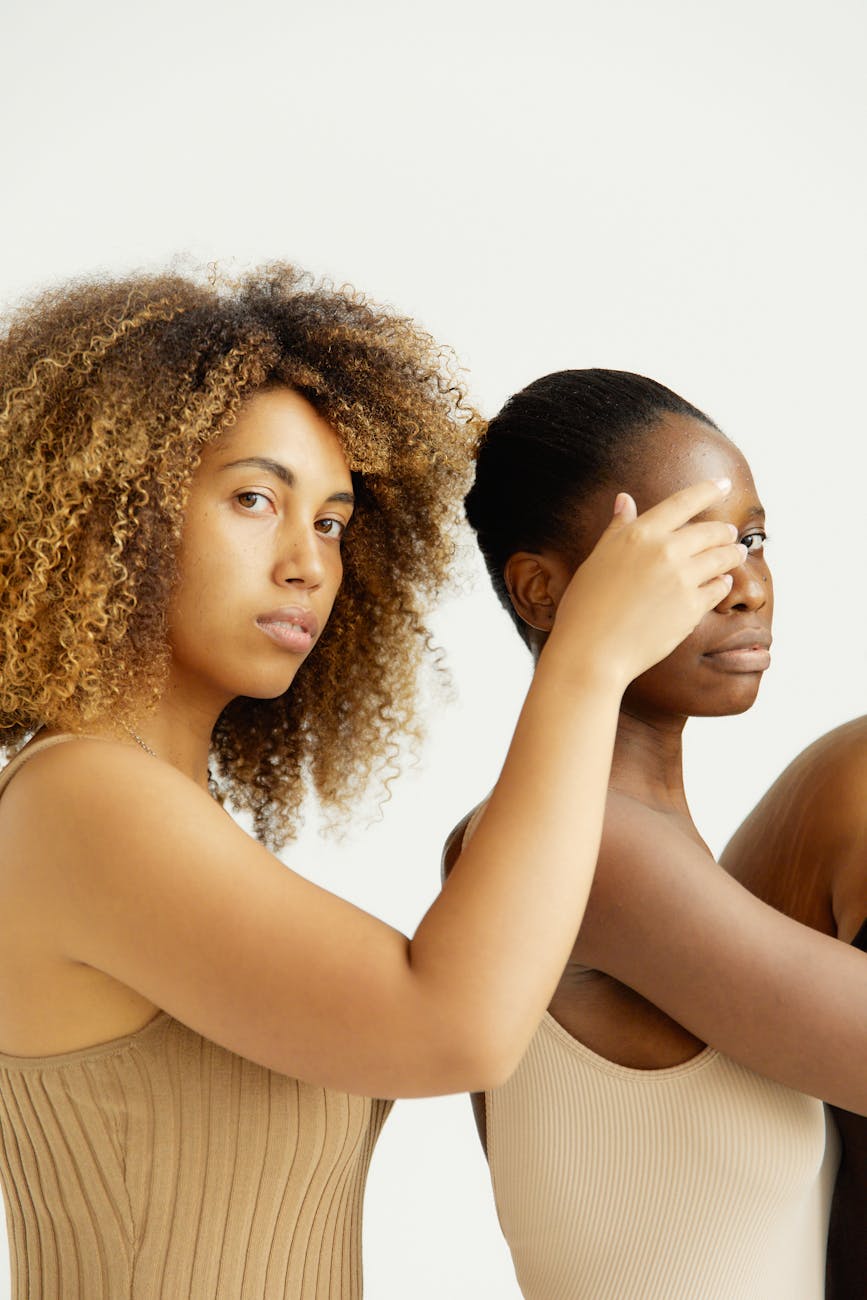
The media plays a significant role in reinforcing these comparisons. Lighter-skinned individuals are often overrepresented in film, television, and advertising, creating a narrow standard of beauty that excludes a wide range of natural diversity.
Public figures such as Lupita Nyong’o have spoken candidly about overcoming internalized colorism, sharing how societal messages once made them question their own beauty. Her journey highlights the psychological impact of constant comparison.
Similarly, Viola Davis has addressed the limited roles available to darker-skinned women and the implicit comparisons that shape casting decisions, emphasizing the systemic nature of these biases.
The concept of social comparison theory helps explain this phenomenon. Proposed by Leon Festinger, this theory posits that individuals determine their self-worth by comparing themselves to others, making them particularly vulnerable to societal hierarchies such as colorism (Festinger, 1954).
When these comparisons are based on skin tone, they can lead to internalized inferiority among darker-skinned individuals and a false sense of superiority among lighter-skinned individuals. Both outcomes are harmful, perpetuating division and inequality.
Family environments can unintentionally reinforce these comparisons. Comments about complexion, preferences for lighter-skinned children, or even seemingly harmless jokes can leave lasting impressions that shape self-perception (Thompson & Keith, 2001).
In educational settings, colorism can influence teacher expectations and peer interactions, further embedding comparative thinking. Students may internalize these biases, which can affect their confidence and academic performance.
Romantic relationships are another domain where comparison is prevalent. Studies suggest that lighter-skinned individuals are often perceived as more desirable, reinforcing the idea that love and acceptance are tied to complexion (Banks, 2000).
Economically, the effects of being conditioned to compare are also evident. Lighter-skinned individuals often receive preferential treatment in hiring and promotions, reinforcing the belief that their appearance is inherently more valuable (Goldsmith, Hamilton, & Darity, 2007).
The role of implicit bias is critical in sustaining these patterns. Even individuals who consciously reject colorism may still unconsciously engage in comparative thinking shaped by societal conditioning (Greenwald & Krieger, 2006).
Social media has intensified this phenomenon, providing a constant stream of images that promote specific beauty standards. Filters, editing tools, and curated content often favor lighter complexions, further distorting perceptions of beauty.
The psychological consequences of constant comparison are significant. Individuals may experience anxiety, depression, and low self-esteem as they strive to meet unattainable standards or feel inadequate in comparison to others.
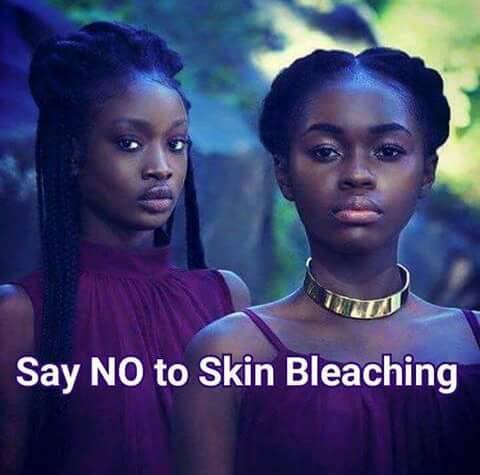
However, there is a growing movement to disrupt this conditioning. Advocacy campaigns, educational initiatives, and cultural shifts are encouraging individuals to reject comparison and embrace self-acceptance.
Representation is key in this transformation. When diverse skin tones are celebrated and normalized in media and leadership, it challenges the hierarchy that fuels comparison and promotes inclusivity.
Faith-based perspectives also offer a powerful counter-narrative, emphasizing that human worth is not determined by outward appearance but by inner character and divine purpose (1 Samuel 16:7, KJV).
Breaking free from the cycle of comparison requires intentional unlearning. It involves recognizing internalized biases, challenging societal norms, and cultivating a sense of self-worth that is independent of external validation.
Ultimately, “Conditioned to Compare” is both a diagnosis and a call to action. By acknowledging the forces that shape our perceptions, individuals and communities can begin to dismantle the harmful hierarchies of colorism and move toward a more unified and equitable future.
References
Banks, I. (2000). Hair matters: Beauty, power, and Black women’s consciousness. New York University Press.
Festinger, L. (1954). A theory of social comparison processes. Human Relations, 7(2), 117–140.
Goldsmith, A. H., Hamilton, D., & Darity, W. (2007). From dark to light: Skin color and wages among African Americans. Journal of Human Resources, 42(4), 701–738.
Greenwald, A. G., & Krieger, L. H. (2006). Implicit bias: Scientific foundations. California Law Review, 94(4), 945–967.
Hunter, M. (2007). The persistent problem of colorism: Skin tone, status, and inequality. Sociology Compass, 1(1), 237–254.
Thompson, M. S., & Keith, V. M. (2001). The blacker the berry: Gender, skin tone, self-esteem, and self-efficacy. Gender & Society, 15(3), 336–357.


 THE BROWN GIRL DILEMMA