
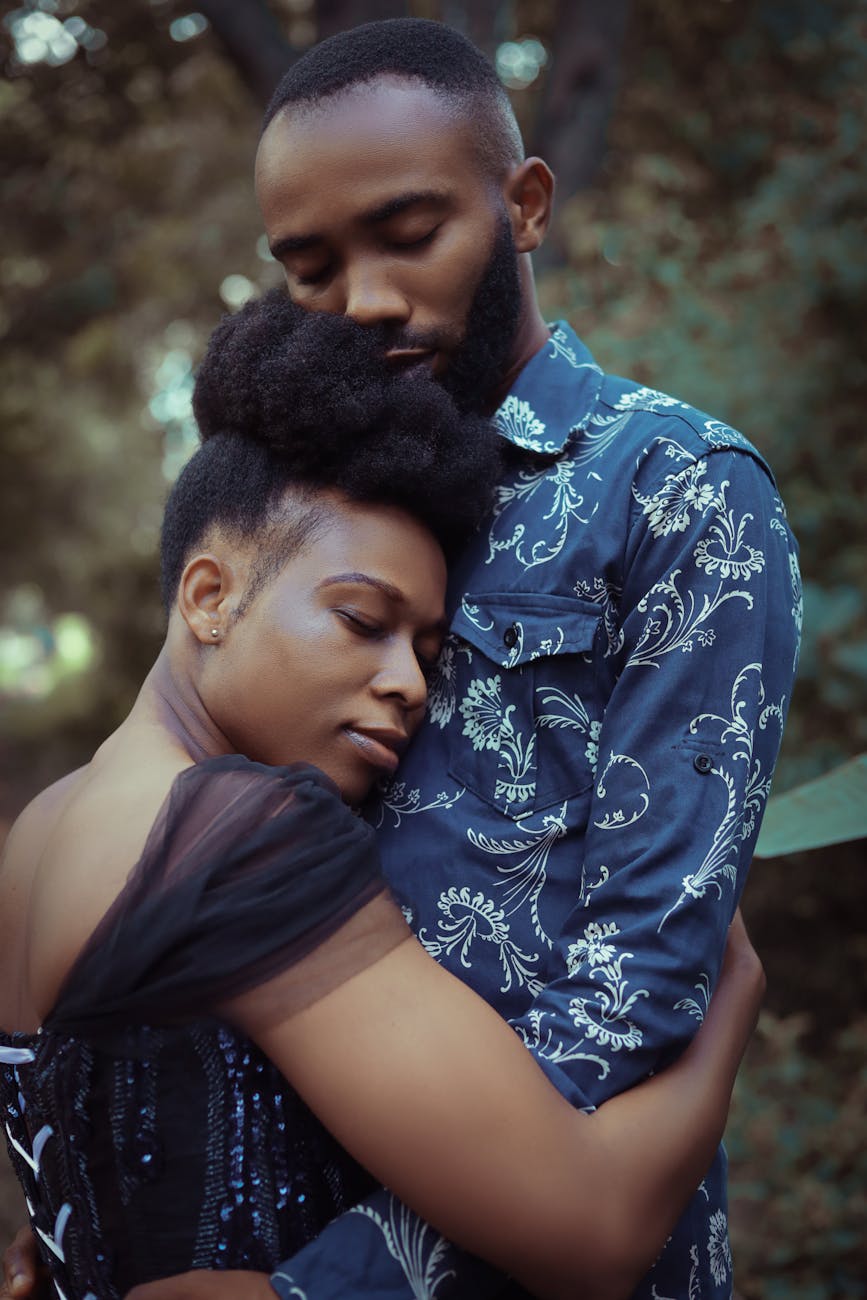
Black love is more than romance—it is revolution. In a world that has systematically tried to dismantle Black families, Black love stands as a testimony of survival and hope. From the plantations where love was forbidden, to the present day where media often distorts images of Black relationships, every Black couple that chooses each other is participating in a radical act of restoration. ✊🏾🤎
Historically, the love between Black men and women has been under attack. Enslavement ripped husbands from wives and sold children away from mothers. Marriage among enslaved Africans was often not legally recognized, leaving couples vulnerable to forced separation (King, 2011). Yet even then, they jumped the broom, exchanged secret vows, and carved out sacred spaces for intimacy despite the chains. This resilience was the earliest chapter of Cocoa & Crown.
After Emancipation, the Black family became a target for Jim Crow laws, systemic poverty, and racial violence. Sociologists note that Black love survived despite mass incarceration, economic deprivation, and social disinvestment (Alexander, 2010). Black couples built churches, schools, and businesses together, proving that their love was both personal and political. 👑🏾
Psychologically, Black love carries intergenerational trauma but also intergenerational strength. Epigenetic research suggests that trauma can leave biological imprints, yet so can resilience (Yehuda et al., 2016). This means Black love is not just about two people—it is about rewriting genetic memory, passing on healing instead of pain.
Gender dynamics complicate this story. Black men have been stereotyped as absentee fathers or hypersexual predators, while Black women have been portrayed as angry, emasculating, or undesirable (Collins, 2000). These harmful narratives create division and distrust, shaping how Black men and women approach love. Cocoa & Crown calls for breaking those stereotypes and rediscovering each other’s humanity.
Spiritually, Black love is a reflection of God’s covenant love. Marriage was designed as a picture of Christ and the Church (Ephesians 5:25–33), meaning that when a Black man loves a Black woman well, it is a sermon to the world about God’s faithfulness. When a Black woman honors and supports her Black man, she reflects the beauty and strength of the Bride of Christ. This is why spiritual warfare often targets Black unions—they carry prophetic power. ✝️🤎
Healing must begin with honest dialogue. Black men must face the wounds they carry from systemic emasculation and the pressures of hypermasculinity. Black women must process the pain of being expected to be “strong” to the point of self-neglect. Together, they must create safe spaces to be vulnerable and rebuild trust. 💬🏾
Forgiveness is a cornerstone of Cocoa & Crown. Many relationships carry scars from betrayal, misunderstanding, and generational baggage. Forgiveness allows couples to move forward rather than remain chained to past hurts (Matthew 18:21–22). Therapy, prayer, and mentorship can all play a role in this healing process.
Economically, Black love thrives when partners support each other’s growth. Couples who build together—saving, investing, and creating generational wealth—turn love into legacy. This is how Cocoa & Crown becomes more than passion; it becomes partnership. 💼👑
Representation matters. Seeing images of Black couples who love each other deeply, publicly, and without apology inspires others to do the same. Television shows like Black Love (OWN) and films like Love Jones and Queen & Slim offer alternative narratives to the toxic stereotypes that flood mainstream media. 🎥🤎
Culturally, Black love is flavored by music, language, and shared struggle. It is the way we dance together at cookouts, the way we grieve together at funerals, the way we pray together during hard times. It is romance rooted in rhythm, tenderness born of trial. 🎶✊🏾
Raising children within Black love is also revolutionary. When sons see their fathers loving their mothers well, they learn what true manhood looks like. When daughters see their mothers respected and cherished, they learn what love they should accept. Strong Black unions become training grounds for future generations of kings and queens. 👑👶🏾
Black love must also transcend competition. Sometimes colonial conditioning pits Black men and women against one another, turning relationships into battlegrounds for power. True love is not about domination but mutual submission (Ephesians 5:21). It is about laying down ego to build something greater than the sum of two individuals.
Ultimately, Cocoa & Crown is a story of restoration. It is a call to honor the beauty, vulnerability, and sacredness of Black love. It is a reminder that despite centuries of attempts to erase it, this love remains. It blooms in protest, prays through pain, and dances in joy. It wears its crown proudly. 👑🤎
The story is still being written. Every time a Black man and woman choose each other, choose forgiveness, choose partnership, they add another chapter. Cocoa & Crown is not just a love story—it is a legacy story. And it is one the world needs to see.
References
- Alexander, M. (2010). The new Jim Crow: Mass incarceration in the age of colorblindness. The New Press.
- Collins, P. H. (2000). Black feminist thought: Knowledge, consciousness, and the politics of empowerment. Routledge.
- King, W. (2011). Stolen childhood: Slave youth in nineteenth-century America. Indiana University Press.
- Yehuda, R., Daskalakis, N. P., Lehrner, A., et al. (2016). Influences of maternal and paternal PTSD on epigenetic regulation of the glucocorticoid receptor gene in Holocaust survivor offspring. American Journal of Psychiatry, 173(8), 856–864.

 THE BROWN GIRL DILEMMA