Tag Archives: lifestyle

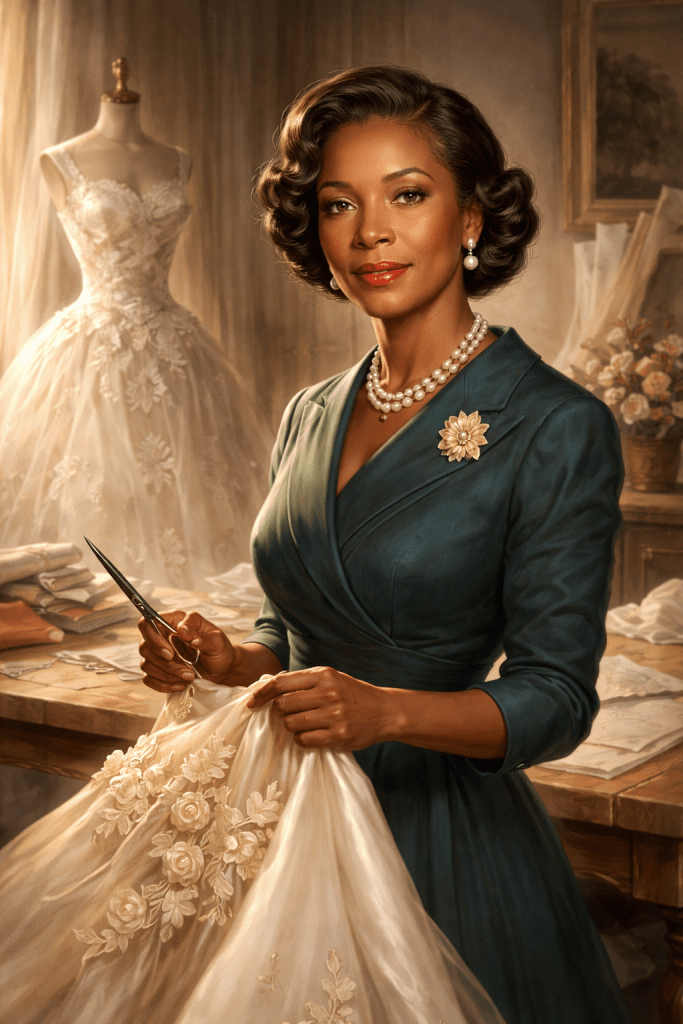
Ann Lowe: The Hidden Architect of Fashion with American Elegance.

Ann Lowe stands as one of the most underrecognized yet profoundly influential figures in American fashion history, a woman whose genius was stitched into some of the most iconic garments of the twentieth century. Born into a lineage shaped by both artistry and oppression, Lowe’s life and career represent a powerful intersection of race, resilience, and refined craftsmanship. Despite working during an era deeply entrenched in racial segregation, she rose to dress some of the most elite women in America, leaving behind a legacy that continues to inspire designers and historians alike.

Born in 1898 in Clayton, Alabama, Ann Lowe was the great-granddaughter of an enslaved seamstress and the daughter of a skilled dressmaker. Her family’s talent for design was cultivated under the harsh conditions of slavery, where Black women were often forced to create garments for wealthy white families. This generational inheritance of skill became Lowe’s foundation, transforming what began as forced labor into a refined art form that would later captivate high society.

Lowe’s early exposure to couture techniques came through her mother and grandmother, who designed elaborate gowns for prominent Southern families. After her mother’s death, Lowe completed an unfinished set of dresses for a governor’s wife at just sixteen years old, astonishing clients with her ability. This moment marked the beginning of her independent career, signaling a rare and extraordinary talent that would defy the limitations imposed on Black women in her time.

Determined to refine her craft, Lowe enrolled in a design school in New York, where she faced segregation even within education. She was separated from her white classmates but excelled beyond expectations, completing her program ahead of schedule. Her perseverance in the face of discrimination highlighted both her resilience and her commitment to excellence.

Lowe eventually established herself in New York City, where she opened her own salon. She became known for her intricate hand-sewn floral appliqués, delicate embroidery, and structured silhouettes that reflected both European couture traditions and her own distinct aesthetic. Her work was often described as ethereal, feminine, and technically masterful.

Among her elite clientele were members of America’s most prominent families, including the Rockefellers and the du Ponts. Yet, despite her high-profile clients, Lowe remained largely uncredited due to the racial dynamics of the era. Many of the women who wore her gowns received public admiration, while Lowe’s name remained hidden behind the seams.

One of the most significant moments in her career came when she was commissioned to design the wedding gown for Jacqueline Bouvier Kennedy, who would later become the wife of John F. Kennedy. This gown would become one of the most iconic bridal dresses in American history.

The dress itself was a masterpiece of ivory silk taffeta, featuring a portrait neckline, fitted bodice, and a voluminous skirt adorned with intricate folds. Lowe also designed the bridesmaids’ dresses, ensuring a cohesive and elegant visual presentation for the entire wedding party. Her attention to detail and commitment to perfection were evident in every stitch.

However, just days before the wedding, a catastrophic flood in Lowe’s studio destroyed the dresses she had painstakingly created. Without informing her client, Lowe worked tirelessly to recreate each garment in time for the ceremony, absorbing the financial loss herself. This act of dedication exemplified her professionalism and unwavering commitment to her craft.

Despite the monumental success of the wedding and the global attention it received, Lowe was not publicly credited at the time. When asked about the designer, Jacqueline Kennedy reportedly described the dress as made by “a colored dressmaker,” reflecting the racial attitudes that obscured Lowe’s recognition.

Lowe’s connection to Jacqueline Kennedy remains one of the most discussed aspects of her legacy, symbolizing both her brilliance and the systemic barriers she faced. It was not until years later that her role in creating the gown was widely acknowledged, allowing her to finally receive the recognition she deserved.

In addition to her work for high society, Lowe also designed dresses for debutantes, particularly for the annual Azalea Ball in Florida. These gowns became a rite of passage for wealthy young women, further cementing her reputation as a designer of elegance and tradition.

Lowe’s designs are now preserved in several prestigious institutions, most notably the Smithsonian Institution, where her work is recognized as a vital part of American cultural and fashion history. Her garments are also held in collections at the Metropolitan Museum of Art, ensuring that her legacy endures for future generations.

Her inclusion in these museums represents a significant shift in how her contributions are valued, transforming her from an overlooked artisan into a celebrated pioneer. These institutions acknowledge not only her technical skill but also the cultural significance of her work as a Black woman navigating a segregated industry.

Lowe’s career was not without hardship. Financial instability plagued her business, partly due to her reluctance to charge her wealthy clients what her work was truly worth. This, combined with systemic racism, limited her financial success despite her immense talent.

Nevertheless, her influence can be seen in the generations of designers who followed. Her emphasis on craftsmanship, detail, and elegance set a standard that continues to resonate within the fashion industry today. She remains a symbol of excellence achieved against overwhelming odds.

Lowe’s story also serves as a lens through which to examine the broader history of Black labor in America. From slavery to the twentieth century, Black artisans have often been the invisible architects of beauty and culture, their contributions minimized or erased. Lowe’s life challenges this narrative, demanding recognition and respect.

Her work embodies a quiet form of resistance, demonstrating that excellence can thrive even in the most restrictive conditions. Through her designs, she asserted her identity and artistry in a society that sought to marginalize both.

Today, Ann Lowe is increasingly celebrated as a trailblazer, a woman who transformed inherited skill into high art. Her story is not just one of fashion but of perseverance, dignity, and the enduring power of creativity.

In reclaiming her legacy, we honor not only Ann Lowe but also the countless unnamed Black women whose talents shaped history from behind the scenes. Her stitches, once hidden, now tell a story of brilliance that can no longer be ignored.

References

Bolton, A. (2016). Jacqueline Kennedy: The White House Years. Metropolitan Museum of Art.

Harris, A. (2018). The Hidden History of American Fashion: Rediscovering Ann Lowe. Fashion Studies Journal, 12(3), 45–62.

Smithsonian Institution. (n.d.). Ann Lowe: American Couturier. National Museum of African American History and Culture.

Vreeland, D. (1965). American Fashion and Its Designers. New York: Harper & Row.

Walker, R. (2020). Threads of Legacy: African American Dressmakers and the Politics of Recognition. Journal of American History, 107(2), 389–412.
Brown Girls Are Not Invisible — They Are Invaluable

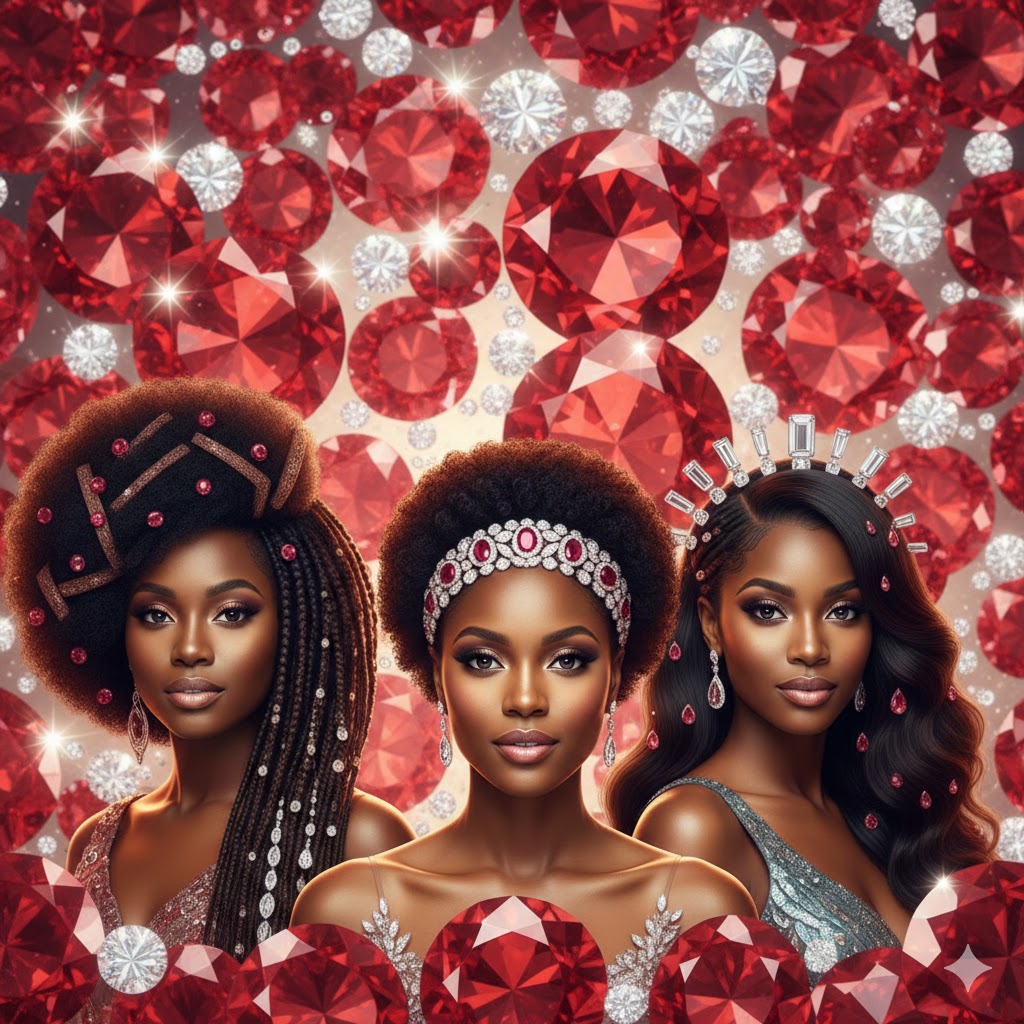
Brown girls have long existed at the intersection of visibility and erasure, seen when convenient yet ignored when their voices disrupt dominant narratives. From classrooms to media, from pulpits to policy, their presence has often been minimized while their labor, creativity, and resilience are consumed. This contradiction has produced a quiet harm, teaching many brown girls that to be valued they must first be validated by systems that were never built with them in mind.

Historically, the devaluation of brown girls is inseparable from the legacy of slavery and colonialism, where Black female bodies were reduced to commodities rather than recognized as bearers of intellect, spirit, and humanity. Enslaved African women were forced into roles that denied their femininity while simultaneously exploiting it, creating a distorted image that still echoes today. These inherited myths continue to shape how brown girls are treated, disciplined, and dismissed in modern society.

Colorism further complicates this reality, establishing a hierarchy within Blackness itself that privileges proximity to Eurocentric features. Brown girls often find themselves navigating a world that praises their culture while policing their skin tone, hair texture, and facial features. Research has shown that darker-skinned women face harsher discipline in schools, reduced romantic desirability in media, and fewer economic opportunities, reinforcing a message of disposability.

In media representation, brown girls are frequently absent or misrepresented. When they do appear, they are often cast in roles defined by struggle, aggression, or hypersexualization rather than joy, innocence, and complexity. This limited imagery narrows the public imagination and subtly instructs brown girls on how society expects them to exist.

Psychologically, invisibility functions as a form of trauma. When young girls do not see themselves affirmed, they internalize silence as survival. Studies in racial identity development show that chronic invalidation can lead to diminished self-esteem, anxiety, and a fractured sense of worth, especially during adolescence.

Yet despite these forces, brown girls have always resisted erasure. From the wisdom of enslaved women who preserved culture through oral tradition to modern scholars, activists, and artists, brown girls have continuously asserted their humanity. Their resistance has often been quiet but enduring, rooted in community, spirituality, and ancestral memory.

Biblically, invisibility has never equaled insignificance. Scripture repeatedly affirms that God sees those whom society overlooks. Hagar, a Black woman in bondage, is the first person in the Bible to name God, calling Him “El Roi,” the God who sees. Her story stands as divine confirmation that marginalized women are not unseen by heaven.

The Psalmist’s declaration that humanity is “fearfully and wonderfully made” directly challenges narratives that diminish brown girls. This scripture is not conditional upon skin tone, social status, or cultural acceptance. It affirms intrinsic worth bestowed by God, not granted by society.

Song of Solomon’s proclamation, “I am black, but comely,” confronts ancient and modern beauty hierarchies. It boldly asserts that Blackness and beauty are not opposites but companions. For brown girls, this verse offers both validation and resistance against internalized shame.

Educational systems have often failed brown girls by misinterpreting their confidence as defiance and their vulnerability as weakness. Studies reveal that Black girls are disciplined at disproportionate rates, criminalizing their childhood and accelerating adultification. This systemic bias communicates that their innocence is less worthy of protection.

Within faith spaces, brown girls are sometimes celebrated for their service but silenced in leadership. Their bodies are policed while their spiritual gifts are overlooked. True liberation within the church requires acknowledging how theology has been weaponized to control rather than affirm Black womanhood.

Despite these barriers, brown girls continue to redefine value on their own terms. Through self-love movements, natural hair reclamation, and intellectual production, they are dismantling imposed hierarchies. This reclamation is not vanity but survival, a refusal to accept inherited lies.

Womanist theology reminds us that the experiences of Black women are not peripheral to God’s story but central to understanding justice, redemption, and love. When brown girls speak their truth, they reveal dimensions of faith that challenge both racism and sexism simultaneously.

Invisibility thrives in silence, but healing begins with naming harm. When brown girls are encouraged to tell their stories, write their narratives, and honor their emotions, they reclaim agency. Storytelling becomes a sacred act of restoration.

Community plays a vital role in affirming value. Intergenerational mentorship, sisterhood, and cultural affirmation counteract isolation. When brown girls are surrounded by those who see them fully, their confidence flourishes.

Economically, recognizing the value of brown girls means investing in their education, creativity, and leadership. Equity is not charity; it is justice. Societies that uplift marginalized girls create stronger, healthier futures for all.

Romantically and relationally, brown girls deserve to be chosen without condition. They are not consolation prizes or aesthetic trends. They are worthy of love that honors their minds, bodies, and spirits without comparison.

The reclaiming of beauty is not about competing with Eurocentric standards but dismantling the need for them altogether. Brown girls are not seeking inclusion; they are asserting authorship over their own image.

Ultimately, invisibility is a lie sustained by systems, not a reflection of truth. Brown girls have always been invaluable, whether acknowledged or not. Their worth predates oppression and outlives it.

To affirm brown girls is to participate in restoration. It is to declare that what was once ignored is now honored, what was dismissed is now celebrated, and what was undervalued is now recognized as essential. Brown girls are not invisible. They are invaluable, divinely seen, and historically significant.

References

Banks, I. (2015). Hair matters: Beauty, power, and Black women’s consciousness. New York, NY: New York University Press.

Collins, P. H. (2000). Black feminist thought: Knowledge, consciousness, and the politics of empowerment (2nd ed.). New York, NY: Routledge.

Craig, M. L. (2002). Ain’t I a beauty queen? Black women, beauty, and the politics of race. Oxford, UK: Oxford University Press.

Davis, A. Y. (1981). Women, race & class. New York, NY: Vintage Books.

Hunter, M. (2007). The persistent problem of colorism: Skin tone, status, and inequality. Sociology Compass, 1(1), 237–254. https://doi.org/10.1111/j.1751-9020.2007.00006.x

Hunter, M. (2011). Buying racial capital: Skin bleaching and cosmetic surgery in a globalized world. The Journal of Pan African Studies, 4(4), 142–164.

hooks, b. (1992). Black looks: Race and representation. Boston, MA: South End Press.

Russell, K., Wilson, M., & Hall, R. (1992). The color complex: The politics of skin color among African Americans. New York, NY: Anchor Books.

Walker, A. (1983). In search of our mothers’ gardens: Womanist prose. San Diego, CA: Harcourt Brace Jovanovich.

Williams, D. S. (1993). Sisters in the wilderness: The challenge of womanist God-talk. Maryknoll, NY: Orbis Books.

Townes, E. M. (2006). Womanist ethics and the cultural production of evil. New York, NY: Palgrave Macmillan.


Biblical References (KJV)

The Holy Bible, King James Version.
Psalm 139:14 – “I will praise thee; for I am fearfully and wonderfully made…”
Genesis 1:27 – “So God created man in his own image…”
Song of Solomon 1:5 – “I am black, but comely…”
Isaiah 43:4 – “Since thou wast precious in my sight, thou hast been honourable…”
1 Samuel 16:7 – “For the LORD seeth not as man seeth…”


Black Stereotype Series: Mammy – The Origins and Legacy of a Controlling Image.

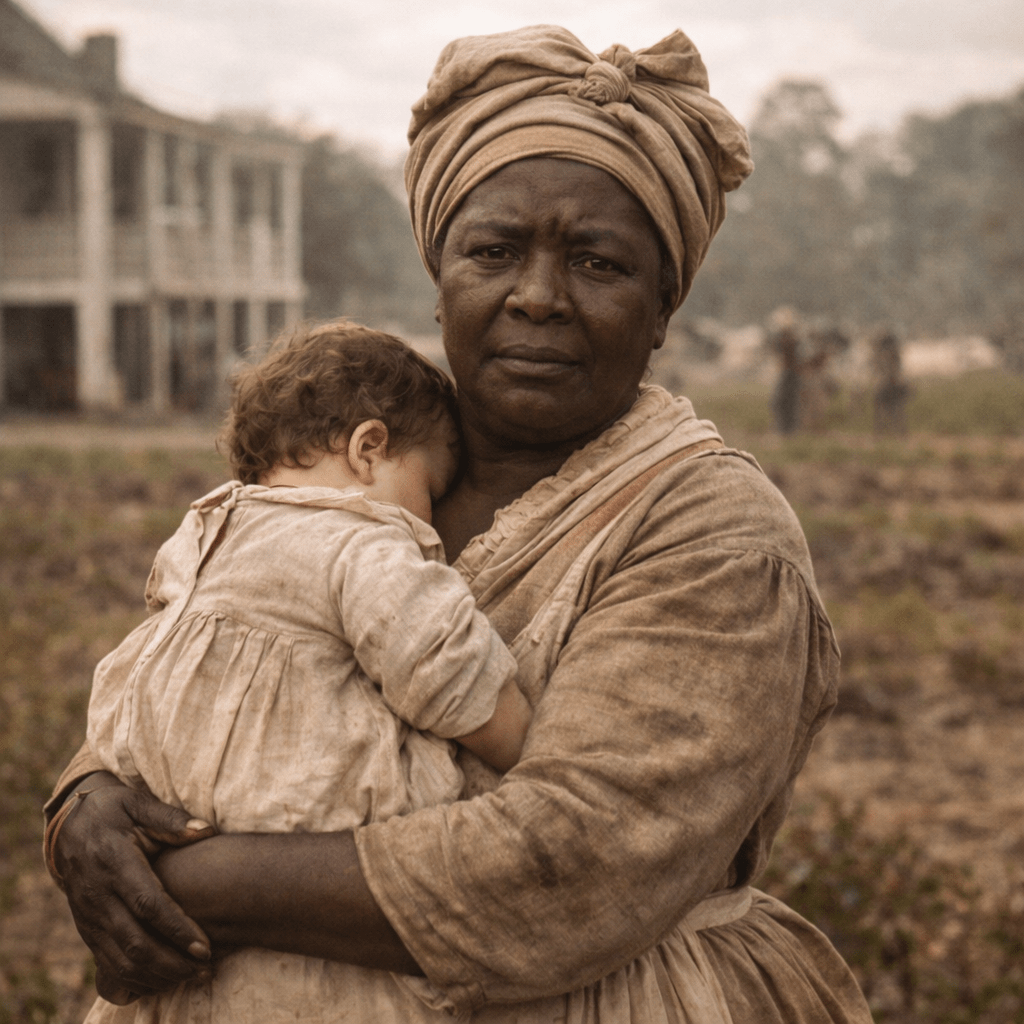
The “Mammy” stereotype is one of the most enduring and harmful caricatures in American culture, representing Black women as loyal, nurturing, and subservient caretakers of white families. This stereotype has its roots in the era of slavery, evolving into a pervasive image in popular media, advertising, and literature that distorted the realities of Black womanhood.

Historically, a mammy was a Black woman employed by a white household, often enslaved, responsible for raising white children, cooking, cleaning, and managing domestic labor. The role required complete obedience, selflessness, and emotional labor while denying the woman autonomy over her own life.

During slavery, the mammy’s existence was shaped by oppression and survival. While she was sometimes positioned as a maternal figure for white children, she was denied motherhood of her own children, who might be sold, abused, or neglected. This forced nurturing role was a form of psychological control that reinforced white supremacy.

Physical characteristics were often exaggerated in the Mammy stereotype. Popular culture depicted mammies as overweight, dark-skinned, elderly women with wide noses, large eyes, and hair tied in a scarf or kerchief. These features were contrasted against ideals of European beauty to emphasize their “otherness” and justify subservience.

The image of the mammy was not simply descriptive—it was prescriptive. It suggested that Black women were naturally suited for servitude, domestic labor, and caretaking, thereby legitimizing both slavery and racial hierarchies. The mammy became a comforting figure for white society, masking the brutality of slavery behind the illusion of loyalty and affection.

In the post-slavery era, the mammy stereotype persisted in media and advertising. The most famous example is Aunt Jemima, a brand that used a smiling, maternal Black woman as its mascot for pancake syrup and other products. The character reinforced notions that Black women existed to serve white households, normalizing racial subordination for generations.

The creation of the mammy stereotype had multiple causes. It served to ease white guilt over the horrors of slavery, rationalize the economic dependence on enslaved labor, and infantilize Black women as harmless, loyal, and nonthreatening. It also reinforced gendered expectations of women as domestic nurturers, but only within a racialized hierarchy.

Slavery itself created conditions for the mammy figure. Enslaved Black women were separated from their families, forced to work in domestic settings, and denied personal agency. These social realities became simplified and romanticized in cultural narratives, which erased the violence and coercion underlying their labor.

The mammy stereotype also had a visual codification in film and literature. Characters such as Hattie McDaniel in Gone with the Wind epitomized the trope, showing Black women as loyal, jolly, and devoted entirely to white families while remaining sexually desexualized. This image became a template for portrayals of Black women for decades.

Treatment of real-life mammies varied, but it was often harsh and exploitative. While some might have had close bonds with children they cared for, their labor was uncompensated or minimally compensated, and they were frequently subjected to physical punishment, verbal abuse, and systemic neglect.

The stereotype persists in subtle ways in modern culture. Contemporary media still sometimes portrays Black women in caregiving or service-oriented roles, emphasizing nurturing or subservient qualities while neglecting complexity, independence, and agency. These echoes of the mammy reinforce racialized expectations.

A defining aspect of the mammy figure is the emotional labor expected of her. She was imagined as endlessly patient, self-sacrificing, and cheerful regardless of mistreatment or abuse. In reality, enslaved and working Black women often carried immense emotional and physical burdens with no recognition or reward.

The mammy’s image was also carefully codified through dress and posture. Headscarves, aprons, and loose-fitting clothing became shorthand for subservience, domesticity, and age, creating a visual language that signaled loyalty to white households while denying Black women individuality or beauty.

Racist ideologies reinforced the stereotype. By presenting Black women as content in servitude, white society justified ongoing racial hierarchies and minimized the brutality of slavery. The mammy figure served as propaganda, comforting white audiences while erasing Black women’s struggles and resistance.

Advertising and branding further entrenched the mammy stereotype. From Aunt Jemima to various domestic product mascots, corporations leveraged the image of a smiling, motherly Black woman to sell products, perpetuating a reductive and exploitative representation for profit.

The mammy stereotype also intersects with gender oppression. By portraying Black women as caretakers first and individuals second, society denied them sexual, economic, and social autonomy. Their identity was flattened into a role that served white households, leaving little space for recognition of personal aspirations or desires.

Efforts to challenge and dismantle the mammy stereotype have increased in contemporary scholarship and activism. Scholars and cultural critics highlight the harm of these images and advocate for nuanced representations that honor the complexity, strength, and humanity of Black women.

In literature, cinema, and history, Black women’s voices reveal a different narrative than the mammy trope suggests. Enslaved and free women resisted domination in countless ways, asserting their dignity, creating cultural expressions, and protecting families despite systemic oppression.

The mammy stereotype exemplifies how race, gender, and labor intersected under slavery and beyond. It illustrates how visual and cultural symbols can enforce social hierarchies while shaping perceptions of entire communities. Understanding this history is critical to dismantling persistent racial stereotypes.

Ultimately, the mammy figure is not a reflection of reality but a tool of control and propaganda. Recognizing its origins, effects, and ongoing influence helps to contextualize contemporary struggles for representation, equity, and the reclamation of Black women’s narratives and beauty.


References

Giddings, P. (1984). When and Where I Enter: The Impact of Black Women on Race and Sex in America. HarperCollins.

Pilgrim, D. (2012). The Mammy Caricature. Jim Crow Museum of Racist Memorabilia, Ferris State University. Retrieved from https://www.ferris.edu/HTMLS/news/jimcrow/mammies/

Wallace-Sanders, K. (2008). Mammy: A Century of Race, Gender, and Southern Memory. University of Michigan Press.

Hine, D. C., Hine, W. C., & Harrold, S. (2009). The African American Odyssey. Pearson Higher Ed.

Pilgrim, D. (2000). Aunt Jemima and the Mammy Figure. Retrieved from https://www.ferris.edu/HTMLS/news/jimcrow/mammies/

West, C. M. (1995). Mammy, Jezebel, Sapphire, and Their Homegirls: Developing an “Oppositional Gaze” Toward the Images of Black Women. In Black Women in America (pp. 28–42). Indiana University Press.

Hall, K. (1992). Hair as Power: Cultural Identity and Resistance in African American History. Journal of American History, 79(3), 921–939.

Black Beauty Through the Decades

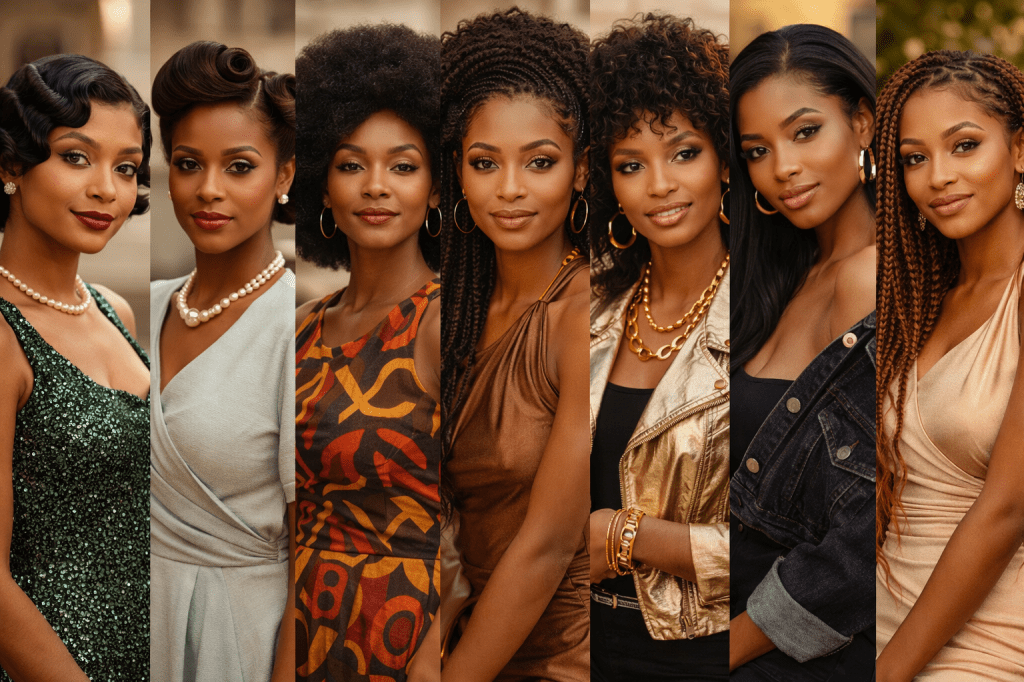
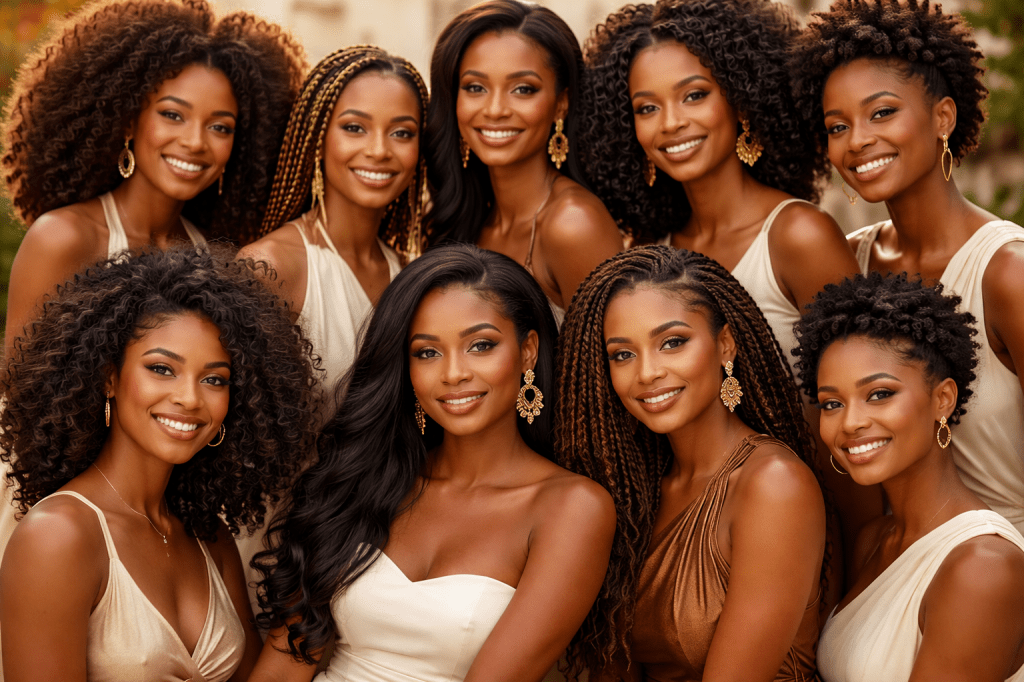
Black beauty is not a trend, a season, or a reaction to outside validation. It is an inheritance—carried through ancestry, memory, and survival. From the earliest days of displacement and resistance, Black women have expressed beauty as a language of identity, dignity, and self-definition. Even when dominant societies attempted to erase, ridicule, or redefine Black features, Black women preserved their beauty through ritual, care, adornment, and community knowledge passed from generation to generation.

To speak of Black beauty is to speak of resilience made visible. Hair, skin, body, and style have long served as sites of both oppression and power, shaped by historical forces yet continuously reclaimed. In times when Eurocentric standards were enforced as the measure of worth, Black women transformed beauty into an act of resistance—refusing invisibility and asserting presence. Each braid, curl, wrap, and adornment carried meaning beyond aesthetics, reflecting survival, creativity, and cultural memory.

Black beauty has never been singular. It exists across a spectrum of skin tones, textures, facial features, and expressions that defy narrow definitions. It evolves across time while remaining rooted in African heritage and diasporic experience. Whether expressed through restraint or boldness, tradition or innovation, Black beauty has always reflected autonomy—the right to define oneself without permission.

In the modern era, the reclamation of Black beauty marks a profound cultural shift. What was once marginalized is now celebrated, studied, and emulated, yet its deepest meaning remains internal rather than performative. Black beauty is not merely what is seen, but what is carried—confidence forged through history, grace born of endurance, and a self-love that persists despite centuries of contradiction. It is both personal and collective, timeless and ever-renewing.

Ultimately, Black beauty is a testament. It testifies to the ability of Black women to remain radiant in the face of erasure, to create elegance from limitation, and to transform survival into art. It is not defined by approval, but by continuity—a living expression of identity that honors the past, affirms the present, and shapes the future.

All photographs are the property of their respective owners. No copyright infringement intended.

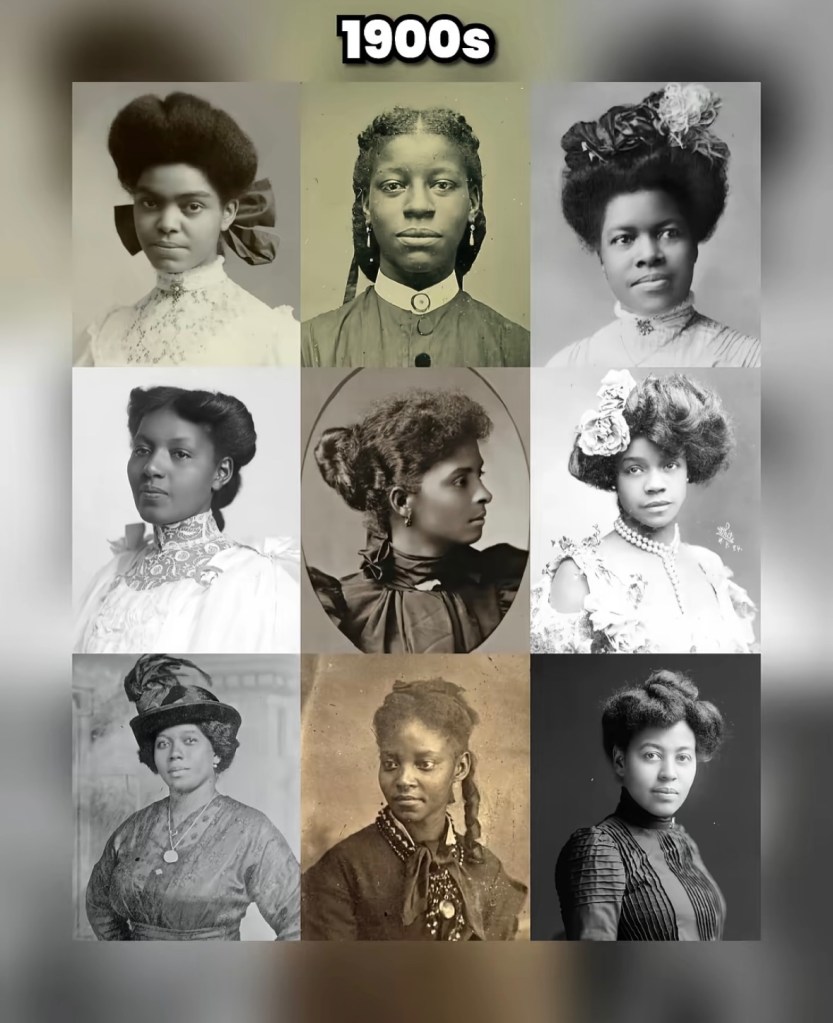
1900s1910s
At the turn of the twentieth century, Black women’s beauty was deeply shaped by resilience, modesty, and self-definition within a racially hostile society. Hairstyles were often practical and protective, including wraps, headscarves, and neatly pressed styles influenced by African traditions and Victorian norms. Despite social limitations, Black women maintained dignity through careful grooming, skin care using natural oils, and adornment that reflected pride and self-respect rather than excess.
During the 1910s, migration from rural Southern communities to urban centers began reshaping Black aesthetics. Hair was frequently styled in soft waves, buns, and pompadours, often achieved through hot combing—a controversial yet common tool of the era. Beauty culture expanded through Black-owned businesses, notably Madam C. J. Walker, who emphasized cleanliness, confidence, and economic independence rather than Eurocentric imitation.

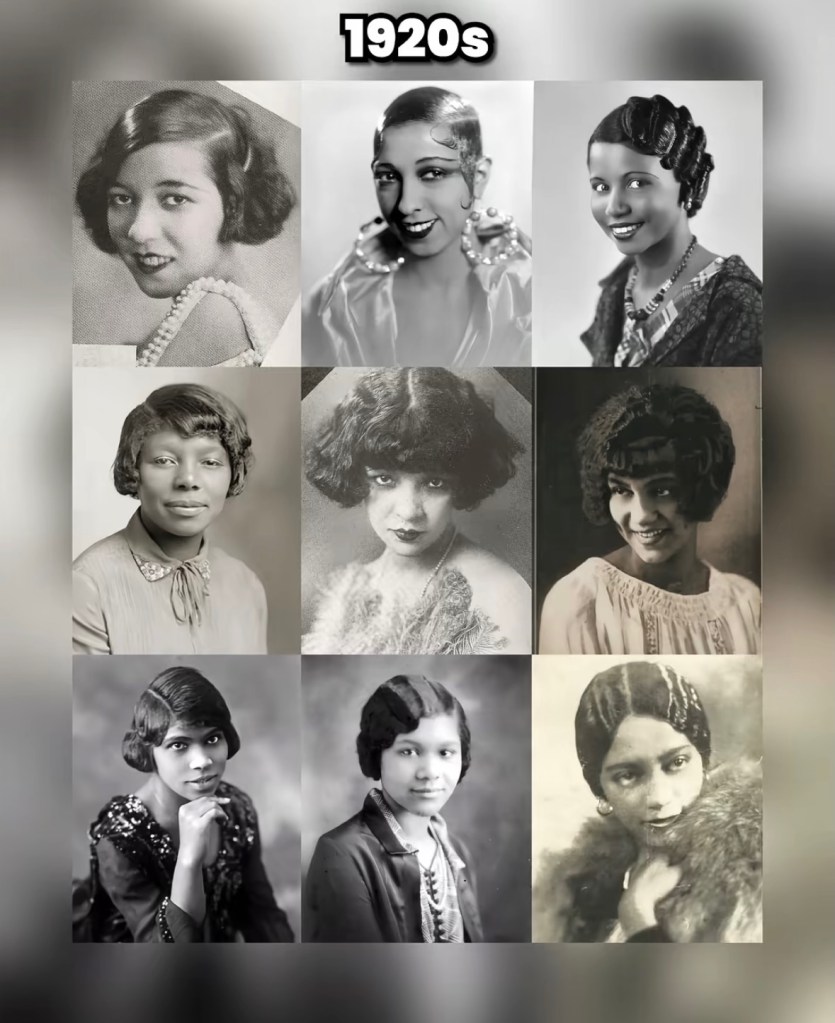
1920s
The Harlem Renaissance of the 1920s marked a cultural awakening in which Black beauty became visible, expressive, and artistic. Shorter hairstyles, finger waves, and sleek bobs emerged, paired with bold lipstick and refined fashion. Black women embodied modernity and glamour, asserting intellectual and aesthetic authority through music, literature, and visual style that celebrated sophistication and cultural pride.

1930s
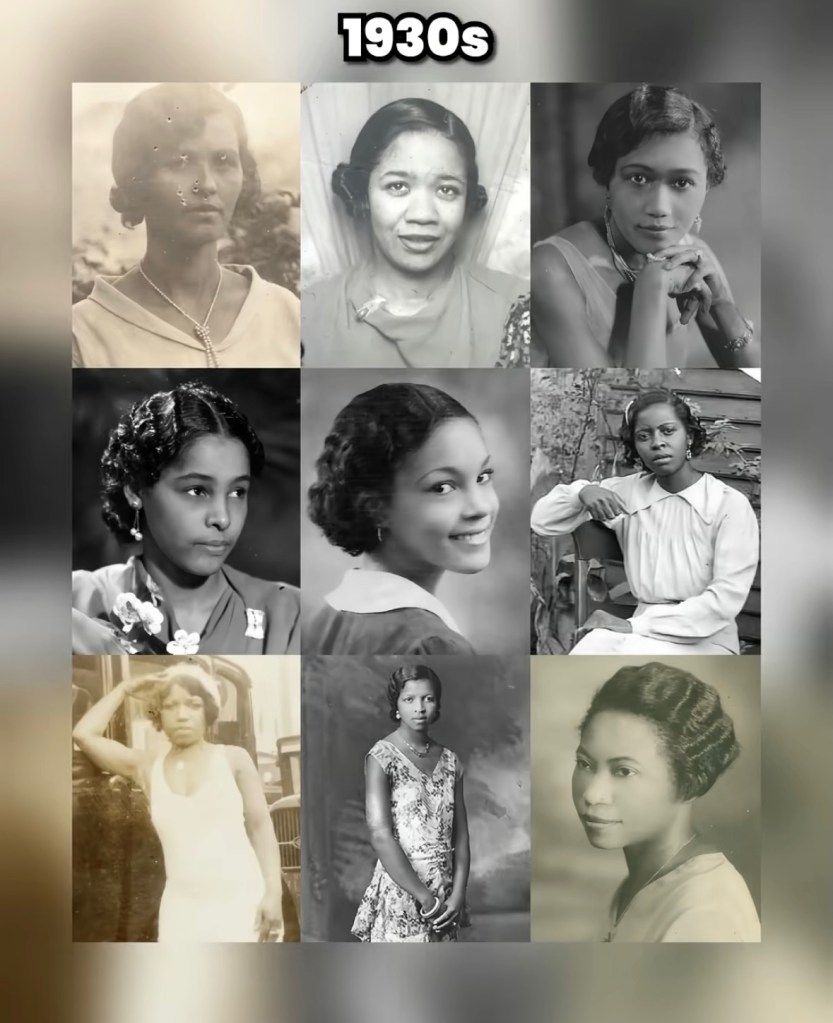
In the 1930s, amid the Great Depression, Black beauty reflected elegance under constraint. Hairstyles favored sculpted waves, rolls, and pinned curls, while makeup remained polished but understated. Beauty became an act of resistance—maintaining poise, femininity, and grace despite economic hardship. Hollywood films influenced aesthetics, though Black women adapted these styles to their own textures and features.

1940s
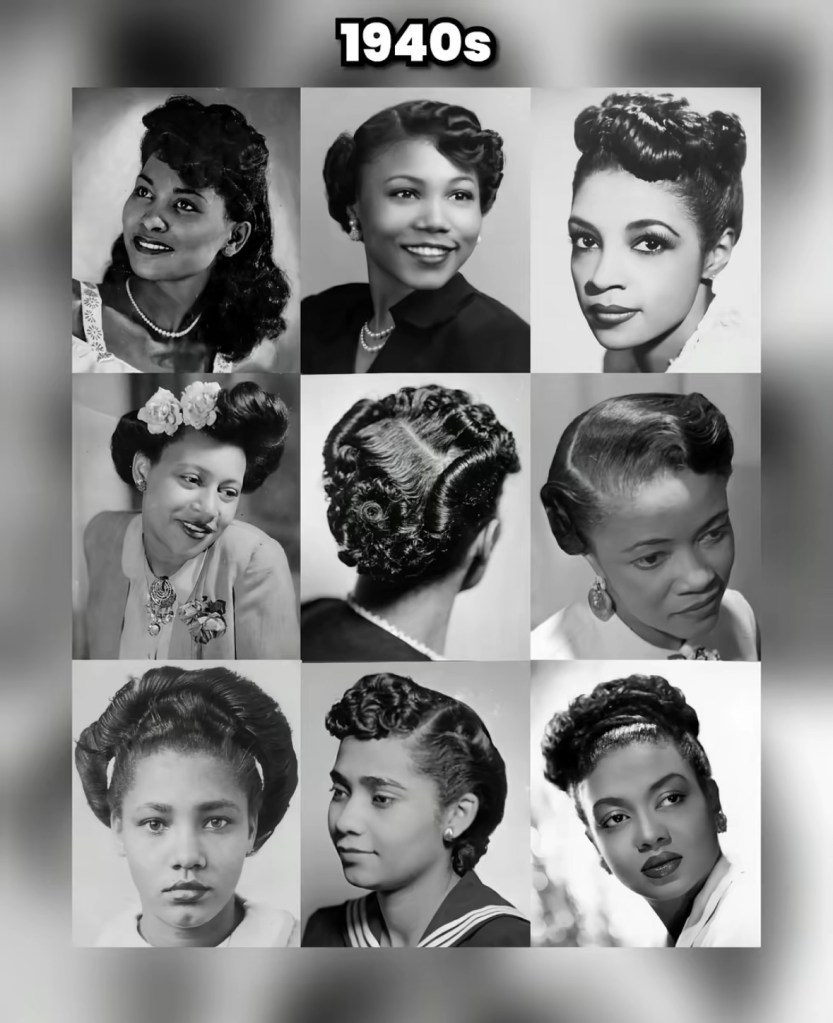
World War II reshaped Black womanhood and beauty in the 1940s as women entered industrial labor and military support roles. Hairstyles were practical yet stylish, including victory rolls, headscarves, and neatly set curls. Beauty symbolized strength and patriotism, with emphasis on clean lines, red lips, and confident posture reflecting both femininity and fortitude.

1950s
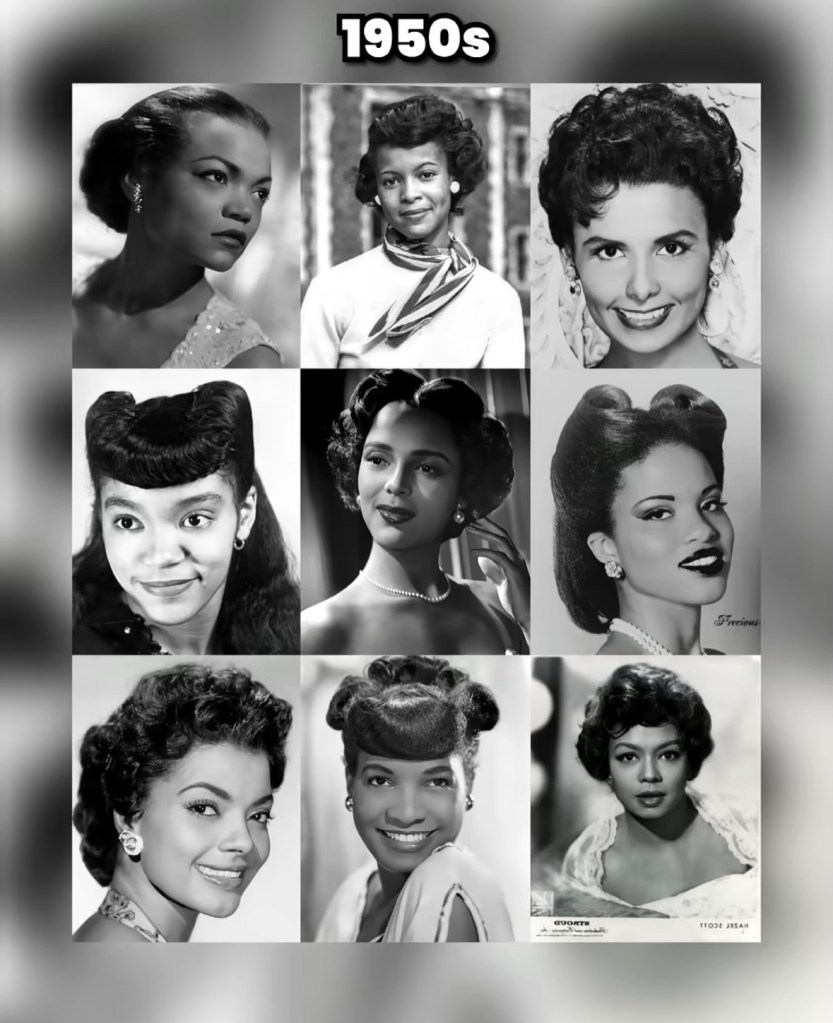
The 1950s emphasized polish, domestic elegance, and hyper-femininity. Black women wore structured dresses, gloves, and coiffed hairstyles, often straightened or softly curled. Beauty standards leaned toward refinement and respectability, particularly within Black middle-class communities, as appearance was closely tied to social mobility, morality, and dignity in a segregated society.

1960s
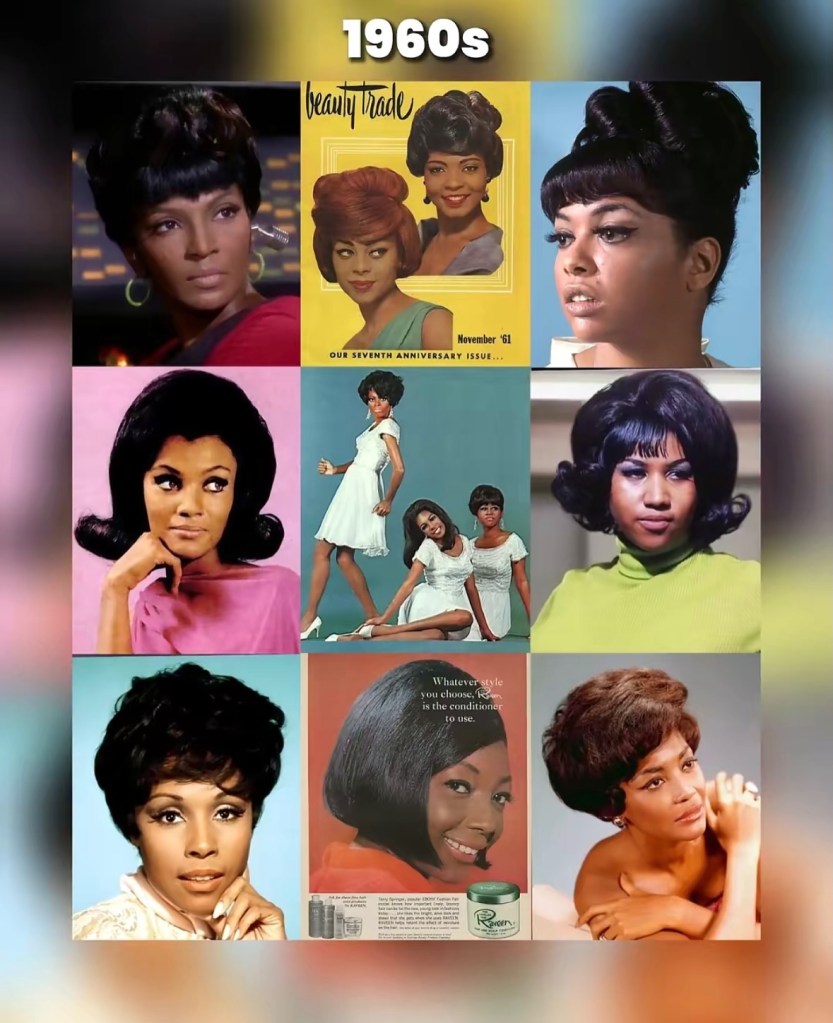
The 1960s ushered in a radical transformation as the Civil Rights and Black Power movements reframed beauty as political identity. The Afro emerged as a powerful symbol of self-acceptance and resistance, rejecting assimilationist standards. Natural hair, dark skin, and African-inspired clothing were embraced as declarations of pride, autonomy, and cultural truth.

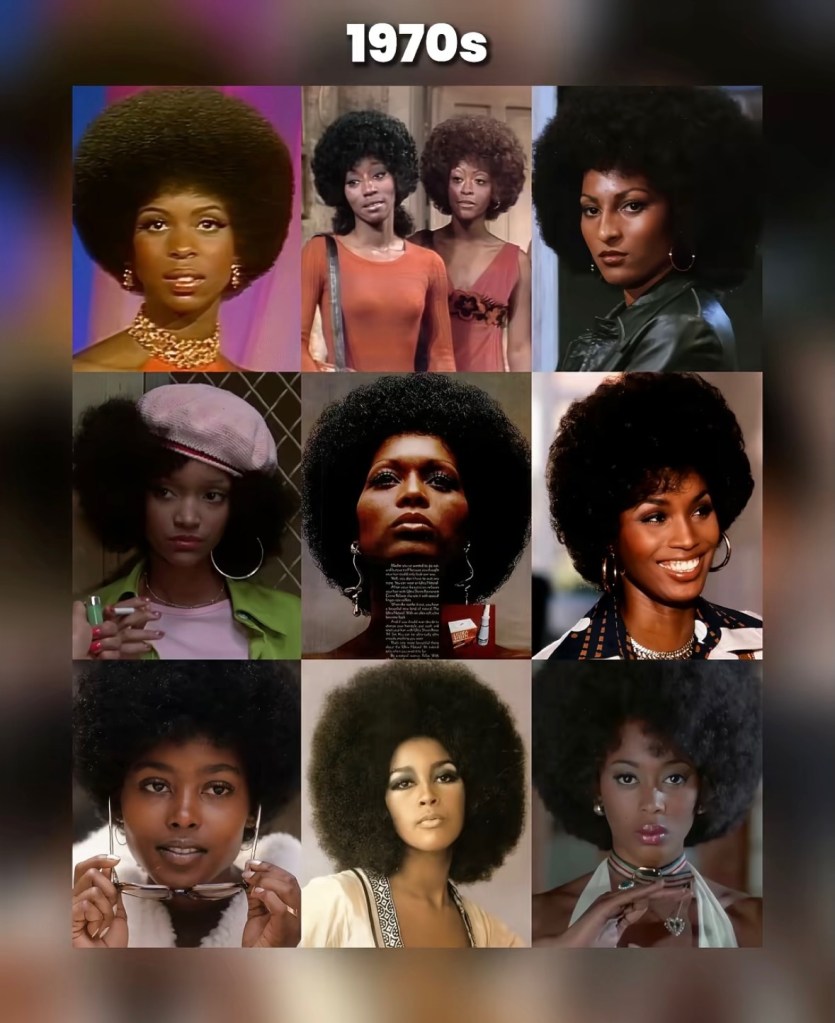
1970s
In the 1970s, Black beauty flourished in boldness, freedom, and Afrocentric expression. Large Afros, braids, cornrows, and natural textures dominated, paired with vibrant makeup and fashion. Icons like Pam Grier and Cicely Tyson embodied a confident sensuality rooted in authenticity rather than approval. Beauty became expansive, expressive, and unapologetically Black.

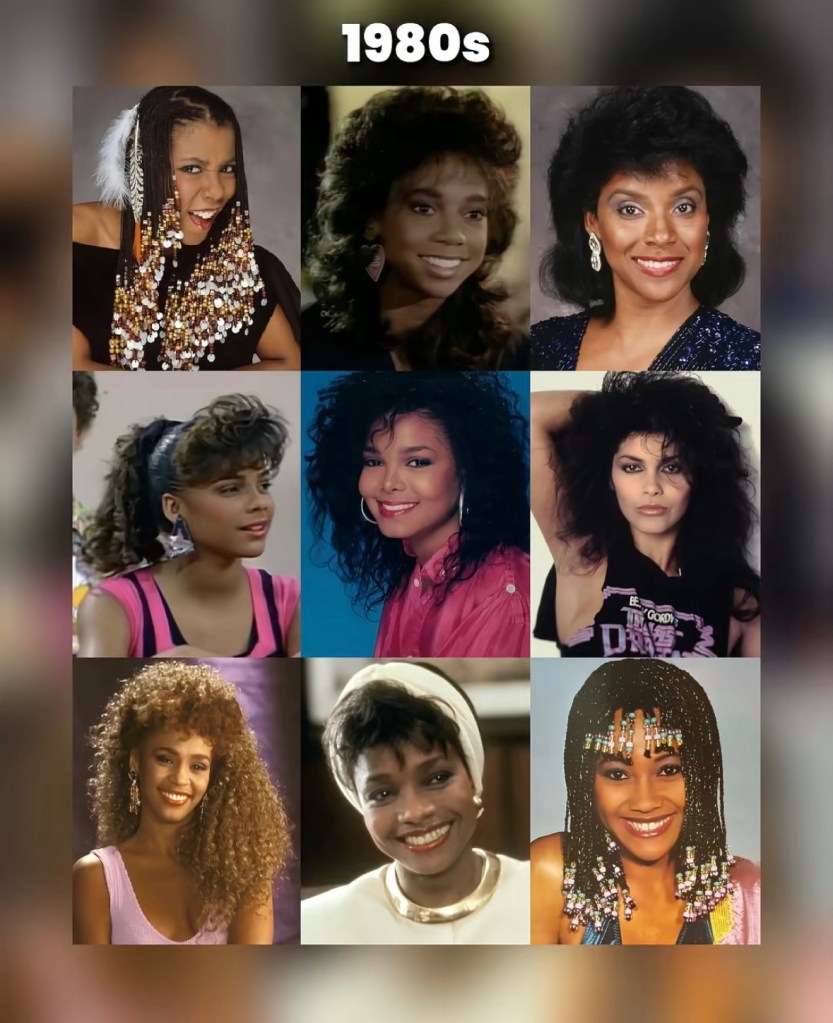
1980s
The 1980s brought excess, experimentation, and glamour. Black women embraced voluminous hairstyles, including jheri curls, blowouts, and elaborate braids. Makeup was bold, featuring strong eyes and glossy lips. Beauty aligned with success, visibility, and power, reflecting growing representation in music, television, and corporate spaces.

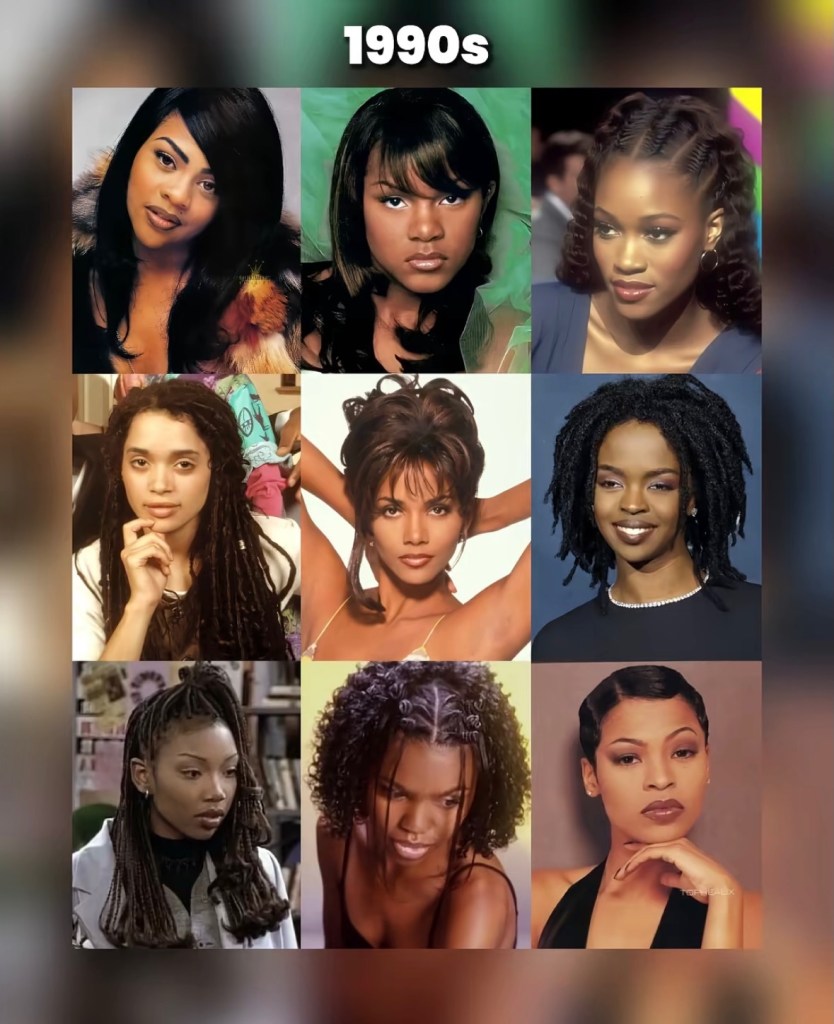
1990s
The 1990s balanced minimalism with cultural edge. Box braids, microbraids, finger waves, and sleek bobs coexisted alongside understated makeup and fashion. Black beauty icons such as Naomi Campbell and Angela Bassett represented strength, athleticism, and global elegance. Authenticity and individuality increasingly defined attractiveness.

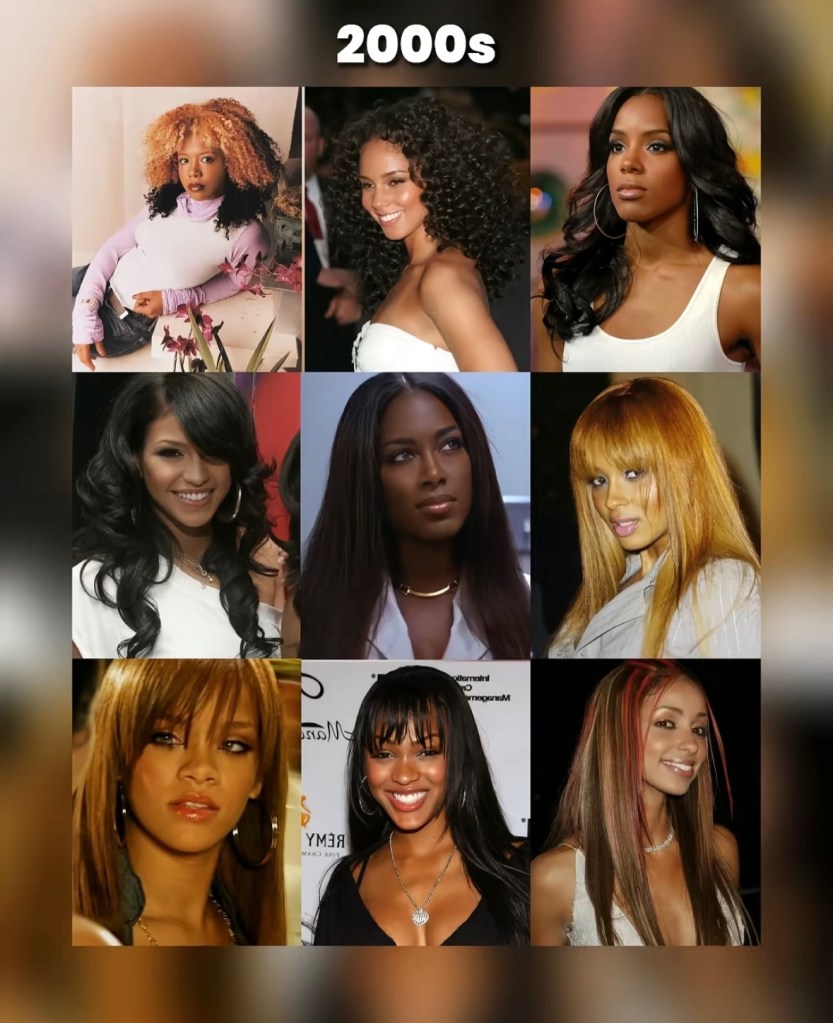
2000s
In the 2000s, Black beauty diversified across mainstream and niche aesthetics. Lace fronts, silk presses, locs, and protective styles gained popularity, alongside experimental makeup and fashion. Media visibility expanded through music videos, magazines, and early digital platforms, allowing Black women to define beauty on their own terms across multiple expressions.

2010s
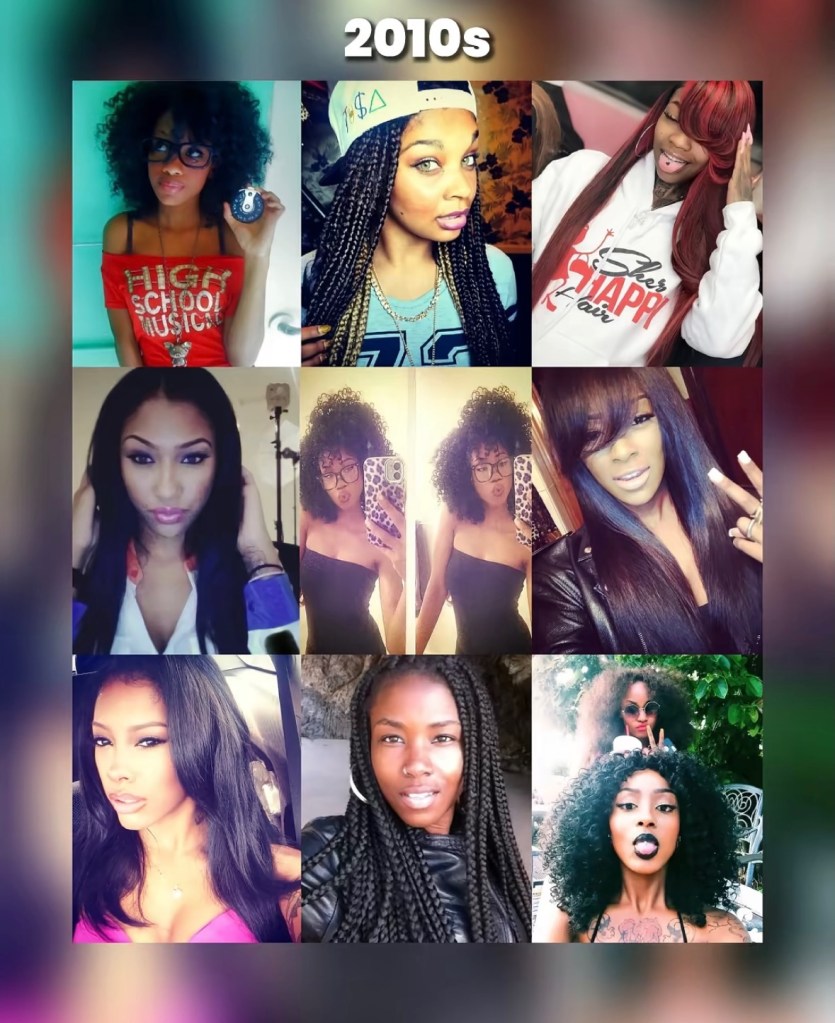
The 2010s marked a renaissance of natural hair and digital empowerment. Social media amplified Black women’s voices, celebrating coils, curls, dark skin, and wide features once marginalized. Beauty became inclusive, instructional, and affirming, with natural hair movements and makeup brands explicitly centering Black women’s needs and aesthetics.

2020s
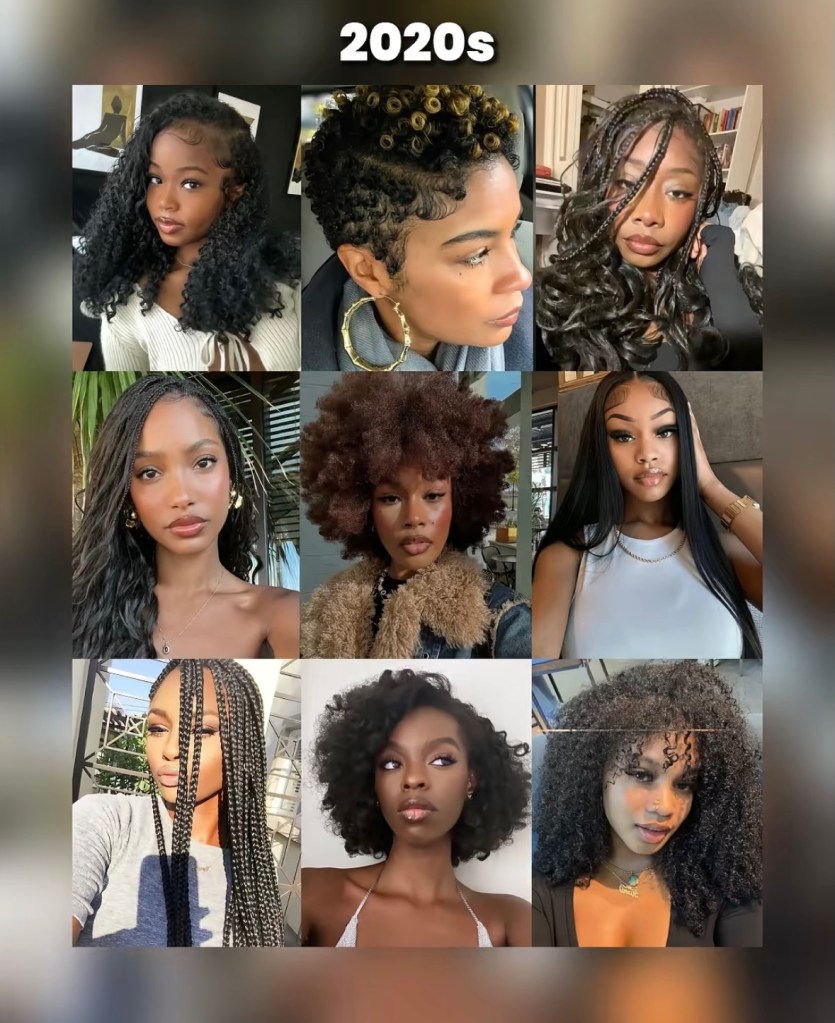
In the 2020s, Black beauty stands fully autonomous, expansive, and global. There is no single standard—locs, Afros, braids, shaved heads, bold colors, and minimalist looks coexist without hierarchy. Beauty is now framed as wellness, self-definition, and cultural inheritance. Black women lead beauty innovation, redefine luxury, and affirm that Blackness itself is timelessly beautiful.


Black beauty endures because it is rooted in truth rather than approval. It is not borrowed, diluted, or dependent on trends—it is ancestral, self-defined, and ever-evolving. Across centuries of challenge and transformation, Black beauty has remained a quiet force and a bold declaration, reflecting dignity, creativity, and spiritual strength. It is the beauty of survival refined into grace, of history carried with pride, and of identity claimed without apology. In every generation, Black beauty stands as living evidence that what was once denied has always been divine, whole, and worthy.

References

Byrd, A. D., & Tharps, L. L. (2014). Hair story: Untangling the roots of Black hair in America (2nd ed.). St. Martin’s Press.

Craig, M. L. (2002). Ain’t I a beauty queen? Black women, beauty, and the politics of race. Oxford University Press.

Hobson, J. (2005). Venus in the dark: Blackness and beauty in popular culture. Routledge.

Peiss, K. (2011). Hope in a jar: The making of America’s beauty culture. University of Pennsylvania Press.

Walker, S. B. (2007). Style and status: Selling beauty to African American women, 1920–1975. University Press of Kentucky.

Wilson, J. (2016). Black beauty: Aesthetic politics in modern African American culture. University of Illinois Press.

The Violence of Beauty Standards

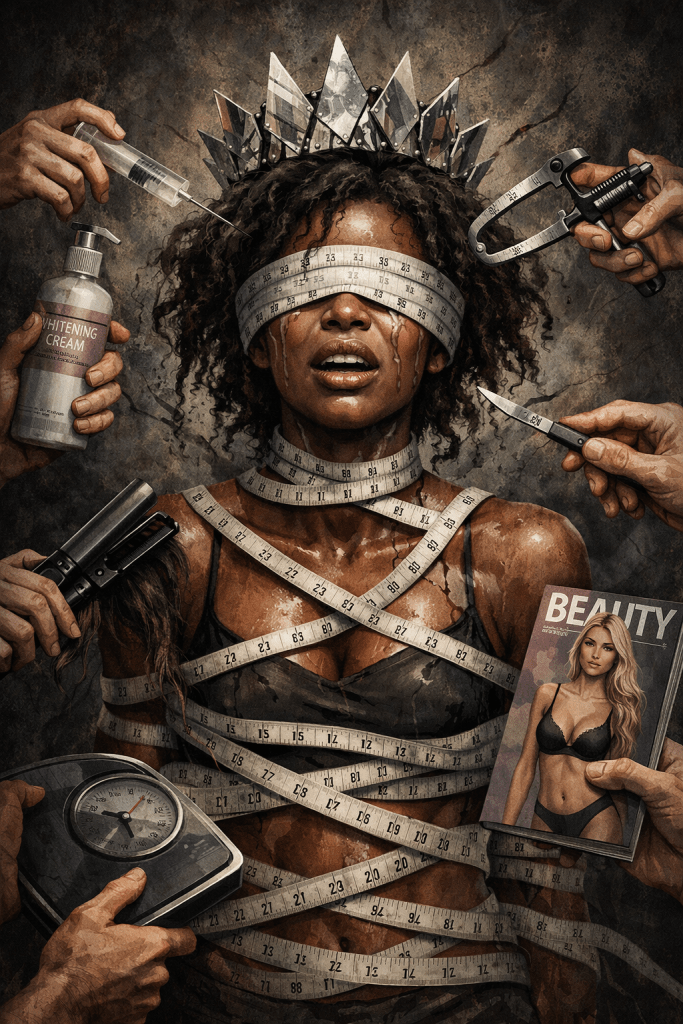
Beauty standards are often framed as harmless preferences or cultural aesthetics, yet their impact is anything but benign. They operate as a quiet, normalized form of violence—psychological, social, economic, and spiritual—imposed upon bodies that fall outside narrowly defined ideals. This violence is subtle enough to evade accountability and powerful enough to shape life outcomes, self-worth, and social hierarchies across generations.

The violence of beauty standards begins with definition. When a dominant culture determines which features are worthy of admiration and which are to be tolerated or erased, it establishes a hierarchy of human value. These hierarchies do not emerge organically; they are historically constructed through colonialism, slavery, class stratification, and racialized power relations that elevate proximity to whiteness, youth, thinness, and Eurocentric features.

For Black communities in particular, beauty standards have functioned as an extension of racial domination. During slavery and colonial rule, physical features were used to classify, rank, and commodify African-descended people. Lighter skin, straighter hair, and narrower features were rewarded with marginal privileges, while darker skin and African phenotypes were associated with labor, disposability, and dehumanization.

This legacy persists through colorism, a system in which skin tone operates as a social currency within and beyond racial groups. Colorism is not merely a preference; it is an internalized enforcement mechanism that reproduces racial hierarchy without the need for overt racism. Its violence lies in how it fractures communal bonds and assigns worth based on phenotype rather than character or humanity.

Beauty standards also enact violence through psychological harm. Repeated exposure to exclusionary ideals fosters chronic self-surveillance, body dissatisfaction, anxiety, and depression. Individuals learn to scrutinize their faces, hair, weight, and aging as problems to be fixed rather than natural expressions of life. This internalized gaze becomes a form of self-policing that mirrors external oppression.

The economic violence of beauty standards is equally profound. Entire industries profit from manufactured insecurity, extracting billions of dollars through skin-lightening products, cosmetic surgery, anti-aging treatments, and hair alteration. Those who can afford to approximate beauty ideals gain social and professional advantages, while those who cannot are penalized in employment, dating, media representation, and social mobility.

Gender intensifies this violence. Women and girls are disproportionately subjected to aesthetic regulation, with their value often tethered to attractiveness rather than intellect, integrity, or contribution. From childhood, girls are conditioned to equate beauty with worth, learning that visibility and validation are contingent upon meeting external standards that shift with trends yet remain rooted in patriarchal control.

Men are not immune to the violence of beauty standards, though it manifests differently. Rigid ideals of masculinity—height, muscularity, stoicism, dominance—discipline male bodies and emotions, discouraging vulnerability and self-acceptance. Men who deviate from these ideals face ridicule, emasculation, and social exclusion, revealing beauty standards as tools of behavioral conformity.

Media functions as a primary weapon in the enforcement of beauty norms. Through film, advertising, social media, and fashion, a narrow range of bodies and faces is repeatedly elevated as aspirational. Algorithmic amplification further entrenches these ideals, rewarding certain looks with visibility while rendering others invisible or stereotyped.

The violence intensifies in the digital age, where beauty standards are no longer distant images but interactive currencies. Likes, follows, and monetization transform appearance into measurable social capital. This quantification of beauty deepens comparison, fuels self-objectification, and accelerates the commodification of the self.

Beauty standards also operate as moral judgments. Attractive bodies are frequently associated with goodness, discipline, intelligence, and virtue, while those deemed unattractive are implicitly linked to laziness, moral failure, or incompetence. This phenomenon, often described as the halo effect, embeds aesthetic bias into decision-making processes that shape education, employment, and criminal justice outcomes.

The violence of beauty standards extends into spiritual dimensions. When individuals are taught to despise the bodies they inhabit, a rupture forms between self and creation. For faith traditions that affirm humanity as divinely made, beauty hierarchies function as theological distortions, subtly contradicting teachings about inherent worth and sacred design.

Historically marginalized bodies carry the heaviest burden of this violence. Disabled bodies, fat bodies, aging bodies, dark-skinned bodies, and gender-nonconforming bodies are treated as deviations rather than variations of human existence. The insistence on correction or concealment communicates that some lives are less deserving of comfort, desire, and dignity.

Resistance to beauty standards is often dismissed as oversensitivity or lack of self-esteem, yet such resistance is deeply political. To reject imposed ideals is to challenge systems that rely on comparison, insecurity, and consumption. It is an act of reclaiming agency over one’s body and narrative.

Cultural movements that celebrate diverse forms of beauty offer important counter-narratives, but they are not immune to co-optation. Inclusion is frequently aestheticized without dismantling underlying power structures, resulting in superficial diversity that leaves hierarchies intact. True liberation requires structural change, not symbolic representation alone.

Education plays a crucial role in disrupting the violence of beauty standards. Critical media literacy, historical context, and conversations about embodiment can equip individuals to recognize how ideals are constructed and whose interests they serve. Awareness does not erase harm, but it weakens its authority.

Healing from beauty-based violence is both personal and collective. Individually, it involves unlearning internalized contempt and cultivating self-regard beyond appearance. Collectively, it requires building communities that affirm worth independent of aesthetics and challenge discriminatory practices in institutions and media.

The language we use around beauty matters. Compliments, critiques, and casual comments can reinforce or resist harmful norms. Shifting language toward appreciation of character, creativity, resilience, and wisdom helps decenter appearance as the primary measure of value.

Ultimately, the violence of beauty standards lies in their ability to disguise domination as desire. They persuade individuals to participate in their own marginalization, to chase approval at the cost of peace, and to mistake conformity for empowerment. Naming this violence is the first step toward dismantling it.

A more just vision of beauty does not require the abandonment of aesthetics, but their reorientation. Beauty can be expansive, contextual, and humane when divorced from hierarchy and exclusion. In reclaiming beauty from violence, society moves closer to affirming the full dignity of every body.

References

Bordo, S. (2003). Unbearable weight: Feminism, Western culture, and the body. University of California Press.

Collins, P. H. (2004). Black sexual politics: African Americans, gender, and the new racism. Routledge.

Crenshaw, K. (1991). Mapping the margins: Intersectionality, identity politics, and violence against women of color. Stanford Law Review, 43(6), 1241–1299.

Dion, K., Berscheid, E., & Walster, E. (1972). What is beautiful is good. Journal of Personality and Social Psychology, 24(3), 285–290.

Hunter, M. (2007). The persistent problem of colorism: Skin tone, status, and inequality. Sociology Compass, 1(1), 237–254.

hooks, b. (1992). Black looks: Race and representation. South End Press.

Kaw, E. (1993). Medicalization of racial features: Asian American women and cosmetic surgery. Medical Anthropology Quarterly, 7(1), 74–89.

Wolf, N. (1991). The beauty myth: How images of beauty are used against women. HarperCollins.

Beauty Sins: Judged by the Flesh

In modern society, physical beauty operates as both a form of privilege and a source of scrutiny, shaping social interactions, professional opportunities, and relational dynamics. Individuals whose appearances align with conventional standards often receive favorable treatment, whereas those who deviate are marginalized, judged, or denied empathy. This phenomenon, often referred to as “pretty privilege,” has profound psychological, social, and cultural implications (Langlois et al., 2000; Eagly et al., 1991).

The “halo effect” explains why attractive individuals are assumed to possess desirable personality traits, such as intelligence, kindness, or competence (Dion, Berscheid, & Walster, 1972). Conversely, individuals considered less attractive may be unfairly perceived as flawed, lazy, or untrustworthy. These biases, though largely subconscious, perpetuate inequities and social hierarchies rooted in appearance.

Cultural expectations of beauty are gendered and racialized. Women, in particular, face pressures to maintain physical attractiveness, often measured against Eurocentric standards, while men encounter standards that emphasize muscularity or facial symmetry. For Black women, these pressures intersect with colorism and societal stereotypes, creating compounded challenges (Hunter, 2007).

Judgment based on fleshly appearance fosters social alienation and psychological distress. Research demonstrates that individuals marginalized for perceived unattractiveness are more susceptible to anxiety, depression, and reduced self-esteem, affecting both personal well-being and social mobility (Langlois et al., 2000).

The media reinforces appearance-based evaluation through idealized images in advertising, television, and social media. Constant exposure to curated beauty standards creates unrealistic expectations and normalizes judgment based on physical traits rather than character or competence (Wolf, 1991).

Social settings often reveal the stark consequences of beauty bias. Attractive individuals may gain access to social networks, career opportunities, and preferential treatment, while others, equally talented or morally virtuous, are overlooked. These disparities illustrate that beauty functions as a form of currency within contemporary culture (Hosoda, Stone-Romero, & Coats, 2003).

Colorism intensifies the judgment of Black bodies. Lighter-skinned individuals frequently receive positive attention and social advantage, while darker-skinned individuals are systematically devalued in social, professional, and romantic contexts. This inequity underscores how appearance-based biases intersect with racial hierarchies (Hunter, 2007).

In relational contexts, the privileging of beauty influences both romantic and platonic interactions. Attractive individuals often receive increased attention and favorable treatment, reinforcing social hierarchies based on appearance (Eagly et al., 1991). Less attractive individuals may struggle to achieve recognition or empathy, perpetuating feelings of exclusion and invisibility.

Religious and ethical perspectives challenge the primacy of physical appearance. Scripture reminds believers that God values character, virtue, and the heart over outward beauty (1 Samuel 16:7, KJV). Faith traditions encourage evaluating individuals by moral integrity rather than superficial attributes, promoting equity and compassion.

The consequences of beauty-based judgment extend to professional domains. Hiring decisions, promotions, and workplace evaluations are influenced by perceived attractiveness, disadvantaging those who do not conform to societal ideals (Hosoda et al., 2003). This systemic bias perpetuates structural inequities tied to appearance.

Psychological resilience can mitigate the effects of beauty-based discrimination. Developing self-worth independent of societal validation, cultivating supportive social networks, and emphasizing skill, intelligence, and moral character contribute to empowerment and reduced vulnerability to external judgment.

The commodification of beauty amplifies its social power. Cosmetic industries, fashion media, and influencer culture profit from insecurities about appearance, reinforcing the notion that attractiveness equates to social and economic advantage (Wolf, 1991).

Educational environments are similarly affected. Attractive students often receive favorable treatment from educators and peers, while those deemed less attractive may experience marginalization or underestimation of ability, shaping long-term outcomes (Langlois et al., 2000).

Intersecting identities, such as gender, race, and socioeconomic status, compound appearance-based bias. Black women, for example, may face both beauty-based and racialized discrimination, highlighting the layered nature of societal judgment (Hunter, 2007).

Legal outcomes also demonstrate the impact of beauty bias. Studies indicate that attractive defendants are more likely to receive lenient sentencing, whereas those considered less attractive face harsher treatment, revealing the systemic influence of physical appearance (Dion et al., 1972).

Media literacy and critical engagement are essential tools for mitigating the influence of beauty-based judgment. Encouraging diverse representations and challenging narrow beauty ideals fosters awareness and reduces the social and psychological harm of appearance bias (Marwick, 2017).

The ethical implications of judging by the flesh extend to everyday interactions. Valuing character, competence, and relational integrity over appearance promotes fairness, empathy, and social cohesion. Cultivating these values counters the superficiality reinforced by cultural norms.

Public discourse increasingly addresses the societal cost of beauty-based privilege. Awareness campaigns, research, and representation efforts highlight the importance of evaluating individuals beyond surface appearance, fostering equity and inclusivity (Zebrowitz & Montepare, 2008).

In conclusion, beauty sins—judging individuals based on their flesh—perpetuate social inequities, psychological distress, and systemic bias. A conscious shift toward evaluating character, virtue, and competence over outward appearance is necessary to foster fairness, empathy, and genuine human connection.

References

Dion, K., Berscheid, E., & Walster, E. (1972). What is beautiful is good. Journal of Personality and Social Psychology, 24(3), 285–290.

Eagly, A. H., Ashmore, R. D., Makhijani, M. G., & Longo, L. C. (1991). What is beautiful is good, but…: A meta-analytic review of research on the physical attractiveness stereotype. Psychological Bulletin, 110(1), 109–128.

Hosoda, M., Stone-Romero, E. F., & Coats, G. (2003). The effects of physical attractiveness on job-related outcomes: A meta-analysis of experimental studies. Personnel Psychology, 56(2), 431–462.

Hunter, M. (2007). The persistent problem of colorism: Skin tone, status, and inequality. Sociology Compass, 1(1), 237–254.

Langlois, J. H., Kalakanis, L., Rubenstein, A. J., Larson, A., Hallam, M., & Smoot, M. (2000). Maxims or myths of beauty? A meta-analytic and theoretical review. Psychological Bulletin, 126(3), 390–423.

Marwick, A. (2017). Status update: Celebrity, publicity, and branding in the social media age. Yale University Press.

Wolf, N. (1991). The beauty myth: How images of beauty are used against women. HarperCollins.

Zebrowitz, L. A., & Montepare, J. M. (2008). Social perception from the face: Mechanisms and meaning. Social and Personality Psychology Compass, 2(3), 1497–1517.

Holy Bible, King James Version (KJV). 1 Samuel 16:7.

Golden Resistance: The Triumph of the Brown-Skinned Woman

The brown-skinned woman embodies resilience, beauty, and cultural heritage. Across centuries, she has faced systemic oppression, colorism, and societal erasure, yet she persists, embodying a narrative of triumph against all odds.

Historical narratives often marginalized dark- and brown-skinned women, privileging Eurocentric ideals of beauty. Despite this, brown-skinned women cultivated spaces of empowerment within communities, families, and spiritual traditions (Hunter, 2007).

Colonialism and slavery imposed external definitions of worth, linking lighter skin to privilege and darker tones to subjugation. Yet brown-skinned women resisted these narratives, preserving identity, culture, and dignity (Gates, 2019).

Beauty standards have long been weaponized against brown-skinned women. Media and literature often depicted them as exotic or undesirable, fostering internalized oppression. Still, many embraced their natural beauty as a form of defiance (Hall, 1997).

The brown-skinned woman’s strength is rooted in cultural memory. Oral histories, music, and literature have documented resilience, transmitting lessons of perseverance and self-respect across generations (hooks, 2000).

Education became a site of resistance. Brown-skinned women have historically fought to access learning, literacy, and leadership roles, challenging societal assumptions of intellect and capability (Collins, 2000).

In contemporary times, brown-skinned women are redefining standards of beauty and success. Social media and grassroots movements celebrate melanin-rich skin, natural hair, and Afrocentric features, reclaiming visibility and pride (Banks, 2017).

Colorism within communities posed internal challenges. Brown-skinned women navigated both external oppression and intra-community hierarchies, cultivating solidarity and mentorship to foster empowerment (Hunter, 2007).

Representation in media and entertainment has been transformative. Figures like Lupita Nyong’o, Kerry Washington, and Tracee Ellis Ross challenge stereotypes, embodying success, beauty, and influence for brown-skinned women worldwide (Ferguson, 2015).

Brown-skinned women have shaped social justice movements. Their leadership in civil rights, feminist movements, and contemporary activism underscores the intersection of gender, race, and color in the struggle for equality (Crenshaw, 1991).

Entrepreneurship is another arena of triumph. Brown-skinned women create businesses, brands, and platforms celebrating Black excellence, simultaneously challenging economic marginalization and societal biases (Smith, 2020).

Art and literature provide spaces to assert identity. Brown-skinned women use creative expression to celebrate heritage, critique oppression, and cultivate self-love, creating enduring cultural legacies (Gates, 2019).

Physical beauty, while celebrated, is not the sole measure of triumph. Intelligence, courage, resilience, and leadership are equally central to the brown-skinned woman’s legacy (hooks, 2000).

Intersectionality shapes the lived experience of brown-skinned women. Navigating race, gender, class, and color, they demonstrate adaptability and agency, crafting strategies for survival and success (Collins, 2000).

Global movements like #MelaninPoppin and #BlackGirlMagic highlight the celebratory reclamation of brown skin, challenging centuries of marginalization and providing visible role models for younger generations (Banks, 2017).

Brown-skinned women’s triumphs are evident in academia. Scholars and researchers assert authority, contribute to global knowledge, and dismantle stereotypes regarding intellectual capacity (Smith, 2020).

In family and community life, brown-skinned women often serve as anchors. They nurture, mentor, and cultivate resilience, passing on wisdom and cultural pride to future generations (hooks, 2000).

Spirituality and faith provide sustenance. Many brown-skinned women draw strength from religious and cultural traditions, which reinforce identity, hope, and perseverance (Hall, 1997).

Overcoming systemic barriers requires courage. Brown-skinned women navigate discrimination in workplaces, media, and education, asserting presence and excellence despite societal prejudice (Crenshaw, 1991).

The triumph of the brown-skinned woman is a continuous narrative. Through resilience, creativity, leadership, and unapologetic self-expression, she transforms historical oppression into a legacy of empowerment, inspiration, and beauty (Hunter, 2007).


References

  • Banks, T. (2017). Representation and beauty in Black media: Celebrating melanin-rich identity. Journal of Black Studies, 48(7), 657–678.
  • Collins, P. H. (2000). Black feminist thought: Knowledge, consciousness, and the politics of empowerment. Routledge.
  • Crenshaw, K. (1991). Mapping the margins: Intersectionality, identity politics, and violence against women of color. Stanford Law Review, 43(6), 1241–1299.
  • Ferguson, R. (2015). Representation matters: African American women in contemporary media. Cultural Studies Review, 21(2), 45–67.
  • Gates, H. L. (2019). The Black image in the White mind: Media and race in America. Vintage Books.
  • Hall, R. E. (1997). Beauty and power: Race, gender, and the visual culture of Black women. Feminist Media Studies, 3(1), 23–45.
  • hooks, b. (2000). Feminism is for everybody: Passionate politics. South End Press.
  • Hunter, M. L. (2007). The persistent problem of colorism: Skin tone, status, and inequality. Sociology Compass, 1(1), 237–254.
  • Smith, D. (2020). Entrepreneurship, empowerment, and the brown-skinned woman. Journal of Black Business, 17(3), 115–130.

Lookism: Man Looketh on the Outward Appearance, but the LORD Looketh on the Heart

Lookism is the societal bias that judges people primarily by their physical appearance. It elevates those deemed conventionally attractive while marginalizing those who do not fit narrowly defined standards. While human perception often values symmetry, skin tone, body shape, or facial features, scripture reminds us that God’s measure of worth differs fundamentally: He examines the heart (1 Samuel 16:7).

The Psychology of Lookism

Human beings make rapid judgments based on appearance, often within seconds. These evaluations affect social interactions, opportunities, and perceptions of competence. Research shows that attractive individuals receive preferential treatment in education, employment, and social settings, a phenomenon known as the “halo effect” (Langlois et al., 2000).

Cultural Standards of Beauty

Lookism is culturally constructed. Different societies prioritize different physical traits, and media perpetuates narrow ideals, often favoring Eurocentric features or lighter skin tones. These standards are fluid and historically contingent, not universal indicators of worth or beauty.

Facial Harmony and Symmetry

Scientific studies reveal that perceived attractiveness is strongly linked to facial harmony and symmetry, not merely skin tone or superficial features (Rhodes, 2006). Symmetry signals health and genetic fitness, which influences human attraction across cultures.

The Eye of the Beholder

Attraction is subjective. What one person finds beautiful, another may not. This variability emphasizes that societal biases are not absolute truths but reflect collective preferences shaped by media, culture, and personal experience.

Consequences of Lookism

The prioritization of appearance can lead to discrimination, low self-esteem, and social exclusion. Those outside conventional beauty standards often experience prejudice, while attractive individuals are granted unearned advantages. Lookism perpetuates inequality and undermines the intrinsic value of all humans.

Skin Tone and Colorism

Within lookism, colorism—a bias favoring lighter skin—is pervasive. However, light skin does not guarantee attractiveness, just as dark skin is not inherently less beautiful. True beauty is determined by proportional features, expression, and presence, not melanin content (Hunter, 2007).

Inner Beauty vs. Outer Appearance

While human culture emphasizes outward appearance, scripture highlights the primacy of the heart. God values character, kindness, and integrity over superficial traits. True attractiveness incorporates moral and spiritual qualities alongside physical features.

Biblical Perspective

1 Samuel 16:7 instructs, “Man looketh on the outward appearance, but the LORD looketh on the heart.” This passage underscores that divine judgment prioritizes intentions, character, and spiritual alignment over physical attributes.

Lookism and Gender

Lookism affects both men and women but manifests differently. Women often face heightened scrutiny of body shape, facial features, and youthfulness, while men may experience bias based on muscularity, height, or facial symmetry. Faith calls both genders to focus on godly character rather than societal validation.

The Media’s Role

Advertising, film, and social media amplify lookism by promoting idealized, often unattainable images. Filters, photo editing, and selective representation reinforce unrealistic standards, distorting perceptions of beauty.

Impact on Self-Esteem

Repeated exposure to biased standards fosters insecurity, comparison, and self-rejection. Individuals may equate their worth with appearance, neglecting their spiritual, emotional, and moral development.

Resisting Lookism

Awareness is the first step to resisting lookism. By understanding the cultural and psychological mechanisms behind appearance bias, individuals can cultivate self-acceptance and celebrate diverse forms of beauty.

Faith-Based Resistance

Prayer, scripture meditation, and community support help believers resist societal pressures. By anchoring self-worth in God’s assessment rather than public opinion, one can live confidently without succumbing to superficial standards.

Redefining Beauty

True beauty transcends symmetry, facial features, or skin tone. It encompasses kindness, wisdom, humility, and spiritual alignment. Lookism is a human construct, but divine beauty is timeless and inclusive.

Role Modeling and Mentorship

Mentors and role models who exemplify godly character and confidence help counteract the effects of lookism, especially for younger generations navigating social pressures.

Encouraging Diversity

Celebrating diverse appearances—different skin tones, body types, and facial features—challenges societal biases and reflects the richness of God’s creation.

Lookism and Society

Addressing lookism requires collective effort. Education, media representation, and conscious social practices can shift cultural norms to value character and capability over superficial appearance.

Personal Reflection and Growth

Believers are called to self-reflection, assessing whether they have internalized lookist biases. Recognizing the heart as the true measure fosters humility, gratitude, and equitable treatment of others.

Conclusion

Lookism privileges the outward and often misjudges intrinsic worth. Scripture reminds us that God’s perception is rooted in the heart. By embracing this perspective, individuals can resist societal pressure, celebrate authentic beauty, and cultivate moral and spiritual excellence, reflecting divine priorities in a world obsessed with appearances.


References

Beautyism: The Social Hierarchy of Appearance.

Beautyism is a pervasive form of bias in which physical attractiveness becomes a determinant of social, economic, and professional value. Unlike racism or sexism, which are widely recognized, beautyism often operates invisibly, normalized as preference or merit. Yet its consequences are tangible, affecting employment, compensation, social treatment, and interpersonal relationships. Appearance, particularly facial symmetry, skin tone, and adherence to cultural beauty norms, functions as an unspoken gatekeeper of opportunity.

Historically, beautyism has roots in class and colonial systems that equated aesthetic traits with worth. Eurocentric standards of beauty were imposed globally, privileging lighter skin, narrow noses, specific body shapes, and “refined” facial features. This legacy persists in contemporary media, professional expectations, and social judgment, reinforcing hierarchies based on appearance (Hamermesh & Biddle, 1994).

In the workplace, beautyism manifests in hiring, promotions, and wage disparities. Attractive individuals are often perceived as more competent, intelligent, and socially skilled, regardless of actual ability. Research indicates that more physically appealing candidates are statistically more likely to be hired, receive higher salaries, and attain leadership roles (Hosoda, Stone-Romero, & Coats, 2003).

Beautyism intersects with race and colorism, amplifying advantage for those whose features align with dominant aesthetic ideals. Lighter-skinned, Eurocentric features are often rewarded, while darker skin or features associated with non-European ancestry are penalized. This creates a compounded effect where racial bias and beauty bias reinforce each other (Hunter, 2007).

Socially, beautyism shapes relational dynamics. Attractive individuals receive more attention, favor, and trust in interpersonal interactions. Studies on the “halo effect” demonstrate that perceived beauty leads observers to attribute positive personality traits, competence, and moral character to an individual solely based on appearance (Eagly et al., 1991).

Within romantic and social spheres, beautyism dictates desirability and perceived worth. Partners with culturally valued features are more likely to receive attention, admiration, and romantic interest, while those outside these norms are often marginalized, fetishized, or overlooked. This hierarchy reinforces societal inequities and internalized self-judgment.

In families and communities, beautyism can exacerbate favoritism and differential treatment. Children with features perceived as attractive may receive more encouragement, praise, and social capital, while less “beautiful” children may experience neglect or lower expectations. Such disparities impact self-esteem, social development, and life trajectories.

Beautyism also intersects with gender, disproportionately affecting women. Societal pressure for women to maintain attractiveness translates into emotional, financial, and professional labor. Women are judged more harshly by appearance than men, facing scrutiny for aging, body size, skin tone, and facial symmetry.

Media and popular culture are key vehicles for perpetuating beautyism. Films, television, advertisements, and social media frequently elevate a narrow standard of beauty, often white-centered, while marginalizing diverse representation. Repetition trains collective perception, normalizing hierarchy and preference (Frisby, 2004).

Psychologically, beautyism contributes to anxiety, body dysmorphia, and low self-esteem. Internalized societal preference for certain features causes individuals to view themselves and others through biased lenses. This internal policing perpetuates inequality even in private or informal spaces.

Education is not immune to beautyism. Teachers’ perceptions of attractiveness influence grading, disciplinary decisions, and expectations. Attractive students are often seen as more capable or disciplined, while those judged less attractive may face harsher critique or reduced encouragement.

Economically, beautyism translates into measurable disparity. Attractive individuals command higher salaries, receive more bonuses, and have access to greater professional networks. Studies show a wage premium for attractive people across industries, indicating structural reinforcement of appearance-based advantage (Hamermesh, 2011).

Beautyism is also intertwined with social mobility. Individuals who conform to aesthetic norms are more likely to navigate elite spaces, gain mentorship, and access resources unavailable to those outside dominant beauty standards. This creates a cycle where beauty functions as currency.

Biblically, beautyism contradicts the principle that God evaluates by heart rather than outward appearance. Scripture warns, “Man looketh on the outward appearance, but the Lord looketh on the heart” (1 Samuel 16:7, KJV). Favoritism based on looks is therefore morally and spiritually flawed.

Churches and faith communities are not exempt. While congregations may reject racial or economic partiality, appearance-based favoritism often persists subtly through leadership selection, social visibility, and interpersonal validation. Spiritual integrity demands confrontation of this bias.

Overcoming beautyism requires intentional awareness and disruption of these hierarchies. Individuals and institutions must examine unconscious bias, challenge media narratives, and affirm diverse forms of beauty. Recognition of privilege tied to appearance is necessary for systemic and personal reform.

Intervention must also address internalized belief systems. Self-worth must be disentangled from aesthetic validation. Educational programs, counseling, and mentorship that prioritize character, talent, and virtue over looks can mitigate the psychological burden of beautyism.

Collective resistance involves creating inclusive environments where appearance does not dictate access or value. Policy, culture, and leadership structures must actively counteract favoritism based on looks, just as they address racial, gender, and class discrimination.

Ultimately, beautyism is a social construct that both reflects and reinforces inequality. Addressing it is not about denying aesthetics, but refusing hierarchy rooted in appearance. Justice, fairness, and human dignity demand that value be measured by character and action rather than physical conformity to cultural standards.

The dismantling of beautyism is a moral, cultural, and spiritual imperative. When societies cease rewarding superficial conformity, they open space for equitable recognition of talent, intelligence, and virtue, affirming the inherent worth of every individual.


References

The Holy Bible, King James Version. (1611). Various passages.

Hamermesh, D. S., & Biddle, J. E. (1994). Beauty and the labor market. American Economic Review, 84(5), 1174–1194.

Hosoda, M., Stone-Romero, E. F., & Coats, G. (2003). The effects of physical attractiveness on job-related outcomes: A meta-analysis of experimental studies. Personnel Psychology, 56(2), 431–462.

Hunter, M. (2007). The persistent problem of colorism: Skin tone, status, and inequality. Sociology Compass, 1(1), 237–254.

Eagly, A. H., Ashmore, R. D., Makhijani, M. G., & Longo, L. C. (1991). What is beautiful is good, but…: A meta-analytic review of research on the physical attractiveness stereotype. Psychological Bulletin, 110(1), 109–128.

Frisby, C. M. (2004). Does race or gender matter? Effects of media images on self-perception. Journal of Broadcasting & Electronic Media, 48(2), 301–317.

Hamermesh, D. S. (2011). Beauty pays: Why attractive people are more successful. Princeton University Press.

Brown Girl Blooming

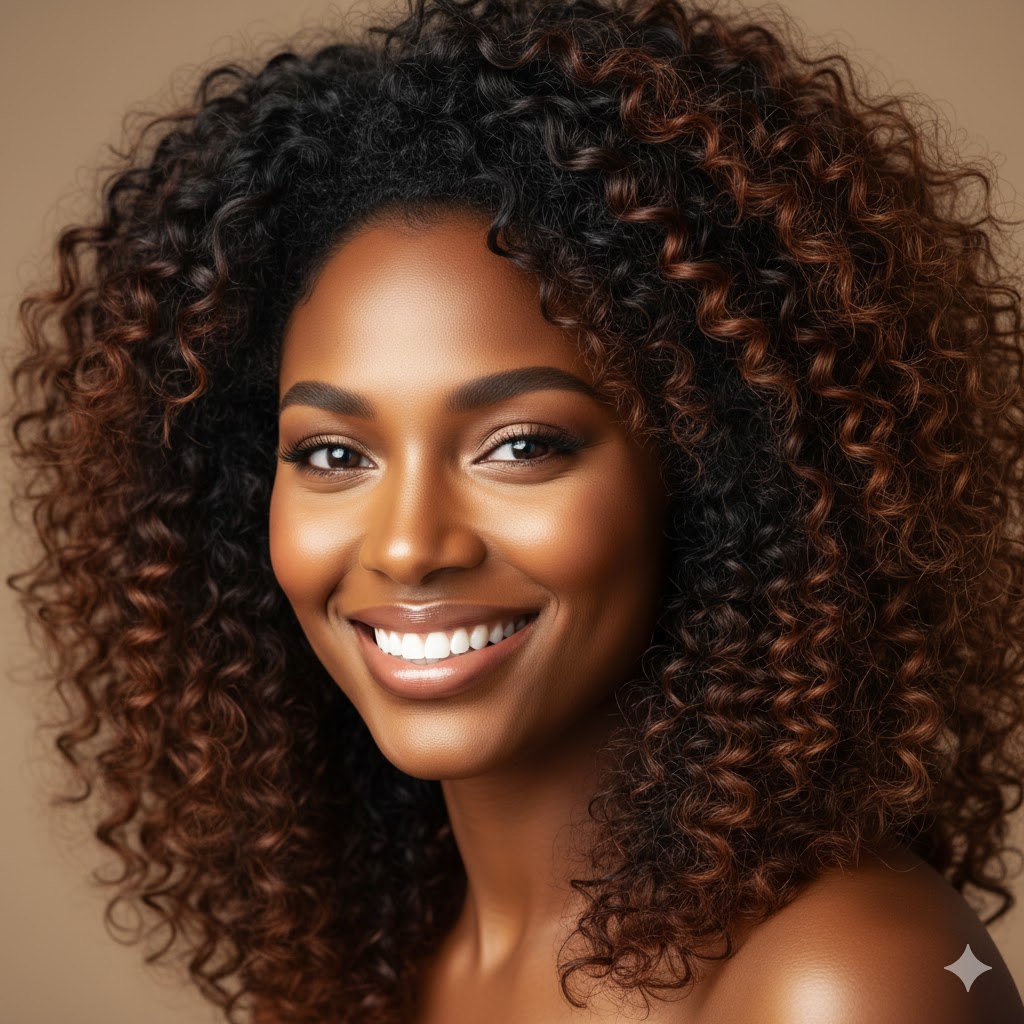
Brown girl blooming is the sacred story of becoming—an unfolding that resists erasure and outgrows every attempt to confine it. Her bloom is not accidental but intentional, watered by ancestors who endured storms she will never fully see. She rises with the memory of those who survived, those who fought, and those who refused to let the world define their worth. Her beauty grows from lineage, truth, and unbreakable Black resilience.

Brown girl blooming means learning to love the soil you were planted in, even when that soil feels too heavy, too harsh, or too overlooked. The richness of melanin carries a testimony of survival, a melody of triumph sung through generations. No flower is judged for the darkness of its petals; rather, it is celebrated for its rare and incomparable brilliance. So too is the brown girl who steps into her own light.

Her bloom is not simply external but deeply spiritual. She learns that God did not make a mistake when He shaped her features, deepened her tones, and crowned her with textured glory. She discovers scriptures that affirm her value, reminding her that she is “fearfully and wonderfully made” (Psalm 139:14, KJV). This truth becomes the wind that pushes her toward self-acceptance.

Brown girl blooming is transformative because it requires the courage to reclaim what society taught her to reject. For decades, she was told that her hair needed to be tamed, her voice softened, her presence minimized. Now, she blooms by taking up space unapologetically, stepping into rooms that were never built with her in mind, yet cannot thrive without her influence.

Society often demanded her labor while dismissing her identity. Yet she continues to rise, drawing from the legacy of women like Sojourner Truth, Ida B. Wells, and Maya Angelou—women who bloomed defiantly in the face of oppression. Their courage becomes fertilizer for her growth, reminding her that blooming is both a right and a responsibility.

Every brown girl carries stories in her skin—stories of migration, resistance, creativity, and spiritual strength. These stories are not burdens; they are seeds. When nurtured, they bloom into purpose, wisdom, and generational healing. Her body becomes a living archive of her people’s triumph.

Some seasons of blooming come through pain. Colorism, misogynoir, and systemic bias attempt to stunt her growth. But even broken branches can sprout again. Research on racial identity development shows how affirming environments help women of color thrive despite systemic oppression (Cross & Vandiver, 2001). Brown girl blooming is not a denial of hardship but a declaration of perseverance.

And when she blooms, she helps others bloom too. Her glow becomes a mirror for her sisters, reflecting possibility and belonging. She becomes a sanctuary for other brown girls who are still learning to see their own beauty, offering encouragement and empathy as they fight to bloom in unfriendly soil.

Brown girl blooming is also intellectual. She reads, studies, questions, and innovates. She pursues degrees, builds businesses, writes books, and reconstructs narratives that once excluded her. Education becomes a form of blossoming—a quiet rebellion against historic attempts to keep her mind unwatered.

Her bloom is emotional as well. She learns to love herself in full dimension, not just the polished parts. Healing from trauma, anxiety, and generational wounds is part of her process. She embraces therapy, sisterhood, and faith as tools that prune her soul, making room for new blossoms.

Spiritually, she blooms by understanding her divine identity. She realizes she is made in the image of the Most High (Genesis 1:27, KJV), and that truth radiates through her confidence. Prayer becomes her sunlight; scripture becomes her living water. Her relationship with God sustains her growth even in barren seasons.

Brown girl blooming is cultural. She adorns herself in braids, curls, coils, locs, Ankara fabrics, and sacred traditions that remind her of home. She celebrates her ancestry unapologetically, allowing heritage to be both her root and her blossom.

Her bloom strengthens when she learns to love her voice. For centuries, society silenced Black women’s truths. Now, she speaks with clarity, power, and purpose. She becomes an advocate, a visionary, a storyteller, and a protector of her community.

The world does not always know how to honor her bloom, but that has never stopped her from flowering. She is not fragile—she is resilient, adaptable, and divinely crafted. Her bloom can withstand harsh winds and still grow toward the sun.

Each stage of blooming reveals a new dimension of her identity. Sometimes she is a bud—still closed, still developing. Other times she is in full bloom—radiant, confident, and unstoppable. There is no shame in her process; blooming takes time.

Brown girl blooming also means unlearning the lies of Eurocentric beauty standards. Studies show that internalized colorism and bias affect the self-esteem and mental health of Black women (Huber & Solorzano, 2015). Yet she uproots these lies and plants new truths: she is beautiful, worthy, and complete in her God-given design.

Her bloom inspires the next generation—girls watching their mothers, aunties, teachers, and mentors flourish with dignity and self-love. They learn from her example that beauty is not measured by complexion but by character, brilliance, and inner strength.

Brown girl blooming is not a trend; it is a lifelong journey. It is the ongoing process of learning who she is, what she carries, and why she matters. Each chapter of her life adds new petals to her story.

She blooms when she builds healthy relationships. She surrounds herself with people who see her, honor her, and water her growth. She releases those who only drain her soul, trusting that God will provide better companions for her journey.

She blooms when she chooses joy—unapologetic joy that refuses to be dimmed. She dances, laughs, celebrates, and embraces her own softness. In doing so, she shows the world that Black women deserve pleasure, ease, and rest.

And ultimately, brown girl blooming is a testament to divine promise. Despite every force that tried to bury her, she grew. She survived. She blossomed. And she will continue to bloom for generations to come.


References

Angelou, M. (1986). All God’s children need traveling shoes. Random House.

Cross, W. E., & Vandiver, B. J. (2001). Nigrescence theory and measurement: Introducing the Cross Racial Identity Scale (CRIS). Journal of Counseling Psychology, 48(3), 278–287.

Huber, L. P., & Solorzano, D. G. (2015). Racial microaggressions as a tool for critical race research. Race Ethnicity and Education, 18(3), 297–320.

King James Bible. (1611). Authorized Version.

Truth, S. (1995). Narrative of Sojourner Truth. Penguin Books. (Original work published 1850)

Wells, I. B. (2020). Crusade for justice: The autobiography of Ida B. Wells. University of Chicago Press. (Original work published 1928)