
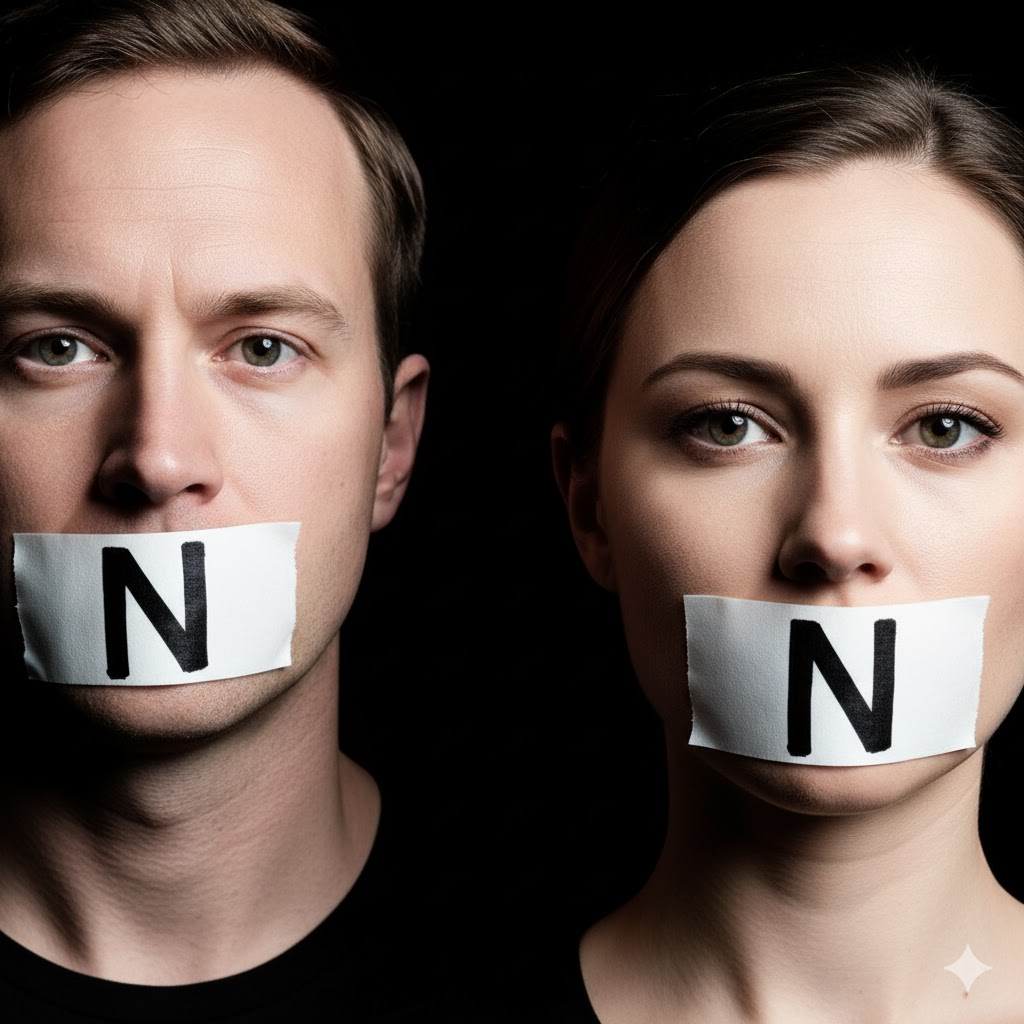
“The N‑word is a linguistic atomic bomb: it is capable of inflicting instantaneous injury, yet its power depends on historical context, speaker identity, and audience. It embodies centuries of subjugation, hatred, and oppression, and no neutral intent can erase that history.”
— Randall Kennedy, The N Word: Who Can Say It, Who Shouldn’t, and Why (2007, Beacon Press)
The word commonly referred to as the “N‑word” occupies one of the most charged spaces in the English language, carrying with it a history of slavery, segregation, dehumanisation, and ongoing racial violence. Its use, whether overt or subtle, signals more than mere insult—it implicates power, identity, culture, and memory. The dilemma lies in how the term continues to resonate, be contested, be reclaimed, and to injure.
Originally derived from the Latin niger (black), the term entered the English lexicon as “negro” (black person) and then evolved into “nigger”, a pejorative term whose first recorded uses as a slur date back to the seventeenth century. AAIHS+3PBS+3AA Registry+3 Even though a linguistic transformation occurred, the historic weight of racialised domination never abated. The term became embedded within the lexicon of white supremacy as a tool of dehumanisation.
In its historic usage, the slur served to mark Black persons as inferior, as property, as objects of violence and contempt. Through slavery, lynching, Jim Crow segregation, and systemic disenfranchisement, the word was more than an insult—it was an instrument of terror. AAIHS+2The Washington Post+2 To call someone this word was to place them at the lowest rung of society, to deny their humanity, to reduce them to a racialised subordinate.
Its meaning, however, is not fixed. Recent scholarship emphasises that context matters: the same lexical form may carry different pragmatic values depending on speaker identity, target, setting, intonation and community. A study of various uses of the slur in film and African American intra‑group settings argues that context determines nuance. PMC+1 In other words, the slur’s semantics are entangled with social and cultural dynamics.
When a non‑Black person uses the word towards a Black person, the meaning is rarely neutral. Given the historical legacy, it almost always signals contempt, racial threat or dominance. The slur thus acts as a linguistic embodiment of racial hierarchy—reinforcing what scholar Randall Kennedy called the “atomic bomb of racial slurs.” PBS+1 The emotional weight carried by the utterance cannot be divorced from the structural history.
Within the Black community, some use a variant ending in “‑a” (i.e., “nigga”) as a form of intra‑group address, signalling camaraderie, shared suffering, and cultural belonging. But this intra‑group appropriation remains contested. On one hand, it is reclamation; on the other, it is still rooted in a lexicon of oppression. PMC+1 This duality captures the complexity of language, identity, and power.
From a sociolinguistic and psychological perspective, the impact of the slur is substantial. Hearing or being addressed with the word has been associated with increased stress, lowered self‑esteem, internalised stigma, and social alienation. A qualitative study of African Americans’ feelings toward the word found strong negative reactions when used by non‑Black persons, and ambivalent or contextually bounded responses when used within the Black community. ScholarWorks The marker of difference and devaluation is thus deeply internalised.
The ethical and theological dimensions are equally weighty. If humanity is grounded in the imago Dei (Genesis 1:27) and dignity is recognized as universal, then the use of a slur that denies that dignity is a moral wrong. The N‑word becomes not merely a linguistic issue but a theological one: the denial of image, the denial of voice, the denial of equal worth. The Christian prophetic tradition that calls for justice (Isaiah 1:17; Amos 5:24) compels an interrogation of how language participates in oppression.
At a cultural level, the proliferation of the slur in media, music (especially hip‑hop), literature, and everyday speech complicates its mitigation. One analysis noted that the N‑word appears half a million times a day in social‑media use of the variant “nigga”. The Washington Post+1 This saturation suggests the word is both hyper‑present and normalized in certain contexts, even as it remains banned or taboo in others.
This juxtaposition—between taboo and normalization—underscores the dilemma. For many youth, especially across racial lines, the word may carry diminished sting or may function as slang. Yet for many older generations and for persons subjected to its historical brutality, the word still evokes chains, lynchings, segregation, and racial terror. The generational and intra‑community divide is thus real and significant. Learning for Justice
Moreover, the double standard inherent in discourse is explicit. Many educators and scholars note that Black persons may face fewer consequences (or different ones) when using the variant among themselves, whereas non‑Black persons often face condemnation, social censure, or institutional discipline. Lester, for instance, taught a college‐level course on the N‑word and observed that discussions often revolved around this double standard. Learning for Justice+1 The question of who may legitimately say the word is itself a question of power and membership.
In workplaces, educational institutions, and legal settings, the slur can trigger claims of hostile work environment, harassment, or discriminatory bias. Courts have grappled with whether intra‑racial use by Black workers can also constitute actionable harassment, demonstrating that the slur remains legally potent. Digital Commons@DePaul The law recognises that language can be a vehicle of structural oppression.
Language scholarship emphasises that slurs are performative: they do things—they wound, intimidate, exclude, subordinate. The N‑word performs historical violence, racial demotion, and cultural silencing. It enacts through sound and symbol what structural racism does through policy and practice. The reclamation rhetoric tries to invert that performance, to transform a scar into a badge—but the original wound remains.
Why do people use the N‑word today? Several motivations exist. Some non‑Black speakers may use it in ignorance of its history, other speakers may use it deliberately as taunt or threat. Sometimes it is used for shock, rebellion or humour (though harm remains). Within the Black community, usage may serve as marker of intimacy or cultural identity. But the asymmetry of power remains: when the speaker is non‑Black, the word seldom escapes the baggage of hate. The refusal of some non‑Black persons to recognise the word’s history is itself an expression of racial insensitivity.
When directed at Black persons in peer or social settings by non‑Black persons, the word often functions as a racial insult, an invocation of threat, or a reaffirmation of inferior status. Its use is fundamentally interlinked with racial hostility because of the long history of its deployment in violence, exclusion and demeaning treatment. It is an instrument of racial harm.
In interpersonal relations it also fosters distrust, emotional injury and intergenerational trauma. The repeated hearing or expectation of the word can condition psychological hyper‑vigilance, identity stress and a sense of perpetual othering. The phenomenon of “racial battle fatigue” resonates here: Black individuals develop cumulative stress responses to recurrent micro‑ and macro‑aggressions, among which the N‑word is a symbolic anchor.
At the community level, the ubiquity of the word among youth, popular culture and digital spaces intersects with structural inequalities and racial hierarchies. The word’s presence signals that racial devaluation remains socially acceptable in many contexts. This undermines collective efforts to build inclusive institutions and equal dignity. The normalization of the slur—especially when used casually—reduces the social impetus for change.
From a historical vantage, the N‑word is deeply tied to structural racism: from its evolution during the era of slavery, where it served as a descriptor of enslaved Africans, to the post‑emancipation era where it reinforced segregation and Jim Crow disenfranchisement, to the present where it persists in linguistic and cultural domains. The scholarly review of its history emphasises its continuity across centuries of racial subordination. AA Registry+1
Critically, the mere elimination of the word does not eliminate the racism behind it. Some commentators argue that focusing solely on “banning the word” distracts from addressing the power structures that allowed the word to thrive. One scholar argued that eradicationists confuse the form of the word with the conditions of its use. PMC In other words, the slur is a symptom, not the root, of racial devaluation.
In light of your interest in theology, genetics, identity and historical injustice, the N‑word invites reflection on how language intersects with inherited trauma, communal identity and racialised bodies. For example, when Black lineages (including Y‑DNA haplogroups such as E1b1a) are reclaimed and celebrated, the presence of a slur undermines the narrative of dignity restoration, reminding us that language remains a battleground for identity.
In conclusion, the dilemma of the N‑word is not simply a lexical matter—it is deeply social, historical, psychological, cultural and structural. Its significance lies in the interplay of language and power, identity and trauma, resistance and reclamation. Addressing the issue meaningfully requires attention not only to who uses the word, but the reasons behind its use, the relational context, the historical weight, and the healing work that must accompany language transformation.
References
Lester, N. A. (2011). Straight talk about the N‑word. Learning for Justice. Retrieved from https://www.learningforjustice.org/magazine/fall-2011/straight-talk-about-the-nword Learning for Justice
Rahman, J. (2014). Contextual determinants on the meaning of the N word. Philosophy & Social Criticism, 40(2), 123‑141. https://doi.org/10.1177/0191453714550430 PMC
Kennedy, R. (2007). The N Word: Who Can Say It, Who Shouldn’t, and Why. Beacon Press. (Referenced in Kennedy’s public commentary). Digital Commons@DePaul+1
National Association for the Advancement of Colored People. (2014). NAACP official position on the use of the word “nigger” and the “N‑word.” Retrieved from https://naacp.org/resources/naacp-official-position-use-word-nigger-and-n-word NAACP
“Analysis of the Reclamation and Spread of the N‑word in Pop Culture.” (n.d.). Undergraduate Showcase. Retrieved from https://www.journals.uc.edu/index.php/Undergradshowcase/article/download/4116/3123 Journals at UC
“A brief history: The word nigger.” African American Registry. (n.d.). Retrieved from https://aaregistry.org/story/nigger-the-word-a-brief-history/ AA Registry
 THE BROWN GIRL DILEMMA