Tag Archives: Jacob

A Long Way Home (Walk with God)

This photograph is the property of its respective owner. No copyright infringement intended.

There is something sacred about the word home. It does not merely describe a physical dwelling, but a spiritual destination—a place of rest, belonging, and divine intimacy. From a biblical perspective, humanity has always been on a journey, wandering between what was lost in Eden and what will be restored in the Kingdom of God. Our entire existence on earth can be understood as a pilgrimage, a long way home.

Scripture presents life as a temporary lodging. “For here have we no continuing city, but we seek one to come” (Hebrews 13:14, KJV). Earth is not our final address; it is a passageway. We are travelers passing through time, culture, trauma, and temptation, all while being called back to the presence of God, from whom the soul originated.

Sin is what made the journey long. In Genesis, Adam and Eve were exiled from divine intimacy, not just from a garden but from unbroken fellowship with the Most High. Every generation since has inherited that spiritual distance. To live in sin is to live in exile—breathing, yet displaced from one’s true home.

Yet God, in His mercy, never abandoned humanity to wander without direction. The entire biblical narrative—from Abraham’s call, to Israel’s wilderness journey, to Christ’s incarnation—is about God providing a path back. Redemption is not merely forgiveness; it is relocation of the soul.

Treasures from our past often shape how we travel. Memories, ancestral wisdom, cultural identity, and lived experiences become spiritual luggage. Some of these treasures refine us, while others weigh us down. God does not ask us to forget our past, but to redeem it—transforming pain into purpose.

Jesus taught that not all treasures belong in our suitcase. “Lay not up for yourselves treasures upon earth… but lay up for yourselves treasures in heaven” (Matthew 6:19–20, KJV). Earthly status, beauty, wealth, and validation cannot accompany us home. Only spiritual capital endures.

Our walk with God is not a sprint but a lifelong pilgrimage. Faith matures through trials, losses, unanswered prayers, and seasons of waiting. Like Israel in the wilderness, we often complain about the journey, forgetting that the delay itself is shaping our character.

Earth becomes a testing ground for the heart. God is less interested in what we accumulate and more concerned with what we become. Pride, bitterness, lust, and fear are burdens that slow the soul’s return. Repentance is the act of unpacking what God never told us to carry.

Home is not heaven as a place; it is God as a presence. Heaven is simply where God fully dwells without obstruction. To return home is to return to intimacy, obedience, humility, and truth. It is not about escaping the world, but being transformed within it.

The Apostle Paul described believers as ambassadors. An ambassador lives in a foreign land but remains loyal to their true country. Likewise, the faithful live in this world but do not belong to its systems, values, or idols.

The greatest deception of modern culture is convincing people that fulfillment is found in external things. Social media, consumerism, and self-worship teach us to build homes in places God never promised to dwell. But anything built without God becomes a temporary shelter.

God desires the heart more than performance. “My son, give me thine heart” (Proverbs 23:26, KJV). The true offering is not religious activity, but inner surrender. The heart is the only possession God explicitly asks us to bring home.

Salvation is not merely about avoiding hell, but about returning to a relationship. Christ did not come to make bad people good; He came to bring lost children back to their Father. The cross is the bridge, not the destination.

Many people reach material success yet feel spiritually homeless. This is because the soul remembers Eden, even if the mind does not. There is a divine homesickness embedded in human consciousness—a longing no relationship, achievement, or pleasure can satisfy.

The longer we stay attached to sin, the longer the journey feels. Sin delays arrival. It fragments identity, distorts purpose, and confuses direction. Every act of obedience shortens the distance between where we are and where we belong.

God’s concept of “packing light” is radical. He calls us to release ego, reputation, unforgiveness, and false identity. What He wants us to carry is faith, love, humility, and truth—items that increase in value the closer we get to Him.

Even suffering becomes a form of spiritual navigation. Trials expose what we truly trust. They teach us that comfort is not home, and pleasure is not peace. Sometimes God allows storms because we have mistaken the boat for the destination.

Death, in biblical theology, is not the end of life but the end of exile. For the righteous, it is not loss but return. It is the final border crossing from temporary residence into eternal citizenship.

To go a long way home is to awaken to who we truly are: souls created by God, separated by sin, restored by grace, and called back by love. Every prayer, every repentance, every act of faith is a step closer to that reunion.

In the end, the only thing God truly wants from us is alignment—our hearts facing the same direction as His. Not perfection, not fame, not success, but surrender. Home is not a place we find; it is a relationship we return to.


What to Pack for the Journey with God

Not physical items, but spiritual essentials:

A surrendered heart
A heart willing to be corrected, softened, and transformed.

A consistent prayer life
Not performance prayers, but honest conversation with God.

The Word of God
Scripture as daily bread, not occasional inspiration.

Repentance and humility
The ability to admit when we are wrong and turn back.

Faith and trust
Believing God even when the path is unclear.

Love and forgiveness
Releasing resentment so the soul can travel light.

Obedience
Choosing God’s will over personal comfort.

Gratitude
Recognizing God’s presence in every season.

Discernment
Knowing what to release and what to carry forward.

Hope
Confidence that the destination is real, even when unseen.


References

The Holy Bible, King James Version. (2017). Hendrickson Publishers.

Augustine of Hippo. (1991). Confessions (H. Chadwick, Trans.). Oxford University Press.

Bonhoeffer, D. (1959). The Cost of Discipleship. SCM Press.

Lewis, C. S. (2001). Mere Christianity. HarperOne.

Nouwen, H. J. M. (1992). The Return of the Prodigal Son: A Story of Homecoming. Doubleday.

Wright, N. T. (2012). After You Believe: Why Christian Character Matters. HarperOne.
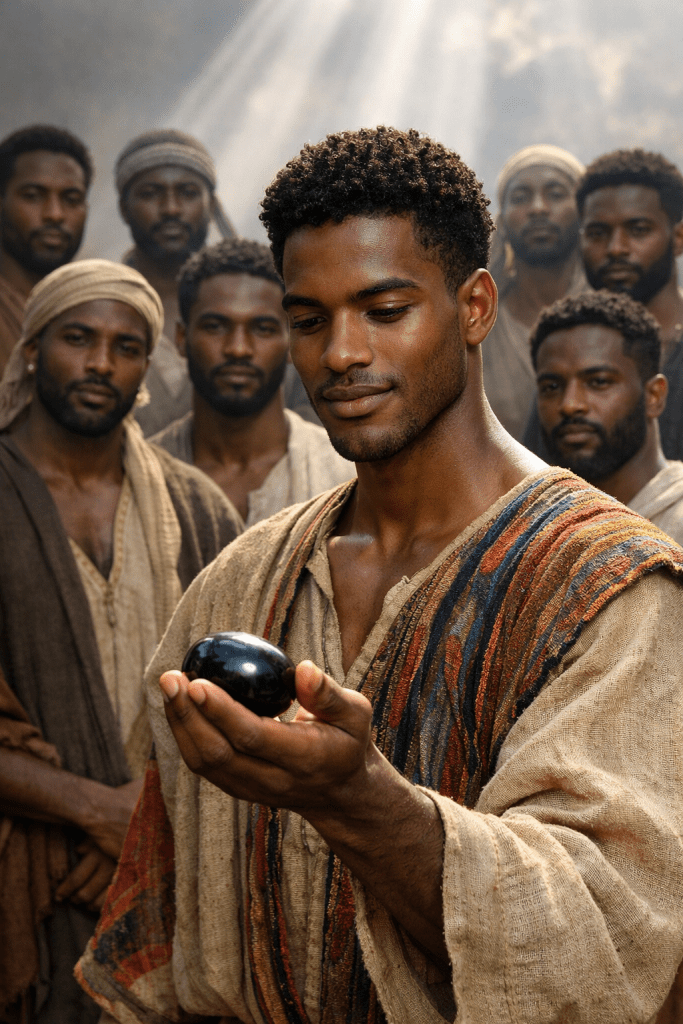
The Onyx Stone: A Family Affair — Joseph and His Brothers.

Onyx, dark as the midnight sky yet polished with hidden light,
a stone of mystery shaped by time and pressure,
a gem that carries both beauty and burden,
whispering of destinies forged through suffering,
and of souls refined in the fire of betrayal.

Onyx holds deep symbolic meaning in the biblical tradition, representing endurance, spiritual depth, and divine remembrance. In Scripture, onyx is one of the stones set in the high priest’s breastplate, engraved with the names of the tribes of Israel, signifying that each tribe was carried before God in sacred memory.

Joseph, the eleventh son of Jacob and the firstborn of Rachel, stands as one of the most compelling figures among the twelve tribes of Israel. His life narrative is not merely historical but theological, illustrating divine providence, generational conflict, and the mystery of chosenness within a fractured family system.

According to rabbinic and later symbolic traditions, Joseph is associated with the onyx stone, reflecting both his dark trials and radiant destiny. Onyx becomes a metaphor for Joseph’s life—polished through suffering, yet ultimately exalted through divine purpose.

Joseph’s story begins with favor, as he is given the coat of many colors by his father, a garment symbolizing distinction, authority, and emotional preference. This visible sign of love ignites jealousy among his brothers, sowing the seeds of betrayal long before the act itself unfolds.

The dreams Joseph receives intensify this conflict. In his visions, the sun, moon, and stars bow before him, along with sheaves of grain belonging to his brothers. These dreams are not merely youthful imagination but prophetic revelations that foreshadow his future role as a ruler and preserver of life.

Yet divine insight does not shield Joseph from human cruelty. His brothers, consumed by envy, conspire against him, stripping him of his garment and casting him into a pit before selling him to Midianite traders for silver, effectively turning family into traffickers and blood into profit.

This act of betrayal reflects one of the Bible’s deepest moral tensions: how God’s purpose often unfolds through human sin. Joseph is innocent, yet he becomes the vessel through which divine redemption will later flow, revealing the paradox of suffering as preparation.

Joseph’s descent into Egypt marks the beginning of his transformation. Though enslaved, he maintains integrity, resisting moral compromise even when falsely accused and imprisoned. His righteousness becomes a quiet rebellion against despair.

In prison, Joseph’s gift of dream interpretation resurfaces, proving that divine calling cannot be silenced by circumstance. His spiritual insight becomes the very instrument that elevates him from prisoner to prince.

Pharaoh’s dreams of famine and abundance position Joseph as a savior figure, entrusted with authority over Egypt’s economy. He rises not by lineage but by wisdom, embodying the principle that divine favor transcends social status.

Joseph’s beauty is also noted in Scripture, described as fair in form and appearance, making him both desired and tested. His physical attractiveness parallels his spiritual calling, showing how outward beauty can coexist with inner discipline.

When famine strikes, Joseph’s brothers unknowingly come before him in search of food, fulfilling the very dreams they once mocked. Their bowing becomes not an act of submission to a man, but to the divine orchestration behind his life.

Joseph’s emotional response reveals the complexity of forgiveness. He weeps privately, torn between memory and mercy, justice and compassion. His power is not in revenge, but in restraint.

The moment of reconciliation becomes one of the Bible’s most profound theological revelations. Joseph declares that what his brothers meant for evil, God intended for good, reframing trauma as testimony.

This declaration does not erase the pain of betrayal but redeems it. Joseph becomes the preserver of the family that once sought his destruction, turning the wound into a wellspring of survival.

Onyx, in this context, becomes more than a gemstone; it is a symbol of Joseph himself—darkened by suffering, refined by pressure, and set in divine memory as part of Israel’s eternal identity.

The family affair of Joseph is not merely about sibling rivalry but about generational inheritance, divine election, and moral responsibility. His story challenges the illusion of fairness and exposes the deeper logic of providence.

Joseph’s life reveals that destiny is not destroyed by betrayal, but often activated by it. The pit becomes the passageway, the prison becomes the platform, and the wound becomes the witness.

Through Joseph, the tribe associated with onyx emerges as a testament to spiritual endurance. He becomes a living stone in the architecture of Israel’s story, bearing both the scars of rejection and the seal of divine favor.

Onyx thus stands as a sacred metaphor for Joseph’s journey, reminding readers that God often engraves glory upon the darkest surfaces, and that what is polished by suffering may one day shine in sovereignty.


References
The Holy Bible, King James Version. (2017). Hendrickson Publishers. (Original work published 1611).
Exodus 28:9–12, 28:20 (KJV).
Genesis 37–50 (KJV).
Alter, R. (2018). The Hebrew Bible: A translation with commentary. W. W. Norton & Company.
Sarna, N. M. (1989). Genesis: The traditional Hebrew text with the new JPS translation. Jewish Publication Society.
Brown, F., Driver, S. R., & Briggs, C. A. (2001). The Brown-Driver-Briggs Hebrew and English lexicon. Hendrickson.

E1B1A: The DNA of Greatness — Tracing the Seed of Israel.

Photo by Muhammad-Taha Ibrahim on Pexels.com

The Y-DNA haplogroup E1B1A is one of the most significant genetic markers in the study of human ancestry, particularly among African populations. Its prevalence in sub-Saharan Africa, especially among West and Central Africans, points to deep historical roots that connect modern descendants to ancient African civilizations. Understanding E1B1A provides insight into the lineage often associated with the biblical Seed of Israel.

Genetic studies indicate that E1B1A likely originated in East Africa and spread westward thousands of years ago. This haplogroup is notably dominant among people of the African diaspora, particularly those whose ancestors were forcibly brought to the Americas during the transatlantic slave trade (Henn et al., 2008). Its prevalence underscores the continuity of African ancestry across continents and centuries.

From a biblical perspective, the Seed of Israel carries promises of covenant, blessing, and nationhood. Scriptures emphasize that God’s covenantal blessings were passed down through the lineages of Abraham, Isaac, and Jacob (Genesis 17:7). Genetic markers like E1B1A offer a modern framework for tracing this lineage in historical and contemporary populations.

The dispersion of E1B1A aligns with historical accounts of migration and conquest. African kingdoms such as Ghana, Mali, and Songhai housed populations with high frequencies of this haplogroup. Their social, economic, and cultural achievements demonstrate a continuity of intelligence, leadership, and resilience—qualities associated biblically with the Israelites (Deuteronomy 28:1–14).

The biblical narrative situates the Israelites as a chosen people, set apart for divine purpose. The connection of E1B1A to African populations reinforces the argument that the original Israelites were of African descent. Psalm 105:6–11 recounts God’s covenant with Abraham and his seed, highlighting the enduring lineage that extends into modern African-descended populations (KJV).

Historically, the transatlantic slave trade severed cultural and genealogical continuity, obscuring the direct lineage of African descendants in the Americas. Despite this disruption, genetic markers like E1B1A provide scientific evidence of enduring heritage and ancestral connection, affirming the biblical promise of the preservation of Israel’s seed (Jeremiah 31:35–37).

Anthropological studies of E1B1A reveal patterns of societal structure, migration, and adaptation. Populations with this haplogroup historically established powerful kingdoms, engaged in sophisticated trade networks, and developed rich cultural traditions. These accomplishments reflect the divine favor and resilience described in Deuteronomy 28:12–13.

The association between E1B1A and leadership traits is notable. Historically, men with this lineage often held positions of authority, governance, and military command. This aligns with the biblical depiction of Israelite men as leaders, judges, and warriors chosen to uphold God’s law and protect their communities (Joshua 1:6–9).

E1B1A also connects to spiritual heritage. The Israelites were entrusted with God’s laws, ethical codes, and covenantal responsibilities. The resilience of African-descended populations, despite centuries of oppression, slavery, and displacement, mirrors the biblical narrative of enduring faith and divine preservation (Psalm 105:8).

Culturally, E1B1A populations have preserved elements of African identity, including language, music, and communal structures, even across diasporic contexts. These cultural continuities serve as living testimony to the endurance of the Seed of Israel, reflecting values emphasized in biblical instruction (Exodus 12:14).

Genetics and scripture intersect in demonstrating continuity and purpose. While DNA provides biological evidence, the Bible provides spiritual and moral context, framing the lineage as not only preserved but chosen and blessed by God (Genesis 28:13–15). Together, these perspectives illuminate the depth of African heritage.

The study of E1B1A challenges Eurocentric historical narratives that have often obscured African achievements. Recognizing the genetic, cultural, and spiritual legacies of E1B1A populations restores historical truth and affirms the presence of the Israelites in Africa (Deuteronomy 28:68).

The distribution of E1B1A among diasporic populations underscores the persistence of identity despite adversity. African-descended people in the Americas, Caribbean, and Europe carry markers of ancient lineage, testifying to the survival of Israel’s seed against historical forces of erasure (Isaiah 49:15–16).

Spiritual reflection on E1B1A emphasizes responsibility and calling. Those who carry this lineage are encouraged to embody principles of justice, wisdom, and leadership, reflecting the covenantal blessings promised to Israel (Proverbs 4:7). The DNA serves not merely as inheritance but as a blueprint for purpose.

Education and awareness of genetic heritage foster empowerment. Understanding the connection between E1B1A and biblical Israel allows African-descended populations to reclaim narratives of dignity, history, and destiny, reinforcing self-worth and communal pride (Jeremiah 33:3).

Modern research on E1B1A includes advanced genetic mapping and population studies. These studies reveal migration patterns, admixture, and historical continuity, providing scientific validation for long-held ancestral knowledge and oral traditions (Henn et al., 2012).

The resilience of E1B1A populations in the face of slavery, colonialism, and systemic oppression demonstrates a living manifestation of biblical promises. Their endurance exemplifies faithfulness and divine protection, echoing Deuteronomy 31:6.

Understanding E1B1A also highlights the intersection of biology, history, and theology. DNA does not exist in isolation—it interacts with culture, belief, and community. Recognizing this interplay enriches both scientific and spiritual understanding of human identity.

Mentorship and intergenerational transmission of knowledge are vital. Passing down awareness of lineage, cultural heritage, and spiritual responsibility ensures that the lessons embedded in E1B1A continue to guide descendants of Israel (Proverbs 22:6).

In conclusion, E1B1A is more than a genetic marker; it is a testament to endurance, heritage, and divine purpose. Tracing this lineage illuminates the biblical Seed of Israel, connecting modern African-descended populations to their ancestral covenant. Recognizing and embracing this inheritance empowers individuals and communities to embody the greatness, resilience, and responsibility embedded in their DNA.


References

Henn, B. M., Botigué, L. R., Gravel, S., Wang, W., Brisbin, A., Byrnes, J. K., … & Bustamante, C. D. (2012). Genomic ancestry of North Africans supports back-to-Africa migrations. PLOS Genetics, 8(1), e1002397. https://doi.org/10.1371/journal.pgen.1002397

Henn, B. M., Cavalli-Sforza, L. L., & Feldman, M. W. (2008). The great human expansion. Proceedings of the National Academy of Sciences, 105(36), 13471–13476. https://doi.org/10.1073/pnas.0805312105

Hunter, M. (2007). The persistent problem of colorism: Skin tone, status, and inequality. Sociology Compass, 1(1), 237–254. https://doi.org/10.1111/j.1751-9020.2007.00014.x

The Holy Bible, King James Version. (n.d.). Genesis 17:7; 28:13–15; Exodus 12:14; Deuteronomy 28:1–14, 28:68, 31:6; Psalm 105:6–11; Isaiah 49:15–16; Proverbs 4:7; 22:6. King James Bible Online. https://www.kingjamesbibleonline.org

Being Spiritually Bankrupt

Spiritual bankruptcy describes a condition in which the soul is impoverished despite outward activity, knowledge, or religious affiliation. It is the quiet emptiness that persists even when one attends services, recites prayers, or possesses intellectual familiarity with Scripture. In biblical terms, it reflects a separation between form and power, where the heart is distant from the Most High though the lips may still speak His name.

In the King James Version, this condition is hinted at when Christ says, “This people draweth nigh unto me with their mouth, and honoureth me with their lips; but their heart is far from me” (Matthew 15:8, KJV). Spiritual bankruptcy is not merely the absence of belief, but the erosion of intimacy with God. It is the soul running on religious fumes rather than living faith.

The spiritually bankrupt individual often experiences dryness, confusion, and fatigue in prayer and reading. Scripture may feel distant or unreadable, and spiritual disciplines become obligations rather than lifelines. This mirrors the Laodicean condition described in Revelation, where believers believed themselves rich, yet were declared “wretched, and miserable, and poor, and blind, and naked” (Revelation 3:17, KJV).

Biblically, spiritual poverty is not always condemned; in fact, it can be the doorway to restoration. Christ declares, “Blessed are the poor in spirit: for theirs is the kingdom of heaven” (Matthew 5:3, KJV). To be poor in spirit is to recognize one’s need, to admit spiritual insolvency without God’s sustaining presence.

Spiritual bankruptcy often develops through neglect rather than rebellion. Slowly, prayer becomes rushed, Scripture reading becomes sporadic, and worldly pressures crowd out sacred space. As Proverbs warns, “He that trusteth in his own heart is a fool” (Proverbs 28:26, KJV). Self-reliance replaces God-dependence, leading to spiritual depletion.

Another cause is unrepented sin, which creates distance between the soul and the Most High. Isaiah declares plainly, “Your iniquities have separated between you and your God” (Isaiah 59:2, KJV). Sin dulls spiritual sensitivity and interrupts communion, leaving the believer spiritually impoverished even while maintaining outward morality.

The first step toward recovery is honest self-examination before God. David models this posture when he prays, “Search me, O God, and know my heart: try me, and know my thoughts” (Psalm 139:23, KJV). Spiritual healing begins when one stops pretending to be full and admits emptiness before the Most High.

Repentance follows recognition. Biblical repentance is not merely sorrow, but a turning of the heart and direction. “If we confess our sins, he is faithful and just to forgive us our sins, and to cleanse us from all unrighteousness” (1 John 1:9, KJV). Confession restores access to divine fellowship and breaks the cycle of spiritual debt.

Prayer must then be rebuilt as relationship rather than ritual. Christ instructed His disciples to pray beginning with reverence and submission: “Our Father which art in heaven, Hallowed be thy name. Thy kingdom come. Thy will be done” (Matthew 6:9–10, KJV). Prayer reconnects the soul to its Source when approached with humility and sincerity.

Effective prayer includes thanksgiving, confession, petition, and listening. The Psalms repeatedly model honest conversation with God, including lament and praise. “The LORD is nigh unto all them that call upon him, to all that call upon him in truth” (Psalm 145:18, KJV). Consistency, not eloquence, restores spiritual vitality.

Reading the Bible is essential to overcoming spiritual bankruptcy, for Scripture is spiritual nourishment. Christ declares, “Man shall not live by bread alone, but by every word that proceedeth out of the mouth of God” (Matthew 4:4, KJV). Without regular intake of the Word, the spirit weakens just as the body would without food.

Scripture reading should be approached prayerfully, asking for understanding and application. “Open thou mine eyes, that I may behold wondrous things out of thy law” (Psalm 119:18, KJV). The goal is not speed or volume, but communion and transformation through divine truth.

Meditation on Scripture deepens this process. Joshua was instructed to meditate on the law day and night to prosper spiritually and practically (Joshua 1:8, KJV). Meditation allows the Word to move from the page into the heart, rebuilding spiritual wealth over time.

Developing a relationship with the Most High requires obedience born from love. Christ states plainly, “If ye love me, keep my commandments” (John 14:15, KJV). Obedience is not legalism but alignment, restoring harmony between God’s will and human conduct.

Trust is another cornerstone of spiritual restoration. “Trust in the LORD with all thine heart; and lean not unto thine own understanding” (Proverbs 3:5, KJV). Spiritual bankruptcy often thrives where trust has been transferred from God to self, systems, or society.

Fellowship with other believers also strengthens spiritual health. Scripture teaches that believers sharpen one another (Proverbs 27:17, KJV). Isolation can deepen spiritual poverty, while righteous community provides encouragement, accountability, and shared wisdom.

Fasting may also play a role in spiritual renewal. Biblically, fasting humbles the soul and reorients desire toward God (Psalm 35:13, KJV). When practiced correctly, it strips away distractions and exposes areas of dependency that must be surrendered.

Ultimately, spiritual wealth is measured by closeness to God, not emotional highs or material success. Paul declares, “I count all things but loss for the excellency of the knowledge of Christ Jesus my Lord” (Philippians 3:8, KJV). True abundance is found in divine intimacy.

The spiritually bankrupt soul is not beyond repair. God promises restoration to those who return to Him wholeheartedly. “Draw nigh to God, and he will draw nigh to you” (James 4:8, KJV). The Most High is not withholding; He is waiting.

Spiritual bankruptcy, when acknowledged, becomes the soil in which renewal grows. Through repentance, prayer, Scripture, obedience, and trust, the soul is rebuilt and restored. The same God who exposes emptiness also supplies fullness, for “the LORD is my shepherd; I shall not want” (Psalm 23:1, KJV).


References (KJV)

The Holy Bible, King James Version.
Matthew 4:4; Matthew 5:3; Matthew 6:9–10; Matthew 15:8
Psalm 23:1; Psalm 35:13; Psalm 119:18; Psalm 139:23; Psalm 145:18
Proverbs 3:5; Proverbs 27:17; Proverbs 28:26
Isaiah 59:2
Joshua 1:8
John 14:15
Philippians 3:8
Revelation 3:17
James 4:8
1 John 1:9

Why Do God’s Chosen Ones Walk Alone?

Biblical and Psychological Reflections

Photo by Aidi Tanndy on Pexels.com

Throughout Scripture, God’s chosen ones often endured seasons of solitude. Abraham left his country and kin at God’s command (Genesis 12:1, KJV). Joseph was betrayed by his brothers and isolated in Egypt before being exalted (Genesis 37–41). Even Christ Himself withdrew to lonely places to pray (Luke 5:16, KJV) and endured Gethsemane’s solitude before the cross. This recurring theme suggests that aloneness is not abandonment, but a sacred space where God develops His chosen vessels.

One reason God’s chosen ones walk alone is preparation for divine assignment. Separation from the crowd allows for spiritual formation, free from distractions and competing voices. In psychology, solitude is associated with self-reflection, emotional regulation, and identity development (Long & Averill, 2003). Spiritually, it allows God’s voice to become clearer, as illustrated when Elijah heard not the earthquake or fire but the “still small voice” (1 Kings 19:12, KJV).

Another reason is that destiny often isolates. The path of the chosen is narrow and cannot be walked by everyone. Jesus taught, “Enter ye in at the strait gate… narrow is the way, which leadeth unto life, and few there be that find it” (Matthew 7:13–14, KJV). Psychology similarly affirms that individuals pursuing uncommon goals or higher callings often experience loneliness, as their values and direction diverge from the majority.

Walking alone also functions as a test of faith and endurance. God uses seasons of isolation to strengthen resilience and dependence on Him. Joseph’s prison years, David’s wilderness hiding from Saul, and Job’s losses all reflect this refining process. Psychologically, enduring solitude can foster resilience and autonomy, teaching individuals to derive self-worth from God and internal strength rather than constant external validation.

Moreover, walking alone guards the chosen against corruption and compromise. When separated, they are less susceptible to the pressures of conformity and worldliness. “Be ye not unequally yoked together with unbelievers” (2 Corinthians 6:14, KJV). Healthy solitude preserves purity of purpose. Psychology supports this principle through the concept of boundary-setting, where distance from toxic influences is necessary for personal growth and emotional well-being.

7 Reasons God’s Chosen Ones Walk Alone

Scripture + Psychology

  1. Preparation for Purpose
  • Genesis 12:1 (KJV): God called Abraham to leave his kin.
  • Psychology: Solitude promotes self-reflection and identity development.
  1. Clarity of God’s Voice
  • 1 Kings 19:12 (KJV): Elijah heard God in the “still small voice.”
  • Being alone quiets distractions so God’s direction becomes clear.
  1. Destiny Requires Separation
  • Matthew 7:14 (KJV): The narrow way is found by few.
  • Psychology: Those pursuing unique callings often experience isolation.
  1. Strength Through Testing
  • Job 23:10 (KJV): “When he hath tried me, I shall come forth as gold.”
  • Trials in solitude refine faith and resilience.
  1. Protection from Corruption
  • 2 Corinthians 6:14 (KJV): “Be ye not unequally yoked…”
  • Healthy solitude guards against negative influence and compromise.
  1. Spiritual Growth and Dependence on God
  • Psalm 62:5 (KJV): “My soul, wait thou only upon God.”
  • Psychology: Solitude develops autonomy and inner strength.
  1. Set Apart for Greatness
  • Jeremiah 1:5 (KJV): “Before I formed thee… I sanctified thee.”
  • God sets apart His chosen to prepare them for higher assignments.

In conclusion, God’s chosen ones walk alone because solitude is the crucible of calling. It is where vision is clarified, faith is tested, character is refined, and destiny is secured. While loneliness may feel like abandonment, Scripture reveals it as preparation: “Lo, I am with you alway, even unto the end of the world” (Matthew 28:20, KJV). To walk alone with God is never truly to be alone; rather, it is to be set apart for greatness.


📚 References

  • The Holy Bible, King James Version.
  • Long, C. R., & Averill, J. R. (2003). Solitude: An exploration of benefits of being alone. Journal for the Theory of Social Behaviour, 33(1), 21–44.
  • Weiss, R. S. (1973). Loneliness: The experience of emotional and social isolation. MIT Press.

E1B1A (Genetic Code of the Chosen)

E1B1A, also known as E-M2, is a Y-DNA (Y-chromosome) haplogroup—a genetic lineage passed exclusively from father to son. It is one of the most common paternal lineages among men of West and Central African descent, especially among the Yoruba, Igbo, Ewe, Fula, and other Bantu-speaking peoples. It is also prevalent among African Americans, Afro-Caribbeans, and Afro-Brazilians—largely because of the transatlantic slave trade.


🔬 Scientific Overview of E1B1A

  • Haplogroup Name: E1b1a (formerly known as E3a)
  • Current Label in Genetics: E-M2 (E1b1a1)
  • Region of Origin: Sub-Saharan Africa
  • Estimated Age: ~20,000 to 30,000 years ago
  • Genetic Trait: Passed only through the male line (father to son via the Y chromosome)

🌍 Where E1B1A is Found

  • High frequency in West Africa: Nigeria, Ghana, Benin, Cameroon
  • Caribbean & Americas: Especially among descendants of the transatlantic slave trade
  • African Americans: Around 60–70% of African-American men belong to E1B1A

🔁 Why It Matters

  1. Ancestral Tracking: E1B1A helps trace paternal ancestry directly to West Africa.
  2. Diaspora Connection: Found heavily among descendants of enslaved Africans, especially in the U.S., Caribbean, and Latin America.
  3. Tribal Links: Often linked with the Yoruba, Igbo, and Bantu tribes, who were among those captured during the slave trade.

📖 Biblical & Cultural Interpretations

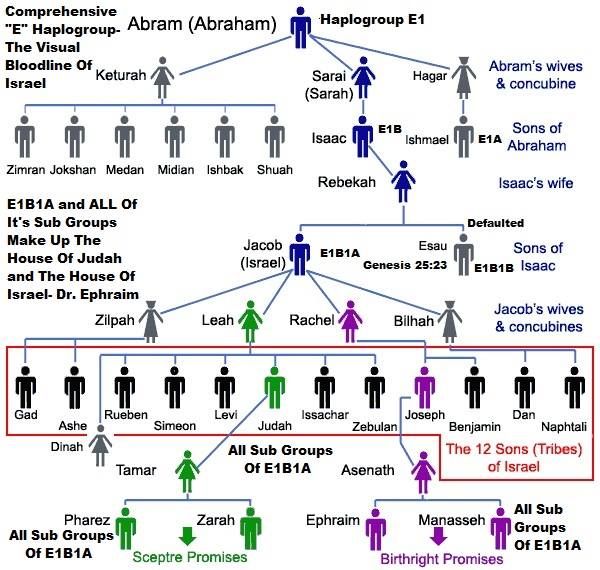
Many researchers and Hebrew Israelite scholars believe E1B1A may correspond with the patrilineal line of the ancient Israelites, especially in light of:

  • Deuteronomy 28:68, which describes being taken into slavery by ships.
  • The historical pattern of curses and captivity matching the transatlantic slave trade.
  • Baruch 4:6 (KJV): “Ye were sold to the nations, not for your destruction: but because ye moved God to wrath, ye were delivered unto the enemies.”

This has led some to identify the E1B1A lineage as belonging to the descendants of Jacob (Israel) and believe it is the genetic marker of the lost tribes of Israel—specifically the tribe of Judah.


⚠️ Common Misconceptions

  • Not all Africans have E1B1A. Some have E1B1B, A, B, or other lineages.
  • E1B1B is often associated with North Africa, the Middle East, and sometimes Esau’s lineage (biblically speaking, the twin brother of Jacob).
  • Y-DNA only traces the male line, so a person’s complete ancestry includes many other lines not captured by Y-DNA.

🧬 Exploring Haplogroup E1b1a: Genetics, Identity & Heritage

Interview with interview with Dr. Yehoshua Ben Ephraim from my book “The Brown Girl Dilemma” 2017

1. Background & Identity

I am originally from Charleston, South Carolina. My intellectual formation is both traditional and autodidactic: I hold an Associate’s, Bachelor’s, and Master’s degree from accredited universities, complemented by an honorary doctorate for substantial contributions to theology and genetics. My expertise spans theology, philosophy, psychology, human behavior, and genetics, sustained by lifelong reading and interdisciplinary inquiry.


2. Origins of the Research

My investigation into lineage and identity was driven by the need to reclaim a lost heritage. Unlike other communities whose ancestral origins in Africa are preserved through tribal or national identity (e.g., Egyptian, Ethiopian), many Black Americans lack this clarity. Genetic research revealed that a significant number of African-descended individuals in the Americas carry Y‑DNA Haplogroup E1b1a, predominantly among the Yoruba and Igbo of Nigeria. This discovery prompted an exploration into how this genetic signature intersects with historical lineage, particularly the prophetic narratives in Deuteronomy 28.


3. The Y‑DNA Haplogroup of the Twelve Tribes of Israel

Through ancestral genetic and scriptural analysis, I concluded that the lineage of Jacob (the Patriarch of Israel) corresponds with Haplogroup E1b1a. The biblical reference in Deuteronomy 28:68, which mentions future enslavement “by ships,” appears prophetic when aligned with the transatlantic slave trade and the predominance of E1b1a among enslaved Africans. Y‑chromosome inheritance is paternally transmitted and unchanged, allowing us to trace a direct male line from Jacob to present-day descendants of the twelve tribes.


4. Genetic Comparison: Ashkenazi Jews & E1b1b

Genesis 25:23 declares that the nations of Jacob and Esau would diverge. Genetically, Esau’s descendants align with Haplogroup E1b1b, which is prevalent in certain Middle Eastern and North African populations. Many Ashkenazi Jews display E1b1b or haplogroup J—distinct from E1b1a, which supports a separate ancestral line. Misattributions linking E1b1b to Black Israelites are thus historically and scientifically flawed.


5. African Tribes & Mixed Lineage

Several African ethnic groups—such as the Lemba, Ashanti, and Igbo—carry both E1b1a and E1b1b haplogroups, reflecting historical admixture. Modern diaspora communities (e.g., in Brazil, the Caribbean, and the United States) also reflect this genetic diversity, consistent with historical migration and intermarriage patterns.


6. The Debate on Black Hebrew Israelites

DNA makes lineage claims far more objective. Since E1b1a is exclusive to the male line of Jacob, any claimant to Israelite identity must test positive for E1b1a. Others may have spiritual, cultural, or chosen affiliation but lack genetic continuity. This clarity undercuts ambiguous identity claims by non-E1b1a lineages.


7. Biracial Identity & Patriarchal Lineage

Y‑DNA is strictly paternal, affecting male descendants. However, cultural and genetic heritage in biracial individuals is influenced by both parents. Thus, while only biological fathers transmit Y‑DNA, biracial Israelite identity can be recognized through maternal collateral lines but requires genetic evidence for formal claim.


8. How DNA Defines National Lineage

Beyond identifying immediate relations, subgroups within E1b1a trace the fourteen branches of Jacob’s descendants (including Joseph’s sons, Ephraim and Manasseh). Genetic markers may eventually assist in mapping modern individuals to specific tribes.


9. Deuteronomy 28 in Context

Deuteronomy 28 outlines blessings and curses tied to Israel’s fidelity. Subsequent exile and dispersal—interpreted as the African diaspora—mirror the conditions described. This scriptural prophecy frames the historical and genetic narrative of descendants of Jacob (the Negroid lineage).


10. Present State & Path Forward

In 2017, many descendants remain disconnected from authentic identity, often identifying broadly as “African American.” This lack of specificity perpetuates cultural dislocation. Romans 9:27 suggests only a remnant attains covenantal alignment—highlighting the need for genealogical clarity and spiritual awakening. My role is to provide empirical—and scriptural—evidence. Change begins when we reconnect with identity and commit to obeying divine statutes.


🔍 Conclusion

  • E1b1a marks the paternal lineage of Jacob (Israel).
  • It is the definitive tool to distinguish genetic Israelites from others.
  • Recognizing this genetic truth is essential to rightful identity.
  • Following identity restoration comes moral and spiritual responsibility.

References:

Jobling, M. A., Hurles, M. E., & Tyler-Smith, C. (2013). Human Evolutionary Genetics. Garland Science.

Kittles, R. A., & Weiss, K. M. (2003). Race, ancestry, and genes: Implications for defining disease risk. Annual Review of Genomics and Human Genetics, 4(1), 33–67. https://doi.org/10.1146/annurev.genom.4.070802.110300

Underhill, P. A., et al. (2000). The phylogeography of Y chromosome binary haplotypes and the origins of modern human populations. Annals of Human Genetics, 64(Pt 3), 223–241. https://doi.org/10.1046/j.1529-8817.2000.00085.x

U.S. National Library of Medicine. (n.d.). Y chromosome haplogroups. Genetics Home Reference. https://ghr.nlm.nih.gov/primer/genomicresearch/ychromosome

Akbar, N. (1996). Breaking the Chains of Psychological Slavery. Mind Productions.

hooks, b. (1992). Black Looks: Race and Representation. South End Press.

Fanon, F. (1967). Black Skin, White Masks. Grove Press.

Russell-Cole, K., Wilson, M., & Hall, R. E. (2013). The Color Complex: The Politics of Skin Color in a New Millennium. Anchor Books.

American Psychological Association. (2019). Ethnic and Racial Disparities in Mental Health Care.