
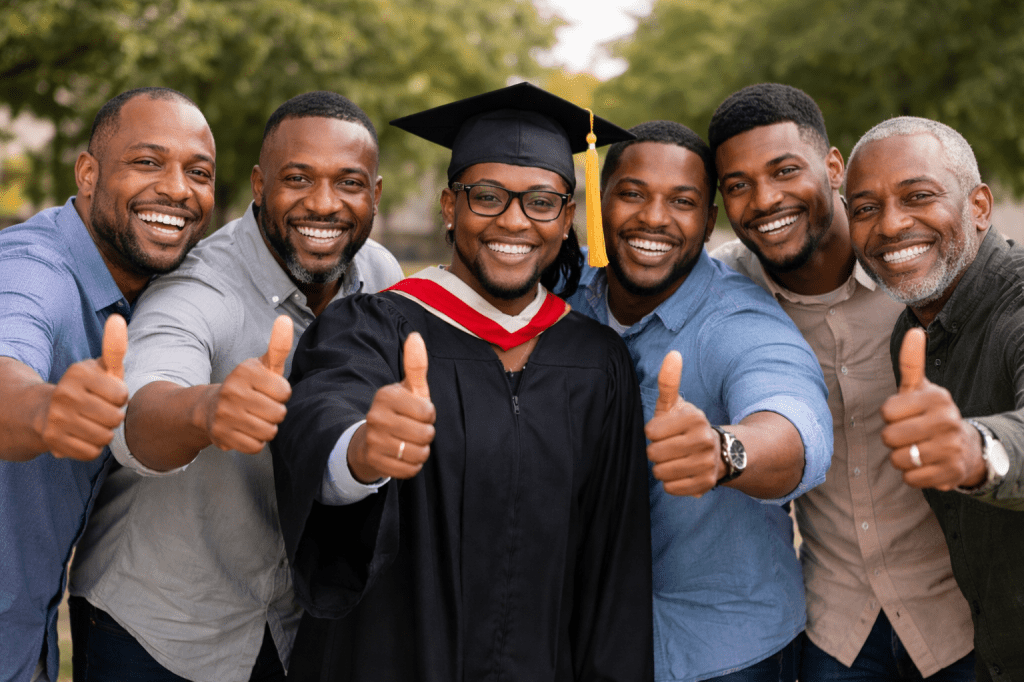
The Black man stands as one of the most complex and misunderstood figures in modern society—shaped by historical trauma, systemic barriers, and cultural misrepresentation, yet continually producing excellence, innovation, and leadership. His story is not one of deficiency, as dominant narratives often suggest, but of resilience: surviving institutions that were never designed for his success while still cultivating identity, dignity, and generational hope.
Historically, Black men were foundational to the construction of the modern world. From forced labor during enslavement to skilled craftsmanship, engineering, agriculture, and military service, Black men have contributed materially to global economies while being excluded from the political and financial rewards of their labor. This historical displacement from power did not erase their leadership capacity—it delayed its recognition.
In education, Black men face some of the most significant structural barriers of any demographic group, including school discipline disparities, underfunded institutions, and racialized tracking systems. Yet despite these obstacles, Black men continue to excel in higher education, producing scholars, scientists, theologians, engineers, physicians, and legal minds who challenge the myth of intellectual inferiority.
The intellectual legacy of Black men includes some of the most influential thinkers of modern history. Figures such as W.E.B. Du Bois, James Baldwin, Martin Luther King Jr., Malcolm X, Frantz Fanon, and Carter G. Woodson reshaped sociology, political theory, psychology, theology, and cultural studies. Their work remains foundational to understanding race, power, identity, and human liberation.
Economically, Black men are increasingly asserting entrepreneurial agency. From tech startups and financial services to fashion, real estate, sports management, and media production, Black men are building independent economic infrastructures. Entrepreneurship has become both a form of resistance to labor market discrimination and a strategy for generational wealth creation.
The Black man is also a cultural architect. Music, fashion, language, and global aesthetics have been profoundly shaped by Black male creativity—from jazz and blues to hip-hop, from streetwear to luxury fashion, from spoken word to film and digital media. Black men continuously produce cultural capital that fuels global industries.
Spiritually, the Black man has served as a prophet, preacher, teacher, and revolutionary theologian. The Black church, Islamic movements, and Afrocentric spiritual systems have provided Black men with frameworks for moral leadership, communal healing, and resistance to psychological colonization. Faith has often been a survival technology in a hostile world.
Psychologically, Black men navigate a unique terrain of racialized masculinity. They are frequently socialized to suppress vulnerability, emotional expression, and mental health needs in order to survive in environments that criminalize their bodies and silence their pain. Yet Black men are increasingly reclaiming emotional literacy, therapy, and self-awareness as tools of empowerment.
In family life, the narrative of the “absent Black father” has been one of the most damaging cultural myths. Research consistently shows that Black fathers are among the most involved fathers across racial groups when structural barriers such as incarceration and economic exclusion are accounted for. Black men actively participate in caregiving, emotional bonding, and moral instruction.
The Black man’s body has historically been framed as a site of fear and criminality. From slavery patrols to modern policing, Black male bodies have been surveilled, punished, and politicized. Yet the Black man continues to reclaim his body as sacred—through health, fitness, discipline, self-care, and spiritual grounding.
Politically, Black men have been central to liberation movements worldwide. From abolition and anti-colonial struggles to civil rights and Pan-Africanism, Black men have organized, theorized, and mobilized resistance against racial oppression. Their political consciousness has shaped democratic ideals globally.
The Black man’s relationship to labor has been one of both exploitation and mastery. Despite being overrepresented in physically demanding and dangerous occupations, Black men have also excelled in professional, technical, and intellectual fields, redefining what Black masculinity looks like beyond brute survival.
In relationships and intimacy, Black men are often burdened by stereotypes of emotional detachment, hypersexuality, or instability. Yet many Black men actively seek emotional depth, spiritual connection, and partnership grounded in respect and mutual growth. They are redefining masculinity beyond dominance toward responsibility and presence.
Culturally, Black men serve as intergenerational bridges. They carry ancestral memory, oral history, and survival strategies passed down through fathers, grandfathers, and community elders. Their identity is not isolated—it is collective, historical, and deeply rooted in lineage.
The modern Black man is increasingly invested in self-development. He studies financial literacy, mental health, spirituality, fitness, and purpose. He reads, builds, mentors, and heals. This shift represents a quiet revolution in Black male consciousness.
The Black man is also a mentor and protector. Whether through coaching, teaching, community organizing, or informal leadership, Black men invest in the next generation, offering guidance in environments where institutional support is often absent.
Despite structural violence, Black men continue to love—deeply, creatively, and spiritually. They love their families, their communities, their cultures, and their futures. Love becomes an act of resistance in a world that expects their emotional absence.
The phenomenal Black man is not defined by pathology but by possibility. He is a survivor of historical trauma and a carrier of ancestral wisdom. He is a thinker, a builder, a father, a lover, a leader, and a visionary.
An ode to the Black man is an ode to perseverance. He exists in the tension between vulnerability and strength, memory and future, pain and purpose. His presence is not accidental—it is historical, spiritual, and revolutionary.
The phenomenal Black man is not waiting to be redeemed by society—he is redeeming himself through consciousness, discipline, faith, and collective responsibility. He is not a problem to be solved, but a force to be understood, honored, and supported.
References
American Psychological Association. (2018). Boys and men of color: Implications for academic success. https://www.apa.org/monitor/2018/07/boys-men-color
Anderson, E. (1999). Code of the street: Decency, violence, and the moral life of the inner city. W. W. Norton.
Bonilla-Silva, E. (2014). Racism without racists: Color-blind racism and the persistence of racial inequality in America (4th ed.). Rowman & Littlefield.
Du Bois, W. E. B. (1903). The souls of Black folk. A.C. McClurg & Co.
Edin, K., Tach, L., & Mincy, R. (2009). Claiming fatherhood: Race and the dynamics of paternal involvement. The ANNALS of the American Academy of Political and Social Science, 621(1), 149–177. https://doi.org/10.1177/0002716208325548
Fanon, F. (1952). Black skin, white masks. Grove Press.
Harper, S. R. (2012). Black male student success in higher education. ASHE Higher Education Report, 38(3), 1–140. https://doi.org/10.1002/aehe.20002
National Center for Education Statistics. (2022). Status and trends in the education of racial and ethnic groups. https://nces.ed.gov/
Pew Research Center. (2018). Black fathers more involved than other dads. https://www.pewresearch.org/social-trends/2018/06/14/fathers-day-2018/
U.S. Department of Justice. (2021). Contacts between police and the public. https://bjs.ojp.gov/
U.S. Small Business Administration. (2023). Black-owned business statistics. https://www.sba.gov/
Woodson, C. G. (1933). The mis-education of the Negro. Associated Publishers.
World Economic Forum. (2020). The future of jobs report. https://www.weforum.org/reports/
 THE BROWN GIRL DILEMMA