
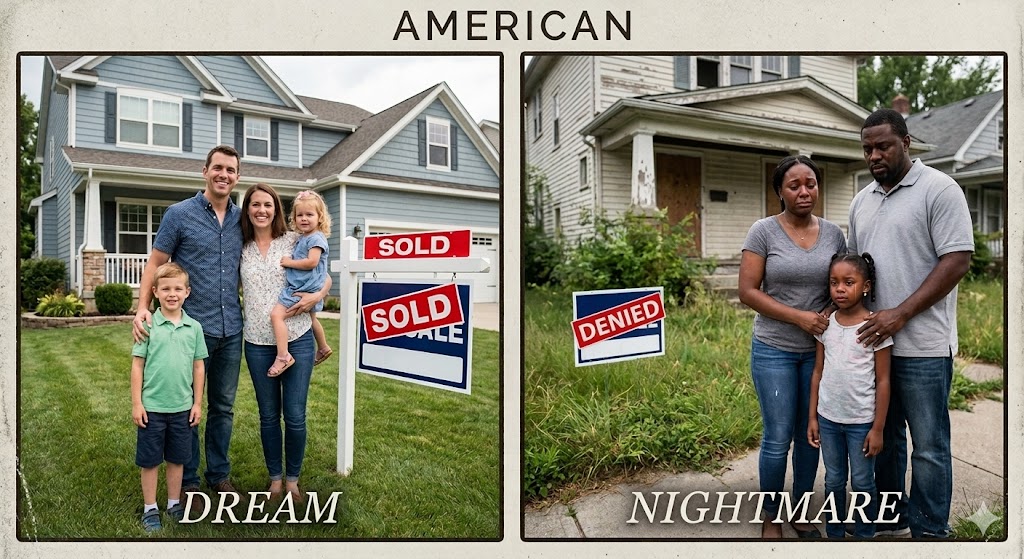
Discrimination in the United States persists as a multifaceted and entrenched phenomenon, extending across domains of employment, housing, and lending. For Black Americans, the impact of discriminatory barriers in these arenas compounds historically embedded disadvantages, reflecting systemic patterns of prejudice, exclusion, and economic dispossession. In examining the hiring process, housing access, and discriminatory lending, we uncover the structural mechanisms that limit opportunity for Black individuals – even those with education – and perpetuate racial wealth gaps and labour‑market segregation.
In the domain of hiring, empirical studies consistently reveal that Black applicants face markedly lower callback and employment rates compared to otherwise equally qualified White applicants. A meta‑analysis of field experiments found that since 1989, White applicants receive on average 36 % more callbacks than African Americans, and 24 % more than Latinos, while controlling for applicant education, gender, method, occupation and local labour market context. PubMed+1
Such findings challenge narratives of progress toward racial equality in employment. Despite decades of civil rights legislation, the level of hiring discrimination against African Americans has changed little. PubMed+1 This means that Black applicants—even those with credentials—face structural barriers at the outset of labour‑market entry that their White counterparts do not.
A large correspondence study of more than 83,000 fictitious applications sent to over 11,000 jobs across 108 major U.S. employers found that Black applicants received approximately 21 fewer callbacks per 1,000 applications than White applicants. Becker Friedman Institute+1 The authors further identified that the discrimination was not evenly distributed: a relatively small group of firms accounted for a large share of the lost opportunities for Black applicants.
From a theological or sociological perspective, these patterns amount to more than individual prejudice—they are manifestations of structural injustice, wherein the “imago Dei” of Black persons is undermined by systems that assign lesser value to their human capital. The fact that educated Black individuals may still be rejected highlights that the barrier is not simply about skills or experience, but about race.
When examining layoffs, job instability and employment insecurity, Black workers are recognised to experience higher vulnerability. According to the Pew Research Centre, 41% of Black workers say they have experienced discrimination or unfair treatment by an employer in hiring, pay or promotions because of their race or ethnicity. Pew Research Centre. While the data on indiscriminate layoffs specific to Black educated workers is sparser, the broader context of racial labour‑market disadvantage forms a backdrop.
The labour‐market disadvantage is compounded by social and spatial isolation, lower networks of opportunity, and cumulative disadvantage of prior schooling, which the Brookings Institution notes as contributing factors in the low employment rates among Black men. Brookings This reveals that even when credentials are comparable, the social context for Black workers diverges from that of White workers.
In addition to blatant discrimination in contacts and callbacks, the phenomenon of “taste‐based” discrimination (employer prejudice) combined with search frictions can reproduce racial gaps across skill levels. One labour‑market model shows that discriminatory hiring can account for 44% to 52% of the average wage gap and 16% of the median wealth gap between Black and White workers. arXiv Thus, hiring discrimination is not only a hiring problem but a wealth‑creation hindrance.
Turning to housing, Black Americans similarly face differentiated treatment in the rental and housing markets. A correspondence study of over 25,000 interactions with rental property managers in the fifty largest U.S. cities found that African American and Hispanic/Latinx renters continue to face significant constraints. Russell Sage Foundation. The study links these constraints to higher levels of residential segregation and lower intergenerational income mobility for Black families.
Moreover, home‑ownership trends for Black households reveal persistent structural obstacles. For example, enforcement of fair‑housing policy correlates positively with growth in Black homeownership from the 1970s through the 1990s, yet the rate has stagnated in recent decades. SpringerLink Even when Black families achieve homeownership, they often pay a “premium” relative to Whites or live in lower‑value neighbourhoods—facts that reflect deeper discrimination beyond mere access. Brookings
In the arena of lending, Black applicants similarly confront systemic discrimination in both small business and consumer credit markets. A study of the Paycheck Protection Program (PPP) found that Black‐owned businesses received loans approximately 50% lower than those of White‐owned businesses with comparable characteristics. PubMed. This disparity existed even after controlling for business size, risk, and geography.
In consumer credit markets, adverse differential treatment emerges clearly. For instance, a study of auto lending combined credit‐bureau records with borrower characteristics and found that Black and Hispanic applicants had approval rates 1.5 percentage points lower than equally creditworthy White applicants, and paid higher interest rates by about 70 basis points—consistent with racial bias. OUP Academic These gaps persist even where risk is controlled, indicating bias rather than purely statistical discrimination.
In mortgage lending, a preprint review of data from 2007‑2016 found that White applicants had higher approval rates than Black applicants with identical financial profiles in 23 of 25 analyzable cells, with disparities of 17–18 percentage points in many groups. Preprints Such substantial gaps in approval reflect discriminatory practices in the mortgage market, which in turn inhibit wealth accumulation via home equity for Black families.
These discriminatory patterns in hiring, housing, and lending do not occur in isolation—they intersect and compound. A Black individual who faces difficulty being hired, lives in a less‑valued neighbourhood, pays higher costs for housing, and is denied equitable lending is locked into a spiral of limited upward mobility and constrained wealth accumulation. From a scriptural lens, this resembles the “cursings” described in Deuteronomy 28, where structural injustice results in generational disadvantage.
On hiring: One subtle aspect of discrimination arises in layoffs and job losses during downturns. Though less studied in field experiments, qualitative and quantitative reports suggest that Black workers are disproportionately the first to be laid off in struggling firms, and face longer spells of unemployment when they lose employment. Investopedia The result is a greater wage‑loss and longer recovery time, further deepening racial economic inequality.
The educational attainment of Black applicants does not always shield them from discrimination. Indeed, research shows that even college‑educated Black applicants suffer callback disadvantages. A classic study by Devah Pager found that Black men without criminal records fared about as poorly in callback rates as White men with felony convictions. While newer data exist, the pattern remains: credentials alone do not eliminate racial hiring gaps. Brookings+1
In housing the consequences of discrimination are both direct and indirect. Directly, Black renters are steered to less desirable units or denied access outright. Indirectly, devaluation of homes in Black neighbourhoods reduces generational wealth building. Brookings reports that homes in majority‑Black neighbourhoods are valued about 23 % less than comparable homes in White neighbourhoods—about $48,000 less per home on average. Brookings Such devaluation reflects systemic discounting of Black neighbourhoods and underscores how housing discrimination inhibits capital formation.
Turning to discriminatory lending for wealth creation: The inability of Black families to access mortgages at the same rate as White families with comparable financial profiles restricts their ability to build home‑equity wealth. Homeownership remains one of the primary channels of wealth generation in the United States. The persistent disparities in approval rates and loan terms therefore contribute to the racial wealth divide. The combination of lower approval rates, higher interest rates, and lower appraised values for properties creates a triple bind for Black borrowers.
It is instructive to consider how competition and regulatory oversight may reduce discrimination. In the mortgage context, a working paper showed that greater bank competition following relaxed branching laws in the 1990s reduced the approval differential for Black versus White borrowers by roughly one quarter. Stanford Graduate School of Business This suggests that policy levers can moderate but not eliminate discrimination entirely.
Given these patterns, the ethical and theological implications are profound. From a faith perspective, the consistent undervaluing of Black human potential and the obstruction of access to opportunity reflect a violation of social justice as rooted in scripture. For example, the biblical imperative to “do justice, love mercy” (Micah 6:8) is compromised when structural systems persist in disadvantaging persons based on race. The persistent barriers faced by Black candidates in hiring, housing, and lending call for remedial as well as restorative responses.
Moreover, the intersectionality of these domains intensifies the problem: many Black individuals face simultaneous workplace discrimination, housing segregation and inferior access to credit. As scholars have shown, residential segregation correlates with lower intergenerational income mobility, and discriminatory housing outcomes amplify labour‑market disadvantage. Russell Sage Foundation+1 Addressing one domain without the others is insufficient for full justice.
In considering the lived experience of educated Black applicants who still cannot secure commensurate employment, one must recognise that the barrier is not simply skills or credentials, but employer perception, network bias, and racialised hiring norms. These are harder to quantify, but the experimental evidence on contact rates confirms their reality. The meta‑analysis cited earlier shows little change in hiring discrimination over time despite improvements in education and credentialing among Black jobseekers. PubMed
The context of discriminatory layoffs and job instability means that even when Black workers are hired, they may occupy more precarious positions, less protected from economic downturns and likely to experience choking effects in career progression. The result is a career path that often stalls, reducing lifetime earnings and inhibiting wealth accumulation. From a material‑justice vantage point, this contributes significantly to the wealth gap and economic marginalisation of Black families.
In housing, the longstanding practice of redlining (and its modern equivalents) has meant that Black neighbourhoods have been systematically starved of capital, banking services, and favourable mortgage access. Qualitative work like “Riding the Stagecoach to Hell” documents how Black borrowers received higher‐cost, higher‐risk loans even when controlling for other relevant risk factors. PMC This amplifies debt burdens and slows wealth building.
In small business and entrepreneurial lending, the PPP evidence underscores that seemingly neutral pandemic programmes still reproduced racial disparities in access. The disproportionate relative disadvantage of Black‐owned businesses in PPP loan size demonstrates how even emergency policy initiatives may fall short of equity unless explicitly designed to overcome structural discrimination. PubMed
When assessing solutions, the evidence suggests multi‑pronged approaches. In employment, audit studies and regulatory enforcement (e.g., through the Equal Employment Opportunity Commission) remain vital. On the lending side, increasing competition among lenders and stricter anti‑discrimination oversight show promise, as the branching competition finding indicates. In housing, stronger fair‑housing enforcement and targeted investment in majority‑Black communities are indicated by the homeownership‐law enforcement correlation.
Nevertheless, structural inertia persists. Hiring discrimination has remained largely unchanged for decades; housing discrimination remains robust; and lending discrimination continues despite regulatory regimes. These patterns underscore that the dilemma is not merely one of individual behaviour but of institutional reproduction of racial disadvantage. The theology of restoration thus must engage systemic transformation, not just individual moral change.
Finally, addressing these interlocking domains has implications for economic literacy, financial inclusion, and community wealth in the Black community. From a capitalist society vantage, when half the talent pool is systematically under‑hired, when entire neighbourhoods are devalued via housing discrimination, and when entire segments are denied credit, the economy suffers from inefficiency, under‑utilised human capital, and stunted growth. From a faith perspective, the prophetic vision of justice demands not only legal equality but substantive parity in opportunity and capital access.
In conclusion, the dilemma of discrimination in hiring, housing, and lending remains one of the most persistent structural injustices facing Black Americans. The evidence is clear: the barriers are measurable, the effects are profound, and the remedies require sustained policy, regulatory, theological and communal commitment. Only by understanding the interconnectedness of employment, housing, and credit discrimination—and their cumulative effect on human dignity and societal flourishing—can we hope to move toward genuine racial and economic justice.
References
Borowczyk‑Martins, D., Bradley, J., & Tarasonis, L. (n.d.). Racial discrimination in the U.S. labor market: Employment and wage differentials by skill. Retrieved from https://ideas.repec.org/p/bri/uobdis/14‑637.html
Brookings Institution. (2023, August 31). For Labor Day, Black workers’ views and experiences of work. Pew Research Center. Retrieved from https://www.pewresearch.org/short‑reads/2023/08/31/black‑workers‑views‑and‑experiences‑in-the‑us‑labor-force‑stand‑out‑in‑key‑ways/
Christensen, P., Sarmiento‑Barbieri, I., & Timmins, C. (2021). Racial discrimination and housing outcomes in the United States rental market. (NBER Working Paper 29516). Retrieved from https://www.nber.org/papers/w29516
Ghoshal, R. (2019). Flawed measurement of hiring discrimination against African Americans. North Carolina Sociological Association. Retrieved from https://nc‑soc.org/articles/flawed‑measurement‑of‑hiring‑discrimination‑against‑african‑americans
Kline, P. M., Rose, E. K., & Walters, C. R. (2021). Systemic discrimination among large U.S. employers. IZA Discussion Paper 14634. Retrieved from https://ideas.repec.org/p/iza/izadps/dp14634.html
Leung, W., Zhang, Z., Jibuti, D., Zhao, J., Klein, M., Pierce, C., Robert, L., & Zhu, H. (2020). Race, gender and beauty: The effect of information provision on online hiring biases. arXiv. Retrieved from https://arxiv.org/abs/2001.09753
Massey, D. S., Rugh, J. S., Steil, J. P., & Albright, L. (2016). Riding the stagecoach to hell: A qualitative analysis of racial discrimination in mortgage lending. City & Community, 15(2), 118‑136. doi:10.1111/cico.12179
Perry, A. M. (2021, February 24). How racial disparities in home prices reveal widespread discrimination. Brookings. Retrieved from https://www.brookings.edu/articles/how‑racial‑disparities‑in‑home‑prices‑reveal‑widespread‑discrimination/
Turner, M. A., Ross, S. L., Galster, G. C., & Yinger, J. (2002). Discrimination in metropolitan housing markets: National results from phase 1 of the Housing‑Discrimination Study. U.S. Department of Housing and Urban Development.
(Additional references for auto‑lending and PPP lending studies as cited above).


 THE BROWN GIRL DILEMMA