
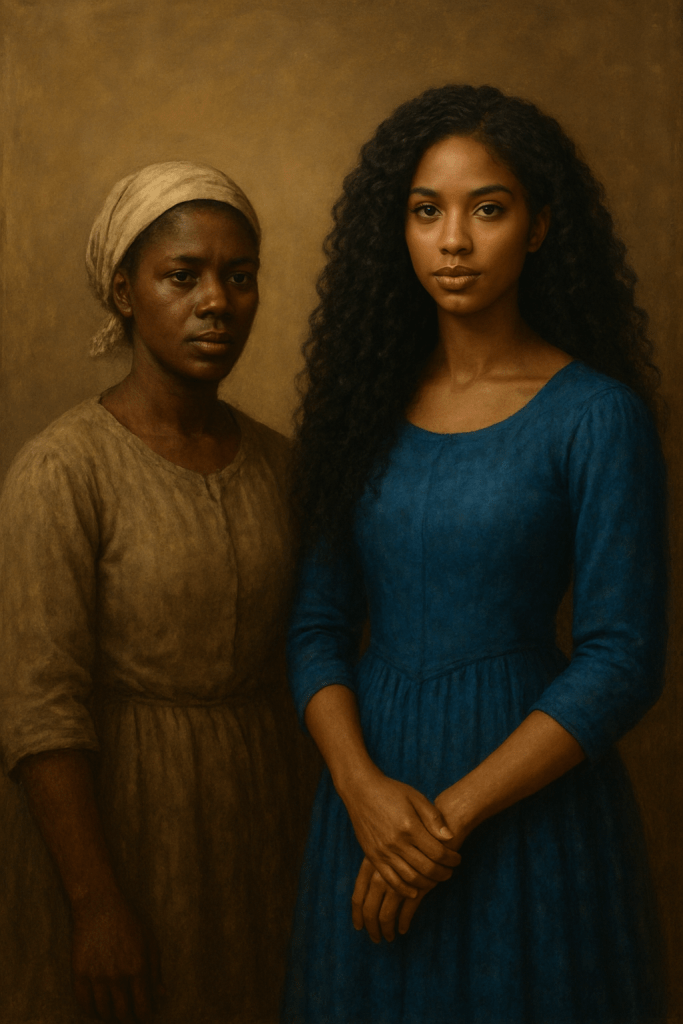
Colorism did not begin as a social preference or a beauty hierarchy. It began as a weapon. The moment enslavers divided African people by skin tone, the seeds of generational fragmentation were planted. This system of racialized favoritism did not emerge from African communities but from the brutality and strategic manipulation of chattel slavery in the Americas. Colorism was engineered to weaken solidarity among enslaved people, to create distrust, to manufacture false hierarchies, and to keep them psychologically controlled.
During slavery, the division between the “house Negro” and the “field Negro” became one of the earliest and most destructive manifestations of colorism. Enslavers created these categories intentionally, assigning different duties, privileges, and punishments based on appearance. Those with lighter skin—often the result of rape, coercion, and abuse by white slaveholders—were more likely to be placed inside the slaveholder’s home. Those with darker skin tones were more frequently relegated to the grueling labor of the fields. This division birthed a social hierarchy that still impacts Black communities today.
To understand the emotional depth of this dilemma, one must examine why certain slaves were placed inside the house. Light-skinned enslaved women were often the victims of sexual abuse. Their proximity to the slaveholder was not privilege; it was violation. Their lighter children became a physical reminder of the violent mixing of oppression and power. Because they resembled the master, they were considered easier to control, more “civilized,” or more acceptable within the home environment.
The field Negro lived under conditions of extraordinary brutality. They labored from sunrise to sunset in scorching heat, cutting sugarcane, picking cotton, or cultivating tobacco. Their bodies bore the scars of whips, chains, and exhaustion. Their work was physically punishing, and their living quarters were typically small, overcrowded cabins with poor sanitation. Yet, despite the harshness of their environment, the field Negro was often seen as mentally and spiritually resilient, unfiltered, and unbroken by proximity to the master’s household.
By contrast, the house Negro was seen as more privileged, but this privilege came with psychological chains. They lived under constant surveillance, forced politeness, and proximity to danger. They had to navigate the emotional volatility of their enslavers, protect their children from being sold, and maintain an appearance of loyalty even while suffering silently. Their clothing, food, and tasks were different—but they were still enslaved, still property, still unfree.
The treatment of each group created emotional fractures that enslavers deliberately exploited. In the house, enslaved people were sometimes given clothing, verbal favors, or lighter workloads—not as kindness, but as manipulation. In the fields, enslaved people viewed those inside with suspicion, believing they were aligned with the master. The house and the field were crafted to be enemies, not allies, and this division became a direct pipeline to colorism.
The purpose of this division was not only physical but psychological. If enslaved people distrusted one another, they would be less likely to organize rebellions, plan escapes, or unite against their oppressors. The slave system relied on internal conflict to maintain external control. The lighter enslaved person, closer to the master’s environment, was conditioned to adopt certain mannerisms, speech patterns, and behaviors that seemed to elevate them in the eyes of the oppressor. The system rewarded assimilation while punishing authenticity.
The darker enslaved person, laboring outdoors, embodied the strength and rawness of African identity. Their deeper skin tone was stigmatized because it symbolized an unbreakable connection to their roots. Slavery punished them more harshly for this. Whipping, backbreaking labor, and deprivation were used to reinforce the lie that darker skin was inferior, dangerous, or less deserving of humane treatment.
The house Negro stereotype later became associated with cooperation with white society, while the field Negro became a symbol of resistance. This dichotomy was famously described by Malcolm X, who used the terms metaphorically to highlight differences in mindset, identity, and resistance within the Black community. These categories still influence how Black people view one another today—through complexion, hair texture, and perceived proximity to whiteness.
Colorism grew as an internalized belief passed down through generations. Lightness became associated with safety, with reduced punishment, with proximity to privilege. Darkness became associated with hardship, danger, and rebellion. These internalized beliefs spread through families, shaping everything from beauty standards to marriage preferences to socioeconomic assumptions.
The legacy of the house-field division deeply influenced Black identity formation. Children born of the master often received special attention not because they were valued, but because they were reminders of the master’s dominance. Their slightly elevated status placed them in the crossfire of envy, resentment, and painful expectations. Meanwhile, darker children were taught strength and survival early because their punishment was more immediate and their labor more severe.
The house Negro often faced psychological trauma that is rarely discussed. They witnessed the master’s private life, endured constant scrutiny, and lived with the threat of sudden violence. They were expected to maintain the household’s emotional balance, sometimes acting as surrogate caregivers, nurses, cooks, or concubines. Their pain was often invisible, dismissed under the myth of “privilege.”
In the fields, pain was more visible. Brutality was public, and suffering was communal. Yet there was also a deep sense of connection, unity, and shared experience. The field Negro carried the collective heartbeat of the community. Their songs, rituals, and traditions preserved African culture in ways the house environment sought to erase.
As the generations progressed, these divisions morphed into color-based discrimination within Black communities. After slavery, lighter-skinned Black people were more likely to be hired, educated, and socially accepted by white institutions. This gave colorism additional fuel, leading to intra-racial discrimination that still shapes identity, relationships, and self-esteem.
The roots of colorism are not accidental—they are engineered. The slave system used complexion as a tool of division, and those wounds did not disappear with emancipation. They became embedded in the social fabric, passed down quietly through families who equated lighter skin with opportunity and darker skin with struggle.
Understanding this history is essential for undoing its damage. The dilemma of colorism is not merely about appearance; it is about identity, trauma, power, and legacy. To heal, Black communities must recognize how deeply slavery shaped perceptions of worth based on skin tone. The field and the house were never natural divisions—they were created by oppression.
Even today, the remnants of these categories influence how people see themselves and each other. Healing begins with confronting the origins of these divisions and refusing to carry forward the hierarchies slavery created. Unifying Black identity requires acknowledging these wounds, rejecting the false narratives of superiority, and reclaiming a collective sense of worth rooted in truth, history, and God’s design.
In Scripture, God declares that all humans bear His image (Genesis 1:27). There was no hierarchy in His creation—only dignity. Recognizing that truth is a crucial step toward dismantling the scars of colorism. The field and the house were systems of bondage, not identity. Understanding their historical purpose allows modern communities to rise above them.
Modern Colorism: A Psychological and Biblical Analysis
Colorism did not end with the plantation; it was modernized, repackaged, and woven into the cultural fabric of the Black experience across the diaspora. Its contemporary expressions can be found in media representation, employment discrimination, dating preferences, beauty standards, and socioeconomic advantages tied to complexion. Although enslavement created the hierarchy, modern institutions continue to reward lighter skin in subtle and measurable ways. In the workforce, research shows that lighter-skinned African Americans often receive higher wages and are perceived as more “professional” compared to darker-skinned counterparts, even with equal qualifications. This reflects the internalized residue of slavery that still shapes perception, value, and opportunity.
Social media has intensified this hierarchy. Filters, photo-editing apps, and beauty algorithms frequently lighten skin, sharpen features, and promote Eurocentric aesthetics as the universal definition of beauty. Colorism becomes normalized in the subconscious because beauty is rewarded with likes, visibility, and digital validation. This reinforcement affects self-esteem, particularly among young girls who internalize the belief that darker skin is a disadvantage to femininity, desirability, or social acceptance. The psychological impact is long-term, deeply emotional, and often unspoken.
Romantic relationships reflect another battleground of colorism. Preferences that appear “personal” are often shaped by societal conditioning. Studies show that both men and women may associate lighter skin with softness, elegance, and femininity, while darker skin is associated with strength, aggression, or hypersexuality. These stereotypes are direct remnants of the slave plantation: the “house” perceived as delicate and desirable, and the “field” viewed as rugged and worn. Though the physical plantation ended, the mental plantation still operates in the subconscious mind.
Women bear the heaviest burden of colorism in modern culture. Beauty is still a form of currency, and society frequently measures worth by appearance. Dark-skinned women often face harsher policing of their tone, attitude, confidence, and femininity. Their beauty is acknowledged reluctantly, conditionally, or only when exoticized. Meanwhile, lighter-skinned women may be celebrated more quickly, assumed to be more approachable or charismatic, and receive privileges that have nothing to do with character. This generational wound shapes sisterhood, self-perception, and community dynamics.
Psychologically, colorism creates identity fractures within the Black community. It produces insecurity in some, superiority in others, and distrust in many. These dynamics weaken unity, creating an internal battleground where people fight over proximity to whiteness instead of reclaiming the richness of their own image. Colorism becomes a device of division, mirroring the same tactics enslavers used to keep the oppressed from rising in collective strength. The trauma persists because systems have not fully dismantled the biases that birthed it.
From a trauma-informed lens, colorism is a form of intergenerational psychological conditioning. The mind learns what it repeatedly sees, and when beauty, intelligence, or success are consistently associated with lighter skin, the subconscious registers this as truth. Healing requires more than awareness—it demands intentional unlearning. Cognitive restructuring, positive representation, cultural education, and community affirmation are necessary steps to breaking the psychological hold of complexion-based hierarchy.
A biblical perspective reveals that colorism is inconsistent with God’s design. Scripture affirms that humanity is made in the image of God, with no hierarchy of value based on physical features. “So God created man in his own image…” (Genesis 1:27, KJV). This means every shade of melanin reflects divine artistry, not a system of worth. The Bible consistently condemns partiality, calling it sin. “But if ye have respect to persons, ye commit sin…” (James 2:9, KJV). Colorism is a form of partiality, a man-made ranking that God never authored.
The Bible also acknowledges the beauty of dark skin. Solomon’s beloved declares, “I am black, but comely…” (Song of Solomon 1:5, KJV), affirming that complexion does not diminish beauty or worth. Yet society reversed this truth, weaponizing skin tone to oppress the very people God adorned with richness and depth. Restoring a biblical perspective allows the community to challenge the lies of colorism with scriptural truth and reclaim identity through God rather than societal perception.
From a spiritual lens, colorism is an attack on purpose. Anything that diminishes self-worth ultimately diminishes potential, confidence, and calling. When people internalize inferiority, they subconsciously limit themselves, shrink before opportunity, or settle for less than what God intended. Colorism becomes not only a social issue but a spiritual barrier to identity and destiny. Healing requires spiritual realignment—seeing oneself not through the gaze of society, but through the eyes of the Creator.
Unity is essential in confronting the residue of the house-versus-field divide. Christ taught that a kingdom divided cannot stand (Mark 3:24–25). The Black community cannot rise while internal fractures persist. Healing colorism requires transparent conversation, generational accountability, and willingness to dismantle inherited mindsets. It also requires celebrating the beauty and diversity of Black skin in all its shades, recognizing each as a reflection of God’s intentional creativity.
Modern colorism will not disappear overnight, but awareness, healing, education, and spiritual grounding create a pathway forward. When the community rejects inherited lies and embraces the fullness of its identity, the plantation in the mind collapses. The descendants of both the “house” and the “field” rise together—not as divided categories, but as one people walking in truth, restored dignity, and renewed understanding.
References
Alexander, M. (2010). The new Jim Crow: Mass incarceration in the age of colorblindness. The New Press.
Billingsley, A., & Caldwell, C. H. (1991). The social roles of Black men and women in the family. Journal of Family Issues, 12(1), 3–25.
Glenn, E. N. (2008). Yearning for lightness: Transnational circuits in the marketing and consumption of skin lighteners. Gender & Society, 22(3), 281–302.
Hunter, M. (2007). The persistent problem of colorism: Skin tone, status, and inequality. Sociology Compass, 1(1), 237–254.
Monk, E. P. (2014). Skin tone stratification among Black Americans, 2001–2003. Social Forces, 92(4), 1313–1337.
Neal, A. M., & Wilson, M. L. (1989). The role of skin color and features in the Black community: Implications for counseling. Journal of Counseling & Development, 67(6), 54–57.
Walker, A. (1982). In search of our mothers’ gardens. Harcourt Brace.
King James Bible. (1769/2023). Cambridge Edition.
Biblical (KJV)
Genesis 1:27
Exodus 1:12
Psalm 139:14
Proverbs 22:2Boyd, T. (2008). The African American experience. Greenwood Press.
Hunter, M. (2007). The persistent problem of colorism: Skin tone, status, and inequality. Sociology Compass, 1(1), 237–254.
Painter, N. (2023). The history of white people. W. W. Norton.
Williamson, J. (1980). New people: Miscegenation and mulattoes in the United States. LSU Press.
Wilder, C. S. (2010). In the shadow of slavery: African Americans in New York City, 1626–1863. University of Chicago Press.
 THE BROWN GIRL DILEMMA