Tag Archives: education

Strength and Struggle: Examining the Social Pressures Placed on Black Women.

Black women in the United States occupy a unique social position shaped by the intersection of race, gender, and historical inequality. Their experiences are influenced by centuries of systemic discrimination, cultural expectations, and social pressures that affect economic opportunities, health outcomes, and societal perceptions. Understanding the realities facing Black women requires examining the historical and structural forces that shape their daily lives.

One of the most significant frameworks used to analyze these experiences is intersectionality, a concept introduced by legal scholar Kimberlé Crenshaw. Intersectionality explains how different forms of discrimination—particularly racism and sexism—interact simultaneously. For Black women, this means facing social barriers that cannot be fully explained by race alone or gender alone but by the combination of both.

Historically, Black women have endured unique forms of labor exploitation and social marginalization. During slavery in the United States, Black women were forced to perform both agricultural labor and domestic work while also being subjected to sexual exploitation. These conditions created enduring stereotypes that portrayed Black women as either excessively strong or morally deviant.

These stereotypes evolved into several harmful archetypes that continue to influence public perception. The “mammy,” “jezebel,” and “angry Black woman” stereotypes emerged from historical narratives that sought to justify inequality and control. These caricatures have persisted in popular culture, shaping how Black women are viewed in workplaces, media, and social institutions.

Economic inequality represents another major pressure affecting Black women. Despite high levels of labor participation, Black women frequently encounter wage disparities compared with white men, white women, and sometimes Black men. Data from the U.S. Bureau of Labor Statistics consistently demonstrates a persistent racial and gender wage gap.

The consequences of wage inequality extend beyond individual income. Lower earnings reduce opportunities for homeownership, savings, and wealth accumulation. Over time, these disparities contribute to the broader racial wealth gap observed across American society.

Education has been an area where Black women have demonstrated remarkable progress. In recent decades, Black women have become one of the fastest-growing groups earning college and advanced degrees. Despite these achievements, barriers to leadership roles and executive positions remain prevalent in many industries.

Healthcare disparities also represent a critical concern. Studies conducted by the Centers for Disease Control and Prevention show that Black women face significantly higher maternal mortality rates than women from other racial groups. These disparities have been linked to unequal access to healthcare, implicit bias among medical providers, and systemic inequalities in the healthcare system.

Mental health pressures are also significant. Many Black women report experiencing high levels of stress related to workplace discrimination, financial responsibilities, and caregiving obligations. Yet cultural expectations often encourage them to appear emotionally resilient regardless of the circumstances.

This expectation is commonly referred to as the “Strong Black Woman” trope. While resilience is often celebrated, scholars argue that the expectation of constant strength can discourage Black women from seeking emotional support or mental health care when needed.

Black feminist scholars have played a central role in analyzing these dynamics. Intellectual leaders such as Patricia Hill Collins and bell hooks have written extensively about the ways Black women resist oppression while simultaneously navigating complex social expectations.

Media representation also shapes how Black women are perceived. Historically, film and television often depicted Black women through narrow stereotypes. Although representation has improved, scholars continue to debate whether contemporary portrayals adequately reflect the diversity and complexity of Black womanhood.

Another significant pressure involves beauty standards and colorism. Western beauty ideals have historically favored lighter skin tones and European features, often marginalizing darker-skinned women. Colorism can influence opportunities in employment, media representation, and social relationships.

Black women are also deeply involved in community leadership and social activism. Throughout American history, they have organized movements advocating for civil rights, gender equality, and social justice. Their leadership has often been underrecognized despite its profound impact.

Figures such as Harriet Tubman, Ida B. Wells, and Shirley Chisholm exemplify the tradition of Black female leadership in American history. Their contributions helped reshape political and social landscapes.

Family and community responsibilities also create unique pressures. Black women frequently play central roles in caregiving, household leadership, and community support networks. These responsibilities often exist alongside professional obligations, creating additional demands on time and emotional energy.

Religious and spiritual institutions have historically provided important support systems. Churches and faith-based organizations have served as spaces where Black women could find community, leadership opportunities, and emotional resilience.

Despite these pressures, Black women have demonstrated extraordinary cultural influence. Their contributions to literature, music, fashion, and art have profoundly shaped American culture and global artistic expression.

Scholars emphasize that understanding the experiences of Black women requires recognizing both the challenges they face and the strength they demonstrate. Their resilience reflects not only personal determination but also collective strategies developed within communities to resist inequality.

Addressing the social pressures facing Black women requires policy reforms that promote economic equity, healthcare access, educational opportunity, and fair representation in leadership positions.

Ultimately, examining the experiences of Black women reveals broader truths about inequality within American society. By acknowledging these realities and addressing systemic barriers, society can move toward a more inclusive and equitable future.


References

Collins, P. H. (2000). Black feminist thought: Knowledge, consciousness, and the politics of empowerment. Routledge.

Crenshaw, K. (1989). Demarginalizing the intersection of race and sex. University of Chicago Legal Forum.

hooks, b. (1981). Ain’t I a woman: Black women and feminism. South End Press.

Jones, C. P. (2000). Levels of racism: A theoretical framework and a gardener’s tale. American Journal of Public Health.

Centers for Disease Control and Prevention. (2023). Racial and ethnic disparities in maternal health.

U.S. Bureau of Labor Statistics. (2023). Labor force statistics by race and gender.

Dilemma: Redlining

The Architecture of Racial Segregation in American Housing

Redlining refers to a discriminatory practice in which financial institutions, lenders, insurers, and government agencies systematically denied or limited access to loans, mortgages, and other financial services to residents of certain neighborhoods based on race or ethnicity. The practice disproportionately targeted Black communities and other minority populations, reinforcing residential segregation and economic inequality across the United States. Redlining became one of the most enduring structural mechanisms used to maintain racial hierarchy in housing, wealth accumulation, and urban development.

The term “redlining” originated from the literal red lines drawn on government-sponsored maps to designate neighborhoods considered risky for mortgage lending. These maps were produced by the Home Owners’ Loan Corporation during the 1930s as part of federal housing initiatives implemented during the Great Depression. Neighborhoods with large Black populations were almost automatically labeled hazardous for investment, regardless of the income or stability of the residents who lived there.

Redlining emerged during the era of sweeping federal housing reform under the Franklin D. Roosevelt administration. In 1933, the U.S. government created the Home Owners’ Loan Corporation to refinance mortgages and prevent mass foreclosures. However, the agency developed color-coded maps to guide lending decisions. Areas marked in green were considered the best investments, while areas marked in red—often where Black Americans lived—were deemed undesirable.

These classifications were further reinforced by policies associated with the Federal Housing Administration (FHA), which was established in 1934. The FHA promoted homeownership through federally insured mortgages but refused to insure loans in neighborhoods with Black residents. This meant that white families could more easily obtain mortgages and build wealth through homeownership, while Black families were largely excluded from these opportunities.

Redlining was not merely an economic practice but a social system that institutionalized racial segregation. Mortgage lenders, real estate brokers, and city planners used these maps to guide investment decisions. Even middle-class Black neighborhoods with stable property values were marked as hazardous. As a result, banks refused to provide loans to Black homeowners seeking to buy, repair, or refinance their properties.

White homeowners and real estate developers frequently benefited from redlining policies. Suburban developments constructed after World War II often included racially restrictive covenants that explicitly prohibited the sale of homes to Black buyers. Developments such as Levittown became symbols of postwar suburban prosperity for white families while simultaneously excluding Black Americans from homeownership opportunities.

Because Black families were prevented from accessing traditional mortgage financing, many were forced into exploitative housing arrangements such as contract buying. Under these arrangements, buyers paid inflated prices for homes but did not gain ownership until the entire payment was completed. Missing even a single payment could result in eviction and loss of all previously paid funds, leaving many Black families financially devastated.

Redlining also restricted Black access to suburban neighborhoods, forcing many African Americans to remain concentrated in urban centers. Cities like Chicago, Detroit, and Baltimore became emblematic of racially segregated housing patterns produced by redlining policies. These patterns shaped the demographic landscape of American cities for generations.

One of the most devastating effects of redlining was its impact on generational wealth. Homeownership is one of the primary mechanisms through which American families accumulate wealth. By denying Black families access to mortgage credit, redlining prevented them from building home equity that could be passed down to future generations.

Redlining also affected neighborhood infrastructure and public services. Communities labeled as hazardous received fewer public investments, including reduced funding for schools, parks, and transportation. Businesses were less likely to open in these areas because banks refused to provide commercial loans, leading to economic stagnation in many Black neighborhoods.

Educational inequality also emerged as a secondary consequence of redlining. Because public school funding in the United States is often tied to local property taxes, neighborhoods with declining property values—often those affected by redlining—experienced underfunded schools. This created a cycle of disadvantage that affected educational attainment among Black children.

Health disparities also correlate with historically redlined neighborhoods. Researchers have found that communities once marked as hazardous often experience higher rates of environmental pollution, limited access to healthcare facilities, and increased prevalence of chronic illnesses such as asthma and hypertension.

Although redlining was formally outlawed with the passage of the Fair Housing Act of 1968, its legacy remains deeply embedded in the American housing system. The law prohibited discrimination in housing based on race, color, religion, or national origin, yet the structural inequalities created by decades of redlining have proven difficult to dismantle.

Modern forms of housing discrimination continue to resemble redlining practices. Some lenders engage in “reverse redlining,” targeting minority communities with predatory loans and subprime mortgages. These financial products often carry higher interest rates and fees, increasing the risk of foreclosure.

Urban scholars have noted that historically redlined neighborhoods still exhibit lower property values compared to areas that were graded favorably in the 1930s. This demonstrates how past policies continue to influence contemporary economic outcomes and spatial inequality.

Redlining also shaped patterns of urban disinvestment that contributed to the decline of many American inner cities during the mid-twentieth century. As white families moved to suburbs with government-backed mortgages, tax bases in urban Black communities declined, limiting municipal resources for infrastructure and public services.

Many historians and sociologists argue that redlining represents one of the clearest examples of structural racism in American policy. Unlike individual acts of prejudice, redlining was embedded within federal institutions, banking systems, and real estate practices, making it a systemic barrier to economic equality.

In recent years, scholars and policymakers have called for reparative housing policies to address the enduring legacy of redlining. Proposals include expanded access to homeownership programs, targeted investments in historically marginalized neighborhoods, and reforms to lending practices to promote equitable access to credit.

Understanding redlining is essential for comprehending the racial wealth gap in the United States. While individual success stories exist, structural barriers created by discriminatory policies significantly shaped economic outcomes for generations of Black Americans.

Ultimately, redlining reveals how government policy, financial institutions, and social attitudes combined to produce lasting racial inequality. Its legacy continues to influence patterns of housing segregation, economic mobility, and urban development in modern American society.


References

Aaronson, D., Hartley, D., & Mazumder, B. (2017). The effects of the 1930s HOLC “redlining” maps. Federal Reserve Bank of Chicago.

Jackson, K. T. (1985). Crabgrass frontier: The suburbanization of the United States. Oxford University Press.

Massey, D. S., & Denton, N. A. (1993). American apartheid: Segregation and the making of the underclass. Harvard University Press.

Rothstein, R. (2017). The color of law: A forgotten history of how our government segregated America. Liveright Publishing.

Satter, B. (2009). Family properties: Race, real estate, and the exploitation of Black urban America. Metropolitan Books.

U.S. Department of Housing and Urban Development. (2023). History of housing discrimination and redlining in America. HUD Archives.

Black History: Economics, Education, and Emancipation.

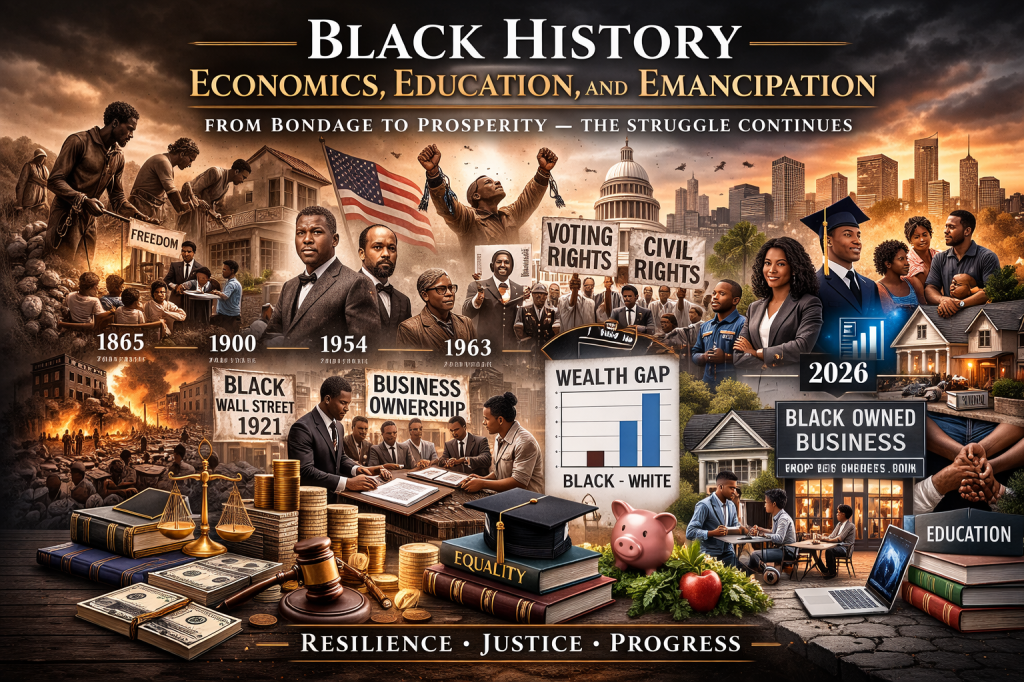
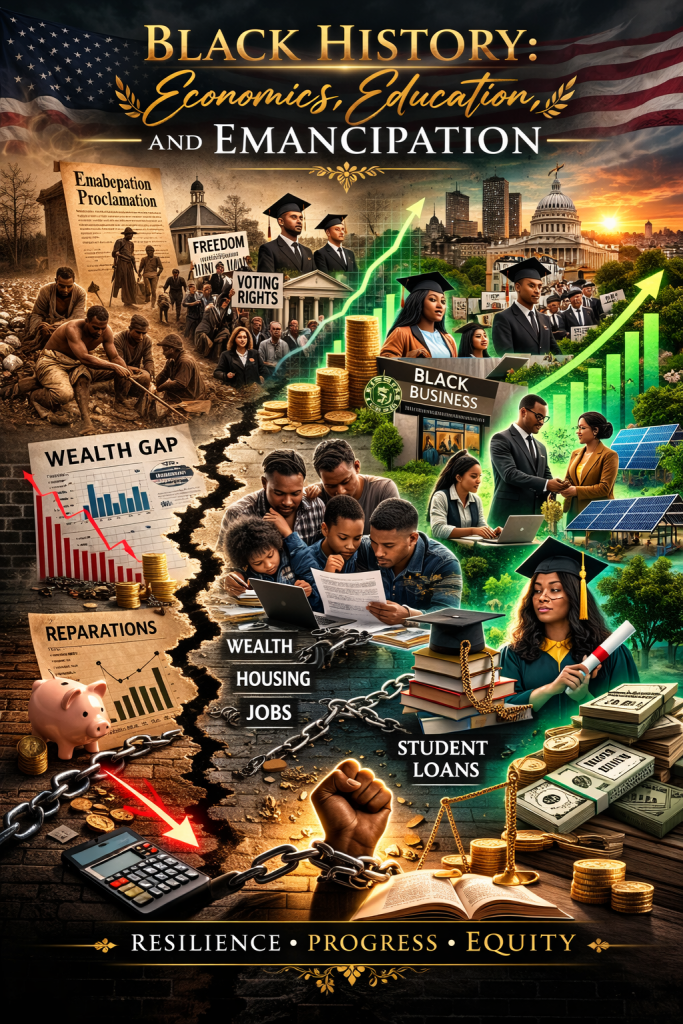
Black history in the United States is not merely a litany of events; it is the story of a people’s persistent struggle for dignity, self-determination, and economic justice. From the systemic deprivations of slavery to the present day, the economic condition of Black Americans has been profoundly shaped by centuries of exclusion, exploitation, and resistance (McKinsey & Company, 2025). The interplay of economic opportunity, access to education, and emancipation has defined both individual lives and collective possibilities.

The legacy of slavery and Reconstruction laid the groundwork for persistent racial inequalities. Even at the formal end of slavery in 1865, Black Americans held virtually no wealth; over a century and a half later, that gap persists. Black households possess only a small fraction of national wealth compared with White households, illustrating how historical racial injustice still translates into economic precarity (LendingTree, 2026; Brookings Institution, 2024).

Structural discrimination continues to influence economic outcomes through labor markets that systematically disadvantage Black workers. Black Americans are overrepresented in lower-wage occupations and underrepresented in higher-paying managerial and professional roles, reinforcing income inequality (McKinsey & Company, 2019). This occupational segregation, rooted in historical discrimination, limits economic mobility and widens the wealth gap across generations.

Education has long been touted as a pathway to economic advancement, yet disparities in educational access and outcomes persist. Predominantly Black school districts receive significantly less funding than predominantly White districts, perpetuating cycles of unequal opportunity and limiting access to high-quality schooling (Black Wall Street Organization, 2025). In this context, education becomes not simply a means of individual uplift but a battleground for equity.

Higher education, while expanding enrollment for Black students over recent decades, also exposes students to disproportionate levels of debt. Black college graduates carry higher student loan burdens than their White counterparts, constraining their capacity to accumulate wealth through homeownership, savings, and investments (Black Wall Street Organization, 2025). Thus, the very institution that promises empowerment can become another vector of economic strain.

Despite the barriers, African Americans have demonstrated remarkable resilience. Historic models of Black economic self-help—mutual aid societies, Black-owned banks, business collectives, and cooperative enterprises—reflect a long tradition of economic self-determination. Yet these efforts have often faced hostile responses, from discriminatory lending practices to overt violence, as in the destruction of Black Wall Street in 1921 (Black Wall Street Organization, 2025).

Homeownership remains a key indicator of wealth building in America, yet the Black homeownership rate lags significantly behind that of White Americans, reflecting a century of housing discrimination and unequal access to mortgage capital (Washington Post, 2026). Even when Black families do own homes, properties often appraise for lower values due to enduring patterns of segregation and appraisal bias, further limiting generational wealth accumulation.

As of recent data, Black homeownership stands well below the rate for White families, and median wages for Black workers are substantially lower across industries. Black workers commonly earn about 70 percent of what White workers earn in comparable sectors, underscoring persistent wage disparities (LendingTree, 2026). These gaps are not accidental; they reflect longstanding structural inequities embedded in the economy.

Economic Data Tables: Black–White Disparities (2025–2026)

Median Household Income & Wealth

IndicatorBlack HouseholdsWhite HouseholdsSource
Median Household Income (2024)~$56,020~$88,010LendingTree (2026)
Median Household Wealth (% of U.S. total)~3.4%~83.5%LendingTree (2026)
Racial Wealth Ratio (White : Black)~8:1ZipDo (2026)
Median Wealth (Black vs White)~$24,100 vs $188,200ZipDo (2026)

Employment & Labor Market Disparities

IndicatorBlack WorkersWhite WorkersSource
Unemployment Rate (Q3, 2025)~7.8%~3.8%LendingTree (2026)
Black Unemployment (Nov 2025 spike)8.3%Reuters (2025)
Earnings Gap (Median wages)~70–75% of White wages100%WorldMetrics (2026)

Homeownership & Wealth Building

IndicatorBlack HouseholdsWhite HouseholdsSource
Homeownership Rate (2026)~43.6%~70.3%Washington Post (2026)
Homeownership Gap (Historical Persistence)Negligible improvement over decadesWashington Post (2026)
Access to Favorable Mortgage TermsHigher denial & biasLower denialLendingTree (2026)

These data illustrate several core structural truths:

  • Persistent Racial Wealth Gap: Black households hold a disproportionately small share of U.S. total wealth (about 3.4%), even though Black Americans represent ~13–14% of the population. Meanwhile, White households control over 80% of the national wealth. Economic inequality is thus not only about income but also about historical asset accumulation and generational transfer of wealth.
  • Income Inequality Across Sectors: Black workers earn approximately 70–75 cents for every dollar earned by White workers across major sectors, with the gap widening in higher‑paying occupations.
  • Employment Barriers: The unemployment rate for Black Americans in late 2025 and early 2026 was more than double the national rate, a persistent pattern indicating structural labor market discrimination and vulnerability during economic contractions.
  • Homeownership & Wealth Building: Black homeownership remains far below White rates, with only about 44% of Black households owning homes — a primary vehicle for middle‑class wealth — compared with around 70% of White households. Appraisal bias, mortgage denial disparities, and historical segregation play significant roles in this enduring gap

The wealth gap also manifests in broader national terms: White Americans hold the vast majority of U.S. wealth, while Black Americans hold only a small sliver despite representing a significant portion of the population (LendingTree, 2026). This imbalance illustrates how historical exclusion has compounded over time, making wealth accumulation a generational challenge.

In the labor market of 2025–2026, the unemployment rate for Black Americans has risen disproportionately higher than the national average, signaling troubling economic trends that scholars and civil rights analysts describe as a “Black recession.” Black unemployment climbed to levels nearly double those of White workers amid broader economic slowdown and policy reversals that eroded programs designed to address racial inequality (State of the Dream Report, 2026).

Economic policy and labor market shifts have gutted diversity and inclusion initiatives in federal agencies, removing support mechanisms that previously helped mitigate racial disparities in employment. As a result, Black workers have borne the brunt of federal job cuts, particularly Black women, who historically are overrepresented in public sector employment (State of the Dream Report, 2026).

The racial wealth gap is not simply an issue of income but of cumulative assets: investments, property equity, business ownership, and inheritance. White families disproportionately benefit from stock market gains and home equity appreciation, while Black families have historically had limited access to these primary vehicles of wealth growth (Investopedia, 2025). This structural imbalance inhibits intergenerational economic security.

The persistence of these disparities challenges the myth that formal emancipation was sufficient to equalize economic outcomes. Rather, emancipation began a long struggle against structural barriers that have constrained Black economic agency. This ongoing reality reveals that legal freedom without equitable economic opportunity remains incomplete.

Economic suffering among Black Americans in 2026 highlights the continuing legacy of these structural inequalities. Rising unemployment, growing wealth concentration among white households, and barriers to capital for Black entrepreneurs all point to an economy in which racial disparities remain entrenched. Scholars argue that the effects of these disparities are so profound that closing the racial wealth gap could significantly benefit the U.S. economy as a whole (McKinsey & Company, 2019).

Educational disparities remain deeply intertwined with economic outcomes. Black students often attend schools with fewer resources, lower teacher salaries, and less access to advanced coursework, hindering academic achievement and future earnings potential. These inequities underscore how education and economic status are mutually reinforcing.

At the same time, economic inequality among Black communities intersects with health, housing, and social stability. The lack of access to quality healthcare increases medical expenses and economic vulnerability, and housing instability remains a persistent threat for families with limited economic resources (Black Wall Street Organization, 2025).

Yet, in spite of systemic barriers, Black economic empowerment initiatives continue to evolve. Black-owned businesses, though smaller and less capitalized than their White counterparts, represent a significant force for community development. Support for entrepreneurship and access to capital remain key strategies for building Black economic resilience (Black Wall Street Organization, 2025).

Historically and in the present day, education has served as both a means of empowerment and a site of struggle. The promise of education as a path to economic freedom remains contested, as disparities in funding, access, and outcomes continue to shape life chances for Black Americans.

To confront the entrenched economic disparities of 2026 and beyond, scholars and policy advocates emphasize the need for structural reforms that address labor market discrimination, broaden access to capital, and ensure equitable educational opportunity. Without such reforms, the legacy of racial economic inequality will persist, limiting the full realization of emancipation.

In sum, Black history—rooted in economics, education, and emancipation—is a testament to both the enduring injustice of systemic exclusion and the persistent struggle for full economic citizenship. The story of Black America’s economic journey reveals deep structural challenges but also the resilience and ingenuity that have propelled this nation toward a more inclusive future.


References

Brookings Institution. (2024). Black wealth is increasing, but so is the racial wealth gap. Retrieved from https://www.brookings.edu/articles/black-wealth-is-increasing-but-so-is-the-racial-wealth-gap/

LendingTree. (2026). Snapshots of Black and White disparities in income, wealth, and employment. Retrieved from https://www.lendingtree.com/debt-consolidation/black-and-white-disparities-study/

McKinsey & Company. (2019). The economic state of Black America: What is and what could be. Retrieved from https://www.mckinsey.com/featured-insights/diversity-and-inclusion/the-economic-state-of-black-america-what-is-and-what-could-be

State of the Dream Report. (2026). From regression to signs of a Black recession. The EDU Ledger. Retrieved from https://www.theeduledger.com/demographics/african-american/article/15815124/state-of-the-dream-2026-from-regression-to-signs-of-a-black-recession

The Washington Post. (2026). Why does Black homeownership lag White ownership in every major city? Retrieved from https://www.washingtonpost.com/business/2026/02/21/black-homeownership-singletary/

Black History: The Rivalry of Booker T. Washington and W.E.B. Du Bois.

Black Minds, Divergent Paths in the Battle for Black America’s Future.

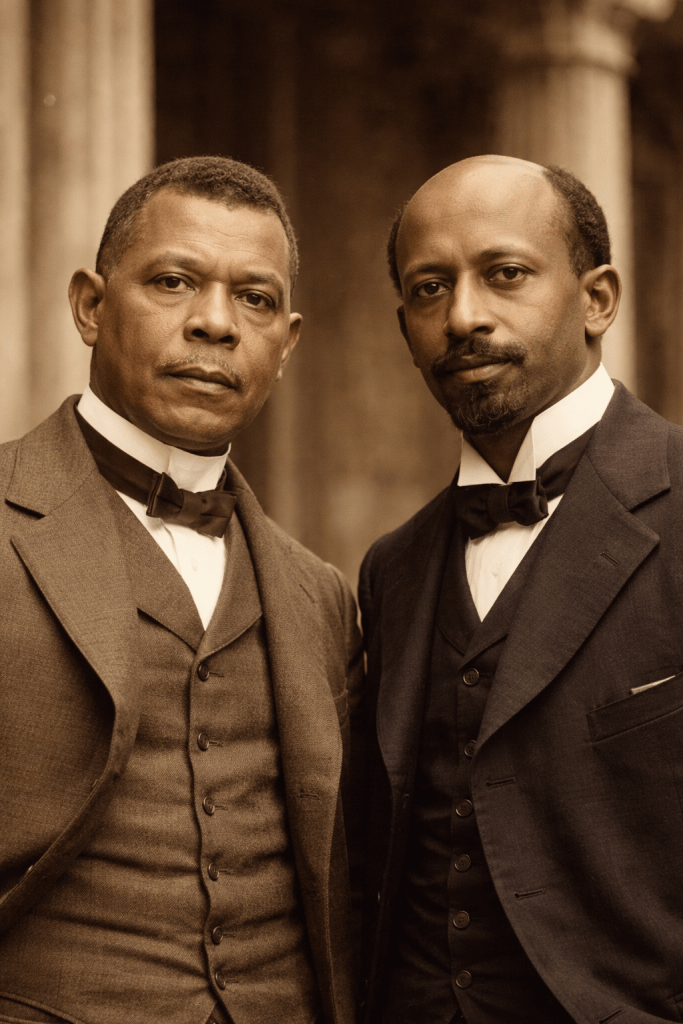
n the long and embattled arc of Black intellectual history, two towering figures emerged at the turn of the twentieth century whose visions would shape the destiny of African Americans for generations: Booker T. Washington and W. E. B. Du Bois. Though contemporaries, their philosophies diverged sharply, reflecting contrasting strategies for racial uplift during the nadir of American race relations. Together, they represent not merely disagreement but the dynamic intellectual tension that propelled Black progress forward.

Booker T. Washington was born into slavery in 1856 in Franklin County, Virginia. Emancipated as a child, he rose from bondage to become one of the most influential Black leaders of his era. His early life of poverty, labor, and illiteracy instilled in him a profound belief in discipline, industrial education, and economic self-sufficiency as the pathway to racial advancement. His autobiography, Up from Slavery, became a testament to perseverance and pragmatism.

Washington’s greatest institutional achievement was the founding of the Tuskegee Institute in Alabama in 1881. There, he emphasized vocational training—carpentry, agriculture, mechanics, domestic science—arguing that economic strength would earn Black Americans respect in a hostile white supremacist society. He believed that dignity could be constructed through labor and ownership, brick by brick.

His philosophy was crystallized in the 1895 Atlanta Exposition Address, often called the “Atlanta Compromise.” In that speech, Washington suggested that Black Americans should temporarily accept segregation and disenfranchisement while focusing on economic development. “Cast down your bucket where you are,” he urged, advocating cooperation with Southern whites in economic matters while avoiding direct agitation for civil rights.

In contrast stood W.E.B. Du Bois, born free in Great Barrington, Massachusetts, in 1868. Du Bois was the first African American to earn a Ph.D. from Harvard University. A scholar of extraordinary brilliance, he mastered history, sociology, economics, and classical studies. His intellect was widely regarded as unmatched among his contemporaries, earning him recognition as one of the greatest thinkers of the twentieth century.

Du Bois rejected Washington’s accommodationist stance. In his seminal work, The Souls of Black Folk, he critiqued what he perceived as Washington’s surrender of political rights. Du Bois introduced the concept of “double consciousness,” describing the psychological tension experienced by African Americans who must navigate a world that views them through the lens of prejudice.

Where Washington championed industrial education, Du Bois advocated for the “Talented Tenth”—the cultivation of a Black intellectual elite who would lead the race toward equality through higher education and political activism. He believed classical education, not merely vocational training, was essential for full citizenship and leadership.

Their disagreement was not simply personal but ideological. Washington emphasized economic gradualism; Du Bois demanded immediate civil rights. Washington sought alliances with white philanthropists and political leaders; Du Bois challenged the very structures of white supremacy. Washington operated behind the scenes, often wielding quiet influence; Du Bois engaged publicly and polemically.

In 1905, Du Bois helped found the Niagara Movement, a precursor to the NAACP, established in 1909. Through this organization, Du Bois became editor of The Crisis, a powerful publication that advocated for anti-lynching legislation, voting rights, and racial justice. His activism laid the groundwork for the modern Civil Rights Movement.

Washington’s influence, however, was equally formidable. He advised U.S. presidents and built networks of Black businesses, schools, and farmers throughout the South. Under his leadership, Tuskegee became a model of Black institutional autonomy. He believed that land ownership, craftsmanship, and financial literacy would fortify Black communities against economic exploitation.

Intellectually, both men were formidable, though in different ways. Washington possessed strategic intelligence and organizational genius. Du Bois embodied scholarly brilliance and philosophical depth. One was a master tactician of survival within oppression; the other a prophetic critic of injustice.

Their views on race also diverged. Washington, shaped by enslavement and Reconstruction’s violent collapse, viewed racial uplift as a long-term project requiring patience and economic stability. Du Bois, shaped by Northern education and exposure to global thought, viewed race as a social construct weaponized by power, demanding immediate dismantling.

Lineage and regional upbringing deeply influenced their perspectives. Washington’s Southern roots, born enslaved, forged a realism rooted in survival. Du Bois, of mixed African and European ancestry, raised in a relatively integrated Northern town, approached race with analytical detachment and global awareness. He later embraced Pan-Africanism, organizing international congresses that connected African diasporic struggles worldwide.

Both men were historically identified and socially classified as Black in the United States, but their ancestry backgrounds were different.

Booker T. Washington was born into slavery in Virginia in 1856. His mother, Jane, was an enslaved African woman. His father was a white man, widely believed to have been a neighboring plantation owner, though Washington never knew him. This means Washington was of mixed African and European ancestry biologically. However, under the racial caste system of the United States—particularly the “one-drop rule”—he was legally and socially defined as Black. Washington identified fully with the Black community and devoted his life to its advancement.

W. E. B. Du Bois was also of mixed ancestry. Born free in Massachusetts in 1868, Du Bois had African, French Huguenot, Dutch, and possibly Native American lineage. He openly acknowledged his multiracial heritage in his autobiographical writings. Despite his partial European ancestry and relatively lighter complexion, Du Bois was socially classified as Black and experienced racial discrimination. He strongly identified as a member of the African American community and became one of its foremost intellectual defenders.

It is important to understand that in 19th- and early 20th-century America, racial identity was not determined by ancestry percentages but by social classification and power structures. The legal doctrine of hypodescent—commonly known as the one-drop rule—assigned anyone with known African ancestry to the Black racial category regardless of admixture.

Genetically speaking, most African Americans descend from a mixture of West and Central African populations with varying degrees of European ancestry due to the history of slavery. Historically speaking, both Washington and Du Bois were Black men operating within and against a racially stratified society that did not recognize “mixed” as a protected or separate political identity.

Du Bois in particular wrestled intellectually with questions of race, ancestry, and identity. In The Souls of Black Folk, he emphasized the social construction of race and the psychological burden imposed upon Black Americans by white supremacy. His mixed heritage did not dilute his commitment to Pan-African solidarity; rather, it sharpened his critique of racial hierarchy.

In summary: biologically, both men had mixed ancestry. Socially, legally, culturally, and politically, they were Black men in America—and they embraced that identity in their scholarship and activism.

Despite their clashes, both men sought the elevation of Black people. Washington feared that agitation would provoke violent backlash. Du Bois feared that silence would entrench permanent subordination. Each perceived the dangers of his time differently, and each responded according to his convictions.

The early twentieth century proved that both strategies held merit. Economic institutions built under Washington provided material foundations for Black communities. Legal activism spearheaded by Du Bois and the NAACP led to landmark challenges to segregation, culminating in victories such as Brown v. Board of Education.

Washington died in 1915, while Du Bois lived until 1963, dying in Ghana on the eve of the March on Washington. Their lifespans bracketed the transformation from Reconstruction’s failure to the threshold of the Civil Rights Movement’s triumphs. History would vindicate aspects of both visions.

Du Bois eventually shifted toward socialism and Pan-African nationalism, critiquing capitalism as a global racial hierarchy. Washington remained committed to American industrial capitalism as a vehicle for Black prosperity. Their economic philosophies reveal deeper tensions about integration, autonomy, and systemic change.

The intellectual rivalry between Washington and Du Bois was not a weakness within Black leadership but a sign of intellectual vitality. Black America was not monolithic; it wrestled with strategy, ethics, and survival in real time. Their debates forced the nation to confront uncomfortable truths about democracy and citizenship.

Today, their legacies continue to shape discussions about education, economic empowerment, protest, and respectability politics. Contemporary debates over vocational training versus liberal arts education echo their arguments. The balance between institutional building and public protest remains central to social justice movements.

To ask who was “smarter” misses the deeper truth. Washington possessed practical genius; Du Bois embodied scholarly brilliance. Intelligence manifested differently in each man, yet both altered the trajectory of history. One built institutions; the other built consciousness.

In the final analysis, Booker T. Washington and W.E.B. Du Bois were not opposites so much as complementary forces within a larger struggle for Black liberation. One carved pathways within the system; the other challenged the system itself. Together, they expanded the intellectual and moral horizons of America, proving that Black thought in the early twentieth century was not only resilient but revolutionary.

References

Du Bois, W. E. B. (1903). The souls of Black folk. A. C. McClurg & Co.

Du Bois, W. E. B. (1968). The autobiography of W. E. B. Du Bois: A soliloquy on viewing my life from the last decade of its first century. International Publishers. (Original work published 1968)

Foner, E. (1988). Reconstruction: America’s unfinished revolution, 1863–1877. Harper & Row.

Harlan, L. R. (1972). Booker T. Washington: The making of a Black leader, 1856–1901. Oxford University Press.

Harlan, L. R. (1983). Booker T. Washington: The wizard of Tuskegee, 1901–1915. Oxford University Press.

Lewis, D. L. (1993). W. E. B. Du Bois: Biography of a race, 1868–1919. Henry Holt.

Lewis, D. L. (2000). W. E. B. Du Bois: The fight for equality and the American century, 1919–1963. Henry Holt.

Logan, R. W. (1954). The betrayal of the Negro: From Rutherford B. Hayes to Woodrow Wilson. Collier Books.

Meier, A. (1963). Negro thought in America, 1880–1915: Racial ideologies in the age of Booker T. Washington. University of Michigan Press.

Washington, B. T. (1901). Up from slavery. Doubleday, Page & Company.

Washington, B. T. (1895). The Atlanta Exposition Address. In L. R. Harlan (Ed.), The Booker T. Washington papers (Vol. 3). University of Illinois Press.

Woodward, C. V. (1955). The strange career of Jim Crow. Oxford University Press.

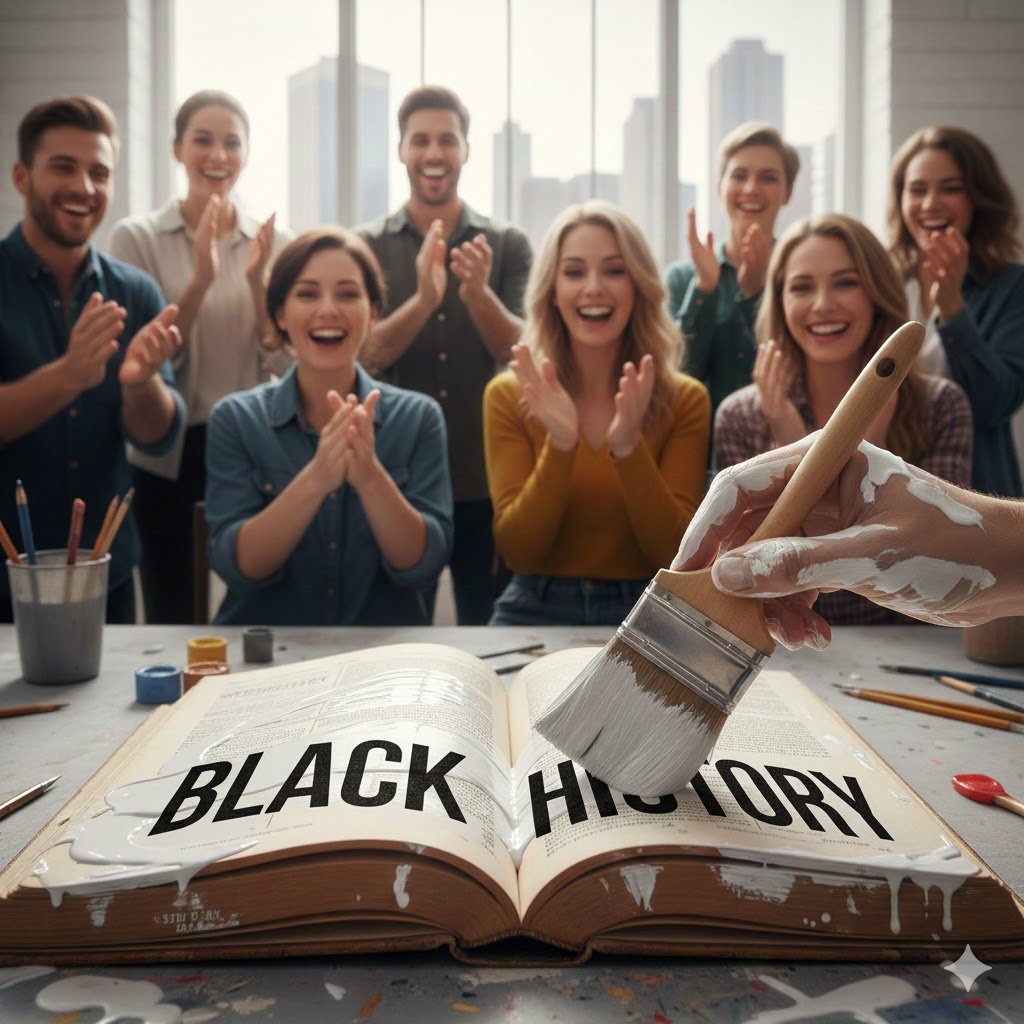
Who Benefits When the Curriculum is Sanitized, and the History is Whitewashed?

When education omits uncomfortable truths or sanitizes history, it does more than distort knowledge—it shapes identities and values in ways that serve the powerful. A whitewashed curriculum often conceals oppression, marginalization, and systemic injustice, leaving students with a skewed perception of reality.

Sanitizing history benefits those who wish to maintain societal dominance. By minimizing the moral failures of the powerful and glorifying selective narratives, the truth about injustice is obscured. Proverbs 18:13 warns, “He that answereth a matter before he heareth it, it is folly and shame unto him.” Without hearing the full account, society cannot respond with justice.

Whitewashing history perpetuates ignorance. Students grow up unaware of the struggles and resilience of oppressed peoples, creating a populace less likely to recognize injustice in the present. Knowledge of history is a form of power, and withholding it sustains inequity.

This sanitized narrative also undermines moral development. Encountering the realities of human sin is essential for cultivating discernment. Romans 1:18–20 states, “For the wrath of God is revealed from heaven against all ungodliness and unrighteousness of men, who hold the truth in unrighteousness.” Suppressing truth allows unrighteousness to flourish.

Those most harmed by whitewashing are communities whose histories are erased or distorted. Cultural and spiritual identity are shaped by knowledge of one’s past. Deuteronomy 32:7 teaches, “Remember the days of old, consider the years of many generations: ask thy father, and he will shew thee; thy elders, and they will tell thee.” History forms the backbone of identity, and its erasure impoverishes future generations.

Sanitized curricula also obscure the mechanisms of systemic oppression. Understanding slavery, colonization, segregation, and exploitation is essential to preventing their recurrence. Ignorance of these realities benefits the descendants of oppressors, who inherit both unexamined privilege and historical myths.

Economic and social power is often maintained through control of narratives. Ecclesiastes 8:11 reminds us, “Because sentence against an evil work is not executed speedily, therefore the heart of the sons of men is fully set in them to do evil.” Delay or denial of historical accountability allows injustices to continue unnoticed.

Whitewashing history also influences psychological and social development. When young people are taught incomplete or sanitized histories, they may internalize inferiority or fail to appreciate their heritage. Understanding one’s ancestry builds resilience and pride.

Sanitized education can manipulate national or cultural identity. By presenting selective histories, institutions foster loyalty to ideologies that serve dominant groups, rather than encouraging critical thinking or moral responsibility. Proverbs 23:23 states, “Buy the truth, and sell it not; also wisdom, and instruction, and understanding.” Truth must be sought and taught, even when uncomfortable.

In contrast, confronting history honestly fosters justice. Awareness of past wrongs equips society to correct present inequities and cultivate empathy. Psalm 82:3–4 exhorts, “Defend the poor and fatherless: do justice to the afflicted and needy. Deliver the poor and needy: rid them out of the hand of the wicked.” Education that recognizes oppression is a tool for justice.

Those in power benefit materially and socially from sanitized curricula. Wealth and influence are preserved, and social hierarchies remain unchallenged. Historical truths that might provoke moral or political reform are hidden.

Religious texts emphasize the importance of remembering and teaching truth. Proverbs 4:7 teaches, “Wisdom is the principal thing; therefore get wisdom: and with all thy getting get understanding.” Knowledge of history is part of this wisdom.

The erasure of marginalized histories also diminishes collective memory. When atrocities or injustices are minimized, lessons from the past are lost, and societies are more likely to repeat mistakes.

Furthermore, sanitized curricula often valorize the oppressor’s narrative, embedding it as a universal truth. This skews morality and erodes empathy, teaching young people to admire figures or institutions without critical evaluation.

A society that ignores historical suffering undermines the spiritual imperative to pursue justice. Isaiah 1:17 instructs, “Learn to do well; seek judgment, relieve the oppressed, judge the fatherless, plead for the widow.” Ignorance of oppression prevents action aligned with divine justice.

The consequences of whitewashed education are multi-generational. When children grow up unaware of historical realities, social inequalities persist, and systemic injustices are perpetuated silently.

Reclaiming historical truth empowers oppressed communities. Knowledge of ancestral struggles and victories fosters resilience, identity, and social cohesion. Deuteronomy 4:9 emphasizes the importance of remembering and teaching what one has learned: “Take ye therefore good heed unto yourselves; for ye saw no manner of similitude on the day that the LORD spake unto you in Horeb out of the midst of the fire.” Awareness preserves wisdom across generations.

In conclusion, sanitized curricula and whitewashed history benefit the powerful by preserving privilege and suppressing accountability. Yet, God commands the pursuit of truth, justice, and understanding, calling societies to confront their past and act rightly.

True education must confront reality fully. Only through honesty in teaching history can justice, empathy, and spiritual discernment flourish. Societies that conceal history cheat themselves of moral and spiritual growth, while those who face it with courage honor God and humanity alike.


References (KJV Bible):

  • Proverbs 18:13
  • Romans 1:18–20
  • Psalm 82:3–4
  • Deuteronomy 32:7
  • Ecclesiastes 8:11
  • Proverbs 23:23
  • Proverbs 4:7
  • Isaiah 1:17
  • Deuteronomy 4:9

Overcoming Colorism

Overcoming colorism requires confronting a system that was never accidental but intentionally engineered to rank human worth by shade. Colorism is the internalization of white supremacist ideology, operating within communities of color to privilege lightness and punish darkness. Healing begins with truth—acknowledging that colorism is not preference, personality, or coincidence, but a learned hierarchy rooted in historical violence.

Colorism was born in slavery and colonialism, where proximity to whiteness determined access to safety, labor conditions, and social value. These hierarchies were imposed by force, reinforced by law, and justified by distorted theology. Over time, what began as external control became internal belief, passed down as culture rather than recognized as trauma.

The first step in overcoming colorism is naming it without defensiveness. Silence protects systems, not people. When communities deny colorism, they allow it to operate unchecked in families, churches, schools, and relationships. Scripture affirms that truth is the pathway to freedom, not comfort (John 8:32, KJV).

Healing requires rejecting the lie that colorism is harmless. Research consistently demonstrates that skin tone affects income, education, sentencing, marriage prospects, and mental health (Hunter, 2007; Monk, 2014). These outcomes reveal colorism as structural inequality, not individual insecurity.

Psychologically, overcoming colorism demands deprogramming. Racialized hierarchies shape self-concept from early childhood, influencing whom people admire, desire, and trust. Proverbs reminds us that as a person thinks in their heart, so they become (Proverbs 23:7, KJV). Without intentional intervention, internalized bias reproduces itself unconsciously.

Families play a central role in dismantling colorism. Differential treatment of children based on skin tone communicates worth long before identity is formed. Overcoming colorism requires equal affirmation, protection, and expectation for all children, regardless of shade. What is nurtured in the home either heals or deepens generational wounds.

Education is another critical site of resistance. Schools must address colorism explicitly, not merely racism. Darker-skinned children are disciplined more harshly and underestimated academically, while lighter-skinned peers receive grace and encouragement. Equity requires awareness, accountability, and structural correction.

Media literacy is essential for overcoming colorism. Representation shapes desire and self-perception. When lighter skin dominates narratives of beauty, success, and love, hierarchy is normalized. Challenging these images and elevating diverse representations disrupts the feedback loop that trains bias.

In romantic relationships, overcoming colorism requires honesty about attraction. Preferences are not neutral when they consistently mirror oppression. Scripture warns against lust shaped by the eyes rather than righteousness (1 John 2:16, KJV). Desire itself must be examined, not defended.

Church spaces must also confront colorism. Partiality based on appearance directly violates biblical law. James condemns favoritism as sin, regardless of cultural norms (James 2:1–9, KJV). Overcoming colorism in faith communities is not optional; it is obedience.

Spiritually, colorism contradicts creation theology. Humanity was made in God’s image, not graded by complexion (Genesis 1:27, KJV). To esteem one shade above another is to dispute God’s craftsmanship and substitute colonial aesthetics for divine truth.

Overcoming colorism also requires addressing shame. Dark-skinned individuals often carry internalized rejection that manifests as self-doubt or overcompensation. Healing involves affirming that darkness is not deficiency but depth, origin, and beauty. African history affirms Blackness as foundational, not marginal (Diop, 1974).

For lighter-skinned individuals, overcoming colorism involves acknowledging unearned advantage without guilt or denial. Recognition is not accusation; it is responsibility. Scripture teaches that to whom much is given, much is required (Luke 12:48, KJV).

Community accountability is essential. Jokes, compliments, and casual comments often reinforce hierarchy. Overcoming colorism means interrupting harmful language and refusing to normalize shade-based value systems, even when they appear subtle or affectionate.

Psychological research affirms that intentional exposure to counter-stereotypical imagery and narratives reduces implicit bias. This aligns with the biblical principle of renewing the mind rather than conforming to inherited patterns (Romans 12:2, KJV).

Overcoming colorism also demands structural change. Institutions must examine hiring practices, promotion criteria, disciplinary policies, and representation. Individual healing cannot substitute for systemic accountability.

Forgiveness is part of the process, but forgiveness without truth is denial. Scripture teaches that repentance precedes restoration. Communities must grieve the damage colorism has caused before reconciliation can occur.

The dismantling of colorism restores unity. Hierarchy fractures solidarity, but truth repairs it. When shade no longer determines worth, collective strength increases, and internal conflict diminishes.

Overcoming colorism is not about reversing hierarchy but abolishing it. Liberation is not achieved by making darkness dominant, but by eliminating dominance altogether.

Ultimately, overcoming colorism is a moral, psychological, and spiritual imperative. God is no respecter of persons (Acts 10:34, KJV). Any system that contradicts this truth must be confronted and dismantled.

When colorism is overcome, communities move closer to wholeness. What replaces hierarchy is not sameness, but dignity. And dignity, once restored, becomes the foundation for justice, unity, and healing.


References

The Holy Bible, King James Version. (1611). Various passages.

Hunter, M. (2007). The persistent problem of colorism: Skin tone, status, and inequality. Sociology Compass, 1(1), 237–254.

Monk, E. P. (2014). Skin tone stratification among Black Americans. Social Forces, 92(4), 1317–1337.

Monk, E. P. (2019). The color of punishment: African Americans, skin tone, and the criminal justice system. Ethnic and Racial Studies, 42(10), 1593–1612.

Russell, K., Wilson, M., & Hall, R. (1992). The color complex: The politics of skin color among African Americans. Anchor Books.

Fanon, F. (1952). Black skin, white masks. Grove Press.

Cross, W. E. (1991). Shades of Black: Diversity in African-American identity. Temple University Press.

Diop, C. A. (1974). The African origin of civilization: Myth or reality. Lawrence Hill Books.

Wilkerson, I. (2020). Caste: The origins of our discontents. Random House.

The Effect of Colorism in Latin America & the Caribbean.

Photo by Keira Burton on Pexels.com

Colorism, the preferential treatment of lighter-skinned individuals over darker-skinned individuals within the same racial or ethnic group, is a pervasive social issue in Latin America and the Caribbean. Unlike racism, which typically operates between racial groups, colorism functions within communities, shaping beauty standards, social mobility, and economic opportunities. The colonial history of the region, combined with complex racial hierarchies, has deeply entrenched the preference for lighter skin.

In Brazil, colorism is heavily influenced by the legacy of Portuguese colonization and the transatlantic slave trade. Lighter-skinned Brazilians often enjoy greater social acceptance, higher economic opportunities, and more visibility in media and politics. Darker-skinned individuals, including Afro-Brazilians, frequently face systemic disadvantages in employment, education, and social interactions.

Colombia presents a similar pattern. The country’s stratified society historically valued European ancestry and lighter skin, relegating Afro-Colombians and Indigenous populations to lower socioeconomic positions. Studies reveal that lighter-skinned Colombians are more likely to secure professional jobs and attain higher wages, while darker-skinned individuals face barriers to upward mobility.

In the Dominican Republic, colorism intersects with national identity and postcolonial ideals of beauty. Lighter-skinned Dominicans are often celebrated in media, popular culture, and advertising, reinforcing the association between fair skin and social prestige. Conversely, darker-skinned Dominicans experience marginalization and negative stereotyping.

Puerto Rico’s complex racial and cultural landscape similarly reflects colorist biases. Fair-skinned Puerto Ricans, often of European descent, are frequently afforded higher social status, while Afro-Puerto Ricans may encounter limited opportunities and social discrimination. These disparities extend to politics, media, and employment sectors.

Cuba’s history of colonialism and slavery has contributed to persistent colorist attitudes. Afro-Cubans, particularly those with darker skin, are disproportionately represented in lower-paying jobs and are underrepresented in government and media. Skin color continues to influence social hierarchy, marriage prospects, and access to resources.

Haiti, despite its predominantly Black population, exhibits colorism rooted in French colonial legacy. Lighter-skinned Haitians historically held more economic power and social influence, a dynamic that persists in contemporary society. Colorism affects access to education, professional advancement, and social acceptance.

Mexico demonstrates the entrenchment of colorist ideals in beauty standards, media representation, and social mobility. Lighter-skinned Mexicans, often perceived as more European, are preferred in modeling, television, and advertising. Darker-skinned individuals face subtle and overt discrimination in professional, educational, and social contexts.

In Panama, lighter-skinned citizens are often associated with higher social and economic status. The Afro-Panamanian population, particularly those with darker skin, experiences limited access to professional opportunities, societal marginalization, and biased treatment in various institutions.

Costa Rica and Nicaragua also reflect similar dynamics. European features and lighter skin are socially valued, while Indigenous and Afro-descendant populations with darker skin are disproportionately underrepresented in media, education, and government.

Peru’s complex racial hierarchy demonstrates how colorism intersects with Indigenous and mestizo identities. Lighter-skinned individuals often achieve greater social mobility, while darker-skinned populations face marginalization, limited economic opportunities, and underrepresentation in leadership roles.

Venezuela has historically celebrated lighter skin in media and social elites. Fair-skinned Venezuelans dominate beauty pageants, television, and political representation, whereas Afro-Venezuelans and darker-skinned individuals remain socially and economically disadvantaged.

In Ecuador, lighter skin continues to confer social advantage. Indigenous and Afro-Ecuadorian populations are frequently subject to prejudice, unequal treatment, and limited access to quality education and professional careers.

In Trinidad and Tobago, colorism affects social stratification, particularly among Afro-Caribbean and Indo-Caribbean communities. Lighter-skinned individuals often receive more social recognition, while darker-skinned individuals face systemic barriers in employment, education, and media representation.

Jamaica exhibits similar patterns, with lighter-skinned Jamaicans often celebrated in popular culture and the entertainment industry. Darker-skinned individuals may encounter prejudice, reduced opportunities, and negative stereotyping in society.

In Belize, lighter skin is frequently associated with European ancestry and social privilege. Afro-Belizeans and Indigenous populations with darker skin experience economic and social marginalization, reflecting the colonial influence on racial hierarchy.

In Guyana, colorism affects both Afro-Guyanese and Indo-Guyanese populations. Lighter skin is socially desirable, influencing marriage patterns, professional opportunities, and media representation. Darker-skinned individuals often face systemic bias.

Barbados and other smaller Caribbean nations similarly reflect entrenched colorist attitudes. Lighter-skinned citizens are often privileged in professional advancement, social acceptance, and media visibility, while darker-skinned individuals face systemic discrimination.

Across Latin America and the Caribbean, the media plays a critical role in perpetuating colorism. Television, film, and advertising frequently feature lighter-skinned individuals as idealized beauty standards, reinforcing societal biases and influencing self-perception among darker-skinned populations.

Table: The Impact of Colorism Across Latin America & the Caribbean

Country/RegionCommunities Most AffectedForms of Colorism & Social Impact
BrazilAfro-Brazilians, Indigenous peoplesLighter skin linked to higher income, visibility in media, and political representation; darker-skinned Brazilians experience systemic racism and underrepresentation.
ColombiaAfro-Colombians, Indigenous groupsLighter-skinned Colombians receive better employment and education opportunities; darker skin associated with lower social class.
Dominican RepublicAfro-Dominicans, Haitian descendantsNational identity tied to whiteness; darker-skinned Dominicans often face denial of citizenship and discrimination.
Puerto RicoAfro-Puerto Ricans, mixed-race populationsLighter skin associated with beauty and privilege; darker-skinned individuals face workplace and media bias.
CubaAfro-Cubans, mixed-race citizensLighter skin favored in tourism and professional sectors; Afro-Cubans underrepresented in media and politics.
HaitiDarker-skinned Haitians (majority), mulatto elitesHistorical “mulatto elite” dominance; darker-skinned citizens face limited economic opportunities.
MexicoIndigenous and Afro-Mexican communitiesTelevision and politics dominated by light-skinned Mexicans; darker-skinned citizens face classism and racial stereotyping.
PanamaAfro-Panamanians, Indigenous groupsColorism intersects with class; lighter-skinned individuals hold most elite and visible positions.
Costa RicaAfro-Costa Ricans, Indigenous peoplesDarker-skinned individuals experience employment discrimination and limited media presence.
NicaraguaAfro-Nicaraguans, Indigenous populationsSkin color determines access to education, tourism jobs, and social status.
PeruIndigenous Andeans, Afro-PeruviansLighter-skinned mestizos have better mobility; darker-skinned citizens face political and social exclusion.
VenezuelaAfro-Venezuelans, Indigenous groupsMedia and beauty industries glorify light skin; darker-skinned Venezuelans face discrimination and poverty.
EcuadorIndigenous, Afro-EcuadoriansLighter skin equated with modernity and wealth; darker skin seen as backward or poor.
Trinidad & TobagoAfro-Trinidadians, Indo-TrinidadiansFair skin often linked to higher desirability and media preference; darker tones marginalized socially.
JamaicaAfro-JamaicansSkin-lightening products normalized; lighter skin considered more beautiful and commercially valuable.
BelizeAfro-Belizeans, Garifuna, MayaLighter skin associated with colonial-era privilege; darker-skinned citizens face social bias.
GuyanaAfro-Guyanese, Indo-GuyaneseColorism influences dating, employment, and social class distinctions.
BarbadosAfro-BarbadiansLighter skin preferred in entertainment and business leadership; darker skin linked to lower income.
Dominica & St. LuciaAfro-Caribbean populationsColorism manifests in beauty pageants and tourism; lighter skin favored for visibility and employment.
BahamasAfro-BahamiansLight-skinned elite families hold social influence; darker-skinned individuals experience class-based prejudice.

Observations

  • Common Thread: In every country, lighter skin is associated with higher socioeconomic status, beauty, and modernity, while darker skin is often linked to poverty, backwardness, or undesirability — a colonial legacy that still shapes identity and opportunity.
  • Media’s Role: Regional television, advertisements, and pageantry largely portray fair skin as ideal, reinforcing intergenerational color biases.
  • Globalization Influence: Western beauty standards continue to affect local perceptions, fueling a growing skin-lightening industry across Latin America and the Caribbean.
  • Resistance Movements: Recent years have seen Afro-Latino and Indigenous activists push for representation through art, education, and social media — reclaiming pride in darker complexions and African ancestry.

Efforts to address colorism in Latin America and the Caribbean require multifaceted approaches. Education, media representation reform, and public awareness campaigns are essential to challenge entrenched biases, promote inclusivity, and foster a society where individuals are valued regardless of skin tone.


References

Rohinianand.com. (n.d.). Colorism’s global manifestations. https://www.rohinianand.com/post/colorism-s-global-manifestations?utm_source=chatgpt.com

News.uga.edu. (n.d.). History of colorism sheds light on discrimination. University of Georgia. https://news.uga.edu/history-of-colorism-sheds-light-on-discrimination/?utm_source=chatgpt.com

PMC. (n.d.). Psychological effects of colorism and internalized bias. https://pmc.ncbi.nlm.nih.gov/articles/PMC11696280/?utm_source=chatgpt.com

PubMed. (2023). Health consequences of skin-lightening practices and biases in medical care. National Library of Medicine. https://pubmed.ncbi.nlm.nih.gov/40063294/?utm_source=chatgpt.com

Teen Vogue. (n.d.). Celebrating Black and brown beauty on social media. https://www.teenvogue.com/story/black-and-brown-beauty-celebration-instagram-accounts-impact?utm_source=chatgpt.com

Axios. (2020, September 8). Hollywood casting and colorism in global media. https://www.axios.com/2020/09/08/hollywood-casting-china-colorism-light-skinned?utm_source=chatgpt.com

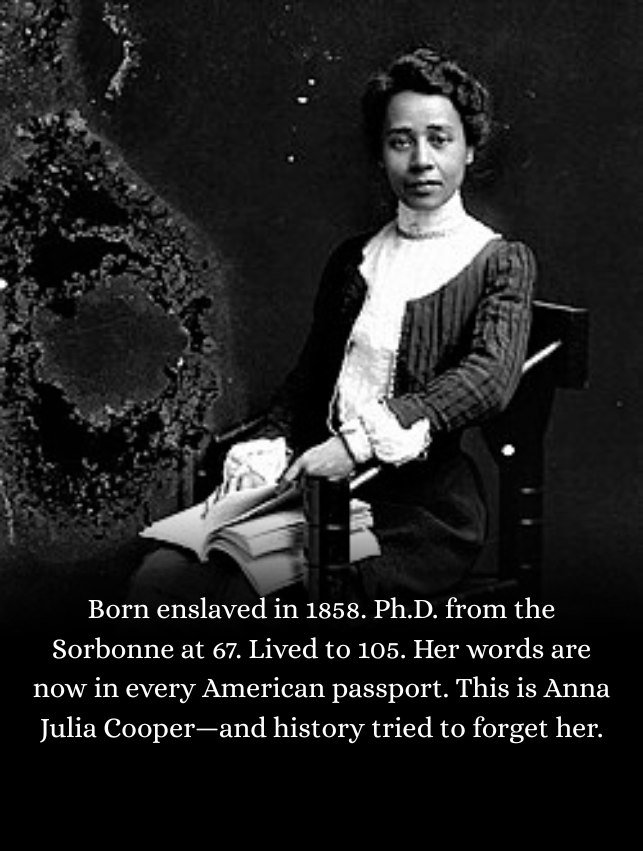
The Slave Files: Anna Julie Cooper

This photograph is the property of its respective owner. No copyright infringement intended.

Anna Julia Cooper was born on August 10, 1858 in Raleigh, North Carolina

Anna Julia Cooper was an influential African American educator, scholar, and author whose life and work left a profound impact on Black education and intellectual thought. Born in the late 19th century, she emerged during a period of systemic oppression and racial discrimination, when opportunities for African Americans—particularly women—were severely limited. Despite these obstacles, Cooper dedicated her life to uplifting her community through education, moral leadership, and scholarly contributions.

Cooper’s early life was marked by a determination to pursue learning despite societal barriers. She believed that education was a fundamental tool for liberation and empowerment. Her passion for teaching and scholarship became a central theme in her life, guiding her professional endeavors and public influence.

As an educator, Julia Cooper worked tirelessly to improve access to quality schooling for African Americans. She advocated for rigorous academic standards, the establishment of Black educational institutions, and curricula that fostered critical thinking and self-worth among students. Her efforts emphasized the transformative power of knowledge as a means to resist systemic oppression.

In addition to teaching, Cooper was a prolific writer and thinker. She authored essays and treatises on the moral, social, and intellectual development of African Americans, emphasizing the necessity of self-respect, cultural pride, and educational attainment. Her writings served as a blueprint for Black uplift during the early 20th century.

Cooper also engaged in public speaking and community organizing. She traveled widely, addressing audiences on the importance of education, civic responsibility, and moral development. Her speeches encouraged African Americans to embrace their intellectual potential and challenge societal narratives that sought to marginalize them.

Her impact extended to her mentorship of younger generations of Black scholars and educators. By providing guidance, encouragement, and access to educational resources, Cooper helped cultivate a new class of African American leaders committed to intellectual excellence and social progress.

Anna Julia Cooper’s work was informed by a deep moral and spiritual philosophy. She believed that personal character and ethical integrity were inseparable from educational and professional achievement. Her vision emphasized holistic development—intellectual, moral, and civic—as essential to individual and communal advancement.

Throughout her career, Cooper confronted racism, sexism, and social prejudice. Her ability to navigate these systemic challenges while achieving professional recognition serves as a testament to her resilience and strategic acumen. She became a symbol of Black female agency in a society structured to limit her potential.

Her legacy is visible in the educational institutions she influenced, the students she inspired, and the broader discourse on African American intellectual empowerment. Cooper’s life exemplifies the potential for knowledge and moral courage to transform communities and challenge entrenched inequalities.

Anna Julia Cooper remains a vital figure in African American history, her life and work illustrating the enduring power of education, scholarship, and leadership in advancing justice and equality. Her contributions continue to inspire educators, students, and leaders committed to intellectual rigor and moral responsibility.


References

  1. Gates, H. L., & Higginbotham, E. B. (2014). African American lives. Oxford University Press.
  2. Gutman, H. G. (1976). The black family in slavery and freedom, 1750-1925. Pantheon Books.
  3. Kelley, R. D. G. (1994). Race rebels: Culture, politics, and the Black working class. Free Press.
  4. Theoharis, J. (2018). A more beautiful and terrible history: The uses and misuses of civil rights history. Beacon Press.
  5. Wiggins, W. H. (2000). The intellectual tradition of African Americans: A historical overview. Greenwood Press.

Racial Caste Systems: The Architecture of Hierarchy and Human Division.

Throughout history, societies have constructed hierarchies that determine human worth, access, and opportunity. A racial caste system is one of the most enduring forms of social stratification—an arrangement where race determines an individual’s status, mobility, and humanity within a society. Rooted in power, these systems are not merely social constructs but political technologies designed to preserve dominance and justify inequality (Feagin, 2013).

In the United States, the racial caste system originated with the transatlantic slave trade. Africans were systematically dehumanized, defined legally as property, and positioned at the bottom of the social order. This structure created a rigid racial hierarchy that survived emancipation and evolved through segregation, mass incarceration, and economic disparity (Alexander, 2010).

The American racial caste system was not accidental but deliberate. It was engineered through laws such as the Virginia Slave Codes of 1705 and later solidified through Jim Crow legislation. These legal instruments established whiteness as a form of property and superiority, ensuring that freedom and rights were racially distributed (Harris, 1993).

Caste systems rely on ideology to sustain themselves. In America, white supremacy functioned as the central narrative that rationalized subjugation. Pseudoscientific racism, biblical distortions, and economic exploitation merged to construct a worldview that depicted Africans and their descendants as inferior, thus justifying their oppression (Fields & Fields, 2012).

Globally, racial caste systems have appeared in various forms. The Indian caste system, though based on purity and birth rather than race, parallels the racial hierarchy of the West in its systemic exclusion of the Dalits (“untouchables”). Similarly, the apartheid regime in South Africa created a codified racial order that privileged whites and oppressed Africans through political and economic control (Fredrickson, 1981).

In Latin America, colonial powers instituted the casta system, which ranked individuals by racial mixture—from pure-blooded Spaniards at the top to Indigenous and African peoples at the bottom. This system demonstrates how racial stratification was a global phenomenon rooted in European imperialism (Martínez, 2008).

The concept of a racial caste system in modern America was revived in contemporary discourse by Michelle Alexander’s The New Jim Crow (2010). She argues that mass incarceration functions as a new racial caste, disenfranchising Black men through criminalization, restricted employment, and civic exclusion. Though slavery and segregation are abolished, their logic persists in the criminal justice system.

Caste systems persist because they evolve with society. When one form of racial control becomes untenable, it is replaced by another—slavery gave way to segregation, segregation to redlining, and redlining to mass incarceration. Each transformation preserves hierarchy while maintaining the illusion of progress (Wilkerson, 2020).

Sociologists describe racial caste systems as “closed systems,” where mobility is nearly impossible. The barriers are both structural and psychological, reinforced by stereotypes, institutional bias, and intergenerational trauma. These systems teach both the oppressed and the privileged their “place” within the social order (Omi & Winant, 2014).

The psychological impact of racial caste systems cannot be overstated. Black and brown individuals internalize inferiority through constant exposure to racism, while dominant groups internalize superiority as cultural normalcy. This dual conditioning ensures the persistence of inequality even without overt enforcement (Fanon, 1952).

Education plays a central role in reinforcing or dismantling caste systems. Historically, Black Americans were denied literacy and access to higher education to prevent empowerment. Even today, educational inequity, biased testing, and underfunded schools perpetuate the old caste boundaries in subtler forms (Ladson-Billings, 2006).

Economics also undergirds the racial caste hierarchy. Wealth accumulation among white Americans is directly tied to centuries of land theft, free Black labor, and discriminatory housing policies. Economic inequality thus becomes a material expression of the racial caste system, sustaining privilege through capital inheritance (Rothstein, 2017).

Religion has been used both to justify and to resist racial caste systems. Slaveholders once cited scripture to defend bondage, while liberation theologians and civil rights leaders later used the same texts to challenge oppression. Theological interpretations have therefore mirrored the moral tensions within society’s caste structures (Cone, 1975).

Media representation contributes to the perpetuation of caste by shaping public perception. Stereotypical portrayals of Black criminality, Asian servitude, or Latino illegality reinforce cultural hierarchies that align with economic and political control (hooks, 1992). These narratives normalize subordination and invisibility for marginalized groups.

The persistence of racial caste systems in democratic societies exposes a contradiction between declared ideals and lived realities. Nations that claim liberty and equality often maintain invisible systems of exclusion, allowing structural racism to flourish under the guise of meritocracy and neutrality (Bonilla-Silva, 2014).

Breaking racial caste systems requires more than moral outrage—it demands institutional transformation. Policies addressing education, housing, healthcare, and criminal justice must confront the racialized roots of inequality, not merely its symptoms (Kendi, 2019).

Social movements have historically played a critical role in challenging caste structures. From abolitionists to civil rights activists and the modern Black Lives Matter movement, collective resistance has been the most effective counterforce to entrenched hierarchy. These struggles reveal that caste is maintained by compliance but undone by courage (Taylor, 2016).

Globally, the persistence of racial hierarchy shows that caste is not uniquely American. From Australia’s treatment of Aboriginal peoples to Europe’s anti-immigrant rhetoric, the global order still privileges whiteness as the dominant standard of humanity and civilization (Painter, 2010).

The modern concept of race was not a natural or scientific discovery—it was a social and political invention that emerged primarily during the Age of Exploration (15th–18th centuries). Its purpose was to justify European colonization, slavery, and the exploitation of non-European peoples.

Origins in Pseudo-Science and Colonialism

1. Early European Encounters (15th–16th centuries)
Before the transatlantic slave trade, people were classified mainly by nationality, religion, or social status—not by skin color. However, when European explorers like the Portuguese and Spanish began to explore Africa, Asia, and the Americas, they encountered physical and cultural differences they sought to explain and control.

2. Justifying Enslavement and Colonial Rule
As the Atlantic slave trade grew, European powers needed a moral and theological rationale to enslave millions of Africans and seize Indigenous lands. They began to argue that nonwhite peoples were “inferior” or “subhuman.” This was a man-made ideology, not a scientific fact.

3. The Role of Enlightenment Thinkers (17th–18th centuries)
Ironically, during the so-called “Age of Reason,” European philosophers and scientists began categorizing humans by skin color and appearance, using false “scientific” reasoning.

  • Carl Linnaeus (1735), a Swedish naturalist, classified humans into subspecies based on continent and color (e.g., Homo europaeus albus for Europeans and Homo afer niger for Africans).
  • Johann Friedrich Blumenbach (1779) introduced five racial categories (Caucasian, Mongolian, Ethiopian, American, and Malay). His use of “Caucasian” helped cement whiteness as the ideal standard of beauty and intelligence.
  • Georges-Louis Leclerc de Buffon and others claimed environmental factors shaped human differences, but their theories were later distorted into racial hierarchies.

4. Race as a Tool of Power
By the 18th and 19th centuries, race became embedded in law, science, and religion. European colonizers institutionalized racial differences through:

  • Slave codes in the Americas
  • Jim Crow laws in the United States
  • Casta systems in Latin America
  • Apartheid in South Africa

These systems legally and socially defined who was considered “white” or “nonwhite,” determining access to education, property, and freedom.

5. The Myth of Scientific Racism (19th century)
So-called scientists like Samuel Morton (craniometry) and Josiah Nott claimed that skull size and brain shape determined intelligence. Their findings, later proven false, were used to argue for white superiority. These theories justified slavery and segregation by presenting racism as “scientific truth.”

6. The Shift in the 20th Century
After World War II and the Holocaust, when racial ideologies led to genocide, anthropologists like Franz Boas and Ashley Montagu dismantled the biological concept of race. They proved that genetic differences among humans are too small to justify racial divisions—humans share over 99.9% of the same DNA.

7. Modern Understanding
Today, race is understood as a social construct, not a biological reality. It has real consequences—shaping identity, privilege, and oppression—but it is rooted in historical systems of control.

The concept of race was created by European thinkers and colonial powers between the 15th and 18th centuries as a tool to legitimize inequality, slavery, and empire. Over time, it evolved into a global system of social hierarchy, deeply influencing how societies perceive and treat one another.


Ultimately, the racial caste system is an architecture of power—designed, maintained, and justified through centuries of policy, ideology, and violence. To dismantle it requires not only equity in law but equality in humanity. The reconstruction of society demands recognition that no human being should be bound by the color of their skin, the shape of their face, or the history of their birth. The future of justice depends on the collective dismantling of the myths that sustain racial caste systems. When truth replaces denial and love replaces hierarchy, humanity will finally step beyond the shadow of its own divisions. Until then, the work of liberation remains unfinished, and the echoes of caste still whisper through the walls of every institution built upon its foundation.


References

Alexander, M. (2010). The new Jim Crow: Mass incarceration in the age of colorblindness. The New Press.
Bonilla-Silva, E. (2014). Racism without racists: Color-blind racism and the persistence of racial inequality in America. Rowman & Littlefield.
Cone, J. H. (1975). God of the oppressed. Orbis Books.
Fanon, F. (1952). Black skin, white masks. Grove Press.
Feagin, J. R. (2013). Systemic racism: A theory of oppression. Routledge.
Fields, K. E., & Fields, B. J. (2012). Racecraft: The soul of inequality in American life. Verso.
Fredrickson, G. M. (1981). White supremacy: A comparative study in American and South African history. Oxford University Press.
Harris, C. I. (1993). Whiteness as property. Harvard Law Review, 106(8), 1707–1791.
hooks, b. (1992). Black looks: Race and representation. South End Press.
Kendi, I. X. (2019). How to be an antiracist. One World.
Ladson-Billings, G. (2006). From the achievement gap to the education debt. Educational Researcher, 35(7), 3–12.
Martínez, M. E. (2008). Genealogical fictions: Limpieza de sangre, religion, and gender in colonial Mexico. Stanford University Press.
Omi, M., & Winant, H. (2014). Racial formation in the United States. Routledge.
Painter, N. I. (2010). The history of white people. W. W. Norton.
Rothstein, R. (2017). The color of law: A forgotten history of how our government segregated America. Liveright Publishing.
Taylor, K.-Y. (2016). From #BlackLivesMatter to Black liberation. Haymarket Books.
Wilkerson, I. (2020). Caste: The origins of our discontents. Random House.Fredrickson, G. M. (2002). Racism: A Short History. Princeton University Press.

Smedley, A., & Smedley, B. D. (2005). Race as biology is fiction, racism as a social problem is real. American Psychologist, 60(1), 16–26.

Gould, S. J. (1981). The Mismeasure of Man. W. W. Norton.

Fields, B. J., & Fields, K. (2012). Racecraft: The Soul of Inequality in American Life. Verso.

Painter, N. I. (2010). The History of White People. W. W. Norton.

Boas, F. (1940). Race, Language, and Culture. University of Chicago Press.

Dilemma: Tokenism

Photo by Mikhail Nilov on Pexels.com

Tokenism is a deceptive social construct that gives the illusion of inclusion while maintaining the core structures of exclusion. It occurs when organizations, media, or institutions make superficial efforts to include individuals from marginalized groups without addressing systemic inequities. Often, these symbolic gestures serve to protect an institution’s image rather than to promote authentic diversity or equality (Kanter, 1977).

The term “tokenism” was popularized by sociologist Rosabeth Moss Kanter in the 1970s to describe the experiences of minority groups—particularly women—in male-dominated professions. Kanter noted that tokens are often treated as representatives of their entire group rather than as individuals. This creates psychological strain and unrealistic expectations for those placed in tokenized roles (Kanter, 1977).

In the corporate world, tokenism manifests through selective hiring or promotion of minorities to demonstrate apparent progressiveness. These symbolic inclusions are often used to deflect criticism about a lack of genuine diversity. Such practices reinforce the idea that inclusion is performative rather than transformational (Wingfield, 2019).

Media representation is another major sphere where tokenism thrives. Black, Indigenous, and People of Color (BIPOC) characters are often written into television and film as secondary figures or stereotypes to appease diversity quotas rather than to enrich narratives. This hollow form of representation sustains racial bias under the guise of visibility (hooks, 1992).

For many people of color, tokenism creates an internal conflict—a dilemma of gratitude versus authenticity. On one hand, they may feel pressured to express appreciation for opportunities in spaces historically denied to them. On the other hand, they struggle with the awareness that their inclusion may not be rooted in merit or equality, but in optics (Thomas, 2020).

Psychologically, tokenism contributes to imposter syndrome and racialized stress. Tokens are hyper-visible due to their difference yet invisible when it comes to decision-making power. This paradox can erode self-esteem and perpetuate feelings of isolation, especially in environments that subtly invalidate their experiences (Pierce, 1974).

In education, tokenism surfaces when institutions highlight a few minority students in promotional materials or diversity panels while ignoring systemic inequities such as racial bias, funding disparities, or lack of representation in leadership. The symbolic celebration of a few does not correct the structural exclusion of many (Harper & Hurtado, 2007).

Within corporate culture, “diversity hires” may become a euphemism for tokenism when institutions recruit marginalized employees without equitable support systems. Without inclusive leadership, mentorship, and pathways for advancement, these hires remain isolated and underutilized (Dobbin & Kalev, 2018).

Tokenism also manifests in politics through the strategic placement of minority candidates to project inclusivity while maintaining the same policy agendas. These acts often aim to win votes or appease critics without granting genuine influence or resources to minority leaders (Gonzalez, 2021).

In the entertainment industry, casting one Black actor or person of color in an otherwise homogeneous production is often marketed as “diverse.” This is particularly prevalent in beauty and fashion campaigns where racial representation is commodified to appear progressive, but the decision-making board remains overwhelmingly white (Banet-Weiser, 2018).

The dilemma deepens when tokens feel obligated to “represent” their entire group. Every success or failure is magnified as a reflection of a collective identity rather than individual performance. This added psychological labor further marginalizes them in spaces where their presence is supposed to symbolize equality (Wingfield & Alston, 2014).

Religious and cultural organizations are not immune to tokenism. In some cases, Black or minority clergy are invited to participate in multicultural events primarily for optics rather than genuine collaboration or shared leadership. Such token gestures distort the meaning of unity and reconciliation (Cone, 1984).

The danger of tokenism lies in its subtlety. Because it mimics diversity, it can pacify calls for justice and delay systemic reform. It functions as a social anesthetic—numbing public consciousness by replacing equity with representation (Ahmed, 2012).

True inclusion requires structural change, not symbolic gestures. This involves redistributing power, addressing implicit bias, and creating accountability measures to ensure marginalized voices influence policy and decision-making. Without these steps, tokenism becomes the default language of modern diversity (Bell, 2020).

Tokenism also intersects with capitalism. Brands often exploit social justice movements to attract consumers, using performative allyship as marketing strategy. The commodification of diversity allows corporations to profit from representation without engaging in ethical transformation (Cottom, 2019).

For individuals experiencing tokenism, resistance begins with awareness. Naming and articulating the experience is a form of empowerment. It allows marginalized people to reclaim agency and challenge performative practices that use their image without valuing their contribution (Sue et al., 2007).

Allyship plays a crucial role in dismantling tokenism. True allies do not merely “invite” diverse individuals to the table—they help rebuild the table to ensure equitable participation. Solidarity must move beyond symbolism into structural advocacy (DiAngelo, 2018).

In academic spaces, tokenism distorts the pursuit of truth. When diversity is treated as a checkbox rather than a core value, intellectual innovation suffers. Authentic inclusion enriches scholarship by expanding perspectives and disrupting monocultural thinking (Stewart, 2017).

The solution to tokenism is not token absence but power redistribution. When institutions cultivate authentic equity, they no longer need symbolic figures to prove their inclusivity—the culture itself becomes inclusive by nature. Representation must evolve from visibility to influence (Crenshaw, 1991).

In the end, the dilemma of tokenism reminds us that progress without power is illusion. Diversity without justice is decoration. Until marginalized voices shape the systems that claim to include them, tokenism will remain a sophisticated disguise for exclusion—an uncomfortable mirror reflecting the unfinished work of equality.


References

Ahmed, S. (2012). On being included: Racism and diversity in institutional life. Duke University Press.

Banet-Weiser, S. (2018). Empowered: Popular feminism and popular misogyny. Duke University Press.

Bell, D. A. (2020). Faces at the bottom of the well: The permanence of racism. Basic Books.

Cone, J. H. (1984). For my people: Black theology and the Black church. Orbis Books.

Cottom, T. M. (2019). Thick: And other essays. The New Press.

Crenshaw, K. (1991). Mapping the margins: Intersectionality, identity politics, and violence against women of color. Stanford Law Review, 43(6), 1241–1299.

DiAngelo, R. (2018). White fragility: Why it’s so hard for White people to talk about racism. Beacon Press.

Dobbin, F., & Kalev, A. (2018). Why diversity programs fail and what works better. Harvard Business Review, 94(7), 52–60.

Gonzalez, J. (2021). Reclaiming representation: Race, politics, and authenticity in modern democracy. Columbia University Press.

Harper, S. R., & Hurtado, S. (2007). Nine themes in campus racial climates and implications for institutional transformation. New Directions for Student Services, 120, 7–24.

hooks, b. (1992). Black looks: Race and representation. South End Press.

Kanter, R. M. (1977). Men and women of the corporation. Basic Books.

Pierce, C. (1974). Psychiatric problems of the Black minority. In G. V. Stone & M. F. Stone (Eds.), Minority mental health (pp. 27–35). Grune & Stratton.

Stewart, D. L. (2017). The language of appeasement. Inside Higher Ed.

Sue, D. W., Capodilupo, C. M., & Holder, A. M. B. (2007). Racial microaggressions in the life experience of Black Americans. Professional Psychology: Research and Practice, 38(4), 329–336.

Thomas, D. A. (2020). Tokenism in corporate spaces: The performance of diversity. Journal of Organizational Change Management, 33(6), 1012–1028.

Wingfield, A. H. (2019). Flatlining: Race, work, and health care in the new economy. University of California Press.

Wingfield, A. H., & Alston, R. J. (2014). Maintaining hierarchies in predominantly White organizations: A theory of racialized tokenism. Sociological Perspectives, 57(4), 658–677.*