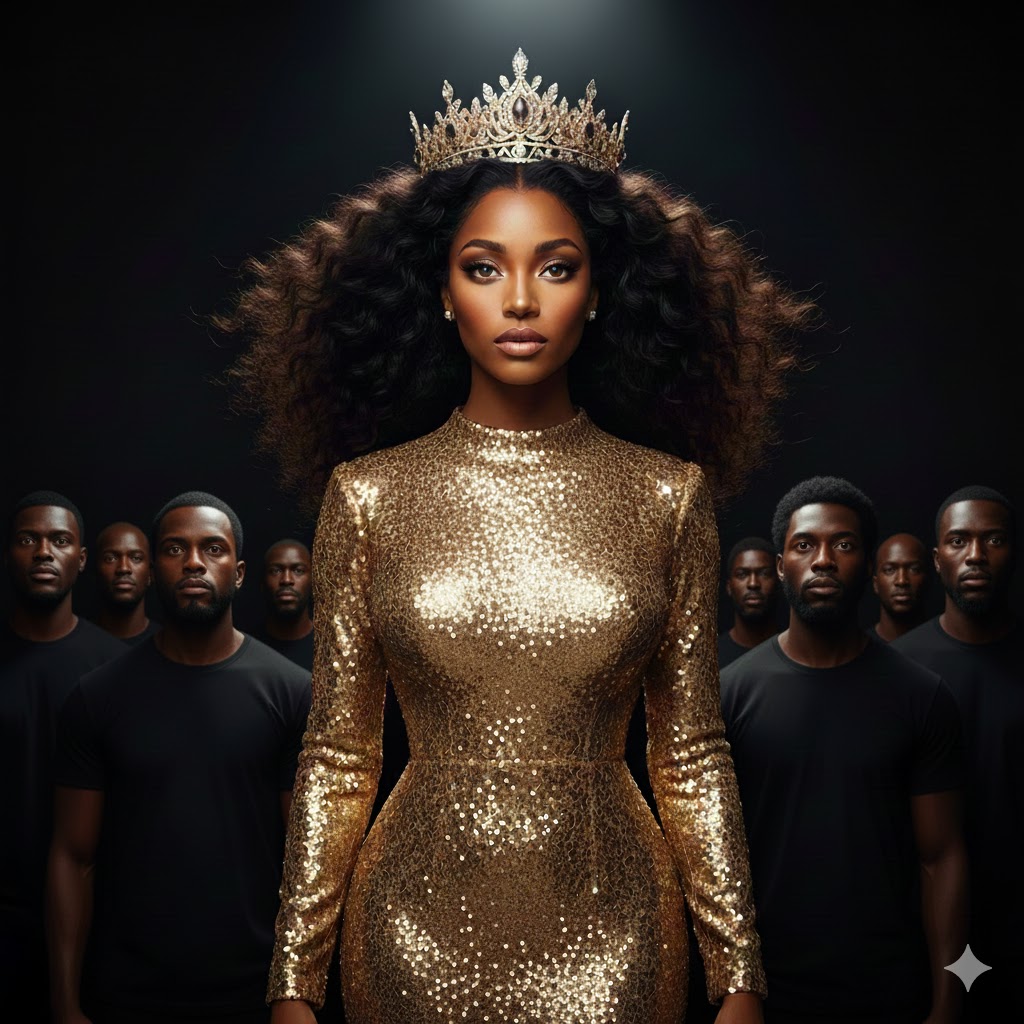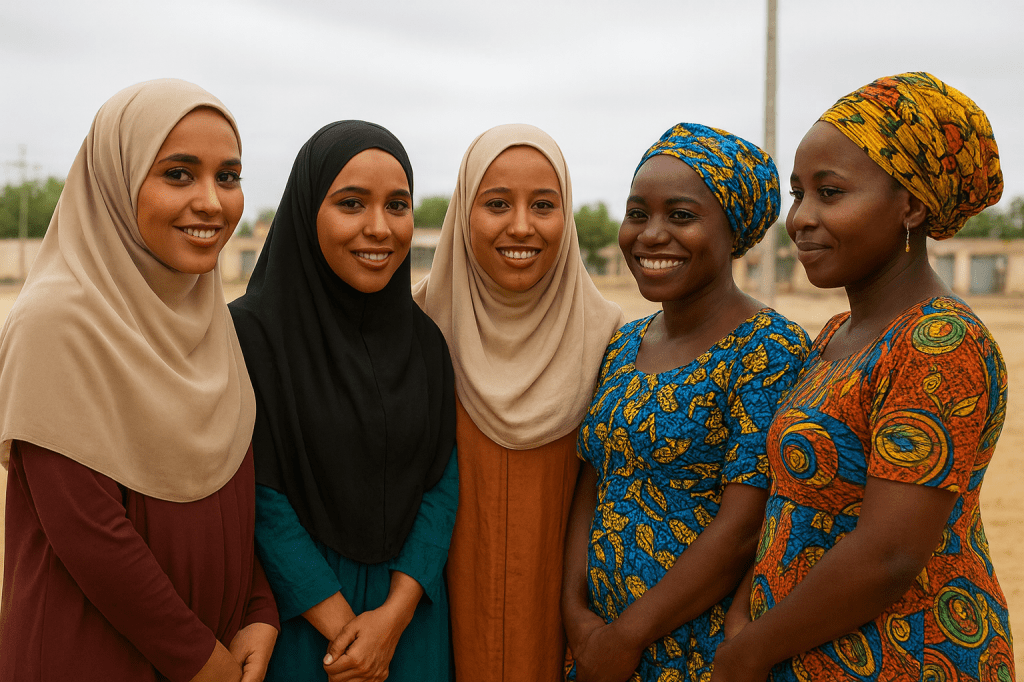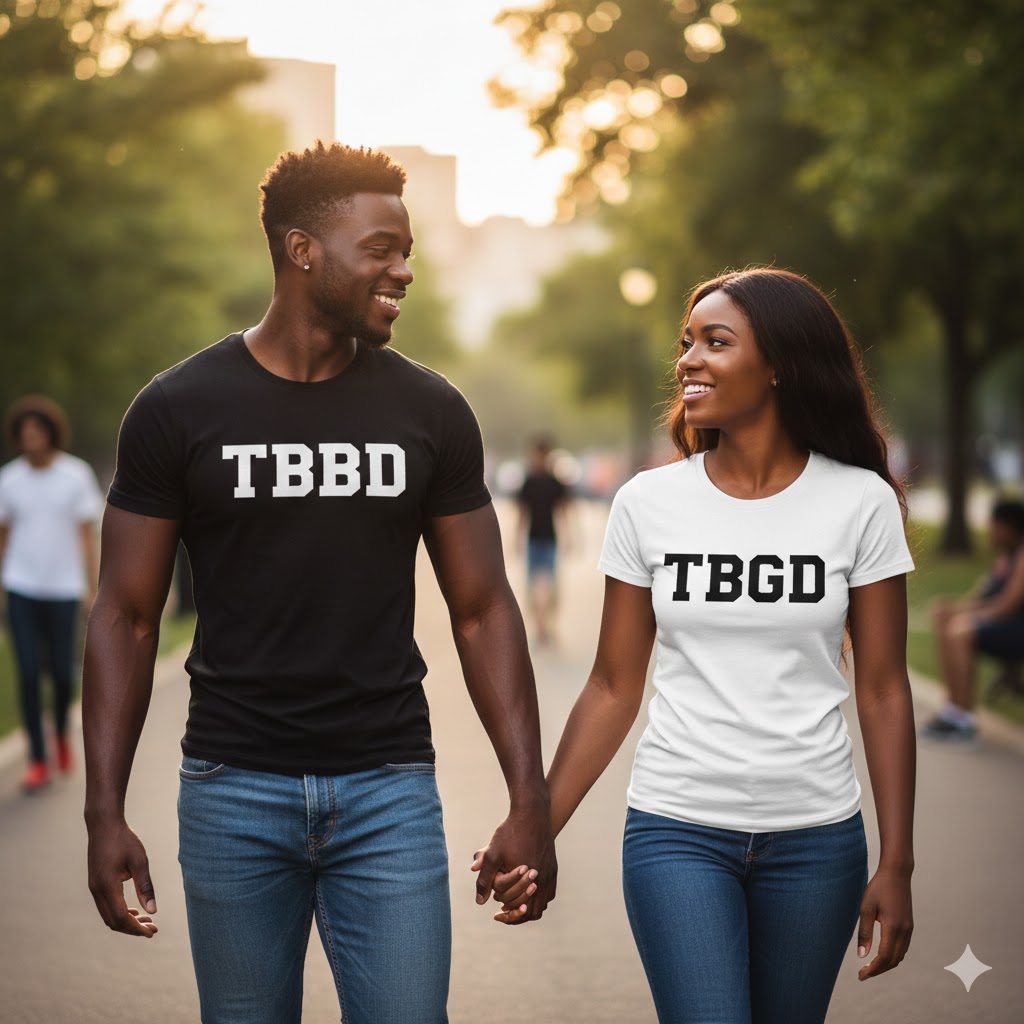
Tag Archives: culture

Dilemma: Black Hair Discrimination

The Politics of Policing Black Identity

Angela Davis

“I had been looking at pictures of women who were free, and they were wearing their hair the way it grows out of their heads.”
(Davis, A. Y., Women, Race & Class, 1981)

Chimamanda Ngozi Adichie

“Hair is political. Hair is personal. Hair is identity.”
(Adichie, C. N., Americanah, 2013)

Bell Hooks

“Straightening our hair is one of the many ways we try to erase the reality of our Blackness.”
(Hooks, b., Black Looks: Race and Representation, 1992)

Lupita Nyong’o

“What I learned is that when the world tells you you’re not enough, you don’t have to believe it.”
(Nyong’o, L., Sulwe, 2019)

“Black hair is not a trend, a problem, or a phase—it is a living archive of survival, resistance, and ancestral memory.”

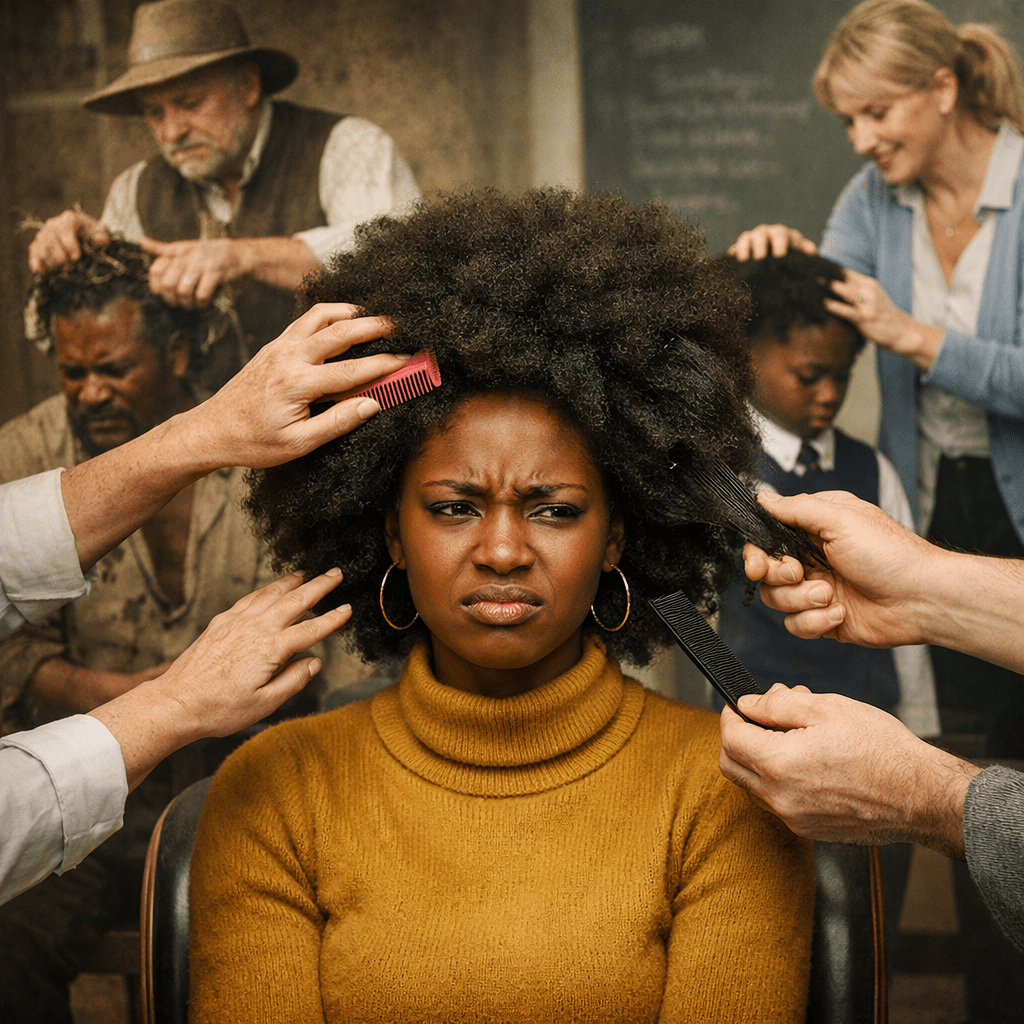
Black hair discrimination remains one of the most visible and normalized forms of racial bias in modern society. From classrooms to corporate offices, Black hair is disproportionately scrutinized, regulated, and punished under the guise of “professionalism,” “neatness,” or “dress code policies.” These standards are not neutral; they are rooted in Eurocentric ideals that define straight, loose, and non-textured hair as the default measure of beauty and respectability. As a result, Black people are often forced to alter their natural hair to gain acceptance, employment, or basic dignity.

In schools, Black children are suspended, sent home, or humiliated for wearing braids, locs, Afros, twists, or even natural curls. These disciplinary practices communicate a dangerous message: that Black identity itself is disruptive and unacceptable. When a child’s natural hair becomes grounds for punishment, the educational system participates in psychological harm that can shape self-esteem and identity formation for life. The classroom becomes not a place of learning, but a site of racial conditioning.

In the workplace, similar patterns persist. Black professionals are routinely told their hair is “unprofessional,” “distracting,” or “unkept,” even when it is clean, styled, and culturally appropriate. This forces many to chemically straighten their hair, wear wigs, or suppress their natural texture in order to be perceived as competent. Such pressures reveal how deeply white norms are embedded in institutional culture, where assimilation is often required for survival.

The hatred toward Black hair did not originate in modern offices or schools—it was cultivated during slavery. Enslaved Africans were stripped of their cultural grooming practices and taught to associate straight hair with proximity to whiteness and social advantage. Field laborers, who often had tightly coiled hair, were deemed inferior, while those with looser textures were privileged within the plantation hierarchy. Hair became a racial marker used to rank human worth.

This legacy did not disappear after emancipation. It evolved into colorism and texture discrimination, where straighter hair is still associated with beauty, intelligence, and professionalism, while kinky or coiled hair is labeled “nappy,” “bad,” or “ugly.” These terms, passed down through generations, reflect internalized racism—a psychological inheritance from white supremacy that continues to shape how Black people see themselves.

One of the most painful aspects of Black hair discrimination is that it is often reinforced within Black families themselves. Many Black parents, conditioned by their own experiences of rejection and survival, teach their children that their natural hair is something to be fixed, relaxed, or hidden. Phrases like “your hair is too nappy” or “you need a perm” are not harmless—they transmit shame and self-rejection at the most formative stages of identity.

This internalization is not accidental; it is a direct result of systemic oppression. When society consistently rewards whiteness and penalizes Blackness, marginalized communities may adopt those standards as coping mechanisms. However, survival strategies should not become permanent ideologies. Black parents must wake up to the reality that teaching children to hate their natural features only perpetuates the same system that devalues them.

White supremacy plays a central role in Black hair discrimination because it establishes whiteness as the universal standard of normality. Under this system, anything outside of European phenotypes is constructed as deviant, exotic, or inferior. Hair texture becomes political, not because Black people made it so, but because racism made Black bodies sites of control.

The concept of “professionalism” itself is racially coded. There is no scientific or moral basis for associating straight hair with competence or intelligence. These associations are cultural myths that developed within colonial and capitalist systems that centered white identity as the model citizen. Black hair challenges these myths simply by existing in its natural state.

Black hair has also been criminalized. From police stops to courtroom bias, Afro-textured hair has been associated with deviance and threat. Studies show that Black people with natural hairstyles are more likely to be perceived as aggressive, untrustworthy, or less intelligent, even when all other factors are controlled. This demonstrates how aesthetic bias becomes a mechanism of social exclusion.

The rise of movements like the Natural Hair Movement and the passing of the CROWN Act represent resistance against these injustices. These efforts aim to legally protect individuals from discrimination based on hair texture and style. However, legal reform alone cannot dismantle deeply ingrained psychological and cultural beliefs. Laws can change policies, but they cannot instantly heal internalized self-hatred.

True liberation requires a cultural shift in how Black beauty is defined and taught. Black hair must be reframed not as a problem to manage, but as a sacred inheritance—genetically rich, biologically diverse, and historically powerful. The same coils once mocked were used to map escape routes during slavery, braid seeds for survival, and encode communal identity.

Education plays a crucial role in this transformation. Schools must incorporate Black history and African aesthetics into curricula, not as side notes, but as central narratives. When children learn that their features have historical meaning and cultural value, they are less likely to internalize racist hierarchies imposed by society.

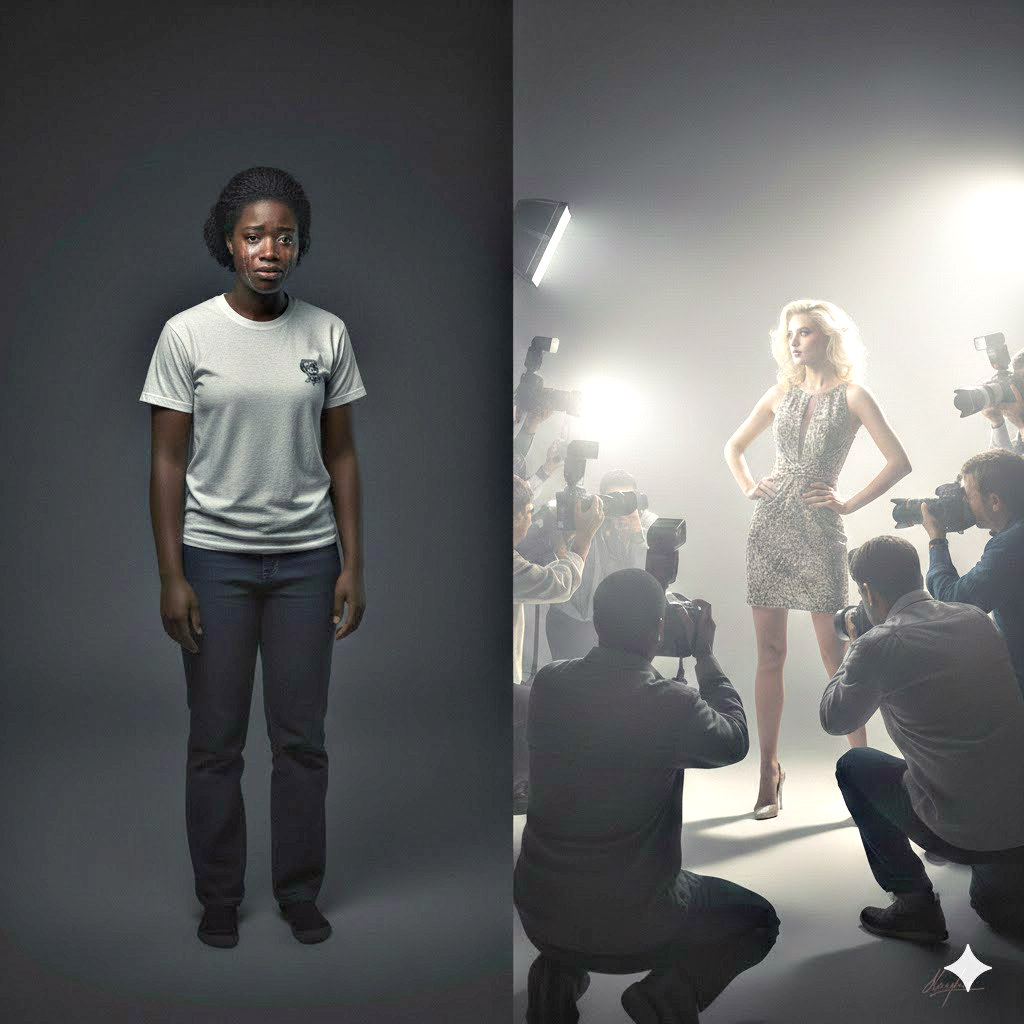
Media representation is equally important. For decades, Black beauty was only celebrated when it approximated whiteness—light skin, straight hair, narrow features. Today, although representation has expanded, Eurocentric beauty standards still dominate advertising, film, and fashion industries. The normalization of natural Black hair must move beyond trends and become structural.

The policing of Black hair is ultimately about control. It is about who gets to define beauty, respectability, and humanity. When institutions regulate how Black people wear their hair, they are not managing aesthetics—they are managing identity. Hair becomes a battlefield where cultural memory confronts colonial ideology.

Psychologically, hair discrimination contributes to identity fragmentation. Black individuals are often forced to perform different versions of themselves depending on context—natural at home, altered at work, cautious in public. This constant self-monitoring produces emotional fatigue and reinforces the idea that authenticity is unsafe.

Black parents, educators, and leaders have a responsibility to disrupt this cycle. Teaching children that their hair is “good” exactly as it grows is not a trivial affirmation—it is a radical act of resistance. It challenges centuries of propaganda designed to disconnect Black people from their bodies and ancestry.

Healing from hair discrimination requires both structural and spiritual work. Structurally, institutions must dismantle biased policies. Spiritually and psychologically, Black communities must unlearn the lie that proximity to whiteness equals worth. The reclamation of Black hair is inseparable from the reclamation of Black identity.

Black hair is not unprofessional, unclean, or undesirable. It is African. It is genetic. It is historical. It is political because oppression made it so. And until society confronts the racial logic behind its beauty standards, Black hair will continue to be policed—not because it is wrong, but because it refuses to conform to a system built on white supremacy.

Ultimately, the hatred of Black hair reflects a deeper hatred of Black existence. To love Black hair fully is to reject the entire hierarchy that ranks human value by proximity to Europe. In that sense, every Afro worn freely, every loc grown proudly, and every child taught to love their coils is an act of cultural revolution.


References

Banks, I. (2000). Hair matters: Beauty, power, and Black women’s consciousness. New York, NY: New York University Press.

Byrd, A. D., & Tharps, L. L. (2014). Hair story: Untangling the roots of Black hair in America. New York, NY: St. Martin’s Press.

Collins, P. H. (2004). Black sexual politics: African Americans, gender, and the new racism. New York, NY: Routledge.

Crenshaw, K. (1991). Mapping the margins: Intersectionality, identity politics, and violence against women of color. Stanford Law Review, 43(6), 1241–1299.

Johnson, T. R., & Bankhead, T. (2014). Hair it is: Examining the experiences of Black women with natural hair. Open Journal of Social Sciences, 2(1), 86–100.

Rooks, N. (1996). Hair raising: Beauty, culture, and African American women. New Brunswick, NJ: Rutgers University Press.

Rosette, A. S., & Dumas, T. L. (2007). The hair dilemma: Conformity versus authenticity. Journal of Applied Psychology, 92(6), 1601–1616.

Tate, S. A. (2009). Black beauty: Aesthetics, stylization, politics. Farnham, UK: Ashgate.

The CROWN Act. (2019). Creating a Respectful and Open World for Natural Hair. U.S. legislation on hair discrimination.
The Semiotics of Black Beauty

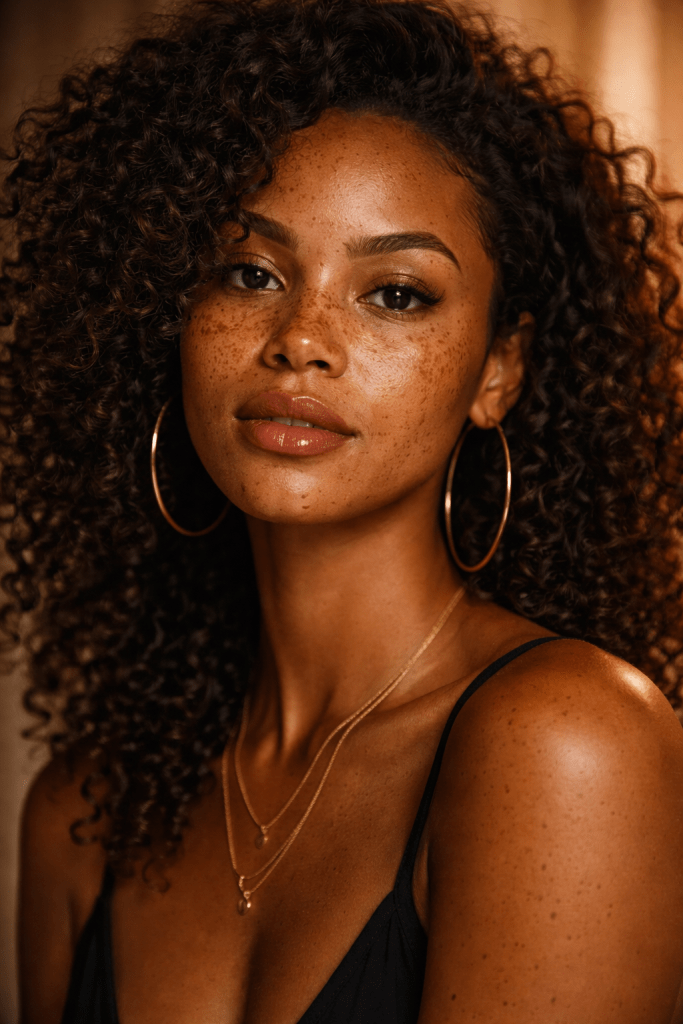
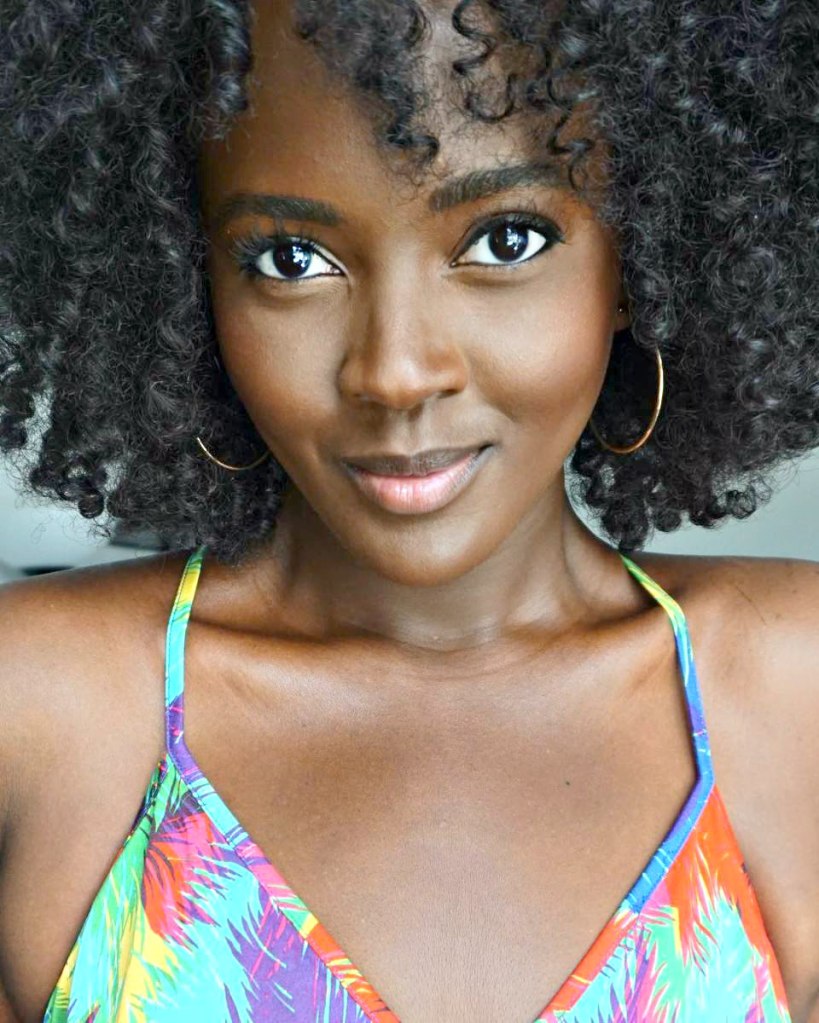
The semiotics of Black beauty begins with the understanding that beauty is not merely an aesthetic category but a system of signs, meanings, and cultural codes. Within semiotic theory, beauty operates as a language—one that communicates values, hierarchies, power relations, and historical memory. Black beauty, in particular, has functioned as a contested sign within Western modernity, simultaneously hyper-visible and marginalized, fetishized and erased. To analyze Black beauty semiotically is to examine how Black bodies, features, and aesthetics have been encoded, decoded, and re-signified across history.

In classical semiotics, Ferdinand de Saussure distinguished between the signifier (the form of the sign) and the signified (the concept it represents). Applied to Black beauty, the signifier may include dark skin, Afro-textured hair, full lips, broad noses, and curvilinear bodies, while the signified has historically been shaped by colonial ideology, racial hierarchy, and Eurocentric aesthetic standards. These physical features were not interpreted neutrally but loaded with meanings such as primitiveness, hypersexuality, exoticism, or inferiority. Thus, Black beauty became a distorted sign within the colonial visual grammar.

Colonialism produced what Frantz Fanon described as a racialized visual order in which Black bodies were rendered objects of surveillance and symbolic domination. In this system, beauty was weaponized as a tool of power, with whiteness positioned as the universal aesthetic norm. Blackness was defined in opposition to this norm, creating what semioticians would call a binary structure: beautiful versus ugly, civilized versus primitive, pure versus excessive. Black beauty was not simply excluded from the category of beauty; it was actively re-coded as its opposite.

Roland Barthes’ concept of myth is especially useful here. Myths transform cultural constructs into naturalized truths. The myth of beauty in Western society presents whiteness as neutral and universal while presenting Blackness as deviation. Over time, this myth became embedded in media, advertising, fashion, film, and even scientific discourse. Beauty standards ceased to appear ideological and instead appeared “natural,” obscuring their historical and political origins.

Black women’s bodies, in particular, have functioned as semiotic battlegrounds. From the exhibition of Sarah Baartman in the nineteenth century to contemporary hypersexualized representations in popular culture, Black femininity has been encoded through signs of excess—too sexual, too loud, too visible, too much. These representations operate as what Stuart Hall called regimes of representation, systems that fix meaning through repetition. The Black woman becomes a sign that circulates independently of her humanity.

Yet semiotics is not only about domination; it is also about resistance and re-signification. Black beauty has undergone profound symbolic transformation through cultural movements such as the Harlem Renaissance, the Black Arts Movement, Afrofuturism, and contemporary digital Black feminism. These movements challenge dominant sign systems by producing alternative visual codes—natural hair, dark skin celebration, Afrocentric fashion, and non-Eurocentric facial aesthetics. Here, Black beauty becomes a counter-sign, disrupting inherited meanings.

The politics of hair provides one of the clearest examples of semiotic struggle. Afro-textured hair has historically been encoded as unprofessional, wild, or undesirable, while straight hair has been associated with respectability and beauty. However, the natural hair movement re-signifies Afro-textured hair as a symbol of authenticity, resistance, and self-definition. Hair becomes a political sign, not merely a cosmetic choice.

Skin tone operates similarly within what scholars describe as colorism. Lighter skin has been historically coded as more beautiful due to proximity to whiteness, while darker skin has been marked as undesirable. This semiotic hierarchy is internalized within Black communities themselves, revealing how colonial sign systems reproduce themselves psychologically. Black beauty thus exists within a complex internal semiotics, where oppression is not only external but also internalized.

Media plays a central role in the production and circulation of beauty signs. Film, fashion, social media, and advertising function as symbolic machines that teach society what to desire and what to devalue. When Black women are underrepresented or represented through stereotypes, the sign of Black beauty becomes constrained, flattened, and commodified. Representation is not simply about visibility but about the range of meanings allowed to exist.

Digital culture has introduced new semiotic possibilities. Platforms such as Instagram, TikTok, and YouTube allow Black women to become producers of their own visual narratives rather than passive objects of representation. The rise of Black influencers, models, and artists creates decentralized beauty codes that challenge traditional gatekeepers. Semiotically, this represents a shift from imposed meaning to negotiated meaning.

The concept of the gaze is central to understanding Black beauty. Laura Mulvey’s theory of the male gaze can be extended to what many scholars call the white gaze—a visual framework through which Black bodies are interpreted and judged. Black beauty under the white gaze becomes spectacle rather than subject. However, the emergence of what is termed the Black female gaze reclaims visual authority, allowing Black women to define beauty on their own terms.

From a psychological perspective, beauty functions as symbolic capital. Pierre Bourdieu argued that symbolic capital produces social power through recognition and legitimacy. When Black beauty is denied legitimacy, Black women are denied access to certain forms of social mobility, desirability, and validation. Thus, beauty is not trivial; it is structurally linked to inequality.

Semiotically, Black beauty also intersects with spirituality. In many African cosmologies, beauty is not separated from morality, ancestry, or divine order. Physical appearance reflects harmony, balance, and spiritual alignment. This contrasts sharply with Western aesthetics, which prioritize surface over substance. Reclaiming Afrocentric aesthetics therefore represents not just cultural pride but epistemological resistance.

Fashion becomes another site of symbolic struggle. Historically, Black fashion was either appropriated or marginalized, yet contemporary Black designers and models are redefining aesthetic language globally. Clothing, hairstyles, and body presentation operate as visual texts through which Black identity is communicated. Fashion becomes semiotic activism.

Black beauty also functions as memory. It carries ancestral traces, historical trauma, and collective survival. The body itself becomes an archive, storing cultural meaning beyond written language. Semiotically, the Black body is a living sign, shaped by slavery, colonialism, migration, and resistance.

The commodification of Black beauty introduces further complexity. While Black aesthetics increasingly dominate popular culture, they are often consumed without acknowledging Black humanity. This produces what bell hooks called “eating the other,” where difference becomes a marketable aesthetic rather than a site of ethical engagement. Black beauty becomes profitable but not liberating.

At the level of language, even the word “beautiful” is semiotically loaded. To call Black women beautiful may appear affirming, yet it risks reinforcing the same system that requires validation from external authority. True semiotic liberation requires not merely inclusion within dominant categories but transformation of the categories themselves.

Thus, the semiotics of Black beauty is ultimately about power over meaning. Who gets to define beauty? Who controls the image? Who benefits from the sign? These are not aesthetic questions but political ones. Beauty operates as a symbolic economy, distributing value unevenly across racial and gendered lines.

Black beauty, when re-signified, becomes epistemological. It produces knowledge about the self, the body, and the world. It challenges Western philosophy’s separation of mind and body by asserting the body as a site of intelligence, history, and meaning. The Black woman becomes not an object of theory but a producer of theory.

In this sense, Black beauty is not simply visual; it is discursive. It speaks. It argues. It remembers. It resists. It transforms the semiotic field itself, expanding what beauty can mean and who gets to embody it.

Ultimately, the semiotics of Black beauty reveals that beauty is never innocent. It is a language shaped by history, power, and ideology. Yet within that language lies the possibility of rewriting the code. Black beauty, when claimed as self-authored meaning, becomes not a sign of exclusion but a symbol of cultural sovereignty.


References

Barthes, R. (1972). Mythologies. Hill and Wang.

Bourdieu, P. (1984). Distinction: A social critique of the judgement of taste. Harvard University Press.

Fanon, F. (1967). Black skin, white masks. Grove Press.

Hall, S. (1997). Representation: Cultural representations and signifying practices. Sage.

hooks, b. (1992). Black looks: Race and representation. South End Press.

Mulvey, L. (1975). Visual pleasure and narrative cinema. Screen, 16(3), 6–18.

Saussure, F. de. (2011). Course in general linguistics. Columbia University Press.

Tate, S. A. (2015). Black beauty: Aesthetics, stylization, politics. Routledge.

Weheliye, A. G. (2014). Habeas viscus: Racializing assemblages, biopolitics, and Black feminist theories of the human. Duke University Press.

Craig, M. L. (2002). Ain’t I a beauty queen? Black women, beauty, and the politics of race. Oxford University Press.

The Ebony Dolls: Philomena Kwao

Beauty, Brains, and the Power of Representation

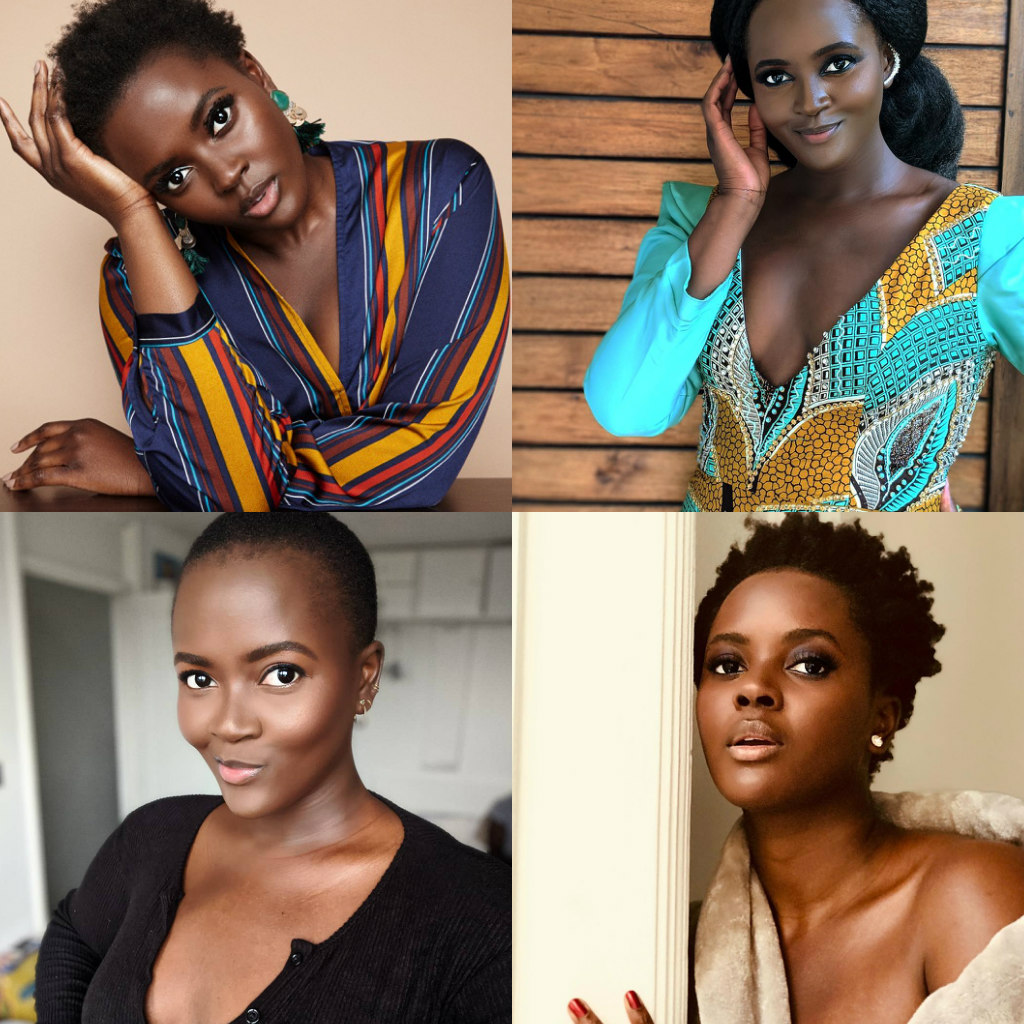
Philomena Kwao stands as one of the most compelling figures in contemporary fashion modeling, not merely for her striking physical beauty, but for the intellectual and cultural depth she brings to an industry long dominated by narrow ideals. With her luminous dark skin, regal posture, and unforgettable, piercing eyes, Kwao represents a modern embodiment of Black elegance—one that challenges both Eurocentric beauty standards and the historical marginalization of plus-size women within fashion. One of Philomena Kwao’s most arresting and unforgettable features is her eyes—mirrored, expansive, and profoundly piercing. They are not merely beautiful; they are commanding. Her large, dark eyes possess a reflective depth that feels almost cinematic, as though they hold both memory and prophecy. In fashion photography, where the gaze is everything, Kwao’s eyes function as a narrative force. They do not simply invite attention; they demand contemplation.

Born in London to Ghanaian parents, Philomena Kwao’s journey into modeling was unconventional. Before the runway and magazine spreads, she pursued higher education, earning a degree in Economics from the University of Birmingham and later a master’s degree in International Health Management. Her academic background already distinguished her as a woman rooted in intellect and global consciousness. Modeling, for Kwao, was not originally a dream but an unexpected calling. She was discovered after submitting photographs to an online modeling platform, initially skeptical of the industry’s limitations but ultimately realizing its potential as a platform for advocacy and change.

Kwao rose to prominence as a plus-size model, though she has often resisted the reductive nature of that label. While she does not conform to traditional sample sizes, her physique defies stereotypes associated with “plus-size” modeling—she is statuesque, toned, and carries herself with the confidence of classical high fashion. Her work with agencies such as Wilhelmina Models and appearances in major publications including Vogue Italia, Essence, Glamour, and Sports Illustrated Swimsuit have placed her firmly among the elite tier of global models.

One of Philomena Kwao’s most defining attributes is her face—often described by critics and fans alike as one of the most beautiful in modern fashion. Her large almond-shaped eyes, sculpted cheekbones, full lips, and smooth melanin-rich complexion create a visage that feels both timeless and contemporary. There is a quiet nobility in her features, evoking the aesthetics of African royalty and classical portraiture. In an industry obsessed with youth and homogeneity, Kwao’s beauty feels ancestral, symbolic, and deeply cultural.

Beyond aesthetics, Kwao’s career is marked by activism and thought leadership. She has become a leading voice in body positivity, diversity, and mental health within fashion. She frequently speaks on panels, contributes to academic and cultural discussions, and advocates for ethical representation of women of color. Her work challenges not only size discrimination but also the sexualization and commodification of Black women’s bodies. She reframes modeling as a site of empowerment rather than objectification.

Philomena Kwao qualifies as an “Ebony Doll” not simply because she is a model, but because she represents the very essence of what the term should signify: a Black woman who is visually exquisite, culturally grounded, intellectually formidable, and socially influential. The Ebony Doll archetype is not about superficial beauty alone—it is about excellence, presence, and representation. Kwao embodies all three. She is living proof that Black beauty is not marginal or niche but global, aspirational, and transformative.

In a world still struggling to reconcile race, gender, and aesthetics, Philomena Kwao stands as a corrective image—one that says Black women do not need to shrink themselves to be seen. They are already monumental.


References

Ashley, L. (2018). The politics of plus-size fashion and representation. Fashion Theory, 22(5), 593–610.

Essence Magazine. (2020). Philomena Kwao on body positivity and mental health.

Glamour. (2017). Meet the model changing the face of fashion: Philomena Kwao.

Sports Illustrated. (2019). Philomena Kwao: Breaking barriers in swimwear.

Vogue Italia. (2016). Curves, color, and couture: A new generation of models.

Wilhelmina Models. (n.d.). Philomena Kwao portfolio and biography.

Kwao, P. (2019). Body image, race, and self-worth in the fashion industry. Journal of Cultural Studies, 14(3), 211–225.

Aesthetics, Access, and Anti-Blackness

Aesthetics have never been neutral. From art and architecture to beauty standards and branding, what a society deems “beautiful” often reflects who holds power. In the Western world, aesthetic norms were constructed alongside colonialism, elevating Eurocentric features while devaluing African phenotypes, cultures, and expressions. This hierarchy of beauty became a quiet but powerful mechanism of anti-Blackness.

Anti-Black aesthetics operate by rendering Blackness undesirable, excessive, or threatening. Dark skin, broad noses, full lips, coily hair, and African body types were historically caricatured and pathologized. These representations did not arise organically; they were crafted to justify enslavement, segregation, and social exclusion.

Colonial visual culture played a central role in this process. European art and early scientific illustrations depicted Africans as primitive or animalistic, contrasting sharply with idealized white bodies portrayed as rational and refined. These images circulated widely, shaping public perception and reinforcing racial hierarchies.

Access became the material consequence of aesthetic hierarchy. Beauty standards dictated who could enter certain spaces, industries, and opportunities. From employment and housing to education and media visibility, proximity to whiteness often determined access to social mobility.

The beauty industry institutionalized this bias. For decades, cosmetic products, hair care lines, and advertising excluded darker skin tones and natural hair textures. Black consumers were forced to assimilate or self-alter in order to be seen as professional or acceptable.

Colorism emerged as a byproduct of anti-Black aesthetics. Within Black communities themselves, lighter skin and looser curls were rewarded, while darker skin was stigmatized. This internalized hierarchy reflects the psychological residue of colonial domination.

Media representation continues to shape aesthetic access. Black characters are often relegated to stereotypes, while darker-skinned women and men are underrepresented in leading or romantic roles. Visibility becomes conditional upon conformity to palatable forms of Blackness.

Fashion and luxury spaces also function as aesthetic gatekeepers. Black bodies are celebrated as inspiration yet policed as consumers. Cultural appropriation allows Black style to be commodified while Black people themselves face exclusion from elite spaces.

Educational institutions reinforce aesthetic norms through Eurocentric curricula that privilege Western art, philosophy, and standards of excellence. African aesthetics are often treated as supplemental or folkloric rather than foundational.

In the workplace, aesthetics dictate professionalism. Natural Black hair has been labeled unkempt, braids deemed unprofessional, and dark skin subtly associated with incompetence. These judgments translate into hiring bias, wage gaps, and limited advancement.

The criminalization of Black aesthetics further exposes anti-Blackness. Hoodies, sagging pants, and Afros have been used to justify surveillance, harassment, and lethal force. Black style becomes evidence of threat rather than expression.

Social media has intensified aesthetic policing while offering new avenues of resistance. Algorithms often favor Eurocentric beauty, yet digital platforms also allow Black creators to reclaim narrative control and redefine beauty on their own terms.

Historically, Black resistance has always included aesthetic rebellion. From African textiles and hairstyles to the Black Arts Movement, aesthetic expression has functioned as cultural preservation and political defiance.

Access to health and wellness is also shaped by aesthetics. Studies show that darker-skinned individuals receive less attentive medical care, as pain tolerance and credibility are racially biased. Appearance influences who is believed and who is neglected.

Aesthetics intersect with capitalism by determining market value. Black beauty generates billions in revenue, yet ownership and profit remain largely outside Black communities. Extraction persists even in celebration.

The psychological toll of aesthetic exclusion is profound. Anti-Black beauty standards contribute to low self-esteem, body dysmorphia, and identity fragmentation, particularly among Black youth.

Policy interventions such as the CROWN Act reveal how deeply aesthetics are tied to civil rights. Laws protecting natural hair underscore that beauty norms are not merely cultural preferences but mechanisms of discrimination.

Challenging anti-Black aesthetics requires structural change, not just representation. It demands redistribution of access, ownership, and authority over cultural production.

Reclaiming Black aesthetics is an act of liberation. When Black people define beauty on their own terms, they disrupt systems that profit from their erasure while consuming their culture.

Ultimately, aesthetics are about power—who is seen, who is valued, and who belongs. Until Blackness is no longer a barrier to beauty, access, and dignity, anti-Blackness will remain embedded in the visual and social fabric of society.


References

Bourdieu, P. (1984). Distinction: A social critique of the judgement of taste. Harvard University Press.

Collins, P. H. (2000). Black feminist thought: Knowledge, consciousness, and the politics of empowerment. Routledge.

Craig, M. L. (2002). Ain’t I a beauty queen? Black women, beauty, and the politics of race. Oxford University Press.

Fanon, F. (1952/2008). Black skin, white masks. Grove Press.

Hunter, M. (2007). The persistent problem of colorism. Sociology Compass, 1(1), 237–254.

Tate, S. A. (2015). Skin bleaching in black Atlantic zones. Palgrave Macmillan.

Wilkerson, I. (2020). Caste: The origins of our discontents. Random House.

Beyond Bias: Education, Culture, and the Future of Brown Girl Empowerment. #thebrowngirldilemma

Photo by Polina Tankilevitch on Pexels.com

Brown girls navigate a complex social landscape where bias, colorism, and cultural stereotypes intersect, shaping self-perception, opportunity, and empowerment. From childhood through adulthood, societal norms often privilege lighter skin, Eurocentric features, and conformity to dominant cultural ideals, placing additional pressure on Brown girls to assert their identity and worth. Overcoming these challenges requires a multi-faceted approach that combines education, cultural affirmation, and personal resilience.

Education plays a pivotal role in empowering Brown girls to rise above systemic bias. Academic achievement equips them with critical thinking skills, confidence, and the ability to advocate for themselves in both professional and social settings. Schools and mentorship programs that emphasize representation, diversity, and culturally responsive pedagogy can counteract stereotypes, reinforcing the idea that intelligence, talent, and leadership are independent of skin tone or appearance (Banks, 2015). Knowledge becomes both armor and empowerment, allowing Brown girls to challenge narratives that seek to diminish their potential.

Cultural affirmation is equally crucial. Celebrating Black and Brown heritage, hair textures, skin tones, and historical achievements fosters pride and resilience. Exposure to role models like Lupita Nyong’o, Issa Rae, and Yara Shahidi demonstrates that success, beauty, and influence are not determined by proximity to whiteness but by authenticity, talent, and perseverance. Cultural initiatives, festivals, and media representation highlight the diversity and richness of Brown girl identity, providing alternative narratives that counteract colorism and societal marginalization.

Psychological resilience is intertwined with education and cultural affirmation. Brown girls often experience internalized bias, which can erode self-esteem and hinder personal growth. Social comparison theory explains how constant exposure to societal standards favoring lighter skin or Eurocentric features can produce dissatisfaction and self-doubt (Festinger, 1954). By cultivating self-awareness, mindfulness, and confidence-building practices, Brown girls can navigate these pressures while maintaining pride in their heritage and features.

Media literacy also empowers Brown girls to critique and navigate content that perpetuates bias. Social media, film, and advertising frequently amplify colorism and unrealistic beauty standards. Teaching Brown girls to deconstruct media messages, recognize algorithmic biases, and value authentic representation fosters critical engagement rather than passive acceptance. This awareness reinforces the understanding that beauty, worth, and influence are not dictated by societal trends but by personal integrity and talent (Fardouly et al., 2015).

Mentorship and community support amplify empowerment. Programs that connect Brown girls with successful role models provide guidance, encouragement, and proof that overcoming bias is possible. Mentors not only teach skills but also model resilience, confidence, and leadership. Supportive networks reinforce the notion that challenges related to skin tone, culture, or societal expectation can be met with knowledge, self-worth, and collective solidarity.

Spiritual grounding offers a lasting framework for empowerment. Proverbs 31:30 (KJV) declares, “Favour is deceitful, and beauty is vain: but a woman that feareth the LORD, she shall be praised.” Faith provides Brown girls with a lens to measure their value beyond societal metrics of beauty or achievement. Spiritual conviction nurtures confidence, perseverance, and ethical decision-making, ensuring that empowerment is holistic, anchored in character as well as capability.

Looking to the future, the empowerment of Brown girls depends on dismantling systemic bias while celebrating identity. Education, cultural affirmation, mentorship, and spiritual grounding collectively create pathways for Brown girls to thrive academically, socially, and personally. Visibility in media, leadership roles, and public discourse further normalizes diverse representation, ensuring that future generations inherit a world where beauty, intelligence, and influence are inclusive and celebrated.

Empowerment in Action: Tools and Programs Uplifting Brown Girls

Empowering Brown girls requires intentional initiatives that address both systemic barriers and personal development. Across education, media, and leadership, programs are emerging to provide resources, mentorship, and representation, equipping young women to navigate societal bias while embracing their identity with pride.

Educational Programs and Mentorship
Programs like Girls Who Code and Black Girls CODE offer access to STEM education, mentorship, and skill-building opportunities for young Black and Brown girls. By fostering technical proficiency and problem-solving skills, these programs counteract stereotypes about intellectual capacity while promoting confidence in academic achievement. Local initiatives, such as culturally responsive school curricula and after-school enrichment programs, ensure that Brown girls see themselves reflected in their learning and are encouraged to pursue higher education and leadership roles (Banks, 2015).

Media Representation and Literacy
Representation in media shapes self-perception and societal expectations. Initiatives like #BlackGirlMagic, #UnapologeticallyBlack, and campaigns led by organizations such as The Representation Project highlight dark-skinned beauty, natural hair textures, and culturally diverse achievements. Media literacy programs teach Brown girls to critically engage with content, identify bias, and challenge unrealistic beauty standards, fostering resilience against harmful social comparisons (Fardouly et al., 2015).

Leadership and Entrepreneurship Programs
Leadership programs like Black Girls Rock! and The National Coalition of 100 Black Women, Inc. empower young women to take active roles in their communities, promoting civic engagement, public speaking, and entrepreneurship. These platforms provide visibility, mentorship, and resources to cultivate both confidence and competence. Brown girls participating in these programs learn to leverage their talents, articulate their perspectives, and claim space in sectors where representation has been historically limited.

Cultural Affirmation and Community Spaces
Cultural centers, youth groups, and online communities dedicated to celebrating Black and Brown heritage create safe spaces for identity exploration and affirmation. Events, workshops, and storytelling sessions allow Brown girls to explore ancestry, art, and personal style while learning from role models who reflect their experiences. These spaces cultivate pride in cultural heritage and counteract internalized colorism, reinforcing the value of authentic self-expression (Hunter, 2007).

Mental Health and Wellness Initiatives
Programs like Therapy for Black Girls address mental health challenges, including anxiety, depression, and self-esteem issues arising from colorism and societal bias. Providing access to culturally competent counselors and peer support, these initiatives normalize emotional care and teach coping strategies for navigating discrimination, social pressures, and media-induced comparison. Mental wellness becomes an essential pillar of empowerment, ensuring that Brown girls develop both confidence and resilience.

Faith and Spiritual Development
Faith-based programs and mentorship integrate spiritual grounding with personal growth. By emphasizing values such as integrity, discipline, and purpose, these initiatives complement secular programs, reinforcing that self-worth extends beyond societal standards of beauty or achievement. Proverbs 31:30 (KJV) serves as a guiding principle: “Favour is deceitful, and beauty is vain: but a woman that feareth the LORD, she shall be praised.” Spiritual empowerment supports holistic development, nurturing both character and confidence.

Digital Platforms and Social Media Advocacy
Social media, when used intentionally, becomes a tool for empowerment. Platforms like Instagram, YouTube, and TikTok allow Brown girls to showcase talent, share personal narratives, and build supportive networks. Influencers and content creators who celebrate natural hair, melanin-rich skin, and cultural heritage provide relatable role models, amplifying messages of self-love and pride. Digital advocacy challenges traditional gatekeepers of beauty and success, democratizing influence and visibility.

Policy and Institutional Support
Sustainable empowerment also requires systemic change. Advocating for policies that address colorism, discrimination, and unequal educational resources ensures that empowerment extends beyond individual programs. Scholarships, equitable representation in curricula, and funding for culturally focused initiatives create structural support that allows Brown girls to thrive academically, socially, and professionally.

Empowering Brown girls demands a multi-dimensional approach that integrates education, mentorship, media representation, mental wellness, cultural affirmation, and spiritual grounding. Programs such as Black Girls CODE, Black Girls Rock!, Therapy for Black Girls, and media campaigns like #BlackGirlMagic illustrate practical pathways for fostering confidence, resilience, and leadership. By combining personal development with systemic advocacy, communities can ensure that the next generation of Brown girls steps into spaces of power, influence, and self-assured identity with pride and unshakable confidence.

In conclusion, moving beyond bias requires intentional strategies that affirm identity, cultivate knowledge, and promote resilience. Brown girls, equipped with education, cultural pride, mentorship, and spiritual grounding, are positioned to redefine societal standards, challenge prejudice, and embrace empowerment in its fullest sense. By fostering these conditions, communities can ensure that the future of Brown girl identity is one of confidence, dignity, and unassailable self-worth.


References

Banks, J. A. (2015). Cultural diversity and education: Foundations, curriculum, and teaching. Routledge.

Festinger, L. (1954). A theory of social comparison processes. Human Relations, 7(2), 117–140.

Fardouly, J., Diedrichs, P. C., Vartanian, L. R., & Halliwell, E. (2015). Social comparisons on social media: The impact of Facebook on young women’s body image concerns and mood. Body Image, 13, 38–45.

Hunter, M. (2007). The persistent problem of colorism: Skin tone, status, and inequality. Sociology Compass, 1(1), 237–254.

Byrd, A. D., & Tharps, L. L. (2014). Hair Story: Untangling the Roots of Black Hair in America. St. Martin’s Press.

Black Thought Collective

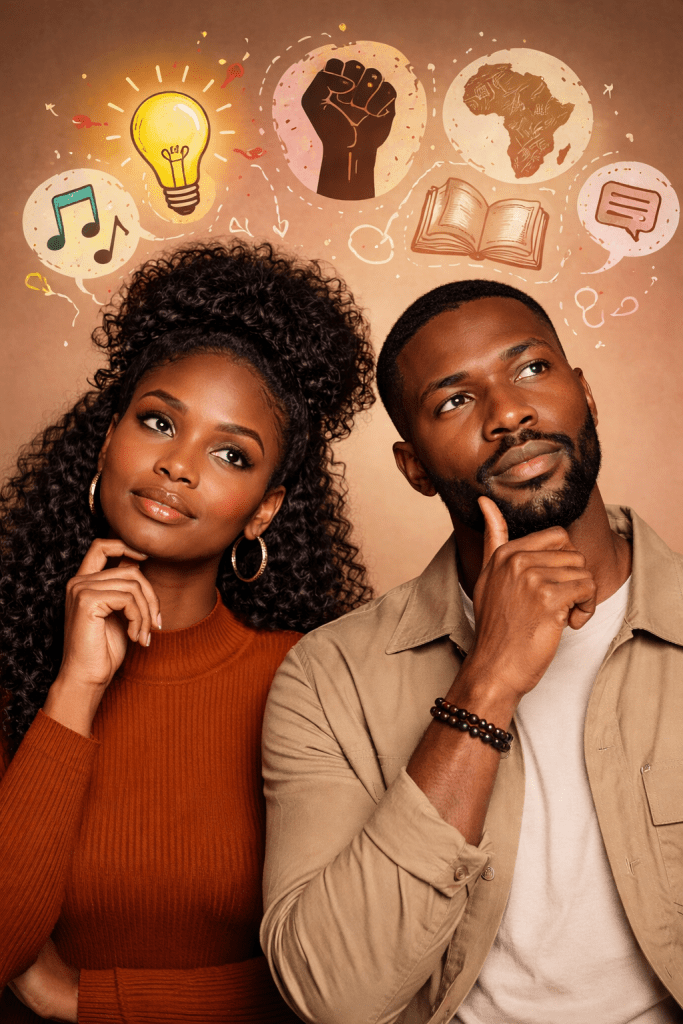
The intellectual and cultural contributions of Black people, when examined collectively, form a rich tapestry of thought that spans centuries, continents, and disciplines. The Black Thought Collective is not merely an academic exercise—it is a recognition of the shared consciousness, resilience, and creative genius of people of African descent. It encompasses reflections on freedom, justice, identity, spirituality, culture, and social responsibility, offering a lens through which the world can better understand the Black experience.

Historical Foundations of Black Thought

Black intellectual thought has deep roots, stretching from African kingdoms and philosophical traditions to the African diaspora. Scholars such as W. E. B. Du Bois articulated the dual consciousness of being Black in a world dominated by Eurocentric norms, highlighting the tensions of identity, freedom, and self-perception (Du Bois, 1903). Similarly, Carter G. Woodson emphasized the importance of education and historical knowledge in combating systemic oppression (Woodson, 1933). These early foundations established the principle that Black people’s collective reflection is not only valid but essential for social transformation.

Resistance and Liberation in Thought

Black thought is often forged in the crucible of struggle. From the era of slavery to the modern civil rights movement, Black intellectuals and activists have confronted oppression with innovative strategies and visionary ideas. The writings of Du Bois (1999) on Reconstruction, the activism of Frederick Douglass, and the political philosophy embedded in contemporary movements like #BlackLivesMatter (Taylor, 2016) all demonstrate that Black thought functions as both critique and guide for collective liberation.

Cultural and Artistic Contributions

Art, music, literature, and philosophy serve as essential vessels of Black collective consciousness. Jazz, hip-hop, African oral traditions, and literary works by Toni Morrison, James Baldwin, and bell hooks articulate both the pain and the triumph of Black life. These cultural productions are not merely aesthetic; they are intellectual interventions, shaping social understanding and advancing discourse on identity, equity, and justice (hooks, 2000; Coates, 2015).

Contemporary Intellectual Discourse

Modern Black thought encompasses sociology, political theory, education, and philosophy. Scholars like Cornel West (2001) and Charles Mills (1997) interrogate the persistent effects of racial hierarchies, systemic injustice, and epistemic exclusion. Collectively, Black intellectuals challenge dominant paradigms, demanding recognition of structural inequities while proposing pathways to equity and collective flourishing (Glaude, 2016).

Spiritual and Moral Dimensions

Faith and spirituality have historically played a central role in shaping Black thought. The moral imperatives embedded in religious traditions—from African spiritual systems to Christianity—inform principles of justice, communal responsibility, and ethical leadership. Black thought consistently integrates the spiritual with the practical, emphasizing that liberation encompasses mind, body, and soul.

Intersectionality and Inclusivity

The Black Thought Collective is inherently intersectional. Gender, class, sexuality, and geographic location intersect with race to produce diverse perspectives within the collective. The insights of Black women intellectuals, including bell hooks and Kimberlé Crenshaw, underscore how multiple axes of oppression and identity inform nuanced understandings of justice and empowerment (hooks, 2000; Taylor, 2016).

Global Perspective

Black thought is not confined to the United States; it resonates across the African diaspora. Intellectuals from the Caribbean, Latin America, Europe, and Africa have contributed perspectives on colonization, migration, cultural identity, and global solidarity. Figures such as Frantz Fanon, Ngũgĩ wa Thiong’o, and Chimamanda Ngozi Adichie highlight the universal and adaptable nature of Black thought, bridging local experience with global consciousness.

Education and Knowledge Production

Education has been both a site of oppression and liberation. Black scholars have emphasized the production and dissemination of knowledge that centers Black experience, countering narratives imposed by colonial and Eurocentric institutions. Woodson’s advocacy for historically accurate education and contemporary calls for decolonized curricula continue this legacy (Woodson, 1933; Painter, 2010).

The Collective Mindset

The strength of Black thought lies in its collective nature. While individual thinkers contribute distinct perspectives, the synthesis of voices creates a holistic understanding of Black life, culture, and aspiration. This collective intelligence fosters resilience, innovation, and strategies for social, political, and cultural advancement.

Future Directions

Looking forward, the Black Thought Collective will continue to evolve. Emerging scholars, activists, and cultural creators are expanding the discourse to include technology, environmental justice, global health, and other contemporary challenges. By integrating historical insight with modern innovation, Black thought remains dynamic, relevant, and transformative.

Conclusion

The Black Thought Collective is a living testament to the intellectual, cultural, and spiritual vitality of Black people. It demonstrates that collective reflection is not merely academic but a vital tool for liberation, empowerment, and social change. Understanding and valuing these contributions is essential for a more just, equitable, and inclusive world. The collective wisdom of Black people offers profound insights into humanity, justice, and the ongoing pursuit of freedom.


References

Alexander, M. (2012). The new Jim Crow: Mass incarceration in the age of colorblindness. The New Press.

Coates, T.-N. (2015). Between the world and me. Spiegel & Grau.

Du Bois, W. E. B. (1903). The souls of Black folk. A. C. McClurg & Co.

Du Bois, W. E. B. (1999). Black reconstruction in America, 1860–1880. Free Press. (Original work published 1935)

Glaude, E. S., Jr. (2016). Democracy in Black: How race still enslaves the American soul. Crown Publishing Group.

hooks, b. (2000). Where we stand: Class matters. Routledge.

Mills, C. W. (1997). The racial contract. Cornell University Press.

Painter, N. I. (2010). The history of White people. W. W. Norton & Company.

Taylor, K.-Y. (2016). From #BlackLivesMatter to Black liberation. Haymarket Books.

West, C. (2001). Race matters. Beacon Press.

Woodson, C. G. (1933). The mis-education of the Negro. Associated Publishers.

Yancy, G. (2018). Black bodies, white gazes: The continuing significance of race in America. Rowman & Littlefield.

Beautyism: The Social Hierarchy of Appearance.

Beautyism is a pervasive form of bias in which physical attractiveness becomes a determinant of social, economic, and professional value. Unlike racism or sexism, which are widely recognized, beautyism often operates invisibly, normalized as preference or merit. Yet its consequences are tangible, affecting employment, compensation, social treatment, and interpersonal relationships. Appearance, particularly facial symmetry, skin tone, and adherence to cultural beauty norms, functions as an unspoken gatekeeper of opportunity.

Historically, beautyism has roots in class and colonial systems that equated aesthetic traits with worth. Eurocentric standards of beauty were imposed globally, privileging lighter skin, narrow noses, specific body shapes, and “refined” facial features. This legacy persists in contemporary media, professional expectations, and social judgment, reinforcing hierarchies based on appearance (Hamermesh & Biddle, 1994).

In the workplace, beautyism manifests in hiring, promotions, and wage disparities. Attractive individuals are often perceived as more competent, intelligent, and socially skilled, regardless of actual ability. Research indicates that more physically appealing candidates are statistically more likely to be hired, receive higher salaries, and attain leadership roles (Hosoda, Stone-Romero, & Coats, 2003).

Beautyism intersects with race and colorism, amplifying advantage for those whose features align with dominant aesthetic ideals. Lighter-skinned, Eurocentric features are often rewarded, while darker skin or features associated with non-European ancestry are penalized. This creates a compounded effect where racial bias and beauty bias reinforce each other (Hunter, 2007).

Socially, beautyism shapes relational dynamics. Attractive individuals receive more attention, favor, and trust in interpersonal interactions. Studies on the “halo effect” demonstrate that perceived beauty leads observers to attribute positive personality traits, competence, and moral character to an individual solely based on appearance (Eagly et al., 1991).

Within romantic and social spheres, beautyism dictates desirability and perceived worth. Partners with culturally valued features are more likely to receive attention, admiration, and romantic interest, while those outside these norms are often marginalized, fetishized, or overlooked. This hierarchy reinforces societal inequities and internalized self-judgment.

In families and communities, beautyism can exacerbate favoritism and differential treatment. Children with features perceived as attractive may receive more encouragement, praise, and social capital, while less “beautiful” children may experience neglect or lower expectations. Such disparities impact self-esteem, social development, and life trajectories.

Beautyism also intersects with gender, disproportionately affecting women. Societal pressure for women to maintain attractiveness translates into emotional, financial, and professional labor. Women are judged more harshly by appearance than men, facing scrutiny for aging, body size, skin tone, and facial symmetry.

Media and popular culture are key vehicles for perpetuating beautyism. Films, television, advertisements, and social media frequently elevate a narrow standard of beauty, often white-centered, while marginalizing diverse representation. Repetition trains collective perception, normalizing hierarchy and preference (Frisby, 2004).

Psychologically, beautyism contributes to anxiety, body dysmorphia, and low self-esteem. Internalized societal preference for certain features causes individuals to view themselves and others through biased lenses. This internal policing perpetuates inequality even in private or informal spaces.

Education is not immune to beautyism. Teachers’ perceptions of attractiveness influence grading, disciplinary decisions, and expectations. Attractive students are often seen as more capable or disciplined, while those judged less attractive may face harsher critique or reduced encouragement.

Economically, beautyism translates into measurable disparity. Attractive individuals command higher salaries, receive more bonuses, and have access to greater professional networks. Studies show a wage premium for attractive people across industries, indicating structural reinforcement of appearance-based advantage (Hamermesh, 2011).

Beautyism is also intertwined with social mobility. Individuals who conform to aesthetic norms are more likely to navigate elite spaces, gain mentorship, and access resources unavailable to those outside dominant beauty standards. This creates a cycle where beauty functions as currency.

Biblically, beautyism contradicts the principle that God evaluates by heart rather than outward appearance. Scripture warns, “Man looketh on the outward appearance, but the Lord looketh on the heart” (1 Samuel 16:7, KJV). Favoritism based on looks is therefore morally and spiritually flawed.

Churches and faith communities are not exempt. While congregations may reject racial or economic partiality, appearance-based favoritism often persists subtly through leadership selection, social visibility, and interpersonal validation. Spiritual integrity demands confrontation of this bias.

Overcoming beautyism requires intentional awareness and disruption of these hierarchies. Individuals and institutions must examine unconscious bias, challenge media narratives, and affirm diverse forms of beauty. Recognition of privilege tied to appearance is necessary for systemic and personal reform.

Intervention must also address internalized belief systems. Self-worth must be disentangled from aesthetic validation. Educational programs, counseling, and mentorship that prioritize character, talent, and virtue over looks can mitigate the psychological burden of beautyism.

Collective resistance involves creating inclusive environments where appearance does not dictate access or value. Policy, culture, and leadership structures must actively counteract favoritism based on looks, just as they address racial, gender, and class discrimination.

Ultimately, beautyism is a social construct that both reflects and reinforces inequality. Addressing it is not about denying aesthetics, but refusing hierarchy rooted in appearance. Justice, fairness, and human dignity demand that value be measured by character and action rather than physical conformity to cultural standards.

The dismantling of beautyism is a moral, cultural, and spiritual imperative. When societies cease rewarding superficial conformity, they open space for equitable recognition of talent, intelligence, and virtue, affirming the inherent worth of every individual.


References

The Holy Bible, King James Version. (1611). Various passages.

Hamermesh, D. S., & Biddle, J. E. (1994). Beauty and the labor market. American Economic Review, 84(5), 1174–1194.

Hosoda, M., Stone-Romero, E. F., & Coats, G. (2003). The effects of physical attractiveness on job-related outcomes: A meta-analysis of experimental studies. Personnel Psychology, 56(2), 431–462.

Hunter, M. (2007). The persistent problem of colorism: Skin tone, status, and inequality. Sociology Compass, 1(1), 237–254.

Eagly, A. H., Ashmore, R. D., Makhijani, M. G., & Longo, L. C. (1991). What is beautiful is good, but…: A meta-analytic review of research on the physical attractiveness stereotype. Psychological Bulletin, 110(1), 109–128.

Frisby, C. M. (2004). Does race or gender matter? Effects of media images on self-perception. Journal of Broadcasting & Electronic Media, 48(2), 301–317.

Hamermesh, D. S. (2011). Beauty pays: Why attractive people are more successful. Princeton University Press.

The Mirror and the Myth: Somali Identity, Colorism, and the Question of Blackness

Somali identity sits at the crossroads of Africa, the Middle East, and the Indian Ocean world, shaped by centuries of migration, trade, and cultural blending. Because of this complex history, conversations about how some Somalis perceive Black people—and even how they perceive themselves—carry emotional, historical, and sociological weight. While it is inaccurate to claim that all Somalis dislike Black people, anti-Black attitudes indeed exist in parts of Somali society, much like in many cultures around the world influenced by colonialism and colorism.

The foundational issue is identity. Many Somalis see themselves not simply as “Black Africans,” but as Cushitic people, a linguistic and cultural group indigenous to the Horn of Africa. This Cushitic identity predates modern racial categories and often separates Somalis from other African ethnic groups in their own cultural memory. For some, this difference becomes a way to claim uniqueness rather than sameness.

Another layer is the historical Arabian connection. For over a thousand years, the Horn of Africa was tied to the Arabian Peninsula through trade, religion, and intermarriage. Somali clans trace parts of their lineage to Arab traders and Islamic scholars, especially after the spread of Islam in the 7th century. While genetic studies show that Somalis are overwhelmingly East African, the presence of some Arabian ancestry became culturally emphasized over time.

This emphasis contributed to a racial hierarchy that elevated proximity to Arab identity. Arab societies historically developed their own colorist and caste-like distinctions, and these ideas traveled back across the Red Sea. Within this framework, darker-skinned Africans were placed at the bottom, while “Arab-adjacent” identities were seen as more respectable. These beliefs influenced Somali beauty standards and self-perception.

Another contributing factor is colonialism. Italian and British powers reinforced racial categories that separated Somalis from other African groups. The more colonizers insisted Somalis were “not like other Africans,” the more some Somali elites embraced this distinction. Colonialism often amplifies preexisting anxieties, and racial hierarchy became a painful legacy that survived long after independence.

In many Somali communities, especially among diaspora youth, the tension around Black identity emerges from confusion rather than malice. Many grow up hearing conflicting narratives: that they are African, but not “Black”; that they are different, but not superior; that they should distance themselves from Blackness, yet they are racially profiled as Black everywhere they go outside Somalia. This creates an identity crisis.

Colorism further complicates the story. Lighter skin is often praised in Somali society, while darker skin may be stigmatized. These views are not unique to Somalis—they appear throughout Africa, the Middle East, and Asia due to global beauty standards shaped by colonialism, slavery, and media. In this system, “beauty” becomes racialized, and some people internalize the idea that proximity to Arab or Eurasian features is more desirable.

Because of these influences, some Somalis adopt an anti-Black worldview even while they themselves are viewed as Black in Western racial structures. This contradiction produces internalized tension and sometimes open prejudice. Yet, at the same time, there are many Somalis who identify proudly as Black, who celebrate African culture, and who reject colorism entirely. Somali societies are not monolithic.

Another significant factor is clan and ethnic hierarchy. Somali culture is deeply clan-oriented, and these hierarchies sometimes extend into attitudes toward neighboring African groups. Historically, pastoral communities often viewed agricultural or hunter-gatherer groups as socially inferior. Over time, these attitudes sometimes merged with racial ideas introduced through Arab societies and colonial rule.

The diaspora experience reshapes Somali identity in new ways. Young Somalis in the West often become more aware of race because they face the same racism as African Americans and other Black people. Many begin to question the old narratives and reject anti-Blackness, choosing instead to embrace broader Black solidarity. Others, however, cling to ideas of distinction as a coping mechanism for racism.

When people ask why some Somalis “think they are beautiful,” the deeper issue is that global beauty standards themselves are warped. Many societies have been conditioned to associate beauty with specific features—lighter skin, looser hair, narrow noses—because these were historically tied to social status and power. In Somali communities, beauty is often associated with a blend of Cushitic, Afro-Arab, and East African phenotypes. This has nothing to do with superiority and everything to do with cultural conditioning.

Moreover, Somali beauty is frequently celebrated within the global modeling and fashion world. This external validation reinforces cultural pride but can also unintentionally deepen colorist tendencies. When beauty becomes linked to specific features rather than the full spectrum of Somali diversity, it fuels exclusion and competition.

The question of “what is going on with them?” cannot be answered with a single explanation. Instead, Somali attitudes toward Blackness are shaped by layers of history—Arab influences, colonial classifications, clan structures, colorism, migration, and modern media. These forces shape self-perception, sometimes in harmful ways, but they are not fixed or universal.

There are many Somalis who actively challenge anti-Blackness, educate their communities, and advocate for unity with the broader African diaspora. Activists, scholars, and artists within Somali communities speak openly about dismantling these internalized biases. They argue that Black identity is not something to avoid, but something to honor and embrace.

At the same time, it is important to recognize that conversations about Somali identity must be nuanced. No ethnic group is uniformly prejudiced or uniformly enlightened. Just as some Somali individuals hold anti-Black beliefs, many others are deeply committed to solidarity, justice, and cross-cultural understanding.

It is also essential to avoid narratives that paint Somalis as uniquely problematic. Anti-Blackness is a global phenomenon—found in Arab countries, Asian countries, Latin America, Europe, and even among some Africans. Somali society reflects this global influence, not an inherent flaw.

Ultimately, the relationship between Somalis and Black identity is a story of internal conflict shaped by external forces. It reflects a broader truth: colonization, racial hierarchy, and colorism have left deep scars across the world. Healing requires honest dialogue, historical literacy, and intentional unlearning.

When Somalis embrace the fullness of their East African heritage, they challenge the myth of separation. When they reject colonial beauty hierarchies, they dismantle the internalized shame that feeds colorism. When they stand in solidarity with other Black communities, they reclaim a shared history of resilience, faith, and cultural pride.

In the end, identity is not just what one inherits—it is also what one chooses. And many Somalis today are choosing a narrative of unity rather than division, truth rather than myth, and empowerment rather than stigma.


References

Abdi, C. M. (2015). Elusive Jannah: The Somali Diaspora and Borderless Muslim Identity. University of Minnesota Press.
Lewis, I. M. (2002). A Modern History of the Somali. James Currey.
Samatar, A. I. (1994). The Somali Challenge: From Catastrophe to Renewal? Lynne Rienner.
Hassan, M. (2017). “Anti-Blackness in the Arab and Horn Regions.” Journal of African Studies, 44(2), 215–231.
Harper, K. (2019). Colorism and the Horn of Africa: Historical Roots and Modern Realities. Routledge.
Ali, N. (2021). “Somali Identity in the Diaspora: Negotiating Blackness, Islam, and Migration.” Diaspora Studies, 14(1), 55–73.

Unapologetically Brown

To be unapologetically brown is to embrace a lineage of strength, beauty, and resilience. It is a declaration that the skin one inhabits is not a limitation but a testament to survival, creativity, and divine design. In a society that often marginalizes or misrepresents brownness, asserting identity without apology becomes both an act of self-love and resistance.

Brownness carries history. From African kingdoms to the diasporic experiences shaped by colonization and slavery, the brown individual is connected to a legacy of leadership, innovation, and cultural richness. Recognizing this heritage strengthens identity and fosters pride, counteracting narratives of inferiority.

Psychologically, embracing brownness combats the internalized biases imposed by colorism and societal hierarchy. Hunter (2007) notes that internalized colorism can affect self-esteem, emotional health, and social interactions. To live unapologetically brown is to reject these limiting perceptions and affirm inherent worth.

Scripture affirms the value of every individual. Psalm 139:14 (KJV) states, “I will praise thee; for I am fearfully and wonderfully made: marvellous are thy works; and that my soul knoweth right well.” Brown skin is part of God’s deliberate creation, a mark of intentionality and beauty.

Celebrating brownness is an act of courage. Society often privileges lighter skin, Eurocentric features, and Western standards of beauty. Standing firm in brown identity challenges these hierarchies and affirms the dignity of one’s natural self.

Unapologetic brownness is intersectional. It encompasses culture, hair, features, language, and heritage. Each aspect is a thread in the tapestry of identity, deserving of affirmation and respect. It is a refusal to conform to external expectations at the expense of authenticity.

Historical awareness strengthens unapologetic brown identity. Understanding the contributions of African civilizations, Caribbean resistance, and Black excellence in America provides context for pride. Knowledge of history transforms marginalization into empowerment, validating existence and achievement.

The Bible speaks to embracing identity and purpose. Jeremiah 1:5 (KJV) declares, “Before I formed thee in the belly I knew thee; and before thou camest forth out of the womb I sanctified thee, and I ordained thee a prophet unto the nations.” God’s intentionality in creation extends to skin, culture, and personal gifts.

Psychologically, embracing brownness correlates with higher self-esteem and resilience. Studies indicate that racial pride mediates stress and enhances mental well-being, particularly in contexts of discrimination or systemic bias (Sellers et al., 2003).

Unapologetic brownness is also expressed through aesthetics. Hair, fashion, and style become forms of self-expression and cultural affirmation. Whether in natural hairstyles, traditional dress, or contemporary fashion, these choices celebrate heritage and individuality.

The arts have long been a vehicle for unapologetic brown expression. Literature, music, visual art, and performance highlight narratives of brown lives, affirming identity and challenging societal misrepresentation. Figures like Toni Morrison, Chimamanda Ngozi Adichie, and Maya Angelou exemplify this power.

Faith and spirituality reinforce unapologetic brownness. Believing in one’s worth as divinely created provides confidence and purpose. Proverbs 31:25 (KJV) states, “Strength and honour are her clothing; and she shall rejoice in time to come.” Spiritual grounding fortifies resilience against societal marginalization.

Community support enhances the experience of living unapologetically brown. Mentorship, family, and cultural networks reinforce pride, provide guidance, and offer affirmation, ensuring that identity is nurtured rather than suppressed.

Rejecting negative stereotypes is essential. Media often portrays brownness through narrow or pejorative lenses. Critical media literacy allows individuals to engage with representation thoughtfully, asserting their own narrative instead of internalizing harmful imagery.

Education empowers unapologetic brown identity. Knowledge of history, literature, science, and social dynamics strengthens self-concept and equips individuals to challenge systemic inequities with informed confidence.

Unapologetic brownness is inherently political. In a world that seeks to marginalize or erase, asserting presence, voice, and value becomes a form of activism. Every act of self-affirmation challenges structures of oppression and asserts dignity.

Mental and emotional well-being is nurtured through affirmation. Daily practices of self-love, gratitude, and reflection reinforce the choice to live authentically, honoring both ancestry and personal journey.

Unapologetically brown individuals inspire future generations. By modeling pride, achievement, and resilience, they teach youth to embrace identity fully, countering generational trauma and societal discouragement.

Brownness is dynamic, multifaceted, and resilient. To live unapologetically is to reject shame, embrace heritage, and move confidently in the world with authenticity and grace.

Ultimately, unapologetic brownness celebrates life, history, and divine intention. It integrates self-love, cultural pride, and spiritual affirmation into an empowered existence. It is not a momentary stance but a lifelong declaration: that to be brown is to be whole, worthy, and beloved.


References

Psalm 139:14, KJV.
Jeremiah 1:5, KJV.
Proverbs 31:25, KJV.
Hunter, M. L. (2007). The Persistent Problem of Colorism: Skin Tone, Status, and Inequality. Sociology Compass, 1(1), 237–254.
Sellers, R. M., Smith, M. A., Shelton, J. N., Rowley, S. A., & Chavous, T. M. (2003). Multidimensional model of racial identity: A reconceptualization of African American racial identity. Personality and Social Psychology Review, 7(3), 210–224.
Asante, M. K. (2007). The History of Africa: The Quest for Eternal Harmony. Routledge.
Gates, H. L. (2019). The Black Experience in America: Identity, Culture, and Achievement. Vintage Press.

The Effect of Colorism in Latin America & the Caribbean.

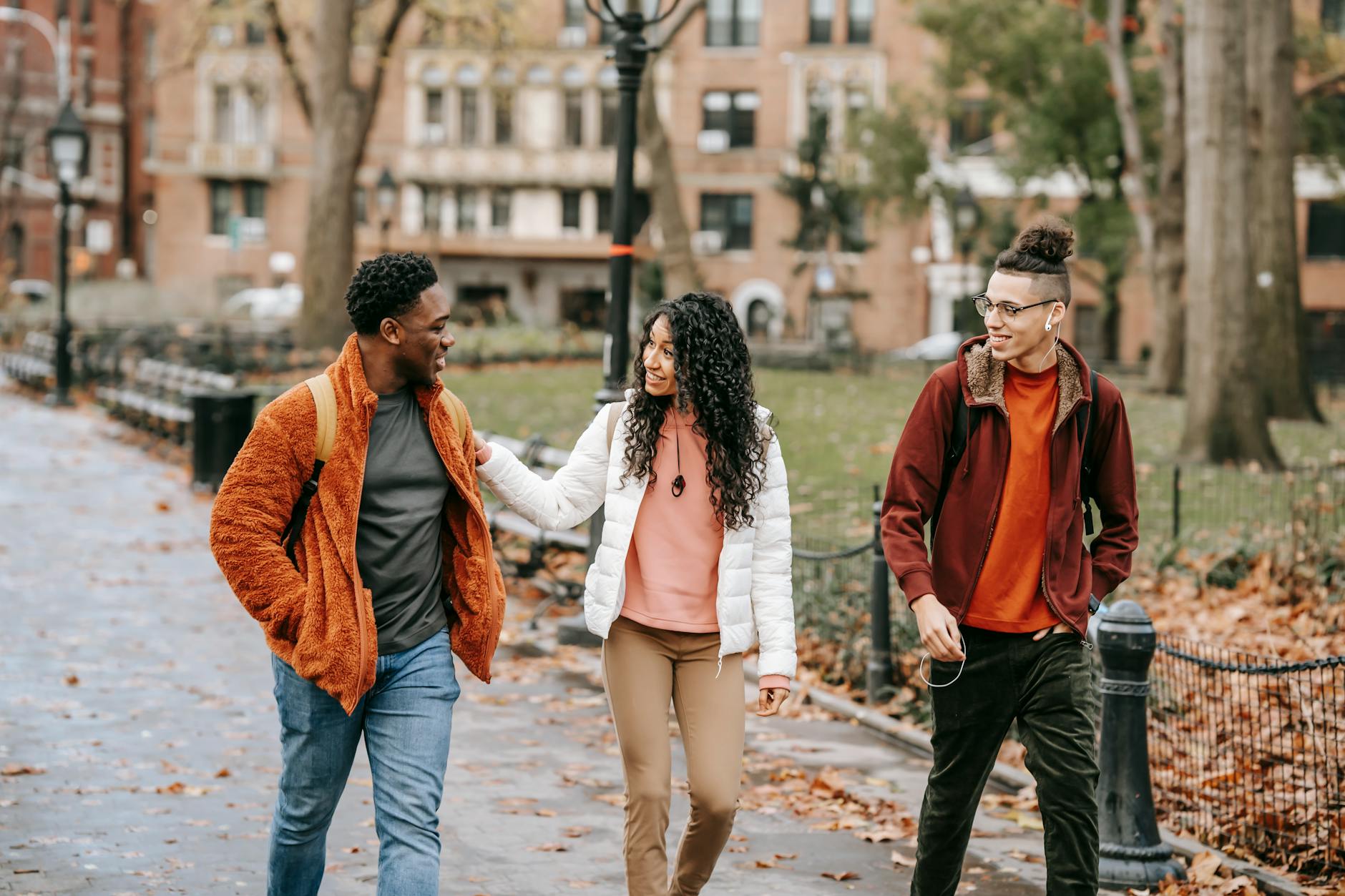
Photo by Keira Burton on Pexels.com

Colorism, the preferential treatment of lighter-skinned individuals over darker-skinned individuals within the same racial or ethnic group, is a pervasive social issue in Latin America and the Caribbean. Unlike racism, which typically operates between racial groups, colorism functions within communities, shaping beauty standards, social mobility, and economic opportunities. The colonial history of the region, combined with complex racial hierarchies, has deeply entrenched the preference for lighter skin.

In Brazil, colorism is heavily influenced by the legacy of Portuguese colonization and the transatlantic slave trade. Lighter-skinned Brazilians often enjoy greater social acceptance, higher economic opportunities, and more visibility in media and politics. Darker-skinned individuals, including Afro-Brazilians, frequently face systemic disadvantages in employment, education, and social interactions.

Colombia presents a similar pattern. The country’s stratified society historically valued European ancestry and lighter skin, relegating Afro-Colombians and Indigenous populations to lower socioeconomic positions. Studies reveal that lighter-skinned Colombians are more likely to secure professional jobs and attain higher wages, while darker-skinned individuals face barriers to upward mobility.

In the Dominican Republic, colorism intersects with national identity and postcolonial ideals of beauty. Lighter-skinned Dominicans are often celebrated in media, popular culture, and advertising, reinforcing the association between fair skin and social prestige. Conversely, darker-skinned Dominicans experience marginalization and negative stereotyping.

Puerto Rico’s complex racial and cultural landscape similarly reflects colorist biases. Fair-skinned Puerto Ricans, often of European descent, are frequently afforded higher social status, while Afro-Puerto Ricans may encounter limited opportunities and social discrimination. These disparities extend to politics, media, and employment sectors.

Cuba’s history of colonialism and slavery has contributed to persistent colorist attitudes. Afro-Cubans, particularly those with darker skin, are disproportionately represented in lower-paying jobs and are underrepresented in government and media. Skin color continues to influence social hierarchy, marriage prospects, and access to resources.

Haiti, despite its predominantly Black population, exhibits colorism rooted in French colonial legacy. Lighter-skinned Haitians historically held more economic power and social influence, a dynamic that persists in contemporary society. Colorism affects access to education, professional advancement, and social acceptance.

Mexico demonstrates the entrenchment of colorist ideals in beauty standards, media representation, and social mobility. Lighter-skinned Mexicans, often perceived as more European, are preferred in modeling, television, and advertising. Darker-skinned individuals face subtle and overt discrimination in professional, educational, and social contexts.

In Panama, lighter-skinned citizens are often associated with higher social and economic status. The Afro-Panamanian population, particularly those with darker skin, experiences limited access to professional opportunities, societal marginalization, and biased treatment in various institutions.

Costa Rica and Nicaragua also reflect similar dynamics. European features and lighter skin are socially valued, while Indigenous and Afro-descendant populations with darker skin are disproportionately underrepresented in media, education, and government.

Peru’s complex racial hierarchy demonstrates how colorism intersects with Indigenous and mestizo identities. Lighter-skinned individuals often achieve greater social mobility, while darker-skinned populations face marginalization, limited economic opportunities, and underrepresentation in leadership roles.

Venezuela has historically celebrated lighter skin in media and social elites. Fair-skinned Venezuelans dominate beauty pageants, television, and political representation, whereas Afro-Venezuelans and darker-skinned individuals remain socially and economically disadvantaged.

In Ecuador, lighter skin continues to confer social advantage. Indigenous and Afro-Ecuadorian populations are frequently subject to prejudice, unequal treatment, and limited access to quality education and professional careers.

In Trinidad and Tobago, colorism affects social stratification, particularly among Afro-Caribbean and Indo-Caribbean communities. Lighter-skinned individuals often receive more social recognition, while darker-skinned individuals face systemic barriers in employment, education, and media representation.

Jamaica exhibits similar patterns, with lighter-skinned Jamaicans often celebrated in popular culture and the entertainment industry. Darker-skinned individuals may encounter prejudice, reduced opportunities, and negative stereotyping in society.

In Belize, lighter skin is frequently associated with European ancestry and social privilege. Afro-Belizeans and Indigenous populations with darker skin experience economic and social marginalization, reflecting the colonial influence on racial hierarchy.

In Guyana, colorism affects both Afro-Guyanese and Indo-Guyanese populations. Lighter skin is socially desirable, influencing marriage patterns, professional opportunities, and media representation. Darker-skinned individuals often face systemic bias.

Barbados and other smaller Caribbean nations similarly reflect entrenched colorist attitudes. Lighter-skinned citizens are often privileged in professional advancement, social acceptance, and media visibility, while darker-skinned individuals face systemic discrimination.

Across Latin America and the Caribbean, the media plays a critical role in perpetuating colorism. Television, film, and advertising frequently feature lighter-skinned individuals as idealized beauty standards, reinforcing societal biases and influencing self-perception among darker-skinned populations.

Table: The Impact of Colorism Across Latin America & the Caribbean

Country/RegionCommunities Most AffectedForms of Colorism & Social Impact
BrazilAfro-Brazilians, Indigenous peoplesLighter skin linked to higher income, visibility in media, and political representation; darker-skinned Brazilians experience systemic racism and underrepresentation.
ColombiaAfro-Colombians, Indigenous groupsLighter-skinned Colombians receive better employment and education opportunities; darker skin associated with lower social class.
Dominican RepublicAfro-Dominicans, Haitian descendantsNational identity tied to whiteness; darker-skinned Dominicans often face denial of citizenship and discrimination.
Puerto RicoAfro-Puerto Ricans, mixed-race populationsLighter skin associated with beauty and privilege; darker-skinned individuals face workplace and media bias.
CubaAfro-Cubans, mixed-race citizensLighter skin favored in tourism and professional sectors; Afro-Cubans underrepresented in media and politics.
HaitiDarker-skinned Haitians (majority), mulatto elitesHistorical “mulatto elite” dominance; darker-skinned citizens face limited economic opportunities.
MexicoIndigenous and Afro-Mexican communitiesTelevision and politics dominated by light-skinned Mexicans; darker-skinned citizens face classism and racial stereotyping.
PanamaAfro-Panamanians, Indigenous groupsColorism intersects with class; lighter-skinned individuals hold most elite and visible positions.
Costa RicaAfro-Costa Ricans, Indigenous peoplesDarker-skinned individuals experience employment discrimination and limited media presence.
NicaraguaAfro-Nicaraguans, Indigenous populationsSkin color determines access to education, tourism jobs, and social status.
PeruIndigenous Andeans, Afro-PeruviansLighter-skinned mestizos have better mobility; darker-skinned citizens face political and social exclusion.
VenezuelaAfro-Venezuelans, Indigenous groupsMedia and beauty industries glorify light skin; darker-skinned Venezuelans face discrimination and poverty.
EcuadorIndigenous, Afro-EcuadoriansLighter skin equated with modernity and wealth; darker skin seen as backward or poor.
Trinidad & TobagoAfro-Trinidadians, Indo-TrinidadiansFair skin often linked to higher desirability and media preference; darker tones marginalized socially.
JamaicaAfro-JamaicansSkin-lightening products normalized; lighter skin considered more beautiful and commercially valuable.
BelizeAfro-Belizeans, Garifuna, MayaLighter skin associated with colonial-era privilege; darker-skinned citizens face social bias.
GuyanaAfro-Guyanese, Indo-GuyaneseColorism influences dating, employment, and social class distinctions.
BarbadosAfro-BarbadiansLighter skin preferred in entertainment and business leadership; darker skin linked to lower income.
Dominica & St. LuciaAfro-Caribbean populationsColorism manifests in beauty pageants and tourism; lighter skin favored for visibility and employment.
BahamasAfro-BahamiansLight-skinned elite families hold social influence; darker-skinned individuals experience class-based prejudice.

Observations

  • Common Thread: In every country, lighter skin is associated with higher socioeconomic status, beauty, and modernity, while darker skin is often linked to poverty, backwardness, or undesirability — a colonial legacy that still shapes identity and opportunity.
  • Media’s Role: Regional television, advertisements, and pageantry largely portray fair skin as ideal, reinforcing intergenerational color biases.
  • Globalization Influence: Western beauty standards continue to affect local perceptions, fueling a growing skin-lightening industry across Latin America and the Caribbean.
  • Resistance Movements: Recent years have seen Afro-Latino and Indigenous activists push for representation through art, education, and social media — reclaiming pride in darker complexions and African ancestry.

Efforts to address colorism in Latin America and the Caribbean require multifaceted approaches. Education, media representation reform, and public awareness campaigns are essential to challenge entrenched biases, promote inclusivity, and foster a society where individuals are valued regardless of skin tone.


References

Rohinianand.com. (n.d.). Colorism’s global manifestations. https://www.rohinianand.com/post/colorism-s-global-manifestations?utm_source=chatgpt.com

News.uga.edu. (n.d.). History of colorism sheds light on discrimination. University of Georgia. https://news.uga.edu/history-of-colorism-sheds-light-on-discrimination/?utm_source=chatgpt.com

PMC. (n.d.). Psychological effects of colorism and internalized bias. https://pmc.ncbi.nlm.nih.gov/articles/PMC11696280/?utm_source=chatgpt.com

PubMed. (2023). Health consequences of skin-lightening practices and biases in medical care. National Library of Medicine. https://pubmed.ncbi.nlm.nih.gov/40063294/?utm_source=chatgpt.com

Teen Vogue. (n.d.). Celebrating Black and brown beauty on social media. https://www.teenvogue.com/story/black-and-brown-beauty-celebration-instagram-accounts-impact?utm_source=chatgpt.com

Axios. (2020, September 8). Hollywood casting and colorism in global media. https://www.axios.com/2020/09/08/hollywood-casting-china-colorism-light-skinned?utm_source=chatgpt.com