Tag Archives: black history

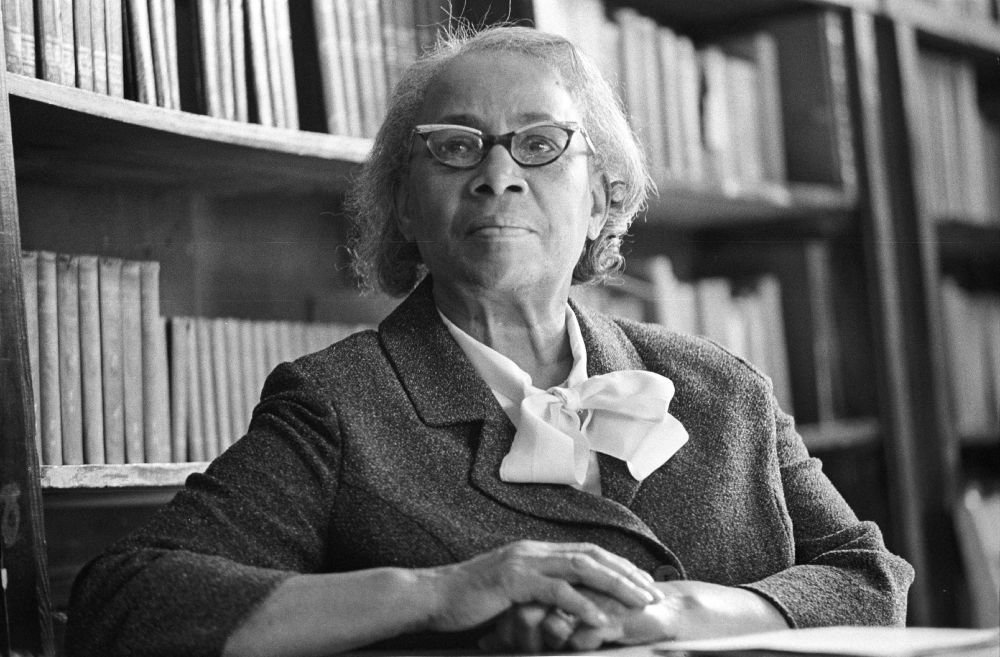
Septima Clark: The Mother of the Civil Rights Movement and Architect of Literacy Empowerment.

“I believe unconditionally in the ability of people to respond when they are told the truth. We need to be taught to study rather than believe, to inquire rather than to affirm.”Septima P. Clark

This photograph is the property of its respective owner. No copyright infringement intended.

Septima Poinsette Clark is often referred to as “The Mother of the Civil Rights Movement” because of her tireless efforts to blend education with grassroots activism. Her life was devoted to dismantling systemic barriers that excluded Black Americans from full participation in civic life. Clark believed that true freedom could not exist without literacy, and she spent her lifetime proving that education was the most powerful weapon against oppression.

Born on May 3, 1898, in Charleston, South Carolina, Septima was the daughter of a washerwoman and a former enslaved father who emphasized dignity and self-respect. Despite segregationist laws barring her from higher education opportunities in the South, she pursued teaching at the Avery Normal Institute and later advanced her studies at Columbia University and Benedict College. Her family background, particularly her mother’s insistence on hard work and her father’s resilience, shaped her commitment to justice and service (Charron, 2009).

Clark’s vision extended beyond the classroom. She understood that systemic racism was not only about physical segregation but also about intellectual deprivation. She founded and expanded Citizenship Schools, grassroots institutions designed to teach African Americans literacy skills so they could pass the literacy tests required for voter registration. These schools became essential in dismantling Jim Crow voter suppression, transforming ordinary men and women into empowered citizens ready to claim their constitutional rights (Clark, 1986).

Her collaborations with leading organizations and figures in the Civil Rights Movement amplified her reach. Clark worked with the NAACP, where she campaigned for equal pay for Black teachers, and with the Highlander Folk School, which became a training ground for activists such as Rosa Parks. She later partnered with the Southern Christian Leadership Conference (SCLC) under Martin Luther King Jr., spreading the Citizenship Schools across the South. In these partnerships, Clark blended her quiet strength with bold strategies, proving that the foundation of mass movements lies in community education (Payne, 1995).

Clark’s achievements were numerous and groundbreaking. She successfully challenged laws that denied Black teachers tenure in Charleston. She helped create a model of civic education that was adopted nationwide. In recognition of her contributions, President Jimmy Carter awarded her the Living Legacy Award in 1979, and she received the Martin Luther King Jr. Nonviolent Peace Prize in 1987. Her lifelong commitment to education, justice, and equality earned her recognition as one of the movement’s most influential yet often overlooked leaders.

Septima Clark’s legacy lies in the simple yet revolutionary idea that teaching literacy is teaching liberation. She understood that the right to vote was meaningless without the knowledge to exercise it. By empowering thousands of African Americans to read, write, and participate in democracy, she dismantled one of the most insidious barriers of segregation. Her life’s purpose was not only to fight oppression but to create a generation of leaders who could continue the work of justice. For this reason, Clark remains indispensable to the history of civil rights and to the enduring struggle for Black freedom.


📚 References

  • Clark, S. P. (1986). Ready from Within: Septima Clark and the Civil Rights Movement. Wild Trees Press.
  • Charron, K. M. (2009). Freedom’s Teacher: The Life of Septima Clark. University of North Carolina Press.
  • Payne, C. M. (1995). I’ve Got the Light of Freedom: The Organizing Tradition and the Mississippi Freedom Struggle. University of California Press.
  • National Women’s History Museum. (n.d.). Septima Poinsette Clark. Retrieved from https://www.womenshistory.org

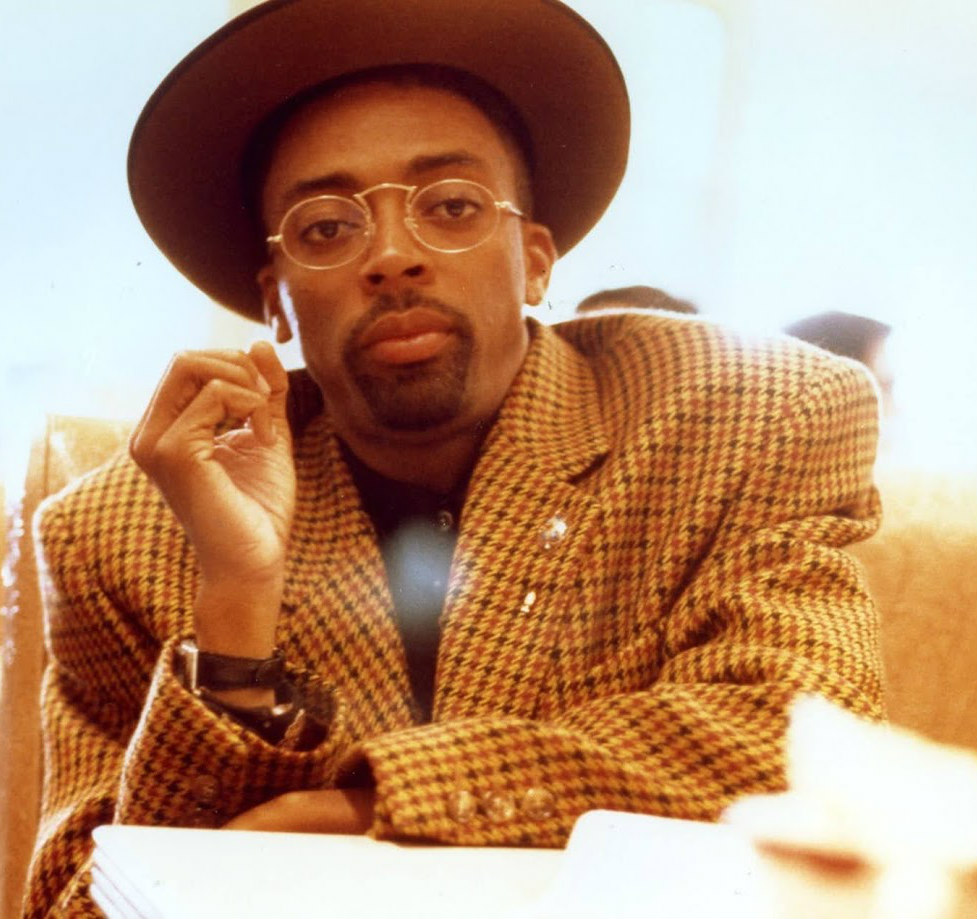
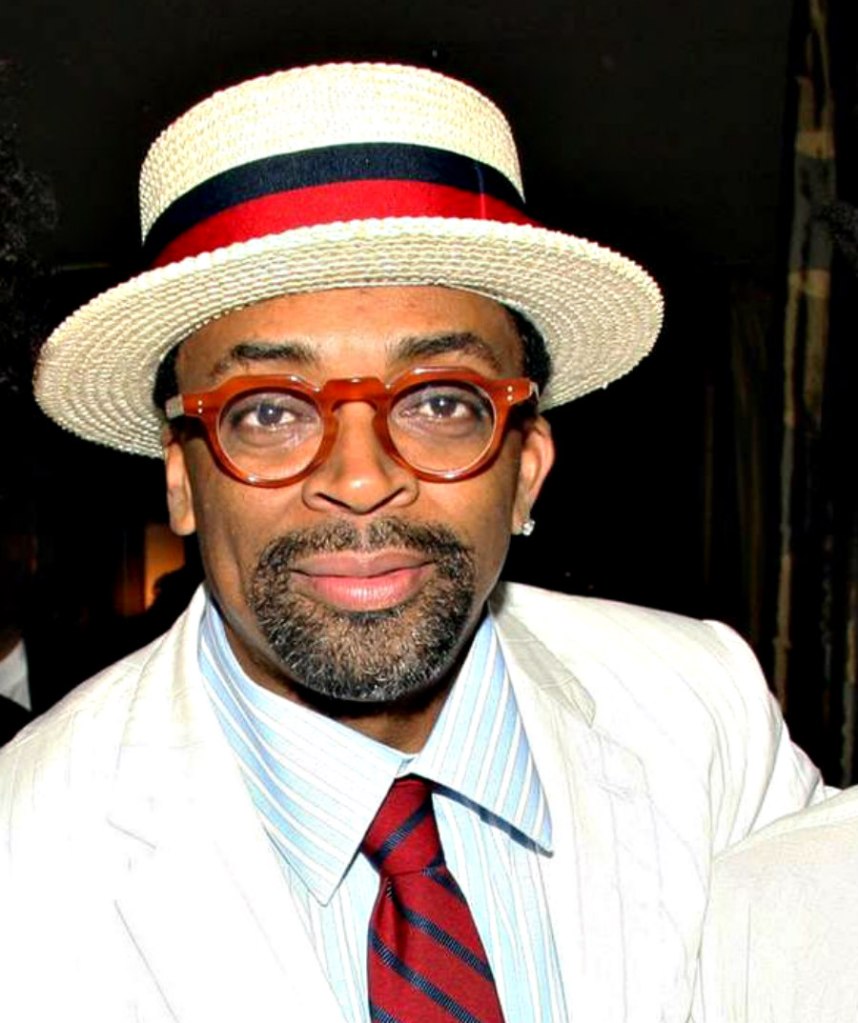
Spike Lee: The Cinematic Trailblazer

This photograph is the property of its respective owners. No infringement intended.

“It’s easier to be President of the United States as a Black person than to be head of a studio.” — Spike Lee, Governors Awards speech (2015).

Spike Lee is more than a filmmaker—he is the cinematic conscience of Black America. For nearly five decades, he has not only told stories but demanded that America listen to the voices it tried to silence. In the Black community of film, Lee stands as the best of the best because he refuses to separate artistry from accountability. His lens does not flatter injustice, nor does it dilute Black experience for mainstream comfort. Instead, it exposes truth with bold color, sharp dialogue, and uncompromising honesty. Where Hollywood often built walls, Lee carved doorways for others to walk through, ensuring that Denzel Washington, Samuel L. Jackson, and countless others could shine. His work reminds us that the measure of greatness is not only found in awards, but in how deeply one reshapes culture. Spike Lee is not just a director—he is a griot with a camera, a keeper of memory, and a visionary who has transformed film into a battleground for justice and a sanctuary for Black creativity.

Shelton Jackson “Spike” Lee, born on March 20, 1957, in Atlanta, Georgia, is widely recognized as one of the most influential filmmakers of the modern era. His career has been defined by an unwavering commitment to telling stories about race, justice, culture, and community. Lee studied at Morehouse College before earning his Master of Fine Arts in Film Production at New York University’s Tisch School of the Arts, where his student thesis film Joe’s Bed–Stuy Barbershop: We Cut Heads (1983) won a Student Academy Award. Soon after, he established his own production company, 40 Acres and a Mule Filmworks, a hub for creating authentic and unapologetically Black narratives. Married to producer and author Tonya Lewis Lee since 1993, Spike Lee is also a father of two children, Satchel and Jackson, who continue his family legacy of creativity and activism.

Spike Lee’s first feature-length film, She’s Gotta Have It (1986), was a breakthrough in independent cinema. Produced on a micro-budget of $175,000 and filmed in just 12 days, it grossed over $7 million at the box office. The story centered on Nola Darling, a sexually independent Brooklyn artist navigating relationships on her own terms. At a time when mainstream films rarely depicted such complex portrayals of Black women, Lee broke new ground in both narrative and representation. The film’s success not only launched his career but also cemented him as an innovative voice in American cinema.

Nearly five decades into his career, Spike Lee has directed films that dissect the nuances of race and American identity. His 1988 film School Daze drew directly from his experiences at Morehouse College and explored colorism, classism, and cultural hierarchies within the Black community. The following year, he directed Do the Right Thing (1989), inspired by the racially charged Howard Beach incident of 1986 and his observations of racial tension in New York City. Set during a sweltering Brooklyn summer, the film captures how ordinary frustrations can explode into violence under systemic injustice. These works positioned Lee as a truth-teller whose films function both as social critique and as artistic expressions of Black life.

Despite his success, Lee has faced persistent barriers in Hollywood, particularly in securing funding for his films. He has consistently spoken out about the racism and exclusion that plague the industry. In his 2015 Governors Awards speech, he remarked that it was “easier for a Black person to be President of the United States than to head a studio.” His decision to boycott the 2016 Oscars in solidarity with the #OscarsSoWhite movement reflected his long-standing critique of Hollywood’s failure to embrace diversity. For Lee, filmmaking has never been simply about entertainment—it has been a vehicle to confront injustice.

Lee’s inspirations are diverse, ranging from his upbringing in Brooklyn to his academic years at historically Black colleges, and the broader African American struggle for equality. His most enduring creative partnership has been with Denzel Washington, whom he cast in several landmark films including Mo’ Better Blues (1990), Malcolm X (1992), He Got Game (1998), and Inside Man (2006). Washington has praised Lee for opening doors for Black actors and redefining what representation in film could look like. Other frequent collaborators include Samuel L. Jackson, Delroy Lindo, Giancarlo Esposito, John Turturro, cinematographer Ernest Dickerson, and composer Terence Blanchard.

Actors who have worked with Lee consistently describe him as a visionary director who challenges them to give their best performances. Denzel Washington, introducing Lee at the 2015 Governors Awards, emphasized that Lee’s commitment to truth-telling has not only elevated his actors but has reshaped the landscape of American cinema. Many in Hollywood acknowledge that Lee’s films helped pave the way for a generation of Black filmmakers who now have greater opportunities to tell their own stories.

Over the course of his career, Spike Lee has been honored with numerous awards and accolades. He won the Academy Award for Best Adapted Screenplay for BlacKkKlansman (2019) and received an Honorary Oscar in 2015. He has also earned the Cannes Grand Prix, BAFTA Awards, two Primetime Emmy Awards for his documentary When the Levees Broke (2006), Peabody Awards, and the U.S. National Medal of Arts (2023). These honors are testaments to his artistry and his role as a cultural historian, documenting America’s triumphs and its deepest wounds through film.

Today, Spike Lee remains a force in Hollywood and beyond. His films continue to spark dialogue about racism, identity, and justice while celebrating Black resilience and creativity. His influence extends not only through his work but also through the countless artists he has mentored and inspired. For Lee, filmmaking has always been about more than the screen—it has been about shifting consciousness.

Feature Filmography (Director/Filmmaker)

1980s

  • She’s Gotta Have It (1986)
  • School Daze (1988)
  • Do the Right Thing (1989)

1990s

  • Mo’ Better Blues (1990)
  • Jungle Fever (1991)
  • Malcolm X (1992)
  • Crooklyn (1994)
  • Clockers (1995)
  • Get on the Bus (1996)
  • He Got Game (1998)
  • Summer of Sam (1999)

2000s

  • Bamboozled (2000)
  • 25th Hour (2002)
  • She Hate Me (2004)
  • Inside Man (2006)
  • Miracle at St. Anna (2008)

2010s

  • Red Hook Summer (2012)
  • Oldboy (2013)
  • Da Sweet Blood of Jesus (2014)
  • Chi-Raq (2015)
  • BlacKkKlansman (2018)

2020s

  • Da 5 Bloods (2020)

(In addition to feature films, Lee has directed numerous documentaries, including 4 Little Girls (1997), When the Levees Broke (2006), and If God Is Willing and da Creek Don’t Rise (2010).)


Selected Awards and Honors

  • Academy Awards (Oscars)
    • Winner: Best Adapted Screenplay – BlacKkKlansman (2019)
    • Honorary Oscar (2015)
    • Nominations: Best Director (BlacKkKlansman), Best Original Screenplay (Do the Right Thing)
  • Cannes Film Festival
    • Grand Prix: BlacKkKlansman (2018)
  • BAFTA Awards
    • Best Adapted Screenplay – BlacKkKlansman (2019)
  • Primetime Emmy Awards
    • Two wins for When the Levees Broke (2007)
  • Peabody Awards
    • Multiple awards including for When the Levees Broke
  • National Medal of Arts
    • Awarded by the U.S. Government (2023)

References

  • Cannes Film Festival. (2018). Grand Prix winners. Retrieved from [festival-cannes.com]
  • Lee, S. (2015). Governors Awards acceptance speech. Academy of Motion Picture Arts and Sciences.
  • NYU Tisch School of the Arts. (2020). Alumni achievements: Spike Lee. Retrieved from [tisch.nyu.edu]
  • Oscars.org. (2019). Spike Lee wins Best Adapted Screenplay for BlacKkKlansman. Retrieved from [oscars.org]
  • Smith, J. (2019). The films of Spike Lee: A cultural critique. Journal of Film Studies, 45(2), 122–138.
  • Washington, D. (2015). Tribute to Spike Lee at the Governors Awards. Academy of Motion Picture Arts and Sciences.
  • Young, S. (2023). Spike Lee awarded National Medal of Arts. The New York Times.

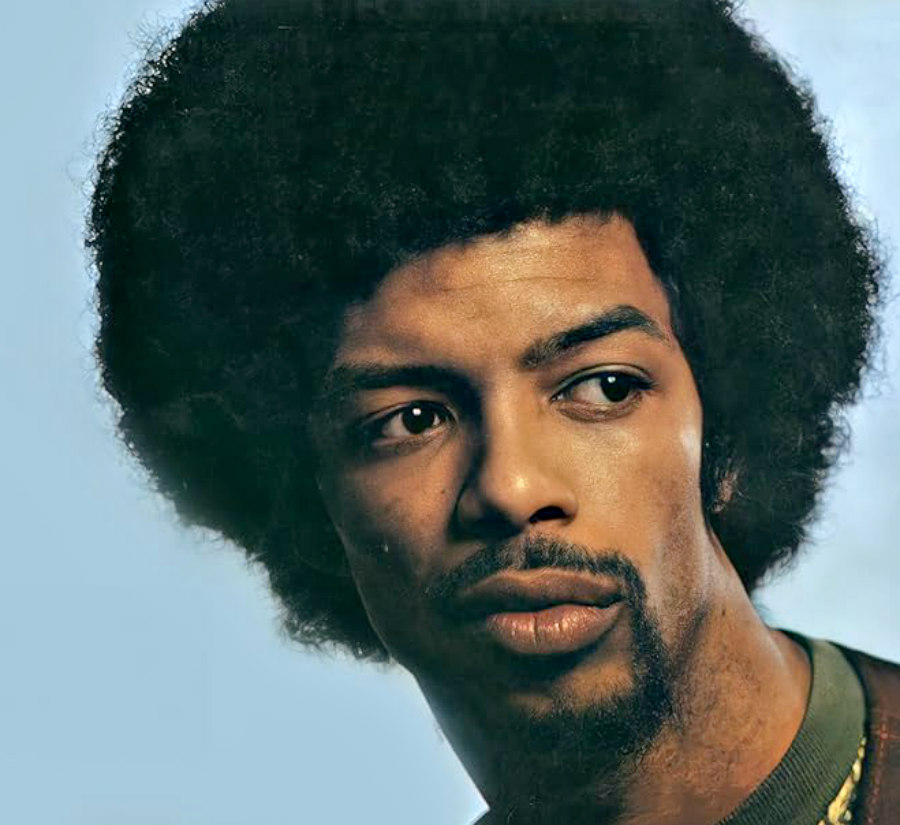
Gil Scott-Heron: The Voice of the Revolution that was Televised 🎤

🎤 The Voice of a Generation…..

Gil Scott-Heron was a poet, musician, novelist, and spoken-word prophet whose powerful lyrics and uncompromising critique of systemic racism made him a towering figure in Black consciousness and American protest culture. Best known for his seminal work “The Revolution Will Not Be Televised,” Scott-Heron used jazz, funk, and poetry to expose the hypocrisy of American democracy and ignite a deeper understanding of Black identity, oppression, and resilience.


🪶 Biography: A Revolutionary Mind

Gilbert Scott-Heron was born on April 1, 1949, in Chicago, Illinois, and raised in Jackson, Tennessee and later The Bronx, New York. His mother, Bobbie Scott, was a librarian and opera singer; his father, Gil Heron, was a Jamaican-born professional soccer player and the first Black man to play for Scotland’s Celtic FC. Scott-Heron was intellectually precocious, winning a full scholarship to the elite Fieldston School in New York and later attending Lincoln University—a historically Black university in Pennsylvania—where he began collaborating with future jazz great Brian Jackson.

He later earned his master’s degree in creative writing from Johns Hopkins University, blending literary talent with political activism and music.


📢 “The Revolution Will Not Be Televised” – A Cultural Detonation

First recorded in 1970, “The Revolution Will Not Be Televised” became an anthem for Black power and radical critique. Delivered in a gritty, urgent tone over a sparse conga beat, the piece warned against passive consumption of media, urging Black Americans to reject corporate distractions and confront real-world oppression.

“The revolution will not be brought to you by Xerox…The revolution will not go better with Coke.”

It rejected commercialism and fake liberalism, shaking the Black community out of political slumber. For many, it was a wake-up call to reclaim agency, identity, and justice—decades before terms like “woke” were popularized. It remains a cornerstone of hip-hop, neo-soul, and conscious rap, influencing artists like Public Enemy, Kendrick Lamar, Common, and Kanye West.


💍 Marriage, Family, and Struggles

Scott-Heron was married to Brenda Sykes, an actress, and had several children, including Gia Scott-Heron, a poet. His personal life, however, was often turbulent. He struggled with drug addiction, particularly crack cocaine, which led to multiple arrests and prison stints.

He died on May 27, 2011, in New York City, reportedly from complications related to HIV/AIDS, as well as pneumonia.


🏆 Awards and Recognition

Despite his commercial limitations, Scott-Heron was widely revered:

  • Grammy Lifetime Achievement Award (posthumously, 2012)
  • BET Honors and various tributes by musical peers
  • Inducted into the Rock and Roll Hall of Fame (2021) under the category of Early Influence

Critics often credit him as the “godfather of rap,” though he personally rejected the label, arguing that his work was rooted more in Blues, Jazz, and Soul-inflected poetry than the structure of hip-hop.


📚 Literary Work: The Vulture (1970)

Gil Scott-Heron was also an accomplished novelist. His debut novel The Vulture was a gripping urban murder mystery that explored themes of race, violence, and identity in Harlem. The story follows the murder of a young Black man and the perspectives of four friends as they try to uncover the truth.

Written when he was just 19, the novel was raw, honest, and infused with street dialect, jazz rhythms, and sociopolitical tension. Scott-Heron wrote it because he saw literature as another weapon to confront societal neglect and expose the real conditions of inner-city youth. The novel was praised for giving voice to disenfranchised Black characters in a way few literary works had done before.


🤍 Reception from White America

Scott-Heron’s message was unapologetically pro-Black and critical of systemic whiteness, so mainstream (largely white) America viewed him with caution, if not outright hostility. However, progressive white intellectuals and musicians appreciated his genius. Over time, as social justice became a broader conversation, even mainstream outlets began to recognize his prophetic insight.


🧠 What He Thought and Said

Scott-Heron was not only a performer but also a philosopher of Black struggle. One of his most quoted lines:

“The first revolution is when you change your mind.”
—Gil Scott-Heron, The Mind of Gil Scott-Heron (1978)

He believed liberation began with mental transformation—a message that deeply influenced Black consciousness movements.


🔥 Legacy and Influence

Scott-Heron’s work laid the foundation for conscious hip-hop, Black Lives Matter rhetoric, and modern spoken word. His uncompromising style still echoes through the works of artists like Nas, Mos Def, Erykah Badu, and Common.

Though he passed away in 2011, Gil Scott-Heron’s prophetic voice still resonates in every protest, every poem, and every performance that dares to tell the truth.


📚 References

Dilemma:🌹 Navigating Identity — Invisible Yet Indispensable: The Labor of Black Women in Society 🌹

🌹 The Brown Girl🌹

Photo by Ivan Samkov on Pexels.com

The journey of the Black woman is a complex tapestry woven with strands of resilience, faith, pain, and perseverance. Her voice, often muted by systemic oppression, resonates with both the echoes of ancestral struggle and the melody of survival. Despite her indispensable role in the shaping of societies, the Black woman remains caught between visibility and invisibility, celebrated yet silenced, desired yet devalued. This essay examines the layered dilemmas Black women face, focusing on silencing and gaslighting, mental health taboos, and generational trauma, while drawing upon psychology and the King James Bible (KJV) for insight and pathways toward healing.

Black women occupy a paradoxical position in society: they are both invisible and indispensable. Their labor has historically undergirded economies, families, and communities, yet their voices, bodies, and contributions are often dismissed or appropriated. This dilemma—rooted in slavery and perpetuated through systemic inequities—has created a cycle of resilience and exhaustion. Black women are expected to give endlessly while being denied the recognition and care they deserve. As scholar bell hooks (1981) argued, the exploitation of Black women’s labor is foundational to both racism and patriarchy, rendering them crucial yet overlooked participants in social progress.

The Price of Being Heard: Silencing and Gaslighting of Black Women’s Voices

One of the most profound challenges Black women face is the silencing of their voices. Whether in corporate boardrooms, political arenas, or healthcare settings, Black women are often dismissed, interrupted, or told their concerns are exaggerated. The tragic case of Serena Williams—who was ignored by medical staff during childbirth complications—illustrates how even wealthy, high-profile Black women experience silencing. Psychologically, this dismissal results in gaslighting: being made to question one’s reality or truth. Biblically, silencing echoes the injustice condemned in Proverbs 31:8 (KJV): “Open thy mouth for the dumb in the cause of all such as are appointed to destruction.” Scripture affirms that truth-telling is both a moral responsibility and a sacred act, underscoring the need to honor Black women’s testimonies.

Psychology of Silencing

From a psychological standpoint, constant silencing creates cognitive dissonance and internalized self-doubt. Research shows that being unheard increases anxiety and depressive symptoms, while persistent microaggressions erode self-esteem (Sue, 2010). For Black women, the compounded effect of race and gender means their silence is not merely personal but systemic. Overcoming this requires validating their voices, establishing platforms where they are centered, and teaching communities to listen with humility rather than defensiveness.

Solutions for Amplification

To counteract silencing, Black women must be given space in leadership, policy, and media representation. Mentorship programs, advocacy networks, and deliberate inclusion in decision-making structures can elevate voices long ignored. Churches and communities must also challenge patriarchal norms that discourage women from speaking openly. The Apostle Paul’s reminder in Galatians 3:28 (KJV)—“There is neither Jew nor Greek, there is neither bond nor free, there is neither male nor female: for ye are all one in Christ Jesus”—calls for dismantling hierarchies that devalue women’s contributions.

Black Women and Mental Health: Breaking the Taboo of Therapy and Healing

Mental health remains a taboo subject within many Black communities. Generational teachings to “pray it away” or “stay strong” have discouraged women from seeking professional help. The stigma is compounded by historical medical racism, such as the exploitation of Black bodies in the Tuskegee experiments. Psychologically, suppression of emotional struggles manifests as anxiety, depression, and even somatic illnesses like hypertension. Woods-Giscombé (2010) notes that the “Superwoman Schema” forces Black women to conceal vulnerability, worsening mental health outcomes.

Biblical and Psychological Perspective on Healing

The Bible affirms the importance of rest, restoration, and vulnerability. Matthew 11:28 (KJV) declares: “Come unto me, all ye that labour and are heavy laden, and I will give you rest.” This scripture reminds Black women that God does not demand unending strength but invites them into divine rest. Psychologically, therapy provides tools to unpack trauma, process grief, and build resilience. When paired with faith, therapy becomes not a contradiction to spirituality but a complement to healing.

Breaking the Stigma: Examples and Solutions

Examples of progress include the growing movement of Black female therapists, such as Dr. Joy Harden Bradford, founder of Therapy for Black Girls, which normalizes counseling within the community. Support groups, church-based wellness ministries, and culturally competent therapists are helping women dismantle stigma. Overcoming silence around mental health requires both education and representation—seeing women who look like them embrace therapy validates its importance.

Daughters of the Diaspora: Carrying Generational Trauma and Triumph

Black women also bear the dual inheritance of generational trauma and triumph. The legacies of slavery, colonization, and Jim Crow laws passed down unresolved pain—manifesting in patterns of fear, hypervigilance, and mistrust (DeGruy, 2005). At the same time, the triumph of survival, creativity, and spiritual faith continues to shape diasporic identity. For instance, the resilience of mothers and grandmothers who held families together amid oppression reflects triumph woven into trauma. This paradox forms the heart of diasporic womanhood: carrying both burden and brilliance.

Psychology of Intergenerational Trauma

Intergenerational trauma is supported by epigenetic research showing that stress can alter genetic expressions, passing heightened vulnerability to descendants (Yehuda & Lehrner, 2018). For Black women, inherited trauma manifests in hyper-responsibility, guardedness, and sometimes mistrust in relationships. Yet resilience is also passed down, enabling survival and cultural creativity. Psychologists argue that acknowledging both trauma and triumph is critical for holistic healing.

Biblical Understanding of Generational Struggles

The Bible acknowledges generational consequences: “Visiting the iniquity of the fathers upon the children unto the third and fourth generation” (Exodus 20:5, KJV). Yet it also emphasizes redemption: “But the mercy of the Lord is from everlasting to everlasting upon them that fear him” (Psalm 103:17, KJV). For Black women, this means generational pain is real but not final. Faith and intentional healing practices can break cycles of suffering.

Practical Solutions for Diasporic Healing

Healing generational trauma requires storytelling, therapy, and cultural reclamation. Practices such as oral history projects, mother-daughter healing circles, and reconnecting with African heritage provide pathways to empowerment. Community spaces that celebrate Black culture, music, and spirituality affirm the triumph that accompanies trauma. For example, the Gullah traditions in South Carolina preserve ancestral memory, providing cultural pride and connection.

Invisible Yet Indispensable: The Labor of Black Women

Throughout history, Black women have been the backbone of families, churches, and economies. From enslaved women sustaining households to domestic workers of the 20th century, their labor has often been invisible yet essential. Even today, Black women disproportionately fill caregiving roles—nurses, teachers, social workers—while also leading grassroots activism. Their indispensability, however, is rarely matched with recognition or protection. Ecclesiastes 3:13 (KJV) reminds us: “Every man should eat and drink, and enjoy the good of all his labour, it is the gift of God.” This affirms the dignity of labor that must be extended to Black women.

The Psychology of Overwork and Recognition

Psychologically, the invisibility of labor leads to burnout, resentment, and internalized feelings of worthlessness. When contributions are undervalued, women experience the psychological toll of invisibility—feeling unseen despite being overextended. Overcoming this requires systemic recognition of Black women’s work, pay equity, and shared household responsibilities. Within communities, honoring Black women means affirming their contributions without exploiting their endurance.

Toward Healing and Liberation

In overcoming these dilemmas, Black women must reclaim vulnerability, embrace therapy, and center their voices. Society must amplify rather than silence, honor rather than exploit, and protect rather than disregard. As Paul writes in 2 Corinthians 12:9 (KJV): “My grace is sufficient for thee: for my strength is made perfect in weakness.” This verse reframes weakness not as failure but as the gateway to divine empowerment. Solutions lie in a holistic embrace of faith, psychology, and cultural resilience—recognizing that Black women’s survival is not enough; their flourishing is essential for the healing of communities.


References

  • bell hooks. (1981). Ain’t I a woman? Black women and feminism. South End Press.
  • DeGruy, J. (2005). Post Traumatic Slave Syndrome: America’s legacy of enduring injury and healing. Uptone Press.
  • Sue, D. W. (2010). Microaggressions in everyday life: Race, gender, and sexual orientation. Wiley.
  • Woods-Giscombé, C. L. (2010). Superwoman schema: African American women’s views on stress, strength, and health. Qualitative Health Research, 20(5), 668–683.
  • Yehuda, R., & Lehrner, A. (2018). Intergenerational transmission of trauma effects: Putative role of epigenetic mechanisms. World Psychiatry, 17(3), 243–257.

The Moors: The Children of the Crescent and Cross.

Photo by Edson Habacuc Rafael on Pexels.com

The Untold Legacy of the Moors in World History.

The Moors were a people of profound cultural, scientific, and political influence whose legacy shaped Europe, North Africa, and beyond. While the term “Moor” historically referred to Muslim inhabitants of the Maghreb (Northwest Africa), Iberian Peninsula, Sicily, and parts of southern Europe during the Middle Ages, their identity and contributions have often been obscured or misrepresented in modern narratives. Many scholars agree that a significant portion of the Moors were of African descent, including Black and Berber populations (Van Sertima, 1991). They were not only warriors and rulers but also scholars, architects, scientists, and traders whose intellectual and cultural gifts transformed European civilization.


I. Origins and Identity

The word “Moor” derives from the Latin Maurus, meaning an inhabitant of Mauretania, a region of ancient North Africa. By the Middle Ages, European Christian writers used “Moor” as a broad term for Muslims of African origin—especially those who came from the Maghreb and crossed into Spain in 711 CE under the leadership of Tariq ibn Ziyad (Fletcher, 1992). Historical evidence, including contemporary accounts, reveals that many of these people had dark skin and African features, confirming their Black African heritage alongside Berber ancestry (Snowden, 1970).


II. Geographic Location

The Moors’ power base stretched across:

  • Northwest Africa: Present-day Morocco, Algeria, Tunisia, Mauritania.
  • Al-Andalus: Muslim-ruled areas of Spain and Portugal from 711 to 1492.
  • Sicily and Southern Italy during parts of the 9th–11th centuries.

From these centers, they controlled vital trade routes linking Africa, Europe, and the Middle East.


III. Contributions to Europe

The Moors’ eight-century presence in Europe—especially in Spain—sparked what some historians call the European Renaissance before the Renaissance. Key contributions included:

  1. Education and Libraries – Córdoba alone had over 70 libraries, with one housing 400,000–600,000 manuscripts at a time when much of Europe was illiterate (Menocal, 2002).
  2. Science and Medicine – Introduced advanced surgical techniques, optics, and pharmacology (Savage-Smith, 1996).
  3. Mathematics – Brought Arabic numerals, algebra (al-jabr), and astronomical instruments like the astrolabe.
  4. Architecture – Built intricate palaces and mosques such as the Alhambra in Granada, blending geometric design with lush gardens and waterworks.
  5. Agriculture – Introduced new crops (rice, citrus fruits, sugarcane) and advanced irrigation systems.
  6. Philosophy – Preserved and translated works of Aristotle, Plato, and other Greek scholars, influencing Christian theologians such as Thomas Aquinas.

IV. Daily Life and Culture

The Moors lived in cosmopolitan cities with paved streets, public baths, markets, and universities. Their society valued literacy, hygiene, and cultural refinement. Women in elite Moorish households could be educated, and the culture encouraged poetry, music, and scholarly debate. The Moors also engaged in international trade, linking African gold and ivory routes to European markets.


V. Were the Moors Bible Believers?

The majority of Moors were Muslim, following Islam after the Arab expansion into North Africa in the 7th century. However, historical records show that Christian and Jewish communities lived under Moorish rule with relative tolerance compared to medieval Christian kingdoms (Fletcher, 1992). While the Moors were not primarily biblical Israelites in faith practice, some modern Afrocentric and Hebraic Israelite scholars argue that among them were remnants of dispersed Israelites who had migrated into North Africa before and after the Roman destruction of Jerusalem in 70 CE (Ben-Jochannan, 1993).


VI. Decline and Fall

The Reconquista—a centuries-long Christian campaign—gradually reduced Moorish territories. In 1492, Granada, the last Moorish stronghold in Spain, fell to Ferdinand and Isabella. This marked the end of Moorish political power in Europe, followed by forced conversions, expulsions, and persecution.


VII. Legacy

The Moors left a transformative legacy in Europe:

  • They catalyzed intellectual revival in the West.
  • They demonstrated advanced urban planning centuries ahead of much of medieval Europe.
  • Their African heritage challenges the narrative that European advancement came without African influence.
    Today, Moorish architecture, scientific texts, and agricultural practices stand as monuments to their ingenuity.

Conclusion

The Moors were not merely conquerors; they were cultural transmitters whose African and Islamic heritage reshaped Europe’s intellectual and material world. Their presence in Spain and beyond proves that African-descended peoples played a central role in shaping global history. As Psalm 24:1 (KJV) reminds us, “The earth is the LORD’s, and the fulness thereof,”—a truth reflected in the Moors’ bridging of continents, cultures, and civilizations.


References

Ben-Jochannan, Y. (1993). African origins of major “Western” religions. Black Classic Press.
Fletcher, R. (1992). Moorish Spain. University of California Press.
Menocal, M. R. (2002). The ornament of the world: How Muslims, Jews, and Christians created a culture of tolerance in medieval Spain. Little, Brown, and Company.
Savage-Smith, E. (1996). Islamic culture and the medical arts. National Library of Medicine.
Snowden, F. M. (1970). Blacks in antiquity: Ethiopians in the Greco-Roman experience. Harvard University Press.
Van Sertima, I. (1991). Golden age of the Moor. Transaction Publishers.

Dilemma: By-Words

The History, Psychology, and Biblical Prophecy of Names Forced Upon Black People

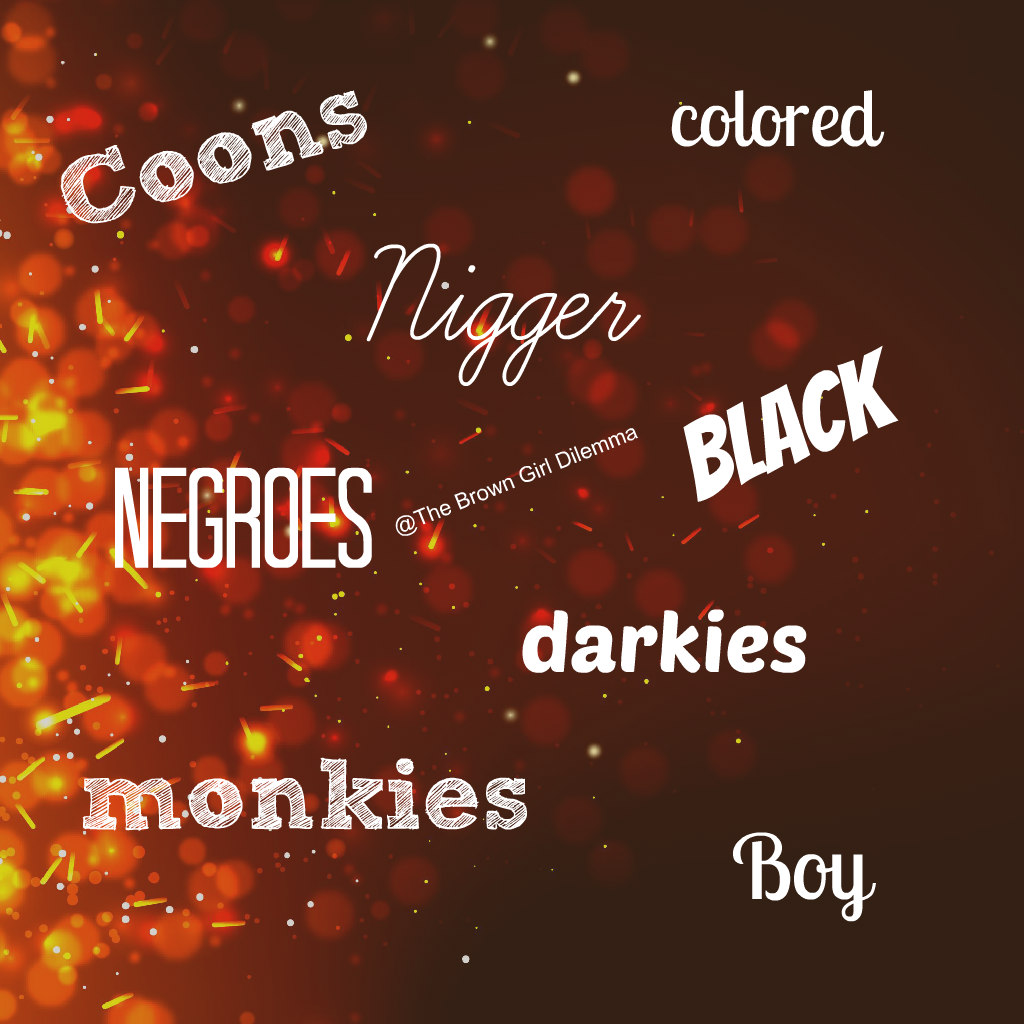
Words carry power. They shape identity, influence perception, and preserve history. Yet words can also wound, distort, and dehumanize. Throughout history, Black people across the diaspora have been branded with derogatory labels—negro, n****, coon, black, colored,* and many more—terms that did not emerge from neutrality but from systems of slavery, colonization, and racial subjugation. The Bible calls these humiliating labels “by-words”—a prophetic sign of oppression and displacement (Deuteronomy 28:37, KJV). To understand the psychology and history of by-words, one must look at the intersection of language, power, slavery, and identity.


What Are By-Words?

The term by-word is defined as a word or phrase used to mock, ridicule, or demean a people or individual. In Scripture, by-words are linked with curses upon nations or peoples who fall under oppression.

  • Deuteronomy 28:37 (KJV): “And thou shalt become an astonishment, a proverb, and a byword, among all nations whither the Lord shall lead thee.”
  • 1 Kings 9:7 (KJV): “Then will I cut off Israel out of the land which I have given them… and Israel shall be a proverb and a byword among all people.”

Biblically, being reduced to a by-word is more than an insult—it signifies loss of sovereignty, dignity, and divine identity.

he Meaning and History of the Word “Nigger”

Origin of the Word

The word nigger is one of the most notorious racial slurs in history. It traces back to the Latin word niger (meaning “black”), which passed into Spanish and Portuguese as negro. When Europeans began enslaving Africans during the transatlantic slave trade (1500s–1800s), the term negro became a racial descriptor.

Over time, particularly in English-speaking countries, negro was corrupted in spelling and pronunciation into n**r—a derogatory term. By the 1700s, it was entrenched in slave societies like the United States as the ultimate label of dehumanization.


Purpose of the Word

The purpose of calling Black people “n****r” was not just insult but domination. It functioned as a psychological weapon in several ways:

  1. Dehumanization:
    • Reduced Black people to something less than human, justifying slavery and racism.
    • Equated Africans with animals, objects, or commodities.
  2. Control and Social Order:
    • Whites used the word to constantly remind enslaved people of their “place” in society.
    • It reinforced racial hierarchy: white = superior, Black = inferior.
  3. Cultural Shaming:
    • Denied African names and identities, replacing them with a word rooted in contempt.
    • Made Blackness itself synonymous with worthlessness or evil.

In short, the word was never neutral. It was created and weaponized to wound, degrade, and keep Black people submissive.


Historical Use in America

  • Slavery Era (1600s–1865): The word was common in plantation speech, laws, and slave advertisements. It was how enslavers referred to Africans as property.
  • Jim Crow (1877–1950s): White people used it as a daily insult to enforce segregation and white supremacy. It became paired with violence—lynching, beatings, and systemic humiliation.
  • Civil Rights Movement (1950s–1970s): The slur was hurled at marchers, students, and leaders fighting for justice. Signs like “Go home n****rs” were common.
  • Modern Era (1980s–Present): The word remains a lightning rod. It is still used by racists as hate speech but also controversially re-appropriated within some Black communities (e.g., in hip-hop, as a term of brotherhood).

How Black People Feel About It

Reactions vary, but the word remains one of the deepest wounds in the Black collective memory:

  1. Pain and Trauma:
    • Many associate it with slavery, Jim Crow, lynching, and racist violence. Hearing it can trigger anger, shame, or grief.
  2. Rage and Resistance:
    • Black leaders like Malcolm X, James Baldwin, and Maya Angelou condemned the word as an instrument of oppression. Baldwin once said: “What you say about somebody else reveals you.”
  3. Division Over Re-appropriation:
    • Some Black people reject the word entirely, seeing it as irredeemable.
    • Others, especially in music and street culture, have attempted to strip it of its power by reclaiming it (e.g., turning it into “n***a” as a casual or friendly address).
    • This re-use, however, is controversial—many feel that no amount of “reclaiming” erases its bloody history.

Biblical & Psychological Perspective

From a biblical standpoint, being called a by-word (Deuteronomy 28:37) is part of a curse—a stripping of honor and identity. Psychologically, constant exposure to the slur can lead to internalized racism: self-doubt, reduced self-worth, and generational trauma.


The word n**r is not just an insult—it is a historical weapon of white supremacy. Born from slavery, cemented during Jim Crow, and still alive today, it carries centuries of blood, pain, and oppression. While some attempt to neutralize it, for most Black people it remains a raw reminder of what their ancestors endured. It is a word heavy with history, one that symbolizes not only racism but also the resilience of a people who refuse to be defined by it.

Timeline: The Evolution of By-Words

1. African Names Before Slavery (Pre-1500s)

Before European colonization, Africans bore names tied to ancestry, geography, spirituality, and meaning: Kwame (born on Saturday, Akan), Makeda (Ethiopian queen), Oluwaseun (God has done this, Yoruba). Names carried memory, culture, and lineage.


2. The Transatlantic Slave Trade (1500s–1800s)

  • Africans kidnapped into slavery were renamed with European surnames (Smith, Johnson, Williams, Brown).
  • By-words such as Negro (from Portuguese/Spanish for “black”) became a racial classification.
  • Slurs like n****,* sambo, and coon emerged on plantations to dehumanize enslaved Africans, comparing them to animals or buffoons.

This was the era of identity erasure: Africans became “property,” marked not by heritage but by by-words.


3. Reconstruction & Jim Crow (1865–1950s)

  • After emancipation, Black people were still denied full humanity. Terms like Negro and Colored became official in laws, schools, and public signs.
  • The Jim Crow system used language to reinforce racial hierarchy: calling Black men “boy” denied manhood, while calling women “mammies” denied femininity.
  • Racist caricatures—coon songs, minstrel shows, Zip Coon, Uncle Tom—spread by-words into mass culture.

By-words became institutionalized, shaping how whites saw Black people and how Black people sometimes internalized those labels.


4. Civil Rights Era (1950s–1970s)

  • The term Negro was challenged, as leaders like Malcolm X urged African Americans to reclaim Black as a badge of pride.
  • The phrase Black is Beautiful emerged as resistance to centuries of being told “black” meant evil or shameful.
  • The name shift to African-American in the late 1980s (championed by Jesse Jackson) reflected a demand for heritage, identity, and cultural recognition.

By-words in this era were confronted with counter-language: affirmations of dignity and identity.


5. Modern Times (1980s–Present)

  • Slurs like n****,* coon, and monkey still circulate, especially online and in extremist circles.
  • The N-word has been re-appropriated in some Black communities as a term of endearment or solidarity—though its use remains deeply divisive.
  • The term Black has been embraced as an ethnic identity marker, while African-American underscores historical and diasporic roots.
  • Psychological studies show that derogatory labeling still impacts self-esteem, racial perception, and systemic bias.

By-words have not disappeared; they have shifted, adapted, and remain central to ongoing struggles over language and identity.


Racism and the Weaponization of By-Words

Racism explains why by-words persisted. These terms justified inequality by painting Black people as inferior, dangerous, or less civilized. By-words reinforced stereotypes in:

  • Law: segregation signs labeled “Colored” vs. “White.”
  • Media: cartoons and films normalized caricatures (Amos ‘n’ Andy, minstrel shows).
  • Society: casual insults reduced Black people to slurs even outside slavery.

By-words were not simply products of ignorance; they were deliberate strategies of domination.


The Psychology of By-Words

From a psychological perspective, by-words operate as verbal shackles.

  1. Identity Erasure: Replacing African names with slave surnames broke ancestral continuity.
  2. Internalized Racism: Constant exposure to insults produced self-doubt and sometimes self-hatred.
  3. Generational Trauma: By-words passed down through history embedded racial inferiority into the subconscious.
  4. Resistance & Reclamation: Language also became a battlefield—turning Black from insult to empowerment, or challenging derogatory names with affirmations.

As psychologist Na’im Akbar (1996) argues, the greatest chains of slavery are not physical but mental—reinforced through language.


Biblical Parallels

The use of by-words against Black people echoes Israel’s fate in exile. Losing names, mocked by nations, and scattered across the earth, they became living fulfillments of Deuteronomy 28. Just as Israel became “a byword among nations,” the descendants of Africa in the diaspora bear the marks of a name-stripping oppression.


Historical Roots of By-Words in Slavery

The transatlantic slave trade, spanning the 16th to 19th centuries, uprooted millions of Africans from their homelands. In the process, enslavers deliberately stripped them of their ethnic names, languages, and tribal lineages. African names like Kwame, Amina, Oluwaseun, Kofi, or Makeda were replaced with European surnames—Smith, Johnson, Williams, Washington—marking forced assimilation into a white supremacist order.

Enslaved Africans were not merely chained physically; they were renamed into invisibility. The imposition of white surnames erased genealogical connections, making it nearly impossible for descendants to trace their ancestral lineage back to their original African nations. This renaming process was a tool of control: to own someone’s name is to own their identity.

At the same time, enslaved Africans became subjects of derogatory by-words. Slave masters, traders, and colonial authorities popularized racial slurs that defined Blackness not by heritage but by supposed inferiority. Terms such as n****,* coon, boy, and Negro reduced a diverse people into a caricature of servitude and subjugation.


The Catalog of By-Words Used Against Black People

Over centuries, Black people have been labeled with words that belittled, animalized, and mocked them:

  • Negro – Derived from the Spanish/Portuguese word for “black,” it became a racial classification imposed by European colonizers.
  • N*** – A perversion of Negro, weaponized as one of the most dehumanizing insults in modern history.
  • Coon – A derogatory word portraying Black people as lazy and buffoonish, rooted in racist minstrel shows of the 19th century.
  • Boy – Used particularly in the Jim Crow South to deny Black men adult dignity and manhood.
  • Colored – Institutionalized through organizations like the NAACP (“National Association for the Advancement of Colored People”), reflecting segregationist terminology.
  • Black – Once synonymous with evil, dirt, or shame in European etymology, rebranded as an identity marker but originally imposed as a contrast to “white purity.”

Each of these terms is a linguistic scar, born of systems that sought to strip away humanity and replace it with inferiority.


Was Racism to Blame?

Yes. The proliferation of by-words was not incidental but systemic, tied directly to racism. By-words allowed dominant groups to control narratives, reinforcing hierarchies of superiority. Racism justified slavery, segregation, colonization, and social exclusion by codifying these by-words into cultural, legal, and political systems.

  • Social Control: Language ensured that Black people were seen not as equals but as perpetual outsiders.
  • Psychological Warfare: By-words internalized shame, often producing generational trauma and fractured self-esteem.
  • Legal Segregation: In the U.S., terms like “colored” and “Negro” were legally inscribed in Jim Crow laws, embedding racism into governance.

The Psychology of By-Words

Psychologists argue that repeated exposure to derogatory labels can produce internalized racism and identity conflict. When a people are constantly described as inferior or less than, the message penetrates deep into the collective psyche.

  • Internalized Oppression: Some Black people began to reject African heritage, aspiring toward whiteness as a form of survival.
  • Group Identity Crisis: By-words created confusion over racial identity—was one “Negro,” “Colored,” “Black,” or “African-American”? This constant renaming fragmented collective identity.
  • Reclamation and Resistance: Over time, Black communities also resisted by re-appropriating terms like “Black” and “N*****” as symbols of empowerment—though still contested.

Biblical Parallels: Israel as a By-Word

The plight of Black people in slavery and colonization parallels biblical Israel’s experience. Just as the Israelites were scattered and mocked with by-words, enslaved Africans endured a loss of name, land, and identity. Deuteronomy 28 not only describes economic curses and enslavement but the stripping away of cultural dignity.

Thus, many Black theologians and scholars interpret the condition of the African diaspora as prophetic: a people renamed, scorned, and marginalized, fulfilling the biblical imagery of becoming “a by-word among nations.”


Conclusion

By-words are more than insults; they are historical markers of oppression. They tell the story of a people kidnapped, enslaved, renamed, and linguistically reshaped to fit the mold of subjugation. From biblical prophecy to the auction blocks of slavery, from Jim Crow to today, the history of by-words reveals how language has been wielded as a weapon against Black identity.

Yet, history also shows resistance. Just as names were stripped, they were reclaimed. Just as by-words mocked, voices rose to redefine them. Understanding the psychology and history of by-words helps restore dignity, while the biblical lens reminds us that identity is ultimately God-given, not man-imposed.

By-words are more than words; they are historical monuments of oppression. They trace a journey from stolen African names to the plantation, from Jim Crow insults to modern re-appropriation. They demonstrate how racism weaponizes language, reshaping identity and memory.

Yet, within that history lies resilience. Every reclaiming of Black as beautiful, every embrace of African names, every refusal to be defined by slurs is a declaration of freedom. In the end, names carry divine weight: not what the oppressor calls us, but what God calls us.


📖 Key Scripture References:

  • Deuteronomy 28:37
  • 1 Kings 9:7
  • Jeremiah 24:9
  • Psalm 44:14

📚 References for Further Reading:

  • Du Bois, W. E. B. (1903). The Souls of Black Folk.
  • Akbar, N. (1996). Breaking the Chains of Psychological Slavery.
  • Davis, A. (1981). Women, Race, and Class.
  • Patterson, O. (1982). Slavery and Social Death.

Kennedy, R. (2002). Nigger: The Strange Career of a Troublesome Word.

Baldwin, J. (1963). The Fire Next Time.

Neely Fuller Jr: The Architect of Counter-Racist Logic and Black Empowerment.

Neely Fuller Jr. is a highly influential yet often underrecognized figure in the realm of African American thought, particularly known for his work on racism, white supremacy, and Black empowerment. Born in the United States during the era of Jim Crow segregation, Fuller developed a worldview deeply shaped by systemic racial oppression. Though many of the personal details of his life—including his date of birth, marital status, and family life—remain private, what stands out is his lifelong dedication to analyzing and dismantling the global system of white supremacy through logic, language, and behavioral code.


Who Is Neely Fuller Jr.?

Neely Fuller Jr. is best known as a theorist and author who introduced a unique, structured framework for understanding and addressing racism in America and worldwide. His life’s work revolves around his central thesis: “If you do not understand white supremacy—what it is and how it works—everything else that you think you understand will only confuse you.” This statement has become a foundational mantra for many in the modern Black liberation and Afrocentric consciousness movements.

Fuller served in the U.S. military and worked as a government employee, experiences that contributed to his understanding of institutionalized racism. Despite lacking the mainstream visibility of figures like Malcolm X or Dr. Martin Luther King Jr., Fuller’s teachings have profoundly impacted generations of Black thinkers, including Dr. Frances Cress Welsing, who credited Fuller’s framework as the intellectual foundation for her own work, The Isis Papers.


His Major Work: A Compensatory Counter-Racist Code

Neely Fuller Jr.’s most well-known book is titled The United Independent Compensatory Code/System/Concept: A Compensatory Counter-Racist Code (first published in 1984 and revised in later editions). The book is not a traditional narrative or academic text; rather, it is a manual—a code of conduct designed to guide non-white people in navigating and countering racism in everyday life.

The book is grounded in logic, clarity, and a precise use of language. Fuller argues that white supremacy is a global system that dominates all areas of people activity: economics, education, entertainment, labor, law, politics, religion, sex, and war. His book offers a “code” of behaviors and linguistic patterns that help non-white people avoid conflict, think critically, and engage in constructive activity rather than reacting emotionally or violently to racism.


Highlights of the Code

  1. Definition of White Supremacy: Fuller defines racism and white supremacy as the same thing, a unified system with the primary goal of maintaining power over all non-white people.
  2. Logic-Based Living: He urges Black people to think, speak, and act in ways that produce justice and eliminate confusion.
  3. Constructive Speech: Fuller teaches the use of precise language—coining the term “codification”—to avoid being manipulated by racist ideology hidden in words.
  4. Sexual Politics: He outlines how sex and relationships are also controlled by the system of white supremacy, emphasizing self-discipline and mutual respect in Black relationships.
  5. Compensatory Code: Non-white people must act independently but in a unified and compensatory way—that is, in a manner that “makes up for” the imbalance caused by racism without engaging in emotional retaliation or disorder.
  6. Universal Man and Universal Woman: Fuller envisions a future where justice is the norm and individuals function without needing the system of racism for identity or value.

Reception and Legacy in the Black Community

While Neely Fuller Jr. has never been a household name, his influence in the conscious Black community is immeasurable. He is widely respected by scholars, activists, and critical thinkers who study race and systems of power. Podcasts, YouTube channels, and online forums continue to analyze and promote his teachings, often referring to him as “the master of logic.”

Figures like Dr. Frances Cress Welsing have publicly praised him, and his concepts are foundational in Afrocentric educational spaces, particularly those focused on mental liberation, cultural sovereignty, and counter-colonial thought. Many regard him as a philosophical giant, especially for his emphasis on the psychological dimensions of racial control.

However, his work has also been critiqued by some as overly methodical or lacking in revolutionary emotion. Yet Fuller deliberately avoided traditional activism or protest methods, believing that emotion-driven movements were easier for white supremacy to manipulate or destroy.


What He Is Known For

  • Creating the Counter-Racist Codification System
  • Influencing critical race theorists like Frances Cress Welsing
  • Highlighting the totalizing nature of white supremacy across all domains of human activity
  • Promoting logic, calmness, and consistency in Black liberation thought
  • Developing a philosophy of “maximum thought, speech, and action to produce justice”

Conclusion

Neely Fuller Jr. is a towering intellectual in the struggle for Black liberation and truth. Through his logical, disciplined framework, he provided tools for African Americans and all non-white people to analyze and dismantle the deceptive and destructive power of white supremacy. While his personal life remains largely hidden from public view, his public legacy—one of clarity, code, and consciousness—continues to shape the minds and strategies of freedom fighters around the globe.


Recommended Reading

  • Fuller, N. (2016). The United Independent Compensatory Code/System/Concept: A Compensatory Counter-Racist Code (Revised Edition). Neely Fuller Publications.
  • Welsing, F. C. (1991). The Isis Papers: The Keys to the Colors. Third World Press.
  • Black Dot, T. (2005). Hip Hop Decoded. Momi Publishing.

“Rosewood: A Massacre Fueled by Lies and White Supremacy in 1923 Florida”


Photo by Alexander Zvir on Pexels.com

Introduction

The story of Rosewood, Florida is one of prosperity, racial pride, and horrifying destruction. Once a thriving Black town in Levy County, Rosewood was obliterated in January 1923 due to a racially charged lie that incited white mob violence. Like the tragedies of Tulsa’s Black Wall Street and the Devil’s Punchbowl, Rosewood exemplifies how Black success in early 20th-century America was often met with white rage, systemic racism, and historical erasure.


The Founding and Prosperity of Rosewood

Founded in the late 1800s, Rosewood was a small, self-sufficient, predominantly African American town. Located near the Gulf Coast of Florida, the town was originally established as a timber and turpentine community. Over time, the Black residents of Rosewood built homes, churches, a school, and several successful businesses. By the early 1920s, Rosewood had become a symbol of Black independence.

The town was made up of about 25 Black families, most of whom were landowners—a rarity in the Jim Crow South. Occupations included blacksmiths, carpenters, midwives, and educators. One notable figure was Sarah Carrier, a well-known midwife and one of the community’s matriarchs.

Rosewood residents lived peacefully—until a white woman in a nearby town falsely accused a Black man of assault, setting off a chain of racial terror.


The Incident: Lies and Racial Violence

On January 1, 1923, Fannie Taylor, a white woman from the neighboring town of Sumner, claimed she had been beaten and assaulted by a Black man while her husband was at work. In truth, she had been injured by her white lover, but to hide her infidelity, she blamed an anonymous Black man. This lie sparked a mob of angry white residents, who began scouring the area for any Black man they could find.

The first victim was Sam Carter, a Black craftsman tortured and lynched when he refused to divulge the whereabouts of the alleged assailant. Soon after, white mobs, some from as far as Gainesville and Jacksonville, stormed Rosewood with rifles, torches, and a thirst for vengeance.


The Massacre and Destruction

Between January 1 and January 7, 1923, the town of Rosewood was burned to the ground. Homes, churches, and schools were set ablaze. Eyewitnesses described the scene as a hellish blaze with smoke rising above the pine trees. At least six Black residents were killed, including Sarah Carrier, who died protecting children hiding in her home. Others were shot as they fled or tortured for information.

The number of deaths is still debated. While official records confirm around six to eight, survivors and descendants estimate that dozens were killed, with bodies either burned in the fires or dumped in mass graves.

Most of the survivors hid in the swamps for days without food, before being evacuated by a few courageous white allies, including John and William Bryce, local train conductors who secretly transported Black families to safety.


Why Did It Happen?

The massacre was rooted in racism, economic envy, and the fear of Black advancement. Rosewood’s prosperity challenged the status quo of white supremacy. Many white residents were resentful that Black citizens owned land, ran businesses, and lived independently.

The lie told by Fannie Taylor was simply a spark that ignited deep-seated hatred. As journalist Gary Moore, who helped revive the story in the 1980s, said:

“It was not just a lynching. It was ethnic cleansing.”


The Aftermath and Silence

After the massacre, Rosewood ceased to exist. Survivors never returned, and many were too traumatized or afraid to speak about what happened. For decades, the story of Rosewood remained buried.

Law enforcement never prosecuted any of the perpetrators, and state officials did nothing to investigate or compensate the victims. The fear of retribution or being labeled a “troublemaker” kept survivors silent.

It wasn’t until the 1990s that survivors came forward with their stories. In 1994, the state of Florida passed the Rosewood Compensation Bill, awarding $2.1 million in reparations to nine survivors and establishing scholarships for descendants. This was one of the first instances of reparations in U.S. history for racial violence (D’Orso, 1996).


Personal Testimonies and Survivors

One of the most vocal survivors was Minnie Lee Langley, who was 7 years old at the time of the massacre. In later interviews, she recalled:

“They burned everything. Everything. We hid in the woods. My mama told me to keep quiet so the white folks wouldn’t hear us.”

Another survivor, Arnett Doctor, helped spearhead the movement for recognition and reparations. He later became known as the “father of the Rosewood legislation.”


Economic Impact and Racial Injustice

The destruction of Rosewood devastated families economically and emotionally. Land that once belonged to Black residents was never returned. This contributed to the racial wealth gap that persists today.

The massacre also underscored the legal impunity enjoyed by white mobs. Local sheriffs did nothing to intervene. White silence and complicity made justice impossible.


Legacy and Rebuilding

Though Rosewood was never rebuilt, its legacy lives on in books, documentaries, and even film. The 1997 movie Rosewood, directed by John Singleton and starring Ving Rhames and Don Cheadle, brought national attention to the tragedy.

In recent years, efforts have been made to preserve the memory of Rosewood:

  • A historical marker was erected in 2004
  • Descendants meet annually to commemorate the lost town
  • Florida’s education system has slowly integrated the story into its curriculum

Still, many argue that true justice has not been served.


Conclusion

The Rosewood Massacre was a deliberate act of racial terrorism, rooted in lies, jealousy, and the desire to uphold white supremacy at the cost of Black lives. It represents more than just a violent episode—it exemplifies how racism, unchecked by law or conscience, destroyed Black progress and stole generational wealth.

The tragedy of Rosewood must be remembered, not only to honor the victims and survivors, but to understand how systemic racism shaped American history and continues to shape the Black experience today.


References

  • D’Orso, M. (1996). Like Judgment Day: The Ruin and Redemption of a Town Called Rosewood. Putnam Publishing Group.
  • Moore, G. (1982, July). “Rosewood Massacre.” St. Petersburg Times.
  • U.S. House of Representatives. (1994). Rosewood Compensation Act. Florida State Archives.
  • Singleton, J. (Director). (1997). Rosewood [Film]. Warner Bros.

The ONE-DROP Rule: Origins, Biblical Lineage, and the Psychology of Racial Classification.

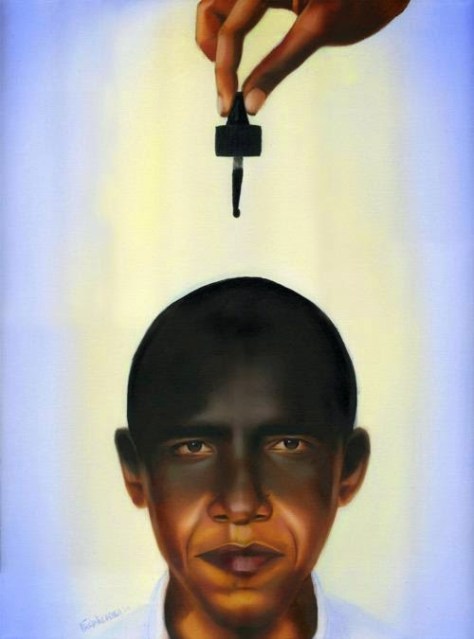
This artwork/photograph is the property or its respective owner.

The concept of the “one-drop rule” is one of the most insidious legal and psychological tools used in the history of racial oppression in the United States. It declared that any person with even one drop of African ancestry was considered Black, regardless of their appearance or the heritage of their other parent. Rooted in white supremacy and the preservation of a racially stratified society, this rule carried severe social, legal, and psychological implications that are still felt today. While unbiblical in origin, the practice is often at odds with the ancient scriptural understanding that identity, especially tribal or ethnic lineage, is determined through the father’s seed—not the mother.


Origins of the One-Drop Rule

The one-drop rule emerged in the American South during the late 17th and early 18th centuries. While not officially named at the time, colonial slave societies began developing legal statutes that defined the status of individuals with mixed ancestry. The first legal precedent was set in Virginia’s 1662 law: “Partus sequitur ventrem”—a Latin phrase meaning “that which is born follows the womb.” This law ensured that children born to enslaved women, even if fathered by white men, would inherit the status of the mother—remaining enslaved (Higginbotham, 1978). This policy contradicted both biblical and patriarchal norms, where identity typically follows the paternal line.

By the 20th century, particularly with the passage of laws in states like Louisiana (1908) and Tennessee (1910), the idea was codified: any person with any African ancestry, no matter how minimal, was legally Black. This was not science—it was sociology engineered to reinforce segregation, deny land and inheritance, and eliminate ambiguity around racial classification. In 1924, Virginia’s Racial Integrity Act legally enforced the one-drop rule and defined a “white person” as someone with “no trace whatsoever of any blood other than Caucasian.”


The Biblical Law of Lineage Through the Father

Contrary to these racial laws, the Bible teaches that a person’s lineage is determined through the father’s seed. According to the King James Version with Apocrypha, tribal and national identity among the Israelites came from the male line:

“And they assembled all the congregation together on the first day of the second month, and they declared their pedigrees after their families, by the house of their fathers, according to the number of the names, from twenty years old and upward, by their polls.”
Numbers 1:18 (KJV)

This shows that Israelite identity was inherited from the father. The same principle is echoed in several other instances, such as:

  • Nehemiah 7:61-64: Where priesthood and national identity were denied to those who could not trace their lineage through their father’s house.
  • Ezra 2:59: Individuals who could not prove their paternal heritage were considered polluted and excluded from certain offices.

In this context, if a man’s father is from another nation (like Esau, Ishmael, or the Gentiles), the child would inherit that man’s identity—even if the mother is Israelite. Hence, by biblical standards, individuals like Princess Meghan Markle (whose father is white) or Barack Obama (whose father was a Black Kenyan, not an Israelite of the West African diaspora) would not fall under the biblical definition of an Israelite.


Barack Obama and Meghan Markle: Case Studies in Racial Perception

Barack Obama, born to a white American mother and a Black Kenyan father, was consistently identified by society as the first Black U.S. president. This classification followed the one-drop rule logic, even though his lineage was not linked to American slavery or the transatlantic slave trade. Obama’s presidency stirred pride and also complex racial discussions: Was he truly representative of the African American struggle if he was not a descendant of slaves?

Similarly, Meghan Markle, born to a Black mother and a white father, has been racially profiled and discriminated against—especially by British tabloids—despite having Eurocentric features and a light complexion. According to biblical lineage law, her father’s lineage (Gentile, non-Israelite) is what defines her bloodline. Yet under the one-drop rule, she is still considered Black—illustrating how race in the West is often defined not through scripture or science, but through oppressive legal and social constructs.


The Psychology of the One-Drop Rule

The one-drop rule functioned as a psychological weapon to maintain white racial purity and control the growing mixed-race population that resulted from white slave owners raping Black women. This imposed identity robbed many mixed-race children of their right to inherit from their white fathers, and simultaneously denied them access to white privilege.

The idea that one drop of Black blood “taints” a person reflects a belief in the superiority of whiteness and the contamination of Blackness. This psychology persists today, as lighter-skinned Black individuals are often socially pressured to “pick a side,” and multiracial identity is oversimplified.

Psychologists have noted that this binary racial system causes identity confusion, self-hatred, and intra-racial bias. Light-skinned Black individuals are sometimes distrusted within the Black community and marginalized in white spaces—an enduring legacy of forced classification.


Written Into Law

Here are a few major laws that codified the one-drop rule in the U.S.:

  • Virginia Racial Integrity Act (1924): Made it illegal for whites to marry anyone with even 1/16th Black ancestry.
  • Louisiana Act 46 (1908): Defined a “Negro” as anyone with one-thirty-second or more Black ancestry.
  • Tennessee Law (1910): Defined a person as Black if they had any trace of African ancestry.

These laws helped maintain segregation and denied equal rights to mixed-race individuals. Though many of these laws have been repealed or ruled unconstitutional (notably in Loving v. Virginia, 1967), their cultural influence lingers in America’s racial categorization system.


Conclusion

The one-drop rule is not a biblical principle but a man-made policy of racial control and white supremacist ideology. Its legacy persists through cultural perceptions and psychological conditioning that still affect racial identity in 2025. In contrast, the Bible teaches that one’s lineage is determined through the father’s seed, as seen in the Israelites’ tribal identification.

Figures like Barack Obama and Meghan Markle highlight the contradictions between scriptural lineage and Western racial constructs. By understanding these distinctions, we can begin to undo centuries of misinformation and restore a more truthful, biblically-aligned understanding of identity and heritage.


References

  • Higginbotham, A. L. (1978). In the Matter of Color: Race and the American Legal Process: The Colonial Period. Oxford University Press.
  • Williamson, J. (1980). New People: Miscegenation and Mulattoes in the United States. Free Press.
  • Numbers 1:18, Ezra 2:59, Nehemiah 7:61-64 — King James Bible with Apocrypha.
  • Davis, A. (2007). Race and Criminal Justice: One Drop, One Crime, and Racial Boundaries. Harvard Law Review.
  • Loving v. Virginia, 388 U.S. 1 (1967)

The Legacy of the Willie Lynch Letter: Historical Premise, Racial Division, and Its Ongoing Impact on Black Identity.

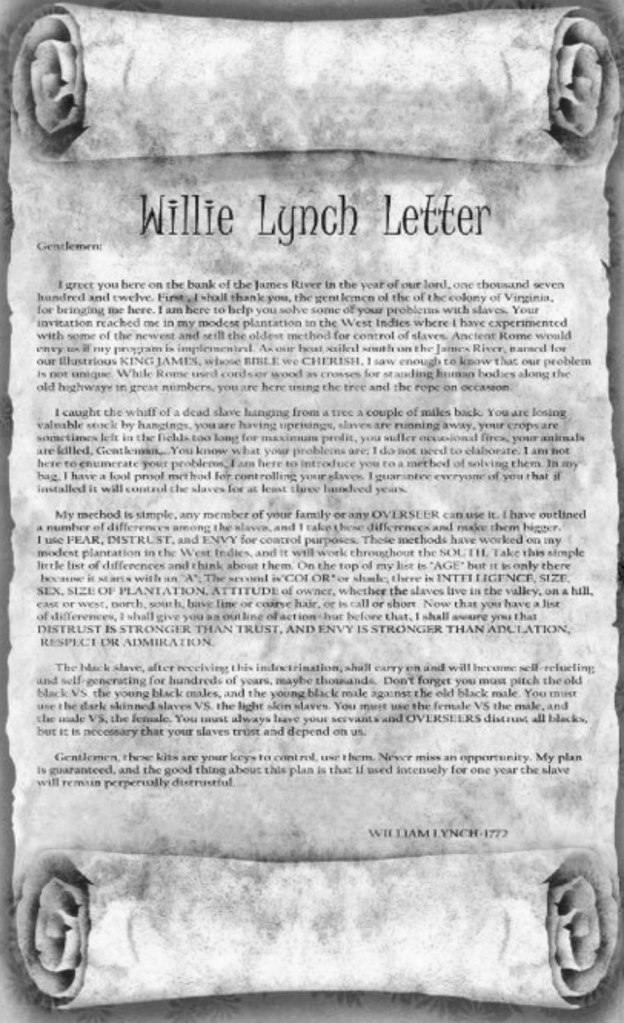
The Willie Lynch Letter—widely circulated as a blueprint for controlling enslaved Africans in America—is often cited in discussions surrounding the systemic psychological manipulation and division within the Black community. Although its authenticity has been heavily disputed, the letter remains symbolically powerful. Allegedly delivered by a British slave owner named Willie Lynch in 1712 on the banks of the James River in Virginia, the letter outlines methods to control slaves for generations by instilling division based on skin color, hair texture, age, gender, and other factors. Despite questions surrounding its historical veracity, the themes it presents remain painfully relevant in 2025.


Alleged Origins and Content of the Willie Lynch Letter

According to the document, Willie Lynch was invited from the West Indies to Virginia to share his “expertise” on slave management. The letter begins with Lynch addressing a group of slave owners, promising them a foolproof method to control their slaves for hundreds of years. He outlines a strategy rooted in psychological division, promoting distrust and disunity among slaves through systemic manipulation of differences—particularly skin color (“light vs. dark”), age (“old vs. young”), gender (“male vs. female”), and even hair texture (“nappy vs. straight”).

One of the most notable concepts from the letter is the separation of the enslaved into house Negroes and field Negroes. House slaves, often lighter-skinned due to being the children of white slave masters, were given relatively better living conditions, cleaner clothes, and closer proximity to their enslavers. They were often used to control or report on the darker-skinned field Negroes, who performed brutal labor in plantations under the hot sun. This intra-racial division served the slaveholders by preventing collective rebellion, as envy, mistrust, and intra-group conflict undermined unity.


Historical Debate: Fact or Fiction?

There is considerable scholarly consensus that the Willie Lynch Letter is a hoax. Historians point to linguistic inconsistencies, anachronisms (such as the use of the term “reflex” and modern grammar structures not used in the 18th century), and the lack of historical evidence of a person named Willie Lynch delivering such a speech in 1712. In fact, no credible record of Lynch’s existence or the letter’s origins exists in the colonial archives (Gates, 2003). Nevertheless, the Willie Lynch Letter endures in cultural consciousness because it reflects real strategies historically used to oppress and manipulate African-descended people in America.


Psychological Residue: Division by Design

Despite its dubious authorship, the letter’s ideology of engineered division has echoed throughout centuries of Black experience in the United States. The division by skin tone, known as colorism, has become deeply embedded within the community. Lighter-skinned individuals have often been afforded more social privilege, greater representation in media, and are sometimes perceived as more intelligent or attractive due to Eurocentric beauty standards (Hunter, 2007). This psychological warfare, seeded in slavery, continues to influence hiring practices, dating preferences, and self-esteem in the modern Black population.

Similarly, the division between field Negroes and house Negroes was metaphorically revived in the 1960s during the civil rights movement, particularly in Malcolm X’s speeches. Malcolm used these terms to describe the difference between the “complacent” Black elite who were comfortable within the white establishment (house Negroes) and the oppressed masses pushing for revolutionary change (field Negroes). His framing highlighted the enduring class-based and psychological divisions that hinder Black unity (X, 1963).


Relevance in 2025: The Lingering Divide

In 2025, the spirit of the Willie Lynch Letter remains manifest in subtle and overt ways. Intra-racial tensions still exist around complexion, hair texture, education, economic status, and gender roles. The media continues to elevate lighter-skinned, Eurocentric Black beauty while marginalizing darker-skinned individuals. Black women with natural hair still face discrimination in professional environments, despite the 2019 CROWN Act (Creating a Respectful and Open World for Natural Hair) aiming to combat hair-based bias (Davis, 2020).

Moreover, systemic racism is far from over. Police brutality, educational disparities, housing discrimination, and wage inequality remain daily realities for many African Americans. Movements like Black Lives Matter emerged as a response not just to violence, but also to the broader dehumanization of Black lives. Although progress has been made, including increased Black representation in politics, media, and academia, the legacy of divide-and-conquer tactics continues to erode unity and foster mistrust.


Conclusion

The Willie Lynch Letter, though likely a fabricated artifact, stands as a mirror reflecting real strategies historically employed to psychologically enslave African Americans through division and manipulation. Whether or not Willie Lynch himself existed, the ideology expressed in the letter has been tragically effective in shaping intergenerational trauma and conflict within the Black community. Recognizing and dismantling these residual effects is critical for healing and unity. In 2025, the challenge is no longer only external oppression, but also internalized division. Understanding our history—both factual and symbolic—is a necessary step toward liberation and solidarity.


References

  • Davis, A. (2020). Hair discrimination and the CROWN Act: A legislative response to anti-Black grooming policies. UCLA Law Review, 67(1), 1–25.
  • Gates, H. L. Jr. (2003). The ‘Willie Lynch Letter’: The Making of a Myth. The Root. Retrieved from https://www.theroot.com
  • Hunter, M. (2007). The Persistent Problem of Colorism: Skin Tone, Status, and Inequality. Sociology Compass, 1(1), 237–254.
  • Malcolm X. (1963). Message to the Grassroots. Speech delivered at King Solomon Baptist Church, Detroit.