Tag Archives: bible

🌹 Beyond the Mirror: Discovering God’s Definition of Beauty 🌹

Photo by Al Ameen Saddiq on Pexels.com

When a person stands before a mirror, the reflection that stares back often determines their mood, confidence, or sense of worth. Yet the Bible reminds us that beauty cannot be fully captured by glass or surface. “For the Lord seeth not as man seeth; for man looketh on the outward appearance, but the Lord looketh on the heart” (1 Samuel 16:7, KJV). God’s definition of beauty goes beyond what is visible—it is rooted in the heart, character, and the fear of the Lord.

The world often sets unrealistic standards of beauty, equating it with youth, body type, skin tone, or fashion trends. These standards shift with culture and time, leaving many feeling inadequate. Psychology confirms that society’s obsession with appearance can lead to anxiety, depression, and body dissatisfaction (Cash & Smolak, 2011). In contrast, God’s design frees us from this endless comparison by grounding beauty in eternal virtues like love, humility, and kindness.

Scripture provides clear examples of this truth. Sarah was admired for her physical beauty (Genesis 12:11 KJV), but it was her faith in God’s promises that secured her place in history. Similarly, Ruth’s loyalty and courage, not her outward form, drew Boaz’s admiration and favor (Ruth 3:11 KJV). Their stories highlight that God values inner faithfulness far above fleeting appearances.

The Apostle Peter addressed women directly about this issue: “Whose adorning let it not be that outward adorning of plaiting the hair, and of wearing of gold… But let it be the hidden man of the heart… the ornament of a meek and quiet spirit, which is in the sight of God of great price” (1 Peter 3:3–4, KJV). Here, beauty is portrayed as something incorruptible—a spiritual adornment more precious than pearls or jewels.

Psychological studies echo this wisdom. Research shows that personality traits such as warmth, honesty, and compassion strongly influence perceptions of attractiveness (Zebrowitz & Montepare, 2008). In other words, a person who radiates kindness and confidence is often seen as more beautiful than someone with perfect features but a harsh spirit. This is why Proverbs 31:26 (KJV) praises the virtuous woman: “She openeth her mouth with wisdom; and in her tongue is the law of kindness.”

Modern life provides countless opportunities to live out God’s definition of beauty. A woman who comforts the grieving, a man who serves the poor, or a youth who stands firm in purity all embody beauty that no mirror can reflect. Their actions mirror Christ’s love and bring light into dark spaces. True beauty shines not through selfies or admiration, but through service, compassion, and faith.

The story of Mary, the mother of Jesus, further exemplifies this. Though not described in Scripture by her appearance, she was called “highly favoured” (Luke 1:28 KJV) because of her obedience and humility. Her legacy demonstrates that God elevates character above all else. This truth reminds believers today that they need not chase worldly standards—they are already beautiful in God’s eyes when they walk in faith.

Ultimately, the mirror shows what time will fade, but God’s definition of beauty is eternal. Outward appearance may open doors for a moment, but character, wisdom, and righteousness leave a lasting legacy. To discover God’s beauty is to embrace the heart He transforms, reflecting His glory in every act of love and every word of truth.

True beauty, then, is not what you see—it’s what you give, how you love, and who you glorify.


References

  • The Holy Bible, King James Version.
  • Cash, T. F., & Smolak, L. (2011). Body Image: A Handbook of Science, Practice, and Prevention. New York: Guilford Press.
  • Zebrowitz, L. A., & Montepare, J. M. (2008). Social psychological face perception: Why appearance matters. Social and Personality Psychology Compass, 2(3), 1497–1517.
  • Koenig, H. G. (2012). Religion, spirituality, and health: The research and clinical implications. ISRN Psychiatry, 2012, 278730. https://doi.org/10.5402/2012/278730


The Bible Series: The Narrow Path – (Matthew 7:14)

Key Scripture: Matthew 7:14 – “Because strait is the gate, and narrow is the way, which leadeth unto life, and few there be that find it.”


The journey of a believer is not meant to follow the broad, easy roads of the world. God calls us to walk the narrow path, a life of obedience, faith, and discipline that leads to eternal life. Though it may be difficult and sometimes lonely, the reward is eternal.


1. Understanding the Narrow Path

The narrow path represents a life dedicated to Christ, aligned with His Word, and obedient to His commands. It is countercultural and requires discernment to stay on course.


2. The Gate is Strait

Entry into this path requires intentional commitment. Jesus calls for repentance, surrender, and faith.

  • Luke 13:24 – “Strive to enter in at the strait gate: for many, I say unto you, will seek to enter in, and shall not be able.”

3. Few Will Find It

The narrow path is exclusive not because God is selective, but because few are willing to embrace sacrifice, discipline, and holiness.


4. The Broad Road vs. The Narrow Path

The world offers an easy, wide path that caters to fleshly desires, comfort, and instant gratification. The narrow path challenges these impulses and calls for faith-driven choices.

  • Matthew 7:13 – “Enter ye in at the strait gate: for wide is the gate, and broad is the way, that leadeth to destruction…”

5. Faith Over Convenience

Walking the narrow path requires trusting God over worldly wisdom, convenience, or peer pressure.


6. Discipline and Holiness

This path demands a daily commitment to prayer, scripture, and righteous living. It is narrow because it rejects compromise and sin.


7. Overcoming Obstacles

Trials, opposition, and temptations are inevitable. The narrow path tests perseverance, character, and dependence on God.

  • James 1:12 – “Blessed is the man that endureth temptation: for when he is tried, he shall receive the crown of life…”

8. Guidance from the Spirit

The Holy Spirit illuminates the path, strengthens the believer, and provides discernment in choices.


9. Community of Believers

Though few, the fellow travelers on the narrow path offer encouragement, accountability, and fellowship.

  • Hebrews 10:24-25 – “And let us consider one another to provoke unto love and to good works…”

10. Eternal Perspective

The narrow path is not about worldly success but eternal reward. Every sacrifice, act of obedience, and step of faith has lasting significance.


Conclusion

Walking the narrow path is challenging, but it leads to life abundant and eternal. Choosing this path reflects faith, obedience, and love for God. It requires courage to walk differently from the crowd, but in doing so, we experience God’s promise, protection, and everlasting reward.

Making It Through: Trusting God in Every Season.

Life unfolds in seasons, each marked by its own challenges, lessons, and transformations. Some seasons are filled with joy and abundance, while others are heavy with loss, uncertainty, and waiting. Trusting God in every season requires faith that extends beyond circumstances and anchors itself in His unchanging nature. Scripture reminds us that God remains faithful whether life feels stable or shaken (Ecclesiastes 3:1, KJV).

Trusting God begins with acknowledging that life’s difficulties are not evidence of His absence. Trials often refine faith rather than destroy it. James 1:2–3 teaches that trials work patience, shaping spiritual endurance that cannot be produced through ease alone. Making it through life requires learning to see hardship as a season, not a sentence.

In seasons of uncertainty, fear often competes with faith. Human instinct seeks control, but Scripture calls believers to surrender. Proverbs 3:5–6 instructs us to trust in the Lord with all our heart and not lean on our own understanding. Trust grows when reliance on God replaces reliance on self.

Prayer becomes essential in seasons of pressure. It is not merely a request for deliverance but a posture of dependence. Through prayer, believers align their hearts with God’s will, even when answers are delayed. Philippians 4:6–7 promises peace that surpasses understanding when prayer replaces anxiety.

Some seasons test endurance more than belief. Waiting seasons, in particular, stretch patience and challenge hope. Yet Isaiah 40:31 assures that those who wait upon the Lord shall renew their strength. Trusting God in delay means believing that His timing is purposeful, not neglectful.

Loss is one of life’s most painful seasons. Grief can shake even the strongest faith, leaving questions unanswered. Scripture does not deny sorrow but offers comfort, reminding believers that the Lord is near to the brokenhearted (Psalm 34:18). Trust in grief is not the absence of tears but the presence of hope.

There are seasons when obedience feels costly. Doing what is right may result in misunderstanding, rejection, or isolation. Yet Galatians 6:9 encourages perseverance, promising that in due season believers will reap if they faint not. Trusting God means believing that obedience is never wasted.

God often uses difficult seasons to develop character. Romans 5:3–4 teaches that tribulation produces patience, experience, and hope. What feels like breaking is often building something deeper and stronger within the soul. Trust allows transformation to occur without bitterness.

Trusting God also requires humility. Seasons of success can be as spiritually dangerous as seasons of suffering. Deuteronomy 8 warns against forgetting God when blessings increase. Faithfulness in abundance means remembering that every good gift comes from Him.

Community plays a vital role in making it through life. God often uses others to provide encouragement, wisdom, and accountability. Ecclesiastes 4:9–10 reminds us that two are better than one, for when one falls, another helps lift them up. Trust includes allowing others to walk alongside us.

Some seasons expose spiritual fatigue. Weariness can dull prayer and weaken resolve. Yet Matthew 11:28 records Christ’s invitation to the weary to find rest in Him. Trusting God includes resting in His sufficiency rather than striving in our own strength.

There are seasons when prayers seem unanswered. Silence from heaven can feel confusing and discouraging. However, God’s silence does not indicate indifference. Lamentations 3:31–33 assures that the Lord does not afflict willingly and that His mercy is still present, even in quiet seasons.

Trust grows through remembrance. Recalling past deliverance strengthens present faith. Psalm 77 reflects how remembering God’s works restores hope in times of distress. Looking back reminds believers that God has carried them through before and will do so again.

Faith matures when it is rooted in God’s character rather than circumstances. Hebrews 13:8 declares that Jesus Christ is the same yesterday, today, and forever. Seasons change, but God does not. Trust rests on His consistency.

Obedience during trials is a powerful testimony. Others witness faith not through words alone but through perseverance under pressure. 1 Peter 2:12 encourages believers to live honorably so that God is glorified, even in adversity.

Making it through life also requires forgiveness. Holding onto bitterness prolongs pain and hinders healing. Ephesians 4:31–32 calls believers to let go of resentment and extend grace, reflecting the forgiveness received from God. Trusting God includes trusting Him with justice.

Seasons of refinement often precede seasons of renewal. Psalm 66 speaks of being brought through fire and water into a wealthy place. God’s process may be painful, but His purpose is restorative. Trust believes that restoration is coming.

Joy is not reserved for perfect seasons. Nehemiah 8:10 teaches that the joy of the Lord is strength. Even in hardship, joy rooted in God sustains the soul. Trusting God allows joy to coexist with struggle.

Making it through every season ultimately requires surrender. Life cannot be controlled, but it can be entrusted to God. Psalm 37:5 encourages believers to commit their way to the Lord and trust Him to bring it to pass.

In the end, trusting God in every season is an act of faith renewed daily. It is choosing belief over fear, obedience over comfort, and hope over despair. God remains faithful through every season, carrying His people until purpose is fulfilled.


Prayer

Heavenly Father,
I come before You, acknowledging that You are God over every season of my life. In times of joy and in times of sorrow, help me to trust You fully. Strengthen my faith when I feel weak, and grant me peace when answers seem delayed. Teach me patience in waiting, humility in abundance, and endurance in hardship. Guard my heart from fear, bitterness, and discouragement, and fill me with hope that rests in You alone. I commit my path, my future, and every season of my life into Your hands, trusting that You are faithful to carry me through. In Jesus’ name, Amen.


References (KJV Bible)

Ecclesiastes 3:1
James 1:2–3
Proverbs 3:5–6
Philippians 4:6–7
Isaiah 40:31
Psalm 34:18
Galatians 6:9
Romans 5:3–4
Deuteronomy 8:11–18
Ecclesiastes 4:9–10
Matthew 11:28
Lamentations 3:31–33
Psalm 77:11–14
Hebrews 13:8
1 Peter 2:12
Ephesians 4:31–32
Psalm 66:10–12
Nehemiah 8:10
Psalm 37:5

Nothing More Beautiful Than a Black Woman Who Loves God.

There is nothing more beautiful than a Black woman who loves God, because her beauty radiates from a source untouched by trends, time, or human approval. Her glow is not manufactured; it is cultivated in prayer, obedience, and reverence for the Most High. What people see in her presence is not merely personality, but light.

Scripture teaches that when God dwells within a person, it becomes visible. “Arise, shine; for thy light is come” (Isaiah 60:1, KJV). A woman who loves God carries a spiritual illumination that draws others not to herself, but to the God she serves. Her life becomes a testimony without words.

Her beauty is rooted in purity, not perfection. Purity of heart, intention, and devotion governs her choices. She understands that holiness is not repression but alignment, and that guarding her heart is an act of wisdom and strength (Proverbs 4:23).

People can see God in her because her character reflects His nature. Her compassion mirrors His mercy, her patience reflects His longsuffering, and her forgiveness reveals His grace. She does not strive to be seen as godly; she simply walks with God, and the evidence follows.

A Black woman who loves God loves people deeply, not selectively. She understands that love is not merely emotion but action, sacrifice, and humility. She serves without applause and gives without calculation, embodying the command to love her neighbor as herself (Matthew 22:39).

She is a woman of peace in a world addicted to chaos. Her presence calms rather than agitates, heals rather than inflames. Scripture calls the peacemakers blessed (Matthew 5:9), and her spirit confirms that peace is a spiritual authority, not weakness.

In marriage, she loves her husband with wisdom, respect, and covenant understanding. She honors him not out of fear, but out of reverence for God. Her love strengthens the household, and her loyalty builds a legacy rather than competition (Proverbs 31:11–12).

She is humble, knowing that humility is not self-erasure but God-centered confidence. She does not need to announce her worth because she understands who defines it. “God resisteth the proud, but giveth grace unto the humble” (James 4:6, KJV).

Her meekness is often misunderstood, but it is power under control. Meekness allows her to respond rather than react, to correct without cruelty, and to endure without bitterness. Christ Himself described meekness as blessed (Matthew 5:5).

She possesses a quiet spirit, not because she lacks a voice, but because she knows when silence speaks louder than noise. Scripture calls this quiet spirit “of great price” in the sight of God (1 Peter 3:4). Her restraint reveals maturity and discernment.

She is not a troublemaker because she refuses to thrive on disorder. She does not sow division, provoke strife, or delight in conflict. Her wisdom teaches her that chaos is rarely holy, and peace is often the truest evidence of God’s presence.

She does not gossip about others, understanding that words carry power to heal or destroy. “Life and death are in the power of the tongue” (Proverbs 18:21, KJV). She guards her speech because she honors God with her mouth as well as her heart.

Her integrity remains consistent whether she is seen or unseen. She lives before God rather than before people. This consistency is what gives her beauty depth and permanence, separating her from surface-level admiration.

A Black woman who loves God knows her identity. She is not confused by cultural narratives that distort womanhood or diminish her value. She understands that she is fearfully and wonderfully made, crafted with intention and divine purpose (Psalm 139:14).

Her faith anchors her through adversity. When storms arise, she does not collapse into despair but leans into prayer. Her resilience is not self-generated; it is sustained by trust in God’s sovereignty.

She carries joy that cannot be stolen by circumstance. Even in sorrow, her hope remains intact. This joy is not denial of pain, but confidence that God is present within it (Nehemiah 8:10).

Her love for God influences future generations. Whether through children, mentorship, or quiet example, she leaves a spiritual imprint. Her obedience plants seeds that may flourish long after she is gone.

She understands submission biblically, not as inferiority but as order under God. She submits first to God’s will, allowing Him to shape her relationships, decisions, and direction.

Her beauty challenges shallow standards. It testifies that holiness is attractive, discipline is powerful, and righteousness is radiant. She reminds the world that true beauty begins within and reflects outward.

Nothing is more beautiful than a Black woman who loves God because her life glorifies Him. She walks in dignity, clothed in strength, crowned with wisdom, and guided by faith. Her beauty is not fleeting; it is eternal.


References

Cone, J. H. (1975). God of the oppressed. New York, NY: Seabury Press.

Holy Bible, King James Version. (1769/2017). Cambridge Edition.

Piper, J. (2012). This momentary marriage. Wheaton, IL: Crossway.

Tozer, A. W. (1948). The pursuit of God. Harrisburg, PA: Christian Publications.

Townsend, J. T. (2010). Sacred womanhood: Faith, identity, and spiritual formation. Downers Grove, IL: IVP Academic.

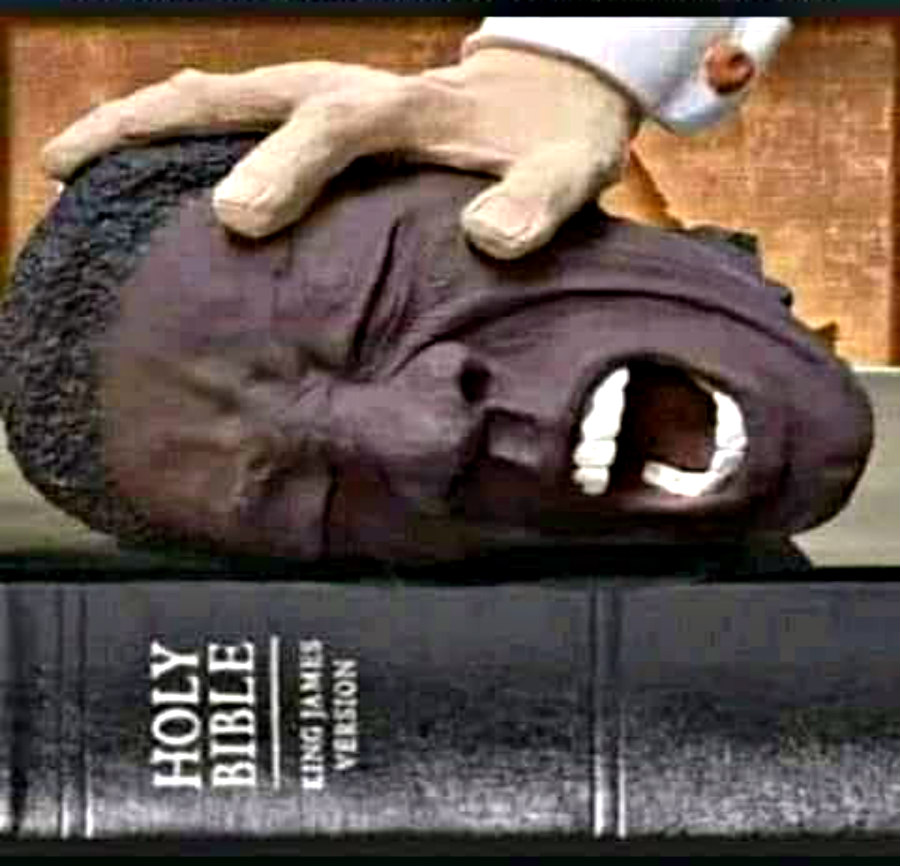
Weaponizing Scripture: How the Bible Was Used to Justify Enslavement

This photograph is the property of its respective owner. No copyright infringement intended

Weaponizing Scripture was one of the most devastating tools used to sustain the transatlantic slave system. The Bible, a text meant to proclaim liberation, justice, and the dignity of humanity, was distorted into an instrument of control. Enslavers did not merely use chains and whips; they used theology, selectively interpreted and strategically taught, to shape belief, obedience, and identity.

European slaveholders understood that physical domination alone was insufficient. To maintain long-term control, they needed mental and spiritual submission. Christianity, when stripped of its liberatory core, became a mechanism for conditioning enslaved Africans to accept suffering as divinely ordained rather than violently imposed.

One of the most common tactics was the selective reading of Scripture. Enslavers emphasized verses that appeared to support servitude while suppressing passages that spoke of freedom, justice, and God’s judgment against oppression. This manipulation created a counterfeit Christianity that served the empire rather than God.

A frequently cited passage was Ephesians 6:5, “Servants, be obedient to them that are your masters” (KJV). This verse was taught without context, stripped of its historical setting, and severed from the broader biblical narrative. Enslavers ignored that the same chapter commands masters to act justly and warns that God shows no partiality.

Similarly, Colossians 3:22 and 1 Peter 2:18 were weaponized to portray submission to abuse as holy obedience. These verses were never intended to endorse racialized, chattel slavery, yet they were recast to sanctify lifelong bondage based on skin color, a concept entirely foreign to the biblical world.

At the same time, enslavers deliberately removed or discouraged engagement with texts that threatened their power. The book of Exodus, which narrates God’s deliverance of an enslaved people, was often censored or reframed. Moses was rarely preached as a liberator, and Pharaoh’s defeat was downplayed or spiritualized to avoid political implications.

In many plantations, enslaved Africans were given a heavily edited text known as the “Slave Bible.” This version removed large portions of the Old Testament and New Testament passages that emphasized freedom, equality, or divine justice. What remained was a hollowed-out gospel engineered for compliance.

This theological distortion extended beyond omission into outright deception. Enslavers taught that Black people were cursed by God, often invoking a twisted interpretation of the so-called “Curse of Ham” in Genesis 9. This lie ignores the text itself, which never condemns Ham’s descendants to perpetual slavery and never mentions race.

By redefining God as a white authoritarian figure aligned with European power, enslavers reshaped spiritual imagination. Blackness became associated with sin, inferiority, and divine disfavor, while whiteness was falsely aligned with righteousness and authority. This inversion was not biblical; it was ideological.

Such misuse of Scripture produced mental slavery, a condition where the enslaved internalized the oppressor’s theology. Over time, some came to believe their suffering was God’s will, that resistance was rebellion against heaven, and that liberation was spiritually dangerous.

Yet even under these conditions, enslaved Africans demonstrated remarkable theological resistance. Through spirituals, coded language, and communal worship, they reclaimed biblical themes of deliverance, judgment, and hope. Songs about crossing Jordan, escaping Egypt, and seeing the promised land were not metaphorical escapism; they were theological protest.

The Bible itself consistently condemns man-stealing, the foundation of chattel slavery. Exodus 21:16 declares that kidnapping a human being and selling them is a capital crime. This verse alone dismantles the moral legitimacy of the slave trade, yet it was systematically ignored.

The prophets repeatedly denounce exploitation of the poor and vulnerable. Isaiah, Jeremiah, and Amos all portray God as hostile toward nations that enrich themselves through oppression. These texts reveal that the God of Scripture sides with the crushed, not the conqueror.

Jesus’ ministry further exposes the lie of slaveholding theology. Christ announced His mission as one to “preach deliverance to the captives” and to set the oppressed free (Luke 4:18). Any theology that sanctifies captivity directly contradicts the words of Christ Himself.

The apostolic message affirms spiritual equality among believers. Galatians 3:28 declares that there is neither slave nor free in Christ, undermining any doctrine that elevates one group over another. While early Christians lived within existing social systems, the gospel planted seeds that inevitably challenged them.

Weaponized Scripture also served to fracture Black identity. African spiritual systems were demonized, ancestral memory was erased, and biblical literacy was restricted. This was not evangelism; it was cultural warfare masquerading as salvation.

The long-term consequences of this distortion persist today. Many descendants of the enslaved wrestle with inherited religious trauma, mistrust of Christianity, or internalized inferiority rooted in centuries of theological abuse. This is one of slavery’s most enduring scars.

Yet the Bible itself is not the enemy. The problem has never been Scripture, but who interprets it, how it is taught, and whose interests it serves. When read holistically, the Bible exposes slavery as sin and oppression as rebellion against God.

Reclaiming Scripture requires restoring context, history, and truth. It demands confronting how Christianity was used as a colonial tool while also recognizing how Black faith communities preserved the liberating heart of the gospel against all odds.

Weaponized Scripture enslaved bodies for centuries, but redeemed Scripture continues to awaken minds. When the Bible is freed from manipulation, it testifies not to chains, but to justice, dignity, and divine judgment against every system built on human suffering.


References

Cone, J. H. (1975). God of the oppressed. New York, NY: Seabury Press.

Douglas, K. B. (1994). The black Christ. Maryknoll, NY: Orbis Books.

Haynes, S. R. (2002). Noah’s curse: The biblical justification of American slavery. Oxford, UK: Oxford University Press.

Raboteau, A. J. (2004). Slave religion: The “invisible institution” in the antebellum South. New York, NY: Oxford University Press.

The Holy Bible, King James Version. (1769/2017). Cambridge Edition.

Wilmore, G. S. (1998). Black religion and Black radicalism (3rd ed.). Maryknoll, NY: Orbis Books.

Boy Meets Girl Series: Episode 1 — When His Eyes Found Hers.

When his eyes found hers, time did not rush forward; it stood still, as though creation itself paused to witness a divine appointment. This was not a glance rooted in appetite or impulse, but a recognition that reached beyond the surface and into the depths of the soul. In her mirrored eyes, he did not merely see beauty—he saw memory, calling, and promise intertwined.

Her eyes reflected his past, not as shame, but as refinement. Every trial that had shaped him, every lesson carved by obedience and repentance, found meaning in that moment. Scripture teaches that God orders the steps of the righteous, and this meeting was not random but arranged by a Sovereign hand that wastes nothing (Psalm 37:23, KJV).

In her gaze, he also saw his present self clearly. There was no need for performance or pretense. Truth stood uncovered, steady and unashamed. “As in water face answereth to face, so the heart of man to man” (Proverbs 27:19, KJV). What he saw reflected back was alignment—two hearts standing honestly before God.

Yet it was the future that startled him most. Within her eyes lived vision: family, legacy, spiritual fruit, and covenant. This was not fantasy, but foresight rooted in purpose. The Word declares that God knows the end from the beginning (Isaiah 46:10, KJV), and when He introduces two lives, He does so with destiny already written.

This encounter moved beyond romance because romance alone cannot sustain a covenant. Attraction may initiate interest, but purpose sustains union. “Except the LORD build the house, they labour in vain that build it” (Psalm 127:1, KJV). What God joins is not merely emotional—it is architectural, intentional, and enduring.

Their meeting was marked by purity, not passion out of control. Desire existed, but it was governed. Beauty was admired without being consumed. He saw her form, yet honored her frame as a temple, not an object. Job’s declaration echoed silently between them: “I made a covenant with mine eyes; why then should I think upon a maid?” (Job 31:1, KJV).

This was admiration without lust, affection without fornication, intimacy without trespass. Scripture does not condemn attraction; it disciplines it. “Flee fornication” (1 Corinthians 6:18, KJV) is not a rejection of desire, but a protection of destiny. They understood that purity preserves clarity.

In a culture that rushes physical closeness while neglecting spiritual alignment, their restraint became revolutionary. They refused to awaken love before its time (Song of Solomon 2:7, KJV). Waiting was not weakness—it was wisdom. Their patience testified that what God ordains, He also sustains.

When their eyes met, they did not speak immediately, yet understanding passed between them. The Spirit bore witness where words would have fallen short. “The Spirit itself beareth witness with our spirit” (Romans 8:16, KJV). This was recognition at the level of calling.

Marriage, in the biblical sense, is never accidental. “He which made them at the beginning made them male and female… What therefore God hath joined together, let not man put asunder” (Matthew 19:4–6, KJV). Their meeting echoed this truth—not ownership, but union under God’s authority.

He did not pursue her to conquer; he approached to cover. She did not entice him to consume; she inspired him to protect. Their interaction reflected Christ and the Church, a pattern rooted in sacrifice, honor, and order (Ephesians 5:25–27, KJV).

This moment affirmed that destiny does not shout; it often whispers. It does not overwhelm the senses but settles the spirit. Peace accompanied their connection, for “God is not the author of confusion, but of peace” (1 Corinthians 14:33, KJV).

Beyond romance, there was an assignment. Beyond affection, there was agreement. Their lives aligned not merely emotionally, but missionally. Amos asks, “Can two walk together, except they be agreed?” (Amos 3:3, KJV). Agreement preceded movement.

They understood that love defined by God is patient, disciplined, and enduring. It seeks the other’s holiness before its own pleasure. Charity “seeketh not her own” (1 Corinthians 13:5, KJV), and so they guarded one another’s virtue as a sacred trust.

In that first meeting, their eyes spoke what their mouths would later confirm: this was not a chance. Heaven had already spoken. The Most High, who establishes households and uproots them, had seen fit to align two paths into one covenant future (Proverbs 18:22, KJV).

Thus, when his eyes found hers, it was not merely a beginning—it was a remembrance of something God had already written. Past refined, present aligned, future revealed. A divine meeting where purity guarded promise, and destiny waited patiently for its appointed time.


References

The Holy Bible, King James Version. (1769/2017). Cambridge University Press.

Additional biblical references used:
Amos 3:3; Ephesians 5:25–27; Isaiah 46:10; Job 31:1; Matthew 19:4–6; Psalm 37:23; Psalm 127:1; Proverbs 18:22; Proverbs 27:19; Romans 8:16; Song of Solomon 2:7; 1 Corinthians 6:18; 1 Corinthians 13:5; 1 Corinthians 14:33.

Dilemma: Power Struggles in America

Power in America has never been neutral. From its inception, the nation’s economic, political, and cultural systems were constructed alongside chattel slavery, colonial extraction, and racial hierarchy. For Black America, modern inequality is not accidental or cultural—it is structural, historical, and systemic. The dilemma lies in navigating institutions that were never designed for Black flourishing, yet demand Black participation for survival.

Wall Street, often celebrated as the engine of American prosperity, traces its origins directly to slavery. The original Wall Street was a literal wall built by the Dutch in New Amsterdam, adjacent to a slave market where Africans were bought, sold, and traded. Early American capital accumulation relied heavily on enslaved labor, plantation profits, and transatlantic trade, making slavery foundational—not peripheral—to American finance.

Beyond geography, Wall Street institutionalized slavery through financial instruments. Bonds, mortgages, and commodities markets treated enslaved Africans as collateral and capital. Enslaved people were insured, leveraged, and securitized, embedding Black bodies into the architecture of global capitalism. This legacy persists in wealth inequality, where Black Americans hold a fraction of the wealth accumulated through centuries of racialized exploitation.

The insurance industry followed a similar trajectory. Early insurers such as Lloyd’s of London and American firms underwrote slave ships, plantations, and enslaved people themselves. Policies protected slave owners against rebellion, death, or loss of “property,” transforming human suffering into actuarial risk. This normalized the monetization of Black death and trauma.

Today, the insurance industry still reflects racial bias through redlining, discriminatory premiums, and unequal access to coverage. Black communities are more likely to be underinsured or denied protection, perpetuating vulnerability while insulating wealthier, whiter populations from risk.

Banking institutions also grew by financing slavery. Banks issued loans to purchase enslaved people, expand plantations, and sustain the plantation economy. Enslaved Africans were listed on balance sheets as assets. When slavery ended, no reparative restructuring followed—banks retained the wealth while Black people were released into poverty.

Modern banking continues this pattern through predatory lending, subprime mortgages, and unequal access to credit. These practices drain wealth from Black communities while reinforcing cycles of debt and dependency, echoing earlier forms of economic bondage.

Silicon Valley now represents a new form of power—control over technology, data, and the future. Algorithms determine employment, creditworthiness, policing, and visibility. Yet these systems are trained on biased data shaped by historical racism, reproducing discrimination under the guise of neutrality.

For Black America, technological control often means surveillance rather than empowerment. Facial recognition misidentifies Black faces, predictive policing targets Black neighborhoods, and digital platforms exploit Black culture without equitable compensation or ownership.

The pharmaceutical and medical industries wield immense power over health and survival. Historically, Black bodies were subjected to medical experimentation, from slavery-era surgeries without anesthesia to the Tuskegee Syphilis Study. These abuses created generational distrust.

Today, Black Americans experience higher mortality rates, inadequate care, and medical neglect. Pharmaceutical profit models prioritize treatment over prevention, while systemic racism ensures unequal access to quality healthcare, reinforcing the biological consequences of social inequality.

The prison-industrial complex represents one of the most direct continuations of slavery. The 13th Amendment abolished slavery “except as punishment for crime,” creating a legal pathway for forced labor. Prisons became sites where Black bodies were again exploited for economic gain.

Mass incarceration disproportionately targets Black men and women, extracting labor, destabilizing families, and generating profit for private corporations. This system functions as racial control, not public safety, maintaining a captive population for economic and political purposes.

The military-industrial complex controls violence and war, both abroad and at home. Black Americans have historically fought in wars for freedoms they were denied domestically. Military spending diverts resources from education, housing, and health needs that disproportionately affect Black communities.

Media power shapes perception, truth, and narrative. From minstrel imagery to modern news cycles, Black people are often portrayed as criminals, victims, or anomalies. Media framing influences public policy, jury decisions, and social attitudes.

This narrative control dehumanizes Black life while obscuring systemic causes of inequality. When the media defines reality, it also defines whose suffering matters and whose humanity is negotiable.

Religious institutions wield spiritual authority, yet American Christianity was deeply complicit in slavery. Churches provided theological justification for bondage, segregation, and racial hierarchy, often quoting scripture selectively to sanctify oppression.

Even today, many churches avoid confronting racial injustice, emphasizing personal salvation over structural sin. This spiritual deflection can pacify resistance and discourage critical engagement with power.

Government power enforces laws that have historically criminalized Black existence—from slave codes to Jim Crow to modern voter suppression. Legal frameworks often present themselves as neutral while producing racially unequal outcomes.

The education system controls knowledge and historical memory. Textbooks frequently sanitize slavery, omit Black resistance, and marginalize African contributions. This intellectual erasure shapes national identity and limits Black self-understanding.

Police power represents the most visible arm of state control. Originating from slave patrols, American policing has long functioned to protect property and enforce racial order. Black communities experience policing as occupation rather than protection.

The cumulative effect of these power structures is not coincidence but coordination. Each system reinforces the other—economic control supports political dominance, narrative control legitimizes violence, and spiritual control discourages rebellion.

For Black America, the dilemma is survival within systems that extract value while denying dignity. Resistance requires not only individual success but collective consciousness, historical literacy, and structural transformation.

Understanding these power struggles is the first step toward liberation. Without truth, there can be no justice—and without justice, America remains trapped in a moral contradiction of its own making.


References

Baptist, E. E. (2014). The half has never been told: Slavery and the making of American capitalism. Basic Books.

Du Bois, W. E. B. (1935). Black reconstruction in America. Free Press.

Hannah-Jones, N. (2019). The 1619 Project. The New York Times Magazine.

Kendi, I. X. (2016). Stamped from the beginning: The definitive history of racist ideas in America. Nation Books.

Rothstein, R. (2017). The color of law: A forgotten history of how our government segregated America. Liveright.

Alexander, M. (2012). The new Jim Crow: Mass incarceration in the age of colorblindness. The New Press.

Dilemma : The Beast Nation

The term Beast Nation is not merely rhetorical; it is biblical, symbolic, and historical. In Scripture, beasts represent empires built on domination, violence, deception, and exploitation (Daniel 7; Revelation 13). America, when examined through its treatment of Black and Indigenous peoples, mirrors the characteristics of a prophetic beast—powerful, wealthy, religious in language, yet ruthless in practice.

Colonialism marks the first stage of the Beast Nation. European powers arrived under the banner of “discovery,” yet what followed was invasion, land theft, and cultural annihilation. Indigenous nations were displaced, murdered, and erased to establish settler dominance, fulfilling the biblical pattern of conquest through bloodshed (Habakkuk 2:12, KJV).

Colonial theology weaponized Christianity to justify conquest. Scripture was distorted to portray Europeans as divinely ordained rulers while Africans and Indigenous peoples were cast as subhuman. This manipulation of God’s Word mirrors the beast that speaks “great things and blasphemies” (Revelation 13:5, KJV).

Chattel slavery institutionalized this evil into law. Unlike other forms of servitude, chattel slavery reduced Africans to lifelong, inheritable property. Black bodies became commodities—bought, sold, bred, insured, and punished—stripped of humanity and covenantal identity.

The Bible condemns manstealing explicitly: “He that stealeth a man, and selleth him…shall surely be put to death” (Exodus 21:16, KJV). Yet America built its wealth in direct violation of this command, revealing the moral contradiction at its core.

Reconstruction briefly exposed the Beast Nation’s fear of Black autonomy. Promises of “40 acres and a mule” symbolized restitution and independence, yet these promises were rescinded. Land was returned to former enslavers, while Black families were thrust into sharecropping and debt peonage.

This betrayal echoed Proverbs 20:10: “Divers weights, and divers measures, both of them are alike abomination to the LORD” (KJV). America promised justice publicly while practicing theft privately.

Jim Crow followed as a system of racial terror disguised as law. Segregation, lynching, and voter suppression enforced white supremacy through fear. Black progress was criminalized, and racial hierarchy was violently preserved.

Lynching functioned as public ritual—Black bodies displayed as warnings. Crosses burned beside corpses while churches remained silent or complicit. This hypocrisy fulfilled Isaiah 1:15: “Your hands are full of blood” (KJV).

Surveillance evolved as a modern method of control. Slave patrols became police departments; plantation ledgers became data systems. Black neighborhoods were watched, tracked, and criminalized long before digital technology made surveillance ubiquitous.

The civil rights movement revealed the Beast Nation’s resistance to righteousness. Peaceful protestors were beaten, jailed, assassinated, and vilified. America condemned foreign tyranny while unleashing state violence on its own citizens.

Dr. King’s assassination symbolized the cost of prophetic truth. Like the prophets before him, he confronted power—and paid with his life (Matthew 23:37, KJV).

The War on Drugs marked a new era of legalized oppression. Though drug use was statistically similar across races, Black communities were targeted disproportionately. Mandatory minimums, three-strikes laws, and police militarization fueled mass incarceration.

Scripture warns of unjust laws: “Woe unto them that decree unrighteous decrees” (Isaiah 10:1, KJV). The prison system became a modern plantation, extracting labor and removing generations of Black men and women from their communities.

America proclaims itself the “Land of the Free,” yet millions of Black people lived and died in bondage on that very soil. Freedom was declared selectively, revealing liberty as conditional rather than universal.

It calls itself the “Home of the Brave,” while Indigenous nations were slaughtered, displaced, and confined to reservations. Courage was claimed by conquerors, while resistance was labeled savagery.

“In God We Trust” is stamped on currency that once financed human trafficking, slave ships, and plantations. Mammon was worshiped while God’s commandments were violated (Matthew 6:24, KJV).

“One Nation Under God” rang hollow as Black bodies swung from trees and crosses burned in terror campaigns. God’s name was invoked while His image-bearers were desecrated.

“Liberty and justice for all” existed only for white citizens. Black Americans were excluded from the social contract, taxed without representation, and punished without protection.

Education systems sanitized this history, presenting America as a flawed but noble experiment rather than a predatory empire. Truth was buried beneath patriotism.

Media reinforced the beast’s image, portraying Black resistance as threat and Black suffering as deserved. Narrative control became psychological warfare.

Churches often chose comfort over conviction. Many preached obedience to the state while ignoring God’s demand for justice (Micah 6:8, KJV).

The Beast Nation thrives on amnesia. Forgetting allows repetition; silence permits continuation.

Biblically, beasts fall when truth is revealed and judgment arrives (Daniel 7:26). Empires collapse not from external enemies alone, but from internal corruption.

For Black America, survival has always required spiritual discernment—recognizing systems not merely as flawed, but as adversarial.

The Exodus narrative reminds us that God hears the cries of the oppressed (Exodus 3:7, KJV). Liberation is divine, not granted by empires.

The Beast Nation fears awakening. Knowledge of history, identity, and covenant threatens its legitimacy.

Judgment begins with truth. Repentance demands restitution, not rhetoric.

Until justice flows “like waters, and righteousness like a mighty stream” (Amos 5:24, KJV), America remains a beast clothed in religious language and democratic symbols.


References

Alexander, M. (2012). The new Jim Crow: Mass incarceration in the age of colorblindness. The New Press.

Baptist, E. E. (2014). The half has never been told: Slavery and the making of American capitalism. Basic Books.

Du Bois, W. E. B. (1935). Black reconstruction in America. Free Press.

Horsman, R. (1981). Race and manifest destiny. Harvard University Press.

KJV Bible. (1769/2017). Authorized King James Version.

Wilkerson, I. (2020). Caste: The origins of our discontents. Random House.

Flirting With Destiny

From the first moment, there was a sense of something greater at work. Their smiles, glances, and gentle exchanges hinted at a story being written long before they met. It was more than attraction—it was destiny flirting with the edges of their lives, a quiet whisper of God’s design.

They recognized that what they shared could only be orchestrated by the Most High. “Many are the plans in a man’s heart; but the counsel of the LORD, that shall stand” (Proverbs 19:21, KJV). Their interaction was not happenstance; it was purpose unfolding in real time.

Interest arose not from impulse, but from alignment with God’s will. Each word and look carried weight, reinforcing the sense that this was part of a divine plan. Scripture reminds us that relationships are gifts when pursued according to God’s guidance: “Every good gift and every perfect gift is from above” (James 1:17, KJV).

There was a playful tension, a knowing smile that suggested destiny was at work. Yet, even in lightheartedness, they maintained reverence for God’s timing. They understood that God’s purpose for a relationship is more important than human desire. “Delight thyself also in the LORD; and he shall give thee the desires of thine heart” (Psalm 37:4, KJV).

Each encounter was intentional, though unseen. He spoke with patience and respect, and she responded with discernment and grace. Together, they navigated the early moments of attraction without rushing, allowing destiny to tease rather than force their hearts.

Destiny is often subtle, appearing in small confirmations: shared laughter, mutual respect, and faith-aligned values. They noticed these moments, feeling that God’s hand was guiding their connection. “The steps of a good man are ordered by the LORD: and he delighteth in his way” (Psalm 37:23, KJV).

Flirting with destiny was not reckless. It carried the weight of responsibility and awareness. They honored God first in their hearts and minds, understanding that purity and obedience safeguard the purpose of their union. “Flee fornication” (1 Corinthians 6:18, KJV) was a reminder that discipline preserves destiny.

As their conversations deepened, they began to see the potential for a relationship rooted in faith. They discussed dreams, prayer, and service to God, realizing that alignment in purpose matters far more than fleeting attraction. “Can two walk together, except they be agreed?” (Amos 3:3, KJV).

Every smile and laugh was infused with anticipation. They sensed that God was preparing their hearts, orchestrating circumstances that would allow their relationship to flourish when the time was right. “To everything there is a season, and a time to every purpose under the heaven” (Ecclesiastes 3:1, KJV).

They understood that destiny is never forced. God’s timing is perfect, and every step they took was part of preparation. Moments of attraction were tempered with prayer and patience, acknowledging that His plan supersedes their impulses.

Mutual admiration was grounded in character, not merely appearance. They recognized integrity, faithfulness, and humility in one another, understanding that God shapes relationships through virtue and alignment with His will. “Favour is deceitful, and beauty is vain: but a woman that feareth the LORD, she shall be praised” (Proverbs 31:30, KJV).

Even in playful banter, their focus remained on what God desired for them. Every glance or smile was filtered through faith, ensuring that affection did not surpass obedience. The tension was sacred, not sinful—a dance choreographed by divine purpose.

Destiny teased, but they were patient. Each interaction strengthened awareness that God’s purpose cannot be hurried. They were learning to trust the unfolding, believing that when God ordains, hearts align effortlessly. “For I know the thoughts that I think toward you, saith the LORD, thoughts of peace, and not of evil, to give you an expected end” (Jeremiah 29:11, KJV).

Flirting with destiny required humility. They acknowledged that this connection was a gift, not a right. Gratitude and reverence shaped every encounter, and they approached one another with a sense of stewardship over what God was cultivating.

By the day’s end, both recognized that the spark they felt was not mere coincidence. It was God teasing the edges of their destiny, a gentle nudge toward a purpose-filled relationship. They had glimpsed the possibility of something sacred, intentional, and guided by Him alone.

Their hearts were stirred, curiosity awakened, and faith strengthened. Flirting with destiny was not just an experience—it was preparation for a covenant aligned with God’s will, a relationship whose foundation rested on divine purpose, mutual respect, and obedient hearts.


References

The Holy Bible, King James Version. (1769/2017). Cambridge University Press.

Scriptures referenced:
Amos 3:3; 1 Corinthians 6:18; Ecclesiastes 3:1; James 1:17; Jeremiah 29:11; Psalm 37:4, 37:23; Proverbs 19:21; Proverbs 31:30.

Dilemma: Racism and Race Baiting

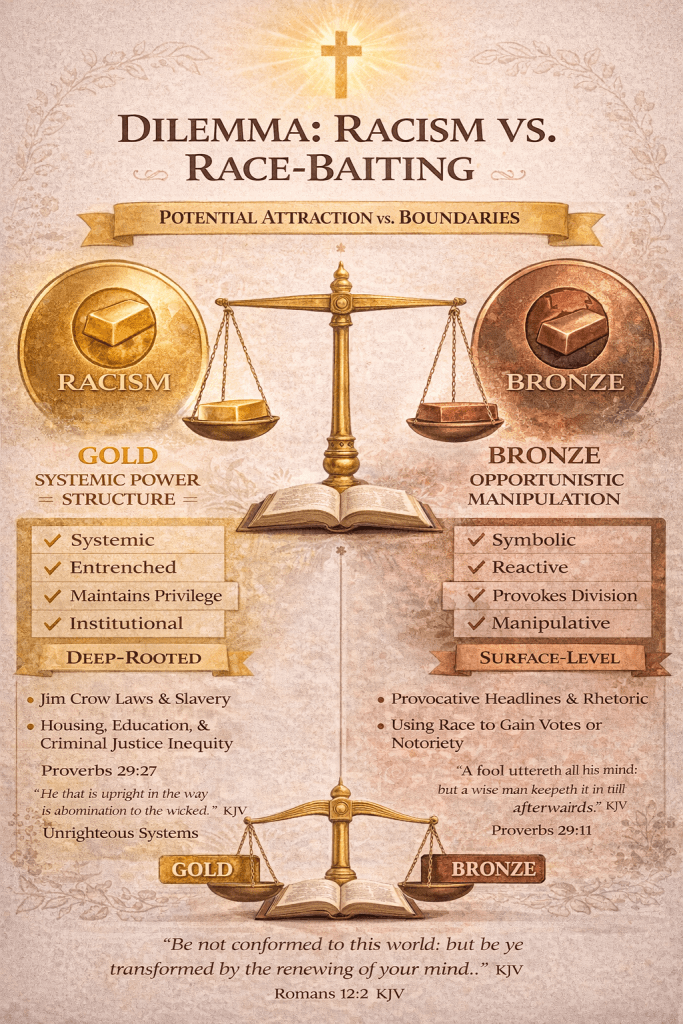
Racism remains one of the most persistent and destructive forces in society, functioning as a systemic power structure designed to maintain the dominance of one group over another (Feagin, 2006). Unlike individual prejudice, which reflects personal bias, racism involves institutional, cultural, and historical mechanisms that enforce inequality. Understanding racism as a power structure is critical to distinguishing it from race-baiting.

Race-baiting, in contrast, refers to tactics that manipulate racial tension for personal, political, or financial gain. It does not necessarily rely on structural dominance but rather exploits societal divisions, often inciting anger, fear, or resentment. While both racism and race-baiting are harmful, their mechanisms and intent differ.

Racism operates at multiple levels: individual, institutional, and systemic. Individual racism involves personal prejudice or discriminatory acts, whereas institutional racism manifests in policies, practices, and norms that advantage one racial group over others. Systemic racism describes the entrenched nature of these structures over generations.

Race-baiting exploits visible racial differences to provoke a reaction. Unlike racism, which is rooted in power dynamics and structural advantage, race-baiting may be opportunistic, focusing on rhetoric and emotional appeal rather than systemic control. Politicians, media personalities, and even social influencers often use race-baiting to advance agendas or gain attention.

In biblical terms, oppression and favoritism have long been condemned. James 2:1 warns, “My brethren, have not the faith of our Lord Jesus Christ, the Lord of glory, with respect of persons” (KJV). Partiality and systemic oppression violate God’s design for justice and equality. Racism is, therefore, fundamentally anti-biblical because it enforces inequality and diminishes the image of God in humanity (Genesis 1:27).

Understanding the difference between racism and race-baiting requires examining the intent behind actions. Racism seeks to preserve hierarchy, maintain privilege, and control resources. Race-baiting seeks to provoke emotional reaction and division, often for personal gain or notoriety. While a racist agenda benefits the oppressor materially or socially, race-baiting primarily manipulates perception.

The metaphor of bronze versus gold can help clarify the distinction. Bronze represents the superficial provocation, often symbolic and reactive—this is race-baiting. Gold represents the deep, entrenched systemic mechanisms—this is racism in its structural form. Observing whether an act addresses the root of inequality or merely agitates emotion can reveal its nature.

Racism and race-baiting intersect in public discourse. Some individuals and media sources may exaggerate or misrepresent incidents of racial tension for attention, funding, or political leverage. This blurs public understanding, making it difficult to address genuine structural injustice. As Proverbs 18:17 notes, “The first to plead his cause seemeth just; but his neighbor cometh and searcheth him” (KJV). Truth requires deeper investigation.

Racism thrives on normalization. When societal structures systematically advantage one group, discriminatory practices are often invisible or dismissed as “tradition” or “meritocracy.” Understanding this helps differentiate between acts that are opportunistic (race-baiting) and those that are embedded within the system (racism).

Race-baiting frequently misdirects anger away from systemic causes toward individual actors, scapegoating specific groups for broader structural problems. This manipulation can polarize communities and hinder meaningful solutions. Micah 6:8 reminds us of justice and humility: “He hath shewed thee, O man, what is good; and what doth the Lord require of thee, but to do justly, and to love mercy, and to walk humbly with thy God?” (KJV).

Media literacy is essential to recognize the distinction. Headlines and social media often amplify emotionally charged narratives without context. Racism is systemic, historically rooted, and persistent, while race-baiting relies on immediate reaction. Educated discernment enables individuals to see beyond sensationalism.

Racism is often intergenerational, perpetuated through education, housing, employment, criminal justice, and healthcare disparities. Race-baiting is usually episodic, emerging around specific incidents, speeches, or events. Understanding historical context is therefore critical to interpreting current racial discourse accurately.

Race-baiting can also occur within oppressed communities, where individuals or groups exploit internal divisions to gain influence. This demonstrates that race-baiting is less about power structures and more about manipulation, contrasting with racism’s reliance on systemic advantage.

The Bible condemns hypocrisy and manipulation. Proverbs 6:16–19 lists pride, false witness, and sowing discord among brethren as abominations to God. Race-baiting falls into the category of sowing discord, whereas racism violates divine law by enforcing inequality. Both are sin, but their mechanisms differ.

Recognizing racism requires assessing who benefits. True racism confers social, economic, and political advantage to a particular racial group. Race-baiting may inflame perceptions of injustice but does not create structural advantage. This distinction clarifies policy debates and moral accountability.

Racism also often hides behind ideology, meritocracy, or cultural norms. The systemic nature makes it less visible than race-baiting, which is loud, overt, and performative. Understanding the bronze versus gold distinction allows individuals to respond with strategic solutions rather than reactive emotion.

Education and awareness are key tools in dismantling both racism and race-baiting. Combatting racism requires structural reform, anti-discrimination policy, and societal accountability. Countering race-baiting requires critical thinking, media literacy, and spiritual discernment (Proverbs 14:15).

Christians are called to pursue justice and reconciliation. Isaiah 1:17 commands, “Learn to do well; seek judgment, relieve the oppressed, judge the fatherless, plead for the widow” (KJV). Responding to racism requires action and advocacy; responding to race-baiting requires wisdom, prayer, and discernment.

Racism is a deep societal disease, while race-baiting is a symptom that exploits and amplifies divisions. One targets systemic change; the other targets immediate perception. Addressing the root cause requires education, advocacy, and awareness of historical context, as well as spiritual discernment.

In conclusion, distinguishing between racism and race-baiting is essential for effective response. Bronze may flare in anger and reaction; gold endures in system and power. Both demand moral responsibility, but the solutions differ. Recognizing the systemic nature of racism while refusing to be manipulated by race-baiting is a critical skill for spiritual and social maturity (Romans 12:2).


References

Feagin, J. (2006). Systemic racism: A theory of oppression. Routledge.
Alexander, M. (2012). The New Jim Crow: Mass incarceration in the age of colorblindness. The New Press.
Kendi, I. X. (2019). How to be an antiracist. One World.
Proverbs 4:23; 14:15; 18:17; 6:16–19
Isaiah 1:17; Micah 6:8; James 2:1; Genesis 1:27
Romans 12:2; Hebrews 13:4
Matthew 10:16; Matthew 26:41