Tag Archives: Beauty

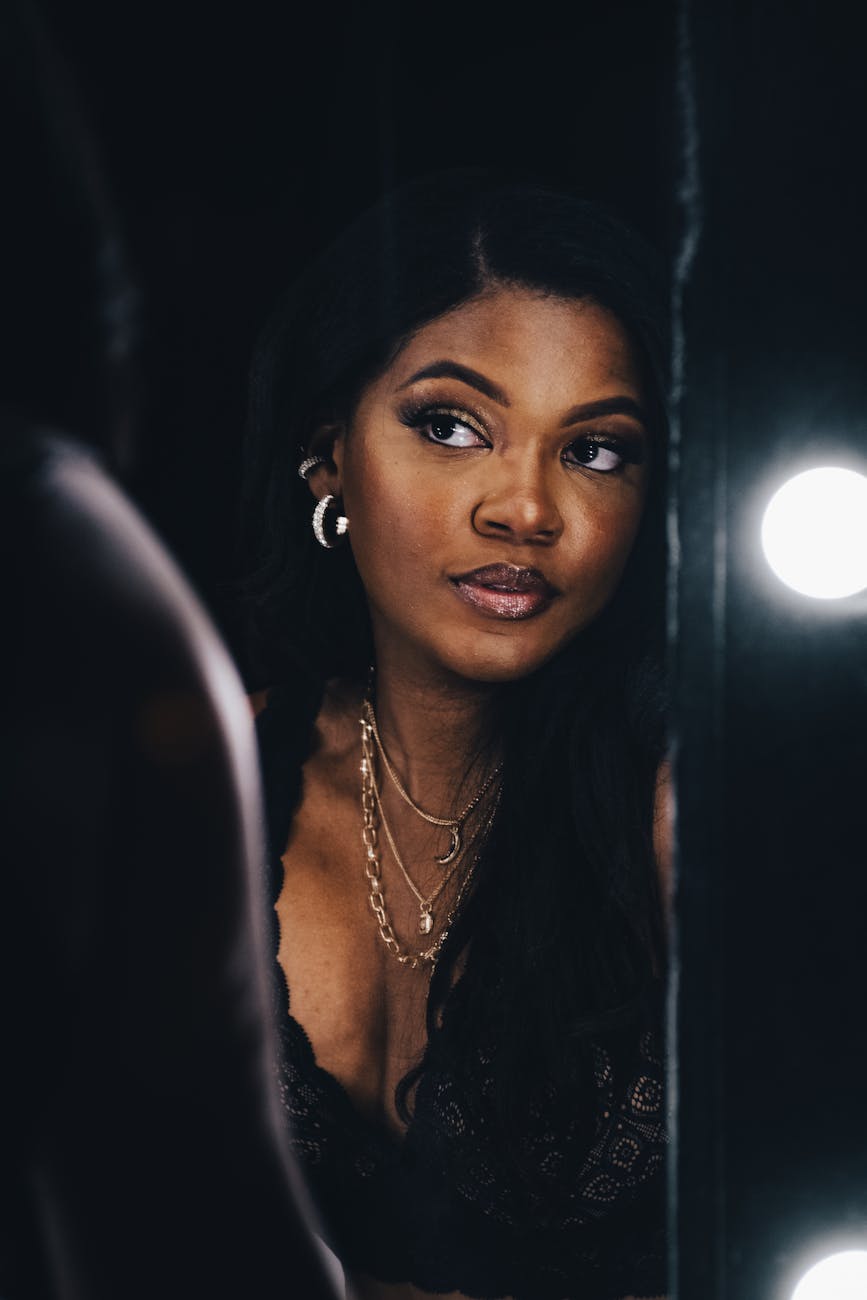
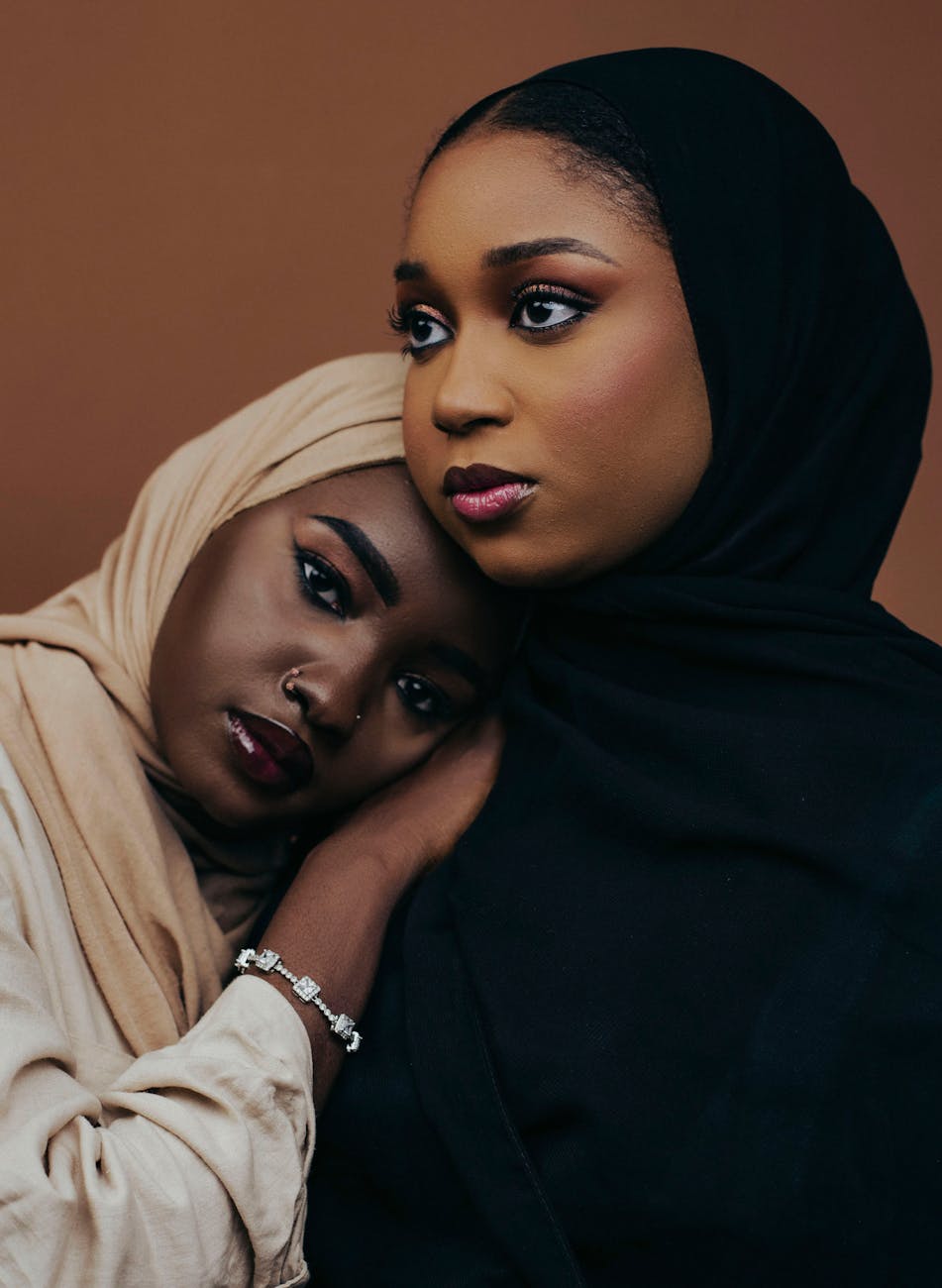
Unveiling Radiance: The Science Behind Black Beauty. #thescienccofblackbeauty

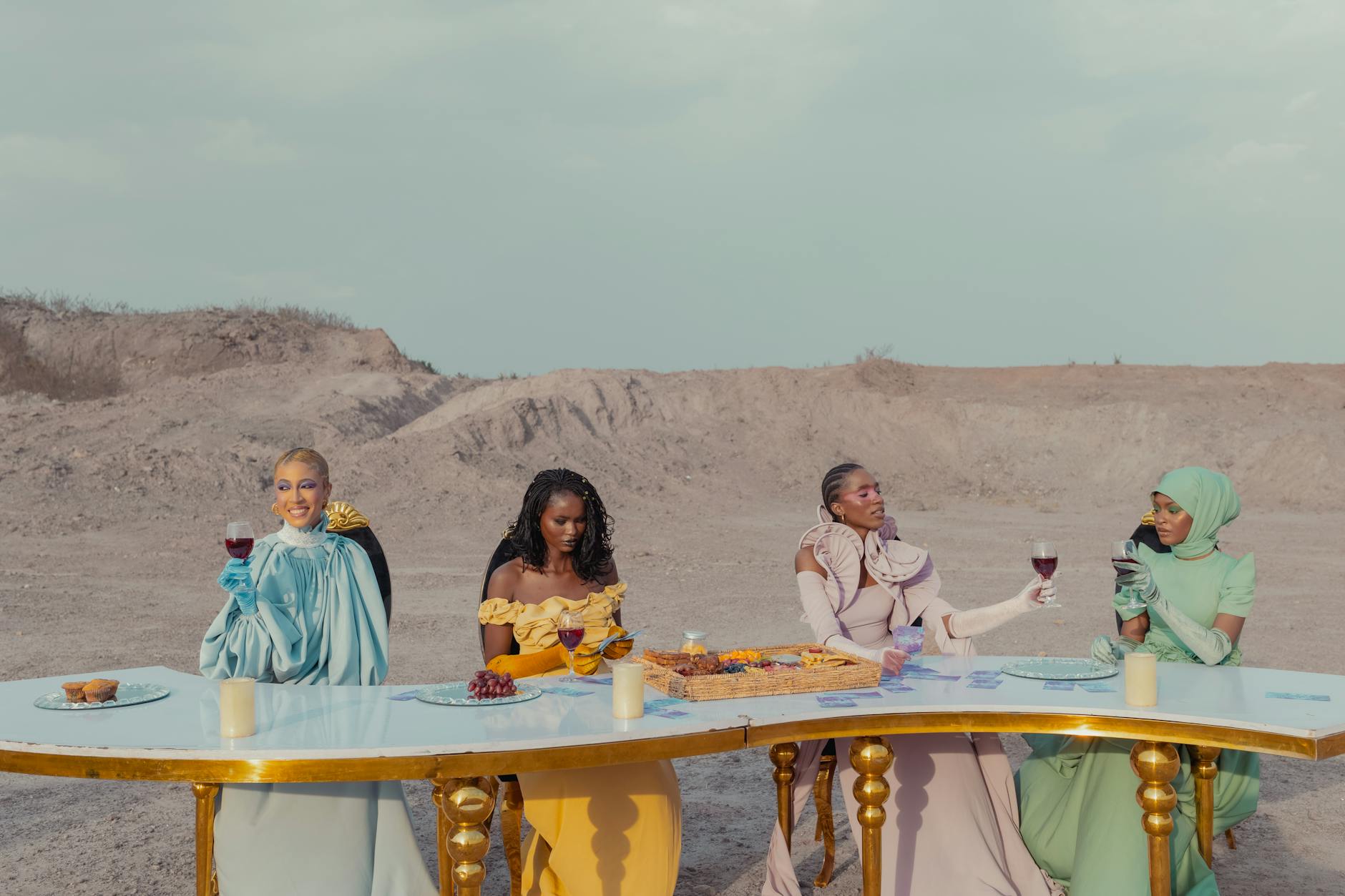
Photo by 3Motional Studio on Pexels.com

Black beauty is a phenomenon that transcends aesthetics, reaching into the realms of biology, psychology, culture, and spirituality. To unveil its radiance is to uncover the evolutionary genius of African traits, the resilience of a people who have endured systemic oppression, and the redefinition of beauty as an act of resistance. Far from being superficial, Black beauty embodies survival, identity, and the sacred dignity of heritage.

From a biological perspective, the features most associated with Black beauty—melanin-rich skin, coiled hair textures, and distinctive facial structures—carry deep evolutionary significance. Dark skin, rich in eumelanin, evolved as protection against harmful ultraviolet rays, while preserving vital nutrients like folate necessary for reproduction (Jablonski & Chaplin, 2010). Similarly, coiled hair functions as a natural insulator, protecting the scalp from heat while aiding in cooling, a design of resilience rooted in Africa’s climate (Robins, 2009). These features reveal that beauty is more than appearance—it is a story of adaptation and survival.

Psychology offers another lens into Black beauty. For centuries, Eurocentric ideals distorted global standards, leading to colorism and the devaluation of African features (Hunter, 2007). Internalized racism caused many to struggle with self-esteem, as seen in studies where Black children favored white dolls over Black dolls. Yet resilience emerged through movements such as “Black is Beautiful,” which reshaped psychological frameworks by affirming melanin, natural hair, and cultural aesthetics (Byrd & Tharps, 2014). In this way, beauty became a psychological anchor of identity and empowerment.

Culturally, representation plays a powerful role in shaping perceptions of beauty. Historically, Black women and men were excluded from mainstream imagery or reduced to stereotypes. However, pioneers like Cicely Tyson and Angela Davis disrupted these patterns by embracing natural styles that carried political meaning. In the modern era, global icons such as Lupita Nyong’o and Rihanna’s Fenty Beauty have expanded definitions of beauty, affirming darker complexions and diverse aesthetics as not only acceptable but aspirational (Tate, 2009). Representation thus transforms beauty from exclusion to celebration.

Black beauty is also inseparable from the politics of survival. During slavery, African women braided hair not only for style but also as cultural memory and, at times, as coded maps for escape (Byrd & Tharps, 2014). Beauty, in this context, was not frivolous but functional, a tool of survival and cultural preservation. This historical resilience underscores that beauty for Black communities is never just cosmetic—it is intertwined with dignity, memory, and liberation.

Spiritually, beauty is rooted in values deeper than appearance. The Bible teaches that true beauty lies within: “Whose adorning let it not be that outward adorning…but the hidden man of the heart” (1 Peter 3:3–4, KJV). For Black people, whose external beauty was often devalued by oppressive systems, inner radiance and spiritual strength became central to survival. Thus, Black beauty is not only seen in skin and hair, but also in character, resilience, and unwavering faith.

In contemporary society, Black aesthetics influence global fashion, music, and art. From natural hairstyles to melanin-positive campaigns, African-descended communities are reclaiming and redefining beauty on their own terms. Yet challenges remain, as colorism and Eurocentric bias persist in media and industries (Patton, 2006). Still, the global celebration of melanin and the mainstreaming of diverse beauty standards signal progress toward broader acceptance.

Ultimately, the science behind Black beauty reveals a truth greater than aesthetics: beauty is resilience, adaptation, and radiance born of struggle and survival. It is biological brilliance, psychological strength, cultural memory, and spiritual dignity combined. To unveil this radiance is to affirm that Black beauty is not only valid—it is foundational to humanity, a sacred testimony to the power of survival, identity, and divine design.


References

  • Byrd, A., & Tharps, L. (2014). Hair story: Untangling the roots of Black hair in America. St. Martin’s Press.
  • Hunter, M. (2007). The persistent problem of colorism: Skin tone, status, and inequality. Sociology Compass, 1(1), 237–254.
  • Jablonski, N. G., & Chaplin, G. (2010). Human skin pigmentation as an adaptation to UV radiation. Proceedings of the National Academy of Sciences, 107(Suppl 2), 8962–8968.
  • Patton, T. O. (2006). Hey girl, am I more than my hair? African American women and their struggles with beauty, body image, and hair. NWSA Journal, 18(2), 24–51.
  • Robins, A. H. (2009). Biological perspectives on human pigmentation. Cambridge University Press.
  • Tate, S. A. (2009). Black beauty: Aesthetics, stylization, politics. Ashgate.
Resilience and Radiance: The Science of Black Beauty. #thescienceofblackbeauty

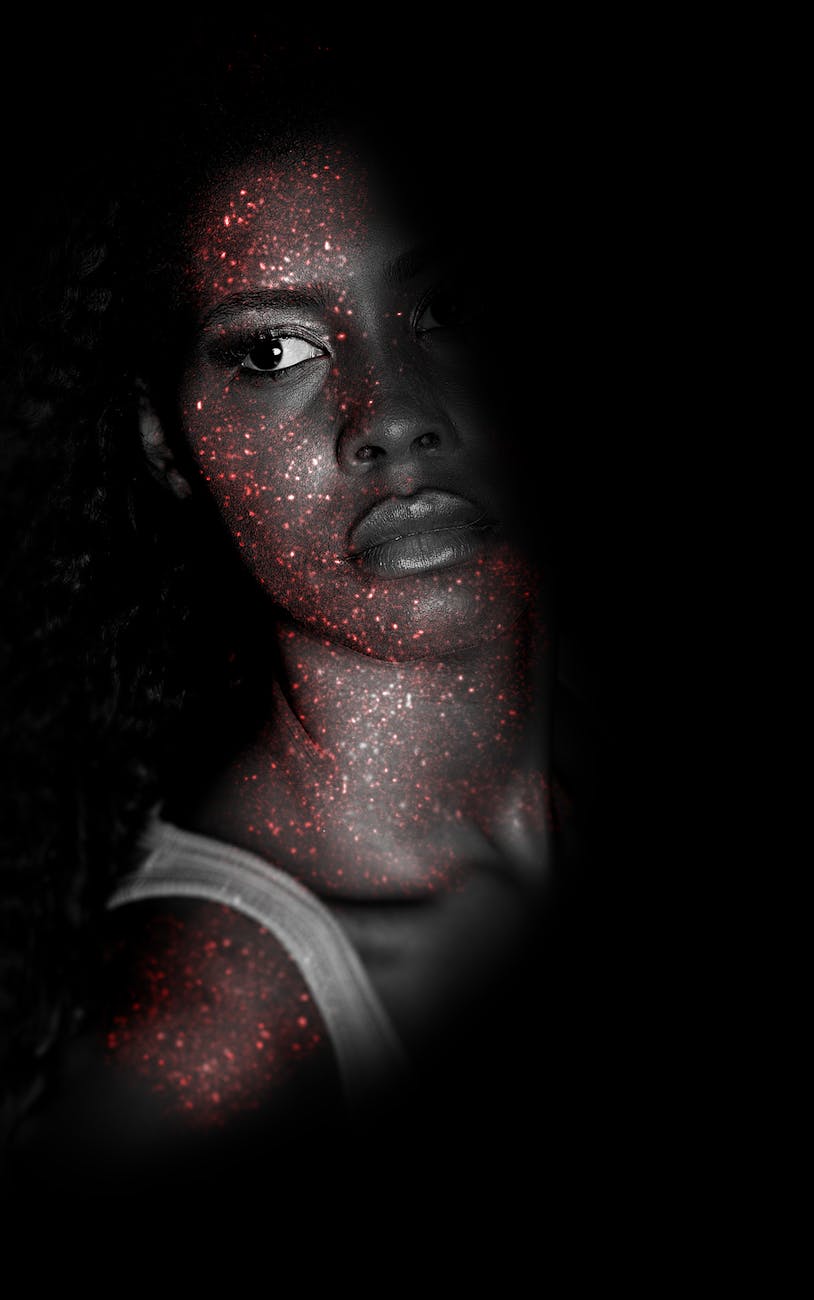
Photo by jim nyamao on Pexels.com

The beauty of people of African descent has long been both celebrated and contested, occupying a complex intersection of biology, culture, and politics. Black beauty is not simply a matter of outward appearance, but a profound embodiment of resilience, history, and spiritual depth. It reflects evolutionary intelligence, psychological endurance, and cultural resistance. Understanding the “science of Black beauty” requires examining its genetic foundations, the psychology of beauty perception, the historical weight of colonialism and slavery, and the spiritual dimension that has sustained Black people across centuries. In this sense, Black beauty radiates not only from the body, but also from the survival of a people who have redefined beauty against all odds.


Evolutionary and Biological Foundations of Black Beauty

Human variation is shaped by adaptation, and the physical features commonly associated with African ancestry bear witness to millennia of survival in diverse ecological environments. Skin pigmentation is one of the most visible markers. Deeply pigmented skin, rich in eumelanin, developed as an evolutionary shield against ultraviolet (UV) radiation. This adaptation protected folate—essential for reproduction and fetal development—while still permitting sufficient vitamin D synthesis near the equator (Jablonski & Chaplin, 2010). Thus, the very darkness of African skin is not only an aesthetic trait but also a marker of evolutionary fitness and resilience.

Hair texture provides another example of adaptation. Afro-textured hair, with its tightly coiled structure, plays a thermoregulatory role, shielding the scalp from intense sunlight while allowing airflow to cool the head (Robins, 2009). This unique adaptation highlights the functionality and beauty embedded within African biology. Similarly, fuller lips, broader noses, and other phenotypic features often stigmatized under Eurocentric ideals were evolutionary responses to environment and climate, rather than biological deficiencies.

Genetics further demonstrates the diversity within African-descended populations. Africa possesses the greatest genetic variation of any continent, meaning that Black beauty cannot be reduced to a monolith but must be understood as a spectrum of phenotypes, from ebony to bronze skin tones, from tightly coiled to loosely curled hair textures (Tishkoff et al., 2009). This genetic diversity underscores that Black beauty is vast, multifaceted, and scientifically foundational to humanity itself.


The Psychology of Black Beauty and Self-Perception

While biology provides the framework, psychology reveals how beauty is experienced and valued. For centuries, Eurocentric beauty standards have dominated the global imagination, leading to colorism and internalized oppression within Black communities (Hunter, 2007). Skin tone hierarchies, hair texture bias, and the devaluation of African features created psychological scars that persist today.

Psychological studies show that exposure to Eurocentric ideals negatively impacts self-esteem among Black girls and women, often leading to increased anxiety, depression, and identity struggles (Thompson & Keith, 2001). The infamous “doll test” conducted by Kenneth and Mamie Clark in the 1940s revealed that Black children preferred white dolls over Black dolls, associating whiteness with goodness and beauty while internalizing negative views of their own Blackness.

Yet psychology also highlights resilience. The “Black is Beautiful” movement of the 1960s was a revolutionary act of cognitive reframing, challenging dominant standards and affirming Black self-worth (Byrd & Tharps, 2014). Today, the natural hair movement, the rise of melanin pride campaigns, and the increasing visibility of dark-skinned models and actresses reflect an ongoing psychological resistance to internalized colonial narratives. These cultural shifts affirm that Black beauty is not fragile—it is resilient, continuously redefining itself in ways that nurture self-love and communal pride.


Cultural Representation and the Politics of Beauty

Beauty is never neutral; it is political. For centuries, the exclusion of Black women and men from mainstream beauty standards reinforced structures of racial hierarchy. Dark skin was demonized, kinky hair was stigmatized, and African facial features were caricatured or erased from media representation. When Black bodies did appear in art, literature, or film, they were often exoticized, fetishized, or portrayed as subhuman.

This exclusion was not accidental but deeply rooted in colonial projects that sought to dehumanize African people while upholding whiteness as the pinnacle of beauty and civilization (Craig, 2006). In this context, to affirm Black beauty was to resist systemic erasure. Icons such as Nina Simone, Angela Davis, and Cicely Tyson redefined beauty through their unapologetic embrace of natural hair and African aesthetics, disrupting dominant cultural narratives.

In contemporary culture, representation has expanded. Lupita Nyong’o’s global influence as a dark-skinned actress and advocate for young Black girls challenges colorism. Rihanna’s Fenty Beauty brand revolutionized the cosmetics industry by offering foundation shades across the spectrum of skin tones, addressing the long-standing exclusion of darker complexions (Tate, 2009). These shifts reveal that beauty is not just personal—it is structural, reshaping industries and social perceptions.


Spiritual and Historical Dimensions of Black Beauty

Beyond biology and psychology, Black beauty possesses a spiritual and historical dimension. The transatlantic slave trade, colonialism, and systemic racism sought to strip African people of dignity, yet inner beauty and resilience endured. Enslaved women, denied adornments or agency, still braided hair in intricate styles that carried cultural meaning and even mapped escape routes (Byrd & Tharps, 2014). Beauty became an act of survival, a hidden language of strength.

The Bible, too, speaks of beauty in terms deeper than physical appearance. “Whose adorning let it not be that outward adorning of plaiting the hair, and of wearing of gold… but let it be the hidden man of the heart” (1 Peter 3:3–4, KJV). This verse affirms that true beauty is rooted in spirit, dignity, and virtue rather than external adornment. For Black communities, beauty has always transcended surface features—it is found in resilience, faith, and the radiance of survival through centuries of oppression.


Resilience and Radiance in the Modern Era

Today, Black beauty radiates globally, shaping fashion, music, film, and art. Afrocentric hairstyles influence global trends, African skin tones are celebrated on runways, and hip-hop culture redefines aesthetics worldwide. Yet challenges remain: colorism, Eurocentric bias in corporate beauty industries, and the commodification of Black aesthetics without proper respect for Black creators (Patton, 2006).

Nevertheless, Black beauty continues to redefine itself as a site of resistance and radiance. It is a reminder that beauty is not static but evolving, deeply intertwined with survival and identity. In both science and spirit, Black beauty testifies to the resilience of a people who refused to be erased, radiating strength that shines across generations.


Conclusion

The science of Black beauty demonstrates that it is both biological and transcendent. Evolutionary biology reveals its brilliance in adaptation. Psychology uncovers both the wounds of imposed Eurocentric standards and the resilience of self-love movements. Culture illustrates the politics of representation and the revolutionary act of embracing melanin and natural aesthetics. Spiritually, Black beauty is inseparable from dignity, survival, and divine worth.

In this light, Black beauty is not fragile—it is radiant because it endured. It is resilience written into skin, hair, and spirit. It is science fused with history, and history fused with faith. Black beauty is not merely seen; it is survived, celebrated, and sacred.


References

  • Byrd, A., & Tharps, L. (2014). Hair story: Untangling the roots of Black hair in America. St. Martin’s Press.
  • Craig, M. L. (2006). Race, beauty, and the tangled knot of a guilty pleasure. Feminist Theory, 7(2), 159–177.
  • Hunter, M. (2007). The persistent problem of colorism: Skin tone, status, and inequality. Sociology Compass, 1(1), 237–254.
  • Jablonski, N. G., & Chaplin, G. (2010). Human skin pigmentation as an adaptation to UV radiation. Proceedings of the National Academy of Sciences, 107(Suppl 2), 8962–8968.
  • Patton, T. O. (2006). Hey girl, am I more than my hair? African American women and their struggles with beauty, body image, and hair. NWSA Journal, 18(2), 24–51.
  • Robins, A. H. (2009). Biological perspectives on human pigmentation. Cambridge University Press.
  • Tate, S. A. (2009). Black beauty: Aesthetics, stylization, politics. Ashgate.
  • Thompson, M. S., & Keith, V. M. (2001). The Blacker the berry: Gender, skin tone, self-esteem, and self-efficacy. Gender & Society, 15(3), 336–357.
  • Tishkoff, S. A., et al. (2009). The genetic structure and history of Africans and African Americans. Science, 324(5930), 1035–1044.

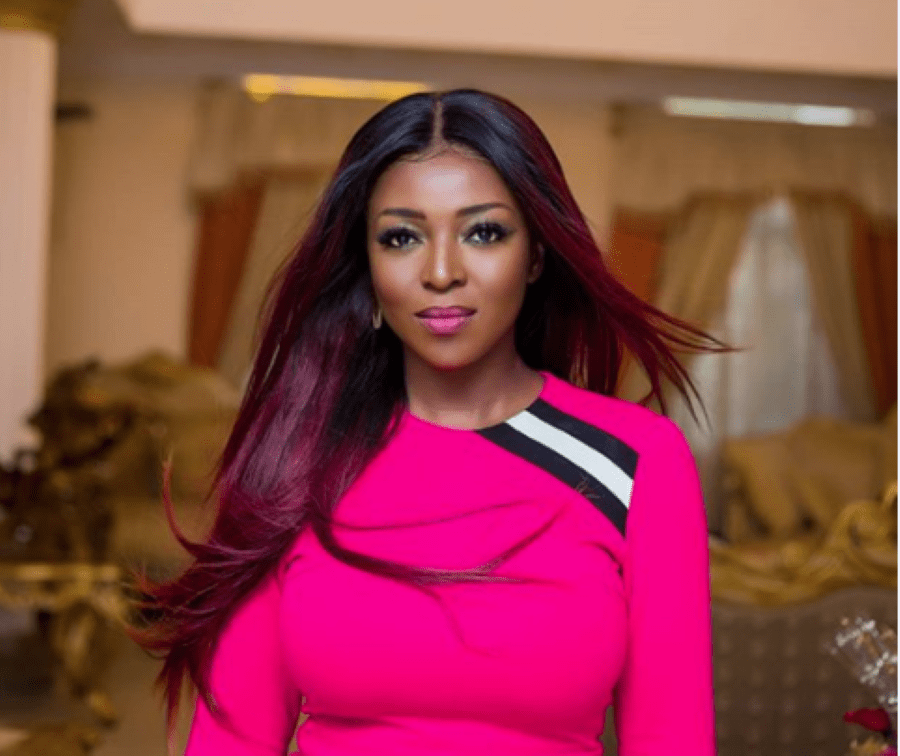
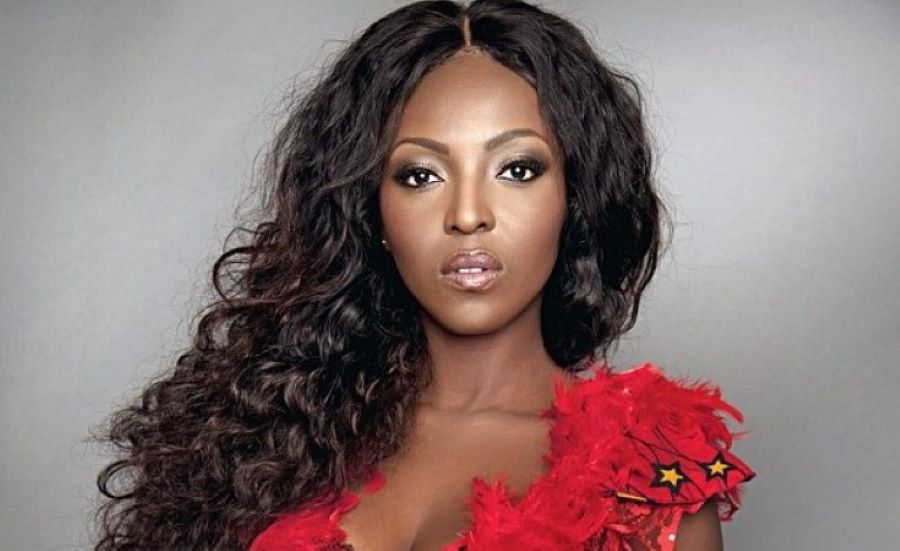
The Ebony Dolls: Yvonne Okoro

This photograph is the property of its respective owners. No copyright infringement intended.

In the constellation of African cinema, Yvonne Okoro shines with a rare brilliance that fuses sophistication, intelligence, and undeniable beauty. With her flawless bronze-ebony complexion, luminous almond-shaped eyes, and refined features framed by a radiant smile, she is often admired for her doll-like allure—a blend of African richness and European elegance. Beyond her physical charm, Okoro’s poise, confidence, and versatility have positioned her among the most respected actresses in both Ghana’s Ghallywood and Nigeria’s Nollywood film industries. She is a modern African woman who balances glamour with grit, embodying excellence both on and off the screen.

Born Chinyere Yvonne Okoro on November 25, 1984, in Tamale, Ghana, she comes from a mixed heritage that beautifully reflects the unity of West Africa—her father is Nigerian (from Abia State, Igbo), and her mother is Ghanaian. This cultural blend enriched her worldview and artistic expression, allowing her to connect with audiences across two major entertainment industries. From a young age, Yvonne demonstrated a passion for performance, often participating in school plays and local talent showcases that revealed her natural charisma and expressiveness.

Yvonne Okoro’s educational journey is as impressive as her acting career. She attended Achimota Preparatory School and Lincoln Community School before earning her Bachelor of Arts in English and Linguistics from the University of Ghana, Legon. She later pursued further studies in France at the Université de Nantes, where she deepened her understanding of communication and modern languages—skills that would later enhance her presence in international cinema.

This photograph is the property of its respective owners. No copyright infringement intended.

Her acting debut came with a supporting role in the Ghanaian film Sticking to the Promise (2002). However, her major breakthrough came when she transitioned into Nollywood, starring in Beyoncé: The President’s Daughter (2006) alongside Nadia Buari and Van Vicker. Her beauty, eloquence, and natural on-screen chemistry with her co-stars captured the attention of filmmakers and audiences alike. Soon, she became a fixture in both Ghanaian and Nigerian film productions, a rare feat achieved by only a handful of actresses.

Over the years, Yvonne Okoro has built an impressive filmography, with notable works including The Game (2010), Contract (2012), Single Six (2011), Rebecca (2016), and Ghana Must Go (2016)—a romantic comedy she also produced. Her role in Contract, opposite Hlomla Dandala, earned her the Best Actress Award at the Ghana Movie Awards and an Africa Magic Viewers’ Choice Award (AMVCA) nomination. The film’s critical success established her as one of the leading ladies of African cinema, capable of blending humor, depth, and authenticity with magnetic beauty.

Yvonne Okoro’s contributions extend beyond acting; she is also a film producer and entrepreneur, using her platform to promote quality storytelling in Africa. Her production company, Desamour Company Limited, has produced several films that highlight African culture, love, and social issues. Through this, she has provided opportunities for emerging talents, especially women in film, fostering growth and creativity in the industry.

This photograph is the property of its respective owners. No copyright infringement intended.

Her grace and intelligence have also made her a favorite for brand endorsements, having represented beauty and fashion brands that mirror her elegance. She is frequently listed among the most beautiful and influential actresses in Africa, celebrated for her radiant skin, well-defined features, and polished style that bridges modern glamour and cultural authenticity.

In addition to her professional achievements, Yvonne Okoro’s personal life reflects humility and purpose. Despite her fame, she remains grounded and family-oriented, often crediting her parents for instilling discipline and confidence. Her close relationship with her siblings—particularly her sister, Roseline Okoro, who also ventured into acting—highlights her belief in family unity and shared success.

Throughout her career, Yvonne has earned numerous accolades, including the Best Actress of the Year (2010) at the Ghana Movie Awards, the Achievement Award at the City People Entertainment Awards in Nigeria, and recognition at the Africa International Film Festival (AFRIFF). Her dedication to excellence has made her one of the highest-paid actresses in Ghana and Nollywood, respected for both her beauty and her business acumen.

Ultimately, Yvonne Okoro represents the epitome of modern African femininity—educated, talented, and unapologetically elegant. Her soft-spoken confidence, luminous ebony glow, and striking intellect set her apart as not merely a star, but a symbol of pan-African pride and excellence. As one of the Ebony Dolls of African cinema, she continues to inspire young women to dream beyond boundaries while embracing their heritage and divine beauty.


References

  • Africa Magic. (2023). Yvonne Okoro: The Actress Who Bridges Ghana and Nollywood. MultiChoice Africa.
  • Ghana Web. (2022). Profile of Yvonne Okoro: From Beauty to Brilliance.
  • Pulse Ghana. (2023). Top 10 Highest-Paid Actresses in Ghana and Nigeria.
  • The Guardian Nigeria. (2021). Yvonne Okoro: The Pan-African Face of Modern Cinema.
  • IMDb. (2024). Yvonne Okoro Biography and Filmography.
  • Modern Ghana. (2022). Yvonne Okoro: The Glamorous Ghanaian-Nigerian Star Redefining African Film.

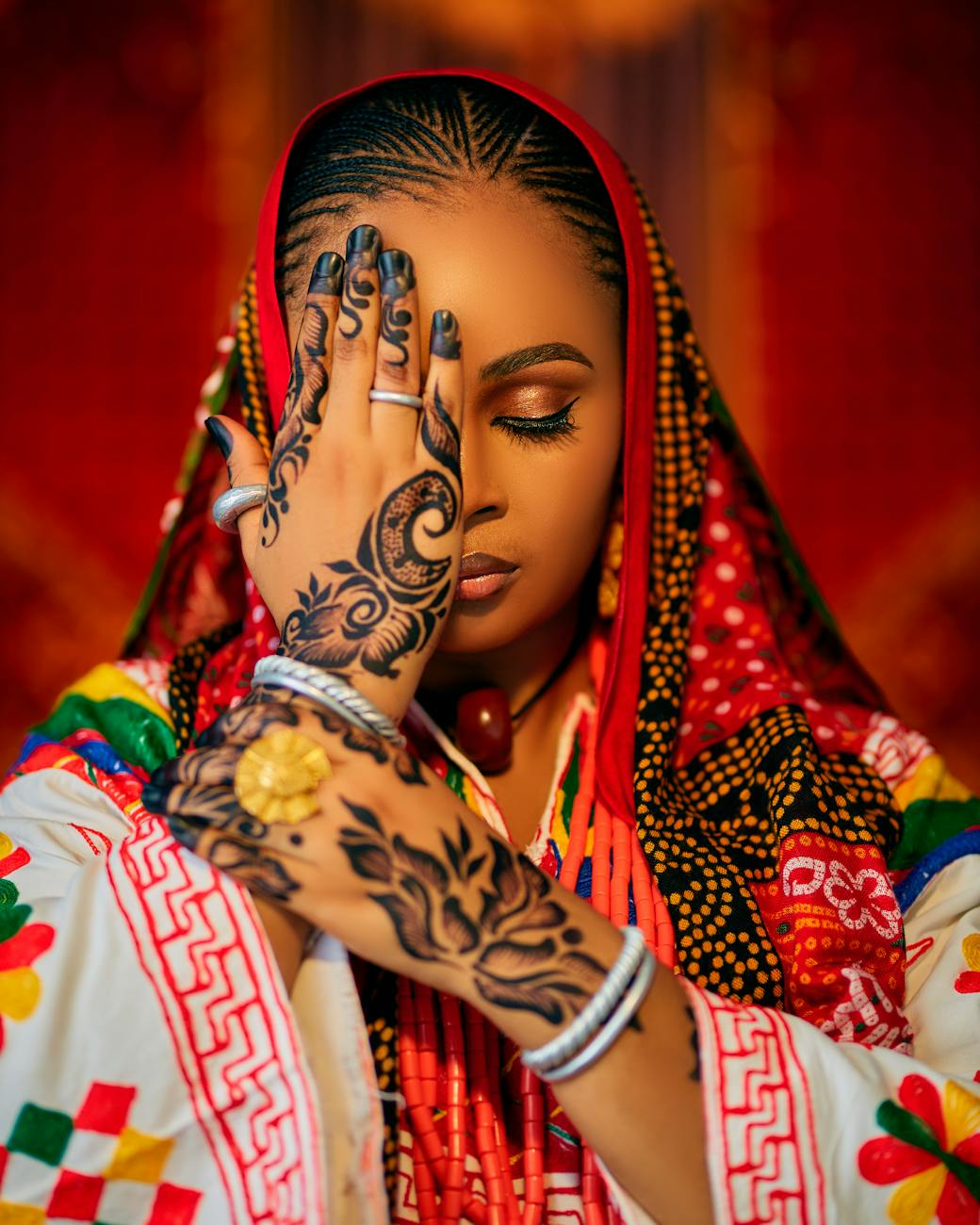
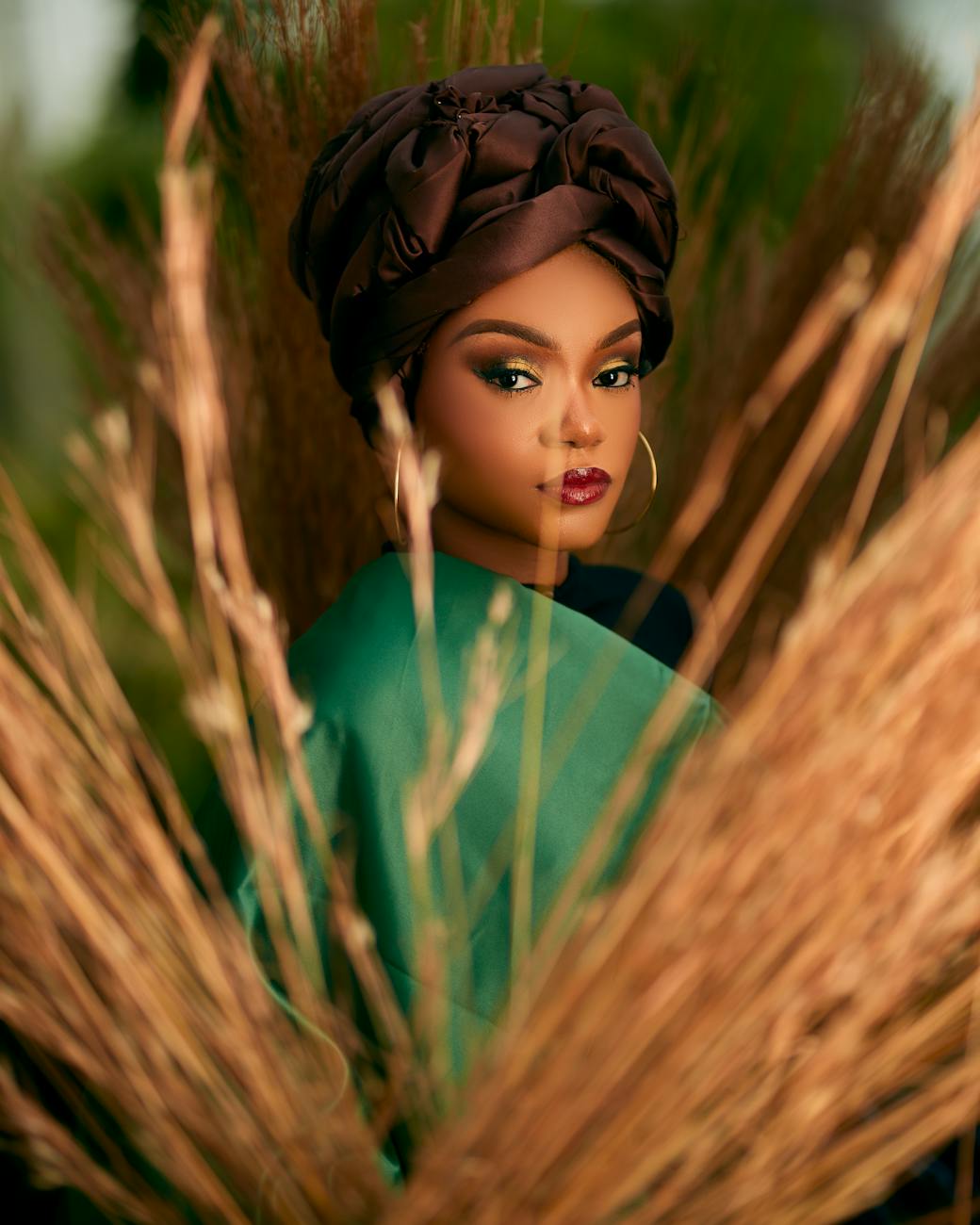
Cultural Pride as Beauty: Why Identity Shapes Perception.

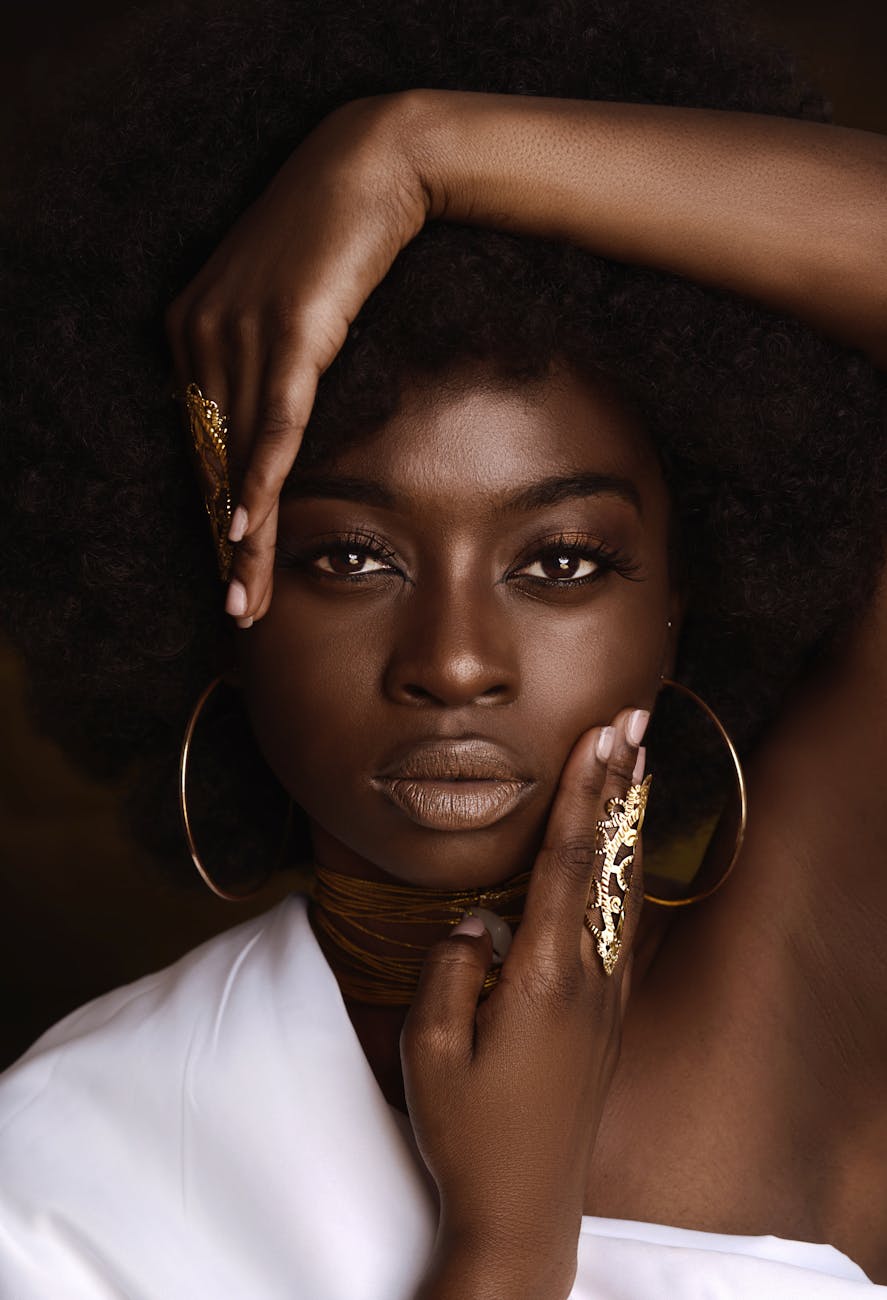
Photo by Al Ameen Saddiq on Pexels.com

Beauty is more than skin deep—it is inseparable from identity, heritage, and cultural pride. Across history, communities have celebrated aesthetic features that reflect ancestral lineage, values, and collective experience. In this sense, cultural pride becomes an intrinsic component of beauty, shaping both self-perception and how others perceive us. Understanding this relationship illuminates the power of identity in cultivating confidence, resilience, and self-worth.

The Interplay of Identity and Perception

Psychological research highlights that individuals who embrace their cultural heritage experience enhanced self-esteem and body image (Phinney, 1990). When identity is acknowledged and celebrated, aesthetic features are interpreted not merely as physical traits but as expressions of history, values, and belonging. For example, Black and brown individuals who take pride in natural hair, melanin-rich skin, or traditional attire often report greater confidence and satisfaction with appearance.

Embodying Heritage: Real-Life Examples of Cultural Pride in Beauty

Cultural pride transforms beauty into a declaration of identity. Across the African diaspora, Black and brown individuals are redefining aesthetic standards by embracing heritage, natural features, and traditional expressions of self. These examples demonstrate how cultural pride enhances confidence, shifts societal perception, and inspires future generations.

1. Lupita Nyong’o – Embracing Natural Skin and Hair
Lupita Nyong’o’s public celebration of her dark, melanin-rich skin and natural hair textures has challenged Hollywood’s narrow beauty standards. She frequently speaks about the importance of representation, affirming that embracing one’s authentic look is empowering. Her presence has inspired young women worldwide to take pride in their natural hair and skin, validating beauty in shades historically marginalized by media.

2. Tracee Ellis Ross – Championing Cultural Hairstyles
Tracee Ellis Ross is known for embracing and showcasing her natural hair in all its textures. From voluminous curls to intricate protective styles, she elevates cultural hairstyles as symbols of heritage and individuality. By owning her aesthetic, she communicates that cultural features are not just personal but political—empowering others to express identity confidently.

3. Adut Akech – Bridging Heritage and Fashion
Model Adut Akech, of South Sudanese heritage, has made waves in the fashion industry while proudly representing her culture. Through runway appearances, editorials, and advocacy, she demonstrates that heritage and beauty are intertwined, proving that embracing cultural roots does not limit opportunities but instead amplifies presence and influence.

4. Michaela Coel – Authentic Storytelling and Visibility
Michaela Coel, the writer and actress behind I May Destroy You, brings cultural pride into storytelling and media representation. Her unapologetic approach to her identity and appearance fosters authenticity on screen, encouraging audiences to appreciate beauty as inseparable from lived experience, heritage, and personal narrative.

5. Rihanna – Integrating Heritage into Style
Rihanna incorporates Caribbean and African influences into her fashion, makeup, and entrepreneurial ventures. By celebrating her roots in visible ways—through Fenty Beauty’s inclusive makeup lines and culturally inspired styling—she demonstrates that embracing heritage enhances both personal beauty and global influence.

The Psychological and Social Impact

These individuals illustrate that cultural pride enhances self-perception and confidence. Studies show that when individuals see public figures embracing heritage and natural features, it reduces internalized colorism and validates diverse expressions of beauty (Hunter, 2007). Socially, such visibility challenges stereotypes and broadens cultural definitions of attractiveness.

Cultural Pride as a Form of Empowerment

Embracing one’s cultural markers is an act of empowerment. Historically marginalized groups have faced pressure to conform to dominant beauty norms—often Eurocentric standards that devalue natural features. By reclaiming these features as symbols of pride, communities assert self-worth and challenge societal bias. Figures like Lupita Nyong’o, Tracee Ellis Ross, and Adut Akech exemplify how cultural pride and identity elevate perceived beauty on global stages.

Influence on Social Perception

Cultural pride also shapes how others perceive beauty. When individuals present themselves confidently while honoring heritage—through hairstyles, fashion, or traditional practices—it signals authenticity, strength, and self-assurance. Research in social psychology shows that observers are more likely to perceive confident, culturally-grounded individuals as attractive, competent, and influential (Tajfel & Turner, 1986). Thus, beauty is not solely an individual attribute but a social signal of identity and pride.

Historical and Spiritual Contexts

Cultural pride and aesthetic appreciation are intertwined with history and spirituality. In African and diasporic communities, features such as skin tone, hair texture, and attire carry ancestral significance, reflecting resilience and continuity. Biblically, beauty is affirmed in relation to identity and creation (Song of Solomon 1:5 KJV: “I am black, but comely, O ye daughters of Jerusalem”). Recognizing the sacredness of one’s heritage enhances self-esteem and reframes beauty as a celebration of identity rather than conformity.

Practical Steps to Embrace Cultural Beauty

  1. Educate Yourself: Learn about the historical and cultural significance of your aesthetic traits.
  2. Celebrate Heritage: Incorporate cultural fashion, hairstyles, and practices into daily life.
  3. Engage Community: Share experiences and support others in embracing their identity.
  4. Challenge Bias: Advocate for inclusive representation in media, education, and professional spaces.
  5. Affirm Daily: Use positive affirmations to reinforce the connection between cultural pride and beauty.

Conclusion

Cultural pride transforms beauty from a superficial attribute into a multidimensional expression of identity. By embracing heritage, individuals cultivate confidence, inspire admiration, and challenge societal biases. Beauty is thus inseparable from identity: it is cultural, historical, and spiritual. Owning one’s heritage, celebrating uniqueness, and expressing it boldly ensures that perception—both self and societal—aligns with authenticity, pride, and brilliance. Cultural pride is a transformative force in defining beauty. Figures like Lupita Nyong’o, Tracee Ellis Ross, Adut Akech, Michaela Coel, and Rihanna exemplify how embracing heritage, natural features, and identity can shape perception—both personally and societally. Beauty rooted in cultural pride is not superficial; it is resilient, empowering, and a declaration of authenticity. By celebrating heritage, we cultivate confidence, inspire representation, and redefine what it means to be truly beautiful.


References

  • Phinney, J. S. (1990). Ethnic identity in adolescents and adults: Review of research. Psychological Bulletin, 108(3), 499–514.
  • Tajfel, H., & Turner, J. C. (1986). The social identity theory of intergroup behavior. In S. Worchel & W. G. Austin (Eds.), Psychology of intergroup relations (pp. 7–24). Chicago: Nelson-Hall.
  • The Holy Bible, King James Version. (1611). Song of Solomon 1:5.

Hunter, M. (2007). The Persistent Problem of Colorism: Skin Tone, Status, and Inequality. Sociology Compass, 1(1), 237–254.

The Holy Bible, King James Version. (1611). Song of Solomon 1:5.

Beauty, Bias, and the Brown Girl Battle. #thebrowngirldilemma

Photo by Norma Mortenson on Pexels.com

The battle for beauty is one of the most enduring struggles for brown-skinned women. It is not simply about cosmetics or fashion, but about history, identity, and survival in a society that has long privileged Eurocentric standards. The phrase “brown girl battle” encapsulates this conflict—where beauty and bias intersect, shaping not only how women are seen but also how they see themselves. To understand this battle is to understand the interplay of race, gender, and culture across centuries.

Beauty as a Social Construction

Beauty is not universal; it is constructed through cultural norms and political power. The idea that lighter skin, straighter hair, or thinner noses are inherently more attractive was not born naturally but manufactured through colonialism, slavery, and racial ideology (Painter, 2010). These constructions continue to influence who is deemed beautiful, desirable, and worthy of opportunities. For brown girls, beauty is not simply about preference but about systems of validation and exclusion.

The Colonial Legacy of Bias

The roots of this bias reach into the colonial era, when European conquerors imposed hierarchies that equated whiteness with superiority and Blackness with degradation. Colonized peoples were taught to despise their own features and strive toward European ideals. The scars of this indoctrination remain visible in societies where light skin continues to be prized in marriage markets, media, and labor economies. The brown girl battle is thus not a personal insecurity but a historical inheritance.

Slavery and the Politics of Shade

During slavery in the Americas, skin tone often determined one’s labor and treatment. Lighter-skinned enslaved women, often the result of sexual violence, were more likely to be placed in domestic roles, while darker-skinned women were forced into backbreaking fieldwork (Hunter, 2007). These practices entrenched colorism within communities of African descent, reinforcing the association of lighter skin with privilege. This historical stratification still shapes perceptions of beauty today.

Colorism Within Communities

One of the most painful aspects of the brown girl battle is that it exists not only between races but within racial groups. Families, schools, and social spaces often reinforce the preference for lighter skin, creating divisions among women who share the same heritage. This intra-community bias can be more wounding than external prejudice, as it corrodes solidarity and deepens insecurities.

Media Representation and Erasure

The media has long been complicit in the brown girl battle. For decades, television and film rarely showcased brown-skinned women as romantic leads or beauty icons. Instead, roles often relegated them to the margins—maids, aggressors, or comic relief. When women of color were celebrated for their beauty, they were frequently of lighter complexion or racially ambiguous. This “brown girl gap” in representation reinforced the bias that brownness was less desirable.

The Rare Visibility of Brown Beauty

When figures like Viola Davis, Lupita Nyong’o, and Gabrielle Union gained visibility, they disrupted these narratives. Lupita’s 2014 Oscar win, paired with her grace and elegance, represented a cultural breakthrough. She openly acknowledged the pain of growing up unseen and the healing power of representation for younger girls who looked like her. Their visibility did not erase the bias, but it began to shift the cultural imagination of beauty.

The Psychological Toll of Bias

Psychological research has shown that repeated exposure to biased standards of beauty can harm self-esteem, body image, and mental health (Thompson, 1996). For brown women, the battle is internal as much as external. The mirror becomes a contested space, reflecting not only their features but also the societal rejection attached to those features. Many grow up questioning their worth, wondering if they will ever be deemed beautiful without modification.

Hair as a Battleground

Hair has become one of the most politicized aspects of the brown girl battle. Eurocentric norms often pressure women to straighten or chemically alter their natural hair to be seen as professional or attractive. Natural hair movements resist this bias, affirming that curls, kinks, and coils are not defects but crowns. Yet, the need for legislation such as the CROWN Act in the United States shows that the policing of Black hair remains a structural problem.

Features Under Scrutiny

Beyond hair and skin, facial features are often judged against Eurocentric standards. Broader noses, fuller lips, and darker eyes were historically devalued, even as cosmetic industries later profited from imitating these same features. The irony of brown women being shamed for their natural features while those features are celebrated when surgically acquired by white women reflects the depth of bias in beauty culture.

Faith as Liberation from Bias

Spiritual traditions provide a counter-narrative to beauty bias. The Bible affirms the worth of women regardless of skin tone or appearance. Song of Solomon 1:5 proclaims, “I am black, but comely” (KJV), boldly affirming beauty in blackness. 1 Peter 3:3–4 reminds women that true beauty lies not in adornment but in “the hidden man of the heart.” Faith, therefore, provides brown women with a spiritual foundation to resist external lies and embrace divine affirmation.

Ancestral Pride and Heritage

For centuries, African societies celebrated brown and dark skin as symbols of strength, wisdom, and fertility. Sculptures, rituals, and traditions affirmed melanin-rich bodies as divine gifts. Reclaiming this ancestral pride allows modern brown women to combat internalized inferiority. By embracing the beauty once honored by their ancestors, they resist colonial erasure and affirm their sacred heritage.

Intersections of Gender and Race

The brown girl battle is intensified by the intersection of gender and race. While all women face pressures from beauty standards, brown women contend with racialized expectations layered on top of gender roles. They are often expected to embody strength without softness, competence without femininity, and beauty without visibility. These contradictions make their battle uniquely complex.

Global Dimensions of the Battle

Around the world, brown women confront the same biases in different forms. In India, the skin-lightening industry thrives on the message that lighter is better. In the Caribbean and Latin America, color hierarchies determine social mobility. In Africa itself, colonial legacies persist in beauty marketing and media representation. The brown girl battle is thus not confined to one geography but is global in scope.

Social Media and Reclamation

Social media has become both a battlefield and a tool of liberation. On one hand, filters and algorithms often reinforce Eurocentric beauty ideals. On the other, movements like #BlackGirlMagic and #MelaninPoppin create digital spaces where brown women affirm their beauty on their own terms. Online, they build communities that counter mainstream bias and celebrate diversity of shade, hair, and features.

Representation as Revolution

Representation is not cosmetic; it is political. When brown women are centered in media, politics, and fashion, it challenges centuries of bias. Michelle Obama’s visibility as First Lady, for instance, offered an unprecedented redefinition of elegance and grace in brown skin. Each act of representation is a strike against erasure, proving that beauty cannot be monopolized by one standard.

Intergenerational Cycles of Bias

The battle is also fought across generations. Mothers who were told they were “too dark” may unintentionally pass insecurities to their daughters. Breaking these cycles requires intentional affirmation, teaching brown girls to see themselves as beautiful and worthy from a young age. This intergenerational healing is vital to dismantling the deep roots of bias.

Collective Resistance and Healing

Healing requires more than individual self-love; it requires collective resistance. Communities must challenge colorism, expand representations, and dismantle systems that perpetuate inequality. Schools, media, and workplaces must normalize beauty in every shade. Collective affirmation ensures that no girl grows up questioning her worth because of her skin.

Beyond Beauty: Full Humanity

Ultimately, the brown girl battle is not only about being recognized as beautiful. It is about being seen as fully human. Beauty bias is a symptom of deeper racial inequality. When society affirms the beauty of brown women, it is also affirming their dignity, intelligence, and value. The battle for beauty is therefore inseparable from the broader struggle for justice.

Conclusion: Winning the Battle

The battle is ongoing, but it is not unwinnable. Brown women continue to resist bias through faith, heritage, representation, and community. By naming and confronting the structures that create the bias, they reclaim power over the narrative of beauty. To declare that brown is beautiful is not vanity—it is an act of survival, defiance, and liberation. The brown girl battle, though forged in oppression, is ultimately a story of victory, where beauty becomes not just reflection but revolution.


References

  • Hunter, M. (2007). The persistent problem of colorism: Skin tone, status, and inequality. Sociology Compass, 1(1), 237–254.
  • Monk, E. P. (2014). Skin tone stratification among Black Americans, 2001–2003. Social Forces, 92(4), 1313–1337.
  • Painter, N. I. (2010). The history of White people. W.W. Norton & Company.
  • Thompson, C. (1996). Black women, beauty, and hair as a matter of being. Women’s Studies, 25(6), 667–678.
  • The Holy Bible, King James Version.

Beyond the Mirror: Unpacking the Brown Girl Dilemma. #thebrowngirldilemma

Photo by Jaycee300s on Pexels.com

The concept of the brown girl dilemma describes the tension of existing in a world that both sees and refuses to see brown-skinned women. It is a paradox of hyper-visibility and invisibility, of being exalted as exotic while simultaneously devalued as undesirable. More than an issue of surface-level aesthetics, it reflects centuries of social engineering, colonial domination, and racialized standards of femininity. To fully understand the brown girl dilemma, one must look beyond the mirror—into history, psychology, spirituality, and cultural representation.

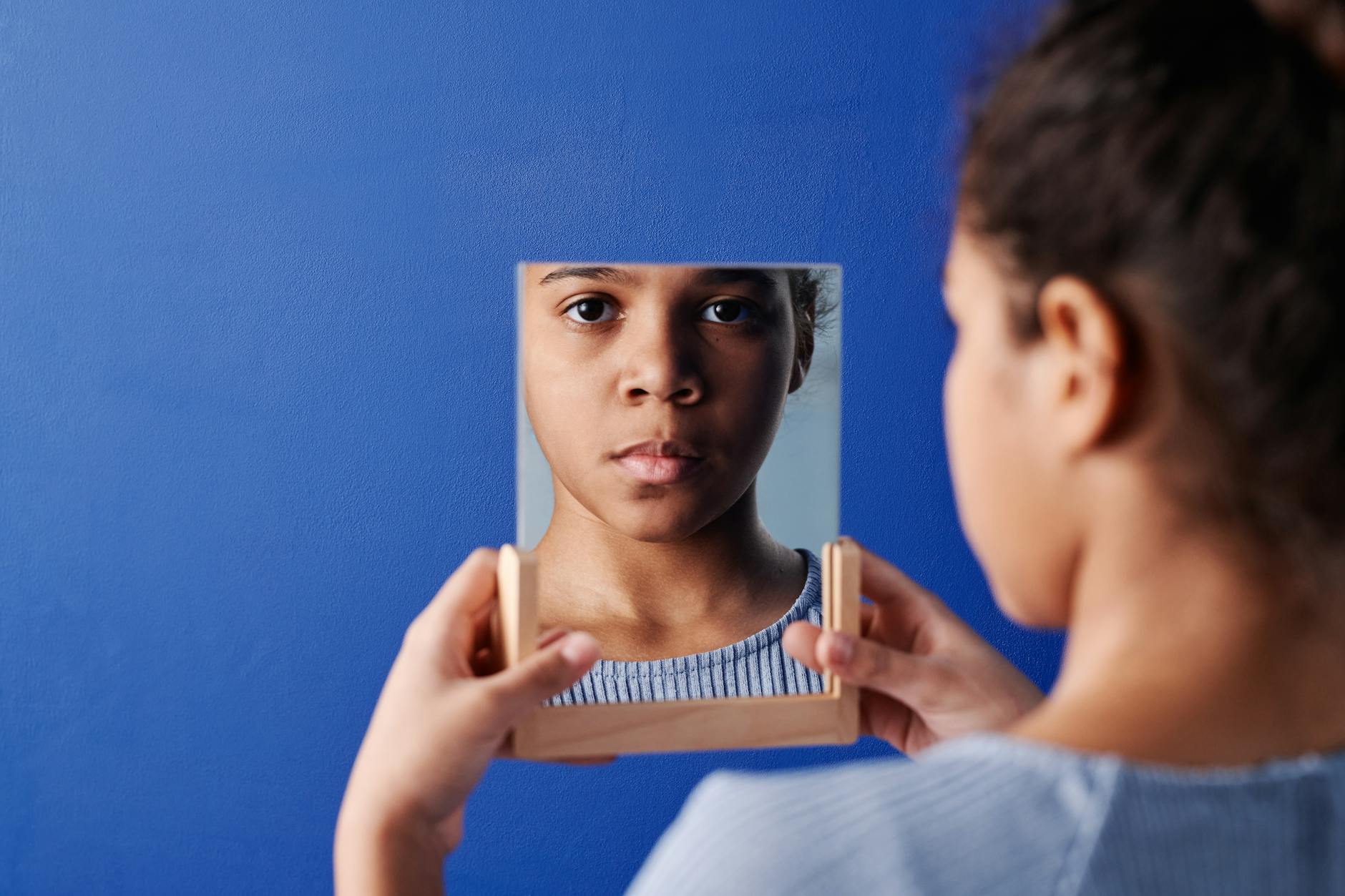
The Mirror as Metaphor

The mirror is not simply an object; it is a metaphor for reflection and self-perception. For the brown-skinned woman, the mirror has too often reflected back distorted images shaped by Eurocentric ideals. What should be a place of affirmation becomes a site of scrutiny and comparison. The dilemma, therefore, is not only about personal insecurities but also about collective histories embedded in glass, culture, and memory.

Colonialism and the Invention of Beauty Hierarchies

The roots of this dilemma stretch deep into colonial encounters where European conquerors created hierarchies of race and beauty. Dark skin became associated with servitude and inferiority, while lighter skin was elevated as closer to civility and divinity (Painter, 2010). This system of thought shaped slavery, caste systems, and beauty industries that persist to this day. The dilemma is thus not self-imposed but historically manufactured.

Slavery and the Double Burden

During slavery in the Americas, brown-skinned women were subjected to a dual exploitation. They were both laborers and objects of sexual control. Enslavers often favored lighter-skinned women, who were frequently products of assault, while darker women endured harsher treatment. This practice seeded colorism within communities of African descent, creating internal hierarchies that still echo (Hunter, 2007). The brown girl dilemma carries this inherited wound.

Colorism as Internalized Oppression

Colorism, the preference for lighter skin over darker tones within the same racial group, continues to mark brown-skinned women. Studies show that lighter skin is often associated with higher earnings, marriageability, and social acceptance, while darker skin is linked with stigma and limited opportunities (Monk, 2014). The brown girl dilemma is therefore not just about external prejudice but also internalized self-division.

Media Representation and Stereotypes

The dilemma intensifies when examining media portrayals. Brown women are either absent, stereotyped, or exoticized. The archetype of the “strong Black woman” often denies vulnerability, while the “sassy brown girl” reduces individuality to caricature. Rarely are brown women portrayed with nuance. When actresses like Viola Davis or Lupita Nyong’o challenge these portrayals, they expand cultural imagination, showing that brown skin is not a limitation but a canvas of depth and brilliance.

The Global Reach of the Dilemma

This dilemma is not unique to African American women. Across the globe, from South Asia to the Caribbean, brown-skinned women confront similar struggles. In India, skin-lightening products remain billion-dollar industries. In the Dominican Republic, Haiti, and Brazil, color hierarchies dictate class and desirability. The brown girl dilemma is therefore a global issue, shaped by centuries of colonialism and reinforced by globalization.

The Psychology of the Mirror

Psychologists argue that beauty standards play a significant role in self-esteem and identity development. For brown girls, the mirror often reflects a struggle between internal truth and external messaging. Research shows that women of color may internalize negative stereotypes, leading to anxiety, depression, or eating disorders (Thompson, 1996). The dilemma, then, is a psychological battle, not merely cultural commentary.

Hyper-Visibility and Invisibility

One of the most painful aspects of the brown girl dilemma is the paradox of being hyper-visible yet unseen. Brown women are often hyper-sexualized in media and fetishized in relationships, yet their humanity, intellect, and individuality are overlooked. This paradox strips them of subjectivity, leaving them caught in the tension between being desired and being dismissed.

The Role of Hair in the Dilemma

Hair becomes another battlefield. Eurocentric ideals often prize straight, silky textures, leading many brown women to alter their natural hair through chemicals or heat. The natural hair movement has sought to reclaim pride in coils, curls, and kinks, asserting that beauty does not need to conform. Yet, the workplace, schools, and even legislation have historically policed Black hair. Thus, the brown girl dilemma extends from skin to scalp, from identity to acceptance.

Spiritual Dimensions of Beauty

Faith offers a powerful alternative to destructive beauty hierarchies. The Bible teaches that true beauty comes from within: “Whose adorning let it not be that outward adorning… but let it be the hidden man of the heart” (1 Peter 3:3–4, KJV). Song of Solomon 1:5 unapologetically declares, “I am black, but comely.” These scriptures affirm the dignity and worth of brown women in ways that challenge societal distortions.

Ancestral Legacy as Healing

Reconnecting with ancestral heritage is another path of healing. For centuries, African societies celebrated melanin-rich skin as divine and powerful. Brown skin was linked to fertility, wisdom, and strength. To reclaim these narratives is to resist colonial lies and honor the legacy of queens, warriors, and mothers who embodied pride long before oppression sought to define them otherwise.

Resilience and Resistance

The brown girl dilemma is not solely a story of struggle; it is also a narrative of resilience. Brown women have continually resisted erasure through art, activism, and scholarship. Writers such as bell hooks and Audre Lorde dissected the intersections of race, gender, and beauty, creating intellectual blueprints for liberation. Their voices demonstrate that naming the dilemma is the first step in dismantling it.

Representation as Revolution

Representation is not trivial; it is revolutionary. When young girls see women who look like them on magazine covers, in films, and in leadership positions, it challenges the internalized hierarchy of shade. Media visibility does not solve all issues, but it creates new frameworks for self-acceptance. Issa Rae’s rise, for example, has offered a celebration of awkward, intelligent, brown-skinned womanhood—shattering monolithic depictions.

Intergenerational Transmission of the Dilemma

The dilemma is also generational. Mothers pass down both pride and pain, shaping how daughters see themselves. Healing requires interrupting cycles of self-deprecation with affirmations of beauty and worth. Teaching brown girls to love their reflection is not vanity—it is survival.

Social Movements and Collective Healing

Movements like #MelaninMagic and #BlackGirlMagic are more than hashtags; they are affirmations of collective worth. They operate as cultural interventions, affirming that brownness is not a liability but a superpower. Social media has become a mirror of its own, where brown women can reclaim narratives, curate beauty on their terms, and create digital sisterhoods.

The Brown Girl Dilemma in Academia and Workplaces

Even in professional spaces, brown women face dilemmas of perception. They are often considered “too aggressive” or “too loud” when advocating for themselves, while lighter-skinned peers may not face the same stereotypes. Professionalism itself has been coded in ways that police Black and brown expression. Thus, the dilemma extends from beauty to competence, from mirror to office.

Beyond Victimhood: Reframing the Narrative

To unpack the brown girl dilemma is to resist framing brown women solely as victims. While acknowledging pain, it is equally essential to celebrate victories. Brown women are innovators, thinkers, artists, and leaders whose contributions to history and culture remain unparalleled. To dwell only on oppression is to diminish the fullness of their humanity.

Toward Liberation and Empowerment

Liberation requires both individual and communal action. Individually, it involves self-love, faith, and reclamation of heritage. Communally, it requires dismantling colorism, expanding representation, and creating structures that honor equity. The brown girl dilemma may have been created by oppression, but it can be undone by empowerment.

Conclusion: Beyond the Mirror

Ultimately, the mirror can no longer be the measure of brown beauty. To look beyond the mirror is to embrace a truth deeper than reflection: that brown skin is sacred, strong, and sufficient. The dilemma may persist, but it need not define. By reclaiming their narrative, brown girls transform the mirror from a place of doubt into a place of affirmation, reflecting the light of resilience, faith, and unyielding beauty.


References

  • Hunter, M. (2007). The persistent problem of colorism: Skin tone, status, and inequality. Sociology Compass, 1(1), 237–254.
  • Monk, E. P. (2014). Skin tone stratification among Black Americans, 2001–2003. Social Forces, 92(4), 1313–1337.
  • Painter, N. I. (2010). The history of White people. W.W. Norton & Company.
  • Thompson, C. (1996). Black women, beauty, and hair as a matter of being. Women’s Studies, 25(6), 667–678.
  • The Holy Bible, King James Version.

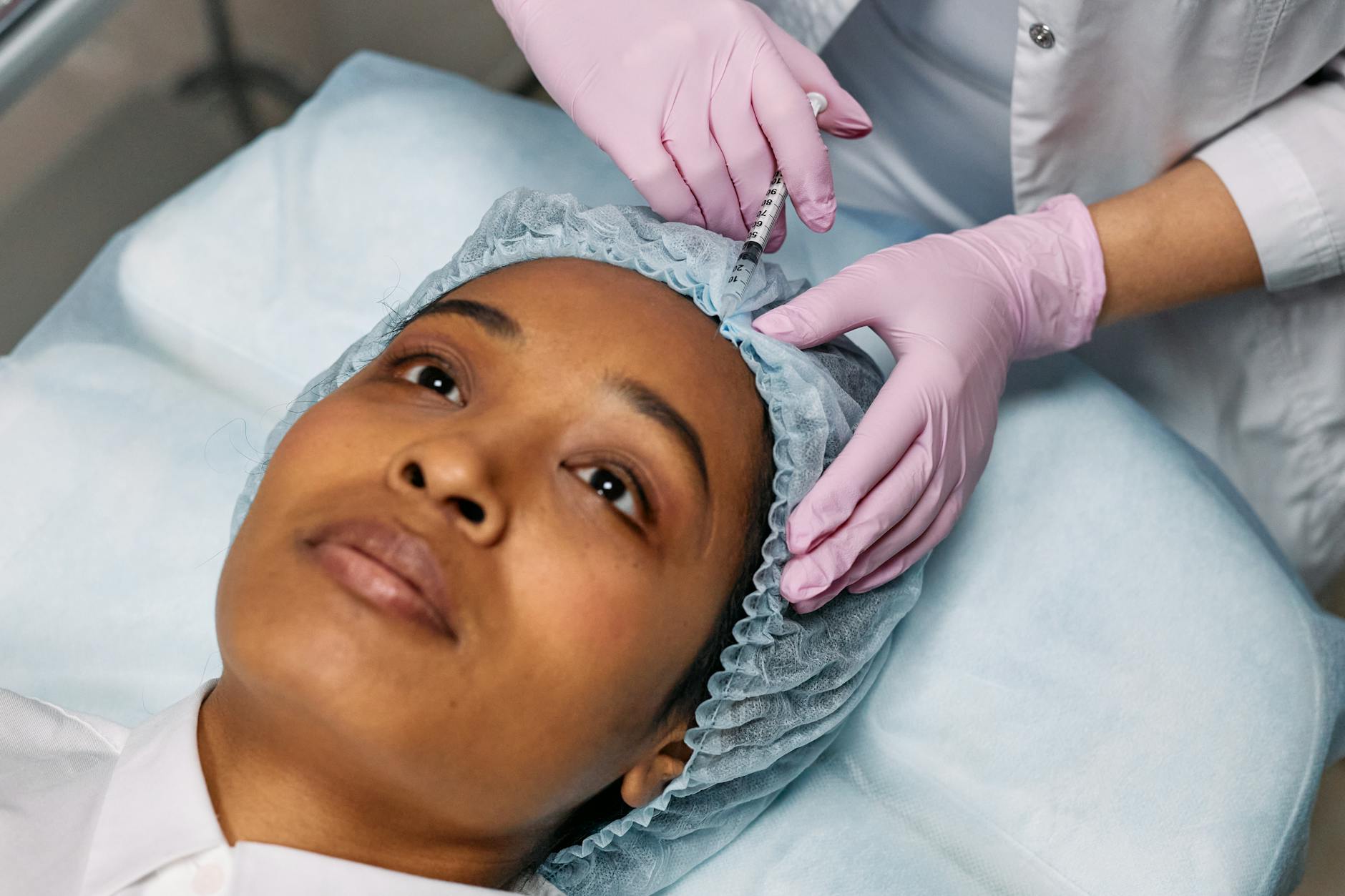
Plastic Surgery: The Artifical Beauty Standard

Photo by cottonbro studio on Pexels.com

The pursuit of beauty has existed for centuries, but in modern society, it has taken on new dimensions with the widespread use of plastic surgery. Increasingly, men and women are willing to undergo painful, expensive, and sometimes dangerous procedures to alter their natural appearance. This fixation on artificial beauty reflects deeper issues of self-esteem, cultural pressure, and misplaced value on outward appearance rather than inner character. The Bible warns against such vanity, urging believers to focus on the “hidden man of the heart” (1 Peter 3:3 -4, KJV), where true beauty lies.

The Psychology of Plastic Surgery

From a psychological standpoint, many people who seek plastic surgery struggle with body image dissatisfaction, social comparison, and the pressures of perfectionism. Studies have linked high usage of cosmetic surgery to body dysmorphic disorder (BDD)—a condition where individuals obsess over perceived flaws in their appearance (Sarwer et al., 2007). Social media platforms further intensify this by promoting “filter culture” and unrealistic beauty ideals, leading many to feel inadequate in their natural state. While some individuals pursue cosmetic enhancements for reconstructive purposes after accidents or illness, the majority seek it for vanity-driven reasons tied to self-worth and societal approval.

Popular Procedures and Cultural Influence

The most popular plastic surgery procedures include rhinoplasty (nose reshaping), liposuction, breast augmentation, buttock enhancement (such as the Brazilian Butt Lift), eyelid surgery, and facelifts. In non-surgical categories, Botox and dermal fillers dominate. Celebrities have both normalized and accelerated these trends. Figures such as the Kardashians are often cited by plastic surgeons as the most requested “look” (Devgan, 2021). Other celebrities like Michael Jackson, Lil’ Kim, and Jocelyn Wildenstein became famous for their extensive facial surgeries. Surgeons report that patients often bring photos of celebrities or even AI-generated images of themselves to consultations, asking to be transformed into “idealized” versions of beauty.

Most Popular Plastic Surgery Procedures

According to the 2024 ASPS (American Society of Plastic Surgeons) report:

These trends reflect both enduring body contouring demands and the growing popularity of quick, minimally invasive procedures.


2. Which Celebrity Faces Are Most Requested?

Plastic surgeons report strong demand to emulate the appearance of celebrities, particularly members of the Kardashian-Jenner family, renowned for contoured bodies, full lips, and balanced facial features. However, now, many clients bring filtered selfies, seeking to replicate surgically what filters achieve—a phenomenon referred to as “Snapchat Dysmorphia.” Wikipedia


3. Psychology: Why Do People Get Plastic Surgery?

  • Self-Image & Identity: Many seek boosted confidence or wish to look refreshed rather than drastically altered. Surgeons like Dr. Banek integrate psychological evaluations to understand client motivations. The Times
  • Social Media Influence: The rise of social media and filter culture increases facial and body dissatisfaction. A study from Boston University found a jump in people considering cosmetic surgery—from 64% to 86%—and increased surgeon consultations. New York Post
  • Psychological Traits: Research shows that high levels of perfectionism and external appearance pressure predict increased interest in cosmetic procedures. Allure

Summary Table

TopicInsight
Top Procedures (2024)Liposuction, breast augmentation, abdominoplasty, breast lift, eyelid surgery
Celebrity TrendsKardashian-inspired looks and “filtered selfie” aesthetic requests
Why People Opt InTo improve confidence, influenced by social media, driven by body image issues

The Cost of Artificial Beauty

Plastic surgery is also a multi-billion-dollar industry. In the United States, procedures can range from $5,000 to $15,000 for breast or body operations, and $7,500 or more for facial surgeries (American Society of Plastic Surgeons, 2022). Non-surgical procedures, though less invasive, still cost hundreds to thousands annually due to repeat maintenance. Beyond financial cost, patients often face physical risks such as infection, scarring, nerve damage, or even death from procedures like the Brazilian Butt Lift, which has one of the highest mortality rates among elective surgeries.

Biblical Teachings on Beauty

The Bible warns against excessive focus on outward appearance. Proverbs 31:30 (KJV) reminds us, “Favour is deceitful, and beauty is vain: but a woman that feareth the Lord, she shall be praised.” Similarly, 1 Timothy 2:9 encourages modesty and inner godliness over outward adornment. God created each person “fearfully and wonderfully made” (Psalm 139:14, KJV), and altering His vanity design can reflect ingratitude and misplaced priorities. While the Bible does not specifically mention plastic surgery, it consistently elevates inner character, spiritual fruit, and holiness above physical alterations.

Why People Do It

The reasons people undergo plastic surgery are deeply tied to insecurity, cultural standards, and societal glorification of celebrity beauty. Many believe it will bring happiness, confidence, or romantic fulfillment, but psychological studies reveal that satisfaction often fades, leading to repeated procedures (Honigman et al., 2004). In essence, it becomes a cycle of chasing perfection that never delivers lasting peace. The Bible teaches that true contentment cannot be bought or surgically implanted but is rooted in faith, identity in God, and the love of Christ (Philippians 4:11).

Conclusion

Plastic surgery reflects a culture that idolizes artificial beauty and neglects the spiritual truth that worth is found in God. While reconstructive procedures have legitimate purposes, the obsession with vanity-driven alterations reveals a deeper spiritual and psychological struggle. For believers, the call is clear: resist the false promises of worldly beauty standards and embrace the eternal beauty of a heart aligned with God.


References

  • American Society of Plastic Surgeons. (2022). Plastic Surgery Statistics Report. Retrieved from https://www.plasticsurgery.org
  • Devgan, L. (2021). The Kardashian Effect: How Celebrity Culture Influences Plastic Surgery. Journal of Cosmetic Surgery, 38(5), 112–120.
  • Honigman, R., Phillips, K. A., & Castle, D. J. (2004). A review of psychosocial outcomes for patients seeking cosmetic surgery. Plastic and Reconstructive Surgery, 113(4), 1229–1237.
  • Sarwer, D. B., Cash, T. F., Magee, L., Williams, E. F., Thompson, J. K., Roehrig, M., … & Anderson, D. A. (2007). Female college students and cosmetic surgery: An investigation of experiences, attitudes, and body image. Plastic and Reconstructive Surgery, 120(3), 845–856.
  • The Holy Bible, King James Version.

The Science of Glow: Melanin, Skin Health, and Beauty.

Photo by Darksight Image on Pexels.com

Golden Glow

Emerging from the depths, a shimmer in the light,
Brown skin gleams with stories, both ancient and bright.
Each droplet a testament, each curve a song,
In the tapestry of heritage, we all belong. Rich as earth, deep as night,
A tapestry of ancestral light.
Golden hues in sun’s embrace,
A legacy etched upon the face.
Strength and beauty intertwined,
In every shade, a story is defined.

Glow is often used in popular culture to describe radiant, healthy skin, but behind the aesthetic appeal lies a biological marvel: melanin. Understanding how melanin functions, its impact on skin health, and its role in beauty offers both scientific insight and cultural affirmation for individuals with melanin-rich skin.

Dr. Frances Cress Welsing’s work, The Isis Papers: The Keys to the Colors, delves into the concept of the “Golden Fleece” as a metaphor for the genetic potential and beauty inherent in Black individuals.. In her writings, she emphasizes the unique and powerful attributes of Black skin, often highlighting its radiance and resilience. ResearchGate+3PBS+3Wikipedia+3

The “Golden Fleece” metaphorically represents the richness and depth of Black identity and heritage. It’s a poetic way to acknowledge the inherent beauty and strength that radiates from within, much like the glow that can be seen when light reflects off skin after emerging from water.

Melanin: Nature’s Protective Pigment

Melanin is a natural pigment responsible for skin, hair, and eye color. It is produced by specialized cells called melanocytes, which convert the amino acid tyrosine into pigment through a process called melanogenesis. Melanin serves a crucial biological function: it protects the skin from ultraviolet (UV) radiation, reducing the risk of DNA damage, premature aging, and certain types of skin cancer.

The Link Between Melanin and Skin Health

Individuals with higher melanin content have natural photoprotection, which contributes to healthier skin over time. Melanin acts as a natural sunscreen, absorbing UV rays and preventing excessive sun damage. However, proper skin care remains essential: hydration, nourishment, and protection from environmental stressors enhance the natural glow, while avoiding harsh chemicals and overexposure to sun preserves skin integrity.

Melanin and Aesthetic Glow

A radiant complexion is often associated with high melanin content because melanin-rich skin can reflect light in a warm, luminous manner. This natural radiance is enhanced by proper hydration, nutrition, and self-care practices. Beyond aesthetics, the glow symbolizes resilience and heritage, linking biological function to cultural identity.

What is Melanin?

  • Definition: Natural pigment responsible for skin, hair, and eye color.
  • Function: Protects skin from harmful UV rays and reduces DNA damage.
  • Visual Idea: Diagram showing melanocytes producing melanin in the skin layers.

2. Melanin and Natural Radiance

  • Glow Factor: Reflects light in warm, luminous tones.
  • Significance: Radiance signals health, vitality, and resilience.
  • Visual Idea: Gradient spectrum of melanin-rich skin glowing under soft light.

3. Skin Health Tips for a Natural Glow

  • Hydration: Drink water to maintain cellular function.
  • Nutrition: Eat foods rich in antioxidants, vitamins C & E, and healthy fats.
  • Sun Protection: Use sunscreen to prevent hyperpigmentation and UV damage.
  • Gentle Care: Avoid harsh chemicals; embrace natural products.
  • Visual Idea: Icons representing water, fruits/veggies, sunscreen, and skincare bottles.

4. Cultural and Psychological Power

  • Heritage: Melanin-rich skin represents ancestral pride and identity.
  • Confidence: Embracing natural glow strengthens self-esteem and counters colorism.
  • Visual Idea: Illustration of diverse brown-skinned women celebrating their glow with affirmations.

5. Daily Affirmations for Your Glow

  • “My melanin is my shield and my shine.”
  • “My glow reflects my heritage, health, and beauty.”
  • “I embrace and celebrate my natural radiance every day.”
  • Visual Idea: Typography-based banners layered over gradient brown tones.

Cultural and Psychological Significance

Melanin has been historically undervalued due to Eurocentric beauty standards and colorism. Embracing melanin-rich skin as beautiful and healthy fosters self-esteem, pride, and identity affirmation (Hunter, 2007). When communities celebrate melanin, glow becomes both a physical and psychological marker of confidence, resilience, and empowerment.

Practical Tips for Enhancing Your Natural Glow

  1. Hydration: Water consumption supports cellular function and skin vitality.
  2. Nutrition: Diets rich in antioxidants, vitamins C and E, and healthy fats promote skin radiance.
  3. Sun Protection: Even melanin-rich skin benefits from sunscreen to prevent hyperpigmentation and UV damage.
  4. Gentle Skin Care: Avoid harsh exfoliants and chemical treatments that disrupt natural skin balance.
  5. Affirmation and Confidence: Embrace your natural glow as a reflection of heritage, health, and beauty.

Conclusion

Glow is more than surface-level radiance—it is the intersection of biology, health, and cultural identity. Melanin not only protects the skin but also enhances its aesthetic appeal, symbolizing resilience, heritage, and self-pride. By understanding and caring for melanin-rich skin, individuals can cultivate a natural glow that is both scientifically supported and culturally empowering. Glow is both science and culture. By understanding melanin’s protective role, practicing healthy skincare, and embracing natural beauty, your glow becomes a declaration of confidence, heritage, and empowerment.


References

  • Hunter, M. (2007). The Persistent Problem of Colorism: Skin Tone, Status, and Inequality. Sociology Compass, 1(1), 237–254.
  • Brenner, M., & Hearing, V. J. (2008). The protective role of melanin against UV damage in human skin. Photochemistry and Photobiology, 84(3), 539–549.
  • The Holy Bible, King James Version. (1611). Song of Solomon 1:5.

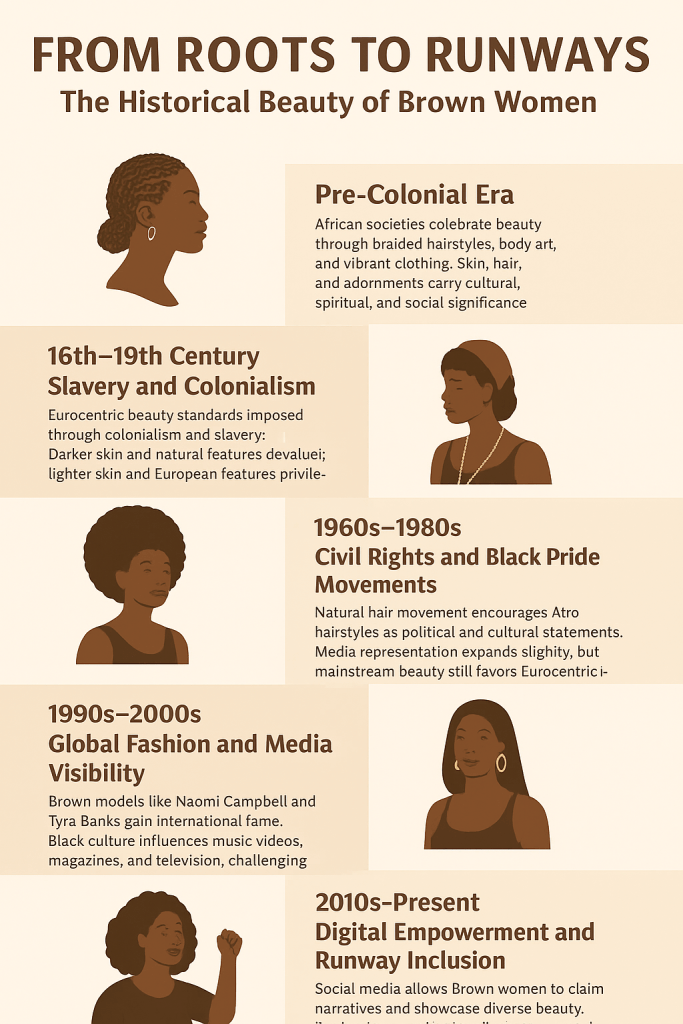
From Roots to Runways: The Historical Beauty of Brown Women

Photo by Al Ameen Saddiq on Pexels.com

The beauty of Brown women is deeply intertwined with culture, history, and resilience. From ancestral traditions to modern fashion runways, Brown women have navigated societies that often imposed Eurocentric standards while cultivating unique forms of self-expression, artistry, and elegance. Exploring this trajectory—from historical roots to contemporary visibility—reveals not only aesthetic contributions but also the resilience and empowerment embedded in the legacy of Brown women.

Ancestral Traditions and Cultural Significance

Throughout African, Caribbean, and Latin American societies, beauty has historically been expressed through hairstyles, skin care, adornments, and textiles. Braided and twisted hairstyles, body art, and vibrant clothing often carried social, spiritual, or cultural meaning, signaling status, heritage, or community affiliation (Byrd & Tharps, 2014). These traditions celebrated melanin-rich skin, facial features, and natural hair textures long before the imposition of colonial beauty standards. Beauty, in these contexts, was both personal and collective—a reflection of identity and heritage.

Colonialism, Slavery, and the Imposition of Eurocentric Standards

The transatlantic slave trade and colonial regimes brought systemic oppression that devalued darker skin and natural features. European ideals of beauty—fair skin, straight hair, and Eurocentric facial features—became markers of social privilege and desirability (Hunter, 2007). Despite these pressures, Brown women preserved cultural beauty practices, maintaining pride in their appearance and transmitting ancestral knowledge through generations. This resistance demonstrates that beauty has always been inseparable from resilience and identity affirmation.

African American Beauty Culture and the Harlem Renaissance

In the United States, the Harlem Renaissance (1920s–1930s) provided a platform for Black artistic expression, including beauty and fashion. Women like Josephine Baker, with her daring style and signature elegance, challenged mainstream perceptions while celebrating African aesthetics. Beauty salons became cultural hubs where women exchanged styling techniques, supported one another, and fostered community identity (Perry, 2009). These spaces cultivated confidence, creativity, and empowerment, demonstrating that beauty is not merely aesthetic but also sociocultural.

Modern Visibility and Runway Influence

In contemporary fashion, Brown women increasingly claim visibility and redefine industry standards. Models like Adut Akech, Duckie Thot, and Naomi Campbell have dominated international runways, demonstrating that melanin-rich beauty is not niche but universal. Designers are incorporating diverse features and complexions into campaigns, acknowledging the historical exclusion and striving toward inclusion. Social media further amplifies these voices, allowing Brown women to influence global perceptions directly.

Timeline: The Historical Beauty of Brown Women

Pre-Colonial Era

  • African societies celebrate beauty through braided hairstyles, body art, and vibrant clothing.
  • Skin, hair, and adornments carry cultural, spiritual, and social significance.

16th–19th Century: Slavery and Colonialism

  • Eurocentric beauty standards imposed through colonialism and slavery.
  • Darker skin and natural features devalued; lighter skin and European features privileged.
  • Brown women preserve cultural beauty practices covertly or in safe community spaces.

1920s–1930s: Harlem Renaissance

  • Black artistic expression flourishes; women like Josephine Baker challenge mainstream norms.
  • Beauty salons become cultural hubs for skill-sharing, empowerment, and community.

1960s–1980s: Civil Rights and Black Pride Movements

  • Natural hair movement encourages Afro hairstyles as political and cultural statements.
  • Media representation expands slightly, but mainstream beauty still favors Eurocentric ideals.

1990s–2000s: Global Fashion and Media Visibility

  • Brown models like Naomi Campbell and Tyra Banks gain international fame.
  • Black culture influences music videos, magazines, and television, challenging stereotypes.

2010s–Present: Digital Empowerment and Runway Inclusion

  • Social media allows Brown women to claim narratives and showcase diverse beauty.
  • Models like Adut Akech, Duckie Thot, and public figures like Lupita Nyong’o redefine global standards.
  • Colorism awareness movements (#MelaninMagic, #BrownSkinPoppin) increase representation and self-love advocacy.

Present & Future

  • Celebration of melanin-rich skin, natural hair, and diverse features continues to grow globally.
  • Beauty becomes a tool of empowerment, cultural pride, and resistance against systemic bias.

Media Representation and Colorism

While progress has been made, media representation continues to favor lighter-skinned women. Colorism—preference for lighter shades within communities of color—persists, reinforcing hierarchical beauty standards (Hunter, 2007). Visibility of darker-skinned models, actresses, and influencers challenges these norms, offering representation that affirms a broader spectrum of beauty. Public figures like Lupita Nyong’o and Tracee Ellis Ross exemplify this shift, inspiring younger generations to embrace their natural features proudly.

Beauty as Resistance and Empowerment

The historical beauty of Brown women reflects both aesthetic expression and resistance. Maintaining traditional hairstyles, advocating for natural skin care, and claiming space in fashion and media are acts of empowerment. Each choice affirms identity, challenges dominant beauty paradigms, and honors ancestral legacy. Brown women’s beauty has always been inseparable from cultural pride, resilience, and agency.

Conclusion

From roots to runways, the beauty of Brown women is a testament to heritage, resilience, and self-expression. Historical traditions, artistic contributions, and contemporary visibility reveal that beauty is not merely physical; it is cultural, social, and political. Celebrating this legacy affirms the value of melanin-rich skin, natural hair, and diverse features, ensuring that the beauty of Brown women continues to inspire confidence, empowerment, and cultural pride for generations to come.


References

  • Byrd, A. D., & Tharps, L. L. (2014). Hair story: Untangling the roots of Black hair in America. St. Martin’s Press.
  • Hunter, M. (2007). The persistent problem of colorism: Skin tone, status, and inequality. Sociology Compass, 1(1), 237–254.
  • Perry, I. (2009). Prophets of the hood: Politics and poetics in Hip Hop. Duke University Press.

Heritage in Every Hue: Embracing the Legacy of Brown Skin.

Photo by magapls . on Pexels.com

Brown skin carries with it a rich history, cultural significance, and an enduring legacy of resilience. For centuries, women of color have navigated societies that devalue their features and privilege lighter complexions, yet they have also cultivated beauty traditions, artistry, and cultural pride that transcend these limitations. Embracing brown skin is not just an aesthetic choice—it is an act of honoring ancestry, reclaiming identity, and asserting worth in the face of systemic colorism.

The Historical Context of Brown Skin

Colorism, a byproduct of colonialism and slavery, created hierarchies that valued lighter skin while marginalizing darker complexions (Hunter, 2007). These social constructs infiltrated media, employment, and even interpersonal relationships, perpetuating the notion that beauty is synonymous with fairness. Despite these historical pressures, women of brown skin have contributed significantly to art, literature, science, and culture, asserting their presence and redefining societal standards of beauty.

Cultural Pride and Beauty Traditions

Across Africa, the Caribbean, South Asia, and Latin America, brown skin has been celebrated through rituals, adornments, and fashion that reflect heritage and creativity. From intricate hairstyles to vibrant fabrics, jewelry, and skincare practices, these traditions affirm identity and beauty in culturally meaningful ways. Such practices highlight the connection between aesthetics and ancestry, showing that embracing brown skin is simultaneously an act of self-love and cultural preservation.

Representation in Media and Fashion

Modern media plays a critical role in shaping perceptions of beauty. Historically, mainstream platforms prioritized Eurocentric features, marginalizing brown skin in advertising, television, and film. However, today, more Brown women are taking control of narratives through modeling, acting, and digital platforms, challenging stereotypes and increasing representation. Public figures like Lupita Nyong’o, Adut Akech, and Tracee Ellis Ross exemplify the beauty, versatility, and influence of brown skin, inspiring younger generations to embrace their own tones.

The Science of Melanin and Health

Beyond cultural and aesthetic significance, brown skin has biological advantages. Higher melanin content provides natural protection against ultraviolet (UV) radiation, reduces the risk of skin cancer, and contributes to skin elasticity, often resulting in slower aging (Brenner & Hearing, 2008). Understanding the science of melanin not only reinforces appreciation for brown skin but also empowers individuals to care for it in informed and intentional ways.

12 Tips for Brown Girls to Celebrate and Care for Their Skin

  1. Embrace Your Natural Tone – Wear your skin proudly without trying to lighten it. Celebrate the unique shades that make you who you are.
  2. Practice Daily Skincare – Use moisturizers, sunscreens, and gentle cleansers suited for melanin-rich skin to maintain health and glow.
  3. Highlight, Don’t Hide – Use makeup or fashion to enhance your natural features rather than masking your complexion.
  4. Wear Color That Compliments Your Hue – Jewel tones, earth tones, and vibrant colors often enhance brown skin beautifully.
  5. Protect Against UV Damage – Even though melanin provides some protection, always apply sunscreen to prevent hyperpigmentation and premature aging.
  6. Celebrate Hair and Texture – Embrace natural hairstyles, braids, curls, or twists as expressions of cultural pride.
  7. Consume Affirming Media – Follow influencers, celebrities, and content creators who celebrate brown skin and diversity in beauty.
  8. Engage in Skin-Positive Communities – Join groups online or offline that promote self-love and reject colorist standards.
  9. Educate Yourself on Skin Health – Understand the biology of melanin and how to care for it; knowledge empowers self-confidence.
  10. Reject Colorist Products and Messages – Avoid products or media that suggest lighter skin is superior; affirm your natural beauty instead.
  11. Affirm Your Worth Daily – Use positive self-talk and reminders such as: “I am beautiful, I am resilient, I am enough.”
  12. Turn Compliments Into Inspiration – Celebrate others’ beauty while embracing your own; upliftment reinforces self-esteem and community pride.

Psychological Impact of Affirming Brown Skin

Affirming one’s brown skin is crucial for mental health and self-esteem. Social comparison theory explains how constant exposure to lighter-skinned ideals can negatively impact confidence (Festinger, 1954). By celebrating brown skin, women counteract these influences, develop resilience, and cultivate positive identity formation. Affirmation can take many forms, from consuming media that celebrates melanin-rich beauty to participating in online movements like #MelaninMagic or #BrownSkinPoppin.

Reclaiming Beauty as Empowerment

Embracing brown skin is also a form of resistance against colorism and systemic oppression. Each act of self-love—wearing natural hair proudly, rejecting skin-lightening products, or sharing authentic images online—challenges dominant narratives and empowers others. Brown skin becomes not just a physical attribute, but a symbol of cultural pride, historical resilience, and empowerment for future generations.

Conclusion

Heritage in every hue is a celebration of history, identity, and resilience. Brown skin embodies centuries of culture, artistry, and strength, and embracing it affirms both personal and collective legacy. By honoring the beauty of brown skin, women reclaim narratives, challenge colorism, and inspire confidence in themselves and others. In doing so, they ensure that the legacy of brown skin is recognized, celebrated, and preserved for generations to come.


References

  • Brenner, M., & Hearing, V. (2008). The protective role of melanin against UV radiation. Photochemistry and Photobiology, 84(3), 539–549.
  • Festinger, L. (1954). A theory of social comparison processes. Human Relations, 7(2), 117–140.
  • Hunter, M. (2007). The persistent problem of colorism: Skin tone, status, and inequality. Sociology Compass, 1(1), 237–254.