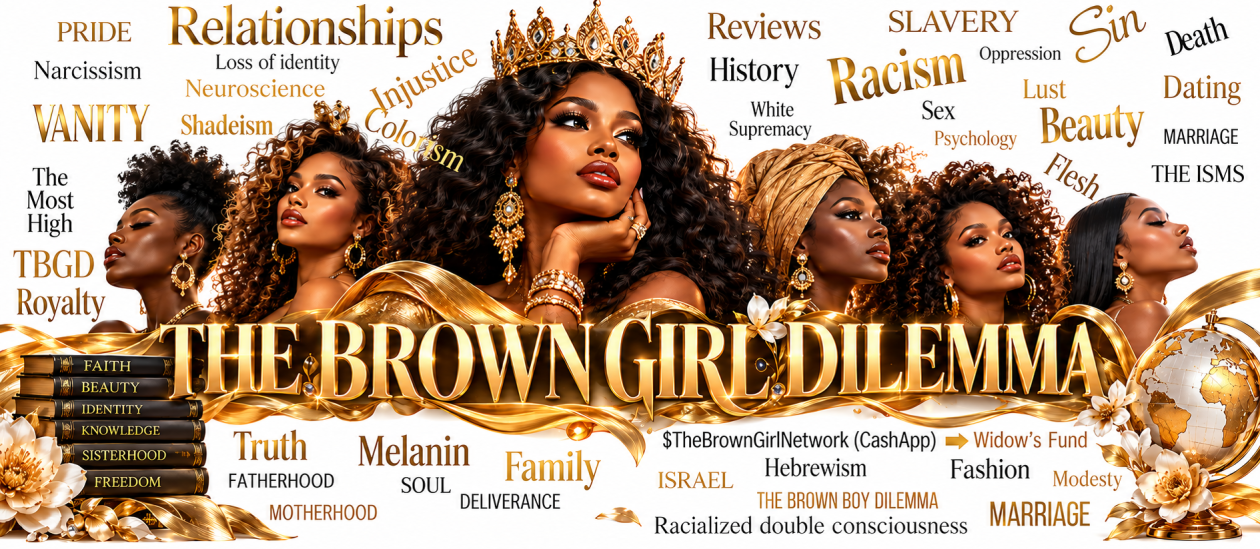

Brown skin has always carried a story—one of survival, one of glory, and one of divine intention. In a world where colonization and white supremacy have often painted darker skin as something to hide, the act of loving one’s own shade becomes a holy defiance. To affirm brown skin is to affirm the Creator’s masterpiece, to say, “I am fearfully and wonderfully made” (Psalm 139:14, KJV). ✊🏾
The Bible teaches that humanity was created in the image of God (Genesis 1:27, KJV). This means that the variety of human skin tones is not a mistake but a reflection of divine creativity. Brown skin, with its richness and depth, is a testament to the God who formed man from the dust of the ground (Genesis 2:7). Dust is not pale—it carries the tones of the earth: cocoa, bronze, and deep mahogany. 🤎🌍
Throughout Scripture, there are clues that the chosen people of God were melanated. Solomon proudly declared, “I am black, but comely” (Song of Solomon 1:5, KJV), affirming that his dark complexion was beautiful and worthy of admiration. The prophet Daniel described the Ancient of Days with a woolly head (Daniel 7:9), and Revelation describes Christ’s feet as “burnished brass” (Revelation 1:15, KJV), imagery that points to a complexion kissed by the sun. ☀️🏾
Historically, European art distorted these images, presenting a pale Christ that aligned with colonial ideals rather than historical evidence (Freeman, 2010). For many brown-skinned believers, this created a theological crisis: if God looks nothing like them, do they still reflect His image? Reclaiming the truth of a multiethnic, brown-skinned biblical world is critical for restoring spiritual dignity to communities of color (Ortiz, 2021). 👑✊🏾
Brown skin is not merely a shade; it is a shield. Melanin is a biological gift that protects against harmful UV rays and is linked to the resilience of African and Afro-diasporic peoples (Jablonski, 2012). Spiritually, this protection can be seen as a metaphor: brown skin is armor, a covering placed by God to endure centuries of heat, labor, and oppression without erasing identity. 🛡️🏾
Psychologically, embracing one’s skin shade strengthens self-concept and combats the effects of colorism. Studies show that positive racial identity correlates with higher self-esteem and lower levels of anxiety and depression among Black youth (Neblett et al., 2012). When brown-skinned individuals see their shade as regal and God-ordained, they reject the lie that proximity to whiteness equals holiness or beauty. 🙌🏾🤎
Colonialism taught generations to despise their own reflection. Enslaved Africans were taught that their skin marked them as cursed (often misusing the story of Ham in Genesis 9:25). This false teaching was used to justify centuries of subjugation. Theologically, we must confront this heresy and declare that brown skin is blessed, not cursed. The curse was not on Ham but on Canaan, and Scripture never ties melanin to divine punishment (Goldenberg, 2003). ✊🏾📖
To call brown skin royal is to place it back in its rightful narrative. Royalty is not just about crowns and thrones—it is about lineage, dignity, and inheritance. In 1 Peter 2:9 (KJV), believers are called a “chosen generation, a royal priesthood, an holy nation.” Brown-skinned believers are heirs of this promise, carrying spiritual royalty in their very bodies. 👑🤎
Representation matters deeply. When children see images of Christ, angels, and biblical figures who look like them, they begin to internalize that they, too, are divine reflections. Artistic movements that depict Black Madonnas, Ethiopian saints, and Afrocentric biblical art are acts of cultural restoration (Bennett & Moss, 2020). 🎨🏾
Brown skin also carries memory. It remembers the sun of Africa, the soil of Eden, the dust of Jerusalem. It remembers the pain of chains but also the joy of emancipation. It is a living testimony that God preserves His people. Each freckle, each undertone, is a chapter in a sacred story of survival and triumph. 📜🤎
The celebration of brown skin should not exclude others but should correct an imbalance. For centuries, whiteness has been upheld as the spiritual and aesthetic standard. To center brown beauty is to bring the pendulum back to truth—where all shades are honored, but none are erased. ⚖️🏾
Practically, loving brown skin means caring for it. It means embracing natural hair, choosing healthy skin care practices, and rejecting harmful bleaching products. It means speaking affirmations over oneself: “My skin is royal. My shade is holy. I bear the image of God.” 🪞👑
Community affirmation is also vital. Churches, schools, and media outlets must intentionally celebrate brown-skinned leaders, saints, and scholars. Doing so heals the intergenerational wounds caused by erasure and teaches the next generation that there is no shame in their shade. ✊🏾🙌🏾
In the end, the royal image of God is not reflected in one hue but in the spectrum of humanity. Brown skin is a jewel in that spectrum, a reminder that the Creator paints with every color in the palette of creation. When the brown-skinned believer walks with head held high, she preaches a sermon without words: “I am God’s masterpiece.” 🖌️👑
Royalty, then, is not something to aspire to—it is something already present. It is in the melanin, in the history, in the reflection staring back from the mirror. The world may try to dim it, but heaven recognizes its glow. Truly, brown skin is more than beautiful—it is divine. 🤎👑🙌🏾
References
- Bennett, L., & Moss, H. (2020). Four hundred souls: A community history of African America, 1619–2019. One World.
- Freeman, C. (2010). Adam and Eve after the pill: Reclaiming a God-given vision of sexuality. Ignatius Press.
- Goldenberg, D. M. (2003). The curse of Ham: Race and slavery in early Judaism, Christianity, and Islam. Princeton University Press.
- Jablonski, N. G. (2012). Living color: The biological and social meaning of skin color. University of California Press.
- Neblett, E. W., Rivas-Drake, D., & Umaña-Taylor, A. J. (2012). The promise of racial and ethnic protective factors in promoting ethnic minority youth development. Child Development Perspectives, 6(3), 295–303.
- Ortiz, J. (2021). Decolonizing theology: Reimagining Christ in color. Journal of Black Theology, 19(2), 134–152.


