Beauty has long captivated philosophers, artists, theologians, and scientists alike, prompting a timeless question: Is beauty a biologically grounded reality, or is it shaped by the beholder’s eye and cultural imagination? Contemporary research suggests the answer lies at the intersection of both. Beauty, though subjective in its cultural expressions, draws from deeply embedded evolutionary cues, genetic factors, and perceptual biases that shape human attraction and social response.
Human beings are biologically attuned to detect cues of health, vitality, and fertility, which often manifest physically. From skin clarity to facial symmetry and body proportions, these physical traits historically signaled reproductive fitness in ancestral environments. Modern psychology calls these traits “fitness indicators,” linking beauty to evolutionary survival mechanisms (Gangestad & Scheyd, 2005).
Yet beauty is also profoundly psychological, shaped by memory, cultural storytelling, spiritual symbolism, and personal experience. One person may be moved by sharp cheekbones and porcelain skin, another by full lips and rich melanin, another by youthful softness and roundness—differences rooted not only in personal taste but also in social history and racial conditioning.
At its core, beauty involves four primary pillars of facial aesthetics: symmetry, averageness, sexual dimorphism (masculinity or femininity), and skin quality. Each contributes to how observers process faces rapidly and subconsciously, forming impressions within milliseconds (Willis & Todorov, 2006).
Symmetry often reflects developmental stability and genetic health. Faces with high symmetry evoke greater automatic liking and trust, even across cultures. Yet perfect symmetry is neither common nor necessary; slight asymmetry can add human uniqueness and charm—what many call “character.”
Averageness, or the degree to which a face resembles a statistical norm, is another universal beauty marker. Averaged facial composites are consistently rated as attractive across ethnic groups, a finding famously demonstrated in computer-generated studies (Langlois & Roggman, 1990). The logic is evolutionary: average features may represent genetic diversity and health.
Sexual dimorphism signals fertility and hormone levels. Feminine features in women—large eyes, full lips, high cheekbones, and a soft jawline—are often preferred, while masculine traits in men—defined jaws, brow prominence, and broader faces—signal strength and protection. However, preferences for masculinity versus gentleness in male faces fluctuate with social context and female hormonal cycles (Penton-Voak et al., 1999).
Skin quality communicates health, youth, and vitality. Smooth texture, even tone, and luminosity are associated with strong immune systems and good nutrition. Across global cultures, clear skin maintains its status as a beauty cornerstone.
Skin color, however, reflects complex biological and sociocultural meaning. Biologically, melanin protects against ultraviolet damage; culturally, shades of skin have been politicized, especially in societies shaped by colonialism and caste stratification. While media norms historically elevated lighter tones, global appreciation for diverse skin tones continues to grow, particularly as cultural representation expands.
Facial features carry racial aesthetics rooted in ancestry and geography. African diasporic features—strong cheekbones, full lips, deeper eye shapes, and rich melanin—reflect adaptation to equatorial environments and hold beauty that is regal, ancestral, and ancient. East and South Asian features carry their own elegance, harmony, and distinct eye and jaw structures shaped by climate and evolution. European features, often associated with delicate bone structure and lighter pigmentation, reflect northern climate adaptations.
Preferences across racial groups can shift depending on exposure and cultural power. Research shows that beauty ideals mirror societies’ dominant ethnic imagery and media representation (Rhodes, 2006). When representation expands, perception expands; when representation narrows, imagination shrinks.
Beyond the face, body proportions also influence attraction. The hourglass figure—waist-to-hip ratio around 0.7—is cross-culturally linked to fertility and hormonal balance in women (Singh, 1993). The V-shaped torso in men—broad shoulders tapering to the waist—signals strength and physical capability. Yet contemporary beauty movements increasingly celebrate diversity in body shapes, challenging rigid biological interpretations.
Psychology reminds us that beauty also resides in the emotional aura one carries—confidence, grace, humor, humility, and depth. A mathematically beautiful face with a cold spirit lacks radiance; a sincere and joyful countenance shines regardless of ratio perfection.
Culturally, beauty narratives can become oppressive if stripped from humanity. When beauty becomes a tool of hierarchy, exclusion, or racial bias, it harms self-worth and limits collective imagination. Yet when understood as both art and biology, wonder and science, beauty becomes empowering—a study in divine craftsmanship and evolutionary brilliance.
Across civilizations, beauty has also symbolized holiness and divinity. In sacred traditions, beauty reflects harmony, order, and spiritual balance. To see beauty rightly is, in a sense, to see God’s fingerprint in human form.
Modern neuroscience reveals that beauty activates the brain’s reward system, lighting up emotional and cognitive pathways associated with pleasure, meaning, and social connection (Ishizu & Zeki, 2011). Beauty is not trivial—it shapes social bonds, inspires creativity, and nurtures emotional well-being.
Still, beauty remains plural. What one considers ethereal, another overlooks. This plurality reminds humanity to honor the diverse expressions of creation rather than idolize a single mold.
True sophistication lies in appreciating structural science while honoring cultural dignity and individual uniqueness.
The Aesthetics of Feminine Beauty: Structure, Ancestry, and Archetype
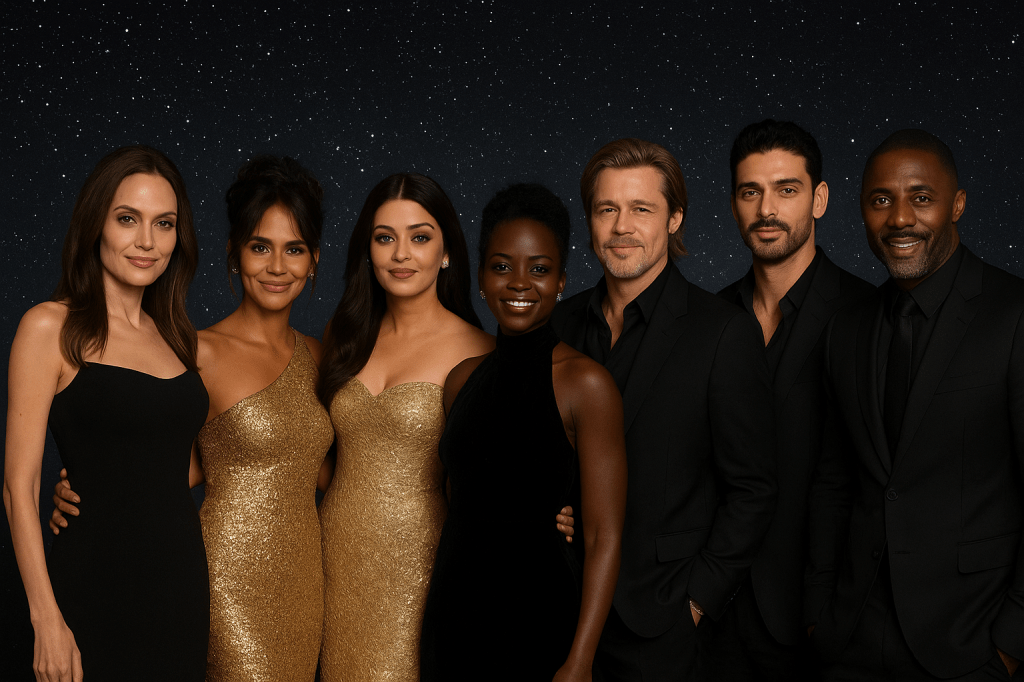
Angelina Jolie — The Geometry of Allure & Evolutionary Feminine Magnetism
Angelina Jolie occupies a uniquely enduring place in global beauty discourse, often referenced as a benchmark for feminine facial aesthetics in modern Western and global culture. Her beauty blends structural precision with sensual softness, positioning her as an exemplar of balanced sexual dimorphism—where feminine softness coexists with sculpted angularity. This duality creates a visual signature that is both delicate and commanding, an interplay that captivates biological instinct and artistic perception.
Lips: The Icon of Fullness & Sexual Dimorphism
Jolie’s lips are among the most frequently studied and emulated features in contemporary cosmetic literature. Naturally voluminous and rich in vermilion visibility, her lips signal estrogen dominance, youthfulness, and reproductive health—universal biological cues linked to attraction. From an evolutionary standpoint, fuller lips are associated with sexual maturity and fertility, which explains their cross-cultural desirability. Her upper-to-lower lip balance (slightly fuller lower lip) reflects proportions considered near ideal in facial aesthetics, driving her influence on modern beauty standards and cosmetic enhancement trends.
Cat-Like Eyes: Exotic Shape & Feminine Intensity
Jolie’s almond-shaped, slightly upturned “cat eyes” provide a dramatic focal point in her facial architecture. Eyes of this shape elongate the face visually and create a natural femme fatale quality—mysterious, intense, and slightly predatory in aesthetic psychology. The subtle upward tilt at the lateral canthus gives a lifted effect that conveys alertness, youth, and emotional depth. Wide palpebral fissure dimensions, combined with thick lash framing and contrasting scleral brightness, reinforce a look associated with sensual power and aristocratic elegance across cultures.
Cheekbones: Sculpted Definition & High-Angle Contour
Her high, sharply contoured cheekbones are hallmarks of classical facial beauty, associated with genetic refinement, low facial adiposity, and strong bone density. Prominent cheekbones create natural shadow structures, emphasizing facial depth and camera-readability—features prized in film and photography. Their angular projection enhances facial sculpting, achieving a balance between feminine softness and architectural definition, a combination found in many historically celebrated beauties and fine-art portrait archetypes.
Face Shape: A Harmonious Fusion of Angles & Curves
Jolie’s face shape—an oval base with diamond-like cheek prominence and tapered jawline—is highly prized in aesthetic science. Oval-diamond hybrid shapes distribute facial volume evenly while maintaining lift, contour, and visual flow. Her structure avoids heaviness in the lower face, maintaining an upward geometric movement associated with youth, vitality, and social dominance in facial perception research.
The slightly squared yet refined jaw adds strength without sacrificing femininity, creating a commanding presence that appeals to psychological constructs of confidence, leadership, and sophistication. Her bone structure exemplifies the balance between grace and power, traits often found in individuals who become cultural icons rather than mere beauties.
Cultural & Psychological Impact
Angelina Jolie’s phenotype shaped early-21st-century beauty norms, influencing media, fashion, and cosmetic ideals for decades. Yet her beauty transcends formulaic metrics. Her features—dramatic yet harmonious, exotic yet classical—create a face of mythic proportions, one that feels ancient and modern at once. She represents beauty that is not merely symmetrical, but expressive, sculptural, cinematic, and biologically resonant.
Her look reminds scholars and admirers that beauty is not a checklist, but an orchestration: a synergy of proportion, emotion, bone structure, and presence.
Angelina Jolie is not simply a beautiful woman—she is a case study in aesthetic equilibrium, where genetics, evolution, and artistic design converge to create a face that altered global beauty psychology for a generation.
Halle Berry — The Hybrid Genetic Ideal & Cross-Cultural Feminine Symmetry
Halle Berry represents one of the most widely discussed embodiments of cross-ethnic beauty, often cited in academic and media discussions for her balanced facial proportions, luminous skin tone, and universal appeal. Her beauty illustrates the evolutionary concept of hybrid vigor—sometimes observed in mixed-ancestry individuals—where genetic blending may produce heightened symmetry, structural balance, and perceived attractiveness due to diverse gene pools contributing to developmental stability.
Facially, Berry’s beauty aligns with key scientific markers: high cheekbones, large almond-shaped eyes, harmonious jaw contours, and soft feminine curvature in facial geometry. Her lips sit in ideal proportion to her facial width, offering fullness without exaggeration, reflecting the evolutionary preference for cues of health and fertility. Her bone structure exemplifies moderate facial dimorphism, balancing feminine refinement with subtle strength—traits often favored in attraction psychology for signaling both approachability and resilience.
Her medium-to-deep melanin richness carries biological advantages, including photoprotection and even skin tone, which historically signaled youth, vitality, and genetic health. Socially, Berry’s complexion sits at a complex intersection of racial aesthetics in Western society—light enough to fit Eurocentric media structures, yet richly melanated enough to embody the ancestry of African diasporic beauty. Her global appeal underscores how diverse phenotypic representation expands beauty norms, showing that elegance, symmetry, and melanin co-exist powerfully in the global beauty landscape.
Culturally, Halle Berry’s ascent challenges Hollywood’s historically narrow beauty standards while simultaneously showing the psychological impact of representation. Her presence in leading roles positioned Black women—particularly women of African descent with mixed heritage—at the forefront of mainstream desirability and cinematic admiration. In beauty science, she serves as a living example of the harmony between genetic diversity, feminine softness, and symmetrical architecture, demonstrating that the world’s perception of beauty is enriched when multiple ancestral aesthetics are elevated.
Aishwarya Rai Bachchan – The Golden Ratio & Classical Indian Beauty Aesthetics
Aishwarya Rai Bachchan is globally regarded as one of the most mathematically and symmetrically balanced faces ever studied in beauty science. Numerous aesthetic analyses and plastic-surgery research forums reference her facial structure when examining the Golden Ratio (Phi ≈ 1.618) and the harmony of classical beauty proportions. With wide-set almond eyes, a delicately sculpted nose, high cheekbones, balanced brow arches, and a soft yet defined jawline, her face demonstrates significant alignment with geometric principles associated with visual harmony.
Her eyes—large, bright, and elongated—anchor her facial expression, enhanced by long ciliary framing and a luminous scleral contrast. Eye prominence is a universal beauty cue linked to perceptions of youthfulness and warmth. Rai’s lips present gentle fullness, maintaining proportion with her nose-to-chin ratio and facial width, while her skin tone—creamy golden-brown with undertones reflecting South Asian pigmentation—embodies the richness of subcontinental ancestry shaped by climate, diet, and genetic evolution.
Unlike Western beauty ideals, Rai exemplifies South Asian feminine archetypes: soft sensuality, serene expression, refined bone structure, and traditionally prized features such as expressive eyes, smooth skin, and balanced facial width-to-height ratios. Her aesthetic presence challenges the assumption that Western features define universal beauty, proving that global admiration expands when the media honors diverse phenotypes rather than conforming them to European standards.
Her legacy also represents India’s historical relationship with beauty—rooted in classical sculpture, Ayurveda, temple aesthetics, and cinematic glamour. She symbolizes a bridge between biology and cultural symbolism, demonstrating how evolutionary symmetry, genetic ancestry, and cultural identity converge to produce a beauty standard that is both scientifically admired and spiritually revered.
Through her worldwide impact, Rai reinforces a central truth in beauty theory: when different regions of the world are seen through their own aesthetic lens—not filtered through colonial beauty hierarchies—new archetypes emerge that reshape global perception.
Lupita Nyong’o — Melanin Majesty & the Reclamation of African Aesthetics
Lupita Nyong’o stands as a living counter-narrative to colorism, Eurocentric hierarchy, and media-driven beauty conditioning. Her deep ebony complexion represents the highest concentration of eumelanin—an evolutionary masterpiece formed under intense equatorial sunlight, offering superior photoprotection and antioxidant capacity. In biological terms, her skin reflects genetic strength, evolutionary adaptation, and biochemical richness.
Her facial structure—high cheekbones, balanced forehead ratio, sculpted jaw, and refined nasolabial contour—embodies classic East African beauty typology. While Western beauty messaging historically marginalized phenotypes like hers, Nyong’o’s global rise demonstrates a profound perceptual shift: society’s expanding ability to see beauty without colonial filters. She represents the scientific and spiritual sanctity of melanin—a reminder that beauty does not exist only where power once resided.
Her presence in luxury fashion, cosmetics, and cinema marks a critical psychological milestone: the re-education of the global eye, where African features are no longer contextualized by struggle alone but by regality, brilliance, purity, and cosmic depth.
Naomi Campbell — Supermodel Proportions & Runway Phenotype Perfection
Naomi Campbell occupies a distinct place in beauty science: the aerodynamic runway phenotype. Her face exhibits sharp angles, pronounced cheekbones, elongated bone structure, and symmetrical alignment that photographs with precision under high fashion lighting—features evolutionarily rare and visually commanding.
Genetically rooted in Afro-Caribbean ancestry with African origins, her facial and body proportions align with elite model requirements—long limbs, narrow waist, and a naturally elongated silhouette. Her allure lies not only in symmetry but in a predictive aesthetic: her presence anticipated and reshaped fashion’s future acceptance of global beauty archetypes long before diversity became corporate vocabulary.
Campbell embodies the endurance of beauty—her longevity challenges stereotypes that feminine allure expires with age. She exists as a beauty constant, proving that genetic elegance paired with discipline and presence can transcend decades.
Sophia Loren — Mediterranean Femininity, Maturity & Timeless Aesthetic Biology
Sophia Loren represents fertility, warmth, and classical European sensuality rooted in Mediterranean genetics. Her full lips, olive complexion, voluptuous hourglass frame, and deep-set eyes reflect a phenotype sculpted by Italy’s climate, diet, and cultural ideals of womanhood.
Her beauty shines not only in youth but in maturation—demonstrating the biology of aging attractiveness. While collagen decreases and skin texture shifts over time, Loren’s charisma and poise reconstruct desirability beyond youthful symmetry alone. She represents the scientific truth that confidence, emotional intelligence, and feminine self-possession amplify beauty in ways no algorithm can quantify.
Loren proves beauty is not merely a stage of life but a temperament and inheritance, where maturity can refine rather than diminish allure.
Monica Bellucci — Voluptuous Elegance & Curvilinear Facial Harmony
Monica Bellucci is celebrated for her high romantic femininity—full lips, balanced brow-to-chin ratio, luminous olive skin tone, and soft jaw curvature. She exemplifies the classical Roman ideal: rounded features, sensual warmth, and proportional symmetry.
Bellucci’s appeal increases with age, embodying “slow beauty”—a style rooted in patience, subtle expression, and the unhurried grace of a woman who exists beyond the male gaze’s urgency. Her mature presence defies Western pressure toward hyper-youth, proving that feminine allure deepens with lived experience.
Her phenotype demonstrates that beauty science is not exclusively concerned with numerical symmetry—softer geometry and emotional magnetism hold equal power.
Rihanna — Asymmetry Allure, Fashion Evolution & Global Aesthetic Disruption
Rihanna’s beauty defies classic symmetry. Her face carries subtle asymmetries—slightly varied eye height, sharp nasal structure, and angular cheekbones—which paradoxically intensify her appeal. This supports contemporary research showing controlled asymmetry can enhance uniqueness and memorability, qualities prized in entertainment and fashion psychology.
Her Caribbean heritage expresses itself in golden-brown undertones, full lips, defined bone angles, and radiant melanin—a phenotype rooted in African ancestry and island hybridity.
Rihanna’s power lies in rebellion against aesthetic predictability. She transitions between tomboy streetwear, haute couture royalty, and avant-garde experimentalism. Her beauty is kinetic, culturally fluid, and emotionally bold—a demonstration that aesthetic dominance in the modern era belongs not only to symmetry, but to audacity, originality, and identity mastery.
The Aesthetics of Masculine Beauty: Structure, Ancestry, and Archetype
Masculine beauty carries its own evolutionary, spiritual, and sociocultural language. Unlike feminine aesthetics—often oriented toward softness, symmetry, and fertility cues—male attractiveness typically combines strength, structure, dominance, emotional command, and noble restraint. Across civilizations, philosophers, sculptors, and poets sought to define manly allure: not merely in muscle or features, but in presence, posture, and the unspoken aura of discipline and legacy.
Modern research emphasizes facial width-to-height ratio, pronounced jawlines, cheekbone projection, brow ridge shape, skin luminosity, vocal resonance, and posture as biological signals tied to testosterone, genetic vitality, and leadership psychology. Yet science alone cannot measure charisma, dignity, emotional intelligence, and ancestral weight—qualities deeply expressed in Black male beauty.
The following case studies explore how three contemporary figures exemplify this masculine aesthetic paradigm.
Idris Elba — The Sovereign Masculine Archetype
Idris Elba embodies the regal masculine template—a fusion of strength, maturity, and quiet dominance. His face reveals structural masculinity: a broad and angular mandible, balanced zygomatic arch, deep-set eyes, and a pronounced brow ridge. These features signal high testosterone equilibrium, conveying confidence and genetic fitness without aggression.
Elba’s rich melanin tone enhances facial definition and symmetry perception, while his salt-and-pepper beard symbolizes wisdom, virility, and maturity—traits increasingly valued in global beauty psychology, countering youth-fixated Western standards. His voice—deep, resonant, and paced with intentional cadence—reinforces alpha calmness rather than performative dominance.
Culturally, he represents a shift from Hollywood’s historically Eurocentric masculine standard, standing as an international symbol of Black elegance, romantic power, and ancestral nobility. His beauty lies not only in his bone structure, but in restraint, confidence, and sovereign emotional command—the beauty of a king in stillness.
Morris Chestnut — Symmetry, Warm Masculinity & Melanin Radiance
Morris Chestnut exemplifies the harmonious masculine ideal—strength balanced by warmth, approachability, and emotional presence. His facial geometry demonstrates symmetrical alignment, strong cheek projection, refined jaw shape, and balanced eye spacing, amplifying perceptions of reliability and trustworthiness.
Chestnut’s smooth, deep brown complexion reflects a youth-preserving melanin advantage and a velvety visual texture associated with vitality, health, and masculine elegance. His physique presents the archetypal mesomorphic V-shape with balanced muscularity—not exaggerated, but powerful, athletic, and functional.
Unlike harsh or stoic masculine portrayals, Chestnut’s beauty carries emotion—softness without fragility, strength without intimidation, affection without surrender. He represents the psychological appeal of a man who protects, honors, and loves deeply—where masculine beauty meets moral presence and relational steadiness.
He is the beloved protector archetype, a man whose beauty feels like home.
Brad Pitt — Symmetry, Masculine Bone Architecture, and the Evolutionary Template of Western Male Beauty
Brad Pitt remains one of the most enduring examples of Western masculine beauty, functioning not only as a cultural icon but also as an anatomical benchmark in aesthetic and evolutionary studies. His face exhibits exceptional synthesis of symmetry, proportional golden-ratio alignment, and sexually dimorphic facial structure, making him a biological ideal often used in academic discussions on human attractiveness. Like classical sculpture and Renaissance male portraiture, Pitt’s beauty sits at the intersection of mathematical harmony and primal masculine signaling — a rare duality that fuels universal appeal.
Genetically, Pitt represents Northern European ancestry, with phenotypic traits associated with Anglo-Germanic and Celtic lineages — lighter pigmentation, angular craniofacial structure, and pronounced brow ridge formation. These phenotypes historically symbolize noble lineage and heroic archetypes in European art and cinema. Evolutionary theorists argue that traits like high jawbone density, pronounced midface projection, and balanced brow structure correlate with both high prenatal androgen exposure and perceived genetic fitness, further positioning Pitt within a biological category associated with dominance, health, and competitive success.
Pitt’s facial symmetry is a primary contributor to his aesthetic ranking. His facial thirds (forehead, midface, lower face) display balanced proportion, and his jawline is sharply squared yet smooth at transition points — a structural harmony rarely seen naturally without surgical intervention. His cheekbones are prominent but not excessively wide, maintaining a masculine yet elegant silhouette. Studies on golden ratio facial mapping frequently align his eye spacing, nose-to-lip distance, and jawline angles with idealized phi-based ratios, reinforcing the mathematical underpinnings of his attractiveness.
Ultimately, Brad Pitt’s face and career demonstrate that beauty is not merely an accident of biology, but a convergence of genetics, symmetry, evolutionary signaling, and myth-building. His structure aligns with measurable scientific ideals, while his cultural positioning amplifies those signals into legend. He is not simply “attractive”; he is a case study in how symmetry, proportion, sexual dimorphism, and sociocultural storytelling unite to create a near-universal masculine ideal. Pitt’s image endures as both specimen and symbol — a living blueprint for modern Western male beauty.
Michele Morrone — Mediterranean Genetic Aesthetics, Sexual Dimorphism, and the Romance-Warrior Archetype
Michele Morrone embodies the modern Mediterranean masculine ideal — a fusion of sculpted facial symmetry, deep pigmentation richness, and sensual expressiveness. His features align with classical Southern European beauty archetypes similar to ancient Roman busts and Renaissance masculine portraiture. Morrone’s appearance exists at the intersection of rugged virility and poetic seduction, making him a compelling evolutionary and cultural study in male attractiveness across global audiences. As with iconic “Italian Lover” archetypes, his beauty derives not only from structural precision but also from emotional depth and sultry allure.
Genetically, Morrone represents the Southern Italian / Mediterranean genetic cluster, characterized by higher melanin levels, darker eye and hair pigmentation, dense facial hair growth, and pronounced midface projection. These phenotypes historically emerge from regions where sunlight, climate, and evolutionary sexual selection favored stronger pigmentation and soft yet dominant bone structure. His phenotype reflects ancient Italic and Levantine genetic exchanges — a beauty narrative rooted in both Roman nobility and ancient Eastern influence, producing a hybrid of warrior masculinity and sensual mystique.
Morrone’s beauty is defined by both structural balance and striking sexual dimorphism. His deep-set hooded eyes, strong brow ridge, and masculine orbital depth convey primal dominance and intensity — traits associated with testosterone symmetry and mate-selection preference. His high, sculpted cheekbones, narrow midface taper, and angular jawline reinforce a predatory masculine silhouette, yet his smooth malar transition, full lips, and warm eye softness provide romantic contrast. Like Pitt, he represents dual signaling, but Morrone leans more heavily into the seductive-dominant phenotype rather than the heroic-noble archetype.
Ultimately, Michele Morrone represents the Mediterranean apex of male beauty — a harmonious convergence of bone architecture, pigmentation advantage, sensual expressiveness, and evolutionary sexual dimorphism. His aesthetic is mathematically balanced yet emotionally charged, scientific yet poetic. In him, symmetry meets soul, masculine strength meets romantic danger, and ancient phenotype meets modern cinematic fantasy. Morrone stands not merely as a handsome man but as an embodied phenotype-myth — a living testament to how genetics, psychology, culture, and archetypal storytelling construct global male beauty.
Regé-Jean Page — Aristocratic Geometry & Refined Masculinity
Regé-Jean Page represents the aristocratic masculine phenotype: high cheekbones, narrow nasal bridge, tapered jawline, and symmetrical contours suggesting refined androgen expression rather than brute strength. His features evoke classical sculpture—elegant, chiseled, poetic, and noble.
A signature trait is his gaze—controlled, observant, emotionally intelligent—communicating internal life rather than stoic emptiness. Beauty science recognizes the allure of expressive masculine eyes as a cue of cognitive depth, empathy, and courtship intelligence.
His skin tone—a smooth espresso-warm hue—reflects Sub-Saharan ancestry blended with European structural proportions, yielding a hybrid aristocratic profile treasured in global aesthetics: ancient yet modern, royal yet youthful, commanding yet romantic.
He embodies the gentleman-warrior aesthetic: not the brute, but the refined sovereign; not the conqueror, but the enlightened ruler—the masculine ideal framed not only by bone, but by dignity.
Closing Reflection: The Divine Craftsmanship of Masculine Beauty
The beauty of men is not accidental—it is architectural, ancestral, and spiritual. In all of them, we see sovereignty, warmth, and devotion. An aristocratic refinement. Each represents a chapter in the book of masculine creation:
- Strength without brutality
- Leadership without arrogance
- Beauty without vanity
- Emotion without weakness
- Power anchored in restraint
Such men redefine beauty as heritage, posture, discipline, and presence, reminding a fractured world that true masculine allure is not born in muscle alone, but in character, ancestry, and sacred purpose.
Ultimately, beauty is not merely what the world sees; it is what the soul radiates. Science gives language to structure, but spirit, culture, memory, and emotion complete the portrait.
Beauty is both seen and felt, shaped by biology and breathed through humanity. In its purest form, beauty is a gift—rooted in nature, refined through culture, and crowned by individuality.
References
Gangestad, S. W., & Scheyd, G. J. (2005). The evolution of human physical attractiveness. Annual Review of Anthropology, 34, 523–548.
Ishizu, T., & Zeki, S. (2011). Toward a brain-based theory of beauty. PLOS ONE, 6(7).
Langlois, J. H., & Roggman, L. A. (1990). Attractive faces are only average. Psychological Science, 1(2), 115–121.
Penton-Voak, I. S., et al. (1999). Menstrual cycle alters face preference. Nature, 399(6738), 741–742.
Rhodes, G. (2006). The evolutionary psychology of facial beauty. Annual Review of Psychology, 57, 199–226.
Singh, D. (1993). Adaptive significance of female physical attractiveness. Journal of Personality and Social Psychology, 65(2), 293–307.
Willis, J., & Todorov, A. (2006). First impressions: Making up your mind after a 100-ms exposure. Psychological Science, 17(7), 592–598.

 THE BROWN GIRL DILEMMA