Tag Archives: art

Modern Trailblazers: Redefining Beauty Standards.

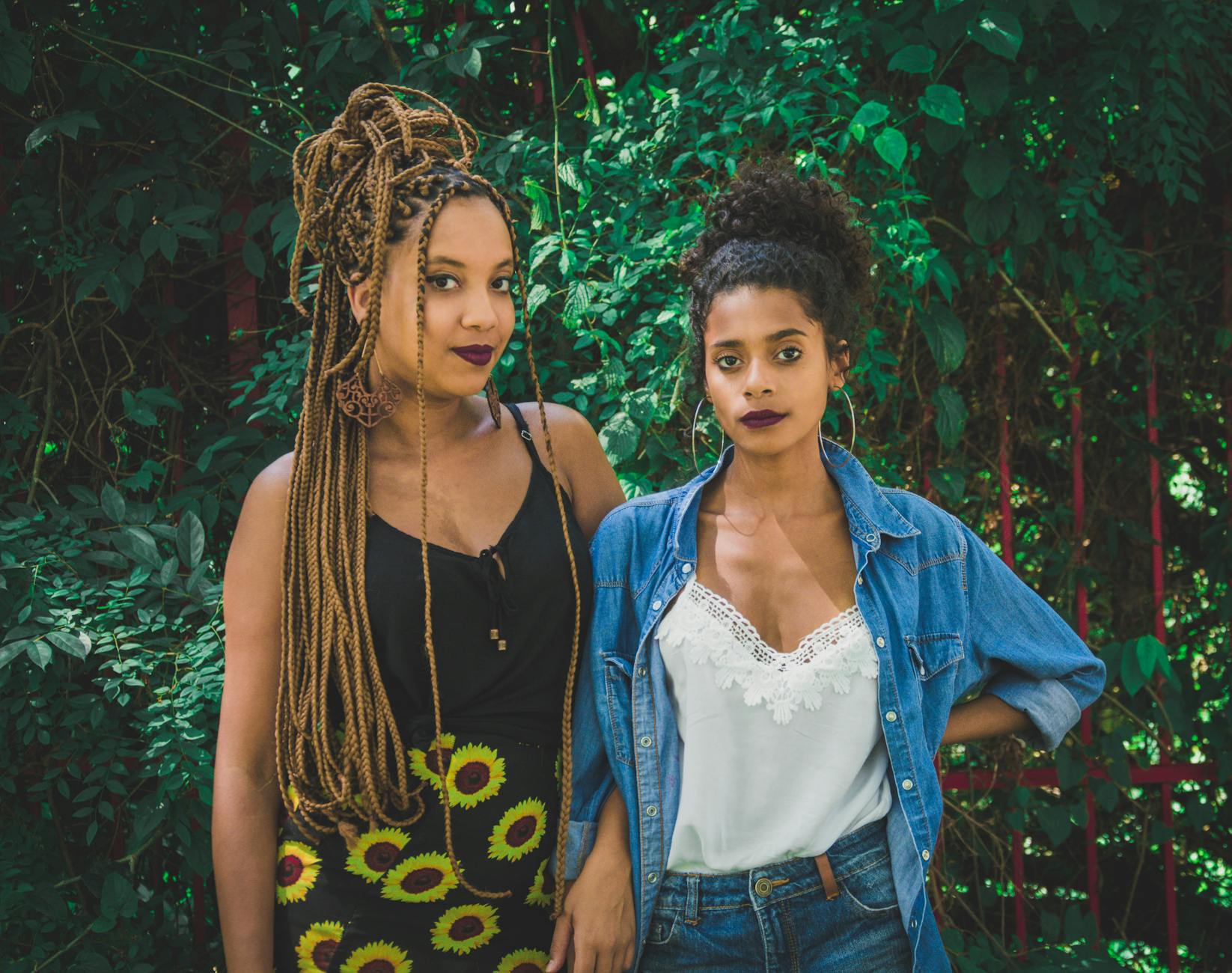
Photo by BULE on Pexels.com

In the modern age, beauty has become a site of both revolution and reclamation. Historically bound by Eurocentric ideals that prioritized whiteness, thinness, and symmetry, today’s beauty landscape has been reshaped by a diverse chorus of voices refusing to conform. Black women, Indigenous creators, trans icons, and differently-abled influencers have emerged as cultural architects, redefining what it means to be beautiful through self-expression and authenticity. The revolution is not merely aesthetic—it is psychological, cultural, and political.

The 21st century has witnessed a radical shift from representation to ownership. Where earlier generations sought inclusion within existing frameworks, modern trailblazers are creating entirely new paradigms. Platforms like TikTok and Instagram have decentralized beauty hierarchies, giving rise to grassroots visibility. Figures such as Lupita Nyong’o, Adut Akech, and Alek Wek stand as embodiments of natural beauty, resilience, and unapologetic African identity. Their presence challenges the historical erasure of darker skin tones from mainstream beauty campaigns.

The reclamation of melanin-rich beauty is not accidental—it is intentional resistance. For centuries, colonialism and media imperialism conflated whiteness with virtue and civilization. Today, the celebration of dark skin tones represents a healing of generational trauma. It affirms that beauty, once defined externally, now belongs to those who were denied it. Through art, photography, and film, a new narrative has emerged—one that celebrates skin not as shade but as legacy.

Moreover, modern beauty trailblazers recognize that authenticity transcends aesthetics. The global push for natural hair representation is a powerful illustration of this. Movements such as #BlackGirlMagic and #TeamNatural have become sociocultural phenomena. They have not only redefined beauty for women of African descent but also established political solidarity rooted in self-acceptance. Natural hair, in this context, is both crown and protest.

The expansion of beauty definitions extends beyond race. Individuals like Winnie Harlow, who embraces her vitiligo. In doing so, they remind the world that beauty is not an exclusionary category; it is a human experience.

At the heart of this transformation lies the concept of visibility. Representation is more than a visual act; it is a psychological affirmation that one belongs. When young people see themselves mirrored in campaigns and media, it restores confidence eroded by centuries of misrepresentation. As philosopher Frantz Fanon noted, “To be seen is to exist.” Today’s beauty trailblazers embody that visibility as liberation.

Beauty influencers have become cultural philosophers of their own era. Through social media, voices such as Jackie Aina and Nyma Tang dissect colorism, cultural appropriation, and tokenism with academic precision and personal vulnerability. Their work bridges activism and aesthetics, dismantling beauty myths from within the very industries that once excluded them.

Inclusivity, however, is not merely about representation—it is about equity. Modern trailblazers are now entering corporate spaces, launching their own brands, and reshaping production norms. Rihanna’s Fenty Beauty revolutionized the cosmetics industry by introducing 40+ foundation shades, a simple yet profound act that exposed the systemic neglect of darker skin tones. Fenty became more than a brand; it became a blueprint for inclusion.

Similarly, Pat McGrath, often hailed as the most influential makeup artist in the world, has used her platform to merge high fashion and multiculturalism. Her artistry reveals that beauty, when liberated from narrow archetypes, becomes art itself. She continues to mentor and open doors for the next generation of global creatives who understand that diversity is not a trend—it is the truth.

The global South is now asserting its own aesthetic sovereignty. African, Caribbean, and Latinx designers are fusing traditional artistry with modern expression. Runways in Lagos, Accra, and São Paulo now rival those of Paris and Milan, redefining fashion geography. These movements signal that the future of beauty will be multipolar and multicultural.

At the intersection of technology and beauty lies another shift: digital self-representation. Filters, AI, and virtual influencers raise critical ethical questions. While these tools can democratize creativity, they also risk reinforcing unrealistic standards. Modern trailblazers navigate this paradox by promoting digital transparency and self-awareness amidst algorithmic distortion.

Beauty is also being redefined through academia and science. Genetic diversity is now understood as the true foundation of human beauty. Traits once deemed “undesirable” are increasingly recognized as markers of resilience and adaptation. The blending of cultures and lineages has produced what anthropologists call “aesthetic hybridity,” an evolution that mirrors humanity’s interconnectedness.

In this sense, modern beauty trailblazers are not anomalies—they are evolutionary symbols. They represent a species reclaiming its visual and spiritual wholeness after centuries of fragmentation. Beauty, once a weapon of division, is becoming a language of unity.

Yet, the work remains unfinished. Systems of patriarchy, racism, and capitalism continue to exploit beauty for profit. Thus, redefinition must be coupled with reformation. True progress means dismantling not only exclusionary ideals but also the economic structures that sustain them.

Education plays a central role in this transformation. By teaching young people media literacy, critical thinking, and self-love, society equips them to resist harmful comparisons and internalized inferiority. Beauty education, when rooted in empowerment, can become a form of social justice.

As this evolution continues, one truth becomes evident: beauty is not something to be achieved—it is something to be remembered. It is the echo of divine design, the harmony of individuality and purpose. The modern trailblazers of beauty are not inventing something new; they are restoring something ancient—authenticity.

Ultimately, the redefinition of beauty is a return to self. It is a collective mirror where every face, every shade, and every form finds reflection. The modern trailblazers remind us that beauty is power, and power, when wielded with love, transforms not only the image but the world itself.


References

Aina, J. (2020). The new face of beauty activism: Representation in the digital age. Journal of Media Studies, 14(3), 45–58.

Fanon, F. (1952). Black skin, white masks. Grove Press.

hooks, b. (1992). Black looks: Race and representation. South End Press.

McGrath, P. (2019). Artistry and identity in global fashion. Vogue Archives Journal, 27(2), 112–129.

Nyong’o, L. (2014). Dark beauty and the global imagination. Cultural Identity Review, 8(1), 9–18.

Rihanna. (2017). Fenty Beauty: The revolution of inclusion. LVMH Archives.

Tang, N. (2022). Colorism and cosmetic culture in the 21st century. Beauty and Society Quarterly, 11(2), 56–73.

Wek, A. (2015). My story: From refugee to runway. HarperCollins.

Zollman, K., & Thakur, M. (2020). Decolonizing aesthetics: The global beauty renaissance. Journal of Cultural Studies, 19(4), 203–221.
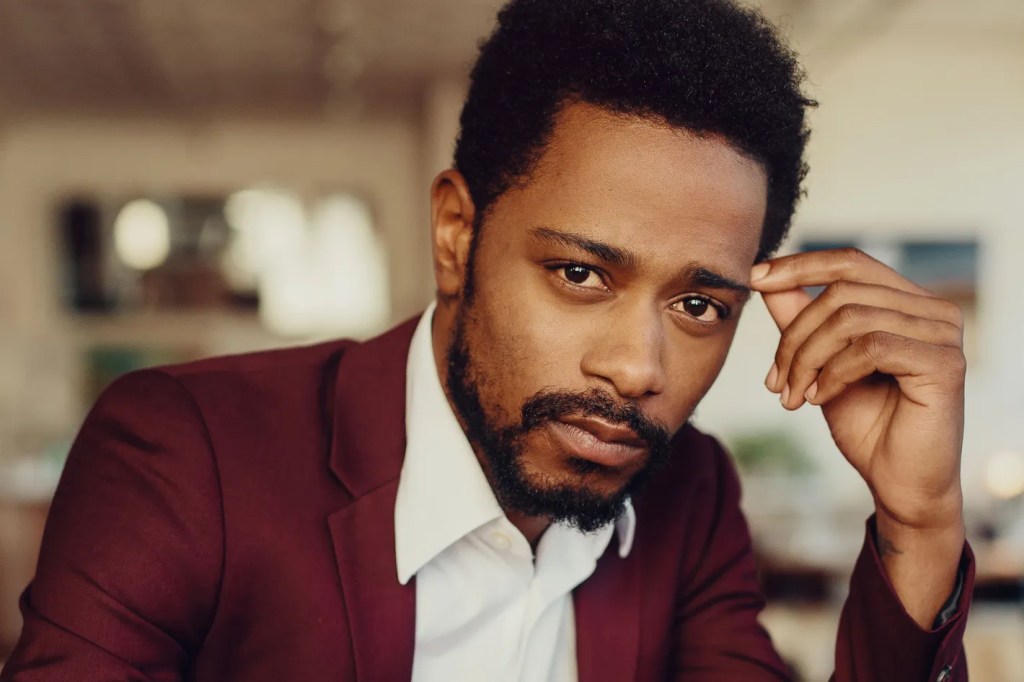
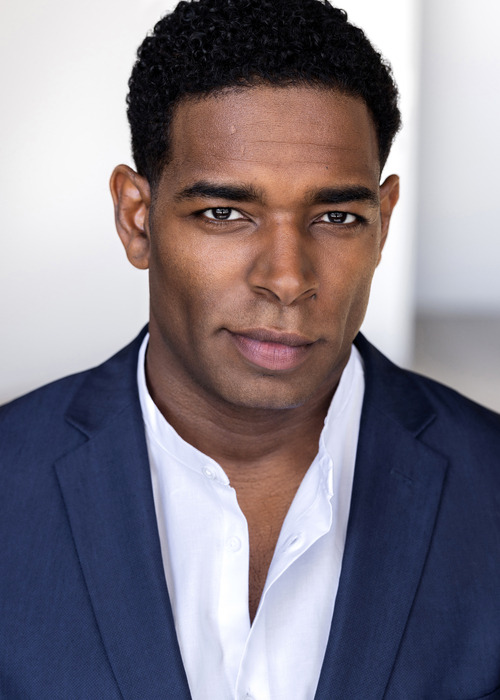
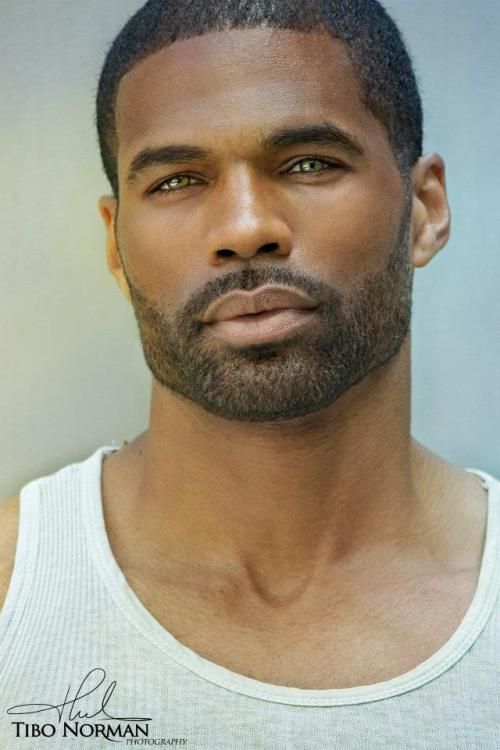
    Masculine Perfection Series: LaKeith Stanfield, Ali Amin Carter & Louis Allen III

    From the moment they enter a room, these three men command attention—LaKeith Stanfield with his piercing, soul-searching eyes that seem to look straight through you; Ali Amin Carter with his refined, boyish good looks that blend innocence and masculine poise; and Louis Allen III with his breathtaking green orbs and sculpted physique that define him as a genetic marvel. Their appearances alone make them unforgettable, but their talent, charisma, and artistic versatility elevate them into the realm of cinematic and modeling excellence.

    LaKeith Stanfield

    “The Enigmatic Soul: A gaze that speaks, a talent that transforms.”

    LaKeith Stanfield stands as one of the most intriguing and enigmatic actors of his generation. Born in California, he began acting in high school before training at the John Casablancas Modeling & Career Center, where he developed the poise and facial precision that now define his screen presence. His breakout came with Short Term 12, which earned him an Independent Spirit Award nomination, and he continued rising with roles in Selma, Get Out, Sorry to Bother You, Knives Out, and Judas and the Black Messiah, for which he received an Academy Award nomination. Among his most captivating roles is his leading performance in The Photograph (2020), where his deep, expressive eyes created a magnetic intensity—particularly in the scene where he gazes at Issa Rae’s character with a mix of longing, vulnerability, and desire. The moment became iconic because Stanfield’s eyes communicate an entire emotional universe, piercing straight into the viewer’s heart just as they pierce Issa Rae’s.

    On the personal front, Stanfield married model Kasmere Trice and together they welcomed a baby in 2023. He is also father to two daughters from previous relationships and describes fatherhood as “something that completely changes” you. His commitment to protecting the privacy of his family and framing the narrative of his own story underscores a grounded side to the actor’s life amid public visibility.

    Ali Amin Carter

    “Attractiveness in Motion: Where quiet masculinity meets undeniable screen presence.”

    This photograph is the property of its respective owner. No copyright infringement intended.

    Ali Amin Carter is a striking talent whose tall, elegant frame and natural good looks positioned him for success in both modeling and acting. Beginning his career on the runway, he eventually transitioned into theatre, earning recognition through the acclaimed stage production Ruined. His screen roles include appearances in Lovecraft Country and The Good Lord Bird, each showcasing his ability to blend emotional depth with quiet masculinity. More recently, Carter starred in the feature film Love Unexpected (2023/24), portraying Chase, a college-playboy figure whose world is challenged by love and transformation. His modeling roots gave him the visual confidence and stature that translate naturally to the screen, and he extended his reach further by starring in a music-video production by the singer Joe, demonstrating a versatility that spans modeling, film, and music.

    Louis Allen III (LA3)

    “The Green-Eyed Hunk: Athletic strength, masculine beauty, and unforgettable allure.”

    Photo Credit: Tibo Norman

    Louis Allen III, known professionally as LA3, emerged from New Jersey as a modeling force defined by his remarkable green eyes, warm brown complexion, and athletic physique honed from his earlier years in minor-league football. His modeling journey began in high school, and he quickly became known for his commanding appearance in editorial spreads and grooming campaigns. Allen’s features made him a favorite for “Eye Candy” showcases and brand ambassador roles, where he represents the fusion of masculine beauty, athletic power, and classic photogenic appeal. Although his acting portfolio is smaller, he continues to expand his influence in fashion, fitness, and men’s grooming culture.

    Together, these three men represent different dimensions of modern Black male beauty—intense, elegant, and powerfully photogenic. Their stories show how physical presence, combined with talent and ambition, opens doors across film, modeling, and public life. Each of them brings a unique energy to the screen or lens: Stanfield with soulful complexity, Carter with polished charm, and Allen with athletic grandeur. They reflect a new era in representation where Black men can embody sensitivity, strength, mystery, and beauty simultaneously. Their careers not only highlight their personal evolution but also expand the cultural imagination of what masculine perfection looks like in the twenty-first century.


    References
    “Ali Amin Carter – Biography,” IMDb.
    “Love Unexpected,” IMDb.
    “LaKeith Stanfield – Personal Life,” Essential Magazine.
    “LaKeith Stanfield – Biography,” Wikipedia.

    IMDb. LaKeith Stanfield – Biography.
    Time Magazine. LaKeith Stanfield: Contemporary Chameleon.
    Empire Magazine. LaKeith Stanfield Profile.
    IMDb. Ali Amin Carter – Biography.
    Essence Magazine. Eye Candy: Louis Allen III.
    Blinging Beauty. The Face of Blinging Beauty’s Manly Man is LA

    Curves, Coils, and Culture: Redefining Black Female Aesthetics.

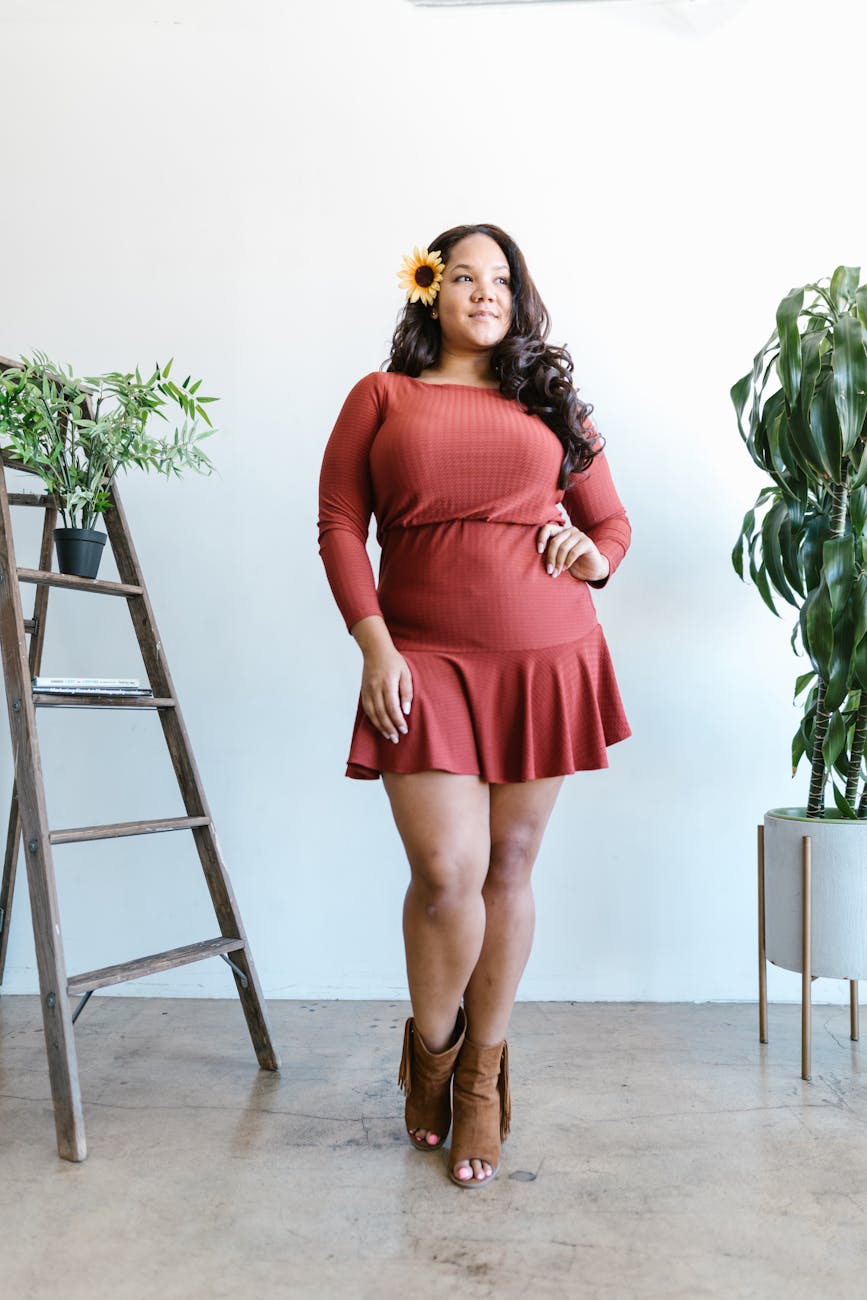
    Photo by RDNE Stock project on Pexels.com

    The beauty of Black women has historically been contested, critiqued, and commodified through the lens of Eurocentric standards. Features such as full lips, natural hair textures, and curvaceous bodies have often been marginalized, while lighter skin, straighter hair, and slender bodies were celebrated. This has created a complex cultural tension where Black women must navigate self-perception, societal validation, and internalized bias. Redefining Black female aesthetics involves reclaiming cultural pride, challenging narrow standards, and celebrating the diversity inherent in African-descended bodies.

    Curves and body shape have long been markers of both cultural identity and contested beauty ideals. Anthropological research shows that in many African societies, curvaceous bodies were historically associated with fertility, strength, and social desirability (Gravlee, 2009). In contrast, Westernized media often valorized thinness, creating a dissonance for Black women who were expected to conform to ideals that excluded natural forms. Recognizing the cultural significance of curves restores aesthetic legitimacy to bodies that have been devalued by colonial and media narratives.

    Hair texture, or “coils,” has similarly been politicized. Natural Black hair—whether tightly coiled, kinky, or wavy—has historically been stigmatized in professional, educational, and social contexts (Byrd & Tharps, 2014). Recent movements such as #NaturalHair and #BlackGirlMagic have reframed natural hair as a symbol of cultural pride, personal identity, and resilience. Embracing natural textures not only challenges Eurocentric beauty standards but also asserts agency over self-expression and self-acceptance.

    Facial features also play a significant role in redefining aesthetics. Full lips, broad noses, and high cheekbones are often celebrated within African-descended communities for their unique beauty, yet historically devalued by mainstream culture. By centering these features in media representation, campaigns, and artistic expression, Black women reclaim visual narratives that affirm their inherent beauty (Hunter, 2007). These traits, coupled with the natural diversity of eye shapes and skin tones, create a holistic framework for appreciating Black female aesthetics beyond reductive stereotypes.

    Psychologically, embracing curves, coils, and distinct features strengthens self-esteem and identity formation. Social comparison theory explains that repeated exposure to media portraying a narrow standard of beauty can lower self-worth (Festinger, 1954). Conversely, visibility of diverse Black beauty—through celebrities, social media influencers, and community representation—promotes positive self-concept, resilience, and empowerment. Testimonials from public figures like Lupita Nyong’o, Tracee Ellis Ross, and Janelle Monáe highlight the transformative power of celebrating authentic features in shaping confidence and cultural pride.

    Spiritual insight further enriches this conversation. Proverbs 31:30 (KJV) emphasizes, “Favour is deceitful, and beauty is vain: but a woman that feareth the LORD, she shall be praised.” While aesthetics hold social and psychological significance, ultimate value is anchored in character, faith, and virtue. Redefining Black female beauty involves harmonizing cultural pride with spiritual grounding, recognizing that divine design surpasses societal metrics of attractiveness.

    In conclusion, the aesthetics of Black women—curves, coils, and unique facial features—represent both cultural heritage and individual empowerment. Challenging Eurocentric norms, reclaiming natural textures and body forms, and celebrating authentic features allow Black women to define beauty on their own terms. This redefinition intersects psychology, culture, and spirituality, providing a holistic framework that affirms identity, fosters confidence, and celebrates the divine artistry inherent in every woman of African descent.


    References

    Byrd, A. D., & Tharps, L. L. (2014). Hair Story: Untangling the Roots of Black Hair in America. New York, NY: St. Martin’s Press.

    Festinger, L. (1954). A theory of social comparison processes. Human Relations, 7(2), 117–140.

    Gravlee, C. C. (2009). How race becomes biology: Embodiment of social inequality. American Journal of Physical Anthropology, 139(1), 47–57.

    Hunter, M. (2007). The persistent problem of colorism: Skin tone, status, and inequality. Sociology Compass, 1(1), 237–254.

    The Ebony Dolls: Kenya Moore

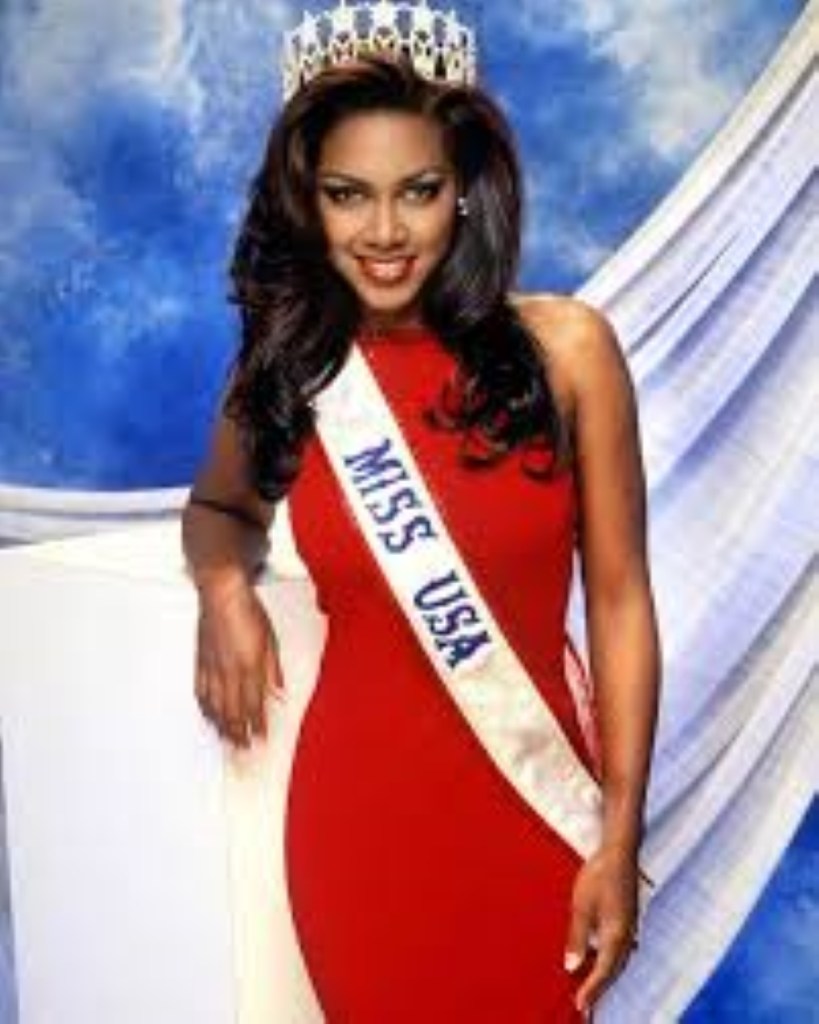
    Here she is, Miss USA…

    This photograph is the property of its respective owner.

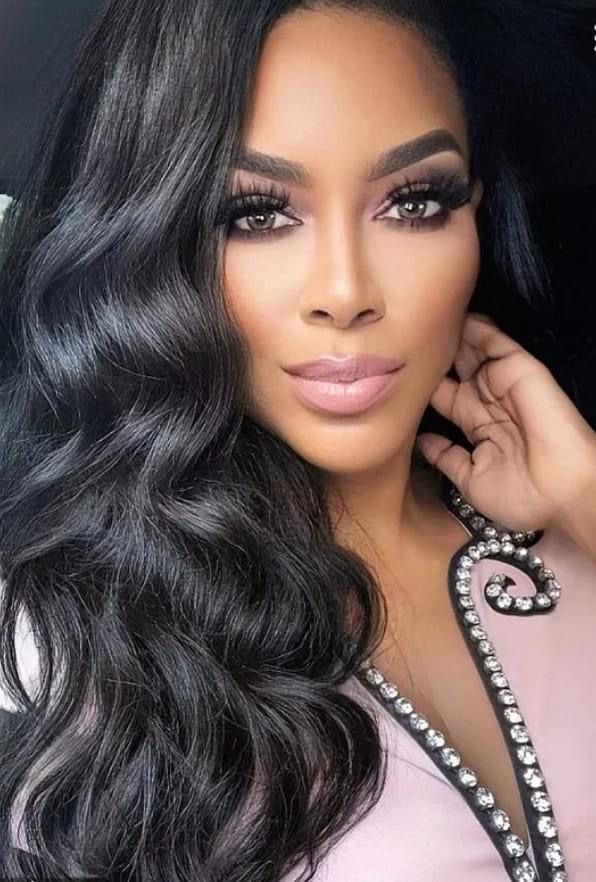
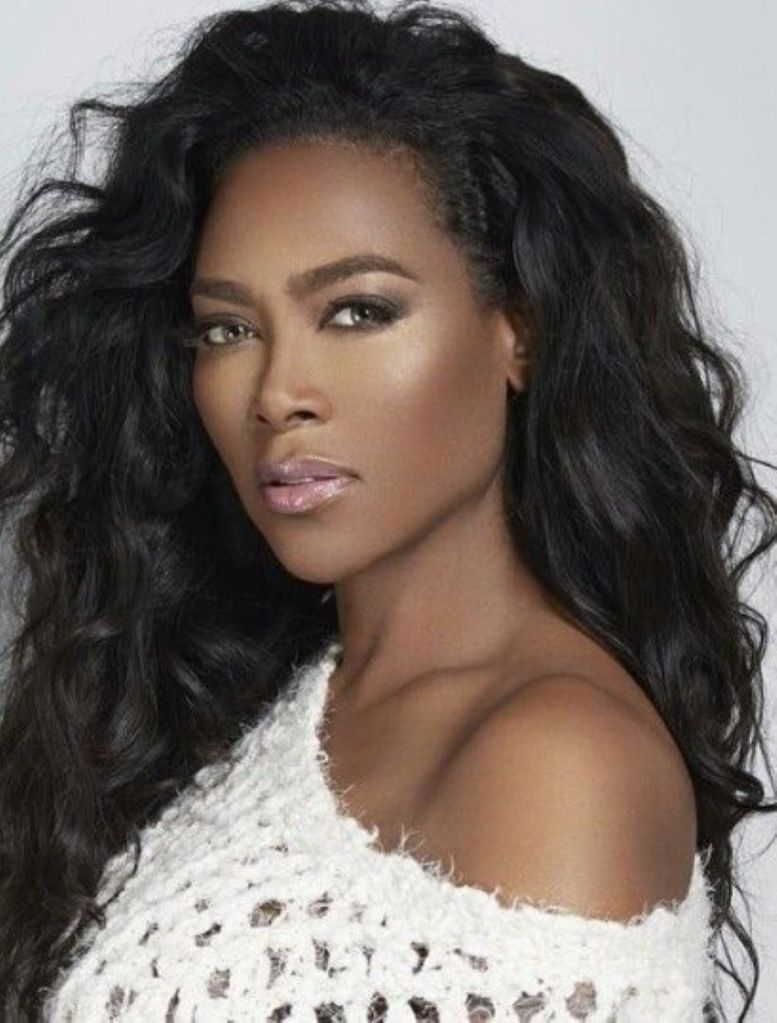
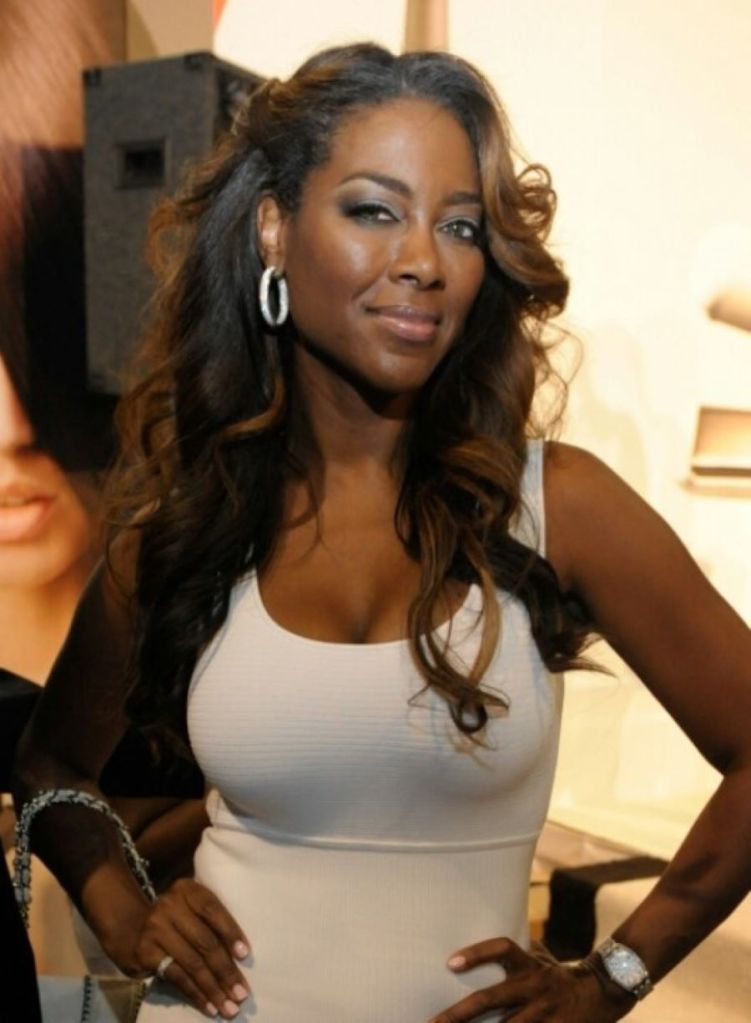
    Kenya Moore is a striking vision of beauty whose deep chocolate skin and stunning facial features have captivated audiences for decades. Her almond-shaped hazel eyes, radiant smile, and elegant poise give her a commanding presence—the “wow factor” that makes her one of the most beautiful, recognizable, and celebrated Black celebrities in modern entertainment. Beyond her physical allure, Kenya combines intelligence, talent, and charisma, establishing herself as a multifaceted figure in television, film, and entrepreneurship. She uses her platform to elevate standards of excellence while embracing her African American heritage (Moore, 2010).

    This photograph is the property of its respective owner.

    Kenya Moore was born on January 24, 1971, in Detroit, Michigan. She is African American and has consistently celebrated her Black identity, often speaking about pride in her heritage and the beauty of her chocolate skin in an industry that has historically marginalized darker-skinned women. Her commitment to representing Black excellence has made her a role model for many young women navigating similar cultural and societal challenges.

    This photograph is the property of its respective owner. No copyright infringement intended.

    Her rise to prominence began in beauty pageants. In 1993, Kenya Moore won the Miss USA title, a historic achievement that showcased not only her beauty but also her poise, intelligence, and advocacy. This win opened doors in Hollywood and the entertainment industry, allowing her to transition into acting, modeling, and television hosting. She became a prominent figure, blending glamour with business acumen and cultural influence.

    Kenya’s acting career includes appearances in films such as Waiting to Exhale (1995), Deliver Us from Eva (2003), and Johnson Family Vacation (2004). She has also appeared in numerous television shows, including recurring roles on series like Girlfriends and guest appearances on The Fresh Prince of Bel-Air. Kenya’s versatility as an actress, combined with her commanding presence, has allowed her to cross genres and media successfully.

    In addition to acting, Kenya Moore is widely known for her reality television work. She has been a prominent cast member on The Real Housewives of Atlanta, where her wit, style, and personality have made her a fan favorite. Beyond reality TV, she has ventured into entrepreneurship, founding her own haircare line and engaging in philanthropic initiatives that empower women and young Black girls.

    This photograph is the property of its respective owner.

    Kenya Moore was married to Marc Daly, and the couple welcomed their first child in 2020. She frequently emphasizes the importance of family, balance, and resilience, sharing her journey as a mother and wife while continuing her career and advocacy work. Her personal life, while celebrated in public, also reflects her commitment to nurturing a grounded, loving family.

    Throughout her career, Kenya Moore has received multiple accolades and recognition for her contributions to beauty, fashion, television, and entertainment. Her Miss USA title remains iconic, and she has leveraged her visibility to influence perceptions of Black beauty positively. Kenya’s career exemplifies how talent, perseverance, and authenticity can converge to create a lasting impact in Hollywood and beyond.

    This photograph is the property of its respective owner.

    Kenya Moore’s legacy is defined by more than her physical beauty. She represents Black excellence, resilience, and empowerment, demonstrating that one can achieve professional success while embracing and celebrating racial identity. Her influence as an actress, television personality, entrepreneur, and mother continues to inspire generations of Black women to pursue their ambitions unapologetically while maintaining dignity, poise, and self-love. All this makes her a true ebony doll.


    References

    • Moore, K. (2010). Interviews and public statements on beauty, heritage, and career. Various media outlets.
    • IMDb. (n.d.). Kenya Moore Filmography. Retrieved from https://www.imdb.com/name/nm0600310/
    • Miss USA Organization. (n.d.). Kenya Moore – Miss USA 1993. Retrieved from https://www.missusa.com/history/1993
    • Erenberg, L. A. (2008). Black Women in Media: Representation, Influence, and Cultural Impact. University of Chicago Press.

    The Golden Ratio of Melanin: The Science of Black Beauty. #thescienceofblackbeauty

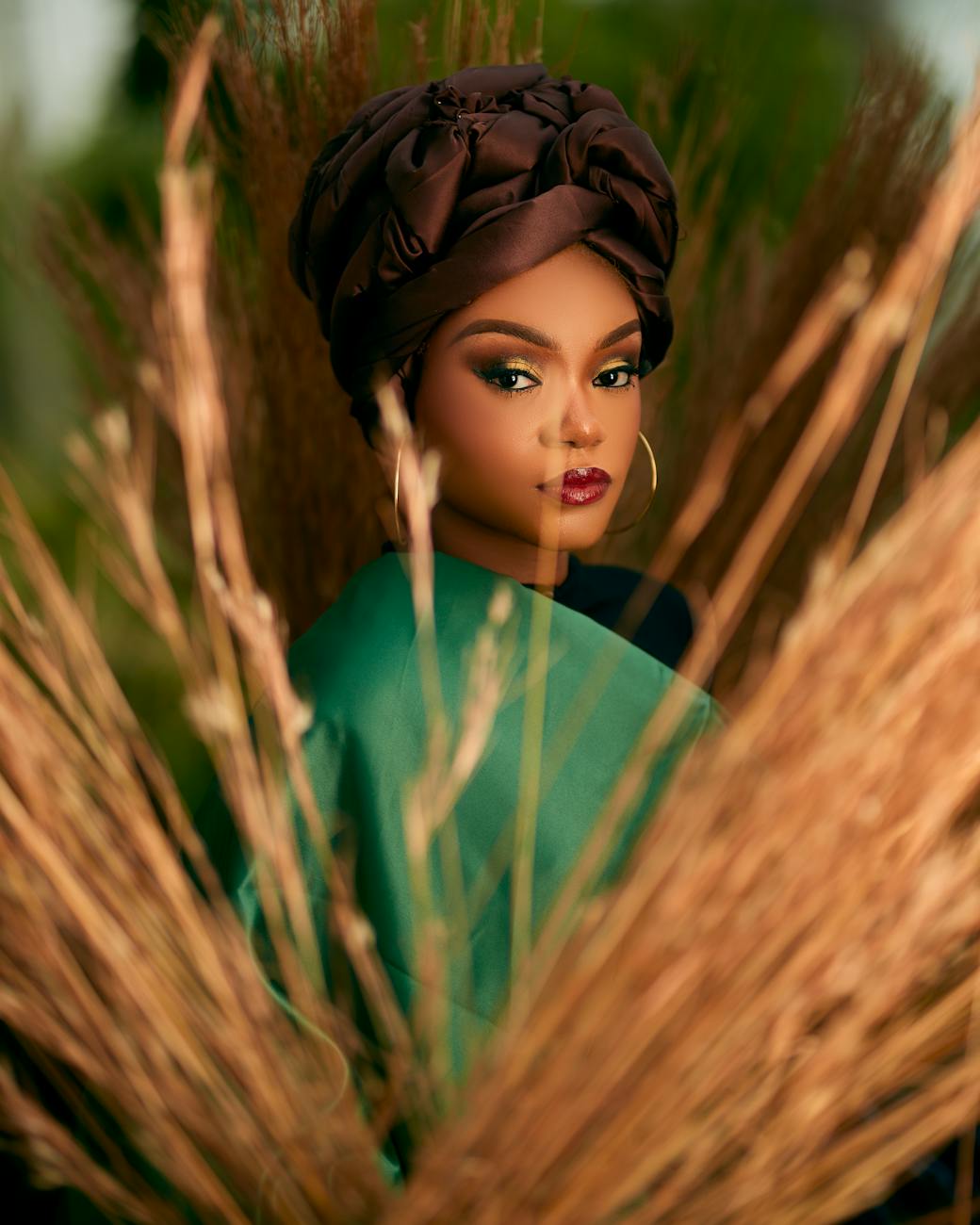
    Photo by Iyke Ibeh on Pexels.com

    Black beauty is a concept far deeper than surface appearance. It is the convergence of science, history, and spirit, revealing how genetics, cultural expression, and aesthetic principles work together to create radiance. To speak of the “golden ratio of melanin” is to acknowledge that Black beauty embodies symmetry, biological adaptation, and cultural meaning. This essay explores the anatomy of Black beauty through genetics, symmetry, cultural aesthetics, and identity, uncovering the scientific and symbolic foundations of its radiance.

    Evolutionary Foundations of Black Beauty

    The human body is a record of adaptation, and African-descended peoples carry evolutionary traits that reflect millennia of survival in diverse climates. Deeply pigmented skin, rich in eumelanin, developed as protection against ultraviolet radiation, safeguarding folate and reproductive health while allowing adequate vitamin D synthesis (Jablonski & Chaplin, 2010). This evolutionary brilliance demonstrates that beauty is inseparable from function and survival.

    The Science of Melanin

    Melanin, the pigment responsible for skin, hair, and eye color, holds both biological and symbolic power. Biologically, it provides a shield against UV damage and oxidative stress. Symbolically, it has become a marker of identity and pride, as phrases such as “melanin magic” reclaim the beauty once devalued by colonial systems. The “golden ratio of melanin” metaphorically expresses the balance between biological adaptation and aesthetic radiance embedded in Black bodies.

    Facial Symmetry and Aesthetics

    Scientific studies show that facial symmetry often influences perceptions of beauty (Little et al., 2011). Yet Black beauty complicates this narrative. While symmetry is biologically associated with health and reproductive fitness, the diversity of African facial structures—from high cheekbones to broad noses—illustrates that beauty cannot be reduced to symmetry alone. The unique harmony of features within African-descended populations reflects both genetic depth and aesthetic variety beyond Eurocentric measures.

    Genetics and Diversity

    Africa is the most genetically diverse continent, containing the origins of humanity itself (Tishkoff et al., 2009). This genetic variation produces an extraordinary range of phenotypes: skin tones from deep ebony to golden bronze, hair textures from tightly coiled to wavy, and eye colors that include rare shades of amber or green. Such diversity underscores that Black beauty is not singular but multifaceted, shaped by genetic inheritance and expressed across continents and diasporas.

    The Psychology of Black Beauty

    The psychology of beauty is inseparable from systems of power. For centuries, Eurocentric ideals defined beauty in ways that excluded African features, leading to internalized racism and colorism within Black communities (Hunter, 2007). Yet psychological resilience emerged through cultural movements that reframed beauty. From the “Black is Beautiful” movement to today’s natural hair renaissance, psychology demonstrates that Black beauty is not merely seen but also consciously reclaimed as self-affirmation.

    The Cultural Expression of Beauty

    Culture shapes how beauty is performed and perceived. Hairstyles, adornment, and fashion within African and diasporic traditions are more than aesthetic—they are carriers of memory, resistance, and identity. Cornrows, locs, and Afro hairstyles, once stigmatized, now stand as global fashion statements while retaining cultural significance (Byrd & Tharps, 2014). Thus, Black beauty is not static but evolves with cultural shifts, asserting both individuality and community.

    Historical Erasure and Resistance

    Colonialism and slavery systematically devalued Black beauty, portraying African features as inferior while elevating Eurocentric standards. Enslaved Africans were stripped of adornments yet found ways to preserve identity, such as braiding hair with hidden codes for survival. This history demonstrates that beauty was never trivial but a form of cultural survival and resistance against dehumanization.

    Representation and Media

    Representation in media profoundly influences global perceptions of beauty. For much of history, darker skin and African features were either excluded or caricatured. Yet figures like Cicely Tyson, Naomi Campbell, and Lupita Nyong’o have redefined representation, bringing diverse expressions of Black beauty to global platforms (Craig, 2006). Rihanna’s Fenty Beauty further revolutionized the cosmetics industry by centering inclusivity, making darker shades visible and celebrated in ways previously unseen.

    The Aesthetics of Proportion

    The “golden ratio,” a mathematical principle often associated with ideal beauty, raises questions about universal aesthetics. While some studies suggest that facial proportions linked to the golden ratio are perceived as attractive, such measures often privilege European features (Pallett et al., 2010). Black beauty challenges and expands this framework, demonstrating that harmony and proportion can be expressed in multiple ways that transcend narrow mathematical formulas.

    Identity and Self-Perception

    Beauty is inseparable from identity. For Black people, affirming beauty has long been an act of self-definition against imposed inferiority. Identity formation involves embracing melanin, natural features, and cultural aesthetics as sources of pride rather than shame. This reclamation is both personal and collective, as communities cultivate beauty standards that reflect African heritage rather than colonial imposition.

    Spiritual Dimensions of Beauty

    Scripture affirms that true beauty is rooted in spirit rather than external adornment: “Whose adorning let it not be that outward adorning… but the hidden man of the heart” (1 Peter 3:3–4, KJV). For Black communities, whose external beauty was historically denied, spiritual beauty became a foundation of dignity and resilience. Thus, Black beauty radiates not only through skin and hair but through faith, endurance, and inner strength.

    Global Influence of Black Aesthetics

    Today, Black aesthetics shape global culture in profound ways. From hip-hop fashion to Afrocentric hairstyles on runways, African-descended styles influence mainstream trends worldwide. Yet appropriation remains a challenge, as Black cultural expression is often commodified without honoring its origins (Patton, 2006). Despite this, the global admiration of Black beauty underscores its undeniable power to shape aesthetics on a universal scale.

    Resilience as Radiance

    At its core, Black beauty is radiant because it has endured. It has survived slavery, colonialism, and systemic erasure, yet continues to redefine standards on its own terms. This resilience transforms beauty from mere appearance into testimony. Black beauty is not fragile—it is forged in fire, radiant because it resisted dehumanization and emerged with power intact.

    Conclusion

    The anatomy of Black beauty encompasses genetics, symmetry, and identity, but extends beyond science into culture, psychology, and spirit. It is the golden ratio of melanin: a perfect balance of biological brilliance, cultural resistance, and aesthetic radiance. To study the science of Black beauty is to affirm that it is foundational to humanity, diverse in expression, and sacred in meaning. Black beauty is not just seen—it is lived, survived, and celebrated as resilience made radiant.


    References

    • Byrd, A., & Tharps, L. (2014). Hair story: Untangling the roots of Black hair in America. St. Martin’s Press.
    • Craig, M. L. (2006). Race, beauty, and the tangled knot of a guilty pleasure. Feminist Theory, 7(2), 159–177.
    • Hunter, M. (2007). The persistent problem of colorism: Skin tone, status, and inequality. Sociology Compass, 1(1), 237–254.
    • Jablonski, N. G., & Chaplin, G. (2010). Human skin pigmentation as an adaptation to UV radiation. Proceedings of the National Academy of Sciences, 107(Suppl 2), 8962–8968.
    • Little, A. C., Jones, B. C., & DeBruine, L. M. (2011). Facial attractiveness: Evolutionary based research. Philosophical Transactions of the Royal Society B: Biological Sciences, 366(1571), 1638–1659.
    • Pallett, P. M., Link, S., & Lee, K. (2010). New “golden” ratios for facial beauty. Vision Research, 50(2), 149–154.
    • Patton, T. O. (2006). Hey girl, am I more than my hair? African American women and their struggles with beauty, body image, and hair. NWSA Journal, 18(2), 24–51.
    • Robins, A. H. (2009). Biological perspectives on human pigmentation. Cambridge University Press.
    • Tishkoff, S. A., et al. (2009). The genetic structure and history of Africans and African Americans. Science, 324(5930), 1035–1044.

    Unveiling Radiance: The Science Behind Black Beauty. #thescienccofblackbeauty

    Photo by 3Motional Studio on Pexels.com

    Black beauty is a phenomenon that transcends aesthetics, reaching into the realms of biology, psychology, culture, and spirituality. To unveil its radiance is to uncover the evolutionary genius of African traits, the resilience of a people who have endured systemic oppression, and the redefinition of beauty as an act of resistance. Far from being superficial, Black beauty embodies survival, identity, and the sacred dignity of heritage.

    From a biological perspective, the features most associated with Black beauty—melanin-rich skin, coiled hair textures, and distinctive facial structures—carry deep evolutionary significance. Dark skin, rich in eumelanin, evolved as protection against harmful ultraviolet rays, while preserving vital nutrients like folate necessary for reproduction (Jablonski & Chaplin, 2010). Similarly, coiled hair functions as a natural insulator, protecting the scalp from heat while aiding in cooling, a design of resilience rooted in Africa’s climate (Robins, 2009). These features reveal that beauty is more than appearance—it is a story of adaptation and survival.

    Psychology offers another lens into Black beauty. For centuries, Eurocentric ideals distorted global standards, leading to colorism and the devaluation of African features (Hunter, 2007). Internalized racism caused many to struggle with self-esteem, as seen in studies where Black children favored white dolls over Black dolls. Yet resilience emerged through movements such as “Black is Beautiful,” which reshaped psychological frameworks by affirming melanin, natural hair, and cultural aesthetics (Byrd & Tharps, 2014). In this way, beauty became a psychological anchor of identity and empowerment.

    Culturally, representation plays a powerful role in shaping perceptions of beauty. Historically, Black women and men were excluded from mainstream imagery or reduced to stereotypes. However, pioneers like Cicely Tyson and Angela Davis disrupted these patterns by embracing natural styles that carried political meaning. In the modern era, global icons such as Lupita Nyong’o and Rihanna’s Fenty Beauty have expanded definitions of beauty, affirming darker complexions and diverse aesthetics as not only acceptable but aspirational (Tate, 2009). Representation thus transforms beauty from exclusion to celebration.

    Black beauty is also inseparable from the politics of survival. During slavery, African women braided hair not only for style but also as cultural memory and, at times, as coded maps for escape (Byrd & Tharps, 2014). Beauty, in this context, was not frivolous but functional, a tool of survival and cultural preservation. This historical resilience underscores that beauty for Black communities is never just cosmetic—it is intertwined with dignity, memory, and liberation.

    Spiritually, beauty is rooted in values deeper than appearance. The Bible teaches that true beauty lies within: “Whose adorning let it not be that outward adorning…but the hidden man of the heart” (1 Peter 3:3–4, KJV). For Black people, whose external beauty was often devalued by oppressive systems, inner radiance and spiritual strength became central to survival. Thus, Black beauty is not only seen in skin and hair, but also in character, resilience, and unwavering faith.

    In contemporary society, Black aesthetics influence global fashion, music, and art. From natural hairstyles to melanin-positive campaigns, African-descended communities are reclaiming and redefining beauty on their own terms. Yet challenges remain, as colorism and Eurocentric bias persist in media and industries (Patton, 2006). Still, the global celebration of melanin and the mainstreaming of diverse beauty standards signal progress toward broader acceptance.

    Ultimately, the science behind Black beauty reveals a truth greater than aesthetics: beauty is resilience, adaptation, and radiance born of struggle and survival. It is biological brilliance, psychological strength, cultural memory, and spiritual dignity combined. To unveil this radiance is to affirm that Black beauty is not only valid—it is foundational to humanity, a sacred testimony to the power of survival, identity, and divine design.


    References

    • Byrd, A., & Tharps, L. (2014). Hair story: Untangling the roots of Black hair in America. St. Martin’s Press.
    • Hunter, M. (2007). The persistent problem of colorism: Skin tone, status, and inequality. Sociology Compass, 1(1), 237–254.
    • Jablonski, N. G., & Chaplin, G. (2010). Human skin pigmentation as an adaptation to UV radiation. Proceedings of the National Academy of Sciences, 107(Suppl 2), 8962–8968.
    • Patton, T. O. (2006). Hey girl, am I more than my hair? African American women and their struggles with beauty, body image, and hair. NWSA Journal, 18(2), 24–51.
    • Robins, A. H. (2009). Biological perspectives on human pigmentation. Cambridge University Press.
    • Tate, S. A. (2009). Black beauty: Aesthetics, stylization, politics. Ashgate.

    The Science of Black Beauty: Evolution, Psychology, and Representation.

    Photo by Abel Kayode on Pexels.com

    Black beauty is a multidimensional construct shaped by biology, cultural history, and sociopolitical forces. Unlike mainstream Eurocentric beauty standards, which often reduce attractiveness to narrow features, Black beauty encompasses genetic diversity, evolutionary resilience, and cultural expression. To understand it requires an interdisciplinary lens—examining the evolutionary science of melanin, the psychological impacts of beauty ideals, and the representation of Black aesthetics in society.

    Evolutionary Foundations of Black Beauty

    From an evolutionary perspective, darker skin pigmentation is a result of natural selection. Melanin, particularly eumelanin, provides protection against ultraviolet (UV) radiation while preserving folate reserves essential for reproduction (Jablonski & Chaplin, 2010). Features common within populations of African descent, such as fuller lips, broader noses, and tightly coiled hair, are not merely aesthetic traits but adaptive markers designed for survival in hot and variable climates (Robins, 2009). These traits, once stigmatized under colonial rule, reflect a scientific truth: Black beauty is evolutionarily advantageous, biologically diverse, and deeply tied to human survival.

    Psychological Dimensions of Black Beauty

    Psychology reveals how beauty standards affect identity and self-esteem. Eurocentric ideals historically marginalized Black features, creating internalized biases and what Fanon (1967) described as a “racial epidermal schema.” The preference for lighter skin—colorism—illustrates how systemic racism infiltrates concepts of beauty (Hunter, 2007). Conversely, the natural hair movement and celebration of melanin-rich skin highlight the psychological liberation that comes from embracing authentic Black beauty. Self-acceptance, in this context, becomes both a personal act of healing and a political statement.

    Representation and Cultural Visibility

    Representation of Black beauty in media has historically oscillated between invisibility and exoticization. Early depictions often reinforced stereotypes, while mainstream fashion and entertainment industries celebrated only a limited spectrum of Black aesthetics (Craig, 2006). Today, however, global icons like Lupita Nyong’o, Viola Davis, and Naomi Campbell expand representation by embodying diverse shades, textures, and body types. Social media platforms also empower everyday voices, allowing new narratives to challenge Eurocentric dominance and redefine beauty on global terms.

    Intersection of Science and Culture

    The study of Black beauty requires bridging scientific objectivity with cultural subjectivity. Facial symmetry, the golden ratio, and evolutionary psychology offer biological explanations for attractiveness (Little et al., 2011). Yet, beauty is also socially constructed, shaped by history, politics, and resistance. For Black communities, beauty is more than appearance—it is identity, resilience, and cultural pride.

    Conclusion

    The science of Black beauty cannot be divorced from its history of misrepresentation and resistance. Evolutionary biology highlights its adaptive strength; psychology reveals its role in identity formation; and representation underscores its sociopolitical weight. To honor Black beauty is to affirm both its scientific roots and its cultural power, recognizing it as central to human diversity and dignity.


    References

    • Craig, M. L. (2006). Race, beauty, and the tangled knot of a guilty pleasure. Feminist Theory, 7(2), 159–177.
    • Fanon, F. (1967). Black skin, white masks. Grove Press.
    • Hunter, M. (2007). The persistent problem of colorism: Skin tone, status, and inequality. Sociology Compass, 1(1), 237–254.
    • Jablonski, N. G., & Chaplin, G. (2010). Human skin pigmentation as an adaptation to UV radiation. Proceedings of the National Academy of Sciences, 107(Supplement 2), 8962–8968.
    • Little, A. C., Jones, B. C., & DeBruine, L. M. (2011). Facial attractiveness: Evolutionary based research. Philosophical Transactions of the Royal Society B: Biological Sciences, 366(1571), 1638–1659.
    • Robins, A. H. (2009). Biological perspectives on human pigmentation. Cambridge University Press.

    The Ebony Dolls: Yvonne Okoro

    This photograph is the property of its respective owners. No copyright infringement intended.

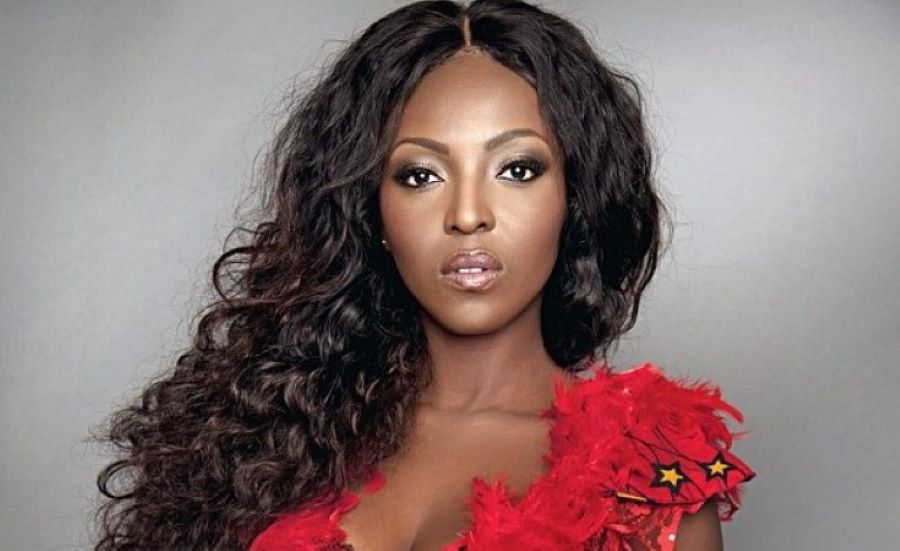
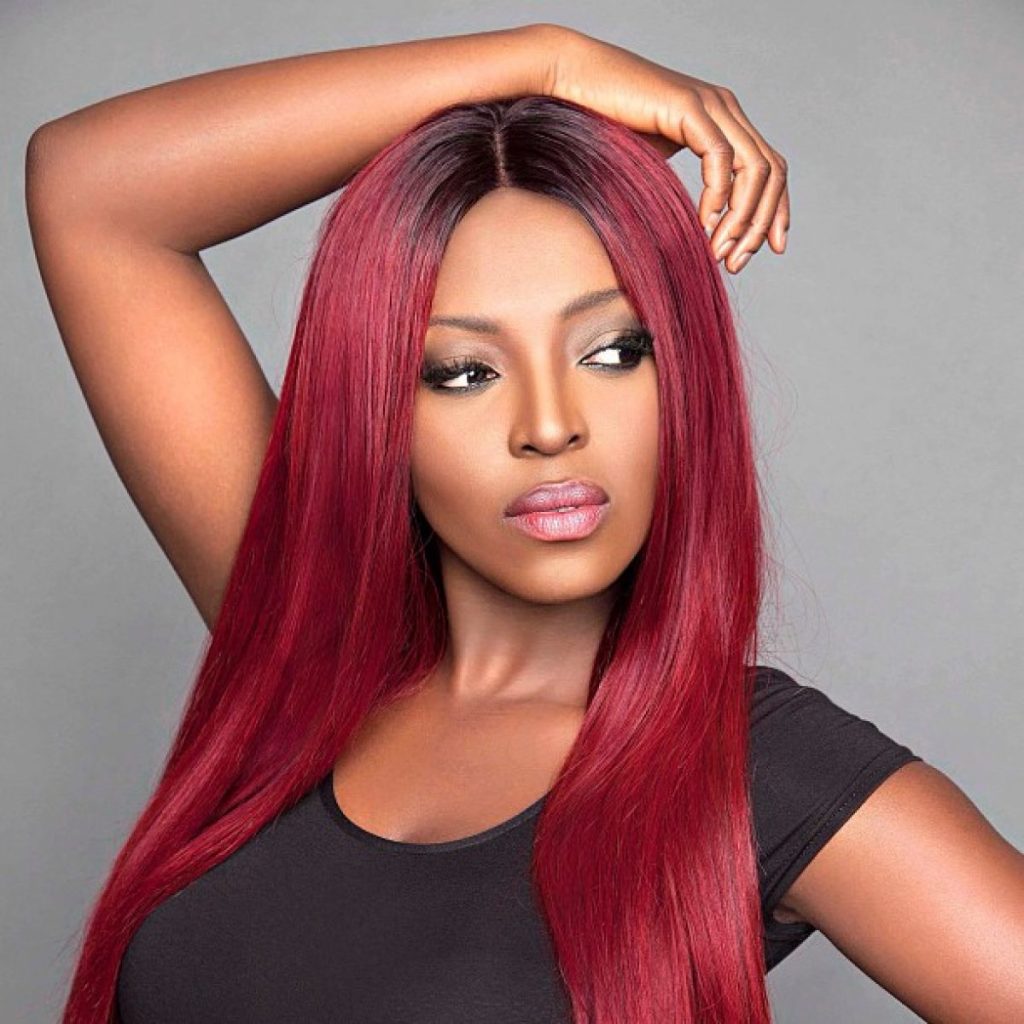
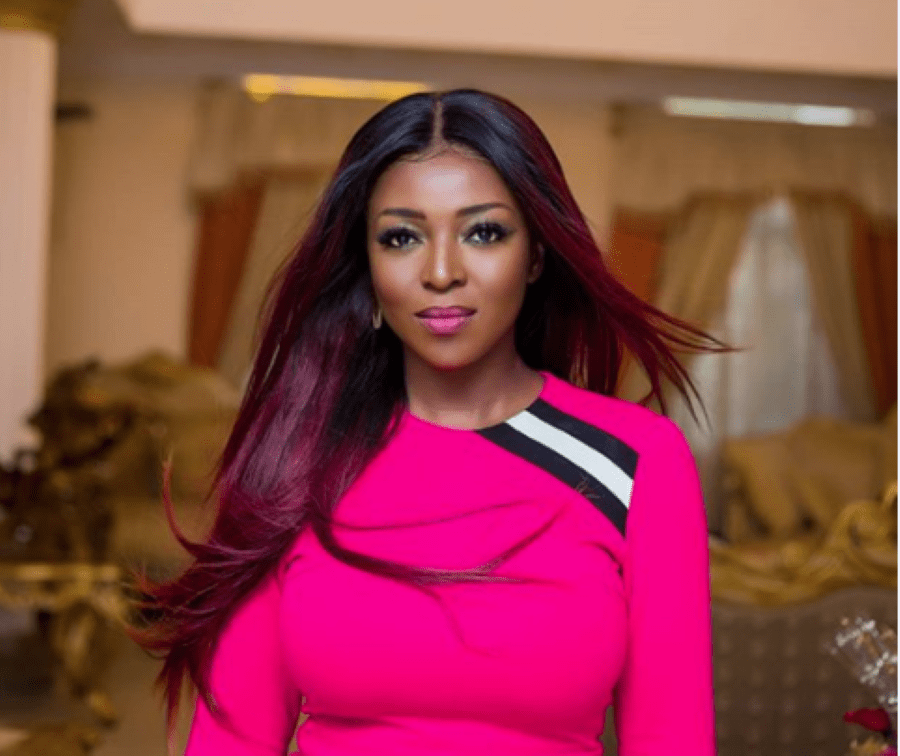
    In the constellation of African cinema, Yvonne Okoro shines with a rare brilliance that fuses sophistication, intelligence, and undeniable beauty. With her flawless bronze-ebony complexion, luminous almond-shaped eyes, and refined features framed by a radiant smile, she is often admired for her doll-like allure—a blend of African richness and European elegance. Beyond her physical charm, Okoro’s poise, confidence, and versatility have positioned her among the most respected actresses in both Ghana’s Ghallywood and Nigeria’s Nollywood film industries. She is a modern African woman who balances glamour with grit, embodying excellence both on and off the screen.

    Born Chinyere Yvonne Okoro on November 25, 1984, in Tamale, Ghana, she comes from a mixed heritage that beautifully reflects the unity of West Africa—her father is Nigerian (from Abia State, Igbo), and her mother is Ghanaian. This cultural blend enriched her worldview and artistic expression, allowing her to connect with audiences across two major entertainment industries. From a young age, Yvonne demonstrated a passion for performance, often participating in school plays and local talent showcases that revealed her natural charisma and expressiveness.

    Yvonne Okoro’s educational journey is as impressive as her acting career. She attended Achimota Preparatory School and Lincoln Community School before earning her Bachelor of Arts in English and Linguistics from the University of Ghana, Legon. She later pursued further studies in France at the Université de Nantes, where she deepened her understanding of communication and modern languages—skills that would later enhance her presence in international cinema.

    This photograph is the property of its respective owners. No copyright infringement intended.

    Her acting debut came with a supporting role in the Ghanaian film Sticking to the Promise (2002). However, her major breakthrough came when she transitioned into Nollywood, starring in Beyoncé: The President’s Daughter (2006) alongside Nadia Buari and Van Vicker. Her beauty, eloquence, and natural on-screen chemistry with her co-stars captured the attention of filmmakers and audiences alike. Soon, she became a fixture in both Ghanaian and Nigerian film productions, a rare feat achieved by only a handful of actresses.

    Over the years, Yvonne Okoro has built an impressive filmography, with notable works including The Game (2010), Contract (2012), Single Six (2011), Rebecca (2016), and Ghana Must Go (2016)—a romantic comedy she also produced. Her role in Contract, opposite Hlomla Dandala, earned her the Best Actress Award at the Ghana Movie Awards and an Africa Magic Viewers’ Choice Award (AMVCA) nomination. The film’s critical success established her as one of the leading ladies of African cinema, capable of blending humor, depth, and authenticity with magnetic beauty.

    Yvonne Okoro’s contributions extend beyond acting; she is also a film producer and entrepreneur, using her platform to promote quality storytelling in Africa. Her production company, Desamour Company Limited, has produced several films that highlight African culture, love, and social issues. Through this, she has provided opportunities for emerging talents, especially women in film, fostering growth and creativity in the industry.

    This photograph is the property of its respective owners. No copyright infringement intended.

    Her grace and intelligence have also made her a favorite for brand endorsements, having represented beauty and fashion brands that mirror her elegance. She is frequently listed among the most beautiful and influential actresses in Africa, celebrated for her radiant skin, well-defined features, and polished style that bridges modern glamour and cultural authenticity.

    In addition to her professional achievements, Yvonne Okoro’s personal life reflects humility and purpose. Despite her fame, she remains grounded and family-oriented, often crediting her parents for instilling discipline and confidence. Her close relationship with her siblings—particularly her sister, Roseline Okoro, who also ventured into acting—highlights her belief in family unity and shared success.

    Throughout her career, Yvonne has earned numerous accolades, including the Best Actress of the Year (2010) at the Ghana Movie Awards, the Achievement Award at the City People Entertainment Awards in Nigeria, and recognition at the Africa International Film Festival (AFRIFF). Her dedication to excellence has made her one of the highest-paid actresses in Ghana and Nollywood, respected for both her beauty and her business acumen.

    Ultimately, Yvonne Okoro represents the epitome of modern African femininity—educated, talented, and unapologetically elegant. Her soft-spoken confidence, luminous ebony glow, and striking intellect set her apart as not merely a star, but a symbol of pan-African pride and excellence. As one of the Ebony Dolls of African cinema, she continues to inspire young women to dream beyond boundaries while embracing their heritage and divine beauty.


    References

    • Africa Magic. (2023). Yvonne Okoro: The Actress Who Bridges Ghana and Nollywood. MultiChoice Africa.
    • Ghana Web. (2022). Profile of Yvonne Okoro: From Beauty to Brilliance.
    • Pulse Ghana. (2023). Top 10 Highest-Paid Actresses in Ghana and Nigeria.
    • The Guardian Nigeria. (2021). Yvonne Okoro: The Pan-African Face of Modern Cinema.
    • IMDb. (2024). Yvonne Okoro Biography and Filmography.
    • Modern Ghana. (2022). Yvonne Okoro: The Glamorous Ghanaian-Nigerian Star Redefining African Film.

    Dilemma: Color Bias

    Photo by Nicole Berro on Pexels.com

    Color bias, often called colorism, is the social preference for lighter skin tones within racial or ethnic groups. Unlike racism, which functions across different races, color bias operates within a community, shaping hierarchies of privilege, beauty, and worthiness according to complexion. Rooted in slavery, colonialism, and Eurocentric ideals, color bias has lasting effects on how people are valued and treated. It creates divisions among those who share the same ancestry, undermining unity and reinforcing oppression from within (Hunter, 2007).

    Historically, color bias took root during the transatlantic slave trade and colonial rule. Lighter-skinned enslaved Africans, often born of European masters, were given positions as house servants, while darker-skinned individuals were confined to harsher field labor (Keith & Herring, 1991). This division fostered the perception that lighter skin represented refinement, intelligence, and proximity to whiteness, while darker skin was stigmatized as less desirable. These beliefs were passed through generations, embedding shade hierarchies into social and cultural structures long after the abolition of slavery.

    In modern contexts, color bias continues to shape opportunity and representation. Lighter-skinned individuals are often favored in entertainment, media, and professional spaces. Globally, skin-lightening industries thrive, promising upward mobility and beauty to those who conform to lighter ideals (Glenn, 2008). Within families, children with lighter complexions may be praised as “beautiful” or “lucky,” while darker-skinned children face teasing or stigma, creating internalized wounds. Even in casual language, terms like “high yellow” or “redbone” highlight how complexion is tied to perceived social value.

    Color bias also significantly impacts relationships, marriage, and family dynamics. Research shows that lighter-skinned women are often perceived as more desirable for marriage, while darker-skinned women face higher levels of rejection, bias, and stereotypes (Hunter, 1998). Men with darker skin may also be labeled as more threatening or less “respectable,” influencing dating choices and family expectations. These biases affect mate selection, with some families encouraging unions with lighter-skinned partners to “improve” the family lineage. Such practices reflect not only internalized racism but also the lingering scars of slavery and colonialism.

    The Bible challenges such distortions of human worth. Song of Solomon 1:5 (KJV) declares: “I am black, but comely, O ye daughters of Jerusalem.” This verse affirms the beauty of dark skin, countering cultural stigmas. Furthermore, 1 Samuel 16:7 (KJV) reminds believers that God judges by the heart, not appearance. Favoritism in love, marriage, or family based on complexion stands against the divine standard of equality. Acts 17:26 (KJV) further emphasizes that God “hath made of one blood all nations of men,” revealing that complexion-based hierarchies are human inventions, not divine truths.

    Psychologically, color bias is sustained through internalized racism and implicit bias. Internalized racism leads individuals to adopt the belief that lighter features are more attractive or valuable, even when such beliefs harm their own identity (Speight, 2007). Implicit bias operates unconsciously, shaping decisions about who is considered attractive, professional, or marriage-worthy. These biases infiltrate dating preferences, hiring choices, and even parental expectations, perpetuating cycles of inequality. Addressing these issues requires intentional reflection, awareness, and healing.

    Ultimately, overcoming color bias demands both spiritual and psychological renewal. Spiritually, believers are called to “be not conformed to this world: but be ye transformed by the renewing of your mind” (Romans 12:2, KJV). Psychologically, education, representation, and open dialogue are necessary to dismantle implicit biases and heal generational wounds. Communities must affirm that every shade of melanin is a reflection of God’s creativity, equally worthy of love, respect, and dignity. By uniting faith and knowledge, families and societies can break the grip of color bias and build relationships rooted in genuine character rather than complexion.


    References

    • Glenn, E. N. (2008). Yearning for lightness: Transnational circuits in the marketing and consumption of skin lighteners. Gender & Society, 22(3), 281–302.
    • Hunter, M. (1998). Colorstruck: Skin color stratification in the lives of African American women. Sociological Inquiry, 68(4), 517–535.
    • Hunter, M. (2007). The persistent problem of colorism: Skin tone, status, and inequality. Sociology Compass, 1(1), 237-254.
    • Keith, V. M., & Herring, C. (1991). Skin tone and stratification in the Black community. American Journal of Sociology, 97(3), 760–778.
    • Speight, S. L. (2007). Internalized racism: One more piece of the puzzle. The Counseling Psychologist, 35(1), 126–134.
    • The Holy Bible, King James Version.

    From Roots to Runways: The Historical Beauty of Brown Women

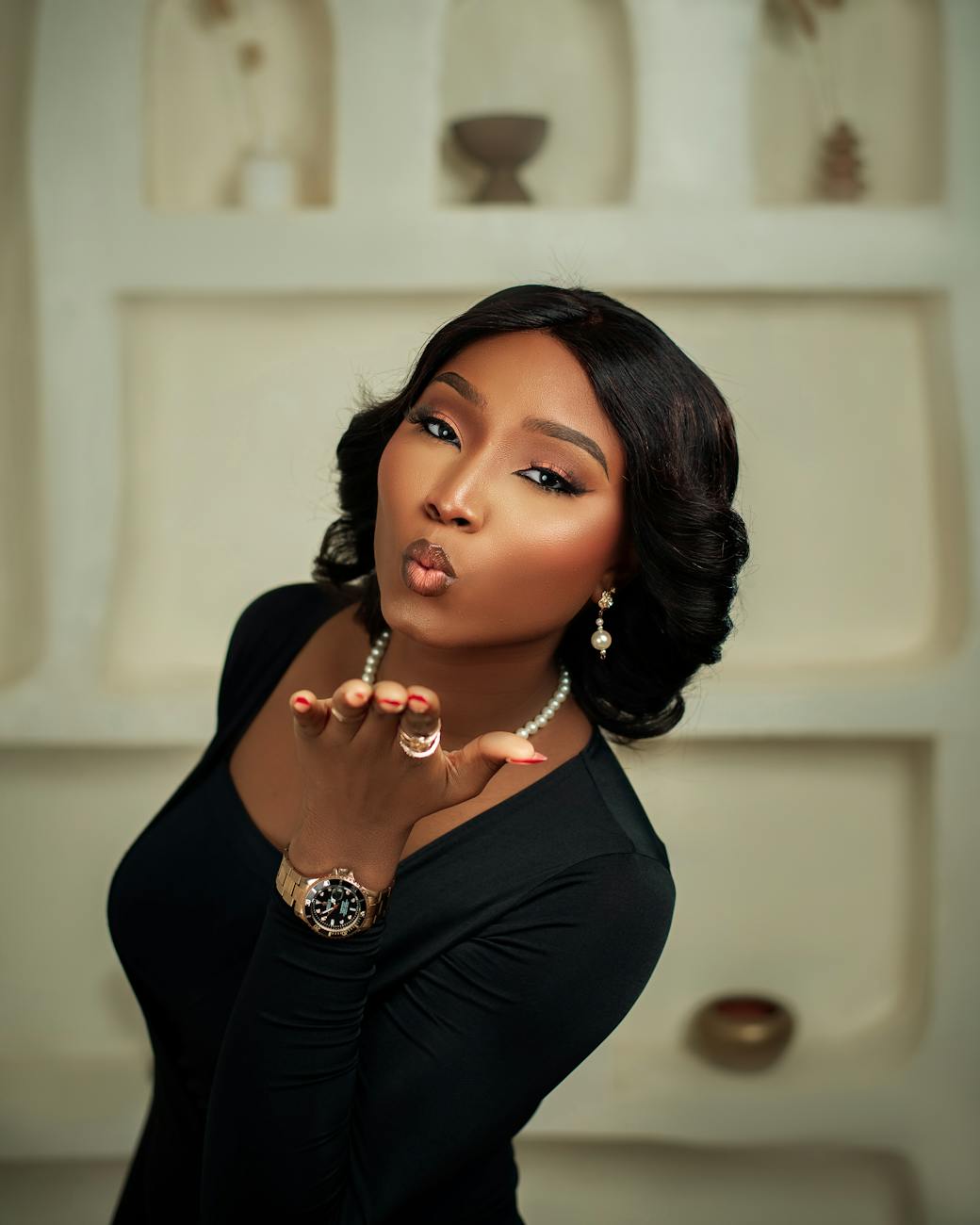
    Photo by Al Ameen Saddiq on Pexels.com

    The beauty of Brown women is deeply intertwined with culture, history, and resilience. From ancestral traditions to modern fashion runways, Brown women have navigated societies that often imposed Eurocentric standards while cultivating unique forms of self-expression, artistry, and elegance. Exploring this trajectory—from historical roots to contemporary visibility—reveals not only aesthetic contributions but also the resilience and empowerment embedded in the legacy of Brown women.

    Ancestral Traditions and Cultural Significance

    Throughout African, Caribbean, and Latin American societies, beauty has historically been expressed through hairstyles, skin care, adornments, and textiles. Braided and twisted hairstyles, body art, and vibrant clothing often carried social, spiritual, or cultural meaning, signaling status, heritage, or community affiliation (Byrd & Tharps, 2014). These traditions celebrated melanin-rich skin, facial features, and natural hair textures long before the imposition of colonial beauty standards. Beauty, in these contexts, was both personal and collective—a reflection of identity and heritage.

    Colonialism, Slavery, and the Imposition of Eurocentric Standards

    The transatlantic slave trade and colonial regimes brought systemic oppression that devalued darker skin and natural features. European ideals of beauty—fair skin, straight hair, and Eurocentric facial features—became markers of social privilege and desirability (Hunter, 2007). Despite these pressures, Brown women preserved cultural beauty practices, maintaining pride in their appearance and transmitting ancestral knowledge through generations. This resistance demonstrates that beauty has always been inseparable from resilience and identity affirmation.

    African American Beauty Culture and the Harlem Renaissance

    In the United States, the Harlem Renaissance (1920s–1930s) provided a platform for Black artistic expression, including beauty and fashion. Women like Josephine Baker, with her daring style and signature elegance, challenged mainstream perceptions while celebrating African aesthetics. Beauty salons became cultural hubs where women exchanged styling techniques, supported one another, and fostered community identity (Perry, 2009). These spaces cultivated confidence, creativity, and empowerment, demonstrating that beauty is not merely aesthetic but also sociocultural.

    Modern Visibility and Runway Influence

    In contemporary fashion, Brown women increasingly claim visibility and redefine industry standards. Models like Adut Akech, Duckie Thot, and Naomi Campbell have dominated international runways, demonstrating that melanin-rich beauty is not niche but universal. Designers are incorporating diverse features and complexions into campaigns, acknowledging the historical exclusion and striving toward inclusion. Social media further amplifies these voices, allowing Brown women to influence global perceptions directly.

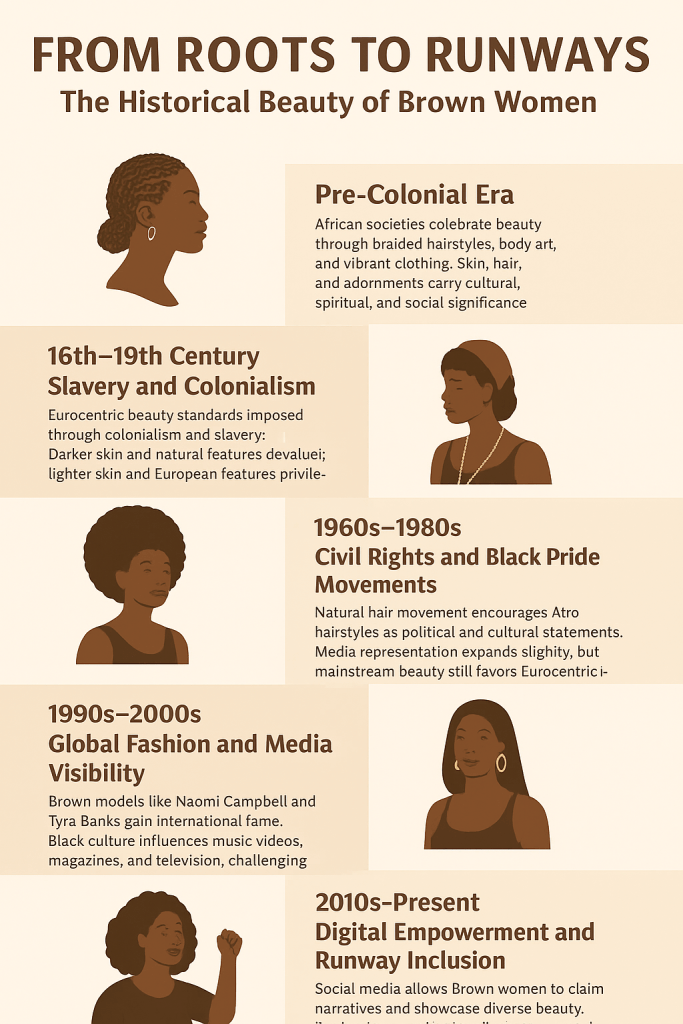
    Timeline: The Historical Beauty of Brown Women

    Pre-Colonial Era

    • African societies celebrate beauty through braided hairstyles, body art, and vibrant clothing.
    • Skin, hair, and adornments carry cultural, spiritual, and social significance.

    16th–19th Century: Slavery and Colonialism

    • Eurocentric beauty standards imposed through colonialism and slavery.
    • Darker skin and natural features devalued; lighter skin and European features privileged.
    • Brown women preserve cultural beauty practices covertly or in safe community spaces.

    1920s–1930s: Harlem Renaissance

    • Black artistic expression flourishes; women like Josephine Baker challenge mainstream norms.
    • Beauty salons become cultural hubs for skill-sharing, empowerment, and community.

    1960s–1980s: Civil Rights and Black Pride Movements

    • Natural hair movement encourages Afro hairstyles as political and cultural statements.
    • Media representation expands slightly, but mainstream beauty still favors Eurocentric ideals.

    1990s–2000s: Global Fashion and Media Visibility

    • Brown models like Naomi Campbell and Tyra Banks gain international fame.
    • Black culture influences music videos, magazines, and television, challenging stereotypes.

    2010s–Present: Digital Empowerment and Runway Inclusion

    • Social media allows Brown women to claim narratives and showcase diverse beauty.
    • Models like Adut Akech, Duckie Thot, and public figures like Lupita Nyong’o redefine global standards.
    • Colorism awareness movements (#MelaninMagic, #BrownSkinPoppin) increase representation and self-love advocacy.

    Present & Future

    • Celebration of melanin-rich skin, natural hair, and diverse features continues to grow globally.
    • Beauty becomes a tool of empowerment, cultural pride, and resistance against systemic bias.

    Media Representation and Colorism

    While progress has been made, media representation continues to favor lighter-skinned women. Colorism—preference for lighter shades within communities of color—persists, reinforcing hierarchical beauty standards (Hunter, 2007). Visibility of darker-skinned models, actresses, and influencers challenges these norms, offering representation that affirms a broader spectrum of beauty. Public figures like Lupita Nyong’o and Tracee Ellis Ross exemplify this shift, inspiring younger generations to embrace their natural features proudly.

    Beauty as Resistance and Empowerment

    The historical beauty of Brown women reflects both aesthetic expression and resistance. Maintaining traditional hairstyles, advocating for natural skin care, and claiming space in fashion and media are acts of empowerment. Each choice affirms identity, challenges dominant beauty paradigms, and honors ancestral legacy. Brown women’s beauty has always been inseparable from cultural pride, resilience, and agency.

    Conclusion

    From roots to runways, the beauty of Brown women is a testament to heritage, resilience, and self-expression. Historical traditions, artistic contributions, and contemporary visibility reveal that beauty is not merely physical; it is cultural, social, and political. Celebrating this legacy affirms the value of melanin-rich skin, natural hair, and diverse features, ensuring that the beauty of Brown women continues to inspire confidence, empowerment, and cultural pride for generations to come.


    References

    • Byrd, A. D., & Tharps, L. L. (2014). Hair story: Untangling the roots of Black hair in America. St. Martin’s Press.
    • Hunter, M. (2007). The persistent problem of colorism: Skin tone, status, and inequality. Sociology Compass, 1(1), 237–254.
    • Perry, I. (2009). Prophets of the hood: Politics and poetics in Hip Hop. Duke University Press.