
Tag Archives: 40 acres and a mule

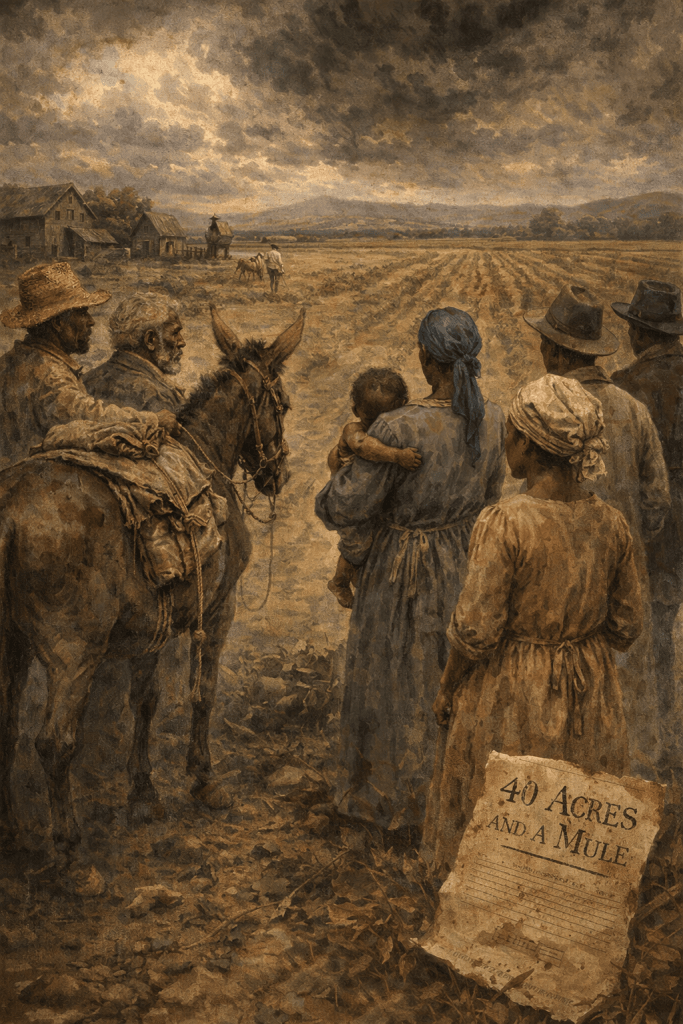
40 Acres and a Mule: The Promise That Was Never Kept.

The phrase “40 acres and a mule” has become one of the most powerful symbols of broken promises in American history, rooted in the aftermath of the American Civil War. It represents an unfulfilled commitment to provide formerly enslaved Black Americans with land and the means to sustain themselves economically.

The origin of this promise can be traced to January 1865, when Union General William Tecumseh Sherman issued Special Field Orders No. 15. This order set aside approximately 400,000 acres of confiscated Confederate land along the southeastern coast for settlement by freed Black families.

Under Sherman’s directive, each family was to receive up to 40 acres of land. Later, some were also given access to surplus army mules, leading to the enduring phrase “40 acres and a mule.” This initiative was seen as a foundational step toward economic independence.

The policy was implemented in areas of South Carolina, Georgia, and Florida, where thousands of formerly enslaved people began to establish communities. For many, this land represented not just property, but dignity, autonomy, and the fruit of generations of unpaid labor.

The idea of land redistribution was supported by leaders such as Thaddeus Stevens, who argued that true freedom required economic justice. Without land, formerly enslaved people would remain dependent on their former oppressors.

However, this promise was short-lived. Following the assassination of Abraham Lincoln in April 1865, his successor, Andrew Johnson, reversed many Reconstruction policies.

President Johnson issued proclamations that returned confiscated land to former Confederate landowners. As a result, thousands of Black families who had begun to build lives on this land were forcibly removed.

This reversal effectively nullified the promise of “40 acres and a mule.” Land that had been distributed to freedmen was taken back, often violently, leaving families dispossessed and vulnerable.

The failure to provide land had profound consequences. Without access to property, many Black Americans were pushed into sharecropping—a system that closely resembled slavery in its economic exploitation.

Sharecropping trapped families in cycles of debt and poverty. Landowners controlled the terms, often charging exorbitant fees for tools, seeds, and housing, ensuring that laborers remained financially dependent.

The denial of land ownership also prevented the accumulation of generational wealth. While white Americans were able to pass down land and assets, Black families were systematically excluded from these opportunities.

The concept of reparations is deeply tied to this history. Advocates argue that the promise of land was a form of restitution for centuries of slavery, and its revocation constitutes a debt still owed.

The economic disparity created by this broken promise is evident today. Scholars frequently link the racial wealth gap to the lack of land redistribution during Reconstruction.

The federal government’s failure to uphold its commitment undermined trust and reinforced systemic inequality. It demonstrated that legal freedom without economic support was insufficient.

In the 20th and 21st centuries, the call for reparations has gained renewed attention. Proposals include financial compensation, land grants, and institutional investments in Black communities.

Legislative efforts such as H.R. 40—named in reference to the original promise—seek to study and develop reparations proposals. The bill symbolizes a continued demand for accountability and justice.

Critics of reparations often argue against revisiting the past, but proponents emphasize that the effects of slavery and Reconstruction policies are still present in modern society.

The story of “40 acres and a mule” is not just historical—it is a living legacy that shapes economic realities today. It highlights the intersection of race, policy, and wealth in America.

Understanding this history is essential for addressing contemporary inequalities. It reveals how systemic decisions made over a century ago continue to impact generations.

The promise of land represented more than compensation—it was an opportunity for true independence. Its denial ensured that freedom would remain incomplete for millions.

Ultimately, “40 acres and a mule” stands as a reminder that justice delayed is justice denied. It calls for a reckoning with the past and a commitment to building a more equitable future.

References

Foner, E. (1988). Reconstruction: America’s Unfinished Revolution, 1863–1877. Harper & Row.

Gates, H. L. (2013). Life Upon These Shores: Looking at African American History, 1513–2008. Knopf.

Oubre, C. (1978). Forty Acres and a Mule: The Freedmen’s Bureau and Black Land Ownership. Louisiana State University Press.

Painter, N. I. (2007). Creating Black Americans: African-American History and Its Meanings, 1619 to the Present. Oxford University Press.

Williamson, J. (1995). After Slavery: The Negro in South Carolina During Reconstruction, 1861–1877. University of North Carolina Press.
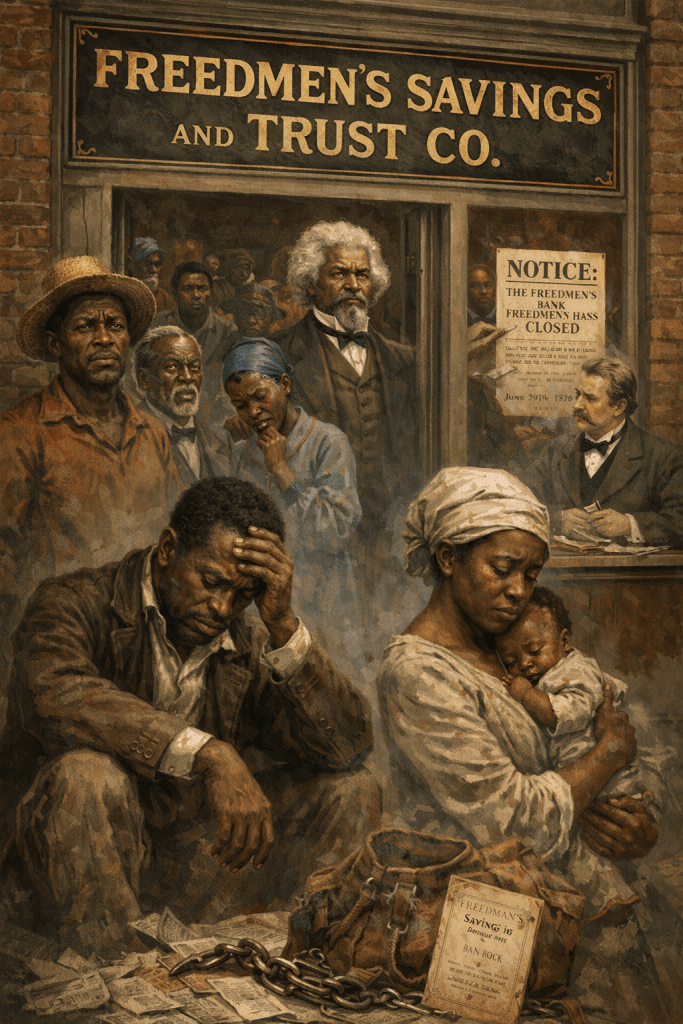
The Freedman’s Bank: A Broken Promise of Freedom.

The story of the Freedman’s Savings Bank is one of hope, betrayal, and systemic injustice. Established in the aftermath of the American Civil War, the bank was intended to provide newly freed Black Americans with a secure place to deposit their earnings and begin building generational wealth.

Founded in 1865, the Freedman’s Bank emerged during the Reconstruction Era, a time when millions of formerly enslaved people were navigating freedom for the first time. With little to no access to financial institutions, the bank appeared as a beacon of opportunity.

The bank was backed by the U.S. Congress, which gave it a sense of legitimacy and trustworthiness. Many Black Americans believed their money was protected by the federal government, though in reality, the institution operated privately without direct federal guarantees.

For formerly enslaved individuals who had labored for generations without wages, the ability to save money represented dignity, autonomy, and hope. Depositors included soldiers, laborers, domestic workers, and families striving for economic independence.

At its peak, the Freedman’s Bank had over 60,000 depositors and held millions of dollars in assets. Branches were established in major cities across the South, reflecting widespread trust among Black communities.

However, this trust would soon be shattered. The bank’s leadership—primarily white trustees—engaged in reckless and speculative investments, including risky railroad ventures and real estate schemes.

Instead of safeguarding deposits, bank officials used funds to finance high-risk projects, many of which failed. This mismanagement reflected not only poor financial judgment but also a disregard for the livelihoods of Black depositors.

One of the most notable figures associated with the bank was Frederick Douglass, who became its president in 1874. Douglass hoped to restore confidence and stabilize the institution, but by then, the damage was already irreversible.

Douglass himself later expressed regret, acknowledging that he had underestimated the extent of the corruption and mismanagement within the bank. His involvement, though well-intentioned, could not save it from collapse.

In 1874, less than a decade after its founding, the Freedman’s Bank failed. The collapse resulted in the loss of approximately $3 million—equivalent to tens of millions today—wiping out the savings of thousands of Black families.

For many depositors, this loss was devastating. These were not excess funds but life savings—money earned through hard labor in the fragile early years of freedom.

The failure of the bank exposed a harsh reality: Black Americans were systematically excluded from secure financial systems and left vulnerable to exploitation. The promise of economic empowerment had been betrayed.

The collapse also reinforced cycles of poverty within Black communities. Without access to capital, many families were unable to invest in land, education, or businesses—opportunities that could have altered generational trajectories.

The Freedman’s Bank is often cited as one of the earliest examples of institutional financial exploitation of Black Americans. It set a precedent for future injustices, including discriminatory lending practices and redlining.

The psychological impact of this betrayal cannot be overstated. Trust in financial institutions was deeply eroded, a sentiment that has echoed across generations.

This event also highlights the broader failures of Reconstruction. While legal freedom was granted, economic justice was largely denied, leaving Black Americans to navigate a system still rooted in inequality.

The Freedman’s Bank did not fail in isolation—it was part of a larger pattern of systemic neglect and exploitation. Its downfall symbolized the fragility of Black progress in a nation unwilling to fully honor its promises.

Despite this history, Black communities have continued to demonstrate resilience, creating alternative systems of support such as mutual aid societies, churches, and Black-owned banks.

Modern discussions about reparations and economic justice often reference the Freedman’s Bank as a foundational injustice. The loss of wealth during this period has had long-term implications for the racial wealth gap in America.

Understanding the history of the Freedman’s Bank is essential for recognizing how systemic inequities were built and maintained. It serves as both a warning and a call to address historical wrongs.

Ultimately, the “Free” Man’s Bank was free in name but costly in consequence. Its legacy reminds us that true freedom must include economic security, accountability, and justice.

References

Baradaran, M. (2017). The Color of Money: Black Banks and the Racial Wealth Gap. Harvard University Press.

Du Bois, W. E. B. (1907). Economic Co-operation Among Negro Americans. Atlanta University Press.

Osthaus, C. (1976). Freedmen, philanthropy, and fraud: A history of the Freedman’s Savings Bank. Journal of Southern History, 42(1), 1–26.

Savage, B. (1999). Standing Soldiers, Kneeling Slaves: Race, War, and Monument in Nineteenth-Century America. Princeton University Press.

Sherraden, M. (1991). Assets and the Poor: A New American Welfare Policy. M.E. Sharpe.